The British Mini Nuclear Fusion Reactor That Actually Works
The title of this post, is the same as that as this article in The Times.
This is the sub-heading.
The only functional model in the world is so small it fits on a table and is set to help diagnose and cure cancer
These are the first two paragraphs, which add more details.
There are a few things that mark this nuclear fusion reactor out as unusual. For one, it is rather small: it could fit on a table top. For another, this research model currently has a little more gaffer tape than you might expect of the energy technology of the future.
But the biggest difference between it and its competitors is that this nuclear fusion reactor, in a warehouse north of Bristol, is actually working. And it is on the cusp of doing something more unusual still: making money.
It almost makes you think, that it should be filed under Too Good To Be True!
In the late 1960s, I shared an office at ICI Mond Division in Runcorn, with a guy, who was working on a process to make acetylene by a revolutionary route.
The process never worked, but now it has turned up being used by a company called HiiROC to make hydrogen.
They are also backed by some big names like Centrica, Hyundai, Kia and others.
I wonder how many other old ideas are finally ripe for developing, due to improvements in manufacturing and systems to control them.
Underground Hydrogen Storage Pilot Gets Funding Boost
The title of this post is the same as that of this article on Energy Live News.
This is the sub-heading.
New hydrogen storage tech could boost grid resilience and emissions cuts
These first three paragraphs add some details.
National Gas and Gravitricity have secured £500,000 from Ofgem to develop a new type of underground hydrogen storage.
The H2FlexiStore system, designed by Edinburgh-based energy storage firm Gravitricity, aims to store up to 100 tonnes of green hydrogen in lined geological shafts.
The technology, which could see a demonstrator built in 2026, is intended to offer a flexible, resilient solution to future hydrogen network needs.
The article also has an excellent graphic.
Note that it takes 55.2 MWh of electricity to generate a tonne of hydrogen, so a hundred tonnes of hydrogen would store 5.52 GWh of electricity as hydrogen.
Centrica And Equinor Agree Major New Deal To Bolster UK Energy Security
The title of this post, is the same as that as this news item from Centrica.
This is the sub-heading.
Centrica and Equinor have today announced a £20 billion plus agreement to deliver gas to the UK. The new deal will see Centrica take delivery of five billion cubic meters (bcm) of gas per year to 2035.
These three paragraphs add more detail to the deal.
The expansive ten-year deal continues a long-term relationship with Equinor that dates back to 2005 bringing gas from Norway to the UK.
In 2024, the UK imported almost two-thirds (66.2%) of its gas demand, with 50.2% of the total imports coming from Norway1. This is an increase from the UK importing around a third of its gas requirements from Norway in 20222 and underlines the strategic importance of the Norwegian relationship to UK energy and price security.
The contract also allows for natural gas sales to be replaced with hydrogen in the future, providing further support to the UK’s hydrogen economy.
I believe there is more to this deal than, is stated in the news item.
These are my thoughts.
Where Does AquaVentus Fit In?
The AquaVentus web site has a sub heading of Hydrogen Production In The North Sea.
This video on the web site shows the structure of the project.
I clipped this map from the video.

Note.
- The thick white line running North-West/South-East is the spine of AquaVentus, that will deliver hydrogen to Germany.
- There is a link to Esbjerg in Denmark, that is marked DK.
- There appears to be an undeveloped link to Norway, which goes North,
- There appears to be an undeveloped link to Peterhead in Scotland, that is marked UK.
- There appears to be a link to just North of the Humber in England, that is marked UK.
- There appears to be an extra link, that would create a hydrogen link between Norway and Humberside.
- Just North of the Humber are the two massive gas storage sites of Aldbrough owned by SSE and Brough owned by Centrica.
- Aldbrough and Rough gas storage sites are being converted into two of the largest hydrogen storage sites in the world!
- There appear to be small ships sailing up and down the East Coast of the UK. Are these small coastal tankers, that are distributing the hydrogen to where it is needed?
When it is completed, AquaVentus will be a very comprehensive hydrogen network.
RWE
I should add that AquaVentus is a project of German energy company; RWE.
It should be noted that RWE are the largest generator of electricity in the UK.
They will soon be even larger as they are developing these offshore wind farms in British waters.
- Dogger Bank South – 3 GW
- Norfolk Boreas – 1.4 GW
- Norfolk Vanguard East – 1.4 GW
- Norfolk Vanguard West – 1.4 GW
Note.
- This is 7.2 GW of electricity.
- The three Norfolk wind farms wwere possibly acquired at a bargain price from Vattenfall.
- None of these wind farms have Contracts for Difference.
- RWE are developing large offshore electrolysers.
- East Anglia is in revolt over pylons marching across the landscape.
I wonder, if RWE will convert the electricity to hydrogen and bring it ashore using AquaVentus, coastal tankers or pipelines to existing gas terminals like Bacton.
The revenue from all this hydrogen going to Germany could explain the rise in Government spending, as it could be a Magic Money Tree like no other.
HiiROC
HiiROC is a Hull-based start-up company backed by Centrica, that can turn any hydrocarbon gas, like chemical plant waste gas, biomethane or natural gas into turquoise hydrogen and carbon black.
I asked Google about the size of Norway’s chemical industry and got this reply.
Norway’s chemical industry, including oil refining and pharmaceuticals, is a significant part of the country’s economy. In 2023, this sector generated sales of NOK 175 billion (approximately €15.2 billion), with 83% of those sales being exports. The industry employed 13,800 full-time equivalents and added NOK 454 billion (approximately €3.9 billion) in value.
Isn’t AI wonderful!
So will Norway use HiiROC or something similar to convert their natural gas and chemical off-gas into valuable hydrogen?
If AquaVentus were to be extended to Norway, then the hydrogen could be sold to both the UK and Germany.
A scenario like this would explain the option to switch to hydrogen in the contract.
Aldbrough And Brough
Earlier, I said that just North of the Humber are the two massive gas storage sites of Aldbrough owned by SSE and Brough owned by Centrica.
I have read somewhere, that Germany is short of hydrogen storage, but I’m sure Centrica and SSE will help them out for a suitable fee. Centrica are also thought to be experts at buying energy at one price and selling it later at a profit.
Conclusion
I have felt for some time, that selling hydrogen to the Germans was going to be the Conservative government’s Magic Money Tree.
Has this Labour government decided to bring it back to life?
Direct Rail Service Plan Supported By PM
The title of this post, is the same as that of this article on the BBC.
This is the sub-heading.
Plans for a new passenger rail service running direct trains between north Wales, the West Midlands and London have received support from the prime minister.
These three paragraphs add detail to the story.
A new open-access rail operator, external, called the Wrexham, Shropshire and Midlands Railway (WSMR), has been formed, offering passengers in Wrexham, as well as Gobowen, Shrewsbury, Walsall and Coleshill, a direct link with the capital.
Speaking in the Commons, Shrewsbury’s Labour MP Julia Buckley asked Sir Keir Starmer if he would support the provider’s application.
The prime minister responded, saying he would be “delighted to make sure the MP and other interested MPs meet with the rail minister to put their case forward”.
He didn’t actually say he supported the application, but then lawyers are careful with words, as every syllable costs money.
I have a few thoughts on this service.
The North Wales Metro
The North Wales Metro was announced today and I wrote about it in £2.1bn North Wales Rail Overhaul Plans Unveiled.
The Wrexham, Shropshire and Midlands Railway connects the North Wales Metro to Gobowen, Shrewsbury, Wolverhampton, Coleshill and London Euston.
Will The Trains Be Hydrogen Powered
In Alstom And Eversholt Rail Sign An Agreement For The UK’s First Ever Brand-New Hydrogen Train Fleet, I reported how Alstom could be going to build a fleet of hydrogen trains in Derby.
I just wonder, if Alstom are going to create a hydrogen train with this specification.
- Five cars
- 125 mph top speed
- Ability to use electrification, where it exists.
- Sufficient range on hydrogen to cover the non-electrified section of the route between Wrexham General and Wolverhampton.
- Wrexham General and Wolverhampton is just under sixty miles and takes an hour and six minutes.
As the fastest trains between London Euston and Walverhampton take one hour and forty-nine minutes, trains would take just under three hours between London Euston and Wrexham General.
I rode an Alstom hydrogen-powered train in Germany in March 2019 and wrote My First Ride In An Alstom Coradia iLint.
I took this picture at the time.

Alstom certainly have all the technology to build a 125 mph hydrogen-powered train, that can use electrification.
Where Would A Hydrogen Train Be Refuelled?
I suspect, that as the train would probably have a range of around a thousand kilometres, it could fill up overnight at Wrexham.
The hydrogen could be sourced from Runcorn or it might even be generated at the depot.
Would A Hydrogen Train Attract Passengers?
If the hydrogen-powered train were to be mouse-quiet like Wrightbus’s hydrogen buses, I believe it would.
Would A Train Manufacturer Save CrossCountry’s Iconic Aberdeen And Penzance Route?
The article in The Times about the cancelling of CrossCountry’s iconic Aberdeen and Penzance route was entitled After 104 Years UK’s Longest Train Route Is Cancelled For Ever, I gave my post the same name and both received a number of nostalgic comments, from those, who had ridden the route or wished they had.
The Characteristics Of The Line
This article on the BBC is entitled We Had To Be On Last Run Of UK’s Longest Train Route.
This is said in the BBC article.
The connection – first established back in 1921 – is 775 miles (1,247km) long.
But electrification is rather thin on the ground.
Between Leeds and Edinburgh stations is electrified and I suspect that some of the route through Birmingham New Street and Bristol Parkway stations are also electrified, so perhaps, a battery-electric train could get a top-up on the way.
But as Leeds and Edinburgh is around 220 miles, there’s about 550 miles of the route or 70 % without electrification.
Battery Power, Hydrogen Power Or Both?
If diesel is ruled out on environmental grounds, it means that only battery or hydrogen power could be used for the route.
Despite some of the progress made by battery-electric trains in the last few years, I feel that unless the route has a large number of charging stations, then battery-electric trains will not be a practical solution.
This is a paragraph from The Times article.
Rail bosses said one of the reasons for ending the train was the difficulty keeping such a long journey on time. The fact that most customers made only short journeys along the route was also a consideration.
And this is another.
As an “express” service it was severely challenged, partly because of the long waits at a number of stations along the way, including 14 minutes at both Edinburgh Waverley and Bristol Temple Meads, and seven minutes at Birmingham New Street and Exeter St Davids.
Stopping regularly to charge the batteries, is going to make timekeeping more difficult and will probably end up with irritable passengers, after all the waiting.
So I suspect, hydrogen would be the ideal power for such a long service over a route with such sparse electrification.
But the trains, would be fitted with regenerative breaking to battery, so that kinetic energy is conserved as much as possible in the station stops.
I believe, that the trains should effectively be tri-mode or hydrogen-hybrid trains, but then many drivers praise the frugality of their hybrid cars.
Would Efficient Hydrogen-Hybrid Trains Attract More Passengers?
Consider.
- All the battery and hydrogen trains and buses, with one exception, that I have ridden on, have been mouse-quiet.
- The exception was a German hydrogen train, that had a very noisy mechanical transmission.
- I also would expect that the trains would be capable of keeping up a cruising speed of 100 mph or perhaps even 125 mph.
- This would enable them to handle the current timetable, which is written for 125 mph Class 222 diesel trains.
An efficient, unobtrusive, reliable and speedy service would surely attract passengers.
What’s In It For The Manufacturer?
Consider.
- There are not many 775 mile routes in the UK.
- But, there are many long rail around the world, that need decarbonising or even creating.
- Some countries, like China, India and France are creating more electrified high speed long-distance lines.
- Others countries, like Australia and the United States are planning and building high speed long-distance lines.
Perhaps, what is needed is a drop-in solution to decarbonise and/or create new high speed long-distance railways.
Could Aberdeen and Penzance be an ideal test bed to trial and demonstrate, your drop-in hydrogen solution?
I am reminded of a story, told to me, by a guy, who was selling an expensive air traffic control radar to an Arab state.
The initial presentations were done in the company’s offices in London.
The only working radar was installed at Prestwick Airport and had been working successfully for a couple of years, so the Arabs would be taken on a visit.
As they were very important clients, the salesman was told, that he was entitled to borrow the chairman’s executive jet for the trip.
The flight to Scotland was uneventful, but as they left the plane, the pilot said to the salesman. “There’s no finer view, than the Scottish Highlands at this time of year, I could fix it, that I gave them the view of a lifetime on the way home.”
After thinking about it for a few seconds, the salesman asked the pilot to fix it.
When they returned to the plane after a successful demonstration, the pilot said. “It’s on if you want it?”
The tale had a very happy ending, in that the Arabs bought an Air Traffic Control radar.
To return to the hydrogen trains; What better route is there to show off the capabilities of your high speed hydrogen-hybrid trains?
- There is the spectacular scenery of the North of Scotland, The Pennines and Cornwall.
- The Firth of Forth is crossed on the Forth Rail Bridge.
- There is running on the wires between Edinburgh and Leeds.
- There is the spectacular views of Durham and York from the train.
- There will be several hours of running on hydrogen.
- The Saltash Bridge is crossed.
What better route is there to sell trains?
Could CrossCountry Customer Service Be Improved?
I’ve never done a long journey on CrossCountry.
But surely, if the trains were designed for the route and the manufacturer was showing them off, the trains could have a top-of-the-range specification and high-quality service?
If you’re going to be stuck on a train for over a dozen hours the service must be good.
Conclusion
Get everything right and the train service would be an unquestionable asset to the UK and extremely good for the manufacturer.
South Korea Aims To Lead The Global Market With Hydrogen Train
The title of this post, is the same as that of this article on Railly News.
These are the first two introductory paragraphs.
South Korea is taking an ambitious step with a vision of becoming a major player in the rapidly growing global hydrogen rail market. To 26,4 billion dollars The country that wants to gain a competitive advantage in this market that is expected to reach A self-developed Hydrogen Train by 2028 announced plans to introduce.
This strategic project is the national railway operator of South Korea korail will be managed by Korail, Building a two-car hydrogen train prototype by 2027 and creating the necessary legal and operational infrastructure for the dissemination of this technology. $23 million will make an investment. South Korean officials also clearly state that they aim to set international standards in the field of hydrogen-based mobility with this project.
I’ve thought for some time, that the Koreans have been serious about hydrogen-powered transport, as Hyundai keeps popping up with hydrogen transport and other ideas.
British company; Centrica owns a big share with Hyundai, Kia and others of a British start-up company from Hull, called HiiROC.
This is the HiiROC web site.
HiiROC can take any hydocarbon gas and split it into green hydrogen and carbon black.
Green hydrogen is obviously useful and the carbon black can be used for making tyres for vehicles, anodes for lithium-ion batteries and in agriculture for soil improvement.
Waste off-gas from a chemical plant can be split into green hydrogen and carbon black.
Biomethane from a sewage plant can be split into hydrogen and carbon black. Could a sewage plant on an estate be used to create biomethane for cooking and feeding to the HiiROC plant? Yes!
Could green hydrogen produced on the estate be used to drive vehicles like cars, vans and ride-on-mowers. Yes! If the manufacturer of the vehicle allows it!
How convenient would it be to have Hydrogen-at-Home?
The Korean investment in HiiROC by Hyundai and Kia clearly fits with the philosophy expressed in the second paragraph of the article of creating the hydrogen infrastructure.
I believe that at some point in the future, you will be able to buy a HiiROC device, that gives you as much hydrogen as you need to power your car, truck, bus, tram or train. The Koreans have a track record of turning ideas like this into reality.
JCB Hydrogen Excavators Approved For UK Roads
The title of this post, is the same as that of this article on Construction Kenya.
This is the sub-heading.
The government’s move supports the UK’s broader net-zero goals.
These are the first two paragraphs.
JCB has celebrated a landmark decision by the UK government allowing hydrogen-powered construction and agricultural machinery on public roads, effective from April 29.
This change enables hydrogen-fuelled diggers, tractors, and other machinery to operate between sites and farms, reducing carbon emissions in two highly polluting industries.
JCB celebrated by driving a hydrogen-powered excavator through London to meet the Minister.
I would have thought that this event would have had more coverage in the news.
But then hydrogen is a taboo subject to many politicians and the media, as the Hindenburg got the anti-hydrogen publicity right.
Does Your Car Have A Large Capacity, Dash Mounted Refrigerator?
I suspect not, but Wrightbus’s new Contour Coach will have one for the driver and the lucky soul, who sits in the other front seat.
Wrightbus have now put the specification of the Contour coach on a page that is entitled Experience The Contour Difference.
This is the introduction.
Introducing the Wright Contour Diesel Coach, where luxury, innovation, and performance come together. Since 1946, Wright has been at the forefront of transportation innovation, shaping the future with its unwavering commitment to excellence. Today, as UK’s No.1 zero-emission bus manufacturer and one of Europe’s fastest growing brands, Wright is making a bold return to the luxury coach market with the all-new Contour Diesel Coach (available in UK and Europe). In the 1980s, Wright revolutionised the luxury coach industry with its innovative, high-end Contour models, setting new standards in design and comfort. On 5th March 2025, Wright makes a bold return to the coach market with the all-new Contour Diesel Coach, redefining performance, style, and efficiency, offering spacious interiors, advanced safety features, and a high-performance Cummins X11 Euro 6 engine delivering 400hp. With competitive pricing, reduced lead times, and full service support to ‘complete Vehicle OEM and operator support’ from Wright’s All Service One Network, the Contour is built to exceed expectations. Plus, with a 2-year or 200,000km warranty backed fully by Wright, it ensures reliability and peace of mind.
I asked Google AI if the Cummins X11 engine can be converted to hydrogen and was told this.
Yes, while not inherently designed for hydrogen from the factory, the Cummins X11 engine, like many Cummins diesel engines, can be converted to run on hydrogen fuel. This involves modifications, including changing the cylinder head and fuel system.
As I discussed in Wrightbus StreetDeck Ultroliner Next-Gen To Get Cummins Power, it appears Wrightbus are going the Cummins route, to open up the possibility of converting the vehicles to hydrogen at some point in the future.
Cummins have certainly seen a green vision. on the Road to Net Zero, which seems to go via their Darlington factory.
The coach specification includes.
- Premium reclining seats for all passengers.
- Adjustable armrests, and USB ports at every seat.
- Safety features like 3-point seat belts and ‘buckle up’ alerts.
- Powered doors to the lockers underneath.
- Reversing and rear-door cameras.
Wrightbus are also promising reduced lead times, which in my experience as a part-owner of a leasing company, that financed a large number of coaches, is very much to be welcomed.
Hydrogen Fuel Cell-Powered Coaches
Two trips convinced me, that hydrogen fuel cell coaches are the way to go.
In Riding Rail Air Between Reading Station And Heathrow Terminal 5, I did what it says in the title.
I was very disappointed.
The coach may have been a nearly-new top-of-the-range model, but my journey was to the accompanying thump-thump-thump of the diesel engine. There were also no USB ports, which these days many British Rail-era trains are sporting.
In Sutton Station To Gatwick Airport By Hydrogen-Powered Bus, I also did what it said in the title.
I was very impressed and it convinced me that hydrogen fuel cell-powered coaches could be an interesting proposition.
The power unit was mouse-quiet and the bus had more than adequate performance for the route, through the Surrey Hills.
It would be a very fruitful experiment, if say a twenty-mile route to say an airport, that is currently run by a traditional diesel coach, were to be replaced by a hydrogen fuel cell-powered bus, with a more luggage-friendly interior.
- Would passenger numbers increase?
- Would the number of airport workers using the service increase?
I believe that in a few years diesel coaches will be filed under Betamax.
Is There A Market For A Wrightbus Hydroliner FCEV-based Hybrid Coach?
A few years ago, there was a plan, to improve public transport to Heathrow, that would have seen the Elizabeth Line to Terminal 5 extended to Staines. I went to Staines and discussed this with one of the staff at the station.
He was all for this, as it would have given staff at the airport and in the airlines, an easy route to and from work, which would mean, they didn’t have to pay to take their car, especially, when they were working difficult shifts.
A Wrightbus Hydroliner FCEV, with a hybrid interior geared to both passengers with heavy luggage and passengers and airport and airline workers with just a carry-on size bag, might appeal to some operators.
Especially for some of the night bus routes operating to Heathrow.
Ørsted Pulls Plug On 2.4 GW Hornsea 4 Offshore Wind Project In UK
The title of this post, is the same as that of this article on offshoreWIND.biz.
This is the sub-heading.
Ørsted has discontinued the development of the UK’s Hornsea 4 offshore wind farm in its current form. The developer said the 2.4 GW project has faced rising supply chain costs, higher interest rates, and increased construction and delivery risks since the Contract for Difference (CfD) award in Allocation Round 6 (AR6) in September 2024.
This introductory paragraph adds more detail.
In combination, these developments have increased the execution risk and deteriorated the value creation of the project, which led to Ørsted stopping further spending on the project at this time and terminating the project’s supply chain contracts, according to the Danish company. This means that the firm will not deliver Hornsea 4 under the CfD awarded in AR6.
Consider.
- Hornsea 4 will be connected to the grid at a new Wanless Beck substation, which will also include a battery and solar farm, which will be South West of the current Creyke Beck substation. Are Ørsted frightened of opposition from the Nimbies to their plans?
- I also wonder if political uncertainty in the UK, and the possibility of a Reform UK government, led by Nigel Farage is worrying companies like Ørsted.
So will factors like these prompt companies like Ørsted to move investment to countries, where they welcome wind turbines like Denmark, Germany and The Netherlands.
Could Ørsted Be Looking At An Alternative?
This is a map of wind farms in the North Sea in the Dogger Bank and Hornsea wind farms, that I clipped from Wikipedia..
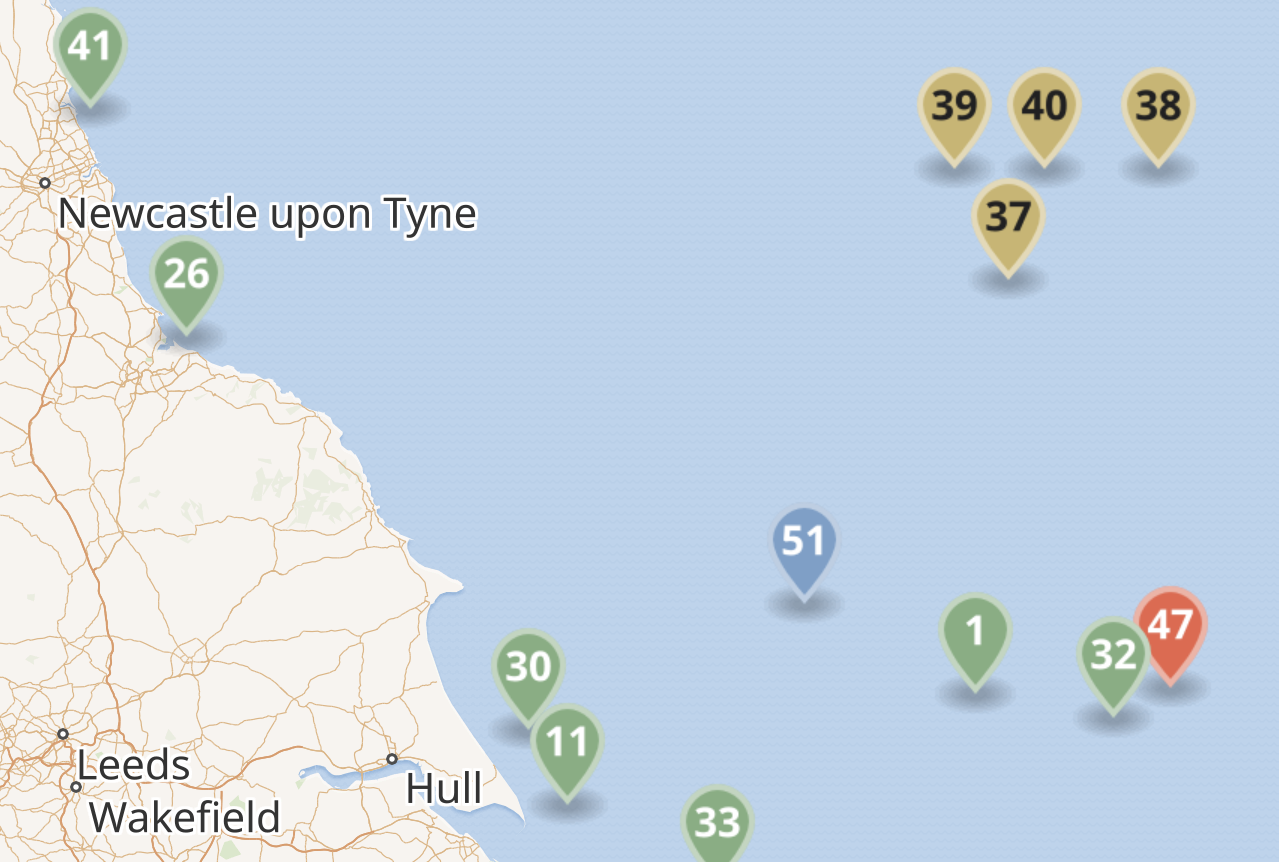
These are the Dogger Bank and Hornsea wind farms and their developers and size
- 37 – Dogger Bank A – SSE Renewables/Equinor – 1,235 MW
- 39 – Dogger Bank B – SSE Renewables/Equinor – 1,235 MW
- 38 – Dogger Bank C – SSE Renewables/Equinor – 1,218 MW
- 40 – Sofia – RWE – 1,400 MW
- 1 – Hornsea 1 – Ørsted/Global Infrstructure Partners – 1,218 MW
- 32 – Hornsea 2 – Ørsted/Global Infrstructure Partners – 1,386 MW
- 47 – Hornsea 3 – Ørsted – 2,852 MW
- 51 – Hornsea 4 – Ørsted – 2,400 MW
Note.
- That is a total of 12, 944 MW, which is probably enough electricity to power all of England and a large part of Wales.
- Wikipedia’s List of offshore wind farms in the United Kingdom, also lists a 3,000 MW wind farm, that is being developed by German company ; RWE called Dogger Bank South,
- The Dogger Bank South wind farm is not shown on the map, but would surely be South of wind farms 37 to 40 and East of 51.
- The Dogger Bank South wind farm will raise the total of electricity in the Dogger Bank and Hornsea wind farms to just short of 16 GW.
Connecting 16 GW of new electricity into the grid, carrying it away to where it is needed and backing it up, so that power is provided, when the wind doesn’t blow, will not be a nightmare, it will be impossible.
An alternative plan is needed!
AquaVentus To The Rescue!
AquaVentus is a German plan to bring 10 GW of green hydrogen to the German mainland from the North Sea, so they can decarbonise German industry and retire their coal-fired power stations.
- I introduce AquaVentus in AquaVentus, which I suggest you read.
- AquaVentus is being developed by RWE.
- AquaVentus connects to a German hydrogen network called H2ercules to actually distribute the hydrogen.
This video shows the structure of AquaVentus.
I clipped this map from the video.
Note.
- The thick white line running North-West/South-East is the spine of AquaVentus, that will deliver hydrogen to Germany.
- There is a link to Esbjerg in Denmark, that is marked DK.
- There appears to be an undeveloped link to Norway, which goes North,
- There appears to be an undeveloped link to Peterhead in Scotland, that is marked UK.
- There appears to be a link to just North of the Humber in England, that is marked UK.
- Just North of the Humber are the two massive gas storage sites of Aldbrough owned by SSE and Brough owned by Centrica.
- Aldbrough and Rough gas storage sites are being converted into two of the largest hydrogen storage sites in the world!
- There appear to be small ships sailing up and down the East Coast of the UK. Are these small coastal tankers, that are distributing the hydrogen to where it is needed?
When it is completed, AquaVentus will be a very comprehensive hydrogen network.
I believe that offshore electrolysers could be built in the area of the Hornsea 4 and Dogger Bank South wind farms and the hydrogen generated would be taken by AquaVentus to either Germany or the UK.
- Both countries get the hydrogen they need.
- Excess hydrogen would be stored in Aldbrough and Rough.
- British Steel gets decarbonised.
- A 1.8 GW hydrogen-fired powerstation at Keadby gets the hydrogen it needs to backup the wind farms.
Germany and the UK get security in the supply of hydrogen.
These may be my best guesses, but they are based on published plans.
 The Anonymous Widower