Saudi Arabia Railways (SAR) Partners With Alstom To Showcase The World’s First Passenger Hydrogen Train In The Kingdom Of Saudi Arabia
The title of this post, is the same as that as this press release from Alstom.
These are the three bullet points.
-
World’s first hydrogen-powered train demo in the Middle East and Africa
-
Alstom’s Coradia iLint train will be used for the demo in the Kingdom
-
Saudi Arabia Railways (SAR) and Alstom highlight their commitment to sustainable mobility and carbon emission reduction in the Kingdom
These are the first two paragraphs.
Saudi Arabia Railways (SAR), in partnership with Alstom, a global leader in smart and sustainable mobility, will operate and demonstrate the world’s first passenger hydrogen-powered train, the Coradia iLint in Riyadh in the month of October. This ground-breaking demonstration marks the first-ever introduction of a hydrogen-powered train in the Middle East and Africa. The collaboration between SAR and Alstom signifies a strong focus by the Kingdom to identify and test innovative sustainable mobility solutions to reduce carbon emissions from transport and meet Vision 2030 targets set by the Kingdom’s leadership.
The planned demonstration follows the memorandum of understanding signed by SAR and Alstom in September 2022 to develop or adapt hydrogen solutions for the needs of the Kingdom. Alstom’s Coradia iLint, a hydrogen-powered passenger train will embark on a first-of-its-kind journey in the Kingdom, travelling 10 to 20 kilometres on Riyadh’s East Network’s Line 1 or Line 2.
Note.
- Hopefully, this is not just green-washing?
- Will the train be powered by green hydrogen?
At least, Alstom will get their trains tested in an atmosphere full of sand.
Offshore Wind Supply Chain Could Boost UK Economy By GBP 92 Billion Before 2040
The title of this post, is the same as that of this article on offshoreWIND.biz.
This is the sub-heading.
Growing the UK’s supply chain for offshore wind represents a GBP 92 billion (approximately EUR 106 billion) opportunity to boost the UK’s economy by 2040, according to a report by the Offshore Wind Industry Council (OWIC) and the Offshore Wind Growth Partnership (OWGP).
These are the first two paragraphs.
The report, titled “Supply Chain Capability Analysis”, outlines key measures that industry and government can take to strengthen the UK’s offshore wind supply chain, according to OWIC.
The UK has the world’s second-largest installed offshore wind capacity, with a government target to more than triple this capacity by 2030 to 50 GW, including 5 GW of floating offshore wind.
It should be remembered that George Soros is only worth around $6.7 billion according to his Wikipedia entry, although he has donated $32 billion to charity.
High Speed Two To Blackpool
There has been a lot of speculation about the Northern end of High Speed Two, so I might as well add sort out a few facts and add a bit of speculation of my own.
The Current Blackpool Service
I shall look at the 05:35 train on the 5th October 2023.
- It was a pair of Voyagers or Class 221 trains.
- Euston and Blackpool North are 226.5 miles apart.
- The train called at Preston, Wigan North Western, Warrington Bank Quay, Crewe and Stafford
- The train should have arrived at Preston at 05:56 and left at 0600.
- The train should have arrived at Wigan North Western at 06:11 and left at 06:12.
- The train should have arrived at Warrington Bank Quay at 06:22 and left at 06:24.
- The train should have arrived at Crewe at 06:46 and left at 06:55.
- The train should have arrived at Stafford at 07:13 and left at 07:14.
- The train should have arrived at London Euston at 08:35
- The journey took three hours.
- The average speed was 75.5 mph.
- The Crewe and Blackpool North section is 68.5 miles and the train is scheduled to take one hour and eleven minutes.
- The average speed between Crewe and Blackpool North is 57.9 mph.
- There are three trains per day (tpd).
Note.
- Other services between London Euston and Blackpool North are run by eleven-car Class 390 trains or Pendolinos.
- Blackpool North is fully electrified to London.
This means that London Euston and Blackpool North could be run using High Speed Two Classic-Compatible trains.
I have a few questions.
What Time Would Be Possible At The Present Time?
Consider.
- According to the Wikipedia entry for High Speed Two, one hour and seventeen minutes is the fastest time between London Euston and Stafford.
- The 05:35 is timed to take one hour and thirteen minutes with the four stops, between Blackpool North and Stafford.
This would give a London Euston and Blackpool North time of two hours and thirty minutes.
What Time Would Be Possible When High Speed Two Lite Opens To Handsacre Junction?
Consider.
- According to the Wikipedia entry for High Speed Two, fifty-five minutes will be the fastest time between London Euston and Stafford, after High Speed Two opens to Handsacre junction.
- The 05:35 is timed to take one hour and thirteen minutes with the four stops, between Blackpool North and Stafford.
This would give a London Euston and Blackpool North time of two hours and eight minutes.
What Frequency Would Be Needed?
LNER seem to run their secondary services to places like Harrogate and Lincoln using a frequency of one train per two hours (tp2h).
That could be an ideal frequency.
Would There Be A Path For The Train To And From London Euston?
This graphic shows High Speed Two services after Phase 2b is completed.
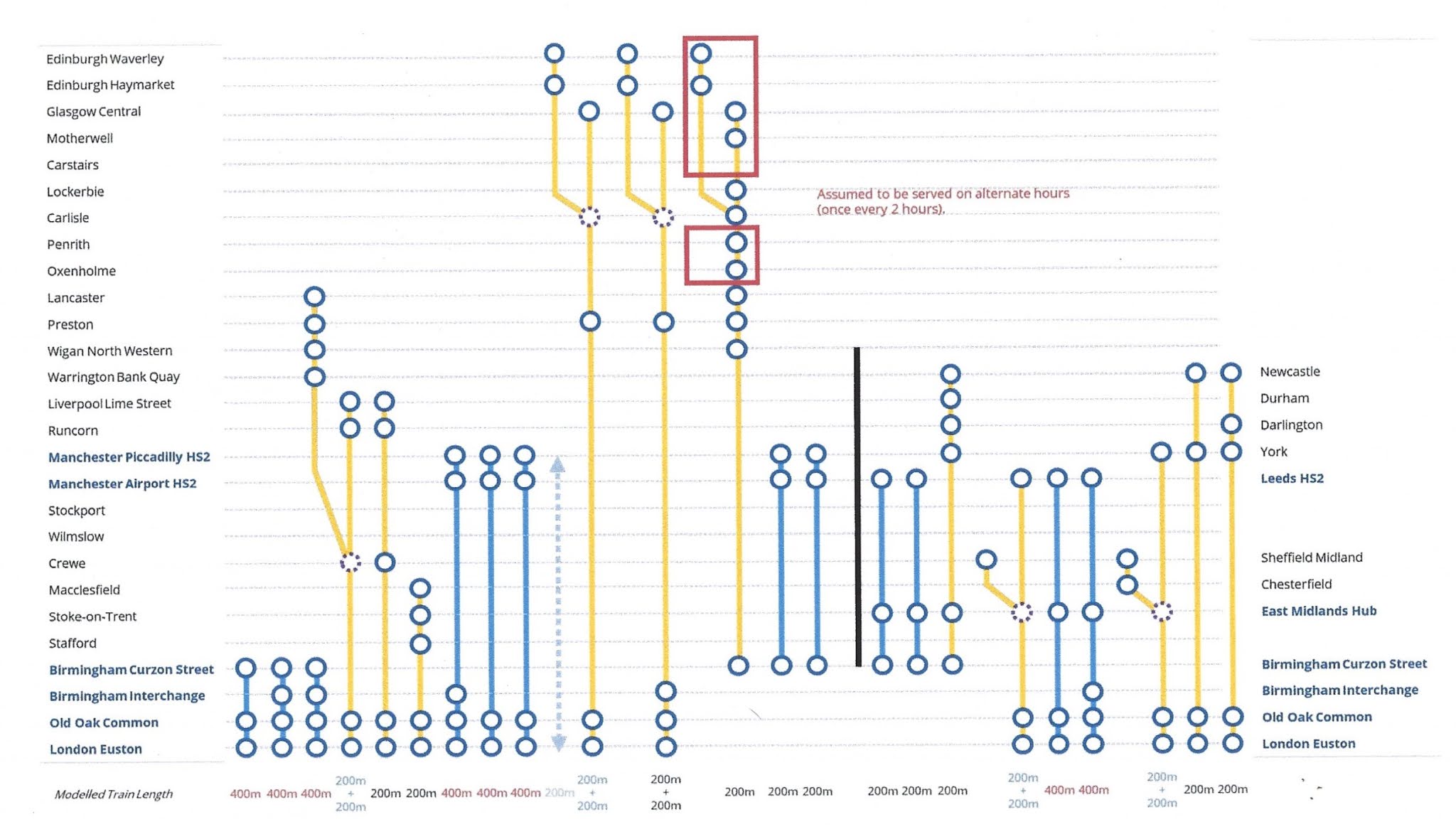
Note.
- Services shown in blue are run by High Speed Two Full Size trains.
- Services shown in yellow are run by High Speed Two Classic-Compatible trains.
- Each of these trains will have a frequency of one tph.
- The nine paths to the right of the vertical black line will not be needed for some time. If ever!
- It looks like a maximum of only eleven paths will be needed to the South of Birmingham.
- It looks like a maximum of only fourteen paths will be needed to the North of Birmingham.
In Will High Speed Two Lite Make Stafford An Important Station?, I totted up all the services through Stafford after High Speed Two Lite opened to Handsacre junction and got these figures.
- Through Stafford station, there are totals of 11 tpd and 14 tph.
- Along the Trent Valley Line, there are totals of 11 tpd and 12 tph.
- North of Stafford on the West Coast Main Line, there are totals of 9 tpd and 12 tph.
- South of Stafford on the West Coast Main Line, there are totals of 2 tpd and 2 tph.
- Between Stafford and Stoke-on-Trent, there are totals of 2 tph.
I accounted for services moving from the West Coast Main Line to High Speed Two.
Consider.
- A large proportion of the route between Preston and Handsacre junction, where the route would join High Speed Two Light has two dedicated high speed tracks and two tracks for freight and local services.
- Digital signalling on High Speed Two has been designed to handle eighteen trains per hour (tph) at 225 mph.
- Surely, the two dedicated high speed tracks, if fitted with High Speed Two digital signalling could handle say 16 tph at 140 mph.
- Network Rail are good at juggling trains to squeeze in more services.
- Extra paths could be created by splitting and joining trains at Crewe or Preston.
My Control Engineering training and practice tells me that it should be possible to add perhaps two tph between Preston and Euston.
Conclusion
I believe that High Speed Two Classic-Compatible trains could be close to two hours between Blackpool and London Euston, when High Speed Two Lite opens from Handsacre junction.
Here We Go Again!
Years ago, I had a very interesting insight into the problems of Israel and the Palestinians.
My next door neighbour; Charles was a retired senior officer in the Royal Engineers, who was in the King David Hotel, when it was blown up by the Irgun.
The hotel was used by the British to administer the Palestinian Mandate. The story of the King David Hotel Bombing has this Wikipedia entry, which is well worth a read.
Charles and his wife had also lived in Palestine before the Second World War and described it as a much more peaceful place, where the only way to tell if anybody was Jew or Arab was from their surname. He felt that they got on well, until it was all stirred up by the right-wing Zionists.
One of my big regrets in life, is that I didn’t interview my neighbour more deeply, as he had fascinating tales to tell.
Was This An Austin 16?
I spotted this car on Moorgate.





It’s not often you see pre-war Austins, these days.
A Design Crime – Marks And Spencer’s New Paper Carrier Bag
This article on the BBC is entitled Marks & Spencer Scraps Plastic For Paper Bags.
This is the sub-heading.
Marks & Spencer is swapping plastic carrier bags for paper ones in all stores, in an expansion of a trial that began in 10 branches in January.
These two paragraphs give a few reasons.
It follows other High Street stores in swapping plastic bags to paper in a bid to cut plastics use.
Supermarkets Morrisons, Waitrose and Aldi all use paper bags for customers, though some stores offer plastic bags as an option.
But the proof of the bag is in the using.
This picture shows the new bag.

It’s main problem is unlike the plastic bags, it is a nightmare to fold.
I could also fold the plastic bags, so they went in the pocket of my Barbour jacket.
I have searched my house for some of the green plastic bags to use in the future.
Conclusion
Three out of ten!
Collecting National Rail Tickets
I took this picture at the Elizabeth Line entrance at Tottenham Court Road station this morning.
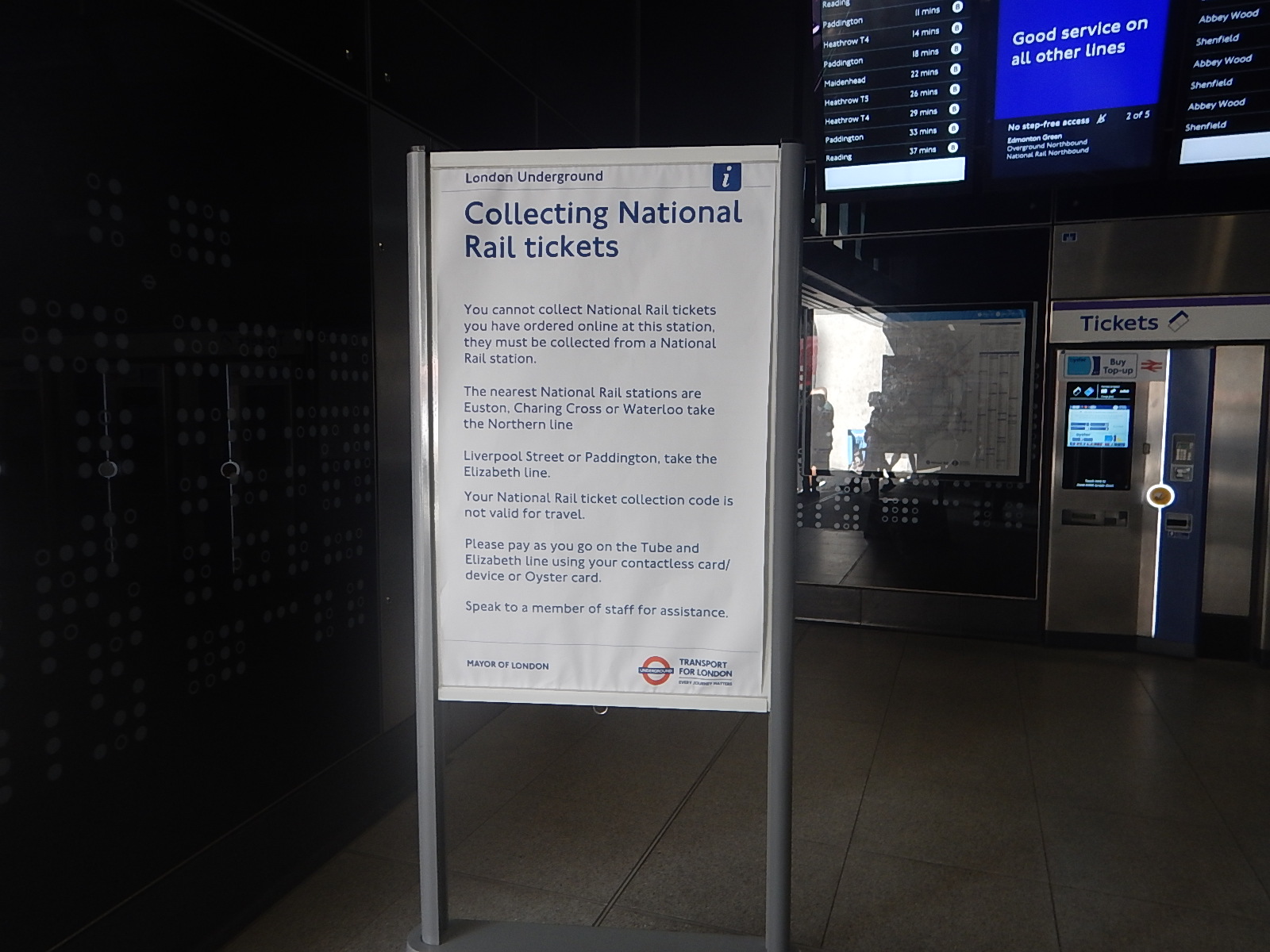
Transport for London are telling people they must go to a National Rail station to pick up National Rail tickets.
There are good reasons, why some passengers like to pick up their tickets at the station, where they enter the rail network.
If I go to Gatwick, as I have a Freedom Pass, I need to buy a ticket from East Croydon to Gatwick.
My normal way to get to Gatwick would be to take a bus to Moorgate and get the Elizabeth Line or the Metropolitan Line one stop to get Thameslink.
But I wouldn’t pass a ticket machine.
I count download the ticket to my phone, as my left hand can’t be relied on to retrieve it.
A better solution for me and many others with a Freedom Pass would be to link it to a bank card, so that the extra could be automatically charged.
Conclusion
Transport for London have no imagination.
Will High Speed Two Lite Make Stafford An Important Station?
Stafford station is where the Trent Valley Line joins the West Coast Main Line and with the current proposals for High Speed Two, which I refer to as High Speed Two Light, it will also have to handle those High Speed Two services to and from Crewe.
Current Services Through Stafford Station
These are current services through Stafford station.
- Avanti West Coast – London Euston and Blackpool North via Birmingham – 2 tpd – Stops at Wolverhampton, Stafford and Crewe
- Avanti West Coast – London Euston and Glasgow Central via Birmingham – 5 tpd – Stops at Wolverhampton, Stafford and Crewe
- Avanti West Coast – London Euston and Edinburgh via Birmingham – 7 tpd – Stops at Wolverhampton, Stafford and Crewe
- Avanti West Coast – London Euston and Blackpool North via Trent Valley – 1 tpd – Stops at Stafford and Crewe
- Avanti West Coast – London Euston and Glasgow Central via Trent Valley – 1 tph – Non-Stop
- Avanti West Coast – London Euston and Holyhead via Trent Valley – 8 tpd – Stops at Stafford and Crewe
- Avanti West Coast – London Euston and Liverpool Lime Street via Trent Valley – 1 tph – Stops at Crewe
- Avanti West Coast – London Euston and Manchester Piccadilly via Trent Valley – 1 tph – Stops at Stafford and Crewe
- CrossCountry – Birmingham New Street and Manchester via Wolverhampton and Stoke-on-Trent – 2 tph – Stops at Wolverhampton, Stafford and Stoke-on-Trent.
- West Midlands – London Euston and Crewe via Trent Valley – 1 tph – Stops at Stafford and Crewe
- West Midlands – Birmingham New Street and Crewe via Wolverhampton and Stoke-on-Trent – 1 tph – Stops at Wolverhampton, Stafford, Stoke-on-Trent and Crewe
- West Midlands – Birmingham New Street and Liverpool Lime Street via Wolverhampton – 1 tph – Stops at Wolverhampton, Stafford and Crewe
Note.
- tpd is trains per day.
- tph is trains per hour.
- Through Stafford station, there are totals of 23 tpd and 8 tph.
- Along the Trent Valley Line, there are totals of 9 tpd and 4 tph.
- North of Stafford on the West Coast Main Line, there are totals of 23 tpd and 4 tph.
- South of Stafford on the West Coast Main Line, there are totals of 14 tpd and 4 tph.
- Between Stafford and Stoke-on-Trent, there are totals of 3 tph.
Stafford is a very busy station.
Services have these frequencies from Stafford.
- Crewe – 21 tpd and 3 tph.
- Stoke-on-Trent – 3 tph.
- London Euston – 23 tpd and 4 tph.
- Wolverhampton – 13 tpd and 4 tph.
Could Stoke-on-Trent and Stafford do with a few extra services?
High Speed Two Services Through Stafford Station
This graphic shows High Speed Two services after Phase 2b is completed.
Note.
- Services shown in blue are run by High Speed Two Full Size trains.
- Services shown in yellow are run by High Speed Two Classic-Compatible trains.
- Each of these trains will have a frequency of one tph.
These could be High Speed Two services through Stafford station, when High Speed Two Lite opens.
- High Speed Two – London Euston and Liverpool Lime Street/Lancaster via High Speed Two and Trent Valley Line – 1 tph – Stops at Crewe
- High Speed Two – London Euston and Liverpool Lime Street via High Speed Two and Trent Valley Line – 1 tph – Stops at Crewe
- High Speed Two – London Euston and Macclesfield via High Speed Two and Trent Valley Line – 1 tph – Stops at Stafford and Stoke-on-Trent
- High Speed Two – London Euston and Manchester Piccadilly via High Speed Two and Trent Valley Line – 3 tph
- High Speed Two – London Euston and Glasgow/Edinburgh via High Speed Two and Trent Valley Line – 2 tph
- High Speed Two – Birmingham and Glasgow/Edinburgh via High Speed Two and Trent Valley Line – 1 tph
- High Speed Two – Birmingham and Manchester Piccadilly via High Speed Two and Trent Valley Line – 2 tph
Note.
- Through Stafford station, there are totals of 11 tph.
- Along the Trent Valley Line, there are totals of 11 tph.
- North of Stafford on the West Coast Main Line, there are totals of 11 tph.
- Between Stafford and Stoke-on-Trent, there are totals of 1 tph.
There are a lot of trains to squeeze through. But remember that High Speed Two signalling is designed to handle 18 tph.
Combined Services Through Stafford Station
These could be the combined current High Speed Two services through Stafford station, when High Speed Two Lite opens.
- Avanti West Coast – London Euston and Blackpool North via Birmingham – 2 tpd – Stops at Wolverhampton, Stafford and Crewe
- Avanti West Coast – London Euston and Glasgow Central via Birmingham – 5 tpd – Stops at Wolverhampton, Stafford and Crewe
- Avanti West Coast – London Euston and Edinburgh via Birmingham – 7 tpd – Stops at Wolverhampton, Stafford and Crewe
- Avanti West Coast – London Euston and Blackpool North via Trent Valley – 1 tpd – Stops at Stafford and Crewe
- Avanti West Coast – London Euston and Glasgow Central via Trent Valley – 1 tph – Non-Stop
- Avanti West Coast – London Euston and Holyhead via Trent Valley – 8 tpd – Stops at Stafford and Crewe
- Avanti West Coast – London Euston and Liverpool Lime Street via Trent Valley – 1 tph – Stops at Crewe
- Avanti West Coast – London Euston and Manchester Piccadilly via Trent Valley – 1 tph – Stops at Stafford and Crewe
- CrossCountry – Birmingham New Street and Manchester via Wolverhampton and Stoke-on-Trent – 2 tph – Stops at Wolverhampton, Stafford and Stoke-on-Trent.
- West Midlands – London Euston and Crewe via Trent Valley – 1 tph – Stops at Stafford and Crewe
- West Midlands – Birmingham New Street and Crewe via Wolverhampton and Stoke-on-Trent – 1 tph – Stops at Wolverhampton, Stafford, Stoke-on-Trent and Crewe
- West Midlands – Birmingham New Street and Liverpool Lime Street via Wolverhampton – 1 tph – Stops at Wolverhampton, Stafford and Crewe
- High Speed Two – London Euston and Liverpool Lime Street/Lancaster via High Speed Two and Trent Valley Line – 1 tph – Stops at Crewe
- High Speed Two – London Euston and Liverpool Lime Street via High Speed Two and Trent Valley Line – 1 tph – Stops at Crewe
- High Speed Two – London Euston and Macclesfield via High Speed Two and Trent Valley Line – 1 tph – Stops at Stafford and Stoke-on-Trent
- High Speed Two – London Euston and Manchester Piccadilly via High Speed Two and Trent Valley Line – 3 tph
- High Speed Two – London Euston and Glasgow/Edinburgh via High Speed Two and Trent Valley Line – 2 tph
- High Speed Two – Birmingham and Glasgow/Edinburgh via High Speed Two and Trent Valley Line – 1 tph
- High Speed Two – Birmingham and Manchester Piccadilly via High Speed Two and Trent Valley Line – 2 tph
Note.
- Through Stafford station, there are totals of 23 tpd and 19 tph.
- Along the Trent Valley Line, there are totals of 9 tpd and 15 tph.
- North of Stafford on the West Coast Main Line, there are totals of 23 tpd and 15 tph.
- Between Stafford and Stoke-on-Trent, there are totals of 4 tph.
But there are duplicate services.
High Speed Two services to Liverpool, Manchester and Scotland, will replace Avanti West Coast services.
High Speed Two services between Birmingham and Manchester, will replace CrossCountry services.
Removing these current services gives.
- Avanti West Coast – London Euston and Blackpool North via Birmingham – 2 tpd – Stops at Wolverhampton, Stafford and Crewe
- Avanti West Coast – London Euston and Blackpool North via Trent Valley – 1 tpd – Stops at Stafford and Crewe
- Avanti West Coast – London Euston and Holyhead via Trent Valley – 8 tpd – Stops at Stafford and Crewe
- West Midlands – London Euston and Crewe via Trent Valley – 1 tph – Stops at Stafford and Crewe
- West Midlands – Birmingham New Street and Crewe via Wolverhampton and Stoke-on-Trent – 1 tph – Stops at Wolverhampton, Stafford, Stoke-on-Trent and Crewe
- West Midlands – Birmingham New Street and Liverpool Lime Street via Wolverhampton – 1 tph – Stops at Wolverhampton, Stafford and Crewe
- High Speed Two – London Euston and Liverpool Lime Street/Lancaster via High Speed Two and Trent Valley Line – 1 tph – Stops at Crewe
- High Speed Two – London Euston and Liverpool Lime Street via High Speed Two and Trent Valley Line – 1 tph – Stops at Crewe
- High Speed Two – London Euston and Macclesfield via High Speed Two and Trent Valley Line – 1 tph – Stops at Stafford and Stoke-on-Trent
- High Speed Two – London Euston and Manchester Piccadilly via High Speed Two and Trent Valley Line – 3 tph
- High Speed Two – London Euston and Glasgow/Edinburgh via High Speed Two and Trent Valley Line – 2 tph
- High Speed Two – Birmingham and Glasgow/Edinburgh via High Speed Two and Trent Valley Line – 1 tph
- High Speed Two – Birmingham and Manchester Piccadilly via High Speed Two and Trent Valley Line – 2 tph
Note.
- Through Stafford station, there are totals of 11 tpd and 14 tph.
- Along the Trent Valley Line, there are totals of 11 tpd and 12 tph.
- North of Stafford on the West Coast Main Line, there are totals of 9 tpd and 12 tph.
- South of Stafford on the West Coast Main Line, there are totals of 2 tpd and 2 tph.
- Between Stafford and Stoke-on-Trent, there are totals of 2 tph.
With these frequencies, I suspect digital signalling will be needed.
Services have these frequencies from Stafford.
- Crewe – 11 tpd and 5 tph.
- Stoke-on-Trent – 2 tph.
- London Euston – 11 tpd and 4 tph.
- Wolverhampton – 3 tpd and 2 tph.
Note.
- Stoke-on-Trent needs more trains.
- There is virtually no trains on the West Coast Main Line to the South of Stafford.
- The frequencies indicate digital signalling will be needed.
On this brief look, I think that High Speed Two Lite will open up a lot of possibilities.
Could The High Speed Two Link Between Lichfield And Crewe Still Be Built?
The original plan for High Speed Two included two routes between Lichfield and Crewe.
This map clipped from the High Speed Two web site, shows the two routes.
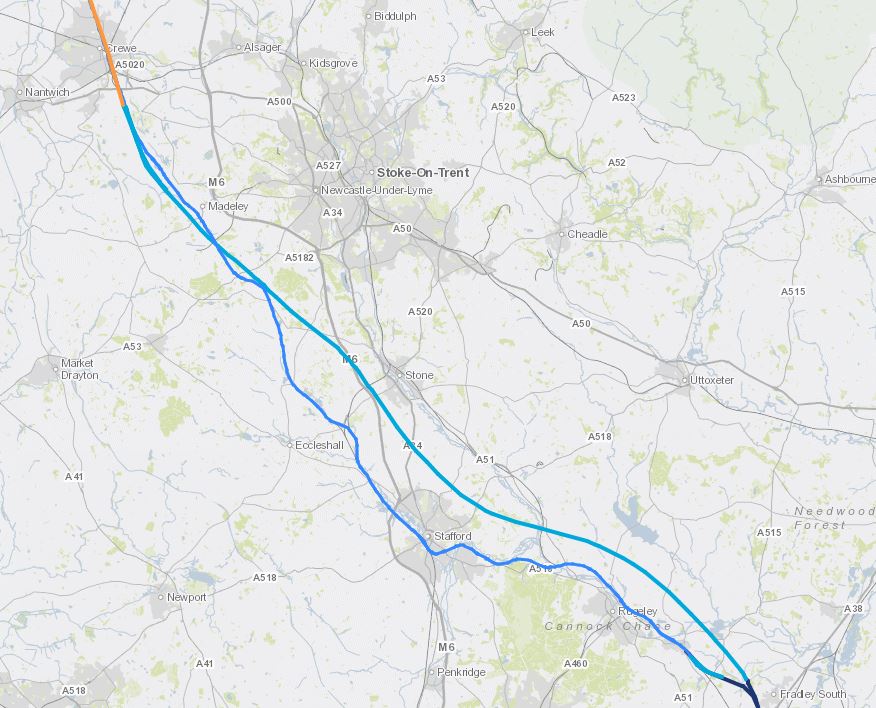
Note.
- High Speed Two Phase 2a is shown in blue.
- High Speed Two Phase 2b is shown in orange.
- Crewe is in the North-West corner of the map, at the Southern end of the orange section.
- The junction at Lichfield is in the South-East corner of the map.
- The lighter blue route to the East, between the Lichfield junction and Crewe is the proposed new tracks of High Speed Two.
- The darker blue route to the West, between the Lichfield junction and Crewe is the existing route of the Trent Valley Line and the West Coast Main Line.
- The Trent Valley Line joins the West Coast Main Line at Stafford.
This second map clipped from the High Speed Two web site, shows the junction North of Lichfield, where High Speed Two connects to the Trent Valley Line through Stafford.

Note.
- High Speed Two runs North-South across the map.
- After the Junction by Fradley South, High Speed Two to Crewe and the North, is the branch to the East.
- The other branch connects to the Trent Valley Line at Handsacre junction.
- Trent Valley Line can be picked out North of Lichfield, where it passes through Lichfield Trent Valley station.
The Trent Valley Line is no Victorian double-track slow-speed bottleneck.
- The route between Rugby and Crewe is generally three or four tracks, with only one short stretch of double track, through Shugborough tunnel.
- The speed limit is generally 110 mph, with 90 mph at Shugborough.
- I wouldn’t be surprised to see Avanti West Coast’s Class 390 and Class 807 trains could be running at up to 140 mph on the route, if digital signalling were to be installed.
- This speed would probably be attained by High Speed Two trains.
London Euston and Stafford would only have under twenty miles of slower line and that could be 140 mph, so High Speed Two times on the route could be very fast.
Trains Between London And Stafford Before And After High Speed Two To Lichfield
Currently, Avanti West Coast trains take around one hour and seventeen minutes between London and Stafford.
The Wikipedia entry for High Speed Two gives these times between London and Stafford.
- Fastest time before High Speed Two – one hour and seventeen minutes.
- Time after Phase 2a of High Speed Two opens – fifty-five minutes.
Note.
- That is a time saving of twenty-two minutes.
- High Speed Two Trains will use the link between the junction at Lichfield and the Trent Valley Line.
- High Speed Two will also add eighteen trains per hour (tph) to the capacity between London and Lichfield.
This would seem to mean that any trains going to or through Stafford will be twenty-two minutes faster, if they use High Speed Two between London and Lichfield.
Trains Between London And Crewe Before And After High Speed Two To Crewe
Currently, Avanti West Coast trains take around one hour and thirty minutes between London and Crewe.
The Wikipedia entry for High Speed Two gives these times between London and Crewe.
- Fastest time before High Speed Two – one hour and thirty minutes.
- Time after Phase 2a of High Speed Two opens – fifty-six minutes.
Note.
- That is a time saving of thirty-four minutes.
- High Speed Two Trains will use the direct line between Lichfield and Crewe.
- High Speed Two will also add eighteen tph to the capacity between London and Crewe.
This would seem to mean that any trains going to or through Crewe will be thirty-four minutes faster, if they use High Speed Two between London and Crewe.
High Speed Two Between Lichfield And Crewe Only Saves An Extra Twelve Minutes
It appears that extending High Speed Two to Crewe only saves an extra twelve minutes.
But it will also have these benefits.
High Speed Two Full-Size trains will be able to run to Crewe.
High Speed Two will also add eighteen tph to the capacity between London and Crewe.
Savings From Scrapping High Speed Two Between Lichfield And Crewe
In addition to the savings of the scrapping of the line, I suspect that any modifications to Crewe station will be much simpler.
I wonder how much will be saved by not building High Speed Two to Crewe.
Could The High Speed Two Link Between Lichfield And Crewe Still Be Built?
This is the question I asked in the title.
We know the benefits of building High Speed Two and as time progresses we’ll know the costs and the disruption the building will cause with an increasing accuracy.
I also believe that even High Speed Two Lite will be a rip-roaring success, and other places will want their own High Speed Two service, which will need an increase in capacity North of Lichfield.
So there will come a point, when there is an overwhelming case to build the High Speed Two Link Between Lichfield and Crewe.
Because of that we must make sure, that any sales of land or properties, doesn’t compromise building the High Speed Two Link Between Lichfield and Crewe.
Conclusion
There will come a point, when the amount of traffic, will mean that it is worth building the High Speed Two Link Between Lichfield and Crewe.
My other conclusion is important and the route of the originally proposed High Speed Two Link Between Lichfield and Crewe, must not be compromised.
Could Manchester Airport Be Accessed From The West By A Tunnel Under The M56?
This OpenRailwayMap shows the railways of East London between Dalston Junction and Stratford International stations.

Note.
- Dalston Kingsland station is marked with an arrow in the West of the map.
- Stratford International station is marked by the blue lettering in the East of the map.
- The orange line between them is the North London Line.
- There are also two pink lines, which indicate High Speed One, which is dug several metres below the North London Line.
It can’t be much different to dig a high speed railway underneath a motorway. Has anybody done this?
This OpenRailwayMap shows the railways leading to Manchester Airport.
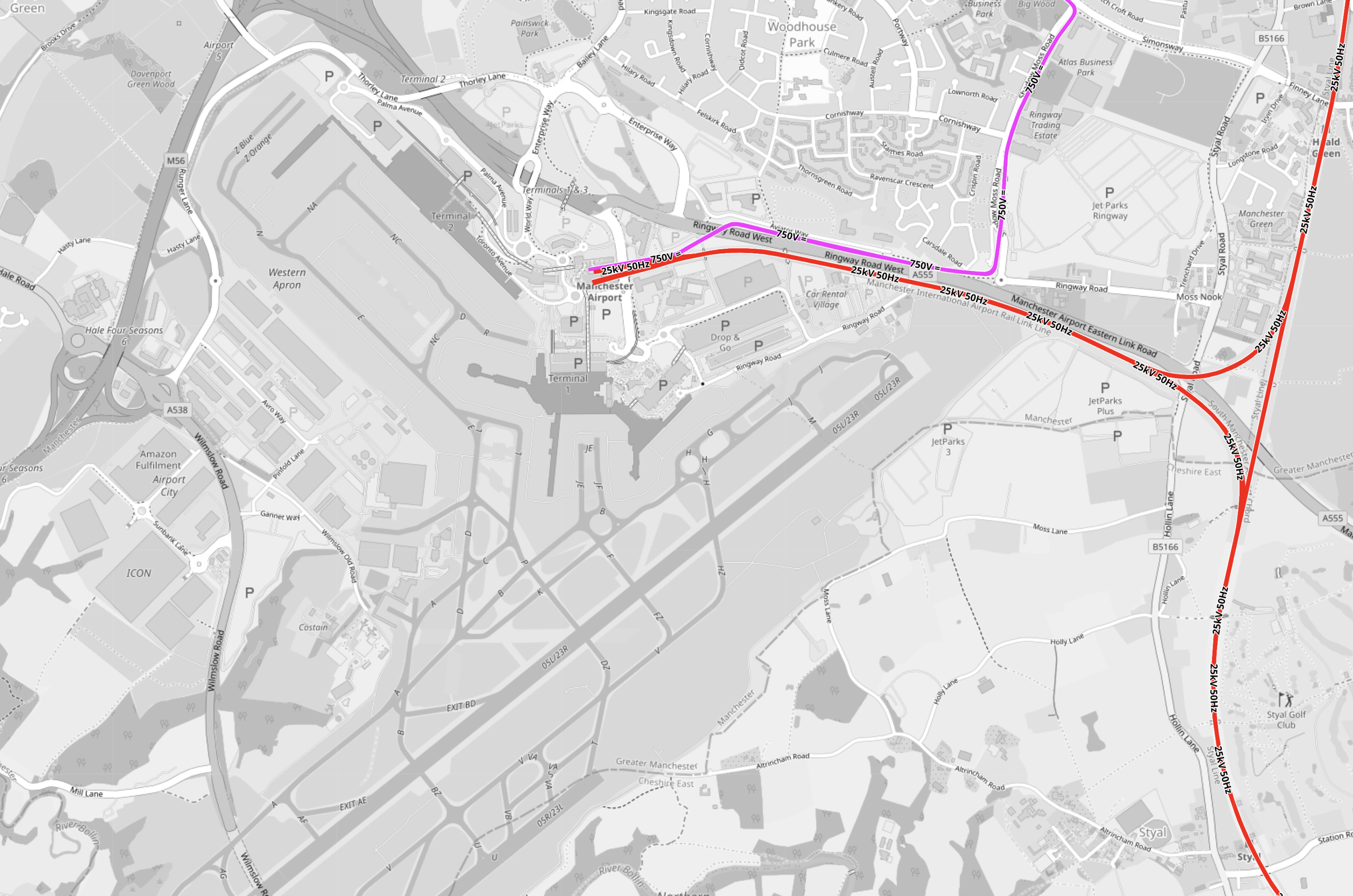
Note.
- Junctions 5 and 6 of the M56 motorway are on the Western edge of the Airport.
- The red tracks are the Styal Line.
- The mauve tracks are the Metrolink.
- It should be noted that railway lines pass under Heathrow Airport’s runways.
Point 4 makes me sure, that Manchester Airport can have a station connected to the West by a railway under the M56.
This OpenRailwayMap shows the railways around Weaver Junction on the West Coast Main Line, where the trains branch off to Liverpool.

Note.
- The West Coast Main Line goes down the Eastern side of the map.
- Warrington Bank Quay is the next station to the North.
- The Liverpool Branch goes off to the West.
- The M56 tuns diagonally across the map from the North-East corner crossing both both branches of the West Coast Main Line.
This Google Map shows where the M56 crosses over the West Coast Main Line to Warrington Bank Quay.
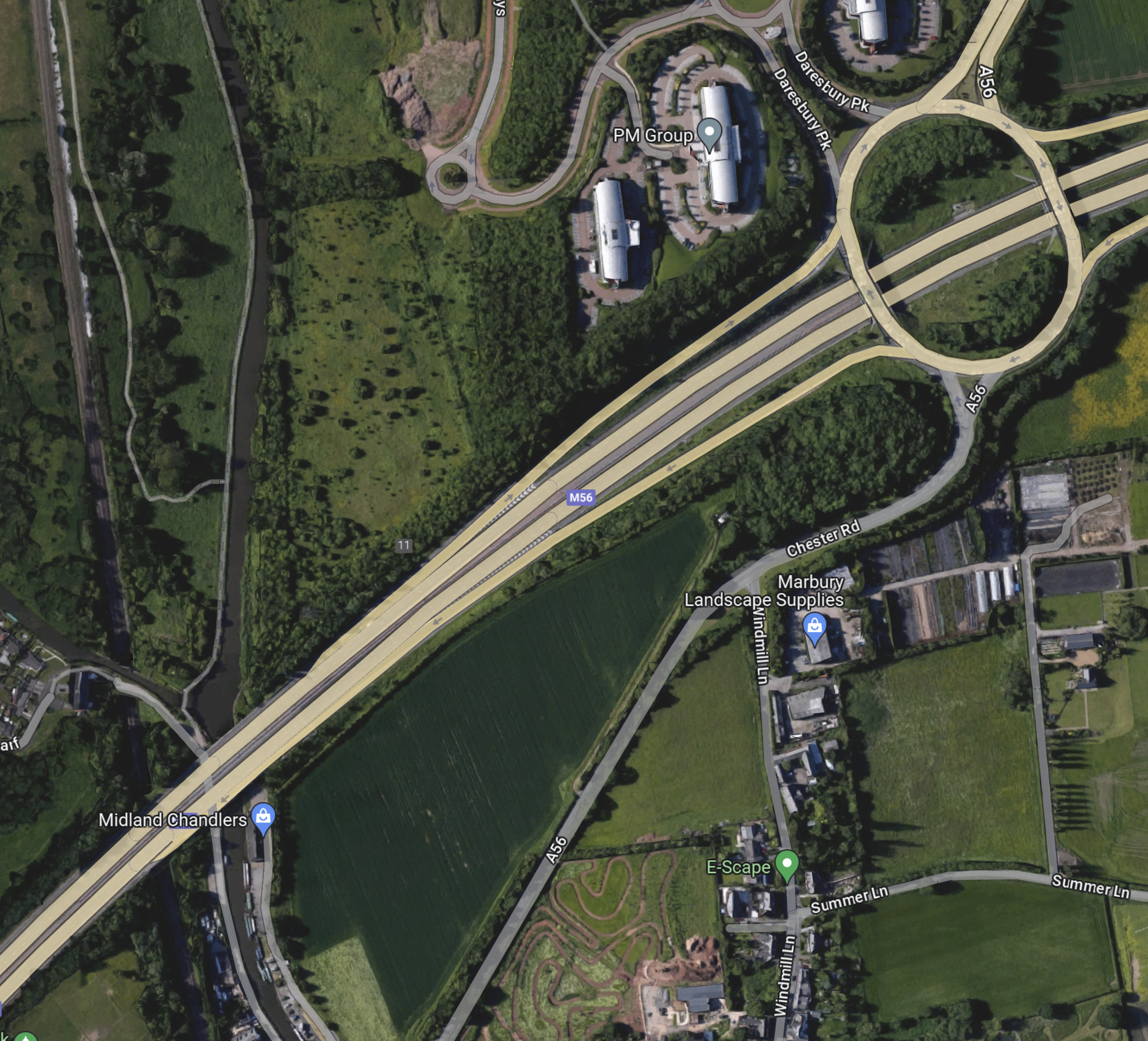
Note.
- The M56 motorway is obvious.
- The Eastbound motorway goes to Manchester Airport and Manchester.
- The junction is numbered 11.
- The railway runs down the Western side of the map.
I believe that it would be possible to connect a railway running East under the motorway to the West Coast Main Line.
This Google Map shows where the M56 crosses over the Liverpool branch of the West Coast Main Line.
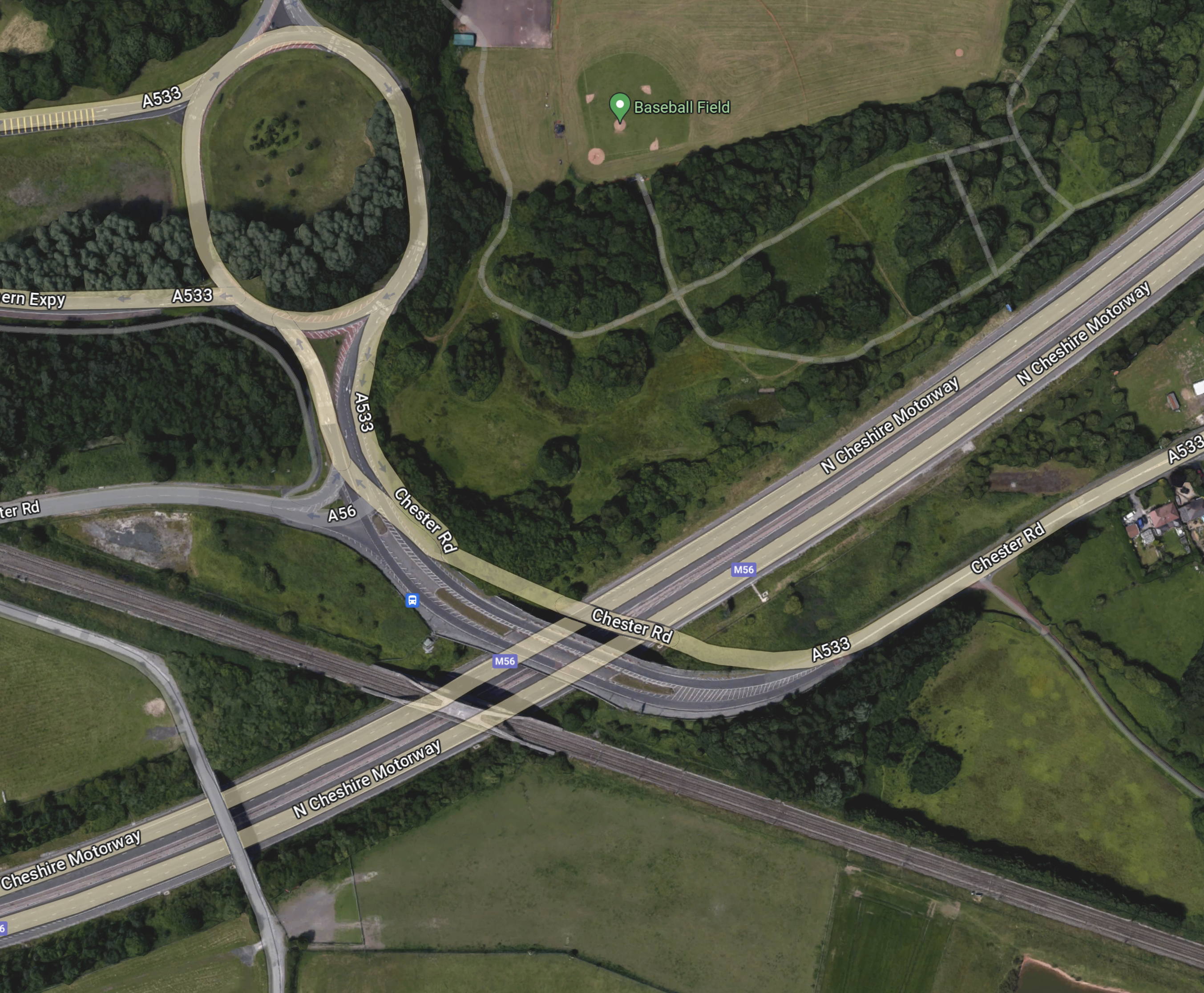
Note.
- There is no motorway junction here.
- The North-East bound motorway goes to Manchester Airport and Manchester.
- The railway runs slightly diagonally across the bottom of the map.
- The Westbound railway goes to Runcorn and Liverpool.
- The Eastbound railway goes to Weaver Junction, Crewe and the South.
There would only need to be a connection between Liverpool and the railway under the motorway going to and from Manchester Airport.
I have some further thoughts and questions.
This Is Just My First Thought
I am happier about the connection to the Liverpool branch than the Northern connection.
But then I feel there are several routes at both junctions, some of which will take a wider route.
How Long Will The Tunnels Be?
Between Junctions 11 and 6 on the M56 is 16 miles.
At What Speed Would The Trains Run?
I suspect that once on the straight section between Junctions 11 and 6, speeds of up to 90 or 100 mph should be possible, but speeds would probably be lower at the junctions to the West Coast Main Line.
How Would It Connect To Manchester Piccadilly?
The tunnel would continue the other side of the Airport and it’s a further 9.4 miles to under Manchester Piccadilly.
In The Rival Plans For Piccadilly Station, That Architects Say Will ‘Save Millions’, I wrote about Weston Williamson’s plan for Manchester Piccadilly station.
This was their visualisation.

Note.
- In the visualisation, you are observing the station from the East.
- The existing railway lines into Piccadilly station are shown in red.
- Stockport and Manchester Airport are to the left, which is to the South.
- Note the dreaded Castlefield Corridor in red going off into the distance to Oxford Road and Deansgate stations.
- The new high speed lines are shown in blue.
- To the left they go to Manchester Airport and then on to London, Birmingham and the South, Warrington and Liverpool and Wigan, Preston, Blackpool, Barrow-in-Furness, the North and Scotland.
- To the right, they go to Huddersfield, Bradford, Leeds, Hull and the North East, and Sheffield, Doncaster and the East.
- Between it looks like a low-level High Speed station with at least four tracks and six platforms.
- The high speed lines could be oriented so they ran East-West, rather than North-South in this visualisation.
- The Manchester Metrolink is shown in yellow.
The potential for over-site development is immense. If the Station Square Tower was residential, the penthouses would be some of the most desirable places to live in the North.
Onward From Manchester Piccadilly
I would hope that a connection could be made to the Huddersfield Line to the East of Manchester Piccadilly station, so that trains could use the TransPennine Upgrade all the way to Leeds.
 The Anonymous Widower