Should We Be Given More Discretion Over Mask Wearing?
I am a bad breather and have been so for most of my life.
I suspect, it’s because I grew up in London smogs and that ruined my breathing.
But my father and his father were also bad breathers and my grandfather died before he was forty of pneumonia.
So when I go on public transport, I find the following.
- I have difficulty climbing stairs with my mask on.
- I can’t wait to get out of the station or bus to take off my mask and put it in my pocket.
- Often in London during the day, there is only a few people on the bus or train and we are all sitting there quietly at least three or four metres apart.
- If I explain my breathing to staff, they will let me remove my mask. I have done this a coule of times, when I have to climb stairs to get out of a station.
Sometimes too, I’ll be on a crowded Underground train for part of my journey, but at other times, I’ll be one of perhaps three in an air-conditioned bus.
As of Thursday rules will say, that we don’t need masks in England, but the Mayor has said we must wear them on public transport in London.
I would like to see some personal discretion, so that some like me would feel more comfortable on public transport, when it is less busy.
Edinburgh Energy Storage Firm Gravitricity Hooks Up To European Backing
The title of this post, is the same as that of this article on The Scotsman.
This is the first paragraph.
Gravitricity, the Edinburgh-based company looking to build an energy storage project in a disused mineshaft, has secured support from the European Investment Bank (EIB).
It’s all to support a project at the recently mothballed Staric coal mine in the Moravian Silesian region of Czechia.
Deutsche Bahn Puts Passengers On Alstom Battery-Electric Trains
The title of this post, is the same as that of this article on electrive.com.
This is the introductory paragraph.
French manufacturer Alstom and Deutsche Bahn are now taking passengers onboard Alstom’s first fully approved electric train since this weekend in Baden-Württemberg. Further testing will start in Bavaria on 5 February and run throughout early May on all routes.
This paragraph describes where the train will be running.
On weekdays the battery-powered train will run in Baden-Württemberg on the Stuttgart – Horb line and Saturdays and Sundays, on the Pleinfeld – Gunzenhausen line in the Franconian Lake District. Alstom said this arrangement would maximise the train’s mileage while testing a variety of route profiles and battery charging scenarios. For example, while in Baden-Württemberg, charging occurs during the ongoing journey via overhead lines, in Bavaria, charging can only take place at stations, as the route in between is not electrified.
The article gives the impression that Alstom have ambitious plans for battery-electric and hydrogen trains in Germany.
This is confirmed by this press release on the Alstom web site, where this is a paragraph.
While Alstom’s hydrogen trains are optimised for longer routes, Alstom’s BEMUs are suitable for shorter routes or lines with non-electrified sections previously operated with diesel vehicles. Direct connections between electrified and non-electrified network sections are now possible and can be operated emission free, without the need of additional electrification – shortening the travel time between city and country.
It appears Alstom will be developing both types of trains.
How Defunct Coal Mines Could Heat UK Homes
The title of this post, is the same as that of this article on Mining Technology.
This is the introductory paragraph.
In a country with no operational coal mines, the UK Coal Authority has proposed to once again turn these operations to heating homes and businesses. But this time, they will not provide coal for burning. The plan, to take warm water from flooded mines, would turn an environmental problem into a community solution, and the idea is spreading.
The reason, I’m posting this is two-fold.
There was a report on this edition of Countryfile, which should be available until the end of 2022. The relevant section starts at 38.5 minutes into the program.
Charlotte Adams is featured in this report and the Countryfile program. I first came across Charlotte and her fascinating work at a lecture in 2018, which I wrote about in Can Abandoned Mines Heat Our Future?
Are First Group Moving Towards Zero-Carbon?
My post, which was entitled Suppliers Sought For New Bi-Mode Locomotives For TransPennine Express And Great Western Railway, prompted me to ask the question in the title of this post.
This factsheet for First Bus says that all their buses will be zero-carbon by 2035.
This factsheet for First Rail says this about Decarbonising Rail Travel.
FirstGroup’s ambition is to be the partner of choice for low or zero emission transport. We recently became the first UK rail and bus operator to formally commit to setting an ambitious science-based target for reaching net zero emissions by 2050 or earlier.
First Rail leads the sector in decarbonisation, including the introduction of bi-mode diesel and electric powered trains which allow us to make best use of electrified networks. We have signed up to the Government’s challenge to take all diesel-only trains out of service by 2040.
GWR has recently taken delivery of the UK’s first tri-mode train which can use overhead wires, third rail or diesel power. Sustainability is at the heart of the NRCs and both SWR and TPE will develop a decarbonisation policy and roadmap towards net zero emissions in accordance with this goal. New all-electric and bi-mode trains will be introduced by Avanti to replace diesel only trains in the current fleet.
Both these factsheets appear to have been written in 2021.
The zero-carbon status of each of First Group’s rail companies is as follows.
Avanti West Coast
The mainstay of Avanti West Coast are fifty-six Class 390 electric trains.
Twenty Class 221 diesel trains are being replaced by ten new Class 807 electric trains and thirteen new Class 805 bi-mode trains.
Great Western Railway
The mainstay of Great Western Railway are a mixture of ninety-three Class 800 and Class 802 bi-mode trains.
They also have thirty-three Class 387 electric trains working London commuter routes.
There are a large assortment of ninety-four diesel trains of various classes working rural routes and local services in Bristol, Exeter, Oxford and Plymouth. There are a lot of these trains in the UK and I suspect that a nationwide solution will be developed.
There are thirty-five Class 43 diesel locomotives, that power the shortened InterCity 125 trains in the South-West. I wrote about converting these to hydrogen in Will We See Class 43 Power Cars Converted To Hydrogen?
Four Class 57 diesel locomotives that haul the Night Riviera are covered by the request for suppliers, that prompted me to write this post.
South Western Railway
The mainstay of South Western Railway are a mixture of around three hundred electric trains.
There are also ten Class 158 diesel trains and thirty Class 159 diesel trains. There are a lot of these trains in the UK and I suspect that a nationwide solution will be developed.
TransPennine Express
The mainstay of TransPennine Express are nineteen Class 802 bi-mode trains and twelve Class 397 electric trains.
There are also fifty-one Class 185 diesel trains.
Fourteen Class 68 diesel locomotives that haul coaches are covered by the request for suppliers, that prompted me to write this post.
Hull Trains
Hull Trains have a fleet of five Class 802 bi-mode trains.
Lumo
Lumo have a fleet of five Class 803 electric trains.
The service is also sold on the basis of its low-carbon footprint.
Conclusion
First Group would appear top have a fair way to go towards full decarbonisation.
- They have around a hundred-and-thirty Hitachi bi-mode trains. Research is ongoing to replace some diesel engines with batteries.
- They have a lot of diesel trains and locomotives, that are still in front-line service.
- They have the tricky problem of the Class 43 locomotives, which I suspect will result in a nationwide solution.
But at least they have started by requesting proposals to replace the other diesel locomotives.
Aviva To Eject Company Directors If Climate Goals Are Not Met
The title of this post is the same as that of this article in The Sunday Times.
Increasingly, I am seeing company boards taking decisions, that will cut their company’s carbon footprint.
Only yesterday, I wrote Suppliers Sought For New Bi-Mode Locomotives For TransPennine Express And Great Western Railway, which was about First Group’s moves to decarbonise some of their locomotive-hauled trains.
I have also written about BHP, BP, Fortescue, Go-Ahead and Rio-Tinto taking action to decarbonise.
It does seem that some company boards are following Aviva’s guidance, but then it is in the directors own interest.
Many directors of large companies own shares and in a big public company, these are publicly traded.
I would suspect, that if a company board, do the right thing in terms of decarbonisation, that the share price will rise.
So by following the accepted climate science, they are actually helping themselves.
If they don’t believe that, then aggressive shareholders from Norwich will punish them.
The Future Of The Class 68 Locomotives
This post has been brought on by the comments to two posts I have written today.
- Direct Rail Services Disposes Of Heritage Locomotives
- Suppliers Sought For New Bi-Mode Locomotives For TransPennine Express And Great Western Railway
Both Direct Rail Services and TransPennine Express are major users of Class 68 locomotives, with each having a fleet of fourteen locomotives.
In addition, Chiltern Railways has a smaller fleet of six locomotives.
- Direct Rail Services use their locomotives for various passenger and freight duties, including the important one of moving nuclear material around the country.
- TransPennine Express use their locomotives on their passenger services across the North of England.
- Chiltern Railways use their locomotives on their passenger services between London and Birmingham and sometimes Oxford.
The design was a bespoke one by Stadler for Direct Rail Services and the first one entered service in 2014.
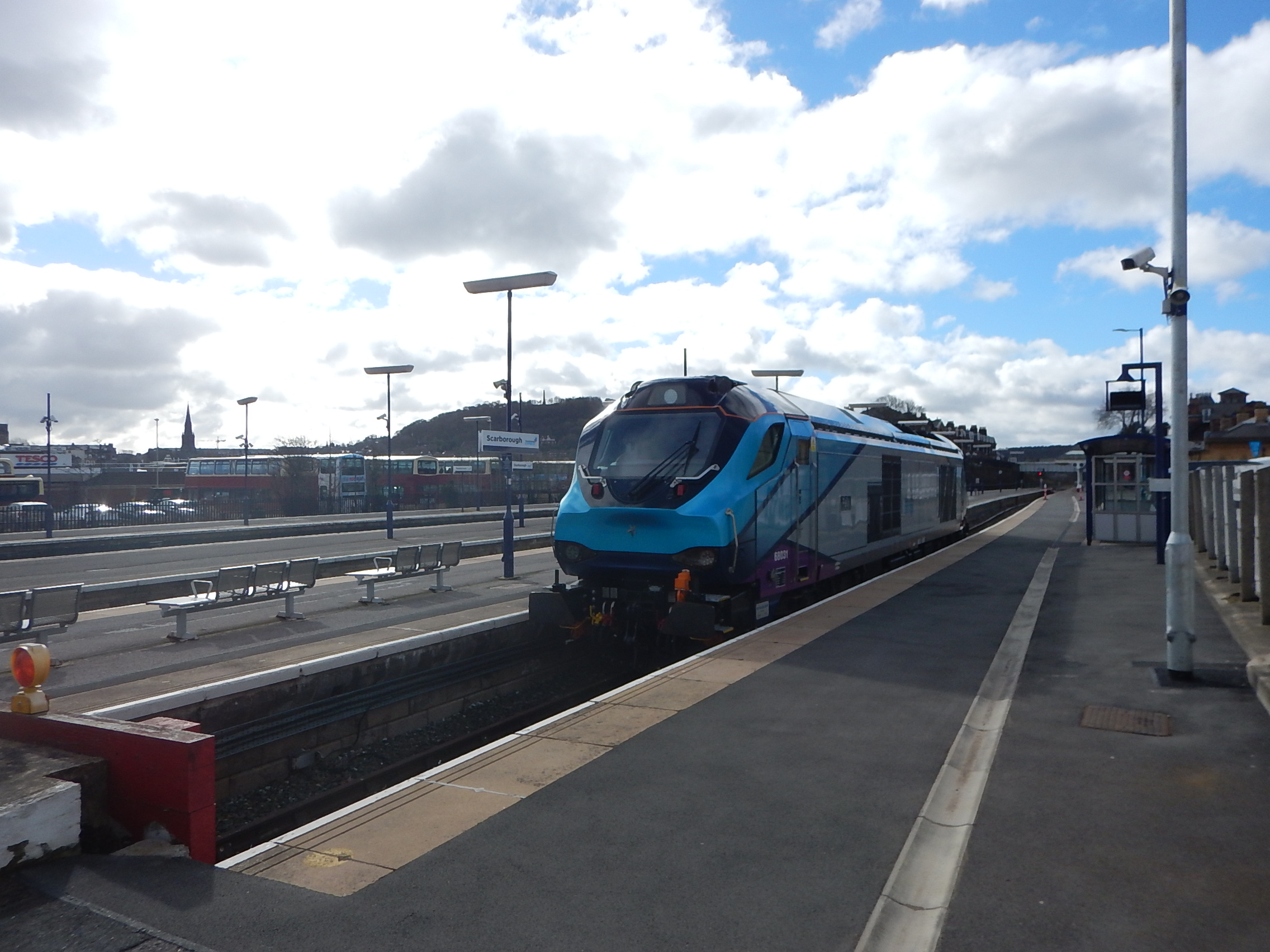
The picture shows one of TransPennine’s Class 68 locomotives at Scarborough. As the picture shows, they are a smart and purposeful-looking locomotive, that wouldn’t look out of place in the right livery on the front of the Royal Train.
It has some good features.
- It is a 100 mph locomotive.
- It seems to be well-liked by operators.
- It can haul both passenger and freight trains.
- It can act as a Thunderbird or rescue locomotive.
But they have three problems; emissions, noise and diesel.
This is from Wikipedia.
The locomotive’s propulsion system is compliant with Stage III A of the European emission standards, but not the more stringent Stage III B requirements.
But noise is a another problem and this has caused council action in Scarborough.
More important than emissions or noise, is the fact, that the locomotive is diesel-powered, so the fleet will probably have to be retired from the railway, at a time, when there is still useful life left in the locomotives.
The Class 68 locomotive is a member of the Stadler Eurolight family, of which there are three versions.
All follow similar design principles, differing mainly in dimensions, with Spain, Taiwan and the UK ordering upwards of twenty-thirty locomotives.
The UKLight branch of the family has two other members.
The Class 88 locomotive is an electro-diesel version of the Class 68 locomotive and the development of the design is described in this extract from the Class 88 locomotive’s Wikipedia entry.
Amid the fulfillment of DRS’ order for the Class 68, Stadler’s team proposed the development of a dual-mode locomotive that could be alternatively powered by an onboard diesel engine or via electricity supplied from overhead lines (OHLE). Having been impressed by the concept, DRS opted to place an order for ten Class 88s during September 2013. Having been developed alongside the Class 68, considerable similarities are shared between the two locomotives, amounting to roughly 70 percent of all components being shared.
According to Wikipedia, the type had a smooth entry into service.
The Class 93 locomotive will be the next development of the UKLight branch of the family, when it is delivered in 2023.
It will be a tri-mode locomotive, that will be capable of being powered by 25 KVAC overhead electrification, an onboard diesel engine and batteries.
It will be a 110 mph locomotive.
It can haul both passenger and freight trains.
Rail Operations Group have ordered 30 locomotives.
This is the first paragraph of the section in Wikipedia called Specification.
The Class 93 locomotive has been developed to satisfy a requirement for a fast freight locomotive that uses electric power while under the wires, but is also capable of self-powered operations. Accordingly, it is capable of running on diesel engines, from overhead wires, or from its onboard batteries. These batteries, which occupy the space used for the braking resistors in the Class 88, are charged via the onboard transformer or regenerative braking; when the batteries are fully charged, the locomotive only has its friction brakes available. The diesel engine is a six-cylinder Caterpillar C32 turbocharged power unit, rated at 900 kW, conforming with the EU97/68 stage V emission standard. The batteries units are made of Lithium Titanate Oxide and use a liquid cooling solution, enabling rapid charge and discharge.
It is a truly agnostic locomotive, that can take its power from anywhere.
The last paragraph of the specification compares the locomotive to the Class 66 locomotive.
In comparison with the Class 66, the Class 93 can outperform it in various metrics. In addition to a higher top speed, the locomotive possesses greater acceleration and far lower operating costs, consuming only a third of the fuel of a Class 66 along with lower track access charges due to its lower weight. ROG has postulated that it presents a superior business case, particularly for intermodal rail freight operations, while also being better suited for mixed-traffic operations as well. Each locomotive has a reported rough cost of £4 million.
It is no ordinary locomotive and it will change rail freight operations in the UK.
I have a feeling that the Class 93 locomotive could be a lower-carbon replacement for the Class 68 locomotive.
But I also believe that what Stadler have learned in the development of the Class 93 locomotive can be applied to the Class 68 locomotive to convert them into zero-carbon locomotives.
It may be just a matter of throwing out the diesel engine and the related gubbins and replacing them with a large battery. This process seems to have worked with Wabtec’s conversion of diesel locomotives to FLXdrive battery-electric locomotives.
Oman And BP Sign Renewable Hydrogen Partnership On Mega-Gigawatt Scale
The title of this post, is the same as that of this article on Hydrogen Fuel News.
This is the introductory paragraph.
Oman has announced that it has entered into an agreement with BP, in which the energy giant will support the country’s development of mega-gigawatts of renewable hydrogen and energy by 2030.
Wind and solar power will be developed on 8,000 square kilometres of land.
Suppliers Sought For New Bi-Mode Locomotives For TransPennine Express And Great Western Railway
The title of this post, is the same as that of this article on Rail Advent.
These three paragraphs give a summary of the proposed fleet of locomotives required by First Group for their two operations.
TransPennine Express is looking for expressions of interest from suppliers for a fleet of at least 15 bi-mode locomotives for use on with its Mk5 carriages.
The provision released by First Group is for up to 30 bi-mode locomotives, with an additional 5 for use on Great Western Railway’s Sleeper Service.
The operators say that the new locomotives must have the capability to be powered by overhead wires as well as being able to operate with an alternate traction mode, IE Diesel or Battery, where routes are not yet electrified or for use as a contingency.
I have also read the detailed proposal, which can be downloaded from this page of the First Group web site.
- The locomotives must be capable of hauling a train at 100 mph.
- First Group are putting a high emphasis on environmental impact of the locomotives.
- The locomotives must be compatible with the latest emission regulations.
- The locomotives must be low-noise.
- The locomotives must be capable of hauling seven coaches, including a driving van trailer.
Nothing in the request for proposals would appear to be too challenging.
I have some thoughts.
The Number Of Locomotives For TransPennine Express
Currently, TransPennine Express has a fleet of fourteen Class 68 locomotives and enough coaches and driving van trailers to create thirteen rakes of Mark 5A coaches.
So why do TransPennine Express talk of up to thirty locomotives?
- Fifteen locomotives would handle the current services, so thirty could cover new services or more services on the current locomotive-hauled routes.
- Manchester Airport and Cleethorpes and Manchester Piccadilly and Hull are run by Class 185 diesel trains, which will need replacing at some future time.
- First Group probably know the costs of running Class 802 trains and locomotives with rakes of coaches better than anyone , so are they thinking about swapping some Class 802 trains for locomotives with rakes of coaches?
The last point would be one for the accountants.
But I am led to the conclusion, that TransPennine Express could be expanding and also decarbonising the long routes still operated by Class 185 trains.
The Number Of Locomotives For Great Western Railway
Currently, Great Western Railway has a fleet of four Class 57 locomotives to haul the Night Riviera.
Five replacement locomotives would probably be enough.
Could A Battery-Electric Locomotive Handle The TransPennine Express Requirement?
Currently, there are gaps in the electrification of the TransPennine network.
- Manchester Victoria and Stalybridge – 7.7 miles – Electrification in progress
- Stalybridge and Huddersfield – 18 miles
- Huddersfield and Dewsbury – 8 miles – Electrification in progress
- Dewsbury and Leeds – 9.1 miles
- Leeds and York – 25.6 – Electrification in progress
- Northallerton and Redcar – 28.8 miles
- Manchester Piccadilly and Stalybridge – 7.5 miles
- Leeds and Hull – 51.8 miles
- Doncaster and Cleethorpes – 72.1 miles
- Scarborough and York – 42 miles
- Doncaster and Sheffield – 18.7 miles
- Sheffield and Stockport – 36.8 miles – Rumoured to be electrified
Note.
- Many gaps are quite small.
- The longest gaps are on easy routes.
- Sheffield will be electrified for the Midland Main Line.
- A length of electrification at Scunthorpe could ease Doncaster and Cleethorpes.
I feel that a battery-electric locomotive with a range of a hundred miles hauling seven coaches, would be able to handle all the TransPennine routes.
If the train could run the routes with an electricity consumption of 4 kWh per vehicle-mile, seven coaches would need 4 * 8 * 100 = 3.2 MWh of battery storage.
Note.
- A 3.2 MWh battery would weigh around 3.2 tonnes, which would be less than the diesel engine in a Class 68 locomotive.
- Regenerative braking to batteries could be used to improve range.
- In How Much Power Is Needed To Run A Train At 125 Or 100 mph?, I calculated that an InterCity 125 needs 1.81 kWh per vehicle mile to maintain 100 mph.
I am fairly certain, that a well-designed efficient battery-electric locomotive would be able to handle all of the routes for TransPennine Express.
Could A Battery-Electric Locomotive Handle The Night Riviera?
I have just looked up the Southbound Night Riviera on Real Time Trains.
- It leaves Paddington at 23:50.
- It is typically eight coaches and a Class 57 locomotive.
- The train is planned to run at 75 mph.
- The first 53 miles between Paddington and Newbury are electrified.
- There is a stop of one hour and 39 minutes at Exeter.
- Newbury and Exeter is 120.4 miles
- Exeter and Penzance is 130.8 miles
The Northbound Night Riviera only has a five minute stop at Exeter and two minutes stops at Totnes, Newton Abbott and Taunton.
A battery-electric locomotive would need a range of 140 miles hauling eight coaches.
- Some stops like Plymouth may need to be lengthened by a few minutes to charge the batteries.
- Extra stops of perhaps five minutes could be added to top-up the batteries.
- The train would be limited to 75 mph, which would improve efficiency.
- It might even be prudent to electrify the uphill track of some of the steeper parts of the route.
But think of the marketing advantages of a zero-carbon sleeper train!
Conclusion
When I saw First Group’s proposals, I thought that they were over ambitious.
But after doing a few simple calculations, I think they can decarbonise some, but not all of the TransPennine Express services and the Night Riviera.
Quiet Battery-Powered River Ferries To Serve Battersea Power Station Pier
The title of this post, is the same as that of this article on Nine Elms.
These two paragraphs give the story and explain the operation of the new boats.
Passengers using Battersea Power Station pier will soon be boarding the UK’s first hybrid high speed passenger ferries using battery power.
Uber Boat by Thames Clippers are building two new vessels which will operate solely on battery power when travelling between Tower and Battersea Power Station piers – and recharge while using biofuelled power when sailing further east and west outside their central London route.
They will join the fleet in the Autumn.
There is also this environmental statement from Thames Clipper.
Uber Boat by Thames Clippers is committed to achieving net zero with all new builds by 2025 and for its wider fleet, infrastructure and environmental footprint by 2040.
That sounds very good to me.
Conclusion
I suspect that this policy will lead to increasing use on London’s river transport system.
I’d also like to see Thames Clipper better integrated with the Overground, Underground and the buses. Some of the walking routes could be improved and have better signage.
I also think, that the Thames Clipper would benefit, if the Freedom Pass could be linked to a credit card, so that Freedom Pass holders would only need to use one card to use all of London’s transport systems.
 The Anonymous Widower