My First Ride In A Class 745 Train
I took these pictures as I took a ride in a new Class 745 train between Liverpool Street and Colchester.
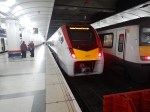


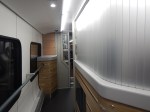
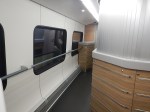


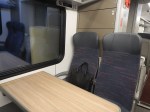
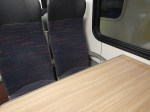
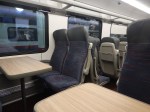
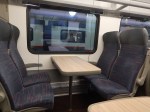
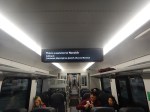
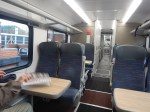
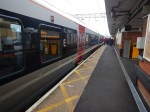
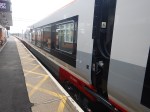
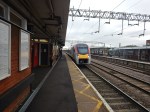
These are my thoughts on various subjects.
Seating
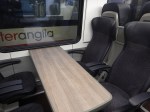
I found no problem with the seats in Second Class, although there have been reports, that they are harder than those of the Mark 3 coaches.
I came back from Colchester in one of British Rail’s finest products and prefer the new train.
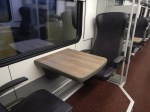
Note that in both cases I had a seat with a proper table, so I was comparing like with like.
In the Class 745 train, I was sitting in one of the higher seats over a bogie and I like this position with its better view, which I have also used in the smaller bi-mode Class 755 trains, that are used for local services in Norfolk and Suffolk.
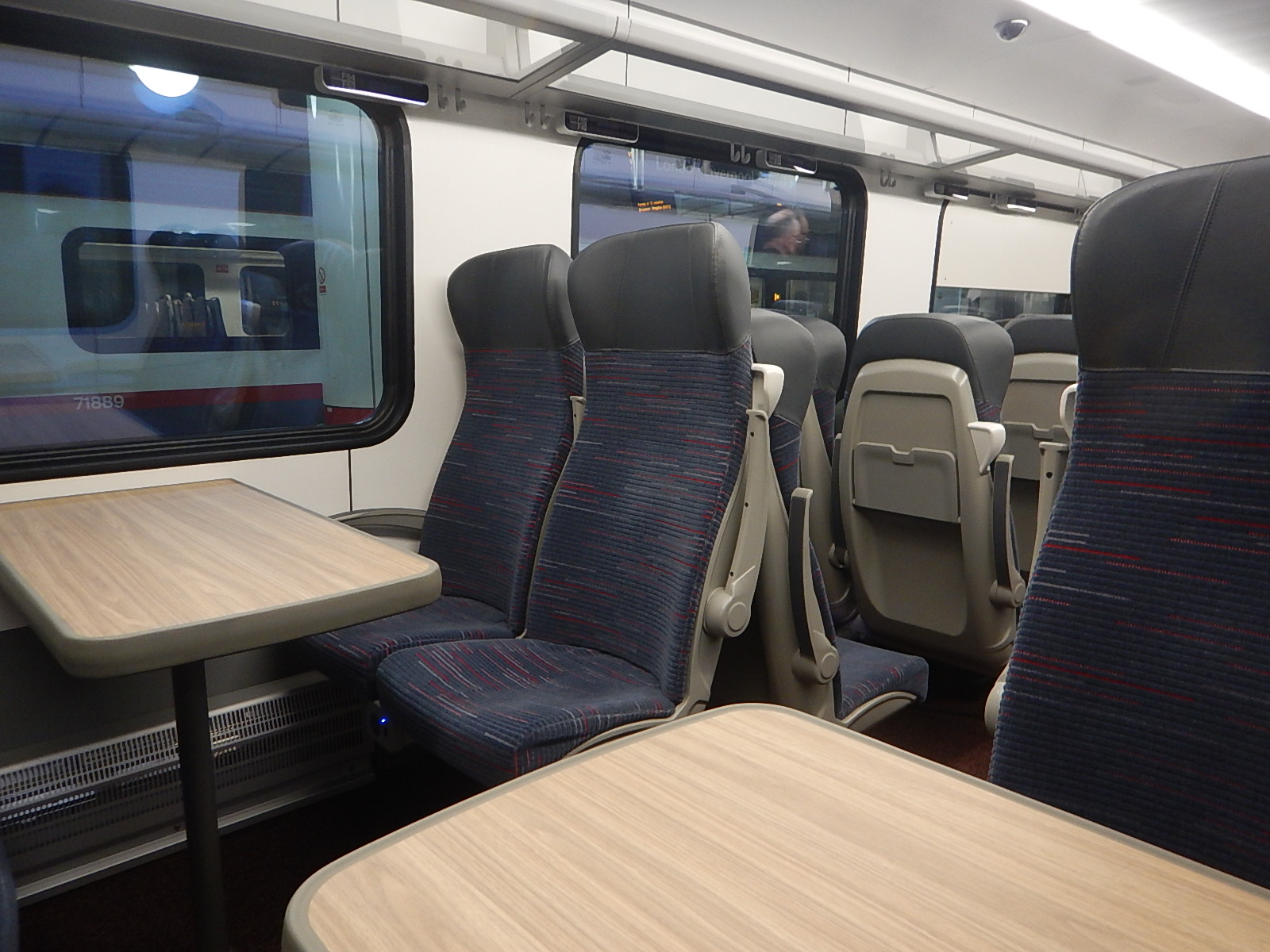
These higher seats, which are in groups of four are a good design solution to maintaining the level floor in the train over the bogies and with their large windows, I feel they would be ideal for families.
You are also slightly isolated from the rest of the train, so could be ideal for a group of people wanting to have a slightly confidential meeting on the train.
Do you get some of the advantages of a compartment, without any of the inconvenience for train operators and passengers?
This article on Rail Magazine is entitled First Pictures: Greater Anglia Reveals Interior Of New Intercity Fleet.
This paragraph describes the seating.
The ‘745/0s’ feature 752 seats (672 in Standard Class and 80 in First Class) compared to the 614 on existing nine-car sets (528 in Standard and 86 in First Class), while they retain the 2+2 seating in Standard Class and 2+1 in First Class. There is space for 245 standing passengers.
Greater Anglia claims there is the maximum padding allowed under stricter fire regulations.
First Class Seats
First Class looks spacious and the seat was better, as I stole a quick try, as I walked through.
If Greater Anglia continue Weekend First, I shall pay the extra if Ipswich lose on the way home.
Tables
In First Class all seats have proper tables and in Standard Class, there are more proper tables than in the Mark 3 coaches.
I didn’t check, but it appears most airline seats in Standard Class have a seat back table. As the Mark 3 coaches are well-provided with seat back tables, there would be protests, if the new trains aren’t the same.
I actually counted the number of four-place tables in Standard class and found their were forty-three pairs of tables on either side of the aisle.
As each table has four seats, this means that 344 seats in Standard Class have a full size table.
This means that just over half of Standard Class seats have a full size table.
In the old Mark 3 rakes of coaches, there are five Standard Class coaches, which each have seventy-four seats, which gives a total of 370 seats.
I feel that at most times of the day, nearly all Standard Class passengers will get a seat with a full-size table.
Greater Anglia seem to be giving passengers on their premium service a lot more space.
The Buffet
I only passed through the buffet, when the train was in Liverpool Street station and it was closed.
So I didn’t get to see the food and drink offering.
The buffet is placed between First and Standard Class, which is where it should be.
Walk-Through Train
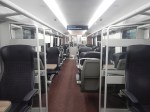
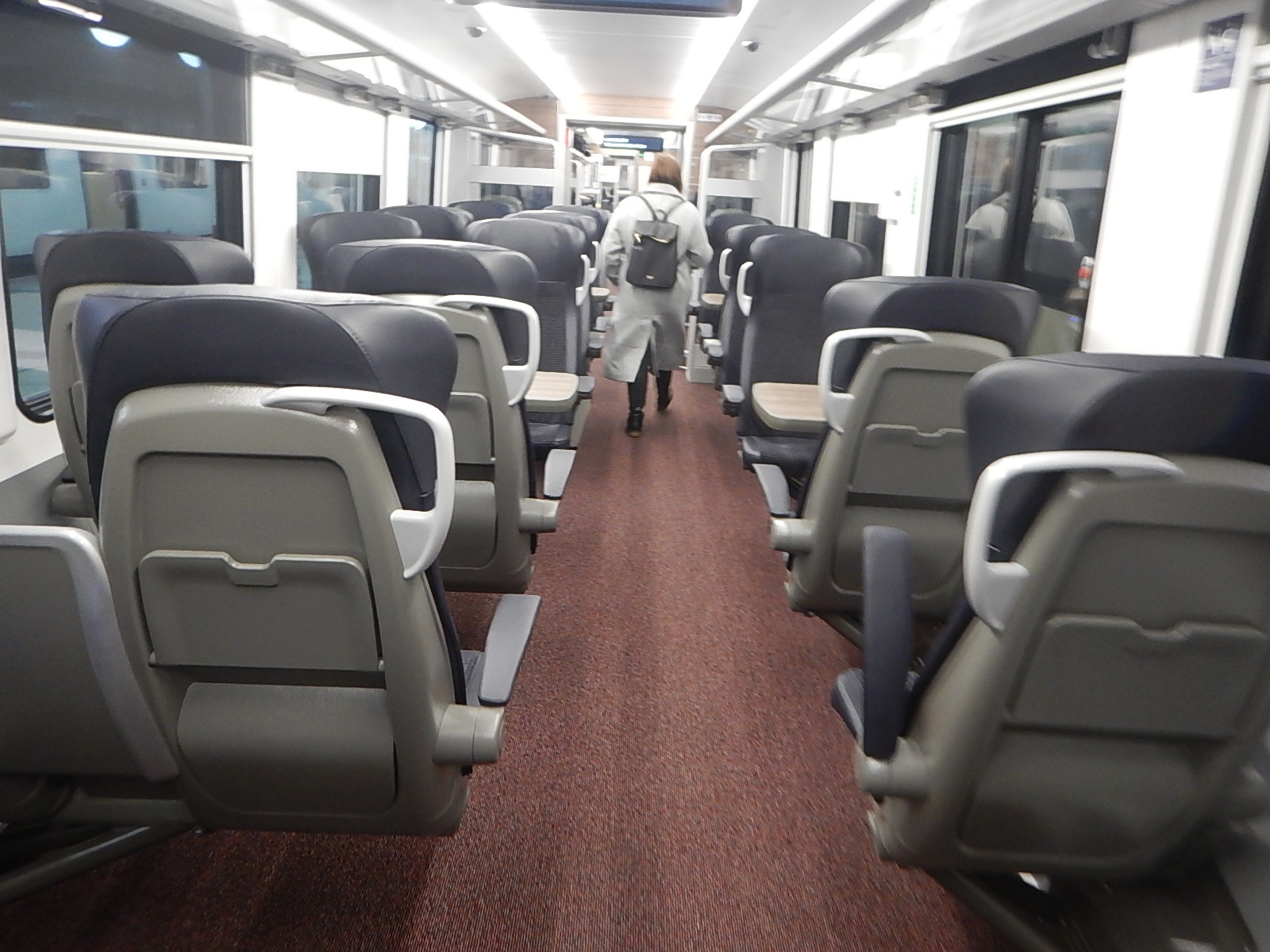
The Class 745 train is the UK’s first walk-through express train, with a nearly level floor from end to end.

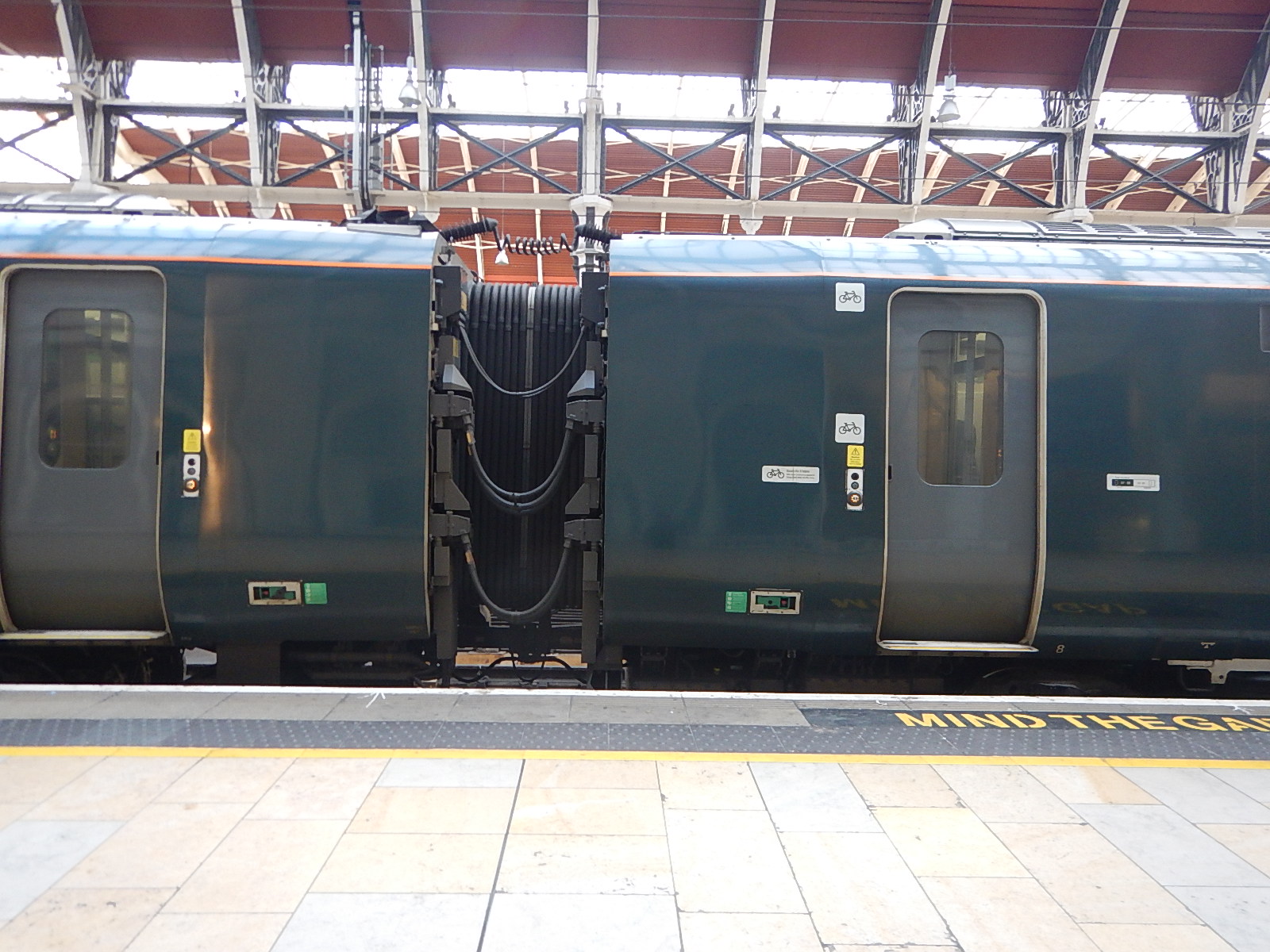
You can even walk through the equipment sections in the middle of the train, where the two halves join.
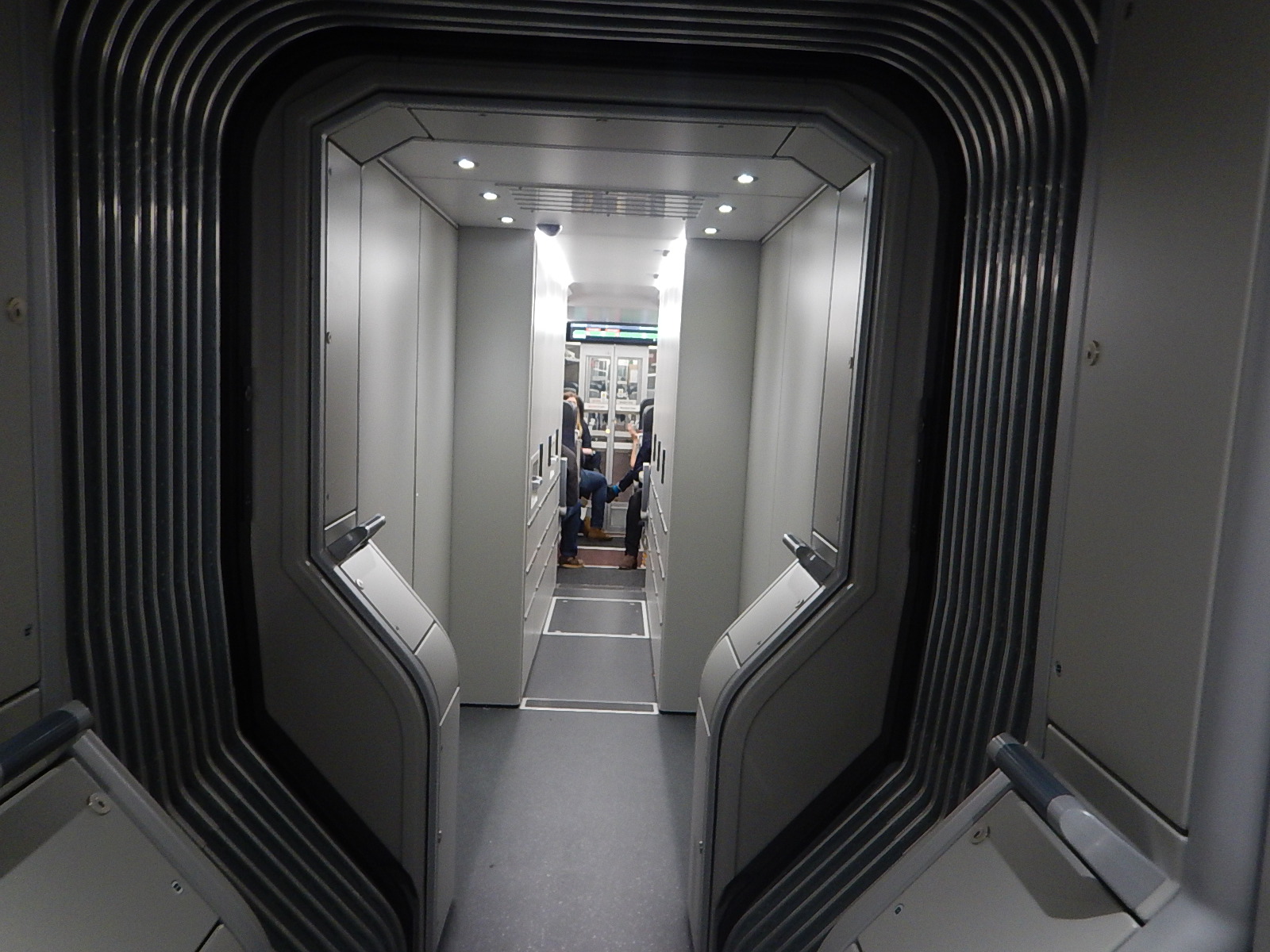
At very nearly 237 metres long, it is over thirty metres longer than Crossrail’s Class 345 trains, so the Class 745 trains must be the UK’s longest walk-through trains.
Note that a twelve-car Class 321 train is just over 239 metres long, with a twelve-car Class 360 train at 244 metres.
But these trains are not walk-through.
Catering Trolley
One benefit of the level walk-through floor, is that it must be easier for staff to push the catering trolley through the train.
As, it came through on both trips, it looks like Greater Anglia are doing the right thing with catering in both First and Standard Class.
However, I did meet a steward, who wasn’t looking forward to pushing a trolley all that way!
Ride Quality
I had no complaints, although not everyone likes sitting on top of the bogie, as it can be choppy.
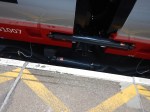
It should be noted that like the bi-modes, the train has yaw dampers between carriages.
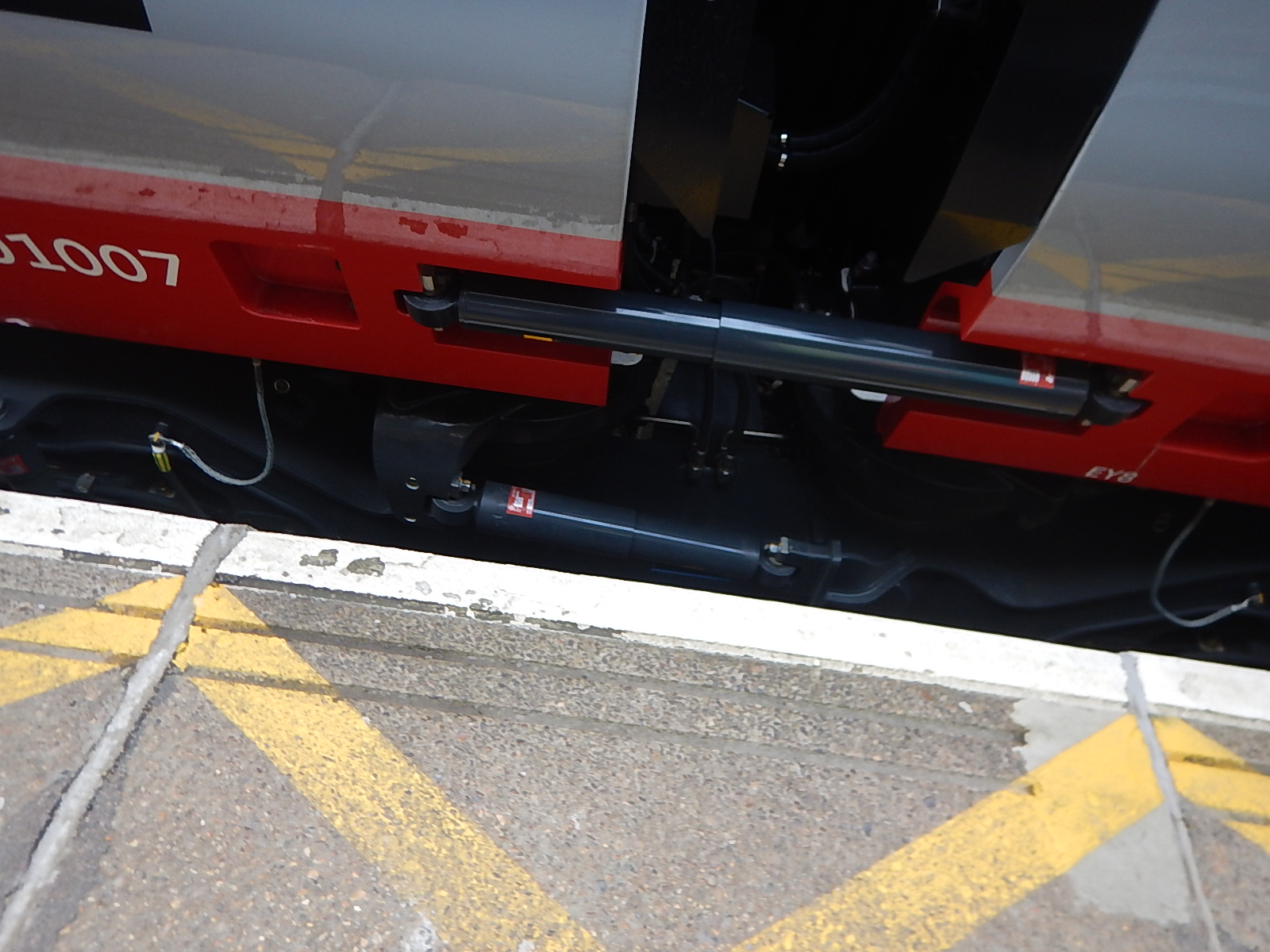
Note the second one lower down! That is not engineering by accountants!
Does these improve the ride? I didn’t ask Greater Anglia to take them off and have another trip!
Step-Free Access
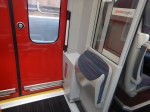
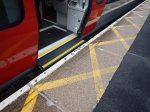
One of my gripes with many trains is the large step to get in or out of the train.
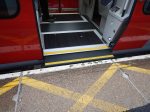
Compare this picture, which shows a Class 717 train at Moorgate station, with this second picture of the step on a Class 745 train at Colchester.
Note too, the wide-double door, which is much more like that of a high-capacity commuter train, than an express designed for two-hour journeys.
I appreciate these touches, as I could have been in a wheel-chair after my stroke.
But the Devil thought I’d be a troublemaker, so she gave me a second chance and threw me back!
A Driver’s View
Sitting opposite was a Greater Anglia driver having his first trip on a Class 745 train.
He was training to change from Class 321 trains to the bi-mode Class 755 trains and seemed genuinely enthusiastic to get driving his new charges.
But he said the best feature of both fleets of new trains from a driver’s point of view in the acceleration and he showed me an impressive video, which compared the acceleration of the old and new trains.
This acceleration will save a few minutes,
He was also very interested in hydrogen power, so I told him about my adventures in the North of the Netherlands.
Performance
When Norwich-in-Ninety services started in May 2019, I wrote Norwich-In-Ninety Is A Lot More Than Passengers Think!.
I described a ride from Norwich to London in ninety minutes in the Mark 3 coaches hauled by a Class 90 locomotive, where for much of the route, we were cruising at the route’s maximum speed of 100 mph.
Today, the Class 745 train was at 100 mph for long periods and appeared to be running easily.
But then a Class 745 train, has a power output of 5,200 kW compared with the 3,730 kW of a Class 90 locomotive. The new train may have twenty-three percent more seats, but it also has nearly forty percent more power.
This is certainly one reason for the acceleration, shown in the driver’s video.
Various fast trains can be compared.
- Pendelino Class 390/0 – 125 mph – 9 cars – 469 seats – 5,100 kW
- Pendelino Class 390/1 – 125 mph – 11 cars – 589 seats – 5,950 kW
- Class 745 – 100 mph – 12 cars – 747 seats – 5,200 kW
- Class 755 – 100 mph – 4 cars – 229 seats – 2,600 kW
- Class 801 – 125 mph – 9 cars – 611 seats – 4,000 kW
- InterCity 125 – 125 mph – 8 cars – 514 seats – 3,400 kW
- InterCity 225 – 125 mph – 9 cars – 535 seats – 4,700 kW
Note.
- Except for their 100 mph, the Class 745 fit well into the table.
- They have more seats than any other trains in the table.
- They have more power than a Class 801, an InterCity 225 and the short Pendelinos.
- The bi-mode Class 755 trains are no wimps either.
Both the Class 745 and Class 755 trains really are high-powered Swiss rockets.
Could they go faster?
There are 120 mph Flirts running in Norway, but the maximum speed on the Great Eastern Main Line is only 100 mph, so they couldn’t run any faster there.
But a senior Greater Anglia driver told me, that the bi-mode Class 755 trains have been designed for 125 mph.
As an engineer, this is not unexpected, as Europe has a plethora of rail lines with a 200 kph or 125 mph operating speed, that have branches that extend to sizeable towns and cities that need an improved rail service.
In the UK, think of LNER’s recently introduced services to Lincoln and Harrogate, where there is a 125 mph electric dash on the East Coast Main Line and a diesel trundle to the destination.
As the two classes of Greater Anglia trains and the Norwegian Flirts seem to use the same running gear, is there lucking in that body a cheetah wanting to be unleashed.
If so, the Hitachi trains have a serious rival!
But could the Class 745 trains go faster on the Great Eastern Main Line?
For periods yesterday, the Speedview app on my phone, was showing a steady 100 mph. But the route to Colchester is crowded with 100 mph commuter trains, which probably preclude faster running.
But get North of Ipswich and in a few months, the only non-Flirt traffic, will be the freight trains to and from Felixstowe, which use the Great Eastern Main Line on the fifteen miles between Ipswich and Haughley Junction.
The Northern section of the Great Eastern Main Line has two major bottlenecks.
- Haughley Junction, which needs remodelling to handle the large numbers of freight trains.
- Trowse swing bridge and its single track, which needs replacing with a proper bridge and a double track.
Both projects are under development by Network Rail.
However, between the two bottlenecks, the track was built for Victorian high speed. and is reasonably straight across flat country, with one station and a few level crossings.
Currently, the Norwich-in-Ninety trains can achieve the following.
- Norwich and Haughley Junction, which is 32 miles, in around 26 minutes at an average speed of 73 mph.
- Norwich and Ipswich station, which is 46 miles, in around 35 minutes at an average speed of 79 mph.
Note there is a stop at Diss, where the Class 745 trains might save a few seconds because of their level access and fast acceleration.
Whilst the two major projects at Trowse and Haughley Junction are carried out, will Network Rail improve the track between Ipswich and Norwich to allow faster running.
Being able to average 100 mph between Norwich and Ipswich would knock several minutes off the journey time.
Conclusion
Hitachi have a serious competitor.
Trump And Flight PS572
What puzzles me about all this is Trump’s reaction.
If he were true to his past persona, he would be very much angrier and vowing vengeance, but his reaction seems almost calm and very measured.
Perhaps, he knows for certain, that it was a tragic accident, that happened to Flight PS572. After all the UK, US, Canada and Ukraine seem to be saying similar things.
Someone or something, seems to have got Trump to see sense!
Melania, Justin, Boris, Emmanuel, Dominic or Angela? Or was it the Italian guy, who does his hair?
London Overground Ticket Office Closures As 2% Of Tickets Are Bought Through Them
The title of this post, is the same as that of this article in Rail Advent magazine.
This is the introductory paragraph.
Transport for London has announced that the hours at some London Overground ticket offices will start to change over the next few weeks to match the times customers use them.
That sounds fine by me, as any company or organisation, should make best uses of resources.
It should be born in mind, that London Overground’s policy is to always have staff visible, when the trains are running.
Greater Anglia Launches New Intercity Trains On Norwich-London Route
The title of this post, is the same as that of this article on Rail Magazine.
The first Class 745 train to enter service left Norwich this morning at 0740 and arrived in Liverpool Street on time at 0924.
There is a more informative article in the East Anglia Daily Times, which is entitled East Anglia’s New Intercity Train Carries Its First Passengers.
Points include.
- There is a cafe bar and First Class accommodation.
- I’ve read elsewhere, there will be a trolley service.
- All ten trains are expected to be in service by the end of March.
- They will be introduced at a rate of one train per week.
- Introduction will enable services run by older trains to be run by eight or nine carriages.
- There are wide passages between carriages.
- Seats are firmer than the older carriages.
- Passengers liked the headrests.
- Wi-fi is getting good reports.
- Lots of charging points.
- Step-free access is very good.
- On-board toilets are fine.
- One passenger said there were more tables.
- Another passenger thought the new trains better than the old ones.
Inevitably these new trains will be compared with Hitachi’s Class 802 trains and other members of the family.
Operating Speed
These Stadler trains and the bi-mode Class 755 trains are only 100 mph trains, as that is the maximum speed anywhere in East Anglia.
But a driver told me, that both trains are designed for 125 mph and as some of their European siblings, run at that speed in service, I have no reason to disbelieve him.
On the other hand, the Hitachi trains are capable of 125 mph or 140 mph, where in-cab digital signalling is installed.
Train Length
The lengths of the two trains are as follows.
- A nine-car Class 802 train is 234 metres long.
- A twelve-car Class 745 train is 236.6 metres long.
The difference won’t matter much, whre it concerns, the stations, that the trains can serve.
Passenger Entry
Doors are different on the two trains.
- A nine-car Class 802 train has two single doors on each side of the car or 18 single doors per train on each side.
- A twelve-car Class 745 train a pair of double doors on each side of the car or 24 doors per train on each side.
Train-And-Platform Step
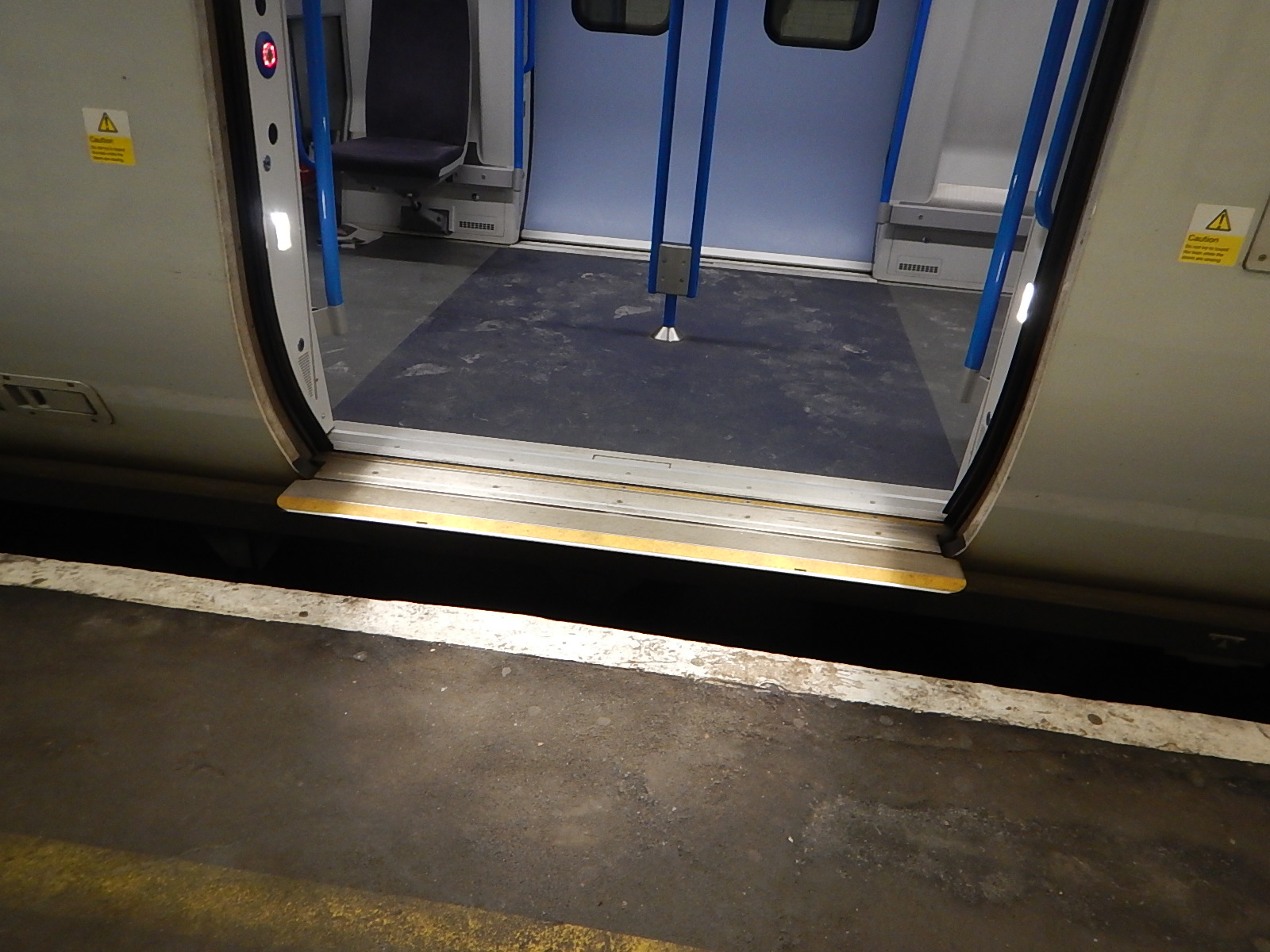
This picture shows the step across in a Class 802 train.
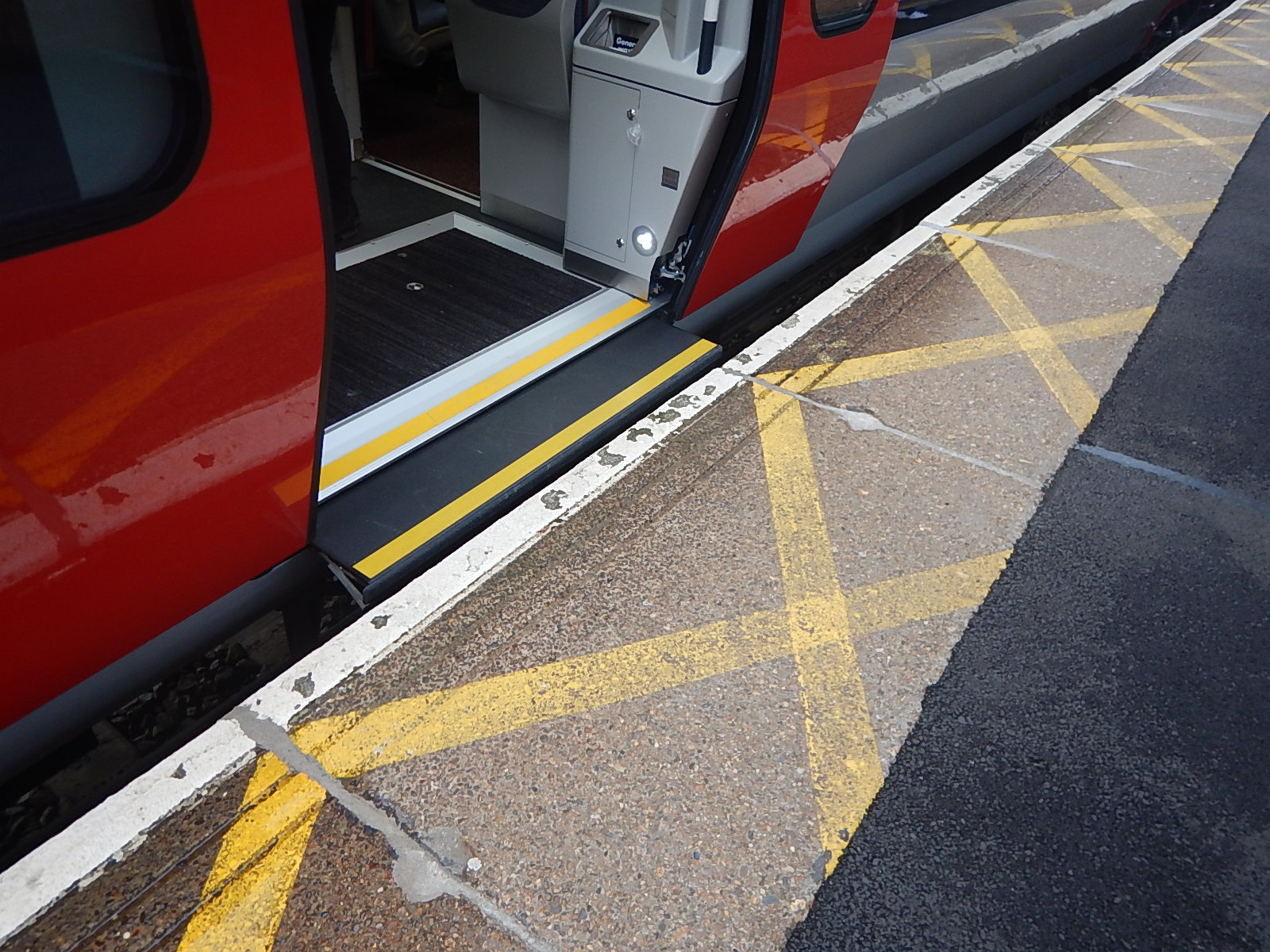
And this picture shows the step across in a Stadler Class 745 train.
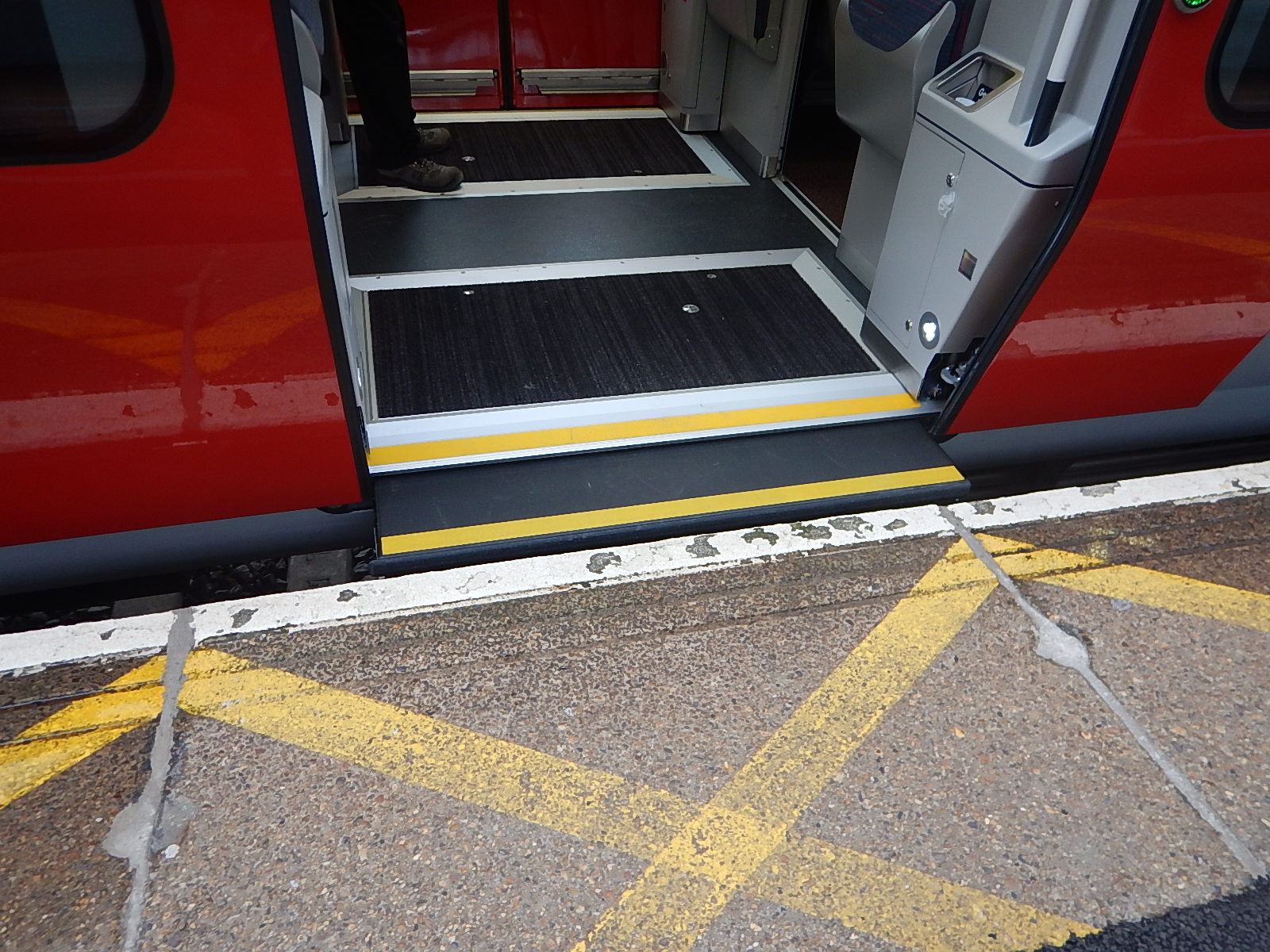
All trains should have an entry like this at all platforms.
Passenger Capacity
- A nine-car Class 802 train holds 576 standard, 71 First or 647 total passengers.
- A twelve-car Class 745 train holds 757 total passengers, including some First Class.
The Greater Anglia train holds seventeen percent more passengers in a train of the same overall length.
Do passengers sit in each other’s laps?
No! I suspect it’s all down to good design.
Exit From A Full Train
Many InterCity trains arrive at their destination full and passengers are in a hurry to get on with their journey.
- A full nine-car Class 802 train has 35 passengers per single door, a narrow lobby and a step down onto the platform.
- A twelve-car Class 745 train has 62 passengers per double doors, a more spacious lobby and level access to the platform.
I shall be watching as a Class 745 train unloads 757 passengers at Liverpool Street station in the Peak.
C
Company Hopes To Use Railways To Develop Drone Delivery Corridors
The title of this post, is the same as that of this article on Railway Gazette.
The first two paragraphs explain the idea.
SkyRights Holdings is seeking to partner with Class I railways to make their alignments available for use by drone delivery companies and for ‘urban air mobility’ applications.
The company said the airspace above railways offers ‘a unique solution to address the safety, electric charging infrastructure and liability management challenges when compared to flying delivery drones over populated areas.’
I think this could be very feasible.
Fuelling The Change On Teesside Rails
The title of this post, is the same as that of an article in Edition 895 of RAIL Magazine.
The article is based on an interview with Ben Houchen, who is the Tees Valley Mayor.
Various topics are covered.
Hydrogen-Powered Local Trains
According to the article, the Tees Valley produces fifty percent of UK hydrogen and the area is already secured investment for fuelling road vehicles with hydrogen.
So the Tees Valley Combined Authority (TVCA) is planning to convert some routes to hydrogen.
The Trains
Ten hydrogen-powered trains will be purchased or more likely leased, as the trains will probably be converted from redundant electrical multiple units, owned by leasing companies like Eversholt Rail and Porterbrook.
- Eversholt Rail and Alstom are developing the Breeze from Class 321 trains.
- Porterbrook and Birmingham University are developing the HydroFLEX from Class 319 trains.
The RAIL article says that the first train could be under test in 2021 and service could be started in 2022.
That would certainly fit the development timetables for the trains.
Lackenby Depot
A depot Will Be Created At Lackenby.
- The site is between Middlesbrough and Redcar.
- It already has rail and hydrogen connections.
This Google Map shows the area.
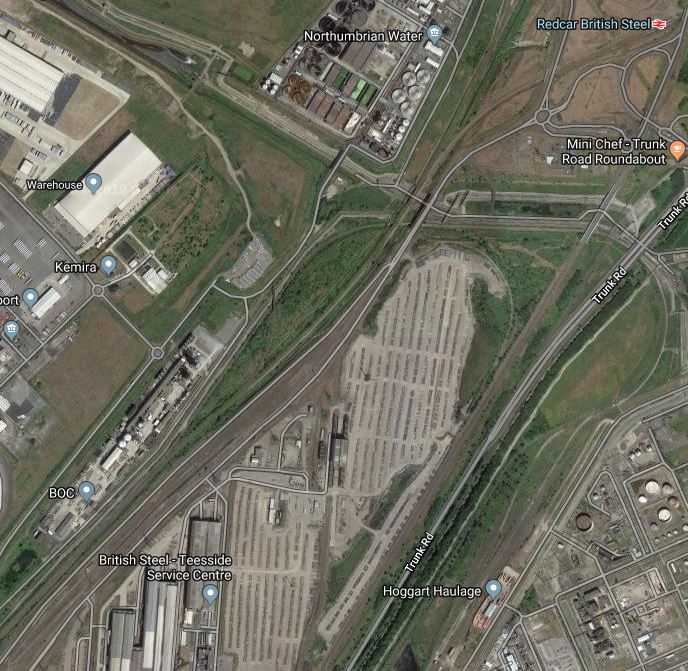
Note the disused Redcar British Steel station, which is still shown on the map.
I remember the area from the around 1970, when I used to catch the train at the now-closed Grangetown station, after visits to ICI’s Wilton site. It was all fire, smoke, smells and pollution.
Darlington Station
Darlington station will also be remodelled to allow more services to operate without conflicting with the East Coast Main Line.
Wikipedia says this under Future for Darlington station.
As part of the Tees Valley Metro, two new platforms were to be built on the eastern edge of the main station. There were to be a total of four trains per hour, to Middlesbrough and Saltburn via the Tees Valley Line, and trains would not have to cross the East Coast Main Line when the new platforms would have been built. The Tees Valley Metro project was, however, cancelled.
It does sound from reading the RAIL article, that this plan is being reinstated.
Would services between Bishop Auckland and Saltburn, use these new platforms?
Saltburn And Bishops Auckland Via Middlesbrough and Darlington
Currently, the service is two trains per hour (tph) between Saltburn and Darlington, with one tph extending to Bishop Auckland.
- I estimate that the current service needs five trains.
- If a two tph service were to be run on the whole route, an extra train would be needed.
- I suspect, the limitations at Darlington station, stop more trains being run all the way to Bishops Auckland.
I could also see extra stations being added to this route.
The Mayor is talking of running a service as frequent as six or eight tph.
These numbers of trains, will be needed for services of different frequencies between Saltburn and Darlington.
- 2 tph – 6 trains
- 4 tph – 12 trains
- 6 tph – 18 trains
- 8 tph – 24 trains
As the London Overground, Merseyrail and Birmingham’s Cross-City Line, find four tph a more than adequate service, I suspect that should be provided.
After updating, Darlington station, should be able to handle the following.
- Up to six tph terminating in one of the new Eastern platforms, without having to cross the East Coast Main Line.
- Two tph between Saltburn and Bishops Auckland could use the other platform in both directions.
I would suspect that the design would see the two platforms sharing an island platform.
Alternatively, trains could continue as now.
- Terminating trains could continue to use Platform 2!
- Two tph between Saltburn and Bishops Auckland stopping in Platforms 1 (Eastbound) and 4 (Westbound)
This would avoid any infrastructure changes at Darlington station, but terminating trains at Darlington would still have to cross the Southbound East Coast Main Line.
If the frequencies were as follows.
- 4 tph – Saltburn and Darlington
- 2 tph – Saltburn and Bishop Auckland
This would require fourteen trains and give a six tph service between Saltburn and Darlington.
Ten trains would allow a two tph service on both routes.
There would be other services using parts of the same route, which would increase the frequency.
Hartlepool And The Esk Valley Line Via Middlesbrough
This is the other route through the area and was part of the cancelled Tees Valley Metro.
- Service is basically one tph, with six trains per day (tpd) extending to Whitby.
- A second platform is needed at Hartlepool station.
- There is a proposal to add a Park-and-Ride station between Nunthorpe and Great Ayton stations.
- One proposal from Modern Railways commentator; Alan Williams, was to simplify the track at Battersby station to avoid the reverse.
- Currently, trains between Whitby and Middlesbrough are timetabled for around 80-100 minutes.
- Hartlepool and Middlesbrough takes around twenty minutes.
Substantial track improvements are probably needed to increase the number of trains and reduce the journey times between Middlesbrough and Whitby.
But I believe that an hourly service between Hartlepool and Whitby, that would take under two hours or four hours for a round trip, could be possible.
This would mean that the hourly Hartlepool and Whitby service would need four trains.
Providing the track between Nunthorpe and |Whitby could be improved to handle the traffic, this would appear to be a very feasible proposition.
Nunthorpe And Hexham Via Newcastle
There is also an hourly service between Nunthorpe and Hexham, via Middlesbrough, Stockton, Hartlepool, Sunderland and Newcastle, there would be two tph.
- It takes around two hours and twenty minutes.
- I estimate that five trains would be needed for the service.
- I travelled once between Newcastle and James Cook Hospital in the Peak and the service was busy.
- A new station is being built at Horden, which is eight minutes North of Hartlepool.
- The service could easily access the proposed fuelling station at Lackenby.
- It would reduce carbon emissions in Newcastle and Sunderland stations..
Surely, if hydrogen power is good enough for the other routes, then it is good enough for this route.
Hartlepool Station
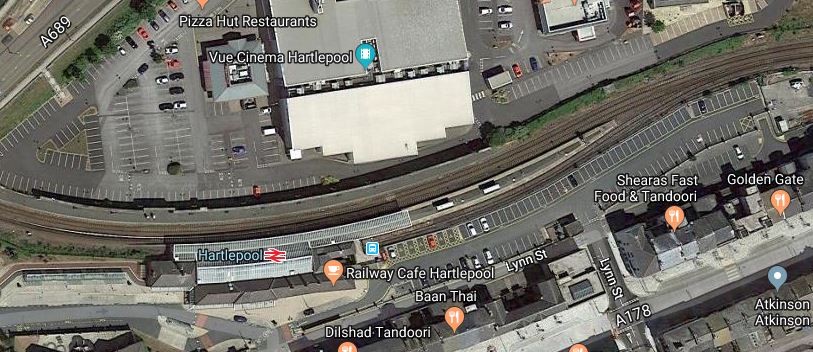
Hartlepool Station could become a problem, as although it is on a double track railway, it only has one through platform, as these pictures from 2011 show.

Consider.
- There is no footbridge, although Grand Central could pay for one
- There is a rarely-used bay platform to turn trains from Middlesbrough, Nunthorpe and Whitby.
This Google Map shows the cramped site.
The final solution could mean a new station.
Nunthorpe Park-And-Ride
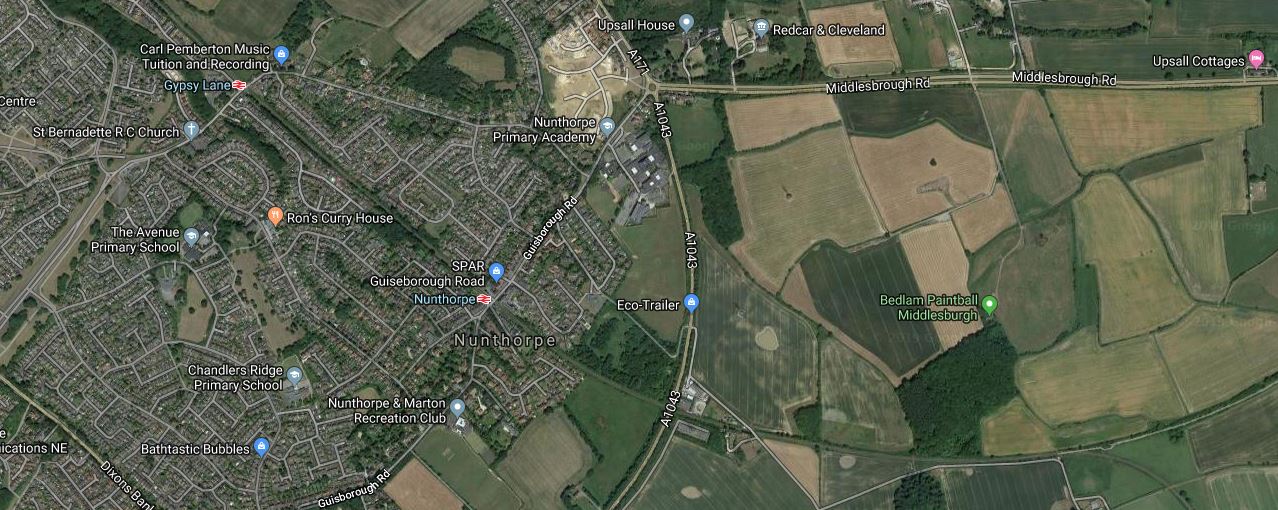
This Google Map shows Nunthorpe with thje bEsk Valley Line running through it.
Note.
- Gypsy Lane and Nunthorpe stations.
- The dual-carriageway A171 Guisborough by-pass running East-West, that connects in the East to Whitby and Scarborough.
- The A1043 Nunthorpe by-pass that connects to roads to the South.
Would where the A1043 crosses the Esk Valley Line be the place for the Park-and-Ride station?
The new station could have a passing loop, that could also be used to turn back trains.
Battersby Station
Alan Williams, who is Chairman of the Esk Valley Railway Development Company, is quoted in the RAIL article as saying.
If you’re going to spend that sort of money we’d much rather you spent it on building a curve at Battersby to cut out the reversal there.
Williams gives further reasons.
- Battersby is the least used station on the line.
- It’s in the middle of nowhere.
- The curve would save five minutes on the overall journey.
This Google Map shows Battersby station and the current track layout.

Note.
- The line to Middlesbrough goes through the North-West corner of the map.
- The line to Whitby goes through the North-East corner of the map.
There would appear to be plenty of space for a curve that would cut out the station.
LNER To Teesside
LNER, the Government and the TVCA are aiming to meet a target date of the Second Quarter of 2021 for a direct London and Middlesbrough service.
Middlesbrough Station
Middlesbrough Station will need to be updated and according to the RAIL article, the following work will be done.
- A new Northern entrance with a glass frontage.
- A third platform.
- Lengthening of existing platforms to take LNER’s Class 800 trains.
This Google Map shows the current layout of the station.
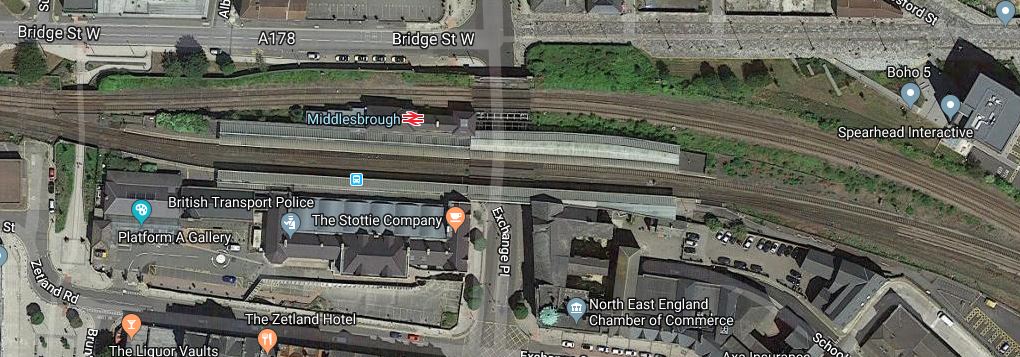
From this map it doesn’t look to be the most difficult of stations, on which to fit in the extra platform and the extensions.
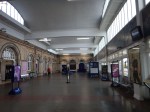
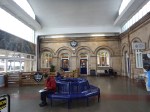



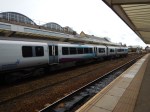
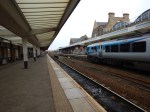
It should also be noted that the station is Grade II Listed, was in good condition on my last visit and has a step-free subway between the two sides of the station.
Journey Times
I estimate that a Kings Cross and Middlesbrough time via Northallerton would take aroud two hours and fifty minutes.
This compares with other journey times in the area to London.
- LNER – Kings Cross and Darlington – two hours and twenty-two minutes
- Grand Central – Kings Cross and Eaglescliffe – two hours and thirty-seven minutes.
I also estimate that timings to Redcar and Saltburn would be another 14 and 28 minutes respectively.
Frequencies
Currently, LNER run between three and four tph between Kings Cross and Darlington, with the competing Grand Central service between Kings Cross and Eaglescliffe having a frequency of five trains per day (tpd).
LNER have also started serving secondary destinations in the last month or so.
- Harrogate, which has a population of 75.000, is served with a frequency of six tpd.
- Lincoln, which has a population of 130,000 is now served with a frequency of six tpd.
Note that the RAIL article, states that the Tees Valley has a population of 750,000.
I feel that Middlesbrough will be served by a frequency of at least five tpd and probably six to match LNER’s new Harrogate and Lincoln services.
Will LNER’s Kings Cross and York Service Be Extended To Middlesbrough?
Cirrently , trains that leave Kings Cross at six minutes past the hour end up in Lincoln or York
- 0806 – Lincoln
- 0906 – York
- 1006 – Lincoln
- 1106 – York
- 1206 -Lincoln
- 1306 – York
- 1406 – Lincoln
- 1506 – York
- 1606 – Lincoln
- 1906 -Lincoln
It looks to me that a pattern is being developed.
- Could it be that the York services will be extended to Middlesbrough in 2021?
- Could six Middlesbrough trains leave Kings Cross at 0706, 0906, 1106, 1306, 1506 and 1706 or 1806?
- York would still have the same number of trains as it does now!
LNER certainly seem to be putting together a comprehensive timetable.
Could Middlesbrough Trains Split At Doncaster Or York?
I was in Kings Cross station, this afternoon and saw the 1506 service to York, go on its way.
The train was formed of two five-car trains, running as a ten-car train.
If LNER employ spitting and joining,, as some of their staff believe, there are surely, places, where this can be done to serve more destinations, without requiring more paths on the East Coast Main Line.
- Splitting at Doncaster could serve Hull, Middlesborough and York.
- Splitting at York could serve Scarborough, Middlesborough and Sunderland.
Scarborough might be a viable destination, as the town has a population of over 100,000.
Onward To Redcar And Saltburn
One of the changes in the December 2019 timetable change, was the extension of TransPennine Express’s Manchester Airport and Middlesbrough service to Redcar Central station.
The RAIL article quotes the Mayor as being pleased with this, although he would have preferred the service to have gone as far as Saltburn, which is a regional growth point for housing and employment.
But the extra six miles would have meant the purchase of another train.
Redcar Central Station
This Google Map shows Redcar Central station and its position in the town.
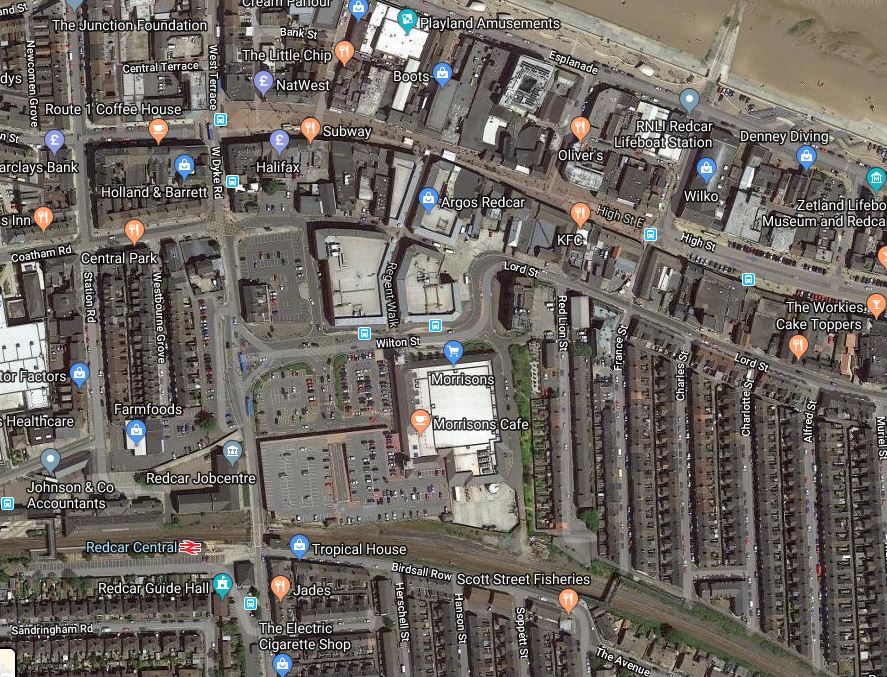
It is close to the sea front and the High Street and there appears to be space for the stabling of long-distance trains to Manchester Airport and perhaps, London.
TransPennine seem to be using their rakes of Mark 5A coaches on Redcar services, rather than their Class 802 trains, which are similar to LNER’s Azumas.
Surely, there will be operational advantages, if both train operating companies ran similar trains to Teesside.
Saltburn Station
Saltburn station is the end of the line.
This Google Map shows its position in the town.
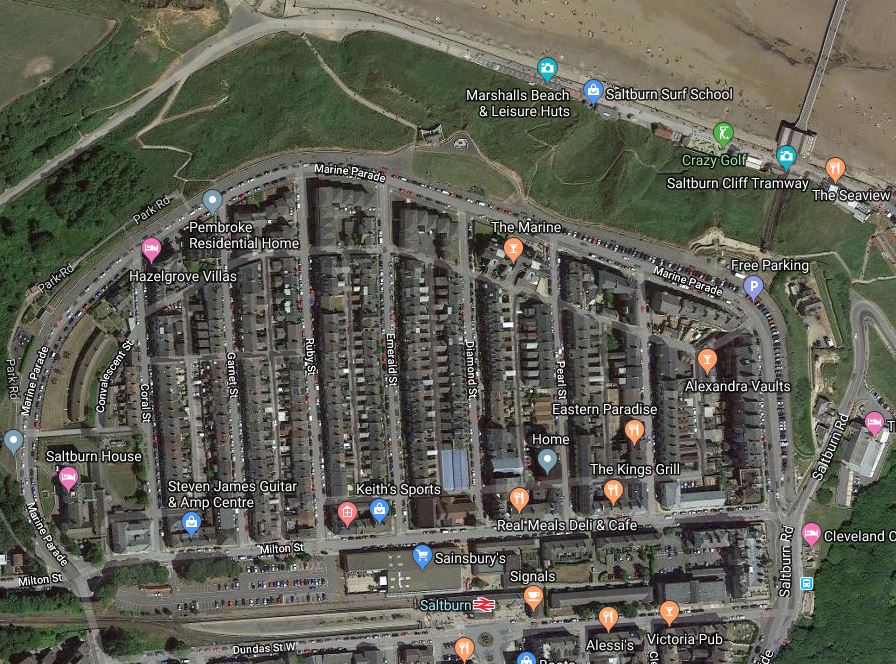
Unlike Redcar Central station, there appears to be very little space along the railway and turning back trains might be difficult.
There may be good economic reasons to use Saltburn as a terminal, but operationally, it could be difficult.
Will Redcar And Saltburn See Services To and From London?
Given that both towns will likely see much improved services to Middlesbrough, with at least a service of four tph, I think it will be unlikely.
But we might see the following.
- LNER using Redcar as a terminus, as TransPennine Express do, as it might ease operations.
- An early morning train to London and an evening train back from the capital, which is stabled overnight at Redcar.
- TransPennine Express using Class 802 trains on their Redcar service for operational efficiency, as these trains are similar to LNER’s Azumas.
It would all depend on the passenger numbers.
A High-Frequency Service Between York And Teesside
After all the changes the service between York and Teesside will be as follows.
- LNER will be offering a train virtually every two hours between York and Middlesbrough.
- Grand Central will be offering a train virtually every two hours between York and Eaglescliffe, which is six miles from Middlesbrough.
- TransPennine Express will have an hourly service between York and Redcar via Middlesbrough.
- There will be between three and four tph between York and Darlington.
All services would connect to the hydrogen-powdered local services to take you all over Teesside.
Could this open up tourism without cars in the area?
Expansion Of The Hydrogen-Powered Train Network
Could some form of Hydrogen Hub be developed at Lackenby.
Alstom are talking of the hydrogen-powered Breeze trains having a range of over six hundred miles and possibly an operating speed of 100 mph, when using overhead electrification, where it is available.
In Breeze Hydrogen Multiple-Unit Order Expected Soon, I put together information from various articles and said this.
I am fairly certain, that Alstom can create a five-car Class 321 Breeze with the following characteristics.
- A capacity of about three hundred seats.
- A smaller three-car train would have 140 seats.
- A near-100 mph top speed on hydrogen-power.
- A 100 mph top speed on electrification.
- A 1000 km range on hydrogen.
- Regenerative braking to an on-board battery.
- The ability to use 25 KVAC overhead and/or 750 VDC third rail electrification.
The trains could have the ability to run as pairs to increase capacity.
The distance without electrification to a selection of main stations in the North East from Lackenby is as follows.
- Newcastle via Middlesbrough and Darlington – 21 miles
- Newcastle via Middlesbrough and Durham Coast Line – 53 miles.
- York via Northallerton – 27 miles
- Doncaster via Northallerton and York – 27 miles
- Leeds via Northallerton and York – 52 miles
- Sheffield via Northallerton, York and Doncaster – 45 miles
I am assuming that the trains can use the electrification on the East Coast Main Line.
From these figures it would appear that hydrogen-powered trains stabled and refuelled at Lackenby could travel to Doncaster, Newcastle, Leeds, Sheffield or York before putting in a days work and still have enough hydrogen in the tank to return to Lackenby.
Several things would help.
- As hydrogen-powered trains have a battery, with a battery range of thirty miles all these main stations could be reached on battery power, charging on the East Coast Main Line and at Lackenby.
- Electrification between Darlington and Lackenby.
- Electrification between Northallerton and Eaglescliffe.
I am fairly certain that a large proportion of the intensive network of diesel services in the North East of |England from Doncaster and Sheffield in the South to Newcastle in the North, can be replaced with hydrogen-powered trains.
- Trains could go as far West as Blackpool North, Carlisle, Manchester Victoria, Preston and Southport.
- Refueling could be all at Lackenby, although other refuelling points could increase the coverage and efficieny of the trains.
- Green hydrogen could be produced by electrolysis from the massive offshore wind farms off the Lincolnshire Coast.
- Hydrogen-powered trains would be ideal for re-opened routes like the proposed services from Newcastle to Blyth and Ashington.
The hydrogen-powered trains on Teesside could be the start of a large zero-carbon railway network.
The Alstom Breeze And The HydroFlex Would Only Be The Start
As I said earlier, the initial trains would be conversions of redundant British Rail-era electrical multiple units.
Thirty-year-old British Rail designs like the Class 319 and Class 321 trains based on the legendary Mark 3 carriages with its structural integrity and superb ride, may have been state-of-the-art in their day, but engineers can do better now.
- Traction and regenerative braking systems are much more energy efficient.
- Train aerodynamics and rolling resistance have improved, which means less energy is needed to maintain a speed.
- Interior design and walk-through trains have increased capacity.
- Crashworthiness has been improved.
Current Bombardier Aventras, Stadler Flirts or Siemens Desiros and CAF Civities are far removed from 1980s designs.
I can see a design for a hydrogen-powered train based on a modern design, tailored to the needs of operators being developed.
A place to start could be an electric CAF Class 331 train. or any one of a number of Aventras.
- From the visualisation that Alstom have released of their Breeze conversion of a Class 321 train, I feel that to store enough hydrogen, a large tank will be needed and perhaps the easiest thing to do at the present time would be to add an extra car containing the hydrogen tank, the fuel cells and the batteries.
- Alstom have stated they’re putting the fuel cells on the roof and the batteries underneath the train.
Although, it is not a hydrogen train, Stadler have developed the Class 755 train, with a power car in the middle of the train.
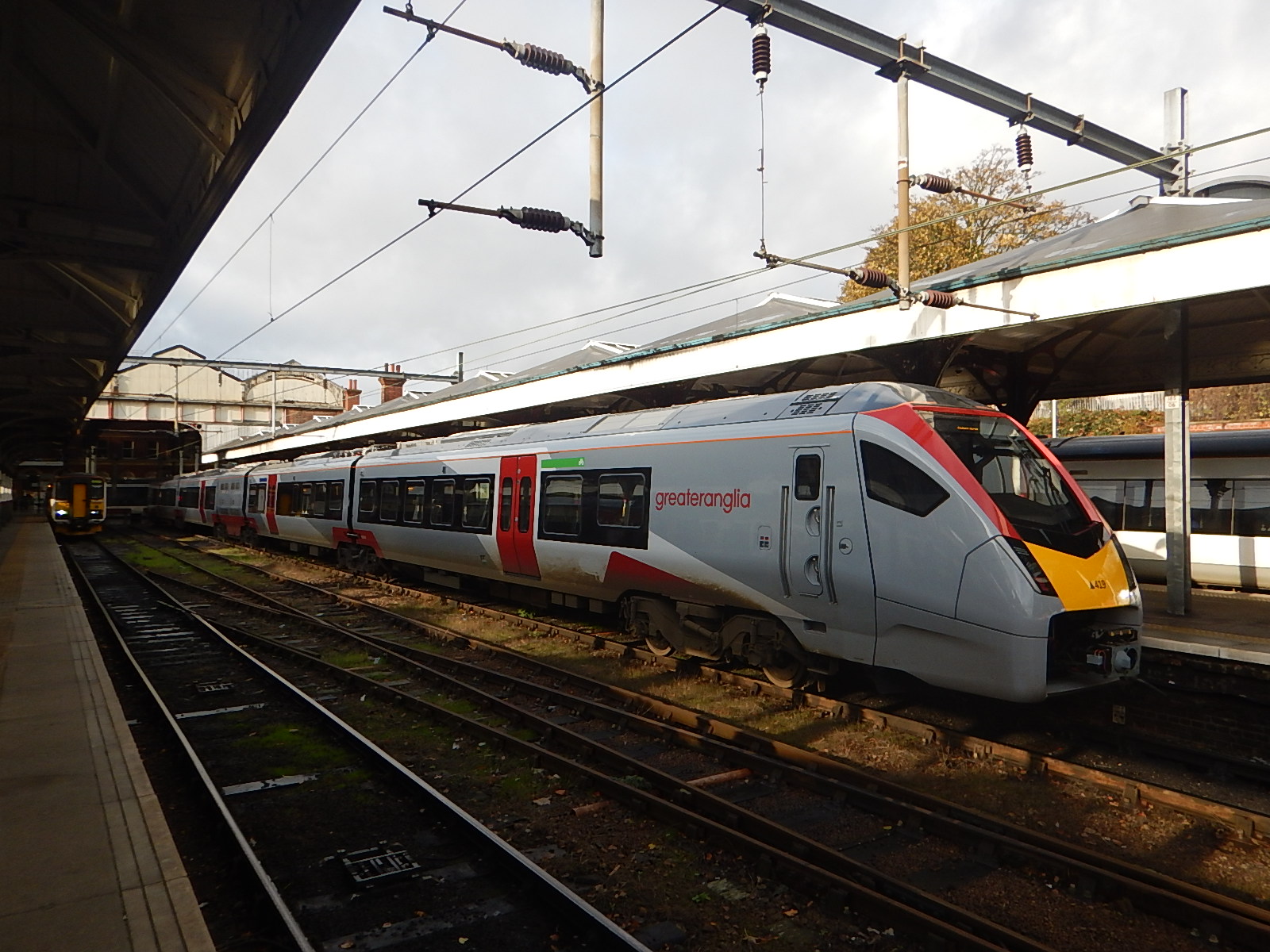
Stadler’s approach of a power car, must be working as they have received an order for a hydrogen-powered version of their popular Flirts, which I wrote about in MSU Research Leads To North America’s First Commercial Hydrogen-Powered Train.
I think we can be certain, that because of the UK loading gauge, that a hydrogen-powered train will be longer by about a car, than the equivalent electric train.
I can see a certain amount of platform lengthening being required. But this is probably easier and less costly than electrification to achieve zero-carbon on a route.
Batteries can be distributed under all cars of the train, anywhere there is space., But I would suspect that fuel cells must be in the same car as the hydrogen tank, as I doubt having hydrogen pipes between cars would be a good idea.
Alstom have resorted to putting hydrogen tanks and fuel cells in both driving cars and they must have sound reasons for this.
Perhaps, it is the only way, they can get the required power and range.
As I understand it, the Alstom Breeze draws power from three sources.
- The electrification if the route is electrified.
- The electricity generated by regenerative braking.
- The hydrogen system produces electricity on demand, at the required level.
Energy is stored in the batteries, which power the train’s traction motors and internal systems.
The electrical components needed for the train are getting smaller and lighter and I feel that it should be possible to put all the power generation and collection into a power car, that is somewhere near the middle of the train. Stadler’s power car is short at under seven metres, but there is probably no reason, why it couldn’t be the twenty metres, that are typical of UK trains.
Suppose you took a four-car version of CAF’s Class 331 train, which has two driver cars either side of a pantograph car and a trailer car.
This has 284 seats and by comparison with the three-car version the trailer car has eighty. As the pantograph car is also a trailer, I’ll assume that has eighty seats too! Until I know better!
Replacing the pantograph car with a hydrogen car, which would be unlikely to have seats, would cut the seats to 204 seats, but a second trailer would bring it back up to 284 seats.
I actually, think the concept of a hydrogen car in the middle of a four-car electric train could work.
- The five-car hydrogen train would have the same capacity as the four-car electric version.
- The train would need an updated software system and some rewiring. Bombardier achieved this quickly and easily with the train for the Class 379 BEMU trial.
- There are several types of four-car electrical multiple units, that could possibly be converted to five-car hydrogen-powered multiple units.
- Some five-car electrical multiple units might also be possible to be converted.
Obviously, if an existing train can be adapted for hydrogen, this will be a more cost effective approach.
Conclusion
Overall, the plans for rail improvements on Teesside seem to be good ones.
I’m looking forward to riding LNER to Teesside and then using the network of hydrogen-powered trains to explore the area in 2022.
My only worry, is that, if the network is successful, the many tourists visiting York will surely increase the numbers of day visitors to Whitby.
This is a paragraph from the RAIL article.
Alan Williams says that the EVRDC’s long-term objective is to see the Esk Valley served at intervals of roughly every two hours, equating to eight return trains per day, but with Northern and NYMR services sharing the single line between Grosmont and Whitby, introducing further Middlesbrough trains during the middle of the day, brings the conversation back to infrastructure.
He goes on to detail what is needed.
Walking Between Blackfriars And Hungerford Railway Bridges
These pictures were taken as I walked between Blackfriars and Hungerford railway bridges.









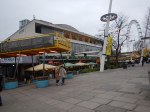
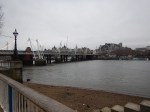


I was walking along the South Bank of the Thames.
Finsbury Park Station – 6th January 2020
Finsbury Park station now has a new entrance on the other side of the tracks.


London’s duck of a station is being turned into a swan.
- At least one new platform has been added.
- Buildings and passenger tunnels have been spruced up.
- Several lifts have been added to the maze of tunnels.
- Thameslink now runs four trains per hour (tph) through the station.
- Moorgate services are now eight tph and there is also a weekend service.
- Nearly all services stopping at the station are run by trains delivered in the last three years.
The new flats will be alongside a comprehensive station.
The Times Had A Hydrogen Saturday
The Times had a feature on Saturday about converting our gas grid to hydrogen and especially about using hydrogen boilers in our homes.
I believe that perhaps in ten years, our gas grid will be full of hydrogen and our central heating boilers will be powered by hydrogen.
The carbon emissions saved with be massive
I don’t know about cooking, but my Michelin-starred Scottish friend and chef, says that we’ll all cook on an electric induction hob.
A Large Collateral Benefit?
I think there will be a large collateral benefit.
At present there are only two feasible methods to power a vehicle without producing carbon emissions; battery or hydrogen.
- Battery vehicles need to be recharged and we need an enormous number of charging stations.
- Hydrogen vehicles need to be filled up from a hydrogen filling station.
It should be noted that the current Hyundai ix35 FCEV has a range of 369 miles on hydrogen.
But as you have a hydrogen gas supply to your house, could you fit a compressor in your garage to pump up your car’s hydrogen tank, when it needs it?
The technology is well-proven.
The only problem, that I can see, is that how will the Government tax it?
The future’s not orange it’s hydrogen.
Energy Storage 2020: It’s Not Just About Lithium-Ion Batteries Any More
The title of this post is the same as that of this article on Clean Technica.
The article is a must-read, as it surveys the various techniques being developed to store energy.
This is the last paragraph of the article.
The one thing we can take away from all this experimentation is that energy storage will be more affordable in the future, and that’s a very good thing for a world suffering heat exhaustion from traditional thermal generation strategies.
I agree!
 The Anonymous Widower