Should Everybody Aim For NoDrive Months?
Over the last few years, we have had vegan and alcohol-free months.
So why shouldn’t people try to organise months, when they don’t drive?
I suspect people would perhaps start with one summer month in a particular year.
Could Modern Energy Systems Have A Secondary Role?
Close to where I live is a small heat and power system, that I wrote about in The Bunhill Energy Centre.
I first went over the centre during Open House.
Several of these modern systems are very good demonstrations of the principles of maths, physics and engineering.
So do these innovative energy systems do their bit in educating the next generation of scientists and engineers?
Some of the modern systems, that are in development like Highview Power’s energy storage using liquid air would be ideal for a secondary education role!
Most too, are very safe, as there are no dangerous processes or substances.
And in the next few years, there will be more systems all over the country and many in the hearts of towns and cities. Some schools, colleges and especially universities, will have their own innovative energy sources.
Liverpool University already has a system, which is described here.
Prowling for Solutions To Unleash Renewable Energy
The title of this post, is the same as this article on Toolbox.
It is a good summary of the best methods of storing renewable energy without using chemical batteries.
Gravitricity, Energy Vault and Highview Power are all mentioned.
This last paragraph, explains some of the philosophy behind Vermont looking seriously at Highview Power.
Vermont may well be tempted by liquid air energy storage because of its flexibility — simply requiring a two-acre site anywhere. One possible location could be near an abandoned power station. That’s a beautiful solution because the transmission lines that once transported the electricity from the plant are built and ready to use in the renewable era.
Note that a two-acre site is slightly smaller than a football pitch.
It is rather elegant to replace a coal- or gas-fired power-station with an environmentally-friendly energy storage system on the same site, which effectively does the same job of providing energy.
The article doesn’t mention employment, but surely many of the existing workforce can be easily retrained for the new technology.
Retired London Underground Train Travels Forty Miles Solely On Battery Power
This article on Railnews is a summary of today’s news and has a subtitle of Battery Train Sets British Record.
This is the first sentence.
A battery train from Vivarail has achieved a British first by travelling 64km on battery power alone, and the feat has been repeated many times during tests.
The train was a Vivarail Class 230 train, that is based on retired London Underground D78 Stock.
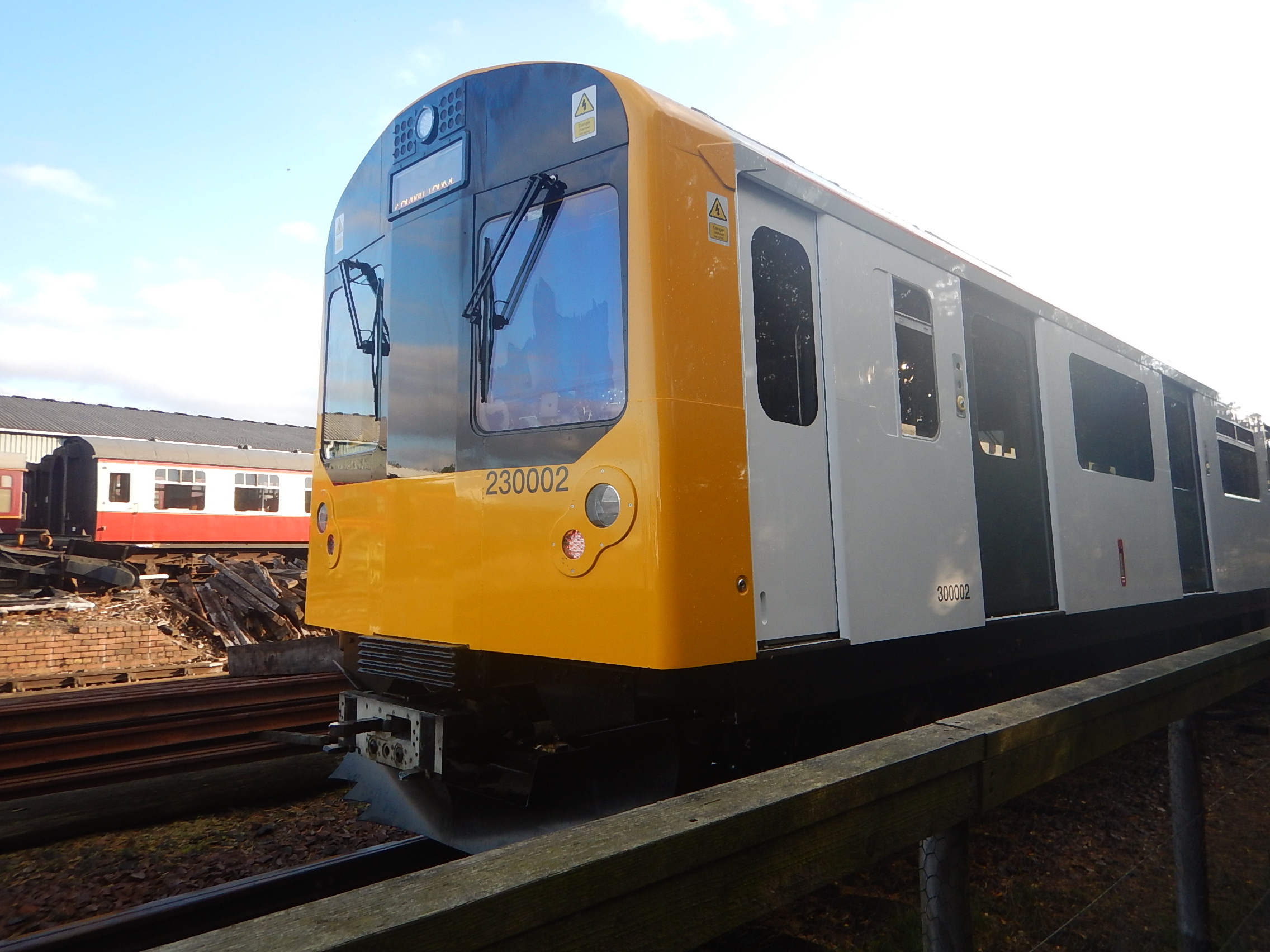
The picture shows the prototype battery train, when I rode it in 2018 at the Bo’ness And Kinneil Railway.
The article also says this.
Vivarail CEO Adrian Shooter is predicting that production versions of the battery trains will be able to run for almost 100km between charges, which will take just 10 minutes.
Battery trains appear to be going places.
Silent Hydrogen Trains On The Cards For New Line Linking Burton And Leicester
The title of this post is the same as that on this article on Derbyshire Live.
The idea of using hydrogen power came about after some people worried about the noise of trains, if the full route were to reopen.
The Proposed Route
The proposed route that would be reopened is the Leicester and Burton-on-Trent Line.
- The route is double-track.
- It is around forty miles long.
- It is still used by freight trains, so the track must be in serviceable condition.
- There are no stations.
Sadly, when the route was closed to passengers in 1964, British Rail simplified Knighton Junction at the Leicester end of the line. Wikipedia says this.
At the Leicester end of the line, Knighton North Junction has been dismantled and the former course of the line to the junction has been sold and turned into an industrial estate. The line’s remaining connection with the Midland Main Line is Knighton South Junction, which faces southwards, away from Leicester station. Trains between Leicester and the line therefore have to reverse direction at the junction.
This Google Map shows, what’s left of the junction.
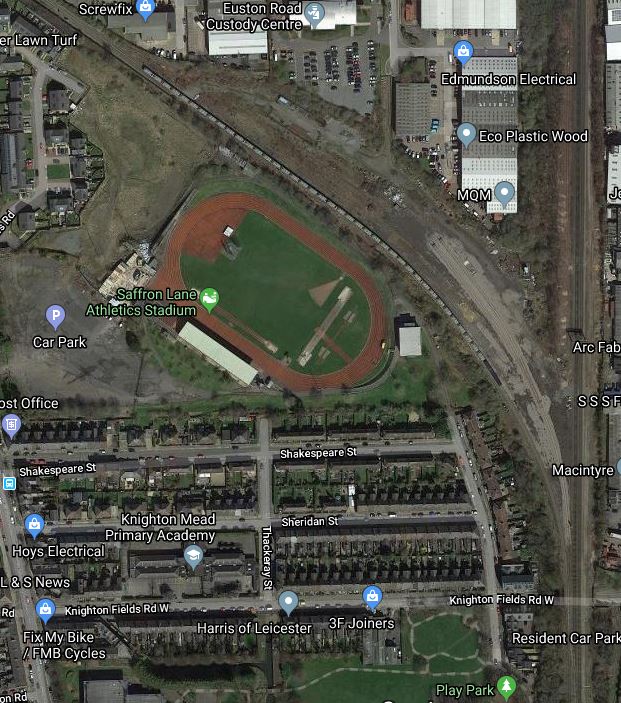
Note.
- Leicester is to the North
- Burton is to the North-West.
- Melton Mowbray and London are to the South.
It looks to me, that someone at British Rail made it absolutely certain, that the rail line could not be reopened to provide a passenger service between Leicester and Burton.
For a train to go between Leicester and Burton, it would either need to reverse as Wikipedia indicated, or the curve would have to be very tight.
There is only one class of passenger train, that can go round tight curves and that is a Class 399 tram-train!
So to enable trains to go direct around the corner, the option is either expensive disruptive demolition or use something like tram-train technology or a specially designed bendy train.
The Ivanhoe Line
The route was originally planned to be the second part of the Ivanhoe Line, but this was discontinued after rail privatisation.
Services on this line is an hourly service between Leicester and Lincoln Central stations.
- Intermediate stations are Syston, Sileby, Barrow-upon-Soar, Loughborough, East Midlands Parkway, Beeston, Nottingham, Newark Castle, Collingham, Swinderby and Hykeham.
- Services can get overcrowded, as the service is run by two-car trains.
- Platforms would need to be lengthened for longer trains.
Extending this service to Burton station would surely be good for connectivity at and through Leicester.
The Association Of Train Operating Companies Plan For The Line
This is taken from the Wikipedia entry for the line.
In 2009 the Association of Train Operating Companies published a £49 million proposal (Connecting Communities: Expanding Access to the Rail Network) to restore passenger services to the line that would include reopening stations at Kirby Muxloe, Bagworth and Ellistown, Coalville Town, Ashby de la Zouch, Moira, and Gresley (for Swadlincote). There is also some support in the Leicester area for the line to have new stations to serve Leicester City F.C.’s stadium and the suburb of Braunstone.
Wikipedia also says, it could be developed as a no-frills line.
Possible New Stations In Leicester
I have mentioned new stations in Leicester, so here’s a few more thoughts.
Leicester Reversal Station
A friend said that to reverse the trains between Leicester and Burton, a station has been proposed to be built, south of Knighton Junction.
This Google Map shows the junction and the line to the South.
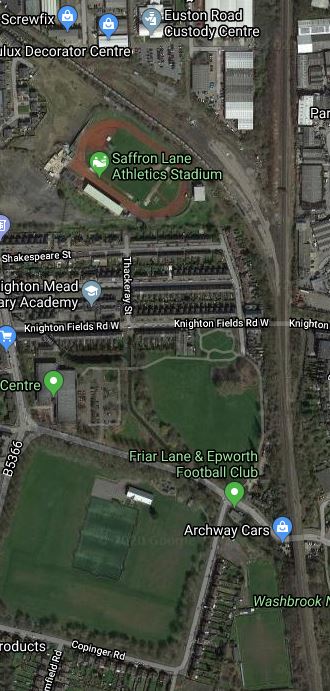
Only a single-platform station would be needed and it would be a simple and affordable solution to British Rail’s lack of vision of the future.
Leicester City Stadium
This Google Map shows the stadium.
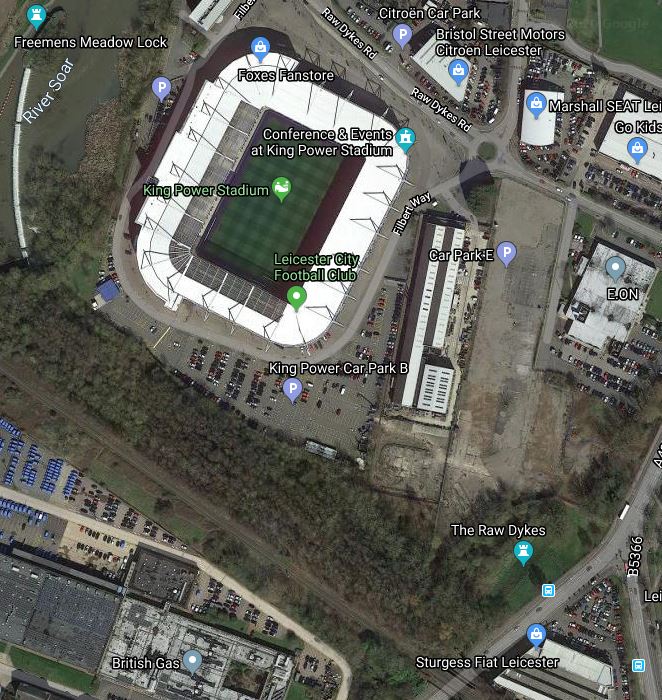
Note the rail line passing to the South of the station.
It would appear that building a new station would not be the most difficult of projects.
But after the experience of Coventry City, who were relegated twice after Coventry Arena station opened, would eicester City want a station?
Braunstone Station
This Google Map shows the rail line running through Braunstone.
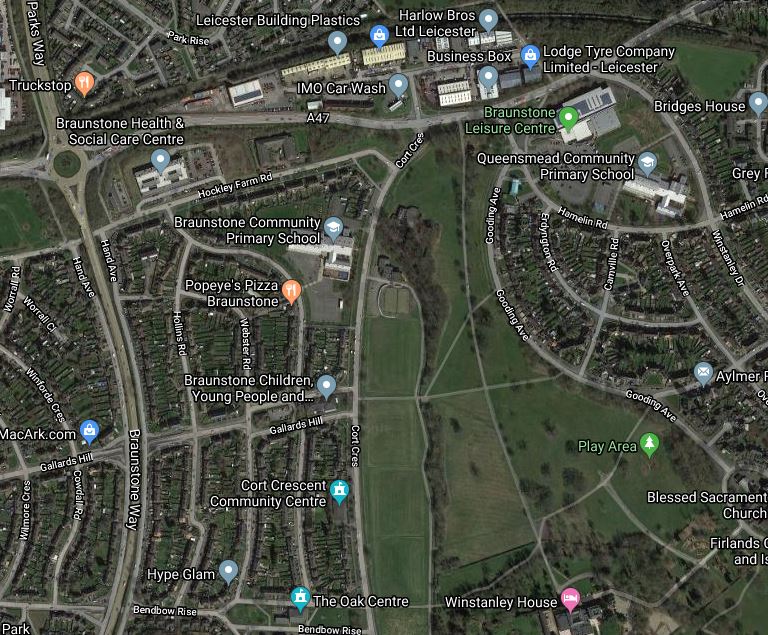
The rail line is at the top of the map.
Leicester Forest East Station
I wrote about this possible station in A Station At Leicester Forest East.
Burton Station
Intriguingly, Burton station is run by East Midlands Railway, who run no services to the town.
Services are provided by CrossCountry using a variety of long distance services.
The South Staffordshire Line connects Burton and Birmingham.
Part of this line is being converted to become an extension of the West Midlands Metro and Staffordshire County Council have looked at converting the whole route to tram-train operation to bring trams to Burton to promote tourism.
Hydrogen Power
I estimate that the distance between Lincoln and Burton is about a hundred miles.
Alstom are predicting a range of several hundred miles for their hydrogen trains for their Breeze train, which should mean a round trip to Lincoln from Burton will surely be in range.
Refuelling could be at a suitable place on the route.
In Delivering Hydrogen For Vehicles, I talk about how iTM Power are building hydrogen refuelling stations for road vehicles.
As the company is already building stand-alone hydrogen fuelling stations for fleets of buses in Birmingham and Pau, I’m sure that one for a fleet of trains is not a problem.
All their filling stations need is a small amount of space, a supply of tap water and a connection to the electricity grid.
It should be noted that Central Rivers Depot is four miles South of Burton.
Possibilities
There are a lot of possibilities to extend the Ivanhoe Line to Burton and even beyond using the South Staffordshire Line.
- Battery or hydrogen trains can be used.
- Stations can be added as required.
- The route will connect to Eat Midlands Airport.
- A solution for Knighton Junction can surely be devised.
Amazon are reported to be interested in the project, as they have a big depot at Coalville.
No News On Hydrogen Trains For The Midland Main Line
In April 2019, I wrote Hydrogen Trains To Be Trialled On The Midland Main Line, which was based on an article on Railway Gazette that is entitled Bimode And Hydrogen Trains As Abellio Wins Next East Midlands Franchise.
I said this in my post.
Abellio will be taking over the franchise in August this year and although bi-mode trains were certain to be introduced in a couple of years, the trialling of hydrogen-powered trains is a surprise to me and possibly others.
This is all that is said in the article.
Abellio will also trial hydrogen fuel cell trains on the Midland Main Line.
It also says, that the new fleet will not be announced until the orders are finalised.
Nothing has been heard since about the hydrogen train trial for the Midland Main Line.
But there have been several related developments, that might have implications for the trial.
East Midlands Railway Has Ordered Hitachi Class 810 Trains For EMR InterCity Services
Class 810 trains are Hitachi’s latest offering, that are tailored for the Midland Main Line.
The trains will have a few differences to the current Class 800,/801/802 trains.
But will they be suitable for conversion to hydrogen power?
Consider.
- The Hitachi trains have a comprehensivecomputer system, that looks at the train and sees what power sources are available and controls the train accordingly.
- Trains have already been ordered in five, seven and nine-car lengths. I have read up to twelve-car trains are possible in normal operation. See Do Class 800/801/802 Trains Use Batteries For Regenerative Braking?
- Hydrogen train designs, with a useful range of several hundred miles between refuelling, seem to need a hydrogen tank, that takes up at least half of a twenty metre long carriage.
- The Hitachi train design has pantographs on the driver cars and can support diesel generator units in the intermediate cars, as it does in current trains.
- The Japanese are researching hydrogen trains.
- The five-car Class 802 trains have 2,100 kW of installed generator power.
I think that Hitachi’s engineers can build another carriage, with the following characteristics.
- It could be based on a Motor Standard car.
- The passenger seats and interior would be removed or redesigned in a shorter space.
- Powered bogies would be as required.
- It would contain a hydrogen tank to give sufficient range.
- Appropriately-sized batteries and fuel-cells would be inside or under the vehicle.
- Regenerative braking would help to recharge the batteries.
- There would probably be no diesel generator unit.
There would need to be a walkway through the car. Stadler have shown this works in the Class 755 train.
A Hydrogen Power car like this would convert a five-car bi-mode diesel-electric train into a six-car hydrogen-electric hybrid train. Or they might just replace one Motor Standard car with the Hydrogen Power Car to create a five-car hydrogen-electric hybrid train, if the longer train would cause problems in the short platforms at St. Pancras.
- The computer system would need to recognise the Hydrogen Power Car and control it accordingly. It would probably be very Plug-and-Play.
- The weight of the train could probably be reduced by removing all diesel generator units.
- The passenger experience would be better without diesel power.
- The range away from the wires would probably be several hundred miles.
The drivers and other staff would probably not need massive retraining.
What Do I Mean By Appropriately-Sized Batteries And Fuel Cells?
I can’t be sure,, but I suspect the following rules and estimates hold.
- The batteries must be large enough to more than hold the kinetic energy of a full five-car train, running at the full speed of 140 mph.
- I estimate that the kinetic energy of the train,will be around 200 kWh, so with a contingency, perhaps battery capacity of between 400-500 kWh would be needed.
- Currently, a 500 kWh battery would weigh five tonnes, which is of a similar weight to one of the diesel generator units, that are no longer needed.
- In How Much Power Is Needed To Run A Train At 125 mph?, I estimated that the all-electric Class 801 train, needs 3.42 kWh per vehicle mile to maintain 125 mph. This means that travelling at 125 mph for an hour would consume around 2,000 kWh or an output of 2,000 kW from the fuel cell for the hour.
- Note that 1 kg of hydrogen contains 33.33 kWh of usable energy, so the hydrogen to power the train for an hour at 125 mph, will weigh around sixty kilograms.
From my past experience in doing chemical reaction calculations in pressure vessels, I think it makes the concept feasible. After all, it’s not that different to Alstom’s Breeze.
I would assume, that the train manufacturers can do a full calculation, to a much more accurate level.
Applying The Concept To Other Hitachi Trains
Once proven, the concept could be applied to a large number of Hitachi bi-mode trains. I suspect too, that it could be applied to all other Hitachi A-train designs, that are in service or on order, all over the world.
In the UK, this includes Class 385, Class 395 and Class 80x trains.
Bombardier Have Said That They’re Not Interested In Hydrogen Power
But Electrostars and Aventras have the same Plug-and-Play characteristic as the Hitachi train.
I wouldn’t be surprised to find that Bombardier have a Hydrogen Power Car design for an Aventra. All that it needs is an order.
They could also probably convert a five-car Class 377 train to effectively a four-car train, with a Hydrogen Power Car in the middle. This would be ideal for the Uckfield Branch and the Marshlink Lines. I suspect it could be done to meet the timescale imposed by the transfer of the Class 171 trains to East Midlands Railway.
There must be an optimal point, where converting an electric multiple unit, is more affordable to convert to hydrogen, than to add just batteries.
But then everybody has been dithering about the Uckfield and Marshlink trains, since I started this blog!
Stadler Have Shown That a Gangway Through A Power Car Is Acceptable To Passengers In The UK
Stadler’s Class 755 trains seem to be operating without any complaints about the gangway between the two halves of the train.
Stadler Have Two Orders For Hydrogen-Powered Trains
These posts describe them.
- Zillertalbahn Orders Stadler Hydrogen-Powered Trains
- MSU Research Leads To North America’s First Commercial Hydrogen-Powered Train
Stadler also have a substantial order for a fleet of battery Flirt Akku in Schleswig Holstein and they are heavily involved in providing the rolling stock for Merseyrail and the South Wales Metro, where battery-powered trains are part of the solution.
It looks to me, that Stadler have got the technology to satisfy the battery and hydrogen train market.
The Driver’s View Of Stadler
It’s happened to me twice now; in the Netherlands and in the UK.
- Both drivers have talked about hydrogen and Stadler’s trains with the engine in the middle.
- They like the concept of the engine.
- The English driver couldn’t wait to get his hands on the train, when he finished his conversion.
- Both brought up the subject of hydrogen first, which made me think, that Stadler are telling drivers about it.
Or does driving a hydrogen-powered vehicle as your day job, score Greta points in the pub or club after work?
Could The Hydrogen Train On The Midland Main Line Be A Stadler?
Greater Anglia and East Midlands Railway are both controlled by Abellio or Dutch Railways.
In The Dutch Plan For Hydrogen, I laid out what the Dutch are doing to create a hydrogen-based economy in the North of the country.
Stadler are going to provide hydrogen-powered for the plan.
In addition.
- Greater Anglia have bought a lot of Class 755 trains.
- A lot of Lincolnshire and Norfolk is similar to the North of the Netherlands; flat and windy.
- One of these trains with a hydrogen PowerPack, could be an ideal train for demonstrating hydrogen on rural routes like Peterborough and Doncaster via Lincoln.
But the promise was on the Midland Main Line?
Conclusion
Hydrogen trains seem to be taking off!
Even if there’s been no news about the trial on the Midland Main Line.
Gore Street Contracts NEC For 100 MW Of Storage
The title of this post is the same as that of this article on the Solar Power Portal.
This is the introductory paragraph.
Gore Street Energy Storage Fund has awarded NEC Energy Solutions both EPC and long-term O&M contracts for 100MW of storage in Northern Ireland.
What I find most comforting, is the matter-of-fact tone of the article.
Although, the author does seem to think that MW and MWh are the same, when in fact MW is used to define the rate of energy used or transferred and MWh the quantity.
If you use one MW for an hour, that is one MWh.
Gore Street appear to have needed two 50 MW energy storage systems for Drumkee and Mullavilly in Northern Ireland to back up a solar farm investment.
And they appear to have just ordered them off the shelf from NEC, in much the way, an individual might buy a Tesla Powerwall for their house.
According to this article on OVO Energy, the average European house uses 3,600 kWh per year.As there are 8760 hours in a year, the average consumption for a year is 0.4 kW per hour.
So if we assume that these two energy storage systems can deliver 50 MW for an hour, the following can be said.
- The total capacity of each system is 50 MWh.
- Each system can supply 125,000 houses for an hour or 25,000 houses for five hours.
- As each housing unit has an average occupancy of 2.66 people, this means that a 50 MWh battery could supply a town of 66,500 people, for five hours.
Note that Lowestoft in Suffolk has a population of 71,000.
These batteries are not small.
 The Anonymous Widower