Mega Airport Costing £24billion In Europe To Rival Heathrow And Dubai
The title of this post is the same as that of this article in the Daily Express.
A new mega airport is being built in Europe, and it is set to rival the likes of Dubai and London Heathrow in terms of size and capacity for passengers and planes alike
These three paragraphs add more details.
A plush new airport could be touching down in Europe, set to rival London’s Heathrow and even the esteemed Dubai International, as it aims to link the entire continent in unprecedented ways.
The Centralny Port Komunikacyjny, a proposed $32.5 billion project, is a fresh aviation gateway in Warsaw that carries the burden of Poland’s ambitious mega airport aspirations. However, the concept is swiftly progressing, with the official approval and handover of the passenger terminal design marking a significant leap forward.
This suggests the colossal airport is officially moving into its next phase of development. The question remains, will this new progression challenge the supremacy of the Middle East, home to both the world’s largest airport, King Fahd International Airport in Saudi Arabia, and the busiest, Dubai International Airport?
Note.
- In English, Centralny Port Komunikacyjny means Central Communications Port.
- CPK’s forecasted passenger capacity makes it a formidable contender as the new hub for Europe.
- Dubai is on course to handle 100 million passengers by the end of next year, thanks to its strategic geographical position with other continents, while the Polish project will eventually accommodate up to 44 million.
- n 2024, Heathrow Airport welcomed a record 83.9 million passengers, a 6% increase from the previous year.
Even the busiest airports in Europe handle far fewer passengers than Dubai.
Central Communications Port has a Wikipedia entry, which has this first paragraph.
The Central Transport Hub is a planned major infrastructure project in Poland aimed at the construction of a new international airport and the development of a nationwide integrated transport network. The airport is planned to be located approximately 40 kilometres (25 mi) southwest of Warsaw, connected to a new high-speed rail network and controlled-access highway system linking it with much of the rest of the country.
Note.
- The airport will be designed by Foster + Partners in collaboration with Buro Happold.
- Initially the airport is planned to have two runways, but will eventually be expanded to four.
- The combined airport and railway station is planned to serve 40 million passengers per year, double the size of Berlin Brandenburg Airport.
- The long-term goal is about 100 million passengers per year.
These are my thoughts.
The Airport’s Location
The Wikipedia entry for the airport has a section called Location, which has this first paragraph.
The airport’s planned site is about 40 km west of Warsaw, next to the village Stanisławów which is part of Gmina Baranów in Grodzisk Mazowiecki County. The Baranow commune occupies a significant part of the Grodzisk County and, despite its rural character, has an extensive road infrastructure. The A2 autostrada and railway lines run in the immediate vicinity of the potential construction site, and Wrocław (Expressway S8) and Poznań (National road 92) is nearby.
It sounds to me, that a British equivalent airport, would be a four-runway airport at Birmingham Airport with connections to the M1, M6, HS2 and the West Coast Main Line.
Rail Connections
The Wikipedia entry says this about rail connections.
Planned train connections from the CPK will take 15 minutes to Warsaw Central railway station, 25 minutes to Łódź Fabryczna railway station, and 2 hours to most other major Polish cities, such as Kraków, Wrocław, Poznań and Gdańsk. The construction of a high-speed train to Frankfurt (Oder) is also planned, which is to shorten the travel time on the Berlin-CPK route to under 3.5 hours
I suspect that Rail Baltica’s trains between Berlin and Helsinki via Warsaw, Kaunus, Riga, Bialystok and Tallinn will also stop at the airport.
The Airport Will Become A Gateway To North-East Europe
I wouldn’t be surprised to see Central Communications Port become a low-cost gateway to the surrounding countries., like Belarus, Estonia, Finland, Latvia, Lithuania and hopefully Ukraine.
Polish Hospitality
Consider.
- Most Poles speak English better, than what I does!
- There are several large Polish cities that are worth a visit.
- The food is excellent, as the local basic ingredients are of high quality.
- I have spent about a month in Poland and I’ve stayed in all levels of accommodation from the lowest to the highest and have never felt need to complain.
- They handle my gluten-free diet with no problem.
My experience of Belarus was also similar.
Centrica Really Can’t Lose At Sizewell
The title of this post, is the same as that of this article in The Times.
This is the sub-heading.
Centrica’s £1.3 billion investment in Sizewell C guarantees substantial returns, even with cost overruns.
These two-and-a-half paragraphs explain the funding.
Now we know what Ed Miliband means by his “golden age of nuclear” — golden for the companies putting their money into Sizewell C. Yes, reactor projects have a habit of blowing up private investors. But maybe not this one. It looks more like an exercise in transferring risk to consumers and the taxpayer.
Sure, nobody builds a £38 billion nuke on a Suffolk flood plain without a frisson of danger. But the energy secretary and his Treasury chums have done their bit to make things as safe as possible for the companies putting in equity alongside the government’s 44.9 per cent stake: Canada’s La Caisse with 20 per cent, British Gas-owner Centrica (15 per cent), France’s EDF (12.5 per cent) and Amber Infrastructure (7.6 per cent).
For starters, nearly all the debt for the 3.2 gigawatt plant, three-quarters funded by loans, is coming from the state-backed National Wealth Fund. It’s bunging in up to £36.6 billion, with £5 billion more guaranteed by a French export credit agency.
It looks to me that between them the British and French governments are providing £41.5 billion of loans to build the £38 billion nuke.
These are my thoughts.
Hydrogen And Sizewell C
This page on the Sizewell C web site is entitled Hydrogen And Sizewell C.
Under a heading of Hydrogen Buses, this is said.
At Sizewell C, we are exploring how we can produce and use hydrogen in several ways. We are working with Wrightbus on a pilot scheme which, if successful, could see thousands of workers transported to and from site on hydrogen double decker buses. You can read more about the pilot scheme in our press release
Firstly, it could help lower emissions during construction of the power station. Secondly, once Sizewell C is operational, we hope to use some of the heat it generates (alongside electricity) to make hydrogen more efficiently.
This would appear to be a more general statement about hydrogen and that the following is planned.
- Hydrogen-powered buses will be used to bring workers to the site. A press release on the Sizewell C web site, talks about up to 150 buses. That would probably be enough buses for all of Suffolk.
- Hydrogen-powered construction equipment will be used in the building of the power station.
- It also talks about using the excess heat from the power station to make hydrogen more efficiently. I talk about this process in Westinghouse And Bloom Energy To Team Up For Pink Hydrogen.
This is a substantial investment in hydrogen.
Centrica And Electricity From Sizewell C
The article in The Times, also says this.
Even so, there’s a fair bit of protection for the likes of Centrica, which has also agreed a 20-year offtake deal for its share of Sizewell’s electricity. The price of that is not yet known.
Nothing is said in the article about the size of Centrica’s electricity offtake.
- If they get 15 % of Sizewell C, that would by 480 MW.
- If they get 15 % of Sizewell B + C, that would by 660 MW.
If they use their share to generate hydrogen, Suffolk would have a massive hydrogen hub.
To power the buses and construction of Sizewell C, Sizewell B could be used to provide electricity to create the hydrogen.
How Would The Hydrogen Be Produced?
Centrica, along with other companies, who include Hyundai and Kia, are backers of a company in Hull called HiiROC, who use a process called Thermal Plasma Electrolysis to generate hydrogen.
On their web site, they have this sub-heading.
A Transformational New Process For Affordable Clean Hydrogen
The web site also describes the process as scalable from small modular units up to industrial scale. It also says this about the costs of the system: As cheap as SMR without needing CCUS; a fraction of the energy/cost of water electrolysis.
If HiiROC have achieved their objective of scalability, then Centrica could grow their electrolyser to meet demand.
How Would The Hydrogen Be Distributed?
Consider.
- Currently, the Sizewell site has both road and rail access.
- I can still see in my mind from the 1960s, ICI’s specialist articulated Foden trucks lined up in the yard at Runcorn, taking on their cargoes of hydrogen for delivery all over the country.
- As that factory is still producing hydrogen and I can’t remember any accidents in the last sixty years, I am fairly sure that a range of suitable hydrogen trucks could be developed to deliver hydrogen by road.
- The road network to the Siewell site is being updated to ensure smooth delivery of workers and materials.
- The rail access to the Sizewell site is also being improved, for the delivery of bulk materials.
I believe there will be no problems delivering hydrogen from the Sizewell site.
I also believe that there could be scope for a special-purpose self-propelled hydrogen tanker train, which could both distribute and supply the hydrogen to the vehicles, locomotives and equipment that will be using it.
Where Will The Hydrogen Be Used?
I have lived a large part of my life in Suffolk and know the county well.
In my childhood, there was quite a lot of heavy industry, but now that has all gone and employment is based on agriculture, the Port of Felixstowe and service industries.
I can see hydrogen being used in the following industries.
Transport
Buses and heavy trucks would be powered by hydrogen.
The ports in the East of England support a large number of heavy trucks.
Large Construction Projects
Sizewell C is not the only large construction project in the East of England, that is aiming to use low-carbon construction involving hydrogen. In Gallagher Group Host Hydrogen Fuel Trial At Hermitage Quarry, I talked about a hydrogen fuel trial for the Lower Thames Crossing, that involved JCB and Ryse Hydrogen.
Hydrogen for the Lower Thames Crossing could be delivered from Sizewell by truck, down the A12.
Rail
We may not ever see hydrogen-powered passenger trains in this country, but I do believe that we could see hydrogen-powered freight locomotives.
Consider.
- The latest electro-diesel Class 99 locomotives from Stadler have a Cummins diesel engine.
- The diesel engine is used, when there is no electrification.
- Cummins have developed the technology, that allows them to convert their latest diesel engines to hydrogen or natural gas power, by changing the cylinder head and the fuel system.
- Access to the Port of Felixstowe and London Gateway needs a locomotive with a self-powered capability for the last few miles of the route.
A Class 99 locomotive converted to hydrogen would be able to run with out emitting any carbon dioxide from Felixstowe or London Gateway to Glasgow or Edinburgh.
Ports
Ports have three main uses for hydrogen.
- To power ground-handing equipment, to create a pollution-free atmosphere for port workers.
- To fuel ships of all sizes from the humblest work-boat to the largest container ships.
- There may need to be fuel for hydrogen-powered rail locomotives in the future.
There are seven ports with excellent road and/or rail connections to the Sizewell site; Felixstowe, Great Yarmouth, Harwich, Ipswich, London Gateway, Lowestoft and Tilbury.
The proposed Freeport East is also developing their own green hydrogen hub, which is described on this page on the Freeport East web site.
Airports
Airports have two main uses for hydrogen.
- To power ground-handing equipment, to create a pollution-free atmosphere for airport workers.
- In the future, there is likely to be hydrogen-powered aircraft.
There are three airports with excellent road and/or rail connections to the Sizewell site; Norwich, Southend and Stansted.
Agriculture And The Rural Economy
Agriculture and the rural economy would be difficult to decarbonise.
Consider.
- Currently, most farms would use diesel power for tractors and agricultural equipment, which is delivered by truck.
- Many rural properties are heated by propane or fuel oil, which is delivered by truck.
- Some high-energy rural businesses like blacksmiths rely on propane, which is delivered by truck.
- Electrification could be possible for some applications, but ploughing the heavy land of Suffolk, with the added weight of a battery on the tractor, would probably be a mathematical impossibility.
- JCB are developing hydrogen-powered construction equipment and already make tractors.
- Hydrogen could be delivered by truck to farms and rural properties.
- Many boilers can be converted from propoane to run on hydrogen.
I feel, that hydrogen could be the ideal fuel to decarbonise agriculture and the rural economy.
I cover this application in detail in Developing A Rural Hydrogen Network.
Exports
Consider.
- Sizewell B and Sizewell C nuclear powerstations have a combined output of 4.4 GW.
- A rough calculation shows that there is a total of 7.2 GW of wind farms planned off the Suffolk coast.
- The East Anglian Array wind farm alone is said in Wikipedia to be planned to expand to 7.2 GW.
- The Sizewell site has a high capacity connection to the National Grid.
Nuclear plus wind should keep the lights on in the East of England.
Any excess electricity could be converted into hydrogen.
This Google Map shows the location of Sizewell B in relation to Belgium, Germany and The Netherlands.
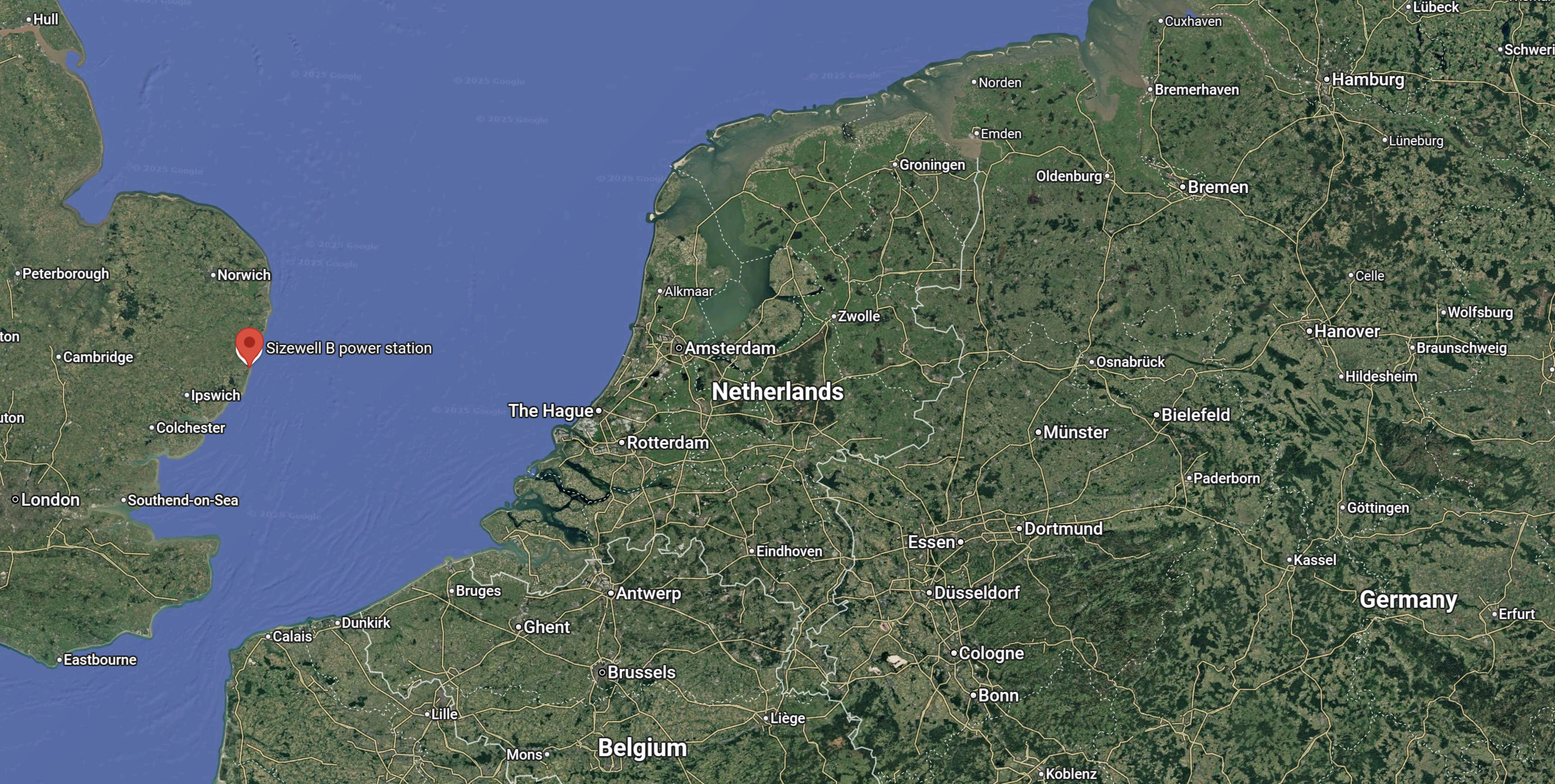
The Sizewell site is indicated by the red arrow.
The offshore oil and gas industry has used technology like single buoy moorings and coastal tankers to collect offshore natural gas for decades.
I don’t see why coastal hydrogen tankers couldn’t export excess hydrogen to places around the North Sea, who need the fuel.
It should be born in mind, that Centrica have a good reputation in doing natural gas trading. This expertise would surely be useful in hydrogen trading.
Conclusion
I believe that a hydrogen hub developed at Sizewell makes sense and I also believe that Centrica have the skills and technology to make it work.
Busiest UK Airports Raise Kiss-and-Fly Fees, Says RAC
The title of this post, is the same as that of this article on the BBC.
This is the sub-heading.
More than half of Britain’s busiest airports have raised “kiss-and-fly” fees for cars dropping off passengers close to terminals, according to research from the RAC.
These two paragraphs add details.
The motoring group found 11 out of 20 UK airports had put up prices since last July, with Gatwick, Bristol, Leeds Bradford and Southampton joining Stansted in charging the top rate of £7 to park for a matter of minutes.
In contrast, at nine of the 10 busiest airports in the European Union there are no drop-off fees.
I don’t drive and these days I can’t walk very far, but I travel around the UK and Europe without any difficulty.
Here are a few tips.
Use James Cameron’s Packing Method
James Cameron was one of BBC’s most famous and much-travelled journalists and his life is documented in this Wikipedia entry.
The Wikipedia entry says nothing about his packing method, which my late wife and myself used after hearing him describe it in one of his excellent documentaries.
Sort everything you think you’ll need into two piles. Each pile contains half the shirts, trousers, swimwear, underwear etc. that you think you’ll need.
Pack each pile in a separate case and leave one case behind.
As to money he said, work out the most you’ll need and double it. These days with credit cards, that is probably not so relevant.
Choose An Airport With Good Step-Free Public Transport
I’m lucky in London, in that I can get a bus within a hundred metres of my house, that takes me to Moorgate, Bank or London Bridge stations, which give me direct access to City, Gatwick, Heathrow, Luton, Southend or Stansted Airports.
Step-free access to some airports in the UK is abysmal.
Use A Train From A Station With a Properly Designed Drop-Off Area
These pictures show the taxi rank and drop off area at Leicester station.








The building would appear to have a Grade II Listed taxi rank and free twenty-minute car park.
How many other stations have well-designed facilities like these?
According to this article on the BBC, Preston station has an innovative solution.
If you spot any others, let me know!
Service Your Car Near The Airport
For three or so years, we had a car, where there was a main dealer a couple of stops on the Piccadilly Line from Heathrow.
So we dropped the car in, walked a short distance to the Underground and started our holiday with a tube ride.
It just needs a bit of research.
I don’t drive anymore after a stroke, but if I did, my car would be serviced by a garage, I could get to on public transport.
Does Your Car Have A Large Capacity, Dash Mounted Refrigerator?
I suspect not, but Wrightbus’s new Contour Coach will have one for the driver and the lucky soul, who sits in the other front seat.
Wrightbus have now put the specification of the Contour coach on a page that is entitled Experience The Contour Difference.
This is the introduction.
Introducing the Wright Contour Diesel Coach, where luxury, innovation, and performance come together. Since 1946, Wright has been at the forefront of transportation innovation, shaping the future with its unwavering commitment to excellence. Today, as UK’s No.1 zero-emission bus manufacturer and one of Europe’s fastest growing brands, Wright is making a bold return to the luxury coach market with the all-new Contour Diesel Coach (available in UK and Europe). In the 1980s, Wright revolutionised the luxury coach industry with its innovative, high-end Contour models, setting new standards in design and comfort. On 5th March 2025, Wright makes a bold return to the coach market with the all-new Contour Diesel Coach, redefining performance, style, and efficiency, offering spacious interiors, advanced safety features, and a high-performance Cummins X11 Euro 6 engine delivering 400hp. With competitive pricing, reduced lead times, and full service support to ‘complete Vehicle OEM and operator support’ from Wright’s All Service One Network, the Contour is built to exceed expectations. Plus, with a 2-year or 200,000km warranty backed fully by Wright, it ensures reliability and peace of mind.
I asked Google AI if the Cummins X11 engine can be converted to hydrogen and was told this.
Yes, while not inherently designed for hydrogen from the factory, the Cummins X11 engine, like many Cummins diesel engines, can be converted to run on hydrogen fuel. This involves modifications, including changing the cylinder head and fuel system.
As I discussed in Wrightbus StreetDeck Ultroliner Next-Gen To Get Cummins Power, it appears Wrightbus are going the Cummins route, to open up the possibility of converting the vehicles to hydrogen at some point in the future.
Cummins have certainly seen a green vision. on the Road to Net Zero, which seems to go via their Darlington factory.
The coach specification includes.
- Premium reclining seats for all passengers.
- Adjustable armrests, and USB ports at every seat.
- Safety features like 3-point seat belts and ‘buckle up’ alerts.
- Powered doors to the lockers underneath.
- Reversing and rear-door cameras.
Wrightbus are also promising reduced lead times, which in my experience as a part-owner of a leasing company, that financed a large number of coaches, is very much to be welcomed.
Hydrogen Fuel Cell-Powered Coaches
Two trips convinced me, that hydrogen fuel cell coaches are the way to go.
In Riding Rail Air Between Reading Station And Heathrow Terminal 5, I did what it says in the title.
I was very disappointed.
The coach may have been a nearly-new top-of-the-range model, but my journey was to the accompanying thump-thump-thump of the diesel engine. There were also no USB ports, which these days many British Rail-era trains are sporting.
In Sutton Station To Gatwick Airport By Hydrogen-Powered Bus, I also did what it said in the title.
I was very impressed and it convinced me that hydrogen fuel cell-powered coaches could be an interesting proposition.
The power unit was mouse-quiet and the bus had more than adequate performance for the route, through the Surrey Hills.
It would be a very fruitful experiment, if say a twenty-mile route to say an airport, that is currently run by a traditional diesel coach, were to be replaced by a hydrogen fuel cell-powered bus, with a more luggage-friendly interior.
- Would passenger numbers increase?
- Would the number of airport workers using the service increase?
I believe that in a few years diesel coaches will be filed under Betamax.
Is There A Market For A Wrightbus Hydroliner FCEV-based Hybrid Coach?
A few years ago, there was a plan, to improve public transport to Heathrow, that would have seen the Elizabeth Line to Terminal 5 extended to Staines. I went to Staines and discussed this with one of the staff at the station.
He was all for this, as it would have given staff at the airport and in the airlines, an easy route to and from work, which would mean, they didn’t have to pay to take their car, especially, when they were working difficult shifts.
A Wrightbus Hydroliner FCEV, with a hybrid interior geared to both passengers with heavy luggage and passengers and airport and airline workers with just a carry-on size bag, might appeal to some operators.
Especially for some of the night bus routes operating to Heathrow.
Procrastination Over Airport Rail Links
This article in the Glasgow Evening Times is entitled Glasgow Airport Rail Link: Fresh Fears Over Plans As MSP Slams Delay.
The title says it all.
Of the airports in the UK, the following have or will have good rail or tram links.
- Birmingham
- Cardiff
- Edinburgh
- Gatwick
- Heathrow
- London City
- Luton – Building a people-mover between the airport and station.
- Manchester
- Newcastle
- Southampton
- Southend
- Stansted
In addition, the following airports have been talking about rail links.
- Belfast City
- Bristol
- East Midlands
- Glasgow
- Leeds/Bradford
- Liverpool
In fact they’ve been talking about rail links for decades.
As I started with a report about Glasgow, if you want to see how they have taken two decades to get nowhere, read the Wikipedia entry for the Glasgow Airport Rail Link.
The latest £144million plan involves tram-trains running from Glasgow Central station.
Currently, of the airports, that have talked for years, I believe the following could use tram-train technology to provide the airport rail link.
- Bristol
- East Midlands
- Glasgow
- Leeds/Bradford
- Liverpool
Now that tram-trains are working well in Sheffield and have been ordered for the South Wales Metro, surely this technology can be considered almost mainstream for the UK.
In the specific case of Glasgow the following would be needed.
- Modification of platforms at Glasgow Central and Paisley Gilmour Street stations, so they would give level-access to the tram-trains.
- Creation of a single-track spur to the airport without electrification, that ends in a single platform, close to or in the airport terminal.
- A fleet of Class 399 tram-trains with a battery capability, as have been ordered for the South Wales Metro.
- Improved signalling to handle the extra trains.
Note.
- Space should be left, so that in the future, the airport spur could be doubled.
- A flat junction would probably work initially, but provision for a flying junction for the spur should be made.
- Currently, four trains per hour (tph) run past the Airport.
- Could the tram-trains be built to give level access to standard height platforms, so that no substantial modification of existing platforms would be needed?
It also strikes me, that this could be a privately funded scheme.
- Glasgow Airport is ultimately owned by Ferrovial and Macquarie Group, who will be the main beneficiary of the scheme.
- Both Ferrovial and Macquarie Group are companies that invest in infrastructure.
- The Class 399 tram-trains can obviously be leased.
So what’s the problem?
- Network Rail are against the scheme, as it’s not one of theirs.
- The Scottish government won’t sanction a privately-funded scheme.
- Various interests want a different scheme.
- The jury is still out on tram-trains.
- It’s a scheme for Glasgow and the decision is taken in Edinburgh.
- Glasgow would get a better airport link than Edinburgh.
Enlighten me!
Other Airport Links
Once Glasgow is completed, other airport links could be built using the same techniques.
I have a feeling, that another airport will get a tram-train link before Glasgow!
The Combined Car Park And Storage Battery
I don’t drive these days, but I did for well over forty years.
If I was still driving now and still lived in Suffolk, I’d be looking seriously at an electric car as an everyday runabout, as rarely in the last twenty years, have I had the need to do a long journey, that I couldn’t do by train.
So my electric car would probably sit in a car park space at Cambridge North station, attached to a charger, a lot of the time. But with better batteries and vehicle-to-grid systems, there will come a time, when you will park your battery vehicle and tell it you’ll be returning in a few hours or days and you’ll need say four hours of charge on return. Obviously, if your circumstances change, you will have an app on your phone to make adjustments.
Suppose your average car had a 30 kWh battery, this would mean that the 450 space car park at Cambridge North station, if say 300 spaces were for electric cars would have a electricity storage capacity of around 0.9MWh.
So if the wind wasn’t blowing or the sun wasn’t shining, then there’s probably about half a MWh of electricity that can be borrowed and still allow drivers to get home.
It may all sound terribly complicated, but electricity put into batteries at night or other quiet times, gets used when it’s needed.
Batteries and other forms of energy storage will be everywhere; in houses, offices, public buildings, wind and solar farms, and in every electric vehicle.
There are 31.,6million cars alone in the UK and how many are quietly sitting in car parks and garages or at the side of the street, for most of the day.
The Car Park As A Power Station
There will be multi-story car-parks reserved for electric cars.
- Each parking space will have a charging point.
- The roof will of course have solar panels.
- I would expect that in a few years time the connection between car and charger will be automatic.
- The parking charge would be based on a mixture of time parked and energy passed to or from the battery.
- Car parks would probably also be paid by National Grid dependent on how much energy they can make available automatically.
The control system for all this lot, would do my head in! But it would mean that all generated energy was either used or stored!
In some ways a car pack for electric cars would become a small power station.
Examples Of Car Parks
These car-parks would have some interesting applications.
Airports
Airports like Heathrow have a pollution problem and it’s not just the planes, but masses of diesel and petrol vehicles.
- To encourage more passengers to drive electric vehicles to an airport, why not make the closest car parks electric car only?
- Long-term car parks for electric vehicles could be a massive storage battery, which would be used to help power the airport.
- Car parks for electric cars would be less polluted.
- Car parks for electric cars could be under the ground with runways and taxiways on top.
Everyone would be a winner.
- Passengers’ electric cars would be earning an energy storage charge from the National Grid.
- The Airport would have a reliable back-up power source.
- There would be much less pollution at the Airport.
- National Grid would gain additional much-needed energy storage.
There will be a lot of thought going in to making airport parking more efficient and affordable for electric cars.
Business Parks And Offices
Much of the logic for airports would apply.
But I do feel, that companies with medium and large-sized fleets of vehicles will go electric, as they can then integrate energy management across their premises and fleet.
Town And City Centres
Towns and cities with a pollution problem like London, will surely use the best car parks as bribes to get more electric vehicles into the centre.
Residential Developments
The mind boggles at what could be done in residential developments.
- Cars could go to and from parking automatically.
- Every house would come with energy storage plus that in the car.
- The development would appear car-free.
- Cars could be in shared ownership with the development.
- There could be automatic trolleys running through the development delivering parcels.
The market will determine what is needed.
Conclusion
Creating car parks solely for electric cars will create energy storage units at points of employment, living, shopping and transport.
Elon Musk Goes Underground With High-Speed Trains
The title of this post is the same as that of an article in the Business section of last Friday’s Times.
This is the first paragraph.
Futuristic electric trains will soon be whizzing under the streets of Chicago at up to 150 mph after Elon Musk’s tunnelling company was chosen by the city to build a new high-speed commuter link.
Currently, the Blue Line train takes about forty-five minutes for the eighteen miles at a cost of five dollars.
Heathrow Airport is eighteen miles from the City of London and Crossrail will do the trip for thirty-three minutes when it opens, next year for a cost of under a tenner.
So what is Musk proposing?
- A journey time of twelve minutes.
- Passengers will ride in skates, which will carry up to sixteen people on concrete tracks.
- Skates will run at a frequency of 120 per hour for 20 hours a day.
- The fare would be twenty-five dollars.
- The system would cost about a billion dollars.
It is a technically ambitious proposal.
There’s more in this section called Chicago in the Wikipedia entry of The Boring Company.
A competition to build a high-speed link from downtown Chicago to the soon-to-be-expanded O’Hare Airport had been reduced to just two bidders by March 2018. The Boring Company was selected in June 2018 and will now negotiate a contract to be presented to the Chicago City Council. Construction is to be entirely financed by The Boring Company, which is subsequently to maintain and operate the link. The system will transport passengers in automated electric cars carrying 16 passengers (and their luggage) through two parallel tunnels running under existing public way alignments, traveling from block 37 to the airport in 12 minutes, at speeds reaching 125 to 150 miles per hour (200 to 240 km/h), with pods departing as often as every 30 seconds
It states it is two parallel tunnels!
Comparison With London’s Crossrail
Crossrail will effectively do the same job in London and a comparison between the two systems may produce some interesting conclusions.
Capacity
Musk’s system will have an hourly capacity of 1920 passengers per hour, based on 120 skates each carrying sixteen people.
Crossrail are talking of six trains per hour, each with a capacity of 1,500 people or 9000 passengers per hour.
I think that Crossrail will need to increase capacity, as Heathrow expands and longer trains and higher frequencies are possible.
But if Musk’s system is a runaway success, can it be expanded easily.
Journey Time
Musk’s system has a journey time of 12 minutes, as against Crossrail’s of 33 minutes
But Crossrail will stop up to ten times!
Intriguingly, the twelve minute is not the headline speed of 125 to 150 mph, but a slower 90 mph.
Routes
Little has been said of the route for Musk’s system, except that it goes between Downtown and O’Hare Airport.
Heathrow to the City of London, also goes direct to London’s major shopping area and the new business area of Canary Wharf.
It is also integrated with London’s existing Underground, Overground and rail lines at several places.
Does Musk’s system have a route structure, that won’t appeal to a lot of possible users?
Musk’s Thinking
This is an extract from the Future Goals section of the Wikipedia entry for The Boring Company.
According to Tesla, Inc. and SpaceX board member Steve Jurvetson, tunnels specifically built for electric vehicles have reduced size and complexity, and thus decreased cost. “The insight I think that’s so powerful is that if you only envision electric vehicles in your tunnels you don’t need to do the air handling for all carbon monoxide, carbon dioxide, you know, basically pollutants for exhaust. You could have scrubbers and a variety of simpler things that make everything collapse to a smaller tunnel size, which dramatically lowers the cost … The whole concept of what you do with tunnels changes.
The philosophy is not unlike that of Crossrail.
- I believe that Crossrail has been designed holistically, using the best tunnel and train technology.
- The tunnel power supply is a simple end-to-end rail.
- The Class 345 trains have batteries to make best use of electricity and provide emergency power.
- The batteries will handle regenerative braking, thus minimising heat-producing electric currents in the tunnel.
- Platform-edge doors and aerodynamic trains reduce mechanical energy losses.
- The electric trains do not emit anything into the tunnel, except perhaps a small amount of hot air.
I suspect that Crossrail’s tunnel section will be a very energy-efficient railway.
Conclusion
Summing up both systems we get.
Musk’s system is.
- A billion dollar cost.
- Twelve minute journey time.
- A vehicle every thirty seconds.
- Only for the few, who want to go from O’Hare to Downtown, who can pay a premium fare.
- Limited capacity.
A Crossrail-like solution would be.
- Perhaps a ten billion dollar cost.
- Twenty minute journey time.
- A train every few minutes.
- For everyone, who wants to travel from O’Hare to most places in Chicago with possibly a change, at a normal fare.
- Expandable capacity.
Musk’s system will appeal to the rich and those who like novelty, but I don’t think it is a long-term solution and just like London, Chicago will eventually have a modern railway linking it to the wider Chicago area.
Where Musk is right, is that he believes that tunnelling methods can be improved and become more affordable.
This will mean that more audacious railway schemes will be built.
 The Anonymous Widower