Chiltern Electrification Alternatives Studied
The title of this post, is the same as that of this article on Railway Gazette.
These are the first two paragraphs.
Chiltern Railways is working to present the Department for Transport with options for a fleet renewal programme, with London Marylebone being the only non-electrified London terminal and pressure for the withdrawal of diesel trains continuing to mount, particularly from local residents.
Industry insiders report that this could see at least the 39 two and three-car Class 165 diesel multiple-units replaced.
Note.
- The Class 165 trains were built in 1990-1992 and refurbished around the turn of the century.
- Chiltern Railways have 28 two-car and 11 three-car Class 165 trains.
- Chiltern Railways also have ten similar two-car, nine three-car and nine four-car Class 168 trains.
- In addition, Great Western Railway has 20 two-car and 16 three-car Class 165 trains, and 23 Class 166 trains.
- The Class 165 and Class 166 trains are 90 mph units, whereas the Class 168 trains are 100 mph units.
As Chiltern’s study would appear to rule out electrification, could all of these trains be replaced with an appropriate number of a new class of 100 mph zero-carbon independently-powered multiple units?
In Alstom And Eversholt Rail Sign An Agreement For The UK’s First Ever Brand-New Hydrogen Train Fleet, I talked about a proposed hydrogen train fleet.
These trains are described as three-car in Alstom’s press release.
- Most Aventras are 100 mph trains.
- They could easily be lengthened to four cars by the addition of an extra car.
- It may even be possible, that these trains could be fitted with a pantograph for working on electrified lines.
The only problem, I can envisage, is that a two-car version might not have enough space for the hydrogen and electrical gubbins.
Chiltern’s Locomotive-Hauled Mark III Stock
Greater Anglia have replaced locomotive-hauled Mark III stock with multiple units and it appears to have been successful.
Could Chiltern’s locomotive-hauled Mark III stock be replaced by six-car hydrogen-powered Aventras, with a long-distance interior?
Other Routes
Alstom and Eversholt Rail announced their agreement in November 2021.
Since then, I have written these posts, where the proposed Alstom Hydrogen Aventra could have an application.
- Adding Buxton And Manchester Piccadilly To The Bee Network
- ‘Castle’ HSTs To Be Withdrawn By Great Western Railway
- Proposals Submitted To Create Darlington To Dales Rail Link
- Alstom Hydrogen Aventras And Teesside
- Alstom Hydrogen Aventras And The Reopened Northumberland Line
- Alstom Hydrogen Aventras And Extension Of The Birmingham Cross-City Line
- Alstom Hydrogen Aventras And Great Western Branch Lines Between Paddington And Oxford
- Alstom Hydrogen Aventras And The Uckfield Branch
Note.
- A two-car version would surely increase the number of applications.
- A 110 mph capability would allow the trains to mix it with high speed trains on fast lines.
- Bombardier proposed a 125 mph bi-mode Aventra. Could this be achieved with hydrogen power?
I feel the eight applications, I listed, could be the start of something a lot bigger.
Conclusion
Alstom and Eversholt Rail Group appear to have done their research.
Lifting The Barriers To Refueling
The title of this post, is the same as that of this article on Railway Age.
It is a good summing up of Alstom’s problems of getting hydrogen for the iLint in Germany.
This paragraph from the article is puzzling.
Alstom’s task now is to clear external hurdles out of the way. Sprotte explains this using the Bremervörde project as an example: “The location is geographically favorable, almost in the middle of the regional transport network. If they were allowed to, Alstom and Linde could jointly supply several surrounding communities with ready-made hydrogen, for example for municipal commercial vehicles. But they can’t, and that’s because public funding for the project was only granted on the express condition that the filling station be used exclusively for rail transport.” This was met with incomprehension by the partners involved.
The Bremervörde project is to provide hydrogen for the Cuxhaven route that I wrote about in My First Ride In An Alstom Coradia iLint.
It strikes me that a certain amount of bureaucracy, is stopping the full deployment of the trains.
But then the London Mayor has a hydrogen policy of ignore it and it might go away.
From 2025, Nestlé Waters France Will Use The First Hydrogen-Powered Freight Train Through An Innovative Solution Developed by Alstom and ENGIE
The title of this post, is the same as that of this press release from Alstom.
These are the main points of the press release.
-
Nestlé Waters will be the first company in Europe to benefit from the hydrogen fuel cell solution developed by Alstom and ENGIE, for rail freight.
-
The purpose is to operate the first hydrogen-powered freight train from the Vosges plant, thanks to a hydrogen generator wagon system developed by Alstom and supplied with renewable hydrogen by ENGIE, from 2025.
-
Ultimately, this project should enable Nestlé Waters to reduce emissions by 10,000 tons of CO2 equivalent per year.
-
This new collaboration is in line with the actions Nestlé Waters has been carried out for several years to decarbonize its supply chain.
In this Alstom visualisation that accompanies the press release, an Alstom Prima locomotive can be seen pulling a tender full of hydrogen, that generates electricity.
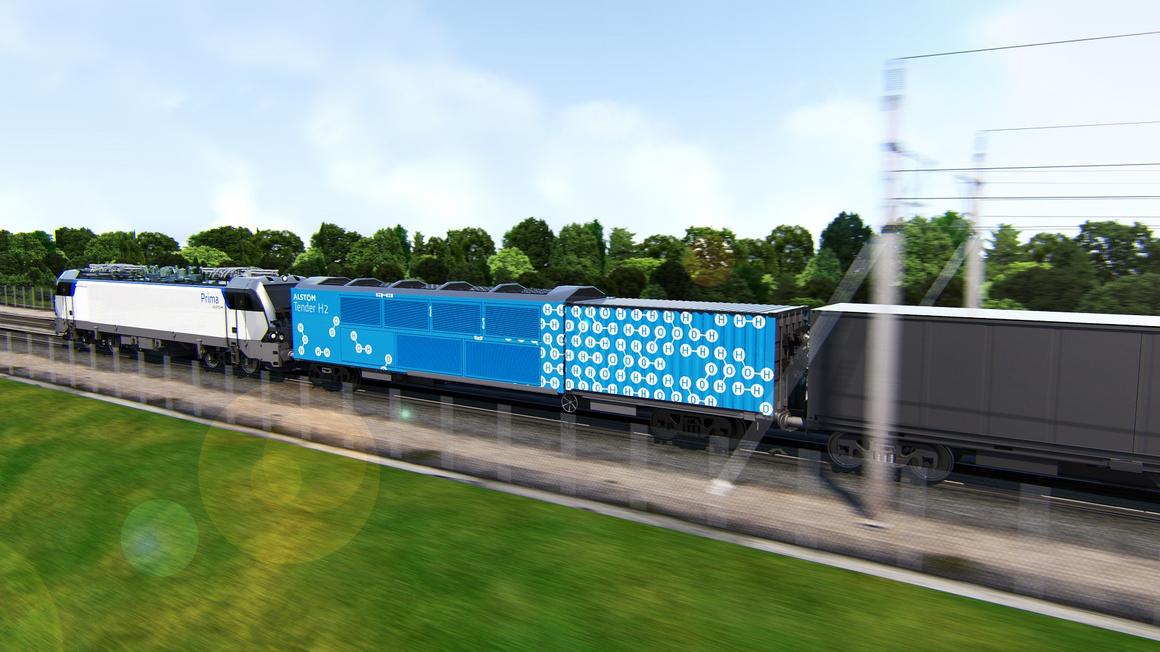
It would appear to be a very simple concept.
- The electric locomotive uses electrification where it is available.
- On lines without electrification, hydrogen is used to generate electricity.
- The locomotive and the tender are connected by a cable.
- I suspect for longer distances, larger generators with a larger hydrogen capacity can be developed.
- It would appear that typical SNCF Prima locomotives have at least 4 MW of power, so the generator must be at least this size.
I could see this concept being used with a 4 MW Class 90 electric locomotive.
Do Cummins And Stadler Have a Cunning Plan?
Roger Ford in the December 2022 Edition of Modern Railways has written an article called Traction à la mode.
The article is a series of small sections, with the last section but one, labelled Monster.
Roger says this.
Finally, we come to the mighty Class 99, which is not at all flakey. In the past I have often commented on the UK railways’ prejudice against Co-Co bogies.
But with the ’99’ six axles will give 6MW (8,000 hp) at the rail, with contact patches to use all its 113 tonnes. Plus the extra axles mean it can accommodate the weight of a 2,400 hp Cummins diesel.
At the recent Rail Freight Group conference, Ross Shepherd, Chief Technical Officer of Beacon Rail, which has 30 locomotives on order for GB Railfreight, revealed a computer simulation which showed a Class 99 would save 36 minutes on a run timed for 1 hr 40 minutes for diesel traction. To quote Mr Shepherd:’It’s a monster and it’s coming.’
I have been doing some digging around the Internet and have found this bulletin from Cummins, which is entitled QSK60 For Rail.
The Class 99 locomotive appears to have a QSK50, which appears to be a less powerful version.
The bulletin describes a Stadler locomotive with a Cummins QSK60 engine, which Stadler are delivering to Bolivia.
This paragraph introduces the locomotives.
Stadler and the Bolivian Ferroviaria Andina (Andean
Railway) FCA have signed a contract for the supply of the first three state-of-the art South American Light
Loco (SALi) locomotives, which will feature the
Cummins QSK60 engine.
The bulletin gives these details.
- Locomotive type – diesel-electric
- Track gauge – one metre
- Axle load – 18 ton/axle
- Power – 1865 kW – 2500 hp
- Diesel engine – QSK60
- Maximum Speed – 100 km/h
- Starting Tractive Effort – 415 kN
- Coupling – AAR
- Fuel Tank – Up to 6000 litres
The bulletin is marked as Printed in UK, so does that mean that the engines will come from Darlington.
The weight of this locomotive is 98 tonnes and Roger says that the Class 99 locomotive is 113 tonnes. But the Class 99 locomotive is an electro-diesel locomotive with 6 MW available when running on 25 KVAC overhead electrification.
It looks to me that Stadler have arranged the substantial electrical gubbins around the Cummins QSK50 diesel engine to create Beacon Rail’s monster.
Cummins And Hydrogen
Cummins is a company, that is big in hydrogen.
- They own hydrogen fuel cell and electrolysis company; Hydrogenics.
- They supply the fuel cells for Alstom’s hydrogen-powered Coradia iLint.
In Werner Enterprises Signs Letter Of Intent Planning To Secure 500 X15H Engines From Cummins, I said this.
More details of the X15H engine are given in this earlier press release, which is entitled Cummins Inc. Debuts 15-Litre Hydrogen Engine At ACT Expo, which has this first paragraph.
Today, Cummins Inc. debuted its 15-liter hydrogen engine at ACT Expo in Long Beach, California. This engine is built on Cummins’ new fuel-agnostic platform, where below the head gasket each fuel type’s engine has largely similar components, and above the head gasket, each has different components for different fuel types. This version, with expected full production in 2027, pairs with clean, zero-carbon hydrogen fuel, a key enabler of Cummins’ strategy to go further faster to help customers reduce greenhouse gas (GHG) emissions.
I certainly like the concept of a fuel-agnostic platform, where below the head gasket, everything is similar, and above the head gasket, there are appropriate components.
Could This Philosophy Be Used To Create An Electro-Hydrogen Locomotive?
It looks to me that if Stadler use the Cummins QSK diesel engine in their locomotives, then if Cummins develop a hydrogen version of the QSK, Stadler can convert the locomotives to hydrogen, if Cummins follow their philosophy of a fuel-agnostic platform, with everything identical below the cylinder head gasket.
Over twenty years ago, I did a small data analysis task for Cummins in Darlington. One of their engineers explained to me how they would rearrange the components of diesel engines, so they fitted with the customer’s application. It looks to me that they have taken this philosophy a step further, so that the customer can have diesel or hydrogen engines in the same application, depending on what the end user wants.
In the case of the order from Beacon Rail for thirty Class 99 locomotives, they will be delivered as electro-diesel locomotives, but at some point in the future, when Cummins has developed the hydrogen engine, they will be able to be converted to electro-hydrogen locomotives.
These locomotives could be in front-line service for over forty years!
The Very Long Range Electro-Hydrogen Locomotive
Hydrogen surely has the power and range to move freight trains across continents.
But can everything be fitted in a standard locomotive body?
Alstom have come up with an innovative solution, which I described in From 2025, Nestlé Waters France Will Use The First Hydrogen-Powered Freight Train Through An Innovative Solution Developed by Alstom and ENGIE
I would also suspect a simple tender containing a tank full of hydrogen will also work.
Collateral Benefits Of A Electro-Hydrogen Locomotive
These are possible benefits of electro-hydrogen locomotives.
- Staff in ports and freight depots get all the clean-air benefits of working with zero-carbon and low-pollution locomotives.
- Ports are becoming hydrogen hubs to fuel ships and ground-handling equipment, so electro-hydrogen locomotives could be easily-fueled.
- Ports and freight depots don’t like electrification, as containers occasionally get dropped.
- Electro-hydrogen locomotives will be able to do their own shunting.
- Electro-hydrogen locomotives will not need all tracks to ports and freight depots to be electrified, but won’t mind if they are.
These benefits would allow Network Rail and the operators of ports and freight depots to develop the best solutions for their operations.
Alstom’s Coradia iLint Successfully Travels 1,175 km Without Refueling Its Hydrogen Tank
The title of this post, is the same as that of this press release from Alstom.
This paragraph describes the trip.
Alstom, global leader in smart and sustainable mobility, has demonstrated the effectiveness of its hydrogen powered solutions for long distance transportation. During a long-distance journey, an unmodified serially-produced Coradia iLint train covered 1,175 kilometres without refuelling the hydrogen tank, only emitting water and operating with very low levels of noise. The vehicle used for this journey comes from the fleet belonging to LNVG (Landesnahverkehrsgesellschaft Niedersachsen), the transport authority of Lower Saxony, and has been in regular passenger operation on the network of evb (Eisenbahnen und Verkehrsbetriebe Elbe-Weser GmbH) since mid-August. For the project, Alstom also partnered with the gas and engineering company Linde.
The distance is around 730 miles.
This paragraph describes the detailed route.
Starting in Bremervörde, the route took the Coradia iLint across Germany. From Lower Saxony, where the hydrogen train was built and developed by Alstom, it travelled through Hesse to Bavaria, all the way to Burghausen near the German-Austrian border before coming to a stop in Munich. Following this remarkable journey, the train will now head for the German capital. Several trips through Berlin are on the agenda as part of InnoTrans 2022, the premier International Trade Fair for Transport Technology, to be held from 20 to 23 September.
It looks to be a good test of a hydrogen-powered train.
It looks like Alstom believe that hydrogen trains can replace diesel ones, providing there is a source of hydrogen.
Cummins Fuel Cell Technology Powers Coradia iLint Fleet In Germany
The title of this post, is the same as that of this article on Green Car Congress.
This is the first paragraph.
Cummins is powering the world’s first fleet of hydrogen trains in Bremervörde, Lower Saxony, Germany. The Alstom Coradia iLint trains (earlier post) are outfitted with Cummins fuel cell systems and will run on the world’s first 100%-hydrogen train route in passenger operation. The first zero-emissions passenger trains in the 14-train fleet arrived in mid-summer.
I rode the prototype in March 2019 and wrote My First Ride In An Alstom Coradia iLint.
I took this picture at the time.

Note.
- The new fleet seem to have a slightly different front end with a snow plough, and a new colour scheme.
- According to the article, the Cummins fuel cell systems were assembled in Germany.
I have a few thoughts.
Cummins Fuel Cells
I must admit, I was a bit surprised to see that Cummins fuel cells are being used, as most other companies seem to be using Ballard.
But, having worked with Cummins on diesel engine testing and seen their thoroughness, I’m sure that their fuel cells will do a good job.
Is The Cummins Choice About Marketing?
Consider.
- Alstom has manufactured or assembled trains for the US market at Hornell, New York.
- Cummins is a large United States company.
- United States and Canadian railways are standard gauge, like most of Europe.
- United States and Canadian railways have a lot of track mileage without electrification.
- United States and Canadian railways use right hand running as does Germany.
- The Coradia iLint doesn’t need any electrification.
- The Coradia iLint has a range of 600–800 kilometres (370–500 mi) on a full tank of hydrogen.
I suspect that a German-specification, Coradia iLint might be possible to run in the United States and Canada, with only a different interior and signage.
If you are an Alstom train salesman in the United States, selling a commuter train to American cities and transit authorities, must be easier if the train has a substantial United States content.
I don’t think Cummins will be worried that the smart new train has their fuel cells, as it might help convert truck, van and car drivers to Cummins hydrogen technology.
I wouldn’t be surprised to learn, that Alstom got a premium deal from Cummins.
Are Hydrogen-Powered Trains Suited To North America?
Consider.
- There is a lot of track without electrification.
- Distances are long, which makes electrification expensive.
- Providing hydrogen for trains should be no more difficult than in Europe.
- In my experience hydrogen trains are a better passenger experience than diesel, in terms of noise and vibration.
I suspect that Alstom/Cummins could sell a lot of hydrogen-powered trains in the North America.
Deutsche Bahn Puts Passengers On Alstom Battery-Electric Trains
The title of this post, is the same as that of this article on electrive.com.
This is the introductory paragraph.
French manufacturer Alstom and Deutsche Bahn are now taking passengers onboard Alstom’s first fully approved electric train since this weekend in Baden-Württemberg. Further testing will start in Bavaria on 5 February and run throughout early May on all routes.
This paragraph describes where the train will be running.
On weekdays the battery-powered train will run in Baden-Württemberg on the Stuttgart – Horb line and Saturdays and Sundays, on the Pleinfeld – Gunzenhausen line in the Franconian Lake District. Alstom said this arrangement would maximise the train’s mileage while testing a variety of route profiles and battery charging scenarios. For example, while in Baden-Württemberg, charging occurs during the ongoing journey via overhead lines, in Bavaria, charging can only take place at stations, as the route in between is not electrified.
The article gives the impression that Alstom have ambitious plans for battery-electric and hydrogen trains in Germany.
This is confirmed by this press release on the Alstom web site, where this is a paragraph.
While Alstom’s hydrogen trains are optimised for longer routes, Alstom’s BEMUs are suitable for shorter routes or lines with non-electrified sections previously operated with diesel vehicles. Direct connections between electrified and non-electrified network sections are now possible and can be operated emission free, without the need of additional electrification – shortening the travel time between city and country.
It appears Alstom will be developing both types of trains.
Alstom And DB To Kick Off Test Operations With Battery Electric Train
The title of this post, is the same as that of this article on RailTech.com.
This is the introductory paragraph.
Alstom and Deutsche Bahn (DB) are set to enter into service Alstom’s Battery Electric Multiple Unit (BEMU) for trial runs. The test operations will commence on January 24 in the state of Baden-Württemberg, followed by passenger services in neighbouring Bavaria from February 5th onwards. The tests will conclude in May 2022.
It does finally appear that battery electric multiple units (BEMUs) are being seen on the railway.
When Will Energy Storage Funds Take The Leap To New Technology?
This article on the Motley Fool is entitled 3 UK Dividend Shares To Buy Yielding 6%.
This is a paragraph from the article.
The first company on my list is the Gore Street Energy Storage Fund (LSE: GSF). With a dividend yield of just over 6%, at the time of writing, I think this company looks incredibly attractive as an income investment. It is also an excellent way for me to build exposure to the green energy industry.
Just as everybody has a fridge in their house to stop food being wasted, electricity networks with a lot of intermittent resources like wind and solar, needs a device to store electricity, so that it isn’t wasted.
Gore Street Energy Storage Fund is being very safe and conservative at the current time, often using batteries from one of Elon Musk’s companies.
You can’t fault that, but they are only barely making a dent in the amount of batteries that will be needed.
If we are generating tens of GW of wind energy, then we need batteries at the GWh level, whereas at the moment a typical battery in Gore Street’s portfolio has only an output of a few megawatts. They don’t state the capacity in MWh.
There is this statement on their web site, about the technology they use.
Although the projects comprising the Seed Portfolio utilise lithium-ion batteries and much of the pipeline of investments identified by the Company are also expected to utilise lithium-ion batteries, the Company is generally agnostic about which technology it utilises in its energy storage projects. The Company does not presently see any energy storage technology which is a viable alternative to lithium-ion batteries. However, there are a number of technologies which are being researched which if successfully commercialised, could prove over time more favourable and the Company will closely monitor such developing technologies.
They say they are agnostic about technology and are looking around, but they are sticking with lithium-ion technology.
That technology works, is safe and gives a good return.
But they are at least thinking about moving to new technology.
In the rail industry, it is common for rail leasing companies to get together with train manufacturers or remanufacturers to develop new trains.
As an example, Eversholt Rail and Alstom formed a partnership to develop a hydrogen-powered train for the UK, which I wrote about in Alstom And Eversholt Rail Sign An Agreement For The UK’s First Ever Brand-New Hydrogen Train Fleet.
Worldwide, there are probably upwards of a dozen very promising energy storage technologies, so I am very surprised that energy storage funds, like Gore Street and Gresham House have not announced any development deals.
Conclusion
Energy storage funds could benefit from using some of the financing methods used by rolling stock leasing companies.

