What Happened To The Toyota Hydrogen-Powered HiLux?
I wrote about this vehicle in Toyota Unveils Prototype Hydrogen Fuel Cell Hilux, but I’ve not heard any more.
So I asked Google AI, the question in the title of this post and received this reply.
The Toyota hydrogen-powered Hilux is currently in the demonstration and evaluation phase and has not been officially confirmed for mass production. Ten prototypes were built in the UK and are undergoing testing, with some being used for customer and media demonstrations at events like the Paris Olympics. Toyota is using this project to gather data, refine its hydrogen technology, and prepare for a future European market that could see the vehicle go on sale around 2028.
A simple Google search produced this YouTube video and this article in the Toyota UK magazine.
I don’t want to drive one, as that would be illegal, but I have just added riding in one of these beasts to my bucket list.
Toyota Have Gone To The Advanced Propulsion Centre For Their Latest Project
In Toyota Leads Multi-Million-Pound Micromobility Research Project, I write about another project, where Toyota have approached the Advanced Propulsion Centre for funding and technical help. So the Advanced Propulsion Centre must be doing something right, to attract another project from Toyota.
In CoacH2 – The Next Generation Coach, I write about how the Advanced Propulsion Centre are helping to develop the powertrain for Wrightbus’s upcoming hydrogen-powered coach.
It certainly looks like the Advanced Propulsion Centre are in the middle of the net-zero transport revolution.
Toyota Leads Multi-Million-Pound Micromobility Research Project
The title of this post, is the same as that of this news item from the Advanced Propulsion Centre.
These five paragraphs introduce the project.
he Advanced Propulsion Centre UK (APC) has announced the latest project funded through the UK Government’s DRIVE35 Collaborate programme.
Toyota will lead a consortium to research and develop a new lightweight battery electric vehicle in Derbyshire.
The project aims to meet the evolving needs of urban populations while accelerating the shift to zero tailpipe emission transport by validating a novel, lightweight battery electric vehicle (BEV) in the L6e category.
Underlining Toyota’s commitment to investing in the UK’s R&D capabilities, it will be manufactured at Toyota Manufacturing UK’s (TMUK) Burnaston site.
The vehicle addresses the growing demand for sustainable micro-mobility solutions and includes an integrated solar roof, increased connectivity, and lightweight sustainable materials supporting recovery and recycling.
Note.
- The vehicle will be light in weight.
- Toyota is investing in UK R & D.
- The vehicle will be built in Derbyshire at Burnaston.
I asked Google AI, what is an L6e Car and received this reply.
An L6e car is a light quadricycle in the EU vehicle classification system, defined as a light, four-wheeled vehicle with a maximum speed of 45 kph}) (28 mph)) and an unladen mass of no more than 425 kg. (excluding batteries for electric versions). It can be powered by small internal combustion engines or electric motors, and vehicles in this category are often used for urban commuting or small delivery tasks.
Note.
- Sir Alec Issigonis’s famous ADO15 Mini, which was launched in 1962, weighed 580 Kg, seated four and had an initial top speed of 75 mph.
- Sir Alec also designed racing cars and high performance Mini Coopers.
- Another partner in the project specialises in urban delivery vehicles.
I always wonder what sort of electric vehicle, the great car designer would have designed.
These are some further thoughts.
Do Toyota Build Microcars In Japan?
I asked Google AI, the question in the title of this section and received this answer.
Yes, Toyota builds microcars in Japan, and the Toyota C+pod is one example. While Toyota previously focused on larger vehicles, it now manufactures ultra-compact electric vehicles like the C+pod for the Japanese market to meet customer demand for small city cars.
The Toyota C+Pod has this Wikipedia entry, which gives these details.
- Two seats.
- 9.2 KW electric motor.
- 670-690 Kg weight.
- 37 mph.
- 93 mile range.
- The car has air conditioning, air-bags and heated seats.
The number of seats, speed and range would appear to be ideal for a city-car.
Could The Vehicle Be Hydrogen Powered?
I asked Google AI, if small lightweight hydrogen fuel cells exist and received this answer.
Yes, small, lightweight hydrogen fuel cells do exist and are commercially available for various applications, ranging from educational kits to power sources for drones and portable electronics.
I wouldn’t be surprised if the project needed a hydrogen fuel cell of a particular weight, size and power, someone could built it, by scaling an existing design.
Could The Vehicles Be Self Driving?
Not probably now, but as the technology gets more sophisticated, I suspect that it will happen.
Could The Vehicles Replace The Invacar?
This article in The Times is entitled Bring Back Three-Wheeled Cars For Disabled Drivers, Reform Urges.
I would expect that, if Toyota, the Advanced Propulsion Centre and their partners did a comprehensive job, then Toyota’s new car could serve the same purpose as an Invacar, much better in a zero-carbon manner.
There Is This Video Of A Toyota C-Pod.
Conclusion
I believe this project could come up with something special.
Another Possible Reason Not To Buy An Electric Car!
As some will have noticed from this blog; I don’t drive and I don’t even have a car.
But then I wouldn’t buy an electric car.
- The range is pathetic and totally out of my comfort zone after sixty years of driving.
- Like my father I like lightweight vehicles and the weight of an electric car is just too heavy.
- The price of an electric car is totally unsustainable when compared to that of a petrol or diesel car.
- The environmental profile of a large lithium-ion battery is not good and could be improved.
I would say, that an electric car’s payload/price/range/weight profile is totally inferior to that of your average petrol or diesel car today. If petrol or diesel fuel were still available, I wouldn’t give an electric car house room. Luckily because a stroke ruined my eyesight, it’s a choice I don’t have to make.
Yesterday evening, another reason not to buy an electric car reared its ugly head.
Opposite my house is a public charging point for electric vehicles, that was installed by a company in co-operation with Hackney Council.
A driver parked their Tesla by the charger and plugged it in.
When they returned to the car, the charger cable had been stolen.
I suspect that a new cable and getting going again wasn’t very affordable.
Moment Energy Secures US$15 Million Series A Funding To Build World’s First Second-Life Gigafactory in the U.S
The title of this post is the same as that of this article on Cision.
This is the sub-heading.
Funding co-led by Amazon Climate Pledge Fund and Voyager Ventures to accelerate production of high-performing Battery Energy Storage Systems (BESS) from repurposed EV batteries
Series A brings Moment Energy’s financing in the last three months alone to over US$40 Million with US$52 million raised to date
This introductory paragraph gives more details.
Moment Energy’s battery energy storage systems (BESS) can be deployed in projects ranging from 400 kilowatt hours (kWh) to 10 megawatt hours (MWh), targeting an intermediate market segment that is currently underserved but crucial to the clean energy transition. Designed to serve commercial and industrial sectors, EV charging infrastructure, and renewable energy integration, the company is strategically positioned to capitalize on the convergence of rising EVs and renewable energy sources.
Sounds like a sensible way of handling old lithium-ion batteries.
Moment Energy has a web site.
Are we getting a second-life gigafactory in the UK?
We probably will need one.
As Moment Energy is Canadian, they might supply it.
The Crews Bracing Themselves For A Rise In Electric Car Fires
The title of this post, is the same as that of this article on the BBC.
This is the sub-heading.
Each year, Essex Fire and Rescue Service focuses on one area of “top-up” training for its crews. In recent years, this has included sessions on firefighting at height and managing hazardous materials. This year, a new course is being introduced: How to deal with electric vehicle fires. Why?
These are the first three paragraphs.
Station manager Terry Maher has recently taken on a new role within the fire service.
A hazardous material expert, he is now the service’s lead officer on tackling lithium-ion battery fires.
His new responsibility comes as the number of electric vehicles (EVs) on UK roads hits more than 540,000. And the number is rising fast.
The article certainly worried me.
Most of the views expressed are by a fire officer, who is also a hazard materials expert.
It should be remembered that I have had serious fire training both as a Scout with the London Fire Brigade and a few years later at both Enfield Rolling Mills and at ICI.
These are a few points from the article.
- Dealing with a petrol or diesel car fire would normally take about 30 minutes. With an EV fire we’re looking at four or five hours or longer, if we’ve used water.
- As more and more people use electric vehicles we can expect more and more electric vehicle fires.
- The results of text searches show there were 59 electric vehicle fire references in 2022-23 across England – up from 30 the previous year.
We are dealing with dangerous vehicles and must handle with care.
These are my thoughts.
Car Insurance Rates For Electric Vehicles Will Rise
The worse the risk, the more you will have to pay.
A Full Safety Assessment Should Be Done Before Buying An Electric Vehicle
For instance, I have an integral garage in my house and wouldn’t feel safe at night, if an electric car or bicycle was in there on charge.
I certainly wouldn’t buy an electric car with a plastic body. Although I did own a Lotus Elan for over twenty years.
Conclusion
Everybody, who is thinking of buying an electric car or bicycle, should read the BBC article first.
First Look Inside £2.2bn Silvertown Tunnel
The title of this post, is the same as that of this article on the BBC.
These are the first five paragraphs.
For the first time, Transport for London has invited journalists inside what is one of the most controversial infrastructure projects in the capital.
The Silvertown Tunnel is 1.4km (just under one mile) long and stretches from Silvertown in Newham to the Greenwich Peninsula.
Inside the tunnel, it is extremely wide. A lot bigger than other tunnels like the supersewer or Crossrail. Boring was finished a few weeks ago.
Transport for London (TfL) says the scheme will address queues at the Blackwall Tunnel and reduce pollution. But it has faced fierce opposition from those who think it will do the total opposite and increase pollution and congestion.
And the big question is – even with mitigation – can a road tunnel ever be green?
Note.
- There is a good picture, showing the width of the tunnel.
- It is very wide and can’t be much narrower than the four-lane Queensway Tunnel, which was opened under Mersey in 1934.
These are my thoughts.
I Am Against The Tunnel Being Built
My main reason I am against the Silvertown Tunnel is that Transport for London’s mathematical modelling of and rerouting of buses past my house has been some of the worst I’ve seen. I talk about the bus problems I now have in Is The Nightmare On The Buses Going To Get Worse?
So until the two tunnels; Blackwall and Silvertown are complete and open with tolling, I won’t trust any of Transport for London’s pronouncements.
I also feel that as the Silvertown Tunnel will allow trucks to pass though, there will be times, when they will cut through the East End to get to the Motorways going North.
But now, it’s more or less finished, we will probably need to use it.
How Is The Tunnel Being Paid For?
The Wikipedia entry for the Silvertown Tunnel has a section called Costs, where this is said.
In 2012, the cost was stated to be £600m. A consultation in 2015 stated that the cost of construction was estimated to be £1bn. In March 2020, the cost was increased again, to £1.2 billion. Operation, maintenance and financial costs of the tunnel over 25 years is expected to cost another £1bn.
The £2.2 billion will be repaid by tolls on both tunnels. Effectively, it’s a Private Finance Initiative or PFI.
Can A Road Tunnel Ever Be Green?
This is the question the BBC asked in the last paragraph of my extract.
Although, I am very much against this tunnel, I do believe this tunnel can be green.
- Suppose, the tunnels were made free for zero-carbon vehicles, that were powered by batteries, hydrogen or possibly ammonia.
- This might nudge vehicle owners and operations to go zero-carbon.
This extra number of zero-carbon vehicles would help to clean up London’s air.
I wonder which will be the preferred route for trucks associated with construction to go to and from sites in Central London?
- These trucks are major polluters in Central London.
- There are sensible moves to make construction sites zero-carbon.
If the Silvertown Tunnel didn’t have tolls for zero-carbon trucks, then surely this would nudge, this sizeable group of trucks to go zero-carbon to the benefit of everyone in Central London.
The only problem with making zero-carbon vehicles toll-free, is that it probably ruins the finances of the tunnels, from the point of view of the investors.
Conclusion
I can see lots of conflict starting over the operation of this tunnel.
Fire Safety Of Battery-Electric Vehicles
I notice that there has been talk of fires in battery-electric vehicles on this blog.
So I thought I’d put up a post with an appropriate topic.
There are some things that already could worry me.
- Vivarail had a fire early on.
- The Merseyrail Class 777 trains go in the tunnels under Liverpool.
- The new Piccadilly Line trains will have batteries.
- Did electric vehicle batteries contribute to the ferocity of the fire in the Luton Airport car park?
- Fire brigades are getting very worried about e-scooter and e-bike fires.
- This page on the Internet gives details of recent BESS fires.
- Do we investigate fires and publish the results properly?
I have some questions.
- Would it be sensible to have nationwide database of all batteries?
- Should we use more non-lithium methods in large stationary batteries?
- Should we use more capacitors?
- Should we make it a criminal offence to build or use a non-compliant e-bike or e-scooter?
- Should installing a battery in your house, need a safety certificate?
One half of me says yes and the other says no, to some of these questions.
Could A Mega-Station Be Built For The Channel Tunnel?
This article on Railway Gazette International, is entitled Start-Up Announces Amsterdam To London And Paris High Speed Train Ambitions.
It talks about how Dutch start-up; Heuro wants to run fifteen trains per day (tpg) between London and Amsterdam.
The article then has this paragraph, which details other operators, who are wanting to run services between London and the near Continent.
Heuro’s announcement comes after Spanish start-up Evolyn announced plans in October for a Paris – London service, while on November 11 British newspaper The Daily Telegraph reported that Sir Richard Branson and Phil Whittingham, former head of Virgin Trains and Avanti West Coast, were also drawing up plans to compete with Eurostar and had held discussions with infrastructure managers.
This leads me to the conclusion, that there will be a need for more capacity for trains and/or passengers at some time in the future.
- There are six International platforms at St. Panvcras International station, which can each probably handle four trains per hour (tph), so I suspect the station could handle 24 International tph.
- As a modern high speed train can carry over 500 passengers, that is 12000 passengers per hour.
- Visit St. Pancras station in the morning and it is often crammed with travellers coming from and going to Europe.
I suspect that the number of trains may not be a problem, but the number of passengers will.
We could always join Shengen, but then that would be an open door to all the would-be migrants to the UK.
This Google Map shows Stratford International station.
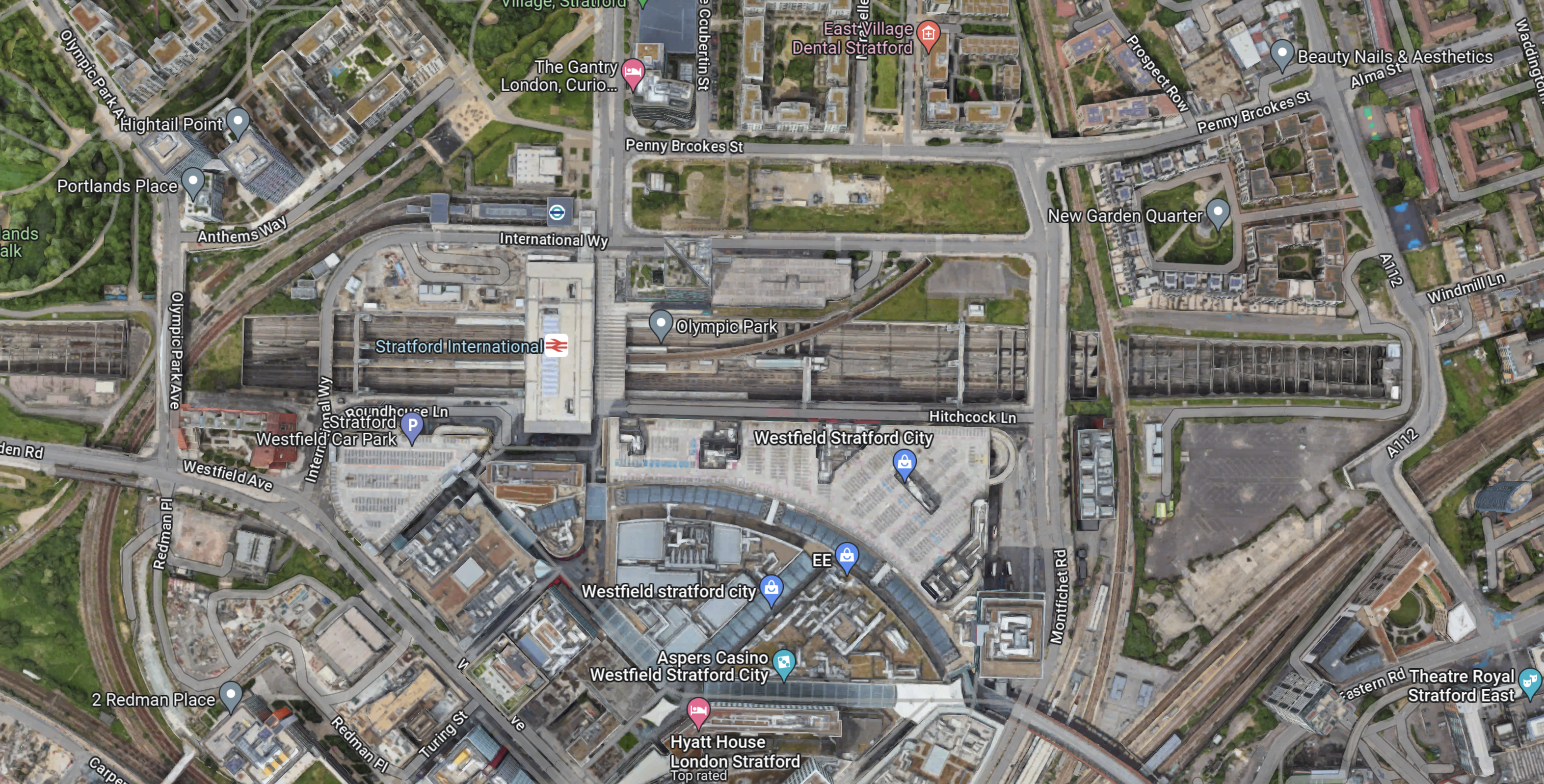
Stratford International station is in a soulless concrete cavern, that lies across the middle of the map.
In Platforms 1 And 4 At Stratford International Station, there are a lot of pictures of the station.
I think it would be extremely difficult to add extra platforms and passenger facilities to the station.
This Google Map shows Ebbsfleet International station.
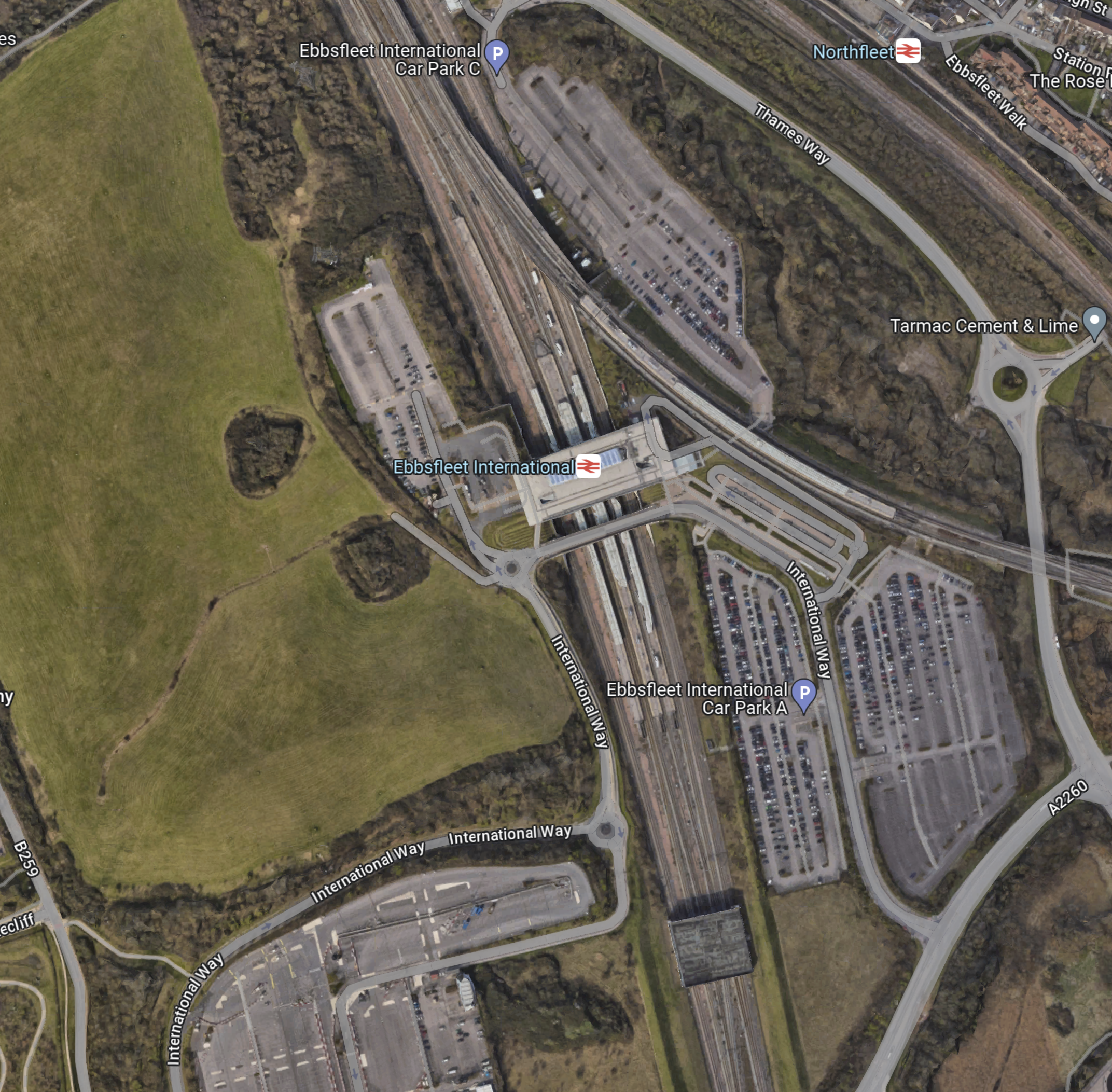
Note.
- Ebbsfleet International station, with its two International and four domestic platforms is in the middle of the map.
- The station is surrounded by car parks with a total of 5,000 spaces.
- Northfleet station is in the North-East corner of the map.
There is a lot of land, without any buildings on it.
These are my thoughts.
Enough Extra Bay Platforms To Handle The Additional Trains
There would appear to be space for perhaps two bay platforms to terminate trains.
But would passengers we happy being dumped outside Central London?
Would An Elizabeth Line Extension To Ebbsfleet Be Needed?
There are various plans to link the Elizabeth Line tp Ebbsfleet International.
In Elizabeth Line To Ebbsfleet Extension Could Cost £3.2 Billion, I showed this map from the Abbeywood2Ebbsfleet consultation.
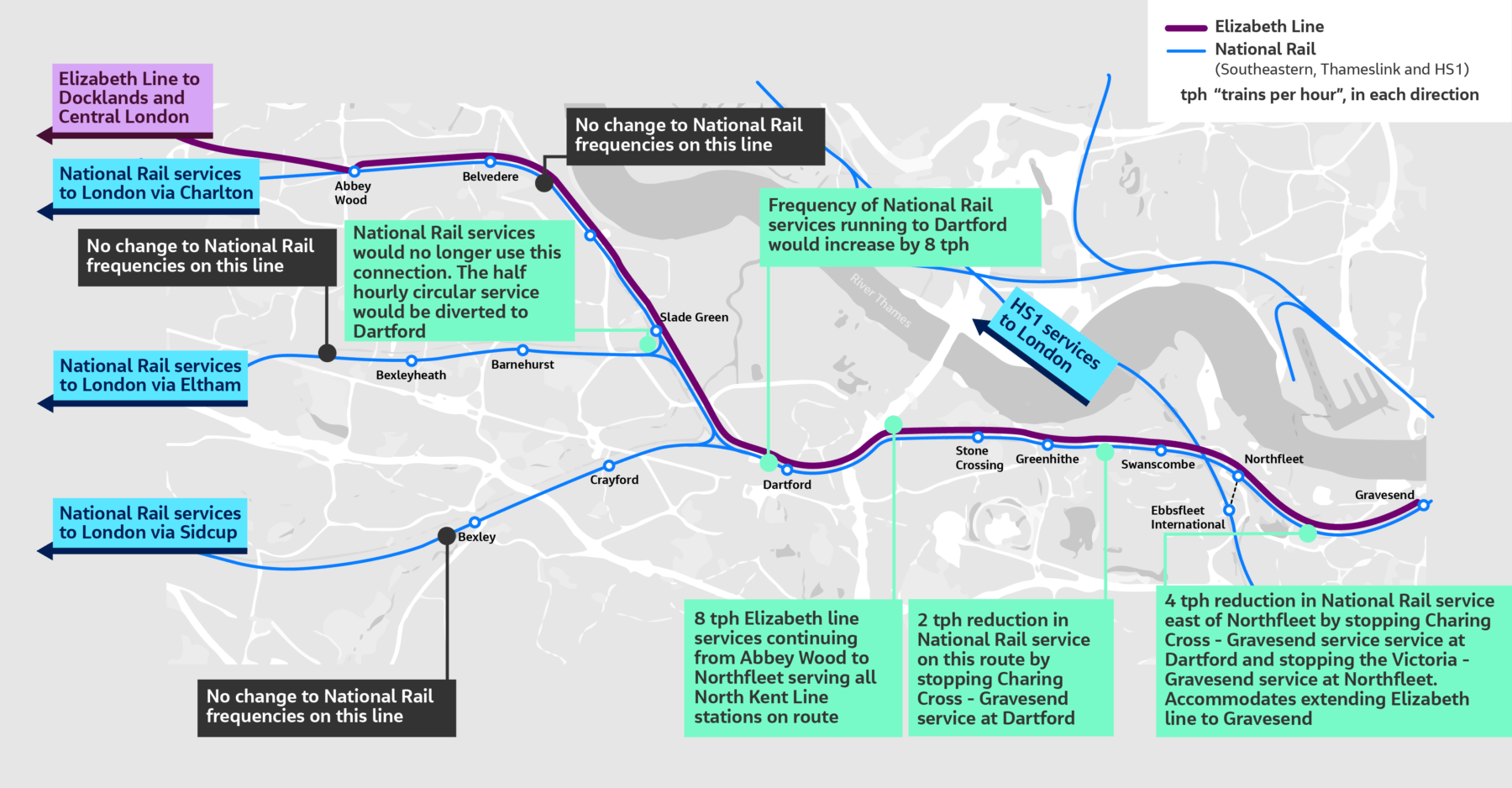
There doesn’t appear to be too much new infrastructure, except for a proper connection between Northfleet and Ebbsfleet stations. References on the Internet, say that the similar-sized Luton DART connection at Luton Airport, cost around £225 million.
The Elizabeth Line connects to the following.
- Bond Street
- Canary Wharf
- City of London
- Farringdon for Thameslink
- Heathrow Airport
- Old Oak Common for High Speed Two
- Liverpool Street station
- Oxford Street
- Paddington station
- Slough for Windsor
- Tottenham Court Road for the British Museum, Oxford Street, Soho, Theatreland and the Underground.
- West End of London
- Whitechapel for the Overground and Underground
For many people like me, the Elizabeth Line at Ebbsfleet will provide one of the quickest ways to get to and from European trains.
Ebbsfleet Has Space For A Bus Station
A bus station with comprehensive routes could be built at Ebbsfleet station, which I don’t think will be possible at St. Pancras.
It would also be possible to provide an easy route to Gatwick Airport along the M25.
Hotel Accommodation
This is surely necessary.
It would make an ideal base for tourists and business people, who wanted to visit several of the large cities connected to Ebbsfleet.
A Very Large Car Park
Consider.
- Heathrow Airport is looking at providing upwards of 50,000 car parking spaces.
- Some travellers are seriously allergic to public transport and will always use their car.
- Many travellers these days want to take a severely outside case with them, when they’re only having a weekend in Paris.
I feel that a mega-station for Europe will need upwards of 10,000 car parking spaces. All of them with vehicle-to-grid chargers.
A Very Large Storage Battery
According to this page on the E-on web site, the average size of the battery in an electric vehicle is 40 kWh.
If 5,000 car parking spaces were to be fitted with vehicle-to-grid charging (V2G), that would be 2 MWh of energy storage, that could be used by National Grid, to store surplus electricity.
Get V2G right and it could make a serious contribution to your parking costs.
Pictures Of Ebbsfleet Station
These are some pictures I took at Ebbsfleet station today.






















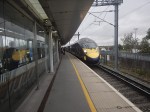
Note.
- The station is a fairly boring concrete, glass and steel construction.
- The SouthEastern HighSpeed services also go to St. Pancras, so they don’t offer any different connectivity towards the capital.
In addition, the SouthEastern HighSpeed Class 395 trains aren’t step-free at the platforms, as these pictures shows.




As I came back into St. Pancras International station, staff were struggling to load a wheelchair onto a train using a ramp.
Would A Two-Station Solution Increase Capacity?
High Speed Rail lines have high capacity trains and there are examples of more than one station at the end of a route.
- The London end of High Speed Two will have stations at Old Oak Common and Euston.
- The Manchester end of High Speed Two will have stations at Manchester Airport and Manchester Piccadilly.
- The Edinburgh end of the East Coast Main Line has stations at Waverley and Haymarket.
- The Amsterdam end of Eurostar and Thalys has stations at Rotterdam, Schipol Airport and Amsterdam.
A selection of stations gives choice and convenience for travellers.
Conclusion
I believe that selective development of Ebbsfleet International station could be used to take the pressure away from St. Pancras International station.
These developments could include.
- A comprehensive bus station
- Elizabeth Line to Northfleet
- Hotel Accommodation
- Lots Of Car Parking
What Percentage Of Government Finance Is Fuel Duties?
I typed the title of this post into Google.
Google found this page from the Office of Budget Responsibility.
This was the first paragraph.
Fuel duties are levied on purchases of petrol, diesel and a variety of other fuels. They represent a significant source of revenue for government. In 2023-24, we expect fuel duties to raise £24.3 billion. That would represent 2.3 per cent of all receipts and is equivalent to £867 per household and 0.9 per cent of national income.
I don’t drive after a stroke ruined my eyesight, so I pay nothing directly.
But when everybody is in electric vehicles, how is the £24.3 billion hole in the government’s finances caused by no-one paying duty on petrol and diesel to be filled?
I would assume that everyone will have a black box in their vehicle and they’ll pay according to the miles they drive, their speed, the congestion and the vehicle type.
And of course if a driver exceeds the speed limit, they’ll be automatically sent a ticket.
I can understand why Labour politicians like Mark Drakeford and Sadiq Khan are so keen on 20 mph limits.
Has that nice Rachel Reeves told them what she has planned for motorists?
Their eyes must be rolling like cash registers.
Rolls-Royce Considering Switching From BEV To Hydrogen For Future Models
The title of this post, is the same as that of this article on INSIDEEVs.
This is the sub-heading
The luxury carmaker’s CEO rules out hydrogen combustion, but fuel cells are on the table.
This is the first paragraph.
Rolls-Royce is considering ditching all-electric powertrains in favor of fuel cell technology for its future zero-emissions models once the technology is mature enough and can be scaled to meet its demands, according to Autocar, quoting the luxury car brand’s CEO, Torsten Müller-Ötvös.
As the Rolls-Royce Spectre has a kerb weight of almost three tonnes, I suspect that the handling might make someone like Alec Issigonis, Colin Chapman or Stirling Moss have a good laugh.
But the smaller battery that the fuel cell technology would require, might give a better balance between acceleration, handling and performance.
It would be good fun to model the dynamics of such a heavy car.
I do think though that it is these dynamics, that have suggested a move to hydrogen.
Or Torsten Müller-Ötvös, may have made the statement to find out, what the sort of people, who would buy this car, might think!
 The Anonymous Widower