More On Batteries On Class 802 Trains
In the December 2021 Edition of Modern Railways, there’s an article called Battery Trial For TPE ‘802’.
Class 802 trains are now involved in two battery trials.
- One involves Great Western Railway (GWR) trains, which I wrote about in Hitachi And Eversholt Rail To Develop GWR Intercity Battery Hybrid Train – Offering Fuel Savings Of More Than 20%.
- A second involves TransPennine Express (TPE), which I wrote about in Hitachi Rail And Angel Trains To Create Intercity Battery Hybrid Train On TransPennine Express.
This article puts some flesh of the bones of the two trials.
It is hoped that replacing one diesel engine (generator unit) with a battery pack will enable the following.
- Reduction of carbon emissions by at least 20 %.
- Reduction of fuel consumption.
- The ability to rely on battery power when entering and leaving stations to reduce noise pollution and emissions.
This paragraph explains a possible way the trains will be operated.
Another option is to use the battery to provide ‘classic’ hybridisation efficiency, allowing most diesel running to be done fuel-efficiently under two engines rather than three. In this case, the battery module would provide top-up power for peak demand and give regenerative braking capability when operating in diesel mode, which the trains currently do not have.
This is one of the aims of the GWR trial and I suspect anybody, who has owned and/or driven a hybrid car will understand Hitachi’s thinking.
The next paragraph is very revealing.
To fully test the 6m-long, 2.2m-wide battery module, the intention is for it to be flexibly programmable in order for different approaches to charging, including from the overhead line power supply, diesel engines and during braking , to be evaluated.
It looks to me that Hyperdrive Innovation will earn their fees for the battery design and manufacture.
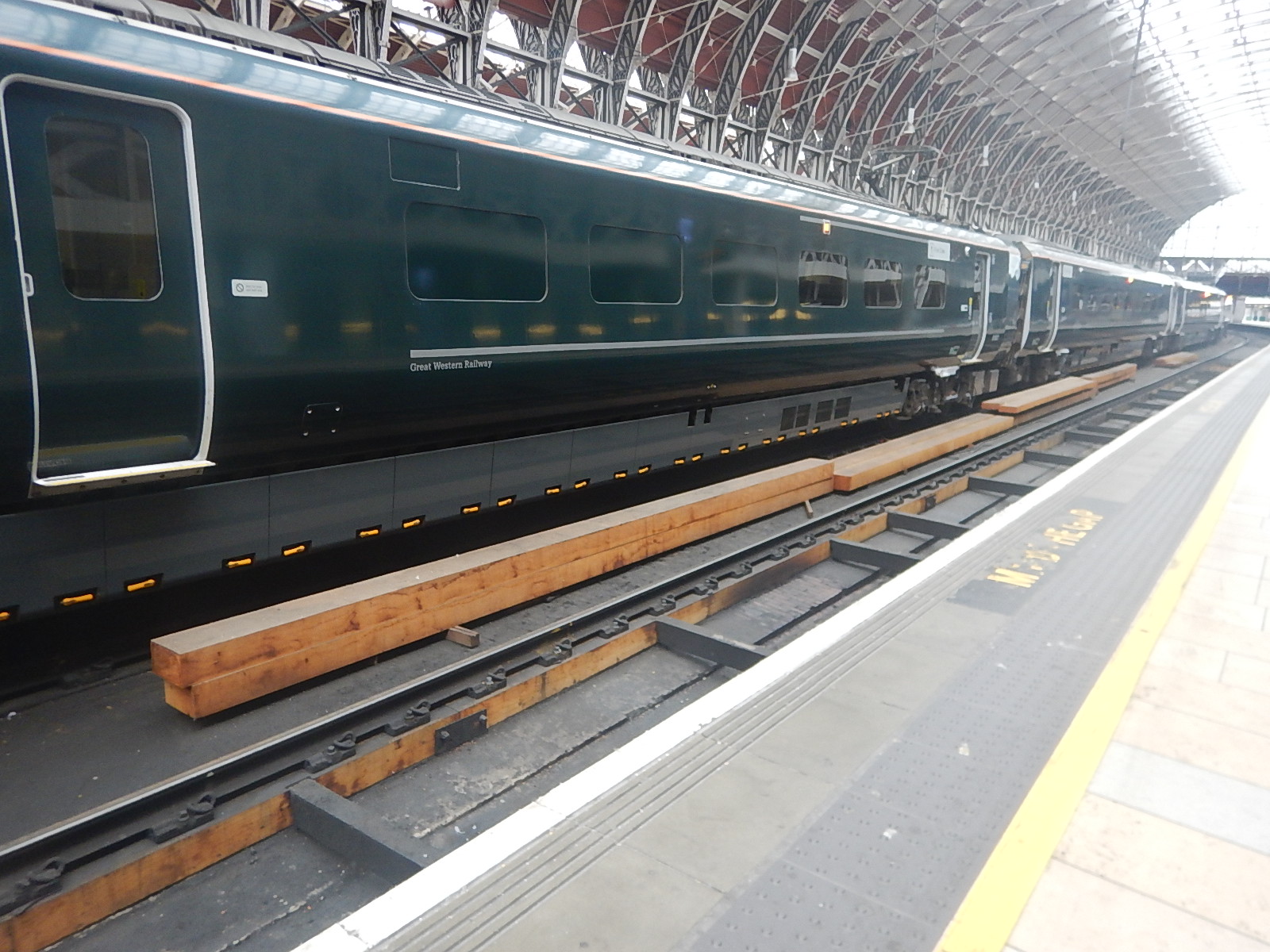
This picture shows the underneath of a Class 802 train.
Note.
- The car is 26 metres long
- The car is 2.75 metres wide.
- The MTU 12V 1600 diesel engines, fitted to a Class 802 train, each weigh around two tonnes.
- The engines have a power output of 700 kW
I would think that the 6 x 2.2 m battery would fit under the car easily.
As an engineer, who has evaluated all sorts of weight and balance problems, I would make the battery similar in weight to the diesel engine. This would mean that the existing mountings for the diesel engine should be able to support the battery pack. It would also probably mean that the handling of a car with a diesel engine and one with a battery pack should be nearer to being identical.
Tesla claim an energy density of 250 Wh/Kg for their batteries, which would mean a battery with the weight of one of the diesel engines could have a capacity of around 500 kWh.
As a Control Engineer, I believe that Hitachi and Hyperdrive Innovation have a tricky problem to get the algorithm right, so that the trains perform equally well under all conditions. But with a good simulation and lots of physical testing, getting the algorithm right is very much a solvable problem.
The article says this about the reliability of the diesel engines or generator units (GU) as Hitachi call them.
Whilst reliability of the generator units (GU) has improved, operators of the bi-mode sets still report frequent issues which see sets ending their daily diagram with one out of use.
I wonder, if battery packs will improve reliability.
From statements in the article, it looks like Hitachi, MTU and the train operating companies are being cautious.
The article also says this about the design of the battery packs.
The battery pack has been designed so it is a like-for-like replacement for a GU, which can maintain or improve performance, without compromising on seats or capacity.
I have always said it would be plug-and-play and this would appear to confirm it.
How Will The Batteries Be Charged?
I showed this paragraph earlier.
To fully test the 6m-long, 2.2m-wide battery module, the intention is for it to be flexibly programmable in order for different approaches to charging, including from the overhead line power supply, diesel engines and during braking , to be evaluated.
GWR and TPE run their Class 802 trains to several stations without electrification. and they will probably need some method of charging the battery before leaving the station.
This is Hitachi’s infographic for the Hitachi Intercity Tri-Mode Battery Train.

Note.
- This infographic was published with the Hitachi press release announcing the development of the tri-mode train for GWR.
- One diesel engine has been replaced by a battery pack.
- Charging the battery can be under wires or 10-15 minutes whilst static.
- At some stations like Exeter St. Davids, Penzance, Plymouth or Swansea, heavily-laden services might need the assistance of batteries to get up to operating speed.
The infographic released with the Hitachi press release announcing the trials for TPE.
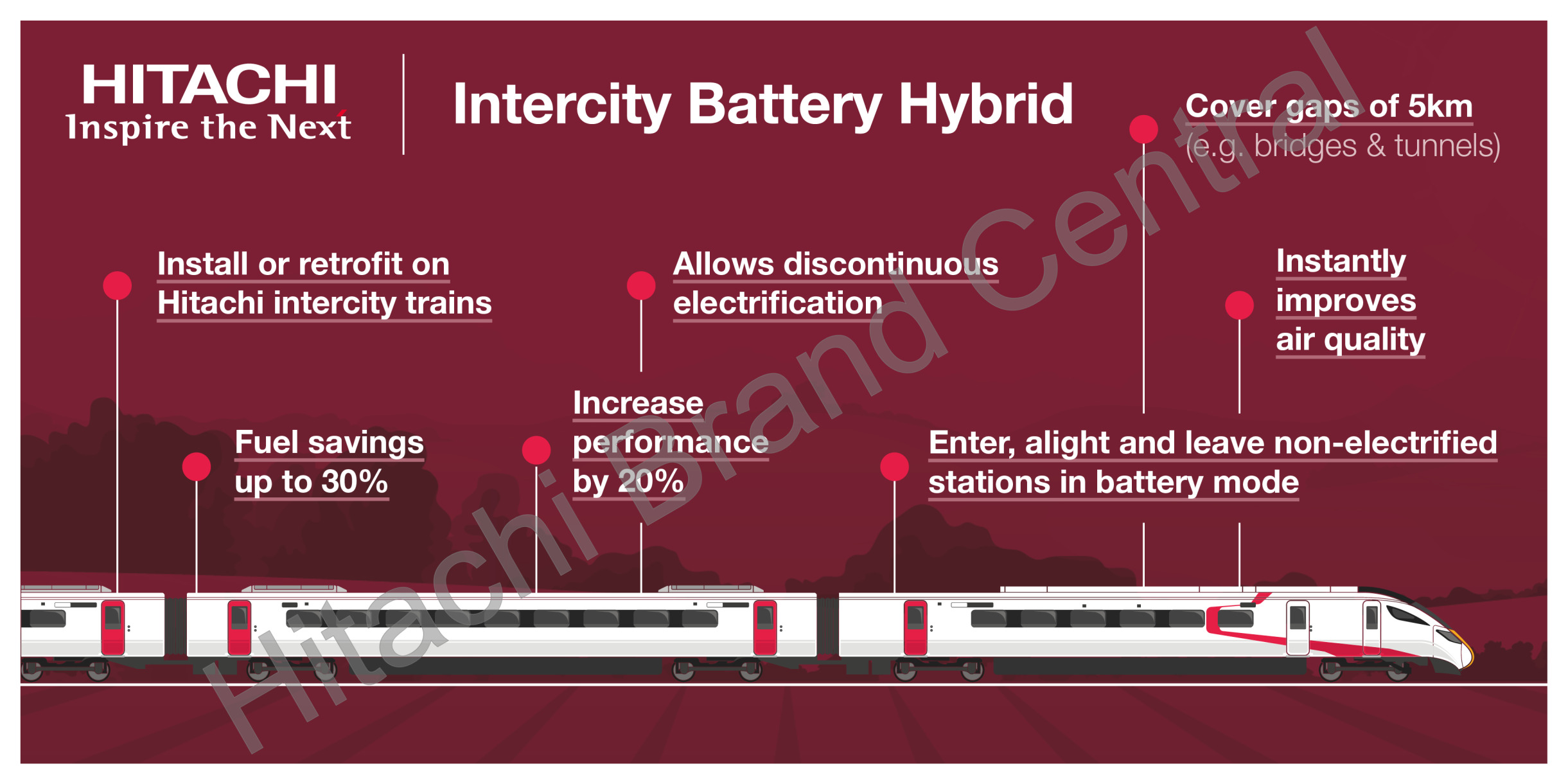
It is similar, but it says nothing about charging.
So how will these trains be charged in stations like Hull, Middlesbrough. Penzance, Scarborough and Swansea, so they leave on their return journey with a full battery?
Consider.
- The formation of a five-car Class 802 train is DPTS-MS-MS-MC-DPTF.
- Pantographs appear to be on both driver cars.
- The middle three cars have diesel engines.
- Only the middle three cars have traction motors.
- There is probably a high-capacity electrical bus running the length of the train, to enable electricity to power all the cars from either or both paragraphs, when running on an electrified line.
The simplest way to charge the batteries would probably be to install a short lengthy of 25 KVAC overhead electrification in the station and then to charge the batteries the driver would just raise the pantograph and energise the electrical bus, which would then feed electricity to the batteries.
I wrote about Furrer + Frey’s Voltap charging system in Battery Train Fast Charging Station Tested. This charging system would surely work with Hitachi’s designs as batteries can be charged from overhead electrification.
Conclusion
I suspect that Hitachi will achieve their objectives of saving fuel and cutting emissions.
But there is more than this project to just replacing one diesel engine with a battery pack and seeing what the savings are.
It appears that the battery packs could have an effect on train reliability.
If the battery packs are truly like-for-like with the diesel engines, then what will be effect of replacing two and three diesel engines in a five-car Class 802 train with battery packs.
Will it be possible to develop an ability to setup the train according to the route? It’s only similar to the way Mercedes probably set up Lewis Hamilton’s car for each circuit.
But then the speed Formula One cars lap Silverstone is not that different to the maximum speed of a Hitachi Class 802 train.
Hitachi And Eversholt Rail To Develop GWR Intercity Battery Hybrid Train – Offering Fuel Savings Of More Than 20%
The title of this post is the same as that of this press release from Hitachi.
The press release starts with these bullet points.
- Batteries replacing an engine to cut fuel usage and reduce carbon emissions
- First time a modern UK intercity train, in passenger service, will use alternative fuel
- Tri-mode train can improve air quality and reduce noise across South West route’s non-electrified stations
They follow these with this introductory paragraph.
In a UK-first, Hitachi Rail and Eversholt Rail have signed an exclusive agreement aimed at bringing battery power – and fuel savings of more than 20% – to the modern Great Western Railway Intercity Express Trains that carry passengers between Penzance and London.
After a couple more paragraphs, the press return returns to the Penzance theme.
GWR’s Intercity Express Train fleet currently calls at 15 non-electrified stations on its journey between Penzance and London, all of which could benefit from trains running on battery-only power.
The press release then sets out their aims.
The projected improvements in battery technology – particularly in power output and charge – create opportunities to replace incrementally more diesel engines on long distance trains. With the ambition to create a fully electric-battery intercity train – that can travel the full journey between London and Penzance – by the late 2040s, in line with the UK’s 2050 net zero emissions target.
Penzance gets another mention, but the late 2040s for a fully electric-battery intercity train between Penzance and London, is not an ambitious target.
Hitachi Intercity Tri-Mode Battery Train
Hitachi have called the train the Intercity Tri-Mode Battery Train and the specification is shown in this infographic.
Note that fuel & carbon savings of at least 20 % are claimed.
Penzance To London In A Class 802 Train
It would appear that Penzance and London has been chosen as the trial route.
These figures were obtained from Real Time Trains figures for the 1015 from Penzance on the 14th December 2020.
- Penzance to St. Erth – 5.65 miles – 8 mins – 42.4 mph – 1 mins stop
- St. Erth to Camborne – 7.2 miles – 10 mins – 43.2 mph – 1 mins stop
- Camborne to Redruth – 3.65 miles – 5 mins – 43.8 mph – 2 mins stop
- Redruth to Truro – 9 miles – 10 mins – 54 mph – 2 mins stop
- Truro to St. Austell – 14.7 miles – 15 mins – 58.8 mph – 1 mins stop
- St. Austell to Par – 4.5 miles – 6 mins – 45 mph – 1 mins stop
- Par to Bodmin Parkway – 8 miles – 11 mins – 43.6 mph – 1 mins stop
- Bodmin Parkway to Liskeard – 9.2 miles – 12 mins – 46 mph – 1 mins stop
- Liskeard to Plymouth – 17.8 miles – 25 mins – 42.7 mph – 9 mins stop
- Plymouth to Totnes – 23.1 miles – 25 mins – 55.4 mph – 1 mins stop
- Totnes to Newton Abbot – 8.8 miles – 9 mins – 59.3 mph – 2 mins stop
- Newton Abbot to Exeter St. Davids – 20.2 miles – 18 mins – 71.3 mph – 2 mins stop
- Exeter St. Davids to Tiverton Parkway – 16.5 miles – 14 mins – 70.7 mph – 1 mins stop
- Tiverton Parkway to Taunton – 14.2 miles – 11 mins – 77.4 mph – 2 mins stop
- Taunton to Reading – 106.7 miles – 76 mins – 84.2 mph – 5 mins stop
- Reading to Paddington – 36 miles – 25 mins – 86.4 mph
The route can be broken neatly into four very different sections.
- Penzance and Plymouth – 79.5 miles – 112 mins – 42.5 mph – 75 mph operating speed
- Plymouth and Exeter St. Davids – 52 miles – 57 mins – 54.7 mph – 100 mph operating speed
- Exeter St. Davids and Newbury – 120.4 miles – 95 mins – 76 mph – 100 mph operating speed
- Newbury and Paddington – 53 miles – 36 mins – 88.3 mph – 100-125 mph operating speed
Note.
- The speed builds up gradually as the journey progresses.
- Only between Newbury and Paddington is electrified.
How does Penzance and Paddington stand up as a trial route?
- Penzance and Plymouth has eight intermediate stops about every nine-ten miles.
- The nine minute stop at Plymouth, is long enough to charge the batteries, should that be incorporated in the trial.
- The Cornish Main Line is generally double track, with an operating speed of 75 mph.
- Plymouth and Exeter includes the running by the sea, through Dawlish.
- Exeter could be given an extended stop to charge the batteries.
- Exeter and Newbury is a faster run and the batteries may help with performance.
- The Reading and Taunton Line has an operating speed of 110 mph.
- Remember the trains are designed for 140 mph and they achieve nothing like that on diesel.
- At each of the fifteen stops, the performance, noise and customer reaction can be evaluated. Strange, but my experience of battery trains, says that they are very much quieter than similar electric trains.
The route has a good selection of the types of routes, that Great Western Railway has in its network.
It would appear to be a good route to sort out the good and bad points of the train.
I have a few thoughts.
Possible Destinations For A Intercity Tri-Mode Battery Train
Currently, the following routes are run or are planned to be run by Hitachi’s Class 800, 802, 805 and 810 trains, where most of the route is electrified and sections do not have any electrification.
- GWR – Paddington and Bedwyn – 13.3 miles
- GWR – Paddington and Bristol Temple Meads- 24.5 miles
- GWR – Paddington and Cheltenham – 43.3 miles
- GWR – Paddington and Great Malvern – 76 miles
- GWR – Paddington and Oxford – 10.4 miles
- GWR – Paddington and Penzance – 252 miles
- GWR – Paddington and Swansea – 45.7 miles
- Hull Trains – Kings Cross and Hull – 36 miles
- LNER – Kings Cross and Harrogate – 18.5 miles
- LNER – Kings Cross and Huddersfield – 17 miles
- LNER – Kings Cross and Hull – 36 miles
- LNER – Kings Cross and Lincoln – 16.5 miles
- LNER – Kings Cross and Middlesbrough – 21 miles
Note.
- The distance is the length of line on the route without electrification.
- Five of these routes are under twenty miles
- Many of these routes have very few stops on the section without electrification.
I suspect that GWR and LNER have plans for other destinations.
What Is The Kinetic Energy Of A Five-Car Class 802 Train At Various Speeds?
I will do my standard calculation.
- Empty train weight – 243 tonnes (Wikipedia for Class 800 train!)
- Passenger weight – 302 x 90 Kg (Includes baggage, bikes and buggies!)
- Train weight – 270.18 tonnes
Using Omni’s Kinetic Energy Calculator, the kinetic energy at various speeds are.
- 60 mph – 27 kWh
- 75 mph – 42 kWh
- 80 mph – 48 kWh
- 90 mph – 61 kWh
- 100 mph – 75 kWh
- 110 mph – 91 kWh
- 125 mph – 117 kWh – Normal cruise on electrified lines.
- 140 mph – 147 kWh – Maximum cruise on electrified lines.
A battery must be large enough to capture this kinetic energy, which will be generated, when the train stops.
Acceleration And Deceleration Of A Five-Car Class 802 Train
The first Intercity Tri-Mode Battery Trains will be conversions of Class 802 trains.
This page on the Eversholt Rail web site, has a data sheet for a Class 802 train.
The data sheet shows the following for a five-car Class 802 train.
- It can accelerate to 120 kph/75 mph in 100 seconds in electric mode.
- It can accelerate to 160 kph/100 mph in 160 seconds in electric mode.
- It can accelerate to 120 kph/75 mph in 140 seconds in diesel mode.
- It can decelerate from 120 kph/75 mph in 50 seconds in electric mode.
- It can decelerate from 160 kph/100 mph in 90 seconds in electric mode.
Note.
- 75 mph is the operating speed of the Cornish Main Line and possibly the Highland Main Line.
- 100 mph is the operating speed for a lot of routes in the UK.
- It would appear that trains accelerate to 75 mph forty second faster in electric mode, compared to diesel mode.
- In diesel mode acceleration slows markedly once 100 kph is attained.
Can we assume that performance in battery mode, will be the same as in electric mode? I will assume that this is valid.
Battery Use In A Station Stop
Suppose the train is travelling at 75 mph with a full load of passengers and makes a station stop, without the use of the diesel engines.
- If the train is decelerating from 75 mph, there must be space for 42 kWh in the battery.
- Because regenerative braking is not 100 % efficient, only perhaps 80 % would be stored in the battery. This is 33.6 kWh.
- To accelerate the train to 75 mph, the battery must supply 42 kWh, as diesel power will not be used for this purpose.
- The train will take 50 seconds to decelerate, 100 seconds to accelerate and perhaps 60 seconds in the station or 210 seconds in total.
- Let’s say the battery will need to supply 2 kWh per minute per car for hotel power, that will be 35 kWh for the 210 seconds.
Adding and subtracting inputs and outputs to the battery gives this equation 33.6 – 35 – 42 = -43.4 kWh
The energy in the battery has been reduced by 43.4 kWh, at each 75 mph stop.
Repeating the calculation for a 100 mph stop, which takes 310 seconds, gives an equation of 60 -51.7 – 75 = -66.7 kWh.
Note that in this calculation, I have assumed that the efficiency of regenerative braking is 80 %. These are a selection of figures.
- For 60 % efficiency, the stops would cost 51.8 kWh from 75 mph and 81.7 kWh from 100 mph.
- For 80 % efficiency, the stops would cost 43.4 kWh from 75 mph and 66.7 kWh from 100 mph.
- For 90 % efficiency, the stops would cost 39.2 kWh from 75 mph and 59.2 kWh from 100 mph.
So it is important to raise the efficiency of regenerative braking to as near to 100 % as possible.
It should also be noted that with an 80 % efficiency of regenerative braking, hotel power has an effect.
- With 1 kWh per minute per car, the stops would cost 25.9 kWh from 75 mph and 40.8 kWh from 100 mph.
- With 2 kWh per minute per car, the stops would cost 43.4 kWh from 75 mph and 66.7 kWh from 100 mph.
- With 3 kWh per minute per car, the stops would cost 60.9 kWh from 75 mph and 92.6 kWh from 100 mph.
It is important to reduce the hotel power of the train, as low as possible.
With a 90 % regeneration efficiency and hotel power of 1 kWh per car per minute, the figures are 21.7 kWh from 75 mph and 33.3 kWh from 100 mph.
London Paddington And Penzance By Intercity Tri-Mode Battery Train
Listing the stops between London Paddington and Penzance and their speeds gives the following.
- St. Erth – 75 mph
- Camborne – 75 mph
- Redruth – 75 mph
- Truro – 75 mph
- St. Austell – 75 mph
- Par – 75 mph
- Bodmin Parkway – 75 mph
- Liskeard – 75 mph
- Plymouth – 75 mph
- Totnes – 100 mph
- Newton Abbot – 100 mph
- Exeter St. Davids – 100 mph
- Tiverton Parkway – 100 mph
- Taunton – 100 mph
- Reading – Electrified
This is nine stops from 75 mph, five from 100 mph and one where the electrification is used.
- Each 75 mph stop needs 43.4 kWh from the battery.
- Each 100 mph stop needs 66.7 kWh from the battery.
To achieve Hitachi’s aim of low noise and pollution-free station stops between London Paddington and Penzance will need 724.1 kWh of power from the battery.
With 80 % regeneration efficiency and hotel power of 2 kWh per minute per car gives a figure of 724.1 kWh.
With 90 % regeneration efficiency and hotel power of 1 kWh per minute per car gives a figure of 361.8 kWh.
The battery must also have sufficient capacity to handle the regenerative braking. I would suspect that provision will be made for a stop from 125 mph, which is 117 kWh.
So will the battery for the route be somewhere between 500 and 1000 kWh?
Note that each of the three MTU 12V 1600 diesel engines, fitted to a Class 800 train, weigh around two tonnes and Tesla claim an energy density of 250 Wh/Kg for their batteries.
This would mean a battery the weight of one of the diesel engines would have a capacity of 500 kWh.
A train with a full 500 kWh battery at Newbury could arrive in Penzance with some juice in the battery, if regenerative braking could be efficient and the demands of the train to run internal systems were at a low level.
Hitachi’s Increasing Efficiency Of Class 80x Trains
The next variant of the Class 80x trains to come into service, should be the Class 803 trains for East Coast Trains.
- These trains will be all-electric like LNER’s Class 801 trains.
- They are designed for a four-hour limited-stop service between London Kings Cross and Edinburgh.
- They will be one-class and average single fares will be £25,
This sentence from Wikipedia, describes a big difference between Class 803 and Class 801 trains.
Unlike the Class 801, another non-bi-mode AT300 variant which despite being designed only for electrified routes carries a diesel engine per unit for emergency use, the new units will not be fitted with any, and so would not be able to propel themselves in the event of a power failure. They will however be fitted with batteries to enable the train’s on-board services to be maintained, in case the primary electrical supplies would face a failure.
I wouldn’t be surprised to find out that the Class 803 trains have been put on a diet to increase their acceleration to meet the demanding schedule, which has been promised by East Coast Trains.
Hitachi has also given out clues to other efficiency improvements.
- Class 807 trains for Avanti West Coast, will have no diesel engines or batteries.
- Class 810 trains for East Midlands Railway will have a revised nose and different headlights. Is this for better aerodynamics?
- Class 810 trains, also have slots for four diesel engines. I can’t see why they would need all this power on the relatively-flat Midland Main Line. Will two of the slots be used by batteries to reduce fuel consumption and/or increase efficiency?
Hitachi are only doing, what all good engineers would do.
Low-Carbon Between Plymouth and Penzance
In How Much Power Is Needed To Run A Train At 125 mph?, I estimated that an all-electric Class 801 train needs around 3.42 kWh per vehicle mile to maintain 125 mph.
It will need less power to maintain the 75 mph of the Cornish Main Line. I would suspect that as air resistance is based on the square of the speed, that the energy consumption of the Class 802 train could be something under 2 kWh per vehicle. Or even less!
The Cornish Main Line is 79.5 miles between Plymouth and Penzance, but the Intercity Tri-Mode Battery Train, will not be on diesel all the way.
- At each station stop deceleration and acceleration, the train will not be using diesel. This could take a mile away for each station.
- All braking will be regenerative to the battery.
I suspect that by using the gradients on the route to advantage and by using diesel in selected areas, that a good driver or a well-written driver assistance system giving advice could safely navigate an Intercity Tri-Mode Battery Train all the way to Penzance on a minimum amount of diesel.
It’s not as if the train will be stranded, as they would have two onboard diesel engines.
I have a suspicion, that with a top-up at Plymouth, if Hitachi can raise efficiencies to a maximum and power consumption to a minimum, that on one battery, the train might be able to run between Plymouth and Penzance for much of the way, without using diesel.
The question also has to be asked, as to what would be the performance of the train with two diesel engines replaced by batteries?
I suspect this is something else to be determined in the trial.
Will Hitachi’s Intercity Tri-Mode Battery Train And Regional Battery Train Have The Same Battery Packs?
The specification of Hitachi’s closely-related Regional Battery Train is described in this Hitachi infographic.

The Regional Battery Train is stated to have a battery range of 90 km/56 miles at 162 kph/100 mph.
Operating speed and battery range have not been disclosed yet for the Intercity Tri-Mode Battery Train. I await them with great interest.
I would expect that it is likely, that Hitachi’s two battery trains and others that follow, will use identical battery packs for ease of manufacture, services and operation.
In their press release, which announced the Battery Regional Train, Hitachi said this.
Hitachi has identified its fleets of 275 trains as potential early recipients of the batteries for use in the UK, as well as installing them on new metro and intercity trains that will be needed in the coming years to replace ageing diesel fleets.
Battery trains produce no greenhouse gases, air pollution and are a far quieter, offering passengers cleaner air in stations, less noise disruption and a carbon-free way to travel. Installing batteries on to existing fleets can also extend their range and allow passengers to reach stations on non-electrified branch lines without having to change train.
They didn’t exactly say all battery packs will be the same, but they were close to it, by saying that they can already be fitted to 275 trains. I would read those paragraphs to say, that a series of trains would use the same technology for different purposes.
What Will Be The Battery Range Of A Hitachi Intercity Tri-Mode Battery Train?
This page on the Eversholt Rail web site, has a data sheet for a Class 802 train, which says that a five-car Class 802 train has an operating speed of 110 mph on diesel power.
According to Wikipedia and other sources, a Class 802 train has three diesel engines.
If the Regional Battery Train has replaced three diesel engines with battery packs in a five-car train like a Class 802 train to get the 90 km/56 mile range, would this mean?
- Replacing one diesel engine with a battery pack, give a range of thirty kilometres or about nineteen miles.
- Replacing two diesel engines with battery packs double the range to sixty kilometres or thirty-eight miles.
It looks like a Hitachi Intercity Tri-Mode Battery Train with one of the same battery-packs should easily reach several of the destinations in my list.
But they would need charging before return or some assistance from the two remaining diesel engines.
I talk about charging the Intercity Tri-Mode Battery Train in Charging The Batteries On An Intercity Tri-Mode Battery Train.
Conclusion
It sounds like a worthwhile train to me and I await the results of the trial with interest.
A Few Hours In Okehampton
Today, I took a trip by train to Okehampton and spent a couple of hours in the town.
I took the 10:04 from Paddington and after changing at Exeter St. Davids, I arrived in Okehampton at 13:11
Coming back, I took the 15:24 from Okehampton and arrived in Paddington at 18:24.
So the journeys took about three hours.
These pictures show Okehampton station.



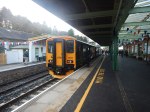

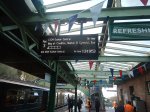

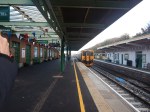
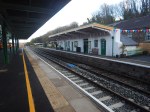
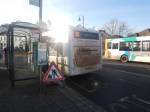
Note.
- The train was two Class 150 trains coupled together.
- I suspect the platform is long enough to take a GWR Castle train
- The bus in the pictures is the 118, of which more later.
- It looked like a buffet was under construction.
- The new train information displays.
I took the bus down to Okehampton, where I took these pictures, as I walked around.












Note, that the first three pictures show the museum and the cycle works cafe, where I had a coffee and a delicious gluten-free flapjack.
I have a few thoughts on my journey, both now and in the future.
The 118 Bus
The 118 bus runs between Tavistock and Okehampton station.
- It serves the villages in between.
- It meets the trains from Exeter and takes them to Okehampton Town Centre.
- It picks people up from Okehampton Town Centre and takes them to the station just before the trains leave for Exeter.
- It accepts contactless payment.
It is a well-designed bus route that links passengers with the trains to and from Exeter.
Many other towns could follow Okehampton’s lead.
Walking Between Station And The Town Centre
I could certainly walk down the hill, but one of the locals said that it rather a stiff walk up the hill that takes about fifteen minutes, if you’re up to it. He also felt a taxi would be about a fiver.
Could A Battery Train Work The Service between Exeter And Okehampton Station?
Consider.
- It is 24.8 miles between Exeter St. David and Okehampton stations.
- It is a rise of under 200 metres.
- The Class 150 trains climbed the hill at around 30 mph, but in places it was lower.
- Hitachi, Stadler and Vivarail are talking about battery-electric trains with a range of fifty miles.
- I was talking to one of the Great Western Railway staff and he said in the days of steam, the trains used to roll down the hill into Exeter.
- There is the 18 MW Den Brook Wind Farm close to Okehampton.
- With regenerative braking rolling down would recharge the batteries.
I suspect, that designing a battery-electric train to climb the hill is possible.
My rough estimate says that a battery of around 500 KWh could be enough.
Are The People Of Devon Going To Use The Train?
I took these pictures as I joined the train back to Exeter.


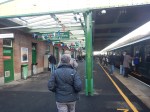
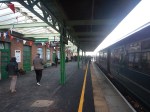
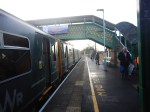


The people were a mixture of those arriving from Exeter and those returning to Exeter, but most seats were taken on the way back.
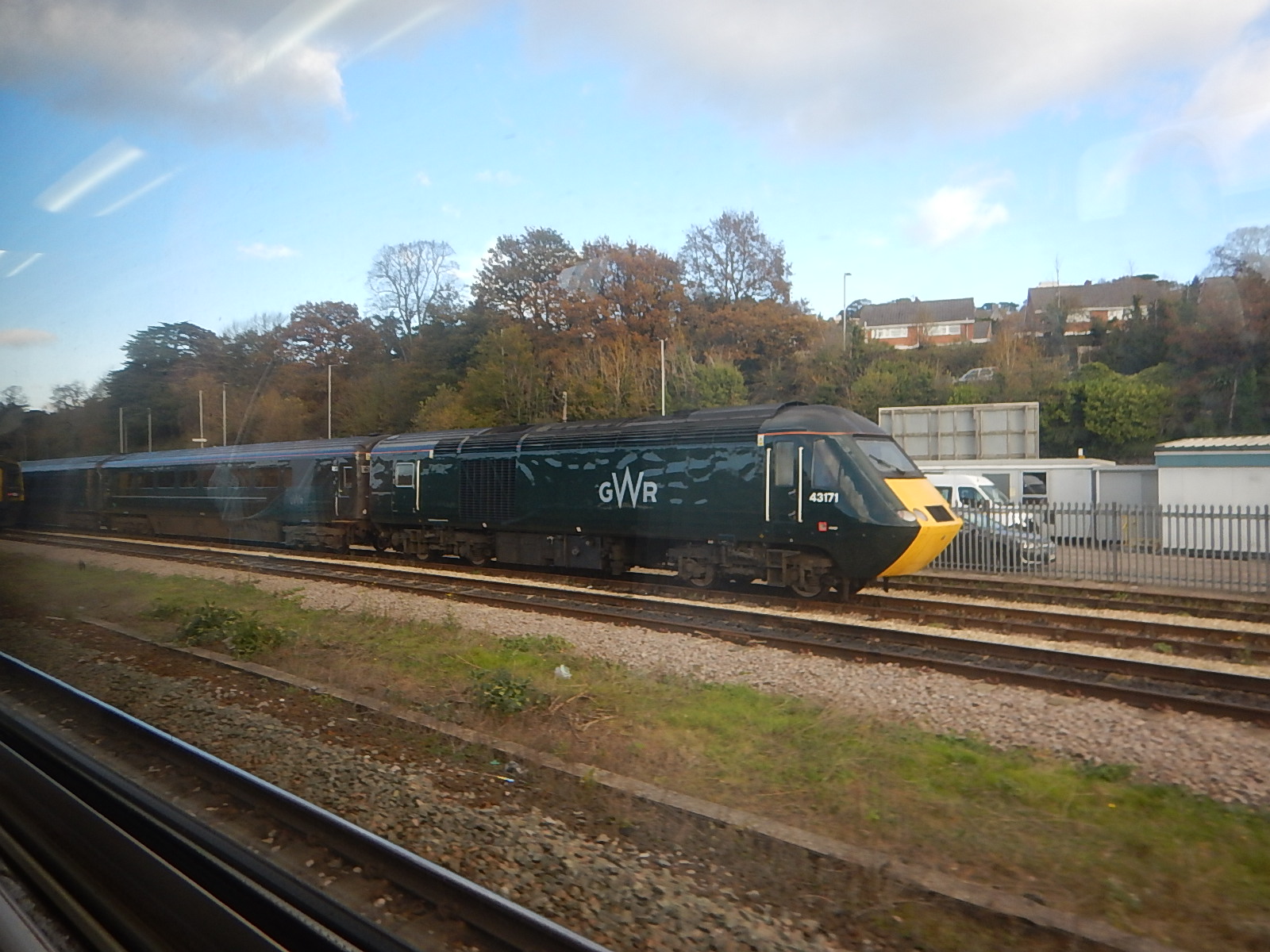
I can see Great Western Railway running Castles, like the one in the picture, for services on this route in the Summer, both to attract passengers and to cope with their numbers.
Local Reaction
I talked to several local people and they were all pleased that the service has been reinstated.
The only complaint was that it should have happened sooner.
Is A Day Trip Possible?
Suppose you live in London and your mother or other close relative lives in Okehampton.
Would it be possible to be able to visit them on their birthday for a good lunch?
Consider.
- At the present time, trains from London, connect to the Okehampton service about every two hours.
- The first connecting service leaves Paddington at 08:04.
- Trains take around three hours between Paddington and Okehampton.
- From probably May 2022, there will be hourly connections to Okehampton.
- The last London train leaves Exeter at 20:46.
If you wanted to be a real hero, you could always take the Night Riviera back to London, which leaves Exeter at 0100.
I would say that if they planned it properly, a day trip from London to Okehampton by train, is feasible for a special occasion.
Will Great Western Railway Ever Run Direct Trains Between London Paddington And Okehampton?
I doubt this would be a regular service but I do believe that it is technically feasible.
- Trains would need to reverse at Exeter St. Davids.
- Trains would probably be limited to five car Class 802 trains.
- Okehampton station could probably accommodate a five-car Class 802 train.
- I estimate that the journey time would be a few minutes under three hours.
It should be noted that Paignton gets around three trains per day (tpd) from Paddington.
It might be that if the demand was there, a few trains per day could be run to and from London, by splitting and joining with the Paignton service at Exeter St. Davids.
- If both services were run by five-car trains, there would be a ten-car service to and from London.
- It certainly looks that GWR wouldn’t have to spend a great deal to implement the service.
- The extra capacity of the five-car train might help commuters into Exeter.
It is likely that this service wouldn’t run until Okehampton Parkway station is opened, which would attract travellers from the West, who would arrive at the station along the A 30 dual-carriageway
I can certainly see a service leaving Okehampton at around seven in the morning and getting into London about ten, paired with a late afternoon/evening train home.
It should be noted, that First Group with their Lumo service between London and Edinburgh, seem to negotiate for paths that create revenue.
But I do wonder, if one of the reasons , that Great Western Railway, Network Rail, Devon County Council, the Department of Transport and the Government were all very much in favour of reopening this route, is that it creates a valid alternative route between London and Plymouth and all places to the West, should the main route via Dawlish be breached again by the sea.
Okehampton station and the future Okehampton Parkway station are both close to the A30 which would allow express coaches to Plymouth and all over West Devon and Cornwall to bypass the trouble.
Hopefully, because the alterative route has been enabled the worst won’t happen.
Conclusion
Exeter and Okehampton is a well-thought out reopening, that will be welcomed in the South West of England.
Would A Lumo-Style Service Work Between King’s Cross And Norfolk?
This is a bit of a fantasy and you’ll never know the real reason why I have written it!
With the upgrade of the East Coast Main Line to full digital signalling, there will be a problem South of Hitchin with 140 mph Azumas and Hitachi Class 802 trains and similar from Grand Central , Hull Trains and Lumo hogging the fast lines to and from King’s Cross. I first wrote about it in Call For ETCS On King’s Lynn Route.
One solution would be to replace the current Class 387 trains with a 140 mph train , such as a Hitachi Class 802 variant. This would enable these fast King’s Lynn and Cambridge trains to join the 140 mph trains on a fast run to and from King’s Cross.
The Future Of Cambridge
Cambridge is one of the UK’s four world cities, with its heritage and lately its high position in any technology league table.
The Current Rail Service Between London And Cambridge
Currently, it has a good service into King’s Cross, Liverpool Street and St. Pancras.
- Great Northern – two tph to King’s Cross – A stopping train using Class 700 or Class 387 trains.
- Great Northern – one tph between Ely and King’s Cross – A fast train using Class 387 trains.
- Great Northern – one tph between King’s Lynn and King’s Cross – A fast train using Class 387 trains.
- Thameslink – two tph to Brighton – A semi-fast train using Class 700 trains.
- Greater Anglia – two tph to Liverpool Street – A semi-fast train using Class 720 or Class 379 trains.
Note.
- tph means trains per hour.
- The similar Class 387 and Class 379 trains are both late-model Bombardier Electrostars with sensible seats and a large number of tables. Both train types can or could be modified to run at 110 mph.
- The Class 700 trains are unsuitable for the route, as they have ironing-board seats and no tables. These are only 100 mph trains.
- The Queen’s bottom doesn’t like the Class 700 trains.
A large proportion of the passengers and commuters between to and from Cambridge work in high-tech or information-rich businesses and I believe if the trains were more geared to this market they would attract passengers away from the roads.
The Cambridge Employment Problem
Fast-growing Cambridge is taking over the region and it is always looking for towns and villages to develop as places for dormitories and to build premises for the hundreds of high-tech businesses.
This is one of the reasons why Greater Anglia acquired new Stadler Class 755 trains to run services from Cambridge to Bury St. Edmunds, Ipswich, Norwich, Peterborough and Stansted Airport.
If you’re going to lure Cambridge’s well-paid high-tech commuters out of their cars, you must give them an equivalent seat to their car. The Class 379, 387 and 755 trains do this.
Living In Norfolk And Suffolk And Working In Cambridge
This has always been the choice of many who work in Cambridge, but using rail into Cambridge didn’t really take-off seriously until modern three-car Class 170 trains replaced the single-car Class 153 trains.
Greater Anglia have followed the upward trend in passenger numbers, by running hourly four-car Class 755 trains from Cambridge to both Ipswich and Norwich.
Before the pandemic, it was starting to look like Norwich and Cambridge would soon need a second service, especially with the planned opening of the new Cambridge South station in 2025.
Addenbrooke’s Hospital And The Cambridge Biomedical Campus
Cambridge South station is being built to serve Addenbrooke’s Hospital and Cambridge Biomedical Campus, which intend to be create the foremost medical research cluster in the world.
Staycations And Holiday Homes In East Anglia
Life is changing because of the covids and more people are taking staycations or buying holiday homes.
And many are following the example of the Queen and going to Norfolk for their relaxation.
The Undoubted Need To Improve Rail Services Between London King’s Cross And Norfolk Via Cambridge
These factors convince me that there is a need for a new or repurposed rail service between London King’s Cross and Norfolk via Cambridge.
- The need to provide a high-class commuter service between London and Cambridge.
- The need to bring workers into Cambridge from Norfolk.
- The need to provide a fast high-class rail link to Cambridge South station with all its medical research.
- The need to provide a comprehensive working environment on the trains.
- The need to cater for all those people relaxing in Norfolk after a hard week in London.
It is my view, that a radical design of train is needed for this route.
- It would need to have a high-class interior.
- It would need at least a 125 mph capability, so that it can use the fast lines between Hitchin and King’s Cross.
- The train may need the ability to split and join.
- It would need an independent power capability for running on the Breckland Line between Ely and Norwich.
- Because of Cambridge and because East Anglia is easy country for cycling, it would need a sensible capacity for cycles.
I also believe that because of the need to decarbonise, the train should be zero-carbon.
These are my thoughts.
Operating Speed
Because of running on the fast lines between Hitchin and King’s Cross with the 140 mph trains from the North, I suspect that an operating speed of at least 125 mph is needed. But if the Hitachi trains of LNER, Hull Trains, Lumo and in the future possibly other operators like Grand Central, will be capable of 140 mph, this speed could be desirable.
Speed limits once the trains have left the East Coast Main Line at Hitchin North junction are as follows.
- Hitchin and Cambridge – 90 mph
- Cambridge and King’s Lynn – 90 mph
- Ely and Norwich – 75-90 mph
I can see Network Rail using their expertise to raise the speed limit on sections of these lines.
Flighting Of Trains On The East Coast Main Line
To increase capacity on the East Coast Main Line, I believe that at some point in the not too distant future that trains will be flighted. This will involve two or more trains leaving King’s Cross in a sequence and proceeding with all trains at a safe distance from each other.
I can envisage a flight like this from King’s Cross.
- An Edinburgh train with York as the first stop – Leaves at XX.00
- A Leeds train with Doncaster as the first stop – Leaves at XX.03
- A Lincoln train with Peterborough as the first stop – Leaves at XX.06
- A Cambridge train with Stevenage as the first stop – Leaves at XX.09
Note.
- The Edinburgh train would set the speed.
- Trains would maintain their time behind the lead train.
- Everything could be controlled by the digital signalling.
- Gaps between the trains would be sufficient for a safe stop.
- No train in the flight would make a station stop unless it was the last train in the flight.
- The last train in the flight would drop off and go to their destination.
As there are at least two tph to Edinburgh, Leeds and Cambridge, there would be two main flights per hour leaving King’s Cross, with the second flight perhaps incorporating a service to Hull.
Digital signalling and precise driving would enable the flights to be built in the opposite direction into King’s Cross.
The big advantage would be that instead of needing eight paths per hour on the East Coast Main Line, only two would be needed.
All trains would need to have similar performance, so this is another reason why the Cambridge trains need to be at least 125 mph trains.
Train Interiors
Lumo has broken new ground in train interiors.
- It is one class.
- Everybody gets a decent seat.
- Everybody gets good legroom.
- Everybody gets some form of table.
- There are decent-sized overhead racks for hand-baggage and coats.
- There is space for bicycles and heavy luggage appropriate to the route.
This can be built on to provide a good working and playing environment suited to the passengers who would use a fast King’s Cross and Norfolk service via Cambridge.
- Lots of tables for four, as in the high-class Electrostars.
- Better bicycle storage.
- Better alignment of seats with windows.
Hitachi could obviously produce a train to this specification.
But what about other manufacturers.
Stadler’s Class 755 trains are surely a possibility.
- A senior driver from Greater Anglia told me that the design speed for a Class 755 train is 200 kph or 125 mph.
- They have good seats.
- They have flat floors.
- They have large windows.
- They have step-free access between train and platform.
- Like the Hitachi trains, they are in service.
I believe the closely-related Class 745 trains are probably the best commuter trains in the UK and are the only alternative to the Hitachi trains on a125 mph fully-electrified route.
Bridging The Electrification Gap Between Ely And Norwich
Between Norwich and Ely stations is 53.8 miles and this section is not electrified, although both stations have full electrification.
The line is not heavily used with typically only two passenger trains and the occasional freight trains in each direction in an hour.
This Hitachi infographic describes the Hitachi Regional Battery Train.
A 90 km. range could be sufficient to cover the gap between Norwich and Ely.
Could Hitachi build a Class 802 train or similar with a battery range of 90 km or 56 miles?
Certainly, a speed of 100 mph would probably be sufficient to bridge the gap in a decent time.
Improving The Breckland Line
The Breckland Line is the route between Cambridge and Norwich.
- Cambridge and Norwich is 68.5 miles
- Only the sixteen miles between Cambridge and Ely North junction is electrified.
- There are thirteen stops between the two cities.
- A typical time is 79 minutes
- This is an average speed of just 52 mph.
- The operating speed is 75-90 mph.
I am sure that Network Rail can squeeze a few minutes here and there to get the operating speed up to the 100 mph of the Great Eastern Main Line.
But the big problem at Norwich is the Trowse swing bridge.
It is only single track and it is likely that this bridge will be replaced soon.
This Google Map shows Trowse junction, a short distance South of the swing bridge.
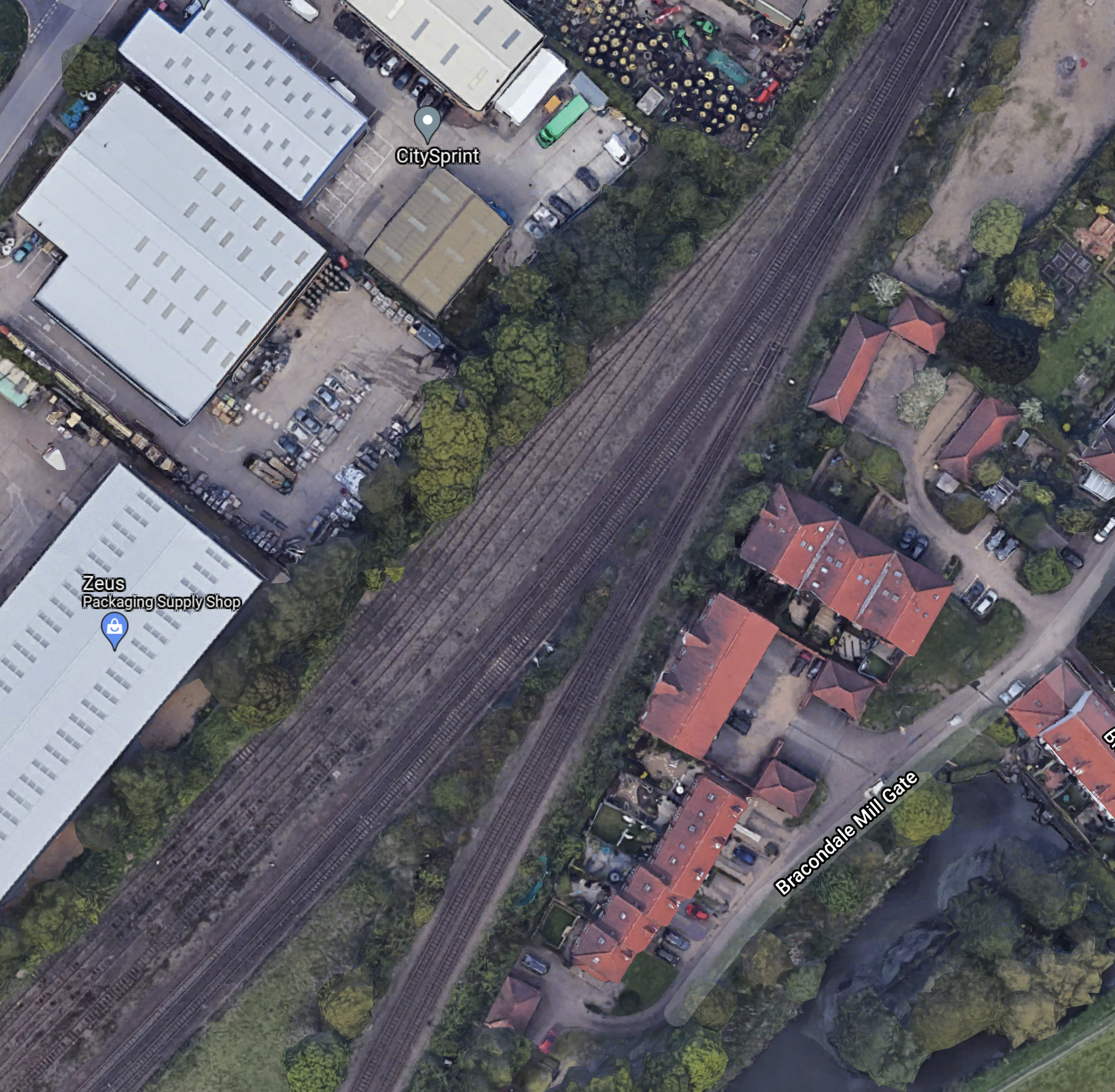
Note.
- The electrified double-track of the Great Eastern Main Line goes across the map from North East to South West.
- The double-track railway to the East of the main line is the unelectrified Breckland Line to Cambridge, which turns West and goes under the main line.
- On the West of the main lines are the Victoria sidings that I wrote about in Greater Anglia Completes Directly-Managed Norwich Victoria Sidings Project.
As the replacement of the swing bridge will require some work to be done to the electrification, I wonder if at the same time Network Rail would electrify the Norwich end of the Breckland Line.
There must be a balance point adding electrification or batteries to the trains.
As the Breckland Line has few freight trains, electrification is not needed for freight.
Ticketing
A high-speed high-capacity service as I’m proposing must be easy to use.
It is a classic route, where nothing short of London-style contactless ticketing will do, as I’m certain this encourages people to use the trains.
As East Anglia is self-contained and has few services that don’t terminate in the area or in London, I am certain that this could be achieved.
If you remove First Class as Greater Anglia has done on many services, you actually simplify the ticketing, so a Lumo-style mid-class is ideal.
High Speed Train Services
Currently Great Northern run two tph from King’s Cross to Ely via Cambridge.
- One service is extended to King’s Lynn.
- I could see the second service extended to Norwich.
Both services would need to be run by 125 mph trains because of the speed of other trains on the East Coast Main Line.
Conclusion
I think duch a system would be possible.
Hull Trains Is Back And Stronger Than Ever
The title of this post, is the same as that of this press release from Hull Trains.
This is the first paragraph.
Timetables at Hull Trains will be back to pre-pandemic levels from December as public confidence in rail travel continues to grow.
These are other points from the press release.
- The number of returning passengers is steadily increasing.
- From December 12th, Hull Trains will be running 94 trains per week in total, which is two higher than the pre-pandemic record.
- An additional service will be run on Sunday to match the six trains per day (tpd) on Saturday.
- There will be seven tpd on weekdays. That’s not far off one train per teo hours (tp2h) all day.
Passenger numbers must be coming out from the pandemic well.
This sentence from the press release gives a clue to how Hull Trains will cope with increasing passenger numbers.
Ten-car operations will commence on Fridays and Saturdays to provide additional capacity just in time for Christmas travel and the general growing demand as we prepare to enter 2022.
I suspect by rescheduling maintenance and running all five trains in services, they can run some trains on Fridays and Saturdays as pairs.
- As Hull trains only stop at Stevenage, Grantham, Retford, Doncaster, Selby, Howden, Brough, Hull and Beverley, there aren’t many stations, that need to be able to take ten-car trains.
- I suspect a couple of platforms might need lengthening, as a ten-car train is 260 metres long. Or they could instruct passengers to only use the front train for the stations with short platforms. Or only use five-car trains to the stations with short platforms.
- But the longer trains won’t need any extra paths.
- I was also told last year, that Hull station can take nine-car trains, so perhaps it can take a ten.
So to increase capacity on the route, Hull Trains just need to add another train to their fleet.
As all costs are probably well-known, with a bit of simple modelling, Hull Trains can probably predict, when they need to add a new train.
Whilst I was looking at the Lumo train yesterday, I got talking to a driver from Hull Trains, who had come over to take a professional look at Lumo’s Class 803 train.
I asked him what he liked about Hull Trains’s Class 802 trains as a driver. He said the brakes, which is probably most important to a driver, as they’re at the sharp end, if anything happens. So that’s comforting.
He also said that some of the Hitachi trains had shown they were stable at 140 mph. So that’s good too.
On talking about the batteries on the Lumo train, I got the impression that batteries will appear on other Hitachi Trains.
Conclusion
It appears to be all trains go between London and Hull.
In Could We See Between London And Much Of The North By Train In Under Two Hours?, I looked at the effect of improvements on the East Coast Main Line and concluded that timings between London Kings Cross and Hull could be around two hours and twenty minutes. This would surely be a spur to increasing traffic on the route.
Surely, when Hull Trains use battery-electric Hitachi trains between London and Hull, this will be the icing on the marketing cake, as we seem to be coming to a point, where zero-carbon sells.
As an aside, will Lumo, who are another First Group company, use a similar mix of five- and ten-car trains on the London and Edinburgh route to increase capacity?
I suspect that what is good for Hull Trains will be good for Lumo.
Open Access Operators And The Lumo Model
In the UK, there are only three established Open Access operators, who run UK train services.
- Grand Central
- Heathrow Express
- Hull Trains
From the 25th of October, they will be joined by Lumo.
We probably don’t think of Heathrow Express as an Open Access operator and as it is effectively a short distance special service with new trains between Heathrow and Paddington, it has its own business model, that may or may not survive.
But how will Lumo and their bold new business model affect Grand Central, Hull Trains and any future Open Access operators?
Grand Central Trains
Grand Central is a well-established Open Access operator.
- They run services between London King’s Cross and Bradford Interchange, Sunderland and several other convenient en-route stations.
- They are owned by Deutsche Bahn.
- They also regularly seem to apply for new routes and extra services.
But they have a big problem fast catching up on them; they have a diesel-only fleet and need to decarbonise.
I also think that all express passenger services on the East Coast Main Line will at some date need to be run by 140 mph trains capable of running with full digital signalling and a degree of Automatic Train Operation.
In Lumo: Why Won’t The New Train Service Stop At Yorkshire Stations?, I said that to continue to be successful, they probably need to embrace the Lumo model and acquire new trains.
I will repeat what I said in the related post.
This would entail.
- The ten diesel Class 180 trains would be replaced by new electric trains.
- The trains would need a 140 mph capability under digital signalling to fit in with the plans of Network Rail, LNER and Lumo to create a top-class high-speed high-capacity East Coast Main Line.
- The trains would need a battery capability as Grand Central’s routes are not fully electrified.
- They could copy Lumo’s green marketing philosophy, ticketing and catering offering.
As to the trains, I’m sure that Hitachi could offer a version of their Intercity Tri-Mode Battery Train, the specification of which is shown in this Hitachi infographic.
The trains would need a range of fifty miles on battery-power.
I have some other thoughts.
Financing
If you look at the finances of decarbonising Grand Central, they would need a new fleet of ten trains, which as Lumo’s fleet of five trains are reported to be costing £100 million, so that figure can be at least doubled.
There would also be costs for the two charging systems at Bradford Interchange and Sunderland. But at least there are several possible solutions for charging systems, so the price will probably not be more than a few million, if that.
Will Deutsche Bahn be prepared to stump up the extra finance?
A Service To Cleethorpes
In the Wikipedia entry for Grand Central, there is a section which is entitled London Kings Cross to Cleethorpes, which outlines a proposed service.
- It would split and join with the London King’s Cross and Bradford service at Doncaster.
- It would call at Crowle, Scunthorpe, Barnetby, Habrough and Grimsby.
- Doncaster and Cleethorpes is 52.1 miles and should be in range of a Battery-electric train with a charging system at Cleethorpes.
Using current times from LNER and TransPennine Express, I estimate that Hitachi Intercity Tri-Mode Battery Trains could travel between London and Cleethorpes in around two hours and twenty minutes.
With digital signalling on the East Coast Main Line to the South of Doncaster, the overall time could be much closer to two hours.
This could be a very viable service with battery-electric trains capable of running at 140 mph on the East Coast Main Line and for sixty miles at 100 mph on battery power.
Maximising The Use Use Of Train Paths By The Use Of Splitting And Joining
The proposed service to Cleethorpes is a classic use of splitting and joining, which enables two separate services to run a large part of their routes together.
- On the East Coast Main Line, it means that maximum use can be made of the paths available.
- Splitting and joining is part of the specification for the Hitachi trains and they do it automatically in under two minutes.
- LNER are already talking about using the technique to serve various destinations from Leeds.
I wouldn’t rule out Grand Central’s two services working as a pair between London King’s Cross and Doncaster, where they would split and join.
Conclusion On Grand Central Trains
Decarbonisation with high-speed battery-electric trains could ensure the future of Grand Central Trains.
Hull Trains
Hull Trains is another well-established Open Access operator.
- They run services between London King’s Cross and Hull and Beverley.
- They have a fleet of five bi-mode Class 802 trains.
- The company is part of First Group.
Hull Trains don’t have the decarbonisation problem of Grand Central Trains, as I suspect Hitachi will come up with a solution to turn Class 802 trains into a battery-electric train with a range of perhaps seventy miles on battery power.
- Beverley and Temple Hirst junction is a distance of 44.3 miles and is the only section of the route without electrification.
- Charging of the batteries will be needed at the Eastern end and probably would be best handled by a short length of electrification in Hull station or between Hull and Brough stations.
The Class 802 trains are also ready for updating to run under the new digital signalling of the East Coast Main Line.
First Harrogate Trains
First Harrogate Trains was a subsidiary of Hull Trains, which hoped to run the following services.
- London King’s Cross and Harrogate via York
- London King’s Cross and Cleethorpes via Peterborough, Spalding and Lincoln
Both these services could be run in conjunction with the current service with an appropriate split and join.
Conclusion On Hull Trains
As both Hull Trains and Lumo share London King’s Cross and are both owned by First Group, I would expect that both train operators would share some services, methods and ideas.
There may be advantages if Hull Trains’s Class 802 trains and Lumo’s Class 803 trains could run each other’s services.
Grand Union
Grand Union is a prospective open access operator who are proposing to operate train services from England to Wales and Scotland.
They are proposing two services.
London Paddington and Cardiff Central via Reading, Bristol Parkway, Severn Tunnel Junction, Newport and Cardiff Parkway, with a possible extension later to Swansea andLlanelli or Carmarthen.
London Euston and Stirling via Milton Keynes Central, Nuneaton, Crewe, Preston, Carlisle, Lockerbie, Motherwell, Whifflet, Greenfaulds and Larbert.
Note.
- London Paddington and Cardiff Central is fully electrified, but there is no electrification West of Cardiff Central.
- Cardiff Central and Swansea are 45.7 miles apart.
- London Euston and Stirling is fully electrified.
Currently, the rolling stock for both services is proposed to be a tri-mode Class 93 locomotive hauling a rake of Mark 4 coaches and a driving van trailer.
The locomotive should be capable of handling the routes to Stirling and Cardiff using the electrification alone.
When the Cardiff route is extended, Grand Union would intend to use Class 802 trains, which could be fitted with batteries to serve Swansea, where the batteries would be charged.
There is no sign as yet, that the Office of Rail and Road have approved any of their possible services, but both services might be improved with some Lumo-style thinking.
Alliance Rail Holdings
Alliance Rail Holdings, which is a sister company to Grand Central, is ultimately owned by Deutsche Bahn, seems to have several ideas for new services, but only seems to have got approval to one.
They were given approval some years ago to run a service between London Euston and Blackpool North.
- Calls would be made at Poulton-le-Fylde, Kirkham and Wesham, Preston, Nuneaton and Milton Keynes Central.
- There will be six trains per day.
- Trains would be InterCity 225 trains.
- The approval is for seven years from 2018.
But because of the pandemic it hasn’t run.
Conclusion
The Lumo model will affect all these services.
Lumo Aims To Be The Green Alternative To Edinburgh – London Flights
The title of this post, is the same as that of this article on Railway Gazette.
Some points from the article.
Lumo Is Targeting Flyers
This is a paragraph.
Lumo is aiming to carry more than 1 million passengers per year. It is particularly targeting people who currently fly between Edinburgh and London; in June it says there were 74 764 air journeys on the route, compared to 82 002 by rail.
I find it interesting that the number of passengers using air and rail are within nine percent. I thought it would have been more of a difference.
The Service Will Ramp Up
This is a paragraph.
Services will ramp up over a period of months to the planned timetable of five trains each way per day. A small increase is envisaged at the December timetable change, followed by full implementation in Q1 2022.
There is a lot of training to do and some more Class 803 trains to be delivered.
Viability Level
Industry sources are quoted that at the prices charged, the trains will need to be eighty percent full to be viable.
As a Control Engineer, who has built hundreds of mathematical models, I am fairly certain, that by adjusting ticket prices and getting the marketing right, they’ll hit that level.
Late Bookers
The eighty percent viability level probably means that they can afford to leave a few seats available for those that need to book the day before.
Yesterday, when I went to Spalding, I bought my ticket in the Booking Office half-an-hour before travel and got a seat with a window.
Seat allocation algorithms on LNER seem to be very good and I don’t think Lumo’s will be in any way inferior.
Early Bookers
The article says advance tickets can be bought earlier than the usual twelve weeks.
So say you always travel to Scotland for your mother’s birthday, you can buy the ticket early and not be hit by low availability, as it turns out later that Rangers are playing Celtic on the day you travel.
Mutual Support In Case Of Disruption
This is a paragraph.
Reciprocal contracts providing support in case of disruption have been signed with other operators, including LNER.
I think in all the troubles yesterday, that I wrote about in Azumas Everywhere!, LNER could have done with some help yesterday.
Lumo Want To Grow Rail
This is a quote from the company.
We want to grow rail and bring people to a more sustainable, environmentally way of travelling.
They also seem fairly relaxed if you want to travel in First on LNER.
Luggage
This is a paragraph.
Passengers will be able keep their luggage close by or, for an additional charge, have it delivered to their final station or destination.
Does that mean you’re going to Edinburgh to see the family at Christmas and the New Year, you can take a lot of luggage and get it delivered both ways?
Efficient Running North Of Newcastle
I particularly liked this paragraph.
The trainsets will be able to run with power draw limited to 80% of normal on the northern part of the East Coast Main Line where there is limited power supply, with modelling by FirstGroup’s engineers and Network Rail suggesting that for five-car sets this will not affect sectional running times and will allow electric trains to continue running.
If you’re on time, the passengers won’t mind, but the electricity saved is all profit.
As a Control Engineer, my philosophy would be to have an economy mode for 80 % power sections.
- Trains would enter these sections with a full battery, that had been charged earlier from the electrification.
- The battery would provide hotel power in these sections.
- Traction power would come from the electrification.
- Trains could leave these sections with an almost flat battery.
The battery is not used for traction, but because it is handling the hotel power, less power is drawn from the electrification for traction.
I always remember Freddie Laker was keen on getting his pilots to save fuel.
Charging The Hotel Power Battery
Obviously this can be charged from the overhead electrification, although I doubt they would charge it in sections where power supplies are limited.
But can the battery be charged using regenerative braking?
In Do Class 800/801/802 Trains Use Batteries For Regenerative Braking?, I tried to answer this question using the information in this document on the Hitachi Rail web site, which is entitled Development of Class 800/801 High-speed Rolling Stock for UK Intercity Express Programme , which was published in 2014 and contains this diagram of the traction system.

Note that BC in the diagram stands for battery charger. So even in 2014, Hitachi were thinking about batteries.
In this diagram it seems to me, that electricity for the Auxiliary Power Supply and charging any batteries, can come from these sources.
- The Electrification
- The Generator Unit, if fitted
- The Drive Converter if it can divert regenerative braking energy to the APS.
It is all very comprehensive.
Handling Engineering Blockades
This is a paragraph.
Lumo has looked at how to manage any engineering blockades involving diversions away from the wires, with options including transfers to Hull Trains or TPE services operated using bimode trainsets, transfer to buses if no alternatives are available, and even the cancellation of a service if passengers indicate they would prefer not to travel if their journey will be disrupted.
Being part of a larger group always helps.
Borrowing Trains
Yesterday, whilst waiting to leave Peterborough, I saw a TransPennine Express Class 802 train go through.
Peterborough isn’t exactly near the Pennines!
On checking today, it appears it was running in one of Lumo’s paths.
So was the train being borrowed for training purposes?
But I can envisage, when a difficult blockade say around Newark is to be enacted, that Lumo would borrow a bi-mode from TransPennine Express, so they could use diesel to run the service via Lincoln.
Conclusion
There’s a lot more to Lumo than has so far been disclosed.
In the meantime read the Railway Gazette article, as there’s more there for starters.
New Rail Service From Newcastle To Edinburgh To Stop At These Northumberland Stations
The title of this post, is the same as that of this article on the Chronicle Live.
Details of the service are as follows.
- It will be run by TransPennine Express.
- It starts in December 2021.
- It will run five times per day (tpd)
- It will call at Cramlington, Morpeth, Widdrington, Alnmouth, Berwick-upon-Tweed, Reston and Dunbar.
It is planned to run at least until May 2023.
These are my thoughts.
What Trains Will TransPennine Express Use?
The service will probably need a single train, if it was run by a dedicated fleet of trains, that just shuttled between Edinburgh and Newcastle. TransPennine could use either an electric Class 802 train or a diesel Class 185 train.
The diesel train might not be a good idea for operational reasons as TransPennine’s current services to Newcastle and Edinburgh use Class 802 trains.
But this service wouldn’t need a Class 802 train, as the route is fully electrified, so TransPennine might use a Class 800 train, if one were available from another company in the First Group.
TransPennine could also extend selected Manchester Airport and Newcastle services to Edinburgh, which might be the most efficient ways of using both trains and platforms in Newcastle.
This would give those using the intermediate stations between Edinburgh and Newcastle a service to and from Manchester Airport and the intervening stations, with a change at Newcastle, which would involve staying on the same train.
I’d organise the service as five tpd between Manchester Airport and Edinburgh with calls at Manchester Piccadilly, Manchester Oxford Road, Manchester Victoria, Huddersfield, Dewsbury, Leeds, York, Northallerton, Darlington, Durham, Chester-le-Street, Newcastle, Cramlington, Morpeth, Widdrington, Alnmouth, Berwick-upon-Tweed, Reston and Dunbar.
The big advantage of this, is that TransPennine could use the existing Class 802 trains, although they may need one more.
Reston Station
It looks like it will be a much needed service, that will get the new Reston station up and running.
I suspect that, passenger numbers at Reston station will determine the calling pattern after May 2023.
Will Other Services Continue?
TransPennine Express only has one service that stops between Newcastle and Edinburgh and that is the hourly service between Liverpool Lime Street and Edinburgh stations and that only stops at Morpeth.
I doubt this service will be changed, although after May 2023, it may make some extra stops depending on passenger numbers on the new service.
It should be noted that CrossCountry and LNER call irregularly at Alnmouth, Berwick-upon-Tweed and Dunbar.
As LNER are in rather a mess over their new timetable, I suspect that after May 2023, there could be a bit of a sort out of services.
How Will The New Service Fit With The Reopened Northumberland Line?
Initially the Northumberland Line will run as far as Ashington and won’t open until 2023 at the earliest.
But plans exist to extend the Northumberland Line to Morpeth.
The new service would fit well with an extended Northumberland Line service.
How Will The New Service Fit With East Coast Trains New London And Edinburgh Service?
East Coast Trains will be running a new Open Access service between London and Edinburgh from this autumn.
- It will have a frequency of 5 tpd.
- It will stop at Newcastle, Morpeth and Stevenage.
- It will offer one way fares of £25.
East Coast Trains are another First Group company.
As both services are five tpd in both directions, will the two services co-ordinate stops, so that passengers between say London and Reston can take advantage?
Going North, the stopping train could follow the East Coast Trains express and going South the stopping train would be a few minutes in front of the express.
This would also help with maximising capacity between Edinburgh and Newcastle on the busy East Coast Main Line.
Conclusion
This new stopping service between Edinburgh and Newcastle looks to be a simple solution to improve passenger services for intermediate stations between the two important cities.
DfT To Have Final Say On Huddersfield Rebuild Of Rail Station And Bridges
The title of this post, is the same as that of this article on Rail Technology Magazine.
This is the first paragraph.
As part of the £1.4bn Transpennine Route Upgrade. Transport Secretary Grant Shapps is to rule on planned changes to Huddersfield’s 19th century rail station and not the Kirklees council, in what is to be a huge revamp of the line between Manchester and York.
According to the article eight bridges are to be replaced or seriously modified.

As Huddersfield station (shown) is Grade I listed and three other Grade II listed buildings and structures are involved, I can see this project ending up with a substantial bill for lawyers.
But then, to have a world-class railway across the Pennines, a few eggs will need to be broken.
Electric Trains Across The Pennine
This page on the Network Rail web site describes the Huddersfield To Westtown (Dewsbury) Upgrade.
When the upgrade and the related York To Church Fenton Improvement Scheme is completed, the TransPennine route between Huddersfield and York will be fully-electrified.
As Manchester To Stalybridge will also have been electrified, this will mean that the only section without electrification will be the eighteen miles across the Pennines between Stalybridge and Huddersfield.
Will this final eighteen miles ne electrified?
Eighteen miles with electrification at both ends will be a short jump for a Hitachi Intercity Tri-Mode Battery Train, the specification of which is shown in this Hitachi infographic.
The Class 802 trains of TransPennine Express are able to be converted into these trains.
The trains could work these routes.
- Liverpool Lime Street and Scarborough
- Manchester Airport and Redcar
- Liverpool Lime Street and Edinburgh via Newcastle
- Manchester Airport and Newcastle
- Manchester Piccadilly and Hull
- Manchester Airport and Cleethorpes
Note.
- I suspect some more Class 802 trains with batteries will be needed.
- The trains would either use battery or diesel power to reach Hull, Redcar and Scarborough or there could be a few miles of electrification to stretch battery range.
- Will the Class 68 diesel locomotives be replaced with Class 93 tri-mode locomotives to haul the Mark 5A coaches to Scarborough.
- Manchester Airport and Cleethorpes could be a problem and will probably need some electrification around Sheffield and Grimsby.
This would just mean TransPennine’s two short routes to be decarbonised.
- Manchester Piccadilly and Huddersfield
- Huddersfield and Leeds
As except for the eighteen mile gap between Stalybridge and Huddersfield, these two routes are fully-electrified, I suspect that a battery-electric version of a 110 mph electric train like a Class 387 or Class 350 train could run these routes.
Conclusion
It looks like if these sections of the TransPennine Express network are upgraded and electrified.
- York and Church Fenton
- Huddersfield and Westtown
- Manchester and Staylebridge
Together with a few extra miles of electrification at strategic points, that TransPennine Express will be able to decarbonise.
Dartmoor Rail Service Reopens This Year In Reversal Of Beeching Cuts
The title of this post is the same as that of this article on The Times.
This is the introductory paragraph.
A largely redundant Victorian railway line will be reopened this year as part of plans to resurrect routes closed in the infamous Beeching cuts.
This line was always likely to be one of the first to reopen, as there is a terminal station at Okehampton, with a bus interchange and other facilities, that has been hosting a service from Exeter on summer Sundays for some years.
The BBC have a reporter there this morning and the station looks in better condition, than some I could name.
This paragraph from The Times describes works to be done.
Network Rail said engineers would start a range of works including improvements to drainage, fencing by the trackside, rebuilding embankments and upgrading Okehampton station. Some 11 miles of track will also be replaced. It is envisaged that test trains will run later this year before it fully reopens to passengers.
Some of the BBC footage, showed a great pile of new track by the station, so it looks like Network Rail are starting to relay the track.
It is hoped to run a one train per two hour service by the end of the year, which could go hourly next year.
In Okehampton Railway Return ‘Clear Reality’ After £40m Commitment In Budget, I said more about this reopening project and I speculated that both Okehampton and Barnstaple services will terminate at Exmouth Junction, as the Barnstaple services do now.
Barnstaple has roughly an hourly service from Exeter and to run two hourly services between Exeter and Coleford Junction, where the two routes divide, may need extra work to be done, so that trains can pass each other at convenient points.
This extra work probably explains, why the service won’t be hourly until next year.
I do wonder, if this reopening also enables other improvement and possibilities.
Meldon Quarry
Meldon Quarry used to be an important source of track ballast for British Rail and it is situated a few miles past Okehampton.
This Google Map shows Meldon Quarry and Okehampton.
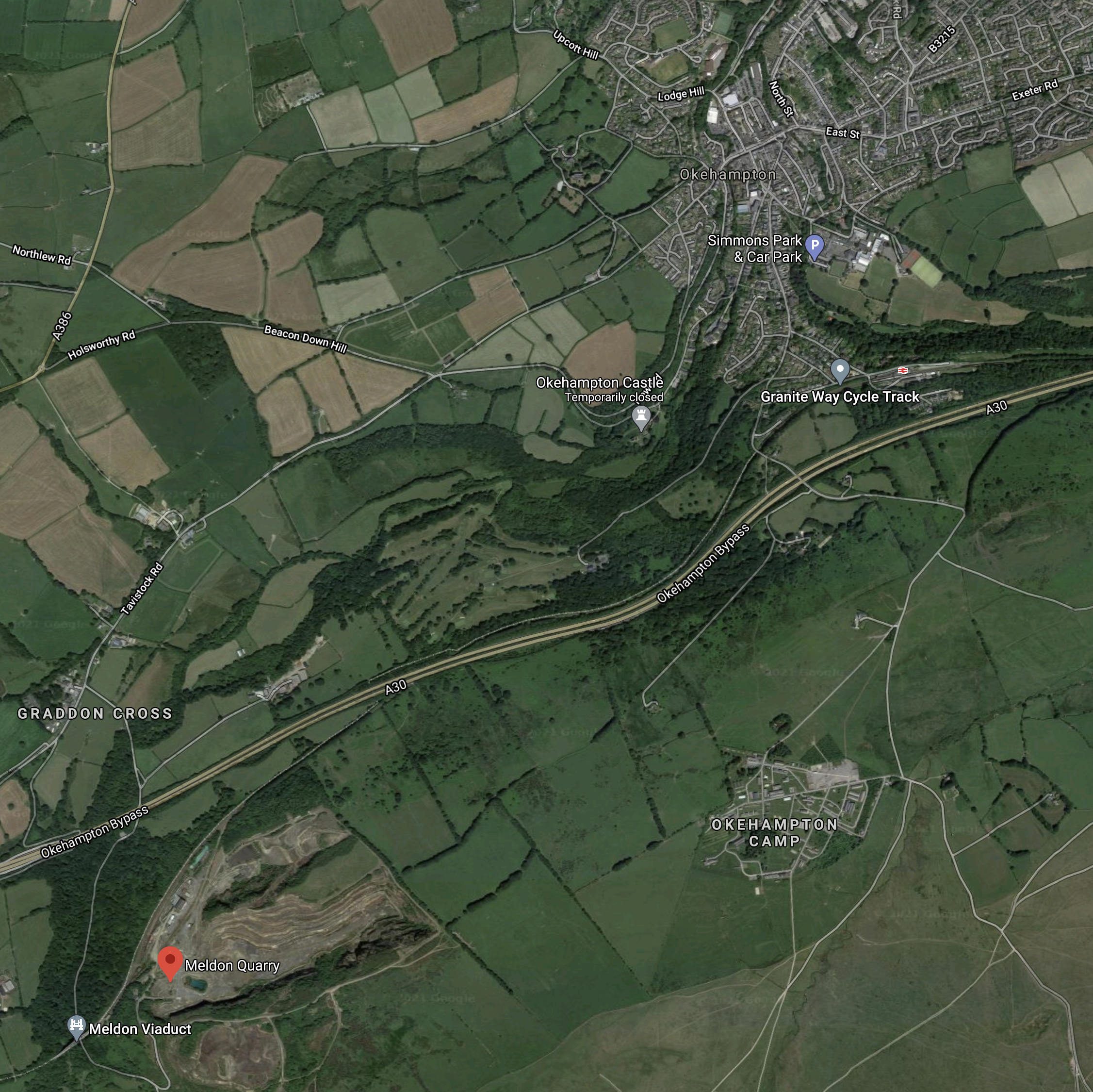
Note.
- Meldon Quarry is in the South-West corner of the map marked by a red marker.
- To its West is Meldon Viaduct, which is part of the old railway line between Okehampton and Plymouth, which is now a walking and cycling route.
- The town of Okehampton is in the North-East of the map.
- Okehampton station is in the South-East of the town close to the A 30.
I wouldn’t be surprised to find, that Network Rail are upgrading the line to Okehampton, so that if they need to obtain quality track ballast from Meldon Quarry, it would not require upgrades to the track East of Okehampton.
Okehampton Camp
Note Okehampton Camp to the South of Okehampton.
Many Army bases like this one need heavy vehicles to be transported to and from the base.
Have Network Rail future-proofed the design of the route to Okehampton, so that heavy vehicles can be transported to the area?
A Railhead For North Devon And North Cornwall
There are two main roads between Exeter and Cornwall.
- The A30 goes to the North of Dartmoor and via Launceston
- The A38 goes to the South of Dartmoor and then via Plymouth
In the past, I’ve always driven to and from Cornwall via the Northern route and I describe one journey in Dancing with Hippopotami.
This Google Map shows the A30, as it passes Okehampton.
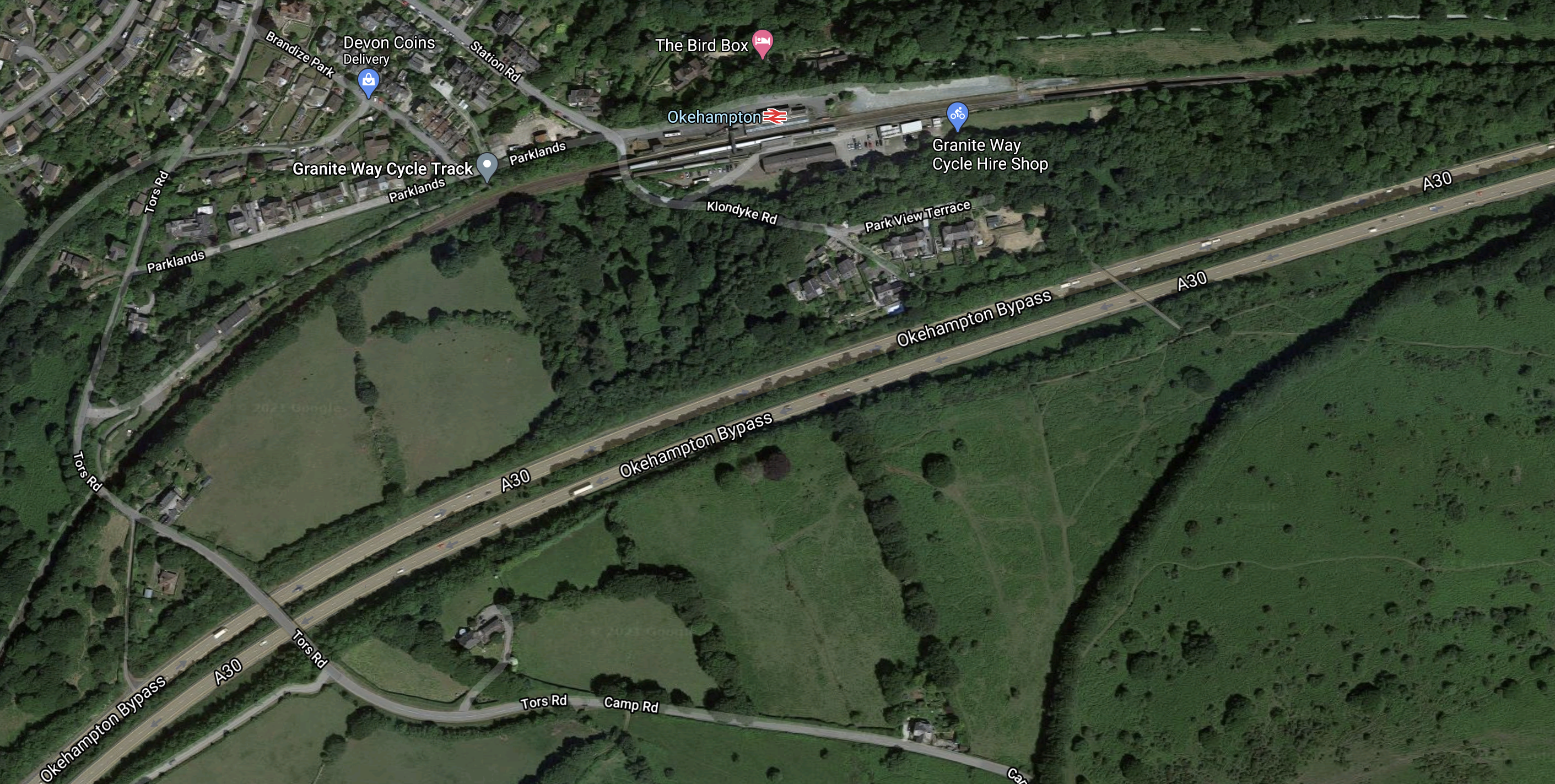
Note that although the station and the A30 are physically close, there would be a few minutes to drive between the two.
But I do feel there is scope to create an appropriate transport interchange between.
- Trains to and from Exeter.
- Buses and coaches to North Cornwall and North Devon.
- Cars on the A30.
It could effectively become a parkway station.
An Alternative Route In Case Of Trouble Or Engineering Works At Dawlish
Bodmin Parkway and Okehampton stations are about 43 miles apart and I suspect a coach could do the journey in around fifty minutes.
Would this be a sensible alternative route in times of disruption?
- It is dual-carriageway all the way.
- Okehampton station can certainly handle a five-car Class 802 train and could probably be improved to handle a nine- or even ten-car train.
- Trains from London could get to Okehampton with a reverse at Exeter St. Davids.
I don’t know the area well, but it must be a possibility.
Could Okehampton Have A London Service?
As I said in the previous section, it looks like Okehampton station can handle five-, nine- and possibly ten-car Class 802 trains and there are many pictures of Great Western Railway’s InterCity 125s or HSTs at Okehampton station in years gone by.
I think it would be feasible to run a small number of services between Okehampton and London.
- The service would have to reverse at Exeter St. Davids station.
- As one service every two hours runs between London Paddington and Exeter St. Davids stations, a service to Okehampton could be run as an extension to the current Exeter service.
- It could also stop at Crediton station.
There must also be the possibility of running a pair of five car trains from Paddington, that split at Exeter St. Davids, with one service going to Okehampton and the second one to Paignton.
- Exeter St. Davids and Paignton are 26.3 miles apart and a fast train takes 34 minutes
- Exeter St. Davids and Okehampton are probably a slightly shorter distance.
I suspect that a sensible timetable could be devised.
The specification of the Hitachi InterCity Tri-Mode Train is given in this Hitachi infographic.
Note.
- It is intended to run these trains to Exeter, Plymouth and Penzance.
- The range of the train on batteries is not given.
These trains could use a mixture of diesel and battery power to travel to and from Okehampton and Paignton.
But I also believe that as Hitachi develop this train and batteries have an increased capacity, that it will be possible for the trin to do a round trip from Exeter to Okehampton or Paignton without using diesel, provided the train can leave Exeter with a full battery.
According to Hitachi’s infographic, the train will take 10-15 minutes to fully charge at a station like Exeter. But that would add up to fifteen minutes to the timetable.
I feel if the roughly thirty-five miles of track between Exeter St Davids station and Cogload Junction, which is to the North of Taunton, were to be electrified, then this would mean.
- Trains would be fully charged for their excursions round Devon.
- Trains would be fully charged for onward travel to Plymouth and Penzance.
- Trains going to London would leave Taunton with full batteries to help them on their way on the ninety mile stretch without electrification to Newbury.
- Trains going between Exeter and Bristol could take advantage of the electrification.
Eventually, this section of electrification might even help to enable trains to run between London and Exeter without using diesel.
As the railway runs alongside the M5 Motorway, this might ease planning for the electrification.
The gap in the electrification between Cogload Junction and Newbury could be difficult to bridge without using diesel.
- Cogload Junction and Newbury are 85 miles apart.
- I’ve never seen so many bridges over a railway.
- I actually counted twenty-one bridges on the twenty miles between Westbury and Pewsey stations.
- I suspect some will object, if some of the bridges are replaced with modern ones.
- There would be a lot of disruption and expense, if a large proportion of these bridges were to be replaced.
- Currently, Great Western Railway run expresses to Exeter, Plymouth and Penzance via Taunton and Newbury.
I think, there needs to be some very radical thinking and low cunning to solve the problem.
- Battery technology and the best efforts of engineers from Hitachi and Hyperdrive Innovation may stretch the battery range sufficiently.
- It might be possible to extend the electrification at the Newbury end to perhaps Bedwyn, as there are only a few bridges. This would shorten the distance by up to thirteen miles.
- It may also be possible to extend the electrification at the Taunton end.
- I would expect some bridges could be dealt with using discontinuous electrification techniques.
But I believe that full electrification between Newbury and Cogload junction might be an extremely challenging project.
There must also be the possibility of using lightweight overhead line structures, where challenges are made about inappropriate overhead gantries.
There is also a video.
Note.
- Electrification doesn’t have to be ugly and out-of-character with the surroundings.
- The main overhead structure of this gantry is laminated wood.
These gantries would surely be very suitable for the following.
- Electrifying secondary routes and especially scenic ones.
- Electrifying single lines and sidings.
- Electrifying a bay platform, so that battery electric trains could be charged.
Innovative design could be one of the keys to more electrification.

