North From Thornton Junction
This Google Map shows how all the railways connect at Thornton junction.
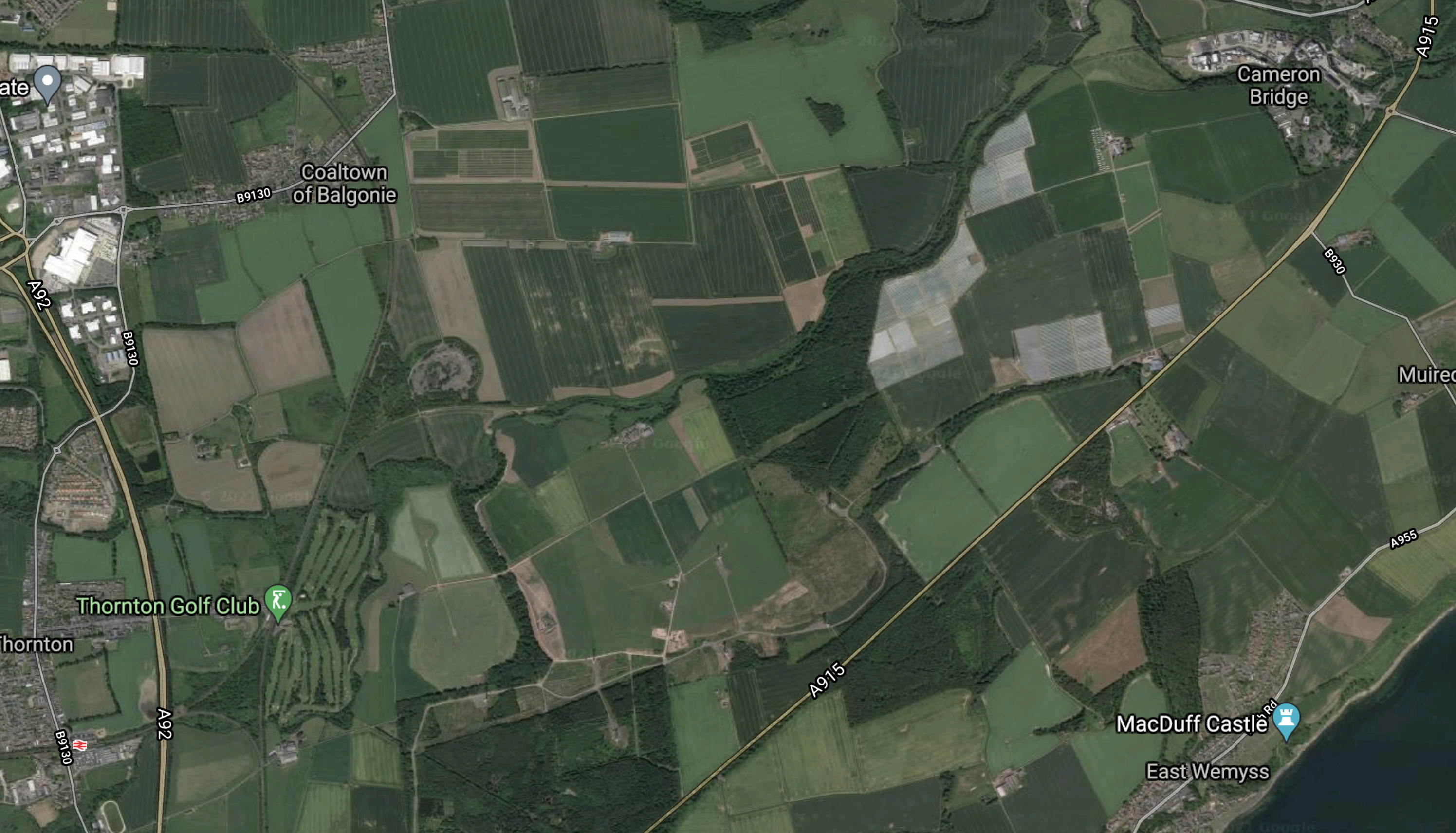
Note.
- The village of Cameron Bridge is in the North-East corner of the map.
- The A 915 running diagonally across the map and to the East of the village of Cameron Bridge.
- In The New Cameron Bridge Station On The Levenmouth Rail Link, I showed how Cameron Bridge station was positioned to the East of the A915 and the village.
- The Levenmouth Rail Link would appear to pass to the South of the village, according to a Network Rail map in the related post.
Thornton junction is a large triangular junction in the South-West corner of the map.
- Thornton North junction is close to Thornton Golf Club, which is shown by the green marker.
- Glenrothes with Thornton station is at the Eastern point of Thornton junction.
- Trains going West from Glenrothes with Thornton station go through Dunfermline and over the Forth bridge to Edinburgh.
- Thornton South junction is South of Thornton Golf Club and leads South through Kirkcaldy station and over the Forth bridge to Edinburgh.
This second Google Map shows the main Edinburgh and Dundee rail line between Thornton Golf Club (Thornton North junction) and Markinch station, which is the next station to the North.
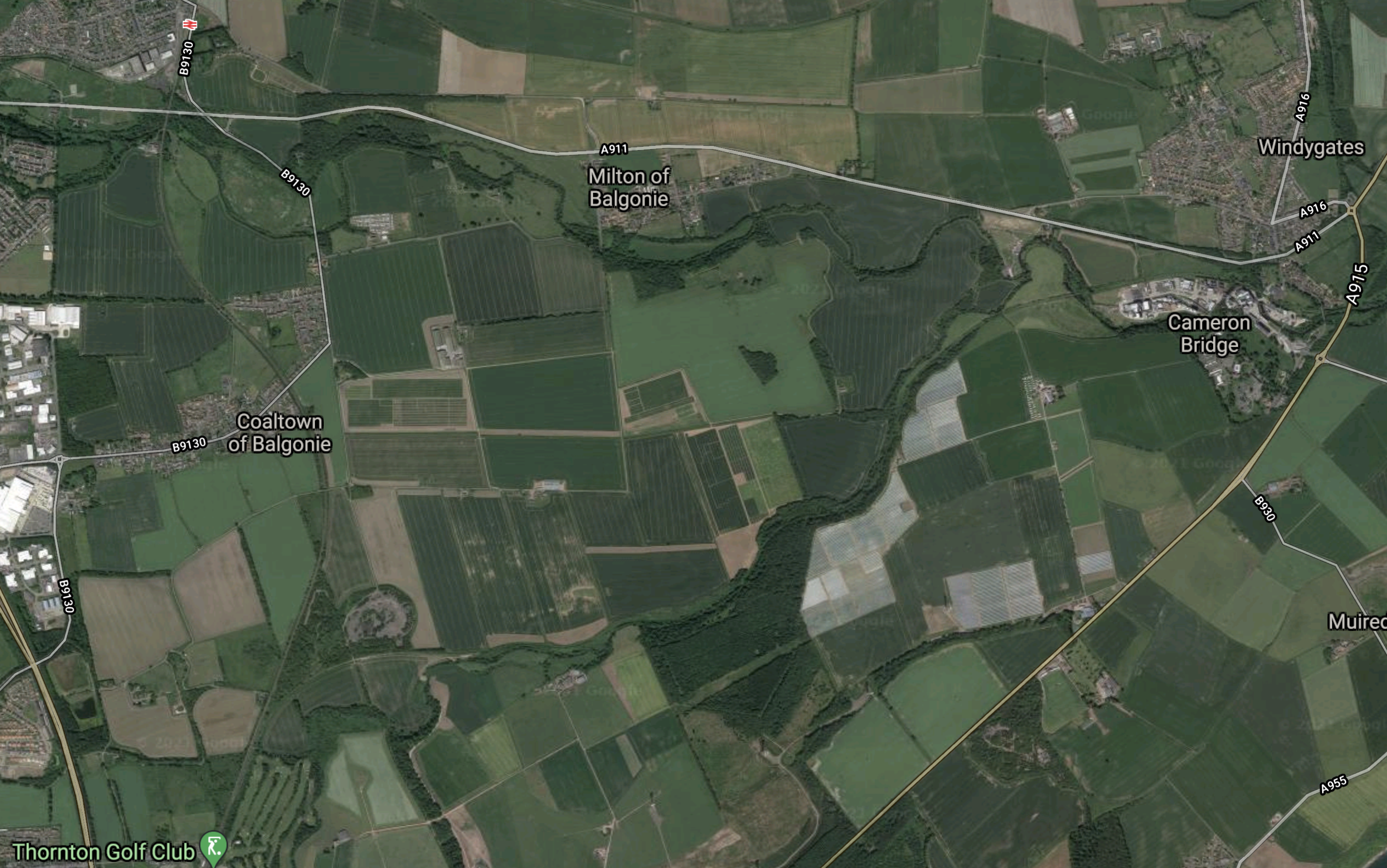
Note.
- The village of Cameron Bridge in the East of the map.
- Markinch station is in the North-West corner of the map.
- Thornton Golf Club (Thornton North junction) is in the South-West corner of the map.
Looking at various maps, Thornton Junction appears very complicated.
- The North-South leg of the junction is at least double-track.
- The North-East leg of the junction appears to be single-track.
- The South-East leg of the junction appears to be single-track.
- The former Levenmouth Rail Link appeared to join the main line at a single-track junction to the North of Thornton North junction
- There is lots of space.
.I’m sure Network Rail can come up with an efficient track layout, that will enable the following.
- Trains can go between Glenrothes with Thornton and Kirkcaldy stations in both directions, as they do now.
- Trains can go between Glenrothes with Thornton and Levenmouth Rail Link in both directions.
- Trains can go between Kirkcaldy station and Levenmouth Rail Link in both directions.
This would enable the service provision, that was specified in Service Provision On The Levenmouth Rail Link.
What Will Be Electrified At Thornton Junction?
This page on the Network Rail web site, says this about the trains that will run the service on the Levenmouth Rail Link.
And while the line will be electrified with overhead wires, services will be operated initially by battery electric units in order to reduce the number of diesels operating on the network as early as possible.
I wouldn’t be surprised to see full electrification between Glenrothes with Thornton and Leven stations, to make sure that the battery-electric trains had full batteries for the run South to Edinburgh.
- The other two legs of Thornton junction would also be fully electrified to give all passing trains a good charge.
- The distance between Kirkcaldy and Markinch stations is 7.3 miles and trains take about ten minutes. I suspect most of this section of the Edinburgh and Dundee line will be electrified. There looks to be about six overbridges that might need raising, but I suspect it would be nothing too terrible, with about the same degree of engineering difficulty as electrifying the Gospel Oak to Barking Line in London.
- I feel with good engineering and guile, enough electrification can be added to the route through Kirkcaldy to get the trains to the South.
- West of Glenrothes with Thornton station, the track looks to be good territory for electrification and enough wires can be added, so that by Cardenden station, there is enough power in the batteries to get the trains to the South.
I have a feeling that by intelligently using the two routes via Kirkcaldy and Dunfermline, Network Rail can increase the frequency of trains over the Forth Bridge.
- This probably partly explains, why trains to Leven go alternatively via Kirkcaldy and Dunfermline.
- 100 mph battery-electric trains help too with their sparkling acceleration.
- Who’d have thought, that at the age of one hundred and thirty, the Forth Bridge will be at the heart of an electrified local train network?
And the only new electrification is based on Thornton junction, over twenty miles to the North.
Electrification Between The Forth Bridge And Edinburgh
Without doubt, the electrification to the South of the Firth of Forth must reach as far North as possible.
Dalmeny station is the most Northerly station South of the bridge and I feel that this could be a practical place for the electrification to end.
Distances from Dalmeny to stations further North include.
- Leuchars – 41.4 miles
- Leven – via Dunfermline – 28.2 miles
- Leven – via Kirkcaldy – 27.3 miles
- Dundee – 48.8 miles
- Perth – 47.4 miles
All these destinations would be within range of Hitachi Regional Battery Trains, which are described in this Hitachi infographic.

Note that the range on battery power alone is 90 km or 56 miles.
Given that the battery-electric trains would be able to grab a battery charge as they passed through Thornton junction, I am fairly certain that Hitachi Regional Battery Trains could reach Leuchars, Dundee or Perth.
An Electric Service Between Edinburgh And Dundee
Dundee is a new station and I doubt, that it was rebuilt without provision for full electrification.
It has two through platforms for Aberdeen and Edinburgh services.
There are also two South-facing bay platforms for regional services from the South.
This picture shows the two bay platforms with an Edinburgh-bound train to the left.
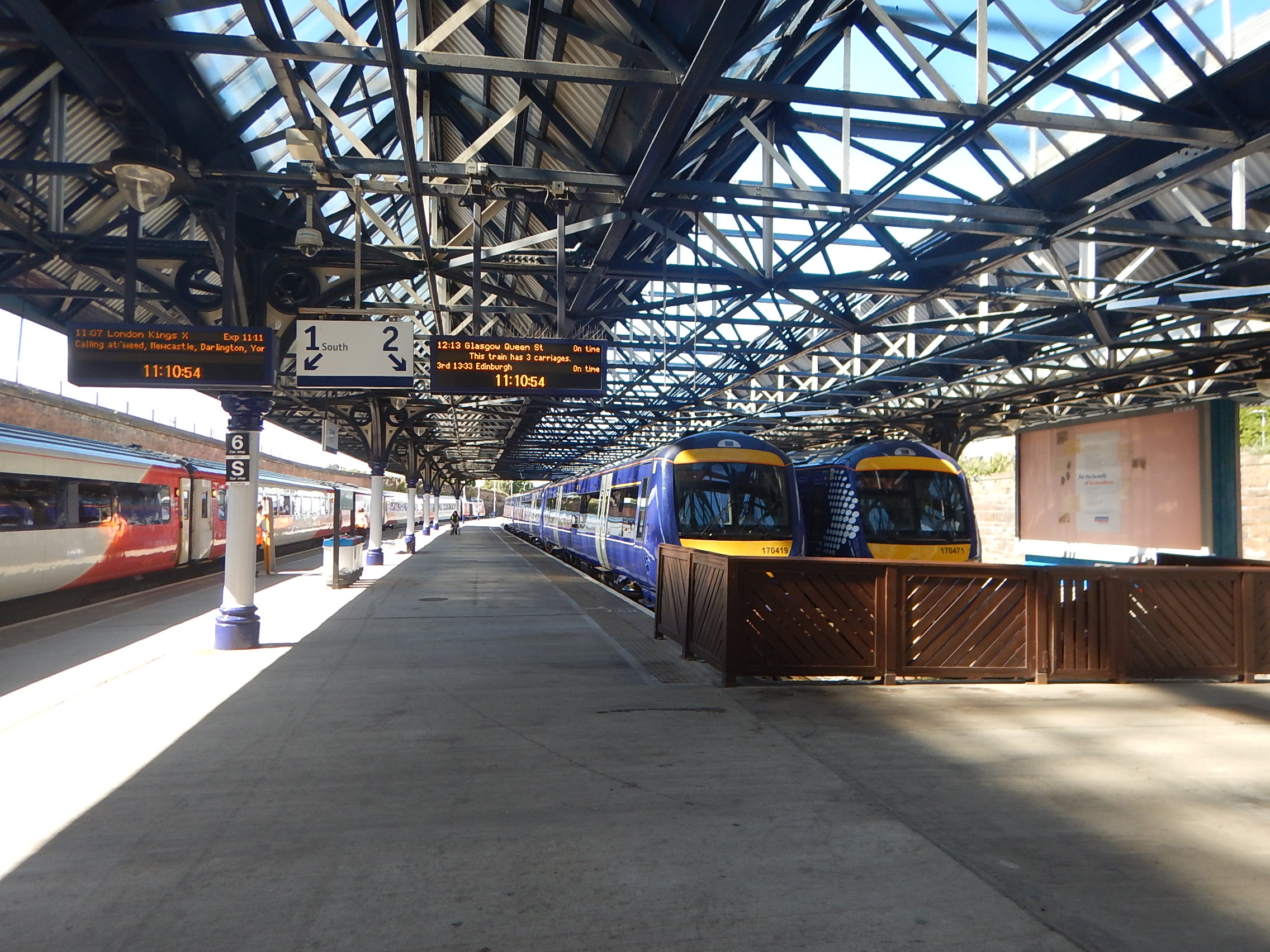
Note.
- In the picture the two Class 170 diesel trains will be going to Edinburgh or Glasgow.
- Scotrail’s plans include an hourly train to both of Edinburgh and Glasgow.
If these two bay platforms were electrified with 25 KVAC overhead wires, these battery-electric services will be possible.
- Edinburgh and Dundee via Haymarket, Kirkcaldy, Thornton junction and intermediate stations.
- Glasgow Queen Street and Dundee via Stirling, Dunblane, Perth, Gleneagles and intermediate stations.
I suspect other routes battery-electric will be possible.
An Electric Service Between Dundee And Aberdeen
The distance between Dundee and Aberdeen stations is 72 miles.
In Solving The Electrification Conundrum, I described techniques being developed by Hitachi Rail and Hitachi ABB Power Grids to electrify routes like Dundee and Aberdeen.
With Hitachi looking to give battery-electric trains a range of over forty miles, it could be just two hops between Dundee and Aberdeen.
I suspect Montrose could be the charging point, as it is forty miles South of Aberdeen.
Conclusion
It appears that the proposed electrification of Levenmouth Rail Link creates an electrification island at Thornton junction, that enables battery-electric trains to reach Dundee.
Coupled with plans to electrify between Stirling and Perth, this means that both Perth and Dundee will be connected to Scotland’s electrified rail network.
I suspect it is also possible to easily extend battery-electric trains all the way to Aberdeen, with only short sections of carefully positioned overhead wires.
Related Posts
The New Leven Station On The Levenmouth Rail Link
The New Cameron Bridge Station On The Levenmouth Rail Link
Service Provision On The Levenmouth Rail Link
Gravitricity Celebrates Success Of 250kW Energy Storage Demonstrator
The title of this post, is the same as that of this article on the Solar Power Portal.
I have already posted about this success in Gravitricity Battery Generates First Power At Edinburgh Site.
But the news story has now been mentioned in several respected publications and web sites.
So this idea, based on traditional Scottish products of heavy weights and girders seems to be getting valuable publicity.
The demonstrator is only small and uses two 25 tonne weights and a fifteen metre tower.
This is only a storage capacity of only 2.04 kWh, but the company is talking of weights totalling up to a massive 12,000 tonnes.
With a fifteen metre tower, that would be 490 kWh.
Note.
- The shafts at Kellingley Colliery in Yorkshire are 800 metres deep.
- The TauTona mine in South Africa is 3.9 kilometres deep
- In this article in The Engineer, Gravitricity talk about weights of up to 12,000 tonnes.
These are typical storage capacities.
- Kellingley – 50 tonnes – 109 kWh
- Kellingley – 12,000 tonnes – 26.15 MWh
- TauTona – 50 tonnes – 531 kWh
- TuaqTona = 12,000 – 127.5 MWh
Accountants before they invest in a company look at the financial figures. As an engineer, I look at the numbers in the science behind their claims.
If the engineering can be made to work, these figures are to say the least; very promising.
They are also beautifully scalable.
If say your application needed a 2 MWh battery and you had a 400 metre shaft available, you can calculate the weight needed. It’s around 1836 tonnes.
The Solar Power Portal article finishes with these two paragraphs.
The company will now look to rollout the technology in a series of full-scale 4-8MW projects, with conversations already underway with mine owners in the UK, Scandinavia, Poland and the Czech Republic, it said. Additionally, in South Africa Gravitricity is working closely with mine operator United Mining Services as part of a programme funded by an Innovate UK Energy Catalyst programme to identify potential schemes.
“A key feature of our full-scale projects will be their long life” added Blair. “Once built, our system can last for over 25 years, with no loss in output or degradation over time. This makes gravity storage cost-effective. And unlike batteries, we have no reliance on rare metals such as cobalt and nickel which are becoming increasingly scarce in the global drive to electrification.”
Note.
- I assume that they are 4-8 MWh projects.
- Charlie Blair is the Managing Director of Gravitricity.
- A weight of 1836 tonnes would give 4 MWh in the 800 metre shaft at Kellingley.
I wouldn’t be surprised that those owning a deep empty hole in the ground will be starting conversations with Gravitricity!
Conclusion
I am not worried, that I bought a few shares in Gravitricity in the crowd-funding last year!
All this good publicity from the BBC, Good News Network, Science, The Engineer, The Times and other media sites won’t harm my investment.
LNER To Keep Class 91s Until 2023
The title of this post is the same as that of this article on Rail Magazine.
This is the two introductory paragraphs.
Class 91s hauling Mk 4s will remain with London North Eastern Railway until 2023.
Ten rakes of coaches and ten ‘91s’ will be used, with two additional spare ‘91s’ and a handful of spare Mk 4s also retained.
It looks like LNER are keeping enough Class 91 locomotives and Mark 4 coaches to guarantee having ten trains in service.
Why 2023?
The answer to this question is probably contained in an article in Issue 901 of Rail Magazine, which is entitled ORR Approves New Hitachi Inter-Car Connector Design, which has these two statements.
- All inter-car connectors will have been updated by Summer 2022.
- Hitachi has deals for a further 61 trains for three operators and all will be in traffic by the end of 2022.
It looks like Hitachi could have production capability from 2023.
The original Rail Magazine article also says this.
The extension is until the end of 2023 while LNER sources brand new trains, which would take a minimum of around two years to build and deliver. The operator has previously told RAIL it needs around six new trains.
It appears the difference between retaining ten InterCity 225 trains and adding six new trains to the fleet, is to cover for the retrofit of the inter-car connectors.
The Performance Of A Class 91 Locomotive And Five Mark 4 Coaches
I have seen in mentioned that Virgin East Coast were intending to run shortened rakes of Mark 4 coaches.
In the Wikipedia entry for the Class 91 locomotive, there is a section called Speed Record, where this is said.
A Class 91, 91010 (now 91110), holds the British locomotive speed record at 161.7 mph (260.2 km/h), set on 17 September 1989,[ just south of Little Bytham on a test run down Stoke Bank with the DVT leading. Although Class 370s, Class 373s and Class 374s have run faster, all are EMUs which means that the Electra is officially the fastest locomotive in Britain. Another loco (91031, now 91131), hauling five Mk4s and a DVT on a test run, ran between London King’s Cross and Edinburgh Waverley in 3 hours, 29 minutes and 30 seconds on 26 September 1991. This is still the current record. The set covered the route in an average speed of 112.5 mph (181.1 km/h) and reached the full 140 mph (225 km/h) several times during the run.
When you consider, this was nearly forty years ago, there can’t be much wrong with British Rail’s train engineering.
What Average Speed Do You Need To Achieve London And Edinburgh In Four Hours?
The rail distance between London and Edinburgh is 393 miles, so four hours needs an average speed of 98 mph.
Consider.
- I have travelled in InterCity 125 and InterCity 225 trains, where I have measured the speed at around 125 mph for perhaps thirty or forty miles.
- In Norwich-In-Ninety Is A Lot More Than Passengers Think!, I travelled to Norwich and back, at around 100 mph most of the way.
- Continuous 125 mph running is just as much about the track as the train.
- I have watched a driver in an InterCity 125 at work and these guys and girls know the route and their charges, like the backs of their hands.
I think it is possible to arrange train pathing, so that trains could run between London and Edinburgh in excess of 100 mph.
I believe, that this would enable London and Edinburgh in under four hours.
Will LNER Run Faster Services With Short Sets?
Virgin East Coast’s original plan, was to run short sets between London and Edinburgh.
Would these short sets have been faster, than full size sets?
- The power-to-weight ratio is higher, so acceleration would be better.
- A five-car train would probably need half the power of a ten-car train to cruise at a given speed.
- It might be possible to save weight to increase performance.
- There would be no intermediate stops.
- They know that the Kings Cross and Edinburgh record is three-and-a-half hours, which was set by a five-car train.
- In-cab digital signalling and other improvements could be fitted.
It should also be noted, that a short set would probably do significantly less damage to the track than a full-size set at 140 mph.
Possible Short InterCity 225 Routes
LNER have only six fully-electrified routes, where they could run short InterCity 225 sets.
- Kings Cross and Leeds
- Kings Cross and Doncaster
- Kings Cross and York
- Kings Cross and Newcastle
- Kings Cross and Edinburgh
- Kings Cross and Stirling
Note.
- All routes are fully-electrified, which is a pre-requisite, as InterCity 225 sets have no self-power capability.
- Kings Cross and Leeds will probably be run by pairs of Class 800 trains, as LNER looks like it will split trains at Leeds and serve two destinations.
- Do Doncaster, York and Newcastle generate enough traffic for a fast service?
- The Edinburgh route will have direct competition from East Coast Trains, who will be running five-car Class 803 trains.
- The Stirling route at over five hours is probably too long.
It looks to me, that the preferred route for InterCity 225 sets,; short or full-size will be Kings Cross and Edinburgh.
How Many Trains Would Be Needed To Run An Edinburgh Service?
A flagship service between London and Edinburgh might have the following timetable.
- One tph perhaps leaving at a fixed time in every hour.
- A timing of under four hours.
- Minimal numbers of intermediate stops.
- The service would not be extended past Edinburgh, as the trains need electrified lines.
Suppose, the trains could do a round trip in eight hours, this would mean that eight trains would be needed to provide a service.
Ten trains would allow one train in maintenance and one ready to be brought into service at a moment’s notice.
Does this explain, why ten InterCity 225 sets are being retained.
Would In-Cab Signalling Be Needed?
I suspect that under current rules, in-cab digital signalling might be needed! But as I observed in Partners On Board For In-Cab Signalling Project On East Coast Main Line, this is on its way!
But, as the average speed needed to do London and Edinburgh in four hours is only 98 mph, I wonder what time could be achieved by one of the top drivers, using the following.
- All their route knowledge and driving skill.
- A five-car train.
- Maximum acceleration.
- A well-thought out pathing structure.
- A clear track
- No hold-ups
- A non-stop run.
If the train were to run at 125 mph all the way without stopping, the journey time would be around three hours and ten minutes.
Wikipedia says this about in-cab digital signalling on the East Coast Main Line.
The line between London King’s Cross and Bawtry, on the approach to Doncaster, will be signalled with Level 2 ERTMS. The target date for operational ERTMS services is December 2018 with completion in 2020.
- I estimate that that this will mean that 145 miles of the route will have full in-cab digital signalling.
- Currently, the fastest London and Doncaster times are around 90 minutes, with many taking 97-98 minutes for the 155 miles.
This means the fast train takes 84 minutes between King’s Cross and Bawtry, at an average speed of 103 mph.
Suppose this fast train could go at 125 mph for all but twenty of the distance between King’s Cross and Bawtry, how much time would this save?
- 125 miles at 125 mph would take 60 minutes.
- 125 miles at 103 mph would take 72 minutes.
This means that just by running at 125 mph continuously for all but twenty miles could save up to twelve minutes.
If 140 mph running could be maintained on this section, another six minutes would be saved.
As they say, every little helps!
Lessons From Norwich-in-Ninety
In Norwich-In-Ninety Is A Lot More Than Passengers Think!, I travelled to Norwich and back, at around 100 mph most of the way.
Liverpool Street and Norwich is 114 miles and a ninety minute journey is an average of just 76 mph, which is 24 mph below the maximum cruise of a Class 90 locomotive and a rake of eight Mark 3 coaches. Compare this with an average speed of 98 mph needed for London and Edinburgh in four hours and the 125 mph maximum certified cruise of an InterCity 225 train, without in-cab digital signalling.
It should also be noted that Greater Anglia, run an additional stopping train after the Norwich-in-Ninety expresses, that call at several important stations and not just Ipswich.
Will LNER use a similar strategy? It was working well and successfully for Greater Anglia, until services were decimated by COVID-19!
Will LNER Increase Frequency Between London And Edinburgh To Three Trains Per Hour?
It would seem that the current two tph service running nine- or ten-car trains, runs with a high level of occupancy, so to replace some of these trains with faster and shorter trains might cause capacity problems.
But to add, a third faster train in the hour might be possible. Especially, if the Norwich-in-Ninety strategy were to be used. The timetable in both directions could be something like.
- XX:00 – Four hour express
- XX:06 – Four-hour plus train to current timing
- XX:30 – Four-hour plus train to current timing
LNER’s Marketing Department would like it.
Could Hitachi Trains Achieve London and Edinburgh In Four Hours?
The all-electric Class 801 trains most certainly have a performance to match an InterCity 225 in terms of acceleration and maximum operating speed without in-cab digital signalling. After all, the Japanese train was designed as a direct replacement for British Rail’s last high performance train!
So I believe that with a well-designed timetable, electric Hitachi trains will be able to run between London and Edinburgh in under four hours, with a small number of stops.
Note that LNER will have a fleet of thirty nine-car and twelve five-car all-electric Class 801 trains.
But East Coast Trains will have a fleet of five five-car all-electric Class 803 trains, which could get near to a four-hour timing, despite their four stops at Stevenage, Durham, Newcastle and Morpeth.
- I have timed a Class 800 train leaving Kings Cross and they get up to 125 mph fairly fast, by about Potters Bar, which is reached in eleven minutes.
- Stops at Stevenage, Durham and Morpeth will probably each add two minutes to the timing, with Newcastle adding five minutes.
- 125 mph all the way from Kings Cross to Edinburgh would be a timing of three hours and ten minutes.
Add up the stationary times at the stops (2+2+2+5) and that gives a journey time of three hours and twenty-one minutes, which leaves thirty-nine minutes for the five decelerations and accelerations between stationary and 125 mph.
This page on the Eversholt Rail web site, has a data sheet for a Class 802 train, which is a Class 800 train with larger engines.
The data sheet shows that a five-car train can accelerate to 125 mph and then decelerate to a stop in six minutes in electric mode. So five accelerations/deceleration cycles to 125 mph would take thirty minutes. This gives a journey time between London and Edinburgh of three hours and fifty-one minutes.
Note that Class 801 trains, which don’t lug diesel engines about will have better acceleration, due to the lower weight, so should have better acceleration and deceleration.
Does this time seem reasonable? First Group with their extensive experience of running Class 800 trains on the Great Western Main Line will know the capabilities of the trains, down to the last mph.
I doubt, they’d have bought the trains for East Coast Trains, if they couldn’t do London and Edinburgh in four hours.
I believe that both InterCity 225 and Class 801/803 trains can do London and Edinburgh in four hours and any train company that doesn’t offer this timing, will come second!
A Possible Hitachi-Based Timetable For LNER
I would be very surprised if a service pattern like this wouldn’t be possible.
- XX:00 – Four hour express – Class 801 train
- XX:06 – Four-hour plus train to current timing – Class 801 train or InterCity 225
- XX:30 – Four-hour plus train to current timing – Class 801 train or InterCity 225
Note.
- As there is only one extra train per hour, ten extra trains would be the addition to the fleet, needed to run this service pattern.
- Class 801 trains could be five-car or nine-car sets as passenger numbers require.
- InterCity 225 trains could be as long as are needed.
InterCity 225 trains would only be doing the job, they’ve done for many years.
Targeting The Airline Market
In Trains Ordered For 2021 Launch Of ‘High-Quality, Low Fare’ London – Edinburgh Service, which described the launch of First East Coast Trains, I said this about their target market.
First East Coast Trains is targeting the two-thirds of passengers, who fly between London and Edinburgh. The company are also targeting business passengers, as the first train arrives in Edinburgh at 10:00. Trains will take around four hours.
Note that currently, LNER’s first train arrives at 11:12. In the future, I would envisage that LNER intend to go for four hour journeys.
It would seem to me, that both train companies will be attempting to take passengers from the airlines.
Conclusion
It looks to me that ten InterCity 225 trains could add a third train in each hour between London and Edinburgh for LNER, that would do the journey in under four hours.
The third train could either be an InterCity 225 or a Class 801 train.
Hydrogen Refuelling In East Lothian
This article on Daily Business is entitled Hydrogen Refuelling Station Boost For Emission-Free Cars.
Hydrogen is coming!
Gluten-Free Breakfast At Amarone In Edinburgh
I had my gluten free breakfast in Amarone in Edinburgh a couple of weeks ago.




I would certainly go back again.
- Service was friendly.
- Price was reasonable.
- Food was excellent.
- Tea was at it should be in a pot!
It was a bit quiet, but that was probably due to the early hour.
I’ll certainly use their restaurant in Glasgow as well!
Trains Ordered For 2021 Launch Of ‘High-Quality, Low Fare’ London – Edinburgh Service
The title of this post, is the same as that of this article on Railway Gazette.
This is the first paragraph.
FirstGroup has finalised an order for five Hitachi AT300 electric trainsets which it will use to launch a London – Edinburgh open access service in autumn 2021.
The trains appear to be be similar to those used by FirstGroup companies; Hull Trains and Great Western Railway.
These are some points from the article.
- FirstGroup is targeting the two-thirds of passengers, who fly between London and Edinburgh.
- They are also targeting business passengers, as the first train arrives in Edinburgh at 10:00.
- The trains are five-cars.
- The trains are one class with onboard catering, air-conditioning, power sockets and free wi-fi.
- Stops will be five trains per day with stops at Stevenage, Newcastle and Morpeth.
- The trains will take around four hours.
- The service will start in Autumn 2021.
These are my observations.
Earlier Start
I suspect that the service can’t start earlier, due to one of the following.
- The lead time in building the trains.
- Completion of the new Werrington Junction.
- Completion of the sorting of Kings Cross.
- Completion of the works at Stevenage station.
The track works will probably be needed to create the extra paths needed on the East Coast Main Line.
Electric-Only Trains
Most other AT300 trains are bi-mode trains, but will these be electric-only?
Capacity Issues
If the trains prove too small, they can just add extra carriages or two trains can run as a pair.
Timetables
Trains will probably take nine hours for a round-trip, allowing 30 minutes for turnround.
This would mean that two trains leaving London and Edinburgh at six, would arrive back at home after two round trips around midnight.
Conclusion
I think it will be a successful service.
Boost For Borders In New Report
This report on the Scottish Government web site is entitled Borders Transport Corridors – Pre-Appraisal.
It is a comprehensive report with a helpful pag of recommendations.
Recommendations that apply to rail include.
Develop Forestry Route Network
Improve network of internal forestry tracks as well as its connections to roads and railway, including ‘low-tech’ timber
pickup facilities.
This seems sensible, as some of the forests on both sides of the Scottish order are mature and need to be cut down and replanted.
Increase Park and Ride Provision
Increase capacity of existing Park-and-Ride sites and implement new Park-and-Ride schemes for all modes at strategic locations [e.g. Interchanges and Key Employment Areas]
Every part of the UK seems to need more Park-and-Ride. The Borders is no exception.
Borders Railway Extension – South/West
Extend the Borders Railway to Hawick and/or Carlisle
Will it go all the way to Carlisle?
Consider.
- The West Coast Main Line will need a capacity increase through Carlisle because of High Speed Two. These works could be combined with those on the Southern part of the Borders Railway.
- Plans exist for a large freight interchange at Longtown on the former MoD site.
- Linking the Tourist areas North and South of the Scottish Border by rail must be a good thing.
- Extension to Carlisle would give those in the Scottish Borders access to High Speed Two at Carlisle, without a long trip via Glasgow.
For these reasons, I think that the Borders Railway will go to Carlisle.
Borders Railway Extension – South/East
Extend the Borders Railway towards East Coast Main Line (ECML) via Berwick-upon-Tweed
This surprised me, but it does complete the jigsaw.
Does it offer a freight route for moving the timber out of the area?
It woulde certainly offer a scenic route between Edinburgh and Newcastle.
New Rail Stations
New rail stations on the existing Borders Railway
This is surely building on the success of the current Borders Railway.
Extension of Borders Railway Services
Link Borders Railway and Fife Circle, providing interchange at Edinburgh Gateway; West Edinburgh; and potential future link to Glasgow.
Back-to-back services across a city are always a good idea, as they cut the need for terminal platforms
- The Borders Railway and Fife Circle are both half-hourly services, so could be connected together, once suitable rolling stock is available.
- This service would also connect the Borders to the Edinburgh Airport tram at Edinburgh Gateway.
- With extra services, would the capacity of the Borders Railway will probably need to be increased?
Does the South East extension enable better services for the Borders beyond Edinburgh?
Conclusion
There are a lot of projects needing to be developed, but they will create a lot of economic activity in the Borders.
The two railway extensions to Hawick and/or Carlisle and Berwick-on-Tweed are the two most expensive projects, but both have English implications, so I don’t think Westminster will mind paying some of the cost.
Edinburgh Tourist Tax Could Be £2 Per Room, Per Night
The title of this post is the same as this article on the BBC.
Will it actually make any difference?
- I looked up the price of two nights in a Premier Inn in the City Centre for next week and they want to charge me £263.
- Glasgow was £137 and Stirling £105 for Premier Inns close to the stations.
- Will the tax apply to Airbnb?
I do think, we’re going to see some innovative tourist taxes and rewards.
For instance, all hotels in Geneva must give you a voucher for a day’s free travel on public transport. This applies for everything from a camp-site to a five-star hotel.
Some hotels in Hamburg, do something similar.
 The Anonymous Widower