Shapps Supports Beeching Axe Reversals
The title of this post is the same as that of this article on Rail Magazine.
This is the introductory paragraph.
Secretary of State for Transport Grant Shapps says he supports the reopening of routes closed in the Beeching cuts of the 1960s.
In the article, which describes proceedings in the House of Commons, Grant Shapps, says he was very supportive of opening the Market Harborough Line.
I have now moved the rest of this article to a standalone article with a title of Reopening Milton Keynes And Market Harborough Via Northampton.
Fresh Calls For ‘Missing Link’ Buxton To Matlock Railway Line To Be Reopened
The title of this post is the same as that of an article in the Buxton Advertiser.
I wrote in full about this route in Connecting The Powerhouses, after an article was published in the June 2017 Edition of Modern Railways.
This was my conclusion.
It’s very difficult to find a reason not to reopen the Peak Main Line.
I think in the last two years the case for reopening the Peak Main Line between Buxton and Matlock may have become even stronger.
MEMRAP
A group called the Manchester and East Midlands Rail Action Partnership or MEMRAP has been setup to promote the case for reopening.
A web site has been created.
New Lower-Carbon And Quieter Passenger Trains
Rolling stock has improved and trains like tri-mode Class 755 trains and possible battery electric trains, should be able to handle the route in a more environmentally-friendly way.
Transport Of Building Materials
This is a paragraph from the Buxton Advertiser article.
Funding for the project, according to Mr Greenwood, would come from working in partnership with local quarries which are supplying materials for the new Heathrow Airport runway and are involved with the HS2 project.
Network Rail has already have spent a lot of money to improve freight access to the quarries, as I reported in £14m Peak District Rail Freight Extension Unveiled. So the demand for building materials must be there and going via Matlock would remove some heavy freight trains from the Hope Valley Line.
Heavy freight trains might not be welcomed by all stakeholders.
Possible High Speed Two Cutbacks
As I wrote in Rumours Grow Over Future Of HS2, The Eastern leg of High Speed Two might be axed.
This may or may not change the case for reopening the Peak Main Line.
There Will Be Opposition
This is two paragraphs from the Buxton Advertiser article.
Peak Rail has long campaigned to re-open the line for heritage trains to run between Buxton and Matlock. However, director Paul Tomlinson said he was not in favour of the new plans.
He said: “I’m all in favour raising the profile of the line to get it re-opened but we can’t support this new idea.
Others will also object.
Conclusion
There will be various opposing pressures on both sides of reopening the Peak MNain Line.
In favour will be.
- The quarries.
- Cities like Derby and Nottingham and passengers wanting better links to and from Manchester and its Airport.
- Transport for the North, as opening could increase capacity on the Hope Valley Line between Manchester and Sheffield.
Local interests will want to maintain the status quo.
Europhoenix Earmarks ‘91s’ For European Freight Use
The title of this post is the same as that of this article on Rail Magazine.
Class 91 locomotives are the locomotives at one end of an InterCity 225 train.
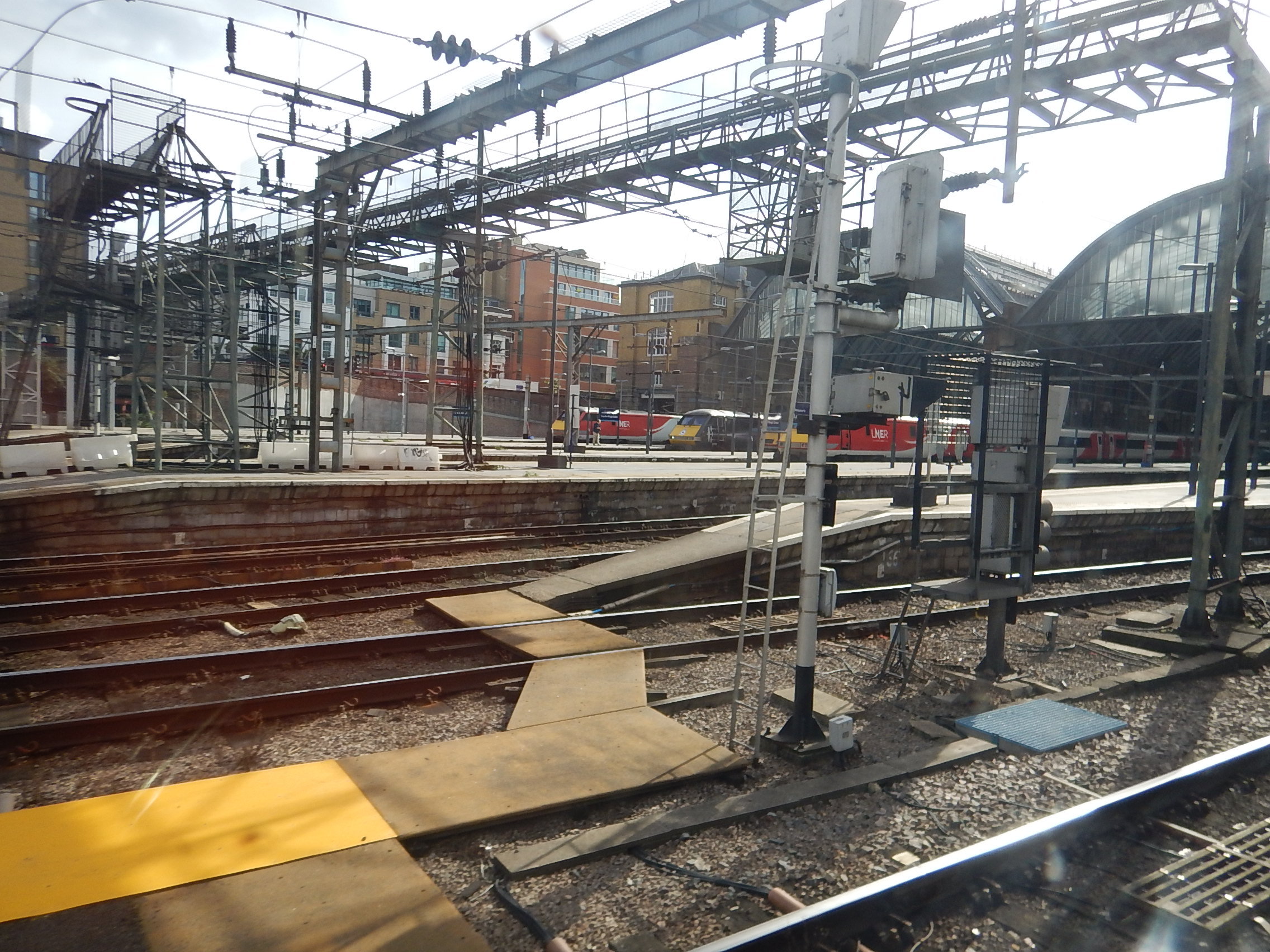
The picture shows three Class 91 locomotives lined up at Kings Cross station. Locomotives are normally at the Northern end of the train, with driving van trailers, which are dummy locomotives with a cab, at the other end of the train. The locomotives have a pantograph.
They are electric locomotives, with an unusual transmission, described like this in Wikipedia.
The locomotive body shells are of all-steel construction. Unusually, the motors are body mounted and drive bogie-mounted gearboxes via cardan shafts. This reduces the unsprung mass and hence track wear at high speeds. The locomotive also features an underslung transformer so that the body is relatively empty compared to contemporary electric locomotives. Much of the engineering specification for the locomotive was derived from the research and operational experience of the APT-P.
Wikipedia also says this about the locomotives.
- Have a power of 4.83 MW.
- Have a weight of 81.5 tonnes.
- Can work on 25 KVAC overhead electrification.
- Have a service speed of 125 mph
- Have a service speed of 110 mph going blunt end first.
- Can operate as a normal locomotive.
According to Wikipedia, there are a total of 31 locomotives.
They are powerful locomotives, that were designed to haul nine heavily-loaded coasches at 140 mph.
Europheonix’s Plan
Europhoenix, which is described as a railway locomotive hire company by Wikipedia, intend to do the following, according to the Rail Magazine article.
Up to twenty Class 91 locomotives will be acquired and they will be used for freight in Eastern Europe.
Two have already been purchased and these are being readied for tests.
This paragraph gives more details on the modifications and how they will be used.
EP owner Glenn Edwards told RAIL on October 4 that the locomotives would work in permanent pairs, with the blunt ends coupled together. Currently, ‘91s’ are not suitable for heavy freight haulage duty, so in partnership with Voith they will be re-geared to a lower rating to enable them to operate in this manner.
A few of my thoughts!
The Double Locomotive
British Rail gets a lot of criticism.
Some of this is justified, but on the other hand, some of their track,locomotive and carriage design has admirably stood the test of time.
In his quote, Glenn Edwards seems very confident that the engines can work in permanent pairs.
As the Class 91 locomotives were designed to work as normal locomotives, perhaps the ability to work as a pair, was part of the original specification.
But as no-one ever used them to haul heavy freight trains, the feature was never needed.
British Rail has form in using pairs of electric engines to haul freight.
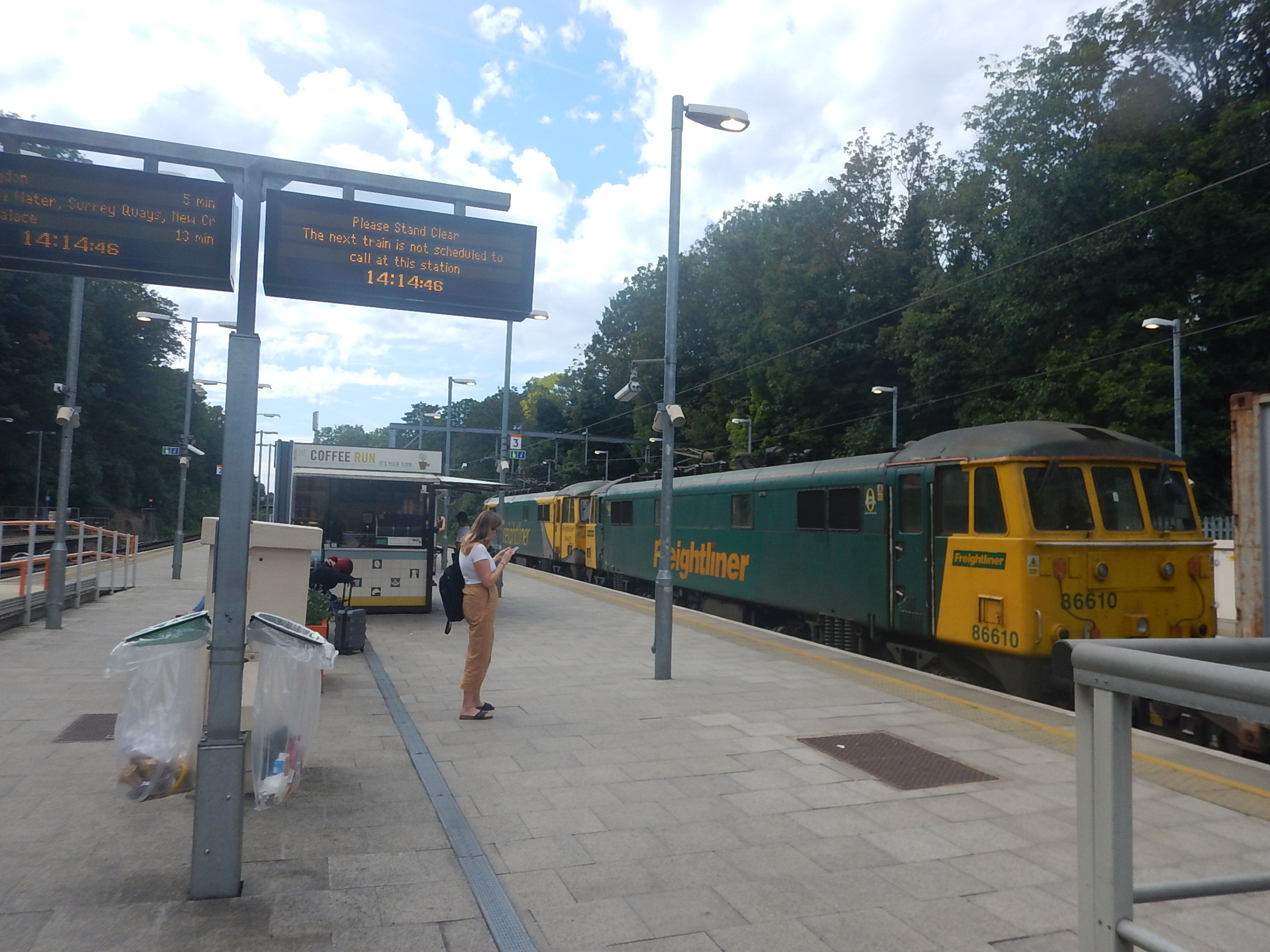
The picture shows a pair of Class 86 locomotives, which were built in 1965-66, pulling a heavy freight train through Canonbury in 2019.
I also must show this picture of a British Rail-era Class 90 locomotive double-heading a heavy freight train with a Class 66 diesel locomotive.
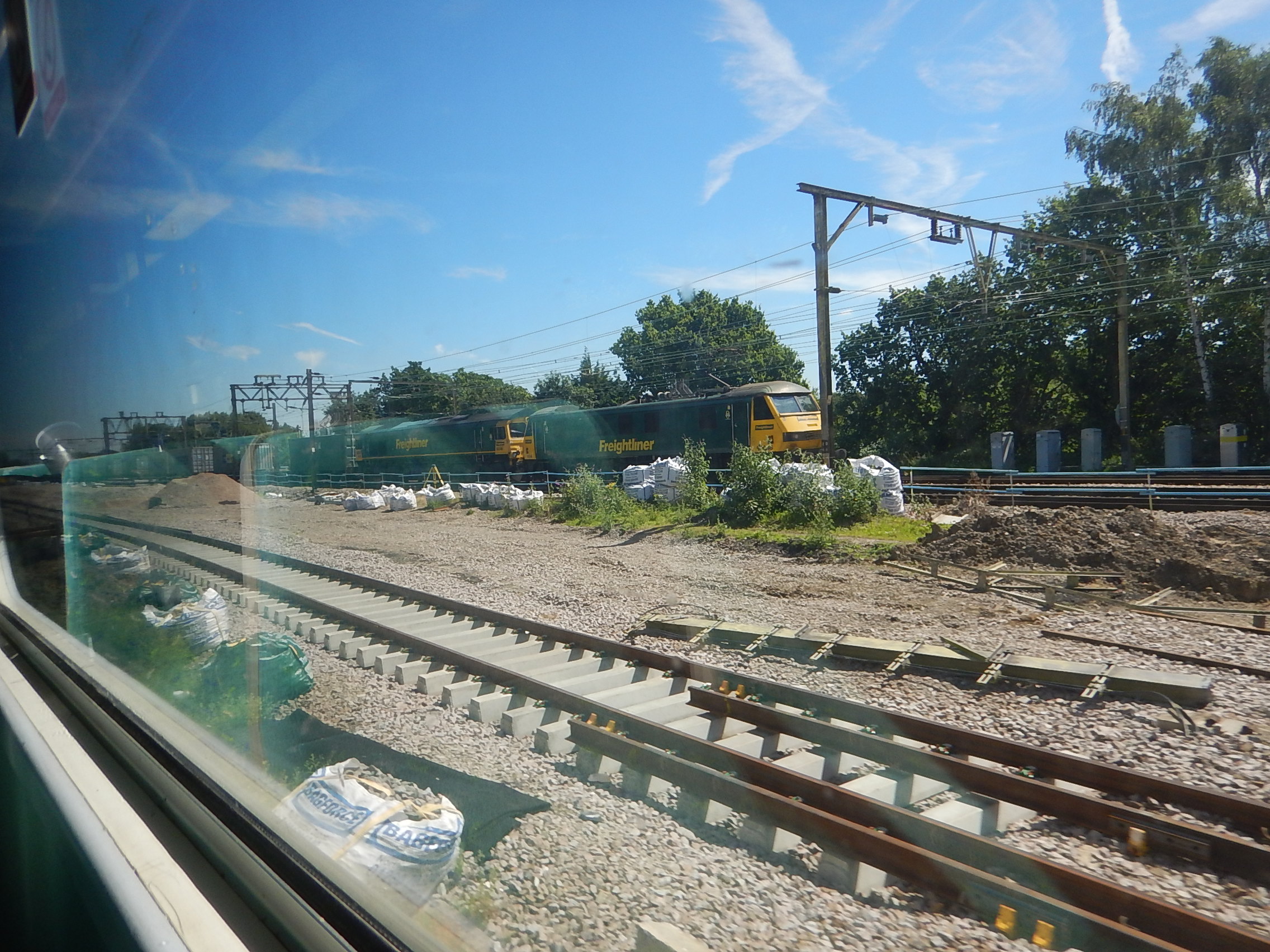
Is this the ultimate bi-mode locomotive for the UK?
I’ve never seen the formation again or found any reference on the Internet.
I wouldn’t be surprised to be told, that running two Class 91 locomotives, blunt end together, was part of the original design.
The pair would be a powerful beast.
- Almost ten MW of power.
- Eight driven axles.
But the pair would have a lowish axle loading of around twenty tonnes.
Modifications Planned
The only modification noted in the Rail Magazine article is to change the gearing from that needed for a 140 mph passenger train to that needed for a slower freight train.
Hopefully the manufacturer of the original gear-boxes are still in existence.
Other Information
There is a discussion about these locomotives on this topic on RailUK Forums.
One post says this.
I spoke to a colleague the other day who said ROG were getting 2X91’s for testing the new wires on the MML.
ROG is Rail Operations Group and they are should be well-qualified to do the testing.
According to Wikipedia, there is a lot of space inside the locomotive, so could this space be used to house instrumentation used to test the overhead wires?
Could Pairs Of Class 91 Locomotives Be Used For Freight In The UK?
I think it all depends on the routes, the amount of electrification and the economics.
On the other hand new Stadler Class 93 locomotives might be a better alternative.
Conclusion
It does look like Eirophoenix have organised an export deal, that is to the benefit of several parties.
A Freight Shuttle For Liverpool Street Station Planned
Edition 889 of Rail Magazine has an article which is entitled London Gateway-Liverpool Street Freight Trial Planned.
Rail Operations Group are planning to run a freight shuttle between London Gateway and Liverpool Street station.
Trains will be Class 769 bi-mode trains.
- The trains will be fitted with roller doors, roller cages and strengthened floors.
- Three aervices will leave Thames Gateway at 0029, 1208 and 1856.
- They will return from Liverpool Street at 0242, 1421 and 2100.
- Services will use Platforms 9 and 10 in Liverpool Street station.
It seems a very detailed plan.
A few of my thoughts.
Journey Time
I would estimate that a time of about 45 minutes to an hour would be possible.
Use Of Platforms 9 and 10
These two platforms are generally used for the London and Norwich expresses via Colchester and Ipswich, but it appears that only one service is timed to arrive in times when the station is really busy.
Platform 10 is near to the old Cab Road and so there is good vehicle access from the back of the station.
Final Delivery
The article says that trucks would be used for the final deliveries, with battery vehicles planned for the future.
Would There Be Sufficient Capacity For Trucks In The Cab Road?
A Class 769 train has four twenty metre long cars, so capacity will be equivalent of four small-to-medium supermarket delivery articulated trucks.
You wouldn’t get artics into the Cab Road, but would you get enough small trucks in to pick up a complete train-load?
- At night or in the evening, this would surely be possible!
- However, in the afternoon, it would surely be too busy, for more than a couple of delivery vans.
I’m sure Karl Watts has a well-laid plan.
What Is The Role Of UPS In This Freight Service?
In the Wikipedia entry for London Gateway, this is said.
Development of the Logistics Park has followed the initial stages of development of the port. UPS is developing a 32,000 square metre package sorting facility on the site – one of the American firm’s largest ever infrastructure investments outside of the USA. Since March 2017,
UPS wouldn’t build a facility the size of thirty two football pitches and then send out a series of trucks to their biggest market in the City of London , only for the packets to get stuck in the traffic.
I suspect that packets will be sorted into small easily-managed loads for delivery by electric vans, cargo bicycles or Shank’s Pony, from Liverpool Street station.
And Could Lidl Be In On The Act?
The Wikipedia entry for London Gateway also says this.
German grocery retailer Lidl has been operating out of the DP World London Gateway Logistics Centre, the first warehouse to be developed on the site.
This article in the Guardian is entitled Lidl In The Middle: Chain To Open First Store In Central London. This is said.
Lidl is to launch its first store in central London as it opens 40 new shops across the capital in the next five years.
Could Lidl be thinking of using such the proposed service to supply Central London stores?
- Last mile delivery could be by electric vehicles.
- Catching the 0029 train from London Gateway could be ideal.
- Goods could be on the shelves by early in the morning.
I think that this could offer interesting possibilities.
Supermarket deliveries were also one of the cargoes proposed in the LaMiLo project that I talked about in The LaMiLo Project.
Why Use Bi-Mode Trains?
Consider.
- Virtually all of the route is electrified, except for the last mile or so into the London Gateway.
- It would be possible to electrify those last few miles and use electric trains.
- Electric trains like unmodified Class 319 trains could be used for the service.
But cranes, containers and 25 KVAC overhead wires are a possible disaster waiting to happen, as a crane driver once told me!
When Will The Service Start?
The article says that the service could start in April or May.
Could There Be Other Services?
This is the last paragraph of the article.
Watts mentioned that other routes were a possibility for the business, suggesting that routes from the West Midlands to the Scottish Central Belt and the West Midlands to the West Country have been investigated. No dates have yet been given for any such trials.
I would also think, that there could be opportunities for moving high-value or perishable cargoes into major city centre stations in the middle of the night.
Suitable stations could be.
- Birmingham New Street
- Bristol
- Edinburgh
- Glasgow
- Leeds
- Liverpool Lime Street
- Manchester Piccadilly
I am not being anti-Geordie, but Newcsastle might be a difficult station to unload cargoes from trains onto trucks!
Conclusion
If seems to me that Rail Operations Group are being innovative with trains.
Two Unrelated (?) Stories About Rail Freight
Today there are two news stories about rail freight on the Internet.
- There Has ‘Never Been A Better Time’ To Invest In Rail Freight–Report on Railnews
- New Owner For GB Railfreight on Rail Magazine.
I’ll sketch out a few details from both stories.
Invest In Rail Freight
This is the first paragraph of the news story.
A new report published by the Rail Freight Group today is outlining how an ‘ambitious growth strategy’ for rail freight over the next ten years could be worth between £75 billion and £90 billion in environmental and economic benefits.
The report was written by well-respected rail commentator; Stephen Joseph
Recommendations include.
- A new approach from national and local government.
- New investment
- More investment in the Strategic Freight Network.
- Increased electrification
- New rail linked terminals
- Reforms to planning laws
- High speed freight services to city centres.
- Road pricing could also be used to encourage a shift to rail.
The Rail Freight group’s director general Maggie Simpson is quoted as saying. With renewed focus on the environment, and with new trade opportunities on the horizon, there has never been a better time to invest in rail freight.
Note that invest or investment is mentioned five times in the short news story.
New Owner For GB Railfreight
This is the first paragraph of the news story.
Hector Rail Group has sold GB Railfreight to Infracapital – the unlisted infrastructure equity arm of M&GPrudential.
This article in Rail Magazine was published in July 2017 and is entitled GB Railfreight In ‘Locomotive Acquisition’ Talks.
GB Railfreight has a fleet of seventy-eight Class 66 locomotives with other locomotives in the ageing category. Some of their work like hauling the Caledonian Sleeper needs well-presented reliable locomotives, so perhaps they need to update their image.
Would being owned by Infracapital give the company better access to finance for a renewed fleet?
The previous article indicated, that new investment in infrastructure, like selective electrification, railfreight terminals and perhaps freight loops is needed in the UK Strategic Freight Network.
Would Infracapital be prepared to fund this infrastructure, where it made their locomotives more profitable?
Consider.
- Partial electrification of the Felixstowe Branch Line might enable a hybrid Class 93 locomotive to haul the heaviest intermodal freight trains between Felixstowe and Ipswich. This improvement would also allow Greater Anglia’s Class 755 trains to run partially on electricity on the route.
- Doubling of the single-track between Soham and Ely would increase the number of freight paths across Suffolk.
- Reworking of junctions at Haughley and Ely would also speed up freight trains across Suffolk.
These are just three examples from an area I know well, but in how many places in the UK would smaller projects improve the profitability of new locomotives.
Infracapital would also be paid track access charges for their small sections of infrastructure. So well-planned improvements would have two revenue streams. And both would have a lifetime of thirty to forty years.
Case Study – Partial Electrification Of Felixstowe Branch Line
The Felixstowe Branch Line has now been double-tracked to create a passing loop to the West of Trimley, which allows more freight trains per day into and out of the Port of Felixstowe.
I believe that if sections of the branch line were to be electrified, that a diesel/electric/battery Class 93 locomotive would be able to haul a maximum weight intermodal freight train from Felixstowe to Ipswich.
The freight train would continue South and would use electric power to go to Bristol, Cardiff, Glasgow, Liverpool and Manchester using existing electrified routes through London.
In Issue 888 of Rail Magazine, there is a short article, which is entitled Battery Power Lined Up For ‘755s.‘
This is said.
Class 755s could be fitted with battery power when they undergo their first overhaul.
Stadler built the trains with diesel and electric power.
The Swiss manufacturer believes batteries to be the alternative power source for rail of the future, and is to build tri-mode trains for Transport for Wales, with these entering traffic in 2023.
Rock Rail owns the Greater Anglia fleet. Chief Operating Office Mike Kean told RAIL on September 4 it was possible that when a four-car ‘755/4’ requires an overhaul, one of its four diesel engines will be removed and replaced by a battery.
I suspect the battery size and electrification can be designed, so that the trains can work the twelve mile branch without using diesel power.
I can envisage a time, when the following trains on the Felixstowe Branch are zero-carbon.
- Freight trains between Felixstowe and London via Ipswich.
- Passenger services.
That will be a substantial improvement in environmental credentials.
Conclusion
There is more to this than an insurance and fund management company, funding locomotives.
Suppose GB Railfreight see an opportunity to deploy a new fleet of locomotives on a valuable contract, but perhaps a missing piece of infrastructure, stops them from running the service. Will they then approach their parent company; Infracapital, to see if they can help?
Are we seeing the first green shoots of realism in the financing of much-needed improvements to the UK rail network.
If it works out well, I don’t think that Infracapital will mind the good publicity.
,
Do We Need More Bikes Like This?
When I moved back to London in 2010, bikes like this were rare!
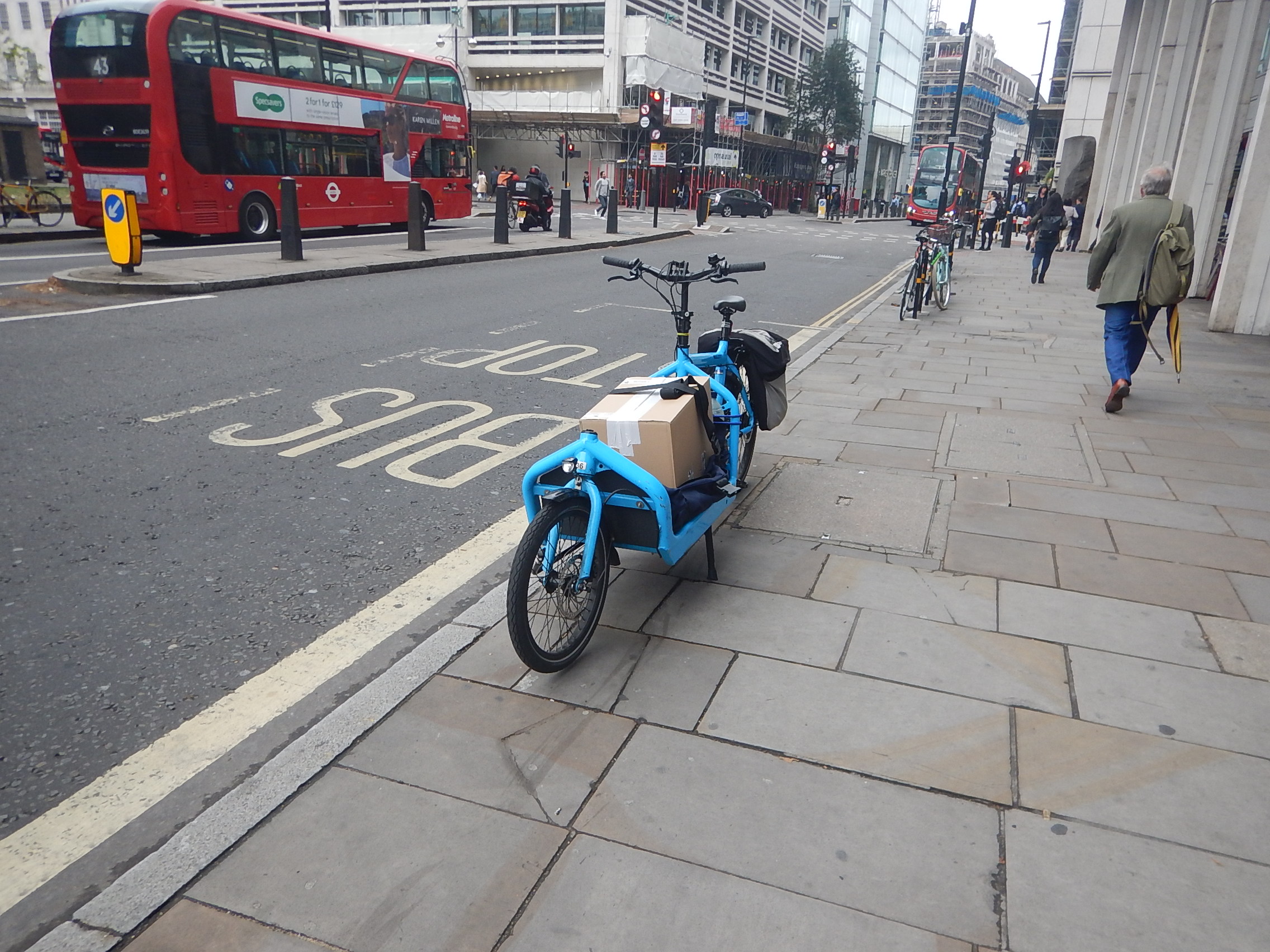
Now, you see various bikes every day delivering bread, children, dogd and parcels in the City and East End of London.
It swhould be noted that in a circle of two to three miles from Bank, London is fairly flat and ideal cycling terrain.
But we still need more!
Have we got enough people, prepared to ride them?
Will HS2 And Northern Powerhouse Rail Go For The Big Bore?
Different Versions Of This Post
The original post was published on the 25th August 2019.
It has been updated on the 21st November 2020 to reflect changes made to High Speed Two (HS2).
It has been updated on the 13th January 2023 for piggy-back freight trains.
The Merging Of High Speed Two And Northern Powerhouse Rail
It looks to me that there will be increasing links and merging between High Speed Two (HS2) and Northern Powerhouse Rail (NPR).
This report on the Transport for the North web site, is entitled At A Glance – Northern Powerhouse Rail.
Proposals and possibilities include.
- NPR will have a Western terminal at a new station in Liverpool City Centre.
- HS2 trains would access Liverpool and Manchester via a junction between HS2 and NPR at High Legh.
- There will be six trains per hour (tph) between Liverpool and Manchester via Manchester Airport.
- The route between Manchester and Manchester Airport is planned to be in tunnel.
- There will be six tph between Manchester and Leeds.
In addition, Boris has made positive noises about a high speed line between Manchester and Leeds being of a high priority.
So will the planners go for the logical solution of a High Speed tunnel between Manchester Airport and Leeds?
- There could be a theoretical capacity of perhaps 18 tph, which is the design capacity of High Speed Two.
- Speeds of up to 125 mph or more could be possible. The Gottard Base Tunnel has an operating speed for passenger trains of 125 mph.
- Stations could be at Manchester Airport, Manchester Piccadilly/Piccadilly Gardens/Victoria, Huddersfield, Bradford and Leeds.
- West of Manchester Airport, the route appears easier and the tunnel would emerge close to the airport. High Speed Two is planning that the tunnel emerges just to the North of the Airport and that the station is below ground level.
- East of Leeds the tunnel would join up with existing routes to Doncaster, Hull, Newcastle and York.
- Freight trains would be allowed at speed of up to 100 mph.
I believe such a tunnel could be built without disrupting existing rail services and passengers. Remember building Crossrail’s tunnels in London was an almost invisible process.
It would result in two rail systems across Northern England.
- Upgraded Classic Rail Routes
- The Big Bore
My thoughts on the two systems follow.
Upgraded Classic Rail Routes
This could include improvements such as these,
- Extra passing loops.
- Selective electrification
- Improved stations
- Comprehensive in-cab digital signalling
- More paths for passenger and freight trains.
Which could be applied to routes, such as these.
- The Huddersfield Line
- The Chat Moss Line
- The Calder Valley Line
- The Hope Valley Line
- The Dearne Valley Line
- The Selby Line
- The Midland Main Line North Of Clay Cross
In addition, there could be the reopening of some closed or freight routes to passenger trains.
This article on Rail Technology Magazine is entitled Network Rail Reveals Detailed £2.9bn Upgrade Plans For TransPennine Route.
It is a comprehensive upgrade that includes.
- Improvement between Huddersfield and Westtown, which is near Dewsbury
- Grade separation or a tunnel at Ravensthorpe
- Rebuilding and electrification of eight miles of track.
- Possible doubling the number of tracks from two to four.
- Improved stations at Huddersfield, Deighton, Mirfield and Ravensthorpe.
This project would be a major improvement to the Huddersfield Line.
In Sheffield Region Transport Plan 2019 – Hope Valley Line Improvements, I talked about planned improvements to the Hope Valley Line, which should begin in the next couple of years.
These improvements are given in detail under Plans in the Wikipedia entry for the Hope Valley Line.
The Hope Valley Improvements will cost in the region of tens of millions of pounds and Wikipedia sums up the benefits like this.
These changes to allow three fast trains, a stopping train and freight trains each hour were also supported in a Transport for the North investment report in 2019, together with “further interventions” for the Northern Powerhouse Rail programme.
It seems like good value to me!
So could we see other multi-million and billion pound projects created to improve the classic routes across the Pennines?
Projects would be fully planned and the costs and benefits would then be assessed and calculated.
Then it would be up to the Project Managers to devise the optimal structure and order in which to carry out all the projects.
I wouldn’t be surprised to see the following techniques used.
- Discontinuous electrification to avoid bridge reconstruction.
- Intelligent, hybrid diesel/electric/battery trains from Bombardier, CAF, Hitachi or Stadler, capable of 125 mph running and changing mode at speed.
- Modular digital signalling
- Factory built stations and step-free bridges.
- Removal of all level crossings.
- All stations updated for step-free access between train and platform.
The objectives would be as follows.
- More train paths, where needed.
- Faster line speed.
- Less running on diesel.
- Fast station stops.
Hopefully, the upgrading could be done without too much disruption.
Remember though, that disruption to existing users during a project, is most likely down to bad project management.
The Big Bore
The Central Core tunnel of Crossrail between Royal Oak and East London, was virtually a separate project before Crossrail’s stations and much of other infrastructure was built.
I believe that digging the tunnel first gave a big advantage, in that it could be constructed as an independent project, provided that the logistics of delivering the components and removing the junk was done efficiently.
But it did mean that travellers wouldn’t see any benefits until the project was almost complete.
HS2 and NPR are different in that they also envisage upgrading these routes.
- The Huddersfield Line
- The Chat Moss Line
- The Calder Valley Line
- The Hope Valley Line
- The Dearne Valley Line
- The Selby Line
- The Midland Main Line North Of Clay Cross
Only the Huddersfield Line is directly affected by the Big Bore.
Effectively, the Big Bore will provide a by-pass route for passenger trains between Leeds and West of Manchester Airport, to take the fast trains of HS2 and NPR underneath the congested classic lines.
In Changes Signalled For HS2 Route In North I said this about a tunnel between Leeds and Manchester.
To get a twenty-five minute time between Leeds and Manchester with a ten minute frequency, which I believe is the minimum service the two cities deserve, would be like passing a whole herd of camels through the eye of a single needle.
The Swiss, who lets face it have higher hills, than we have in Northern England would create a new route mainly in tunnel between the two cities, with perhaps an underground station beneath the current Grade I Listed; Huddersfield station.
The transport for the North report suggests Bradford Low Moor station, as an intermediate station, so why not Bradford Low Moor and Huddersfield stations?
Note that the Gotthard Base Tunnel, which opened a couple of years ago, deep under the Alps, is about the same length as a Leeds and Manchester tunnel, and cost around eight billion pounds.
It would be expensive, but like Crossrail in London, the tunnel would have big advantages.
- It could be built without disrupting current rail and road networks.
- It would have a capacity of up to thirty tph in both directions.
- Unlike Crossrail, it could handle freight trains.
- It would unlock and join the railway systems to the East and West.
I believe, it would be a massive leap forward for transport in the North of England.
It would be a very big project and probably one of the longest rail tunnels in the world.
Comparison With The Gotthard Base Tunnel
But surely, if a small and rich nation like Switzerland can build the Gotthard Base Tunnel, then we have the resources to build the Big Bore between Manchester Airport and Leeds.
Consider these facts about the Gotthard Base Tunnel.
- It is two single track bores.
- Each bore has a track length of around 57 kilometres or 35 miles.
- The tunnel may be deep, but it is direct and level.
- The maximum speed is 250 kph or 160 mph.
- The operational speed for passenger trains is 200 kph or 125 mph.
- The operational speed for freight is 100 kph or 62 mph.
- It can take the largest freight trains.
To make numbers even more impressive it is joined to the shorter Ceneri Base Tunnel, to provide an even longer route.
Manchester Airport And Leeds Direct
Now consider Manchester Airport and Leeds.
- The current rail distance is 56 miles.
- There are stops at Manchester Piccadilly, Manchester Oxford Road, Manchester Victoria and Huddersfield stations.
- Journey time is eighty minutes.
But the direct distance is only 68 kilometres or forty-three miles.
Surely if the Swiss can blast and dig two 57 km. single-track rail tunnels through solid rock, we can go eleven kilometres further with all the recent experience of tunnelling around the world.
The lengths of the various legs would be as follows.
- Manchester Airport and Manchester – 14 km.
- Manchester and Huddersfield – 35 km.
- Huddersfield and Bradford – 17 km.
- Bradford and Leeds – 13 km
Trains running on the various legs at 200 kph, which is the cruising speed of a 1970s-built InterCity 125, could take the following times for the various legs.
- Manchester Airport and Manchester – 4.2 minutes
- Manchester and Huddersfield – 10.5 minutes
- Huddersfield and Bradford – 5.1 minutes
- Bradford and Leeds – 13 km – 3.9 minutes
Leeds and Manchester Airport would be under thirty minutes apart, even allowing two minutes each for the three stops.
Looking at NPR between Liverpool and Hull, times could be as follows.
- Liverpool and Manchester – 26 minutes
- Manchester and Leeds – 20 minutes
- Leeds and Hull – 38 minutes
Or a Coast-to-Coast time of under ninety minutes.
Train Frequencies
HS2 is being designed to handle eighteen tph, although slower intensive railways in the UK can handle up to twenty-four tph.
At the current time or certainly in a few years time, the theoretical maximum frequency through the Big Bore should be between these two figures. I will assume at least eighteen tph in this post.
The At A Glance – Northern Powerhouse Rail report talks about the following frequencies.
- Liverpool and Manchester via Manchester Airport – Six tph.
- Manchester and Leeds – Six tph
- Leeds and Hull – Two tph
This is all so lacking in ambition. It is like building a new high capacity road and only allowing those with status to use the road.
If Leeds and Manchester Airport can handle eighteen tph, why not use some of it to create an Express Metro under the Pennines?
To me, if the Big Bore is built, nothing short of twelve tph or a train every five minutes is acceptable, at Liverpool, Manchester Airport, Manchester, Huddersfield, Bradford and Leeds stations.
The extension to Hull could be reduced to perhaps six tph, but with the upgrading of the Hull and Leeds Line to perhaps 140 mph, I’d be bold and create a true TransPennine Express;
Hull and Liverpool every five minutes would be the ultimate Marketing Man’s dream.
The Underground Stations
Manchester Airport, Manchester, Huddersfield, Bradford and Leeds would all be through stations deep underground.
- They would be connected to the surface by lifts and escalators.
- Some entrances to the stations would connect to existing stations and others might emerge in City squares like Manchester’s P:iccadilly Gardens.
- Most stations would be just two platforms, as all trains would pass through on either side of a large underground concourse.
- Bay platforms could be added as required.
- All stations would have platform edge doors.
- Passengers would be able to reverse direction by just walking across the concourse.
Stations would build on the lessons learned from Crossrail. But then NPR is closer to Crossrail than a Classic High Speed Line.
Weston Williamson’s Vision For Manchester Piccadilly Station
I wrote about this in The Rival Plans For Piccadilly Station, That Architects Say Will ‘Save Millions’.
I believe that this is the way to create an underground station.
The Terminal Stations
The two main terminal stations for NPR and trains running through the Big Bore would be the proposed High Speed station at Liverpool and the existing Hull station.
But one other terminal station is being created; Edinburgh.
I have been going to Edinburgh station to and from England for perhaps thirty years and the capacity of the station has constantly increased.
Recent developments have been an extended Platforms 5 and 6, that can take the longest LNER trains.
I wouldn’t be surprised to find out that with the application of digital signalling, that there is capacity for at least eight tph between Edinburgh and Newcastle.
There would certainly be capacity for at least two tph between Liverpool and Edinburgh via Manchester Airport, Manchester, Huddersfield, Bradford, Leeds, York and Newcastle.
In the East the other possibilities for terminals are Doncaster, Newcastle and York.
- I would discount Newcastle, as it lacks capacity and its location would make it difficult to add more.
- Doncaster has good connectivity and space, but do Leeds and Hull offer similar connectivity?
So that leaves Hull, Edinburgh and York, as the only Eastern terminals.
In the West, there is probably a need to connect to the Northern section of the West Coast Main Line (WCML).
- Glasgow Central is probably the obvious terminal, but it would need an extra connection at the junction of HS2, NPR and WCML at High Legh.
- If necessary Preston could be used, as it has space and lots of connectivity.
- Why not use Blackpool North, as it sits on a large site and is fully electrified. It could certainly take four tph?
- A lot of the things I said for Blackpool, also apply to Chester, which would give a gateway to Mid and North Wales!
The trains through the Big Bore could fan out at both the East and West.
Tunnel Size
As Manchester will be served by High Speed Two’s Full-Size trains from Birmingham and London, both Manchester stations will need to be built to accept these trains.
I feel that the whole tunnel between Manchester Airport and Leeds, should be built to the High Speed Two size, so that it can accept the largest possible passenger and freight trains, in the future.
That would obviously include the ability to handle piggy-back freight trains.
Integration Of HS2 and NPR
The At A Glance – Northern Powerhouse Rail report is proposing this and it looks that the following HS2 services could be possible between Euston and Manchester.
- Two tph – Euston and Hull via Old Oak Common, Manchester Airport, Manchester, Huddersfield, Bradford and Leeds
- Two tph – Euston and Edinburgh via Old Oak Common, Manchester Airport, Manchester, Huddersfield, Bradford, Leeds, York and Newcastle.
Note.
- Manchester Airport, Manchester, Huddersfield, Bradford and Leeds would all have four tph to and from London, by the Western arm of HS2’s Y.
- If in addition there were two tph between Liverpool and Hull and Liverpool and Edinburgh, this would mean four tph from the Big Bore of NPR to both Hull and Edinburgh.
- None of these core services need to terminate in the Big Bore.
I very much feel that integrating HS2 and NPR is the way to go.
Could We See A High Speed Northern Metro?
If we assume that the Big Bore could handle the HS2 frequency of at least eighteen tph, then it would be possible to create a high speed service across the Pennines with the following Metro-like frequencies.
- Liverpool and Hull – 4 tph
- Liverpool and Edinburgh – 2 tph
- Glasgow and Hull – 2 tph
- London Euston and Hull – 2 tph
- London Euston and Edinburgh – 2 tph
- London Euston and Glasgow – 2 tph
This would result in the following frequencies
- Liverpool – 6 tph
- Glasgow – 4 tph
- London Euston – 4 tph
- Manchester Airport – 12 tph
- Manchester – 12 tph
- Huddersfield – 12 tph
- Bradford – 12 tph
- Leeds – 12 tph
- Hull – 8 tph
- York – 4 tph
- Newcastle – 4 tph
- Edinburgh – 4 tph
What would these frequencies do for train travel in the North of England?
Freight
The Gotthard Base Tunnel has been designed so that both freight and passenger trains can use the route.
There is a need for extra freight capacity across the country and I wonder if freight trains could use the Big Bore.
I estimate that the Big Bore would be 68 kilometres if bored straight and level between West of Manchester Airport and Leeds.
Lets assume it is seventy kilometres or 43.5 miles.
So times, through the tunnel at various average speeds would be.
- 125 mph – 21 minutes
- 110 mph – 23.7 minutes
- 100 mph – 26.1 minutes
- 90 mph – 29 minutes
- 80 mph – 32.6 minutes
- 62 mph (Gotthard Base Tunnel speed for freight) – 42 minutes.
Could it be mandated that freight trains can use the tunnel, if they could maintain a particular speed?
Consider.
- A 125 mph train with stops at Manchester Airport, Manchester, Huddersfield, Bradford and Leeds would probably take thirty minutes to transit the tunnel.
- A freight train running at 90 mph would take more or less the same time.
- Fifteen tph would mean a train every four minutes.
- Automatic control of all trains in the tunnel would be a possibility. It appears to work on the much more complicated Thameslink.
I think with the following conditions, one or even two freight trains per hour, in addition to the passenger trains, can pass through the Big Bore in each direction.
- The locomotives have the performance of at least the Class 93 locomotive, which is currently being built.
- Freight trains can be hauled through at a minimum speed, which could be between 90 and 110 mph.
- The passenger trains and train and platform staff work together to produce very short station dwell times.
- All passenger trains are identical.
- Station platforms are designed so that passengers can leave and enter the trains rapidly.
It will be a Big Bore with a capacity to match!
What About Sheffield?
I haven’t forgotten Sheffield, but I think it could be linked across the Pennines by another route.
Under the upgrades for Northern Powerhouse Rail, it is proposed that services between Sheffield and Leeds become 4 tph in 25 minutes along the Dearne Valley Line.
Does Boris Know More Than He Lets On?
The headline on the front cover of Issue 885 of Rail Magazine is Boris Backs New Pennine Railway.
There is also a sub-heading of PM commits to Leeds-Manchester line.
Boris didn’t apply any substance to the speech, except to say that it will be funded.
Conclusion
I believe that my naïve analysis in this post shows that a TransPennine tunnel is possible.
But I believe that the right tunnel could have one big advantage.
Suppose it was built to handle the following.
- A capacity of eighteen tph, which is the same as High Speed Two.
- An operating speed of 140 mph or more. The Gotthard Base Tunnel has a maximum operating speed of 160 mph.
- High Speed Two’s Full-Size trains.
- The largest freight trains.
It would be future proofed for longer than anybody could envisage.
There are also other smaller advantages.
- It would by-pass a lot of difficult areas.
- It would cause very little aural and visual disruption.
- If it were designed with care, it would not affect the flora and fauna.
- As with the Swiss tunnel, it could be dug level, which would save energy and allow trains to run faster.
- It could be running twelve tph between Leeds and Manchester Airport via Bradford, Huddersfield and Manchester Piccadilly.
- Existing surface railways at the Eastern end could serve Cleethorpes, Darlington, Doncaster, Edinburgh, Hull, Middlesbrough, Newcastle, Scarborough, Sheffield and York
- Existing surface railways at the Western end could serve Barrow, Blackpool, Carlisle, Chester, Glasgow, Liverpool. North Wales, Preston and Wigan.
It would be more like Thameslink for the North turned on its side, rather than Crossrail for the North.
Government Announces £25m Brexit High-Speed Medicines Train
The title of this post is the same as that of this article on Rail Technology Magazine.
It’ll be interesting to see what happens to this proposal!
The Heaviest Freight Train Running In The UK
This is a paragraph from an article on Railway Gazette, which is entitled World Rail Freight News Round-Up.
Genesee & Wyoming subsidiary Freightliner has successfully operated a 4 624 tonne ‘jumbo train’ of aggregates from Merehead in Somerset to Acton in London, which it described as ‘the heaviest freight train currently running in the UK’. This was a trial run ahead of Freightliner taking over the haulage contract for the Mendip Rail joint venture of Hanson UK and Aggregate Industries. As the contract envisages the movement of 8 million tonnes/year, G&W’s Bulk Commercial Director for the UK/Europe Region, David Israel said ‘it was crucial that we tested the maximum haulage capability using one of our powerful Class 70 locomotives’
That is some train for the UK!
A few figures and calculations.
- Compare the weight of 4,624 tonnes with that of a nine-car 125 mph Class 800 train, which is just 438 tonnes.
- Fully loaded with 90 Kg passengers a Class 800 train weighs 494 tonnes.
- The Class 70 locomotive that is mentioned in the paragraph has a power of 2,750 kW and a weight of 129 tonnes.
- Travelling at 125 mph, the full passenger train has an energy of 214 kWh.
- Travelling at 41 mph, the freight train has an energy of 215 kWh
The stone train at 41 mph has a similar kinetic energy to a Class 800 train at 125 mph.
Just Look How The Port Of Felixstowe Has Grown
This article on Rail Engineer is entitled Felixstowe Branch Line Capacity Enhancement Goes Live.
This is the introductory paragraph.
Funded by the Strategic Freight Network, with a contribution from Hutchinson Ports UK (HP-UK), a £60.4 million investment to create a new 1.4km loop on the Felixstowe branch line in Suffolk was successfully brought into service on 29 May 2019, on time and on budget. It facilitates an increase from 33 to 47 freight train paths a day in each direction on this key artery, carrying the highest freight tonnage in the country and serving the largest container port in the UK.
High Speed Two it is not, but if you read the article, you’ll see that a substantial amount of work has been done, involving track, footbridges, level crossings and signalling.
I can remember the Port of Felixstowe, when it was a just a small basin, with the Little Ships Hotel, a couple of warehouses and the giant seaplane crane. A couple of times, I used the Harwich Ferry to cross the harbour to Harwich on the Brightlingsea.
In some ways Felixstowe has come a long way in those sixty years.
With the increase in capacity on the Felixstowe Branch Line, the rail link can handle the container traffic through the Port better!
Note this about trains between Ipswich and Felixstowe.
- 47 freight trains per day between Ipswich and Felixstowe is roughly two trains per hour (tph) in both directions.
- The current passenger service is one tph.
- In addition, there is an hourly Ipswich and Lowestoft train, which shares track between Ipswich and Westerfield Junction.
- The new Class 755 trains are faster and will have shorter dwell times than the current trains.
Between Ipswich and Westerfield, there are four tph.
- The route is double-track.
- Not all trains stop at Westerfield
- The level-crossing at Westerfield station has been improved and is now is a Manually Controlled Barrier with CCTV
- The signalling has been improved and moved to Colchester Power Signal Box.
Between Westerfield and Felixstowe, there are three tph.
- The route is single track with loops to the East of Derby Road and the West of Trimley stations.
- The level crossings have been improved and three have been converted to Manually Cntrolled Barriers.
- The signalling has been improved and moved to Colchester Power Signal Box..
It looks to my untrained eye, that these service pattern are possible.
So what will happen in the future?
In the next few sections, I talk about the future.
Could More Passenger Trains Be Run To Felixstowe And Lowestoft?
I suspect here, that the limiting factor will be platform capacity at Ipswich station.
Ipswich station will have at least four tph running between Stowmarket and Colchester (3 x London and Norwich and 1 x Peterborough and Colchester), that will use Plstform 2 at Ipswich station. I suspect that this means Lowestoft and Felixstowe trains will have to share the Bay Platform 1.
With good signalling and precision driving, I suspect that the single platform could handle 2 tph to both Felixstowe and Lowestoft.
There would only ever be one train in Platform 1 at Ipswich station, unlike now, where two trains share. The new Class 755 trains will be just too long.
Could Two tph Be Run Between Ipswich And Felixstowe?
The current timetable is as follows.
- Leaves Ipswich at XX:58 and arrives Felixstowe at XX:24
- Leaves Felixstowe at XX:28 and arrives Ipswich at XX::54
Note.
- The clock-face nature of the timetable.
- Both journeys are 26 minutes
- There is four minutes for the driver to change ends and have a break.
This service would need two trains and if there’s one thing that Abellio Greater Anglia aren’t short of, it’s three-car Cl;ass 755 trains.
If the trains had the branch to themselves, there could be a two tph service between Ipswich and Felixstowe.
But they have to share it with freight trains running at two tph.
This would mean the following.
- Five tph between Ipswich and Westerfield
- Four tph between Westerfield and Felixstowe.
As two tph between Ipswich and Felixstowe is likely to be on Greater Anglia’s wish list, I suspect the new track layout was designed with this service in mind.
Currently, there is one or two cars per hour between Ipswich and Felixstowe, but a two tph service would mean a minimum of six cars per hour or a massive increase in capacity.
Could Two tph Be Run Between Ipswich And Lowestoft?
The current timetable between Ipswich and Lowestoft stations is as follows.
- An almost clock-face hourly service in both directions.
- A journey time of just under one-and-a-half hours.
- There are nine stops on the route.
- There are several minutes for the driver to change ends and have a break.
When the new Class 755 trains are working the route, the following will apply.
- The Class 755 trains are faster and have a shorter dwell time in stations.
- There will be four London and Lowestoft services per day.
I think it is true to say, that journey times will be reduced.
I suspect that the following could be possible.
- A journey time of perhaps one hour and twenty minutes.
- Trains would leave Lowestoft at XX:07
- Trains would leave Ipswich at XX:37
This or something like it, would be an acceptable clockface timetable.
I strongly believe that an improved service will be possible between Ipswich and Lowestoft.
- I feel that two tph between Ipswich and Lowestoft might be difficult to achieve without extra works on the track.
- Extra capacity can be added by using four-car Class 755 trains on the route.
- Faster services will certainly be introduced, as the train’s faster speed and shorter dwell times will knock several minutes from the journey.
I also think, that it may be possible to introduce a second service on the Southern section of the route, which runs to perhaps Leiston or even Aldeburgh. This would give the busier Southern section of the route two tph.
So Platform 1 at Ipswich station could see the following trains.
- Two tph Ipswich and Felixstowe
- One tph Ipswich and Lowestoft
- One tph Ipswich and Leiston/Aldeburgh
I believe that timetabling of the route would not be a difficult task!
Four Trains Per Day Between Lowestoft and London
The London and Lowestoft service could be arranged as follows.
- Lowestoft station has three platforms., so one could be reserved for the London service.
- If the last service arrived back late or the first service needed to leave early, the dedicated platform could be used for overnight stabling.
- When running between Ipswich and Lowestoft it would take over, one of the Ipswich and Lowestoft paths.
- The trains will stop at all stations between Ipswich and Lowstoft, as there will be jealousy between users.
- It would call in the through platforms 2 and 3 at Ipswich station..
- The trains would make as few calls as possible South of Ipswich, as the Lowestoft train will be a fourth fast London service in the hour.
No new infrastructure would be required.
Could London And Lowestoft Services Be A Dedicated Shuttle Train?
This may have marketing advantages, as the train could have its own livery and perhaps a buffet or a catering trolley.
If you assume that the working day for a train is 0600-2400, then this means the following.
- A round trip must be performed in four and a half hours.
- A London and Lowestoft time of two hours and fifteen minutes,.
- The journey time would include the turnround time at the destination.
As Ipswich and London times of an hour are possible with a 100 mph trains, like the Class 755 train, Ipswich and Lowestoft would have to be run in a time as close to an hour as possible.
Consider.
- The only trains on the East Suffolk Line will be Class 755 trains between Ipswich and Lowestoft.
- Class 755 trains may be able to stop at stations in under a minute.
- Line speed could possibly be increased, as the route appears reasonably straight
- Some level crossings could probably be removed.
- The current average speed on the line is around 35 mph.
I also suspect that Greater Anglia have run tests with the current Class 170 trains, which are 100 mph trains to determine what times are possible.
I wouldn’t be surprised if using a single shuttle train to run the four trains per day between London and Lowestoft, is possible.
- Services could leave Lowestoft at 06:00, 10:30, 15:00 and 19:30
- Services could leave Liverpool Street at 08:15, 12:45, 17:15 and 21:45
The last service would arrive back in Lowestoft at midnight.
Tram-Trains Between Ipswich And Felixstowe
This report on the East-West Rail web site is entitled Eastern Section Prospectus and gives full details of their proposals for the Eastern section of the East-West Rail Link.
This is said in the report.
Introduction of a tram-train service on the Felixstowe branch, with doubling between Derby Road and Felixstowe and street running through
Ipswich.
It is also said, that there will be a frequency of four tph between Ipswich and Felixstowe.
It looks like the plan is to fully-double the branch line to the East of Derby Road station.
To the West of Derby Road, the line is mainly single track until it joins the East Suffolk Line close to Westerfield station.
The problem is that the single-track railway goes over the over the Spring Road Viaduct. Rebuilding the viaduct to add the second track, would be something that everybody would want to totally avoid, as how would the containers from forty-seven freight trains per day in both directions, be moved in and out of the Port of Felixstowe?
If the capacity can’t be increased, the demand will have to be reduced.
A Possible Tram-Train Proposal
The East West Rail report is proposing that the 1-2 tph passenger service between Ipswich and Felixstowe should be replaced by a four tph tram-train service.
- The tram-train service would start at Ipswich station, running as a tram.
- It would probably meander through Ipswich, serving places like Portman Road, the Town Centre< Christchurch Park, the new housing in the North, Ipswich Hospital and the Retail Parks in the East.
- If Ipswich gets a new Northern Ring Road, the tram-trains, might run on the original by-pass, that goes past Ipswich Hospital.
- It would then join the double-track section of the Felixstowe Branch Line on the Eastern outskirts of the town.
- Extra stops might be built between Ipswich and Felixstowe.
- At Felixstowe station, the tram-trains could revert to tram mode and might even go as far as the sea-front, using battery-power.
There are a lot of possibilities to give Ipswich and Felixstowe, one of the best local transport links in the world.
There will be some collateral benefits.
- Extra freight trains can probably be squeezed through.
- Ipswich Hospital will get the updated transport links, that it badly needs.
- Road traffic would be reduced.
I also believe that the tram-train could be added to the Felixstowe Branch Line without disrupting trains, freight or passengers.
Electrification
I can remember reports from the 1960s, which said that felt the Felixstowe Branch Line would be electrified.
- With a frequency of four tph, the route would surely be electrified for the tram-trains.
- It would probably be electrified at 25 KVAC, so that freight trains could take advantage.
- When street running in Ipswich and Felizstowe,, 750 VDC electrfication or battery-power could be used.
There would be no extra electrification needed to enable all freight trains going via London to be electric-hauled.
Freight Locomotives
I think it likely, that increasingly, we’ll see Class 93 locomotives and other electro diesel locomotives with a Last Mile capability taking freight trains into and out of the Port of Felixstowe.
These new breed of 110 mph locomotives will be able to take maximum-length freight trains on routes to, from and through London, but a new locomotive will be needed to take trains across East Anglia to Ely and Pryrtborough and then on to the Midlands and the Notth.
Conclusion
The Port of Felixstowe and the railways connecting it to the rest of the UK have come a long way in sixty years and they will expand more in the next decade or two!
 The Anonymous Widower