Potential Tram Builders Announced For New London Trams
The title of this post, is the same as that of this article on RailAdvent.
These three paragraphs outline the design of the new trams.
Transport for London has issued an Invitation to Tender for four manufacturers to design and build a new fleet of trams.
Alstom UK, CAF, Hitachi and Stadler are the four manufacturers who can now proceed to the next stage of the procurement process with Transport for London to design and build the new trams.
The new trams are expected to feature air-conditioning, real time travel info and charging points, along with areas designed for wheelchair users and those with pushchairs and luggage.
It sounds that the new trams will be to a higher standard with more comfort and interior space.
These are my observations and thoughts.
Will There Be The Same Number of Trams?
These two paragraphs indicate the number of trams.
The initial contract will be for 24 new trams to replace the oldest trams on the network – which are now nearly 25 years old.
There is an option in the contract to replace the trams that were introduced from 2012.
Could this mean, that each tram would be replaced on a one-to-one basis?
It would surely make it easy to introduce the new fleet.
Will The New Trams Be Longer?
To me, the most significant words in the article are “areas designed for wheelchair users and those with pushchairs and luggage”.
As passengers seem to want to carry more and more with them on buses, trains and probably trams in London, I believe the new trams will probably need more interior space.
Increasing the width of the tram, would probably mean gauging difficulties, but with the lengthening of some platforms longer trams might be possible.
The current trams are as follows.
- 24 x Bombardier CR4000 – 30.1 metres – 70+138=208 = 6.9 pass/metre
- 12 x Stadler Variobahn – 32 metres – 72+134 = 206 = 6.4 pass/metre
Note.
- The total number of each tram type is at the left.
- Seats+Standing=Total Passengers.
- The Bombardier trams only have a single articulation, but it looks like the Stadler ones have four.
The longer Stadler trams seem less crowded, despite carrying two fewer passengers.
I have looked at the terminal platforms on maps and it appears, that 35 metre and possibly 40 metre trams would be possible.
At least in London, passengers are used to being told not to use the end door.
A 40 metre tram could probably handle over 250 passengers based on the Stadler passenger density.
Longer Trams Could Increase Capacity By Up To 25 %
I believe my figures show this could be possible.
More Articulations Should Mean A Tighter Turning Circle
This could help operation on some existing or new sections of London Tramlink.
Would Battery Tram-Train Operation Be Useful?
CAF’s trams in the West Midlands already have batteries and Stadler’s tram-trains in Cardiff will have batteries to extend routes on rail tracks, that don’t have electrification.
In Could Beckenham Junction To Birkbeck Be Run Using Third-Rail Tram-Trains?, I detailed how third-rail tram-trains could be used between Harrington Lane tram stop and Beckenham Junction station to create more capacity.
I believe that third-rail tram-trains would work, but that Health and Safety would outlaw the concept.
On the other hand, battery-electric tram trains could probably handle the link between train and tram routes.
If I was bidding for the TramLink contract, I’d make sure the trams could be updated with a battery-electric tram-train capability.
Increasing Capacity At Elmers End Tram Stop
Elmers End tram stop, is the only terminal on the London Tramlink with a single platform.
This map from OpenRailwayMap shows the platform layout at Elmers End station.
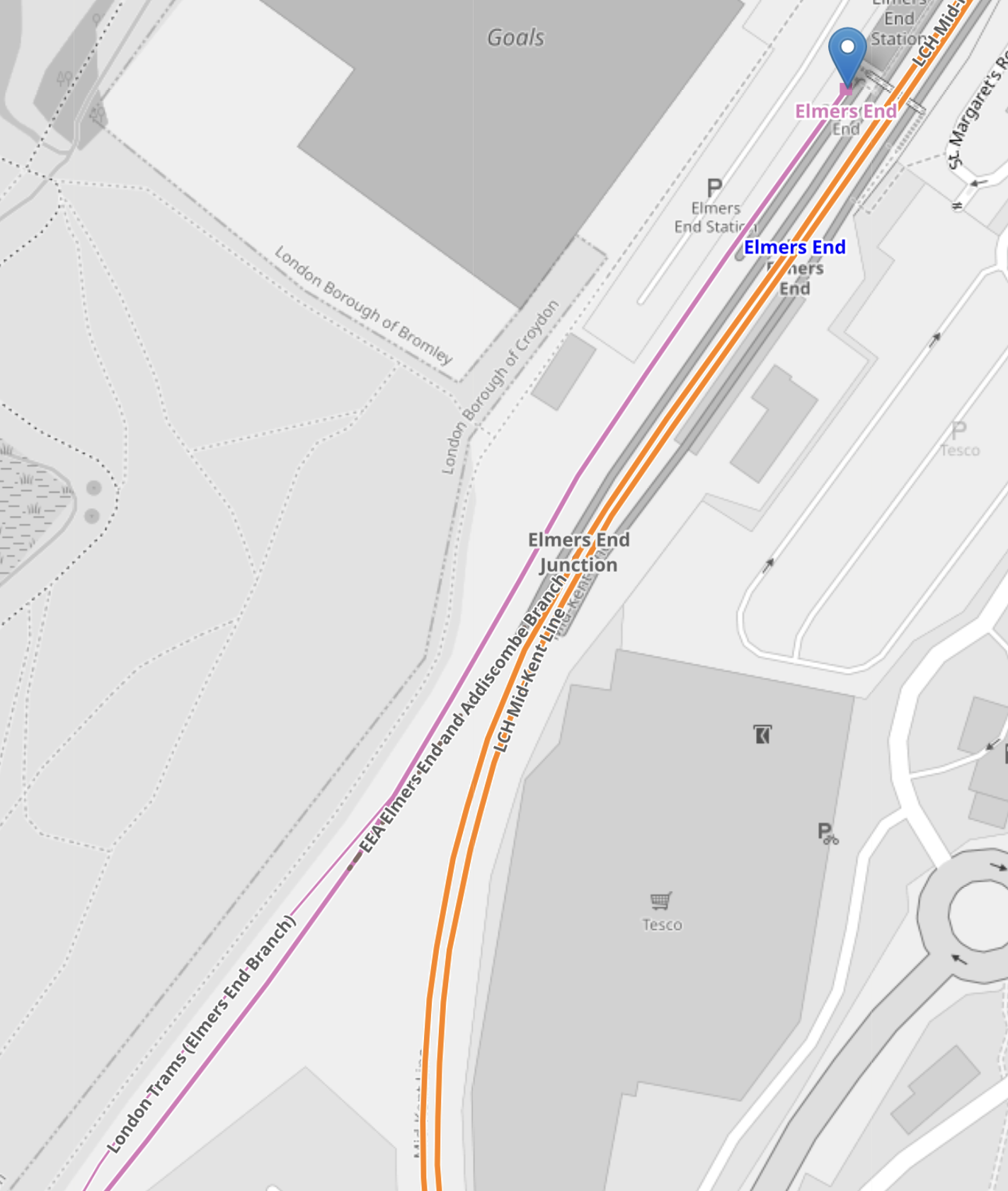
Note.
- The orange lines are the Hayes Line.
- The mauve line is the London Tramlink.
- The London Tramlink has a single platform on the North-West side of the Hayes Line.
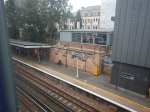
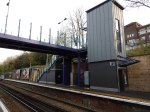
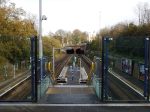
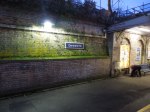
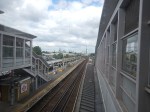
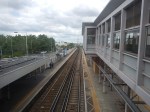
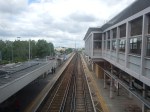
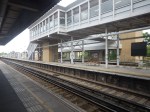
These pictures show Elmers End station and a tram in the London Tramlink platform.
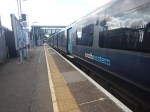
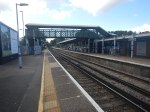
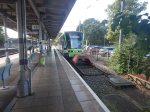
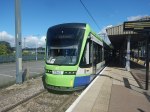
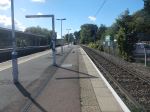
Note.
- The bridge in the station is not step-free.
- The tram is a five-section Stadler Variobahn.
- The tram platform would appear to be able to handle a tram, that is several metres longer than the 32.0 metre Stadler Variobahn.
- The London Tramlink has a typical off-peak service to Wimbledon every ten minutes from Elmers End tram stop.
The Wikipedia entry for Elmers End station, says this about Tramlink developments at the station.
Work is underway to open a second tram platform and double the tram line to Arena to increase capacity. As of March 2019, vegetation has been cleared to make way for the new line. The platform was due to open in December 2020, but has been delayed.
My pictures show no ongoing work or evidence of the second Tramlink platform.
There are two main ways, that capacity can be increased at Elmers End station.
- Install a second platform and run more trams to the station.
- Run longer trams with a higher capacity.
Perhaps, Transport for London have decided, that the second way, is the best, especially, if the money saved, allows them to build a much-needed step-free footbridge at Elmers End station.
From my observations, I would estimate that Elmers End tram stop could accommodate a forty metre tram and possibly, one that was even longer.
Arena Tram Stop
The Arena tram stop, is where the Beckenham Junction and Elmers End branches join and split.
This map from OpenRailwayMap shows the platform layout at Arena tram stop.
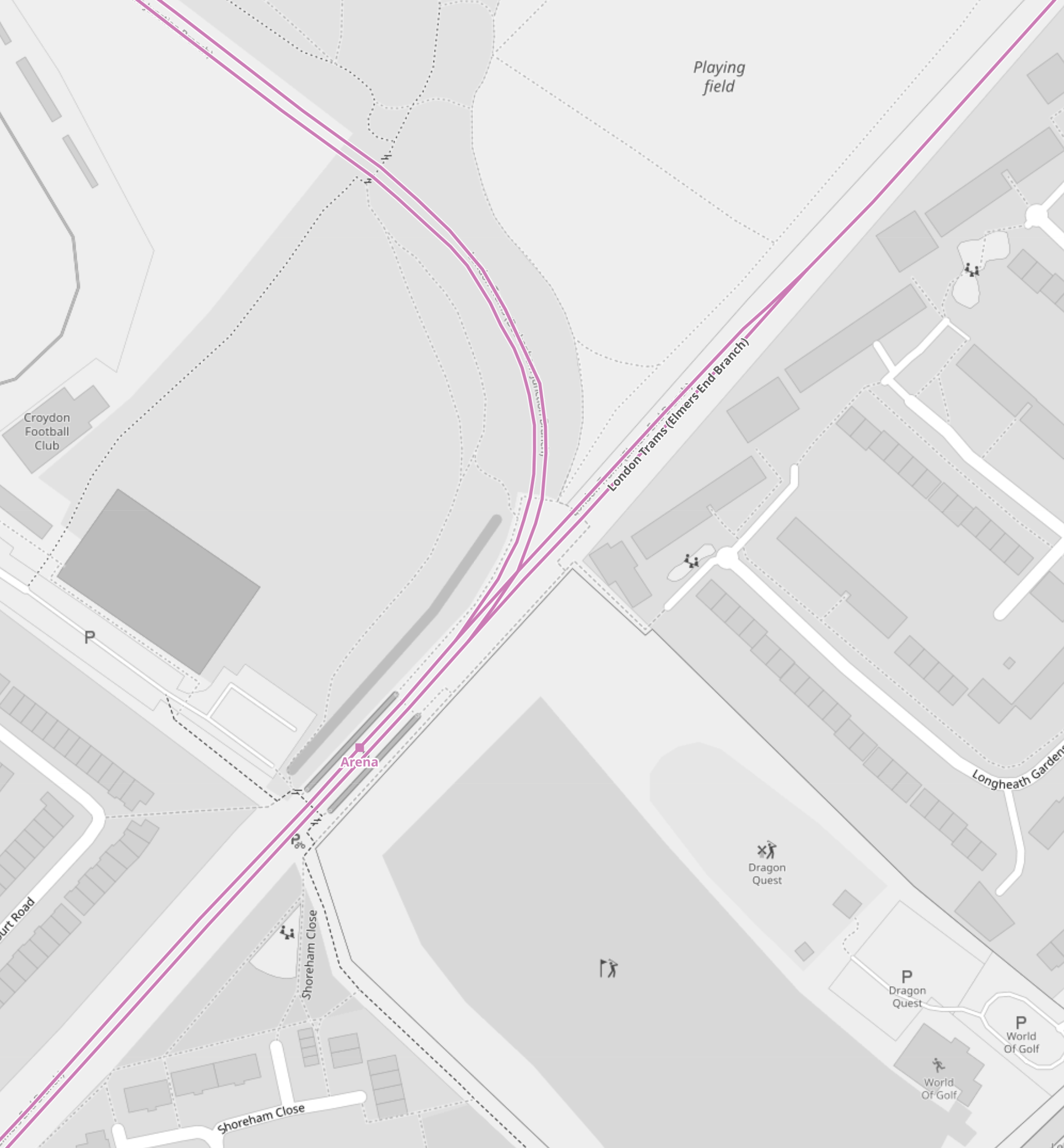
Note.
- The mauve lines are the London Tramlink.
- The line going North-East runs to Elmers End. It starts off as double-track at Arena tram stop and quickly becomes single track all the way to Elmers End. tram stop.
- The line going North-West runs to Beckenham Junction.
- The line going South-West runs to East Croydon and Wimbledon.
- The platforms are on the outside of both tracks.
These pictures show Arena tram stop and some trams passing through.
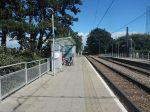
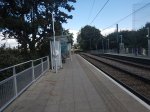
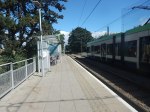
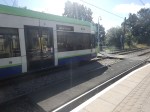
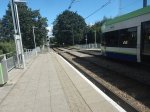
Note.
- The tram platforms are generally a few metres longer than the trams.
- All tram doors are step-free to the platform.
- Passengers walk across the line in front or behind the trams.
- The platform is wide, so that passengers can stay well clear of the occasional passing tram. One picture shows a tram is signed “Not In Service”
I believe, that with some judicial platform lengthening, some selective door opening and trams stopping automatically in the right place on the platform, that longer trams could be handled in a stop like Arena.
As with Elmers End, I believe a forty metre tram will be possible, but this might not be the limit with clever design.
Handling Longer Trams At Beckenham Junction Tram Stop
This map from OpenRailwayMap shows the platform layout at Beckenham Junction tram stop.
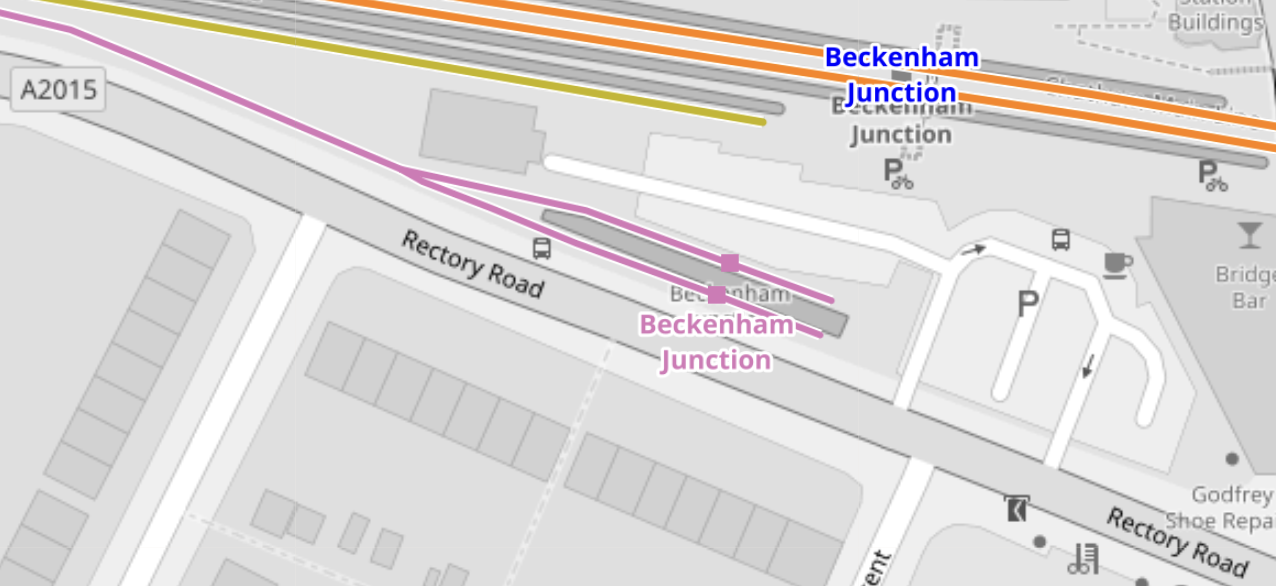
Note.
- The orange lines are the Chatham Main Line.
- The mauve line is the London Tramlink.
- There are a pair of short platforms for the London Tramlink.
- The platforms would be difficult to extend to the East.
- The platforms would be difficult to extend to the West, as the map above shows a building, just to the North of the junction of the two Tramlink platforms.
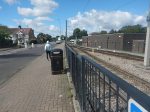
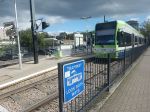
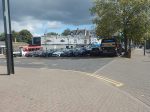
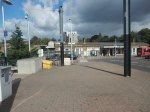
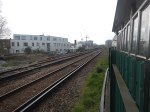
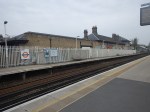
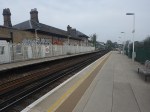
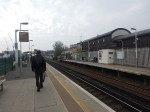
These pictures show Beckenham Junction station and the London Tramlink platforms.
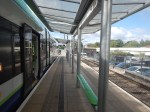
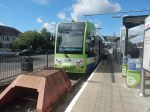
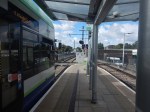
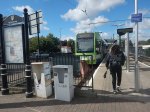
The Wikipedia entry for Beckenham Junction tram stop, says this about the Tramlink service.
Tram services at Beckenham Junction are operated by Tramlink. The tram stop is served by trams every 10 minutes to Wimbledon via Croydon. This is reduced to a tram every 15 minutes on Saturday evenings and Sundays.
Perhaps, the solution to lengthen Tramlink platforms at Beckenham Junction is to do the following.
- Rebuild the building to the North of the junction of the two Tramlink platforms.
- Extend the two Tramlink platforms to the West.
- Move the junction between the two Tramlink platforms to the West.
These pictures show the building in detail.
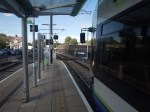
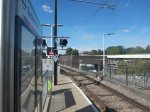
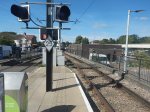
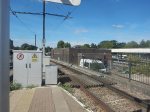
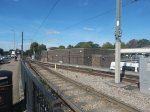
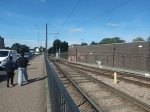
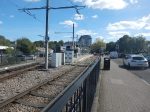
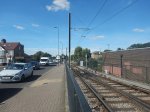
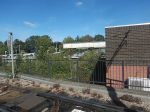
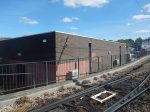
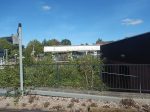
Note.
- There is a Network Rail van outside the building.
- The building looks like it dates from about 2000, when the Tramlink was built.
- Perhaps, the building houses power supply or signalling equipment for the Tramlink.
After the modifications, operation would be the same, but longer trams could be handled.
Trams And Trains Between Birkbeck And Beckenham Junction Stations
This short section of track must be one of the most unusual and complicated in the UK.
- There are three dual National Rail and Tramlink stations; Birkbeck, Avenue Road and Beckenham Road.
- Each station has a single bi-directional National Rail track and/or platform.
- Birkbeck has a single bi-directional Tramlink platform.
- Avenue Road and Beckenham Road each have two Tramlink platforms.
Engineer; Baldrick was obviously having one of his cunning phases.
This map from OpenRailwayMap shows the track/platform layout at Birkbeck station/tram stop.
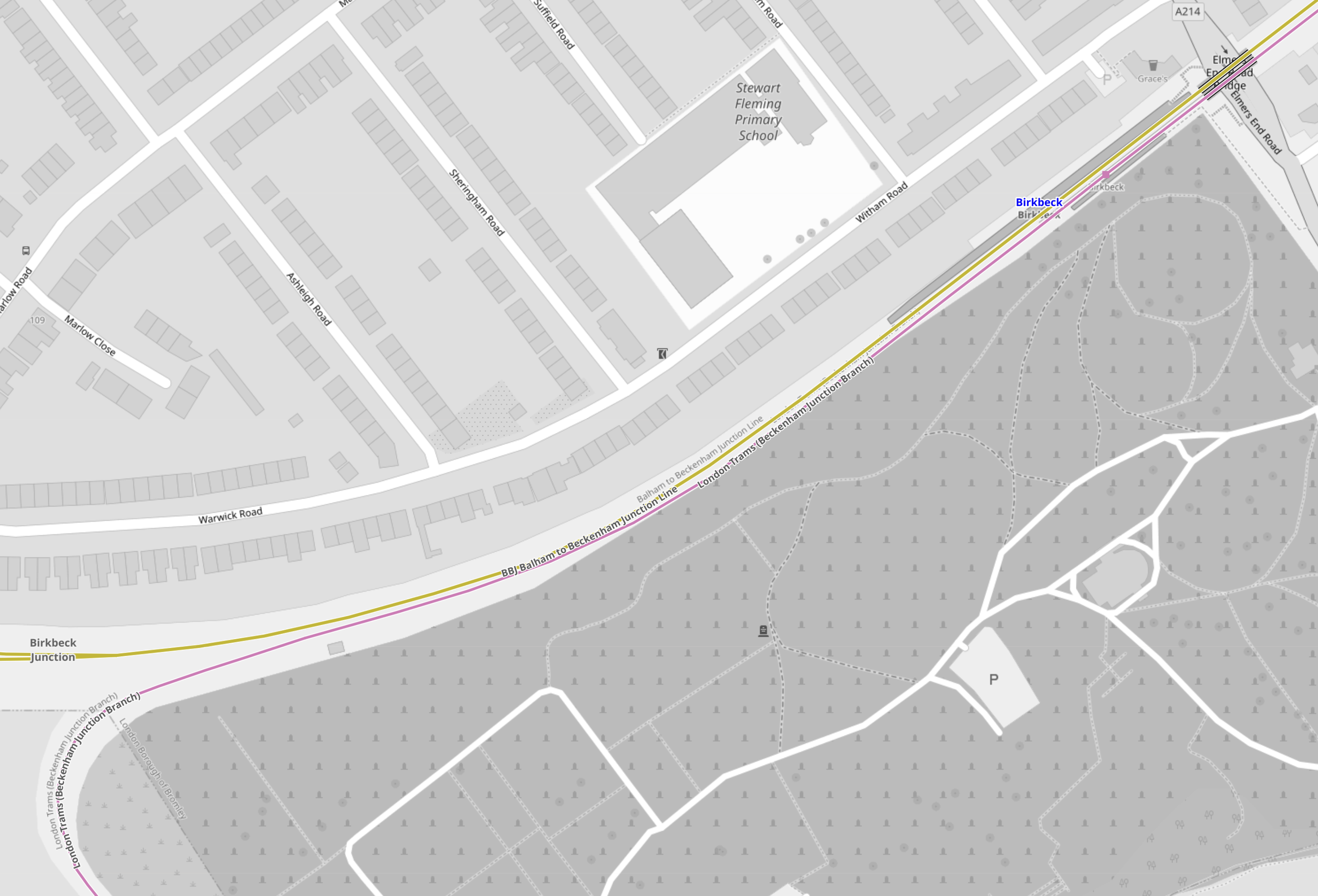
Note.
- The yellow line is the National Rail line between Crystal Palace and Beckenham Junction.
- The mauve line is the London Tramlink between Croydon and Beckenham Junction.
- There is no rail connection between the two lines.
Birkbeck station/tram stop has bi-directional platforms on both National Rail and London Tramlink.
These pictures were taken at the Birkbeck station/tram stop.

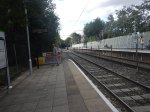
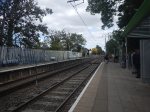
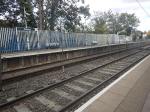
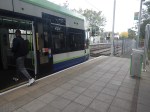
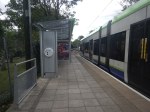
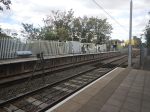
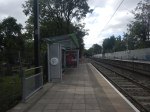
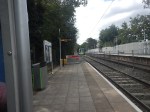
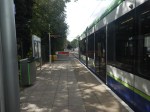
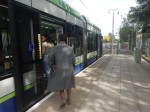
Note.
- The two bi-directional platforms.
- The wire fence between the tracks.
- The two tracks appear to be the same level, but the National Rail platforms seem quite a bit higher.
From the pictures, I would estimate that the Birkbeck tram stop platform is currently about thirty-five metres and could probably handle a forty metre tram with selective door opening.
This map from OpenRailwayMap shows the track/platform layout at Avenue Road station/tram stop.
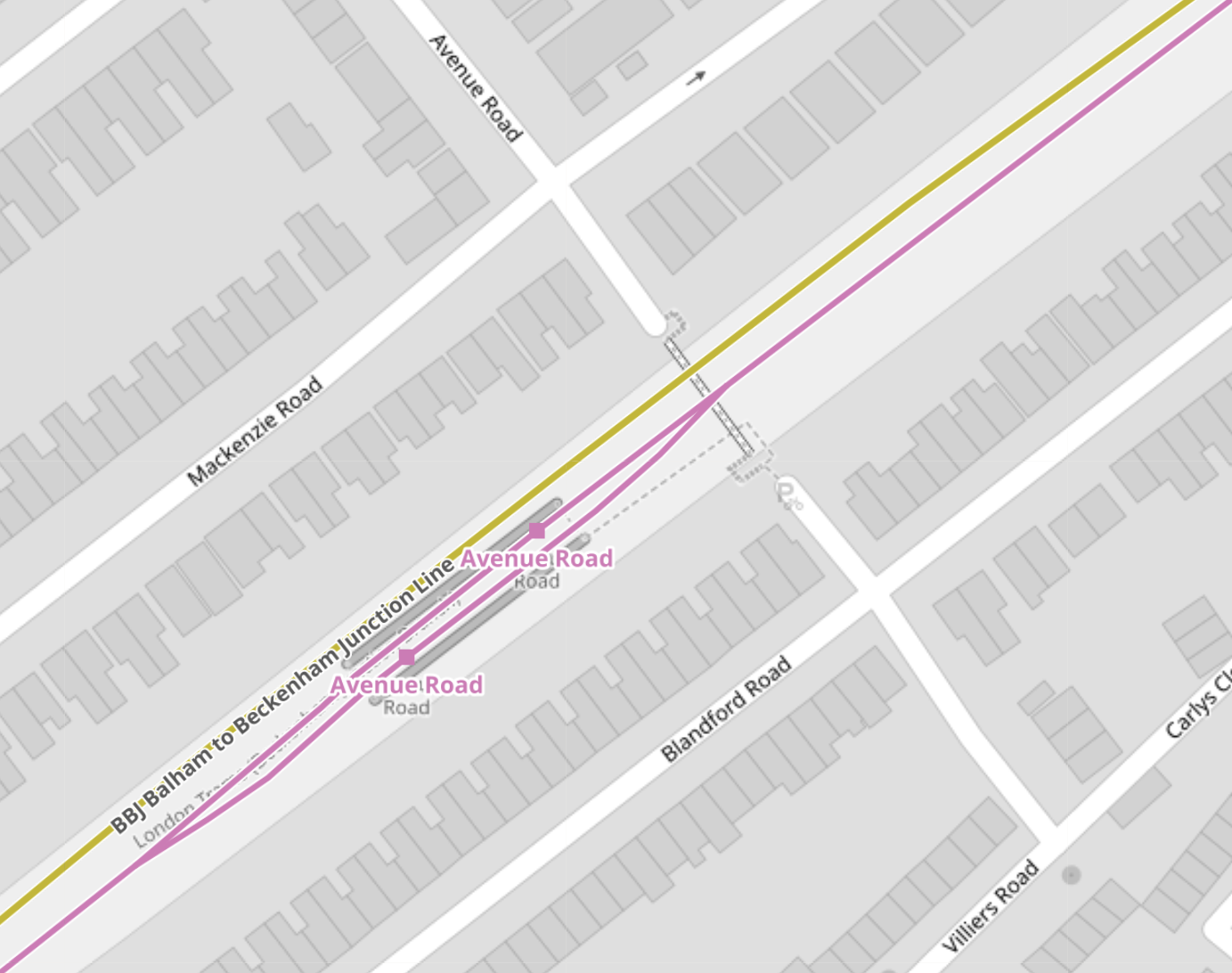
Note.
- The yellow line is the National Rail line between Crystal Palace and Beckenham Junction.
- The National Rail line isn’t shown to have a platform.
- The mauve line is the London Tramlink between Croydon and Beckenham Junction.
- There is no rail connection between the two lines.
London Tramlink has a loop through the tram stop and each branch has a platform.
These pictures were taken at the Avenue Road tram stop.
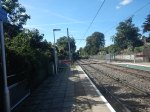
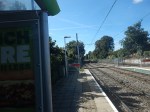
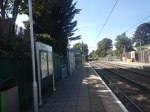
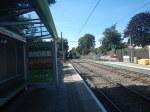
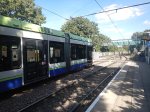
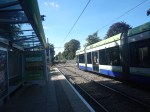
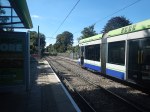
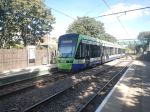
I would estimate the the loop at Avenue Road tram stop could handle a forty metre tram and possibly one of forty-five metres, judging the loop against this thirty-two metre Stadler tram.
This map from OpenRailwayMap shows the track/platform layout at Beckenham Road station/tram stop.
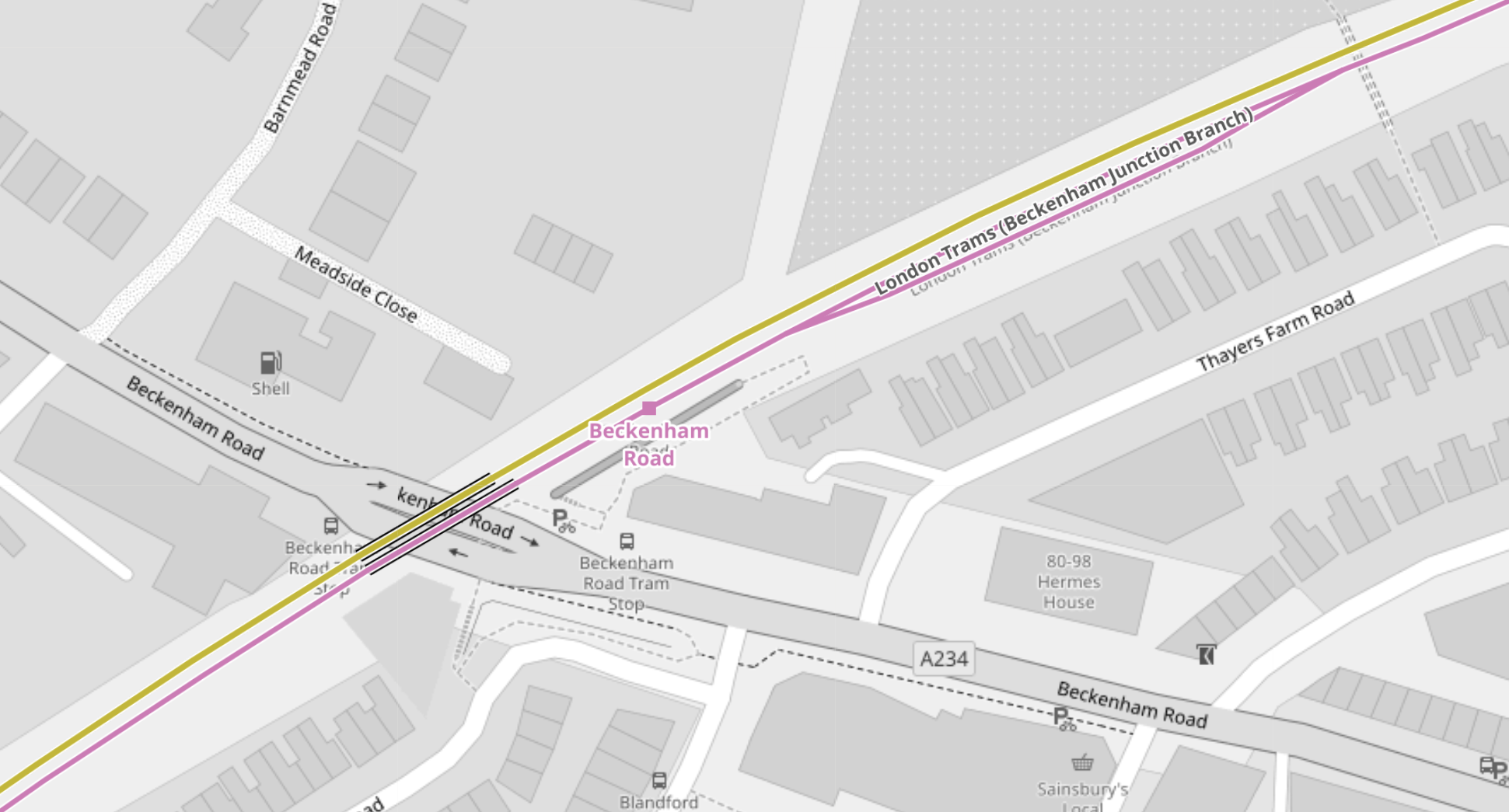
Note.
- The yellow line is the National Rail line between Crystal Palace and Beckenham Junction.
- The National Rail line isn’t shown to have a platform.
- The mauve line is the London Tramlink between Croydon and Beckenham Junction.
- There is no rail connection between the two lines.
The London Tramlink has a single bi-directional platform.
There is also a loop in the London Tramlink to the East of Beckenham Road station/tram stop to allow trams to pass.
These pictures were taken at the Beckenham Road tram stop.
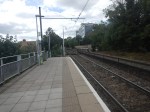
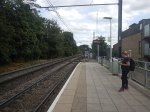
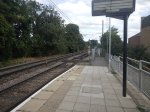
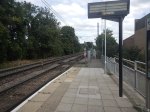
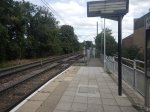
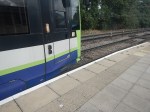
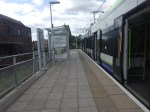
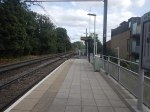
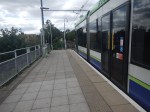
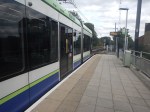
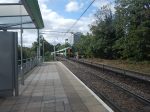
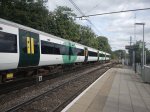
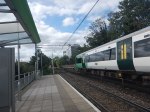
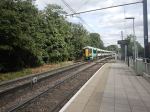
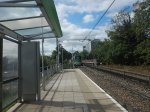
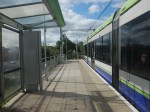
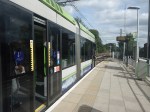
Note.
- A train conveniently came through from London Bridge to Beckenham Junction, when I was taking pictures.
- Several pictures show trams using the loop to the East of the tram stop.
- Both types of tram were pictured in the tram stop.
- The platform in the tram stop is wide.
From the pictures, I would estimate that the Beckenham Road tram stop platform is currently about thirty-five metres and could probably handle a forty metre tram with selective door opening.
Tram-Train Operation Between Birkbeck And Beckenham Junction Stations
I am certain that if this track was being designed today, tram-train operation would be used.
- There would be two tracks, with one for each direction, through Birkbeck, Avenue Road and Beckenham Road stations.
- Both tracks would have dual-height platform at each station/tram stop, so tram and train passengers got level boarding.
- Trains would use third-rail power and trams would use battery-power.
Unfortunately, tram-trains didn’t exist, when the London Tramlink was designed.
Handling Longer Trams At New Addington Tram Stop
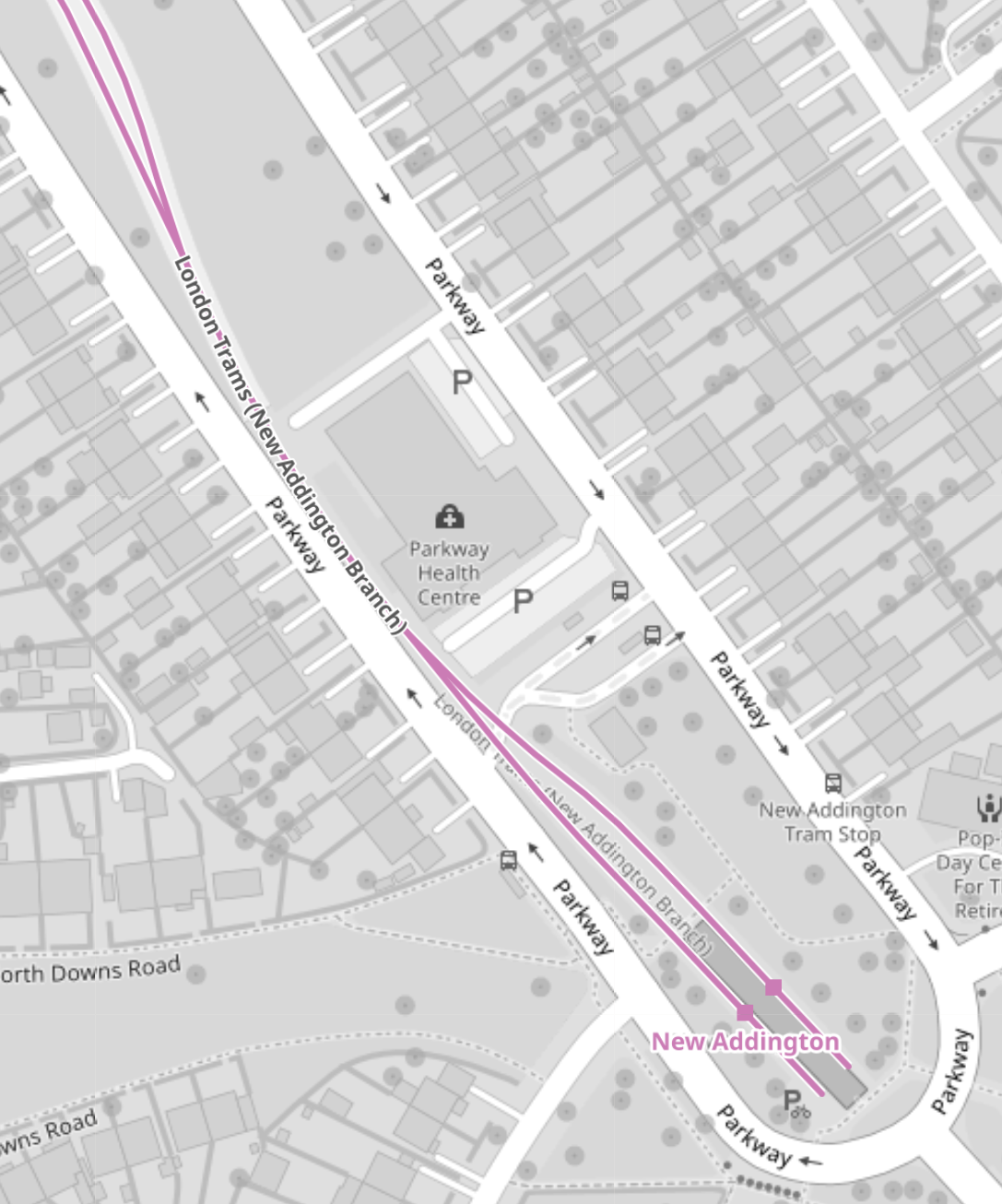
This map from OpenRailwayMap shows the platform layout at New Addington tram stop.
These pictures show the New Addington tram stop and the London Tramlink platforms.
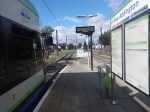
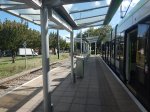
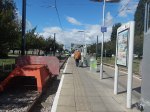
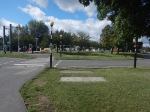
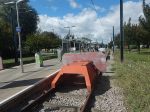
If some of the grassland around the platforms was allocated to the tram stop, I suspect the platforms could be lengthened.
Handling Longer Trams At Wimbledon Station
This map from OpenRailwayMap shows the platform layout at Wimbledon station.
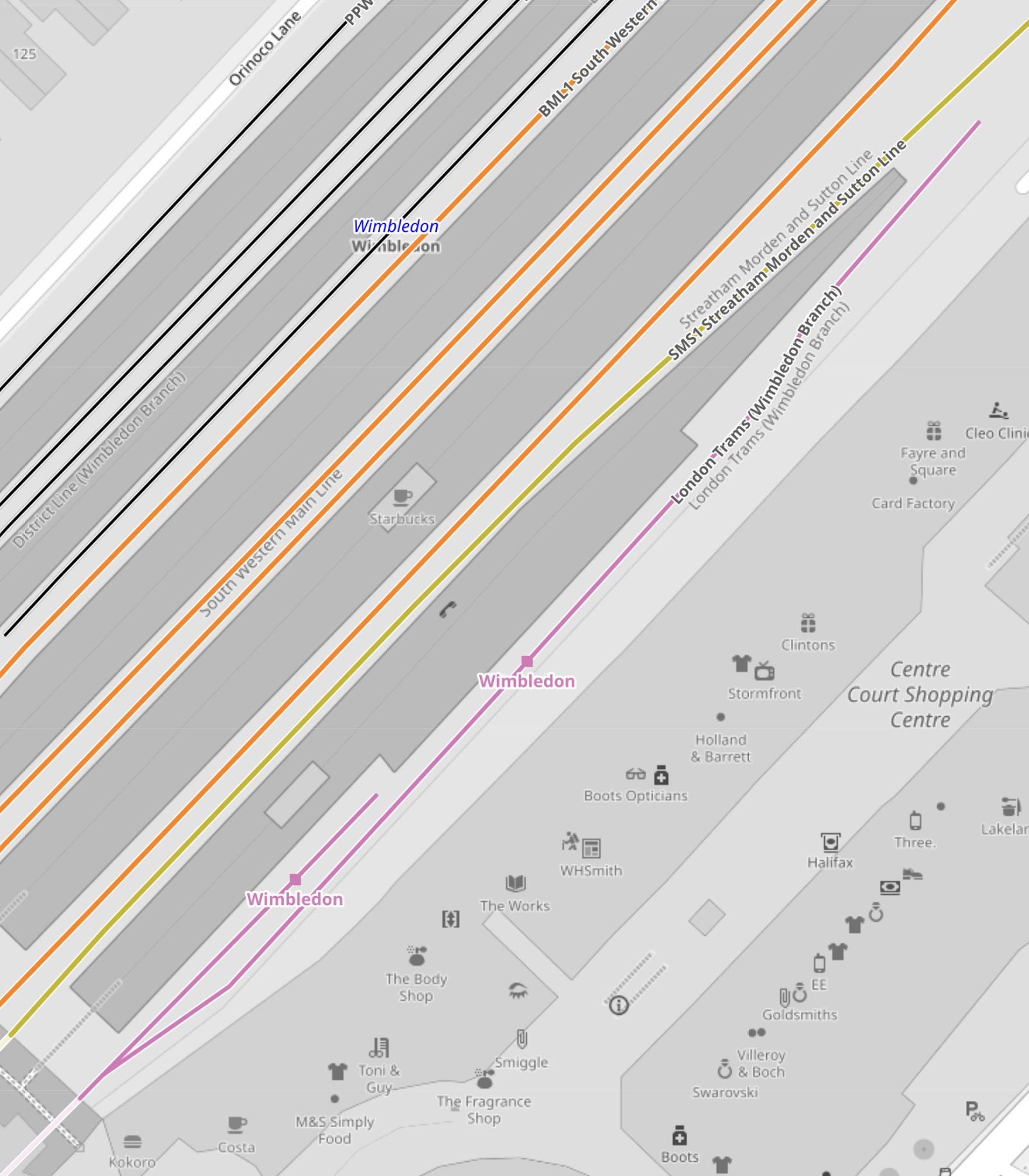
Note.
- The mauve line is the London Tramlink.
- There are two platforms; 10A and 10B, which are indicated with a separate dot.
- Platform 9, which is used by Thameslink, is the other side of Platform 10, so interchange to Thameslink is excellent.
- The main tram platform 9/10 is wide.
- The platforms are step-free to the trams, with lifts to the station bridge and the other platforms and Way Out.
I suspect that when the second platform was built, both platforms were made longer than the thirty-two metres needed for the Stadler trams.
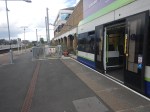
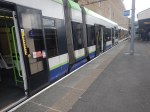
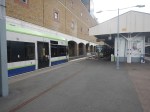
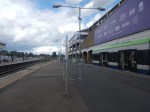
These pictures show the two platforms.
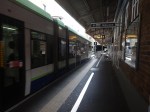
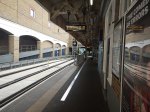
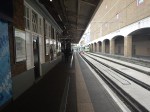
Could another platform be created on the other side of the tracks to give better access to the tracks?
Conclusions
My first conclusion is that the London Tramlink could be run by a new fleet of the same number of trams, that were a few metres longer than the current 30.7/32 metres of the current trams.
- I suspect that forty metre trams would be possible, with a few modifications to platforms.
- It might even be possible to have forty-five metre trams, with a more substantial rebuild at Beckenham Junction.
- Trams could overhang platforms and selective door opening could be used.
- Forty metre trams would carry 25 % more passengers than the current trams.
- The Elmers End and Wimbledon terminals already seem to be capable of handling forty metre long trams and possibly could take trams a few metres longer.
I suspect that Elmers End and Wimbledon, could be the first route, where the longer trams were introduced, as the trams should be able to shuttle between the two end terminals to the current timetable.
The New Addington tram stop would be brought into operation next.
- Platforms would be lengthened as required.
- Trams operate a frying pan loop from New Addington to Croydon, with an Off Peak frequency of 7-8 minutes.
- I suspect that one platform won’t be able to handle this frequency.
- The last point probably means that the two platforms will need to be lengthened.
Works at the New Addington tram stop could be tricky, but not substantial.
Initially, the service to Beckenham Junction could be run by the existing Stadler Variobahn trams.
I believe that a lot of work will need to be done to get Beckenham Junction ready for the new trams if they are longer, which I suspect they are.
- The Network Rail installation will have to be relocated.
- The two platforms will have to be lengthened.
I suspect the works will be substantial.
But I do believe, that there is scope to plan all the works at the terminals, so they can be done efficiently, whilst at least maintaining a partial service.
My second conclusion, is that it will be possible to build a financial model, which shows infrastructure costs against tram lengths.
Longer trams will cost more and cost more for infrastructure, but they will carry more passengers and collect more fare revenue.
Clapham High Street Could Gain Direct Overground Routes To Victoria Station
The title of this post, is the same as that of this article on the Clapham Nub News.
These two paragraphs introduce the article.
Local councillors and the Clapham Transport Users Group have been in discussions with Network Rail about the direct route once the current ‘Networker’ trains are replaced.
Clapham High Street lost its direct services to Victoria in December 2012 when the South London Line was withdrawn in favour of the London Overground to Clapham Junction.
This forces passengers onto the Northern Line, which through Clapham has two dangerous-looking stations; Clapham Common and Clapham North.
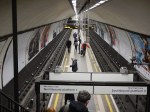

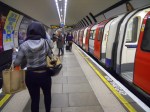
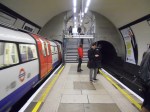
I have a few thoughts and observations.
Clapham High Street Station
These pictures show Clapham High Street station.
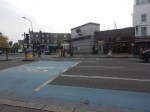
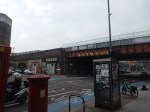
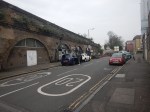
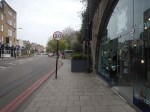
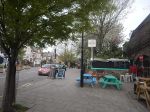
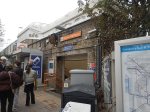
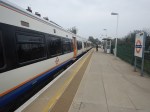
Note.
- The station is Grade II Listed.
- There are four tracks through Clapham High Street station.
- Only the lines used by the London Underground have platforms.
- I don’t think it will be difficult to add platforms to the other two tracks.
- The platforms will probably take five-car trains.
- Access to the platforms is by a subway, which could probably be extended to the other side of the tracks.
- A second entrance would be closer to Clapham North station.
- I suspect step-free access would not be too difficult to install.
- The tracks are over railway arches, which could be developed to add to the quality businesses in the area.
This Google Map shows the station.
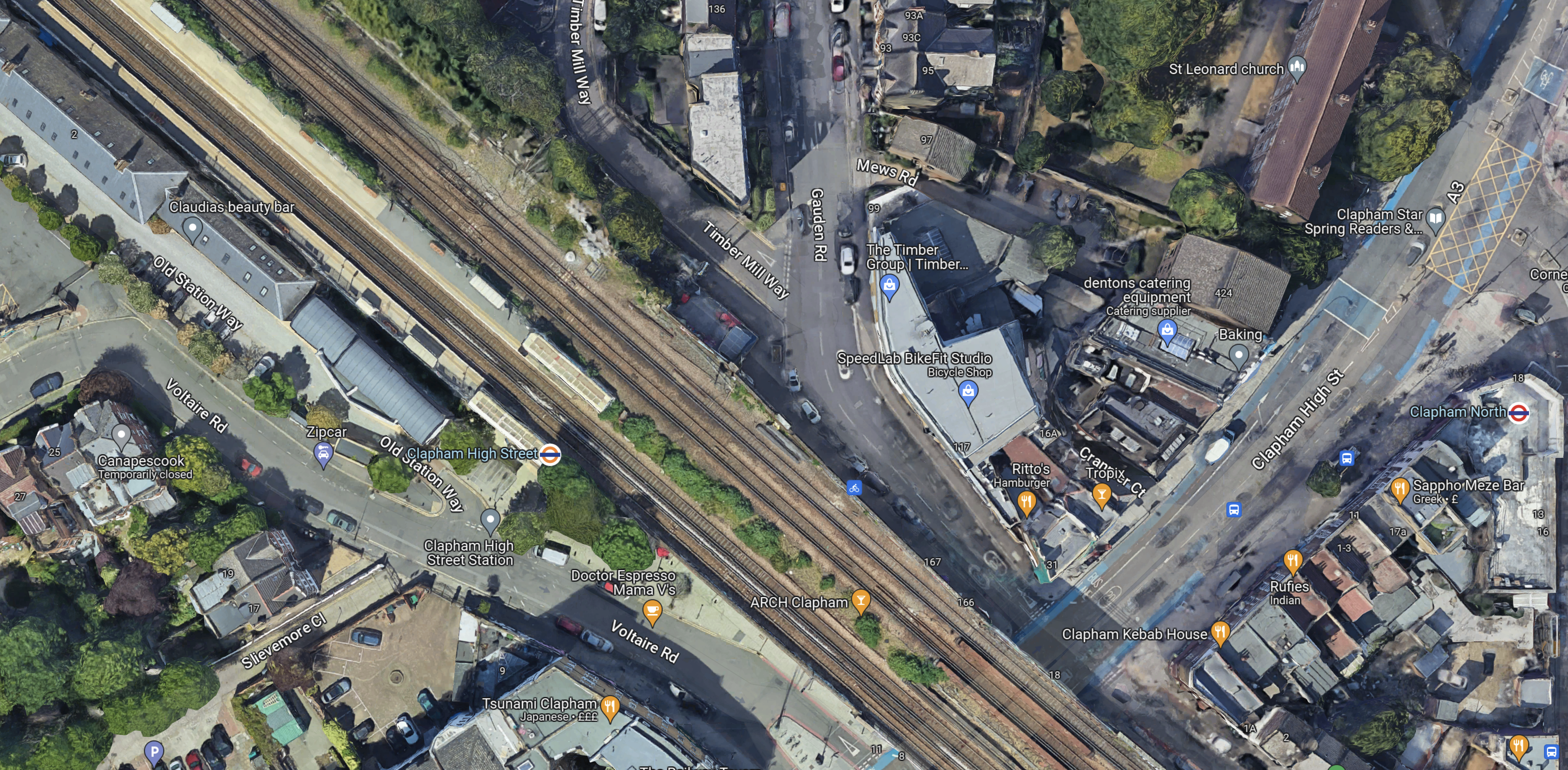
Note.
- Clapham High Street station is in the North-West corner of the map.
- Clapham North station is at the Eastern edge of the map in the middle.
- There seems plenty of space for two more platforms.
I think there is a lot of scope to improve this station.
Tracks Through Clapham High Street Station
This map from cartometro.com shows the tracks through Clapham High Street station.

Note.
- The Overground tracks are shown in orange and black.
- The fast lines, which are to the North of the Overground lines are shown in black.
- Shepherds Lane and Voltaire Road junctions allow trains on the fast lines to call in Clapham High Street station.
I suspect full digital signalling will be employed for efficiency of handling the junctions.
Services Through Clapham High Street Station
These services run through Clapham High Street station.
- London Overground – Dalston Junction and Clapham Junction – four tph – Goes via Denmark Hill and Peckham Rye
- Southeastern – London Victoria and Ashford International – one tph – Goes via Brixton, Herne Hill and West Dulwich
- Southeastern – London Victoria and Dartford – two tph – Goes via Denmark Hill, Peckham Rye, Nunhead and Lewisham
- Southeastern – London Victoria and Dover Priory – one tph – Goes via Brixton, Herne Hill and West Dulwich
- Southeastern – London Victoria and Gillingham – one tph – Goes via Denmark Hill, Peckham Rye, Nunhead and Bromley South
- Southeastern – London Victoria and Orpington – two tph – Goes via Brixton, Herne Hill and West Dulwich
- Southeastern – London Victoria and Ramsgate – one tph – Goes via Brixton, Herne Hill and West Dulwich
Note.
- tph means trains per hour.
- The London Overground services could be increased to 6 tph.
- Only the London Overground services stop in Clapham High Street station.
- The Dartford, Gillingham and Orpington trains are pathed for 90 mph trains.
- The Ashford International, Dover Priory and Ramsgate trains are pathed for 100 mph trains.
It is a comprehensive timetable.
Southeastern’s New Trains
In Battery EMUs Envisaged In Southeastern Fleet Procurement, I wrote about Southeastern’s proposed new trains.
Full details haven’t been announced yet, but I think we can be sure of the following.
- The first trains to be replaced will be the Networker trains, because they are the oldest and slowest.
- The new trains will have selected door opening (SDO), as this a feature of nearly all modern trains.
- I also suspect the trains will be capable of running at 100 mph and will be five cars long, with the ability to run in pairs.
This will enable the new trains to cross over from the fast lines to the Overground lines to stop in Clapham High Street station.
How Many Trains Would Stop At Clapham High Street Station?
Currently trains passing through the station are as follows.
- London Overground – 4 tph – Stopping
- Southeastern – 3 tph – 100 mph services to Ashford International, Dover Priory and Ramsgate – Non-stop
- Southeastern – 5 tph – 90 mph services to Dartford, Gillingham and Orpington – Non-stop
Note.
- It is likely that the London Overground service will go to 6 tph.
- Would 100 mph services always go through without stopping?
- In an ideal world would it be best if services alternated?
I suspect that a better service could be provided between Clapham High Street and Victoria with very little expenditure on infrastructure.
High Speed One Issues
An article in the July 2017 Edition of Modern Railways is entitled Kent On The Cusp Of Change.
The article suggests that Fawkham junction, could be used to allow Southeastern Highspeed services to access Victoria as a second London terminal, to increase capacity on High Speed One.
The route could be via Clapham High Street, Denmark Hill, Bromley South, St. Mary Cray, Swanley and Farningham Road.
The Arches Underneath
There are several railway arches underneath the tracks at Clapham High Street station.
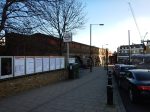
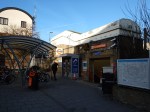
Some of the businesses look good and there are several other arches that are boarded up.
Railway arches are now generally owned by The Arch Co.
In Findlater’s Corner At London Bridge – 11th February 2023, I wrote about the company’s restoration of some arches at London Bridge station, which included these pictures.
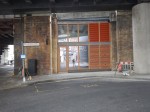
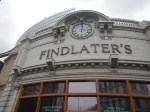


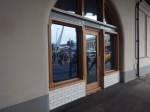
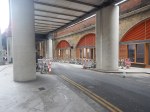
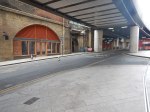
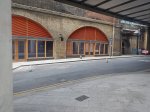
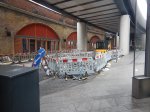
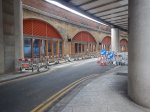
I suspect that a similar restoration in up-market Clapham could be a good investment for The Arch Co.
A Four-Platform Clapham High Street Station
Consider.
- There is space for two new platforms alongside the fast lines.
- The station entrance is in an arch, that goes right under the tracks.
- Putting lifts in an arch would not be the most challenging of tasks.
- A second entrance in Gauden Road would be nearer Clapham North Underground station.
- It should also be remembered that the Government is giving out levelling up funding.
- Hackney is to receive this type of funding and I wrote about it in Hackney Central Before Levelling Up.
I can see a fully-accessible four-platform station being built at Clapham High Street station.
Denmark Hill Station
Denmark Hill station is the next station to the East of Clapham High Street station and after a rebuild is now a high quality station, with these features.
- Four tracks and platforms.
- Frequent trains to Ashford International, Clapham Junction, St. Pancras, Victoria and Whitechapel.
- Full step-free access with lifts.
- A solar roof.
- A Grade II listing.
- King’s College and Maudsley Hospitals are next door.
- A pub.
I wrote about the station in Denmark Hill Station – 4th September 2021.
These are a few pictures.



Note the solar roof. There’s more about the roof on this page of the BiPVco web site.
On the About page, there is a section called Our Story, where this is said.
BIPVco was established in April 2015 following five years of collaborative research between Tata Steel LCRI (Low Carbon Research Institute) and Swansea University with support from the Welsh government.
The research program developed ways of integrating thin-film CIGS PV cells directly onto the same substrates that make roofs and walls so that true BIPV functionality would become integral to the building envelope and could be achieved without having to resort to heavy on site mounting systems.
Our manufacturing processes were further enhanced to suit commercial production, and the products and procedures were tested and accredited before commercial launch.
Working with select partners, we designed and built many pilot PV integrated roofs between 2015 and 2017 in varying climates, including Nigeria, Canada, UAE and the UK, to demonstrate product suitability in all environments. The full commercial launch was effected in June of 2017.
They certainly seem to have taken solar panels to a new level.
I would also rate Denmark Hill station one of the finest suburban railway stations in the world!
Peckham Rye Station
The next station to the East of Denmark Hill station is Peckham Rye station.
Like many other stations and buildings in London, including the original Denmark Hill station, Peckham Rye station was designed by Charles Henry Driver.
These are some pictures, I’ve taken over the years at Peckham Rye station.

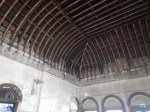
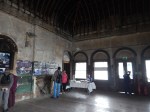

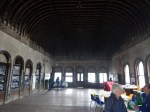
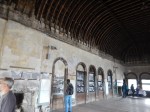
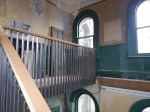
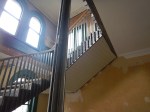
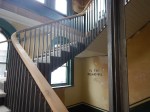

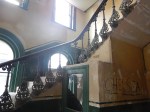
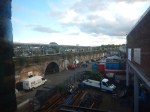

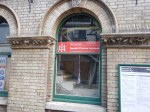

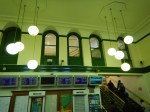
Note.
- It is a very busy station.
- I’ve read somewhere, that it is the busiest station in the UK, without any step-free access.
- It could be a magnificent station.
- One of the people driving this project is the architect; Benedict O’Looney.
This page on the Network Rail web site is entitled Peckham Rye Station Upgrade and it starts with this statement.
On 7th March 2022, we submitted Planning Permission and Listed Building Consent applications to upgrade Peckham Rye station to make it fully accessible with more capacity and better facilities for passengers.
It’s all a bit out of date, but these pictures, that I took this morning, indicate that something is progressing.
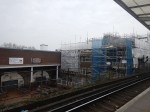

This article on IanVisits gives a few more details.
South London Crosslink
The South London Crosslink, doesn’t seem to have a website or a Wikipedia entry.
But it is mentioned in a question and answer to the London Mayor.
In response to this question.
Will you consider bringing the Victoria rail service back to Clapham High Street station and providing direct trains to Brixton, Herne Hill, and Bromley South?
The Mayor gave this answer.
The Department for Transport (DfT) is responsible for these services, as they run Southeastern railway as operator of last resort. Transport for London (TfL) is not opposed to the existing Southeastern services to and from Victoria making additional calls at Clapham High Street should the DfT, wish to take the idea forward.
There are however several practical issues that would need to be taken into consideration, and any changes to the service would be subject to cost-effective solutions being found to these.
The Clapham High Street platforms are too short for the eight-car trains used on the Victoria to Dartford and Orpington metro routes, and the existing rolling stock lacks a safety intervention called “Selective Door Opening” that enables trains to call at a station where the platform is shorter than the train. There are also technical restrictions, such as the frequent routing of these services along an adjacent pair of tracks which do not have any platforms, which would make implementation difficult using the existing railway infrastructure. Finally, there would need to be clear consideration on the wider capacity of the rail network and the robustness of the timetable. All of these concerns could affect the value for money of any proposal for these services to call at Clapham High Street station.
As I showed earlier, it looks like new trains will solve most of these problems. If they don’t, then the wrong trains have been ordered.
But there’s still not much about where the route will go after Peckham Rye, except for vague mentions of Dartford and Orpington.
I asked a friend and they said the South London Crosslink could possibly go to Bellingham.
This map from cartometro, shows the route between Denmark Hill and Crofton Park stations.
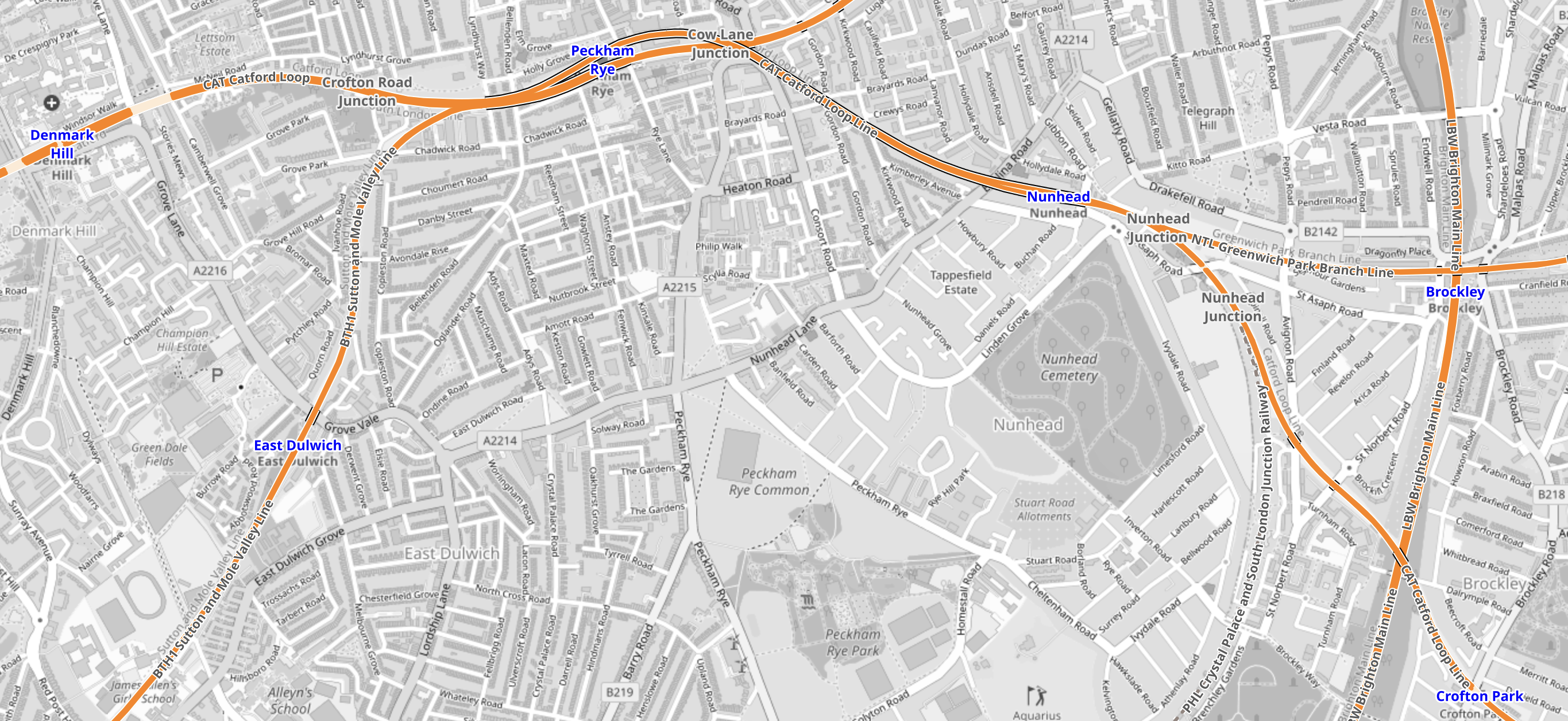
Note.
- Denmark Hill station is in the North-West corner of the map.
- Crofton Park station is in the South-East corner of the map.
- The route would be via Peckham Rye and Nunhead stations.
- It is not a very fast route with an operating speed of 50-60 mph.
- In Nunhead Junction Improvement, I wrote about improvements needed at Nunhead junction to the East of Nunhead station to improve capacity for freight trains.
This second map from cartometro, shows the route between Crofton Park and Bellingham stations.
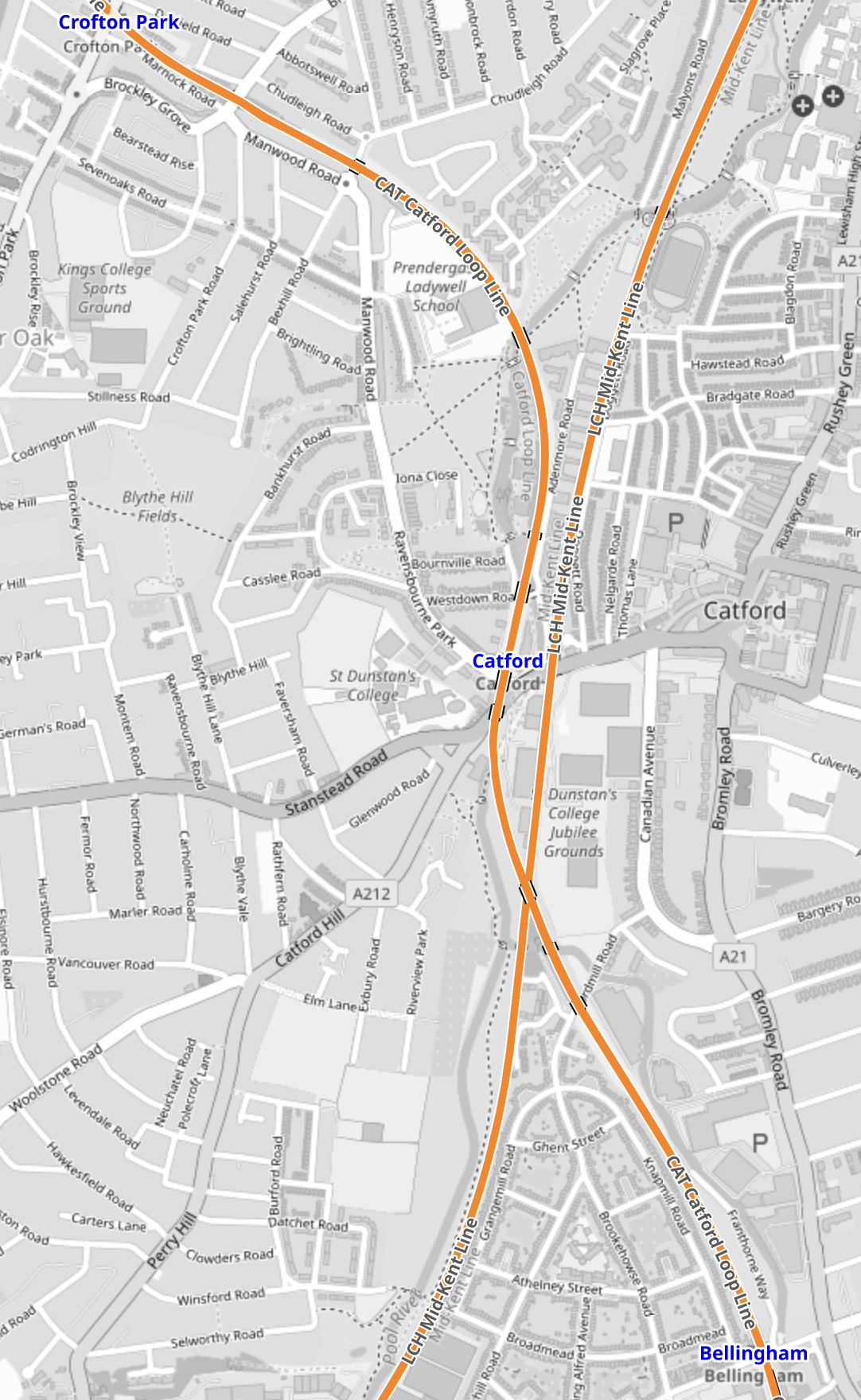
Note.
- Crofton Park station is in the North-West corner of the map.
- Bellingham station is in the South-East corner of the map.
- The line going diagonally across the map from North-East to South-West is the Hayes Line to Hayes.
- There are plans to create an interchange station at Catford.
This Google Map shows Bellingham station.
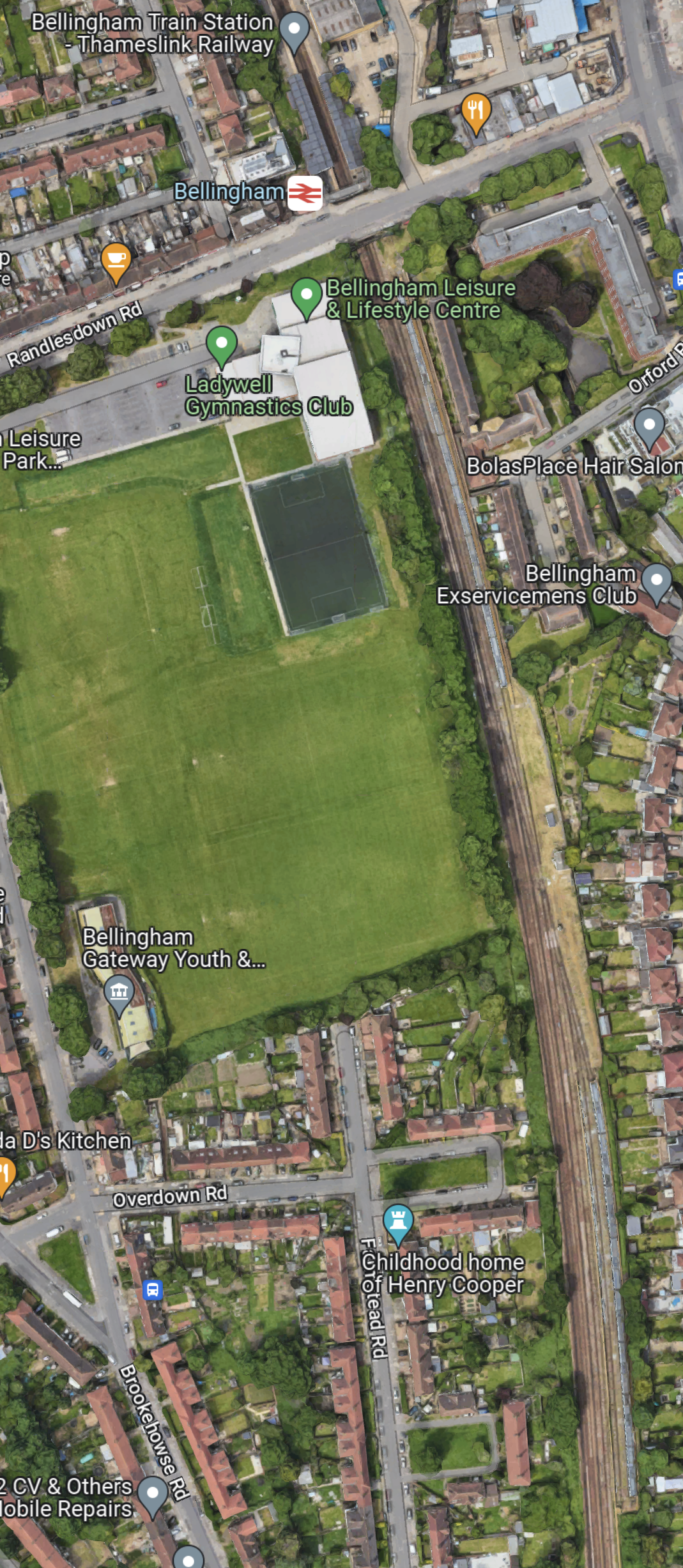
Note.
- Bellingham station is at the top of the map.
- Bellingham station is on the Catford Loop Line.
- South of Bellingham station are a series of sidings.
Is the reason, that Bellingham station was proposed as a terminus, that with a proper interchange at Catford, it creates a very efficient operational railway with some convenient sidings thrown in?
This map from cartometro, show the track layout at Bellingham station.
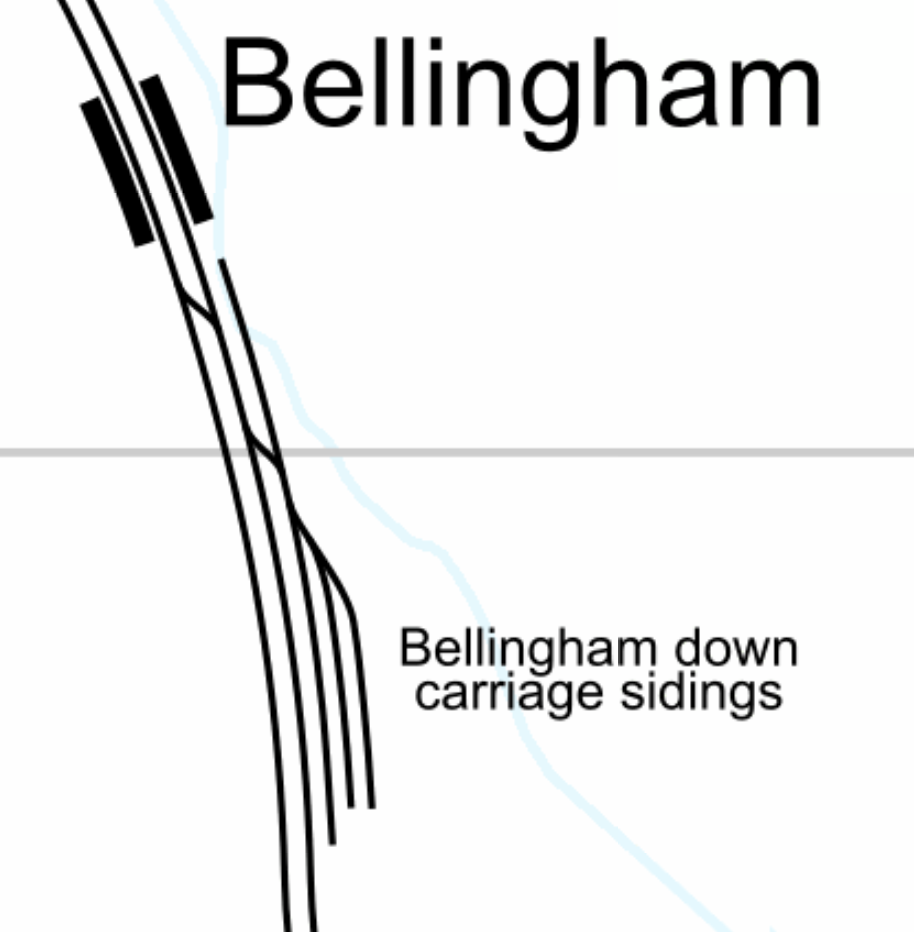
I believe that the sidings could be used as a turnback siding for trains from both directions.
These pictures show trains in the sidings.
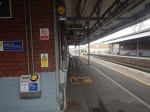
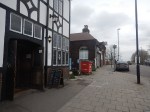
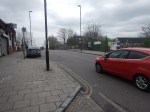
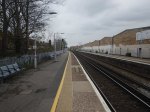
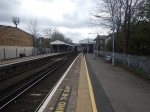
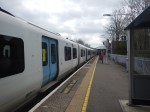
And these are of the station.
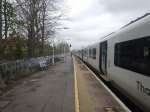
Note.
Battery EMUs Envisaged In Southeastern Fleet Procurement
The title of this post, is the same as that of this article on Railway Gazette.
This is the first paragraph.
Southeastern has invited expressions of interest for the supply of new electric multiple-units with an optional battery capability for operation away from the 750 V DC third-rail network.
This article on bidstats is entitled Supply Of And Maintenance Support For New Rolling Stock For Southeastern, and gives more details.
These are my thoughts.
Southeastern HighSpeed Services
There would appear to be no changes in this contract to the Class 395 trains, that work on High Speed One, as this is said in the bidstats article.
Full compatibility with Southeastern infrastructure (excluding High Speed 1 infrastructure)
which appears to rule out running on High Speed One.
In addition, this article on Rail Magazine is entitled Southeastern’s Class 395 Javelin Train Sets Are To Receive A £27 million Facelift.
Southeastern Have Both 75 and 100 mph Trains
In addition to their Class 395 trains, Southeastern have the following trains in their fleet.
- Class 375 trains – 100 mph – 10 x 3 cars
- Class 375 trains – 100 mph – 102 x 4 cars
- Class 376 trains – 75 mph – 36 x 5 cars
- Class 465 trains – 75 mph – 129 x 4 cars
- Class 466 trains – 75 mph – 36 x 2 cars
- Class 707 trains – 100 mph – 18 x 5 cars
Note.
- Running a mixed fleet of 75 and 100 mph trains can’t be very efficient.
- The Class 465 and 466 trains are the oldest trains and date from 1991-1994.
- They are often to be seen in ten-car formations of 2 x 465 trains and a Class 466 train.
- Another twelve Class 707 trains are planned to join Southeastern.
I would expect the Class 465 and Class 466 trains to be replaced first.
What Length Will The New Trains Be?
If you look at the new suburban electric trains, they have the following lengths.
- c2c – Class 720 trains – 5 cars
- Greater Anglia – Class 720 trains – 5 cars
- Northern – Class 331 trains – 3 and 4 cars
- Southeastern – Class 707 trains – 5 cars
- South Western Railway – Class 701 trains – 5 and 10 cars
- West Midlands Trains – Class 730 trains – 3 and 5 cars
Note.
- Southeastern already run five-car trains as pairs.
- A significant proportion of existing suburban trains are five-car trains.
- Great Western, Hull Trains, LNER, Lumo and TransPennine Express run five-car Hitachi trains, with more companies to follow.
- A pair of five-car trains make a pair of a convenient length for most platforms.
I would be fairly confident, that the new trains will be five-car trains, with the ability to run as pairs.
What Will Be The Operating Speed Of The New Trains?
To match the speed of the Class 375 and Class 707 trains, I would expect them to be 100 mph trains.
The Quietness Of Battery-Electric Trains
All of the battery-electric trains I have ridden, have been mouse-quiet, with none of the clunking you get for a lot of electric trains.
This is said in the bidstats article says this about the interiors
Interiors suitable for metro & mainline operation.
I wouldn’t be surprised to see a lot of these trains on commuter routes to attract passengers.
Battery Power
This is said in the bidstats article about battery power.
Inclusion of options for traction batteries with capability for operation in depots and sidings without the need for external power supply, and with the capability to operate on the main line where power supply is not available due to isolations or incidents, or for non-electrified line sections of up to 20 miles.
Although Merseyrail’s new Class 777 trains are not in service yet, I find it interesting that the proposed Southeastern trains will be similarly-fitted with a small battery for depot and siding operation.
The twenty mile battery range is specific and I wonder if it will be used innovatively. I suspect it could be a bit longer in the future, as battery technology improves.
Possible Electrified Routes Using Battery Power
These are a few possibilities.
The Hoo Branch
In Effort To Contain Costs For Hoo Reopening, I discussed running electric trains to a proposed Hoo station.
I made these two points.
- Hoo junction to Hoo station is no more than five or six miles.
- There are also half-a-dozen level crossings on the route, which I doubt the anti-third rail brigade would not want to be electrified.
It would appear that a battery-electric train with a range of twenty miles would handle this route easily.
- Charging would be on the nearly thirty miles between Hoo junction and Charing Cross station.
- No charging would be needed at Hoo station.
There may be other possibilities for new routes locally to open up new housing developments.
The Sheerness Line
The Sheerness Line has the following characteristics.
- It is double-track
- It is electrified
- It is less than eight miles long.
- For most of the day, the service is one train per hour (tph)
- There are two tph in the Peak.
- Would two tph attract more passengers to the line?
- Does the power supply on the Sheerness Line limit the size and power of trains that can be run on the line?
- Is there a need for one train per day to London in the morning and a return in the evening?
- Could the Sheerness Line be run more economically with battery trains. providing a two tph service all day?
The Isle of Sheppey needs levelling up, perhaps 100 mph trains to London using battery power on the Sheerness Line, might just make a difference.
The Medway Valley Line
The Medway Valley Line has the following characteristics.
- It is double-track
- It is electrified
- It is less than twenty-six and a half miles long.
- For most of the day, the service is two tph.
- In the Peak there are HighSpeed services between Maidstone West and St.Pancras International stations.
If electrification was removed between Paddock Wood and Maidstone West stations, the HighSpeed services could still be run and battery-electric trains with a twenty mile range could still run the Tonbridge and Strood service.
The Marshlink Line
The Marshlink Line has the following characteristics.
- It is mainly single-track with a passing loop at Rye station.
- It is not electrified
- It is 25.4 miles between the electrified Ashford International and Ore stations.
- Services are irregular and less than one tph.
If the proposed battery-electric train had a range of thirty miles, it should be able to handle the Marshlink Line.
The service between Eastbourne and Ashford International stations would need to be moved between the Southern and Southeastern operations.
The Uckfield Branch
The Uckfield Branch has the following characteristics.
- It is a mixture of single- and double-track.
- It is not electrified South of Hurst Green Junction.
- It is 24.7 miles between the electrified Hurst Green Junction and Uckfield station
- Services are one tph.
If the proposed battery-electric train had a range of thirty-miles, it should be able to handle the Uckfield Branch, with a charging system at Uckfield station.
Will Battery-Electric Trains Allow Some Lines To Have Their Electrification Removed?
There are several reasons, why electrification might be removed.
- It is on a line, where the electrification needs upgrading.
- It is on a line, where there are lots of trespassers.
- Possibly at a level-crossing or a stretch of track with several.
- Possibly in a tunnel, with a large inflow if water.
- It is a depot or siding, where safety is important to protect the workforce.
Obviously, the electrification would not be removed unless battery-electric trains can handle all possible services.
These are surely some possibilities for electrification removal.
The Hayes Line
The Hayes Line has the following characteristics.
- It is double-track
- It is electrified
- It is less than eight miles to Ladywell Junction, where the branch joins the main line at Lewisham.
- It is currently run by Class 465 and Class 466 trains, which will likely be changed for the new trains with a battery capability.
- Services are four tph.
If the proposed battery-electric train had a range of twenty-miles, it would be able to handle the route between Ladywell junction and Hayes station.
Erith Loop, Crayford Spur and Slade Green Depot
This map from Cartometro.com shows the Erith Loop, the Crayford Spur and the Slade Green Depot.

Note.
Not many trains take the Erith Loop or the Crayford Spur.
- The distance between Slade Green and Barnehurst is less than a mile-and-a-half.
- Dartford station is off the South-East corner of the map.
- The distance between Barnehurst and Dartford is less than three miles.
- The distance between Slade Green and Crayford is less than two miles-and-a-half.
- The distance between Crayford and Dartford is less than two miles.
- The main line through Slade Green would need to remain electrified, as electric freight trains use the line.
I suspect, that quite a lot of electrification could be removed here, much to the disgust of the copper thieves.
It might even be possible to build on top of the depot.
Does The Elizabeth Line Offer Similar Benefits To The Bakerloo Line Extension?
This map shows the proposed Bakerloo Line extension.
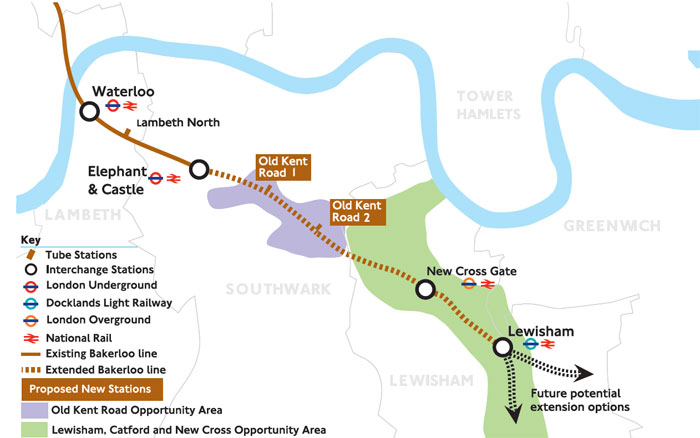
Note.
- There are new or improved stations at Old Kent Road 1, Old Kent Road 2, New Cross Gate and Lewisham.
- New Cross Gate station has Overground and Southern services.
- Lewisham station has Docklands Light Railway and Southern services.
- The future potential option going South is to take over the Hayes Line.
Could we provide improvements along the line of the Bakerloo Line Extension in a less disruptive and more affordable manner?
I will look at the various stations.
New Cross Gate
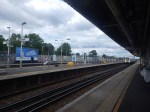
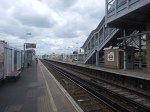
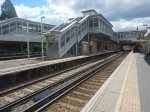
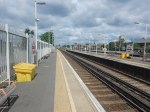
New Cross Gate station is a fully-accessible station, as these pictures show.
The station, currently has the following services.
- Overground – Highbury & Islington and Crystal Palace – 4 tph
- Overground – Highbury & Islington and West Croydon – 4 tph
- Southern – London Bridge and Victoria via Sydenham – 2 tph
- Southern – London Bridge and Coulsdon Town via Sydenham – 2 tph
Note.
- tph is trains per hour.
- The Overground services provide an 8 tph service to the Elizabeth Line at Whitechapel station.
- TfL may well increase the frequency of the two Overground services to 5 tph.
I suspect that the easiest way between New Cross Gate and Harrow & Wealdstone will be with changes at Whitechapel and Paddington.
- New Cross Gate and Whitechapel – Overground – 13 minutes.
- Whitechapel and Paddington – Elizabeth Line – 14 minutes.
- Paddington Interchange – 15 minutes
- Paddington and Harrow & Wealdstone – Bakerloo Line – 29 minutes
This gives a total time of 71 minutes.
As Bakerloo Line trains go between Elephant & Castle and Harrow & Wealdstone, which is 24 stations and the journey takes 48 minutes, this gives a figure of two minutes per station.
- This seems to fit Irene’s Law, which I wrote about in Irene’s Law – Estimating Tube Journey Times.
- So it looks like a direct train on the extension would take 54 minutes.
- That time fits well with the 71 minutes via the Elizabeth Line if fifteen minutes is allowed for the walk at Paddington.
I will do the trip for real today.
Lewisham
There are two ways to get between Lewisham and the Elizabeth Line.
- Take the Dockland’s Light Railway to Canary Wharf. Estimated at 15 minutes.
- Take a train to Whitechapel, which needs a change of train at New Cross station. Estimated at 17 minutes minimum.
Neither are perfect.
I will try out these two trips soon.
Hayes
The Hayes Line is often talked about as the final destination of the Bakerloo Line.
In More Frequent Trains And A New Station For The London Overground, I put forward a plan for connecting the Hayes Line to the New Cross branch of the London Overground.
This map from carto.metro.free.fr shows the lines at New Cross station.
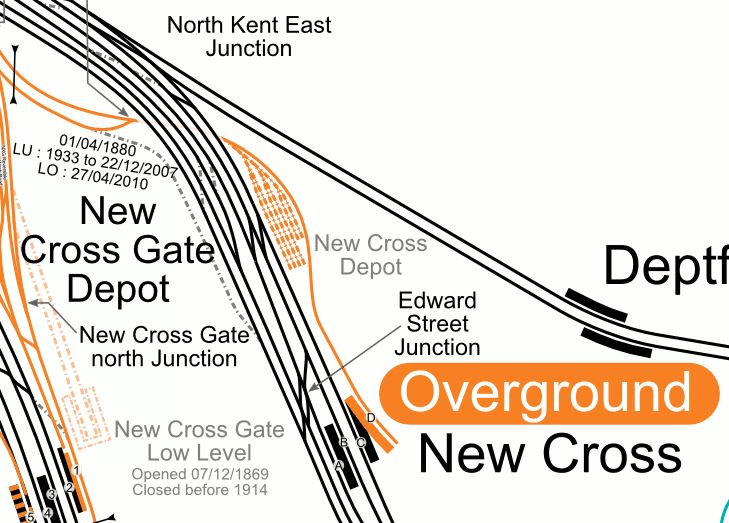
Note.
- The double-track East London Line, shown in orange, arrives from Surrey Quays station arrives in the North-Western corner of the map, becomes a single-track and then goes under the main lines before going into the bay platform D.
- Hayes Line services use Platform C going South and Platform A going North.
- Could the Overground going South divert into Platform C for Hayes?
- It would appear there used to be a line connecting Platform A to the East London Line of the Overground. Could this line be reinstated?
This Google Map shows the same area.
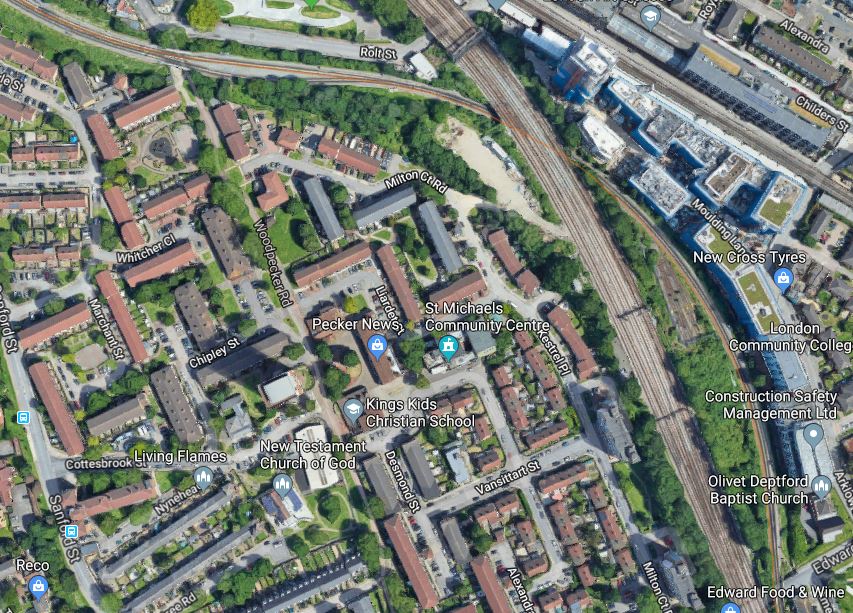
Note.
- The London Overground track is clearly visible.
- The needed connection certainly looks possible, without too much heroic engineering.
- Although, I suspect it could need digital signalling to get everything to work smoothly. But that will happen anyway!
The big advantage of this approach, is that all stations between Whitechapel and Hayes, would have a direct connection to the Elizabeth Line.
Hayes Line services would still continue to Victoria and Cannon Street, although the frequency might be reduced, depending on how many Overground services used the route.
Old Kent Road 1 And Old Kent Road 2
I think there are two ways to serve this important area.
- The first would be to run a high-frequency bus service between Elephant & Castle and the two stations at New Cross.
- I also suspect, it would be possible to have a short extension of the Bakerloo Line to a double-ended station at New Cross Gate and New Cross stations.
I went into the second way in More Frequent Trains And A New Station For The London Overground, where I came to these conclusions.
I am drawn to these two conclusions.
- The Bakerloo Line should be extended via two new Old Kent Road stations to a double-ended terminal station in New Cross with interchange to both New Cross Gate and New Cross stations.
- The New Cross branch of the London Overground should be extended through Lewisham to Orpington and/or Hayes.
My preferred destination for the London Overground service could be Hayes, as this would surely help to free up paths through Lewisham and London Bridge.
I also feel, that the scheme would be much more affordable if high-specification buses were used between Elephant & Castle and the two stations at New Cross.
Conclusion
There are certainly possibilities to create an alternative route, with the same objectives as the Bakerloo Line Extension.
More Frequent Trains And A New Station For The London Overground
The title of this post, is the same as that of this article on IanVisits.
This is said.
In a statement, the government agreed to requests for £80.8 million from the GLA to support transport upgrades so that 14,000 homes can be built along the East London Line.
Upgrades include.
- New Bermondsey station, which was originally to be called Surrey Canal Road, will be built.
- A second entrance will be built at Surrey Quays station.
- Frequency between Dalston Junction and Clapham Junction stations will be increased from four trains per hour (tph) to six tph.
- Frequency between Highbury & Islington and Crystal Palace stations will be increased from four tph to six tph.
The frequency upgrades will mean twenty tph between Dalston Junction and Surrey Quays stations, or a train every three minutes as opposed to the current three minutes and forty-five seconds.
A few thoughts follow.
Surrey Quays Station Upgrade
Ian’s article says this about the new entrance at Surrey Quays station.
The very cramped Surrey Quays station gets a second entrance, which will run under the main road and be based on the north side, where the shopping centre car park is today. That avoids crossing two busy roads, which can take some time if you’re waiting for the lights to change.
This Google Map shows the station and the car park of the Shopping Centre.
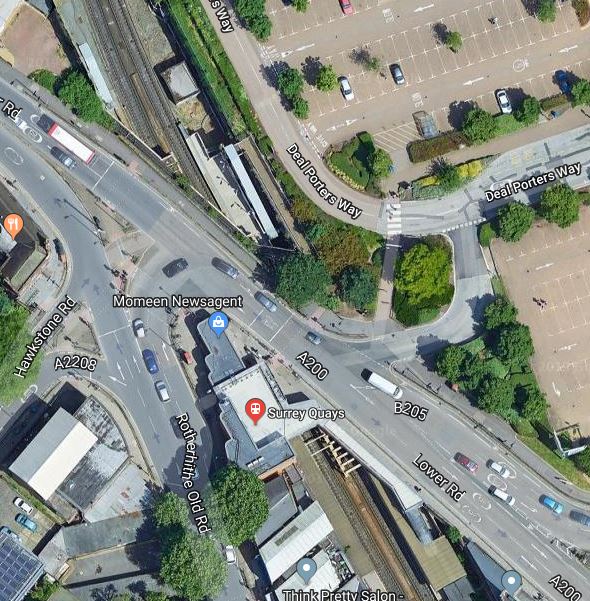
These are my pictures, taken at and around the station.

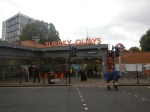
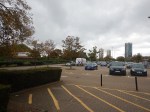
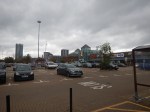
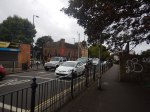
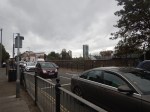
Traffic is bad and the subway suggested by Ian’s wording will be very welcome.
Collateral Benefits At New Cross Gate
New Cross Gate station will be one of several stations along the East London Line to see benefits in service frequency and quality.
The train frequency on East London Line services will rise from eight tph to ten tph.
But this is not all that should or could happen.
- The service between Highbury & Islington and West Croydon stations could rise from four tph to six tph.
- This would mean that New Cross Gate would have a twelve tph service to and from Whitechapel, which in a year or so, will have Crossrail connections to Canary Wharf, Bond Street, Paddington and Heathrow.
- Southeastern should be getting new higher-capacity, higher-performance and possibly longer trains to replace their elderly trains into London Bridge.
- Charing Cross station is redeveloped into a higher-capacity, cross-river station, to allow more trains.
- Digital signalling, as used on Thameslink will be extended to cover all trains through New Cross and New Cross Gate.
- The Docklands Light Railway to Lewisham will get new and higher-capacity trains.
- Southeastern Metro services could go to the London Overground.
Could this all mean that the East London Line, Southeastern and Crossrail will more than hold the fort until it is decided to build the Bakerloo Line Extension?
The Bakerloo Line Extension
This map from TfL shows the route of the Bakerloo Line Extension.
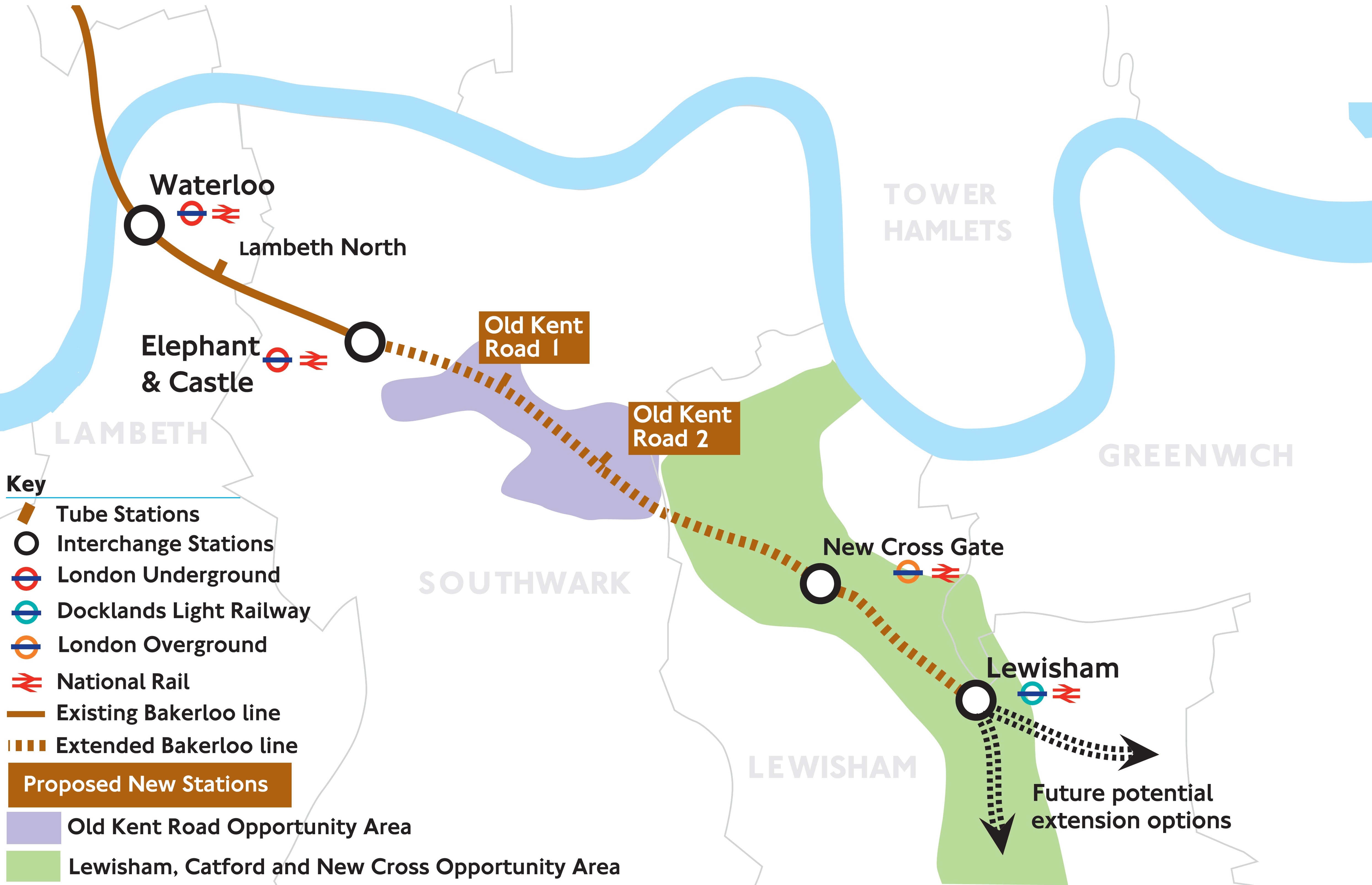
If and when the Bakerloo Line Extension is built, New Cross Gate will surely become a major transport hub.
If you look at the current and proposed stations on the Southern section of an extended Bakerloo Line, you can say the following.
- Paddington will get a step-free pedestrian link between Crossrail and the Bakerloo Line.
- Charing Cross will benefit from more Southeastern Metro services into the main line station.
- Waterloo will benefit from more Southeastern Metro services through the attached Waterloo East station.
- Elephant & Castle station will benefit from more Thameslink services through the attached main line station.
- New Cross Gate will benefit from more Southeastern Metro and East London Line services through the station.
- Lewisham will benefit from more Southeastern Metro services through the station.
But there are no interim benefits for the blue-mauve area, that will be served by the proposed Old Kent Road 1 and Old Kent Road 2 stations.
In addition, is there a need to add capacity between the New Cross area and Lewisham? Southeastern improvements will help, but the Bakerloo Line Extension will do a lot more!
Except for these two stations, is there a reason to build an extension to the Bakerloo Line, as train services between Charing Cross, Waterloo East and New Cross and Lewisham will be significantly increased in frequency, reach and quality?
A Bakerloo Line Extension Redesign
Whatever happens to the Bakerloo Line, the following should be done.
- New walk-through trains running at a higher-frequency on the current route.
- Major access improvements and better connection to main line services at Elephant & Castle, Waterloo East, Charing Cross and Willesden Junction stations.
- A radical reorganisation North of Queen’s Park station, in conjunction with the Watford DC Line and the proposed West London Orbital Railway.
This would improve the current line, but it would do nothing for those living where the extension will go!
So why not do what is happening to the Northern Line at Battersea and create a short extension to the Bakerloo Line that serves the areas that need it and one that can be extended in the future?
- You could argue, that the extension to Lewisham is short and it could be extended to Hayes and other places.
- I also think, that the route goes via New Cross Gate, as that is one of the few sites in the area, from where a large tunnel could be built.
Ideally, what could be needed is a high-capacity public transport link from Elephant & Castle and Greenwich and/or Lewisham via the Old Kent Road, New Cross Gate and New Cross.
The Germans, the Dutch and others wouldn’t mess about and would run trams along the road, but that would go down with the locals like a lead West London Tram.
So it looks like some form of extension of the Bakerloo Line is the only way to go.
Consider.
- Two-platform terminal stations at Brixton and Walthamstow Central handle up to thirty-six tph on the Victoria Line.
- New Cross Gate and New Cross stations are about five hundred metres apart.
- Double-ended stations like Knightsbridge on the Piccadilly Line and Kings Cross on the Victoria Line work very well.
I would look at building a double-ended Bakerloo Line station deep underneath New Cross Road.
- It would be connected by escalators and lifts to the existing stations at New Cross Gate in the West and New Cross in the East.
- Provision would be made to extend the line further to either Greenwich or Lewisham.
- New Cross and Lewisham already have a high-frequency connection of six tph.
- The whole extension could be built from the single tunnelling location on the Sainsbury’s site at New Cross Gate.
- There would be no necessity for any works at Lewisham station.
It would probably need more services to be run between New Cross and Lewisham.
Current Services Between New Cross And Lewisham
Southeastern currently runs these services between New Cross and Lewisham.
- London Cannon Street and Slade Green via Sidcup
- London Cannon Street and Orpington via Grove Park
- London Cannon Street and Hayes
All services are two tph.
Extending The East London Line Service South From New Cross
New Cross is served by the only short service on the London Overground; the four tph between Dalston Junction and New Cross stations.
So could this East London Line service be extended South to serve Lewisham to increase services between New Cross and Lewisham?
This map from carto.metro.free.fr shows the lines at New Cross station.
Note how the double-track East London Line, shown in orange, arrives from Surrey Quays station arrives in the North-Western corner of the map, becomes a single-track and then goes under the main lines before going into the bay platform D.
This Google Map shows the same area.
The London Overground track is clearly visible.
Could extra track be added, to enable the following?
- Southbound trains could join the main line and stop in Platform C
- Northbound trains could leave the main line after stopping in Platform A and go towards Surrey Quays station.
If this is possible, then it would give a four tph service between Dalston Junction and Lewisham, with an important stop at Whitechapel to connect to Crossrail.
Lewisham doesn’t have the space for a terminal platform, but there would appear two possible terminals South of Lewisham.
- Hayes – Journey time to and from Dalston Junction would take around 53 minutes.
- Orpington – Journey time to and from Dalston Junction would take around 50 minutes.
Both stations would make ideal terminals.
- They have bay platforms for terminating the trains.
- Round trips would be a convenient two hours.
- Eight trains would be needed for the service.
- New Cross will have the same four tph to and from Dalston Junction as it does now!
- Lewisham and Dalston Junction would have a four tph service that would take 27 minutes.
The service could even be split with two tph to each terminal.
Will the Extended Services Need To Replace Other Services?
Currently Hayes has these current Off Peak services.
- Two tph to Cannon Street via London Bridge
- Two tph to Charing Cross via London Bridge
I would expect that if digital signalling is applied through the area, that the extra services could be added to Hayes and Orpington as decided.
An Improved Hayes Line
Transport for London and various commentators always assume that the Bakerloo Line will eventually take over the Hayes Line.
This will or could mean the following.
- Passengers used to a full-size train looking out on the countryside and back gardens through big windows, will have to get used to a more restricted view.
- Platforms on the Hayes Line will need to be rebuilt, so that two different size of train will be step-free between train and platform.
- The service could be slower.
- The ability to walk through an increasingly pedestrianised Central London to and from Cannon Street, Charing Cross and London Bridge will be lost.
- Loss of First Class seats. which will happen anyway!
I think that passengers could want to stick with the current service.
The only reason to allow the Bakerloo Line Extension to take over the Hayes Line, is that it would allow another four tph to run between Lewisham and London Bridge. But digital signalling could give the same benefit!
But what if the Overground muscled in?
The Hayes Line could take up to four tph between Dalston Junction and Hayes, via Lewisham and New Cross, which would give these benefits.
- Increased capacity on the Hayes Line.
- An excellent connection to Crossrail, which would give a better connection to the West End, Liverpool Street and Heathrow.
- Better connection to the Eastern side of the City of London and Canary Wharf.
- It could free up four tph between New Cross and London Bridge.
- Same-platform interchange between Southeastern and East London Line services at Lewisham and New Cross.
There would need to be these changes to the infrastructure.
- A new track layout at New Cross.
- Installation of digital signalling.
The latter will happen anyway.
Times To And From Crossrail
Times to and from Whitechapel, with its Crossrail connection are.
- Lewisham – 17 minutes
- Hayes – 44 minutes
- Orpington – 41 minutes
The current service between Orpington and Farrington, which also will connect to Crossrail, takes 52 minutes.
Penge Interchange
Although, this has not been funded, I think that this new interchange could be very much in Transport for London’s plans.
I discuss the possible Penge Interchange station in Penge Interchange.
It’s certainly something to watch out for, as it could improve connectivity by a large amount.
The View From The Dalston Omnibus
For decades, Dalston had a terrible reputation and then came the Overground, which changed everything.
There are now these combined devices from the two Dalston stations.
- Eight tph to Stratford
- Four tph to Richmond via Willesden Junction
- Four tph to Clapham Junction via Willesden Junction
- Four tph to Clapham Junction via Surrey Quays
- Four tph to Crystal Palace via Surrey Quays
- Four tph to New Cross via Surrey Quays
- Four tph to West Croydon via Surrey Quays
There is also a useful eight tph connecting service between Dalston Junction and Highbury & Islington.
In the next couple of years, these developments should happen.
- Services on the East London Line will be increased with an extra two tph to Clapham Junction and Crystal Palace.
- Services on the North London Line will be increased to cope with overcrowding. As the Dalston Junction and Highbury & Islington connecting service will be going to ten tph, it would seem logical that the North London Line service should match this frequency.
- Crossrail will open and Dalston will have a twenty tph connection to its services at Whitechapel.
Dalston needs better connections to either main line terminal stations or their interchanges a few miles out.
Currently, Dalston has very useful connections to the following main interchanges.
- Stratford for the Great Eastern Main Line.
- Clapham Junction for the South Western Railway and Southern services.
- Richmond for Windsor and Reading services.
- Whitechapel will provide a link to Crossrail.
- In addition the planned update at Norwood Junction will give better connection to services to Gatwick, Brighton and other services to the South of Croydon.
Better interchanges are needed with services to the North and the South East of London.
Extending the Dalston Junction and New Cross service to Hayes or Orpington via Lewisham could greater improve the train service from Dalston, by providing interchange to services fanning out into and beyond South East London.
Conclusion
I am drawn to these two conclusions.
- The Bakerloo Line should be extended via two new Old Kent Road stations to a double-ended terminal station in New Cross with interchange to both New Cross Gate and New Cross stations.
- The New Cross branch of the London Overground should be extended through Lewisham to Orpington and/or Hayes.
My preferred destination for the London Overground service could be Hayes, as this would surely help to free up paths through Lewisham and London Bridge.
The Future Of Class 378 Trains
This post is a musing on the future of the Class 378 trains.
The Thames Tunnel
The Thames Tunnel is the tail that wags the East London Line, when it comes to trains.
- For evacuation and safety purposed, trains running through the tunnel, must have an emergency exit through the driver’s cab.
- It hasn’t happened yet, as far as I know, but a version of Sod’s Law states if you ran trains without this emergency exit, you’d need to use it.
- London Overground’s Class 378 trains have this feature, but their Class 710 trains do not.
So it would appear that until Bombardier build an Aventra with an emergency exit through the driver’s cab, that the existing Class 378 trains must work all services through the Thames Tunnel.
Incidentally, I can’t think of another long tunnel, that might be served by the London Overground, so it could be that Class 378 trains will be the only trains to go through the Thames Tunnel, until they wear out and need to go to the scrapyard.
Six Car Trains On The East London Line
I covered this in Will The East London Line Ever Get Six-Car Trains? and I came to this conclusion.
I will be very surprised if Network Rail’s original plan on six-car trains on the East London Line happens in the next few years.
It might happen in the future, but it would need expensive platform extensions at Shadwell, Wapping, Rotherhithe and Canada Water and Surrey Quays stations.
Increased Frequency On The East London Line
If five-car Class 378 trains are the limit, the only way to increase capacity of the East London Line would be to increase frequency.
The current frequency of the East London Line is sixteen trains per hour (tph)
There are four tph on each of these routes.
- Dalston Junction And Clapham Junction
- Dalston Junction And New Cross
- Highbury & Islington And Crystal Palace
- Highbury & Islington And West Croydon
Two increases are planned.
- 2018 – 6 tph – Highbury & Islington And Crystal Palace
- 2019 – 6 tph – Dalston Junction And Clapham Junction
This would increase the frequency of the East London Line to twenty tph.
It will probably mean an updated digital signalling system on the East London Line.
Eventually, I think it likely, that a full ERTMS system as is fitted to Thameslink and Crossrail will be fitted to at least the East London Line, but possibly the whole Overground network.
Digital signalling would certainly allow the twenty-four tph frequency of Thameslink and CXrossrail, which could mean that the four routes all received a frequency of four tph.
But Thameslink and Crossrail are theoretically capable of handling thirty tph or a train every two minutes, through their central tunnels.
If the two modern multi-billion pound tunnels can handle 30 tph, why can’t their little brother, that started life as a half-million pound pedestrian tunnel in 1843,
The Number Of Trains Needed For The Current Service
If I go through the routes of the original Overground, I find the following.
Dalston Junction And Clapham Junction
Trains take 46 minutes to go South and 44 minutes to come North and a round trip would take two hours.
This means that the current four tph service would need eight trains.
A six tph service in the future would need twelve trains.
Dalston Junction And New Cross
Trains take 22 minutes both ways and a round trip would take an hour.
This means that the current four tph service would need four trains.
A six tph service in the future would need six trains.
Highbury & Islington And Crystal Palace
Trains take 44 minutes to go South and 43 minutes to come North and a round trip would take two hours.
This means that the current four tph service would need eight trains.
A six tph service in the future would need twelve trains.
Highbury & Islington And West Croydon
Trains take 52 minutes both ways and a round trip would take two hours.
This means that the current four tph service would need eight trains.
A six tph service in the future would need twelve trains.
This means that the current four tph on all four routes needs twenty-eight trains.
The Proposed 2020 Service
This will have two extra tph to Crystal Palace and Clapham Junction and will need thirty-six trains.
Six Trains Per Hour On All Four Routes
as each route terminates at both ends in a single platform, which can handle six tph, with the right signalling, I feel that this could be the design objective of the East London Line, when it was built in the early-2010s.
This could be achieved with forty-two trains, leaving perhaps twelve to fifteen trains for other duties, depending on how many are needed on stand-by or are in maintenance.
What Could Be Done With Twelve Trains?
As I calculated earlier, three routes need twelve trains to provide a six tph service.
- Dalston Junction And Clapham Junction
- Highbury & Islington And Crystal Palace
- Highbury & Islington And West Croydon
All three services take between 44 and 52 minutes.
So could another six tph service that takes around this time be added to the current four services?
Willesden Junction As A Northern Terminal
Trains could take the North London Line to Willesden Junction and terminate in the Bay Platform 2.
I estimate the following timings from Willesden Junction.
- Highbury & Islington – 27 mins
- Dalston Junction – 31 mins
- Whitechapel – – 41 mins
- New Cross – 49 mins
- Crystal Palace – 64 mins
- Clapham Junction – 73 mins.
- West Croydon – 74 mins
It would appear that the only possible Southern terminal of the current four, would be New Cross, as that is the only terminal within the 44-52 minute range of journey time.
So could a service between Willesden Junction and New Cross replace the current one between Dalston Junction and New Cross?
- It would need to be run using dual-voltage trains
- Voltage changeover could be at Highbury & Islington station.
- Extending the New Cross service would free up a bay platform at Dalston Junction station.
- It should be possible to have a frequency of six tph.
- Serious modifications or additions to infrastructure would probably not be required.
As running to Willesden Junction was talked about before the Overground opened, I wonder if the numerous crossovers on the North London Line, already allow trains from the East London Line to terminate at Willesden Junction.
Southern Terminals Via New Cross Station
This map from carto.metro.free.fr shows the lines at New Cross station.
Note how the double-track East London Line, shown in orange, arrives from Surrey Quays station arrives in the North-Western corner of the map, becomes a single-track and then goes under the main lines before going into the bay platform D.
This Google Map shows the same area.
The London Overground track is clearly visible.
Could extra track be added, to enable the following?
- Southbound trains could join the main line and stop in Platform C
- Northbound could leave the main line after stopping in Platform A and go towards Surrey Quays station.
If this is possible, then trains could run between Dalston Junction and Lewisham stations.
Once at Lewisham they would have choice of Southern terminal,
Hayes As A Southern Terminal
Consider a service between Dalston Junction and Hayes stations.
- I estimate that a train could go between the two stations in 53 minutes.
- Hayes station has two terminal platforms
Six tph would probably be too many services, but 2-3 tph might be very welcome.
Orpington As A Southern Terminal
Consider a service between Dalston Junction and Orpington stations.
- I estimate that a train could go between the two stations in 47 minutes.
- Orpington station has three terminal platforms.
Six tph would probably be too many services, but 2-3 tph might be very welcome.
A Combined Hayes And Orpington Service
As a case can be made for services to both Hayes and Orpington via Lewisham, I think the ideal service could be two tph to both Hayes and Orpington.
- There would be four tph between Dalston Junction and Lewisham.
- Stations on the East London Line would have access to the important interchange station at Lewisham.
- Several stations on the routes to Hayes and Orpington would have a two tph service to Crossrail and the Jubilee Line.
Other Stations Via New Cross
Looking at rail maps, there would seem to be several possibilities including with their times from Dalston junction station.
- Beckenham Junction – 41 mins
- Bromley North – 40 mins
- Gove Park – 35 mins
There are probably others.
Southern Terminals Via Peckham Rye Station
As an example Streatham Common station is planned to be a major interchange and is 43 minutes from Dalston Junction.
Would a bay platform work here as an East london Line terminal?
Conclusion
If all fifty-seven Class 378 trains worked the East London Line, they could run six tph on the current routes.
- Dalston Junction And Clapham Junction
- Dalston Junction And New Cross
- Highbury & Islington And Crystal Palace
- Highbury & Islington And West Croydon
It would need forty-two trains.
Suppose the Dalston Junction and New Cross service was replaced with a Willesden Junction and New Cross service.
- This would provide a useful direct four tph service between East and North London.
- Changing at Highbury & Islington station would be avoided for a lot of journeys.
- The journey time wold be around 49 minutes.
- A two tph service would need four trains.
- A four tph service would need eight trains.
- A six tph service would need twelve trains.
- Many journeys between North and South London would now be possible with just a single same platform interchange.
To run the following frequencies on this route would mean these total frequencies on the East London Line and total numbers of trains.
- 2 tph – 20 tph – 40 trains
- 4 tph – 22 tph – 44 trains
- 6 tph – 24 tph – 48 trains
I think that if the figures are juggled a bit, there is enough trains to run extra services to one or more Southern destinations from Dalston Junction.
My preference would be a split service of 2 tph to both Hayes and Orpington via New Cross, where some new track would be needed.
This would do the following.
- Create a frequent connection between South-East and North-East London.
- Both areas would be connected to Crossrail and several Underground Lines, including the future Bakerloo Line Extension.
- The Hayes Line would be shared between Overground and Southeastern trains.
No more new trains or large amounts of new infrastructure would be needed.
I suspect that London Overground and the new Southeastern franchise can do better than my musings.
Connecting The Bakerloo Line Extension At Lewisham To The North Kent And Bexleyheath Line
This map from carto.metro.free.fr shows the lines in the area of Lewisham station.
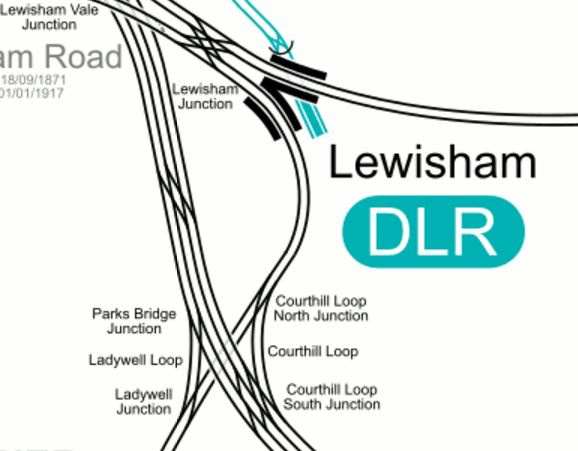
Note.
- The multi-track line going North-West to South-East is the South Eastern Main Line .
- The double-track line going South-West to North-East is the Hayes Line.
- The double-track going East are the North Kent & Bexleyheath Lines
- I think it is quite likely that the overrun tunnels for the Bakerloo Line Extension will be under the Hayes Line.
The North Kent & Bexleyheath platforms are as follows.
- Platform 3 is the Up platform
- Platform 4 is the Down platform
Services running on the lines include.
- Dartford to London via Platform 3
- Slade Green to London via Platform 3
- London to Dartford via Platform 4
- London to Slade Green via Platform 4
In Connecting The Bakerloo Line Extension At Lewisham To The Hayes Line, I showed that it would be reasonably easy to connect the overrun tunnels for the Bakerloo Line to the Hayes Line.
So could the Bakerloo Line Extension be connected to the North Kent and Bexleyheath Lines?
If the Lewisham Underground station was deep under the current station, it might be possible to create a junction, which would enable the Underground trains to go in the direction of both the Hayes and Bexleyheath Lines.
But having been on a train between Lewisham and Bexleyheath stations, it would appear that there is little space for the Bakerloo Line to emerge from the ground and join the surface railway.
These pictures show the viaduct and other structures that support Platforms 1 and 2 at Lewisham station.
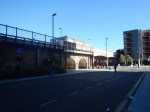
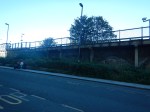
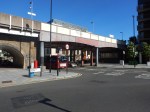
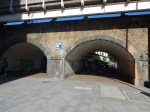
The pictures seem to confirm that linking to a line under Lewisham station would be extremely difficult and very expensive, and would require a long closure of the North Kent and Bexleyheath Lines through Lewsiham.
If this is the case, this must mean that the Hayes Line is the only place, where the Bakerloo Line can go.
Connecting The Bakerloo Line Extension At Lewisham To The Hayes Line
This map from carto.metro.free.fr shows the lines in the area of Lewisham station.
Note.
- The multi-track line going North-West to South-East is the South Eastern Main Line .
- The double-track line going South-West to North-East is the Hayes Line.
- The double-track going East are the North Kent & Bexleyheath Lines
- I think it is quite likely that the overrun tunnels for the Bakerloo Line Extension will be under the Hayes Line.
The platforms are as follows.
- Platform 1 is the Up platform on the Hayes Line.
- Platform 2 is the Down platform on the Hayes Line.
- Platform 3 is the Up platform on the North Kent & Bexleyheath Lines.
- Platform 4 is the Down platform on the North Kent & Bexleyheath Lines.
They are numbered from bottom to top in the map.
Services running through the area include.
- Slow London to Hayes via Platform 1
- London to Orpington via Platform 1 and the Courthill Loop
- Slow Hayes to London via Platform 2
- Orpington to London via the Courthill Loop and Platform 2.
- Dartford to London via Platform 3
- Slade Green to London via Platform 3
- London to Dartford via Platform 4
- London to Slade Green via Platform 4
- Fast London to Hayes via the Ladywell Loop
- Fast Hayes to London via the Ladywell Loop
If the Hayes Line were to be directly connected to the Bakerloo Line Extension, some services would be difficult to run.
But suppose the tunnels were connected to the Hayes Line between Courthill Loop North Junction and Ladywell Junction, the following services would still be possible.
- London to Orpington via Platform 1 and the Courthill Loop
- Orpington to London via the Courthill Loop and Platform2.
- Fast London to Hayes via the Ladywell Loop
- Fast Hayes to London via the Ladywell Loop
The slow services between London and Hayes would use the Bakerloo Line Extension.
Services On The Hayes Line
Currently, there are two trains per hour (tph) to both Charing Cross and Cannon Street. Some fast services avoid Lewisham, but all services stop at London Bridge.
In the Wikipedia entry for Hayes station, this is said.
In 2004, the Strategic Rail Authority proposed withdrawing services to Charing Cross from the Hayes Line. Following a campaign led by local Councillors and the Hayes Village Association, the plans were withdrawn.
So the locals have form in getting what they want.
Intriguingly, Charing Cross station has two Underground stations; Embankment and Charing Cross, on the Bakerloo Line.
But it will surely lose some of the National Rail services, if Hayes station becomes part of the Underground.
Some must stay, as if all were discontinued, getting to the City could mean a roundabout route and I suspect another campaign would be started by the good burghers of Hayes.
In Thoughts On The Power System For The New Tube for London, I felt that changing to a conventional three-rail electrification could be possible on the deep-level Underground lines.
At Hayes station, it would enable both National Rail and Underground services to both serve the station.
The design of the new Tube for London could well sort out that problem!
Beckenham Junction
This map from carto.metro.free.fr shows Beckenham Junction station and its connection to the Hayes Line at New Beckenham station.
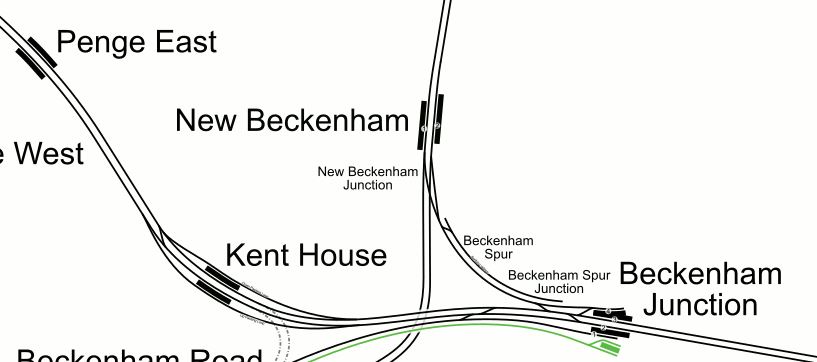
In some ways Beckenham Junction station would make a good terminus for the Bakerloo Line Extension.
- Platform 1 could be converted to use by the Underground.
- There is a four tph service between Victoria and Bromley South stations.
- There is a two-platform station for Tramlink.
But would the flat New Beckenham Junction, where trains join the Hayes Line, have the capacity to handle all the trains and Tubes, going hither and thither?
At the very least use of Beckenham Junction as a terminal for the Bakerloo Line, would need a lot of innovative thinking.
In Could Beckenham Junction To Birkbeck Be Run Using Third-Rail Tram-Trains?, I proposed using tram-trains with a third-rail capability.
This would allow the Birkbeck to Beckenham Junction section of the route to become a conventional railway again and have a higher capacity.
This was my conclusion in the post.
By replacing the trams to Beckenham Junction station with tram-trains, capable of running on both 750 VDC types of electrification and with a limited battery capabilty, would simplify operation at Beckhenham Junction and enable Tramlink services to be extended to Bromley South station.
The collateral benefit, is that Bromley town centre could get a Tramlink connection.
Going East from Beckenham Junction station, the track is only double, but if the New Tubes for London were fast enough, they could gp on to Bromley South station.
Conditions And Thoughts On The New Southeastern Franchise
The January 2018 Edition of Modern Railways gives a review of the conditions, that the Department for Transport are imposing on bidders.
The First Sentence
This is the first sentence of the article.
The Department for Transport says bidders for the next Southeastern franchise will be required to provide space for at least 40,000 additional passengers in the morning rush hour with 12-car services on the busiest routes.
This raises an interesting question.
Does the DfT mean actual twelve-car trains or ones as long as current twelve-car trains?
In Big On The Inside And The Same Size On The Outside, I discussed how by using good design, Bombardier were getting more passengers in a train of the same length.
This is an extract from c2c’s Press Release.
The Aventra is one of the fastest-selling trains in the UK rail industry, and these new trains will be manufactured at Bombardier’s factory in Derby. Each new train, which will operate in a fixed set of 10-carriages, will include over 900 seats, plus air-conditioning, wifi, plug sockets and three toilets onboard. Each new carriage is larger and contains more seats than on c2c’s current trains, so each 10-carriage new train provides capacity for 15% more passengers onboard compared to a current 12-carriage c2c train.
So three x four-car trains working as a twelve-car train are replaced by one ten-car train, just as with Greater Anglia. Note the claimed fifteen percent capacity increase!
Metro Services
The article says this about Metro services,
Metro-style trains will be introduced on suburban routes, similar to those on other high-capacity routes into London.
Is the DfT thinking of trains like Crossrail’s Class 345 trains?
Changes Of London Terminals
The DfT was thinking of all inner suburban services going to a single London terminal, but this has been dropped following opposition.
Changes are still proposed, to stop conflicts at Lewisham.
- Bexleyheath Line services will switch from Victoria to Cannon Street or Charing Cross.
- Hayes Line services will serve Victoria and Charing Cross, but not Cannon Street.
- North Kent Line services will run to Cannon Street.
- Sidcup Line services will run to Charing Cross and Cannon Street in the Peak.
- Extra services will serve Abbey Wood for Crossrail.
- More twelve-car trains.
The objective is a turn-up-and-go Metro-style service on suburban routes.
To London Overground, Merseyrail and other commuters around the K, that means four trains per hour.
As there was with the proposal Network Rail made to curtail Sutton Loop Line services at Blackfriars, there will be complaints. Especially, from those who were at Eton with certain MPs!
Hopefully the design of London Bridge station will help smooth things over.
Twelve-Car Trains At Charing Cross And Waterloo East
If most trains are twelve-car trains, then surely all platforms at Cannon Street, Charing Cross, London Bridge, Victoria and Waterloo East stations, must surely be able to handle trains of this length.
As it is specifically mentioned, Charing Cross and Waterloo East stations must be the most problem.
There have been suggestions of rebuilding the two stations, with the platforms at Charing Cross extending over the Thames.
Consider.
- Modern signalling could handle twenty-four trains per hour between Charing Cross and London Bridge.
- Connections to the Jubilee Line could be better.
- The Bakerloo Line is planned to be extended to Lewisham.
- Waterloo East station could surely have over-site development.
- Techniques borrowed from London Underground could be used to turn trains faster at Charing Cross.
I have a feeling that we will see something fairly radical happen in the next few years to increase capacity across the South Bank.
Faster Services To Hastings
This is said about services to and from Hastings.
DfT has specified a new two trains per hour service between London, Tonbridge and Ashford, allowing services to Hastings to be speeded up by removing calls at Orpington, Sevenoaks and Hildenborough.
Bidders are incentivised to develop further proposals for reducing journey times, including for deliveringn high speed services between London St. Pancras, Hastings and Bexhill via Ashford.
That all sounds good for Hastings.
More Trains Between Strood And Tonbridge
This route along the Medway Valley Line will have two trains per hour all day.
Trains For The Franchise
The DfT has specified the trains in a fairly detailed way.
Cars No Longer Than Twenty Metres
This is probably because of curved platforms and other restrictions on the various routes.
It is also a similar car length to the current Class 465 trains and Class 377 trains.
No Extra Selective Door Opening, Except At Waterloo East
I suspect this could be that selective door opening, confuses passengers and perhaps slow the stops.
First Class To Be Removed By September 2020
Will this be popular with all passengers?
There doesn’t seem to have been too many protests about the future removal of First Class on Greater Anglia’s services in Essex.
But it will allow the capacity of the train to be increased, to provide space for some of those 40,000 additional passengers.
ETCS Will Have To Be Deployed
European Train Control System (ETCS) can enable higher frequencies of trains in a safe manner and mandating that it be deployed is a sensible move.
At Least One Accessible Toilet On Main Line And High Speed Trains
I think most train operating companies would do this!
Adequate Wi-Fi
Not providing wi-fi and in addition 4G signals, is probably an easy way to reduce ridership.
Walk Through Trains
The fleets that have been bought recently, are all of this type, so I think it would be unlikely, that any new trains for the Southeastern franchise would be different.
My Thoughts
Train Length
Greater Anglia, Great Western Railway, South Western Railway and Virgin Trains East Coast have set a pattern, by ordering trains and half-trains, that can probably be used in a flexible manner.
Half-train/Full-train ratios for the various companies are.
- Great Western Railway – 1.6
- Greater Anglia – 4.0
- South Western Railway 0.5
- Virgin Trains East Coast – 0.5
Each company has chosen an appropriate number of trains for their routes, but each can adjust numbers by running two half-trains as a full train.
So will we see the same strategy on a future Southeastern franchise?
Perhaps most trains will be twelve-car trains with a small number of six-car trains, that can work together as required.
Train Speed
In Kent On The Cusp Of Change – Elimination Of Slow Trains, I came to this conclusion.
All trains incapable of running a service at 100 mph should be eliminated, just as the two operators;Greater Anglia and South Western Railway, are planning to do.
All of the new Southeastern franchise’s trains should be 100 mph trains.
Could Third-Rail Tram-Trains Be Used To Increase Services In South London?
I ask this question, as some of the frequencies on suburban lines in South London aren’t up to their equivalent in the North.
Sutton Loop Line
As an example, Sutton Common station on the Sutton Loop Line of Thameslink, has this Off Peak service according to Wikipedia.
The typical off-peak service from the station is 2 trains per hour to Wimbledon (clockwise around the loop) and 2 trains per hour to Sutton (anticlockwise).
Other stations on the loop with this level of service include Haydons Road, Morden South, St. Helier, South Merton, Tooting, West Sutton and Wimbledon Chase.
On the other side of the loop via Mitcham Junction station, the service is augmented by London Victoria to Epsom services, running at two trains per hour (tph).
People might say, that the solution to the poor service at stations on the Sutton Loop Line is just to run four tph in both directions round the loop.
But that would probably mean the Snow Hill Tunnel with its capacity of 24 tph, will become overloaded.
Thameslink’s Route To Sevenoaks
Crofton Park station on Thameslink’s route to Sevenoaks station has this Off Peak service according to Wikipedia.
Two trains per hour to West Hampstead Thameslink and Sevenoaks.
The passengers moan about it as I wrote in The Natives Are Getting Restless In Crofton Park.
They want four tph now!
But again they can’t have them, as it’s the capacity of the Snow Hill Tunnel.
Transport For London’s Philosophy
Transport for London, have released a report on the Bakerloo Line Extension that they call the Option Selection Summary Report.
It is one of those worthy documents, you get from analysing the data from consultations.
But it is full of several nuggets, which although not directly associated with the Bakerloo Line could be very important for passengers coming from or venturing to South London.
They have also provided this helpful map, which lays out possible actions and improvements.
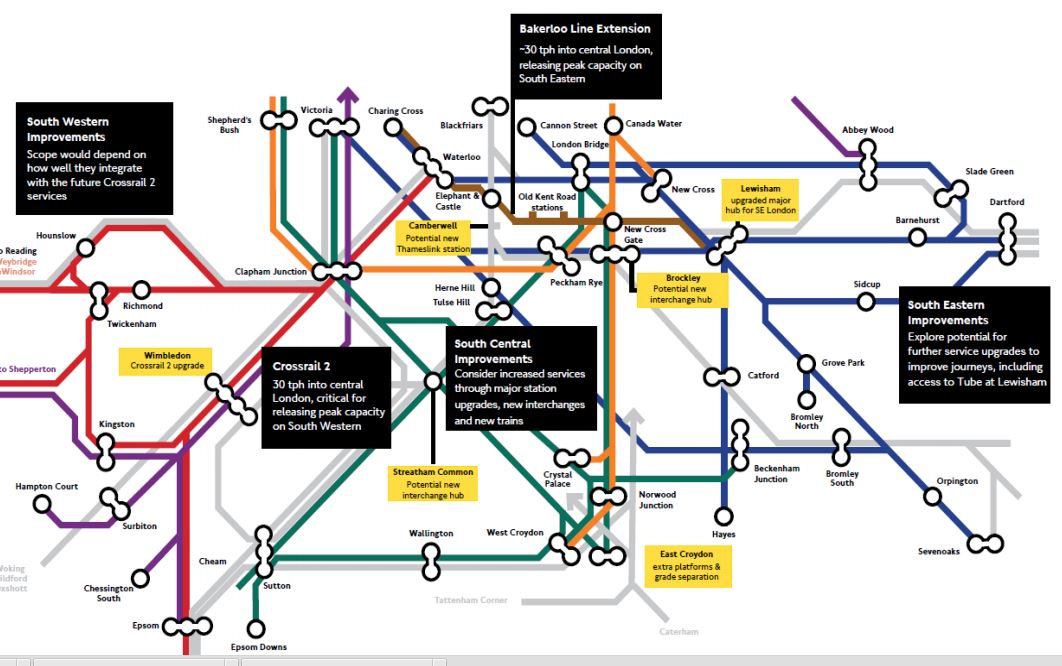
It seems to me that TfL are following a plan to add more transport hubs to their network South of the Thames.
Currently, the following are important interchanges between Underground, Overground, trains, Tramlink and buses.
- Bromley South
- Clapham Junction
- East Croydon
- Greenwich
- Lewisham
- Wimbledon
- Woolwich
Note.
- East Croydon will benefit in a large way from Thameslink, but so will Greenwich and Woolwich in a smaller way.
- Clamham Junction and Wimbledon will be stations on from Crossrail 2, if it’s ever built.
- Lewisham will become the terminus of the Bakerloo Line.
The map and other sources also show other stations becoming important transport hubs or connections.
- Brixton, where all the lines in the area are in a single station.
- Brockley
- Catford, where the current Catford and Catford Bridge stations become one station.
- Crystal Palace, which will soon get extra services from Whitechapel and Highbury and Islington stations.
- Orpington
- Penge
- Streatham Common
- Sutton
London Bridge station shouldn’t be ignored, as after Thameslink is completed, it will be an efficient interchange between the North-South Thameslink services and the Southeastern services between Charing Cross/Cannon Street and the wider South-East.
Put all of these proposals together and could third-rail tram-trains be a useful addition to transport in South London?
I will detail a few possible routes.
Onward From Beckenham Junction To Bromley South or Orpington
In Could Beckenham Junction To Birkbeck Be Run Using Third-Rail Tram-Trains?, I detailed how third-rail tram-trains could be used between Harrington Lane tram stop and Beckenham Junction station to create more capacity.
If run by tram-trains, this service could be extended to Bromley South or Orpington.
Orpington station has four bay platforms facing towards London and Beckenham Junction.
This map from carto.metro.free.fr shows the track layout at the station.
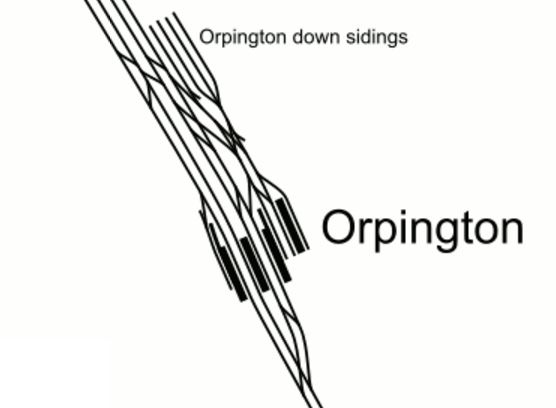
The tracks reduce from four to two at Orpington station, which probably means that tram-trains should probably not go further than Orpington station.
Bromley South station is another possibility for a terminus for tram-trains and this map from carto.metro.free.fr, shows the station layout.
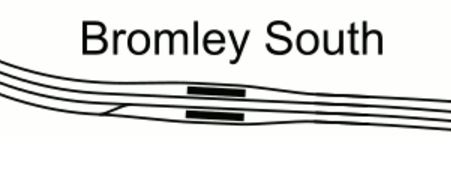
The tram-trains would probably use the two Northern tracks.
At present there are the following services between Birkbeck and Beckenham Junction stations.
- 2 trains per hour between London Bridge and Beckenham Junction
- 6 trams per hour between East Croydon and Beckenham Junction
Looking at the frequencies, I suspect that if two of the trams per hour, were tram-trains and ran to Bromley South and Orpington, this could be accommodated in the timetable.
I think that this route would have the following advantages.
- Bromley South and Orpington stations would be valuable interchanges to Southeastern’s and Thameslink’s Kentish destinations.
- Running tram-trains between Birkbeck and Beckenham Junction stations as tram-trains on a double-track line, must improve capacity and reliability.
- Bromley town centre has been touted as an extension to Tramlink.
Bromley South station, might not be Bromley town centre, but it is only a short walk.
However, if it were needed, I suspect that a single-track spur to serve the town centre could be created to the West of Bromley South station.
This Google Map shows the Southern end of Bromley High Street and Bromley South station.
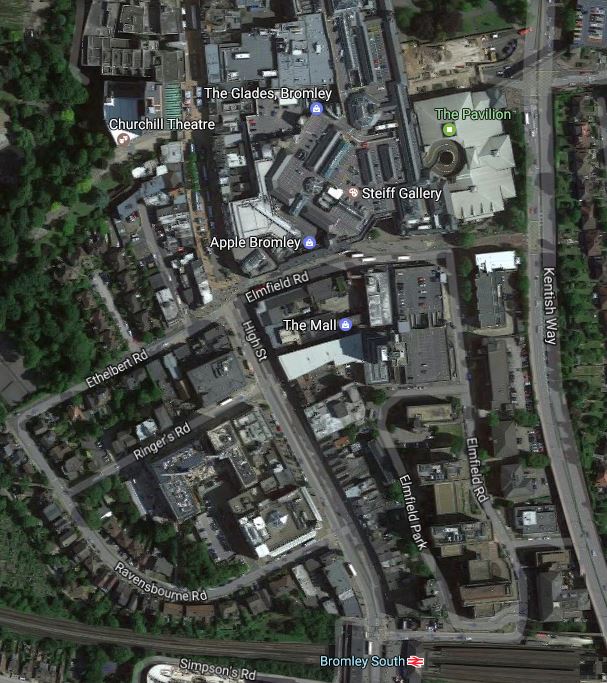
It could probably use battery power to pull up the short hill to Bromley town centre.
- The terminal tram stop could be at the South end of the pedestrianised area.
- The on-street route would be single-track, bi-directional and electrically dead.
- A second tram stop could be provided by Bromley South station.
- The maximum frequency to a single platform would probably be two trams per hour.
In some ways, the town centre tram stop is a bay platform for Bromley South station, that can only be used by tram-trains with a battery capability.
Onward From Harrington Road To Crystal Palace
It was always hoped that Tramlink could be extended to Crystal Palace station and this has been developed as Route 5.
The Wikipedia entry for Harrington Road tram-stop says this.
Transport for London once had plans to extend the Tramlink system to Crystal Palace. These plans were known as Extension D or Tramlink route 4, and would have involved a junction to the north of Harrington Road, with the extension joining the existing railway in the opposite direction to the current line 2.
The planned extension to Crystal Palace was formally dropped by Transport for London in 2008.
But using tram-trains could make this a more flexible low-cost option.
- Battery power could be used to go to the terminus at Crystal Palace Parade.
- Battery trams would be very easy to install in a park, if required.
- A charging station, like a Railbaar, could be provided at the terminus, if the battery running looked like needing assistance.
- Tram-trains could go past Crystal Palace to a station with a suitable bay platform.
This Google Map shows the route.
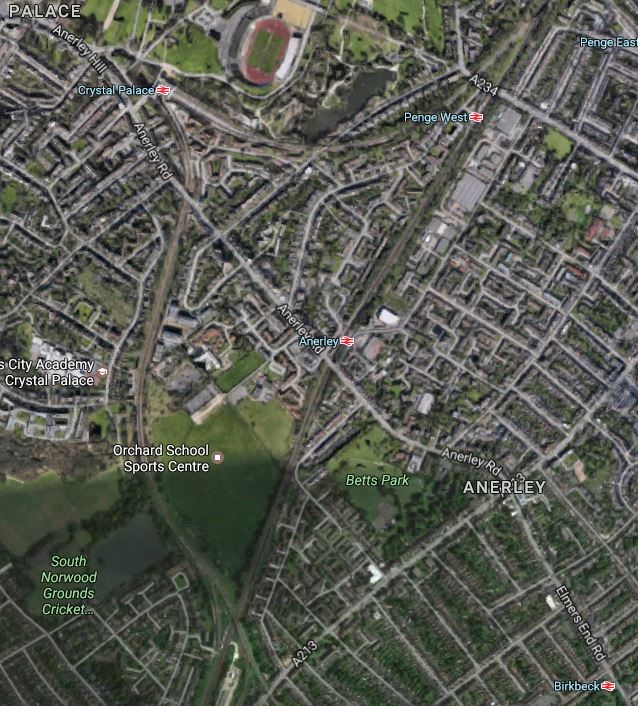
Note Crystal Palace in the North West corner, by the running track and Birkbeck station in the South East.
New tram stops have been proposed at Penge Road and Anerley Road and as the lroute will be run by tram-trains, I suspect that an innovative island station design could serve both tram-trains and trains.
Crystal Palace station, which in a couple of years will have six tph from the well-connected Whitechapel, would benefit from a Tramlink connection.
Onward From Elmers End To Catford
Elmers End station has six trams per house from East Croydon.
This Google Map shows the station.
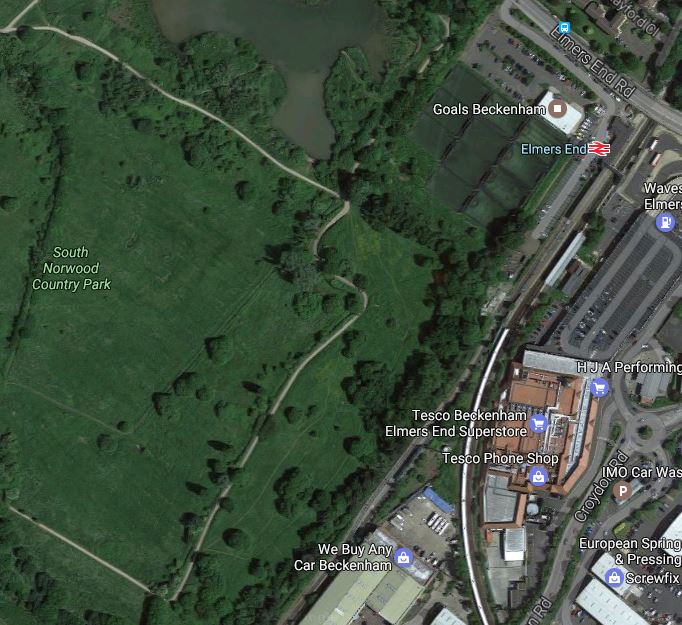
Note how it connects to the Hayes Line and I doubt if it would be difficult to allow through running of tram-trains between East Croydon and stations to the North on the Hayes Line.
The logical Northern terminus would probably be in a new Catford Interchange, which Transport for London have talked about to combine Catford and Catford Bridge stations.
This Google Map shows the two stations and Catford town centre.
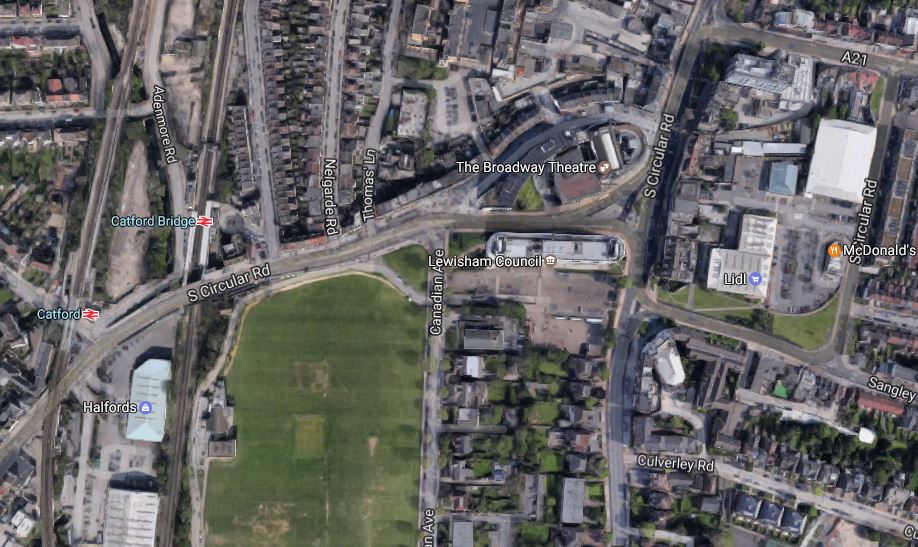
A tram-train could probably run on batteries to the town centre, perhaps with a terminus at Catford Broadway by Lewisham Town Hall and the Broadway Theatre.
But with the right design of the new interchange, the tram-train could go further North to a station with a handy bay platform, if that was deemed necessary.
Increasing The Frequency On The Sutton Loop Line
As I said earlier stations on the Western side of the loop, generally get about two tph in both directions, but those on the Eastern side get an extra two tph going between Victoria and Epsom.
The trains on the line are typically eight-car trains of a variety of types. Capacity may be a problem, but a line like this needs at least four tph all day.
There could also be a case for an extra station to serve St. George’s Hospital and perhaps another as part of the development at Hackbridge.
There is a Hackbridge Masterplan on Wikipedia. This is the first paragraph.
The London Borough of Sutton is working to make Hackbridge the ‘UK’s first truly sustainable suburb’. There has been a regeneration scheme in Hackbridge which has a number of developments on many sites. These are mentioned as part of the Hackbridge Regeneration. Detailed plans include proposals for new eco-friendly homes, more shops, leisure and community facilities, jobs, sustainable transport and pedestrian/ cycle initiatives, improved networks and open spaces.
It all sounds good to me. This is a Google Map of the area.
Hackbridge
Note the rail line going up the map with Hackbridge station about a quarter of the way up.At the top of the map, is an icon indicating the BedZed Pavilion.
If they are truly into green transport, it strikes me, that there needs to be another station between Hackbridge station and Mitcham Junction station, which is the next one to the North. As the Tramlink through Mitcham Junction runs down the eastern side of the site and has a stop at Beddington Lane on the north east corner, I would also feel that there scope for extensions to the through Hackbridge.
So for frequency and environmental reasons, I think there is a strong case to improve the Sutton Loop Line.
The obvious way to increase the service would be to have two tph start and finish in a bay platform, at the proposed Streatham Common transport interchange. Not only would it provide four tph on the whole loop, but if the trains were scheduled correctly, all stations on the loop would have the following services to Blackfriars.
- 2 tph direct.
- 2 tph with a change at Streatham Common.
- 2 tph direct via Sutton
- 2 tph via Sutton with a change at Streatham Common.
With good design the change at Streatham Common could be a walk across the platform.
I don’t think that the extra services would need to be eight-car trains, but why use tram-trains?
The tram-trains major advantage is that they could go walkabout to perhaps serve some of the new developments or hospitals like St. Helier or the Royal Marsden.
Using The Sutton Loop Line As A Reversing Loop For Trams From Croydon
This Google Map shows Mitcham Junction station.
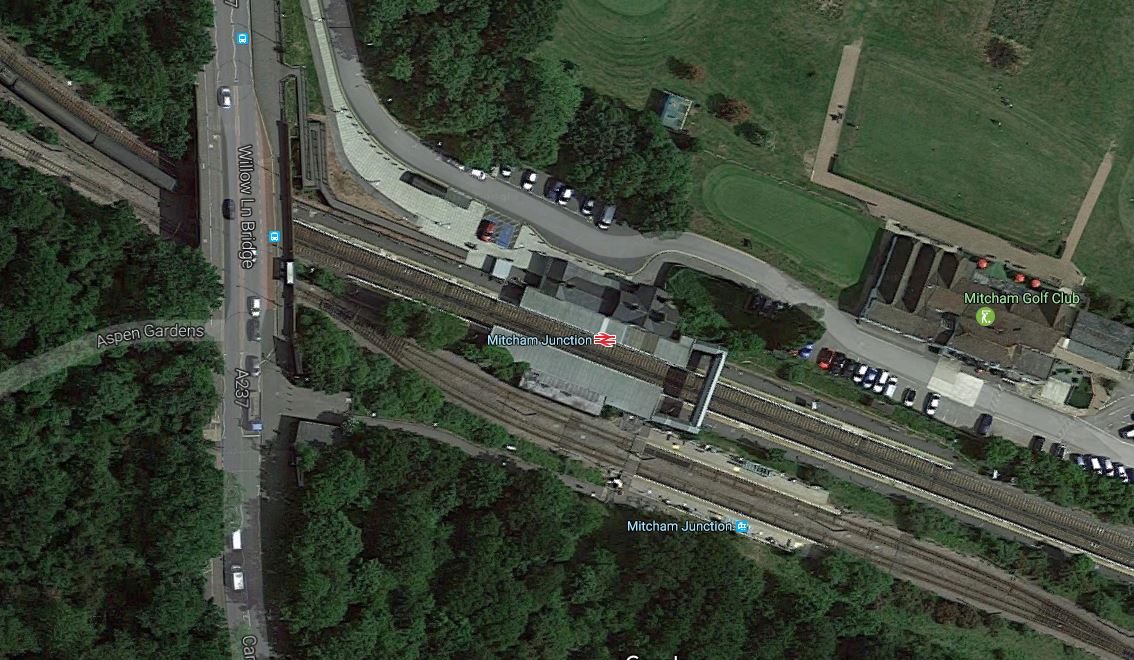
I don’t think it would be too difficult to add chords to the junction, so that a tram-train coming from Croydon could transfer from Tramlink to the Sutton Loop Line. The tram-train would then go round the loop including passing through Wimbledon station on the opposite face of the Tramlink platform.
After returning to Mitcham Junction, the tram-train would return to Croydon.
It may seem a long way round, but there’s probably only a couple of minutes in it.
But it would need a chord at Streatham Common for the tram-trains to by-pass the station.
This Google Map shows the location of the proposed Streatham Common interchange.
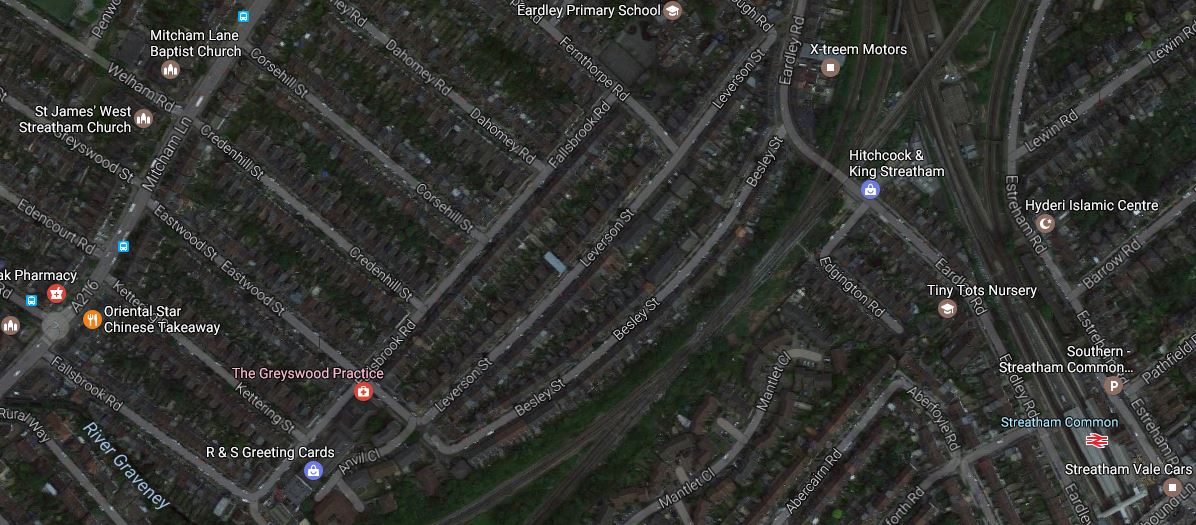
The current Streatham Common station is in the East, The interchange would be built, where the lines cross.
The chord would be built to the South of where the two lines of the Sutton Loop meet, at the bottom of the map.
The track could be adjusted, so that tram-trains could go round the loop both ways.
Will The Victoria-Epsom Service Call At Streatham Common Interchange?
Stops with modern trains are much quicker than they used to be only a few years ago.
So If the design of Streatham Common station and the timetable could allow a fast interchange, it might improve journey times for those living on the Wimbledon side of the Sutton Loop Line, which don’t get direct services from Victoria.
The Proposed Tramlink Extension To Sutton
The proposed Tramlink route Between South Wimbledon And Sutton is possibly a worthwhile extra public transport link to throw into the mix. It is described under Extension A in the Wikipedia entry for Tramlink. This is said.
In July 2013, Mayor Boris Johnson affirmed that there is a reasonable business case for Tramlink to cover the Wimbledon – Sutton corridor. A map has been released showing the planned route. It would leave the existing route just to the east of Morden Road and head along the A24 and A297 to Rosehill Roundabout, then the B2230 through Sutton town centre, ending at the station. A loop via St Helier Hospital and a possible extension to Royal Marsden Hospital also are shown.
This is a map of the route.
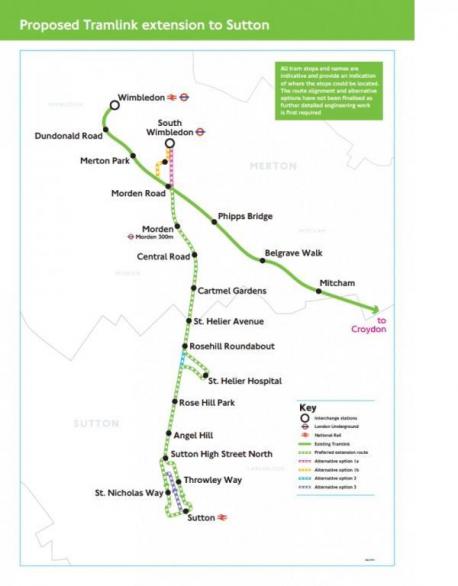
So how would third-rail tram-trains using the Sutton Loop Line affect the proposed Tranlink Extension to Sutton?
- There are at least four tph in both directions on the Sutton Loop Line.
- The trams will reach Sutton, but only running as trains.
- St. Helier Hospital is not served.
- Tram-trains could possibly serve the Epsom Downs Branch, in addition to the direct services to Victoria.
I describe how third-rail tram-trains could serve the Epsom Downs Branch and the Royal Marsden Hospital in Could Third-Rail Tram-Trains Work The Epsom Downs Branch?
 The Anonymous Widower