High Speed Two To The North West Of England
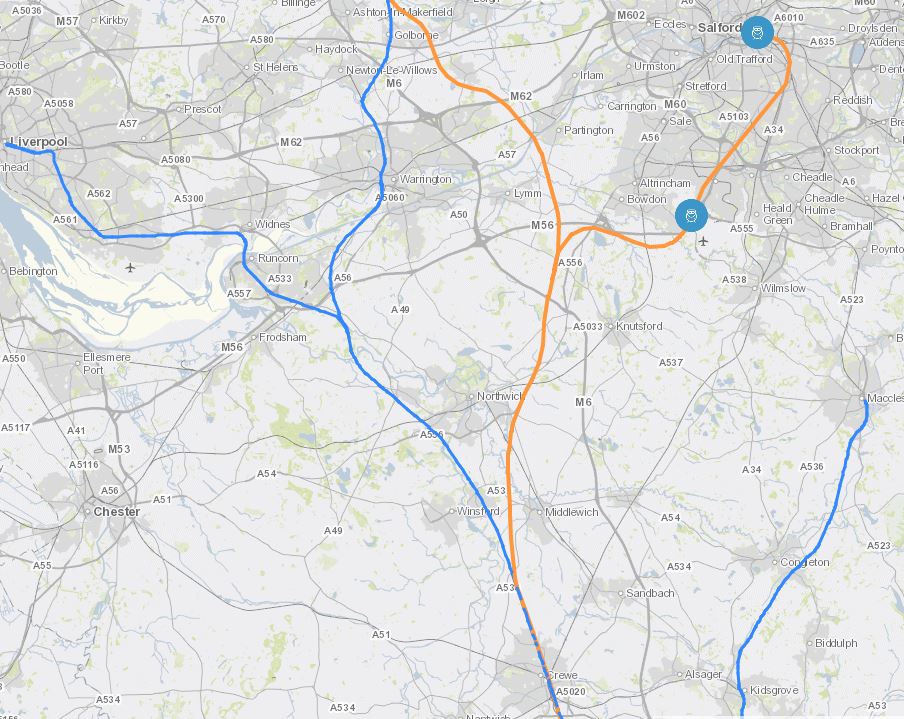
This map clipped from the High Speed Two web site, shows High Speed Two routes in the North West of England.
Note.
- When shown in orange, High Speed Two will use new tracks.
- When shown in blue, High Speed Two will use existing tracks.
- New stations are shown as large blue dots.
- High Speed Two and the West Coast Main Line appear to share a corridor through Crewe, before dividing near Walley’s Green.
- High Speed Two loops to the East of the West Coast Main Line and rejoins it South of Wigan between Bryn Gates and Abram Brow.
The route will or might serve the following stations in North West England.
Blackpool North
Blackpool North station is not planned to be served by High Speed Two.
But the station has been recently rebuilt.
- It has a number of platforms, that are capable of handling 200 metre long classic-compatible High Speed Two trains.
- The route to High Speed Two at Preston is fully electrified.
- In a couple of years, it will be connected to Blackpool’s expanding tramway.
- Blackpool would welcome High Speed Two with open arms.
Blackpool North would be an ideal extra destination, if more trains were to be split and joined at Crewe.
But whatever happens, I believe that high speed commuter trains will run from Blackpool North.
- Blackpool and Manchester Piccadilly via Preston, Wigan North Western, Warrington Bank Quay and Manchester Airport.
- Blackpool and Derby via Preston, Wigan North Western, Warrington Bank Quay, Crewe and Stoke-on-Trent.
Blackpool North has the platforms and electrification and it will be used.
Carlisle
Carlisle station is a through station on the current Glasgow service and can handle a nine-car Class 390 train which is over 210 metres long, which means they can handle a 200 metre long, classic-compatible High Speed Two train.
But two tph will be 400 metre London Euston and Edinburgh/Glasgow trains, so platform lengthening will probably be required.
There will be the following trains.
- Birmingham Curzon Street and Carlisle – I tph – 118 minutes
- London Euston and Carlisle – 2 tph – 154 minutes.
After any necessary platform lengthening, Carlisle will be ready and waiting for High Speed Two and will be reached in Phase 1 of the project.
The High Speed Two web site, says Carlisle will be reached in Phase 2b, but as Edinburgh and Glasgow are part of Phase 1, this must be a mistake.
Crewe
Crewe station is at the bottom of the map, just to the right of centre.
The station gets this introduction on this page of the High Speed Two web site.
HS2 services will call at Crewe, where passengers will be able to access the high speed network heading south. Journey times to London will be cut to under an hour. Macclesfield, Stafford and Stoke-on-Trent will also receive HS2 services, spreading the benefits of better connectivity.
The page also says that between five and seven trains per hour (tph) will call at Crewe.
Lancaster
Lancaster station is a through station on the current Glasgow service and can handle a nine-car Class 390 train which is over 210 metres long, which means they can handle a 200 metre long, classic-compatible High Speed Two train.
Lancaster will also be a terminus of 200 metre long classic-compatible High peed Two train from London Euston, so there may need to be refurbishment to handle the larger, if not longer train.
The use of Lancaster as a terminus, would appear to have the following advantages.
- The platform is already there.
- Using Lancaster as a terminal, may reduce the scope of works at Carlisle and Preston.
- The one tph service from London Euston is effectively a High Speed Northern stopper between Lancaster and Crewe, with calls at Warrington Bank Quay, Wigan North Western and Preston stations.
- Lancaster has connections to Barrow-in-Furness, Heysham Port and Morecambe and the scenic Cumbrian Coast and Settle-Carlisle Lines.
- Paces like Barrow-in-Furness. Morecambe and a host of other stations, should save forty-three minutes on journeys to and from London.
I think that Lancaster, is a good place to terminate a service in the North-West of England.
There will be the following trains.
- Birmingham Curzon Street and Lancaster – I tph – 65 minutes
- London Euston and Lancaster – 1 tph – 101 minutes.
After the necessary refurbishment, Lancaster will be ready and waiting for High Speed Two and will be reached in Phase 2b of the project.
But I do feel that Lancaster could be reached in Phase 1 of the project, if necessary works North of Preston and at Lancaster station were planned as an independent project.
Liverpool Lime Street
Liverpool Lime Street station is at the Western edge of the map, at the end of the Liverpool Branch of the West Coast Main Line.
Liverpool gets this headline and brief description on this page of the High Speed Two web site.
The City Region Wants To Deliver a World Class Transport Network
Its ambitious plans would integrate the existing HS2 route and builds on the Northern Powerhouse Rail proposals for high speed, east-west links directly into Liverpool City Centre.
Liverpool has made a good start to prepare for High Speed Two.
- The Grade II Listed; Lime Street station now has lengthened platforms and an improved layout so that it can handle two 200 metre long High Speed Two trains per hour.
- Merseyrail is taking delivery of a fleet of new Class 777 trains to update their suburban network.
- By the time High Speed Two arrives in the city, the suburban network will be larger.
Liverpool is ready and waiting for High Speed Two and will be reached in Phase 1 of the project.
Macclesfield
Macclesfield station is at the Eastern edge of the map, at the end of its own leg of High Speed Two.
The station was the surprise destination added, during the last iteration of High Speed Two.
- The late, great Brian Redhead, who lived in the town would be very pleased.
- The station was rebuilt in 1960 and has three platforms.
- It is planned to have one tph to London Euston via Stoke-on-Trent, Stafford and Old Oak Common.
- The visualisation on this page of the High Speed Two web site, also shows three platforms, but I wouldn’t be surprised to see a fourth added, as the extra platform would add flexibility.
The second surprise for Macclesfield, is that like Liverpool, it will be reached in Phase 1 of the project.
Manchester Airport
Manchester Airport station is the Southern large blue dot at the top of the map.
This page on the High Speed Two web site is rather sparse on information about Manchester Airport station.
I have combined train times given on the web page, with frequencies from an article in the June 2020 Edition of Modern Railways to create this table, which should be valid after the completion of High Speed Two.
- Birmingham Curzon Street and Manchester Airport – 2 tph – 32 minutes
- Birmingham Interchange and Manchester Airport – 1 tph – 29 minutes
- London Euston and Manchester Airport – 3 tph – 63 minutes
- London Old Oak Common and Manchester Airport – 3 tph – 56 minutes
- Manchester Piccadilly and Manchester Airport – 5 tph – 6 minutes
In Changes Signalled For HS2 Route In North, I stated that Northern Powerhouse Rail were proposing the following Liverpool and Manchester service.
Manchester Airport station will be reached in Phase 2b of the project.
- Six tph
- Stops at Manchester Airport and Warrington.
- An end-to-end journey time of 26 minutes.
This would do the following.
- Add a Liverpool and Manchester Airport service with a frequency of 6 tph, that will take 20 minutes.
- Add a Warrington Parkway and Manchester Airport service with a frequency of 6 tph that will take around 10 minutes.
- Increase the frequency between Manchester Piccadilly and Manchester Airport to 11 tph. Or more likely 12 tph.
How many cities have an airport connection running every five minutes using trains running at 125 mph?
As these Liverpool and Manchester services would probably start in places like Hull and Newcastle and come via varied routes that included a selection of Bradford, Doncaster Huddersfield, Leeds and Sheffield, all of the North, that lies to the East of the Pennines will be connected to Manchester Piccadilly, Manchester Airport and Liverpool by high speed trains.
Manchester Piccadilly
Manchester Piccadilly station is the Northern large blue dot at the top of the map.
This page on the High Speed Two web site is rather sparse on information about Manchester Piccadilly station.
Using the same data as before I can create a table of services from Manchester Piccadilly station, where I have included Liverpool and Manchester services, that will be run by Northern Powerhouse Rail.
- Birmingham Curzon Street – 2 tph – 40 minutes
- Birmingham Interchange – 1 tph – 37 minutes
- London Euston – 3 tph – 67 minutes
- London Old Oak Common – 3 tph – 60 minutes
- Manchester Airport – 12 tph – 6 minutes
- Liverpool – 6 tph – 26 minutes
Manchester Piccadilly station will be reached in Phase 2b of the project.
Oxenholme Lake District
Oxenholme Lake District station is a through station on the current Glasgow service and can handle a nine-car Class 390 train which is over 210 metres long, which means they can handle a 200 metre long, classic-compatible High Speed Two train.
There will be the following trains.
- Birmingham Curzon Street and Oxenholm Lake District – I tph – 79 minutes
- London Euston and Oxenholme Lake District – 115 minutes – Change at Preston
Oxenholme Lake District is ready and waiting for High Speed Two and will be reached in Phase 2b of the project.
But I do feel that Oxenholme Lake Districtcould be reached in Phase 1 of the project, if necessary works North of Preston and at Lancaster station were planned as an independent project
Penrith North Lakes
Penrith North Lakes station is a through station on the current Glasgow service and can handle a nine-car Class 390 train which is over 210 metres long, which means they can handle a 200 metre long, classic-compatible High Speed Two train.
There will be the following trains.
- Birmingham Curzon Street and Penrith North Lakes – I tph – 102 minutes
- London Euston and Penrith North Lakes – 138 minutes – Change at Preston
Penrith North Lakes is ready and waiting for High Speed Two and will be reached in Phase 2b of the project.
But I do feel that Penrith North Lakes could be reached in Phase 1 of the project, if necessary works North of Preston and at Lancaster station were planned as an independent project
Preston
Preston station is a through station on the current Glasgow service and can handle a nine-car Class 390 train which is over 210 metres long, which means they can handle a 200 metre long, classic-compatible High Speed Two train.
But two tph will be 400 metre London Euston and Edinburgh/Glasgow trains, so platform lengthening will probably be required.
There will be the following trains.
- Birmingham Curzon Street and Preston – I tph – 50 minutes
- London Euston and Preston – 3 tph – 78 minutes.
After any necessary platform lengthening, Preston will be ready and waiting for High Speed Two and will be reached in Phase 1 of the project.
Runcorn
Runcorn station is a through station on the Liverpool service and can handle a nine-car Class 390 train which is over 210 metres long, which means they can handle a 200 metre long, classic-compatible High Speed Two train.
There will be two tph between London Euston and Runcorn and trains will take 74 minutes.
Runcorn is ready and waiting for High Speed Two and will be reached in Phase 1 of the project.
Stafford
Stafford station is a through station on the Macclesfield service and can handle a nine-car Class 390 train which is over 210 metres long, which means they can handle a 200 metre long, classic-compatible High Speed Two train.
There will be one tph between London Euston and Stafford and trains will take 54 minutes.
Sfafford is ready and waiting for High Speed Two and will be reached in Phase 1 of the project.
Stoke
Stoke station is a through station on the Macclesfield service and can handle a nine-car Class 390 train which is over 210 metres long, which means they can handle a 200 metre long, classic-compatible High Speed Two train.
There will be one tph between London Euston and Stoke and trains will take 71 minutes.
Stoke is ready and waiting for High Speed Two and will be reached in Phase 1 of the project.
Warrington
Warrington Bank Quay station is a through station on the current Glasgow service and can handle a nine-car Class 390 train which is over 210 metres long, which means they can handle a 200 metre long, classic-compatible High Speed Two train.
There will be the following trains.
- Birmingham Curzon Street and Warrington Bank Quay – I tph – 25 minutes
- London Euston and Warrington Bank Quay – 1 tph – 73 minutes.
Warrington Bank Quay is ready and waiting for High Speed Two and will be reached in Phase 1 of the project.
Wigan
Wigan North Western station is a through station on the current Glasgow service and can handle a nine-car Class 390 train which is over 210 metres long, which means they can handle a 200 metre long, classic-compatible High Speed Two train.
There will be the following trains.
- Birmingham Curzon Street and Wigan North Western – I tph – 36 minutes
- London Euston and Wigan North Western – 1 tph – 84 minutes.
Wigan North Western is ready and waiting for High Speed Two and will be reached in Phase 1 of the project.
High Speed Rail Link To Lift Baltic Economies By Up To 0.6 Per Cent
The title of this post, is the same as that of this article on Emerging Europe.
This is the first two paragraphs.
A major new report from Swedbank, a Nordic-Baltic banking group based in Stockholm, Sweden, claims that the construction of a high speed rail link between the Estonian capital Tallinn and Lithuania’s border with Poland could lift GDP in each of the three Baltic states by between 0.2 and 0.6 per cent.
In addition to the direct economic impact in terms of public investment and jobs, the ambitious project will also help the region meet its environmental goals and bring in new technology and know-how.
The article is a must-read and has left me thinking, what will High Speed Two do for the UK?
The Route Of High Speed Two Into Birmingham
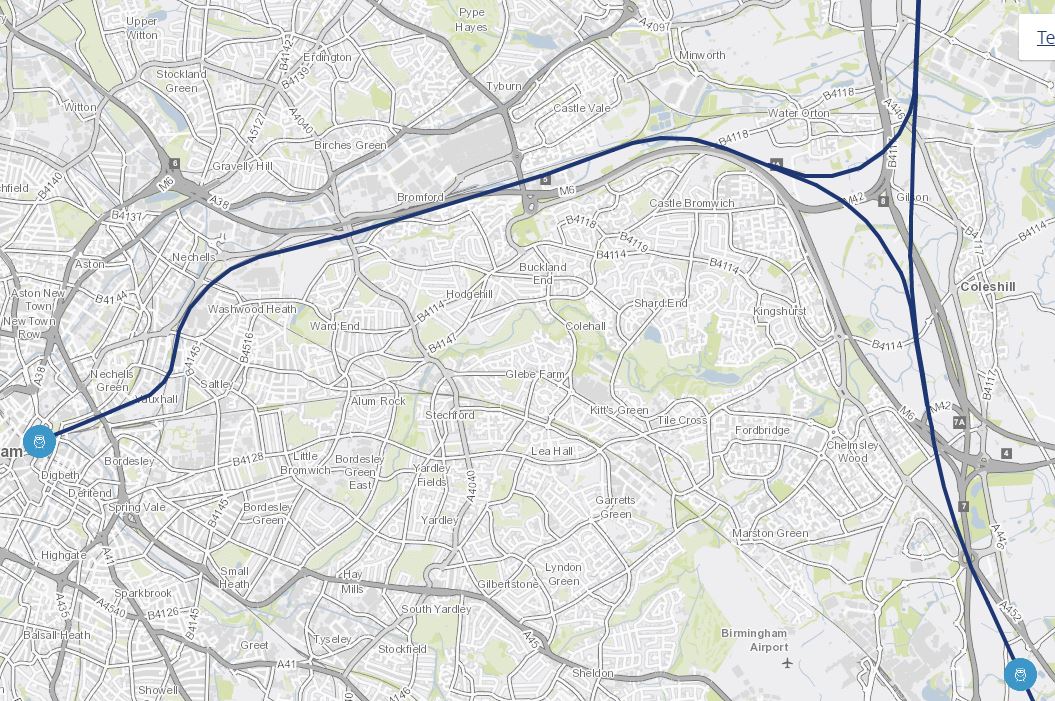
This map clipped from the High Speed Two web site, shows the route of the line to its terminus in Birmingham Curzon Street station.
Note.
- Birmingham Curzon Street station is indicated by the blue dot in the West.
- Interchange station is indicated by the blue dot in the South-East corner of the map.
- There is a large triangular junction connecting the spur to Birmingham Curzon Street to the main North-South route of High Speed Two.
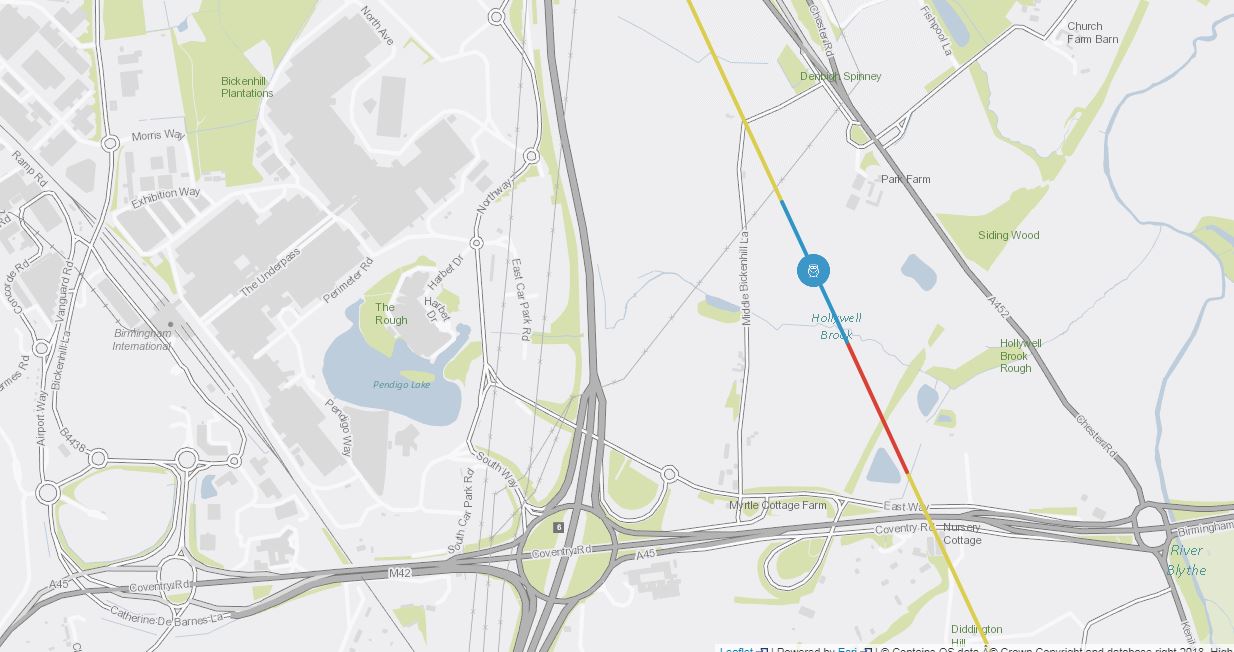
This second map is an enlargement of the South-East corner of the map.
Note.
- The road across the bottom of the map is the A45,
- The large circular roundabout roughly at the halfway [point is where the M42 crosses the A45 at Junction 6.
- The Junction at the Eastern edge of the map is where the A452 crosses the A45.
- High Speed Two goes roughly North-South between the M42 and the A452.
- When shown in red, High Speed Two is on an embankment.
- When shown in yellow, High Speed Two is in a tunnel.
- The large blue dot is the position of the Interchange station.
- The existing Birmingham International station is on the other side of the M42.
- The two stations will be connected by a people mover.
This description of the Interchange station is from this page on the High Speed Two web site.
The Interchange Station itself will be made up of two 415 metre long island platforms, offering 4 platform faces, as well as 2 central high speed through lines for non-stopping services. The station will be linked to the NEC, Birmingham International Station and Birmingham Airport via an automated people mover carrying up to 2,100 passengers per hour in each direction. In addition to the APM, the station will be fully integrated with other local buses, taxis and private vehicle options.
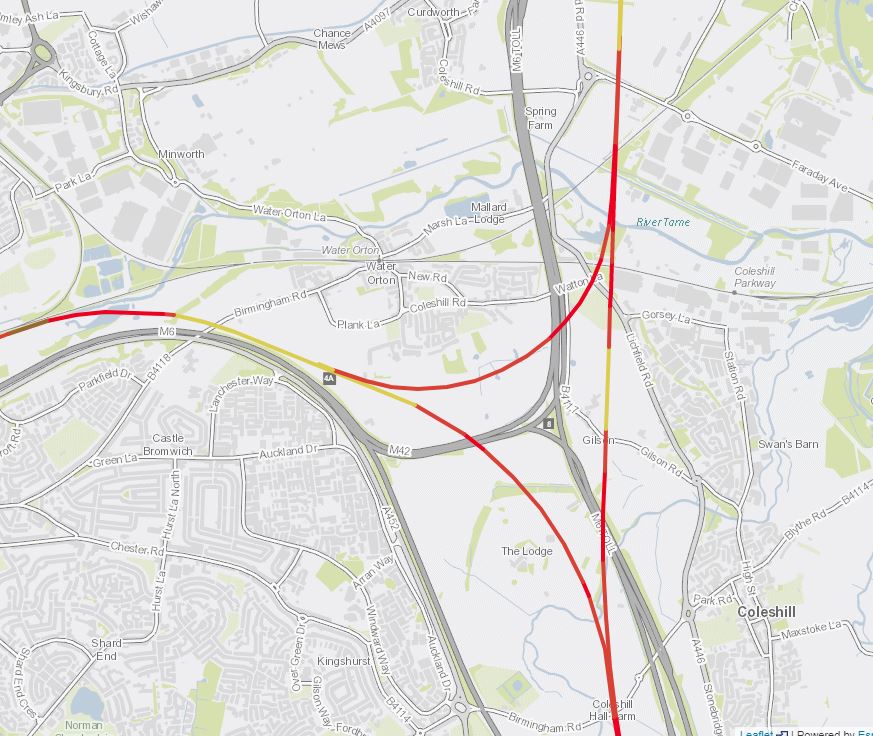
This third map is an enlargement of the triangular junction.
Note.
- The M6 going West to Spaghetti Junction, Birmingham and the North.
- The M42 and the M6 Toll going North-South.
- When shown in red, High Speed Two is on an embankment.
- When shown in yellow, High Speed Two is in a tunnel.
The junction seems to have been fitted around the motorways using a series of embankments and tunnels.
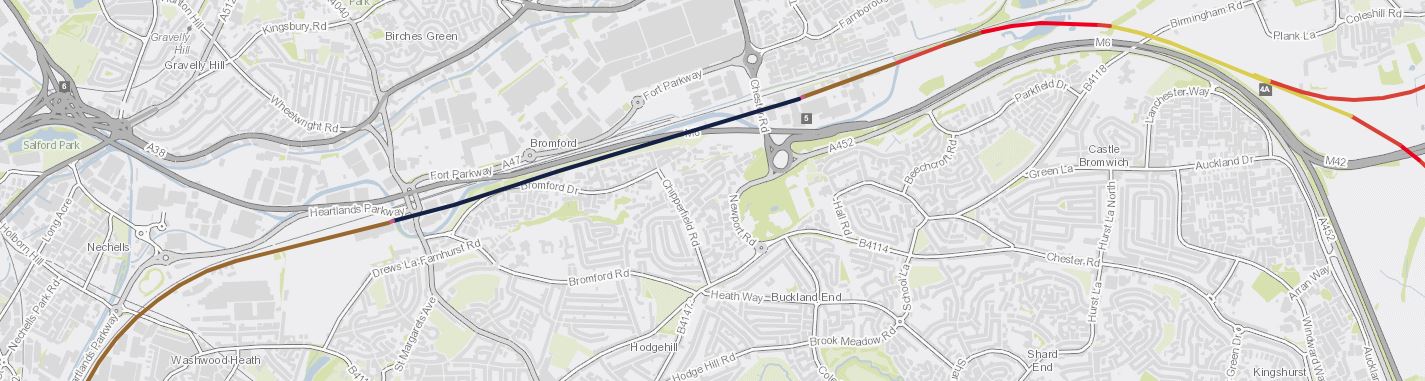
This fourth map shows the approach to the City.
Note.
- The spur appears to run alongside the elevated section of the M6.
- Spaghetti Junction is in the North-West corner of the map.
- The Western junction of the triangular junction is at the Eastern edge of the map.
- When shown in brown, High Speed Two is on the surface.
- When shown in black, High Speed Two is in a cutting.
- Or are black and brown, the other way round, as I can’t find the legend for the map.
The spur seems to have been neatly fitted in alongside the M6.
This fifth map shows the route as it terminates in Birmingham Curzon Street station.

Note.
- The A38 (M) that connects the City Centre to Spaghetti Junction at the top of the map.
- High Speed Two appears to approach the City Centre on a viaduct. But then trains between London and Birmingham New Street and Birmingham Moor Street stations, do the same.
- The three stations are within a reasonable walking distance and there will also be a tram connection.
- The journey time between Birmingham Curzon Street and Interchange stations is planned to be nine minutes.
This page on the High Speed Two web site, gives more details on Birmingham Curzon Street station.
Splitting And Joining Of High Speed Two Trains
In Existing Stations Where High Speed Two Trains Will Call, I looked at how existing stations will need to be modified to handle the High Speed Two service pattern described in an article, which is entitled HS2 Minister Backs 18 tph Frequency, in the June 2020 Edition of Modern Railways.
The article states that splitting and joining of trains will take place at three stations; Carlisle, Crewe and East Midlands Hub.
To successfully split and join the pairs of 200 metre long High Speed Two trains, the following will be needed.
- 400 metre long platforms, that can handle the pair of trains.
- Excellent signage, so that passengers get into the right train and leave for the right destination.
- Efficient crew methods, so that drivers are in the correct cabs at the right time.
For many years trains at Cambridge and several places South of London have successfully split and joined.
This video shows two Class 395 trains coupling and uncoupling automatically.
It;s impressive and I suspect High Speed Two’s trains will be equally good or even better at this procedure.
Why Is Split And Join Needed For High Speed Two?
According to the Modern Railways article, the full High Speed Two service will be as follows in trains per hour (tph) and trains per two hours (tp2h)
- 1 tph – London Euston and Birmingham Curzon Street via Old Oak Common (OOC) – 400 metres
- 2 tph – London Euston and Birmingham Curzon Street via OOC and Birmingham Interchange – 400 metres
- 1 tph – London Euston and Lancaster via OOC, Crewe, Warrington Bank Quay, Wigan North Western and Preston – London Euston and Liverpool Lime Street via OOC, Crewe and Runcorn – 200+200 metres with Split/Join at Crewe
- 1 tph – London Euston and Liverpool Lime Street via OOC, Crewe and Runcorn – 200 metres
- 1 tph – London Euston and Macclesfield via OOC, Stafford and Stoke-on-Trent – 200 metres
- 1 tph – London Euston and Manchester Piccadilly via OOC, Birmingham Interchange and Manchester Airport – 400 metres
- 2 tph – London Euston and Manchester Piccadilly via OOC and Manchester Airport – 400 metres
- 1 tph – London Euston and Edinburgh Waverley via OOC, Preston, Carlisle and Edinburgh Haymarket – London Euston and Glasgow Central via OOC, Preston and Carlisle – 200 +200 metres with Split/Join at Carlisle
- 1 tph – London Euston and Edinburgh Waverley via OOC, Birmingham Interchange, Preston, Carlisle and Edinburgh Haymarket – London Euston and Glasgow Central via OOC, Preston and Carlisle – 200 +200 metres with Split/Join at Carlisle
- 1 tp2h – Birmingham Curzon Street and Edinburgh Waverley via Wigan North Western, Preston, Lancaster, Oxenholme, Penrith and Edinburgh Haymarket – 200 metres
- 1 tp2h – Birmingham Curzon Street and Glasgow Central via Wigan North Western, Preston, Lancaster, Oxenholme, Penrith, Lockerbie and Motherwell – 200 metres
- 2 tph – Birmingham Curzon Street and Manchester Piccadilly via Manchester Airport – 200 metres
- 2 tph – Birmingham Curzon Street and Leeds via East Midlands Hub – 200 metres
- 1 tph – Birmingham Curzon Street and Newcastle via East Midlands Hub, Darlington and Durham – 200 metres
- 1 tph – London Euston and Sheffield via OOC and East Midlands Hub – London Euston and Leeds via OOC and East Midlands Hub – 200 + 200 metres with Split/Join at East Midlands Hub
- 1 tph – London Euston and Leeds via OOC and East Midlands Hub – 400 metres
- 1 tph – London Euston and Leeds via OOC, Birmingham Interchange and East Midlands Hub – 400 metres
- 1 tph – London Euston and Sheffield via OOC, East Midlands Hub and Chesterfield – London Euston and York via OOC and East Midlands Hub – 200 + 200 metres with Split/Join at East Midlands Hub
- 1tph – London Euston and Newcastle via OOC and York – 200 metres
- 1 tph – London Euston and Newcastle via OOC, York and Darlington – 200 metres
Note.
- Trains 10 and 11 share the same path in alternate hours.
- Birmingham Curzon Street is effectively a second Southern terminus.
- Seventeen tph leave London Euston and Old Oak Common for the North, of which eight are 400 metre trains, five are a pair of 200 metre trains and four are 200 metre trains.
As the five pairs of 200 metre trains Split/Join en route, this effectively means, that London Euston is served by twenty-two tph.
It would appear that Split/Join is important, as it allows the same number of train paths between London Euston and the North to support more services.
Could Any Other Trains Be Split And Joined?
I don’t see why not!
There are eight tph going North from London Euston and Old Oak Common, that are 400 metre long trains that don’t Split/Join
- 3 tph – Birmingham Curzon Street
- 2 tph – Leeds
- 3 tph – Manchester Piccadilly
Note.
- Each 400 metre train would appear to have a capacity of around 1,100 passengers.
- Leeds is also served by another 200 metre train from London.
Effectively, this gives the following passenger capacities between London and the three major cities.
- Birmingham – 3,300
- Leeds – 2,750
- Manchester – 3,300
If these capacities have been carefully predicted, performing a Split/Join on these trains might cause a shortage of capacity.
There are four single 200 metre trains, that could be doubled up for their run to the North.
- London Euston and Liverpool Lime Street via OOC, Crewe and Runcorn
- London Euston and Macclesfield via OOC, Stafford and Stoke-on-Trent
- London Euston and Newcastle via OOC and York
- London Euston and Newcastle via OOC, York and Darlington
In theory, these four trains could be doubled to provide extra services.
But there are two problems.
Where Would The Trains Split and Join?
- Train 1 could Split/Join at Crewe.
- Train 2 could Split/Join at Stafford, if the platforms were lengthened to accept a pair of 200 metre trains.
- Trains 3 and 4 would need to stop at East Midlands Hub to Split/Join
It would appear that four extra trains could be run into London Euston, by running all single trains as pairs.
Where Would The Extra Services Terminate?
There are possibilities on the Western leg of High Speed Two.
- An extra train for Liverpool Lime Street
- An extra train for Lancaster
- A direct train for the current Manchester Piccadilly via Wilmslow and Stockport
- A direct train for Blackpool
But the Eastern leg of High Speed Two is more of a problem.
- An extra train for Sheffield
- A direct train for Hull.
Hull could be served via a new junction between High Speed Two and the Hull-Leeds Line to the North-West of Garforth or perhaps by extending a service from Sheffield.
Could Any Services North From Birmingham Curzon Street Be Split And Joined?
These 200 metre services go North from Birmingham Curzon Street station.
- 1 tp2h – Birmingham Curzon Street and Edinburgh Waverley via Wigan North Western, Preston, Lancaster, Oxenholme, Penrith and Edinburgh Haymarket
- 1 tp2h – Birmingham Curzon Street and Glasgow Central via Wigan North Western, Preston, Lancaster, Oxenholme, Penrith, Lockerbie and Motherwell
- 2 tph – Birmingham Curzon Street and Manchester Piccadilly via Manchester Airport
- 2 tph – Birmingham Curzon Street and Leeds via East Midlands Hub
- 1 tph – Birmingham Curzon Street and Newcastle via East Midlands Hub, Darlington and Durham.
Note that trains 1 and 2 share the same path in alternate hours.
There may be scope to double up some of these trains, to serve extra destinations in the North from Birmingham Curzon Street.
Conclusion
Split/Join is a powerful tool to increase the number of services without spending a fortune on new infrastructure.
Existing Stations Where High Speed Two Trains Will Call
The June 2020 Edition Of Modern Railways has an article called HS2 Minister Backs 18 tph Frequency, which gives a detailed diagram of the route structure of High Speed Two and it is possible to summarise the stations, where High Speed Two trains will call.
- Carlisle – 3 tph – 400 metres – Split/Join
- Chesterfield – 1 tph – 200 metres
- Crewe – 2 tph – 400 metres – Split/Join
- Darlington – 2 tph – 200 metres
- Durham – 1 tph – 200 metres
- East Midlands Hub HS2 – 7 tph – 400 metres – Split/Join
- Edinburgh Haymarket – 2.5 tph – 200 metres
- Edinburgh Waverley – 2.5 tph – 200 metres – Terminal
- Glasgow Central – 2.5 tph – 200 metres – Terminal
- Lancaster – 2 tph – 200 metres – Terminal
- Leeds HS2 – 5 tph – 400 metres
- Liverpool Lime Street – 2 tph – 200 metres – Terminal
- Lockerbie – 1 tph – 200 metres
- Macclesfield – 1 tph – 200 metres – Terminal
- Manchester Airport HS2 – 5 tph – 400 metres
- Manchester Piccadilly HS2 – 5 tph – 400 metres
- Motherwell – 0.5 tph – 200 metres
- Newcastle – 3 tph – 200 metres – Terminal
- Oxenholme – 0.5 tph – 200 metres
- Penrith – 0.5n tph – 200 metres
- Preston – 4 tph – 400 metres
- Runcorn – 2 tph – 200 metres
- Sheffield – 2 tph – 200 metres
- Stafford – 1 tph – 200 metres
- Stoke-on-Trent – 1 tph – 200 metres
- Warrington Bank Quay – 1 tph – 200 metres
- Wigan North Western – 1 tph – 200 metres
- York – 4 tph – 200 metres
Note.
- HS2 after the station name indicates a new station for High Speed Two
- tph is trains per hour
- 0.5 tph is one train per two hours (tp2h).
- 200/400 metres is the maximum length of trains that will call.
- Terminal indicates that trains will terminate at these stations.
- Split/Join indicates that trains will split and join at these stations.
These are more detailed thoughts on how existing stations will need to be modified.
Train Lengths
Before, I look at the individual stations, I’ll look at the train lengths.
- High Speed Two train – Single – 200 metres
- High Speed Two train – Pair – 400 metres
- Class 390 train – 11-car – 265.3 metres
- Class 390 train – 9-car – 217.5 metres
- Class 807 train – 7-car – 182 metres
- Class 810 train – 5-car – 120 metres
- Class 810 train – Pair of 5-car – 240 metres
- InterCity 125 – 2+8 – 220 metres
- InterCity 225 – 9-car – 245 metres
- Class 222 train – 4-car – 93.34 metres
- Class 222 train – 5-car – 116.16 metres
- Class 222 train – 7-car – 161.8 metres
- Class 222 train – 4-car+5-car – 209.5 metres
- Class 222 train – 5-car+5-car – 232.32 metres
These are the thoughts on the individual stations.
Carlisle
Carlisle station will need two 400 metre through platforms, so each can accommodate a pair of 200 metre trains.
This Google Map shows the station.

I estimate the platforms are about 380 metres, but it looks like, they could be lengthened, without too much difficulty.
As High Speed Two trains to the North of Carlisle will be 200 metres long, there would probably be no need for platform lengthening North of Carlisle, as these trains are shorter than the Class 390 trains, that currently work the routes to Edinburgh and Glasgow.
Carlisle station is step-free, has good secondary rail connections and is within walking distance of the city centre.
The only thing it needs, is a connection to Edinburgh on a rebuilt Borders Railway.
Chesterfield
Consider.
- Chesterfield station will need to handle 200 metre trains.
- Chesterfield station may be rebuilt for High Speed Two.
- Chesterfield station can handle an InterCity 125, which is 220 metres.
- It will need to handle a pair of Class 810 trains, which would be 240 metres.
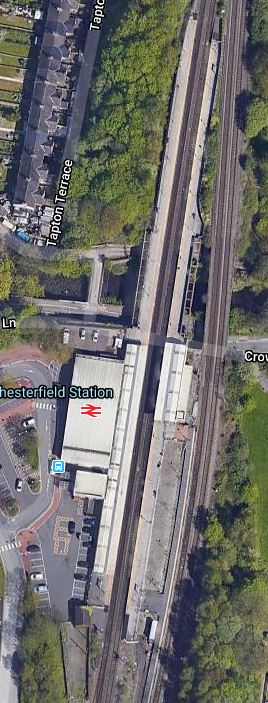
This Google Map shows Chesterfield station.
Note.
- The slow lines passing the station on the Eastern side.
- There are two long through platforms and a third bi-directional platform on the down slow line.
There is space to build two long platforms for High Speed Two, but is it worth it, when one one tph will stop?
- According to High Speed Two’s Journey Time Calculator, trains will take just twelve minutes between Sheffield and Chesterfield stations.
- This compares with 12-15 minutes for the current diesel trains.
- The distance between the two stations is 14 miles, which means that a twelve minute trip has an average speed of 70 mph.
- If there are still two tph to St. Pancras, there will be four tph, that run fast between the Sheffield and Chesterfield stations, of which three will stop at Chesterfield.
I think this could result in a simple and efficient design for the tracks between Sheffield and South of Clay Cross, where High Speed Two joins the Erewash Valley Line.
Chesterfield station is step-free.
Crewe
Crewe station will need two 400 metre through platforms, so each can accommodate a pair of 200 metre trains.
This Google Map shows the station.

There have been references to rebuilding of Crewe stations, but it does appear that some platforms are over 300 metres long.
Darlington
Darlington station will need to accommodate 200 metre trains.
As it already accommodates 245 metre InterCity 225 trains, there shouldn’t be too much of a problem.
Durham
Durham station will need to accommodate 200 metre trains.
As it already accommodates 245 metre InterCity 225 trains, there shouldn’t be too much of a problem.
Edinburgh Haymarket
Edinburgh Haymarket station will need to accommodate 200 metre trains.
As it already accommodates 245 metre InterCity 225 trains, there shouldn’t be too much of a problem.
Edinburgh Waverley
Edinburgh Waverley station will need to accommodate 200 metre trains.
As it already accommodates 245 metre InterCity 225 trains, there shouldn’t be too much of a problem.
Glasgow Central
Glasgow Central station will need to accommodate 200 metre trains.
As it already accommodates 265 metre Class 390 trains, there shouldn’t be too much of a problem.
Currently, Avanti West Coast runs the following services to Glasgow Central.
- One tph from London Euston calling at Warrington Bank Quay, Wigan North Western, Preston, Lancaster, Oxenholme Lake District (1tp2h), Penrith (1tp2h) and Carlisle.
- One tp2h from London Euston calling at Milton Keynes Central, Coventry, Birmingham International, Birmingham New Street, Sandwell and Dudley, Wolverhampton, Crewe, Warrington Bank Quay, Wigan North Western, Preston, Lancaster, Oxenholme Lake District (1tp2h), Penrith (1tp2h) and Carlisle.
High Speed Two is proposing to run the following trains to Glasgow Central.
- Two tph from London Euston calling at Old Oak Common, Preston and Carlisle.
- One tp2h from Birmingham Curzon Street calling at Wigan North Western, Preston, Lancaster, Oxenholme (1tp2h), Penrith (1tp2h), Carlisle, Lockerbie and Motherwell (1tp2h)
If the current services to Glasgow Central were to be replaced by the High Speed Two services, most travellers would get a similar or better service.
But if Avanti West Coast decide to drop their classic services to Glasgow via Birmingham, will travellers starting between Milton Keynes and Crewe, be a bit miffed to lose their direct services to Glasgow?
Glasgow Central station would appear to be ready for High Speed Two.
Lancaster
I was initially surprised, that on High Speed Two, one tph would terminate at Lancaster station.
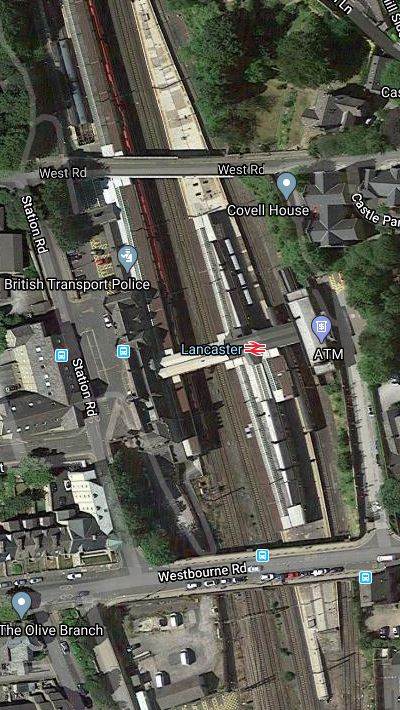
This Google Map shows the station.
Note.
- There are two bypass lines without any platforms on the Western side of the tracks, where trains can speed through.
- The station has five platforms.
- Some Avanti West Coast services terminate at Lancaster station.
- 265 metre, eleven-car Class 390 trains, stop in Lancaster station.
As High Speed Two services will use 200 metre trains, which are shorter than all Class 390 trains, I would suspect that High Speed Two services will be able to be turned at Lancaster station, without too much difficulty.
Liverpool Lime Street
Liverpool Lime Street station will need to be able to turn two 200 metre High Speed Two tph.
- The remodelling of the station in 2018, probably allowed for two tph between London Euston and Liverpool Lime Street station.
- From 2022-2023, it will be turning two Class 807 trains per hour, which will probably be 182 metres long.
Liverpool Lime Street station may well be ready for Phase One of High Speed Two. It’s also very much step-free.
There are also alternative plans for a new High Speed station in Liverpool.
- It would be alongside the current Liverpool Lime Street station.
- The station would have a route to High Speed Two at Crewe via Warrington and a junction at High Legh.
- Northern Powerhouse Rail would start in the station and go to Manchester via Warrington, High Legh and Manchester Airport.
- It would enable six tph between Liverpool and Manchester, in a time of just 26 minutes.
I talked about this plan in Changes Signalled For HS2 Route In North, where I included this map.

High Legh Junction is numbered 5 and 6.
Nothing published about High Speed Two, would appear to rule this plan out.
Lockerbie
Lockerbie station will need to accommodate 200 metre trains.
As it already accommodates 265 metre Class 390 trains, there shouldn’t be too much of a problem.
Macclesfield
I was initially surprised, that on High Speed Two, one tph would terminal at Macclesfield station.
This Google Map shows the station.

Wikipedia says this about the platforms in the station.
There are three platforms but only two are in regular use, the up platform for services to Manchester and the down platform to Stoke-on-Trent and Birmingham. Platform 3 sees a small number of services. Evidence of a fourth platform can be seen, on which a Network Rail building now exists.
As the station has a regular Avanti West Coast service every hour, the platforms must be over 200 metres long and they will be long enough for the 200 metre High Speed Two trains.
So why would High Speed Two want to terminate a train at Macclesfield, rather than at Manchester Piccadilly as they do now?
Currently, Avanti West Coast runs these services between London Euston and Manchester Piccadilly.
- One tph via Milton Keynes Central, Stoke-on-Trent and Stockport.
- One tph via Stoke-on-Trent, Macclesfield and Stockport
- One tph via Stafford, Crewe, Wilmslow and Stockport
The diagram in the Modern Railways article shows these High Speed Two services to Manchester Piccadilly.
- One tph from London Euston via Old Oak Common, Birmingham Interchange and Manchester Airport
- Two tph from London Euston via Old Oak Common and Manchester Airport
- Two tph from Birmingham Curzon Street via Manchester Airport.
Note.
- None of these five tph serve Macclesfield, Milton Keynes Central, Stockport, Stoke-on-Trent or Wilmslow.
- All five proposed services are shown to call at Manchester Airport.
- It is likely, that a tunnel will be bored between Manchester Airport and Manchester Piccadilly stations.
- The High Speed Two station at Manchester Piccadilly might even be in a tunnel under the current Manchester Piccadilly station or central Manchester.
- A below-ground High Speed Two station for Manchester could also serve Northern Powerhouse Rail services to Leeds and the East.
- According to the plans, I talked about under Liverpool Lime Street earlier, there could also be up to six tph running between Liverpool and Manchester via Manchester Airport, as part of Northern Powerhouse Rail.
Plans need to be developed to serve the towns and cities, that will not be served by High Speed Two’s current proposals.
- It appears Stafford, Stoke-on-Trent and Macclesfield will be served by an independent High Speed Two service from London Euston.
- Terminating one tph at Macclesfield station doesn’t appear to be challenging.
- A rail route between Macclesfield and Manchester Airport to link up with the proposed tunnel could be very difficult.
- Manchester Piccadilly and Macclesfield stations have a frequent rail connection, with most trains calling at Stockport station.
- Perhaps during construction work for High Speed Two in the centre of Manchester, Macclesfield station can be used as an alternative route into the city, using the existing Manchester Piccadilly station.
The London Euston and Macclesfield service via Stafford and Stoke-on-Trent could be a pragmatic solution to part of the problem, but what about Milton Keynes, Wilmslow and Stockport?
According to the title of the Modern Railways article, High Speed Two will have a maximum frequency of 18 tph.
When fully-developed, the current proposed timetable shows the following.
- A frequency of 17 tph between London Euston and Birmingham Interchange stations.
- A frequency of 11 tph between Birmingham and Crewe.
- A frequency of 9 tph through East Midlands Hub station.
It would appear that if there is a capacity bottleneck, it is between London and Birmingham.
However if classic services to Manchester Piccadilly are replaced by the High Speed Two services to the city via the new tunnel from Manchester Airport to a new station in the City Centre, there will be spare capacity on the Crewe and Manchester Piccadilly route via Wilmslow and Stockport stations.
This could lead to a number of solutions.
- A direct High Speed Two service runs using the spare path, between London and the current Manchester Piccadilly station.
- Similar to the previous service, but the service splits and joins at Crewe, with one individual train going to Manchester Piccadilly and the other somewhere else. Blackpool?
- One service between London and Liverpool is planned to split and join at Crewe with individual trains going to Lancaster and Liverpool. The other Liverpool service could split at Crewe with individual trains going to Liverpool and Manchester Piccadilly.
- The service between London and Macclesfield is run by a pair of trains, that split at Birmingham Interchange, with individual trains going to Macclesfield and Manchester Piccadilly. The advantage of this service, is that if you got into the wrong train, you’d still be going to roughly the same destination.
- Wikipedia says “At peak times, the current Avanti West Coast services may additionally call at one or more of: Watford Junction, Rugby, Nuneaton, Tamworth, Lichfield Trent Valley.” So why not run classic services on the West Coast Main Line between Euston and Manchester Piccadilly via Milton Keynes using suitably fast trains. Perhaps, the new Class 807 trains would be ideal.
Note.
- All services serving the current Manchester Piccadilly station would call at Crewe, Wilmslow and Stockport stations.
- Passengers going to or from Manchester Airport would change at Crewe.
The more I look at Macclesfield, the more I like using it as a High Speed Two destination.
Motherwell
Motherwell station will need to accommodate 200 metre trains.
As it already accommodates 265 metre Class 390 trains, there shouldn’t be too much of a problem.
Newcastle
Newcastle station will need to accommodate 200 metre trains.
As it already accommodates 245 metre InterCity 225 trains, there shouldn’t be too much of a problem.
Oxenholme
Oxenholme station will need to accommodate 200 metre trains.
As it already accommodates 265 metre Class 390 trains, there shouldn’t be too much of a problem.
Penrith
Penrith station will need to accommodate 200 metre trains.
As it already accommodates 265 metre Class 390 trains, there shouldn’t be too much of a problem.
Preston
Preston station will need two 400 metre through platforms, so each can accommodate a pair of 200 metre trains.
This Google Map shows the station.

I estimate that the main through platforms aren’t much short of the required 400 metres.
But something must be done to make the station step-free.
Runcorn
Runcorn station will need to accommodate 200 metre trains.
As it already accommodates 217 metre Class 390 trains, there shouldn’t be too much of a problem. The station is also step-free.
Sheffield
Sheffield station will need to accommodate 200 metre trains.
This Google Map shows the station.

As the station can already handle a 220 metre InterCity 125, there shouldn’t be too much of a problem. The station is also substantially step-free.
Stafford
Stafford station will need to accommodate 200 metre trains.
This Google Map shows the station.

As it already accommodates 265 metre Class 390 trains, there shouldn’t be too much of a problem. The station is also step-free.
Wikipedia says this about Stafford station and High Speed Two.
Under current proposals, Stafford will be a part of the High Speed 2 network, via a ‘Classic Compatible’ junction, which will allow HS2 trains to operate to Stafford, and further on towards Liverpool. This would shorten journey time from Stafford to London, to an estimated 53 minutes. Under current proposals it is expected that an hourly services will operate in both directions, however it is currently unclear if these services will terminate at Stafford, or Liverpool.
This does appear to be rather out of date with High Speed Two’s latest proposals as disclosed in the Modern Railways article, which say that Stafford is served by the following service.
- One tph between London Euston and Macclesfield.
- Calls at Old Oak Common, Stafford and Stoke-on-Trent.
- A 200 metre train.
One possibility must surely be to run a pair of 200 metre trains to and from Stafford, where they would split and join.
- One could go as currently proposed to Stoke-on-Trent and Macclesfield.
- The second train could go to Liverpool via Crewe and Runcorn or Manchester Piccadilly via Crewe, Wilmslow and Stockport.
- The recent works at Norton Bridge Junction will have improved the route for the second train.
There would need to be platform lengthening at Stafford to accommodate the 400 metre pair of trains.
A split and join at Stafford does show the possibilities of the technique.
Another possibility is mentioned for Stafford in Wikipedia.
There is also been proposals to reintroduce services to Stafford to terminate on the Chase Line which was cutback to Rugeley Trent Valley in 2008. The Key Corridors states “Extension of Chase Line services to Stafford”. This is proposed to be in development.
It will surely connect a lot of people to Stafford for High Speed Two.
The extract from Wikipedia, that I used earlier, mentions a Classic Compatible junction, which will allow High Speed Two trains to reach Stafford.
This map clipped from the High Speed Two web site, shows the junction North of Lichfield, where High Speed Two connects to the Trent Valley Line through Stafford.

Note.
- High Speed Two runs North-South across the map.
- After the Junction by Fradley South,
- High Speed Two to Crewe and the North, is the branch to the East.
- The other branch connects to the Trent Valley Line, which can be picked out North of Lichfield, where it passes through Lichfield Trent Valley station.
The Trent Valley Line is no Victorian double-track slow-speed bottleneck.
- Most of the route between Rugby and Stafford is three or four tracks.
- The speed limit is generally 125 mph.
- I wouldn’t be surprised to see Avanti West Coast’s Class 390 and Class 807 trains running at 140 mph on the route.
- This speed would probably be attained by High Speed Two trains.
London Euston and Stafford would only have under twenty miles of slower line and that could be 140 mph, so High Speed Two times on the route could be very fast. High Speed Two is quoting 54 minutes on their Journey Time Calculator.
Stoke-on-Trent
Stoke-on-Trent station will need to accommodate 200 metre trains.
This Google Map shows the station.
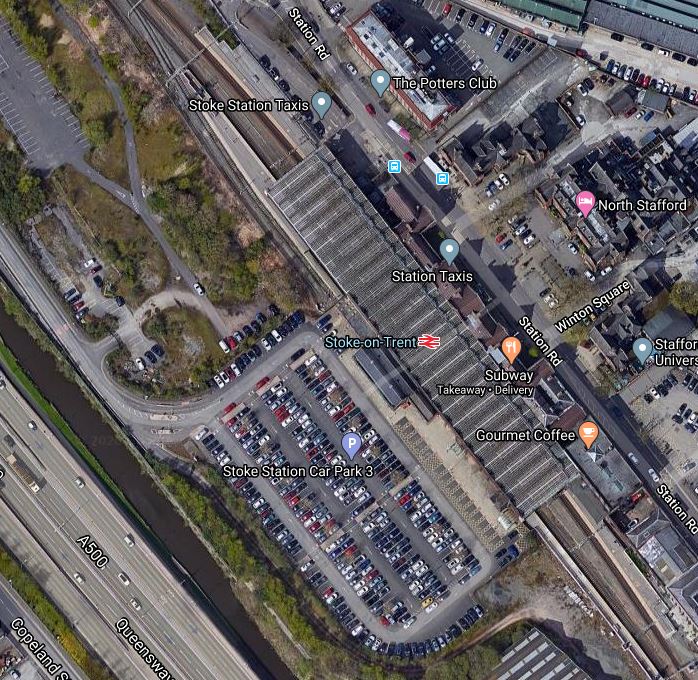
As it already accommodates 265 metre Class 390 trains, there shouldn’t be too much of a problem. The station is also step-free.
Warrington Bank Quay
Warrington Bank Quay station will need to accommodate 200 metre trains.
As it already accommodates 265 metre Class 390 trains, there shouldn’t be too much of a problem.
Wigan North Western
Wigan North Western station will need to accommodate 200 metre trains.
In Is Wigan North Western Station Ready For High Speed Two?, I said this.
Wigan North Western station would accept a single-train now, but the platforms would need lengthening to handle a double-train.
As all trains through Wigan North Western station will only be 200 metre single trains and the station is step-free, the station appears to be ready for High Speed Two.
York
York station will need to accommodate 200 metre trains.
As it already accommodates 245 metre InterCity 225 trains, there shouldn’t be too much of a problem.
Conclusion
I have come to these conclusions.
- Because most of these stations have been rebuilt in the last few decades to accommodate the 200-plus metre InterCity 125s, InterCity 225s and Class 390 trains, all the stations can handle a 200 metre High Speed Two train without significant lengthening.
- Some stations like Carlisle, Crewe, Preston and Stafford may need a small amount of platform lengthening to accommodate a pair of trains, but most of the improvements needed for a world-class High Speed railway will be more refurbishment than a complete rebuild.
- Using existing platforms at Lancaster and Macclesfield stations as terminal platforms is an elegant and a much more affordable solution than building new stations or even platforms.
- Because all five tph into the High Speed Two station at Manchester Piccadilly go via Manchester Airport, I would envisage that this will be in a tunnel, that can be part of a future Northern Powerhouse Rail.
I also think that the plan has been devised with the Project Management and minimising disruption to travellers in mind.
Will The East Coast Main Line Give High Speed Two A Run For Its Money To The North East Of England?
I have looked up High Speed Two timings on their Journey Time Calculator and compared them with current LNER timetables.
- London-Leeds – Current – 136 minutes – HS2 – 81 minutes
- London-York – Current – 111 minutes – HS2 – 84 minutes
- London – Darlington – Current – 141 minutes – HS2 – 112 minutes
- York- Darlington – Current – 27 minutes – HS2 – 26 minutes
- London – Durham – Current – 170 minutes – HS2 – 138 minutes
- York – Durham – Current – 45 minutes – HS2 – 44 minutes
- London – Newcastle – Current – 170 minutes – HS2 – 137 minutes
- York – Newcastle – Current – 55 minutes – HS2 – 51 minutes
- London – Edinburgh – Current – 259 minutes – HS2 – 220 minutes
- Newcastle – Edinburgh – Current – 83 minutes – HS2 – 83 minutes
- York – Edinburgh – Current – 138 minutes – HS2 – 134 minutes
Note.
- I have assumed that Newcastle and Edinburgh takes 83 minutes, which is the current timing.
- The time savings possible to the North of Leeds are only a few minutes.
- As an example, the straight route between York and Darlington is 34 miles, which means an average speed of only 75 mph.
Serious work needs to be done North of York to improve timings.
Improvements To The East Coast Main Line
Various improvements to the East Coast Main Line are in process of building designed or built.
Extra Tracks
These example of more tracks are from the Wikipedia entry for the East Coast Main Line.
- Four tracks are being restored between Huntington and Woodwalton.
- Freight loops between York and Darlington.
There are probably other places, which will see extra tracks in the next few years.
Power Supply And Electrification
Wikipedia identified places where the power supply and the electrification could be better.
This sentence indicates the comprehensive nature of the planned work.
Power supply upgrades (PSU) between Wood Green and Bawtry (Phase 1 – completed in September 2017) and Bawtry to Edinburgh (Phase 2), including some overhead lines (OLE) support improvements, rewiring of the contact and catenary wires, and headspan to portal conversions (HS2P) which were installed at Conington in January 2018.
The Hertford Loop Line is also due to have some power supply upgrades.
Station Improvements
Darlington, Kings Cross, Stevenage and York will have track improvements, which will improve the capacity of the tracks through the stations.
Werrington Dive Under
The Werrington Dive Under will be a big improvement. This is an extract from the Wikipedia entry.
The project will see the construction of 1.9 miles (3 km) of new line that will run underneath the fast lines, culverting works on Marholm Brook and the movement of the Stamford lines 82 feet (25 m) westwards over the culverted brook. This will mean that trains for the GN/GE line no longer need to cross the fast lines on the level, nor use the Up Fast line between Peterborough station and the junction. The project, coupled with other ECML improvement schemes (such as the four tracking from Huntingdon to Woodwalton) will improve capacity on the line through Peterborough by 33% according to Network Rail. This equates to two extra train paths an hour by 2021, when the work is scheduled to be completed. In turn, this will remove 21 minutes from the fastest King’s Cross to Edinburgh Waverley service, and 13 minutes from the fastest King’s Cross to Leeds service. It will also see an increase of 1,050 ‘intercity’ seats per hour on express trains through Peterborough.
The upgrade will add two more train paths to the route and knock 21 and 13 minutes off the faster Edinburgh and Leeds services respectively.
The Newark Flat Crossing
This is the railway equivalent of a light-controlled pedestrian crossing in the middle of a motorway.
This Google Map shows the crossing.
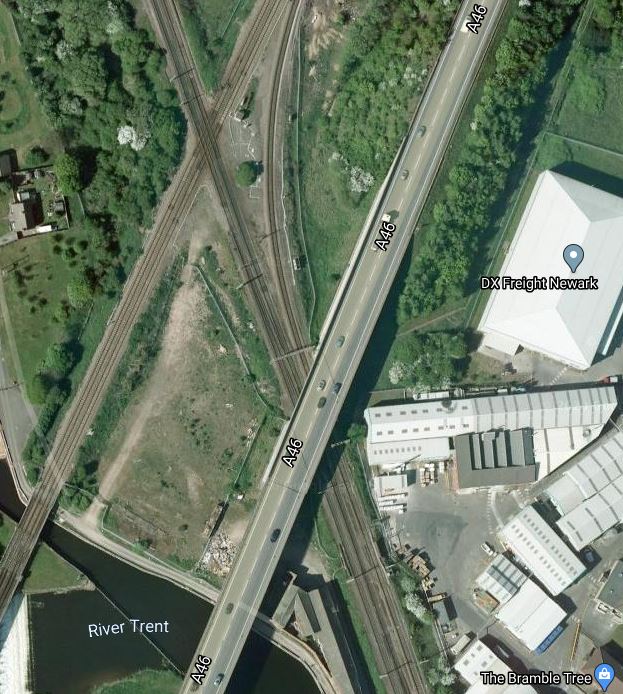
Note.
- The East Coast Main Line running roughly North-South
- The A 46 road crossing the line.
- The Nottingham-Lincoln Line running parallel to the railway.
- A chord allowing trains to go between the Nottingham-Lincoln Line and Newark North Gate station, which is to the South.
- The River Trent.
Complicated it certainly is!
I wrote about the problems in The Newark Crossing and felt something radical needed to be done.
Looking at the numbers of trains at the Newark Crossing.
- The number of trains crossing the East Coast Main Line, is typically about three to five trains per hour (tph) and they block the East Coast Main Line for about two minutes.
- But then there could be a fast train around every four minutes on the East Coast Main Line, with eight tph in both directions.
The numbers of trains and their speeds would probably cut out a Control Engineer’s solution, where all trains are computer controlled through the junction.
Although, it might be possible to reduce the number of conflicting trains on the East Coast Main Line dramatically, by arranging a Northbound and a Southbound express passed each other at the flat junction.
There’s also the problem of what happens if a crossing train fails, as it goes over the East Coast Main Line. But that must be a problem now!
Whatever happens here will be a well-thought through solution and it will add to the capacity of the East Coast Main Line and increase the line-speed from the current 100 mph.
Level Crossings
Wikipedia says this about level crossings.
Level crossing closures between King’s Cross and Doncaster: As of July 2015 this will no longer be conducted as a single closure of 73 level crossings but will be conducted on a case-by case basis (for example, Abbots Ripton Level Crossing will close as part of the HW4T scheme).
It is my personal view that all should be removed.
ERTMS Signalling
Wikipedia says this about the installation of ERTMS digital in-cab signalling.
The line between London King’s Cross and Bawtry, on the approach to Doncaster, will be signalled with Level 2 ERTMS. The target date for operational ERTMS services is December 2018 with completion in 2020.
Note that, ERTMS is needed for 140 mph running.
140 mpg Running
Wkipedia says this about 140 mph running.
Increasing maximum speeds on the fast lines between Woolmer Green and Dalton-on-Tees up to 140 mph (225 km/h) in conjunction with the introduction of the Intercity Express Programme, level crossing closures, ERTMS fitments, OLE rewiring and the OLE PSU – est. to cost £1.3 billion (2014). This project is referred to as “L2E4” or London to Edinburgh (in) 4 Hours. L2E4 examined the operation of the IEP at 140 mph on the ECML and the sections of track which can be upgraded to permit this, together with the engineering and operational costs.
A rough calculation indicates that up to eleven minutes could be saved by this upgrade, between London and Darlington.
Prospective Timings On The East Coast Main Line
Consider.
- The package of new trains level crossing closures, ERTMS, OLE rewiring and the OLE PSU, which is collectively known as L2E4 should deliver Edinburgh in four hours.
- Nineteen minutes need to be saved on current times.
- I believe that if the train takes four hours or less, travellers will switch from the airlines.
- High Speed Two are aiming for a time of 220 minutes, but is this by the West or East Coast routes?
- As their proposed Glasgow service has a similar time, I assume it is by the West Coast route.
- Wikipedia states that an Open Access Operator was thinking of running Class 390 trains or Pendelinos between London Kings Cross and Edinburgh in 223 minutes.
If the managers of LNER are the least bit ambitious, I can see them wanting to run a service between London and Edinburgh, in a time that is several minutes under four hours.
It should always be remembered that the East Coast Main Line was built for speed, as these true stories illustrate.
- Mallard set the world speed record for steam locomotives in 1938 of 126 mph, on the line.
- The record time between London and Edinburgh was set in 1991 by an InterCity 225 train at a minute under three-and-a-half hours.
I even have my own special memory of the line, which I wrote about in The Thunder of Three-Thousand Three-Hundred Horses. Behind a Deltic or Class 55 locomotive, I went from Darlington to London in two hours and fifteen minutes, which is faster than today’s fastest trains. Not bad for a 1960s design, but the train was a coach short and had a clear run. And was probably extremely-well driven.
Is the East Coast Main Line and especially the section South of Darlington, a route, where a knowledgeable driver can coax the maximum out of a high speed train?
Possible savings over the next few years include.
Werrington Junction
When this is completed, it could knock twenty-one minutes off the timings to Edinburgh.
Newark Crossing
How much time could be saved here?
There must be some time savings if the line speed can be increased from 100 mph.
140 mph Running
The various improvements in L2E4 are intended to enable services to run between London and Edinburgh in under four hours.
- Does L2E4 include any possible time savings from the Werrington Dive Under?
- Does L2E4 include any possible time savings from improvements at Newark?
- What is the completion date for L2E4?
- Most of the time savings for L2E4 will be South of Darlington as the track is straighter.
As I said earlier a rough calculation indicates that L2E4 will save about eleven minutes to the South of Darlington.
Conclusion
There must be over thirty minutes of savings to be accumulated on the East Coast Main Line. Much of it because of the Werrington and Newark improvements will be South of Darlington.
I wouldn’t be surprised to see timings like these.
- London-Leeds – Current – 136 minutes – HS2 – 81 minutes – Possible ECML – 120 minutes
- London-York – Current – 111 minutes – HS2 – 84 minutes – Possible ECML – 90 minutes
- London – Darlington – Current – 141 minutes – HS2 – 112 minutes – Possible ECML – 115 minutes
- London – Durham – Current – 170 minutes – HS2 – 138 minutes – Possible ECML – 130 minutes
- London – Newcastle – Current – 170 minutes – HS2 – 137 minutes – Possible ECML – 130 minutes
- London – Edinburgh – Current – 259 minutes – HS2 – 220 minutes – Possible ECML – 210 minutes
It looks to me, that the East Coast Main Line could be fulfilling the aspirations of British Rail’s engineers of the 1980s.
Railway Lines Through East Midlands Hub Station
This Google Map shows the position of High Speed Two‘s East Midland Hub station to the West of Nottingham.
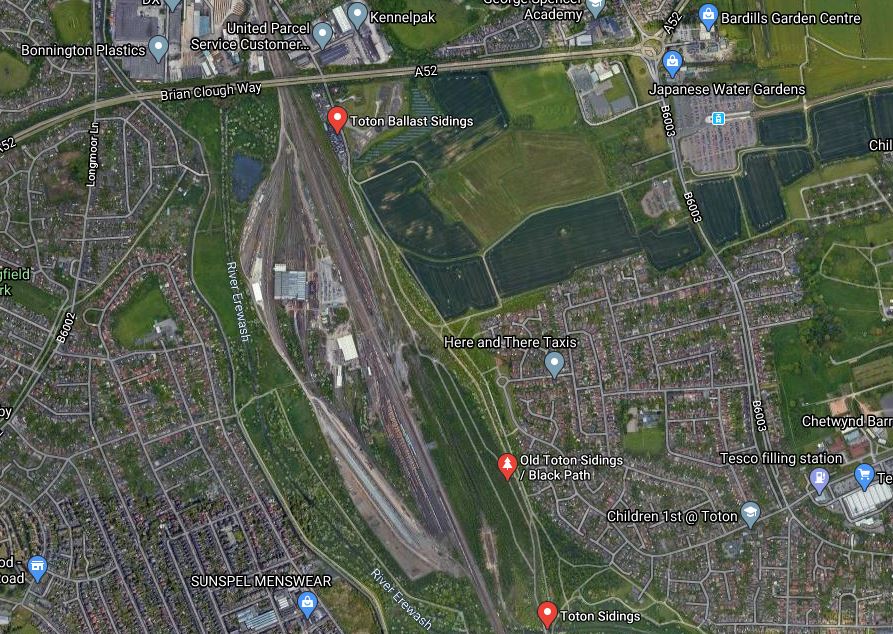
Note.
- In the North East Corner of the map, is a label saying Japanese Water Garden. Below that is a blue dot, which marks the Toton Lane tram stop.
- Three red arrows relate to Toton Ballast Sidings, Old Toton Sidings (Black Path) and Toton Sidings from North to South.
- Running to the West of the arrows is a double-track railway and beyond that are a large number of sidings.
This second Google Map shows some of the sidings.

The double track main line is the Erewash Valley Line.
- This line goes North to Ilkeston, Langley Mill, Alfreton, Clay Cross North Junction, Chesterfield and Sheffield.
- Going South, the route splits with one branch going East through Attenborough and Beeston to Nottingham station.
- The other branch turns to the West and then splits again at the massive Trent Junction.
- One branch goes West through Long Eaton station, under the M1, through Spondon station and on to Derby station.
- The second branch goes South over the River Trent to join up with the Midland Main Line and pass through East Midlands Parkway station.
- There is also a chord across the Trent Junction to allow trains to go between Long Eaton and East Midlands Parkway stations.
It is sounds complicated this map from High Speed Two may help.

Note.
- High Speed Two is shown in orange, with the blue dot indicating the East Midlands Hub station.
- Nottingham station is to the North East.
- Attenborough station can be picked out on the line going to Nottingham station.
- The water is in the Trent Valley.
- Trent Junction is the large triangular junction to the West of High Speed Two.
- Two rail lines lead to the West from Trent junction; the northerly one goes to Derby by Long Eaton and the other is a freight line to Castle Donington and East Midlands Gateway.
It is worth looking at how the various passenger services go through the area.
- CrossCountry – Cardiff and Nottingham goes via Derby, Long Eaton, Attenborough, Beeston and Nottingham
- CrossCountry – Birmingham and Nottingham goes via Derby, Long Eaton, Attenborough, Beeston and Nottingham
- East Midlands Railway – Leicester and Lincoln goes via East Midlands Parkway, Attenborough, Beeston and Nottingham
- East Midlands Railway – Liverpool and Norwich goes via Alfreton, Langley Mill, Ilkeston and Nottingham
- East Midlands Railway – Matlock and Newark Castle goes via Derby, Long Eaton, Attenborough, Beeston and Nottingham
- East Midlands Railway – St. Pancras and Sheffield goes via East Midlands Parkway, Long Eaton and Derby
- East Midlands Railway – St. Pancras and Nottingham goes via East Midlands Parkway, Attenborough, Beeston and Nottingham
- Northern – Leeds and Nottingham goes via Alfreton, Langley Mill, Ilkeston and Nottingham.
Note.
- Not one service goes past the site of the new East Midlands Hub station.
- Most services to and from Nottingham seem to use the Attenborough and Beeston route
- Services between Derby and Nottingham go via the Long Eaton, Attenborough and Derby route.
- Services from the North use the Erewash Valley Line and turn East at Trowell for Nottingham.
It is fairly obvious that there needs to be a sort-out of services to fit in with the location of the new East Midlands Parkway station.
Classic-Compatible High Speed Two Trains At East Midlands Hub Station
This article on Rail News, is entitled £2.7bn East Midlands Plan Unveiled For HS2 Links.
This is the first two paragraphs.
A bold plan costed at £2.7 billion for the area around the HS2 hub in the East Midlands has been published by a group of councils, transport bodies and East Midlands Airport.
The core of the scheme is the future East Midlands Hub at Toton, and the plan proposes direct access to the Hub from more than 20 cities, towns and villages in the East Midlands.
If you want to read the original report by Midlands Connect, there’s a download link on this page of their web site.
The original report has a section entitled Midlands Engine Rail, where this is said.
This project is fully integrated with Midlands Engine Rail, a rail improvement plan developed by Midlands Connect to revolutionise connectivity, mobility and productivity across the region. Midlands Engine Rail includes plans for two new HS2 classic-compatible services on an electrified Midland Main Line that will run direct from:
- Bedford and Leeds via Leicester and East Midlands Hub
- Nottingham and Birmingham Curzon Street via East Midlands Hub
These services can run on both electrified and high speed tracks, and would join the HS2 network at Toton, the HS2 East Midlands Hub, meaning that Nottingham and Leicester city centres are directly linked to HS2 without the need to change trains.
These improved connections will more than halve current journey times, with Leicester to Leeds dropping from 120 minutes to 46 minutes and Nottingham to Birmingham falling from 72 minutes to 33 minutes.
Note.
- Between Bedford and East Midland Hub stations, the Midland Main Line is or soon will be an almost a complete 125 mph rail line.
- It is likely, that with digital in-cab signalling, that faster running up to 140 mph may be permitted in places.
- Between Birmingham Curzon Street and East Midlands Hub stations, trains will use High Speed Two at up to 205 mph.
- Between Leeds and East Midlands Hub stations, trains will use High Speed Two at up to 205 mph.
- Leeds and Birmingham Curzon Street station will be new stations for High Speed Two.
The Classic-Compatible Trains
These are described in this section in Wikipedia, by this sentence.
The classic-compatible trains, capable of high speed but built to a British loading gauge, permitting them to leave the high speed track to join conventional routes such as the West Coast Main Line, Midland Main Line and East Coast Main Line. Such trains would allow running of HS2 services to the north of England and Scotland, although these non-tilting trains would run slower than existing tilting trains on conventional track. HS2 Ltd has stated that, because these trains must be specifically designed for the British network and cannot be bought “off-the-shelf”, these conventional trains were expected to be around 50% more expensive, costing around £40 million per train rather than £27 million for the captive stock.
The trains will have the same characteristics as the full-size trains.
- Maximum speed of 225 mph.
- Cruising speed of 205 mph on High Speed Two.
- Length of 200 metres.
- Ability to work in pairs.
- A passenger capacity around 500-600 passengers.
It should be noted that one of these trains will be shorter than a pair of East Midlands Railway’s five-car Class 810 trains, which should avoid any serious platform lengthening on existing lines.
Bedford and Leeds via Leicester and East Midlands Hub
A few facts and thoughts.
- The service is shown as stopping at Wellingborough, Kettering, Market Harborough, Leicester, Loughborough and East Midlands Hub.
- The service frequency could be hourly, but two trains per hour (tph) would be better.
- This service could be more important, than it appears, as by the time High Speed Two opens to Leeds, the East West Railway will be open through Bedford.
- Would a terminal platform need to be added at Bedford station? As the station could be rebuilt for the East West Railway, this shouldn’t be a problem.
- Leeds will have a new High Speed Two station or at least new platforms in the existing station.
- The Bedford and Leeds service would join High Speed Two at East Midlands Hub and go North.
- The Leeds and Bedford service would leave High Speed Two at East Midlands Hub and go South.
Leeds and Leicester will take 46 minutes, with High Speed Two’s journey time calculator, indicating twenty-seven minutes between East Midlands Hub and Leeds stations.
According to an article in the June 2020 Edition of Modern Railways High Speed Two is planning to run the following services on the Eastern leg of High Speed Two between East Midlands Hub and Leeds.
- Two tph – Birmingham Curzon Street and Leeds
- Three tph – London Euston and Leeds
There will be a Turn-Up-And-Go six tph service between East Midlands Hub and Leeds stations.
If the Bedford and Leeds service was an hourly service, when added to the current East Midlands Railway Inter-City services, it would give the following calling frequencies.
- Wellingborough – 2 tph
- Kettering – 2 tph
- Market Harborough – 3 tph
- Leicester – 5 tph
- Loughborough – 3 tph
- East Midlands Parkway – 2 tph
The calling pattern can be adjusted to the number of passengers.
Nottingham and Birmingham Curzon Street via East Midlands Hub
A few facts and thoughts.
- The service is shown as only stopping at East Midlands Hub.
- The service frequency could be hourly.
- The service would go between East Midlands Hub and Nottingham using the Trowell Curve route, which I discussed in Access To Toton – Scheme 6 – Trowell Curve.
- Nottingham station has long terminal platforms that take a full-length Inter-City 125.
- Birmingham Curzon Street will be a new High Speed Two station.
- The Nottingham and Birmingham Curzon Street service would join High Speed Two at East Midlands Hub and go South.
- The Birmingham Curzon Street and Nottingham service would leave High Speed Two at East Midlands Hub and go North.
Nottingham and Birmingham Curzon Street will take 33 minutes, with High Speed Two’s journey time calculator, indicating twenty minutes, between Birmingham Curzon Street and East Midlands Hub stations.
According to an article in the June 2020 Edition of Modern Railways High Speed Two is planning to run the following services on the Eastern leg of High Speed Two from Birmingham Curzon Street.
- Two tph – East Midlands Hub and Leeds
- One tph – East Midlands Hub, York, Darlington, Durham and Newcastle.
There will be a Turn-Up-And-Go four tph service between East Midlands Hub and Birmingham Curzon Street stations.
Midland Main Line Electrification
Midlands Connect is calling for full electrification of the Midland Main Line.
The problem is electrification through Leicester station, where there is a low bridge over the track.
In Discontinuous Electrification Through Leicester Station, I showed how the problem might be solved by discontinuous electrification and battery-equipped trains.
The Shared High Speed Two Path
If you look at the two previous sections you’ll see the following.
- The Birmingham Curzon Street and Nottingham service would leave High Speed Two at East Midlands Hub and go North.
- The Bedford and Leeds service would join High Speed Two at East Midlands Hub and go North.
- The Leeds and Bedford service would leave High Speed Two at East Midlands Hub and go South.
- The Nottingham and Birmingham Curzon Street service would join High Speed Two at East Midlands Hub and go South.
The two services are using the same path on High Speed Two.
I would design the East Midlands Hub, so that High Speed Two and classic services going in the same direction shared an island platform.
Southbound services would behave like this.
- The Nottingham to Birmingham Curzon Street train would arrive in the High Speed Two face of the platform.
- The Leeds to Bedford train would arrive in the classic face of the platform.
- Passengers who needed to change would walk across the platform.
- When ready both trains would go on their way.
Northbound services would do something similar.
It would be an efficient way to organise interchange between services.
- Train design would have to ensure, that all trains using the island platform had similar and preferably step-free access.
- If Greater Anglia and Merseyrail, can do step-free access, then no train designer has an excuse not to.
- Surely every High Speed Two train that arrives at East Midlands Hub, should be paired with a Midland Main Line service, if the timetable allows it.
The money being spent on High Speed Two means that the British public, won’t accept anything less than perfect.
Are There Any Other Possible Destinations For Classic-Compatible High Speed Two Trains From East Midlands Hub Station?
I will put these in alphabetical order.
Bedford
Consider.
- Bedford is already planned to have one classic-compatible service to and from Leeds.
- One of East Midlands Railway’s St. Pancras services calls at Bedford.
- Bedford has a four tph Thameslink service to a large proportion of Central London and the South East of England.
- Bedford has direct services to Gatwick Airport.
- Bedford station will be expanded to accommodate the East West Railway.
- In a few years, Bedford will be connected to Milton Keynes, Oxford and Reading by the East West Railway.
- When the East Midlands Hub station opens, Bedford will be connected to Cambridge, Ipswich and Norwich by the East West Railway.
I feel there is a need for a Turn-Up-And-Go four tph service between Bedford and East Midlands Hub stations.
I estimate that between Bedford and East Midlands Parkway stations will have a journey time of around 60 minutes.
Cambridge
I believe that the East West Railway should be built to the same standard as the East Coast, Great Western, Midland and West Coast Main Lines.
- Digitally signalled
- 125 mph-capable
- Electrified
This would enable classic-compatible services to be extended from Bedford to the UK’s Technology Powerhouse; Cambridge.
As Bedford and East Midlands Parkway could be 60 minutes, timings depend on the times of the East West Railway, between Bedford and Cambridge.
Edinburgh
Consider.
- Edinburgh is an important city; financially and politically.
- Edinburgh is planned to have a classic-compatible service from London via the West Coast Main Line.
- Newcastle is planned to have a classic-compatible service from East Midlands Hub
The city must be a possibility for a classic compatible service from East Midlands Hub.
I estimate that Edinburgh and East Midlands Parkway will have a journey time of a few minutes over two hours
Hull
This clip of a map from the Transport for the North report shows a schematic of the rail links in Yorkshire.
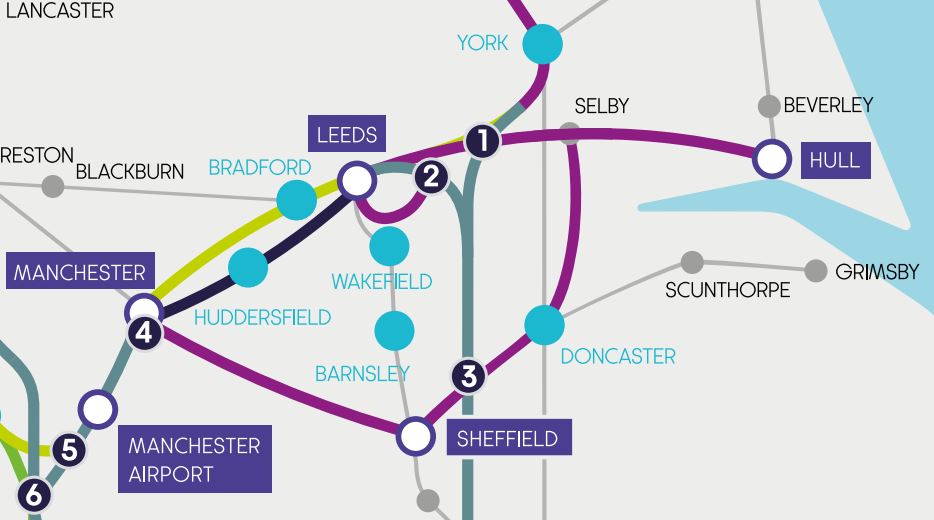
Hull is important for various reasons.
- It is large city.
- It is the Eastern terminus of an increasing number of routes.
- It is becoming a manufacturing centre for North Sea wind.
- The city will be the terminus of Northern Powerhouse Rail across the Pennines from Liverpool, Manchester and Leeds.
- Some reports have shown the city as a terminus of the Western leg of High Speed Two.
For these reasons, I will add Hull to the list.
I estimate that Hull and East Midlands Parkway will have a journey time of under an hour.
Lincoln
Looking forward to 2040, I wouldn’t bet against Lincoln being a very important city in the UK.
- It has history.
- It is becoming an important higher education centre.
- It has lots of space.
- Train operating companies like LNER and East Midlands Railway are improving services to the city.
But most importantly, as Aberdeen became Scotland’s centre for North Sea Oil and Gas, I believe that Lincoln could become England’s centre for North Sea renewable electricity and hydrogen.
I estimate that Lincoln and East Midlands Parkway will have a journey time of around an hour.
Milton Keynes
As I said for Cambridge, I believe that the East West Railway should be built to the same standard as the East Coast, Great Western, Midland and West Coast Main Lines.
This would enable classic-compatible services to be extended from Bedford to Milton Keynes.
As Bedford and East Midlands Parkway could be 60 minutes, timings depend on the times of the East West Railway, between Bedford and Milton Keynes.
Newcastle
As Newcastle already has a direct High Speed Two classic-compatible connection to and from East Midlands Hub station, this must be a possibility.
According to High Speed Two’s journey time calculator<, trains between Newcastle and East Midland Hub stations will take 96 minutes.
Northern Powerhouse Rail
The map I showed with Hull could indicate that a train could take High Speed Two to Leeds and then power its way across the Pennines calling at Leeds, Huddersfield, Manchester Piccadilly, Manchester Airport and Liverpool.
East Midlands Railway would have found a replacement for the Western part of their Liverpool and Norwich service, which is one of the worst railway services in the UK.
Oxford And Reading
As I said for Cambridge, I believe that the East West Railway should be built to the same standard as the East Coast, Great Western, Midland and West Coast Main Lines.
This would enable classic-compatible services to be extended from Bedford to Oxford and Reading.
As Bedford and East Midlands Parkway could be 60 minutes, timings depend on the times of the East West Railway, between Bedford and Oxford and Reading.
Peterborough
I think Peterborough could be an interesting possibility.
- It is the gateway to the East of England.
- It is a fully-electrified station.
- It has seven platforms with space for more.
- Most platforms could take a two hundred metre long train.
East Midlands Railway’s Liverpool and Norwich service, links Peterborough with Nottingham.
- That section of the route is 52 miles long.
- 29 miles of the route on the East Coast Main Line are electrified.
- The 100 mph Class 158 trains take 67 minutes and 30 minutes to travel between the two stops at Grantham and Peterborough.
- Some of LNER’s 125 mph electric Class 800 trains are timetabled to travel between the two stops at Grantham and Peterborough as fast as 18 minutes.
What time will be achievable on this short length of electrified track, when digital signalling is fully-deployed and 140 mph running is possible?
I can certainly see a bi-mode Class 801 train going between Peterborough and Nottingham in under an hour.
I also think that they could equal East Midlands Railway’s times to Nottingham going from Kings Cross via Grantham.
In Access To Toton – Scheme 6 – Trowell Curve, I advocated the following electrification, to allow battery-electric trains to work the Nottingham and Skegness service.
- The Allington Chord between Bottesford and Ancaster stations.
- The line linking the chord to Grantham station.
As Nottingham station will surely be electrified to allow classic-compatible High Speed Two trains to run between the station and Birmingham using High Speed Two, there will only be sixteen miles of double-track between Bottesford and Nottingham station without electrification.
I have just flown my helicopter along the route and there are one or two bridges and Netherfield station, that will need a rebuild, but it wouldn’t be the most challenging of electrifications.
Especially, as there is High Speed Two and the East Coast Main Line to provide power at both ends of the route.
But as it is only sixteen miles would they use battery-electric high-speed trains.
Surely, that is a crazy idea?
In Will High Speed Two’s Classic-Compatible Trains Have Battery Operation?, I explain why you would use such a concept to create an efficient train.
- The batteries drive the train and they are charged from the electrification and regenerative braking.
- Batteries would give a train recovery capability in case of overhead catenary failure.
- Batteries would be used for depot movements.
In Will The Trains On High Speed Two Have Batteries For Regenerative Braking?, I do a calculation for the battery size needed for a 250 mph Spanish high speed train and the batteries are surprisingly small, at 100 kWh per carriage.
I firmly believe, that the mathematics say it is possible for a high speed train to use on-board battery power to perhaps do thirty miles at say 90 mph on a line without electrification.
Sheffield
As Sheffield station will have a direct High Speed Two connection to and from East Midlands Hub station, this must be a possibility.
According to High Speed Two’s journey time calculator, trains between Sheffield and East Midland Hub stations will take 27 minutes.
Note.
- An article in the June 2020 Edition of Modern Railways shows that the Eastern leg of High Speed Two is planned to have nine tph, against a theoretical limit of 18 tph.
- The Leeds-Bedford and Nottingham-Birmingham Curzon Street will use another path.
- Not all services would need to be hourly.
- Could some CrossCountry services be replaced with classic-compatible services?
I feel there is plenty of scope to develop more classic-compatible services along the Eastern leg of High Speed Two.
Access To Toton – Scheme 6 – Trowell Curve
In £2.7bn East Midlands Plan Unveiled For HS2 Links, a series of schemes are given, which improve access to the High Speed Two East Midlands Hub station.
Scheme 6 is defined like this.
The implementation of a minimum of four direct rail services per hour linking the HS2 East Midlands Hub station to Derby, Nottingham and Leicester stations, as well as Loughborough, Matlock, Mansfield, Newark, Alfreton and Grantham, made possible by the building of a new piece of infrastructure, the Trowell Curve, which will link to the Midland Mainline. These additional connections will also create direct links to Stoke-on-Trent, Crewe, Newark and Lincoln, by extending services on existing routes.
That is a comprehensive set of connections.
The Trowell Curve
This Google Map shows the location of the village of Trowell.
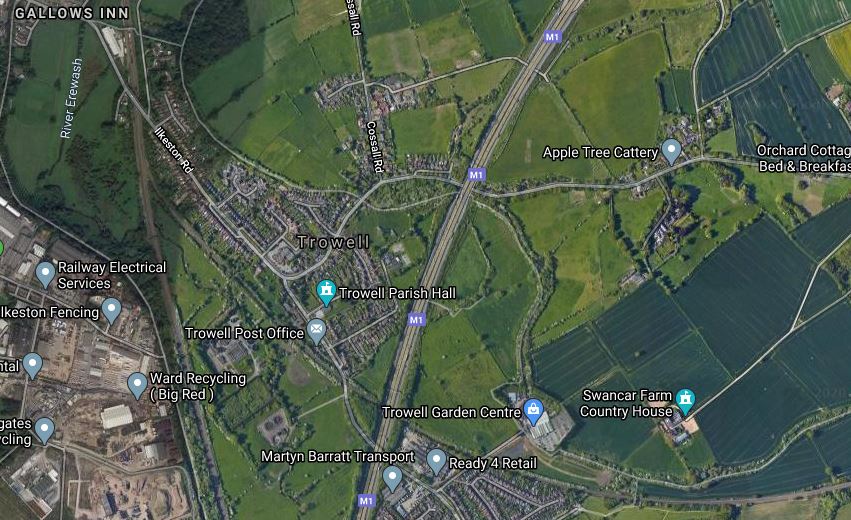
Note.
- The M1 Motorway running North-South up the map.
- The village of Trowell on the Western side of the motorway.
- Many people will have stopped at Trowell services on the motorway, which are just to the North of the top edge of the map.
- The North-South railway line to the West of the village is the Erewash Valley Line, that runs North from the East Midlands Hub station at Toton to Ilkeston, Langley Mill, Alfreton, Clay Cross North Junction, Chesterfield and Sheffield.
There is also another railway line, that runs on the South Western side of the village and across the bottom of the map, that connects the Erewash Valley Line to Nottingham station.
Trains can go between Nottingham and the North, but there is no connection to go between Nottingham and the South.
It looks like the proposed Trowell Curve will add extra connectivity to the junction, so that all these directions are possible.
- Nottingham to Ilkeston and the North.
- Ilkeston and the North to Nottingham.
- Nottingham to East Midlands Hub Station and the South.
- East Midlands Hub Station and the South to Nottingham
The Trowell Chord will be double-track or bi-directional and must certainly improve connectivity.
East Midlands Hub Station
The East Midlands Hub station will link various bus, tram and train services to High Speed Two.
According to the latest reports in the June 2020 Edition of Modern Railways there will be nine high-speed trains per hour (tph) through the station of which seven tph will stop.
Destinations served would be.
- Birmingham Interchange – 1 tph
- Birmingham Curzon Street – 3 tph
- Chesterfield – 1 tph
- Darlington – 1 tph
- Durham – 1 tph
- Leeds – 5 tph
- London Euston – 4 tph
- Newcastle – 1 tph
- Old Oak Common – 4 tph
- Sheffield – 2 tph
- York – 2 tph
As the capacity of High Speed Two has been said to be 18 tph, there must be the possibility for extra services to run on this leg of High Speed Two.
As four tph is considered by many to be a good Turn-Up-And-Go frequency and two tph a sensible minimum frequency, I can see another train between Birmingham Curzon Street and Newcastle with stops at East Midlands Hub, Leeds, Darlington and Durham.
The design has certainly left enough capacity for those that follow us!
Especially, as Wikipedia says that the new East Midlands Hub station will have eight platforms.
- It would need a minimum of two through platforms for High Speed Two services
- Would it need a terminating platform for High Speed Two services? Not for the currently proposed timetable.
- It would need a minimum of two through platforms for East Midlands Railway’s Inter-City services.
- Would it need a terminating platform for East Midlands Railway’s Inter-City services? Not for the currently proposed timetable.
- There would probably be a need for two through platforms for local services.
On this crude look, eight platforms would appear to be more than enough.
Current Services Through The Area
In Railway Lines Through East Midlands Hub Station, I detailed where the new East Midlands Hub station is to be built and the rail services in the area.
After listing all the services I said this.
Note.
- Not one service goes past the site of the new East Midlands Hub station.
- Most services to and from Nottingham seem to use the Attenborough and Beeston route
- Services between Derby and Nottingham go via the Long Eaton, Attenborough and Derby route.
- Services from the North use the Erewash Valley Line and turn East at Trowell for Nottingham.
It is fairly obvious that there needs to be a sort-out of services to fit in with the location of the new East Midlands Parkway station.
So will the new Trowell Curve give the new station, the rail access it needs?
The Splitting Of The Norwich and Liverpool Service
I wrote about this in Abellio’s Plans For Norwich And Liverpool, where I said this about the basic plan.
Early in the new franchise the Liverpool – Nottingham section will transfer to another operator, which will enable the two halves of the service to better meet the needs of customers.
It will become two services.
- Norwich and Derby via Nottingham, Trowell Curve, East Midland Hub and Long Eaton.
- Nottingham and Crewe via Trowell Curve, East Midland Hub, Long Eaton and Derby.
The second service will go to another operator.
I said earlier, this change is for the needs of customers.
It will also have other effects.
- It will add an extra service between Nottingham and Derby
- It will remove the Norwich and Liverpool service from the Erewash Valley Line.
Has this change being driven by the need to provide good connections to High Speed Two?
Train Services To East Midlands Hub Station
The following sub-sections detail the service between various stations and the East Midlands Hub station.
Alfreton Station
Alfreton station on the Erewash Valley Line, is going through major changes to train services.
Currently, there are these two hourly services.
- East Midlands Railway’s Liverpool and Norwich service.
- Northern’s Leeds and Nottingham service.
Neither service currently goes through the site of East Midlands Hub station and East Midlands Railway will split the Liverpool and Norwich service, so it won’t go anywhere near Alfreton.
Consider.
- Alfreton station probably needs at least a two tph service to East Midlands Hub station.
- The Northern service might be able to go via East Midlands Hub station.
- Both Alfreton and the East Midlands Hub station are on the Erewash Valley Line.
- Trains could run between Alfreton and Nottingham via Langley Mill, Ilkeston, East Midlands Hub, Attenborough and Beeston.
- Trains could run between Alfreton and Derby via Langley Mill, Ilkeston, East Midlands Hub, Long Eaton and Spndon.
Or would it be best to put in a bay platform at Alfreton station and run a shuttle service between Alfreton and the East Midlands Hub stations?
- The minimum frequency would be two tph.
- Up to four tph could probably be easily run.
- Trains would call at all stations.
- Extra stations could be added.
- The distance between Alfreton and East Midlands Hub stations is around twenty miles, so a battery-electric train could be possible.
This Google Map shows Alfreton station.
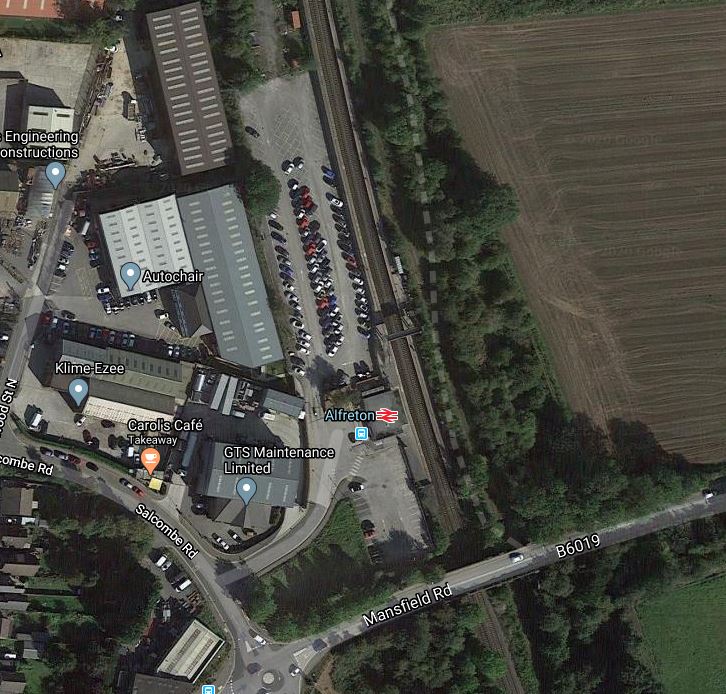
I suspect a bay platform could be added. Or failing that, there could be a turnback siding to the North of the station.
Surely, a local train solution would be a spur to development in the area, especially if it connected to High Speed Two at East Midlands Hub station for High Speed Two.
Derby Station
Consider.
- The current half-hourly East Midlands Railway services between St. Pancras and Sheffield, could not call at both the East Midlands Hub and Derby stations, unless it performed a reverse at East Midlands Hub station.
- Two hourly CrossCountry services, that call at both Derby and Nottingham could use a route via Long Eaton, East Midlands Hub and Trowell Curve.
- An hourly East Midlands Railway service between Newark Castle and Matlock could use a route via Long Eaton, East Midlands Hub and Trowell Curve
- The split service between Liverpool and Norwich would run two tph between Nottingham and Derby, via Long Eaton, East Midlands Hub and Trowell Curve, in both directions.
Six tph can be provided by existing services calling at the new East Midlands Hub station.
Grantham Station
Consider.
- The current hourly East Midlands Railway service between Norwich and Liverpool, calls at Grantham station and could call at the East Midlands Hub, if it used the Trowell Curve route.
- After the service has been split, the two sections will probably both go between Nottingham and Derby via long Eaton, East Midlands Hub and Trowell Curve.
- The current hourly East Midlands Railway service between Nottingham and Skegness calls at Grantham station, but doesn’t pass the site of the East Midlands Hub station.
- This service could be extended to the East Midlands Hub station using the Trowell Curve or the Beeston/Attenborough route, where it would terminate.
It appears relatively easy to give Grantham a two tph service to the East Midlands Hub station.
Ilkeston Station
Ilkeston station would be a stop on all services between the East Midlands Hub and Alfreton and Mansfield stations, so would have a frequent service to the East Midlands Hub station.
Langley Mill Station
Langley Mill station would be a stop on all services between the East Midlands Hub and Alfreton and Mansfield stations, so would have a frequent service to the East Midlands Hub station.
Leicester Station
Consider.
- The current half-hourly East Midlands Railway services between St, Pancras and Nottingham, could call at both the East Midlands Hub and Leicester stations, if the trains used the Trowell Curve.
- Any Ivanhoe Line services between Lincoln and Leicester, could call at both the East Midlands Hub and Leicester stations, if the trains used the Towell Curve.
Leicester would get a frequent train service from the East Midlands Hub station.
Lincoln Station
Lincoln is the Eastern terminal of Ivanhoe Line services. Currently, they run as far as Leicester, but by the time the East Midlands Hub station opens, the services will probably terminate at Burton-on-Trent. I wrote about this project, which is being promoted by the Restoring Your Railway Fund in Reinstatement Of The Ivanhoe Line.
I can see two tph between Lincoln and Burton-on-Trent.
- Stations served could be Newark, Nottingham, East Midlands Hub, East Midlands Parkway, Loughborough, Leicester, Coalville and Ashby-de-la-Zouch.
- The services would use the proposed Trowell Curve.
- Services could be extended to Grimsby and Cleethorpes at the Lincoln end of the service.
- Services would co-ordinate with East Midlands Railway’s Inter-City services to and from London with easy interchange at Leicester and or East Midlands Hub stations.
- Trains could be five-car Class 810 trains to take full advantage of the 125+ mph running between Leicester and Trowell.
- These trains have a shorter dwell time than many and timings could benefit.
Effectively, East Midlands Railway would have a second main line.
Loughborough Station
Consider.
- East Midlands Railway currently has two Inter-City and one Ivanhoe Line service, that stop in Loughborough station and could stop at the East Midlands Hub station.
With another service, Loughborough could have four tph to and from the East Midlands Hub station.
Mansfield Station
This is where Maid Marion flashes her lashes and gets the engineers to reopen her line for passenger trains between North of the former Pye Corner station on the Erewash Valley Line and Kirkby-in-Ashfield station on the Robin Hood Line.
This Google Map shows the route.
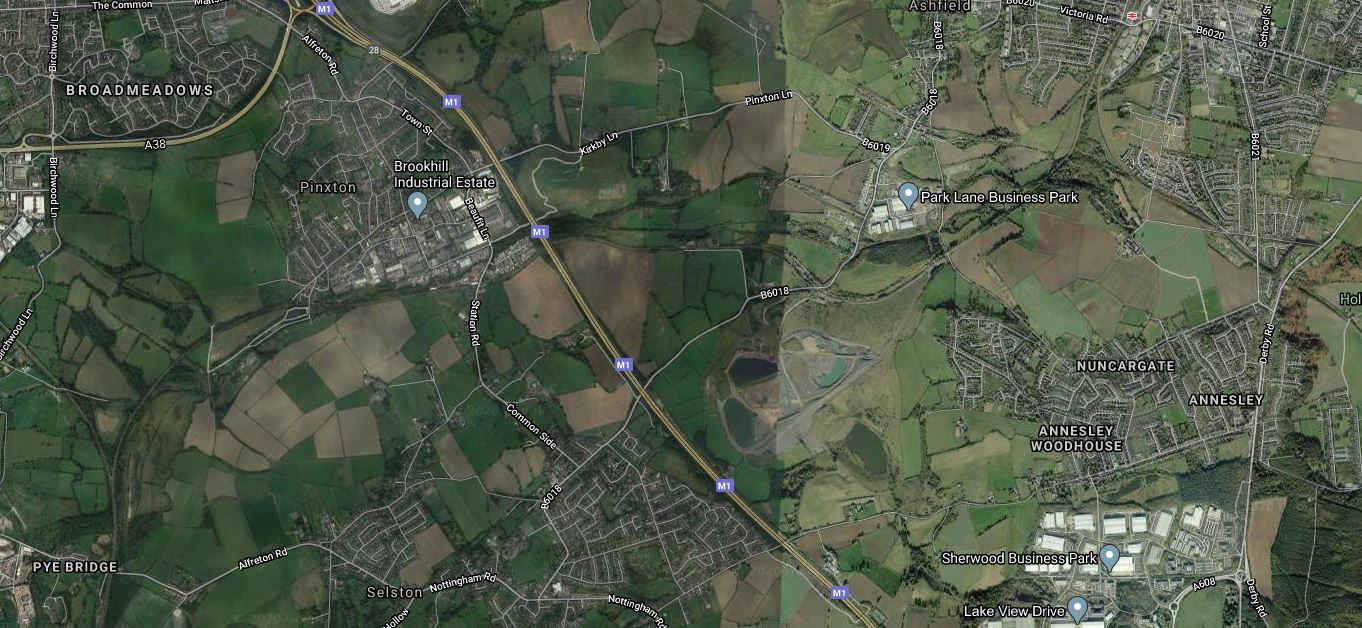
Note.
- The M1 Motorway crossing the map from North-West to South-East.
- Pye Corner is in the South-West corner of the map.
- The Erewash Valley Line runs North-South through Pye Corner.
- Kirkby-in-Ashfield is the urban area in the North-East corner of the map.
- Kirkby-in-Ashfield station is shown by the usual red symbol.
- The Robin Hood Line runs North-South through Kirkby-in-Ashfeld station.
On a high-resolution screen, it’s possible to pick out the freight line, that will become the Maid Marian Line.
- The Maid Marian Line is double-track.
- According to Real Time Trains, the distance between Kirkby-in-Ashfield and Langley Mill stations is around nine miles.
- A freight train took twenty-two minutes between the two stations.
- As there are two tph on the Robin Hood Line, I think it would be reasonable to have a similar frequency on the Maid Marian Line.
- Trains between the East Midlands Hub and Mansfield stations would pass Ilkeston, Langley Mill, Kirkby-in-Ashfield and Sutton Parkway stations.
- Trains could terminate at Nottingham using the Attenborough route.
- Trains could terminate at Derby using the Long Eaton route.
The Maid Marian Line could improve services from Derby, Mansfield, Nottingham and Worksop stations to the new East Midlands Hub station.
Matlock Station
Consider.
- Matlock is currently served by an hourly service between Matlock and Newark Castle via Derby, Spondon, Long Eaton, Attenborough, Beeston, Nottingham and several other smaller stations, which is a service that goes past the site of the East Midlands Hub station.
If this service were to call at the East Midlands Hub station and be doubled in frequency, it would be a very valuable connecting service to and from the East Midlands Hub station.
To call at East Midlands Hub station, it would need to use the Trowell Curve.
Newark Station
Consider.
- Newark is a calling point on the Ivanhoe Line service between Lincoln and Leicester.
- Newark is currently served by an hourly service between Matlock and Newark Castle via Derby, Spondon, Long Eaton, Attenborough, Beeston, Nottingham and several other smaller stations, which is a service that goes past the site of the East Midlands Hub station.
Both services could be increased to two tph, so Newark might end up with a four tph service to Nottingham and East Midlands Hub stations with a two tph service to Derby and Lincoln.
Nottingham Station
Consider.
- The current half-hourly East Midlands Railway services between St. Pancras and Nottingham could use the Trowell Chord route, as this would allow a call at the East Midlands Hub station.
- Ivanhoe Line services between Lincoln and Leicester could also use the Trowell Chord route, which with a change at the hub station, would give Lincolnshire a faster service to and from London and Birmingham.
- In Reinstatement Of The Ivanhoe Line, I wrote about plans to extend the Ivanhoe Line to Burton on Trent.
- The split service between Liverpool and Norwich would run two tph between Nottingham and Derby, via Long Eaton and East Midlands Hub stations, in both directions.
- If the Nottingham and Skegness service, were to be extended to East Midlands Hub, this would add extra services between Nottingham and East Midlands Hub stations.
The required four tph between the East Midlands Hub and Nottingham station could be provided by the diversion of existing services to call at the East Midlands Hub station and using the Trowell Curve.
Stoke-on-Trent And Crewe Stations
Consider.
- Currently, there is an hourly East Midlands Railway service between Crewe and Derby, that calls at nine stations including Kidsgrove, Stoke-on-Trent and Uttoxeter.
- There are also plans to split the Liverpool and Norwich service into two, with the Western half possibly becoming a Crewe and Nottingham service via Derby, East Midlands Hub and Long Eaton.
These two services could be arranged to give a two tph service between Nottingham, Long Eaton, East Midlands Hub and Derby in the South and Stoke-on-Trent and Crewe in the North.
Back-To-Back Services At East Midlands Hub Station
Running services through a station is always more efficient as terminating services in a station will need a bay platform or turnback facility of some sort.
In my analysis, I have proposed that these services might terminate at East Midlands Hub Station.
- A possible shuttle service between East Midlands Hub and Alfreton stations.
- The Maid Marian Line service between East Midlands Hub and Mansfield and Worksop stations.
- The Nottingham and Skegness service could be extended to East Midlands Hub station.
- The Crewe and Derby service could be extended to Nottingham via East Midlands Hub station.
Note.
- The splitting of the Liverpool and Norwich service will result in an overlap between Nottingham and Derby.
- Matlock and Newark services already run back-to-back through the area.
So would it be logical to join some services back-to-back through East Midlands Hub station?
s an example, the Maid Marian Line and Skegness services could be joined into one service.
Other services could follow the precedent of the splitting of the Liverpool and Norwich service.
- Trains coming and going from the East terminate at Derby.
- Trains coming and going from the West terminate at Nottingham.
If the following were arranged.
- Grantham and Mansfield were back-to-back.
- Alfreton and Crewe services terminated at Nottingham.
- Norwich services terminated at Derby.
There would be seven tph between Nottingham and Derby via Long Eaton and East Midlands Hub stations.
Battery-Electric Operation
Consider.
- Hitachi are claiming, that the battery-electric versions of their AT-300 trains, like the Class 810 trains will have a battery range of 55-65 miles and take ten minutes to recharge.
- Nottingham and Derby are sixteen miles away and trains between the two cities, take as long as thirty minutes for the trip.
- There will be high quality electrification at East Midlands Hub station.
In addition, station distances from the East Midlands Hub station are as follows.
- Alfreton – 17 miles
- Crewe – 55 miles – 35 miles without electrification (Derby and Stoke Junction)
- Derby – 6 miles
- Grantham – 20 miles
- Ilkeston – 7 miles
- Langley Mill – 10 miles
- Lincoln – 43 miles
- Mansfield – 23 miles
- Matlock – 23 miles
- Newark Castle – 26 miles
- Nottingham – 10 miles
- Skegness – 80 miles
- Stoke-on-Trent – 42 miles – 35 miles without electrification (Derby and Stoke Junction)
I think the following would be possible on battery power.
- Return journeys to Alfreton, Grantham, Ilkeston, Langley Mill, Mansfield, Matlock and Newark Castle.
- Return journeys to Lincoln with a charge at the destination.
- Return journeys to Crewe and Stoke using the electrification between Stoke Junction and Crewe.
Running battery-electric trains between East Midlands Hub and Skegness station would need a bit of ingenuity.
The building of the Allington Chord in 2005, may have opened up a way for battery-electric trains to be able to run between Nottingham and Skegness.
Consider.
- Bottesford station is the station nearest to Grantham on the Western side of the East Coast Main Line and it is 15.3 miles from Nottingham.
- Ancaster station is the station nearest to Grantham on the Eastern side of the East Coast Main Line and it is 28 miles from Nottingham.
- The original route between Bottesford and Ancaster station caused delays on the main line, so it was replaced by two routes.
- A modified version of the original route allows trains to call at Grantham station, where they reverse before continuing. The distance is 18.7 miles and typically takes 33 minutes
- A double-track short cut under the East Coast Main Line is about 12.7 miles and typically takes 17 minutes.
- The distance between Ancaster and Skegness is 46.7 miles.
- The East Coast Main Line is electrified.
I wonder, if it were possibly to electrify the following tracks.
- The direct double track between Ancaster and Bottesford stations.
- The access lines from the Allington Chord into Grantham station.
Hopefully, as the tracks, were built in 2005, they shouldn’t be too challenging to electrify.
This would enable a train from East Midlands Hub to Skegness to use the following procedure.
- Use the electrified line between East Midlands Hub and Nottingham stations, charging the battery en route.
- Call at Nottingham station and lower the pantograph.
- Leave Nottingham with a full battery.
- Run between Nottingham and Bottesford stations on battery power.
- Call at Bottesford station and raise the pantograph.
- Use either of the electrified routes between Bottesford and Ancaster stations, charging the battery en route.
- Call at Ancaster station and lower the paragraph.
- Run between Ancaster and Skegness stations on battery power.
After charging the train at Skegness, the return would use the following procedure.
- Leave Skegness with a full battery.
- Run between Skegness and Ancaster on battery power.
- Call at Ancaster and raise the paragraph.
- Use either of the electrified routes between Ancaster and Bottesford stations, charging the battery en route.
- Call at Bottesford station and lower the pantograph.
- Run between Bottesford and Nottingham on battery power.
- Call at Nottingham station and raise the pantograph.
- Use the electrified line between Nottingham and East Midlands Hub stations, charging the battery en route.
It’s almost as if, the Allington Chord was designed for battery-electric trains.
Conclusion
The Trowell Curve with a little bit of help from a few friends can create a battery-electric network of local lines based on the three important stations of Nottingham, East Midlands Hub and Derby.
I
£2.7bn East Midlands Plan Unveiled For HS2 Links
The title of this post, is the same as that of this article on Rail News.
This is the first two paragraphs.
A bold plan costed at £2.7 billion for the area around the HS2 hub in the East Midlands has been published by a group of councils, transport bodies and East Midlands Airport.
The core of the scheme is the future East Midlands Hub at Toton, and the plan proposes direct access to the Hub from more than 20 cities, towns and villages in the East Midlands.
If you want to read the original report by Midlands Connect, there’s a download link on this page of their web site.
The project is in three phases.
Phase One
Phase One is to be operational within ten years.
- Scheme 1 – The extension of the Nottingham tram system (Nottingham Express Transit or NET light rail system) from the Toton Lane Park and Ride site to Long Eaton via two new stops at the planned Innovation Campus development and HS2 East Midlands Hub station.
- Scheme 2 – New bus services between the HS2 East Midlands Hub and Amber Valley, West Bridgford and Clifton.
- Scheme 3 – Bus Rapid Transit between the HS2 East Midlands Hub and Derby city centre via Pride Park and Derby railway station.
- Scheme 4 – Extension of the HS2 East Midlands Hub A52 highway access route to the A6005 Derby Road in Long Eaton.
- Scheme 5 – Capacity enhancements to M1 Junction 25, increasing road capacity and improving access to the HS2 East Midlands Hub station and Innovation Campus site.
- Scheme 6 – The implementation of a minimum of four direct rail services per hour linking the HS2 East Midlands Hub station to Derby, Nottingham and Leicester stations, as well as Loughborough, Matlock, Mansfield, Newark, Alfreton and Grantham, made possible by the building of a new piece of infrastructure, the Trowell Curve, which will link to the Midland Mainline.
- Scheme 7 – New rail service between Mansfield, Derby and Leicester with stops at Ilkeston, Langley Mill, Kirkby in Ashfield, Sutton Parkway and HS2 East Midlands Hub via the Kirkby Freight Line (Maid Marian line).
Note.
- These schemes will be built before the HS2 East Midlands Hub station opens.
- I discussed Scheme 7 – The Maid Marian Line in After The Robin Hood Line Will Nottingham See The Maid Marian Line?.
The most important part of Phase One is that all these seven schemes will be built before High Speed Two reaches the East Midlands. So hopefully, there will be a continuous stream of improvements in the East Midlands.
Phase Two
Phase Two will be operational within twenty years.
- Scheme 8 – Extension of the NET light rail system or enhanced Bus Rapid Transit from the HS2 East Midlands Hub station to Derby.
- Scheme 9 – The construction of a railway station at East Midlands Airport, connected to the Midland Mainline via a spur to the south of Kegworth village, allowing new direct rail services to the airport from Derby, Nottingham, Leicester and Mansfield as well as some intermediate stations including HS2 East Midlands Hub and East Midlands Parkway. This intervention will vastly improve public transport access to East Midlands Airport for passengers and staff.
Phase Three
Phase Three will be operational within twenty-five years.
- Scheme 10 – A new rail line between East Midlands Airport (opened during Phase 2) and Derby via the South Derby Growth Zone residential and employment developments and the Rolls Royce site, designed to support local housing and employment growth.
- Scheme 11 – A tram-train service connecting into the NET light rail network (Phase 1) to a proposed development site (11,000 houses and other associated development) to the west of East Midlands Airport. This scheme would also serve stops within the Ratcliffeon-Soar power station development site and could also serve Kegworth village and the East Midlands Gateway Logistics Park.
It is comprehensive project and I will discuss the various schemes in separate posts.
 The Anonymous Widower