Cummins Agrees To Integrate Its Hydrogen ICE Technology Into Terex® Advance Trucks
The title of this post, is the same as that of this article on H2 View.
These three paragraphs outline the deal.
Cummins and Terex® Advance have signed a Letter of Intent (LoI) to integrate hydrogen internal combustion engines (ICE) into Terex’s Commander Series.
The Commander Series trucks are currently powered by Cummins’ diesel engines, but the company will now provide its X15H hydrogen ICE when series production of the technology begins later this decade.
The X15H is based on familiar combustion engine technology, with integration into the truck chassis being straightforward and doesn’t require a major overhaul of vehicle design or business operations.
Note.
This page is the Terex Advance web site.
This page on the Terex web site shows the Terex Advance Commander series.
I think it is true to say to UK and European eyes, these trucks are an unusual design.
In Cummins Fuel-Agnostic X Series Platform, there is a link to a Cummins video, which explains Cummins multi-fuel technology.
This is a side view of the top-of-the-range monster.
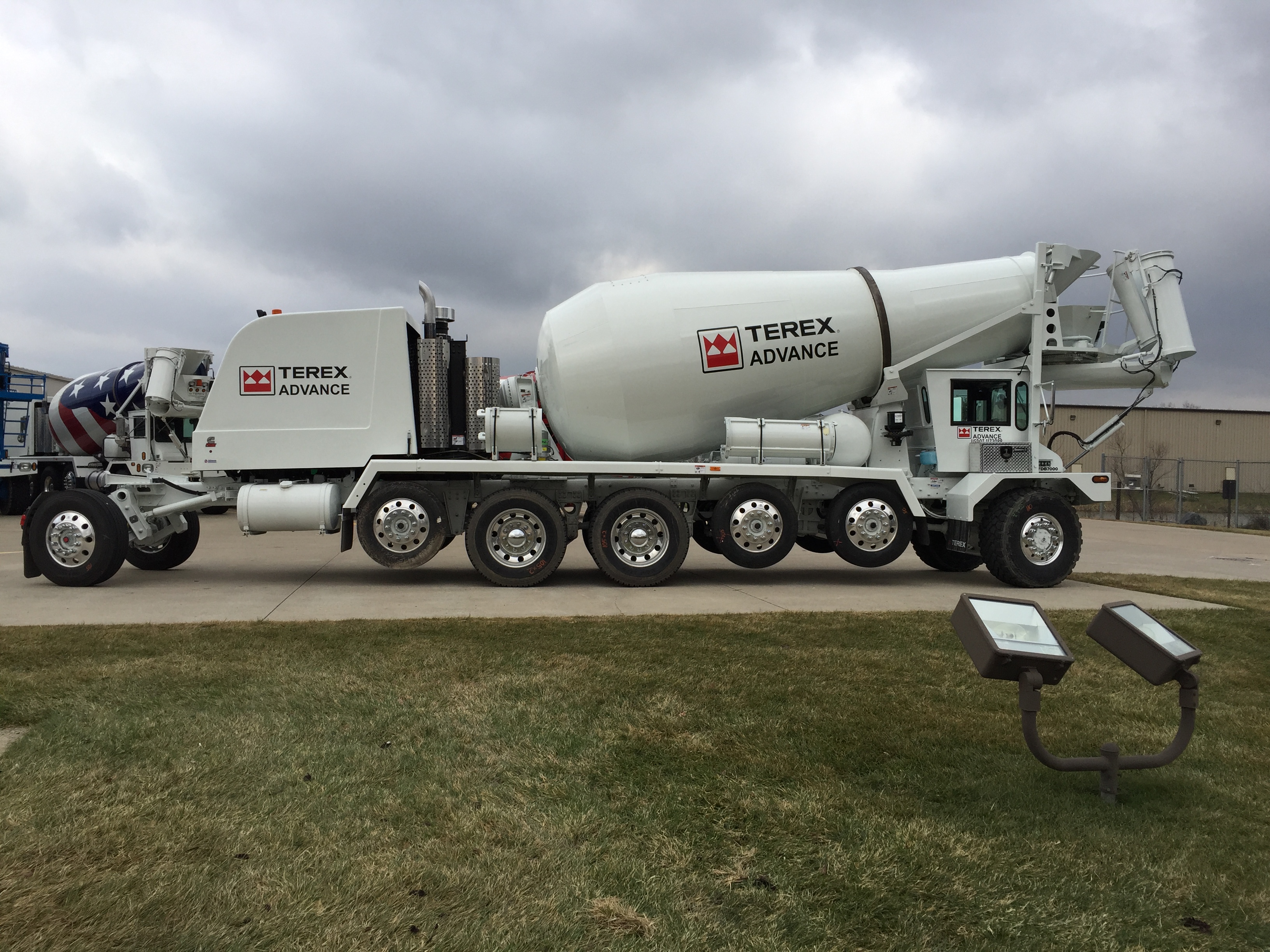
Note.
- Front is to the right.
- I suspect the driver doesn’t have to get out of the cab to discharge the concrete.
- The engine is at the rear with vertical exhausts.
- All axles are driven.
You’d certainly notice one of these if they were to be used in the City of London.
And this is the baby of the range.
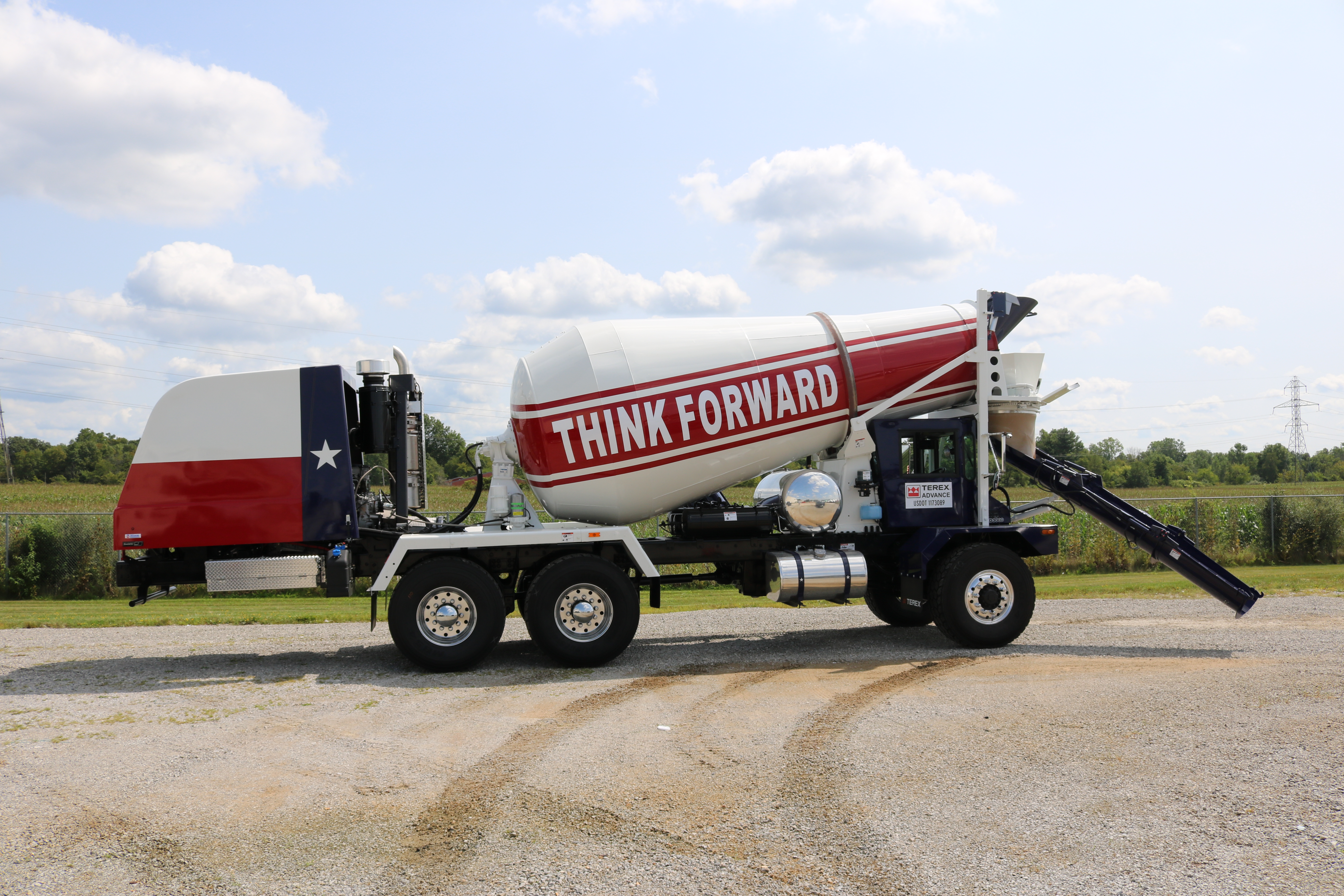
Three axles is normal for the UK. so I wonder if this machine will ever make it across the pond.
This last paragraph in the article describes the X15H hydrogen internal combustion engine.
The X15H was showcased at the Advanced Clean Transportation (ACT) Expo in May (2023), along with its hydrogen ICE-powered concept truck. The X15H features a 700-bar pressure 80kg capacity hydrogen storage system and a range of more than 500 miles, with up to 500 horsepower.
Could one of these trucks really deliver ready-mix concrete from London to Manchester and return?
Conclusion
The article says that integration of the hydrogen technology is straightforward and if you watch the Cummins video, the animation says it is.
But surely the big advantage on construction sites, is that all the workers will not get the dose of pollution, that they would currently get from a diesel cement mixer delivering a load of ready-mixed concrete, that had to be distributed and laid.
I think this could be a very neat application of hydrogen technology and Cummins will be looking for more applications of a similar nature.
Hydrogen ‘The Only Option’ For Metrobus Fastway ZE
The title of this post, is the same as that of this article on Route One.
This is the introductory paragraph.
Hydrogen fuel cell-electric remains the most realistic zero-emission technology for usage cases requiring very high mileage and utilisation capabilities. That is the verdict from the Go-Ahead Group after its Metrobus subsidiary launched 20 Wrightbus GB Kite Hydroliner single-deckers on 29 June.
This paragraph gives more details.
Go-Ahead Group Chair Claire Hollingsworth, who was present at the launch alongside Under-Secretary of State for Transport Richard Holden and other stakeholders and dignitaries, underlines the need for hydrogen on Fastway. “These are the most intensive routes in the Go-Ahead network,” she explains. “We need 300 miles of range and have little time to plug in.”
Let’s face it, a bus that takes a lot of time to fuel-up can’t be as efficient, as one that takes just a few minutes. Especially, if the buses are running a large number of hours per day.
The whole article is a must read and surely Go-Ahead’s conclusion to other modes of transport, that do long distances, like heavy trucks, long-distance coaches and railway locomotives.
Silvertown Tunnel: Cracks In Mayoral Policies
The title of this post, is the same as that, as this article on the BBC.
This is the sub-heading.
It is an infrastructure project that is well-underway with the boring almost completed — but it has a very low profile.
These three paragraphs possibly explain why.
Every step of the Crossrail tunnelling, the media were invited along. Not so with this project.
This is Silvertown Tunnel. It is more than 1km long and will be London’s first road tunnel in over 30 years.
Perhaps one of the reasons it isn’t being pushed publicity-wise, is it is very controversial.
Reading the rest of the article it certainly is controversial in many people’s minds.
These are my thoughts.
Avoiding The Dartford Crossing
When I drove back to Suffolk from Gatwick, Kent or Sussex, in the last century, because of congestion at the Dartford Crossing, I would sometimes cut through London and use the Blackwall Tunnel, when I thought it would be quicker.
When the Silvertown Tunnel opens, this could be a viable alternative for vehicles.
My experience of modelling flows, tells me, that water finds its own level. With driving, Satellite Navigation will be able to tell drivers, which will be the fastest route.
It is my view, that the Silvertown Tunnel will become the biggest rat-run in London.
Except some of these rats will be super-rats in 45-tonne HGVs.
Cutting Pollution In London
If super-rat-running is going to happen, then this will raise pollution in Central London, with all those heavy trucks going through.
The only way to cut pollution would be to have differential pricing for vehicles in the tunnels.
Perhaps hydrogen and electric vehicles should be at a discount.
But then Sadiq Khan doesn’t have a hydrogen policy, except to ignore it and hope it goes away.
The Elizabeth Line Effect
Talking to Elizabeth Line staff at Whitechapel station, they feel that there is an increasing number of passengers, who do journeys in East London on an up-one-branch-down-t’other basis between places like Ilford and Woolwich.
I believe, that other cross-river railways and the Bank station improvements, will also take passengers out of their cars, which will free up the Silvertown Tunnel for more HGVs.
A City Airport Station On The Elizabeth Line
I wrote about this in Thoughts On London City Airport And The Elizabeth Line.
How many cars would this remove from the tunnels under the Thaames?
A Cute Refuse Truck
I took these pictures on Moorgate.




Note.
- This truck was built on a DAF LF chassis.
- It normally has a Cummins B-series diesel engine.
- It looks like it was registered in late 2022.
Some DAF LF chassis have a hybrid transmission.
I have a few thoughts.
Cummins B Series Engine
The Wikipedia entry for the Cummins B Series engine starts like this.
The Cummins B Series is a family of diesel engines produced by American manufacturer Cummins. In production since 1984, the B series engine family is intended for multiple applications on and off-highway, light-duty, and medium-duty. In the automotive industry, it is best known for its use in school buses, public service buses (most commonly the Dennis Dart and the Alexander Dennis Enviro400) in the United Kingdom, and Dodge/Ram pickup trucks.
Since its introduction, three generations of the B series engine have been produced, offered in both inline-four and inline-six configurations in multiple displacements.
Note.
- It is a very versatile engine.
- When I did some data analysis work for Cummins about twenty years ago, they told me, that they are happy to create a new configuration of their engines for a new application.
- Engines for the UK are made in Darlington.
- A version of the B series engine is used in London’s New Routemaster buses.
Cummins have made a lot of these engines.
Cummins And Hydrogen
Cummins realise they have a lot to lose, as the world decarbonises and doesn’t need diesel engines anymore.
Cummins have adopted the hydrogen route to zero-carbon with a large degree of enthusiasm.
- In 2019, they took a majority stake in hydrogen company; Hydrogenics.
- In Cummins Fuel Cell Technology Powers Coradia iLint Fleet In Germany, I described how Cummins supply the fuel cells for Alstom’s hydrogen trains in Germany.
- In Electrolyser System To Linde For Green Hydrogen Production In Niagara Falls, New York, I describe how Cummins are providing a 35 MW hydrogen electrolyser .
- In Cummins Shows Hydrogen Internal Combustion-Engined Concept Truck At IAA Transportation Exhibition, I describe how Cummins have developed and released a powerful hydrogen internal combustion engine based on the B series.
I believe that in Ricardo Supports Industry Leaders To Develop Innovative Dedicated Hydrogen Engine, I talk about the most significant development involving Cummins and hydrogen.
This is how I started the post.
The title of this post, is the same as that of this press release from Ricardo.
This is the sub-heading.
Ricardo, a global strategic, environmental, and engineering consulting company, has delivered a hydrogen-fuelled research engine to global engine specialist Cummins and automotive supplier BorgWarner, as part of Project BRUNEL part funded by the Advanced Propulsion Centre (APC)
These four paragraphs outline the project.
Cummins is a global specialist in diesel and alternative fuel engines and generators, and related components and technology. BorgWarner is an automotive tier 1 supplier and specialist in the design and manufacture of systems for electrified and conventional propulsion types, that includes injection equipment for conventional and renewable fuels. BorgWarner recently announced the intention to spin off its Fuel Systems segment. The intended company name is PHINIA Inc. PHINIA is expected to be a product leader in fuel systems, starters, alternators and aftermarket distribution.
The project aims to support internal combustion engine (ICE) sub-system suppliers to increase their use of hydrogen as an alternative zero-emissions fuel solution across the light commercial vehicle market.
The engine is specifically designed to burn only hydrogen – with no supporting fuels that could give rise to any carbonaceous, or excessive air quality emissions.
Experts in hydrogen technology and integration, Ricardo has provided an engine based upon its world-renowned series of single cylinder research units, which can help the research teams evaluate a wide variety of fuels. The engine is designed to help engineers evaluate a variety of injector types and will support increased fuel efficiency, reduced air quality emissions and the move towards carbon-free heavy-duty propulsion.
Reports of the death of the internal combustion engine are greatly exaggerated.
Cummins already have larger sizes of the B series engine that will run on hydrogen, so are BorgWarner, Cummins and Ricardo going to fill the gap in the range?
Are the companies going to develop B series hydrogen engines for the DAF LF trucks, Dodge RAM pickups and the New Routemaster buses?
ULEZ: Impact Of Mayor’s Expansion Questioned
The title of this post, is the same as that of this article on the BBC.
This is the sub-heading.
One in six cars registered in outer London did not meet Ultra Low Emission Zone (ULEZ) standards last year, according to figures from the Society of Motor Manufacturers and Traders
These paragraphs outline the analysis.
The data was released following a Freedom of Information request by the BBC to Transport for London (TfL).
It comes amid a dispute over whether existing data used by City Hall and TfL is accurate.
However, London Mayor Sadiq Khan said the newly released data was unreliable.
From the end of August, all those driving vehicles within Greater London that do not meet ULEZ pollutant limits will face a £12.50 daily charge or a £180 fine.
I’m sure that any Professor of Statistics from London’s universities or an expert from the Royal Statistical Society, could give a definitive answer on the statistics.
But then Khan is a lawyer and will hide behind the law in this case, by claiming he is both judge and jury.
If Khan really cared about London’s air, he would have a hydrogen policy, which would enable London’s local cement, construction and refuse trucks to be replaced or converted to hydrogen, so that the city’s air improved.
It would also make it easier to introduce more hydrogen-powered buses.
Companies like Tesco and Marks & Spencer, who regularly run trucks into London, should be encouraged to convert their delivery trucks to zero-carbon, by adjustment of the ULEZ charges.
The ULEZ has been badly thought out and needs to be realigned with what is practical and reduces the pollution.
Toyota And VDL Groep To Convert Heavy-Duty Vehicles Into Hydrogen Fuel Cell Trucks
The title of this post, is the same as that of this article on Hydrogen Fuel News.
This is the first paragraph.
Toyota Motor Europe (TME) and Dutch VDL Groep have teamed up to covert VDL’s existing heavy-duty trucks into hydrogen fuel cell trucks using Toyota’s fuel cell modules, with a goal to accelerate decarbonizing the road logistics sector while also breaking into Europe’s zero-emission heavy duty H2 trucks market.
Note.
- According to their Wikipedia entry, VDL Groep seem to manufacture buses, coaches, chassis modules and vehicle components.
- In Ricardo Supports Toyota To Develop Its First UK-Based Hydrogen Light Commercial Vehicle, I wrote about conversion of the Toyota Hilux to hydrogen.
- There are a large number of companies all over the world, who will convert vehicles to hydrogen.
- It could be argued that Wrightbus and Alexander Dennis, have designed hydrogen buses, that could be conversions of existing designs.
- Cummins are selling diesel engines, that can be converted to hydrogen.
Could these points indicate, that one of the main routes to the decarbonisation of the heavier end of the commercial vehicle sector will be conversion of existing vehicles to hydrogen fuel?
And will this lead to smaller conversion kits to decarbonise vehicles like Land Rovers, Range Rovers, larger BMWs, Jaguars and Mercedes?
If you consider, that when I was growing up in the 1950s, you rarely saw a small diesel vehicle and how diesel came to grab a large market share, due to good engineering and some misguided tax changes from Gordon Brown, I don’t think it is unreasonable to believe that good engineering and perhaps well-thought out tax changes could create an affordable route to decarbonise a large proportion of vehicles.
If I was still driving and lived away from dreaded ULEZs, then I would be keeping my reliable diesel Jaguar estate.
Would Zero-Carbon Trucks Have Better Fuel Security?
There’s just been a story on the BBC, about the need for better truck stops.
One truck owner, said that a truck can carry up to fifteen hundred pounds of diesel and they are always being targeted by thieves.
So would zero-carbon trucks be less of a target for thieves?
I’ve never seen this mentioned in the discussion of zero-carbon vehicles.
Further Thoughts On BP’s Successful INTOG Bid
I have been searching the web and I feel BP’s successful INTOG bid may be different.
In 13 Offshore Wind Projects Selected In World’s First Innovation And Targeted Oil & Gas Leasing Round, I decided that BP’s bid, which only was for 50 MW of offshore wind would generate hydrogen and send it to shore through the Forties Pipeline System, which is owned by INEOS.
My reasons for feeling that it would generate hydrogen were as follows.
- In the wider picture of wind in the North Sea, BP’s proposed 50 MW wind farm is a miniscule one. SSE Renewables’s Dogger Bank wind farm is over a hundred times as large.
- A cable to the shore and substation for just one 50 MW wind farm would surely be expensive.
- BP Alternative Energy Investments are also developing a 2.9 GW wind farm some sixty miles to the South.
- It would probably be bad financial planning to put large and small wind farms so close together.
I still believe for these and other reasons, that there is no reason to believe that the proposed 50 MW wind farm is a traditional wind farm and most likely it will be paired with an appropriately-sized electrolyser producing around twenty tonnes of hydrogen per day.
But instead of being sent ashore by using the Forties Pipeline System, could this hydrogen be sent directly to the coast near Aberdeen, in its own personal hydrogen pipeline?
- Using a variety of maps, I have estimated the distance at only around twenty miles.
- With all the experience from BP and their suppliers, there must be a solution for a relatively short hydrogen pipeline.
I also found this scientific paper on ScienceDirect, which is entitled Dedicated Large-Scale Floating Offshore Wind To Hydrogen: Assessing Design Variables In Proposed Typologies, which talks about three different layouts.
- Centralised Onshore Electrolysis
- Decentralised Offshore Electrolysis
- Centralised Offshore Electrolysis
All would appear to be feasible.
There is a lot of information in the scientific paper and it leads me to the conclusion, that hydrogen could be generated offshore and transferred by pipeline to storage on the shore.
The paper shows a design for a submarine hydrogen pipeline and schematics of how to design a system.
I believe that BP’s proposed system could deliver around twenty tonnes of hydrogen per day to the shore.
The system could be as simple as this.
- A few large floating wind turbines would be positioned offshore, perhaps twenty miles from shore.
- Perhaps 5 x 10 MW, 4 x 12 MW turbines or 3 x 16 MW could be used. Deciding would be one of those calculations, that combines accountancy, data, engineering and finance, which are great fun.
- The offshore distance would be carefully chosen, so that complaints about seeing them from the shore would be minimised.
- The generated electricity would be collected at a floating electrolyser, where hydrogen would be created.
- The hydrogen would be pumped to the shore.
- The floating electrolyser could also contain hydrogen storage.
I think there is large scope for innovation.
- I can imagine drones and helicopters delivering equipment and personnel to service the electrolyser.
- Underwater hydrogen storage could be developed.
- A standard system could be developed for rolling out anywhere.
- It could be placed in the sea, by a steelworks or other large hydrogen user.
In its own right the concept would develop new markets, which is one of the wind farm’s aims.
Could This Be The Route To Create Affordable Hydrogen For All?
BP would be failing their customers, employees and shareholders, if they weren’t developing a zero-carbon alternative to diesel and petrol.
Offshore hydrogen electrolysers strategically placed along the coastline, could provide a reliable hydrogen supply to a that sizeable proportion of the world’s population, who live near to the coast.
Could The Technology Be Adapted To Motorway And Large Service Stations?
This document on the UK Government web site, gives the mileage statistics of lorries (HGVs) and has this sub-heading.
In 2019 lorries travelled 17.4 billion vehicle miles, remaining broadly stable (increasing slightly by 0.3%) compared with 2018.
It breaks this figure down, by the class of road.
- Motorways – 8.0 – 46 %
- A Roads – 6.3 – 36 %
- Rural Minor Roads – 0.9 – 5 %
- Urban A Roads – 1.5 – 9 %
- Urban Minor Roads – 0.7 – 4 %
Note that 82 % of HGV mileage is on Motorways or A roads. Anybody, who has ever driven a truck bigger than a Ford Transit over a distance of upwards of fifty miles, knows that trucks and vans regularly need to be fuelled up on the road. And that applies to the drivers too, who also by law must take a break, away from the cab.
Charging an electric truck could be a lengthy business and would require service stations to be connected directly to the nation grid and be fitted with a substantial number of heavy duty chargers.
One thing, that would be difficult with an electric truck, would be a Splash-and-Dash, if a truck was nearing the destination and needed a small amount of charging to meet delivery schedules.
Because of the distances involved, the driving rules, the often tight schedules and the fast filling, I am convinced that there will be a large proportion of hydrogen-powered trucks and vans on the road and these will need a network of service stations where hydrogen is available.
Look at these overhead view of South Mimms Services, where the M25 and the A1(M) cross to the North of London.
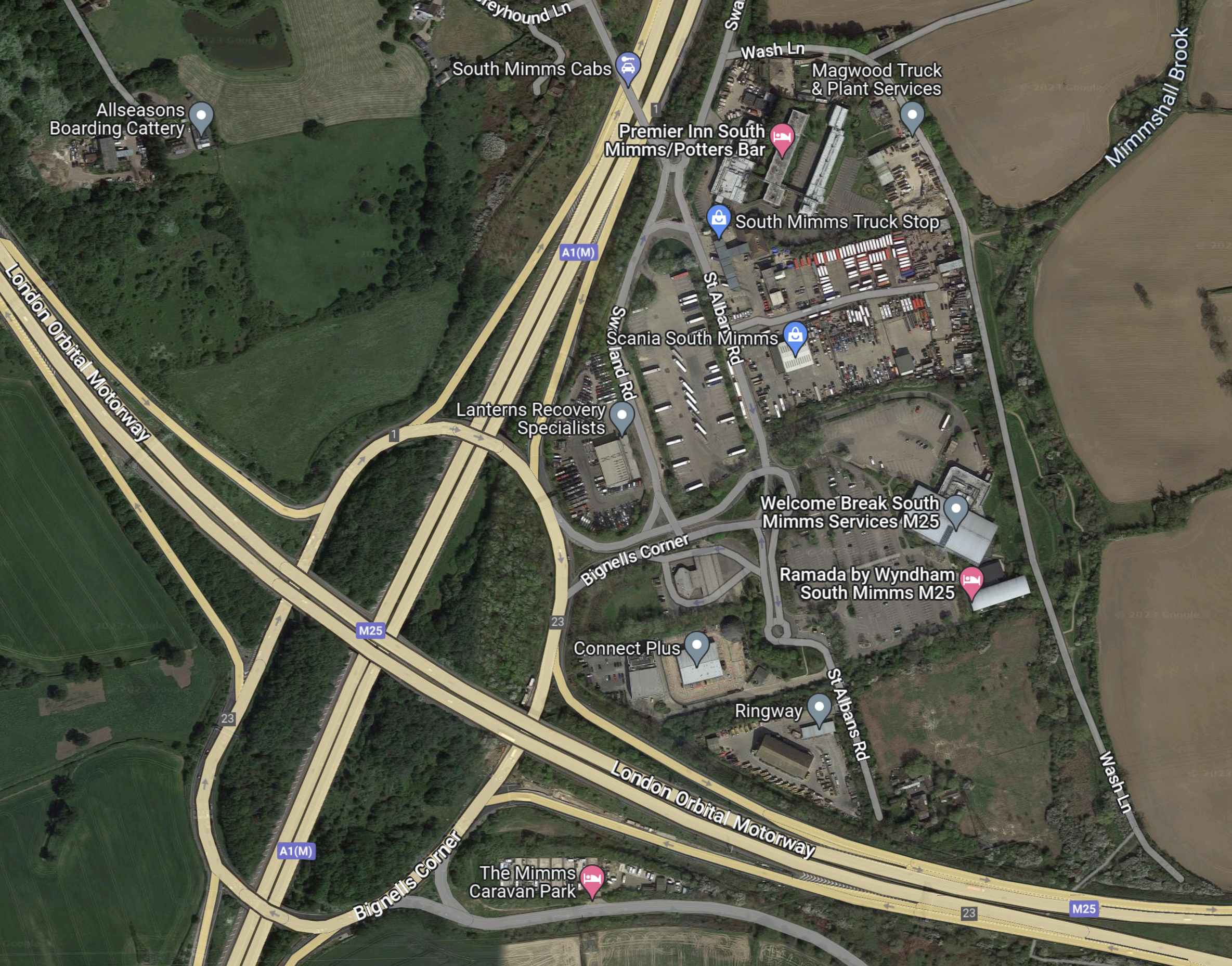
I would envisage that at least four 10 MW wind turbines, which have a rotor diameter of around 160-190 metres could be dotted around and inside the site including inside the roundabout.
- The electrolyser would be slightly smaller than that which would be used at Aberdeen.
- Perhaps fifteen tons per day of hydrogen could be generated.
- No hydrogen needed on the site would ever be brought in by truck.
- Wind-generated electricity could also power the hotels, restaurants and the service station.
- As the percentage of vehicles running on fossil fuels decreased, the air quality in the area of the service station, should increase.
- How many people, who lived locally would switch to a hydrogen-powered runabout and fill it up perhaps once a week, when they passed?
Much of the technology needed to add a hydrogen option to a typical large service station has already been developed and some would also be needed to build BP’s 50 MW offshore wind farm with an electrolyser.
Budweiser To Convert Second UK Brewery To Hydrogen
The title of this post, is the same as that of this article on The Engineer.
This is the sub-heading.
Samlesbury Brewery in Lancashire is set to be powered by green hydrogen from 2025, according to new plans announced by owner Budweiser Brewing Group.
This paragraph outlines what will be done at Salmesbury.
The Samlesbury Net Zero project will see the brewery paired with a new hydrogen production facility (HPF), delivered by UK hydrogen services company Protium. Situated adjacent to the brewery, the HPF will provide green hydrogen to meet the thermal demand of the brewing processes, as well as the building’s other heating requirements.
Note.
- A refuelling station for hydrogen-ready HGVs will also be developed as part of the project.
- Heat from the HPF will be recovered and used in Budweiser’s bottling process.
- This is the second project involving Budweiser and Protium, after one at Magor in South Wales.
- Beers produced at the facility include Budweiser, Stella Artois and Corona.
I may have had the odd bottle of Corona in the States, but I’ve generally drunk real ale only since, I started having halves of Adnams with my father at the age of thirteen.
Now, because I’m on Warfarin, I more or less exclusively drink zero-alcohol beers, most of which is Adnams, straight from the brewery.
I’ve yet to find any beer which is less than 0.5 % alcohol, has contained enough gluten to have an effect on my gut.
I have discussed this with experienced brewers and they are not surprised, as the brewing process for zero-alcohol beers doesn’t use much barley.
Conclusion
We need more integrated projects like this, that both decarbonise industrial processes and provide filling stations for hydrogen-powered vehicles.
Hydrogen Truck Can Make Garbage Day A Much Quieter Event
The title of this post in the same as that of this article on Hydrogen Fuel News.
This is the first paragraph.
Hyzon Motors has announced that it will be rolling out a 27-ton Australian-made hydrogen truck to be used for vehicle towing as well as potentially for garbage collection this year.
Less noise, less pollution\2 What more can you want?
In London, we something rather important, a hydrogen policy, rather than a Mayor, who hopes the problem will fade away.
The writer of this article finds it interesting, that Hyson, who are an American company are making the trucks in Australia.
They say this.
Hyzon opened an Australian location three years ago in order to benefit from the substantial industry talent that became available there when Ford, Toyota and Holden closed their local operations. As the country also places a considerable focus on H2 production, it has opened several doors for moving forward with various types of hydrogen truck design.
So vehicle manufacturers beware! If you close an operation in a country, you may find competitors starting up!
 The Anonymous Widower