Wrightbus At Heart Of £6.5bn Hydrogen Mega-Project Set To Transform UK Economy
The title of this post is the same as that of this article on Love Ballymena.
These are the first three paragraphs.
Ballymena’s Wrightbus is at the forefront of a transformative £6.5 billion clean hydrogen initiative that promises to create 24,300 jobs across the UK and position the nation as a global leader in renewable energy.
Project HySpeed, unveiled this week, unites some of Britain’s most influential companies—including Wrightbus, Centrica, JCB, and ITM Power—in a landmark effort to scale up green hydrogen production, reduce costs, and accelerate industrial decarbonisation.
The project is a major coup for Ballymena, where Wrightbus, a pioneer in zero-emission transport, has been a vital part of the local economy for decades. As a key member of the HydraB Power group, which spearheads HySpeed, Wrightbus brings its expertise as the producer of the world’s first hydrogen-powered double-decker bus.
I believe we need the Irish dimension in Project HySpeed, as the Irish have a unique way of getting things done.
I am reminded by a story, that I heard from a retired Guards officer about the liberation of Vienna in World War II.
The city was in a desperate state and as he hold me the story, the retired officer said that a woman could be had for the price of two cigarettes.
In the mess one evening, the officers were discussing what to do, when an Irish Guards officer said, “The people need some fun! Let’s organise a horse race meeting!”
They all thought he was joking, but that is what they did!
The guy, who told the story is long since dead, but he believed that day of fun meant that Austria wasn’t taken over by the Soviets, like so many other East European countries.
The Irish do have this unique way of getting things done.
Note that the CEO of Centrica is Chris O’Shea. Does he have Irish roots?
ITM Power Seals PEM Electrolyser Deal With Hygen
The title of this post, is the same as that of this article on gasworld.
These three paragraphs give details of the deal.
ITM Power has struck a partnership with Hygen Energy to become the preferred supplier for Proton Exchange Membrane (PEM) electrolysers for major hydrogen projects within the UK and across Europe.
Hygen, a leading developer, producer and asset owner of low-carbon hydrogen production on the continent, focusing on the decarbonisation of mobility, construction and hard-to-electrify industries and power, is targeting 200 Megawatt (MW) of electrolyser projects across the continent.
The two-phase collaboration will see 50 MW of Neptune Plug and Play electrolysers across several projects, many of which will be based on UK government HAR2 or similar funding programmes, followed by 150 MW of larger-scale modular electrolysers. Each project will be subject to a Final Investment Decision (FID).
Note.
- This page on the iTM Power web site gives details of the Neptune electrolyser.
- Neptune appears to be a 2 MW electrolyser, so the first phase could be around 25 electrolysers.
- This news item on the iTM Power web site is entitled iTM Power And Sumitomo Complete Installation Of First If Its Kind Demonstration Electrolyser Un Japan.
Things seem to be looking up for iTM Power.
Conclusion
I can see a time in the not to distant future, where a large number of small-to-medium size electrolysers will be mopping up surplus electricity to create hydrogen.
RWE Acquires 4.2-Gigawatt UK Offshore Wind Development Portfolio From Vattenfall
The title of this post, is the same as that of this press release from RWE.
These three bullet points, act as sub-headings.
- Highly attractive portfolio of three projects at a late stage of development, with grid connections and permits secured, as well as advanced procurement of key components
- Delivery of the three Norfolk Offshore Wind Zone projects off the UK’s East Anglia coast will be part of RWE’s Growing Green investment and growth plans
- Agreed purchase price corresponds to an enterprise value of £963 million
These two paragraphs outline the deal.
RWE, one of the world’s leading offshore wind companies, will acquire the UK Norfolk Offshore Wind Zone portfolio from Vattenfall. The portfolio comprises three offshore wind development projects off the east coast of England – Norfolk Vanguard West, Norfolk Vanguard East and Norfolk Boreas.
The three projects, each with a planned capacity of 1.4 gigawatts (GW), are located 50 to 80 kilometres off the coast of Norfolk in East Anglia. This area is one of the world’s largest and most attractive areas for offshore wind. After 13 years of development, the three development projects have already secured seabed rights, grid connections, Development Consent Orders and all other key permits. The Norfolk Vanguard West and Norfolk Vanguard East projects are most advanced, having secured the procurement of most key components. The next milestone in the development of these two projects is to secure a Contract for Difference (CfD) in one of the upcoming auction rounds. RWE will resume the development of the Norfolk Boreas project, which was previously halted. All three Norfolk projects are expected to be commissioned in this decade.
There is also this handy map, which shows the location of the wind farms.
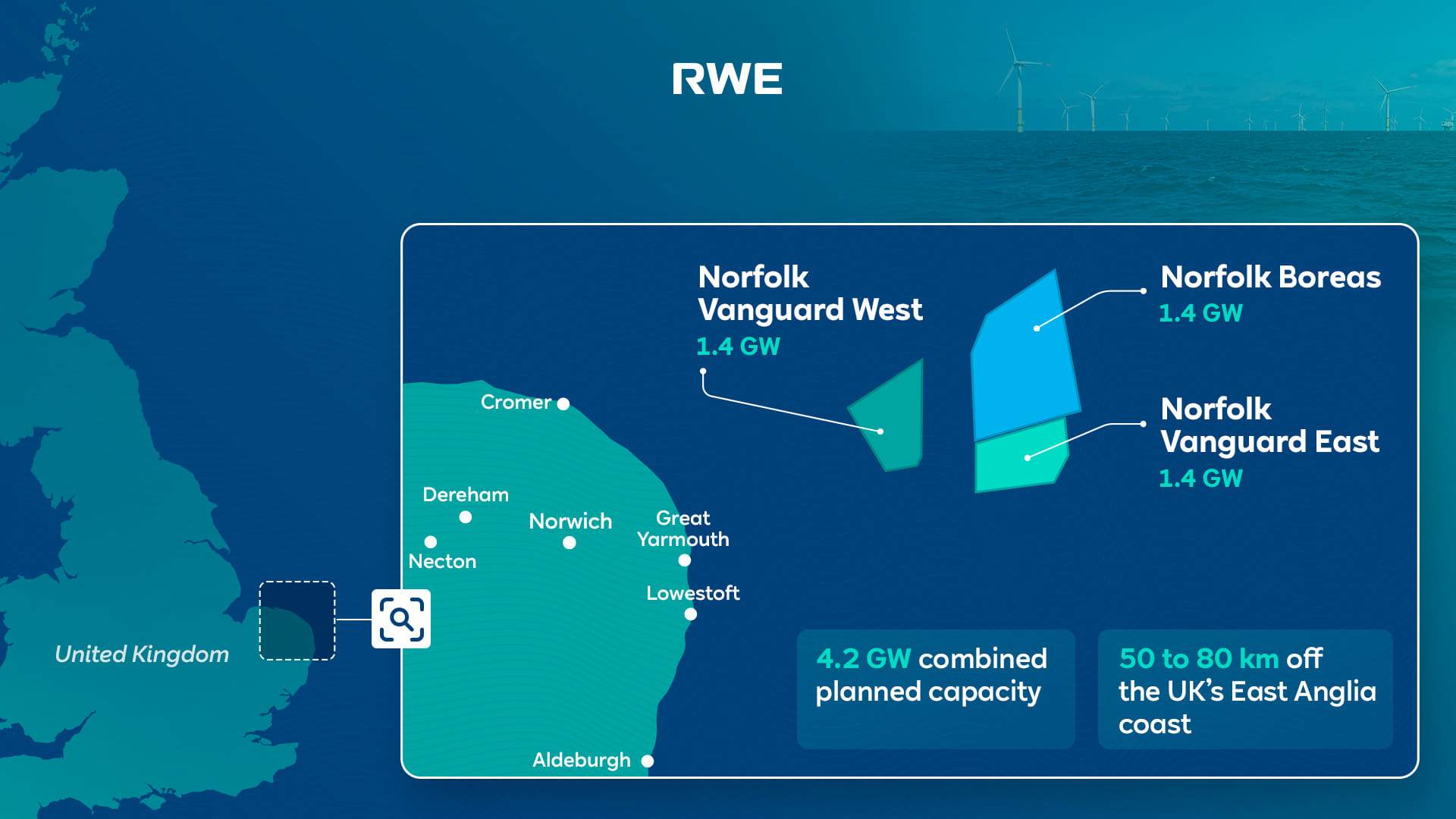
Note that there are a series of assets along the East Anglian coast, that will be useful to RWE’s Norfolk Zone development.
- In Vattenfall Selects Norfolk Offshore Wind Zone O&M Base, I talked about how the Port of Great Yarmouth will be the operational base for the Norfolk Zone wind farms.
- Bacton gas terminal has gas interconnectors to Belgium and the Netherlands lies between Cromer and Great Yarmouth.
- The cable to the Norfolk Zone wind farms is planned to make landfall between Bacton and Great Yarmouth.
- Sizewell is South of Lowestoft and has the 1.25 GW Sizewell B nuclear power station, with the 3.2 GW Sizewell C on its way, for more than adequate backup.
- Dotted around the Norfolk and Suffolk coast are 3.3 GW of earlier generations of wind farms, of which 1.2 GW have connections to RWE.
- The LionLink multipurpose 1.8 GW interconnector will make landfall to the North of Southwold
- There is also the East Anglian Array, which currently looks to be about 3.6 GW, that connects to the shore at Bawdsey to the South of Aldeburgh.
- For recreation, there’s Southwold.
- I can also see more wind farms squeezed in along the coast. For example, according to Wikipedia, the East Anglian Array could be increased in size to 7.2 GW.
It appears that a 15.5 GW hybrid wind/nuclear power station is being created on the North-Eastern coast of East Anglia.
The big problem is that East Anglia doesn’t really have any large use for electricity.
But the other large asset in the area is the sea.
- Undersea interconnectors can be built to other locations, like London or Europe, where there is a much greater need for electricity.
- In addition, the UK Government has backed a consortium, who have the idea of storing energy by using pressurised sea-water in 3D-printed concrete hemispheres under the sea. I wrote about this development in UK Cleantech Consortium Awarded Funding For Energy Storage Technology Integrated With Floating Wind.
A proportion of Russian gas in Europe, will have been replaced by Norfolk wind power and hydrogen, which will be given a high level of reliability from Suffolk nuclear power.
I have some other thoughts.
Would Hydrogen Be Easier To Distribute From Norfolk?
A GW-range electrolyser would be feasible but expensive and it would be a substantial piece of infrastructure.
I also feel, that placed next to Bacton or even offshore, there would not be too many objections from the Norfolk Nimbys.
Hydrogen could be distributed from the site in one of these ways.
- By road transport, as ICI did, when I worked in their hydrogen plant at Runcorn.
- I suspect, a rail link could be arranged, if there was a will.
- By tanker from the Port of Great Yarmouth.
- By existing gas interconnectors to Belgium and the Netherlands.
As a last resort it could be blended into the natural gas pipeline at Bacton.
In Major Boost For Hydrogen As UK Unlocks New Investment And Jobs, I talked about using the gas grid as an offtaker of last resort. Any spare hydrogen would be fed into the gas network, provided safety criteria weren’t breached.
I remember a tale from ICI, who from their refinery got a substantial amount of petrol, which was sold to independent petrol retailers around the North of England.
But sometimes they had a problem, in that the refinery produced a lot more 5-star petrol than 2-star. So sometimes if you bought 2-star, you were getting 5-star.
On occasions, it was rumoured that other legal hydrocarbons were disposed of in the petrol. I was once told that it was discussed that used diluent oil from polypropylene plants could be disposed of in this way. But in the end it wasn’t!
If hydrogen were to be used to distribute all or some of the energy, there would be less need for pylons to march across Norfolk.
Could A Rail Connection Be Built To The Bacton Gas Terminal
This Google Map shows the area between North Walsham and the coast.
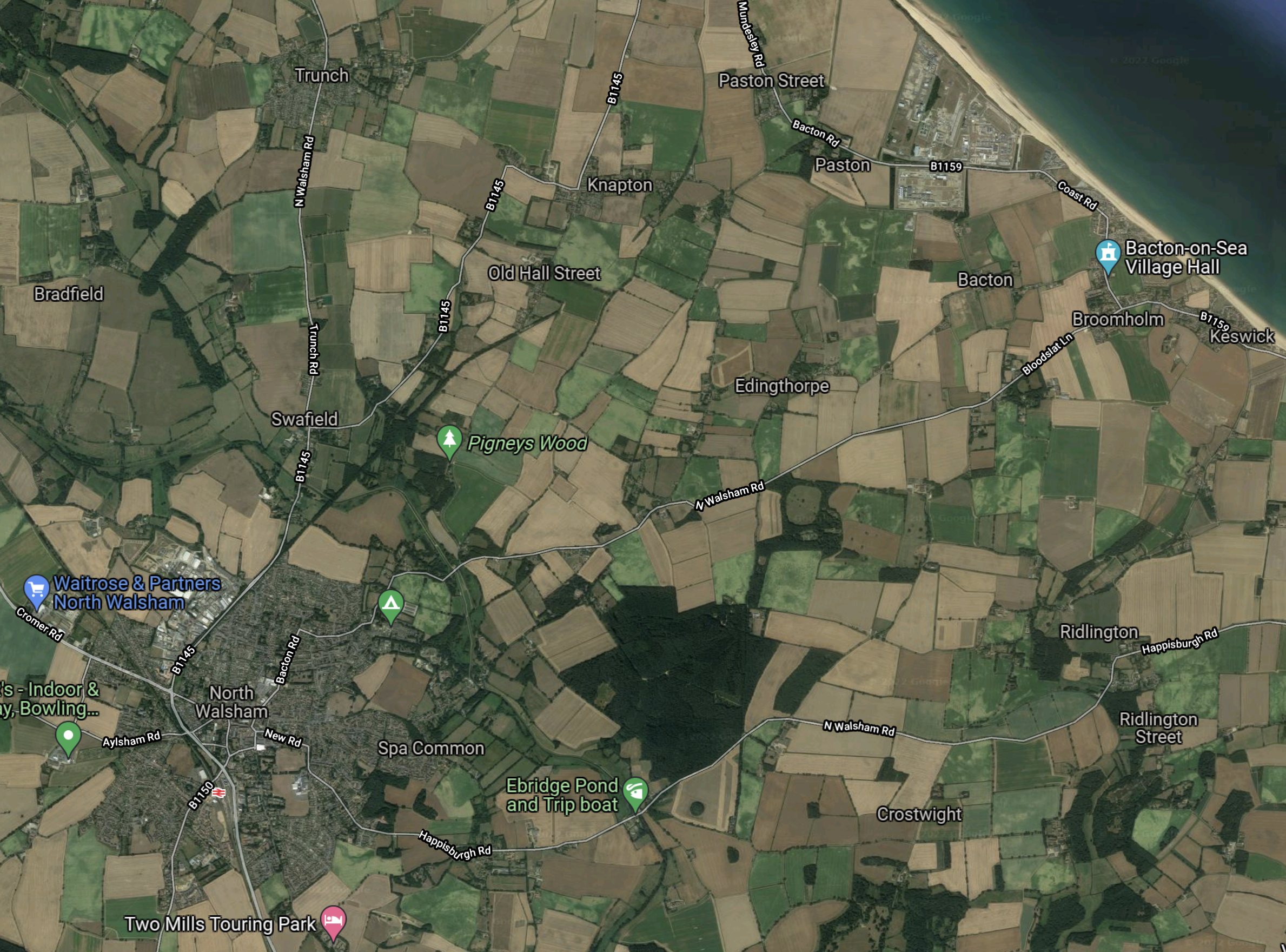
Note.
- North Walsham is in the South-Western corner of the map.
- North Walsham station on the Bittern Line is indicated by the red icon.
- The Bacton gas terminal is the trapezoidal-shaped area on the coast, at the top of the map.
ThisOpenRailwayMap shows the current and former rail lines in the same area as the previous Google Map.

Note.
- North Walsham station is in the South-West corner of the map.
- The yellow track going through North Walsham station is the Bittern Line to Cromer and Sheringham.
- The Bacton gas terminal is on the coast in the North-East corner of the map.
I believe it would be possible to build a small rail terminal in the area with a short pipeline connection to Bacton, so that hydrogen could be distributed by train.
There used to be a branch line from North Walsham station to Cromer Beach station, that closed in 1953.
Until 1964 it was possible to get trains to Mundesley-on-Sea station.
So would it be possible to build a rail spur to the Bacton gas terminal along the old branch line?
In the Wikipedia entry for the Bittern Line this is said.
The line is also used by freight trains which are operated by GB Railfreight. Some trains carry gas condensate from a terminal at North Walsham to Harwich International Port.
The rail spur could have four main uses.
- Taking passengers to and from Mundesley-on-Sea and Bacton.
- Collecting gas condensate from the Bacton gas terminal.
- Collecting hydrogen from the Bacton gas terminal.
- Bringing in heavy equipment for the Bacton gas terminal.
It looks like another case of one of Dr. Beeching’s closures coming back to take a large chunk out of rail efficiency.
Claire Coutinho And Robert Habeck’s Tete-a-Tete
I wrote about their meeting in Downing Street in UK And Germany Boost Offshore Renewables Ties.
- Did Habeck run the RWE/Vattenfall deal past Coutinho to see it was acceptable to the UK Government?
- Did Coutinho lobby for SeAH to get the contract for the monopile foundations for the Norfolk Zone wind farms?
- Did Coutinho have a word for other British suppliers like iTMPower.
Note.
- I think we’d have heard and/or the deal wouldn’t have happened, if there had been any objections to it from the UK Government.
- In SeAH To Deliver Monopiles For Vattenfall’s 2.8 GW Norfolk Vanguard Offshore Wind Project, I detailed how SeAH have got the important first contract they needed.
So it appears so far so good.
Rackheath Station And Eco-Town
According to the Wikipedia entry for the Bittern Line, there are also plans for a new station at Rackheath to serve a new eco-town.
This is said.
A new station is proposed as part of the Rackheath eco-town. The building of the town may also mean a short freight spur being built to transport fuel to fire an on-site power station. The plans for the settlement received approval from the government in 2009.
The eco-town has a Wikipedia entry, which has a large map and a lot of useful information.
But the development does seem to have been ensnared in the planning process by the Norfolk Nimbys.
The Wikipedia entry for the Rackheath eco-town says this about the rail arrangements for the new development.
The current rail service does not allow room for an extra station to be added to the line, due to the length of single track along the line and the current signalling network. The current service at Salhouse is only hourly during peak hours and two-hourly during off-peak hours, as not all trains are able to stop due to these problems. Fitting additional trains to this very tight network would not be possible without disrupting the entire network, as the length of the service would increase, missing the connections to the mainline services. This would mean that a new 15-minute shuttle service between Norwich and Rackheath would have to be created; however, this would interrupt the main service and cause additional platforming problems. Finding extra trains to run this service and finding extra space on the platforms at Norwich railway station to house these extra trains poses additional problems, as during peak hours all platforms are currently used.
In addition, the plans to the site show that both the existing and the new rail station, which is being built 300m away from the existing station, will remain open.
. As the trains cannot stop at both stations, changing between the two services would be difficult and confusing, as this would involve changing stations.
I feel that this eco-town is unlikely to go ahead.
Did RWE Buy Vattenfall’s Norfolk Zone To Create Green Hydrogen For Europe?
Consider.
- Vattenfall’s Norfolk Zone is a 4.2 GW group of wind farms, which have all the requisite permissions and are shovel ready.
- Bacton Gas terminal has gas pipelines to Europe.
- Sizewell’s nuclear power stations will add security of supply.
- Extra wind farms could be added to the Norfolk Zone.
- Europe and especially Germany has a massive need for zero-carbon energy.
The only extra infrastructure needing to be built is the giant electrolyser.
I wouldn’t be surprised if RWE built a large electrolyser to supply Europe with hydrogen.
Japanese Companies To Invest GBP 14.2 Billion In UK’s Offshore Wind, Green Hydrogen
The title of this post, is the same as that of this article on offshoreWIND.biz.
This is the sub-heading.
Japanese giants Marubeni Corporation, Sumitomo Corporation, and Sumitomo Electric Industries have committed to investing a total of GBP 14.2 billion (approximately EUR 16.3 billion) in offshore wind and green hydrogen projects, and the offshore wind supply chain in the UK
These two paragraphs add a bit of context and flesh to the deal.
Ahead of the UK Prime Minister’s business reception in Tokyo on 18 May, the UK government announced that leading Japanese businesses have committed to invest GBP 17.7 billion (approx. EUR 20.3 billion) in businesses and projects across the UK.
Of this, GBP 14.2 billion has been committed by Marubeni, Sumitomo and Sumitomo Electric for projects in offshore wind, green hydrogen and offshore wind supply chain.
SSE’s Berwick Bank Wind Farm will have a capacity of 4.1 GW and is budgeted to cost just short of £18 billion. Doing a quick calculation, indicates that £14.2 billion would only finance £3.23 GW of offshore wind.
But the Japanese say they will invest in offshore wind, green hydrogen and offshore wind supply chain. Investing in the offshore wind supply chain, would surely attract more money as the developers placed orders for foundations, floaters, electrical gubbins and support vessels.
Note.
- In Japanese Giant Sumitomo Heavy Invests In Liquid-Air Energy Storage Pioneer, I wrote about Sumitomo’s investment in English energy storage. company; Highview Power.
- Electrolyser company; iTM Power has also sold a 1.4 MW electrolyser to Sumitomo and signed an agreement over American sales with another Japanese company.
I can see other similar co-operative deals being developed. Possible areas could be cables, transformers and support vessels.
Overview – Siemens Energy Electrolyser Deal Dwarfs Rest In Q1 2023
The title of this post is the same as that of this article on Renewables Now.
This is the first paragraph.
The global electrolyser market concluded the first quarter of 2023 with a variety of equipment supply deals, partnerships, framework agreements and even some firm contracts. Siemens Energy stood out with the news of its selection to equip a “world-scale” eFuels facility in Texas with a total capacity of 1,800 MW.
The article is a good summary of the electrolyser market.
ITM Signs 200MW Electrolyser Deal
The title of this post, is the same as that of this article on renews.biz.
This is the sub-heading.
Agreements with Linde Engineering will be for installation at RWE’s GET H2 Nukleus project in Germany
These paragraphs outline the deal.
ITM Power has signed two contracts for electrolysers, totalling 200MW, which will be installed in green hydrogen plants in Germany that will be supplied by North Sea offshore wind.
The contracts, both with Linde Engineering, are each for 100MW of PEM electrolysers.
The machines will be installed at two plants operated by RWE in Lingen, Germany.
Note.
- Linde Engineering and ITM Power were preselected by RWE for these orders.
- ITM Power seem to be going through scale-up problems.
But the comments in the article and the orders, surely show that ITM Power is now more likely to recover.
Electrolyser System To Linde For Green Hydrogen Production In Niagara Falls, New York
The title of this post, is the same as that of this press release from Cummins.
This is the first paragraph.
Cummins Inc. will supply a 35-megawatt (MW) proton exchange membrane (PEM) electrolyzer system for Linde’s new hydrogen production plant in Niagara Falls, New York. Once commissioned, Cummins’ electrolyzer system will power Linde’s largest green hydrogen plant in the U.S., marking significant progress in moving the green hydrogen economy forward.
Note.
- The electrolyser will be powered by hydroelectricity.
- Linde have a strategic investment in iTM Power, who are a British manufacturer of electrolysers.
- ITM Linde Electrolysis is a joint venture between iTM Power and Linde.
Why did Linde choose Cummins over iTM Power?
Is it down to cost, delivery, politics or quality?
The Concept Of Remote Island Wind
This document from the Department of Business, Industry and Industrial Strategy lists all the Contracts for Difference Allocation Round 4 results for the supply of zero-carbon electricity that were announced yesterday.
The contracts have also introduced a concept that is new to me, called Remote Island Wind. All have got the same strike price of £46.39 per MWh.
Two of the projects on Orkney are community projects of around 30 MW, run by local trusts. This is surely, a model that will work in many places.
There is more on Orkney’s Community Wind Farm Project on this page of the Orkney Islands Council web site.
It could even have an electrolyser to provide hydrogen for zero-carbon fuel, when there is more electricity than is needed. Companies like ITM Power and others already build filling stations with an electrolyser, that can be powered by wind-generated electricity.
The other Remote Island Wind projects are larger with two wind farms of over 200 MW.
It does look to me, that the Department of BEIS is nudging wind farm developers in remote places to a model, that all stakeholders will embrace.
The Viking Wind Farm
I wrote about this wind farm in Shetland’s Viking Wind Farm.
There are more details in this press release from SSE enewables, which is entitled CfD Contract Secured For Viking Energy Wind Farm.
These introductory paragraphs, give a good explanation of the finances of this farm.
SSE Renewables has been successful in the UK’s fourth Contract for Difference (CfD) Allocation Round, announced today, and has secured a low-carbon power contract for 220MW for its wholly-owned Viking Energy Wind Farm (Viking) project, currently being constructed in Shetland.
Viking’s success in securing a contract follows a competitive auction process in Allocation Round 4 (AR4) where it competed within Pot 2 of the allocation round set aside for ‘less established’ technologies including Remote Island Wind.
The 443MW Viking project, which SSE Renewables is currently building in the Shetland Islands, has secured a CfD for 220MW (50% of its total capacity) at a strike price of £46.39/MWh for the 2026/27 delivery year.
The successful project will receive its guaranteed strike price, set on 2012 prices but annually indexed for CPI inflation, for the contracted low carbon electricity it will generate for a 15-year period. Securing a CfD for Viking stabilises the revenue from the project whilst also delivering price security for bill payers.
It’s very professional and open to explain the capacity, the contract and the finances in detail.
The press release also has this paragraph, which details progress.
Viking is progressing through construction with over 50 per cent of turbine foundation bases poured. When complete in 2024, Viking Energy Wind Farm will be the UK’s most productive onshore wind farm in terms of annual electricity output, with the project also contributing to Shetland’s security of supply by underpinning the HVDC transmission link that will connect the islands to the mainland for the first time.
SSE also released this press release, which is entitled Major Milestone Reached As First Subsea Cable Installation Begins On Shetland HVDC Link, where this is the first paragraph.
The first phase of cable laying as part of the SSEN Transmission Shetland High-Voltage Direct Current (HVDC) Link began this week off the coast of Caithness, marking a major milestone in the £660M project.
SSE seem to be advancing on all fronts on the two projects!
The Stornoway Wind Farm
This press release from EDF Renewables is entitled EDF Renewables UK Welcomes Contract for Difference Success, where these are the first two paragraphs.
Two EDF Renewables UK projects bid into the Contract for Difference (CfD) auction round held by the UK Government’s BEIS department have been successful.
The projects are the Stornoway wind farm on the Isle of Lewis and Stranoch wind farm in Dumfries and Galloway. Together these onshore wind farms will provide 300 MW of low carbon electricity which is an important contribution to reaching net zero.
The press release also gives this information about the contract and completion of the Stornoway wind farm.
Stornoway Wind Farm on the Isle of Lewis is a joint venture with Wood. The project has won a CfD for 200 MW capacity, the strike price was £46.39, the target commissioning date is 31 March 2027.
This page on the Lewis Wind Power web site, gives these details of the Stornoway Wind Farm.
The Stornoway Wind Farm would be located to the west of the town of Stornoway in an area close to the three existing wind farm sites.
The project has planning consent for up to 36 turbines and is sited on land owned by the Stornoway Trust, a publicly elected body which manages the Stornoway Trust Estate on behalf of the local community.
The local community stands to benefit as follows:
- Community benefit payments currently estimated at £900,000 per annum, which would go to an independent trust to distribute to local projects and organisations
- Annual rental payments to local crofters and the Stornoway Trust – which we estimate could total more than £1.3m, depending on the CfD Strike Price secured and the wind farm’s energy output
- Stornoway Wind Farm is the largest of the three consented wind farm projects with a grid connection in place and is therefore key to the needs case for a new grid connection with the mainland. Indeed, the UK energy regulator Ofgem has stated that it will support the delivery of a new 450MW cable if the Stornoway and Uisenis projects are successful in this year’s Contract for Difference allocation round.
Note the last point, where only the Stornoway wind farm was successful.
The Uisenis Wind Farm
This press release from EDF Energy is entitled Lewis Wind Power Buys Uisenis Wind Farm, gives these details of the sale.
Lewis Wind Power (LWP), a joint venture between Amec Foster Wheeler and EDF Energy Renewables has bought the Uisenis Wind Farm project on the Isle of Lewis. The wind farm has planning consent for the development of 45 turbines with a maximum capacity of 162 MW. This would be enough to power 124,000 homes and would be the biggest renewable energy development on the Western Isles.
LWP owns the Stornoway Wind Farm project located around 20km to the north of Uisenis which has planning consent to develop 36 turbines to a maximum capacity of 180 MW – enough to power 135,000 homes.
This would bring Stornoway and Uisenis wind farms under the similar ownership structures.
This is a significant paragraph in the press release.
On behalf of Eishken Limited, the owner of the site where the Uisenis Wind Farm will be located, Nick Oppenheim said: “I am delighted that LWP are taking forward the wind farm. The resources available on the Eishken estate, and the Western Isles in general, means that it is an excellent location for renewable energy projects and, as such, the company is also developing a 300MW pumped storage hydro project immediately adjacent to the Uisenis wind farm. With such potential for renewables and the positive effect they will have on the local community, economy, and the UK as a whole I am are looking forward to positive news on both support for remote island projects and the interconnector.”
Note the mention of pumped storage.
This article on the BBC is entitled Pumped Storage Hydro Scheme Planned For Lewis, where this paragraph introduces the scheme.
A pumped storage hydro scheme using sea water rather than the usual method of drawing on freshwater from inland lochs has been proposed for Lewis.
The only other information is that it will provide 300 MW of power, but nothing is said about the storage capacity.
It looks like Lewis will have a world-class power system.
Mossy Hill And Beaw Field Wind Farms
Mossy Hill near Lerwick and Beaw Field in Yell are two Shetland wind farms being developed by Peel L & P.
This press release from Peel L & P is entitled Government Support For Two Shetland Wind Farms, where these are the first two paragraphs.
Plans for two onshore wind farms on the Shetland Islands which would help meet Scotland’s targets for renewable energy production are a step closer to being delivered after receiving long-term Government support.
Clean energy specialists Peel NRE has been successful in two bids in the Department for Business, Energy and Industrial Strategy’s (BEIS) Contracts for Difference (CfD) scheme; one for its Mossy Hill wind farm near Lerwick and the other for Beaw Field wind farm in Yell.
It looks like the two wind farms will power 130,000 houses and are planned to be operational in 2027.
Conclusion
I must admit that I like the concept. Especially, when like some of the schemes, it is linked to community involvement and improvement.
Only time will tell, if the concept of Remote Island Wind works well.
Shell To Start Building Europe’s Largest Renewable Hydrogen Plant
The title of this post, is the same as that of this press release from Shell.
This is the first paragraph.
Shell Nederland B.V. and Shell Overseas Investments B.V., subsidiaries of Shell plc, have taken the final investment decision to build Holland Hydrogen I, which will be Europe’s largest renewable hydrogen plant once operational in 2025.
Theconstruction timeline for Holland Hydrogen 1 is not a long one.
The next paragraph describes the size and hydrogen production capacity.
The 200MW electrolyser will be constructed on the Tweede Maasvlakte in the port of Rotterdam and will produce up to 60,000 kilograms of renewable hydrogen per day.
200 MW is large!
The next paragraph details the source of the power.
The renewable power for the electrolyser will come from the offshore wind farm Hollandse Kust (noord), which is partly owned by Shell.
These are my thoughts.
Refhyne
Refhyne is a joint project between Shell and ITM Power, with backing from the European Commission, that has created a 10 MW electrolyser in Cologne.
The 1300 tonnes of hydrogen produced by this plant will be integrated into refinery processes.
Refhyne seems to have been very much a prototype for Holland Hydrogen 1.
World’s Largest Green Hydrogen Project – With 100MW Electrolyser – Set To Be Built In Egypt
The sub-title is the title, of this article on Recharge.
It looks like Holland Hydrogen 1, is double the current largest plant under construction.
Shell is certainly going large!
Will ITM Power Be Working Again With Shell?
Refhyne has probably given Shell a large knowledge base about ITM Power’s electrolysers.
But Refhyne is only 10 MW and Holland Hydrogen 1 is twenty times that size.
This press release from ITM Power is entitled UK Government Award £9.3 m For Gigastack Testing.
This is the first paragraph.
ITM Power (AIM: ITM), the energy storage and clean fuel company, announces that the Company has been awarded a contract by The Department for Business, Energy and Industrial Strategy (BEIS), under its Net Zero Innovation Portfolio Low Carbon Hydrogen Supply 2 Competition, to accelerate the commercial deployment of ITM Power’s 5 MW Gigastack platform and its manufacture. The award for the Gigatest project is for £9.3m and follows initial designs developed through previous BEIS funding competitions.
Note.
- The Gigastack is 2.5 times bigger, than ITM Power’s previously largest electrolyser.
- Forty working in parallel, in much the same way that the ancient Egyptians built the pyramids, will be needed for Holland Hydrogen 1.
- ITM Power have the world’s largest electrolyser factory, with a capacity of one GW. They have plans to create a second factory.
ITM Power would probably be Shell’s low-risk choice.
My company dealt with Shell a lot in the 1970s, with respect to project management software and we felt, that if Shell liked you, they kept giving you orders.
The Hollandse Kust Noord Wind Farm
This wind farm is well described on its web site, where this is the introduction on the home page.
CrossWind, a joint-venture between Shell and Eneco, develops and will operate the Hollandse Kust Noord subsidy-free offshore wind project.
Hollandse Kust Noord is located 18.5 kilometers off the west coast of the Netherlands near the town of Egmond aan Zee.
CrossWind plans to have Hollandse Kust Noord operational in 2023 with an installed capacity of 759 MW, generating at least 3.3 TWh per year.
This Google Map shows the location of Egmond aan Zee.

Note that the red arrow points to Egmond aan Zee.
Will The Electrolyser Be Operational In 2025?
If Shell choose ITM Power to deliver the electrolysers, I don’t think Shell are being that ambitious.
I would suspect that connecting up an electrolyser is not the most complicated of construction tasks.
- Build the foundations.
- Fix the electrolyser in place.
- Connect power to one end.
- Connect gas pipes to the other.
- Switch on and test.
Note.
- If ITM Power deliver electrolysers that work, then the installation is the sort of task performed on chemical plants all over the world.
- ITM Power appear to have tapped the UK Government for money to fund thorough testing of the 5 MW Gigastack electrolyser.
- Enough wind power from Hollandse Kust Noord, should be generated by 2025.
I feel it is very much a low risk project.
Shell’s Offshore Electrolyser Feasibility Study
This is mentioned in this article in The Times, which describes Holland Hydrogen 1, where this is said.
Shell is also still involved in a feasibility study to deploy electrolysers offshore alongside the offshore wind farm. It has suggested this could enable more efficient use of cabling infrastructure.
I very much feel this is the way to go.
Postscript
I found this article on the Dutch Government web site, which is entitled Speech By Prime Minister Mark Rutte At An Event Announcing The Construction Of Holland Hydrogen 1.
This is an extract.
By building Holland Hydrogen 1, Shell will give the Dutch hydrogen market a real boost.
So congratulations are in order.
And this is only the beginning.
Because countless companies and knowledge institutions are working now to generate the hydrogen economy of tomorrow.
The government is supporting this process by investing in infrastructure, and by granting subsidies.
Because we want to achieve our climate goals, though the war in Ukraine won’t make it any easier.
We want to reduce our dependence on Russian gas.
We want the Netherlands to lead the way in the European energy transition.
And all these ambitions are combined in the Holland Hydrogen 1 project.
Mark Rutte seems to believe in hydrogen.
Conclusion
This is a very good example of the sort of large electrolyser, we’ll be seeing all over the world.
In fact, if this one works well, how many 200 MW electrolysers will Shell need all over the world?
Will they all be identical?
New Mobile Hydrogen Unit Unveiled By Logan Energy In Bid To Accelerate Greener Transport
The title of this post, is the same as that of this article on Fuel Cell Works.
This sums up the development, that has been unveiled by Logan Energy.
It is a compression trailer, that looks like it could be towed by any vehicle capable of towing a horse box.
- The compressor can transfer hydrogen between any two cylinders at all the usual pressures.
- It is aimed at both the bus and heavy goods vehicle market.
- The hydrogen capacity of the trailer is not stated.
I feel that this sort of development will help operators embrace hydrogen.
A bus company for instance could have an appropriate number of trailers, for their fleet of hydrogen buses.
- The bus company would need a suitable towing vehicle, like a light truck.
- Trailers would be filled at an electrolyser outside of the city.
- Each bus depot could have a space, where a trailer could be parked to fill the buses.
- A schedule would probably need to be developed for filling the trailers.
We will see more developments like this.
But they will have to compete with companies like ITM Power, who can supply on-site electrolysers.
 The Anonymous Widower