Climate Change: ‘Bath Sponge’ Breakthrough Could Boost Cleaner Cars
The title of this post is the same as that of this article on the BBC.
This is the introductory paragraph.
A new material developed, by scientists could give a significant boost to a new generation of hydrogen-powered cars.
The article is a must read and the development could make it a lot easy to store hydrogen in vehicles.
The problem is that hydrogen is extremely light and the article says this about storage.
In normal atmospheric pressure, to carry 1kg of hydrogen which might power your car for over 100km, you’d need a tank capable of holding around 11,000 litres.
That is rather large. This extract from the article describes the solution.
To get around this problem, the gas is stored at high pressure, around 700 bar, so cars can carry 4-5kg of the gas and travel up to 500km before refilling.
That level of pressure is around 300 times greater than in a car’s tyres, and necessitates specially made tanks, all of which add to the cost of the vehicles.
Now researchers believe they have developed an alternative method that would allow the storage of high volumes of hydrogen under much lower pressure.
The team have designed a highly porous new material, described as a metal-organic framework.
As ITM Power’s hydrogen filling stations can provide hydrogen at up to 350-700 bar, I’m sure that there could be a useful coming together, that will make hydrogen-powered vehicles more common.
Could for instance, the new material mean, that hydrogen becomes the fuel of choice for heavy trucks and railway locomotives?
Hydrogen Islands
I found this concept on the ITM Power web site.
This was the sub-title.
Islands tend to have abundant renewable resources yet they rely heavily upon importing fossil fuels, often at relatively high cost.
And this was the body of the page.
The integration of renewables into an island’s power grid soon creates substantial balancing and curtailment problems. These can be overcome by deploying controllable rapid response electrolysers to produce green hydrogen for the island’s transport, heat and power sectors. Projects such as BigHit are demonstrating how this may be achieved.
It would create a zero-carbon island for an Internet tycoon or a Bond villain.
I’m certain that the concept would work for somewhere like a farm or even a small village, which is effectively a landlocked island, with perhaps wind turbines or solar panels.
ITM Power and Ørsted: Wind Turbine Electrolyser Integration
The title of this post is the same as that of this press release from ITM Power.
This is the introductory paragraph.
ITM Power (AIM: ITM), the energy storage and clean fuel company, is pleased to share details of a short project sponsored by the Department for Business, Energy & Industrial Strategy (BEIS), in late 2019, entitled ‘Hydrogen supply competition’, ITM Power and Ørsted proposed the following: an electrolyser placed at the wind turbine e.g. in the tower or very near it, directly electrically connected to the DC link in the wind turbine, with appropriate power flow control and water supplied to it. This may represent a better design concept for bulk hydrogen production as opposed to, for instance, remotely located electrolysers at a terminal or platform, away from the wind turbine generator, due to reduced costs and energy losses.
Some points from the remainder of the press release.
- Costs can be saved as hydrogen pipes are more affordable than underwater power cables.
- The proposed design reduces the need for AC rectification.
After reading the press release, it sounds like the two companies are performing a serious re-think on how wind turbines and their links to get energy on-shore are designed.
Will they be using redundant gas pipes to bring the hydrogen ashore?
I think, that they could go further than that!
- Imagine a very large wind farm built over a cluster of redundant gas-fields that are suitable for the storage of gas.
- The wind farm will produce hydrogen, which could be either sent to an onshore terminal or stored in one of the redundant fields.
- When hydrogen is needed onshore, it can come from the turbine/electrolysers in the wind-farm or from offshore storage.
- The pipeline to the shore would probably also be reversible and used to take carbon dioxide offshore for storage.
- If more electricity is needed onshore, the hydrogen is used as fuel for a gas-fired power station.
It sounds complicated, but hydrogen gives a lot of flexibility, as it is easily converted to and from electricity.
Controlling this network is a classic problem for Control Engineers and sophisticated computers will make sure, there is both enough electricity and gas.
The other application for combined wind turbines and electrolysers is where there is a need for moderate amounts of gas in the middle of nowhere.
Uses could include.
- Large farms all over places like East Anglia, much of North America, Australia and Serbia, where it would be used for motive power and heating.
- Islands like the Orkneys to decarbonise heating and transport and especially aviation and small ships like tugs and ferries.
- Hydrogen filling stations for trucks and other vehicles in places like the Mid West and large parts of Africa and Asia.
- Large transport depots, that switch from diesel to hydrogen might install their own combined wind turbine and electrolyser.
- Ports of all sizes will switch to hydrogen and smaller ports may well use combined wind turbines and electrolysers.
- Will isolated villages and small towns have their own combined wind turbines and electrolyser to bring a much needed gas supply?
I used to own a farm and I would certainly have looked at the technology to see, if it was worth installing.
It is my view, that combined wind turbines and electrolysers are one of those enabling technologies, that will find lots of different applications.
HyDeploy
I could have called this post; What Do You Do With Surplus Electricity?.
Believe it or not, one thing you can do is inject it into the gas main, by converting it into hydrogen first.
The Project
The concept is being tested in a project called HyDeploy at Keele University.
- The project has its own web site, from where I have obtained much of the information on this post.
- Keele University has its own gas network.
- Keele has a campus population similar to a small town.
- Keele University has a reputation for research excellence.
This paragraph outlines the project.
HyDeploy is a pioneering energy demonstration to establish the potential for blending hydrogen, up to 20%, into the normal gas supply so that we can reduce carbon dioxide (CO2) emissions.
A 10 month live demonstration of blended gas is taking place on part of the Keele gas network and will finish in August 2020.
HyDeploy will help to determine the level of hydrogen which can be used by customers safely and with no changes to their existing domestic appliances.
The HyDeploy project has been split into the following phases.
- Phase One will be live test using the Keele University gas network to learn about injecting hydrogen into a natural gas network.
- Phase Two will move to a larger demonstration on public network in the North East.
- Phase Three will be another large demonstration in the North West.
Once the evidence has been submitted to Government policy makers, we very much expect hydrogen to take its place alongside other forms of zero carbon energy in meeting the needs of the UK population.
The Electrolyser
ITM Power are providing the 0.5 MW electrolyser to turn electricity into hydrogen.
It’s only a small one, but this is about proving the technology.
Big London Hospital Was Close To Running Out Of Oxygen
The title of this post is the same as this article on The Times.
With COVID-19 and all those ventilators and CPAP devices, this sounds like a tragedy about to unfold.
I also remembered a story told to me by a friend, who used to be the Chief Pharmacist at a London hospital.
Oxygen was one of their problems, as the tanks were in a small yard with gates opening on to a busy street, about two hundred metres, away from the hospital.
The problem was that illegal parkers would block the gates, so that delivery couldn’t be made.
Knowing my physics and the reliability of deliveries in parts of London, I thought on-site electrolysis might be a better idea. So I consulted my bible.

There on page 760, it is all described how water can be split into two molecules of hydrogen and one of oxygen by electrolysis.
ITM Power are the experts on electrolysis, so I sent them an e-mail and asked if they could make an electrolyser, that produced oxygen instead of hydrogen.
The reply came swiftly and confirmed, that they could make an electrolyser that supplied oxygen. They also said, that the oxygen was of a high purity.
Just Connect Electricity And Tap Water
All these electrolysers would need is supplies of electricity and tap water to create hydrogen and/or oxygen.
No trucks would be needed to deliver tonnes of liquid gases, which can be rather dangerous to move around city streets.
ITM Power’s hydrogen electrolysers are starting to appear in filling stations, so they can refuel hydrogen-powered vehicles.
One could be installed in a hospital to provide a continuous stream of pure oxygen, which could be piped into the current oxygen delivery system.
What To Do With The Hydrogen
The hydrogen electrolysers produce oxygen as a by-product, which I suspect is just vented to the atmosphere!
But you can’t vent large amounts of hydrogen to the atmosphere, as it is an inflammable gas!
However, you could do either of the following options.
- Connect it to a hydrogen fuel pump to refuel hydrogen vehicles.
- Inject the hydrogen into the gas main, as is regularly done with hydrogen produced by surplus renewable electricity.
I prefer the first option, as it could mean that health-care could start to use hydrogen-powered ambulances, that are zero carbon and pollution-free.
Perhaps not an appropriate saying for the industry, but it would genuinely kill two birds with one stone.
Batteries Come Of Age In Railway Construction
The title of this post is the same as that of this article on Rail Engineer.
It is very much a must-read article on the subject of constructing and repairing railways in a zero-carbon manner.
These are some extra comments of mine!
Smaller And Lighter First
This is a paragraph from the article.
Smaller and lighter equipment is getting the treatment first – the batteries and motors can be smaller. Volvo Construction Equipment has already supplied its first electric compact loader, to a customer in Germany.
Volvo seems to be busy creating electric loaders.
Size Appears To Be No Limit
This extract shows how a large dump truck can go electric.
If a 25-tonne excavator is not big enough, how about a Komatsu HD605-7 off-highway truck, which weighs 51 tonnes unladen and has a payload of 63 tonnes? Kuhn Switzerland, working with Lithium Storage and the Swiss Federal Office of Energy (SFOE), has converted this 111-tonne gross vehicle weight monster into an electric vehicle.
Out came the 23-litre, 778hp (578kW) diesel engine and in went a synchronous electric motor rated at 789hp (588kW) electric motors. An additional 120kW motor is fitted just to power the hydraulic systems. The battery was a challenge – the four large packs have a combined rating of 700kWh and weigh 4.5 tonnes.
Do you get much bigger than 111 tonne, nearly 600 kW and a 700 kWh battery pack?
Regenerative Braking
The article also says that in some applications, vehicles go up and down a route and can charge the batteries using regenerative braking on the downhill run. In one application batteries only need charging every three days.
Rail Application Of Off-Road Equipment
The article says this.
While an eDumper may be too large to use on the railway, it does show what can now be done. Between JCB’s mini-excavator and eMining’s dump truck, there is room to battery-power almost any item used on the railway today.
I would suspect that there are a lot of companies, including giants like Caterpillar, JCB, Komatsu. Volvo and others working to produce electric versions of their successful products.
What About The Workers
The article says this.
These new machines are only the tip of the ‘electric’ iceberg. As pressure mounts to cut carbon emissions and to protect workers from harmful fumes, there will be more to come.
Health and safety will lead to a big push towards electric, as electric vehicles are pollution, carbon and fume-free, with a substantial noise reduction.
Hydrogen Will Have A Part To Play
This statement is from the Wikipedia entry for ITM Power.
In March 2015 JCB made a strategic investment of £4.9M in ITM Power.
Why would a construction equipment company invest in a company, that makes equipment that generates hydrogen to power vehicles?
- It is known, that the Bamford heir has purchased Wrightbus and intend to make hydrogen-powered buses for the world.
- JCB have built their own diesel engines, so are they building their own hydrogen engine?
- JCB make tractors and I believe a hydrogen-powered tractor may be more than a niche market.
- Is it possible to build a hydrogen-powered JCB?
Buy any of these products and you get a gas station in the price.
To deliver hydrogen, all you need to do is connect it to the water and electricity mains and switch on.
If you’re using it to power rail or site construction equipment, the gas station could be on wheels, so it can be moved from site to site.
Conclusion
This is the writer’s conclusion.
It seems that ‘battery is the new diesel’. It will be fascinating to see how this sector develops over the next few years.
I don’t disagree, but would add, that I feel that JCB are the elephant in this room!
Consultation On The Cambridge Autonomous Metro
Issue 900 of Rail Magazine has an article called Have Your Say On Plans For Cambridge Metro Network.
These are the introductory paragraphs.
The Cambridge and Peterborough Combined Authority has launched a public consultation into outline plans for the Cambridge Autonomous Metro (CAM)
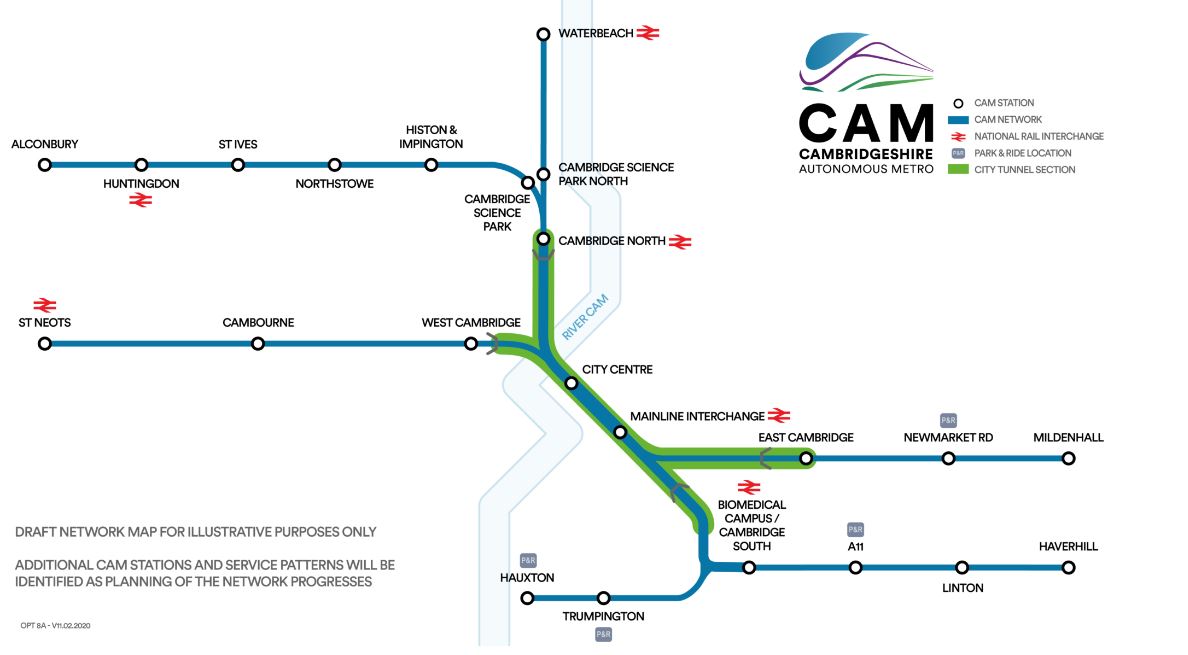
Under current proposals the CAM network would comprise a tunnelled section beneath Cambridge city centre, and four regional routes, radiating out towards St. Neots, Alconbury, Mildenhall and Haverhill.
This is a map clipped from the proposals.
Note.
Sections shown in green are tunnelled.
Sections shown in blue are on the surface.
Some sections would appear to reuse parts of the Cambridgeshire Guided Busway.
These are a few of my thoughts.
Rolling Stock
This picture from the consultation, shows possible rolling stock.
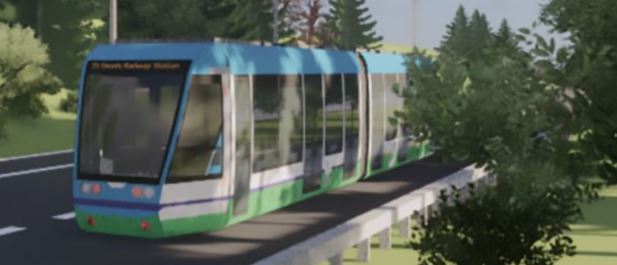
It could be a version of Van Hool’s ExquiCity BRT tram-bus, which is used is Belfast, Geneva, Metz and Parma – To name just four!
A hydrogen-powered version has also recently been introduced in Pau in France.
Could this be the version, that will be preferred for Cambridge?
- It would be carbon and pollution free.
- It could use exclusively green hydrogen, created from renewable electricity. Pau uses a hydrogen-generation system from ITM Power.
- Would hydrogen-power encourage passengers to use the system?
- It might borrow ideas from the Glider system in Belfast, which is diesel-electric powered.
- Each Belfast Glider vehicle can hold 105 passengers.
A hydrogen-powered system would surely be ideal for working in the tunnels under Cambridge.
Tunnels
This article on the BBC is entitled Cambridge Metro: Engineer Says Underground Will Work.
In the article, Professor John Miles of Cambridge University says.
Britain was a world leader in boring small tunnels
It will be tight in the cramped city, but it should be possible.
Conclusion
Oxford will want one!
I Design A Hydrogen Aventra
This article on Rail News is entitled Alstom Moves Ahead With Bombardier Takeover.
This is a paragraph in the report, which is dated the eighteenth of last month.
n a statement issued last night, Alstom said it had ‘signed a Memorandum of Understanding with Bombardier Inc. and Caisse de dépôt et placement du Québec in view of the acquisition of Bombardier Transportation. Post-transaction, Alstom will have a backlog of around €75bn and revenues around €15.5bn. The price for the acquisition of 100 per cent of Bombardier Transportation shares will be €5.8bn to €6.2bn, which will be paid via a mix of cash and new Alstom shares.’
That sounds pretty definite to me.
In the UK, Alstom will take over a company with the following projects.
- A large order book for building Aventras in the Litchurch Lane factory at Derby.
- Several support projects for existing train fleets.
- A joint design project with Hitachi to bid for the trains for High Speed Two. Alstom are also bidding for High Speed Two, as are CAF, Siemens and Talgo.
- Design and build the cars for the Cairo monorail.
- Bombardier have been offering train operating companies a bi-mode Aventra.
There are also rumours, that Bombardier are in the running for a large order for Southeastern.
What are Bombardier’s strengths in the UK?
- The Aventra is without doubt an excellent train, but with some software teething troubles.
- The company has the ability to turn out finished trains at a formidable rate.
- The company can make the carriage bodies in a high-tech plant.
- Could the bodies be built in a larger size?
- Or even a smaller size for a country like Australia, New Zealand, Nigeria or South Africa that uses a narrow gauge?
- The company has the ability to design complete trains to the UK’s smaller standards.
- The company can make trains in both European-sizes in Europe and UK-sizes in Derby.
- The company builds bogies for other train manufacturing companies.
On the other hand, Bombardier has the following weaknesses.
- It doesn’t make any diesel-powered trains, although it has successfully trialled battery-powered trains.
- It has dismissed hydrogen-powered trains.
- But above all the finances of the parent company are a basket case.
It appears to me that Alstom might bring much needed technology and finance to Bombardier UK. In return, they will acquire a modern design, that can be used in the UK and other countries, that use a smaller loading gauge.
Obviously, if the takeover goes through, more information should be forthcoming in the near to mid future.
The Future For Hydrogen Trains In The UK
I would suspect, that Alstom have designed a train in the Class 321 Breeze, that fits their view of what will work well in the UK train market.
- It is a sixty metre long train, for a couple, where most platforms are at least eighty metres long.
- It has a capacity similar to that of a modern two-car diesel multiple unit.
- The Renatus version of the Class 321 train has a modern and reliable AC-based traction package. Or that’s what a Greater Anglia driver told me!
- Eversholt Rail Group have already devised a good interior.
- I said I was impressed with the interior of the train in A Class 321 Renatus.
- The train can operate at 100 mph on a suitably electrified line, when running using the electrification.
- Adding an extra trailer car or two could be a simple way of increasing capacity.
I should say, that I think it will be a quieter train, than the Coradia iLint, which has a rather noisy mechanical transmission.
I feel that a Class 321 Breeze train could be a good seller to routes that will not be electrified, either because of difficulty, expence or politics.
With a 100 mph operating speed on electrification and perhaps 90 mph on hydrogen power, it may have enough performance to work a lot of routes fast, profitably and reliably.
I think, that the Alston Class 321 Breeze will prove whether there is a market for hydrogen-powered trains in the UK.
I would think, that use of these trains could be a big application.
Replacement Of Two-And Three-Car Diesel Multiple Units
There are a lot of these still in service in the UK, which include.
- 3 x three-car Class 150 trains
- 134 x two-car Class 150 trains
- 114 x two-car Class 156 trains
- 15 x three-car Class 158 trains
- 155 x two-car Class 158 trains
- 30 x three-car Class 159 trains
All of these are currently running services all over Great Britain and I have ignored those trains run by Chiltern Railways as they will logically be replaced by a dedicated batch of new trains, with possible full- or part-electrification of the route. Or they could be custom-designed hydrogen trains.
As there are only 105 Class 321 trains that can be converted, some other trains will be needed.
I suppose classes of trains like Class 365 trains and others can be converted, but there must come a point, when it will be better to build new hydrogen trains from scratch.
Components For Hydrogen Trains
This article on Rail Business is entitled Breeze Hydrogen Multiple-Unit Order Expected Soon.
It says this about the design of the Alstom Breeze train.
The converted HMUs would have three roof-mounted banks of fuel cells on each of the two driving vehicles, producing around 50% more power than the iLint. Two passenger seating bays and one door vestibule behind each cab would be replaced by storage tanks. The fuel cells would feed underfloor battery packs which would also store regenerated braking energy. The current DC traction package on the centre car would be replaced by new AC drives and a sophisticated energy management system. Despite the loss of some seating space, each set of three 20 m vehicles would provide slightly more capacity than a two-car DMU with 23 m cars which it would typically replace.
The following components will be needed for hydrogen trains.
One Or More Hydrogen Tanks
This picture shows the proposed design of the Alstom Class 321 Breeze.
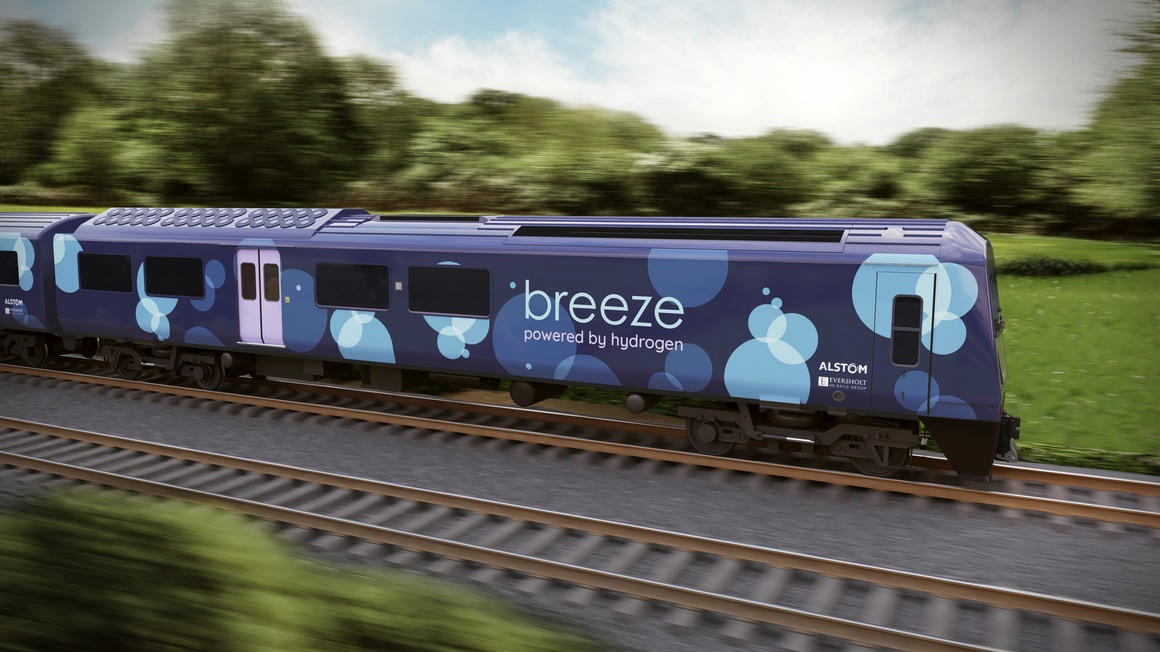
Note how half the side of the front car of the train is blocked in because it is full of the hydrogen tank. As this Driver Car is twenty metres long, each hydrogen tank must be almost seven metres long. If it was one larger tank, then it could be longer and perhaps up to fourteen metres long.
Batteries
As the Rail Business article said, that the batteries are underfloor, I wouldn’t be surprised to see all cars having a battery pack.
I favour this layout, as if cars all are motored, it must cut the length of cabling and reduce electrical losses.
Effectively, it creates a train with the following.
- Faster acceleration
- Smooth, fast deceleration.
- Efficient braking
- Low energy losses.
It should also add up to a train with good weight distribution and high efficiency.
Hydrogen Fuel Cells
In the Class 321 Breeze, Alstom are quoted as having three banks of fuel cell on the roof of each driver car.
This would distribute the power derived from hydrogen to both ends of the train
Hydrogen For Hydrogen Trains
Alstom’s Coradia iLint trains do not have a custom-design of hydrogen system, but over the last few years green hydrogen systems have started to be supplied by companies including ITM Power from Rotherham. Recently, they have supplied the hydrogen system for the hydrogen-powered Van Hool Exqui-City tram-buses in Pau in France. A similar system could be used to refuel a fleet of Breeze trains.
It looks like we have a limited number of hydrogen-powered trains and their fuel could be made available, but not enough to replace all of the UK’s small diesel trains, if we rely on Class 321 Breeze trains.
So there will be a need to build some more.
My Design Of Hydrogen Train
I would start with the Aventra design.
- It is very much Plug-and-Play, where different types of cars can be connected together.
- Cars can be any convenient length.
- Some Aventras, like the Class 345 trains for Crossrail are even two half-trains.
- There are various styles of interior.
- The Aventra appears to be a very efficient train, with good aerodynamics and a very modern traction system with regenerative braking.
- Driver, pantograph, trailer and motor cars and third-rail equipment are available.
- Battery cars have probably been designed.
- For good performance, Aventras tend to have a high proportion of motored cars.
- Aventras have been designed, so that power components can be distributed around the train, so that as much space as possible is available for passengers.
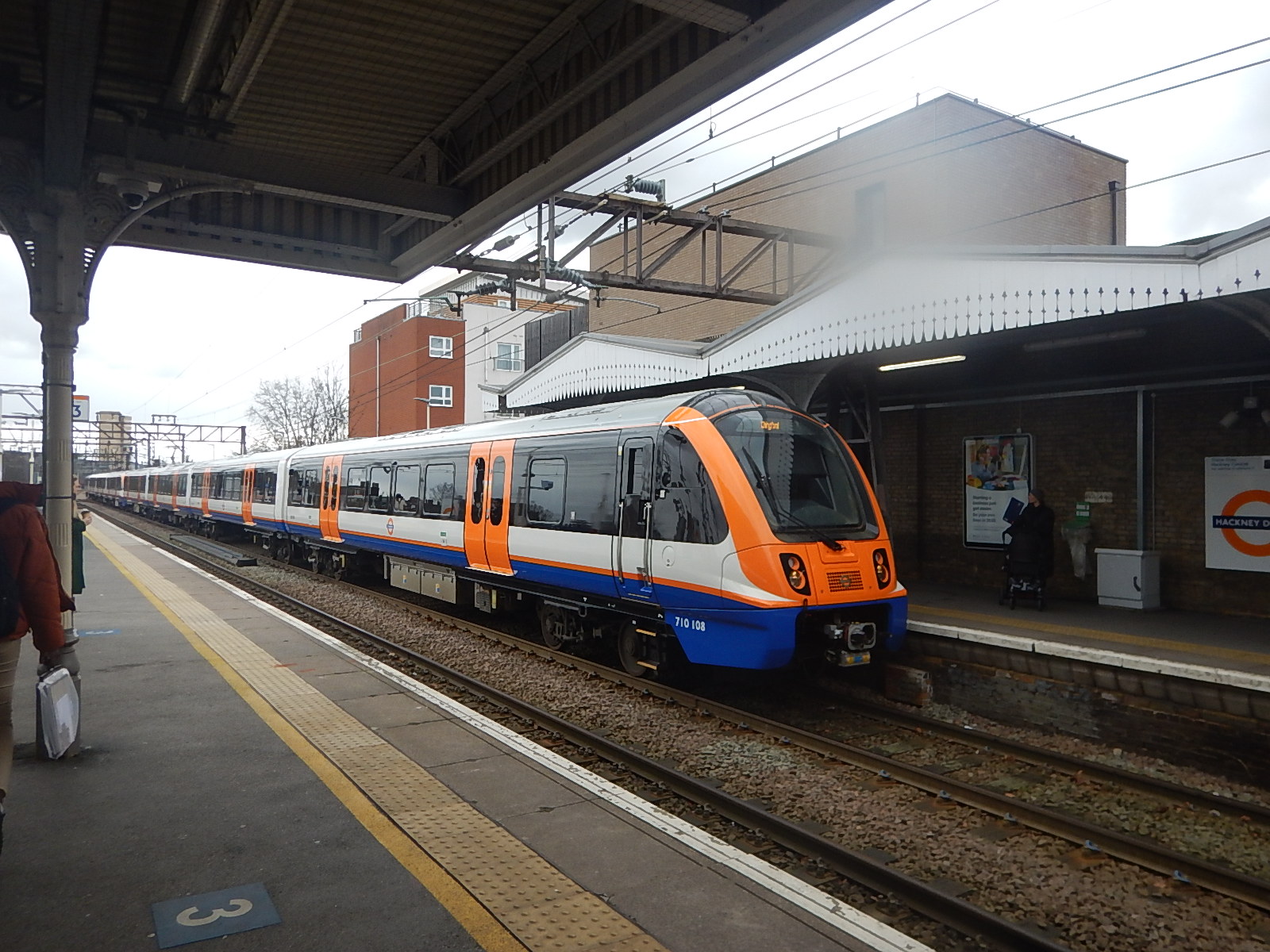
This picture shows a four-car Class 710 train, which is an Aventra.
In the next sub-sections I will fill out the design.
Train Layout
Perhaps, a hydrogen-powered train could be five cars and consist of these cars.
- Driver Motor Car
- Trailer or Motor Car
- Hydrogen Tank Car
- Trailer or Motor Car
- Driver Motor Car
Equipment would be arranged as followed.
- I would put the hydrogen tank in the middle car. Stadler have been very successful in putting a power car in the middle and it could be the ideal car for some of the important equipment.
- As I said earlier, I would put batteries under all cars.
- Regenerative braking and electrification would be used to charge the batteries.
- I think, I would put the hydrogen fuel cells in Alstom’s position on the rear part of the roof of the driver cars.
- There would also be a need to add a pantograph, so that could go on any convenient car!
- I do wonder, if the middle-car could be developed into a mini-locomotive with a walkway through, like the PowerCar in a Stadler Class 755 train.
There’s certainly a lot of possibilities on how to layout the various components.
Passenger Capacity
The five-car hydrogen-powered Aventra, I have detailed is effectively a four-car Aventra like a Class 710 train, with a fifth hydrogen tank car in the middle.
So the passenger capacity will be the same as a four-car Aventra.
The Class 710 trains have longitudinal seating, as these pictures of the interior show.
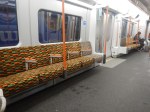

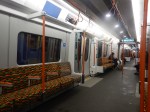
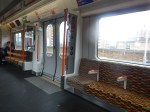
They have a capacity of 189 sitting and 489 standing passengers or a total capacity of 678.
Greater Anglia’s Class 720 trains have transverse seating and a five-car train holds 540 sitting and 145 standing passengers.
Multiplying by 0.8 to adjust for the hydrogen car and the capacity would be 432 sitting and116 standing passengers or a total capacity of 548.
Seats in various UK four-car electric multiple units are as follows.
- Class 319 – 319
- Class 321 – 309
- Class 375 – 236
- Class 379 – 209
- Class 380 – 265
- Class 385 – 273
- Class 450 – 264
It would appear that a five-car hydrogen-powered Aventra, with one car taken up by a hydrogen tank and other electrical equipment can carry a more than adequate number of passengers.
Extra Passenger Capacity
Suppose to eliminate diesel on a route, a five-car Class 802 train were to be replaced with a six-car hydrogen-powered Aventra, which contained five passenger cars
- The capacity of the Class 802 train is 326 seats, which still compares well with the five-car hydrogen-powered Aventra.
- The extra car would increase the passenger capacity.
As Aventras are of a Plug-and-Play design, extra cars would be added as needed.
Maximum Length
Aventras tend to have lots of powered axles, as this improves accelerations and braking, so I suspect that trains with four or five cars on either side of the hydrogen car would be possible.
Nine-car trains could be ideal for replacing trains like Class 800 bi-mode trains to reduce the number of diesel trains. The Class 800 trains would then be converted to Class 801 electric trains or a new battery/electric version.
A Walkway Through The Hydrogen Car
These pictures show the walkway through the PowerCar in a Stadler Class 755 train.
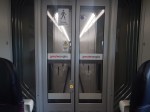
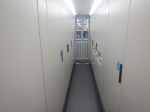
I’m sure that an elegant design of walkway can be created.
In-Cab Digital Signalling
It goes without saying, that the train would be capable of being fitted with in-cab digital signalling.
Performance On Electrification
Bombardier have stated that they have a design for a 125 mph bi-mode Aventra. They might even have designed the trains to achieve 140 mph running on routes with full in-cab digital signalling.
These electrified lines are likely to be able to support 140 mph running with full in-cab digital signalling.
- East Coast Main Line
- Great Western Main Line
- Midland Main Line
- West Coast Main Line
As these hydrogen-powered Aventras may need to run on these high speed electrified lines, I would design the trains so that they could achieve the design speed of these lines, when using the electrification.
This would enable the trains to keep out of the way of the numerous 140 mph electric expresses.
Performance On Batteries And Hydrogen
Hydrogen-powered trains are essentially battery-electric trains, which have the ability to top up the batteries using hydrogen power.
I would suspect that a well-designed hydrogen/battery/electric train should have the same maximum speed on all modes of power, subject to the capabilities of the track and having sufficient power in the batteries to accelerate as required.
The Complete Package
As Hydrogen filling stations from companies like ITM Power and others, that can refuel hydrogen-powered trains are a reality, I’m certain, that it would be possible to create a package solution for a railway company that needed the complete solution.
Different Gauges
If you take a country like Malawi, Malawi Railways looks to need improvement.
They have a three-foot six-inch gauge railway, so could a package of narrower hydrogen-powered Aventras and a solar-powered hydrogen-generator be put together to improve Malawi’s railways?
In When Do Mark 2 Coaches Accept The Inevitable?, I discuss how British Rail Mark 2 coaches were converted from UK loading gauge to one that would work with New Zealand’s 1067 mm. gauge.
So I suspect that a design related to trains built for the UK could be modified for running on the narrow gauge lines of Africa, Australia and New Zealand.
Conclusion
I think it would be possible to design a hydrogen/battery/electric train based on an Aventra with the following characteristics.
- Up to eleven cars
- A hydrogen car with a hydrogen tank in the middle of the train.
- Ability to use 25 KVAC overhead or 750 VDC third-rail electrification.
- In-cab digital signalling
- 140 mph running where the route allows.
- Regenerative braking to batteries.
- Sufficient range on hydrogen power.
- Sophisticated computer control, that swaps mode automatically.
The train would be possible to run the following routes, if configured appropriately.
- Kings Cross and Aberdeen
- Kings Cross and Inverness
- Kings Cross and Cleethorpes via Lincoln and Grimsby
- Kings Cross and Redcar via Middlesbrough
- Kings Cross and Norwich via Cambridge
- Paddington and Penzance
- Paddington and Swansea
- Waterloo and Exeter via Basingstoke
Some routes might need a section of fill-in electrification, but most routes should be possible with a hydrogen fill-up at both ends.
Offshore Wind to Hydrogen Project Secures GBP 7.5 Million Funding
The title of this post is the same as that of this article on Offshore Wind.
This is the first two paragraphs.
The next phase of Gigastack, a renewable hydrogen project, has secured GBP 7.5 million funding as part of the UK’s Department for Business, Energy and Industrial Strategy (BEIS) Hydrogen Supply Competition.
The Gigastack project, led by ITM Power, Ørsted, Phillips 66 Limited, and Element Energy, will show how renewable hydrogen derived from offshore wind can support the UK’s 2050 net-zero greenhouse gas emission target.
Points from the article.
- A 100 MW system will be designed.
- Modules with a capacity of 20 MW will be used.
- Energy will be delivered directly from Ørsted’s Hornsea Two wind farm.
- Some of the hydrogen produced will be used in Phillips 66 Humber Refinery.
- ITM Power will trial their new electolyser and automatic manufacturing.
This seems an ambitious project.
ITM Power signs deal with AEG Power Solutions
The title of this post, is the same as that of this article on the Yorkshire Post.
This is the first two paragraphs.
Energy storage and clean fuel company ITM Power has signed a deal with AEG Power Solutions.
The agreement means that Sheffield-based ITM Power will integrate its electrolyser technology, which produces hydrogen gas from electricity and water, with AEG’s power control electronics.
ITM Power are a company that certainly has some well-known friends.
Initially, they will be working together on five projects.
 The Anonymous Widower