Mersey Ferry To Be Decommissioned After 67 Years
The title of this post is the same as that of this article on the BBC.
This is the sub-heading.
A “much-loved” ferry that has crossed the River Mersey for 67 years is being decommissioned.
These three paragraphs add more details.
Mersey Ferries confirmed The Royal Iris of the Mersey is to be replaced by the new £26m Royal Daffodil later this year.
From its launch in Devon in 1959 until a major refurbishment in 2001, The Royal Iris was named Mountwood. She was renamed on her return to service in 2002, following a major revamp.
Mersey Ferries said it was considering how best to mark her farewell “with further details to be confirmed in due course”.
When I was a student at Liverpool University, it was named Mountwood and I used it regularly.
This is a video of the ferry, that I found on Youtube.
I have a thought.
Is There Any Other Public Transport, That I Have Used Recently, That Was Built In 1957?
I can’t think of anything, except the occasional Routemaster bus.
Does Lack Of B12 Make You Sneeze?
I asked Google AI this question and received this answer.
Based on available research, a lack of vitamin B12 is not typically a direct cause of sneezing. However, B12 deficiency can cause symptoms that mimic allergies, such as a runny nose, nasal congestion, and increased sensitivity to histamine, which might lead to symptoms like sneezing in some individuals.
Key Findings on B12 and Respiratory/Allergy-like Symptoms:
Histamine Increase: When B12 is deficient, the body’s methylation process slows down, leading to higher histamine concentrations in the blood. This can result in allergy-like symptoms, including a runny nose, itchy eyes, and itchy skin, even without traditional allergens.
Chronic Cough: B12 deficiency has been linked to chronic, unexplained coughs due to increased Nerve Growth Factor (NGF) levels, which can cause sensory neuropathy in the airways.
Other Symptoms: A lack of B12 is more commonly associated with extreme fatigue, shortness of breath, dizziness, headaches, pale skin, tingling (pins and needles), and cognitive issues.
While a runny nose or increased sensitivity is possible, sneezing is not a hallmark symptom of B12 deficiency. If you are experiencing persistent sneezing along with fatigue or tingling, it is best to consult a healthcare professional.
Memories Of An Unhealthy Childhood
I was a very unhealthy child and my father used to joke about me as hacking Schmidt, whoever he was, because I coughed a lot?
But I can remember the following.
- Always seeing our GP ; Dr. Egerton White; both at his surgery and at our house.
- Being given lots of various medicines; Including penicillin.
- Catching scarlet fever.
- Missing large amounts of school due to illness.
Unfortunately, my early medical notes have got lost.
Was “Hacking Schmidt” A Pun On George Hackenschmidt?
These are the first two paragraphs of George Hackenschmidt’s Wikipedia entry.
George Hackenschmidt, was an Estonian strongman, amateur and professional wrestler, writer, and sports philosopher. He is recognized as professional wrestling’s first world heavyweight champion.
Hackenschmidt was the only professional wrestling champion who is not known to have taken part in fixed matches, which were pervasive even in his day.
My father was very much a punsmith and his punning nickname for me, could have come from someone, who was very much famous, when he was growing up.
Liverpool Fans’ Celebrations Caused Earth Tremor
The title of this post, is the same as that of this article on the BBC.
This is the sub-heading.
Liverpool fans celebrating the club’s historic title-clinching win over Tottenham Hotspur at Anfield caused a series of tremors, university scientists have revealed.
These three paragraphs give more details.
Arne Slot’s side secured the club’s 20th top-flight championship defeating Tottenham 5-1 in front of a packed Anfield stadium on 27 April.
The most significant tremor was caused by Alexis Mac Allister’s strike in the 24th minute, which put Liverpool 2-1 ahead and registered a peak magnitude of 1.74 on the Richter scale.
The data was recorded by University of Liverpool earth scientists using equipment used to detect earthquakes.
Looking at it on a scientific basis, it is surely a very good test that the equipment is working well.
The whole of the BBC article is worth a good read.
UK Government Sets 8-Hour Minimum For LDES Cap-And-Floor Sheme
The title of this post, is the sa,e as that of this article on Energy Storage News.
This is the sub-heading.
The UK government has published a Technical Decision Document confirming crucial aspects of its long duration electricity storage (LDES) cap-and-floor scheme, which includes increasing the minimum duration required from six hours to eight
These paragraphs give full details.
The document, released by regulator Ofgem on 11 March, details the final overarching rules and requirements for the scheme as well as how it will be implemented, though significant detail still remains to be worked out.
The scheme will provide a cap-and-floor revenue protection for 20-25 years that will allow all capital costs to be recoverable, and is effectively a subsidy for LDES projects that may not be commercially viable without it. Most energy storage projects being deployed in the UK today are lithium-ion battery energy storage systems (BESS) of somewhere between 1-hour and 3-hour in duration (very occasionally higher).
One of the most significant new details of the scheme is that, following industry feedback, the minimum duration for projects to qualify has been increased from six hours to eight hours of continuous rated power.
The ‘continuous rated power’ aspect prevents shorter duration projects from bidding in a smaller section of their MW capacity in order to act like an 8-hour system.
Another interesting detail pointed out by several commentators is that the cap is a ‘soft’ one, meaning it will allow extra revenue to be shared between developers and consumers. Exact details on the ratio are yet to be determined.
As a Graduate Control Engineer from Liverpool University in the 1960s, I hope that the move from a six to eight hours minimum duration is feasible.
I wasn’t dealing with power systems, but with multi-vessel chemical plants.
These are my thoughts.
The biggest project, I was dealing with a few years later in the 1970s, was the modeling of all the the reservoirs and pipelines by the Water Resoures Board.
As the supply side of the water industry hasn’t had too many issues with the volume of water supplied, I feel that the main modelers must have done a reasonable job.
Six To Eight Hours Of Continuous Operation
The article says this about uprating from six to eight hours of continuous operations.
All the systems that have been proposed for cap-and-floor operation, seem to have some form of physical storage.
- Energy Dome appears to have tents of carbon dioxide.
- Energy Vault uses stacks of heavy weights.
- Form Energy has tanks of rust.
- Gravitricity has huge weights in disued mine shafts.
- Highview Power has large tanks of liquid air.
- Pumped storage hydro has two lakes, that hold water.
- Rheenergise has two large tanks, of a water-based slurry.
So to go from six to eight hours will hopefully just need some more storage.
Highview Power appears to use similar gas tanks to those used to store natural gas or hydrogen.
This image clipped from Highview’s web site, shows large tanks for liquified gas storage.
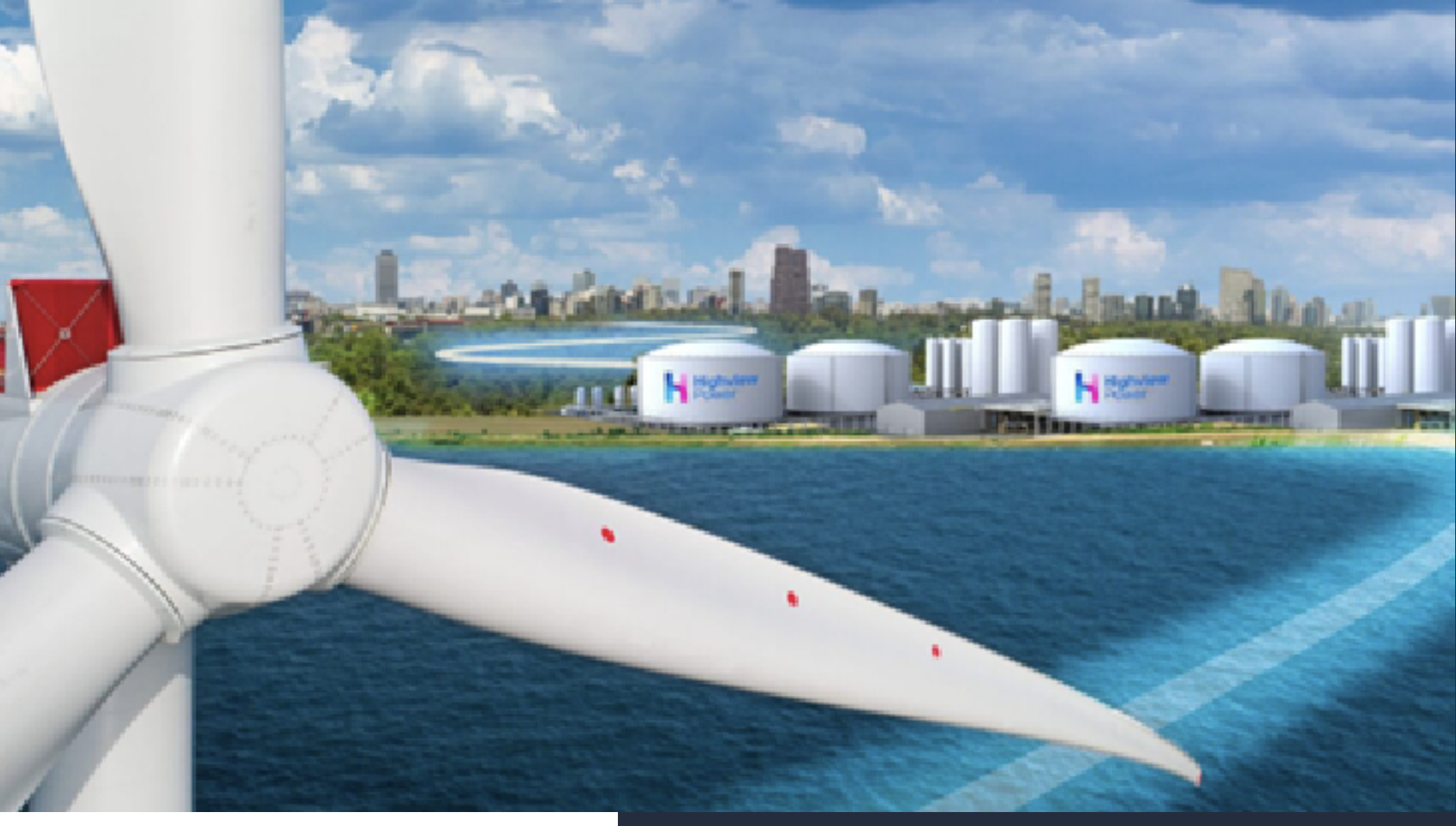
With tanks like these, which can hold GW-equivalents of liquid air, Highview could be building batteries with storage to rival the smaller pumped storage hydroelectric power stations. They are already talking of 200 MW/2.5 GWh systems, which would have a 12.5 hour continuous rating and would probably need two to three tanks.
Coire Glas Pumped Storage
I’ll use Coire Glas pumped storage hydro electric power station as an example.
As currently planned SSE’s Cioire Glas pumped storage hydroelectric power station is 1.5 GW/30 GWh, so it has a a 20 hour continuous rating.
In The UK’s Pumped Storage Hydroelectricity, I gave a rough estimate of the pumped storage hydroelectricity systems in operation or planed as nearly 11 GW/224GWh.
The Soft Cap
The article says this about a soft cap.
Another interesting detail pointed out by several commentators is that the cap is a ‘soft’ one, meaning it will allow extra revenue to be shared between developers and consumers. Exact details on the ratio are yet to be determined.
I seem to remember that when I was modeling a larger multi-vessel chemical plant at ICI, I was using sharing between vessels, to get the system to operate on a PACE-231R analog computer.
So I suspect a soft cap is possible.
Back To The Dark Ages In West Virginia?
This article on WBOY is entitled West Virginia Senators Aim To Revitalize Coal Industry.
These are the introductory paragraphs.
If you’re tired of rising utility bills, you are not alone. West Virginia senators say they share the same feelings and believe the answer is right under our feet.
Revitalizing West Virginia’s coal industry and bringing down utility costs for customers is the goal of two pieces of legislation originating in the Senate.
A resolution known as the Coal Renaissance Act aims to keep current coal operations running as well as open up new opportunities for the industry, expanding mining in West Virginia.
According to Senators in support of the act, the optimum capacity factor for coal plants to run at is 69%. Currently, industry leaders say that number is down to around 30% to 40%.
A new bill known as the Reliable and Affordable Electricity Act incentivizes utility companies to rely on West Virginia coal.
There is also going to be a Senate bill, that will abolish tax breaks for wind farms.
In the UK, it is my belief, that coal died with the Aberfan disaster in 1966, which is described in this first paragraph of the disaster’s Wikipedia entry.
The Aberfan disaster (Welsh: Trychineb Aberfan) was the catastrophic collapse of a colliery spoil tip on 21 October 1966. The tip had been created on a mountain slope above the Welsh village of Aberfan, near Merthyr Tydfil, and overlaid a natural spring. Heavy rain led to a build-up of water within the tip which caused it to suddenly slide downhill as a slurry, killing 116 children and 28 adults as it engulfed Pantglas Junior School and a row of houses. The tip was the responsibility of the National Coal Board (NCB), and the subsequent inquiry placed the blame for the disaster on the organisation and nine named employees.
I do have memories of coal mining in my brain.
- As a young child, I can remember being driven past the Kentish collieries and seeing the blackened landscape of the Garden of England.
- Newspapers of the 1950s and 1960s published, their share of mining disasters.
- In the 1980s, I drove through coal mining country in the United States and was appalled at all the fumes and smoke from the coal-fired power stations and the trucks delivering coal. Nothing as civilised as a merry-go-round train was used.
- In 2015, I visited Katowice and wrote An Excursion In Katowice. The air was thick with coal smoke from the coal-fired power stations.
I also remember at the Jobs Fair, when I left Liverpool University in 1968, seeing the recruiter from the National Coal Board sitting there alone, as if he’d got the plague. Graduates had decided, that no way, were they going to work in the coal industry.
The West Virginia senators, should be certified, if they want to bring back coal.
Ministers Will Relax Rules To Build Small Nuclear Reactors
The title of this post is the same as that of this article in The Times.
This is the sub-heading.
Britain’s five nuclear power stations, which generate about 6GW in total, powering 13 million homes, are all nearing the end of their lives
These first three paragraphs indicate the reasons why, the government wants to relax the rules.
Ministers are preparing to relax planning rules to make it easier to build mini nuclear power plants in more parts of the country in order to hit green energy targets and boost the industry.
They are also examining whether it is possible to streamline the process for approving the safety of new nuclear power plants as a way to reduce construction delays.
At present rules state that only the government may designate sites for potential nuclear power stations, of which there are eight, severely limiting where they can be built.
The article includes a vote and surprisingly to me, the vote embedded in the article, shows 92 % in favour of relaxing the rules and only 8 % against.
I must admit these figures surprise me, as I’d have thought more would have been against.
Certain Words Frighten The Public
It is because nuclear is one of those words, that I felt that the vote in favour would have been much lower.
Regular readers of this blog will know, that in the 1960s,, I worked for ICI doing itinerant computing and instrumentation tasks, in my first job after leaving Liverpool University with a degree in Control Engineering.
I can now classify the experience as a superb apprenticeship, where I learned a lot that has been useful to me in later life.
For a time, I was working on nuclear magnefic resonance or NMR scans. ICI Mond Division in Runcorn had one of the best installations for analysing chemicals using this technique, which is described in this Wikipedia entry, which starts with these sentences.
Nuclear magnetic resonance (NMR) is a physical phenomenon in which nuclei in a strong constant magnetic field are disturbed by a weak oscillating magnetic field (in the near field) and respond by producing an electromagnetic signal with a frequency characteristic of the magnetic field at the nucleus. This process occurs near resonance, when the oscillation frequency matches the intrinsic frequency of the nuclei, which depends on the strength of the static magnetic field, the chemical environment, and the magnetic properties of the isotope involved; in practical applications with static magnetic fields up to ca. 20 tesla, the frequency is similar to VHF and UHF television broadcasts (60–1000 MHz).
One day, the Senior Scientist, who ran the machine came in to work and announced that the property of nuclear magnetic resonance would be replacing X-rays, as the technology had just been used to give a three-dimensional image of something like the tail of a mouse.
Now fifty-five years later, many if not most of us have had MRi scans.
The Wikipedia entry for Magnetic Resonance Imaging or MRi, explains, what happened to the dreaded N-word.
MRI was originally called NMRI (nuclear magnetic resonance imaging), but “nuclear” was dropped to avoid negative associations.
Perhaps, it would be easier to build nuclear power stations, if the level of science teaching in the UK was better.
The Three Paragraphs In Detail
Earlier, I copied three paragraphs from The Times, into this post.
I shall now look at each in detail.
Paragraph 1
Ministers are preparing to relax planning rules to make it easier to build mini nuclear power plants in more parts of the country in order to hit green energy targets and boost the industry.
I was in Suffolk, when the planning of Sizewell B was undertaken.
There appeared to be little strong opposition, but the general feeling was what there was from second home owners, who were worried that the value of their holiday home would decline.
Employment and commerce created by Sizewell B was certainly good for the area in lots of ways.
At the time, my late wife; C was practicing as a family barrister in chambers in Ipswich. She believed that the building of Sizewell B had had a good effect on the area, as it had injected work and money, which had created the finance to allow a couple to end a marriage, that had long since died. She stated a couple of times, that Sizewell B was good for her practice.
Paragraph 2
They are also examining whether it is possible to streamline the process for approving the safety of new nuclear power plants as a way to reduce construction delays.
My worry about streamlining the process for approving safety, is that we approve nuclear power stations so rarely, do we have the qualified personnel to replace elapsed time with people. I would suggest that we don’t.
But we could have.
- We have some excellent universities, where Nuclear Engineering can be studied.
- How many personnel leave the Royal Navy each year, who could be trained as nuclear safety inspectors?
- If say Rolls-Royce and/or Hitachi are building several small modular nuclear reactors a year in the UK, then nuclear engineering will become fashionable, as electronics was for my generation of engineers and it will attract the brightest students.
Perhaps an established university, with access to the needed skills should be funded to set up a Nuclear Safety Institute
Paragraph 3
At present rules state that only the government may designate sites for potential nuclear power stations, of which there are eight, severely limiting where they can be built.
I can envisage new small modular nuclear reactors being built in the UK, where there is a need for lots of electricity to support developments like.
- Offshore wind farms
- Data centres
- Green steelmaking
- Metal refining
- Hydrogen production.
Rolls-Royce have said that their small reactors will be around 470 MW, so I could imagine power stations of this size being placed on disused coal-fired power station sites to boost power in an area. I have already suggested building some on Drax in The Future Of Drax Power Station.
In some locations, the choice could be between a small modular nuclear reactor and some form of energy storage.
Powering Germany
But there is one controversial area, where we can take advantage.
- The Germans are very short of electricity because of their reliance on coal and Russian gas that needs to be replaced.
- The 1.4 GW NeuConnect interconnector is being built by European and Japanese money between the Isle of Grain and Wilhelmshaven.
- The AquaVentus hydrogen system could be extended to Humberside to link with UK hydrogen production and storage.
- A couple of small modular nuclear reactors could be built on Humberside to back up hydrogen production, when the wind isn’t blowing.
But Rolls-Royce and other companies have been putting small nuclear reactors close to the sea bed safely for decades, so why no design an offshore reactor that can be placed at a safe distance offshore?
We would need to solve the Putin and friends problem first, but I can see the UK exporting a lot of electricity and hydrogen produced by nuclear energy.
A New Metier
This article in The Times today is entitled Too many Sir Humpreys are stopping London from taking a punt.
The article is about one of Britain’s most successful private investors ; John Gunn.
The article also introduces a new company to me, with this paragraph.
His latest enthusiasm is for Metier, a company that aims to leapfrog electric vehicle power to convert buses and heavy trucks to hydrogen fuel cells. Several big firms such as Volvo are making new hydrogen-powered vehicles, but Gunn and his partners reckon there is more money in reconfiguring existing ones.
It was Metier, that caught my eye.
In the 1970s, with three others, I started a company called Metier Management Systems, which developed a project management system called Artemis.
We were very successful, in that we sold the company for a nine figure sum and won two Queen’s Awards for Exports.
Since then, there have been several successful companies named Artemis, but we haven’t seen a Metier.
Until now that is and I hope that the hydrogen vehicle company is as successful worldwide as we were.
Strangely, my first job on leaving Liverpool University was in a hydrogen factory and I am a great believer in using the gas as a source of energy.
Metier have a web site, if you want to find out more about the company.
World-First Operation To Treat Rhino’s Broken Leg
The title of this post, is the same as that of this article on the BBC.
This is the sub-heading.
A rhinoceros with a broken leg is back on its feet after a world-first operation.
These are the first three paragraphs.
Amara, a southern white rhino at Knowsley safari park, was given keyhole surgery and had to wear a cast for four weeks.
Surgeons took what they knew about operating on horses and applied it to Amara because there was so little information about rhinos which had been injured in this way.
A team of 10 vets was involved in the operation, which they described as “unlike anything we’ve experienced previously”.
I bet it wasn’t like a horse, as equines in my experience don’t have a bodger on their bonce.
The BBC featured the story in BBC Breakfast this morning and I wouldn’t be surprised to see it turn up later or on the Internet.
Some may say, is the expense worth it to operate on a rhino.
But I would say, that the experience gained by the University of Liverpool, will be applied to the treatment of other large animals, like buffalo, bison, draught horses, elephants and hippotami.
Also, knowing Scousers as I do, I suspect that some of the techniques used, will be scrounged by Liverpool’s medics and applied to humans.
Observing Trains At Stafford Station
I’m fairly certain, that I’ve only been to Stafford once in my life, in the past. That would be in 1968, when I went to English Electric in the town, when I was looking for a job on leaving Liverpool University.
In the end, my first job on leaving was at ICI in Runcorn.
As Stafford station, is on the West Coast Main Line, I’ve been through the station many times, on my way to Liverpool, Manchester, Preston, Scotland and other places in the North West of England.
I travelled North to Stafford in one of London Northwestern’s Class 350 trains, which definitely had ironing board seats. Some of these trains are being replaced with new Class 730 trains.
Stafford Station
This OpenRailwayMap shows the layout of platforms at the station.
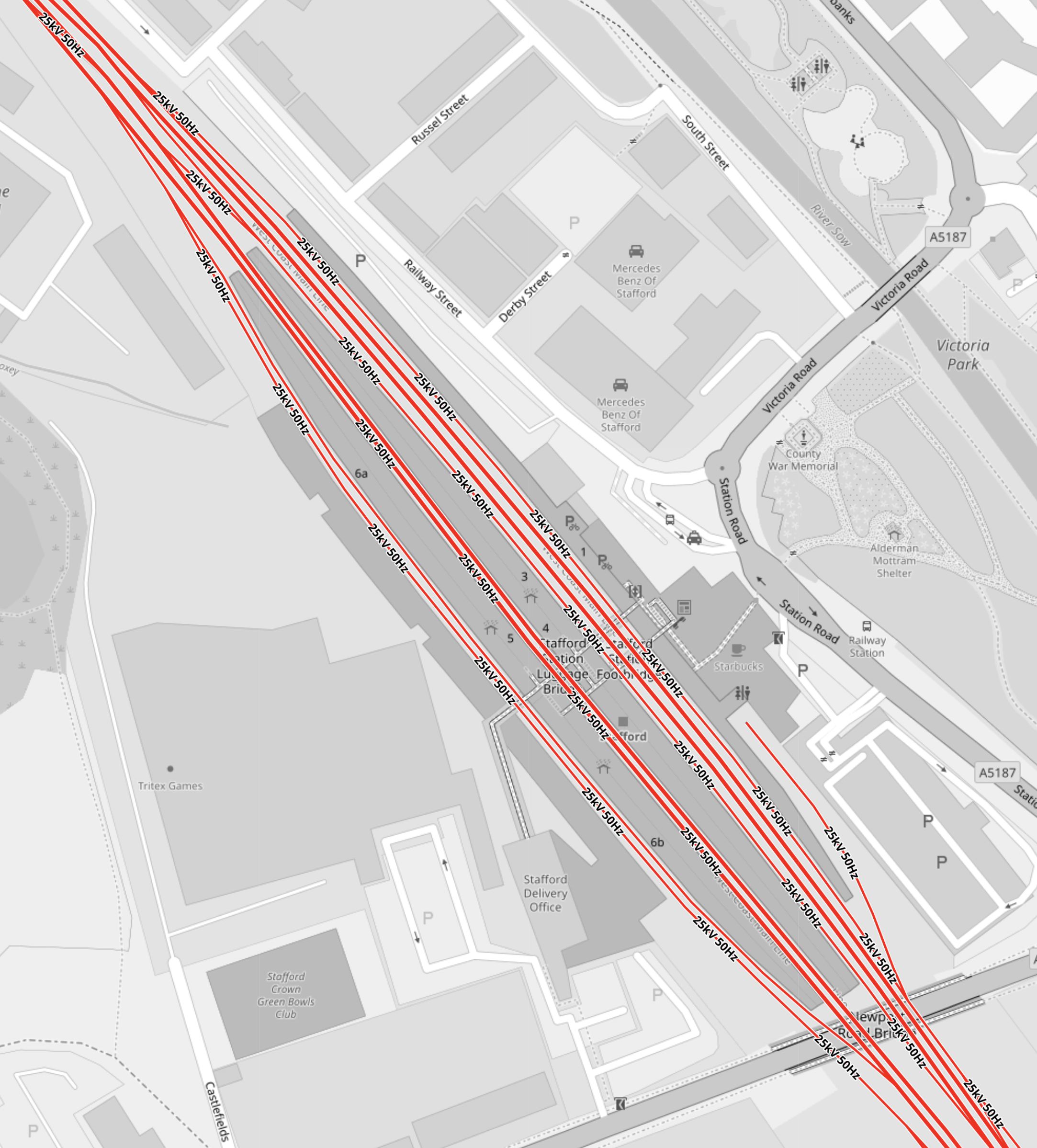
Note.
- Platforms are numbered starting with Platform 1 in the East.
- There are five through tracks for passenger trains and a double-track goods loop.
- All tracks are electrified and bi-directional.
- The platforms are three hundred metres long, but I feel they could be lengthened to take the 400 metre long High Speed Two trains.
- The platforms are certainly long enough for pairs of 200 metre long High Speed Two trains, to split and join at the station.
These pictures show Stafford station.


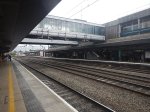

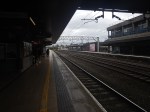
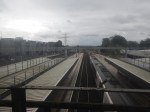
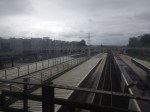


Note.
- The station was built of concrete in the early 1960s.
- It has a unique feature, in that there is a waiting area above the tracks, so kids of all ages can watch the trains speed through.
- It has been improved several times in recent years.
- It is step-free with several lifts.
I feel, the station could be converted into a major High Speed Two hub station.
High Speed Two Services
This graphic shows High Speed Two services after Phase 2b is completed.
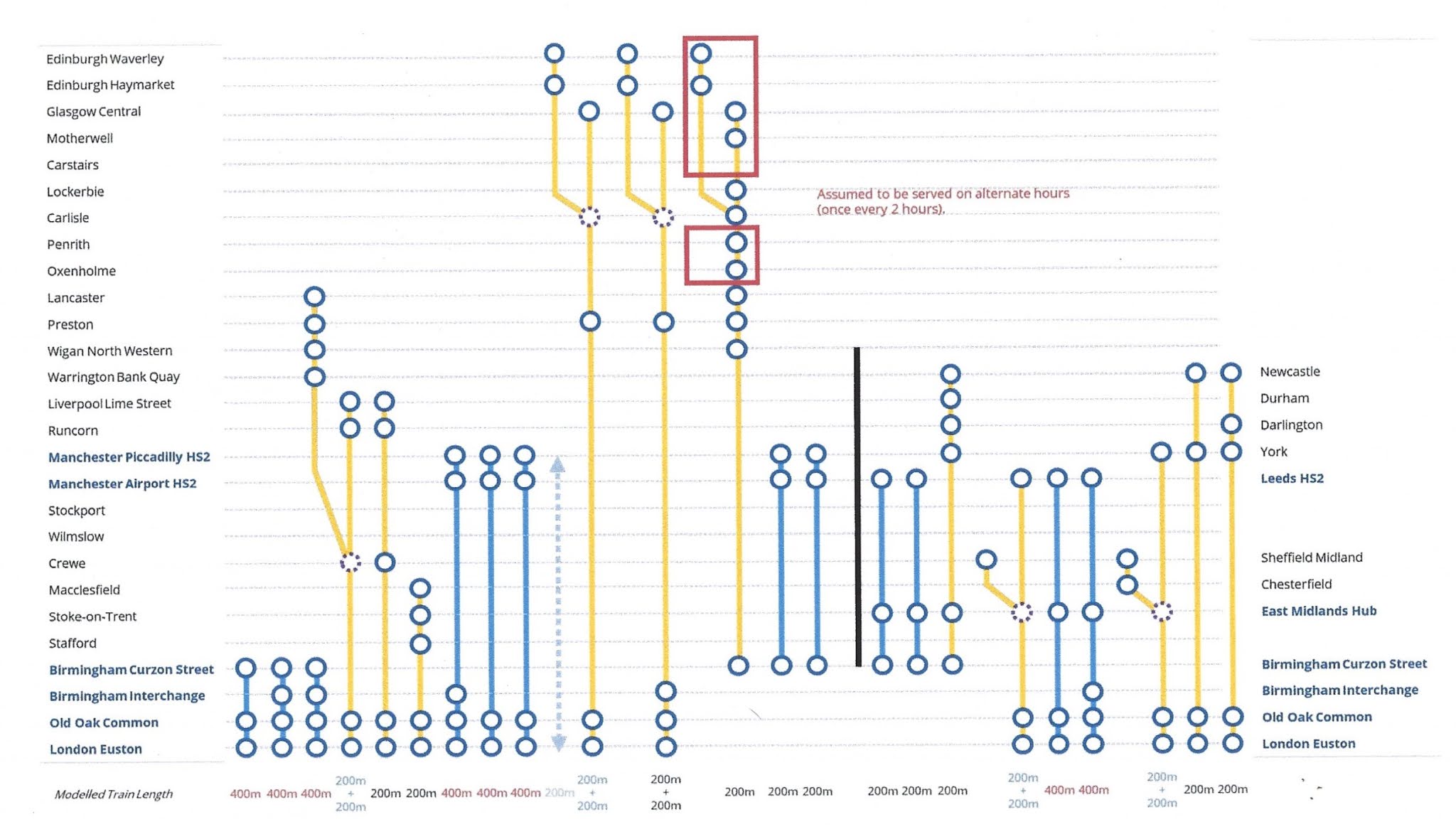
Note.
- Everything to the right of the vertical black line has now been cancelled
- Services shown in blue are run by High Speed Two Full Size trains.
- Services shown in yellow are run by High Speed Two Classic-Compatible trains.
- Each of these trains will have a frequency of one train per hour (tph).
These High Speed Two trains pass through Stafford.
- London and Lancaster/Liverpool Lime Street – Split/Join at Crewe
- London and Crewe/Runcorn/Liverpool Lime Street
- London and Stafford/Stoke-on-Trent/Macclesfield
- London and Manchester Airport/Piccadilly
- London and Manchester Airport/Piccadilly
- London and Manchester Airport/Piccadilly
- London and Edinburgh/Glasgow – Split/Join at Carlisle
- London and Edinburgh/Glasgow – Split/Join at Carlisle
- Birmingham and Edinburgh/Glasgow
- Birmingham and Manchester Airport/Piccadilly
- Birmingham and Manchester Airport/Piccadilly
In addition space will need to be found for these other services.
- Avanti – London and Chester/North Wales
- Avanti – London and Blackpool
- Freight – London and Liverpool/Manchester and Scotland
That gives a total of at least fourteen tph through Stafford station or one every 257 seconds.
Between Stafford and Crewe, with the completion of the flyover at Norton Bridge, there is effectively four tracks all the way, so this should give enough capacity to allow fourteen tph between Stafford and Crewe.
Between Stafford and Handsacre junction, where High Speed Two will join the Trent Valley Line about half the route is four-track with the rest being just two-track.
Will the two-track section be able to handle fourteen tph? I suspect it will, especially, as it is sandwiched between two four-track sections.
These are my thoughts about making the most of capacity through Stafford station.
Could Pairs Of High Speed Two Trains, Split And Join At Stafford?
Stafford station has 300 metre long platforms and pairs of High Speed Two Trains are 400 metres long.
Looking at maps and pictures of Stafford station, I suspect that lengthening the platforms at Stafford would be possible.
In the provisional High Speed Two service diagram, that I displayed earlier, these are two services.
- London and Crewe/Runcorn/Liverpool Lime Street
- London and Stafford/Stoke-on-Trent/Macclesfield
These could be run as a pair of trains between London and Stafford.
One advantage of running the two services as a pair, is that it would reduce the number of trains between Stafford and Handsacre junction by one, which might help the scheduling of trains through the double-track section, of the Trent Valley Line.
Fitting In The London and Chester/North Wales Services
Consider.
- These important services will soon be run by five-car Class 805 trains.
- The trains are diesel-electric.
- A pair would be 260 m long.
- There are ten trains per day (tpd) on the route.
The service has a few problems.
- It takes up a path between Crewe and Handsacre junction via Stafford, where train paths are at a premium.
- It is not zero-carbon.
- If London and Holyhead times were reduced, it would probably attract more passengers to the route.
As there are plenty of spare paths on High Speed Two, due to the cancellation of the Eastern leg, the easiest way to speed up the service would be to use High Speed Two between Handsacre junction and London.
200 metre long High Speed Two Classic-Compatible trains could be used, but this would need one of the following.
Electrification between Crewe and Holyhead. Although this was promised by the last government, I suspect the antis will stop it.
Partial electrification between Crewe and Holyhead. As Crewe and Holyhead is only 105.5 miles, I suspect a creditable scheme to use battery-electric trains could be developed. These trains could be useful in opening up High Speed Two to other destinations.
Could Other Services Piggy-Back On London and Chester/North Wales Services?
The London and Chester/North Wales services would all be run by 200 metre long High Speed Two trains.
There would be no reason, why on the London end of the journey, they could be paired with another High Speed Two train to and from another destination.
- They could split and join with a Blackpool service at Crewe.
- They could split and join with a Barrow service at Crewe.
- They could split and join with a second Stoke-on-Trent/Macclesfield service at Stafford.
Services like these, would improve the coverage of High Speed Two.
As with the joining of the Liverpool Lime Street and Macclesfield services, the pairing of trains reduces the number of paths needed on the double-track section of the Trent Valley Line to the South of Stafford.
Other Splitting And Joining At Stafford
It may be possible to arrange other splitting and joining at Stafford.
By rearranging the Manchester and/or the Scottish services, it might be possible to reduce the number of trains, through the double-track section of the Trent Valley Line.
There are certainly several possibilities.
Conclusion
Stafford station could be crucial, in making High Speed Two Lite feasible.
The Aerosol Tales
When I left Liverpool University in 1968, I was very familiar with the use of products distributed in aerosol cans.
- I had used aerosol shaving cream, although about that time, I acquired my beard.
- I certainly used aerosol deodorant, as did most in the 1960s.
- Aerosol paints were common for covering scuffs and scratches in your car.
- Aerosols were often used to apply sun protection.
- Aerosols containing cream or a non-dairy alternative for culinary use were not unknown.
- Aweosol lubricants were starting to appear.
Although, I went to work for the chemical giant; ICI, at that time, I had no idea how an aerosol and its can worked.
As ICI at the time, ICI were major manufacturers of aerosol propellants, I quickly learned how they worked.
The Wikipedia entry for Aerosol Spray Dispenser gives a lot of history about aerosol cans and their propellants.
The Wikipedia entry for Propellant has this paragraph describing propellants of the last century.
Chlorofluorocarbons (CFCs) were once often used as propellants, but since the Montreal Protocol came into force in 1989, they have been replaced in nearly every country due to the negative effects CFCs have on Earth’s ozone layer. The most common replacements of CFCs are mixtures of volatile hydrocarbons, typically propane, n-butane and isobutane. Dimethyl ether (DME) and methyl ethyl ether are also used. All these have the disadvantage of being flammable. Nitrous oxide and carbon dioxide are also used as propellants to deliver foodstuffs (for example, whipped cream and cooking spray). Medicinal aerosols such as asthma inhalers use hydrofluoroalkanes (HFA): either HFA 134a (1,1,1,2,-tetrafluoroethane) or HFA 227 (1,1,1,2,3,3,3-heptafluoropropane) or combinations of the two. More recently, liquid hydrofluoroolefin (HFO) propellants have become more widely adopted in aerosol systems due to their relatively low vapor pressure, low global warming potential (GWP), and nonflammability.
Note that the whole range of these chemicals, effect the ozone layer.
Rocksavage Works
ICI’s Rocksavage Works, was an integrated chemical plant by the Mersey,.
- It made all types of CFCs for aerosols and other purposes.
- It also made the fire suppressant and extinguisher; Bromochlorodifluoromethane or BCF.
- Alongside BCF, it made the anaesthetic Halothane or as ICI called it Fluothane.
- The plant was a poisonous place with all those bromine, chlorine and fluorine compounds.
- Despite this, the plant had a remarkable safety record.
I had the pleasure of working at the plant and it was where, I had most of my excellent Health and Safety training, from the amazing site foreman; Charlie Akers.
Some of the wisdom he distributed has proved invaluable in aiding my stroke recovery.
I suspect that since the signing of the Montreal Protocol, the plant has changed greatly or has even been closed.
All that appears to be left is the 800 MW gas-fired Rocksavage power station and a Facebook page.
Aerosol Baked Beans
In those days, I worked most of the time in a lab at Runcorn Heath.
One of the labs near to where I generally worked, in the large research complex, was a lab, where new aerosol products were developed and tested.
One of the standard jokes about that lab, was that they were working on aerosol baked beans. They said, they would develop the product, even of they had to eject them from the can one at a time.
Gift Time
One afternoon, the boss of the aerosol development lab came through with a tray of goodies.
On the tray, which was much like a cinema usherette’s ice cream tray of the sixties was a whole host of partly-labeled aerosol cans. Only clues to what the product might be were written on the outside in felt-tip pen.
I grabbed two, one of which was marked something like lubricating oil and the other was just marked hand cream, which I of course gave to my new wife; C.
We were married for nearly forty years and often, when she bought hand cream, she would remark, that it wasn’t of the same standard as the little can I brought home from work.
It appears to me, that one of the world’s top cosmetic companies and ICI were trying to create the world’s best and probably most expensive hand creams.
DMW
Fast-forward nearly twenty years and I was approached by Lloyds Bank about two individuals, who had developed an aerosol valve, that instead of using CFCs or other ozone-depleting chemicals.
- By the exploitation of the nether end of fluid dynamics, the propellant of the aerosol was nothing more harmless than pure nitrogen.
- I formed a company called DMW with the two inventors.
- John Gummer, who at the time was my MP and Environment Minister, knew of the aerosol valve and he took the details to Montreal.
So did a device developed in Suffolk help push through the Montreal Protocol?
Osbourne Reynolds
I also wonder, if we had some supernatural help. At the time, I lived in the family home of Osbourne Reynolds.
- He did a lot of the early work on fluid dynamics.
- He was the first UK Professor of Engineering.
- He was professor of Engineering at Manchester University for nearly forty years.
- The Reynolds number is named after him.
- Remarkably, students are sill taught on the equipment Reynolds designed.
- Reynolds was certainly one of our great Victorian scientists.
This Wikipedia entry gives more details of his remarkable life and work.
After Montreal the aerosol valve was sold to Johnson & Johnson.
DMW continued to develop other products and we had one, who no-one had any idea about how it worked.
So I discussed it with the Reynolds’s expert at Manchester University and he said he had no idea either.
But he was absolutely certain, that Reynolds would have known.
 The Anonymous Widower