Centrica Partners With Ceres Power On Solid Oxide Fuel Cells
The title of this post, is the same as this article on gasworld.
This is the sub-heading.
UK multinational energy and services company Centrica is partnering with clean tech firm Ceres Power to accelerate solid oxide fuel cells [SOFCs] production to meet forecasted ‘multi-gigawatt’ demand from industrial customers across Europe.
These three paragraphs indicate the market opportunity, that Centrica feel, that the partnership will fill.
With electricity grid connection delays impacting new industrial, commercial and digital projects, the UK and Europe are experiencing a widening gap between demand and available capacity.
Centrica aims to offer customers high‑efficiency, low‑carbon, grid independent on‑site power that can be deployed much faster than gas turbines or nuclear.
Group Chief Executive Chris O’Shea said by collaborating with Ceres’ technology it sees an opportunity to support data centres, AI and industry with cleaner power at scale. Ceres claims SOFCs can be manufactured and delivered on site to get power online “in months not years”.
It certainly sounds feasible to drop in an appropriate-sized stack of fuel cells and connect them up to the gas main.
These two paragraphs, indicate how Ceres will support Centrica.
Initially, Ceres will support Centrica in expanding a new differentiated service-led model for clean power, providing access to British technology through its expanding network of global manufacturing partners.
Ceres will assist Centrica with opportunities across project origination, installation and commissioning, remote monitoring, predictive maintenance and end of life recycling.
I have a few questions for Google AI.
Do Ceres Fuel Cells Emit Carbon Dioxide?
Google AI replied this.
Yes, Ceres Power has developed Solid Oxide Fuel Cell (SOFC) technology, known as the SteelCell®, that works on natural gas. This technology is specifically designed to be fuel-flexible, capable of converting grid natural gas into electricity at high efficiency.
Key Details About Ceres Fuel Cells and Natural Gas:
Technology Capability: The Ceres SteelCell runs on natural gas, as well as future-focused fuels like hydrogen and biogas.
Application: These fuel cells are used for distributed power generation in homes, businesses, and industrial settings (such as AI data centres).
Efficiency: When running on natural gas, the SOFC systems can achieve an electrical efficiency of around 62%, with total efficiency exceeding 90% when combined with heat recovery.
Emission Reductions: Compared to conventional combustion engines, the technology offers a 30% reduction in carbon emissions.
Current Strategy: As of early 2026, Ceres is focusing on natural gas-fueled SOFCs for stationary power markets, particularly in collaboration with partners like Centrica to address power shortages in the UK and Europe.
While the systems can be used for hydrogen in the long term, they are currently fully functional with natural gas, making them a “bridge” technology for decarbonisation.
A 30% reduction is surely worthwhile!
In What Size Are Ceres Power Holdings Fuel Cells Manufactured?
Google AI replied this.
Ceres Power Holdings’ solid oxide fuel cell (SOFC) technology is manufactured in modular, scalable sizes, with individual stacks ranging from 10-50 kW and commonly deployed in 1-5 MW power modules. These stacks are produced at manufacturing facilities with capacities like 50MW (e.g., with partner Doosan), with plans for up to 100MW annual capacity.
Key manufacturing and size details include:
Cell Component: 30–150W.
Stack: 10–50 kW.
Stack Array/Module: 100–500 kW, up to 1-5 MW modules.
Manufacturing Capacity: 50MW production facility in South Korea (Doosan), with plans for 100MW+ annual capacity in future plants.
Applications: Primarily stationary, distributed power systems for AI data centres, industrial decarbonisation, and commercial buildings.
Ceres licenses its technology to partners like Bosch and Doosan, with cell technology based on low-cost printed steel substrate
How Much Power Does A Top Of The Range MRi Scanner Use?
I am asking this question, as it is surely something you might power with a Ceres fuel cell powered by natural gas.
Google AI replied this.
A top-of-the-range MRI scanner (such as a 3-Tesla or 7-Tesla system) is highly energy-intensive, consuming substantial power 24/7 to maintain its superconducting magnet. During active scanning, power usage often ranges from 25 kW up to 80 kW or more.
Here is a breakdown of the power consumption for high-end MRI scanners:
Power Consumption Breakdown
Idle/Stand-by Mode (24/7): The machine constantly consumes roughly 6 to 7 kW for background cooling (liquid helium refrigeration).
Standard Scanning: Productive scanning sessions typically demand around 25 kW.
High-Demand Scanning: Demanding examinations (e.g., head examinations with EPI sequences or special angles) can cause power usage to surge to 70 kW to 80 kW.
System Total: A 3T MRI, including cooling systems (chillers) and peripheral electronics, might require a 3-phase, 480V, 200A supply—roughly equivalent to the capacity of six modern houses.
Conclusion
This seems to be a deal with a large number of possibilities.
Speaking from my past experience of banks and financing, where the bill is ultimately paid by a reputable individual or company like Shell or BP, I believe that Centrica will have no difficulty in financing lots of these systemsusing instiutions like Lloyds or Deutsche Bank.
Centrica Energy And Whitecap Enter Long-Term Natural Gas Supply Agreement
The title of this post, is the same as that of this news item from Centrica.
This is the sub-heading.
Centrica Energy is pleased to announce signing of a long-term natural gas purchase agreement with Whitecap Resources Inc., a leading Canadian producer dedicated to the responsible development of oil and gas resources across the Western Canadian Sedimentary Basin.
These first three paragraphs add more detail to the story.
Starting in April 2028, Whitecap will deliver 50,000 MMBtu of natural gas per day to Centrica Energy for a period of ten years – equivalent to roughly five LNG cargoes each year. The supply will be priced against the Title Transfer Facility (TTF), the benchmark for European gas markets.
This agreement advances Centrica’s strategy of managing market price exposure across its LNG portfolio by linking feed gas costs to European price signals. For Whitecap, the agreement provides access to international LNG-linked pricing, supporting the company’s natural gas price diversification strategy.
“Entering into this innovative agreement with Whitecap underlines our focus on building a balanced LNG portfolio through strategic partnerships across the globe allowing us to deliver reliable energy solutions to global markets” said Chris O’Shea, Group Chief Executive at Centrica.
I have some thoughts.
This Is The Seventh Deal Of This Type By Centrica In A Few Months
Note.
- All are marked with a tag of Natural Gas Trading.
- None of the deals appear to be in the Middle East.
- All appear to be fairly long term deals, with three stretching until 2037.
Hopefully, with luck we’ll have enough gas for the next few years.
Grain LNG Terminal Is Very Flexible
Consider.
- It is Europe’s largest LNG Terminal
- It can import, export and store gas.
- It has plenty of space for expansion, which could include new technologies.
- Centrica have said bunkering facilities will be added, which will be able to handle the latest low-carbon fuels.
I can certainly see, why Centrica acquired the terminal.
Centrica Energy And Seneca Resources Company Sign First-of-Its-Kind Long-Term MiQ Methane Emissions Certificates Agreement
The title of this post, is the same as that of this press release from Centrica.
This is the sub-heading.
Centrica Energy and Seneca Resources Company are proud to announce a groundbreaking agreement, marking the first long-term deal of its kind to support independently verified methane emissions from an MiQ-certified US natural gas producer, helping to underpin reductions over time. This ten-year agreement underscores the commitment of Centrica and Seneca to support global efforts to reduce methane emissions.
This first paragraph added more detail.
Centrica Energy sources and delivers gas and LNG globally, including LNG shipped from the US to international markets. Under the terms of the agreement, Centrica will procure 250,000 MMBtu per day of MiQ-certified gas certificates over the next ten years, a strategic move that positions Centrica at the forefront of methane reduction initiatives, aligns with emerging regulatory requirements, and reinforces leadership in sustainable energy practices.
MiQ is new to me, so here is what the press release says about MiQ.
MiQ is a global leader in methane emissions certification and data. Our mission is to accelerate the transition to lower emissions gas by providing a credible and transparent certification system that drives regulatory compliance, incentivizes continuous improvement, and ensures methane accountability in the oil and gas sector throughout the entire supply chain.
It appears to me that MiQ-certified low-emissions gas is almost like an equivalent of FairTrade coffee.
If the UK buys its gas as MiQ-certified low-emissions gas, it could claim, that it has cut its gas emissions.
Google AI On Low-Emission Natural Gas
I asked its view and received this answer.
Low-emission natural gas refers to methane-based energy with significantly reduced greenhouse gas, methane leakage, and particulate emissions, often achieved through enhanced extraction, certification, or blending with cleaner gases. It offers up to 40% less (CO2) than coal and 20-30% less than oil, serving as a critical transition fuel to support renewable energy.
low-emission natural gas would seem to be a sensible way to go.
Is Carbon Black Used To Make Offshore Electrical Cable?
I asked Google AI, the answer to this question and received this answer.
Yes, carbon black is extensively used to make offshore electrical cables. It serves two primary functions: providing electrical conductivity to specific components and offering UV protection to outer jacketing materials.
That seems a positive answer.
It also could be a very complementary one.
HiiROC have a process that splits any hydrocarbon gas including natural gas, chemical plant off gas and biomethane, into turquoise hydrogen and carbon black.
Two methods of bringing energy to the shore from an offshore wind farm are electricity and hydrogen, through a cable or pipe respectively.
This looks to me, that there could be a possibility to use one of Baldrick’s cunning hybrid plans to bring energy onshore using both hydrogen and electricity.
Effectively, the transmission and use of the system, would use both the hydrogen and carbon black produced by HiiROC.
Better Than A Kick In The Teeth – As C Would Say!
I’ve just had an e-mail from OVO Energy, who have been my energy supplier for at least eight years, that they are going to reduce my Direct Debit by £26 per month.
OVO didn’t give a reason, but then it dawned on me.
In I’m Getting A New Hydrogen-Ready Boiler, I laid out my reasoning for getting a new boiler, as the pump had failed.
It’s only been one billing period, but I suspect other factors have kicked in.
I asked Google AI, if the the efficiency of gas boilers increased in the last ten years, and received this reply.
Yes, gas boiler efficiency has significantly increased in the last ten years, with new models achieving efficiencies over \(90\%\) compared to older ones that could be as low as \(60\%\). This is primarily due to the mandatory use of condensing technology in new boilers, which recovers and reuses heat from exhaust gases to preheat water.
As far as we know, Google are not in the gas boiler business, so I’m sure their answer is unbiased.
It looks like I shall be saving £312 per year, because of the new boiler.
Thus, if it lasts ten years, which is the guarantee period, then it has paid a substantial part of the cost of the new boiler.
As my late wife, C, would often say, that is better than a kick in the teeth.
Should You Get A New Boiler?
I am not qualified to answer that, but I’m you know a man or woman who is!
Consultation Opens For Ferrybridge Next Generation Power Station
The title of this post, is the same as that of this press release from SSE.
These three bullet points act as sub-headings.
- Ferrybridge Next Generation sets out plans for continuing the legacy of power generation at the site, with the potential to bring significant investment to the region.
- Statutory consultation phase launched, inviting communities and stakeholders to have their say on project proposals.
- Hydrogen-enabled project could support the security of supply and offer a clear route to decarbonisation.
These three paragraphs add more detail.
Members of the public are being invited to have their say on plans for a proposed new power station in development, Ferrybridge Next Generation Power Station.
The station is being designed so that it can run on hydrogen, as a lower-carbon alternative to natural gas. It would also be able to operate using natural gas or a blend of hydrogen and natural gas until a technically and commercially viable hydrogen supply becomes available to the site.
With a proposed capacity of up to 1.2GW, Ferrybridge Next Generation Power Station could play an important role in supporting the UK’s energy system in the short term – providing reliable flexible back-up power during periods of peak demand and balancing the system when the wind doesn’t blow or the sun doesn’t shine, while delivering a route to decarbonised power generation in the longer term.
Note.
- A 150 MW/300 MWh Battery Electric Storage System is being developed on the site, which I wrote about in SSE Renewables Announces Construction Of Second Utility-Scale Battery Storage System.
- The last Ferrybridge power station; C had a capacity of just over 2 GW.
- This will be SSE Renewable’s second hydrogen-fired power station after Keadby, which I wrote about in Consultation On Plans For Keadby Hydrogen Power Station To Begin.
- As the press releases says, Ferrybridge Hydrogen-Fired Power Station will be West Yorkshire’s backup for when the wind doesn’t blow and the sun doesn’t shine.
How similar will the two hydrogen-fired power stations be?
Will SSE Be Building Any More In The First Wave Of Hydrogen-Fired Power Station?
This is a paragraph from SSE’s press release.
The station is being designed so that it can run on hydrogen, as a lower-carbon alternative to natural gas. It would also be able to operate using natural gas or a blend of hydrogen and natural gas until a technically and commercially viable hydrogen supply becomes available to the site.
It would appear that the availability of the hydrogen fuel may be a problem.
But places like Aberdeen, Bradford, Brighton, Humberside and Merseyside, do seem to be planning for hydrogen, so all is not lost.
Hydrogen Milestone: UK’s First Hydrogen-to-Power Trial At Brigg Energy Park
The title of this post, is the same as that of this press release from Centrica.
This is the sub-heading.
Centrica and HiiROC, supported by the Net Zero Technology Centre (NZTC), have successfully demonstrated the injection of hydrogen into a gas-fired peak power plant at Centrica’s Brigg Energy Park, North Lincolnshire. The trial that took place last Thursday (11 September) marks a UK first in using hydrogen to decarbonise peak power generation supplying power directly to the electricity grid.
These three opening paragraphs add detail.
HiiROC’s modular hydrogen production technology, using Thermal Plasma Electrolysis (TPE), produced hydrogen on site which was then blended at a 3% ratio for the purposes of a one-hour trial.
The trial marks a further step forward in Centrica’s ongoing efforts to advance innovative solutions for the decarbonisation of its portfolio of gas plants, demonstrating that existing gas infrastructure can operate on a hydrogen blend to provide reliable, low carbon electricity to UK homes and businesses. More broadly, the trial shows a viable route for delivering on decarbonisation readiness obligations for peaker generation as part of the UK’s journey to net zero.
It is also a key milestone in HiiROC’s journey, demonstrating the effectiveness and affordability of HiiROC’s TPE process, which produces hydrogen without CO2 emissions, making it compliant with the UK’s Low Carbon Hydrogen Standard (LCHS). By leveraging the existing gas network and co-locating hydrogen production where it is needed, operators can decarbonise without costly new infrastructure.
Note.
- This test was only at a low level of hydrogen.
- Brigg power station is a 240 MW power station, which is fuelled by natural gas.
A long journey starts with a single step.
I’m Getting A New Hydrogen-Ready Boiler
The pump in my current nine-year-old boiler has died and it needs to be replaced.
The plumber gave me two solutions.
- Put a new pump in the old boiler.
- Replace the boiler with the current version of the old boiler.
Note.
- The plumber said the new boiler would be hydrogen-ready.
- I seem to remember the same pump failed before.
- The pump had failed because of a water-leak into its electrics.
- Was the previous failure of the pump caused by the same water-leak?
- Fitting a heat pump in my house would probably cost more than I could afford.
- The new boiler would come with a ten-year guarantee.
As an engineer, I can see the following scenarios for heating my house and providing hot water.
1. Keeping Calm And Carrying On
This means that the current arrangements for energy continue.
- There would be no compulsory heat pumps.
- There would be no change to any of my hardware, after installing the new boiler.
- I would continue to get gas for heating and hot water delivered through the mains.
The new boiler solution should give me ten years of reasonably trouble free-running, so long as the gas was natural gas, hydrogen blend or hydrogen.
2. Keeping Calm And Carrying On But My Energy Supplier Switches My Gas To 20 % Hydrogen-Blend
This means that the current arrangements for energy continue.
- There would be no compulsory heat pumps.
- There would be no change to any of my hardware, after installing the new boiler.
- I would continue to get gas for heating and hot water delivered through the mains.
- The gas pipe into my house would have to be checked for compatibility with hydrogen-blend. But then I encountered no problems when switched from coal-gas to North Sea Gas around 1970.
The new boiler solution should give me ten years of reasonably trouble free-running, so long as the gas was natural gas, hydrogen-blend or hydrogen.
3. Keeping Calm And Carrying On But My Energy Supplier Switches My Gas To 100 % Hydrogen
This means that the current arrangements for energy continue.
- There would be no compulsory heat pumps.
- There would be no change to any of my hardware, after installing the new boiler.
- I would continue to get gas for heating and hot water delivered through the mains.
- The gas pipe into my house would have to be checked for compatibility with hydrogen.
The new boiler solution should give me ten years of reasonably trouble free-running, so long as the gas was natural gas, hydrogen blend or hydrogen.
4. Switching To Some Form Of Heat Pump
- This would mean that I would go all electric.
- My house is a concrete lump and a guy I trust, said it would be difficult to fit a heat pump.
- I am suspicious of scientific and technical solutions proposed by politicians.
I’m not saying, I’d never use a heat pump, but I will take a lot of convincing.
5. Switching To Some New Form Of Electric Heating
I have seen two companies, which use the excess heat from a data centre to heat water for central heating and/or hot water for domestic needs.
- heata is a spin out from Centrica, that provides hot water and saves you money on your utility bill.
- thermify is a startup from Wales, that replaces the gas boiler, with an electric one.
There are probably other similar systems under development.
From my knowledge of computing and electrical engineering, I believe devices like this could be new form of cost-efficient electric heating.
Because my house has three-bedrooms, I would need a thermify, for both heating and hot water, but a heata working in tandem with my gas boiler could probably keep me in hot water.
I would feel that large blocks of flats or offices could have a data centre in the basement to provide heat for the building.
I would also suspect, that there are other devices out there, that work on different principles.
My Decision
I’m fitting a new boiler, as that should give me ten years’guarantee-backed and trouble free running and future-proof me for all possible government decisions, except saying that everybody must fit a heat pump.
When, this new boiler pops its clogs, i would hope, that some clever engineers have come up with a plug-compatible electric replacement for the new boiler I am about to have fitted.
Centrica Enters Into Long Term Natural Gas Sale & Purchase Agreement
The title of this post, is the same as this press release from Centrica.
This is the sub-heading,
Centrica plc today confirmed that its trading arm, Centrica Energy, has entered into a natural gas sale and purchase agreement with US-based Devon Energy Corporation.
This first paragraph adds a few more details.
Under the agreement, Devon Energy will supply 50,000 (MMBtu) per day of natural gas over a 10‑year term starting in 2028. This is equivalent to five LNG cargoes per year. The volumes will be indexed to European gas hub price (TTF). This sale and purchase agreement supports Centrica’s objective of managing market price risk in its LNG portfolio by aligning feed gas pricing with European gas prices whilst providing Devon Energy with international price exposure.
At a first look, it looks a lot of gas.
In Investment In Grain LNG, I talk about Centrica’s purchase of the Grain LNG Terminal from National Grid. But the Grain LNG Terminal comes with several things that Centrica might need for gas from Devon.
- A large amount of gas storage.
- The ability to convert liquid natural gas (LNG) into gas suitable for consumers.
- Space to build more storage if required.
- The ability to store LNG for other companies.
- Two jetties for delivering the LNG to the Grain LNG Terminal.
- The ability to load tankers with LNG, so that it can be sold on to third parties like say the Germans or the Poles.
Centrica also say this about their use of the Grain LNG Terminal in this press release, that describes the purchase of the terminal.
Aligned with Centrica’s strategy of investing in regulated and contracted assets supporting the energy transition, delivering predictable long-term, inflation-linked cash flows, with 100% of capacity contracted until 2029, >70% until 2038 and >50% until 2045.
Centrica have obviously modelled their gas supply and delivery and I believe they have come up with a simple strategy, that will work.
How Will Centrica Use The Gas From The Grain LNG Terminal?
The Wikipedia entry for the Grain LNG Terminal says this about the terminal delivering gas into the gas grid.
The terminal can handle up to 15 million tonnes per annum of LNG, has a storage capacity for one million cubic metres of LNG, and is able to regasify up to 645 GWh per day (58 million cubic metres per day) for delivery into the high pressure gas National Transmission System (NTS).
Note.
- This will be one of the major uses of the gas.
- I wouldn’t be surprised if these capacities will be increased significantly, so that more gas can be stored and processed.
In Investment in Grain LNG, I outlined how I believe that hydrogen and ammonia will be produced for the bunkering of ships on one of busiest sea lanes in Europe, if not the world.
Some LNG will be used to create these zero-carbon fuels.
Some modern ships, also run on natural gas, so I asked Google AI about their operation and received this answer.
Ships can run on natural gas, specifically liquefied natural gas (LNG), by using it as a fuel source in specially designed engines. LNG is natural gas that has been cooled to a liquid state at -162°C, making it easier to store and transport. This liquid form is then used to power the ship’s engines, either directly or by burning the boil-off gas (BOG) that naturally occurs when LNG warms up.
This means that some LNG could be used to directly fuel these ships.
What Is The Gas Capacity Of The Grain LNG Terminal?
I asked Google AI this question and received this answer.
The Grain LNG Terminal, the largest LNG import terminal in Europe, has a storage capacity of 1,000,000 cubic meters (m³) and an annual throughput capacity of 15 million tonnes of LNG. This is equivalent to about 20% of the UK’s total gas demand. The terminal also has the capacity to deliver 25% of the UK’s daily gas demand.
As the space is there, I wouldn’t be surprised to see Centrica increase the capacity of the terminal, as in cold weather, emergency gas for Germany can be delivered quicker from Kent than the United States.
Could The Grain LNG Terminal Accept Gas Deliveries From The United States?
I’m certain that it already does.
Could The Grain LNG Terminal Accept Gas Deliveries From The UK?
If we start extracting gas again from under the seas around the UK, could the Grain LNG Terminal be used to store it?
Yes, but it would have to be liquified first.
It would be more energy efficient to process the extracted gas, so it could be used directly and gasify enough gas at Grain LNG Terminal from storage to make up any shortfall.
Conclusion
Centrica have done some very deep joined up thinking, by doing a long term gas deal and the Grain LNG Terminal purchase so that they have the gas to supply and somewhere to keep it, until it is needed.
Could Wrightbus’s New Hydrogen Coach Do A London Scotland Round Trip On A Full Load Of Hydrogen?
Victoria Coach Station And Edinburgh
I have just looked up on the National Express web site and found that I can leave Victoria Coach Station at 22:00 and arrive in Edinburgh at 07:40 the following morning for a ticket price of £29.90.
The road distance would appear to be 638.1 km, which would be a 1276 km round trip. So I would expect that, there would need to be refueling in the round trip.
Victoria Coach Station And Glasgow
I have just looked up on the National Express web site and found that I can leave Victoria Coach Station at 23:00 and arrive in Glasgow at 07:40 the following morning for a ticket price of £23.90.
The road distance would appear to be 652.1 km, which would be a 1300 km round trip. So as with Edinburgh, I would expect that, there would need to be refueling in the round trip.
A Refuelling Strategy
Consider.
- I would expect that a refuelling strategy would minimise, the carrying of large amounts of hydrogen, through the centre of London or any other conurbation.
- The Southern Uplands of Scotland already host a lot of wind farms, including the UK’s largest onshore wind farm at Whitelee, which has a capacity of 539 MW.
- An electrolyser to produce hydrogen is being developed at Whitelee, which is 32.8 km South of Glasgow.
- Newport Pagnell services is 86.5 km. from the Southern end of the M1.
- Toddington services is 62 km. from the Southern end of the M1.
I wonder if two refuelling points, say 50-100 km. from each end of the route, would be a safe an efficient way to fuel the coaches?
Some Services Between London And Scotland
They are in South to North order.
Toddington Services
Toddington Services is 62 km. from the Southern end of the M1.
This map shows the services.
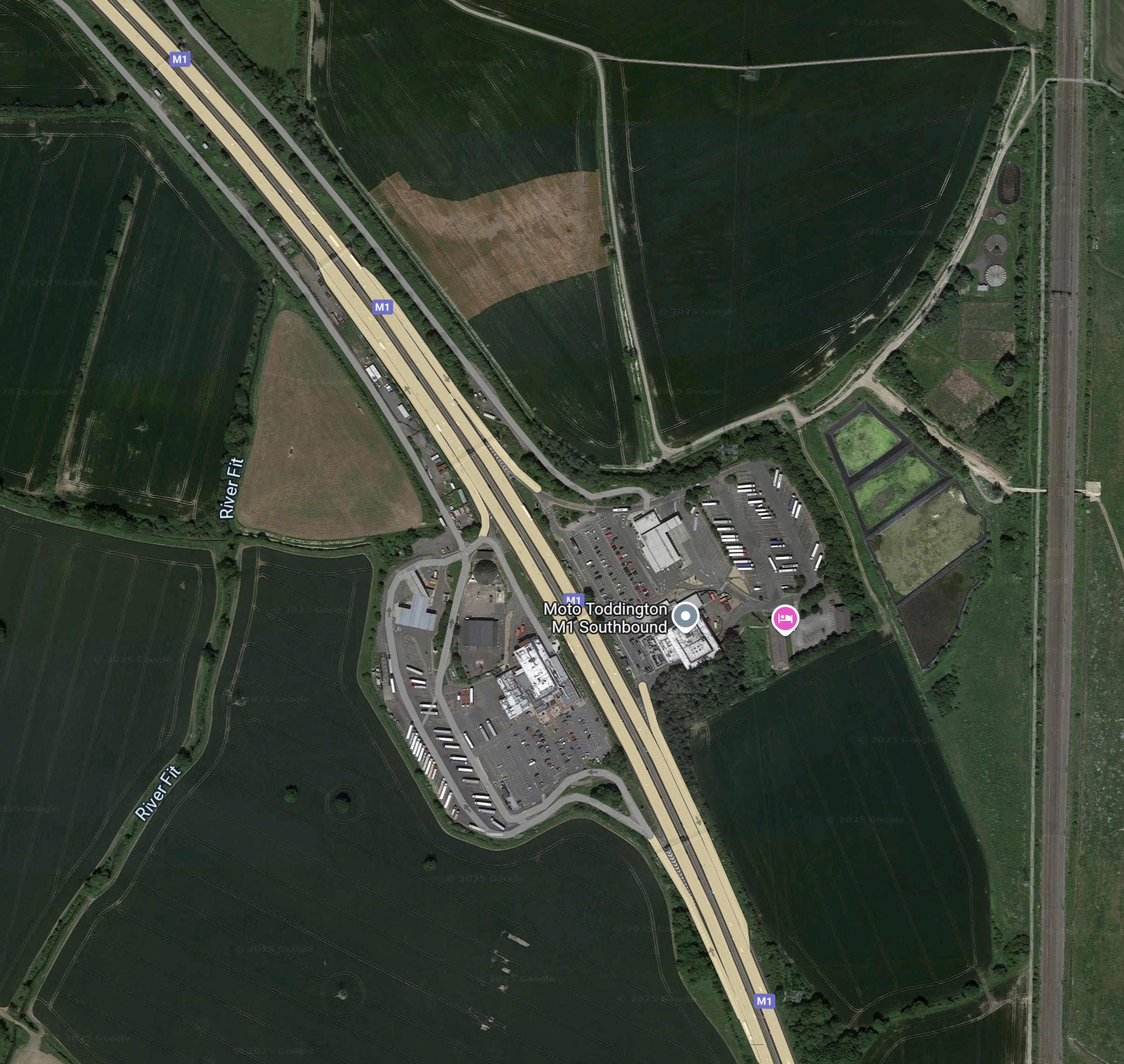
Note.
- There is land around the services that could be used to create more parking for hydrogen coaches.
- There doesn’t appear to be much space for a large wind farm to provide electricity to generate hydrogen.
- The Midland Main Line runs up the Eastern side of the map.
I wonder, if hydrogen could be brought to a refuelling site at Toddington services by the use of rail wagons.
Newport Pagnell Services
Newport PagnellServices is 86.5 km. from the Southern end of the M1.
This map shows the services.
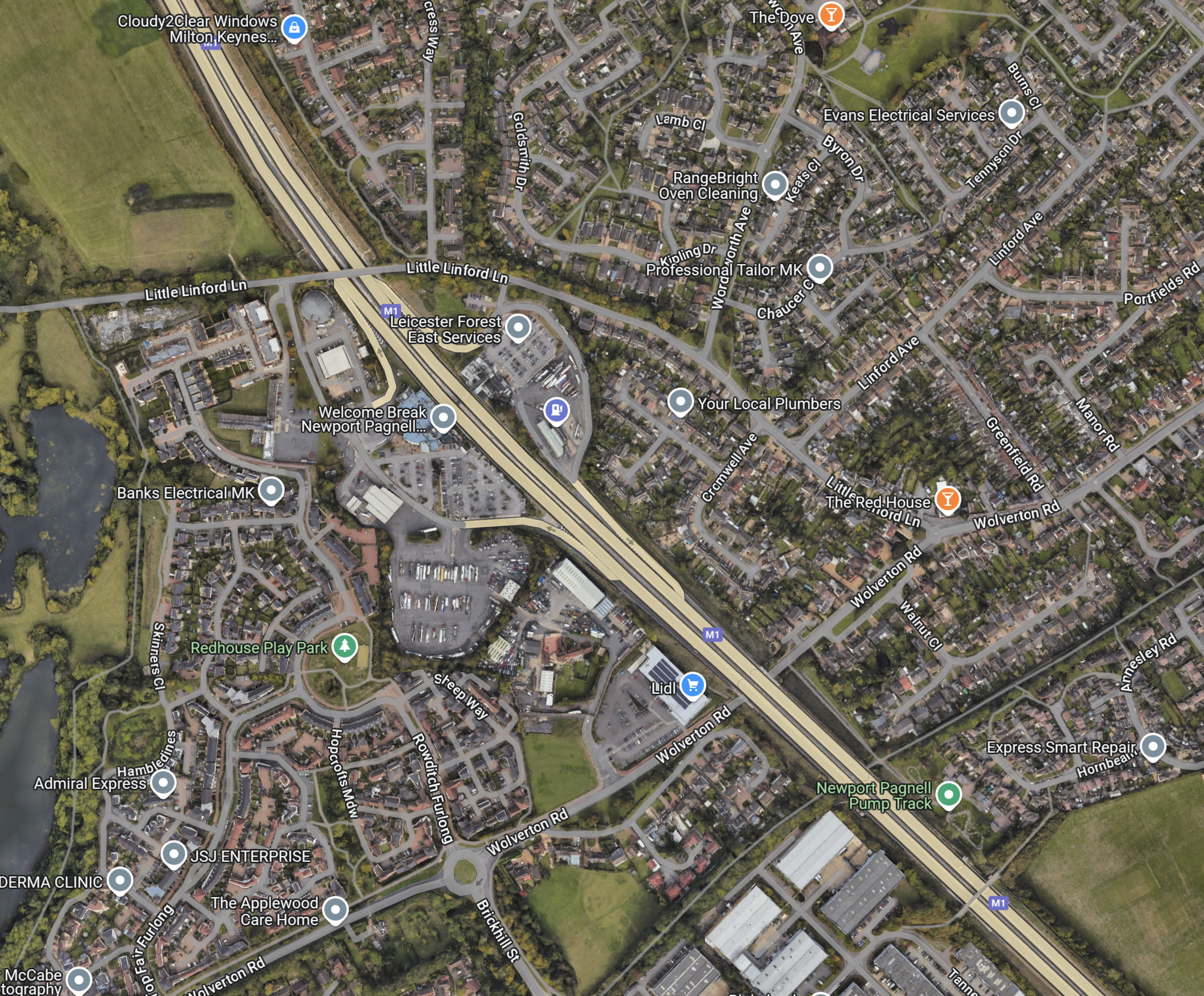
Note.
- The services are labelled as Leicester Forest East.
- The services are tightly surrounded by houses.
I’m not sure the residents would like to have a hydrogen refuelling station in their midst.
Northampton Services
Northampton Services is 104.5 km. from the Southern end of the M1.
This map shows the services.
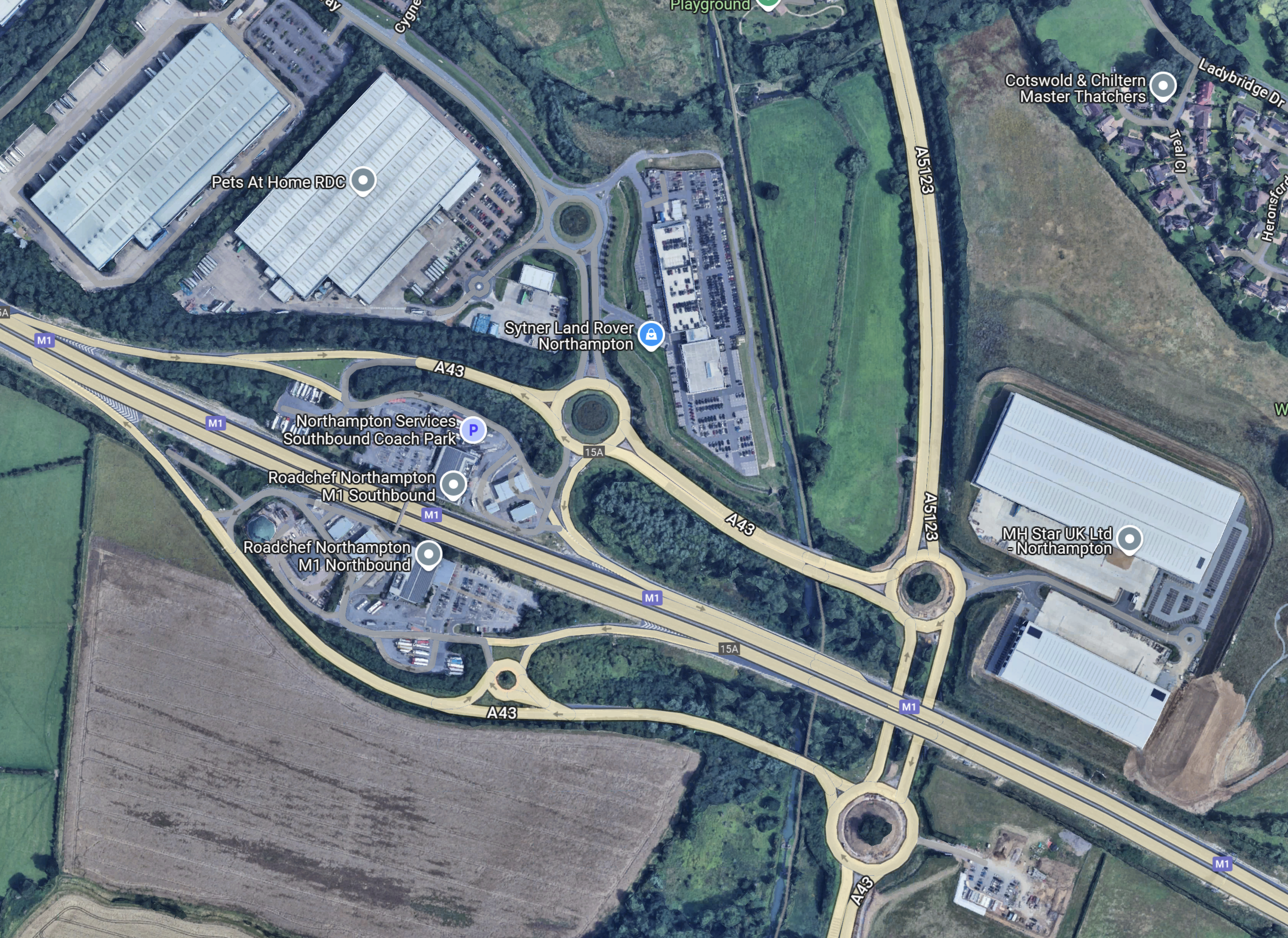
Note.
- It looks a rather complicated services.
- It might be too far from London.
- Provision of hydrogen might be difficult.
I think that this is another services that we can discount.
Watford Gap Services
Watford Gap Services is 120.8 km. from the Southern end of the M1.
This map shows the services.
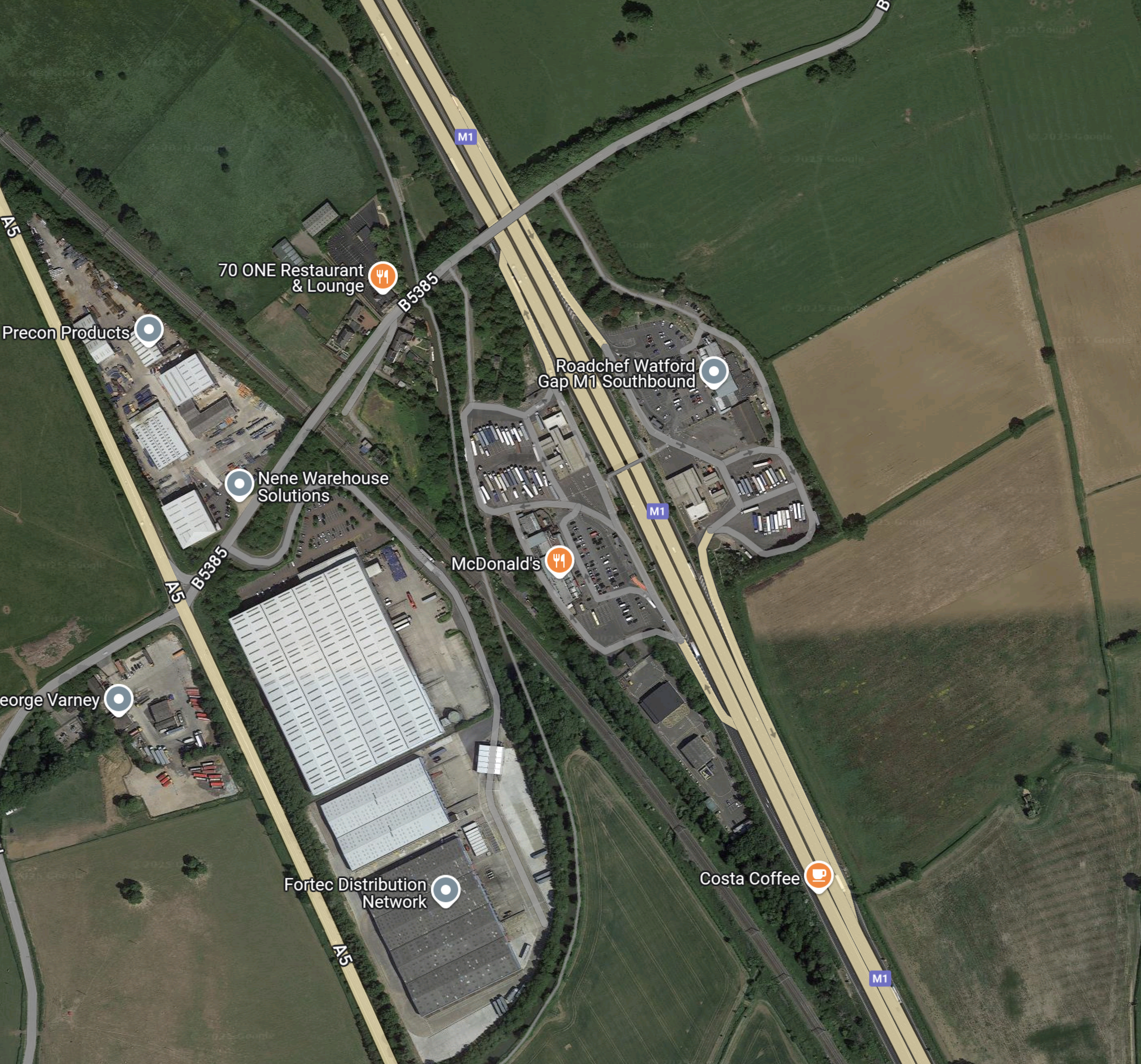
Note.
- There is land around the services that could be used to create more parking for hydrogen coaches.
- There doesn’t appear to be much space for a large wind farm to provide electricity to generate hydrogen.
- The West Coast Main Line runs through the centre of the services.
I wonder, if hydrogen could be brought to a refuelling site at Watford Gap services by the use of rail wagons.
Rugby Services
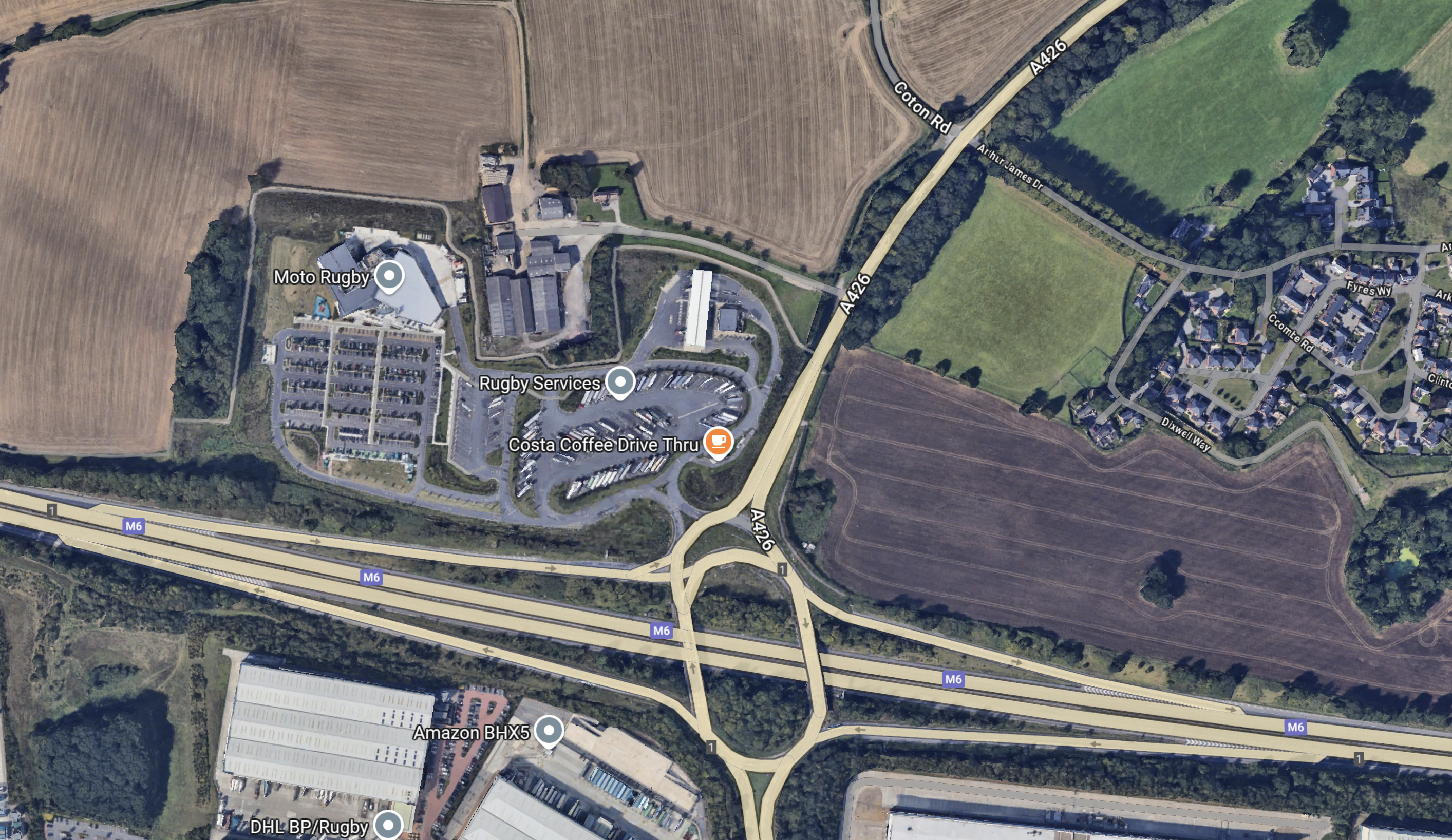
Rugby Services is 137.8 km. from the Southern end of the M1.
This map shows the services.
Note.
- There is land around the services that could be used to create more parking for hydrogen coaches.
- It is at Junction 1 of the M6.
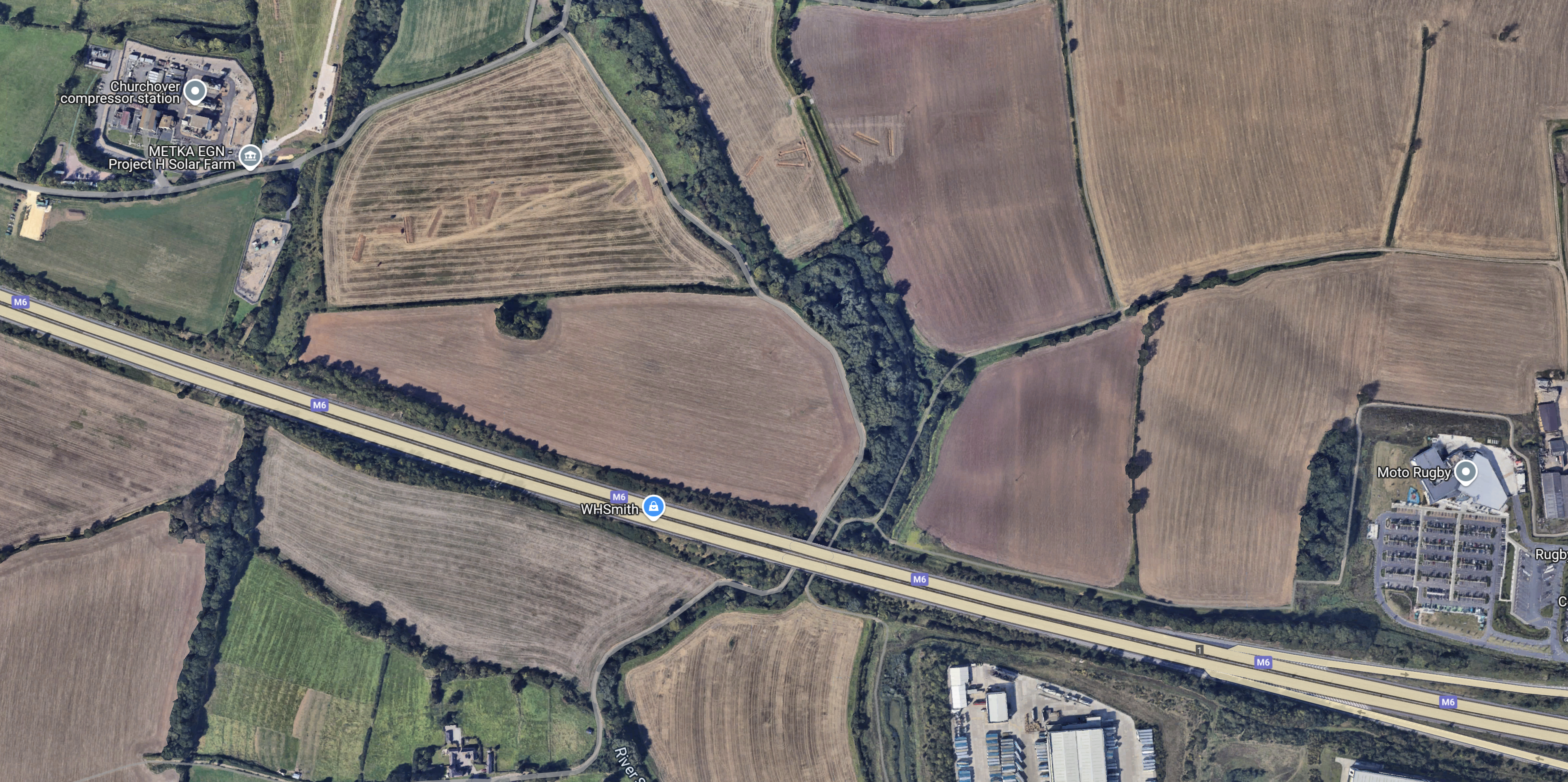
There is also a gas compressor station nearby, so I wonder, if a HiiROC system could be located here to extract hydrogen from the natural gas.
This map shows the location of the Churchover compressor station, with relation to Rugby services.
Note.
- The compressor station is in the North-West corner of the map.
- Rugby services are in the South-East corner of the map.
- From labels on the map it appears, a solar farm might be planned by the compressor station.
With a system like HiiROC creating turquoise hydrogen from natural gas, this could be a major filling station for hydrogen-powered trucks, coaches and cars.
Conclusion
It looks to me, that Toddington services would be best, but there would need to be a large increase in capacity, if a large number of hydrogen coaches, were going to fill up at Toddington for their trip into London.
The alternative would be to give the coach a large enough hydrogen tank for a complete round trip.
 The Anonymous Widower