First Ever Gravity Green Energy Storage System Set For North Yorkshire Town
The title of this post, is the same as that of this article on the Yorkshire Post.
These paragraphs give an outline of the project.
Plans to create the UK’s first below ground gravity energy storage system have been unveiled in North Yorkshire.
Scottish energy storage firm Gravitricity is to apply to Ryedale District Council with its plan for a facility at East Knapton in Ryedale on the site of the former Knapton gas generator.
If completed, it could store up to four megawatt hours (4MWhs) of electricity – sufficient to power more than 9,000 homes for an hour.
It looks like the system will have an output of 4 MW.
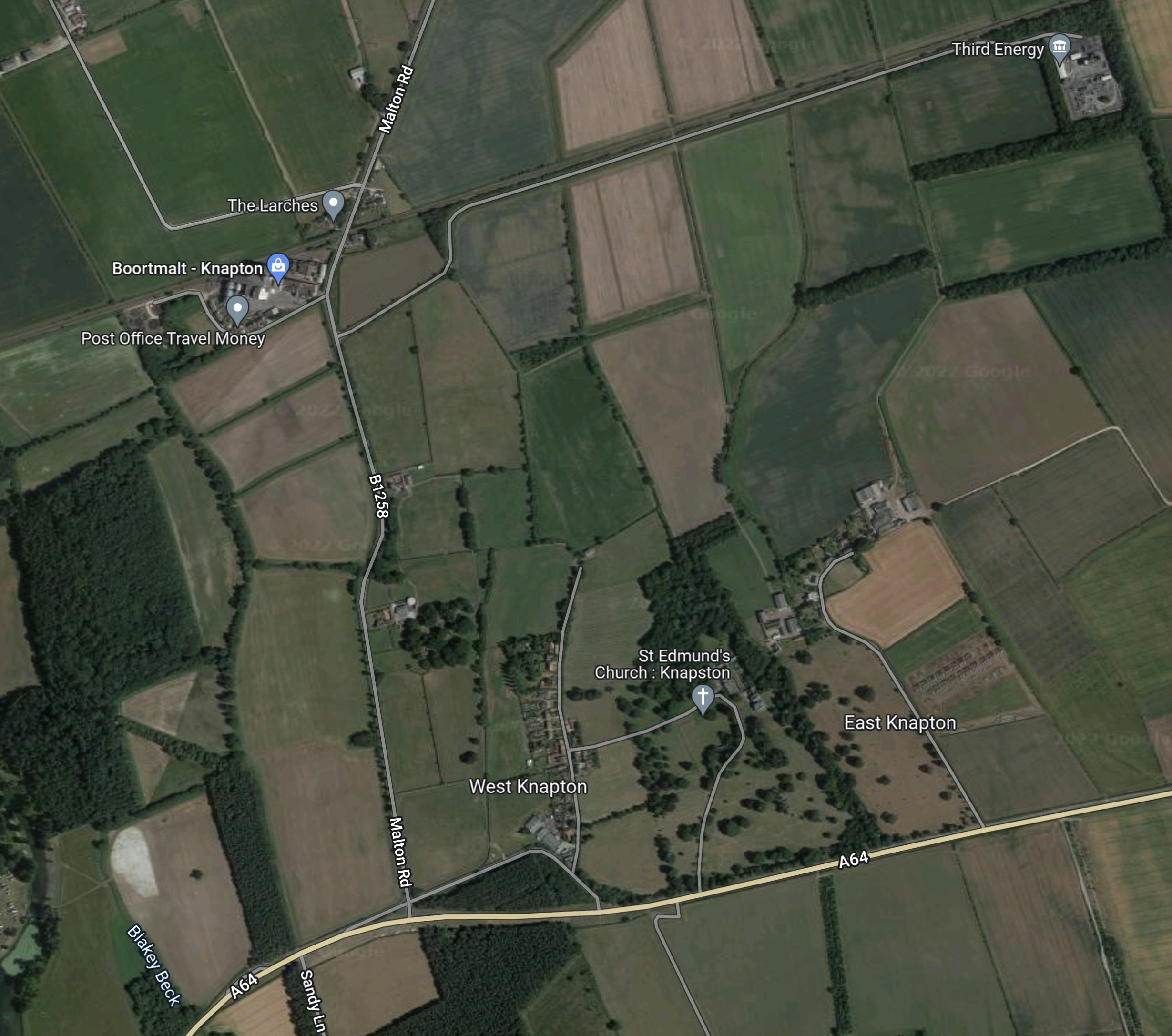
This Google Map shows the two villages of West and East Knapton.
Note.
- The A64 road between Malton and Scarborough going across the map.
- Scarborough and the coast is about fifteen miles to the East.
- The Third Energy site in the North-East corner of the map.
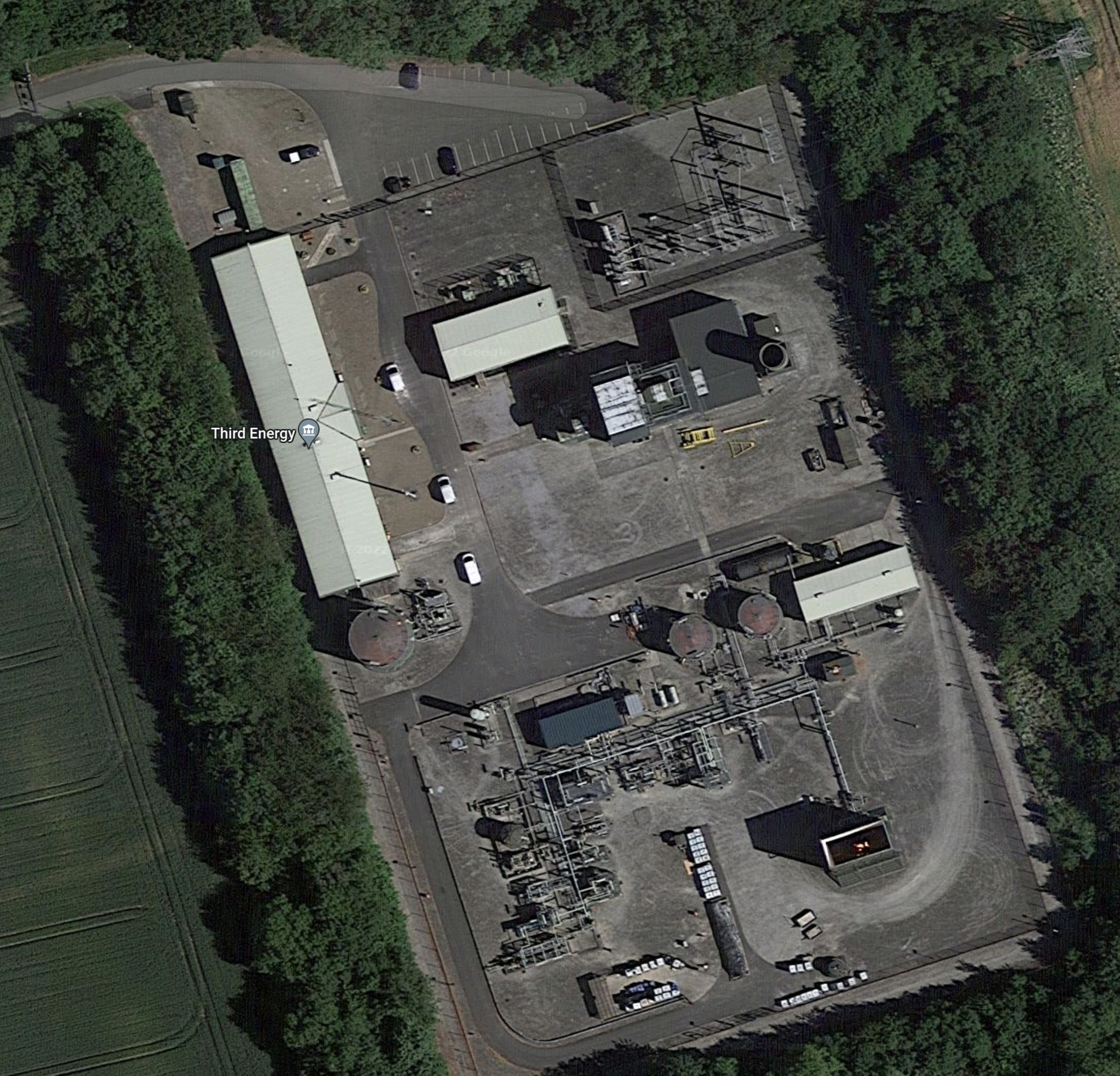
This second Google Map shows the Third Energy site in more detail.
Note.
- The substation and a power line in the North-East corner of the map.
- The 42 MW Knapton Generating Station used to be on this site and it was powered by local gas wells.
Third Energy have now called the site Knapton Energy Park and it now has a web page, which has this mission statement.
Third Energy is developing the former Knapton Generating Station into the Knapton Energy Park. The energy park will house multiple sources of power generation and energy storage. The aim of the project is to pay a part in the development and generation of renewable energy systems in North Yorkshire, and contribute to making the UK Net Zero by 2050.
This paragraph talks about weights.
One of our technology partners has also received government funding to conduct feasibility studies for a pilot project at Knapton which would utilise suspended weights to store energy as an alternative to the traditional battery storage technologies. This project will be developed through 2022 onwards.
It looks like Gravitricity has planted an acorn in Yorkshire.
The Third Energy web site is worth an explore. This is the mission statement on the home page.
At Third Energy our aim is to be at the forefront of North Yorkshire’s transition from fossil fuels to sustainable energy. Our team are proactively playing a part in innovative energy solutions and energy development; transforming our facilities into a multi-purpose energy park and research centre.
I particularly like this page, which is entitled Plug & Abandon.
This is the outline of their P % A philosophy on the page.
As wells near the end of their life cycle they must be decommissioned and the land returned to its original state. Unfortunately, the current P&A practices of the oil and gas industry are cost prohibitive, resulting in delays to abandonment (as companies attempt to avoid the high cost), and poor abandonment practices that may be harmful to the environment.
Fortunately, there are solutions to this problem. Our ambition is to use new and innovative technologies to P&A the wells in a more effective and sustainable manner, and first to extend the period our wells may service the community by re-purposing them for geothermal energy.
Can they really convert abandoned gas wells into geothermal energy sources?
Have We Enough LNG Carriers To Distribute The Natural Gas We Need?
I recently, asked this question of myself, as liquefied natural gas (LNG), now seems to be being moved all over the world.
Note, that the we in the title of this post, is a global we!
I stated by reading the Wikipedia entry for LNG Carrier.
This paragraph outlines the history of LNG carriers.
The first LNG carrier Methane Pioneer (5,034 DWT), classed by Bureau Veritas, left the Calcasieu River on the Louisiana Gulf coast on 25 January 1959. Carrying the world’s first ocean cargo of LNG, it sailed to the UK where the cargo was delivered. Subsequent expansion of that trade has brought on a large expansion of the fleet to today where giant LNG ships carrying up to 266,000 m3 (9,400,000 cu ft) are sailing worldwide.
The Methane Pioneer carried only 27,000 m3 of LNG.
Things have come a long way since the Methane Pioneer.
This is said in the Wikipedia entry for LNG Carrier.
According to SIGTTO data, in 2019 there were 154 LNG carriers on order, and 584 operating LNG carriers.
I don’t think capacity is a problem.
The Wikipedia entry also talks in detail about Cargo Handling and a Typical Cargo Cycle.
It is a very worthwhile read.
Equinor Is Counting On Tax Breaks With Plans For North Sea Oilfield
The title of this post, is the same as that, of this article in The Times.
These paragraphs outline the project.
Norway’s state-owned oil company is pushing ahead with plans to develop Britain’s biggest untapped oilfield after confirming that it stands to benefit from “helpful” tax breaks introduced alongside the windfall levy.
Equinor could lower its windfall tax bill by as much as £800 million in the years to come thanks to investment relief if it develops the Rosebank field, according to Uplift, a campaign group.
Rosebank, to the west of Shetland, could cost £4.1 billion to develop and may account for about 8 per cent of British oil output in the second half of this decade, producing 300 million barrels of oil by 2050.
Equinor said yesterday that it hoped to take a final investment decision on the field by next year and to start production by 2026. It has applied for environmental approval from the government.
Needless to say Greenpeace are not amused.
We Have Both Long Term And Short Term Energy Problems
In the UK, energy is generally used as electricity or gas and to power industry and transport.
Electricity
In the long term, we need to decarbonise our electricity production, so that all our electricity is produced from zero-carbon sources like nuclear, solar, tidal, wave and wind.
- As I write this, our electricity production is around 26.8 GW of which 62 % is coming from renewable sources.
- Surprisingly around 45 % of the renewables is coming from solar. Who’d have ever thought that in an predominantly-grey UK?
- As we have committed to around 50 GW of wind power by 2030 and the 3.26 GW Hinckley Point C will be on stream by the end of the decade, the long term future of electricity production looks to be fairly secure.
- It would be even more secure, if we added around 600 GWh of storage, as proposed in Highview Power’s Plan To Add Energy Storage To The UK Power Network, which would be used as backup when the sun doesn’t shine and the wind doesn’t blow.
It looks to me, that our long term electricity problem is capable of being solved.
For the next few years, we will need to rely on our existing gas-fired power stations until the renewables come on stream.
Gas
Gas could be more of a problem.
- I wouldn’t be surprised to see a lot of resistance to the replacement of natural gas for heating, cooking and industrial processes.
- Natural gas is becoming increasingly difficult to source.
- As I said in the previous section, we will still need some gas for electricity generation, until the massive wind farms are completed.
On the other hand, there is HyDeploy.
I like the HyDeploy concept, where up to 20 % of hydrogen is blended with natural gas.
- Using a blend of hydrogen and natural gas doesn’t require any changes to boilers, appliances or industrial processes.
- The hydrogen blend would make the most of our existing world class gas network.
- Customers do not require disruptive and expensive changes in their homes.
- Enormous environmental benefits can be realised through blending low carbon hydrogen with fossil gas.
- The hydrogen blending could happen, where the natural gas enters the network at terminals which receive gas from the UK continental shelf or where liquified natural gas is imported.
- Alternatively, it may be possible to surround a gas production platform with an offshore wind farm. This could enable hydrogen production and blending to be performed offshore.
The amount of gas we need would drop by twenty percent.
In The Mathematics Of Blending Twenty Percent Of Hydrogen Into The UK Gas Grid, I calculated that 148.2 tonnes per hour of hydrogen would be needed, to blend twenty per cent of hydrogen into UK natural gas supplies.
I also said this about the electricity needed.
To create 148.2 tonnes per hour of hydrogen would need 8,180.64 MW of electricity or just under 8.2 GW.
I also calculated the effect of the hydrogen on carbon dioxide emissions.
As twenty percent will be replaced by hydrogen, carbon dioxide emission savings will be 24,120,569.99 tonnes.
I believe that generating the 8.2 GW of electricity and delivering the 148.2 tonnes per hour of hydrogen is feasible.
I also believe that HyDeploy could be a valuable way to reduce our demand for natural gas by twenty per cent.
Transport
Not every vehicle, ship, aircraft and train can be powered by electricity, although batteries will help.
Hydrogen will help, but we must also develop our capability for sustainable fuels made from rubbish diverted from landfill and biologically-derived ingredients like used cooking oil.
Summing Up Our Long Term And Short Term Energy Problems
We obviously have got the problem of creating enough renewable energy for the future, but there is also the problem of how we keep everything going in the interim.
We will need gas, diesel, petrol and other fossil fuel derived products for the next few years.
Is Rosebank Our Short Term Solution?
This page on the Equinor web site is entitled Rosebank Oil And Gas Field.
This introductory paragraph described the field.
Rosebank is an oil and gas field 130 kilometres off the coast of the Shetland Islands. Equinor acquired the operatorship in 2019 and has since then been working to optimise and mature a development solution for the field together with our partners.
Could the field with its resources of oil and gas, be just the sort of field to tide us over in the next few difficult years.
But given the position, it will surely not be an easy field to develop.
These two paragraphs set out Equinor’s strategy in developing the field.
Equinor believes the field can be developed as part of the UK Government North Sea Transition deal, bringing much needed energy security and investment in the UK while supporting the UKs net zero target. According to a socioeconomic study (see link below) based on data and analysis by Wood Mackenzie and Voar Energy, if sanctioned Rosebank is estimated to create GBP 8.1 billion of direct investment, of which GBP 6.3 billion is likely to be invested in UK-based businesses. Over the lifetime of the project, Rosebank will generate a total of GBP 24.1 billion of gross value add (GVA), comprised of direct, indirect and induced economic impacts.
Equinor together with our partners are working with the supply chain to ensure that a substantial part of investment comes to Scotland and the UK. A supplier day was held in Aberdeen in partnership with EIC in order to increase the number of local suppliers to tender.
Note.
- The sums that could accrue to the UK economy are worthwhile.
- The Government North Sea Transition Deal is worth a read.
- A lot of the deal is about converting oil and gas skills to those of a renewable energy economy.
Planned properly, we should get all the oil and gas we need to get through difficult years.
I particularly like these two paragraphs, which are towards the end of the Government North Sea Transition Deal.
Through the Deal, the UK’s oil and gas sector and the government will work together to deliver
the skills, innovation and new infrastructure required to decarbonise North Sea oil and gas
production as well as other carbon intensive industries. Not only will it transform the sector in
preparation for a net zero future, but it will also catalyse growth throughout the UK economy.
Delivering large-scale decarbonisation solutions will strengthen the position of the existing UK
energy sector supply chain in a net zero world, securing new high-value jobs in the UK,
supporting the development of regional economies and competing in clean energy export
markets.
By creating the North Sea Transition Deal, the government and the UK’s oil and gas sector are
ambitiously seeking to tackle the challenges of reaching net zero, while repositioning the UK’s
capabilities to serve the global energy industry. The Deal will take the UKCS through to
maturity and help the sector pivot towards new opportunities to keep the UK at the forefront of
the changing 21st century energy landscape.
I believe that developing Rosebank could enable the following.
- The oil and gas we need in the next few years would be obtained.
- The economic situation of the UK would be improved.
- The skills and techniques we need to decarbonise the UK would be delivered.
- Net-zero would be reached in the required time.
- Jobs will be created.
- The export of surplus oil and gas.
I strongly believe that developing the Rosebank field would be worthwhile to the UK.
I have some other thoughts.
Electrification Of Platforms
This page on the Equinor web site is entitled Electrification Of Platforms.
This paragraph explains what that means.
Electrification means replacing a fossil-based power supply with renewable energy, enabling a reduction in greenhouse gas emissions. Equinor is fully committed to reducing emissions from our offshore oil & gas production.
Note.
- Typically, platforms use gas turbine engines running on natural gas to provide the electricity needed on the platform.
- Platforms in the future will get their electricity from renewable sources like wind and will have an electricity cable to the shore.
- Rosebank will be powered in this way.
This document on the Equinor web site is entitled Rosebank: Investing In Energy Security And Powering A Just Transition, which has a section called How Is Rosebank Different?, where this is said.
The key difference of Rosebank compared to other oil fields is that it
aims to draw on new technology applications to help reduce carbon
emissions from its production, through FPSO electrification.Building offshore installations that can be powered by electricity reduces
reliance on gas powered generators which are the biggest source
of production emissions. The electrification of UKCS assets is vital to
meeting the North Sea Transition Deal’s target of reducing production
emissions by 50% by 2030, with a view to being net zero by 2050.Electrification of Rosebank is a long-term investment that will drastically
cut the carbon emissions caused by using the FPSO’s gas turbines for
power. Using electricity as a power source on Rosebank results in a
reduction in emissions equivalent to taking over 650,000 cars off the
road for a year compared with importing 300 million barrels of oil from
international sources.
Note.
- An FPSO is a Floating Production Storage And Offloading Unit, which is the method of production, that Equinor have chosen for the Rosebank field.
- If we are going to extract fossil fuels then we must extract them in a manner, that doesn’t add to the problem by emitting extra carbon dioxide.
- We will probably extract fossil fuels for some years yet, as they are the easiest route to some important chemicals.
- I also believe that we will increasingly find uses for any carbon dioxide captured in combustion and chemical processes.
I already know of a farmer, who heats greenhouses using a gas-powered combined heat and power unit, who pipes the carbon dioxide to the tomatoes in the greenhouses.
Despite what Greenpeace and others say, carbon dioxide is not all bad.
Energy Security
The last page of this document on the Equinor web site is entitled Rosebank: Investing In Energy Security And Powering A Just Transition, is entitled Energy Security.
Look at the numbers.
- £8.1 billion – Total field investment with 78% of this being spent in the UK
- 1600 – Estimated peak number of direct FTE jobs
- £24.1 billion – Estimated gross value add
- 8 % – Of UK oil production from Rosebank to 2030
- 39 million cubic feet per day – Average daily gas production over the first 10 years of field life, equivalent to almost twice Aberdeen’s daily gas consumption
- 250kt CO2 – Carbon avoided by reusing existing FPSO
And if you have time read it fully.
Could The Rosebank FPSO Be Powered By Floating Offshore Wind?
Floating wind turbines are now being installed around the world.
- They can use the largest turbines.
- Some designs perform in the roughest of seas.
- They have a high capacity factor.
- They are generally brought into a suitable port for servicing and updating.
- Floating wind farms can be connected to floating substations
There is at least 20 GW of floating wind turbines planned for UK waters.
So could an appropriately-sized floating wind farm be placed near the Rosebank FPSO to provide it with electricity?
I don’t see why not, if there were some energy storage in the system, for when the wind wasn’t blowing.
Floating Offshore Wind Close To The Rosebank FPSO Would Be Challenging
Rosebank is an oil and gas field 130 kilometres off the West coast of the Shetland Islands.
That would be a challenging location for floating wind turbines.
But solving the installation problems would set precedents for floating wind farms all over the world.
Could The Rosebank FPSO Handle Hydrogen From Floating Offshore Wind?
It would surely be possible to put an electrolyser in the system somewhere, so that hydrogen was also stored in the tanks of the FPSO.
I also don’t think it unfeasible, that twenty percent of hydrogen could be blended into the natural gas to create the low-carbon natural gas, that has been proposed by the HyDeploy project.
Long Duration Energy Storage Would Reduce The UK’d Gas Usage By 10 Megatonnes By 2035
The title of this post, is the same as that of this press release on the Highview Power web site.
The press release gives these three bullet points.
- UK has wasted over 1,300 GWh of wind since the start of the energy crisis in September 2021 due to an inability to store excess generation – enough to power 500,000 homes a day.
- A new survey from YouGov, commissioned by Highview Power, reveals that 43% of UK adults think the UK imports too much gas, rising to 54% among Conservative voters at the 2019 General Election.
- Long-duration energy storage (LDES) would reduce UK’s gas usage by 10 megatonnes in 2035 and save the grid around £2 billion a year, passing on savings of up to £50 a year.
In Highview Power’s Plan To Add Energy Storage To The UK Power Network, I talked about Highview Power’s possible 30 GWh CRYOBattery.
This project has not been fully revealed and I expect something will be announced before the end of this year.
Will Our Gas Supplies Hold Up This Winter?
I am prompted to ask this question because of this article in The Times, which is entitled ‘Really High Gas Prices’ Loom For UK As Europe Faces Winter Rationing.
These are a few thoughts.
UK Gas-Fired Power Station Capacity
This entry in Wikipedia is entitled List Of Natural Gas Power Stations In The United Kingdom.
This statement summarises the capacity.
There are currently 32 active gas fired combined cycle power plants operating in the United Kingdom, which have a total generating capacity of 28.0 GW.
This section is entitled Decline Of Gas For Power In The United Kingdom, where this is said.
In 2016 gas fired power stations generated a total of 127 TWh of electricity. Generation has dropped to 119 TWh in 2017, 115 TWh in 2018, 114 TWh in 2019 and 95 TWh in 2020. The decline is largely due to the increase in renewable sources outweighing the decline of coal, and an overall reduction in demand.
Putting these pictures as a table and applying a simple numerical analysis technique gives the following.
- 2016 – 127 TWh
- 2017 – 119 TWh – Drop of 8TWh
- 2018 – 115 TWh – Drop of 4 TWh
- 2019 – 114 TWh – Drop of 1 TWh
- 2020 – 95 TWh – Drop of 19 TWh
In four years the amount of electricity generated each year by gas-fired power stations has dropped by an amazing 8 TWh on average per year.
Factors like the increase in renewables and an overall reduction in demand will still apply.
I wouldn’t be surprised to see a continuous reduction of electricity generated by gas of 8 TWh per year.
Figures like these could be possible.
- 2021 – 87 TWh
- 2022 – 79 TWh
- 2023 – 71 TWh
- 2024 – 63 TWh
- 2025 – 55 TWh
- 2026 – 47 TWh
- 2027 – 39 TWh
I have stopped these figures at 2027, as one major event should happen in that year, as Hinckley Point C is planned to switch on in June 2027, which will contribute 3.26 GW. or 28.5 TWh per year.
In Will We Run Out Of Power This Winter?, I also summarised the energy that will be produced by the various projects, that were signed off recently in the Contracts for Difference Allocation Round 4′, where I said this.
Summarising the figures for new capacity gives.
- 2022 – 3200 MW
- 2023 – 1500 MW
- 3024 – 2400 MW
- 2025 – 6576 MW
- 2026 – 1705 MW
- 2027 – 7061 GW
This totals to 22442 MW.
Note that a 1 GW power source would generate 8.76 TWh of electricity per year.
One problem we may have is too much electricity and as we are not blessed with much storage in the UK, where will be able to put it?
In a strange way, Vlad the Mad may solve the problem, by cutting off Europe’s gas.
Jackdaw Gas Field
This document on the Shell web site is the standard information sheet for the Jackdaw field development.
This is the short description of the development.
The Jackdaw field is an uHPHT reservoir that will be developed with a not permanently
attended WHP. Four wells will be drilled at the Jackdaw WHP. Produced fluids will be
exported via a subsea pipeline to the Shearwater platform where these will be processed
before onward export via the Fulmar Gas Line and the Forties Pipeline System.
The proposed development may be summarised as follows:
- Installation of a new WHP
- Drilling of four production wells
- Installation of a new approximately 31 km pipeline from the Jackdaw WHP to the Shearwater platform
- Processing and export of the Jackdaw hydrocarbons via the Shearwater host platform
First production expected between Q3 – Q4 2025.
Note.
- Production could start in just over three years.
- This gas will come ashore at the Bacton gas terminal in Norfolk.
- Bacton has two gas interconnectors to Europe; one to Belgium and one to The Netherlands, so is ideally connected to export gas to Europe.
Given the high gas prices, I am sure any company would pull out all the stops to shorten the project development time.
HyDeploy
I described HyDeploy, which is a project to blend up to 20 % of hydrogen into the distributed natural gas in HyDeploy.
In The Mathematics Of Blending Twenty Percent Of Hydrogen Into The UK Gas Grid, I worked how much electricity would be needed for HyDeploy’s target blending of hydrogen.
It was 8.2 GW, but!
- It would save a lot of carbon emissions.
- Boilers and other appliances wouldn’t have to be changed, although they would probably need a service.
- It would significantly cut the amount of natural gas we need.
- It might even be a product to export in its own right.
I certainly feel that HyDeploy is a significant project.
Gas Imports And Existing Fields
This entry in Wikipedia is entitled Energy in the United Kingdom.
In this section, which is entitled Natural Gas, this is said.
United Kingdom produced 60% of its consumed natural gas in 2010. In five years the United Kingdom moved from almost gas self-sufficient (see North Sea gas) to 40% gas import in 2010. Gas was almost 40% of total primary energy supply (TPES) and electricity more than 45% in 2010. Underground storage was about 5% of annual demand and more than 10% of net imports.
Gasfields include Amethyst gasfield, Armada gasfield, Easington Catchment Area, East Knapton, Everest gasfield and Rhum gasfield.
Consider.
- We know that the amount of gas used for generating electricity is reducing , due to the increase in renewables and an overall reduction in demand.
- The cost of both gas imports and exports are rising.
- In two years time the Jackdaw gas field should be producing gas.
Would it be sensible to squeeze as much gas out of the existing fields, as by the time they run out, renewables, an overall reduction in demand, the Jackdaw gasfield and other factors will mean that we will have enough gas and electricity for our needs.
Will We Run Out Of Power This Winter?
Someone asked me if we will run out of power, if Vlad the Mad cuts all the gas to Western Europe.
This was my reply.
It appears that this year, 3.2 GW of new offshore wind farms could start producing electricity, followed by similar amounts in both 2023 and 2024.
One of those to come on stream about now is the 1.4 GW Hornsea 2 wind farm!
The follow-up 2.9 GW Hornsea 3, signed a contract last week for delivery in 2026/27.
Moray East in Scotland and Triton Knoll off Lincolnshire, are also scheduled to come on stream this year and they’re around 900 MW each.
As someone, who used to write project management software, I hope the companies building these fields have enough resources, in terms of people, boats, cranes and money. But as the companies are all the Shells of the wind industry, I would hope they have got their sums right.
What About The Contracts for Difference Awarded In Allocation Round 4?
We are currently fighting two wars at the moment.
- The main war in Ukraine, where we are giving that unfortunate country all the help we can.
- The secondary war in the UK against energy prices.
Would it help our cause in both wars, if we produced more energy?
- More renewable energy would reduce our dependence on imported gas.
- The gas saved could go to Europe.
- Europe would not be buying Vlad the Mad’s bloodstained gas.
- Replacing gas with solar and wind power might reduce energy prices.
If I put myself in the position of a struggling farmer with a contract for difference to build a solar farm on a poor field, I would want that farm to be earning money as soon as possible.
- Now that I have the contract can I start assembling that solar farm?
- Similar arguments can probably be used for onshore wind, which must be easier to assemble, than offshore wind.
- I don’t think that the hard-pressed energy suppliers would bother, if they received some quality cheap electricity earlier than they expected.
- Obviously, all the cables and the substations would need to be in place.
So I think that it is reasonable to assume, that energy might ramp up quicker than expected.
It could even be more front-loaded, if all the installers got a shift on.
Every little helps!
New Renewable Energy In 2023?
These wind farms are scheduled for commissioning in 2023.
- Neart Na Gaoithe – 450 MW
- Sofia Offshore Wind Farm – 1400 MW
- Seagreen Phase 1 – 1075 MW
We could see 2925 MW of offshore wind power commissioned in 2023.
New Renewable Energy In 2024?
These renewable energy sources are scheduled for commissioning in 2024.
- Dogger Bank A – 1200 MW
- Round 4 Solar – 125.7 MW
- Dogger Bank B – 1200 MW
- Dogger Bank C – 1200 MW
Note, where a windfarm is given a commissioning date of 2023/24 in Wikipedia , I will put it in 2024.
We could see 3726 MW of renewable energy commissioned in 2024.
New Renewable Energy In 2025?
These renewable energy sources are scheduled for commissioning in 2025.
- Moray West – 1200 MW
- Round 4 Solar – 1958 MW
- Round 4 Onshore Wind – 888 MW
- Round 4 Energy from Waste – 30 MW
- Vanguard Boreas Phase 1 – 1400 GW
We could see 6476 MW of renewable energy commissioned in 2025.
New Renewable Energy In 2026?
These renewable energy sources are scheduled for commissioning in 2026.
- East Anglia 1 North – 800 MW
- East Anglia 2 – 900 MW
- Round 4 Tidal Stream – 5.62 MW
We could see 1705 MW of renewable energy commissioned in 2026.
New Renewable Energy In 2027?
These renewable energy sources are scheduled for commissioning in 2027.
- Round 4 Tidal Stream – 35.2 MW
- Round 4 Floating Offshore Wind – 32 MW
- Round 4 Offshore Wind – 5594 MW
- Hornsea 3 Offshore Wind – 2852 MW
- Hinckley Point C Nuclear – 3,260 MW
We could see 13173 MW of renewable energy commissioned in 2027.
Too Much Electricity!
Summarising the figures for new capacity gives.
- 2022 – 3200 MW
- 2023 – 2925 MW
- 3024 – 3726 MW
- 2025 – 6476 MW
- 2026 – 1705 MW
- 2027 – 11773 MW
This totals to 28554 MW.
One problem we may have is too much electricity and as we are not blessed with much storage in the UK, where will be able to put it?
In a strange way, Vlad the Mad may solve the problem, by cutting off Europe’s gas.
We have a few interconnectors, where we can export the electricity to allow the Belgians, Dutch, French and the Germans to have a shower.
- BritNed – 1 GW – Isle of Grain and Rotterdam
- ElecLink – 1 GW – England and France through the Channel Tunnel.
- HVDC Cross-Channel – 2 GW – England and France
- IFA-2 – 1 GW – England and France
- Nemo Link – 1 GW – Richborough and Zeebrugge
- North Sea Link – 1.4 GW – Blyth and Norway
- Viking Link – 1.4 GW – Lincolnshire and Denmark
It looks like construction may be starting soon for another interconnector. NeuConnect will have a capacity of 1.4 GW between the Isle of Grain and Wilhelmshaven.
Conclusion
If I was the German Chancellor, I’d do everything in my power to accelerate the construction of NeuConnect!
SSE Thermal And Equinor To Acquire Triton Power In Acceleration Of Low-Carbon Ambitions
The title of this post, is the same as that as this press release from SSE.
These are the first three paragraphs.
SSE Thermal and Equinor have entered into an agreement to acquire Triton Power Holdings Ltd from Energy Capital Partners for a total consideration of £341m shared equally between the partners.
The transaction represents another step forward for the two companies’ existing collaboration, supporting the long-term decarbonisation of the UK’s power system whilst contributing to security of supply and grid stability through flexible power generation in the shorter term.
Triton Power operates Saltend Power Station which is 1.2GW CCGT (Combined Cycle Gas Turbine) and CHP (Combined Heat & Power) power station located on the north of the Humber Estuary in East Yorkshire.
This deal is more complicated than it looks and these are my thoughts.
What About The Triton Power Workers?
The press release says this.
The 82 existing employees will continue to be employed by Triton Power. In line with just transition principles, the joint venture is committed to transitioning the assets for the net zero world through responsible ownership and operation, and in consultation with the local workforce and representatives.
It does sound that they are following the right principles.
Saltend Power Station
Saltend power station is no tired ancient asset and is described like this in Wikipedia.
The station is run on gas using single shaft 3 × Mitsubishi 701F gas Turbines machines with Alstom 400 MWe generators. The station has a total output of 1,200 MW; of that 100 MW is allocated to supply BP Chemicals. Each gas turbine has a Babcock Borsig Power (BBP) heat recovery steam generator, which all lead to one steam turbine per unit (single shaft machine means Gas turbine and Steam Turbine are on the same shaft). The waste product of electricity generation is steam at the rate of about 120 tonnes/h which is sold to BP Chemicals to use in their process. This makes Salt End one of the most efficient[clarification needed] power stations in the UK. The plant is scheduled to use hydrogen from steam reformed natural gas for 30% of its power.
Note.
- It was commissioned in 2000.
- It appears there are seven CCGT power stations in England that are larger than Saltend.
- The power station seems to have had at least four owners.
The press release says this about SSE and Equinor’s plans for Saltend power station.
The transaction underscores SSE Thermal and Equinor’s shared ambition to decarbonise the Humber, which is the UK’s most carbon-intensive industrial region, as well as the UK more widely. Initial steps to decarbonise Saltend Power Station are already underway, targeting partial abatement by 2027 through blending up to 30% of low-carbon hydrogen. In addition, carbon capture provides an additional valuable option for the site. SSE Thermal and Equinor will continue to work towards 100% abatement.
Note.
- It appears that initially, Saltend power station will move to running on a mixture of 30 % hydrogen and 70 % natural gas.
- Carbon capture will also be applied.
- It looks like that in the future all carbon-dioxide emitted by the power station will be captured and either stored or used.
The press release says this about the source of the hydrogen.
Saltend Power Station is a potential primary offtaker to Equinor’s H2H Saltend hydrogen production project. H2H Saltend is expected to kick-start the wider decarbonisation of the Humber region as part of the East Coast Cluster, one of the UK’s first carbon capture, usage and storage clusters.
H2H Saltend is described in this page on the Equinor web site, which has a title of The First Step To A Zero Carbon Humber, where this is said.
This project represents a bold but practical first step towards delivering the world’s first net zero industrial cluster by 2040. This unparalleled project can play a leading role in the UK’s journey to net zero by 2050, renew the UK’s largest industrial cluster, and unlock technology that will put the UK at the forefront of a global hydrogen economy.
There is also a video.
SSE Thermal And Equinor Low-Carbon Thermal Partnership
This is a section in the press release, where after giving their policy about the workers, it says this about the acquisition of Triton Power.
This acquisition strengthens SSE Thermal and Equinor’s portfolio of joint projects, which bring together expertise in power, natural gas, hydrogen and carbon capture and storage. This portfolio includes three development projects within the Humber region:
- Keadby 3 Carbon Capture Power Station, which could be the UK’s first flexible power station equipped with carbon capture.
- Keadby Hydrogen Power Station, which could be one of the world’s first 100% hydrogen-fuelled power stations.
- Aldbrough Hydrogen Storage, located in East Yorkshire, which could be one of the world’s largest hydrogen storage facilities.
The two companies are also developing Peterhead Carbon Capture Power Station, situated on the Aberdeenshire coast in Scotland and there are further opportunities for hydrogen blending across SSE’s generation portfolio, including at Keadby 2.
Note.
- There is no mention of the three Dogger Bank Wind Farms, each of which will be 1200 MW, that are owned by SSE Renewables and Equinor.
- I wrote about Aldbrough Gas Storage in The Massive Hydrogen Project, That Appears To Be Under The Radar.
- According to this press release from Equinor, which is entitled SSE Thermal And Equinor Join Forces On Plans For First-Of-A-Kind Hydrogen And Carbon Capture Projects In The Humber, Keadby Hydrogen power station will have a capacity of 1800 MW.
The Complete System
The system has the following power sources.
- Dogger Bank A – 1200 MW – Expected commissioning in 2023/24
- Dogger Bank B – 1200 MW – Expected commissioning in 2024/25
- Dogger Bank C – 1200 MW – Expected commissioning in 2024/25
- Keadby power station – 735 MW
- Keadby 2 power station – 893 MW – Could be Part-Hydrogen
- Keadby 3 power station – 910 MW – Carbon Capture
- Keadby Hydrogen power station – 1800 MW – Hydrogen
- Saltend power station – 1200 MW – Part-Hydrogen
That totals up to 9138 MW.
Fuel will come from three sources.
- The God of the winds.
- Natural gas
- Hydrogen
Hydrogen will be sourced from.
- Blue hydrogen from H2H Saltend
- Green Hydrogen could come from electrolysers driven by wind power.
Hydrogen would be stored in Aldbrough Gas Storage.
I am by training a Control Engineer and controlling these power sources is either a wonderful dream or your most entwined and complicated nightmare.
Conclusion
I suspect on an average day, this cluster of power stations and sources could reliably supply as much zero-carbon power as two large nuclear stations.
Could Rolls-Royce SMRs Be The Solution To Europe’s Gas Shortage?
Of all the offshore wind farms, that I’ve looked at recently, I find Magnora’s ScotWind N3 wind farm the most interesting.
I wrote about it in ScotWind N3 Offshore Wind Farm.
I said this.
In any design competition, there is usually at least one design, that is not look like any of the others.
In the successful bids for the ScotWind leases, the bid from Magnora ASA stands out.
- The company has an unusual home page on its offshore wind web site.
- This page on their web site outlines their project.
- It will be technology agnostic, with 15MW turbines and a total capacity of 500MW
- It will use floating offshore wind with a concrete floater
- It is estimated, that it will have a capacity factor of 56 %.
- The water depth will be an astonishing 106-125m
- The construction and operation will use local facilities at Stornoway and Kishorn Ports.
- The floater will have local and Scottish content.
- The project will use UK operated vessels.
- Hydrogen is mentioned.
- Consent is planned for 2026, with construction starting in 2028 and completion in 2030.
This project could serve as a model for wind farms all round the world with a 500 MW power station, hydrogen production and local involvement and construction.
I very much like the idea of a concrete floater, which contains a huge electrolyser and gas storage, that is surrounded by an armada of giant floating wind turbines.
These are my thoughts.
Floating Concrete Structures
To many, they may have appear to have all the buoyancy of a lead balloon, but semi-submersible platforms made from concrete have been used in the oil and gas industry for several decades.
Kishorn Yard in Scotland was used to build the 600,000-tonne concrete Ninian Central Platform,in 1978. The Ninian Central Platform still holds the record as the largest movable object ever created by man.
The Ninian Central Platform sits on the sea floor, but there is no reason why a semi-submersible structure can’t be used.
Electrolysers
There is no reason, why a large electrolyser, such as those made by Cummins, ITM Power or others can’t be used, but others are on the way.
- Bloom Energy are working on high temperature electrolysis, which promises to be more efficient.
- Torvex Energy are developing electrolysis technology that used sea water, rather than more expensive purified water.
High Temperature Electrolysis
High temperature electrolysis needs a heat source to work efficiently and in Westinghouse And Bloom Energy To Team Up For Pink Hydrogen, I described how Bloom Energy propose to use steam from a large nuclear power station.
Offshore Nuclear Power
I’ve never heard of offshore nuclear power, but it is not a new idea.
In 1970, a company called Offshore Power Systems was created and it is introduced in its Wikipedia entry like this.
Offshore Power Systems (OPS) was a 1970 joint venture between Westinghouse Electric Company, which constructed nuclear generating plants, and Newport News Shipbuilding and Drydock, which had recently merged with Tenneco, to create floating nuclear power plants at Jacksonville, Florida.
Westinghouse’s reactor was a 1.150 MW unit, which was typical of the time, and is very similar in size to Sizewell B.
The project was cancelled before the reactors were towed into position.
Nuclear Knowledge Has Improved
Consider.
- In the fifty years since Offshore Power Systems dabbed their toes in the water of offshore nuclear power, our knowledge of nuclear systems and engineering has improved greatly.
- The offshore oil and gas industry has also shown what works impeccably.
- The floating offshore wind industry looks like it might push the envelop further.
- There has been only one nuclear accident at Fukushima, where the sea was part of the problem and that disaster taught us a lot.
- There have been a large number of nuclear submarines built and most reached the planned end of their lives.
- Would a small modular nuclear reactor, be safer than a large nuclear power plant of several GW?
I would suggest we now have the knowledge to safely build and operate a nuclear reactor on a proven semi-submersible platform, built from non-rusting concrete.
An Offshore Wind Farm/Small Modular Reactor Combination Producing Hydrogen
Consider.
- A typical floating offshore wind farm is between one and two gigawatts.
- A Rolls-Royce small modular reactor is sized to produce nearly 0.5 GW.
- The high temperature electrolyser will need some heat to achieve an optimum working temperature.
- Spare electricity can be used to produce hydrogen.
- Hydrogen can be stored platform.
- Hydrogen can be sent ashore using existing gas pipes.
- Hydrogen could even be blended with natural gas produced offshore to create a lower-carbon fuel.
- It would also be possible to decarbonise nearby offshore infrastructure.
A balance between wind and nuclear power can be obtained, which would provide a steady output of energy.
Conclusion
There are a large numbers of possibilities, to locate a Rolls-Royce small modular reactor close to a wind farm to use high temperature electrolysis to create green hydrogen, which can be used in the UK or exported through the gas network.
Shell’s Jackdaw Gas Field Given Go-Ahead By Regulators
The title of this post, is the same as that of this article on the BBC.
These are the first two paragraphs.
Development of a major North Sea gas field has been approved by regulators.
The Jackdaw field, east of Aberdeen, has the potential to produce 6.5% of Britain’s gas output.
This is Greenpeace’s response
But environmental campaigners have condemned the move.
The activist group Greenpeace said it believed the approval could be unlawful and it was considering legal action.
“Approving Jackdaw is a desperate and destructive decision from Johnson’s government, and proves there is no long-term plan,” said Ami McCarthy, a political campaigner for Greenpeace.
I have my thoughts.
The Short Term Problem
We are all paying the high gas price, brought about by Vlad the Mad’s illegal invasion of Ukraine.
On the other hand, I am all for cutting carbon emissions, but stopping the development of the Jackdaw gas field will do nothing to cut total emissions in the short term.
In my view, the only way to cut carbon emissions is to replace the use of natural gas with hydrogen or electricity produced by renewable sources like solar, tidal, wave or wind power.
This change to every heating system and important industries like cement, chemicals, glass and steelmaking to hydrogen and renewable energy is not a short term or low-cost project. Especially whilst we’re still recovering from the pandemic and trying to handle Vlad the Mad.
We will need a supply of natural gas for a few years and if we don’t have enough gas will Greenpeace and their ilk, be happy to see everybody freezing and a large increase in unemployment?
The Government is between a rock and a hard place, where they can either bow to Greenpeace or buy Putin’s bloodstained gas, where there are two alternatives.
- Buy liquified natural gas (LNG) from countries like Australia, Canada, Qatar or the United States.
- Develop our own proven resources.
The advantages of taking the second route include.
- Some of the countries from where gas is available, have bizarre views on human rights and keeping their people safe.
- Gas is transported over long distances in a liquid form. Liquifying natural gas uses a lot of energy. Is that energy renewable?
- Countries from where gas is available are thousands of miles away. How much carbon dioxide will be emitted liquifying and transporting it?
- Gas from our own resources is delivered by pipeline.
- Development of gas fields like Jackdaw, will surely create employment in the UK.
At a first look, I feel that developing Jackdaw and other similar fields, may well be a sensible option to help us through these difficult times.
Exporting Gas To Europe
If you look at the geographical position, you would feel, that the gas will be landed at St. Fergus gas terminal, which is to the North of Aberdeen.
But no! The gas will be landed at Bacton in Norfolk through the SEAL pipeline, which is 475 km. long
Could this be because Shell want to make sure the South of England gets its gas?
Possibly, but much of the UK’s gas imports arrive at LNG terminals in the South.
But Bacton has other assets, in that it has two undersea gas pipelines to the Continent. One is to Belgium and the other is to the Netherlands.
Surely, if we export our gas to other countries, then it is their business what they do with the carbon dioxide.
Not our’s or Shell’s!
Perhaps, we should develop other proven gas fields, as they will create employment in the UK and valuable exports. It will also help our friends out in Europe, in their time of need!
Will Shell Play The Market?
I have just been informed, that recently, improvements have been made to the pipelines in the area and Jackdaw’s gas could now go to St. Fergus.
This surely would give the gas from Jackdaw three destinations.
- Scotland via St. Fergus.
- England via Bacton
- Europe via Bacton and the undersea pipelines.
So will Shell play the markets?
If in the future, we start to produce massive amounts of green hydrogen, I’m sure Europe, will be happy to buy that instead.
Powering Platforms With Renewable Energy
The BBC article says this.
And it plans also to re-power its offshore platforms with renewable electricity rather than burning gas.
Looking at the map, Jackdaw will not be far from the 2 GW wind farm, that Shell are developing.
Will they build a short interconnector from this wind farm to the gas platforms of Jackdaw and other nearby fields?
Will Shell Produce Hydrogen Offshore?
This article on Gas Processing And LNG is entitled Construction Of World’s Largest PEM Electrolyzer Completed.
This is the first two paragraphs.
Air Liquide has completed the construction of the world’s largest PEM (Proton Exchange Membrane) electrolyzer. Supplied with renewable energy, this unit is now producing up to 8.2 tons per day of low-carbon hydrogen in Bécancour, Québec. With this large-scale investment, the Group confirms its long-term commitment to the hydrogen energy markets and its ambition to be a major player in the supply of low-carbon hydrogen.
The new 20 MW PEM electrolyser, equipped with Cummins technology, is the largest operating unit of its kind in the world and will help meet the growing demand for low-carbon hydrogen in North America. Bécancour’s proximity to the main industrial markets in Canada and the United States will help ensure their supply of low-carbon hydrogen for industrial use and mobility. The commissioning of this electrolysis unit increases by 50% the capacity of Air Liquide’s Bécancour hydrogen production complex.
Note.
- This article is about a year old and electrolysers will get larger.
- 20 MW of electricity will produce 8.2 tons per day of low carbon or green hydrogen.
- It may surprise some, that the electrolyser has been built by Cummins, who are diesel engine manufacturers. They are a company, who appear to have seen the way the wind is blowing and are making sure they lead the revolution.
How much hydrogen could a 2 GW wind farm produce?
- Wind farms have a capacity factor, which is how much energy they actually produce compared to their rating.
- Shell’s 2 GW wind farm will be a floating wind farm and these typically have a capacity factor of at least 50 percent.
- I will assume the capacity factor of 50 percent.
This will give 8,200 tonnes per day of green hydrogen. This is nearly three million tons per year.
How Will The Hydrogen Be Brought Ashore?
The HyDeploy project is investigating blending of hydrogen into our natural gas grid.
- It appears that up to 25 % of hydrogen can be added without the need to change boilers and appliances.
- This blending of hydrogen into our natural gas supply, would cut our carbon emissions by a worthwhile amount.
So will we see gas piped to nearby gas platforms like Jackdaw for blending with fresh virgin natural gas?
This would have the following advantages for Shell.
- They wouldn’t need to install an electric cable to the shore with all its associated onshore and offshore substations.
- The hydrogen could be brought ashore at either Bacton or St. Fergus gas terminals.
- Shell could invite other local wind farms to share their electrolyser.
- Shell would need to new onshore installations.
If Shell get this right, they could cut the project cost.
Will Shell Produce Blue Hydrogen Offshore?
I wonder if Shell have a cunning plan.
- It is known, that Shell have developed a catalyst-based blue hydrogen process, which splits natural gas into hydrogen and carbon dioxide, with the addition of oxygen from the air.
- I suspect the process could need a lot of energy to work. But at least a GW from the nearby wind farm will probably be a good start.
- Could that carbon dioxide be captured and stored in a depleted gas field.
- The hydrogen could be piped to either Bacton or St. Fergus, as I previously described.
This hybrid method might be a more economic way to produce zero-carbon hydrogen.
Conclusion
I wouldn’t be surprised if Shell will produce hydrogen offshore.
The Massive Hydrogen Project, That Appears To Be Under The Radar
This page on the SSE Thermal web site, is entitled Aldbrough Gas Storage.
This is the introductory paragraph.
The Aldbrough Gas Storage facility, in East Yorkshire, officially opened in June 2011. The last of the nine caverns entered commercial operation in November 2012.
This page on Hydrocarbons Technology is entitled Aldbrough Underground Gas Storage Facility, Yorkshire.
It gives these details of how Aldbrough Gas Storage was constructed.
The facility was originally planned to be developed by British Gas and Intergen in 1997. British Gas planned to develop Aldbrough North as a gas storage facility while Intergen planned to develop Aldbrough South.
SSE and Statoil became owners of the two projects in 2002 and 2003. The two companies combined the projects in late 2003. Site work commenced in March 2004 and leaching of the first cavern started in March 2005.
The storage caverns were created by using directional drilling. From a central area of the site, boreholes were drilled down to the salt strata located 2km underground.
After completion of drilling, leaching was carried out by pumping seawater into the boreholes to dissolve salt and create a cavern. Natural gas was then pumped into the caverns and stored under high pressure.
Six of the nine caverns are already storing gas. As of February 2012, dewatering and preparation of the remaining three caverns is complete. Testing has been completed at two of these caverns.
The facility is operated remotely from SSE’s Hornsea storage facility. It includes an above ground gas processing plant equipped with three 20MW compressors. The gas caverns of the facility are connected to the UK’s gas transmission network through an 8km pipeline.
Note.
- The caverns are created in a bed of salt about two kilometres down.
- It consists of nine caverns with the capacity to store around 370 million cubic metres (mcm) of gas.
- Salt caverns are very strong and dry, and are ideal for storing natural gas. The technique is discussed in this section in Wikipedia.
As I worked for ICI at Runcorn in the late 1960s, I’m very familiar with the technique, as the company extracted large amounts of salt from the massive reserves below the Cheshire countryside.
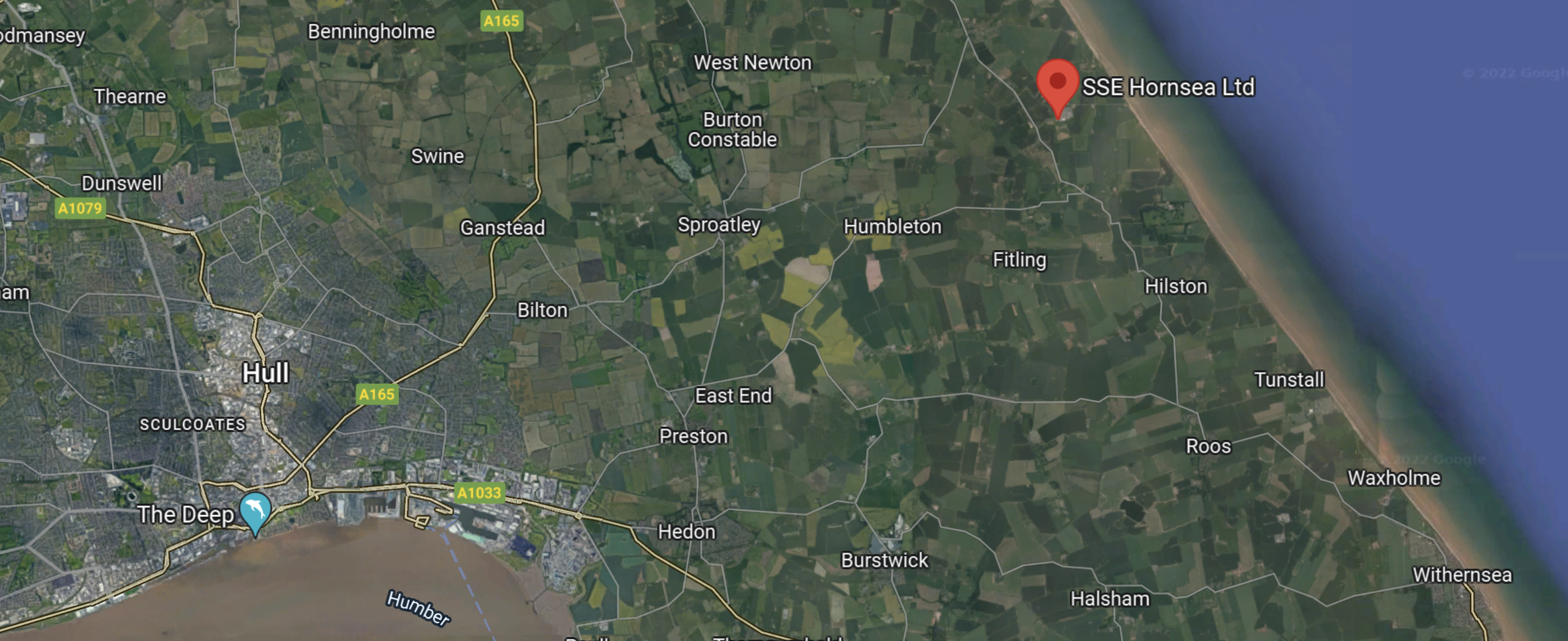
This Google Map shows the location of the Aldbrough Gas Storage to the North-East of Hull.
Note.
- The red-arrow marks the site of the Aldbrough Gas Storage.
- It is marked on the map as SSE Hornsea Ltd.
- Hull is in the South-West corner of the map.
This Google Map shows the site in more detail.
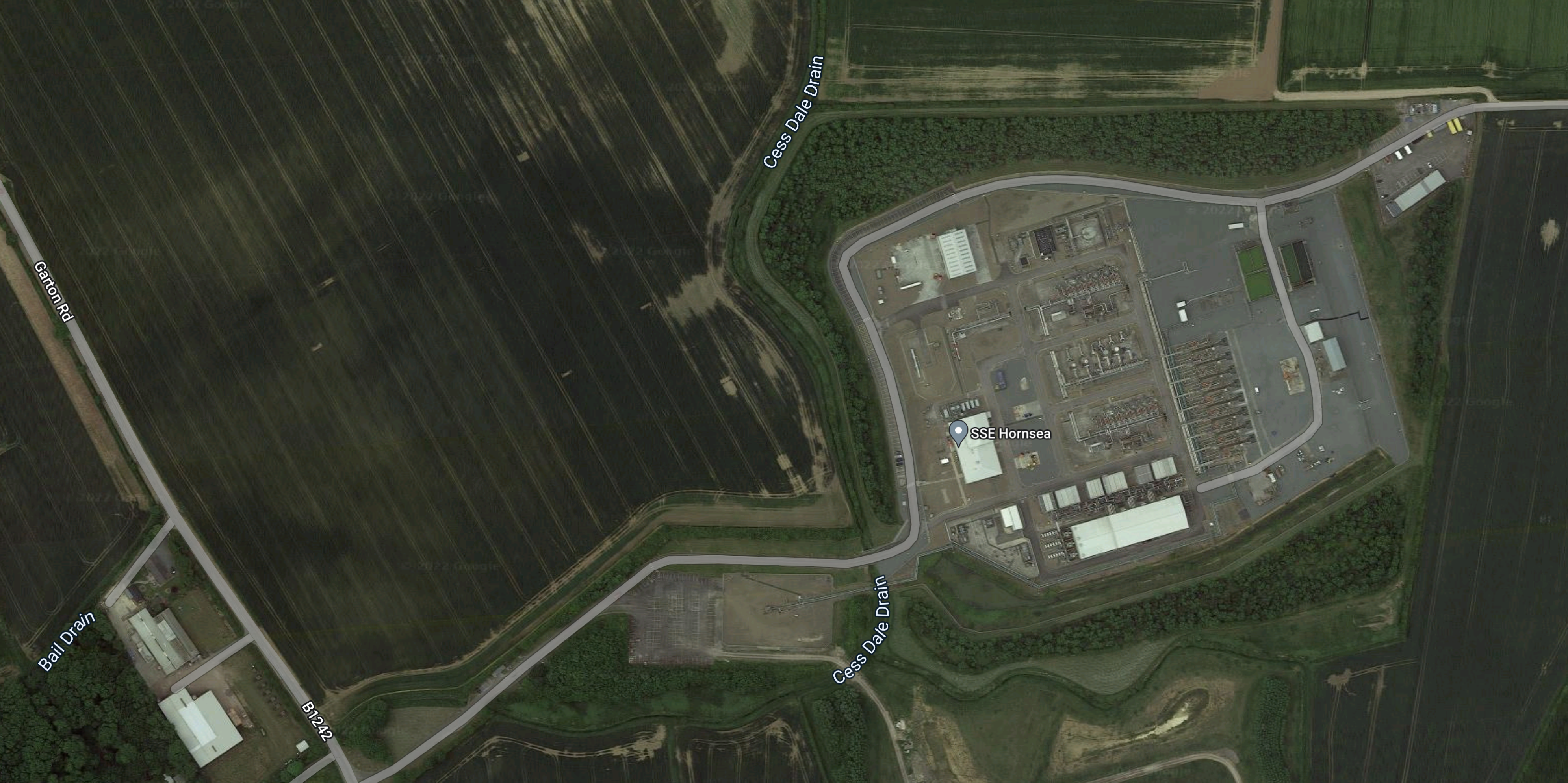
It appears to be a compact site.
Atwick Gas Storage
This page on the SSE Thermal web site, is entitled Atwick Gas Storage.
This is said on the web site.
Our Atwick Gas Storage facility is located near Hornsea on the East Yorkshire coast.
It consists of nine caverns with the capacity to store around 325 million cubic metres (mcm) of gas.
The facility first entered commercial operation in 1979. It was purchased by SSE in September 2002.
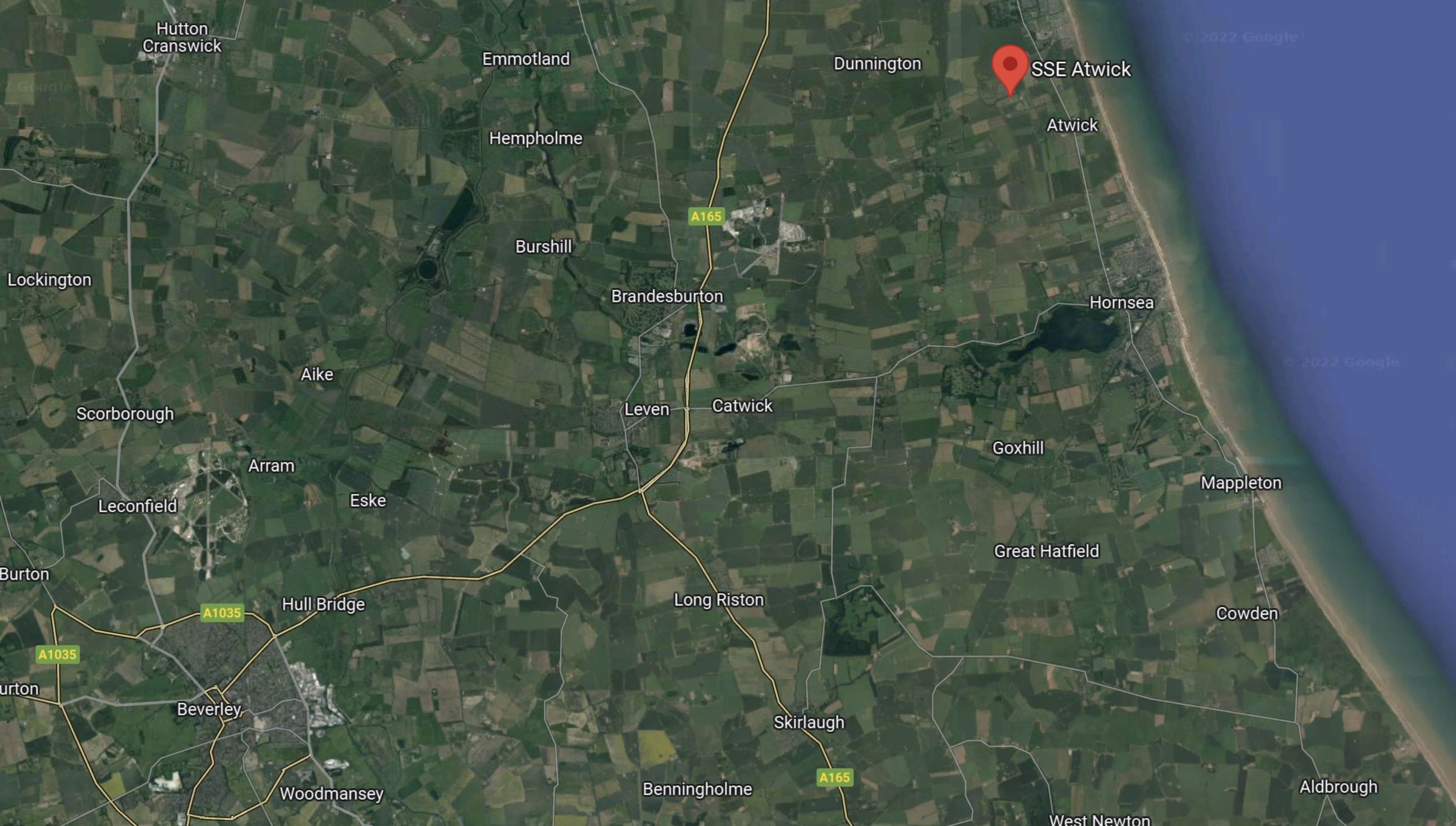
This Google Map shows the location of the Atwick Gas Storage to the North-East of Beverley.
Note.
- The red-arrow marks the site of the Atwick Gas Storage.
- It is marked on the map as SSE Atwick.
- Beverley is in the South-West corner of the map.
This Google Map shows the site in more detail.
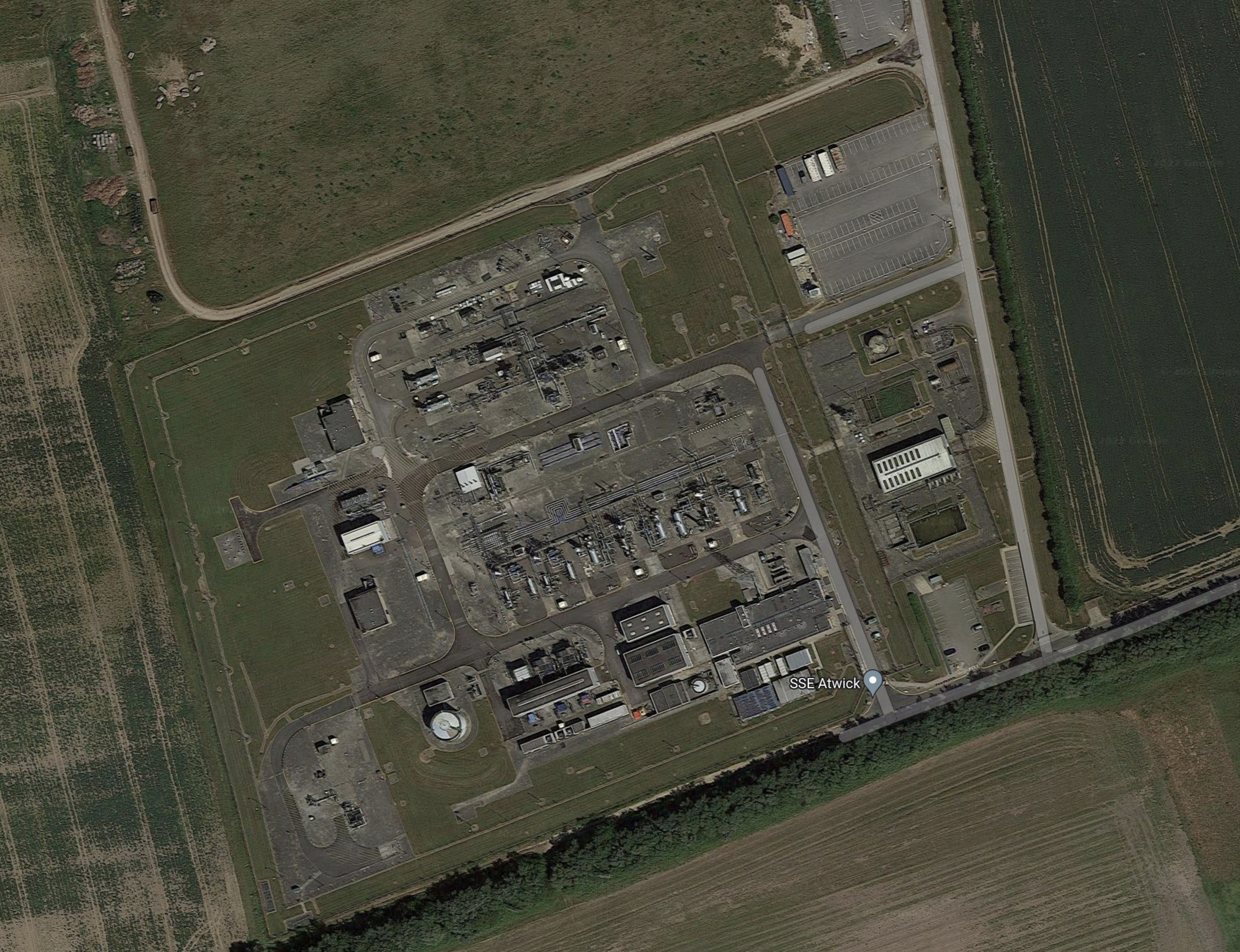
As with the slightly larger Aldbrough Gas Storage site, it appears to be compact.
Conversion To Hydrogen Storage
It appears that SSE and Equinor have big plans for the Aldbrough Gas Storage facility.
This page on the SSE Thermal web site is entitled Plans For World-Leading Hydrogen Storage Facility At Aldbrough.
These paragraphs introduce the plans.
SSE Thermal and Equinor are developing plans for one of the world’s largest hydrogen storage facilities at their existing Aldbrough site on the East Yorkshire coast. The facility could be storing low-carbon hydrogen as early as 2028.
The existing Aldbrough Gas Storage facility, which was commissioned in 2011, is co-owned by SSE Thermal and Equinor, and consists of nine underground salt caverns, each roughly the size of St. Paul’s Cathedral. Upgrading the site to store hydrogen would involve converting the existing caverns or creating new purpose-built caverns to store the low-carbon fuel.
With an initial expected capacity of at least 320GWh, Aldbrough Hydrogen Storage would be significantly larger than any hydrogen storage facility in operation in the world today. The Aldbrough site is ideally located to store the low-carbon hydrogen set to be produced and used in the Humber region.
Hydrogen storage will be vital in creating a large-scale hydrogen economy in the UK and balancing the overall energy system by providing back up where large proportions of energy are produced from renewable power. As increasing amounts of hydrogen are produced both from offshore wind power, known as ‘green hydrogen’, and from natural gas with carbon capture and storage, known as ‘blue hydrogen’, facilities such as Aldbrough will provide storage for low-carbon energy.
I have a few thoughts.
Will Both Aldbrough and Atwick Gas Storage Facilities Be Used?
As the page only talks of nine caverns and both Aldbrough and Atwick facilities each have nine caverns, I suspect that at least initially only Aldbrough will be used.
But in the future, demand for the facility could mean all caverns were used and new ones might even be created.
Where Will The Hydrogen Come From?
These paragraphs from the SSE Thermal web page give an outline.
Equinor has announced its intention to develop 1.8GW of ‘blue hydrogen’ production in the region starting with its 0.6GW H2H Saltend project which will supply low-carbon hydrogen to local industry and power from the mid-2020s. This will be followed by a 1.2GW production facility to supply the Keadby Hydrogen Power Station, proposed by SSE Thermal and Equinor as the world’s first 100% hydrogen-fired power station, before the end of the decade.
SSE Thermal and Equinor’s partnership in the Humber marks the UK’s first end-to-end hydrogen proposal, connecting production, storage and demand projects in the region. While the Aldbrough facility would initially store the hydrogen produced for the Keadby Hydrogen Power Station, the benefit of this large-scale hydrogen storage extends well beyond power generation. The facility would enable growing hydrogen ambitions across the region, unlocking the potential for green hydrogen, and supplying an expanding offtaker market including heat, industry and transport from the late 2020s onwards.
Aldbrough Hydrogen Storage, and the partners’ other hydrogen projects in the region, are in the development stage and final investment decisions will depend on the progress of the necessary business models and associated infrastructure.
The Aldbrough Hydrogen Storage project is the latest being developed in a long-standing partnership between SSE Thermal and Equinor in the UK, which includes the joint venture to build the Dogger Bank Offshore Wind Farm, the largest offshore wind farm in the world.
It does seem to be, a bit of an inefficient route to create blue hydrogen, which will require carbon dioxide to be captured and stored or used.
Various scenarios suggest themselves.
- The East Riding of Yorkshire and Lincolnshire are agricultural counties, so could some carbon dioxide be going to help greenhouse plants and crops, grow big and strong.
- Carbon dioxide is used as a major ingredient of meat substitutes like Quorn.
- Companies like Mineral Carbonation International are using carbon dioxide to make building products like blocks and plasterboard.
I do suspect that there are teams of scientists in the civilised world researching wacky ideas for the use of carbon dioxide.
Where Does The Dogger Bank Wind Farm Fit?
The Dogger Bank wind farm will be the largest offshore wind farm in the world.
- It will consist of at least three phases; A, B and C, each of which will be 1.2 GW.
- Phase A and B will have a cable to Creyke Beck substation in Yorkshire.
- Phase C will have a cable to Teesside.
Creyke Beck is almost within walking distance of SSE Hornsea.
Could a large electrolyser be placed in the area, to store wind-power from Dogger Bank A/B as hydrogen in the Hydrogen Storage Facility At Aldbrough?
Conclusion
SSE and Equinor may have a very cunning plan and we will know more in the next few years.
 The Anonymous Widower