Observations On A Trip To Doncaster And Sheffield
My objectives were.
- Buy a walk-up ticket from a machine at King’s Cross for Doncaster station and then use it.
- Use local trains, tram-trains and trams to get to as quick as possible to Sheffield station.
- Buy a walk-up ticket from a machine at Sheffield station for St. Pancras and then use it.
This is the story of my day.
A Ticket From King’s Cross for Doncaster
This happened at King’s Cross
- I got charged £38.65, but I didn’t get any tickets.
- So I complained in the Booking Office.
- But they didn’t believe me.
- Then I showed them the debit on my credit card account.
- Then a lady came and checked the machine, but couldn’t find any tickets.
- They then issued me with a new ticket for Doncaster.
- But they were these design crimes of flimsy tickets.
- I now have two debits on my credit card account.
They said one will be refunded.
King’s Cross To Doncaster
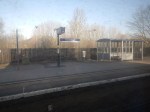
I took these pictures of the trucks along the nearby A1 to the North of Newark.






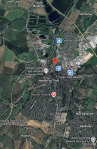
This map shows how the A1 curves round the town.
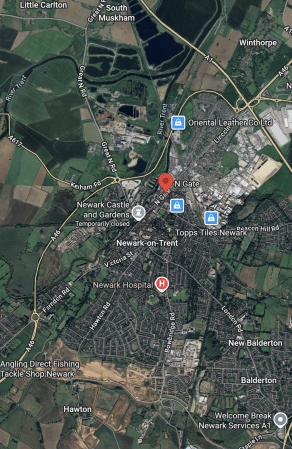
Note.
- The A1 Road curving around the right of the town.
- The red arrow marking Newark Northgate station.
- There is a notorious flat crossing, that needs to be replaced to the North of the station.
I believe as a Control Engineer, that digital signalling might solve the problem of the crossing and I wrote about it in Could ERTMS And ETCS Solve The Newark Crossing Problem?.
But there was no problems on the journey
- The train was ten coaches.
- It was going to Edinburgh.
- It left on time.
- It didn’t appear to be very full.
- It was four minutes late at Doncaster and arrived at 14:47.
These pictures show Doncaster station.
Note.
There are nine platforms and eleven tracks.
The nine platforms are arranged in three island platforms.
Farage Wants HS2 Scrapped
The title of this post, is the same as a sub-title in this article on The Times. which is entitled HS2: Labour confirms delay until 2033.
This is the sub-heading.
Nigel Farage has called for the whole HS2 project to be scrapped.
These two paragraphs give NF’s view.
The Reform UK leader told the Commons: “Has the moment not come, rather than having another reset, to recognise this is a failure?
“Let’s scrap HS2, let’s use the tens of billions of pounds we can save in the next decade to upgrade railway lines across the entirety of the United Kingdom to the benefit of many millions and spend the rest on other national priorities in these financially straitened times.”
Farage’s simplistic plan will appeal to his disciples, but the major thing that is needed, is more capacity between South and North. Or North and South depending on where you live!
HS2 will provide an extra seventeen paths between London and a large triangular junction in the West Midlands.
If HS2 Is Not Built There Will Be More Cars And Trucks On The Roads
In Footage Released Of East West Rail’s First Commercial Freight Train, I wrote about the SEGRO Logistics Park Northampton (SLPN), which would generate lots of road and rail traffic. Without developments like HS2, the roads will just get clogged up.
High Speed Two’s Originally Proposed Service Pattern
This graphic shows the original service pattern for High Speed Two.
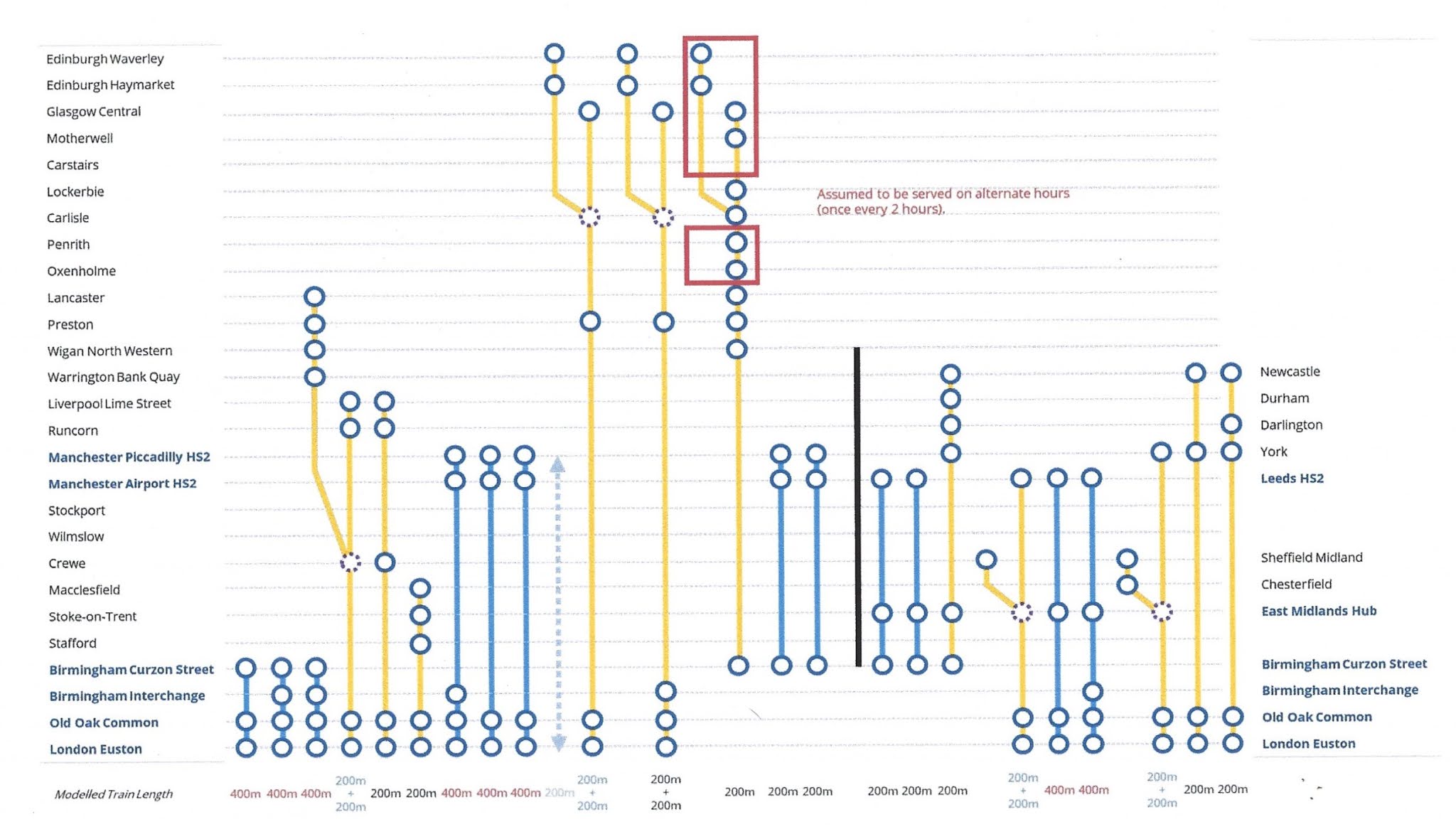
Note.
- There are seventeen paths terminating in the South at Euston station.
- Six of these paths go to Leeds, Newcastle or York.
- As the Eastern leg has been abandoned, that means six extra trains can run between London and the large triangular junction in the West Midlands.
Six extra trains running to the West side of England and Scotland could give a substantial improvement of services.
High Speed Yorkshire
HS2 needs to be paired with High Speed Yorkshire, which would mainly be an upgrading of the East Coast Main Line running at up to 160 mph to serve Lincolnshire, Yorkshire, the North-East and East Scotland.
Note.
- British Rail built the Selby Diversion in the 1980s to run at 160 mph.
- Digital signalling is currently being installed on this route and this will allow trains to speed through the two bottlenecks of the Digswell Viaduct and the Newark Crossing.
- Times of three-and-a-half hours between King’s Cross and Edinburgh, should be possible.
These times should give the airlines a good kicking on London-Newcastle and London-Scotland routes.
Fast services would run on High Speed Yorkshire to Alnwick, Barnetby, Barnsley, Beverley, Berwick, Bradford, Brough, Cleethorpes, Darlington, Doncaster, Durham, Edinburgh, Goole, Grantham, Grimsby, Harrogate, Huddersfield, Hull, Leeds, Lincoln, Middlesbrough, Newcastle, Peterborough, Pontefract, Retford, Rotherham, Scarborough, Scunthorpe, Sheffield, Skipton, Stevenage, Sunderland, Wakefield, Worksop and York.
Most of these towns and cities are already served by Hitachi or other high speed trains from King’s Cross.
A high proportion of the services to Yorkshire destinations will be under two hours from London.
When the current trains need replacing, they could be replaced by High Speed Two Classic-Compatible trains.
Onward From Handsacre Junction
Services to the North-West and Scotland will join the Trent Valley Line at Handsacre junction.
This OpenRailwayMap shows the Trent Valley Line between Crewe station and Handacre junction.
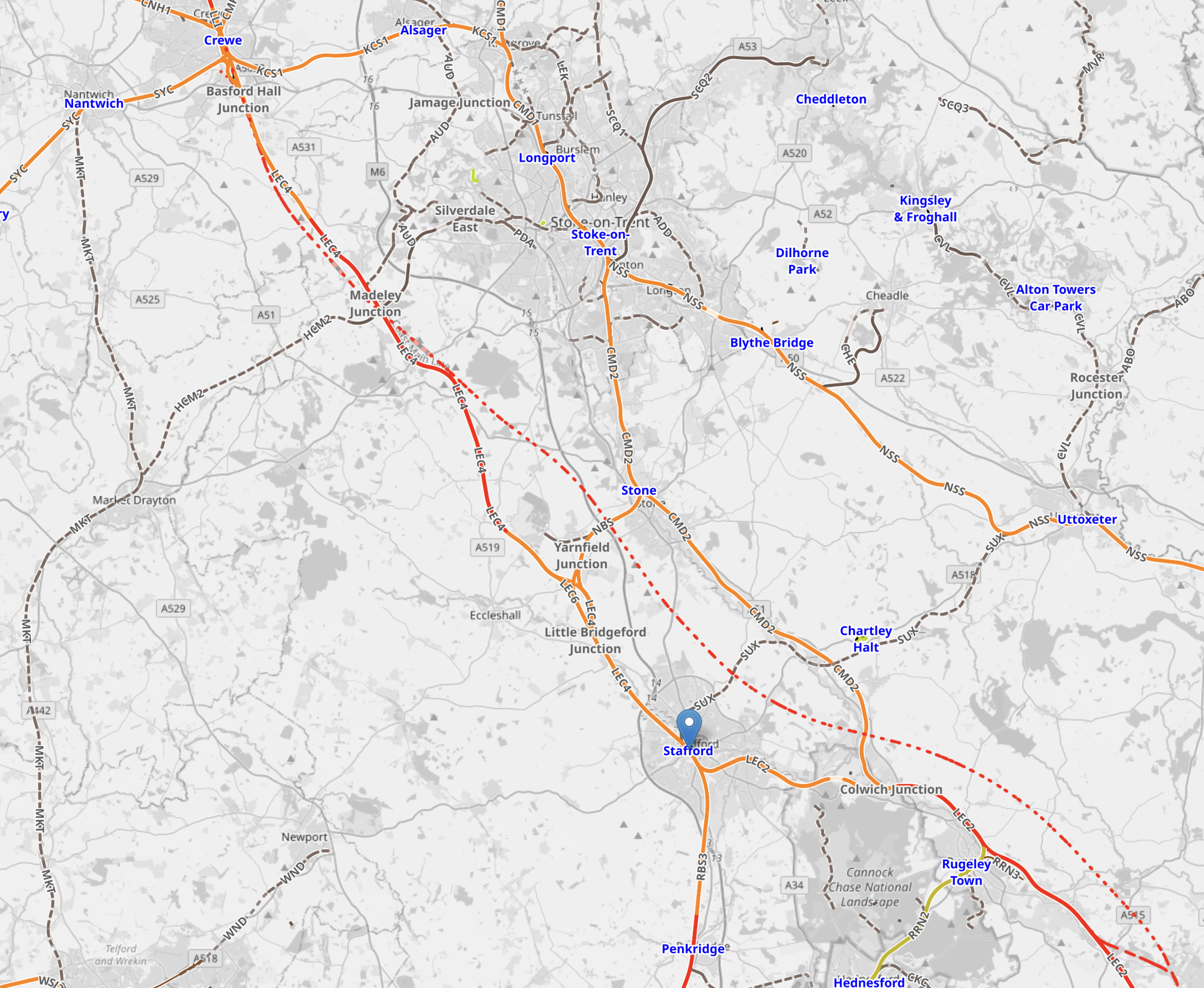
Note.
- The proposed route of High Speed Two is shown as a dotted line, running diagonally across the map.
- The red track to its West is the Trent Valley Line, which is a section of the West Coast Main Line.
- Handsacre junction is in the South-East corner of the map.
- The blue arrow indicates Stafford station on the West Coast Main Line.
- The main High Speed Two tracks will not connect to Stafford or Stoke-on-Trent stations.
- Crewe station is in the North-West corner of the map.
- Crewe station and Handsacre junction are 37.6 miles apart.
With the exception of the 6 mile twin-track section between Stafford Trent Valley and Colwich junctions, it appears that Crewe station and Handsacre junction is all quadruple track.
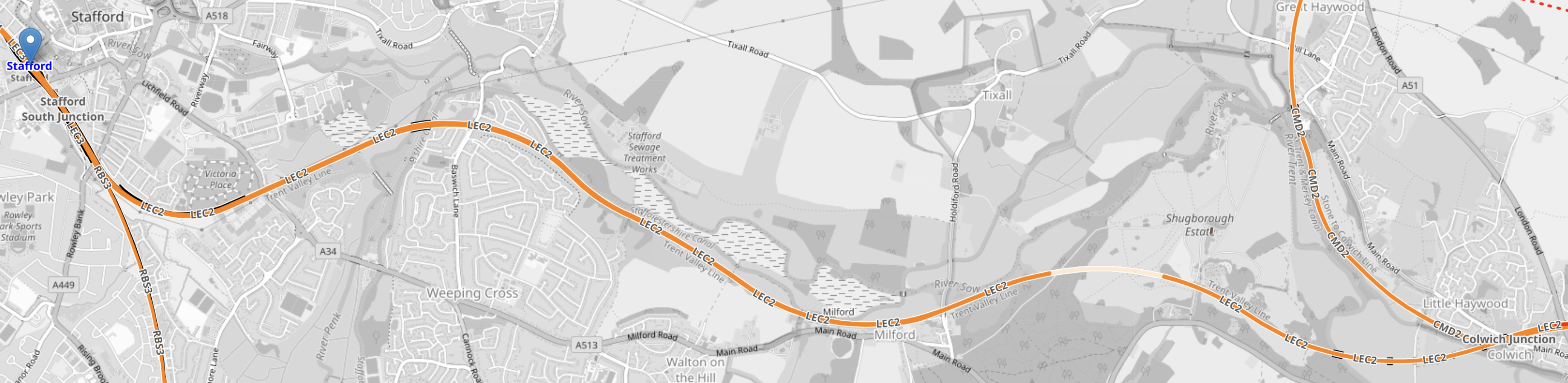
This OpenRailwayMap shows the Trent Valley Line between Stafford stationand Colwich junction.
Note.
- The Trent Valley Line, which is a section of the West Coast Main Line, runs across the map.
- The arrow in the North-West corner of the map indicates Stafford station.
- Colwich junction is in the South-East corner of the map.
- About three-quarters of the way across, the track is shown in cream. This is the twin-track Shugborough Tunnel, which is around a half-mile long.
- The Shugborough Tunnel has a 100 mph maximum speed.
- The portals of Shugborough Tunnel are Grade II Listed and the Wikipedia entry for the tunnel is certainly worth a read.
How Many High Speed Two trains per hour (tph) will use the Trent Valley Line route?
The original proposal in the graphic earlier shows these trains.
- 4 – London to Lancaster/Liverpool Lime Street – Splits at Crewe
- 5 – London to Liverpool Lime Street
- 6 – London to Stafford, Stoke -on-Trent and Macclesfield
- 7 – London and Birmingham Interchange to Manchester Airport and Manchester Piccadilly
- 8 – London to Manchester Airport and Manchester Piccadilly
- 9 – London to Manchester Airport and Manchester Piccadilly
- 10 – London and Birmingham Interchange to Preston, Carlisle, Edinburgh Haymarket and Edinburgh Waverley/Glasgow Central – Splits at Carlisle
- 11 – London Euston to Preston, Carlisle, Edinburgh Haymarket and Edinburgh Waverley/Glasgow Central – Splits at Carlisle
- 12 – Birmingham Curzon Street to Wigan North Western, Preston, Lancaster, Oxenholme, Penrith, Carlisle, Edinburgh Haymarket and Edinburgh Waverley Or Wigan North Western, Preston, Lancaster, Carlisle, Lockerbie, Motherwell and Glasgow Central- Services alternate.
- 13 – Birmingham Curzon Street to East Midlands Hub, Manchester Airport and Manchester Piccadilly
- 14 – Birmingham Curzon Street to East Midlands Hub, Manchester Airport and Manchester Piccadilly
Note.
- It looks like there will be eleven High Speed Two tph on the Trent Valley Line.
- As East Midlands Hub will not be built, I will assume trains 13 and 14 will be Birmingham Curzon Street to Manchester Airport and Manchester Piccadilly.
- Other trains will need to use the route.
- I suspect that freight trains, that couldn’t maintain 100 mph would not be allowed.
I believe that digital signalling can handle all the trains between Handsacre Junction and Crewe.
- Trains 10 and 11 would run every thirty minutes to give two tph between London and Glasgow Central and two tph between London and the two Edinburgh stations.
- Each of these trains would lead a flight of trains behind them through the Trent Valley Line.
- The last trains going North in the flights, would be trains 4 and 6, as they stop on the Trent Valley Line section.
I have written a lot of scheduling algorithms in the last fifty years and I wouldn’t be surprised if flights could be up to 7 or 8 trains, running 3 or 4 minutes apart.
It would be an impressive sight.
What Timings Would Be Possible On High Speed Two Using Handsacre Junction And The Trent Valley Line?
In Where Is Handsacre Junction? I calculated some times on High Speed Two to various destinations, using Handsacre junction and the Trent Valley Line. This is a more comprehensive table.
- London and Blackpool North – 205 mph – 1:55
- London and Blackpool North – 140 mph – 2:12
- London and Carlisle – 205 mph – 2:45
- London and Carlisle – 140 mph – 3:01
- London and Crewe – 205 mph – 1:03
- London and Crewe – 140 mph – 1:19
- London and Edinburgh Waverley – 205 mph – 4:14
- London and Edinburgh Waverley – 140 mph – 4:30
- London and Glasgow Central – 205 mph – 4:22
- London and Glasgow Central – 140 mph – 4:38
- London and Handsacre junction – 205 mph – 0:35
- London and Handsacre junction – 140 mph – 0:51
- London and Lancaster – 205 mph – 1:50
- London and Lancaster – 140 mph – 2:06
- London and Liverpool Lime Street – 205 mph – 1:46
- London and Liverpool Lime Street – 140 mph – 2:02
- London and Manchester Piccadilly – 205 mph – 1:41
- London and Manchester Piccadilly – 140 mph – 1:57
- London and Preston – 205 mph – 1:31
- London and Preston – 140 mph – 1:47
- London and Stafford – 205 mph – 0:45
- London and Stafford – 140 mph – 1:01
- London and Stoke-on-Trent – 205 mph – 0:55
- London and Stoke-on-Trent – 140 mph – 1:11
- London and Wigan North Western – 205 mph – 1:17
- London and Wigan North Western – 140 mph – 1:33
Note.
- 205 mph could be the average speed between London Euston and Handsacre junction for High Speed Two Classic-Compatible trains.
- 140 mph could be the average speed between London Euston and Handsacre junction for Class 390 trains.
- Times are in hh:nn.
- For times North of Handsacre junction are typical Class 390 times.
A typical timing between London Euston and Handsacre junction for Class 390 trains is 71 minutes, so if High Speed Two services were run using Class 390 trains, twenty minutes would be saved on all services via Handsacre junction compared to current Avanti West Coast services.
I have some other thoughts.
Using Class 390 Trains Is Not My Idea
This article on Rail nBusiness UK is entitled Viewpoint: Buy tilting trains and finish Delta Junction to salvage HS2, says Gibb.
This is the sub-heading.
UK: Procurement of a fleet of tilting trains and a focus on Birmingham – Manchester services are key to making the most the descoped High Speed 2 scheme, former Virgin Trains executive Chris Gibb tells Rail Business UK.
Chris Gibb has the right experience. and has been used as a go-to man, when projects are in trouble.
The major points of his plan are as follows.
- Connect High Speed Two to the Trent Valley Line to go North from the Midlands.
- Initially, use Class 390 trains or Pendelinos on Liverpool, Manchester and Scottish services.
- Run Class 390 trains at 140 mph between Euston and Handsacre junction.
- When the Pendelinos need to be retired, buy a new set of tilting trains.
- Complete the North-to-West leg of High Speed Two’s triangular junction, so that trains can run between Birmingham Curzon Street and Manchester.
- Gibb proposes a Blackpool service, that splits and joins with a Liverpool service. I assume he means train 5.
Gibb feels a fundamental review of the operating principles and fleet requirements is now needed.
It is a well-thought out viewpoint and very much a must-read.
High Speed Yorkshire
In December 2019, I wrote Could High Speed Two Be A One-Nation Project?, which I started like this.
As currently envisioned, High Speed Two is very much an English project, with the following routes
- London and Birmingham
- London and Liverpool via Birmingham
- London and Manchester Airport/Manchester via Birmingham and Crewe
- London and Sheffield via Birmingham and the East Midlands Hub
- London and Leeds via Birmingham and the East Midlands Hub
There are large numbers of mid-sized towns and cities that it won’t serve directly.
This is what I said about the East Coast Main Line in the post.
The East Coast Main Line serves the following routes.
- London and Bradford
- London and Cambridge
- London and Edinburgh via Doncaster, York and Newcastle
- London and Harrogate via Leeds
- London and Hull
- London and Kings Lynn via Cambridge
- London and Lincoln via Newark.
- London and Leeds via Doncaster
- London and Middlesbrough
- London and Skipton via Leeds
- London and Sunderland
The East Coast Main Line could become another high speed line.
Extra services could be added.
- London and Norwich via Cambridge
- London and Nottingham
- London and Grimsby and Cleethorpes via Lincoln.
- London and Sheffield via Retford.
Add the East Coast Main Line and High Speed Two together and there could be a wider range of towns and cities served.
- Peterborough and Doncaster could play the same role in the East as Birmingham and Crewe will play in the West.
- The East Coast Main Line between London and Doncaster will be upgraded to in-cab ERTMS signalling in a few years time, which will allow 140 mph running on several sections of the route.
- Improvements are either under way or being planned to reduce bottlenecks on the East Coast Main Line.
- If High Speed Two can handle eighteen trains per hour (tph), then surely the East Coast Main Line, which has a lot of quadruple track, can handle upwards of twelve 140 mph trains per hour between London and Doncaster, after the improvements to track and signalling.
- I estimate that 140 mph running between London and Doncaster could save as much as twenty minutes.
- I feel that Barnsley, Doncaster, Hull, Leeds, Sheffield and York could all be reached in under two hours from London using the existing Azuma trains.
- This morning the 0700 from Kings Cross is timetabled to reach York at 0852. Would it be possible for London and York to be around just ninety minutes?
- Savings would also apply to trains between London and Leeds, Middlesbrough, Newcastle, Scotland and Sunderland.
- Sub-four hour journeys between London and Edinburgh would be commonplace.
Note that the Internet gives a driving time of nearly three and a half hours between London and Leeds. Surely, two hours or less on High Speed Yorkshire would be much preferable.
I would add this infrastructure.
- There might be a good case to create electrified routes to Hull and Sheffield and between Sheffield and Leeds, but they wouldn’t be needed to start the service or obtain the time savings. But they would ease operation, cut carbon emissions and save a few more minutes.
- A station at Doncaster-Sheffield Airport.
- A parkway station at Barnsley on the Dearne Valley Line with direct services to Doncaster, Leeds, London and Sheffield.
The two latter improvements have been proposed in Sheffield Region’s transport plans.
High Speed Yorkshire should be finished as soon as possible. A completion date of 2024 is not unreasonable.
This was the first time I used the term High Speed Yorkshire.
Benefits Of Digital Signalling On The East Coast Main Line
The obvious benefit is there will be 140 mph running on several stretches of the East Coast Main Line.
But as a Control Engineer, I believe that the digital signalling can be used to eliminate two major bottlenecks on the route.
- The Digswell Viaduct, which I wrote about in Is There An ERTMS-based Solution To The Digswell Viaduct?.
- The Newark Flat Crossing, which I wrote about in Could ERTMS And ETCS Solve The Newark Crossing Problem?.
Digital Signalling will also offer techniques to run more trains per hour on the route.
LNER Orders CAF Tri-Mode Sets
The title of this section, is the same as this article in the December 2023 Edition of Modern Railways, which has this paragraph.
Modern Railways understands the new fleet will be maintained at Neville Hill depot in Leeds and, like the ‘225’ sets, will be used predominantly on services between London and Yorkshire, although unlike the ‘225s’ the tri-modes, with their self-power capability, will be able to serve destinations away from the electrified network such as Harrogate and Hull.
Note.
- This surprised me, as I’d always expected the Yorkshire routes will be served by Hitachi battery-electric trains.
- But it does look that both Harrogate and Hull stations, have long enough platforms to hold a ten-car train.
- With their tri-mode technology, it also looks like the CAF trains won’t be needed to be charged before returning to London.
The last point would enable them to try out new routes.
But it does look like LNER are planning to strengthen their Yorkshire routes.
- Does Azuma Test Train Takes To The Tracks As LNER Trials Possible New Route, also mean that they’re looking at a service to Cleethorpes?
- The curtailment of High Speed Two was hard on Yorkshire.
- The Government has had time to get a verdict from experts on TransPennine Express.
It could just be that, it’s easier to sell rail tickets to Yorkshire folk, than Lancashire folk.
FirstGroup Applies To Run New London To Sheffield Rail Service
The title of this section, is the same as that of this press release from First Group.
These two paragraphs outline FirstGroup’s initial plans.
FirstGroup plc, the leading private sector transport operator, has today submitted the first phase of an application for a new open access rail service between London and Sheffield to the Office of Rail and Road (ORR).
FirstGroup plans to expand its open access rail operations as part of its award-winning Hull Trains business, building on their successful existing service which has transformed long-distance connectivity between Hull and London.
Note.
- FirstGroup want to run two trains per day (tpd) between London King’s Cross and Sheffield stations via Retford.
- Services will be non-stop between London King’s Cross and Retford.
- The service will be run by Hull Trains.
- I suspect that Hull Trains will use a fleet of identical Hitachi trains for both services.
- Hull Trains could decarbonise the services by using battery-electric trains.
- I believe a time of 82 minutes will be possible between London King’s Cross and Sheffield.
- High Speed Two were promising a time of 87 minutes for their route from London Euston via Birmingham and Nottingham.
I believe there could be up to seven tpd to both Hull and Sheffield.
Timings On High Speed Yorkshire
In FirstGroup Applies To Run New London To Sheffield Rail Service, I felt the following is possible, between London King’s Cross and Sheffield.
- After the digital signalling is completed between King’s Cross and Retford, I suspect that a 135 mph average speed can be maintained between Woolmer Green and Retford. This would mean that a King’s Cross and Retford time of 68 minutes would be possible.
- If Network Rail improve the track between Retford and Sheffield, I believe that a 70 mph average could be achieved on the Retford and Sheffield section. This would mean that a Retford and Sheffield time of 20 minutes would be possible.
- I would expect at least six minutes would be saved by missing stops.
This gives a time of 82 minutes between London King’s Cross and Sheffield.
I will use these timings to calculate other possible times.
- Current time between London King’s Cross and Retford – 82 minutes
- Digitally signalled average speed between Woolmer Green and Retford – 135 mph
- Digitally signalled time between London King’s Cross and Retford – 68 minutes
- Digitally signaled time between London King’s Cross and Sheffield – 82 minutes
These are my estimated timings from London King’s Cross.
Barnetby via Newark Northgate and Lincoln
Operator: LNER
Served by High Speed Two: No
Time to/from London King’s Cross: 114 minutes
Barnetby via Peterborough and Lincoln
Operator: LNER
Served by High Speed Two: No
Time to/from London King’s Cross: 128 minutes
Barnsley via Sheffield
Operator: Hull Trains
Served by High Speed Two: No
Time to/from London King’s Cross: 112 minutes
Note: Uses Penistone Line and Hull Trains times to Sheffield
Beverley
Operator: Hull Trains
Served by High Speed Two: No
Time to/from London King’s Cross: 101 minutes
Note: Uses Hull Trains times from Doncaster
Bradford Foster Square via Leeds
Operator: LNER
Served by High Speed Two: No
Time to/from London King’s Cross: 146 minutes
Note: Uses LNER times from Leeds
Bradford Interchange via Doncaster
Operator: Grand Central
Served by High Speed Two: No
Time to/from London King’s Cross: 166 minutes
Note: Uses Grand Central times from Doncaster
Brighouse via Doncaster
Operator: Grand Central
Served by High Speed Two: No
Time to/from London King’s Cross: 143 minutes
Note: Uses Grand Central times from Doncaster
Brough
Operator: Hull Trains
Served by High Speed Two: No
Time to/from London King’s Cross: 101 minutes
Note: Uses Hull Trains times from Doncaster
Cleethorpes via Newark Northgate and Lincoln
Operator: LNER
Served by High Speed Two: No
Time to/from London King’s Cross: 141 minutes
Cleethorpes via Peterborough and Lincoln
Operator: LNER
Served by High Speed Two: No
Time to/from London King’s Cross: 155 minutes
Darlington
Operator: LNER
Served by High Speed Two: Yes
High Speed Two time to/from London Euston: 116 minutes
Time to/from London King’s Cross: 127 minutes
Doncaster
Operator: Grand Cenreal, Hull Trains, LNER
Served by High Speed Two: No
Time to/from London King’s Cross: 76 minutes
Durham
Operator: LNER
Served by High Speed Two: Yes
High Speed Two time to/from London Euston: 136 minutes
Time to/from London King’s Cross: 160 minutes
Eaglescliffe
Operator: Grand Central
Served by High Speed Two: No
Time to/from London King’s Cross: 155 minutes
Note: Uses Grand Central times from Northallerton
Edinburgh
Operator: LNER
Served by High Speed Two: Yes
High Speed Two time to/from London Euston: 220 minutes
Time to/from London King’s Cross: 234 minutes
Grantham
Operator: LNER
Served by High Speed Two: No
Time to/from London King’s Cross: 53 minutes
Grimsby Town via Newark Northgate and Lincoln
Operator: LNER
Served by High Speed Two: No
Time to/from London King’s Cross: 134 minutes
Grimsby Town via Peterborough and Lincoln
Operator: LNER
Served by High Speed Two: No
Time to/from London King’s Cross: 148 minutes
Halifax via Doncaster
Operator: Grand Central
Served by High Speed Two: No
Time to/from London King’s Cross: 153 minutes
Note: Uses Grand Central times from Doncaster
Harrogate
Operator: LNER
Served by High Speed Two: No
Time to/from London King’s Cross: 147 minutes
Note: Uses LNER times from Leeds
Hartlepool
Operator: Grand Central
Served by High Speed Two: No
Time to/from London King’s Cross: 175 minutes
Note: Uses Grand Central times from Northallerton
Horsforth
Operator: LNER
Served by High Speed Two: No
Time to/from London King’s Cross: 124 minutes
Note: Uses LNER times from Leeds
Huddersfield via Leeds
Operator: LNER
Served by High Speed Two: No
Time to/from London King’s Cross: 161 minutes
Note: Uses LNER times from Leeds
Huddersfield via Sheffield
Operator: Hull Trains
Served by High Speed Two: No
Time to/from London King’s Cross: 140 minutes
Note: Uses Penistone Line and Hull Trains times to Sheffield
Hull
Operator: Hull Trains
Served by High Speed Two: No
Time to/from London King’s Cross: 114 minutes
Note: Uses Hull Trains times from Doncaster
Keighley via Leeds
Operator: LNER
Served by High Speed Two: No
Time to/from London King’s Cross: 178 minutes
Note: Uses LNER times from Leeds
Leeds
Operator: LNER
Served by High Speed Two: Yes
High Speed Two time to/from London Euston: 81 minutes
Time to/from London King’s Cross: 116 minutes
Lincoln via Newark Northgate
Operator: LNER
Served by High Speed Two: No
Time to/from London King’s Cross: 85 minutes
Lincoln via Peterborough
Operator: LNER
Served by High Speed Two: No
Time to/from London King’s Cross: 99 minutes
Market Rasen via Newark Northgate and Lincoln
Operator: LNER
Served by High Speed Two: No
Time to/from London King’s Cross: 101 minutes
Market Rasen via Peterborough and Lincoln
Operator: LNER
Served by High Speed Two: No
Time to/from London King’s Cross: 115 minutes
Meadowhall via Sheffield
Operator: Hull Trains
Served by High Speed Two: No
Time to/from London King’s Cross: 90 minutes
Note: Uses Penistone Line and Hull Trains times to Sheffield
Middlesbrough
Operator: LNER
Served by High Speed Two: No
Time to/from London King’s Cross: 155 minutes
Mirfield via Doncaster
Operator: Grand Ccentral
Served by High Speed Two: No
Time to/from London King’s Cross: 136 minutes
Note: Uses Grand Central times from Doncaster
Newark Northgate
Operator: LNER
Served by High Speed Two: No
Time to/from London King’s Cross: 60 minutes
Newcastle
Operator: LNER
Served by High Speed Two: Yes
High Speed Two time to/from London Euston: 137 minutes
Time to/from London King’s Cross: 145 minutes
Northallerton
Operator: Grand Central, LNER
Served by High Speed Two: No
Time to/from London King’s Cross: 126 minutes
Peterborough
Operator: Grand Central, LNER
Served by High Speed Two: No
Time to/from London King’s Cross: 40 minutes
Pontefract Monkhill
Operator: Grand Central
Served by High Speed Two: No
Time to/from London King’s Cross: 103 minutes
Note: Uses Grand Central times from Doncaster
Retford
Operator: LNER
Served by High Speed Two: No
Time to/from London King’s Cross: 68 minutes
Selby
Operator: Hull Trains
Served by High Speed Two: No
Time to/from London King’s Cross: 92 minutes
Note: Uses Hull Trains times from Doncaster
Sheffield
Operator: Hull Trains
Served by High Speed Two: Yes
High Speed Two time to/from London Euston: 87 minutes
Time to/from London King’s Cross: 82 minutes
Shipley via Leeds
Operator: LNER
Served by High Speed Two: No
Time to/from London King’s Cross: 168 minutes
Note: Uses LNER times from Leeds
Skipton via Leeds
Operator: LNER
Served by High Speed Two: No
Time to/from London King’s Cross: 191 minutes
Note: Uses LNER times from Leeds
Sleaford
Operator: LNER
Served by High Speed Two: No
Time to/from London King’s Cross: 83 minutes
Spalding
Operator: LNER
Served by High Speed Two: No
Time to/from London King’s Cross: 61 minutes
Sunderland
Operator: Grand Central
Served by High Speed Two: No
Time to/from London King’s Cross: 194 minutes
Note: Uses Grand Central times from Northallerton
Thirsk
Operator: Grand Central
Served by High Speed Two: No
Time to/from London King’s Cross: 116 minutes
Note: Uses Grand Central times from Northallerton
Thornaby
Operator: LNER
Served by High Speed Two: No
Time to/from London King’s Cross: 146 minutes
Wakefield Kirkgate
Operator: Grand Central
Served by High Speed Two: No
Time to/from London King’s Cross: 118 minutes
Note: Uses Grand Central times from Doncaster
Wakefield Westgate
Operator: LNER
Served by High Speed Two: No
Time to/from London King’s Cross: 95 minutes
Worksop
Operator: Hull Trains
Served by High Speed Two: No
Time to/from London King’s Cross: 81 minutes
York
Operator: LNER
Served by High Speed Two: Yes
High Speed Two time to/from London Euston: 84 minutes
Time to/from London King’s Cross: 98 minutes
Note.
- Times have improved because of the digital signalling.
- As the digital signalling goes further North timings will will come down further.
- Unelectrified branches like those to Beverley, Cleethorpes, Grimsby, Harrogate, Huddersfield, Hull, Lincoln, Middlesbrough and Sheffield will be improved and further bring down times.
Sheffield could be as low as 80 minutes, with York at 91 minutes.
London North Eastern Railway Runs Trial Train To Liverpool Street
The title of this post, is the same as that of this article on Rail Advent.
These two paragraphs, describe why this was done.
In an effort to mitigate the effect on passengers during disruption to services, London North Eastern Railway (LNER) ran one of its Azuma trains from Finsbury Park to London Liverpool Street during the early hours of this morning, Friday, 14th July.
The trial run took place to determine the long-term feasibility of diverting services during periods of planned disruption or when significant engineering works were taking place.
There doesn’t seem to have been any problems.
- The route in from Finsbury Park station went through Canonbury, Dalston Kingsland, Hackney Central, Homerton, Hackney Wick, Stratford and Bethnal Green stations, which was a distance of 9.6 miles.
- The route out to Finsbury Park station went through Bethnal Green, Cambridge Heath, London Fields, Dalston Kingsland and Canonbury, what was a distance of 5.8 miles.
Note.
- Two different routes were checked.
- The Class 800 train had five cars.
- Platform 4 at Liverpool Street station was used, which is normally used by London Overground and Cambridge services.
As this comes so soon after the test run to Cleethorpes, that I wrote about in Azuma Test Train Takes To The Tracks As LNER Trials Possible New Route, I wonder if Network Rail and the train operating companies are planning for some worst case scenario, where the two or more of the West Coast Main Line, Midland Main Lone and East Coast Main Line are blocked.
LNER and Network Rail have shown the following.
- Azumas can use Cleethorpes station.
- Azumas can use Liverpool Street station.
We also know that Cleethorpes has a direct TransPennine train service across the North of England to Doncaster, Sheffield, Manchester and Liverpool.
So if say Euston has to be shut for perhaps fourteen days during the construction of High Speed Two, a service between Liverpool Street and Cleethorpes via Colchester, Ipswich, Cambridge, Peterborough and Lincoln could be used to get some passengers to and from the North.
The other big problem is the removal of the problems of the Newark Crossing, which if it results in a long blockade of the East Coast Main Line, might need services to go into an alternative London terminal.
The Powerhouse In The East
Consider.
- The importance of Cambridge to the economy of the UK is growing fast.
- The city suffers from a shortage of commercial premises, housing and staff at all levels.
- I have just looked at the non-passenger traffic on the West Anglia Main Line for all of yesterday and there were just six freight trains through Bishop’s Stortford.
I wonder, if it would be possible to run a Liverpool Street and Cleethorpes service via Cambridge, Ely, Peterborough, Spalding, Sleaford, Lincoln, Market Rasen, Barnetby and Grimsby Town?
- The service avoids the East Coast Main Line, except through Peterborough, where it would use the separate Werrington lines.
- Liverpool Street is in the heart of one of the world’s major financial centres.
- Liverpool Street is on the Elizabeth Line.
- The service could call at Stansted Airport, but a reverse would be needed.
- Peterborough is sometimes promoted in Cambridge as a city, that could be developed, to provide support for Cambridge.
- A reverse would be needed at Lincoln.
- Lincoln is developing as a university city with character.
- Grimsby and Cleethorpes are close to the fast expanding Humberside renewable energy and hydrogen cluster.
The service could be paired with a Liverpool Street and Norwich service, via Ely, Thetford, Attleborough and Wymondham.
The services could alternate every half hour or perhaps leave London as a pair and split and join at Cambridge.
Platform Availability At Kings Cross And Liverpool Street
Consider.
- Digital signalling on the East Coast Main Line will increase the number of possible trains between London and the North.
- LNER have said they want to increase services to the North and have identified a possible service to Cleethorpes.
- Grand Central would like to increase services to Bradford.
- Lumo have started services to Newcastle and Edinburgh from Kings Cross.
- The Elizabeth Line now runs less services into Liverpool Street station.
- The Elizabeth Line connects to Liverpool Street, but doesn’t connect to King’s Cross.
- Liverpool Street is to undergo a major refurbishment, which should increase the overall passenger capacity of the station.
Would it be sensible to move a small number of services from King’s Cross to Liverpool Street?
Surely, the logical service to move to Liverpool Street would be the new Cleethorpes service.
- It would route via Cambridge, Cambridge North, Ely, Peterborough, Spalding, Sleaford, Lincoln, Market Rasen, Barnetby and Grimsby Town.
- It would use the Werrington Lines through Peterborough.
- It would not need a path on the East Coast Main Line.
- The service would provide a much needed direct link between Cambridge and Lincoln via Peterborough.
- The service could also be hourly or two-hourly.
I also believe that a Liverpool Street and Cleethorpes service could be run by a battery-electric Azuma.
- The route is electrified between Liverpool Street and Ely and through Peterborough.
- Ely and Peterborough is 30 miles.
- Peterborough and Lincoln is 56.9 miles.
- Lincoln and Cleethorpes is 47.2 miles.
- There would need to be a charging station or a few miles of electrification at Cleethorpes.
- There may be 134.1 miles of unelectrified track, but there can be a Splash and Dash at Peterborough.
A Stadler Akku would be able to handle this route, so I suspect that a similar-sized battery-electric Azuma should also be able to handle the route.
What Will Be The Fastest Times Possible Between London King’s Cross And Leeds?
According to media reports, it is likely that the Eastern Leg of High Speed Two will be scrapped on kicked into the long grass.
So out of curiosity, what times can be achieved between London King’s Cross and Leeds.
Wikipedia says this about digital signalling on the line.
Increasing maximum speeds on the fast lines between Woolmer Green and Dalton-on-Tees up to 140 mph (225 km/h) in conjunction with the introduction of the Intercity Express Programme, level crossing closures, ETRMS fitments, OLE rewiring and the OLE PSU – est. to cost £1.3 billion (2014). This project is referred to as “L2E4” or London to Edinburgh (in) 4 Hours. L2E4 examined the operation of the IEP at 140 mph on the ECML and the sections of track which can be upgraded to permit this, together with the engineering and operational costs.
Note.
- Woolmer Green is 23.8 miles North of King’s Cross and a short distance to the North of the Digswell Viaduct.
- Dalton-on-Tees is North of Doncaster, where the line to Leeds leaves the East Coast Main Line.
The 186 mile journey to Leeds can be broken down into these sections.
- King’s Cross and Woolmer Green – 23.8 miles – 16 minutes – 89.3 mph
- Woolmer Green and Doncaster – 132.2 miles – 85 minutes – 93.3 mph
- Doncaster and Leeds – 29.9 miles – 32 minutes – 56 mph
In Will Avanti West Coast’s New Trains Be Able To Achieve London Euston and Liverpool Lime Street In Two Hours?, I estimated that each stop in an electric Hitachi Class 802 train takes eight minutes, which includes six minutes accelerating and decelerating and a two minute dwell time in the station.
- Services between London Euston and Leeds typically stop three times, so this means there are four acceleration/deceleration cycles, if you add in the one split between London Kings Cross and Leeds.
- There are also three dwell times of perhaps two minutes in the intermediate stations.
- This would mean that a total of thirty minutes must be added to calculate the journey time.
If the train averaged these speeds over 186 miles, the following times would be achieved.
- 125 mph – 89 minutes
- 130 mph – 86 minutes
- 140 mph – 80 minutes
- 150 mph – 74 minutes
- 160 mph – 70 minutes
Adding in the thirty minutes for stops gives some reasonable timings for between London King’s Cross and Leeds.
There are ways that times could be reduced.
Removal Of Level Crossings
This course of action always brings results, but is hated by the local users.
This article in The Times is entitled HS2 Eastern Leg To Leeds Axed, where there is said.
The government’s long-awaited Integrated Rail Plan also commits to full electrification of the Midland Main Line from London St Pancras to Sheffield, as well as upgrades to the East Coast Main Line. The Times understands this includes removing level crossings, which will help reduce journey times.
Every little helps!
More Running At Higher Speeds
From my figures, it appears that roughly a ten mph increase in average speed reduces journey time by up to six minutes.
So the more running at 140 mph or even faster the better.
It should be noted that the Selby Diversion on the East Coast Main Line was designed by British Rail for 160 mph The Wikipedia entry says this.
The line was the first purpose-built section of high-speed railway in the UK having a design speed of 125 mph; however, research by British Rail in the 1990s indicated that the route geometry would permit up to 160 mph operation, subject to the necessary overhead line equipment and signalling upgrades.
Upgrading the line for higher speeds would be a way of reducing the journey time.
- Curves could be better profiled.
- Full digital signalling with perhaps even some degree of automatic control could be introduced.
- More robust overhead line equipment could be installed.
- Some sections of slab track could be laid.
- Level crossing removal.
I wouldn’t be surprised if one of the new Hitachi trains within a few years could be able to average 140 mph between London King’s Cross and Leeds, with a possible 160 mph average speed in the future.
Faster Acceleration And Deceleration
If the three-minute acceleration and deceleration times can be reduced to two minutes this will save eight minutes on the journey.
Quicker Dwell Times
Why not?
Automatic Train Control Through The Newark Crossing
I proposed this in Could ERTMS And ETCS Solve The Newark Crossing Problem? and I believe it would allow trains on the East Coast Main Line at full speed if they didn’t stop at Newark station.
Automatic Train Control Over The Digswell Viaduct And Through The Welwyn North Station
As at the Newark Crossing, I believe ERTMS and ETCS could increase speeds over the Digswell Viaduct and through Welwyn North station.
High-Speed Two Classic Compatible Trains
These faster trains could bring the time down further, if they were to run the service.
Sample Times
I wouldn’t be surprised to see with full digital signalling and a 125 mph average between London King’s Cross and Leeds.
- 125 mph Base Time – 89 minutes.
- Four Acceleration/Deceleration section at 6 minutes each – 24 minutes.
- Three Dwell Times at 2 minutes each – 6 minutes
This would mean a total time of one hour and 59 minutes.
Uprate that to 140 mph and faster acceleration and deceleration.
- 140 mph Base Time – 80 minutes.
- Four Acceleration/Deceleration section at 4 minutes each – 16 minutes.
- Three Dwell Times at 2 minutes each – 6 minutes
This would mean a total time of one hour and 42 minutes.
Uprate that to 160 mph and faster acceleration and deceleration.
- 160 mph Base Time – 70 minutes.
- Four Acceleration/Deceleration section at 4 minutes each – 16 minutes.
- Three Dwell Times at 2 minutes each – 6 minutes
This would mean a total time of one hour and 32 minutes.
A Non-Stop Service
This would speed up the service.
With a 125 mph average between London King’s Cross and Leeds.
- 125 mph Base Time – 89 minutes.
- One Acceleration/Deceleration section at 6 minutes each – 6 minutes.
This would mean a total time of 95 minutes.
Uprate that to 140 mph and faster acceleration and deceleration.
- 140 mph Base Time – 80 minutes.
- One Acceleration/Deceleration section at 4 minutes each – 4 minutes.
This would mean a total time of 84 minutes.
Uprate that to 160 mph and faster acceleration and deceleration.
- 160 mph Base Time – 70 minutes.
- One Acceleration/Deceleration section at 4 minutes each – 4 minutes.
This would mean a total time of 74 minutes.
These compare with a proposed time of one hour and 21 minutes on the original plan to High Speed Two.
Conclusion
It looks like a non-stop service between London and Leeds running at 140 mph, with perhaps some sections at perhaps a bit faster, could be able to match the High Speed Two times.
What Is Possible On The East Coast Main Line?
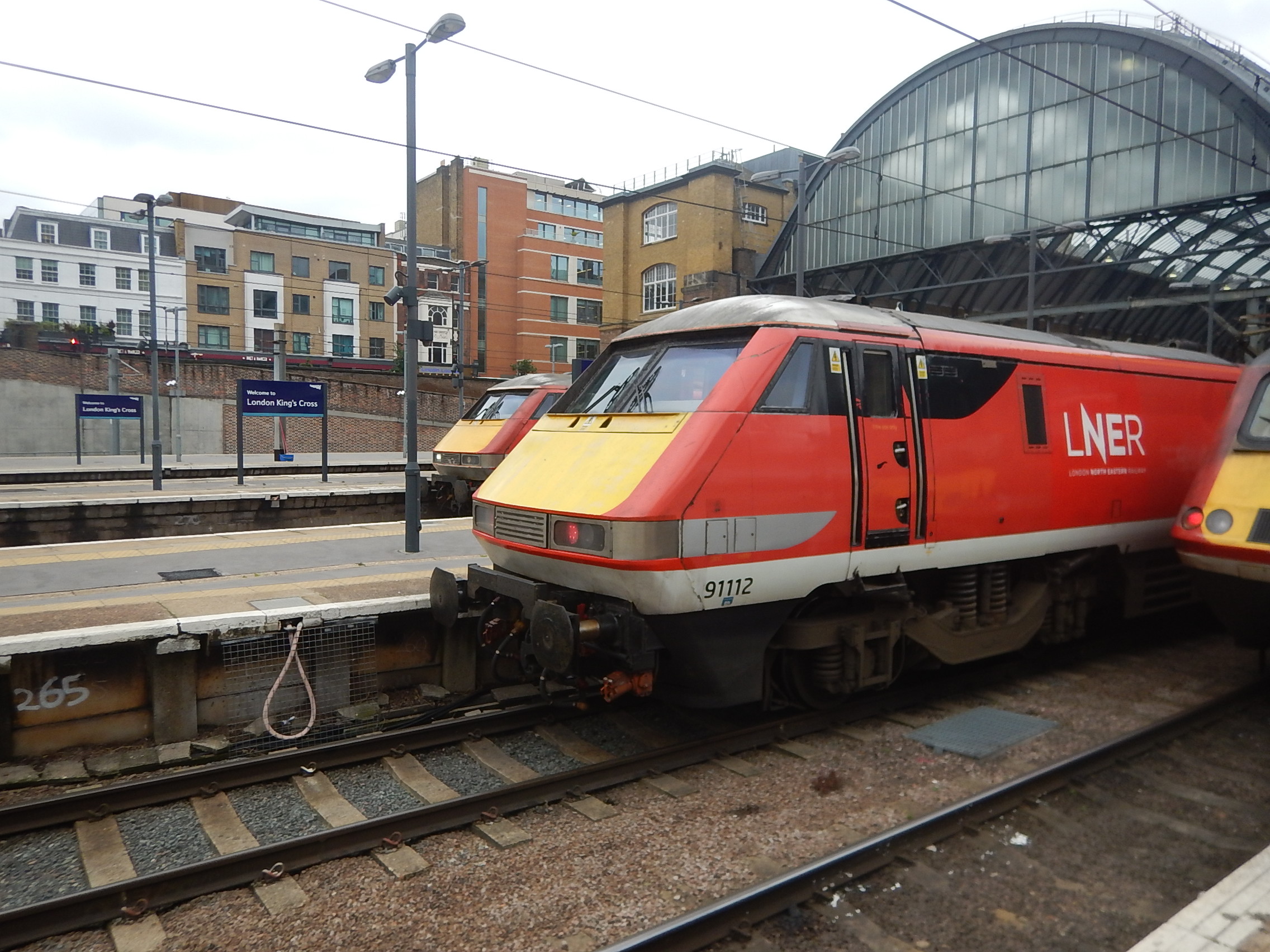
In the Wikipedia entry for the Class 91 locomotive, there is an amazing story.
This picture shows one of these locomotives at Kings Cross.
Note.
- They have a design speed of 140 mph.
- They have a power output of 4.8 MW.
- They were built around 1990 by British Rail at Crewe.
They were designed to run services between London King’s Cross and Edinburgh as fast as possible, as the motive power of the InterCity 225 trains.
This section in the Wikipedia entry for the Class 91 locomotive is entitled Speed Record. This is the first paragraph.
A Class 91, 91010 (now 91110), holds the British locomotive speed record at 161.7 mph (260.2 km/h), set on 17 September 1989, just south of Little Bytham on a test run down Stoke Bank with the DVT leading. Although Class 370s, Class 373s and Class 374s have run faster, all are EMUs which means that the Electra is officially the fastest locomotive in Britain. Another loco (91031, now 91131), hauling five Mk4s and a DVT on a test run, ran between London King’s Cross and Edinburgh Waverley in 3 hours, 29 minutes and 30 seconds on 26 September 1991. This is still the current record. The set covered the route in an average speed of 112.5 mph (181.1 km/h) and reached the full 140 mph (225 km/h) several times during the run.
Note.
- For the British locomotive speed record, locomotive was actually pushing the train and going backwards, as the driving van trailer (DVT) was leading.
- How many speed records of any sort, where the direction isn’t part of the record, have been set going backwards?
- I feel that this record could stand for many years, as it is not very likely anybody will build another 140 mph locomotive in the foreseeable future. Unless a maverick idea for a high speed freight locomotive is proposed.
I have a few general thoughts on the record run between Kings Cross and Edinburgh in three-and-a-half hours.
- I would assume that as in normal operation of these trains, the Class 91 locomotive was leading on the run to the North.
- For various reasons, they would surely have had at least two of British Rail’s most experienced drivers in the cab.
- At that time, 125 mph InterCity 125 trains had been the workhorse of East Coast Main Line for well over ten years, so British Rail wouldn’t have been short of experienced high speed drivers.
- It was a Thursday, so they must have been running amongst normal traffic.
- On Monday, a typical run between Kings Cross and Edinburgh is timetabled to take four hours and twenty minutes.
- High Speed Two are predicting a time of three hours and forty-eight minutes between Euston and Edinburgh via High Speed Two and the West Coast Main Line.
The more you look at it, a sub-three-and-and-a-half hour time, by 1980s-technology on a less-than-perfect railway was truly remarkable.
So how did they do it?
Superb Timetabling
In Norwich-In-Ninety Is A Lot More Than Passengers Think!, I talk about how Network Rail and Greater Anglia created a fast service between Liverpool Street and Norwich.
I suspect that British Rail put their best timetablers on the project, so that the test train could speed through unhindered.
Just as they did for Norwich-in-Ninety and probably will be doing to the East Coast Main Line to increase services and decrease journey times.
A Good As ERTMS Signalling
Obviously in 1991, there was no modern digital in-cab signalling and I don’t know the standard of communication between the drivers and the signallers.
On the tricky sections like Digswell Viaduct, through Hitchin and the Newark Crossing were other trains stopped well clear of any difficult area, as modern digital signalling can anticipate and take action?
I would expect the test train got a signalling service as good as any modern train, even if parts of it like driver to signaller communication may have been a bit experimental.
There may even have been a back-up driver in the cab with the latest mobile phone.
It must have been about 1991, when I did a pre-arranged airways join in my Cessna 340 on the ground at Ipswich Airport before take-off on a direct flight to Rome. Air Traffic Control had suggested it to avoid an intermediate stop at say Southend.
The technology was arriving and did it help the drivers on that memorable run North ensure a safe and fast passage of the train?
It would be interesting to know, what other equipment was being tested by this test train.
A Possible Plan
I suspect that the plan in 1991 was to use a plan not unlike one that would be used by Lewis Hamilton, or in those days Stirling Moss to win a race.
Drive a steady race not taking any chances and where the track allows speed up.
So did British Rail drive a steady 125 mph sticking to the standard timetable between Kings Cross and Edinburgh?
Then as the Wikipedia extract indicated, at several times during the journey did they increase the speed of the train to 140 mph.
And the rest as they say was an historic time of 3 hours, 29 minutes and 30 seconds. Call it three-and-a-half-hours.
This represented a start-to-stop average speed of 112.5 mph over the 393 miles of the East Coast Main Line.
Can The Current Trains Achieve Three-And-A-Half-Hours Be Possible Today?
Consider.
- The best four hours and twenty minutes timings of the Class 801 trains, represents an average speed of 90.7 mph.
- The Class 801 trains and the InterCity 225 trains have similar performance.
- There have been improvements to the route like the Hitchin Flyover.
- Full ERTMS in-cab signalling is being installed South of Doncaster.
- I believe ERTMS and ETC could solve the Newark Crossing problem! See Could ERTMS And ETCS Solve The Newark Crossing Problem?
- I am a trained Control Engineer and I believe if ERTMS and ETC can solve the Newark Crossing problem, I suspect they can solve the Digswell Viaduct problem.
- The Werrington Dive Under is being built.
- The approaches to Kings Cross are being remodelled.
I can’t quite say easy-peasy. but I’m fairly certain the Kings Cross and Edinburgh record is under serious threat.
- A massive power supply upgrade to the North of Doncaster is continuing. See this page on the Network Rail web site.
- ERTMS and ETC probably needs to be installed all the way between Kings Cross and Edinburgh.
- There may be a need to minimise the number of slower passenger trains on the East Coast Main Line.
- The Northumberland Line and the Leamside Line may be needed to take some trains from the East Coast Main Line.
Recent Developments Concerning the Hitachi Trains
There have been several developments since the Hitachi Class 800 and Class 801 trains were ordered.
- Serious engineers and commentators like Roger Ford of Modern Railways have criticised the lugging of heavy diesel engines around the country.
- Network Rail have upgraded the power supply South of Doncaster and have recently started to upgrade it between Doncaster and Edinburgh. Will this extensive upgrade cut the need to use the diesel power-packs?
- Hitachi and their operators must have collected extensive in-service statistics about the detailed performance of the trains and the use of the diesel power-packs.
- Hitachi have signed an agreement with Hyperdrive Innovation of Sunderland to produce battery-packs for the trains and two new versions of the trains have been announced; a Regional Battery Train and an Intercity Tri-Mode Battery Train.
- East Coast Trains have ordered five five-car Class 803 trains, each of which will have a small battery for emergency use and no diesel power-packs.
- Avanti West Coast have ordered ten seven-car Class 807 trains, each of which have no battery or diesel power-packs.
And these are just the ones we know about.
The Class 807 Trains And Liverpool
I find Avanti West Coast’s Class 807 trains the most interesting development.
- They have been partly financed by Rock Rail, who seem to organise train finance, so that the train operator, the train manufacturer all get the best value, by finding good technical solutions.
- I believe that these trains have been designed so they can run between Euston and Liverpool Lime Street stations in under two hours.
- Does the absence of battery or diesel power-packs save weight and improve performance?
- Euston and Liverpool Lime Street in two hours would be an average of only 96.8 mph.
- If the Class 807 trains could achieve the same start-stop average of 112.5 mph achieved by the InterCity 225 test run between Kings Cross and Edinburgh, that would mean a Euston and Liverpool Lime Street time of one hour and forty-three minutes.
- Does Thunderbird provision on the West Coast Main Line for the Class 390 trains mean that the Class 807 trains don’t need emergency power?
- Have diesel power-packs been rarely used in emergency by the Hitachi trains?
I believe the mathematics show that excellent sub-two hour times between Euston and Liverpool Lime Street are possible by Avanti West Coast’s new Class 807 trains.
The Class 803 Trains And Edinburgh
East Coast Trains ordered their Class 803 trains in March 2019, nine months before Avanti West Coast ordered their Class 807 trains.
In Trains Ordered For 2021 Launch Of ‘High-Quality, Low Fare’ London – Edinburgh Service, I outlined brief details of the trains and the proposed service.
- FirstGroup is targeting the two-thirds of passengers, who fly between London and Edinburgh.
- They are also targeting business passengers, as the first train arrives in Edinburgh at 10:00.
- The trains are five-cars.
- The trains are one class with onboard catering, air-conditioning, power sockets and free wi-fi.
- Stops will be five trains per day with stops at Stevenage, Newcastle and Morpeth.
- The trains will take around four hours.
- The service will start in Autumn 2021.
I also thought it would be a successful service
As I know Edinburgh, Liverpool and London well, I believe there are similarities between the Euston-Liverpool Lime Street and Kings Cross-Edinburgh routes.
- Both routes are between two cities known all over the world.
- Both routes are fully-electrified.
- Both routes have the potential to attract passengers from other transport modes.
The two services could even be run at similar speeds.
- Euston-Liverpool Lime Street in two hours will be at 96.8 mph
- Kings Cross-Edinburgh in four hours will be at 98.3 mph.
Does this explain the similar lightweight trains?
Could Lightweight Trains Help LNER?
There is one important factor, I haven’t talked about in detail in this post. Batteries and diesel power-packs on the Hitachi trains.
I have only mentioned them in the following circumstances.
- When trains are not fitted with battery and/or diesel power-packs.
- When battery developments are being undertaken.
Let’s consider the LNER fleet.
- LNER has thirteen nine-car Class 800 trains, each of which has five diesel power-packs
- LNER has ten five-car Class 800 trains, each of which has three diesel power-packs
- LNER has thirty nine-car Class 801 trains, each of which has one diesel power-pack
- LNER has twelve five-car Class 801 trains, each of which has one diesel power-pack
There are sixty-five trains, 497 coaches and 137 diesel power-packs.
And look at their destinations.
- Aberdeen – No Electrification from Edinburgh
- Alnmouth – Fully Electrified
- Berwick-upon-Tweed – Fully Electrified
- Bradford Forster Square – Fully Electrified
- Darlington – Fully Electrified
- Doncaster – Fully Electrified
- Durham – Fully Electrified
- Edinburgh – Fully Electrified
- Glasgow – Fully Electrified
- Grantham – Fully Electrified
- Harrogate – No Electrification from Leeds – Possible Battery Destination
- Huddersfield – No Electrification from Leeds – Possible Battery Destination – Probable Electrification
- Hull – No Electrification from Temple Hirst Junction – Possible Battery Destination
- Inverness – No Electrification from Stirling
- Leeds – Fully Electrified
- Lincoln – No Electrification from Newark North Gate – Possible Battery Destination
- Middlesbrough – No Electrification from Northallerton – Possible Battery Destination
- Newcastle – Fully Electrified
- Newark North Gate – Fully Electrified
- Northallerton – Fully Electrified
- Peterborough – Fully Electrified
- Skipton – Fully Electrified
- Retford – Fully Electrified
- Stevenage – Fully Electrified
- Stirling – Fully Electrified
- Sunderland – No Electrification from Northallerton – Possible Battery Destination
- Wakefield Westgate – Fully Electrified
- York – Fully Electrified
The destinations can be summarised as followed.
- Not Electrified – 2
- Possible Battery Destination – 6
- Fully Electrified – 20
This gives a total of 28.
Could the trains be matched better to the destinations?
- Some routes like Edinburgh, Glasgow, Newcastle and Stirling could possibly be beneficially handled by lightweight trains without any diesel or battery power-packs.
- Only Aberdeen and Inverness can’t be reached by all-electric or battery-electric trains.
- In LNER Seeks 10 More Bi-Modes, I proposed a hydrogen-electric flagship train, that would use hydrogen North of the existing electrification.
There certainly appear to be possibilities.
Example Journey Times To Edinburgh
This table shows the various time for particular start-stop average speeds between Kings Cross and Edinburgh.
- 80 mph – 4:54
- 85 mph – 4:37
- 90 mph – 4:12
- 98.2 mph – 4:00
- 100 mph – 3:56
- 110 mph – 3:34
- 120 mph – 3:16
- 125 mph – 3:08
Note.
- Times are given in h:mm.
- A few mph increase in average speed reduces journey time by a considerable amount.
The figures certainly show the value of high speed trains and of removing bottlenecks, as average speed is so important.
Decarbonisation Of LNER
LNER Seeks 10 More Bi-Modes was based on an article in the December 2020 Edition of Modern Railways, with the same title. These are the first two paragraphs of the article.
LNER has launched the procurement of at least 10 new trains to supplement its Azuma fleet on East Coast main line services.
In a Prior Information Notice published on 27 October, the operator states it is seeking trains capable of operating under 25kW overhead power with ‘significant self-power capability’ for operation away from overhead wires. ‘On-board Energy Storage for traction will be specified as a mandatory requirement to reduce, and wherever practical eliminate, diesel usage where it would otherwise be necessary, although LNER anticipates some degree of diesel traction may be required to meet some self-power requirements. Suppliers tendering are asked to detail their experience of designing and manufacturing a fleet of multi-mode trains with a range of traction options including battery-electric, diesel-electric, hydrogen-electric, battery-diesel, dual fuel and tri-mode.
From this, LNER would appear to be serious about decarbonisation and from the destination list I published earlier, most services South of the Scottish Central Belt can be decarbonised by replacing diesel-power packs with battery power-packs.
That last bit, sounds like a call for innovation to provide a solution to the difficult routes to Aberdeen and Inverness. It also looks as if it has been carefully worded not to rule anybody out.
This press release from Hitachi is entitled Hitachi And Eversholt Rail To Develop GWR Intercity Battery Hybrid Train – Offering Fuel Savings Of More Than 20%.
It announces the Hitachi Intercity Tri-mode Battery Train, which is described in this Hitachi infographic.

As the Hitachi press release is dated the 15th of December 2020, which is after the publication of the magazine, it strikes me that LNER and Hitachi had been talking.
At no point have Hitachi stated what the range of the train is on battery power.
To serve the North of Scotland these gaps must be bridged.
- Aberdeen and Edinburgh Haymarket – 130 miles
- Inverness and Stirling – 146 miles
It should also be noted that distances in Scotland are such, that if these gaps could be bridged by battery technology, then probably all of the North of Scotland’s railways could be decarbonised. As Hitachi are the major supplier of Scotland’s local and regional electric trains, was the original Prior Information Notice, written to make sure Hitachi responded?
LNER run nine-car Class 800 trains on the two long routes to Aberdeen and Inverness.
- These trains have five diesel power-packs under coaches 2,3, 5, 7 and 8.
- As five-car Class 800 trains have diesel power-packs under coaches 2, 3 and 4, does this mean that Hitachi can fit diesel power-packs under all cars except for the driver cars?
- As the diesel and battery power-packs appear to be interchangeable, does this mean that Hitachi could theoretically build some very unusual trains?
- Hitachi’s trains can be up to twelve-cars in normal mode and twenty-four cars in rescue mode.
- LNER would probably prefer an all Azuma fleet, even if a few trains were a bit longer.
Imagine a ten-car train with two driver and eight intermediate cars, with all of the intermediate cars having maximum-size battery-packs.
Supposing, one or two of the battery power-packs were to be replaced with a diesel power-pack.
There are a lot of possibilities and I suspect LNER, Hitachi and Hyperdrive Innovation are working on a train capable of running to and from the North of Scotland.
Conclusion
I started by asking what is possible on The East Coast Main Line?
As the time of three-and-a-half hours was achieved by a short-formation InterCity 225 train in 1991 before Covids, Hitchin, Kings Cross Remodelling, Power Upgrades, Werrington and lots of other work, I believe that some journeys between Kings Cross and Edinburgh could be around this time within perhaps five years.
To some, that might seem an extraordinary claim, but when you consider that the InterCity 225 train in 1991 did it with only a few sections of 140 mph running, I very much think it is a certainly at some point.
As to the ultimate time, earlier I showed that an average of 120 mph between King’s Cross and Edinburgh gives a time of 3:16 minutes.
Surely, an increase of fourteen minutes in thirty years is possible?
Could ERTMS And ETCS Solve The Newark Crossing Problem?
This is an updated version of what, I originally published the following in Will The East Coast Main Line Give High Speed Two A Run For Its Money To The North East Of England?
The Newark Crossing is the railway equivalent of a light-controlled pedestrian crossing in the middle of a motorway.
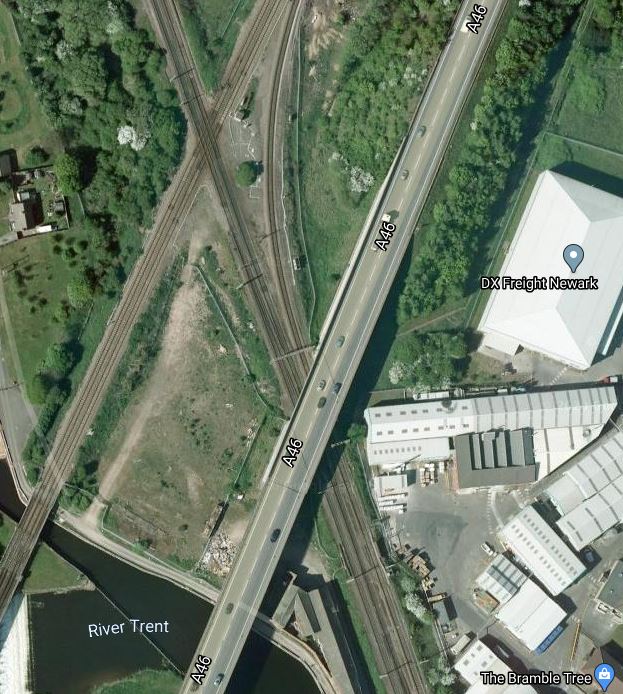
This Google Map shows the crossing.
Note.
- The East Coast Main Line (ECML) running roughly North-South
- The A 46 road crossing the line.
- The Nottingham-Lincoln Line running parallel to the road.
- A chord allowing trains to go between the Nottingham-Lincoln Line and Newark North Gate station, which is to the South.
- The River Trent.
Complicated it certainly is!
I wrote about the problems in The Newark Crossing and felt something radical needed to be done.
Looking at the numbers of trains at the Newark Crossing.
- The number of trains crossing the ECML is typically about three trains per hour (tph) and they block the ECML for about two minutes.
- But then there could be a fast train around every four minutes on the ECML, with eight tph in both directions.
Would a Control Engineer’s solution, where all trains are computer controlled through the junction, be possible?
ERTMS, which is digital in-cab signalling is being installed on the ECML and will allow the following.
- Trains to be able to run at up to 140 mph.
- Trains to be precisely controlled from a central signalling system called ETCS.
ERTMS and ETCS are already working successfully on Thameslink.
Suppose all trains going through the Junction on both the ECML or the Nottingham-Lincoln Line, were running using ERTMS and ETCS.
- Currently, there are three tph crossing from East to West and three tph crossing from West to East. Which means that the junction is blocked six times per hour for say two minutes.
- Suppose the signalling could control the crossing trains, so that an East to West and a West to East train crossed at the same time.
- To cater for contingencies like late and diverted trains, you might allow the trains to cross at up to four tph.
Instead of six tph, the frequency across the junction would be no more than four tph.
A similar paired crossing procedure can be applied to trains on the ECML.
The outcome is that you are scheduling a smaller number of double events, which must be easier.
I suspect there are other tricks they can do to increase capacity.
There’s also the problem of what happens if a crossing train fails, as it goes over the East Coast Main Line. But that must be a problem now!
Whatever happens here will be a well-thought through solution and it will add to the capacity of the East Coast Main Line and increase the line-speed from the current 100 mph.
Will The East Coast Main Line Give High Speed Two A Run For Its Money To The North East Of England?
I have looked up High Speed Two timings on their Journey Time Calculator and compared them with current LNER timetables.
- London-Leeds – Current – 136 minutes – HS2 – 81 minutes
- London-York – Current – 111 minutes – HS2 – 84 minutes
- London – Darlington – Current – 141 minutes – HS2 – 112 minutes
- York- Darlington – Current – 27 minutes – HS2 – 26 minutes
- London – Durham – Current – 170 minutes – HS2 – 138 minutes
- York – Durham – Current – 45 minutes – HS2 – 44 minutes
- London – Newcastle – Current – 170 minutes – HS2 – 137 minutes
- York – Newcastle – Current – 55 minutes – HS2 – 51 minutes
- London – Edinburgh – Current – 259 minutes – HS2 – 220 minutes
- Newcastle – Edinburgh – Current – 83 minutes – HS2 – 83 minutes
- York – Edinburgh – Current – 138 minutes – HS2 – 134 minutes
Note.
- I have assumed that Newcastle and Edinburgh takes 83 minutes, which is the current timing.
- The time savings possible to the North of Leeds are only a few minutes.
- As an example, the straight route between York and Darlington is 34 miles, which means an average speed of only 75 mph.
Serious work needs to be done North of York to improve timings.
Improvements To The East Coast Main Line
Various improvements to the East Coast Main Line are in process of building designed or built.
Extra Tracks
These example of more tracks are from the Wikipedia entry for the East Coast Main Line.
- Four tracks are being restored between Huntington and Woodwalton.
- Freight loops between York and Darlington.
There are probably other places, which will see extra tracks in the next few years.
Power Supply And Electrification
Wikipedia identified places where the power supply and the electrification could be better.
This sentence indicates the comprehensive nature of the planned work.
Power supply upgrades (PSU) between Wood Green and Bawtry (Phase 1 – completed in September 2017) and Bawtry to Edinburgh (Phase 2), including some overhead lines (OLE) support improvements, rewiring of the contact and catenary wires, and headspan to portal conversions (HS2P) which were installed at Conington in January 2018.
The Hertford Loop Line is also due to have some power supply upgrades.
Station Improvements
Darlington, Kings Cross, Stevenage and York will have track improvements, which will improve the capacity of the tracks through the stations.
Werrington Dive Under
The Werrington Dive Under will be a big improvement. This is an extract from the Wikipedia entry.
The project will see the construction of 1.9 miles (3 km) of new line that will run underneath the fast lines, culverting works on Marholm Brook and the movement of the Stamford lines 82 feet (25 m) westwards over the culverted brook. This will mean that trains for the GN/GE line no longer need to cross the fast lines on the level, nor use the Up Fast line between Peterborough station and the junction. The project, coupled with other ECML improvement schemes (such as the four tracking from Huntingdon to Woodwalton) will improve capacity on the line through Peterborough by 33% according to Network Rail. This equates to two extra train paths an hour by 2021, when the work is scheduled to be completed. In turn, this will remove 21 minutes from the fastest King’s Cross to Edinburgh Waverley service, and 13 minutes from the fastest King’s Cross to Leeds service. It will also see an increase of 1,050 ‘intercity’ seats per hour on express trains through Peterborough.
The upgrade will add two more train paths to the route and knock 21 and 13 minutes off the faster Edinburgh and Leeds services respectively.
The Newark Flat Crossing
This is the railway equivalent of a light-controlled pedestrian crossing in the middle of a motorway.
This Google Map shows the crossing.
Note.
- The East Coast Main Line running roughly North-South
- The A 46 road crossing the line.
- The Nottingham-Lincoln Line running parallel to the railway.
- A chord allowing trains to go between the Nottingham-Lincoln Line and Newark North Gate station, which is to the South.
- The River Trent.
Complicated it certainly is!
I wrote about the problems in The Newark Crossing and felt something radical needed to be done.
Looking at the numbers of trains at the Newark Crossing.
- The number of trains crossing the East Coast Main Line, is typically about three to five trains per hour (tph) and they block the East Coast Main Line for about two minutes.
- But then there could be a fast train around every four minutes on the East Coast Main Line, with eight tph in both directions.
The numbers of trains and their speeds would probably cut out a Control Engineer’s solution, where all trains are computer controlled through the junction.
Although, it might be possible to reduce the number of conflicting trains on the East Coast Main Line dramatically, by arranging a Northbound and a Southbound express passed each other at the flat junction.
There’s also the problem of what happens if a crossing train fails, as it goes over the East Coast Main Line. But that must be a problem now!
Whatever happens here will be a well-thought through solution and it will add to the capacity of the East Coast Main Line and increase the line-speed from the current 100 mph.
Level Crossings
Wikipedia says this about level crossings.
Level crossing closures between King’s Cross and Doncaster: As of July 2015 this will no longer be conducted as a single closure of 73 level crossings but will be conducted on a case-by case basis (for example, Abbots Ripton Level Crossing will close as part of the HW4T scheme).
It is my personal view that all should be removed.
ERTMS Signalling
Wikipedia says this about the installation of ERTMS digital in-cab signalling.
The line between London King’s Cross and Bawtry, on the approach to Doncaster, will be signalled with Level 2 ERTMS. The target date for operational ERTMS services is December 2018 with completion in 2020.
Note that, ERTMS is needed for 140 mph running.
140 mpg Running
Wkipedia says this about 140 mph running.
Increasing maximum speeds on the fast lines between Woolmer Green and Dalton-on-Tees up to 140 mph (225 km/h) in conjunction with the introduction of the Intercity Express Programme, level crossing closures, ERTMS fitments, OLE rewiring and the OLE PSU – est. to cost £1.3 billion (2014). This project is referred to as “L2E4” or London to Edinburgh (in) 4 Hours. L2E4 examined the operation of the IEP at 140 mph on the ECML and the sections of track which can be upgraded to permit this, together with the engineering and operational costs.
A rough calculation indicates that up to eleven minutes could be saved by this upgrade, between London and Darlington.
Prospective Timings On The East Coast Main Line
Consider.
- The package of new trains level crossing closures, ERTMS, OLE rewiring and the OLE PSU, which is collectively known as L2E4 should deliver Edinburgh in four hours.
- Nineteen minutes need to be saved on current times.
- I believe that if the train takes four hours or less, travellers will switch from the airlines.
- High Speed Two are aiming for a time of 220 minutes, but is this by the West or East Coast routes?
- As their proposed Glasgow service has a similar time, I assume it is by the West Coast route.
- Wikipedia states that an Open Access Operator was thinking of running Class 390 trains or Pendelinos between London Kings Cross and Edinburgh in 223 minutes.
If the managers of LNER are the least bit ambitious, I can see them wanting to run a service between London and Edinburgh, in a time that is several minutes under four hours.
It should always be remembered that the East Coast Main Line was built for speed, as these true stories illustrate.
- Mallard set the world speed record for steam locomotives in 1938 of 126 mph, on the line.
- The record time between London and Edinburgh was set in 1991 by an InterCity 225 train at a minute under three-and-a-half hours.
I even have my own special memory of the line, which I wrote about in The Thunder of Three-Thousand Three-Hundred Horses. Behind a Deltic or Class 55 locomotive, I went from Darlington to London in two hours and fifteen minutes, which is faster than today’s fastest trains. Not bad for a 1960s design, but the train was a coach short and had a clear run. And was probably extremely-well driven.
Is the East Coast Main Line and especially the section South of Darlington, a route, where a knowledgeable driver can coax the maximum out of a high speed train?
Possible savings over the next few years include.
Werrington Junction
When this is completed, it could knock twenty-one minutes off the timings to Edinburgh.
Newark Crossing
How much time could be saved here?
There must be some time savings if the line speed can be increased from 100 mph.
140 mph Running
The various improvements in L2E4 are intended to enable services to run between London and Edinburgh in under four hours.
- Does L2E4 include any possible time savings from the Werrington Dive Under?
- Does L2E4 include any possible time savings from improvements at Newark?
- What is the completion date for L2E4?
- Most of the time savings for L2E4 will be South of Darlington as the track is straighter.
As I said earlier a rough calculation indicates that L2E4 will save about eleven minutes to the South of Darlington.
Conclusion
There must be over thirty minutes of savings to be accumulated on the East Coast Main Line. Much of it because of the Werrington and Newark improvements will be South of Darlington.
I wouldn’t be surprised to see timings like these.
- London-Leeds – Current – 136 minutes – HS2 – 81 minutes – Possible ECML – 120 minutes
- London-York – Current – 111 minutes – HS2 – 84 minutes – Possible ECML – 90 minutes
- London – Darlington – Current – 141 minutes – HS2 – 112 minutes – Possible ECML – 115 minutes
- London – Durham – Current – 170 minutes – HS2 – 138 minutes – Possible ECML – 130 minutes
- London – Newcastle – Current – 170 minutes – HS2 – 137 minutes – Possible ECML – 130 minutes
- London – Edinburgh – Current – 259 minutes – HS2 – 220 minutes – Possible ECML – 210 minutes
It looks to me, that the East Coast Main Line could be fulfilling the aspirations of British Rail’s engineers of the 1980s.
Improving Services To Lincoln
Lincoln is one of those places, where, companies have promised better train services for years and they’ve never appeared.
The Wikipedia entry for Lincoln station under Future Services reads like a catalogue of broken promises and very little progress.
I think that it is time to think out of the box to provide a better service for the City.
Sorting Out Newark
Newark is an important interchange to get good services to and from Lincoln.
Because of the notorious Newark Flat Crossing, the railways around the town need improving.
Currently there are two fast trains to and between Lincoln and London a day in both directions, an hourly service to Newark and various other random services.
To make matters worse, the change at Newark Northgate station is often fifteen minutes or so.
These pictures were taken as I changed trains at the station for Lincoln on a fine day.
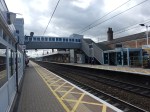
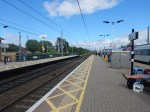
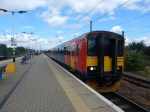
Is an hourly single coach Class 153 train between Lincoln and Newark Northgate an adequate service?
There are other services to Newark Castle station, but the two stations are separated by the notorious flat junction at Newark, which slows services on the East Coast Main Line.
I think in a well-thought out solution, the following will be achieved.
- Trains on the Nottingham to Lincoln Line will pass Newark without inconveniencing trains on the East Coast Main Line, possibly by means of a flyover or a dive-under.
- These trains would ideally call at both Newark stations.
- Hopefully lifts and stairs will make the changebetween the two lines step-free.
I wouldn’t be surprised to see a very unconventional solution to the problem.
Newark Northgate station could be closed and a flyover could take the Nottingham to Lincoln Line over the East Coast Main Line to the North of the town, where a new out-of-town station could be built, which had platforms on all lines and they were connected by lifts. I have called this arrangement A Four-Poster Station in the past.
The new station could also be a transport hub, with lots of car parking.
I changed twice at Newark Northgate today and in both instances I waited nearly fifteen minutes.
So why not just build a simple single-track flyover or dive-under and provide a comfortable electric shuttle bus between Northgate and Castle stations, that meets all trains and does the journey in less time, than the current wait?
Remember that Castle station is closer to the town centre.
It would be a cheaper flyover and the money saved might purchase some bigger new trains.
The service from Nottingham could even be run by tram-trains or like in Zwickau by diesel multiple units, which left the Nottingham to Lincoln Line at Castle station and then went walkabout in Newark.
The only certainty about the sorting of Newark, is that there are innumerable ways to do it and some could be unusual.
I doubt though, that we’ll see much improvement at Newark until after 2020.
The Great Northern And Great Eastern Joint Line
In Project Managers Having Fun In The East, I talked about hoe the Great Northern And Great Eastern Joint Line (GNGE) has been upgraded to be a valuable diversion route for freight trains travelling up and down the East Coast Main Line.
£230million has been spent to create a high-quality railway from Werrington Junction just North of Peterborough to Doncaster via Spalding, Sleaford and Lincoln.
Given the increasing traffic on the East Coast Main Line and the long wait for any relief in the shape of HS2 to Leeds, the North East and Scotland, I think we will see further development of the GNGE.
- I reported in To Dive Or Fly At Werrington, how plans are ongoing to improve the Southern connection of the line to the East Coast Main Line.
- The latest details on Werrington Junction are here on the Network Rail web site and talk about a 2020 completion.
- Could a new Lincoln Avoiding Line be built, so that freight trains avoid going through Lincoln Central station and the level crossings?
- The GNGE has lots of closed stations and some have been reopened in the last few years. Could more be reopened?
All these developments lead me to the conclusion, that there will be improved passenger services on the Peterborough to Doncaster route via Lincoln.
As the GNGE is now a high-class modern route, the single coach Class 153 train will be replaced by something like a two-car Class 158 train or Class 170 train.
The speeds of the three trains are.
- Class 153 – 120 kph
- Class 158 – 140 kph
- Class 170 – 160 mph
As Inter-City 125s are released by the arrival of new Class 800 trains, could we even see shortened versions running between Kings Cross and Yorkshire via Peterborough, Lincoln and Doncaster? These magnificent trains certainly perform well on secondary routes, as anybody, who has ridden in the cab between Edinburgh and Inversion can testify.
I wonder what times a well-driven Class 170 train could achieve. Currently Peterborough to Lincoln takes eighty minutes and Lincoln to Doncaster takes two hours.
I estimate that a Class 170 train could do the journey between Lincoln and Peterborough in about an hour, which is about the fastest time that can be achieved changing at Newark.
An estimate for the time between Lincoln and Doncaster could be about ninety minutes.
All of this speed improvement could probably be obtained without any major infrastructure improvements, but updating Werrington Junction and creating a new Lincoln Avoiding Line would improve things further.
Faster connections to Doncaster and Peterborough would bring various benefits.
- At Doncaster, it would give access to the East Coast Main Line services to the North East and Scotland.
- From 2018, at Doncaster, it would give access to the the improved TransPennine services to Leeds, Liverpool, Manchester and Manchester Airport.
- At Peterborough, it would give access to services to London, East Anglia and the South Midlands.
- From 2018, at Peterborough, there will be a connection to Thameslink, to take passengers all over London and the South East.
Surely these connections will benefit Lincoln most, but a fast service to Peterborough would also do something to improve connectivity at places like Sleaford and Spalding.
I suspect that when the new East Midlands Franchise is announced next year or when suitable trains are procured, we will see significant speed, frequency and comfort improvements on this route.
Reinstating The Complete Great Northern And Great Eastern Joint Line
With the next East Anglian Franchise, it is rumoured that there will be a marked improvement in train services in the region with new and refurbished trains everywhere, running many more services.
One possibility, is that the Bramley Line to Wisbech will be served by passenger trains, as a network of local services are improved and created around Cambridge with expansion and development needs and its soon-to-be-two stations.
I think that the possibility exists that the line between March and Sleaford might be reinstated to give freight trains to and from Felixstowe, direct access to the GNGE to get to Doncaster, avoiding Peterborough and the East Coast Main Line South of Yorkshire.
If you look at Google Maps, then the old rail line is clearly visible for most of the way between March and Sleaford. However, Whitemoor Prison has been build over the route.
If this Southern part of the GNGE were to be reinstated, could we see passenger services between Cambridge and Lincoln?
I think we would, as the engine of growth that is Cambridge, would then be directly connected by train to all the cities and larger towns of East Anglia and Lincolnshire.
I should say, that just as London dominates the South East, I believe that Cambridge with all its skills, ambition and success will dominate the East of England.
Lincoln to Cambridge could be about ninety minutes using a fully developed GNGE, as opposed to two hours now.
Conclusions
I have come to the following occlusions.
- The record of train companies in getting more direct services to Lincoln says a lot and I’d be very surprised if Lincoln sees more direct services to London.
- Newark is a basket case and sorting it will be difficult and probably expensive
- The best bet for improved services is to put faster trains on the upgraded Great Northern And Great Eastern Joint Line between Peterborough and Doncaster, which could mean Peterborough in an hour and Doncaster in ninety minutes from Lincoln.
- The trains for this should be available in 2018.
In the long term, I can see benefits in connecting March and Sleaford.
Ironically, the GNGE was built to bring coal to East Anglia from Yorkshire and it could be used to bring freight between Felixstowe and the North, in an efficient ,manner.
The Victorians seem to have got the route of the GNGE correct.
Just as they did the Varsity Line and the Borders Railway.
 The Anonymous Widower