Odfjell Oceanwind and Source Galileo Norge Forge Floating Offshore Wind Alliance
The title of this post, is the same as that of this article on offshoreWIND.biz.
The first highlighted paragraph outlines the possible deal.
Odfjell Oceanwind and renewable energy developer Source Galileo’s Norwegian branch, Source Galileo Norge, have signed a memorandum of understanding (MoU) to cooperate on developing floating offshore wind farms using Odfjell Oceanwind’s technology.
Note.
- Odfjell is a Norwegian shipping company, with this web site.
- Odfjell Oceanwind has a web site, with a mission statement of We are shaping the future of floating offshore wind power.
- Source Galileo style themselves as a Developer of Large-Scale Renewable Projects on their web site.
These three paragraph outline the cooperation’s plans.
- The cooperation will target wind farms for the electrification of oil and gas installations, the Utsira Nord seabed development, and selected floating wind parks in Europe.
- According to the partners, they also plan to apply for a seabed lease on Utsira Nord where the project, named UtsiraVIND, will use Odfjell Oceanwind’s proprietary solutions for cost-competitive, industrial production of floating offshore wind units.
- Odfjell Oceanwind is developing the Deepsea Semi floating wind foundation design which could be used in floating wind farms and for off-grid applications including temporary electrification of oil and gas installations in harsh environments.
They seem to have large ambitions, but then the money is available to fulfil the ones that work in Norway.
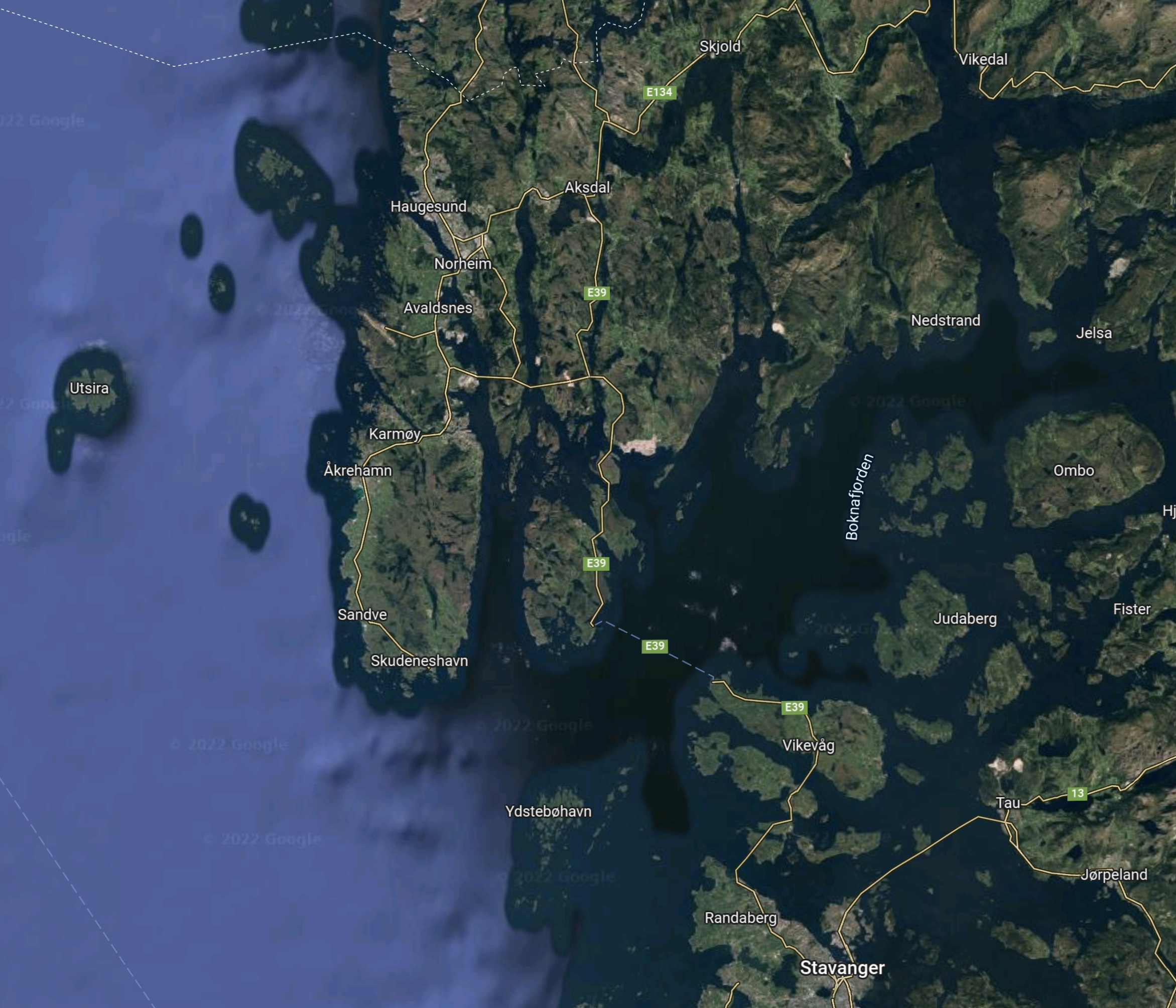
This Google Map shows area of Norway, that includes Utsira, Haugesund and Stavanger.
Note.
- Utsira is the largest island at the West of the map.
- Haugesund is on the coast to the North-East of Utsira.
- Stavanger is the fourth largest city in Norway and is at the bottom of the map.
There would appear to be plenty of space to place floating wind turbines between all the islands and the coast.
These are some other points from the article.
- Odfjell Oceanwind floats appear to be able to handle 15 MW turbines.
- In May, Norway initiated an investment plan to reach 30 GW of offshore capacity by 2040.
- Work has started to prepare Norway for floating offshore wind.
- Norway’s next offshore wind auction is in 2025.
Norway’s going large for wind!
Rishi Sunak To Reimpose Fracking Ban
The title of this post, is the same as that of this article on The Telegraph.
This is the first paragraph.
The new PM made the commitment during his first session of PMQs on Wednesday, reversing Liz Truss’s controversial decision to overturn it.
I think it is the right call.
Here’s why!
Cerulean Winds Massive Decarbonisation Project
Consider.
- At present ten percent of our gas is used to power the oil and gas rigs in the seas around our coasts. The gas is fed into gas-turbines to generate electricity.
- One simple way to increase gas production by this ten percent, would be to decarbonise the rigs by powering them from nearby wind farms with green electricity and green hydrogen as the Norwegians are proposing to do.
- A British company; Cerulean Winds has proposed under the Crown Estate INTOG program to decarbonise a significant part of the oil and gas rigs, by building four 1.5 GW wind farms amongst the rigs.
- The majority of the energy will be sold to the rig owners and any spare electricity and hydrogen will be brought ashore for industrial and domestic users.
- This massive project will be a privately-funded £30 billion project.
- And when the oil and gas is no longer needed, the UK will get another 6 GW of offshore wind.
We need more of this type of engineering boldness.
This page on the Cerulean Winds web site gives more details.
INTOG
This document on the Crown Estate web site outlines INTOG.
Other Projects
Decarbonisation has also attracted the attention of other developers.
I can see Rishi Sunak being offered several projects, that will increase our oil and gas security, by some of the world’s best engineers and most successful oil companies.
Rishi Sunak’s ban on fracking will only increase the rate of project development.
We live in extremely interesting times.
Norwegians Developing Monopile Foundation For 100-Metre Depths
The title of this post, is the same as that of this article on offshoreWIND.biz.
Monopile foundations are a common fixed foundation for offshore wind farms.
The article starts with this paragraph.
Norway’s Entrion Wind and Techano AS have signed a Memorandum of Understanding (MoU) through which Techano AS will join the ongoing development and test project planned to take place in Kristiansand, Norway for the patent-pending fully restrained platform (FRP) offshore wind foundation technology said to extend the operating depth of the monopile technology to up to 100 metres.
It does seem that the Norwegians are intending to take this type of foundation to new heights. Or is it new depths?
A picture in the article shows a tall monopole held in position by three wires securely anchored in the sea-bed. It reminds me slightly of the sort of flag-poles, that we used to build in Scout camps in the 1960s, using Scout staves, ropes and tent pegs.
But seriously in the 1970s, I did the calculations for a company called Balaena Structures, who were trying to develop a reusable oil and gas platform.
- The company had been started by two Engineering professors from Cambridge University.
- The platforms were formed of a long steel cylinder, which would have been built horizontally in the sort of ship-yards, that were used to build supertankers.
- They were to be floated out horizontally and then turned upright.
- Weight and the gumboot principle would have kept them, in place.
The design also included a square platform on the top end. Originally, they were planning to put the platform on top after erection, but I showed that, it would be possible to erect cylinder and platform, by just allowing water to enter the cylinder.
The project had a somewhat unfulfilling end, in that they never sold the idea to an operator and the company closed.
But I still believe something similar has a future in the offshore energy industry.
It could be a foundation for a wind turbine or possibly as I indicated in The Balaena Lives, it could be used to clear up oil field accidents like Deepwater Horizon.
Could This Be A Design For A Hundred Metre Plus Monopole Foundation?
Construction and installation would be as follows.
- A long cylinder is built in a ship-yard, where supertankers are built.
- One end, which will be the sea-bed end after installation, is closed and has a skirt a couple of metres tall.
- The other end is profiled to take the transition piece that is used as a mount for the wind turbine.
- A float would be added to the top end for tow-out. This will help the cylinder to float and erect.
- Water would be added into the cylinder and, if the dimensions are correct, it will turn through ninety degrees and float vertically.
- It would be towed to a dock, where a large crane on the dock would remove the float and install the turbine.
- The turbine and its foundation would then be towed into place and by adding more water lowered to the sea-bed.
- The float would be reused for the next turbine.
Note.
- The float is needed to nudge the cylinder to turn vertically.
- If the Cambridge professors were right, the skirt and the weight of water would hold it in place.
- Traditional moorings could be added if required.
- No heavy lifts are performed at sea.
- The concept would surely work for a floating turbine as well.
But then what do I know?
I was just a twenty-five year old engineer, mathematician and computer programmer, who did a few calculations and a dynamic simulation fifty years ago.
National Grid’s North Sea Link Strengthens Electricity Supply And Repays Its Carbon Cost In Just Six Months
The title of this post, is the same as that of this press release from National Grid.
These are three bullet points from the press release.
- World’s longest subsea electricity cable has been in operation since Oct 2021.
- 5.7 terawatt (TWh) hours of clean power have been shared between GB and Norway, strengthening security of supply for consumers in both countries.
- It has saved 800,000 tonnes of carbon in the first year, paying off its carbon cost after only six months of operation.
This must surely be considered a good start.
These two paragraphs describe the operation in the first year.
During its first year of operation, the link has imported 4.6 TWh of clean electricity – enough to power 1.5 million British homes for a year.
North Sea Link has also exported 1.1 TWh to Norway, demonstrating the vital role that interconnectors play in strengthening energy security and maximising the benefits of clean energy sources for consumers across the UK and Europe.
In The Monster In The Mountains That Could Save Europe’s Winter, I describe what makes the North Sea Link so important.
It gives the UK access to the Norwegian Bank Of Electricity or Ulla-Førre, which is a complex of five hydroelectric power stations and a massive lake in the Norwegian mountains to the East of Stavanger.
- The power stations have a total generating capacity of 2.1 GW.
- Lake Blåsjø is able to hold enough water to generate 7800 GWh of electricity.
- Ulla-Førre can also supply electricity to Germany, through the 1.4 GW NordLink.
If Ulla-Førre has a problem, it is that if Norwegian weather is dry, the filling of Lake Blåsjø could be difficult, which is where the interconnector comes into its own, as excess UK wind power or the 1,185 MW Hartlepool nuclear power station, can be used to send electricity to Norway for storage.
In An Update To Will We Run Out Of Power This Winter?, I predicted we will add the following capacity to our renewable generation in the next three years.
- 2023 – 2925 MW
- 3024 – 3726 MW
- 2025 – 6476 MW
This is a total of 13,127 MW.
As a Control Engineer, I can see the following happening.
- Several of the UK’s gas-fired power stations will be mothballed.
- Some of the UK’s gas-fired power stations will be fitted with advanced control systems so they can supply more precise amounts of electricity.
- Some UK electricity is stored in Ulla-Førre for onward sale to Germany.
- Some UK electricity is stored in Ulla-Førre for withdrawal back to the UK, when needed.
One of Ulla-Førre’s main tasks could be to ensure that no UK electricity is wasted.
Conclusion
With all these wind generated electricity and electricity transfers, the Crown Estate, National Grid and the Treasury should be coining it.
The Germans are already building the 1.4 GW NeuConnect between the Isle of Grain and Wilhelmshaven to import more electricity.
But I do believe that another interconnector will be needed.
CIP Picks Stiesdal Floater For 100MW Scottish Offshore Wind Farm
The title of this post, is the same as that of this article on Offshore Engineering.
These two paragraphs introduce the project.
Copenhagen Infrastructure Partners (CIP) has selected Stiesdal Offshore’s TetraSub floating foundation structure for the 100MW Pentland Floating Offshore Wind Farm project, to be located off the coast of Dounreay, Caithness, Scotland.
The technology has been said to offer a lightweight and cost-effective floating solution, based on factory-made modules which are then assembled domestically in port to form a complete foundation.
Note.
- The TetraSub seems to have been designed for ease of manufacture.
- One if the aims appears to be to build a strong local supply chain.
- The TetraSub was designed with the help of Edinburgh University.
- The TetraSpar Demonstrator is in operation off the coast of Norway.
- This page on Mission Innovation describes the TetraSpar in detail.
- The TetraSpar foundation, owned by Shell, TEPCO RP, RWE, and Stiesdal.
- It can be deployed in water with a depth of up to 200 metres.
- Currently, they carry a 3.6 MW turbine.
- At that size, they’d need 27 or 28 turbines to create a 100 MW wind farm.
The home page of the Pentland Offshore Wind Farm gives more details.
This article on offshoreWIND.biz is entitled CIP And Hexicon To Halve Pentland Floating Wind Project Area.
- The project area has been halved.
- The number of turbines has been reduced from ten to seven.
- Compact turbines will be used.
- The project will be built in two phases, one turbine in 2025 and six in 2026.
- Effectively, the first turbine will help to fund the second phase, which eases cash flow.
The changes show how the wind farm has changed during development due to local pressures and improved technology.
Conclusion
It does seem that the competition is growing in the field of floating wind turbines.
Given the quality of the research and backing for these floats and the fact they now have an order, I wouldn’t be surprised to see this technology be a success.
Carbon-Neutral Concrete Prototype Wins €100k Architecture Prize For UK Scientists
The title of this post, is the same as that of this article on the Architect’s Journal.
Under a picture of two white-coated scientists with their protective boots on concrete samples, the story and their invention is outlined.
A pair of PhD students at Imperial College London have won a global architecture prize for devising a groundbreaking method of creating carbon-neutral concrete
Material scientists Sam Draper and Barney Shanks landed the €100,000 2022 Obel Award with their ‘simple way’ to capture carbon from industrial production processes and create an end product that can eliminate the CO₂ footprint of concrete.
The prototype technology, dubbed Seratech, takes industrial CO₂ emissions directly from flues and produces a carbon-negative cement replacement material (silica). According to the scientists, when this is used in combination with Portland cement, the carbon capture associated with producing the silica means the concrete products can be zero carbon.
One of the products, we will need in the world is concrete and if we can make it in a carbon-neutral manner, then that will surely reduce worldwide carbon emissions.
The Technology Explained
This page on the Seratech website is entitled Our Technology.
It gives this description of the technology.
Seratech has developed a process that consumes olivine and waste CO₂ from flue gases and produces two products which both have significant value in construction.
Silica is produced which can be used as a supplementary cementitious material (SCM) in concrete meaning the amount of Portland cement in the concrete can be reduced by up to 40%. As the silica comes from a process that captures CO₂ it is “carbon negative” and the concrete can become carbon neutral.
Magnesium carbonate is produced that can be used to make a range of zero carbon construction materials and consumer products, including alternatives to building blocks and plasterboard.
The aim is for humanity to be able to continue building robust cities and infrastructure, but without the climate cost of traditional cement mixes and with the Seratech technology this goal is achievable!
Note that olivine in Europe is generally mined in Norway.
Replacement Of Steel By Concrete
Could we also replace steel in some applications with concrete?
In UK Cleantech Consortium Awarded Funding For Energy Storage Technology Integrated With Floating Wind, I talked about some of ground-breaking methods used by a company called RCAM Technologies to create infrastructure using 3D printing of concrete.
If Imperial’s concrete, which is called Seratech can be 3D printed, I can see lots of applications for the technology.
So you could kill two sources of large carbon emissions with one technology.
Conclusion
I have said on this blog before, that we will have to keep or even build more gas-fired power stations, as they can be an efficient source of pure carbon dioxide, that will be needed as a feedstock to create an increasing number of agricultural and building products.
Will Norwegian Pumped Storage Hydro Help Us Through The Winter?
In UK To Norway Sub-Sea Green Power Cable Operational, I discussed the North Sea Link interconnector to Norway.
The North Sea Link is no ordinary interconnector, as it is a lot more than a 1.4 GW cable linking the electricity grids of the UK and Norway.
- At the UK end, there is an increasing amount of wind power. The UK has added 3.5 GW in 2022.
- At the Norway end, there is the 2.1 GW Ulla-Førre hydropower complex.
- The water to generate electricity at Ulla-Førre comes from the artificial Lake Blåsjø, which contains enough water to generate 7.8 TWh of electricity.
- The storage capacity at Ulla-Førre is 857 times greater than that at the UK’s largest pumped storage hydroelectric power station at Dinorwig in North Wales.
- The power complex consists of five power stations and some can also be used as a pump powered by UK electricity to fill Lake Blåsjø with water.
Effectively, the North Sea Link, the Ulla-Førre power complex and Lake Blåsjø are a giant pumped storage hydro battery, that can either be filled by Norwegian precipitation and water flows or by using surplus UK electricity, through the North Sea Link, which opened a year ago.
If the Norwegian precipitation goes on strike, the only way to fill Lake Blåsjø is to use surplus UK power, which I suspect will be British wind and nuclear in the middle of the night!
But then I thought we will be short of electricity this winter.
- I suspect we will be at times, but then at others there will be a surplus.
- So the surplus will be pumped to Norway to top up the reservoir at Lake Blåsjø.
- When we are short of electricity, the Norwegians will turn water back into electricity and send it back through the North Sea Link.
It will be more sophisticated than that, but basically, I believe it provides us with the electricity we need, at the times, when we need it.
I wouldn’t be surprised to be told, that we’ve been squirreling away overnight wind energy to Norway over the last few months.
I have written more about Ulla-Førre in The Monster In The Mountains That Could Save Europe’s Winter.
It includes a video about the building of the complex.
North Seas Countries Commit To 260 GW Of Offshore Wind By 2050
The title of this post, is the same as that of this article on Renewables Now.
This is the first two paragraphs.
The nine member countries of the North Seas Energy Cooperation (NSEC) on Monday committed to at least 260 GW of offshore wind energy by 2050.
The NSEC aims to advance offshore renewables in the North Seas, including the Irish and Celtic Seas, and groups Belgium, Denmark, France, Germany, Ireland, Luxembourg, the Netherlands, Norway, Sweden and the European Commission.
Note.
Intermediate targets are 76 GW by 2030 and 193 GW by 2040.
The UK has a target of 50 GW by 2030, of which 5 GW will be floating offshore wind.
The UK is not mentioned, but has joint projects with the Danes, Germans, Irish, Norwegians, Spanish and Swedes.
There is nothing about energy storage or hydrogen!
On the figures given, I think we’re holding our own. But then we’ve got more sea than anybody else.
Can We Move The Equilibrium Point Of The Energy Market?
Equilibrium In Systems
As a Control Engineer, I believe that most systems eventually end up in a state of equilibrium.
How many football batches have you watched between two evenly-matched teams that have ended, where the statistics are even and the match has ended in a nil-nil draw or a win by one goal.
Now suppose one manager makes an inspired substitution, one important player gets injured or one player gets sent off.
One team will have an advantage, the statistics will no longer be even and one team will probably win.
The equilibrium point will have been shifted.
Zopa’s Stable Peer-to-Peer Lending System
I used Zopa’s peer-to-peer lending system for several years and found it a very stable system, that over the years paid a steady return of between four and five percent before tax.
I even developed a method to maximise my savings income, which I wrote about in The Concept Of Hybrid Banking.
It was a sad day for me, when Zopa closed its ground-breaking peer-to-peer lending system.
As a Control Engineer, I believe that Zopa’s strength was a well-written computerised algorithm, that matched lenders and borrowers and spread the risk.
- There was no bias in the system, introduced by personal prejudices.
- The algorithm was agnostic and judged all borrowers on their profiles and credit ratings alone.
- Money was allocated under fair rules for borrowers.
- I never borrowed from Zopa, but from my experience of owning half of a finance company, their terms were the most customer-friendly I’ve ever seen.
Someone will go back to the basics of peer-to-peer lending and it can’t be soon enough for both savers and borrowers.
Zopa In Troubled Times
Over the years that I invested in Zopa, my returns stayed very much the same, as the algorithm seemed to be able to maintain sufficient difference between lenders’ returns and borrowers’ rates. I also suspect the dynamics of savvy lenders and borrowers helped to stabilise both the system and the difference between rates.
It even worked through the Banking Crisis of 2008 and other mini-hiccups along the way.
My Conclusion About Zopa
As someone, who knows computing well, I would rate Zopa, one of the best computer systems, I’ve ever seen.
But it showed how a large transactional system can work well.
One of the keys to its success and smooth operation was that the computer was totally in control and it took all transaction decisions without direct human intervention.
The Energy Market
The energy market is a network of energy providers and users.
It is controlled by complicated rules and it has settled into an equilibrium, which involves.
- Importation of energy, which I suspect is not at a low price
- Some high priced energy generators, based on gas, which has a high-price, due to Putin’s war.
- Waste of wind energy due to lack of energy storage.
- The intermittency of renewable sources.
- A lack of gas storage, means that we probably get the wrong end of fluctuations in the gas price.
This results in a high price to consumers.
Can We Move The Equilibrium Point Of The Energy Market?
And we also need to move it quickly to a more favourable place, which benefits everybody!
As a Control Engineer, I believe that there are five ways to move the equilibrium point.
- Stop Putin’s war.
- Increase gas storage.
- Generate more low-cost electricity.
- Increase electricity storage.
- Improve the control algorithm.
I will now look at each in more detail.
Stopping Putin’s War
Giving in to Putin’s ambitions, would be an easy way to solve our energy crisis. But at what cost?
My parents generation, watched as Nazi Germany took over Austria and Czechoslovakia, whilst the world did nothing.
- We mustn’t repeat that mistake.
- We must not flinch in our support of the Ukraine.
- We must be ready to support Moldova, Finland and the Baltic States if Putin expands his ambitions.
I do wonder, if Boris will turn up with Churchillian-style anti-Putin rhetoric all over Eastern Europe.
Increasing Gas Storage
The major gas storage facility is Rough, which is handily close to the Easington gas terminal.
The facility needs maintenance and this paragraph from the Wikipedia entry gives the current status.
In May 2022, the Secretary of State for Business, Energy and Industrial Strategy, Kwasi Kwarteng, began talks with the site’s owners with a view to reopening the site to help ease the ongoing cost-of-living crisis in the United Kingdom. In June 2022, owners Centrica submitted an application to the North Sea Transition Authority (NSTA), the licencing authority for the UK Government, to reopen the facility. Approval was granted in July. Subsequently, Centrica indicated that they are working hard to restore storage operations at Rough which would depend on securing subsidies from the British government. Centrica was aiming to have some capacity available for the winter of 2022/23 against an overall plan to increase storage capacity gradually over time.
Note.
- Rough can store around 2832 million cubic metres of gas.
- This article on Energy Live News is entitled Reopening Of Rough Storage Gets The All-Clear.
Less well-known is SSE and Equinor’s Aldborough Gas Storage.
These three paragraphs from SSE web site, describe the gas storage.
The Aldbrough Gas Storage facility, in East Yorkshire, officially opened in June 2011. The last of the nine caverns entered commercial operation in November 2012.
The facility, which is a joint venture between SSE Thermal (66%) and Equinor, has the capacity to store around 330 million cubic metres (mcm) of gas.
SSE Thermal and Equinor have consent to increase the storage capacity at the Aldbrough site (Aldbrough Phase 2) and during the last couple of years have been working to involve the local community where appropriate to refine aspects of this project, which has not been progressed to date due to market conditions.
Future plans for the facility, may include converting it to one of the world’s largest hydrogen stores.
In the grand scheme of things, Rough and Aldborough, when you consider that the UK uses 211 million cubic metres of gas every day, will only keep us going for a few days.
But it should be noted, that the Easington gas terminal is connected to the Norwegian gas fields, by the Langeled pipeline.
So Yorkshire and Humberside will be alright.
Generating More Low-Cost Electricity
The only low-cost electricity of any size to come on stream will be wind-power.
This article on Renewables Now is entitled UK Hits 25.5 GW Of Wind Power Capacity.
These wind farms seem to be coming on stream soon or have been commissioned recently.
- Dogger Bank A – 1200 MW – Commissioning 2023 expected
- Dogger Bank B – 1200 MW – Commissioning 2024/25 expected
- Dogger Bank C – 1200 MW – Commissioning 2024/25 expected
- Hornsea Two – 1386 MW – Commissioned 2022
- Moray East – 950 MW – Commissioning 2022 expected
- Neart Na Gaoithe – 450 MW – Commissioning 2024 expected
- Seagreen – 1075 MW – Commissioning 2023 expected
- Triton Knoll – 857 MW – Commissioning 2022 expected
That is expected to be over 5 GW of offshore wind by the end of 2023.
In case there is some double counting, I’ll only say that wind power capacity could be near to 30 GW by December 2023, with perhaps another 3 GW by December 2024.
Other large wind farms in the future include.
- Berwick Bank – 4100 MW – Commissioning 2028 expected
- East Anglia Two – 900 MW – Commissioning 2026 expected
- East Anglia Three – 1400 MW – Commissioning 2027 expected
- Inch Cape Phase 1 – 1080 MW – Commissioning 2027 expected
- Hornsea Three – 2800 MW – Commissioning 2027 expected
- Moray West – 294 MW – Commissioning 2027 expected
- Morgan and Mona – 3000 MW – Commissioning for 2028 expected
- Morven – 2900 MW – Commissioning for 2028 expected
- Norfolk Boreas – 1400 MW – Commissioning 2027 expected
- Norfolk Vanguard – 1400 MW – Construction start planned for 2023
- Sofia – 1400 MW – Commissioning 2026 expected
That is over 14 GW of wind power.
I should also take note of solar and onshore wind power detailed in this document from the Department of Business, Industry and Industrial Strategy that lists all the Contracts for Difference Allocation Round 4 results for the supply of zero-carbon electricity.
It gives these figures and dates.
- Solar – 251 MW – Commissioning 2023/24 expected
- Solar – 1958 MW – Commissioning 2024/25 expected
- Onshore Wind – 888 MW – Commissioning 2024/25 expected
I can now build a yearly table of renewables likely to be commissioned in each year.
- 2022 – 3193 MW
- 2023 – 2275 MW
- 2024 – 701 MW
- 2025 – 5246 MW
- 2026 – 2300 MW
- 2027 – 6974 MW
- 2028 – 11400 MW
Note.
- Where a double date has been given, I’m taking the latter date.
- I have assumed that Norfolk Vanguard will be commissioned in 2028.
- I have ignored Hinckley Point C, which should add 3.26 GW in mid-2027.
- I have only taken into account one of the Scotwind wind farms in Scotland, some of which could be commissioned by 2028.
- I have assumed that BP’s Mona, Morgan and Morven will all be commissioned by 2028.
This is a total of 32 GW or an average of nearly 5 GW per year.
Increasing Electricity Storage
Big schemes like the 1.5 GW/ 30 GWh Coire Glas and 600 MW Cruachan 2 will help, but with 32 GW of renewable energy to be installed before 2028 and energy prices rocketing, we need substantial energy storage in the next couple of years.
One feasible plan that has been put forward is that of Highview Power’s CEO; Rupert Pearce,, that I wrote about in Highview Power’s Plan To Add Energy Storage To The UK Power Network.
The plan is to build twenty of Highview Power’s CRYOBatteries around the country.
- Each CRYOBattery will be able to store 30 GWh.
- Each CRYOBattery will be one of the largest batteries in the world.
- They will have three times the storage of the pumped storage hydroelectric power station at Dinorwig.
- They will be able to supply 2.5 GW for twelve hours, which is more output than Sizewell B nuclear power station.
Note.
- The first 30 GWh CRYOBattery is planned to be operational by late 2024.
- 600 GWh distributed around the country would probably be sufficient.
I believe that as these batteries are made from standard proven components, they could be built fairly quickly.
Paying For The Energy Storage
This press release from Highview Power is entitled New Analysis Reveals Extent Of UK Renewable Energy Waste, which makes these three bullet points.
- Enough renewable energy to power 500,000 homes a day wasted since the energy crisis began.
- 8 out of 10 Britons want more investment in boosting Britain’s energy resilience.
- UK spent £390 million turning off wind farms and using gas since September 2021.
Note.
- As the press release was published in July 2022, was the £390 million for ten months.
- Will this level of spend continue, as we’re not creating any electricity storage or building any factories that will start in a year or so, that will need large amounts of electricity?
- The Germans are at least building the NeuConnect interconnector between the Isle of Grain and Wilhelmshaven.
- As we’re adding up to 5 GW per year to our renewable energy systems, this problem will surely get worse and we’ll spend more money switching off wind turbines.
We have the money to build a very large amount of energy storage.
Improving The Control Algorithm
A better control algorithm would always help and politicians should only be allowed to set objectives.
Conclusion
There is a chance we’ll have an oversupply of electricity, but this will have effects in the UK.
- Gas-fired power-stations will be retired from front-line service to produce electricity.
- Some will question the need for nuclear power.
- Gas may even be used selectively to provide carbon dioxide for agricultural, scientific and industrial processes.
- Industries that need a lot of electricity may build factories in the UK.
- We will have a large supply of green hydrogen.
But it should bring the price of electricity down.
New Proton Ceramic Reactor Stack For Highly Efficient Hydrogen Production And Carbon Capture In A Single Step
The title of this post, is the same as that of this article on Green Car Congress.
This is the opening paragraph.
A team of researchers from CoorsTek Membrane Sciences and SINTEF in Norway, and Universitat Politècnica de València in Spain, has demonstrated a 36-cell well-balanced proton ceramic reactor stack enabled by a new interconnect that achieves complete conversion of methane with more than 99% recovery to pressurized hydrogen, leaving a concentrated stream of carbon dioxide. The team has also demonstrated that the process can be scaled up for commercial application.
A paper has been published in the journal; Science.
I find this concept interesting for a number of reasons.
- I’ve believed for some time, that applications, that need a good supply of pure carbon dioxide will be developed. One obvious use is feeding it to plants in large greenhouses, so we can have our CO2 and eat it!
- 99 % is a very high efficiency.
- Ammonia, natural gas or biogas can be used as a feedstock.
Coors were an Artemis user for project management and I had an enjoyable few days Golden, Colorado and at the Coors brewery, sometime in the 1980s.
- It was then that I first heard of CoorsTek, who used to make ceramics for the US defence industry.
- In those days, the beer was made to German brewing rules and was unpasteurised.
- The beer had to be delivered to customers within a certain time, so long distance deliveries used trains.
- Coors Brewing Company has since merged with Molson, but CoorsTek appears to be still owned by the Coors family.
- I had taken a few small bottles of Adnams Broadside with me and one of their managers analysed one before drinking the rest of the bottle. He informed me that it was a felony to be in possession of such a strong beer in Colorado.
Coors were and probably still are in some ways not your average brewing company.
Coors News Item On Proton Ceramic Membranes For Hydrogen Production
This page on the CoorsTek web site, which is entitled Proton Ceramic Membranes For Hydrogen Production Published In ‘Science’, gives more details.
Conclusion
This technology could be massive.
 The Anonymous Widower