My Past Is Worrying Me!
It must have been in the early 1970s, when I was acting as a mathematical-modelling consultant.
I was asked to do some modelling by a major drug company of the propagation of a virus through the UK population.
Their aim was to show how serious these pandemics could be and they wanted to get substantial grants from the Government to fund various lines of research.
With their data and the model I built, we were able to show how a dangerous pandemic could evolve.
But I never found out how successful they were in obtaining the money needed to start the research!
It does look like this pandemic could be the one that researchers at the company were predicting nearly fifty years ago.
Rail Research At Birmingham University
In Issue 898 of Rail Magazine, there is an article entitled Full Steam Ahead, which discusses the the work at the Birmingham Centre for Railway Research an Education (BCRRE).
Amongst many subjects three are mentioned where I have a big interest.
Aerodynamics
The article says this.
Aerodynamics is also an important area for research, as any reduction in drag and air resistance due to structures will improve the energy efficiency of rail vehicles.
I very much agree with this approach.
I also feel that due to their low noise profiles as they pass by, that Bombardier have applied aerodynamic knowledge, perhaps from their aircraft engineers, to the design of the new Aventra.
Hydrogen Supplies For Hydrogen-Powered Trains
The article says this.
Funding has also been secured from Innovate UK to create a company that can provide the necessary infrastructure needed to support hydrogen trains, including fuelling stations and hydrogen generation facilities.
This sounds very similar to the systems that ITM Power ae deploying for Shell to fuel hydrogen buses, cars and other vehicles.
I hope that there is not too much duplication going on.
Working With Michigan State University And Stadler To Bring Hydrogen Trains To California
Co-operation is always good and especially in rail projects, where the number of trains involved is fairly small.
A Quote From Dr. Stuart Hillmansen of BCRRE
This quote is in the article.
Is is possible to completely decarbonise, by using electrolysis that is powered using renewable energy to create the fuel.
I completely agree with that!
Conclusion
I would hope that the BCRRE develops into a one step shop for the solution of rail related problems.
It does seem that by putting various areas of expertise together, they could be a go-to institution for those that want to built a hydrogen-powered rail service.
Why Are Liverpool Good At Transfers?
This question was asked on BBC Radio 5, about Liverpool Football Club.
As an alumni, I raise money for cancer research at Liverpool University.
I get the impression, the University has no problem getting the best researchers to come to the Second City of England!
Everybody in the World has heard of Liverpool!
AI ‘Outperforms’ Doctors Diagnosing Breast Cancer
The title of this post is the same as that of this article on the BBC.
This is the first two paragraphs.
Artificial intelligence is more accurate than doctors in diagnosing breast cancer from mammograms, a study in the journal Nature suggests.
An international team, including researchers from Google Health and Imperial College London, designed and trained a computer model on X-ray images from nearly 29,000 women.
I have rarely worked with healthcare data, so I can’t comment on the accuracy of this trial.
However, over fifty years ago, I was able to make a lot of progress in the analysis of mass spectrometry data, by observing operators and asking how they identified various chemicals in the scan from the mass spectrometer.
I wouldn’t be surprised to find some detailed observation of the working methods of radiologists, formed the foundation data for this research.
The research seems to have done it well, judging by the published results.
Should we trust ourselves to methods like this in healthcare?
Undoubtedly! Yes!
Many systems like this are starting to be used in the maintenance of complex entities, as diverse as trains, planes, chemical works and advanced automated distribution depots.
But every fault, is always tested by a trained person.
This is a paragraph from the BBC article.
Prof Ara Darzi, report co-author and director of the Cancer Research UK (CRUK) Imperial Centre, told the BBC: “This went far beyond my expectations. It will have a significant impact on improving the quality of reporting, and also free up radiologists to do even more important things.”
I very much feel we will see very much more of this automated testing of the human body! And not just for cancer!
I already know of groups working on automatic diagnosis of arthritis!
MSU Research Leads To North America’s First Commercial Hydrogen-Powered Train
The title of this post, is the same as that of this article in Railway Age.
This is the introductory paragraph.
Research from Michigan State University’s Center for Railway Research and Education (CRRE) contributed to the San Bernardino County Transportation Authority’s (SBCTA) decision to order the first commercial hydrogen-powered train for use in North America.
These statements were also made.
- The research was conducted in partnership with the Birmingham CRRE and Mott MacDonald.
- Funding was from the California State Transportation Agency (CalSTA).
- The trains will be built by Stadler, probably in their US factory.
There is also a picture of the hydrogen-powered Flirt in the article, and it is very similar in formation to a Class 755 train, with a PowerPack in the middle.
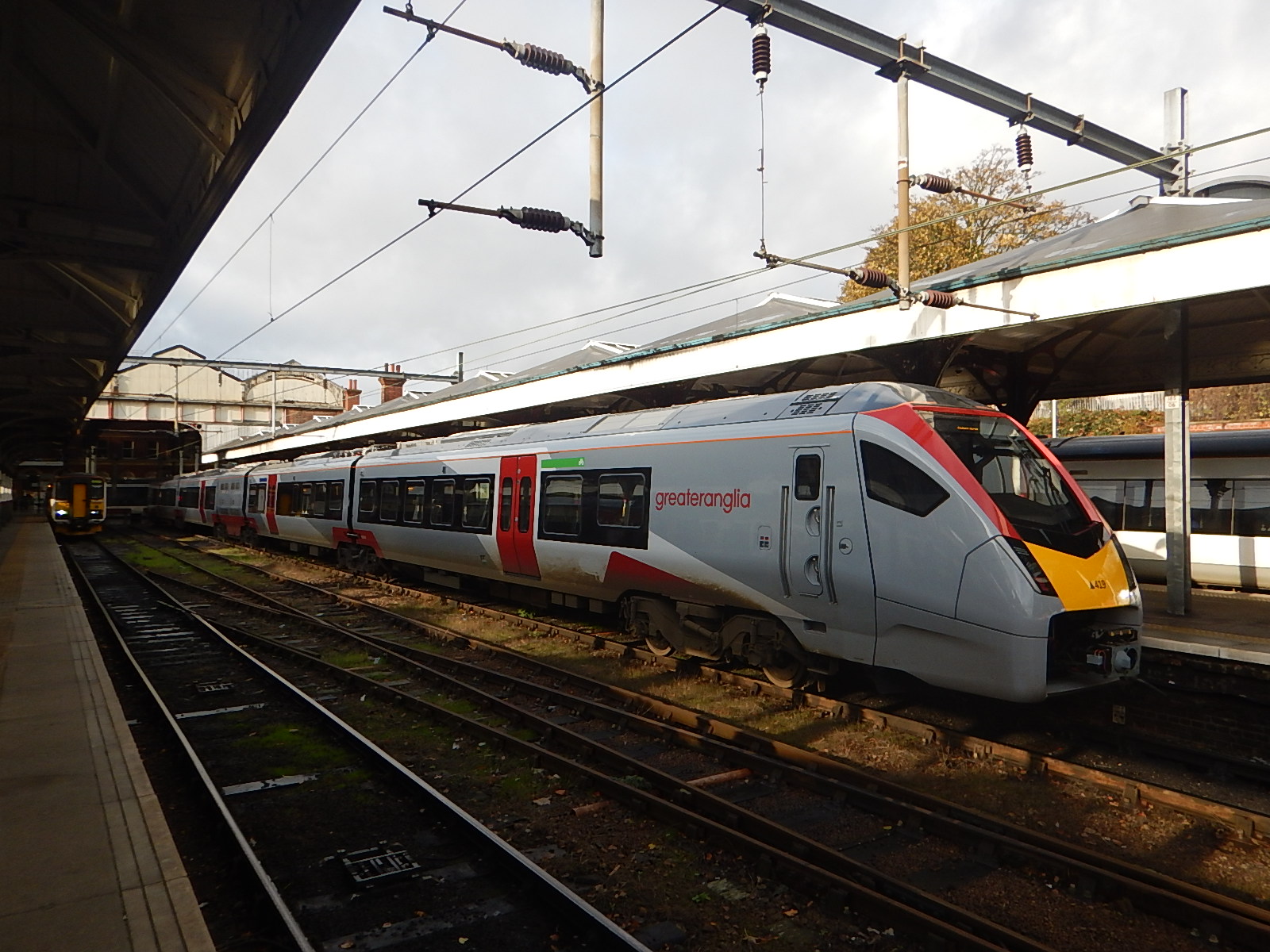
The picture shows a Class 755 train at Norwich station.
The article indicates that hydrogen-power was chosen, as the rail line may be extended by sixty miles to Los Angeles.
Conclusion
After reading the full article, it certainly looks like San Bernardino County Transportation Authority have planned their new railway in a very professional way.
Home-Made Cabbage Soups Could Help Combat Malaria
The title of this post is the same as that of this article in The Times.
The article comes from this page on the Imperial College web site, which is entitled Scientists And Schoolkids Find Family Soups Have Antimalarial Properties.
This is the introduction.
London schoolchildren have found that some of their families’ soup recipes have antimalarial properties, with the help of Imperial scientists.
Researchers from Imperial College London helped the schoolchildren test their family soup broths for activity against the malaria parasite.
There is also this quote from one of the researchers; Professor Jake Baum.
We may have to look beyond the chemistry shelf for new drugs, and natural remedies shouldn’t be off our watch list, as artemisinin shows.
I also wonder, if natural remedies of this type, which are generally administered by a trusted relative or friend, come with a degree of care and concern, that is often lacking in healthcare.
We should also remember, that aspirin is not a modern drug, but was known to the ancient Egyptians.
New Rail Testing Scheme Launched For Small Businesses
The title of this post is the same as that of this article on Rail Technology Magazine.
This is the first two paragraphs.
Businesses in the West Midlands are being offered subsidised access to test and trial facilities as a way to boost railway innovation.
The University of Birmingham has joined forces with Quinton Rail Technology Centre (QRTC) to offer access to the UK’s only privately owned and independent outdoor rail testing and trialling site.
There would appear to be one major condition, companies must be signed up to the DIGI-RAIL program at the Uiversity of Birmingham.
I think this concept is an excellent idea, as often finding a way to test a new product, is the most difficult part of the development process.
But why restrict the process to rail developments?
I have had friends in Cambridge, who have been involved in medical developments.
Finding a route to test their product, often means finding an overseas partner, as much of the NHS and its research partners almost have a policy to exclude, ideas that they didn’t think of.
As someone, who helped fund the successful development of a metered-dose inhaler for asthma drugs, I can honestly say, we would have been greatly helped by a far-sighted agency attached to a reputable University.
University Of Birmingham Leases HST For Alternative Fuel Tests
The title of this post is the same as that of this article on Rail Magazine.
This is the first paragraph.
A High Speed Train is being leased by the University of Birmingham to help analyse and test what alternative fuel could be used to power long-distance passenger or freight trains.
It will be interesting to see what results from the research.
A few of my thoughts.
Suitability Of A HST For Research
It must be suitable for research purposes, otherwise the University wouldn’t have obtained the train.
If you look at the Birmingham Centre for Railway Research and Education web site, they list the Research Areas.
- Railway Control and Operations Simulation
- Data Integration and Cybersecurity
- Condition Monitoring and Sensing
- Centre of Excellence in Digital Systems
- Power Systems and Energy Use
- Aerodynamics
- Climate Change and Weather Impact
There must be a lot of scope for the use of a real train, especially one which has a lot of free space in the engine, where test equipment can be mounted.
Porterbrook’s Interest
I can think of several reasons, why Porterbrook might need to partner with the Research Centre, for sound commercial reasons.
Most will probably seem small in the eyes of the general public, but might be based on Porterbrook’s feedback from customers about their extensive fleet.
Understanding The HST’s Success
The HST or InterCity 125 has been an undoubted success with passengers, drivers, staff and train companies for forty years and understanding the reasons could be invaluable in improving rail transport in the future.
Education
I suspect too that the train will be used to educate students, especially those, who want to work in train or railway design.
When I left Liverpool University with my Control Engineering degree in 1968, I was one of the few, who’d worked on bg heavy machinery in a factory environment.
These days, with Heath and Safety rules much tighter, I doubt, today’s students can gewt the same experience.
Conclusion
I do hope that Porterbrook and the Research Centre, when they look back in a few years, feel that this venture has been a success.
RTRI Tests Fuel Cell Multiple Unit
The title of this post is the same as that of this article on Railway Gazette.
This is the first two paragraphs.
JAPAN: Railway Technical Research Institute has started test running with a prototype multiple-unit which can work as a conventional or battery EMU or using a fuel cell powerpack.
Converted from an older 1·5 kV DC EMU, the test train comprises a 34 tonne motor car and 29 tonne trailer vehicle. Each car is 19 760 mm long and 2 950 mm wide. It is able to operate as a conventional EMU when running under overhead catenary, or as a battery unit off-wire, with or without the fuel cell in use to trickle-charge the batteries.
These are my thoughts.
The Hydrogen Fuel Cells.
The article says this about the hydrogen fuel cells.
Two polymer electrolyte fuel cells are contained in an underfloor module 2 600 mm long, 2 655 mm wide and 720 mm high, which weighs 1·9 tonnes.
The fuel cells are stated to have a rating of 90 kW at 200 to 350 V.
To get a handle on how powerful the hydrogen fuel cells are, these are some characteristics of a British Rail Class 456 train.
- It is a two-car electric multiple unit.
- It weighs 72.5 tonnes.
- It has an operating speed of 75 mph.
- It is a 750 VDC train.
- It has a power output of 373 kW
I wouldn’t think that the two trains are that far apart in performance and capacity.
The Japanese train has a total power output from the fuel cells of 180 kW, but it can also use power from the battery.
I wouldn’t be surprised to find out that the Japanese fuel cell and battery combination was powerful enough to power the British train.
I also think, they would fit underneath a typical British train like the Class 456 train, which has a width of 2800 mm.
The Hydrogen Tanks
The article says this about the hydrogen tanks and the range.
Hydrogen is stored in four high pressure cylinders at 35 MPa, with a capacity of 180 litres, giving a range of 72 km.
The mass of the hydrogen in the tank according to this calculator on the Internet is around 4.3 Kg.
In How Much Energy Can Extracted From a Kilogram Of Hydrogen?, I showed that a typical fuel cell can produce 16 kWh from a kilogram of hydrogen.
So the hydrogen tank can be considered a battery holding 4.3 * 16 = 68.8 kWh.
That doesn’t sound much, so perhaps the capacity figure is for a single tank. In that case the total for the train would be 275.2 kWh, which seems more in line with the battery size of Vivarail’s two-car battery prototype, which has 424 kWh.
Each tank would be something like 2500 mm long and 300 mm in diameter, if they were cylindrical. Double the diameter to 600 mm and the capacity would be over 700 litres.
The Battery
The article says the train has a 540 kW battery, which I think could be a misprint, as it would more likely be 540 kWh.
Performance
The article says this about the performance.
The four 95 kW traction motors provide a maximum acceleration of 0·7 m/s2, and an electric braking rate of 0·86 m/s2
It also says that the range is 72 km.
My observations on the performance and traction system are.
- The traction power of the two-car Japanese train at 380 kW is very similar to the 373 kW of the similar-sized British Class 456 train
- The acceleration rate is very typical of an electric multiple unit.
- Braking is regenerative and used to charge the batteries. As it should!
This leads me to conclude, that this is a train, that could run a short public service, just as the Class 379 BEMU demonstrator did in 2015.
Thoughts About Range
The range is quoted at 72 kilometres (forty five miles.) This figure is unusual in that it is very precise, so perhaps it’s the Japanese way to give an exact figure, whereas we might say around or over seventy kilometres.
Applying my trusty formula of three kWh per vehicle-mile for cruising gives a energy requirement of 270 kWh for the full range, which is close to the four-tank energy capacity of 275.2 kWh.
Comparison With Alstom’s Breeze
Alstom are building a hydsrogen-powered version of a Class 321 train, which they have named Breeze.
Like the Japanese train, this is a effectively two-car train with respect to capacity as large hydrogen tanks to give a thousand kilometre range are installed.
So do the developers of both trains feel that a hydrogen-powered train to replace two- and three-car diesel multiple units is the highest priority?
Conclusion
If nothing else, it seems the Japanese have designed a two-car electric multiple unit, that has the following characteristics.
- Practical size of two-cars.
- Most equipment underneath the train.
- Useful range.
- Acceleration and braking in line with modern units.
- Regenerative braking.
- Ability to work on overhead, battery and hydrogen power.
I am led to the conclusion, that once their research is finished, the Japanese could design a very practical hydrogen-powered train for production in the required numbers.
How To Go Mining In A Museum
This article on Active Investors is entitled Government Backing Lined Up For Cornish Lithium As It Partners With Wardell Armstrong And The Natural History Museum To Advance UK Battery Capabilities.
These are the first few paragraphs.
Cornish Lithium is now moving in some pretty august circles in its quest to put the UK on the lithium map.
Lithium is essential in the manufacture of batteries for electric vehicles.
“It’s been a huge voyage of discovery,” says Jeremy Wrathall.
“An absolutely amazing journey.”
In the past year the company he created, Cornish Lithium, has been transforming rapidly from a concept conjured up from the pages of old documents hidden in half-forgotten library vaults into a well-funded exploration vehicle with 10 geologists and some serious-minded partners providing additional funding and know-how.
The article goes on to give the full story of lithium in Cornwall and how by looking at old documents in the museum’s archives, Jeremy Wrathall may have found where to mine for the valuable mineral.
Now his company; Cornish Lithium, who are partnered with Wardell Armstrong, who describe themselves on their web site as.
An Engineering, Environmental and Mining consultancy with over 180 years of international service and experience.
And the Natural History Museum, who need no introduction.
They have been backed by £500,000 from the Government’s Faraday Battery Challenge fund.
It is a must-read tale, that I hope, very much has a successful conclusion.
 The Anonymous Widower