The title of this post, is the same as that of this article on offshoreWIND.biz.
This is the sub-heading.
BW Ideol has signed the final grant agreement for up to EUR 74 million from the EU Innovation Fund for a factory in Fos-sur-Mer, France, that will produce concrete floating wind foundations. The factory, dubbed Fos3F, has also secured up to EUR 52 million from the French State.
These three paragraphs add more detail.
The final agreement for the EU Innovation Fund grant was signed on 19 March, after BW Ideol revealed in November 2025 that the Fos3F was selected for up to EUR 74 million in funding by the European Commission.
The French government awarded support for the project at the end of 2025 through the C3IV tax credit scheme, dedicated to supporting leading French companies in the Green Industry. The funding from the French State will cover up to EUR 52 million to partially fund development and capital expenditures.
According to BW Ideol, if built, the Fos3F will be a first-of-its-kind factory dedicated to the serial production of concrete floating wind foundations based on the company’s patented Damping Pool.
The factory is stated to have a capacity of thirty foundations per year.
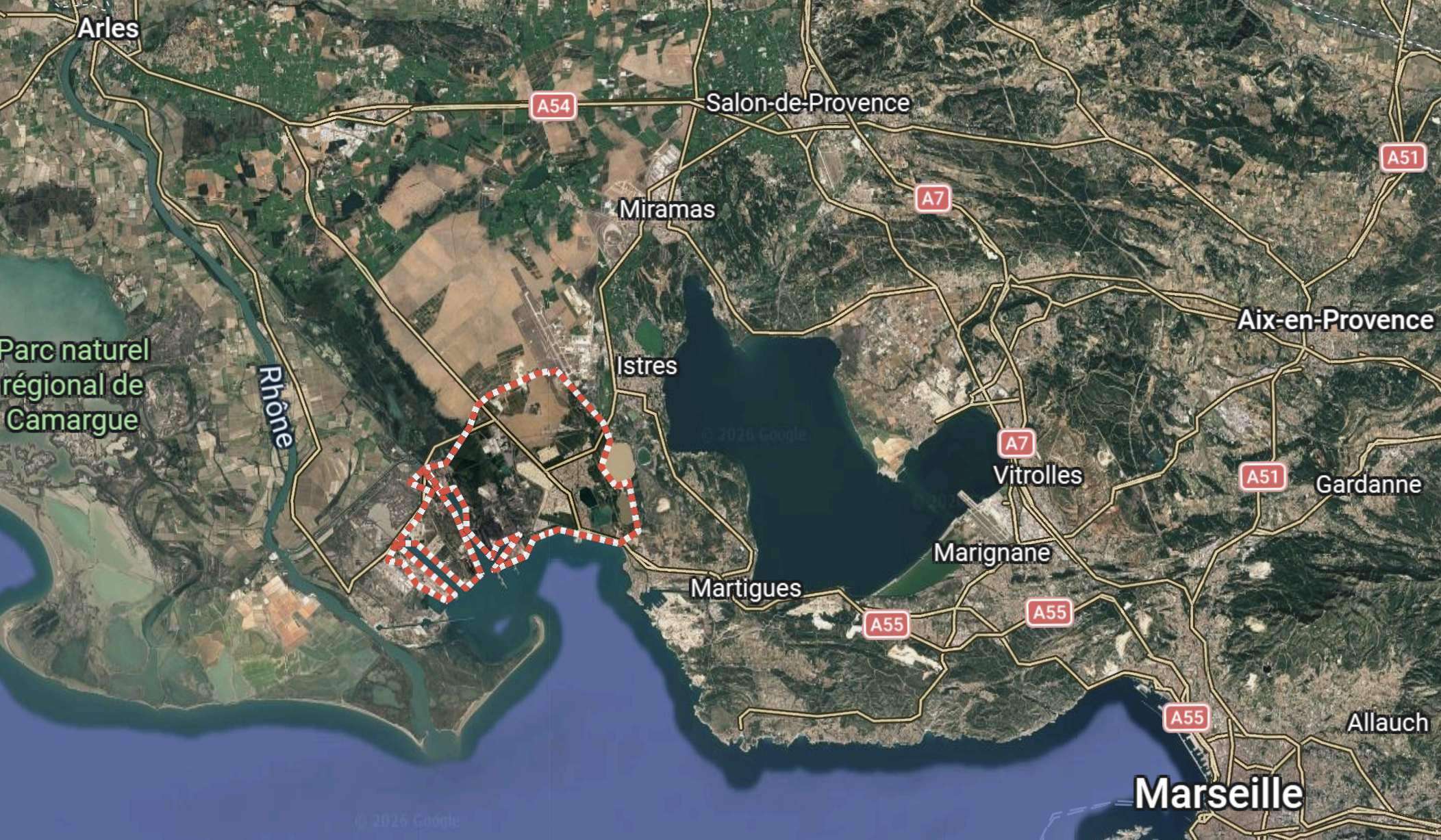
This Google Map shows the location of Fos-sur-Mer.
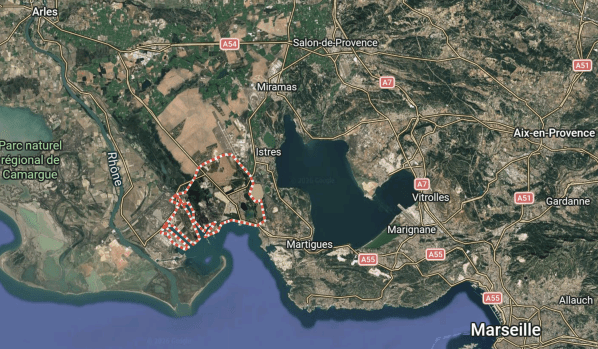
Note.
- Arles is in the North-West corner.
- Marseille is in the South-East corner.
- The mouth of the Rhône River is in between.
- Fos-sur-Mer is outlined by the red-and-white border.
Google AI says there is significant steel making at the mouth of the Rhône River.
I also asked Google AI, “What turbines will BW Ideol floating foundations support? and received this reply.
BW Ideol’s floating foundations are designed to be universal, supporting all major 15 MW+ offshore wind turbines currently on the market, with scalability to future 20 MW+ platforms. Their concrete barge-type technology—using the Damping Pool® design—is compatible with both existing and next-generation turbine manufacturers.
Key Compatibility Details:
15 MW+ and 20 MW+ Turbines: The foundations are engineered for current large-scale turbines (15 MW+) and are ready to accommodate upcoming 20 MW+ turbines, with designs already certified by DNV.
Proven Technology: The technology has been in operation since 2018 at the Floatgen site in France (using a Vestas V80 2 MW turbine) and in Japan, covering both shallow and deep-water applications.
Universal Application: The design is tailored for diverse metocean conditions and is designed to support the commercial deployment of large turbines in projects like the Buchan Offshore Wind project in Scotland.
Production Scalability: The concrete floating platforms are designed for mass production, capable of being manufactured quickly in a factory setting, such as the proposed Fos-sur-Mer site, to meet the schedules of major developers.
These foundations have received Design Certification from DNV, confirming their suitability for large-scale, commercial floating wind farms.
My Thoughts:
Concrete v. Steel: I used to work with someone, who was a big advocate of concrete yachts. Also check out the Wikipedia entry for the Troll A platform, which is a concrete Norwegian gas platform.
Zero-Carbon: I wouldn’t be surprised if concrete manufacture emits less carbon, than steel.
Port Talbot: Will BW Ideol build a similar factory at Port Talbot? I wrote about the Port Talbot factory in Port Talbot To Become Offshore Wind Hub For Celtic Sea. Both sites are next to a large bay, which would be ideal for parking completed floats and a world-class steelworks.
Buchan: Buchan’s web site says it will use seventy BW Ideol floats and generate I GW, 75 km. to the North-East of Fraserburgh. Google AI said the floats will be built at the Port of Ardersier.
Will A Mini-Steel Mill Be Built At The Port Of Ardersier?
I asked Google AI, the question in the title of this section and received this reply.
Yes, a £300 million green steel mill is planned for the Ardersier Port redevelopment as part of its transformation into a circular Energy Transition Facility. This facility aims to process scrap steel from decommissioned oil rigs into new materials to support offshore wind developments, alongside creating a concrete production plant.
Key details regarding the development:
Purpose: The mill is intended to process scrap from offshore decommissioning.
Technology: It is planned as a green steel plant.
Integration: It is aimed to be integrated into a new, fully circular “Energy Transition Facility”.
Context: While the facility aims for circular steel production, the port is primarily focused on becoming a hub for offshore wind and manufacturing.
Recent developments as of March 2026 suggest a focus on a “scaled back,” more achievable vision by new owners/managers, focusing on floating concrete wind turbine bases. Additionally, recent UK government intervention restricted a large Chinese-backed manufacturing plan at the site due to security concerns.
March 31, 2026
Posted by AnonW |
Artificial Intelligence, Energy, Finance & Investment, Manufacturing | Buchan Wind Farm, BW Ideol, Concrete, Energy Transition Facility, Floating Wind Power, France, Google AI, Green Steel, Mini-Steel Mill, Offshore Decommissioning, Offshore Wind Power, Port Of Ardersier, Port Of Fos-surMer, Port Of Port Talbot, Rhône River, Scotland, South Wales, Steel, Wind Power |
Leave a comment
The title of this post, is the same as that of this article on offshoreWIND.biz.
This is the sub-heading.
Vestas plans to build a nacelle and hub assembly facility in Scotland to support offshore wind projects in the UK and across Europe.
These four paragraphs give what looks to be a full outline of a more or less comprehensive plan.
The proposed factory would require a capital investment of more than EUR 250 million and is planned to manufacture nacelles and hubs for the company’s V236-15.0 MW offshore wind turbine. The new facility is expected to create up to 500 direct jobs, with additional employment across the supply chain.
According to Vestas, the plan to set up the factory follows the results of the Contracts for Difference Allocation Round 7 (AR7) in January 2026, the company’s growing offshore wind order book in the UK, and strategic discussions with the UK and Scottish governments on the next steps to develop and co-invest in the facility.
The plan also includes the potential co-location of suppliers producing other major turbine components, as part of a broader manufacturing setup.
The final investment decision (FID) on the new factory will depend on Vestas securing sufficient UK-based orders for the AR7 projects and those from the upcoming AR8. Subject to the timing of those results and the planning process, the facility could begin production by 2029 or 2030, Vestas said on 25 March.
- V236-15.0 turbines are 15 MW turbines, for which Vestas have 256 orders in the UK for Inchcape, Norfolk Vanguard East and Norfolk Vanguard West.
- In addition to new wind farms, will these large turbines be used for refitting to older wind farms?
- If other manufacturers or components could be involved, this would surely be sensible.
The picture in the original article shows the large size of these nacelles, which would suggest a site with good access to water might be good to ease transport.
Did The Help For Steel, Six Days Ago Help?
On the 19th March, I wrote UK Steel Industry Backed By Major New Trade Measure And Strategy. Did this help for steel to formulate Vestas’s plans? I wouldn’t be surprised, if the steel can be taken to the site Vesta chooses by rail or water.
March 29, 2026
Posted by AnonW |
Energy, Finance & Investment, Manufacturing | Offshore Wind Power, Scotland, Steel, Vestas, Wind Power, Wind Turbine Manufacture |
1 Comment
The title of this post, is the same as that of this article on the BBC Future Web Site.
It is also one of the best articles, I’ve read on the economics of liquid-air energy storage.
This is the sub-heading.
An overlooked technology for nearly 50 years, the world’s largest liquid air energy storage facility is finally set to power up in 2026. It’s hoping to compete with grid-scale lithium batteries and hydro to store clean power, and reduce the need to fall back on fossil fuels.
These three introductory paragraphs add detail to the project.
As the world’s use of renewable electricity soars, surpassing coal for the first time, the need to store that energy when the Sun isn’t shining and the wind isn’t blowing is growing in step. While some turn to grid-scale lithium batteries and others to pumped hydro, a small but growing industry is convinced there’s a better solution still: batteries that rely on air.
Near the village of Carrington in north-west England, the foundations are being laid for the world’s largest commercial-scale liquid air energy storage facility, one of the first of its kind. The site will eventually become an array of industrial machinery and a number of large storage tanks, filled with air that has been compressed and cooled so much it has become a liquid, using renewable energy surplus to demand. The stored energy can be discharged later when demand exceeds supply.
If the project succeeds, more will follow. The site’s developers Highview Power are confident that liquid air energy storage will make it easier for countries to replace fossil fuels with clean renewable energy – though at present, the technology is expensive. But as the need for clean energy storage surges, they’re betting the balance will tip in favour of liquid air.
The BBC article, seems to have been written with input from Shaylin Cetegen, a chemical engineer at the Massachusetts Institute of Technology (MIT), who studies energy storage systems.
Topics discussed include.
- The intermittency problem of renewables and how this gives problems for the stability of electricity grids.
- The switchable nature of fossil-fuel power generation.
- A big part of the solution is to store the surplus energy so that it can be released when it’s needed. Think of it like an electricity deposit account!
- For decades, the main form of energy storage has been pumped hydro. In 2021, the world had 160 GW of pumped hydro capacity. The UK has a total of just 3 GW in Scotland and Wales! But more is on the way!
- Recently, large-scale battery storage systems have risen to the challenge and installed capacity has risen from 55.7 GW in 2023 to 150 GW / 348 GWh in 2025.
- The liquid air solution is then explained.
- A grid-scale stop-gap, that is the 30 MW/300 MWh Manchester hybrid liquid-air battery, is then described.
- In August 2026, the battery is set to begin operating.
- An alternative way of stabilising the grid will be provided.
- It will come online in two stages, says Highview Power CEO Richard Butland.
- Then in 2027 the liquid air storage is expected to begin fully operating.
Highview Power will make money by trading electricity, as pumped storage operators do.
The penultimate section of the article looks at the bottom line and comes to these conclusions.
Instead, she says governments could support the technology. In her study, subsidising the initial capital costs to set up the systems “could be a viable approach to achieve economic viability in the short term”, she says.
Furthermore, faster uptake of renewables would increase energy price volatility, making energy storage more economically viable.
Cetegen makes a final point in favour of liquid air energy storage: it’s cheap. Energy storage technologies are often assessed using a metric called the “levelised cost of storage”, which estimates how much each unit of stored energy costs over the lifespan of the project. For liquid air, this can be as low as $45 (£34) per megawatt-hour – compared to $120 (£89) for pumped hydro and $175 (£130) for lithium-ion batteries.
“While none of these storage methods are likely economically viable right now without policy support, liquid air energy storage stands out as a particularly cost-effective option for large-scale storage,” Cotegen says.
Ultimately, Butland expects electricity grids to rely on a mix of storage technologies. Pumped hydro is extremely effective and works for decades, but it’s location-dependent because it needs a water supply. Meanwhile, batteries are highly efficient and can be placed anywhere, but need to be replaced after about 10 years. Liquid air has the advantage that it can store energy for longer than batteries, with minimal losses.
As any country enters the green transition, its electricity grid needs to be remodelled to cope. “We’re rebuilding all grids globally, based on new generation,” says Butland. And that could well mean a lot of liquid air energy storage.
March 21, 2026
Posted by AnonW |
Energy, Energy Storage | Battery Energy Storage Systems (BESS), Carrington LDES, Coal, Grid Battery, Highview Power, Hunterston LAES, Lithium-Ion Battery, Pumped Storage Hydroelectricity, Renewable Energy, Scotland, Solar Power, Wind Power |
2 Comments
Pumped Storage Hydro is the Bank of England-standard for energy storage.
I asked Google AI, the question in the title of this post and received this answer.
The UK currently has approximately 3 GW (roughly 26-28 GWh) of operational pumped storage hydro (PSH) capacity. By 2030, this capacity is expected to increase, driven by new projects in the pipeline that aim to meet a government goal of up to 8 GW of long-duration energy storage by that year.
Key Projects Expected Online by 2030-2031:
Coire Glas (SSE): A major project in Scotland with a planned capacity of 1.3 GW / 30 GWh, expected to be operational around 2030–31.
Cruachan Expansion (Drax): A 600MW plant in Scotland that has received approval, with construction expected to contribute to the 2030 goal.
Glenmuckloch: Projected to be operational by 2029. In
Other Developments:
Total Pipeline: Developers have identified up to 10 GW of potential projects in the Scottish Highlands and Wales, though not all will be operational by 2030.
Future Growth: The total installed capacity of PSH is expected to grow significantly, with one projection suggesting a rise from 26.7 GWh currently to over 122 GWh by 2034.
To support these projects, the UK government has confirmed a “cap and floor” investment framework to stimulate development of long-duration energy storage (LDES).
For a relatively small island we do seem to be an ideal place to develop pumped storage hydro!
The Coire Glas Pumped Storage Scheme
In The Coire Glas Pumped Storage Scheme, I give more details of this scheme.
The Glenmuckloch Pumped Storage Scheme
In The Glenmuckloch Pumped Storage Scheme, I give more details of this scheme, which is based on a disused open cast coal mine.
Addition Of Pumped Storage Hydro By 2030
This looks to be around 5 GW, but it is just a foretaste of the shape of things to come!
February 28, 2026
Posted by AnonW |
Artificial Intelligence, Energy, Energy Storage | Bank of England, Cap And Floor, Coal Mines, Coire Glas Pumped Hydro, cruachan 2, Cruachan Power Station, Drax Group, Glenmuckloch Pumped Hydro, Google AI, highlands Of Scotland, Innovation, Long Duration Energy Storage (LDES), Scotland, SSE, Wales |
1 Comment
The title of this post is the same as that of this article in The Times.
This is the heading.
Now the Caledonian Sleeper connects the Midlands to Scotland in style. Mark Smith travels to the UK’s most northerly rail station and beyond
These are the first two paragraphs.
In January the Caledonian Sleeper added Birmingham to its route from London to Scotland — its first new stop in 30 years. With a ticket for one of the first departures and a bucket-list desire to see the historic naval anchorage that is Scapa Flow, I would ride the sleeper to Inverness, take Scotland’s scenic Far North Line to Britain’s northernmost station and then sail across the Pentland Firth to Stromness. I could leave my Buckinghamshire home in the evening and reach Orkney 24 hours later without setting foot on a plane. It sounded like a plan.
The Highland sleeper (which travels to the Highlands; there is also a Lowland sleeper that travels to Edinburgh and Glasgow) rolled into Birmingham International at 10.42pm on the dot. I was greeted at the door by a steward with a friendly Scottish accent and my room key. He jotted down my breakfast reservation and I headed for room 4 in car L. The Cal Sleeper is rightly proud of its Scottish-made mattresses and fluffy duvets and I drifted off to sleep in my cosy berth to the sound of steel wheel on steel rail.
I feel adding a Birmingham International stop is a masterstroke, as it gives so many travel options.
- You could of course still join in London.
- I might go to Birmingham on Chiltern, as I prefer the trains to Avanti West Coast.
- There are lots of shows and exhibitions in Birmingham.
- If you had a relative in Scotland and you lived in the far South-East of England and Wales, half of the journey would be in a comfortable bed.
- Birmingham International has regular connections to Aberystwyth, Bournemouth, Pwllheli, Shrewsbury and Wrexham General.
- Some journeys might be easier with a change between plane and sleeper train at Birmingham International.
The list is endless and will grow as travellers have other ideas.
More imagination needs to be added to train journeys.
My first thoughts are.
There needs to be a Lumo-style service between Birmingham and Scotland and a sleeper between Birmingham and Penzance.
February 20, 2026
Posted by AnonW |
Transport/Travel | Avanti West Coast, Birmingham, Birmingham International Station, Caledonian Sleeper, Chiltern Railways, Inverness, London, Man In Seat 61, Scotland, Sleeper Train |
1 Comment
The title of this post, is the same as that of this article in The Telegraph.
The journeys are.
South Wales Metro (The ‘Welsh Tube’)
Effectively, what the Welsh have done is turn the railways radiating from Cardiff into the sort of metro that Birmingham, Glasgow, Liverpool and Tyne-Tees have created over the last few decades.
- They are replacing a large proportion of the rolling stock, with new electric or hybrid-electric trains and tram-trains.
- Some of the lines are notably scenic.
- Some new stations have been added.
- There are attractions to visit.
- A Day Ranger ticket is available.
A few times in the past few years, when I feel I need some fresh air, I’ve taken a train to Cardiff, bought a Day Ranger and climbed a few hills in a train, as in my seventies, I’m too old to walk up.
I wouldn’t be surprised that the forthcoming Leeds Metro borrows heavily from ideas developed on the South Wales Metro.
London To Stirling
Stirling is one of those towns and cities, like Barrow-in-Furness, Blackpool, Shrewsbury and a few others, that Virgin and Avanti West Coast seem reluctant to serve.
I feel by choosing Stirling for a service, Lumo have just done the obvious.
- The route is fully-electrified.
- Stops will be Milton Keynes, Nuneaton, Crewe, Preston, Carlisle, Lockerbie, Motherwell, Whifflet, Greenfaulds, and Larbert.
- There will be four trains per day.
- The initial trains will be Class 222 trains.
- The electric Class 803 trains are on order.
- Hitachi are developing battery-electric trains for Lumo on the East Coast to be able to use the diversion via Lincoln, which would probably reach Perth.
- Car-hire companies will do well in Stirling.
- Stirling has onward train connections to Aberdeen, Dundee, Inverness, Montrose, Perth and Stonehaven.
- I wouldn’t be surprised to see FirstGroup, who are Lumo’s parent or another coach company, creating a hydrogen-powered coach network for the North of Scotland.
- The service will start in May 2026.
That really shows how railways can be used to boost growth. But will the SNP get the message?
I will use this service to have a few days in Stirling and explore the Southern part of the Scottish Highlands by train.
Caledonian Sleeper from Birmingham
This looks to be obvious addition to the Caledonian Sleeper.
The Telegraph says this.
The joys of the Caledonian Sleeper to Scotland, well known to travellers from London, are to be extended for the first time to those wanting to alight at Birmingham International. This change – the biggest in the Caledonian Sleeper schedule for 30 years – will mean that greeting the dawn approaching places as far flung as Fort William, Aberdeen and Inverness will be a far more realistic prospect for fans of this form of travel who live in the Midlands.
Note.
- The Birmingham stop will be at International not New Street.
- The service starts on January 16.
- Only the Highlander will stop at Birmingham International.
It seems to be a well-thought out simple addition to the service.
Newquay And Falmouth
The Telegraph says this.
Exciting news for fans of Cornwall where a new direct service linking the north and south coasts this year will make travelling by train between the key towns of Newquay and Falmouth considerably easier. The improvement to the current journey, frequently involving multiple changes and lasting two and half hours, will start with an increase in services between Newquay and Par in the spring and, by the end of the year, the commencement of the direct link all the way through to Falmouth.
Note.
The project is named the Mid Cornwall Metro.
The project has cost £57 million.
The route will be Newquay and Falmouth Docks via Quintrell Down, St. Columb Road, Roche, Bugle, Luxulyan, Par, St. Austell, Truro, Perranwell, Penryn, Penmere and Falmouth Town.
For more information, see midcornwallmetro.com
The journey time between Newquay and Falmouth will be cut by forty-five minutes.
I am sure that there are other rail systems in the UK, Ireland and in the wider world, that could benefit from a
High Speed Sonnet (Weardale To Stratford-upon-Avon)
The Telegraph says this.
And now for something completely different: a one-off charter train from the dales of County Durham to Stratford-upon-Avon, the heart of Shakespeare country. This journey, dubbed the “High Speed Sonnet”, comes as part of the 50th anniversary celebrations of the introduction of the legendary InterCity 125 high speed trains, one of which will be deployed on the run from Stanhope to the birthplace of the bard.
This train journey, although it is probably very nice is not really my scene.
- I don’t have a partner.
- I don’t live near to Weardale or Stratford-on-Avon.
- As I’m coeliac and low alcohol, I’m not really keen on gourmet dining events.
But the train is an Intercity 125, so some might like to take a ride.
For more details see excursionsbyrail.co.uk
West Highland Line, Scotland
The Telegraph says this.
A journey along the West Highland line, the most scenic stretch of track in Britain, and a visit to the Royal waiting room used by Queen Victoria during visits to Balmoral are two of the highlights of a new tour for 2026, offered by small group Scotland and UK specialists McKinlay Kidd.
Similar comments to the previous journey apply, except that it is West Scotland.
But the train is steam-hauled over the Glenfinnan Viaduct of Harry Potter fame, so some might like to take a ride.
For more details see mckinlaykidd.com
Mid Wales Explorer
The Telegraph says this.
Another new tour for 2026, this one run by The Railway Touring Company, has as its focus the central part of Wales. Highlights include a journey along the Welsh Highland line on the “Harbourmaster”, shorter trips on the celebrated little railways of Llangollen, Bala Lake, Talyllyn, Vale of Rheidol and Welshpool, and a narrowboat ride across world heritage Pontcysyllte Aqueduct located 38 metres above the River Dee. Tidy.
I might go on this one if the date of June 10th fits.
For more details see railwaytouring.net
Newcastle And Brighton
The Telegraph says this.
How about this for a tantalising prospect – a direct service between Newcastle and Brighton calling at York, Sheffield, Birmingham New Street, Oxford, Reading, and Gatwick Airport – with no need to change trains in London? This is the new route proposed by open-access operator Grand Central (part of Arriva UK Trains) and currently awaiting approval from the Office of Rail and Road.
All going well, services – five trains each way daily – should start by the end of the year. A potential game changer and, following the commencement of the direct link between Seaham and London in December 2025, a further example of Grand Central’s drive to connect underserved communities.
For more details see grandcentralrail.com
London And Cleethorpes
The Telegraph says this.
Another Grand Central proposal that whets the appetite is the application to run direct services (for the first time since 1992) between London and the Lincolnshire seaside town of Cleethorpes. While not without its critics, Cleethorpes is an old-school British resort with pier, promenade and the Cleethorpes Coast Light (miniature) Railway service. If approved, four services a day would be up and running by the end of 2026; additional stops would include Doncaster, Scunthorpe, Grimsby, Thorne South, Crowle and Althorpe.
For more details see grandcentralrail.com
Note.
Althorpe is not to be confused with the burial place of Princess Di.
In Lunch On The Pier In Cleethorpes, I wrote about excellent gluten-free fish and chips on the pier.
Champagne Moments On The Northern Belle
The Telegraph says this.
The late Queen Mother famously enjoyed G&Ts while seated in carriages which now form part of the the Northern Belle. This in mind, she would likely have approved of the latest innovation on one of Britain’s plushest trains: the addition of a “Krug class”, which includes one bottle of Krug Grande Cuvée Champagne per couple, to enjoy over a multi-course meal and seating in Duart (formerly a carriage on The Royal Train) or Glamis, named after the Queen Mother’s childhood home.
The train operates a number of day trips on scenic routes to landmark cities such as York, Edinburgh and Bath, and to colourful events such as the RHS Chelsea Flower Show.
For more details see 95pp; northernbelle.co.uk
January 8, 2026
Posted by AnonW |
Transport/Travel | Avanti West Coast, Class 222 Train, Class 803 Trains, Cleethorpes, Cleethorpes Station, Coeliac/Gluten-Free, Cornwall, Falmouth, Falmouth Docks Station, Fish And Chips, Great Northern and Great Eastern Joint Line (GNGE), InterCity 125, Mid-Cornwall Metro, Newquay, Newquay Station, Northern Belle, Scotland, South Wales Metro, Stratford-upon-Avon, Virgin Trains, Wales, Weardale |
Leave a comment
The title of this post, is the same as that of this article on offshoreWIND.biz.
This is the sub-heading.
The Inverness and Cromarty Firth Green Freeport (ICFGF) has signed a Memorandum of Understanding (MoU) with the UK and Scottish governments and The Highland Council, creating a formal framework for cooperation in developing the Highlands as a major international hub for the offshore wind and renewable energy sector
This is the first paragraph.
The agreement is said to unlock GBP 25 million (approximately EUR 29 million) in funding from the UK government, which ICFGF plans to use to support the delivery of significant infrastructure projects and its partner ports.
These are some points from the rest of the article.
- Inverness and Cromarty Firth Green Freeport aims to bring up to 11,300 jobs to the Highlands.
- Significant investments we’ve already include the Sumitomo subsea cable plant at Nigg and the Haventus energy transition facility at Ardersier.
- Over the next 25 years, ICFGF is expected to attract over GBP 6.5 billion of investment.
- The Green Freeport includes three tax sites: Cromarty Firth, which includes Port of Nigg, Port of Cromarty Firth, and Highland Deephaven.
- Ardersier Energy Transition Facility has secured a GBP 100 million joint credit facility to create nationally significant infrastructure for industrial-scale deployment of fixed and floating offshore wind.
- It has placed contracts with more than 110 local firms as part of the development.
These investments will setup the long-term future of Inverness and the Highlands of Scotland.
The Inverness and Cromarty Firth Green Freeport (ICFGF) has this web site, with these messages on the home page.
Europe’s strategic hub for renewable energy
Transforming the Highland economy and delivering national energy security
Conclusion
This area will become one of the most vibrant places in Europe.
September 29, 2025
Posted by AnonW |
Energy, Finance & Investment, Hydrogen | Highland Council, highlands Of Scotland, Inverness, Inverness & Cromarty Firth Green Freeport, Offshore Wind Power, Port Of Ardersier, Port Of Nigg, Renewable Energy, Scotland, Wind Power |
Leave a comment
The title of this post, is the same as that of this article on H2-View.
These four paragraphs introduce the deal and add some detail.
Hydrogen Scotland has committed to working with the AquaDuctus consortium on cross-border infrastructure concepts to connect Scotland’s offshore wind power to hydrogen production in the North Sea.
Under a Memorandum of Understanding (MOU), the two organisations plan to combine Scotland’s offshore wind with AquaVentus’ offshore electrolysis expertise, linking export and import goals across the North Sea.
The AquaDuctus pipeline is a planned offshore hydrogen link designed to carry green hydrogen through the North Sea, using a pipes and wires hybrid approach. The German consortium plans 10GW of offshore electrolysers in the North Sea, producing around one million tonnes of green hydrogen.
The pipeline design allows offshore wind farms to deliver electricity when the grid needs it, or convert power into hydrogen via electrolysis and transport it through pipelines.
Germany is embracing hydrogen in a big way.
- I introduce AquaVentus in AquaVentus, which I suggest you read.
- AquaVentus is being developed by RWE.
- AquaVentus connects to a German hydrogen network called H2ercules to actually distribute the hydrogen.
This video shows the structure of AquaVentus.
I clipped this map from the video.

Note.
- The thick white line running North-West/South-East is the spine of AquaVentus, that will deliver hydrogen to Germany.
- There is a link to Esbjerg in Denmark, that is marked DK.
- There appears to be an undeveloped link to Norway, which goes North,
- There appears to be an undeveloped link to Peterhead in Scotland, that is marked UK.
- There appears to be a link to just North of the Humber in England, that is marked UK.
- Just North of the Humber are the two massive gas storage sites of Aldbrough owned by SSE and Rough owned by Centrica.
- Aldbrough and Rough gas storage sites are being converted into two of the largest hydrogen storage sites in the world!
- There appear to be small ships sailing up and down the East Coast of the UK. Are these small coastal tankers, that are distributing the hydrogen to where it is needed?
When it is completed, AquaVentus will be a very comprehensive hydrogen network.
I believe that offshore electrolysers could be built in the area of the Hornsea 4, Dogger Bank South and other wind farms and the hydrogen generated would be taken by AquaVentus to either Germany or the UK.
- Both countries get the hydrogen they need.
- Excess hydrogen would be stored in Aldbrough and Rough.
- British Steel at Scunthorpe gets decarbonised.
- A 1.8 GW hydrogen-fired powerstation at Keadby gets the hydrogen it needs to backup the wind farms.
Germany and the UK get security in the supply of hydrogen.
Conclusion
This should be a massive deal for Germany and the UK.
September 6, 2025
Posted by AnonW |
Energy, Energy Storage, Hydrogen | Aldbrough Gas Storage, AquaVentus, Centrica, Denmark, Dogger Bank South Wind Farm, Germany, H2ercules, Hornsea Wind Farm, Humberside, Hydrogen Scotland, Keadby Hydrogen Power Station, North Sea, Norway, Offshore Hydrogen Production, Offshore Wind Power, Peterhead, Rough Gas Storage, RWE, Scotland, SSE |
Leave a comment
The title of this post, is the same as that of this article on offshoreWIND.biz.
This is the sub-heading.
The 450 MW Neart na Gaoithe (NnG) offshore wind farm has become fully operational, with Scotland’s First Minister John Swinney visiting Eyemouth on 24 July to mark the launch of the country’s newest offshore wind project.
These first three paragraphs give more details.
Located 15.5 kilometres off the coast of Fife, NnG is co-owned by EDF power solutions UK and Ireland and ESB. The wind farm’s 54 turbines are now generating up to 450 MW of clean electricity, which is enough to power around 375,000 homes and will offset over 400,000 tonnes of CO2 emissions each year, according to the developer.
The installation of Siemens Gamesa 8 MW turbines was completed in April 2025, while the project produced its first power in October 2024.
Electricity generated by Neart na Gaoithe is transmitted via the subsea export cable from the offshore substation to Thorntonloch Beach, where the underground onshore export cable feeds it to the national grid.
This Google Map shows the mouth of the Firth of Forth.

Note.
- The red arrow indicates Torness power station.
- The Fife Coast is at the top of the map.
- The most Easterly island is the Isle of May.
- The wind farm is located 15.5 kilometres off the Fife Coast.
This second Google Map shows the Fife Coast and the Isle of May.
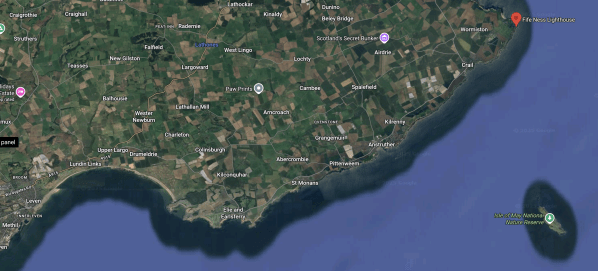
Note.
- The red arrow indicates Fife Ness lighthouse.
- The island in the South-East corner of the map is the Isle of May.
- Leven station is in the South-West corner of the map, which I described in Leven Station – 15th May 2025.
From this map, I estimated that Fife Ness lighthouse and the Isle of May are around ten kilometres apart.
This third Google Map shows Torness nuclear power station on the other side of the Firth of Forth.
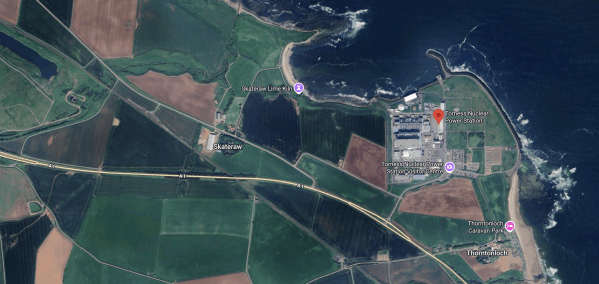
Note.
- Torness nuclear powerstation is indicated by the red arrow.
- The A1 road between Edinburgh and the South crossing the map diagonally.
- The East Coast Main Line following a similar route to the A1.
- The beach below the power station is Tgortonlock, where the cable from Neart na Gaoithe wind farm comes ashore.
Consider.
- Torness nuclear powerstation was built in 1988.
- It has a capacity of 1290 MW.
- Neart na Gaoithe wind farm has a capacity of 450 MW.
This is said in the Wikipedia entry for the Torness nuclear powerstation about its closure.
In December 2024, in response to concerns over energy security following delays to the opening of Hinkley Point C, EDF announced that the life of Torness would be extended two years until March 2030.
In January 2025, EDF stated that “their ambition is to generate beyond these dates [of March 2030], subject to plant inspections and regulatory oversight”
It looks like more power is needed at Torness to cover the closure of the nuclear powerstation.
I asked Google to give me an AI Overview of what wind farms will connect to the grid at Torness and I was given this answer.
Several wind farms are planned to connect to the grid near Torness, with the largest being the Berwick Bank Wind Farm. This offshore wind farm, located 40km off the coast, will connect to the National Grid at Branxton, near Torness. Another project, Eastern Green Link 1 (EGL1), will also connect to the grid near Torness, specifically at the Torness substation, and then link to Hawthorn Pit in County Durham. Additionally, the Neart na Gaoithe offshore wind farm is also being developed in the area.
As Berwick Bank wind farm and EGL1 have capacities of 4.1 and 2 GW respectively, I am fairly sure that Torness can be safely decommissioned.
July 25, 2025
Posted by AnonW |
Energy | Berwick Bank Wind Farm, Eastern Green Link 1, Leven Station, Neart Na Gaoithe Wind Farm, Offshore Wind Power, Scotland, Torness Nuclear Power Station, Wind Power |
Leave a comment
The title of this post, is the same as that of this article on the Inverness Courier.
These two paragraphs introduce the article.
The announcement is underpinned by the publication of a new developer-led research report, the first of its kind in the UK energy sector, which brings together national polling, public consultation, and direct input from communities.
The report marks a major step in the development of the fund, setting out emerging priorities, design principles and governance themes that reflect what GEE has heard to date and will help guide the next phase of engagement.
Other points from the article include.
Size And Delivery
This is said about the size and delivery of the project.
Subject to planning, the project will provide up to 34GWh of long-duration energy storage in 2030.
All these projects seem to be on course for delivery by 2030. Mr. Ed. Milliband will be pleased.
The Community Wealth Fund
This is said about the Community Wealth Fund.
The fund will be rooted in the communities that share the key water resource underpinning the scheme, with scope to contribute to wider regional projects, including contributions to a Strategic Fund for the Highlands as a whole.
“The GEE Community Wealth Fund is about more than sharing the benefits of clean energy, it is about creating long-term value for the communities who make this project possible.
As the grandmother of all pumped storage hydro in the UK; Electric Mountain, started storing energy and producing power in 1984, the Community Wealth Fund should last a few years.
June 9, 2025
Posted by AnonW |
Energy, Energy Storage | Glen Earrach Energy, Glen Earrach Pumped Hydro, Pumped Storage Hydroelectricity, Scotland |
Leave a comment


 The Anonymous Widower