Man In Seat 61: My Nail-Biting Journey To Orkney By Train And Ferry
The title of this post is the same as that of this article in The Times.
This is the heading.
Now the Caledonian Sleeper connects the Midlands to Scotland in style. Mark Smith travels to the UK’s most northerly rail station and beyond
These are the first two paragraphs.
In January the Caledonian Sleeper added Birmingham to its route from London to Scotland — its first new stop in 30 years. With a ticket for one of the first departures and a bucket-list desire to see the historic naval anchorage that is Scapa Flow, I would ride the sleeper to Inverness, take Scotland’s scenic Far North Line to Britain’s northernmost station and then sail across the Pentland Firth to Stromness. I could leave my Buckinghamshire home in the evening and reach Orkney 24 hours later without setting foot on a plane. It sounded like a plan.
The Highland sleeper (which travels to the Highlands; there is also a Lowland sleeper that travels to Edinburgh and Glasgow) rolled into Birmingham International at 10.42pm on the dot. I was greeted at the door by a steward with a friendly Scottish accent and my room key. He jotted down my breakfast reservation and I headed for room 4 in car L. The Cal Sleeper is rightly proud of its Scottish-made mattresses and fluffy duvets and I drifted off to sleep in my cosy berth to the sound of steel wheel on steel rail.
I feel adding a Birmingham International stop is a masterstroke, as it gives so many travel options.
- You could of course still join in London.
- I might go to Birmingham on Chiltern, as I prefer the trains to Avanti West Coast.
- There are lots of shows and exhibitions in Birmingham.
- If you had a relative in Scotland and you lived in the far South-East of England and Wales, half of the journey would be in a comfortable bed.
- Birmingham International has regular connections to Aberystwyth, Bournemouth, Pwllheli, Shrewsbury and Wrexham General.
- Some journeys might be easier with a change between plane and sleeper train at Birmingham International.
The list is endless and will grow as travellers have other ideas.
More imagination needs to be added to train journeys.
My first thoughts are.
There needs to be a Lumo-style service between Birmingham and Scotland and a sleeper between Birmingham and Penzance.
High Speed Two To Barrow-in-Furness
There has been a lot of speculation about the Northern end of High Speed Two, so I might as well add sort out a few facts and add a bit of speculation of my own.
Barrow-in-Furness Used To Have A Service To London
Barrow-in-Furness station doesn’t have a direct service to London.
This paragraph from the Wikipedia entry, describes how it used to be.
The present station was formerly known as Barrow Central, and at one time it was a terminus for British Rail long-distance or InterCity services. From October 1947 until May 1983 these included sleeper services to and from London Euston. A sleeper service in the London direction only was briefly reintroduced between May 1987 and May 1990.
Note.
- I find it interesting, that the area had both InterCity and sleeper services.
- There are some big employers like BAe Systems and British Nuclear Fuels in the area.
- Rishi Sunak has announced that the Cumbrian Coast Line will be upgraded.
- A High Speed Two service could improve low-carbon access to the Lake District.
- Grimsby/Cleethorpes in Lincolnshire, which probably has a similar economic profile to Barrow-in-Furness appears to be getting a service from London as I wrote about in Azuma Test Train Takes To The Tracks As LNER Trials Possible New Route. So why shouldn’t Barrow-in-Furness have a similar service?
It is my view that Barrow-in-Furness station could support a sprinkling of services.
The Current Barrow-in-Furness Service
Barrow-in-Furness station’s current services are described in these two paragraphs from the Wikipedia entry.
Services to the north are provided on Monday-Saturday by Northern, with services approximately hourly during the day to Whitehaven and Carlisle. One train per day operates to Sellafield specifically for workers at Sellafield nuclear plant (BNFL). Evening trains run only as far as Millom. There are 19 northbound departures each weekday; 15 of these go to Carlisle, three to Millom and one to Sellafield. There are 20 arrivals from the northern part of the line: 15 from Carlisle, three from Millom, one from Maryport and one from Sellafield. Some of these services continue along the Furness Line to Lancaster and Preston.
To the south, there are a mixture of stopping services to Lancaster and a number of through services to Manchester Airport via Manchester Piccadilly. These operate on a broadly hourly frequency, with a few peak extras throughout the week (including Sundays).
Hard facts on what the improvements to the line will be, have not been reported. But it does seem that a doubling of frequency to two trains per hour (tph) is being proposed.
What Are The Government’s Plans?
This news story from the Government is entitled North West To Benefit From £19.8 billion Transport Investment.
Proposed improvements in Cumbria are contained in this paragraph.
A brand new £2.5 billion fund to transform local transport in 14 rural counties, smaller cities and towns. This new money could pay for new stations, further electrification, bus corridors and new integrated public transport networks. The Energy Coast Line between Carlisle, Workington and Barrow will be upgraded, improving capacity and journey times, enabling trains every 30 minutes between Carlisle, Workington and Whitehaven. The upgrade will also accommodate major new freight demands from the new coal mine and provide regular services for the Westlakes Science Park, Nuclear Academy and Sellafield. This could support the creation of over 18,000 jobs.
I have my thoughts.
Will The Route Be Electrified?
The Cumbrian Coast and the Furness Line effectively form a near 120 mile loop between Carnforth and Carlisle stations on the West Coast Main Line.
- A journey from one end to the other takes about three hours and 18 minutes.
- Main towns and places served include Barrow-in-Furness, Sellafield, Whitehaven and Workington.
- A train between Carnforth and Carlisle can stop at as many as 29 stations.
- The route is not electrified, but it connects to the electrified West Coast Main Line at both ends at Carnforth and Carlisle.
This OpenRailwayMap shows Carnforth.

Note.
- The red line is the West Coast Main Line between Carlisle and Lancaster.
- Carlisle is to the North.
- Lancaster is to the South.
- The black line going North-West is the Furness Line to Barrow-in-Furness.
- The black line going East is the Bentham Line to Settle and Leeds.
This OpenRailwayMap shows Carlisle.

Note.
- The red line is the West Coast Main Line between Scotland and Carnforth.
- Scotland is to the North.
- Carnforth is to the South.
- The black line going South-West is the Cumbrian Coast Line to Workington, Whitehaven and Barrow-in-Furness.
- The black line going East is the Settle and Carlisle Line to Settle and Leeds.
If it were to be fully electrified, it could be a diversion route for electrified trains on the West Coast Main Line.
This document on the Government web site is the Train Technical Specification for High Speed Two Classic-Compatible Trains.
The specification says this about the unit and train formation.
The nominal length of the Unit shall be 200m. It has been determined that all Units should
be the same length, with no requirement for a Unit to be capable of being lengthened or
shortened. This supports the overall HS2 business case.The Unit shall be capable of Normal Operation as a single Unit or as two coupled Units.
On the Wikipedia entry for the Cumbrian Coast Line, there is a picture of a very long steam-hauled train on the line.
Full electrification would have these advantages.
- In the next few years several 21st century electrical multiple units will be looking for new places to operate.
- I am fairly certain, that a fully-electrified Cumbrian Coast Line could act as a diversion for High Speed Two and the West Coast Main Line between Carnforth and Carlisle.
- It would enable occasional High Speed Two services to Carlisle via Barrow-in-Furness, Sellafield, Whitehaven and Workington.
- It would also allow electrified freight trains to the new coal mine at Workington and to Sellafield.
But trains from the coal mine would probably need to have hydrogen-hybrid locomotives to get across the Pennines to Teesside for export.
Partial Electrification Of The Line
Partial electrification would probably need the following.
- Installation of electrification between Carnforth and Barrow-in-Furness, so that High Speed Two services can reach Barrow-in-Furness.
- Installation of electrification from Carlisle for enough miles towards Workington to be able to charge the local trains.
- The local trains would need to be able to run about seventy miles on batteries.
Partial electrification would be more affordable, but it would allow the following.
- Battery-electric trains to work between Carnforth and Carlisle.
- It would enable occasional High Speed Two services to Barrow-in-Furness
- Hydrogen-hybrid locomotive-hauled freight trains to the new coal mine at Workington and to Sellafield.
Rail passengers in, to and from Cumbria would probably see a similar level of improvement to that with full electrification.
What Time Would Be Possible At The Present Time?
Consider.
- According to the Wikipedia entry for High Speed Two, two hours and twenty-five minutes is the fastest time between London Euston and Lancaster.
- Trains are timed to take one hour and four minutes with the nine stops, between Barrow-in-Furness and Lancaster.
- To save time some stops could be cut between Barrow-in-Furness and Lancaster.
This would give a London Euston and Barrow-in-Furness time of three hours and twenty-nine minutes, but by removing perhaps five stops, the time could be around three hours and fifteen minutes.
What Time Would Be Possible When High Speed Two Lite Opens To Handsacre Junction?
Consider.
- According to the Wikipedia entry for High Speed Two, two hours and three minutes will be the fastest time between London Euston and Lancaster, after High Speed Two opens to Handsacre junction.
- Trains are timed to take one hour and four minutes with the nine stops, between Barrow-in-Furness and Lancaster.
- To save time some stops could be cut between Barrow-in-Furness and Lancaster.
This would give a London Euston and Barrow-in-Furness time of three hours and seven minutes, but by removing perhaps five stops, the time could be under three hours.
What Frequency Would Be Needed?
LNER seem to run their secondary services to places like Harrogate and Lincoln using a frequency of one train per two hours (tp2h).
That could be an ideal frequency.
Would There Be A Path For The Train To And From London Euston?
This graphic shows High Speed Two services after Phase 2b is completed.
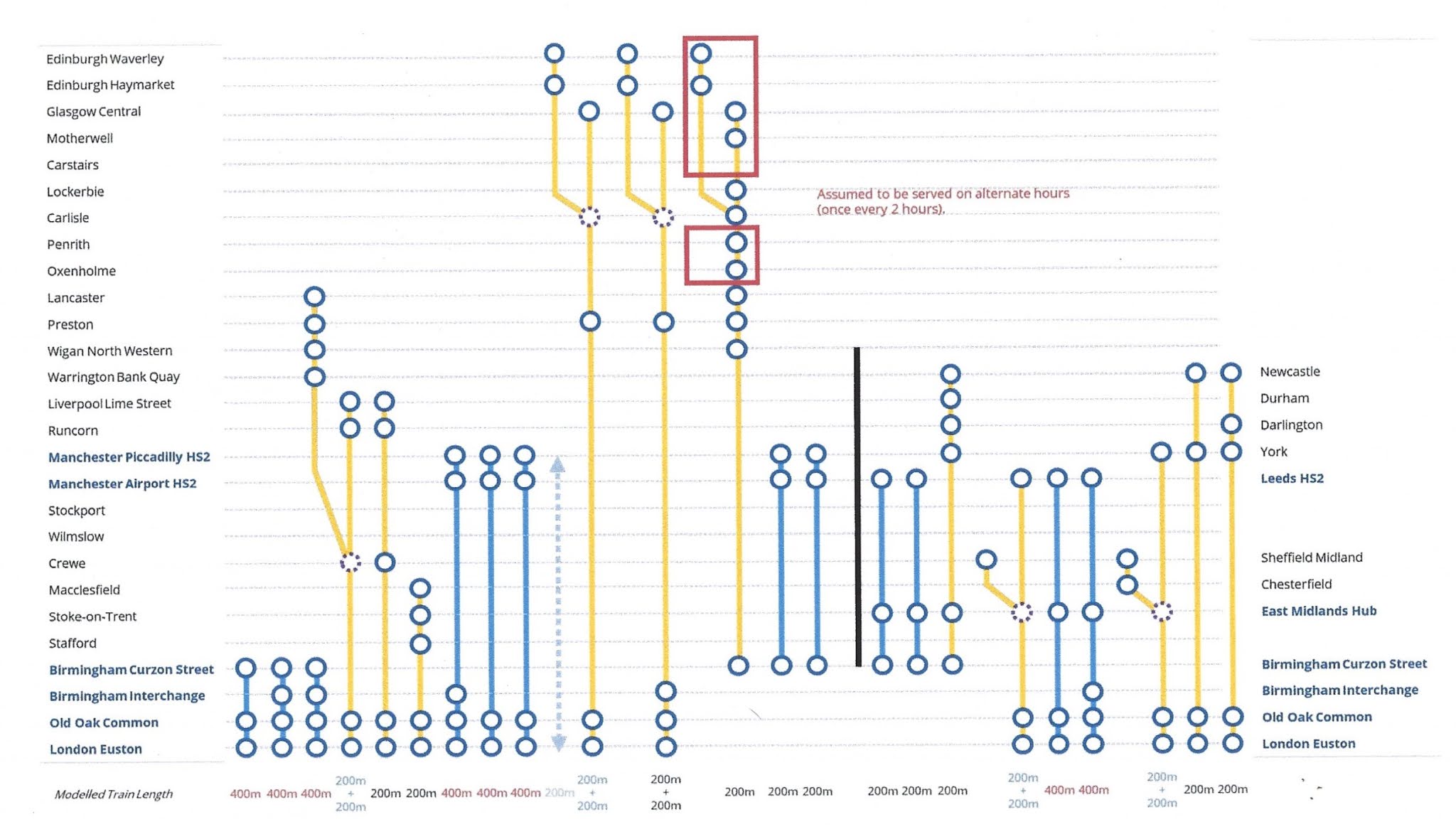
Note.
- Services shown in blue are run by High Speed Two Full Size trains.
- Services shown in yellow are run by High Speed Two Classic-Compatible trains.
- Each of these trains will have a frequency of one tph.
- The nine paths to the right of the vertical black line will not be needed for some time. If ever!
- It looks like a maximum of only eleven paths will be needed to the South of Birmingham.
- It looks like a maximum of only fourteen paths will be needed to the North of Birmingham.
In Will High Speed Two Lite Make Stafford An Important Station?, I totted up all the services through Stafford after High Speed Two Lite opened to Handsacre junction and got these figures.
- Through Stafford station, there are totals of 11 tpd and 14 tph.
- Along the Trent Valley Line, there are totals of 11 tpd and 12 tph.
- North of Stafford on the West Coast Main Line, there are totals of 9 tpd and 12 tph.
- South of Stafford on the West Coast Main Line, there are totals of 2 tpd and 2 tph.
- Between Stafford and Stoke-on-Trent, there are totals of 2 tph.
I accounted for services moving from the West Coast Main Line to High Speed Two.
Consider.
- A large proportion of the route between Preston and Handsacre junction, where the route would join High Speed Two Light has two dedicated high speed tracks and two tracks for freight and local services.
- Digital signalling on High Speed Two has been designed to handle eighteen trains per hour (tph) at 225 mph.
- Surely, the two dedicated high speed tracks, if fitted with High Speed Two digital signalling could handle say 16 tph at 140 mph.
- Network Rail are good at juggling trains to squeeze in more services.
- Extra paths could be created by splitting and joining trains at Crewe or Preston.
My Control Engineering training and practice tells me that it should be possible to add perhaps two tph between Lancaster and Euston.
Could High Speed Two’s Lancaster Service Be Extended To Barrow-in-Furness?
I don’t see why some services could be extended the 34.8 miles to Barrow-in-Furness.
Would Much Work Be Needed At Barrow-in-Furness?
This Google Map shows Barrow-in-Furness station.

Note.
Trains to and from Carnforth come and go from the South East.
Trains to and from Sellafield, Whitehaven and Workington and Carlisle come and go from the North West.
There are three platforms.
Work needed to be done would include.
- Creation of a 200 metre platform for the High Speed Two trains.
- Electrification.
- Addition of charging facilities to the platform for the local trains, which would probably be standard electrification.
Passengers would walk across between the High Speed Two and local trains.
Conclusion
I believe that High Speed Two Classic-Compatible trains could be under three hours between Barrow-in-Furness and London Euston, when High Speed Two Lite opens from Handsacre junction.
Suppliers Sought For New Bi-Mode Locomotives For TransPennine Express And Great Western Railway
The title of this post, is the same as that of this article on Rail Advent.
These three paragraphs give a summary of the proposed fleet of locomotives required by First Group for their two operations.
TransPennine Express is looking for expressions of interest from suppliers for a fleet of at least 15 bi-mode locomotives for use on with its Mk5 carriages.
The provision released by First Group is for up to 30 bi-mode locomotives, with an additional 5 for use on Great Western Railway’s Sleeper Service.
The operators say that the new locomotives must have the capability to be powered by overhead wires as well as being able to operate with an alternate traction mode, IE Diesel or Battery, where routes are not yet electrified or for use as a contingency.
I have also read the detailed proposal, which can be downloaded from this page of the First Group web site.
- The locomotives must be capable of hauling a train at 100 mph.
- First Group are putting a high emphasis on environmental impact of the locomotives.
- The locomotives must be compatible with the latest emission regulations.
- The locomotives must be low-noise.
- The locomotives must be capable of hauling seven coaches, including a driving van trailer.
Nothing in the request for proposals would appear to be too challenging.
I have some thoughts.
The Number Of Locomotives For TransPennine Express
Currently, TransPennine Express has a fleet of fourteen Class 68 locomotives and enough coaches and driving van trailers to create thirteen rakes of Mark 5A coaches.
So why do TransPennine Express talk of up to thirty locomotives?
- Fifteen locomotives would handle the current services, so thirty could cover new services or more services on the current locomotive-hauled routes.
- Manchester Airport and Cleethorpes and Manchester Piccadilly and Hull are run by Class 185 diesel trains, which will need replacing at some future time.
- First Group probably know the costs of running Class 802 trains and locomotives with rakes of coaches better than anyone , so are they thinking about swapping some Class 802 trains for locomotives with rakes of coaches?
The last point would be one for the accountants.
But I am led to the conclusion, that TransPennine Express could be expanding and also decarbonising the long routes still operated by Class 185 trains.
The Number Of Locomotives For Great Western Railway
Currently, Great Western Railway has a fleet of four Class 57 locomotives to haul the Night Riviera.
Five replacement locomotives would probably be enough.
Could A Battery-Electric Locomotive Handle The TransPennine Express Requirement?
Currently, there are gaps in the electrification of the TransPennine network.
- Manchester Victoria and Stalybridge – 7.7 miles – Electrification in progress
- Stalybridge and Huddersfield – 18 miles
- Huddersfield and Dewsbury – 8 miles – Electrification in progress
- Dewsbury and Leeds – 9.1 miles
- Leeds and York – 25.6 – Electrification in progress
- Northallerton and Redcar – 28.8 miles
- Manchester Piccadilly and Stalybridge – 7.5 miles
- Leeds and Hull – 51.8 miles
- Doncaster and Cleethorpes – 72.1 miles
- Scarborough and York – 42 miles
- Doncaster and Sheffield – 18.7 miles
- Sheffield and Stockport – 36.8 miles – Rumoured to be electrified
Note.
- Many gaps are quite small.
- The longest gaps are on easy routes.
- Sheffield will be electrified for the Midland Main Line.
- A length of electrification at Scunthorpe could ease Doncaster and Cleethorpes.
I feel that a battery-electric locomotive with a range of a hundred miles hauling seven coaches, would be able to handle all the TransPennine routes.
If the train could run the routes with an electricity consumption of 4 kWh per vehicle-mile, seven coaches would need 4 * 8 * 100 = 3.2 MWh of battery storage.
Note.
- A 3.2 MWh battery would weigh around 3.2 tonnes, which would be less than the diesel engine in a Class 68 locomotive.
- Regenerative braking to batteries could be used to improve range.
- In How Much Power Is Needed To Run A Train At 125 Or 100 mph?, I calculated that an InterCity 125 needs 1.81 kWh per vehicle mile to maintain 100 mph.
I am fairly certain, that a well-designed efficient battery-electric locomotive would be able to handle all of the routes for TransPennine Express.
Could A Battery-Electric Locomotive Handle The Night Riviera?
I have just looked up the Southbound Night Riviera on Real Time Trains.
- It leaves Paddington at 23:50.
- It is typically eight coaches and a Class 57 locomotive.
- The train is planned to run at 75 mph.
- The first 53 miles between Paddington and Newbury are electrified.
- There is a stop of one hour and 39 minutes at Exeter.
- Newbury and Exeter is 120.4 miles
- Exeter and Penzance is 130.8 miles
The Northbound Night Riviera only has a five minute stop at Exeter and two minutes stops at Totnes, Newton Abbott and Taunton.
A battery-electric locomotive would need a range of 140 miles hauling eight coaches.
- Some stops like Plymouth may need to be lengthened by a few minutes to charge the batteries.
- Extra stops of perhaps five minutes could be added to top-up the batteries.
- The train would be limited to 75 mph, which would improve efficiency.
- It might even be prudent to electrify the uphill track of some of the steeper parts of the route.
But think of the marketing advantages of a zero-carbon sleeper train!
Conclusion
When I saw First Group’s proposals, I thought that they were over ambitious.
But after doing a few simple calculations, I think they can decarbonise some, but not all of the TransPennine Express services and the Night Riviera.
Would A North-East And South West Sleeper Service Be A Good Idea?
I ask this question as in the October 2021, there is an article entitled A New Sleeper, which has this explanatory sub-title.
Des Bradley describes his concept for a North-East to South-West Overnight Service
Paraphrasing his resume from the article, Des Bradley is probably best described as a rail enthusiast, who has travelled all over Europe by train, especially on sleeper trains. He has also worked recently with ScotRail, where he led their integrated travel activities.
I regularly use the Caledonian Sleeper on my trips to Scotland, often taking a sleeper one way and a day time train the other. Towards the end of next month, I have tickets booked for a low-cost Lumo train to Edinburgh and a sleeper back to London in the evening.
In this blog, I have regularly written about the sleeper trains being introduced across Europe and this summer I had intended to go via Eurostar and NightJet to Vienna. But the pandemic has kept me in England for two years.
An Edinburgh And Plymouth Sleeper
Des Bradley is proposing a sleeper train between Edinburgh and Plymouth.
- A typical daytime trip on this route takes eight hours and forty-five minutes.
- Intermediate stops would be Berwick-upon-Tweed, Newcastle, Durham, Darlington, York, Leeds, Sheffield, Derby, Birmingham New Street, Cheltenham Spa, Bristol Parkway, Bristol Temple Meads, Taunton, Exeter St. David’s and Newton Abbot.
- Journey time would be just over twelve hours.
- By comparison a sleeper between London and Edinburgh takes about seven hours and thirty minutes.
He calls the service the NESW Sleeper.
I have some thoughts on the proposal.
A Spine Route Between Edinburgh And Penzance
The route is effectively a spine between Edinburgh and Plymouth on which other services can be built.
Unlike the Caledonian Sleeper, Des Bradley doesn’t feel the train should split and join as it travels up and down the country.
But I do think that the NESW Sleeper can be timed to fit in with high-quality connecting services to extend the coverage.
An Innovative Timetable
Des Bradley’s timetable is innovative.
- Trains leave Edinburgh and Plymouth around 21:00.
- Trains arrive at their destination around 09:00.
- Trains stop for about two hours at Derby.
- After resting at Derby, the trains are effectively early morning trains.
Note.
- The wait at Derby, adds extra time, that can be used to make up for engineering diversions, which often happen at night!
- The trains could be used by non-sleeper passengers to get to Plymouth or Edinburgh early.
The consequence of the second point, is that the trains will have to offer some Standard Class seats.
Should The Train Serve Penzance?
The Great Western Railway’s Night Riviera sleeper train calls at Liskeard, Bodmin Parkway, Lostwithiel, St.Austell, Truro, Redruth, Cambourne, Hoyle and St. Erth between Plymouth and Penzance.
According to a proposed NESW timetable, the Night Riviera has long gone, before the NESW Sleeper arrives in Plymouth at 08:58.
But I’m sure Great Western Railway could arrange for a convenient service between Plymouth and Penzance to pick up passengers in the morning and deliver them in the evening. This picture taken at Plymouth, indicates that cross-platform interchange may be possible.
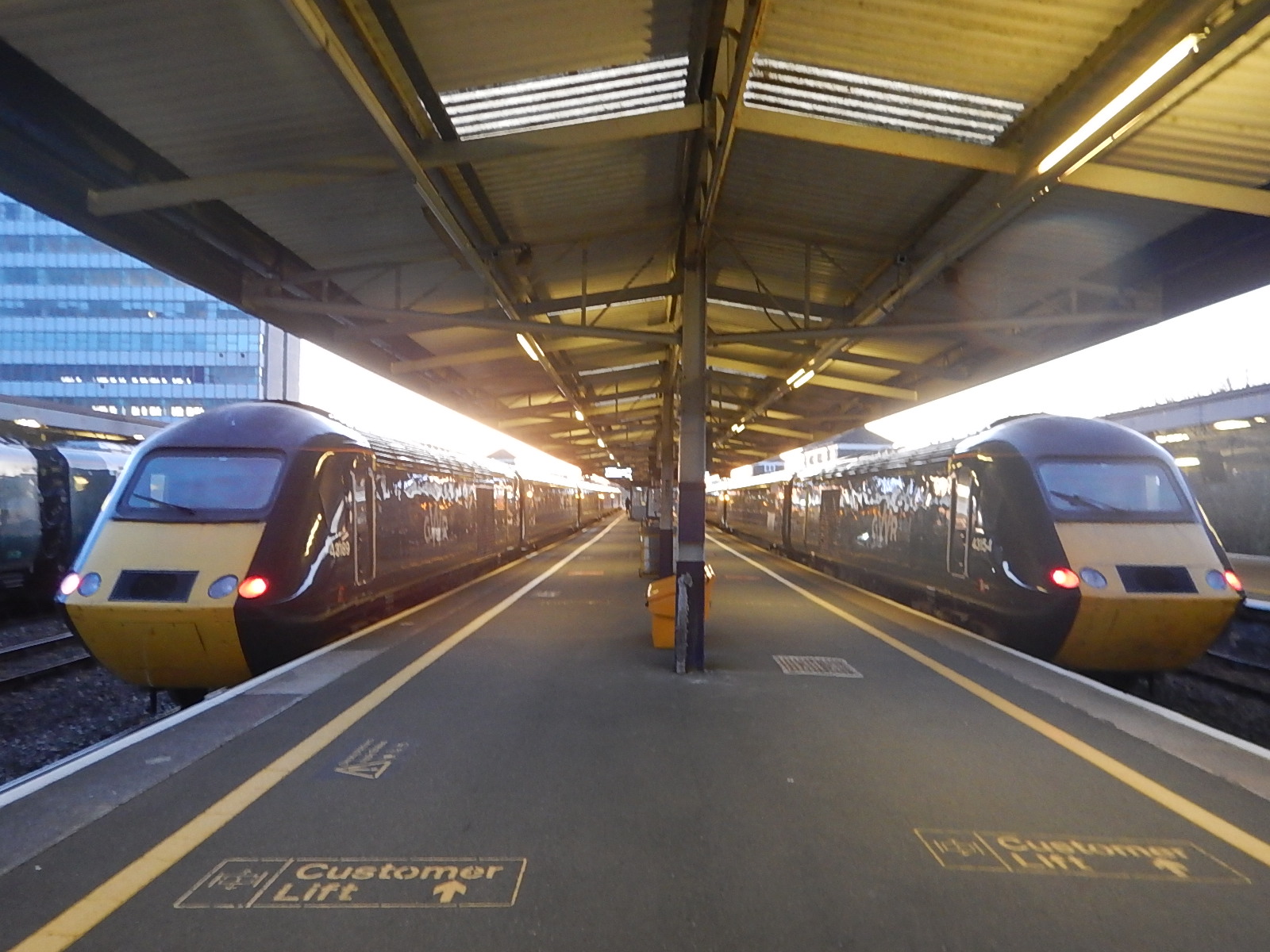
This picture shows a pair of GWR Castles, which regularly work additional services between Plymouth and Penzance.
What About Wales?
I suspect that Cardiff, Swansea and other towns and cities in South Wales, can be served in a similar way, by connecting with GWR services at Bristol Parkway station.
Other Connecting Services
Birmingham New Street, Derby, Leeds and Newcastle are important interchange stations and I can see services being timed to bring passengers to and from the NESW Sleeper.
Rolling Stock
The author offers choices for the trains, based on what is used currently in the UK and adding multiple units. But he is definitely tending towards fixed formations.
I feel that the trains should meet the following criteria.
They should be of similar standard as the Caledonian Sleeper.
They would need an independently-powered capability for sections without electrification.
They should be zero-carbon.
They should offer a range of accommodation including Standard Class seats to cater the early birds and budget travellers.
The possibility to run at 100 mph or faster might be useful to catch up time on some sections of the route.
I think that two trains could be possible.
- A rake of coaches hauled by a hydrogen-electric locomotive.
- A battery-electric Sleeper Multiple-Unit with a range of perhaps eighty miles on batteries.
This is a sentence from the article.
The concept of ‘Sleeper Multiple-Units’ has also emerged in recent years, and this idea could be attractive; although it has some inherent inflexibility, it could in the future allow multi-portion or experimental new routes to be tagged onto the core service.
Sleeper Multiple Units might enable a South Wales and Edinburgh service, that used the same train path between Edinburgh and Bristol Parkway, where the two trains would split and join.
Conclusion
I like this proposal and definitely think it is a good idea.
Councillors Approve Train Station For Inverness Airport
The title of this post, is the same as that of this article on Rail Technology Magazine.
These are the first two paragraphs.
Planning permission has finally been granted for a two-platform train station at Inverness Airport.
The plans were “reluctantly” granted by the Highland Council, as much debate over the Petty Level crossing which is to be removed as a consequence.
Ir certainly looks like there were strong arguments over the level crossing.
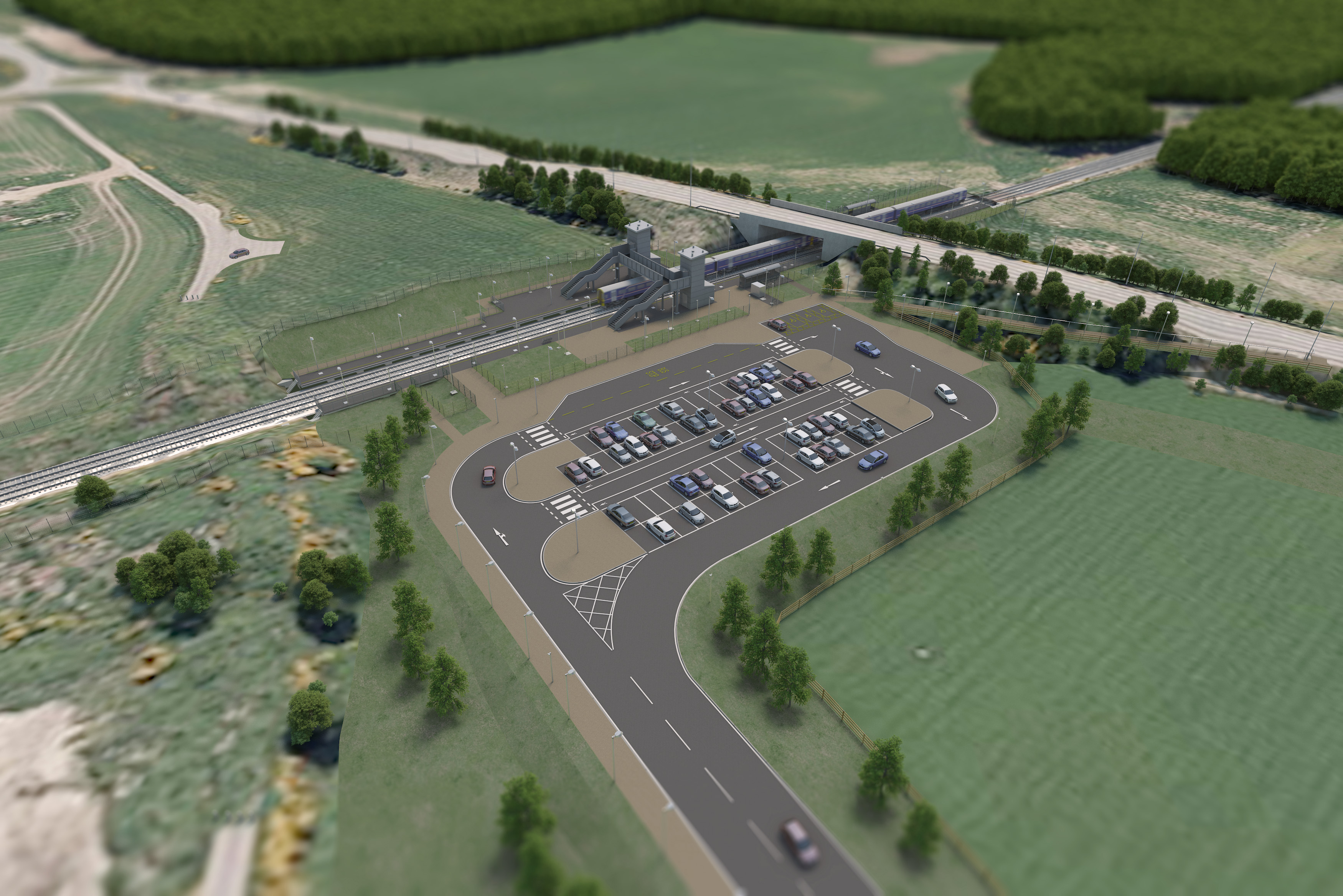
This Network Rail visualisation shows the station from a virtual helicopter hovering over the Airport.
And this Google Map shows the Airport from the South-West
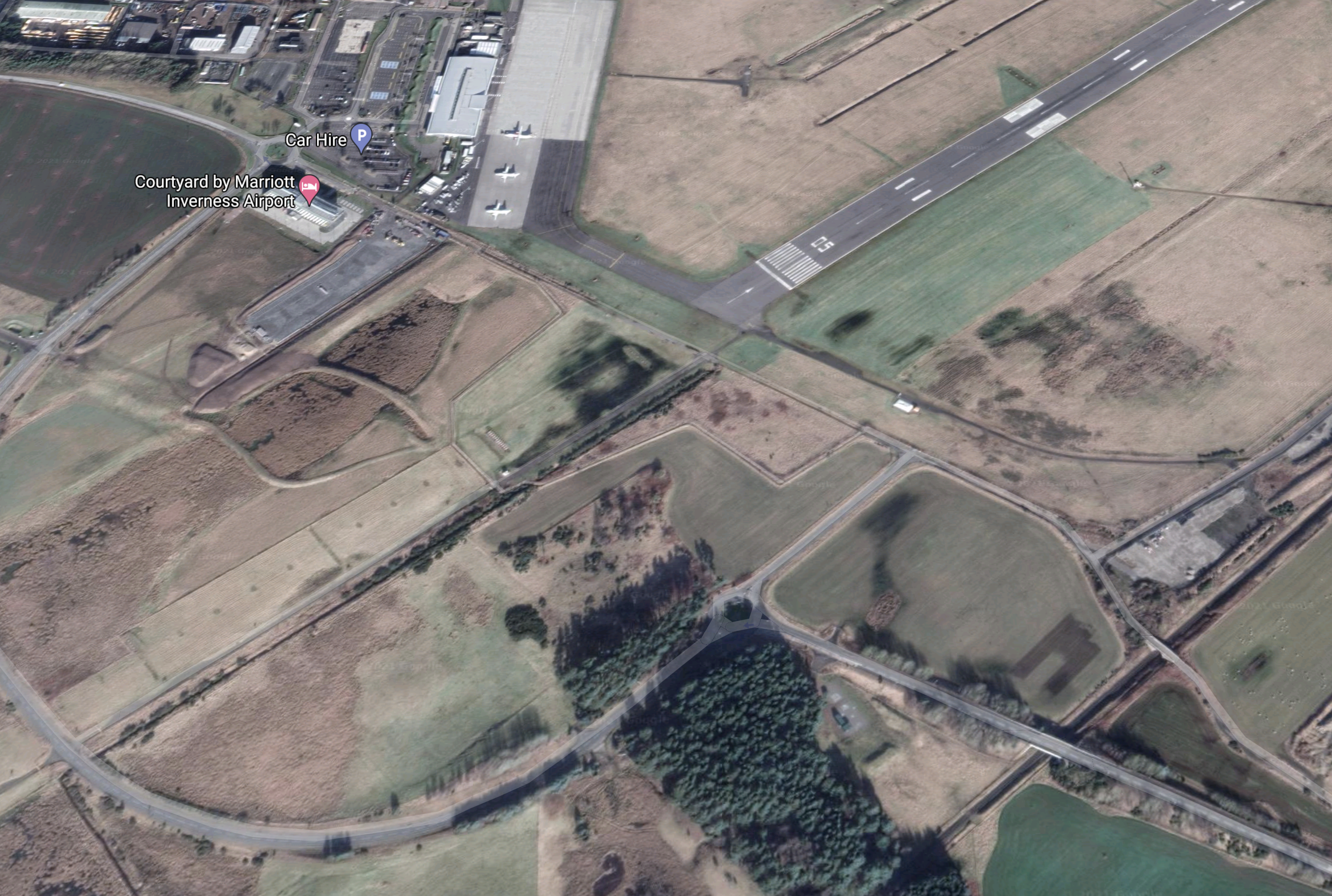
Note.
- The link road to the A96 crossing the railway in both images. But from opposite directions.
- In the Network Rail visualisation you can see the roundabout, where the link road joins the A96 in the top left corner.
- The current railway is only single track, but Network Rail will be doubling it.
- From these images and this document on the Network Rail web site, I can deduce this about the station.
- The station will have two platforms that will be capable of handling six-car trains.
- The footbridge is shown with lifts.
- The station will be able to be used as a Park-and-Ride for Inverness.
I suspect there will be a shuttle bus to the Airport terminal.
Travel Between London And Inverness
I’ve been to Inverness twice and and in both cases, I’ve gone by train.
- The first time, I went by a day train from Edinburgh. And I was in the cab courtesy of East Coast. I wrote about it in Edinburgh to Inverness in the Cab of an HST.
- The other occasion, I took the Caledonian Sleeper to Inverness and that is a civilised way to go.
I feel that on this route very keen competition could develop.
Advantages Of Flying
Flying to Inverness Airport has these advantages.
- A shorter journey time.
- A greater choice of destinations.
- Destinations in the sun.
- After the new station is built it will be rail connected all the way to Aberdeen.
This Google map shows Inverness and Inverness Airport.
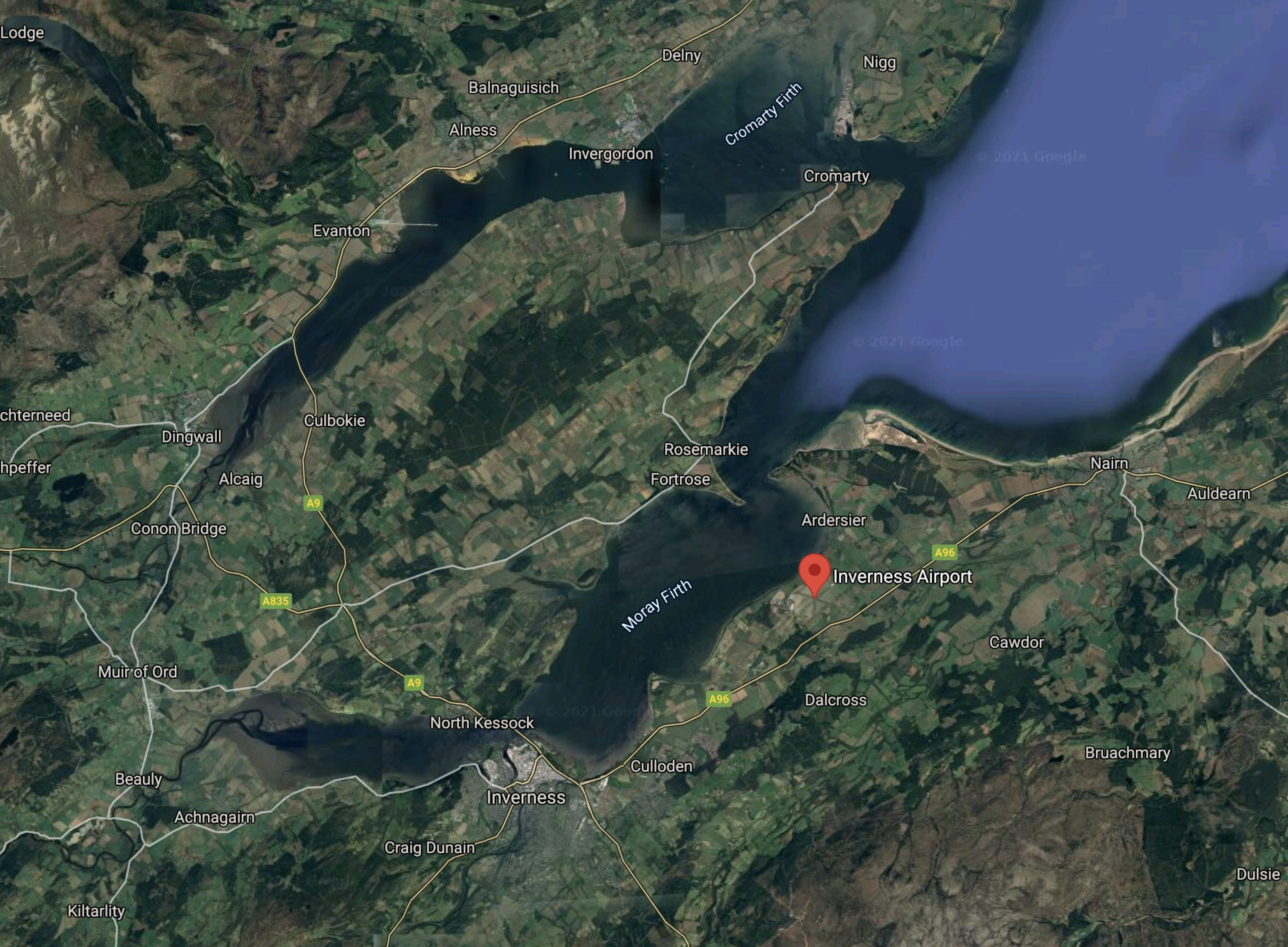
Note.
- The city of Inverness is at the Southern end of the Moray Firth.
- With all the water, I suspect the airport can be a good neighbour as far as noise and pollution are concerned.
- The Airport would have good access to green hydrogen and electricity from renewable sources.
- Even the Airport train and all the ground-handling equipment could run on hydrogen.
I feel that the Airport could sell itself as an environmentally-friendly way to the Highlands, when sufficient numbers of zero-carbon aircraft are available.
- You should be able to fly in from Amsterdam, Birmingham, Brussels, Geneva, London, Manchester etc. and not feel any environmental guilt.
- Airbus’s proposed hydrogen-powered ZEROe Turbofan is quoted as having a range of 2,000+ nautical miles,
- That distance would put a lot of the sun in range of Inverness Airport.
- Smaller feeder airliners could connect to other airports in the North of Scotland and the islands.
Inverness Airport will not be beaten without a fight.
Advantages Of Trains
Taking the train to Inverness has the following advantages.
- Luxury
- Zero Carbon-Footprint
- The possibility of an overnight trip on a sleeper train.
- The scenery through the Highlands.
I also believe that it would be possible to design a hydrogen-powered luxury train. I laid out my ideas in LNER Seeks 10 More Bi-Modes.
I believe a train could have this specification.
- 140 mph operation on 25 KVAC overhead electrification. This was done by British Rail almost forty years ago.
- Ability to use full digital in-cab signalling. This is on its way and already working in some applications.
- 110 mph operation on hydrogen. Hitachi are planning 100 mph battery trains, so it should be possible.
- 400 mile range on one filling of hydrogen. This is working in Germany.
- Ability to be upgraded to higher speeds on electric power, should the East Coast Main Line be upgraded for higher speeds in the future. The train manufacturers are probably ahead of track designers with this one.
I believe a sub-seven hour time would be possible between London and Inverness.
Conclusion
This is the sort of route, where rail and air will have a hard fight for supremacy.
Could Trains From The North Connect To High Speed One At St. Pancras?
I was casually flying my virtual helicopter over the throat of St. Pancras International station, when I took a few pictures.
This Google Map shows the Northern ends of the platforms and the tracks leading in.
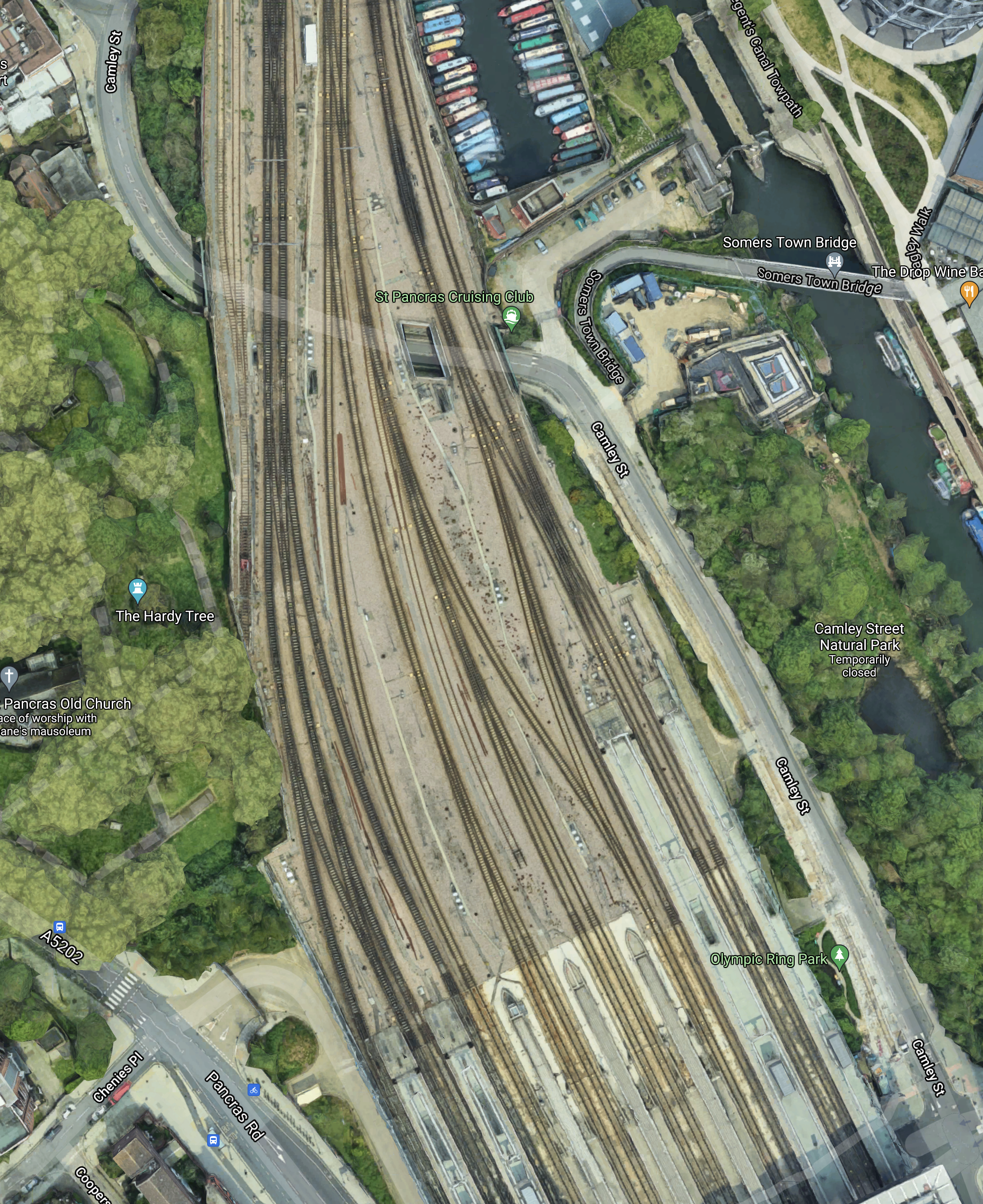
Note.
- Platforms 1-4 to the West with darker tracks handle the East Midlands Railway services.
- Platforms 5-10 in the centre with lighter tracks formed of three shorter islands handle the Eurostar services.
- Platforms 11-13 to the East with longer platforms handle the Southeastern HighSpeed services.
This Google Map shows the East Midlands Railway platforms.
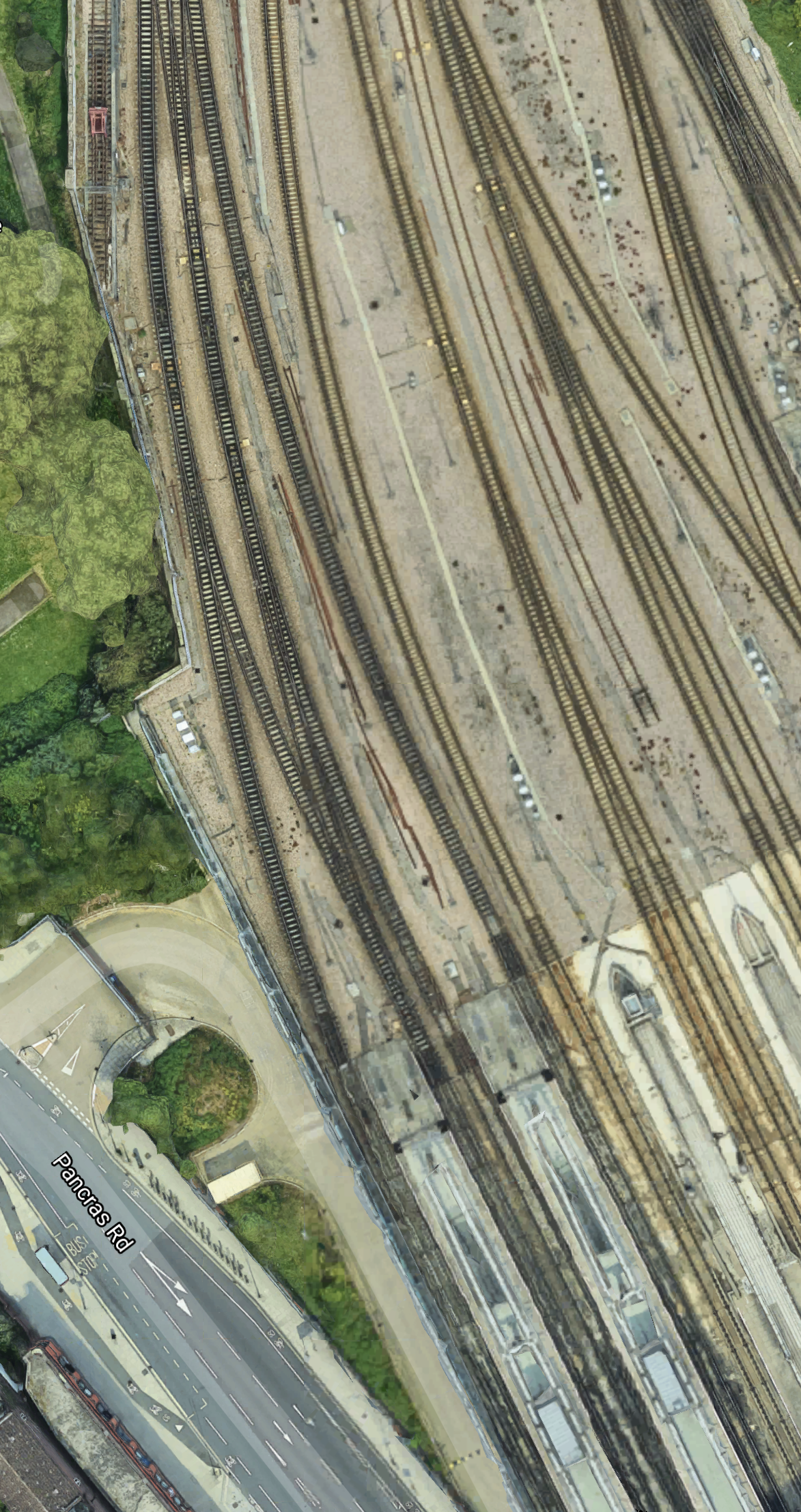
Note.
- There are two island platforms; 1-2 and 3-4.
- The four platforms are served by two tracks, that connect to the fast lines of the Midland Main Line.
- The platforms will be able to handle a pair of Class 810 trains, which will be 240 metres long.
- Will the two trains per hour (tph) using Class 360 trains between London and Corby always use the same platform at St. Prancras station?
This Google Map shows the Eurostar platforms.
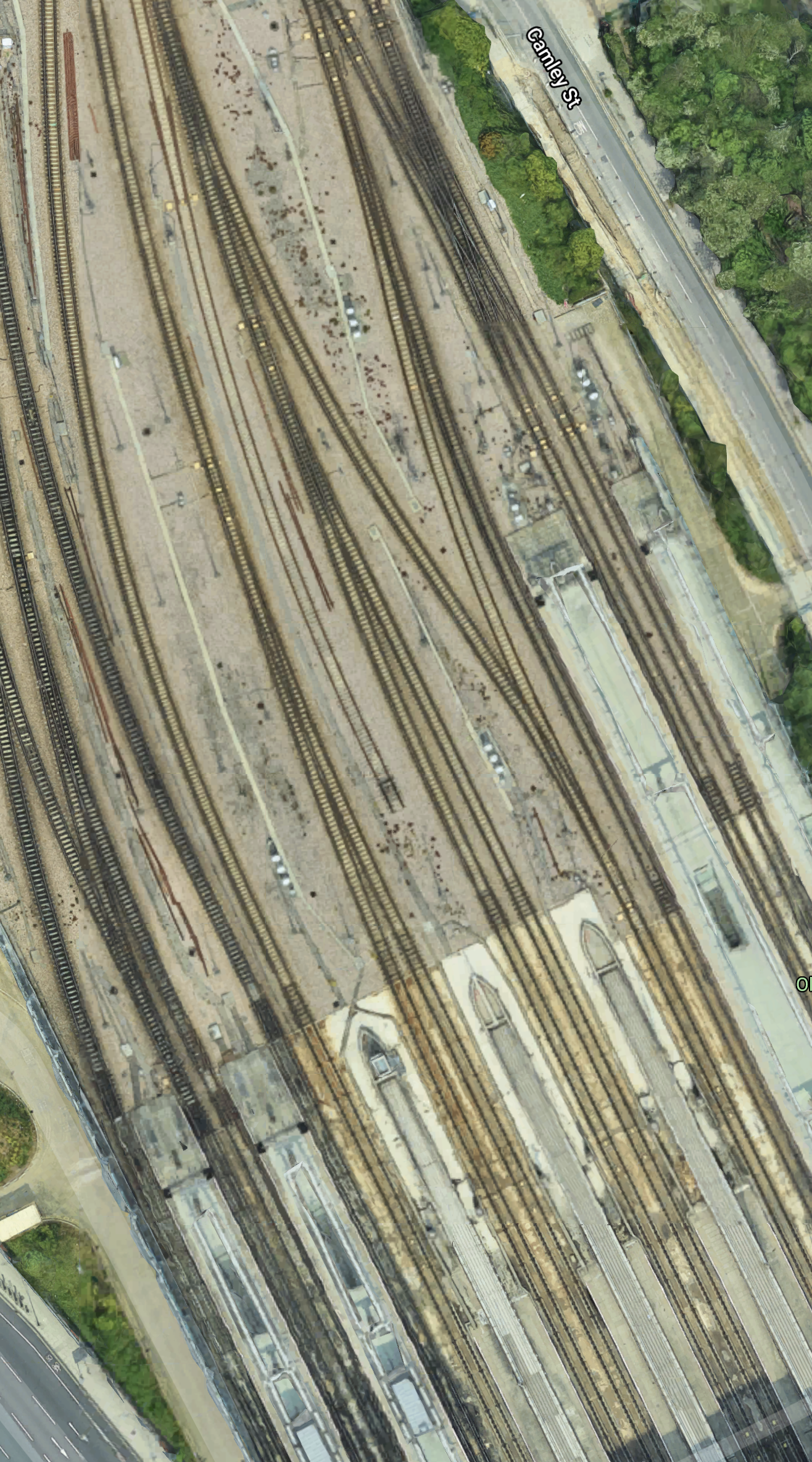
Note.
There are three island platforms; 5-6, 7-8 and 9-10.
The two island platforms in the West are for East Midlands Railway services.
The two longer island platforms in the East are for Southeastern HighSpeed services.
The six platforms connect to two fast lines, that are shared with the Southeastern services.
This Google Map shows the lines proceeding to the North.
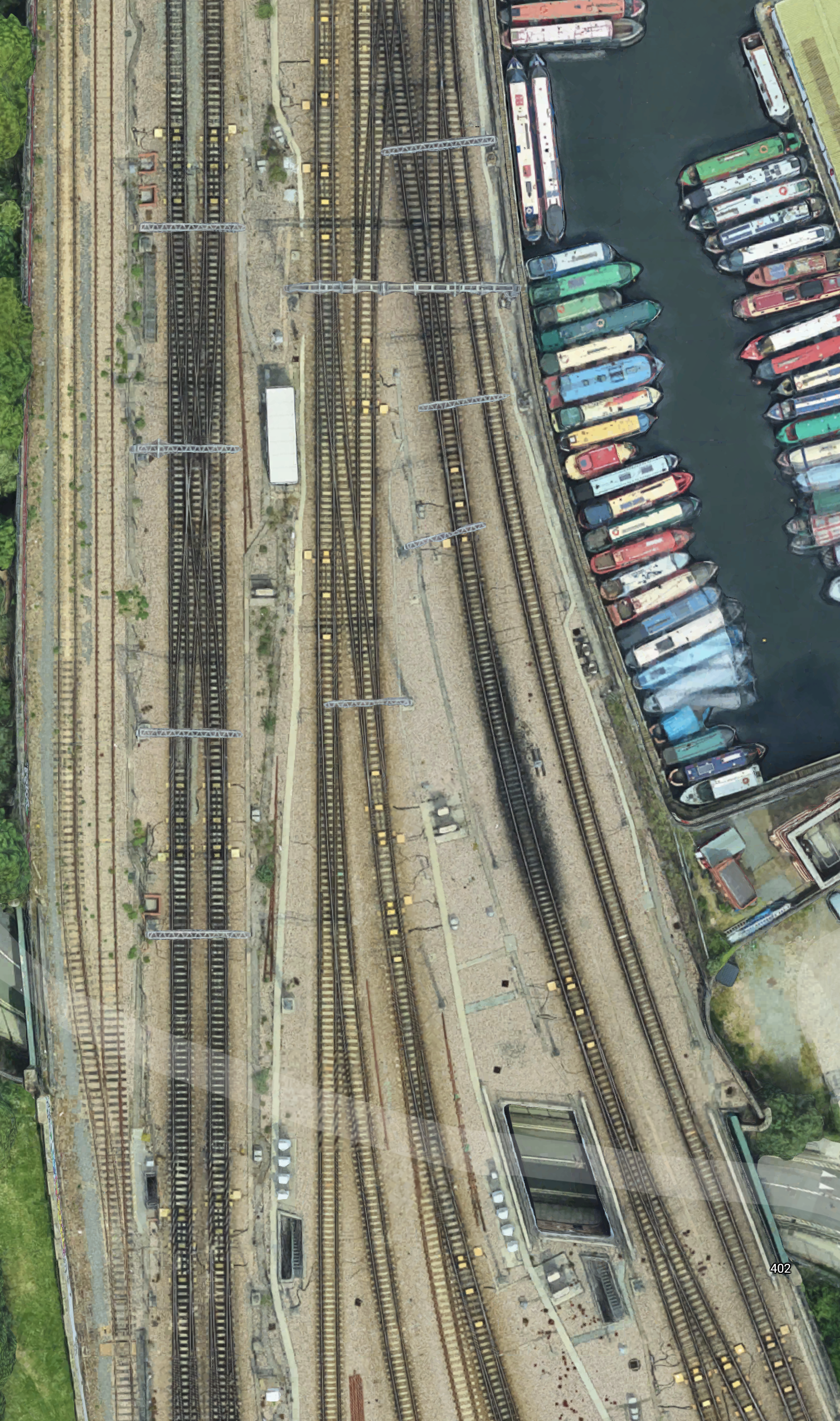
Note.
- There are four sets of tracks.
- The two light-coloured tracks on the left are for Thameslink or sidings.
- The next two dark-coloured tracks are the two tracks of the Midland Main Line.
- The next set of tracks are those connecting to the six Eurostar platforms.
- The two tracks on the right are those connecting to the Southeastern Highspeed platforms.
- There are crossovers between the Eurostar and Southeastern Highspeed tracks to allow efficient operation of the trains going to and from the twin tracks of High Speed One.
This Google Map shows where the Midland Main Line and High Speed One divide.
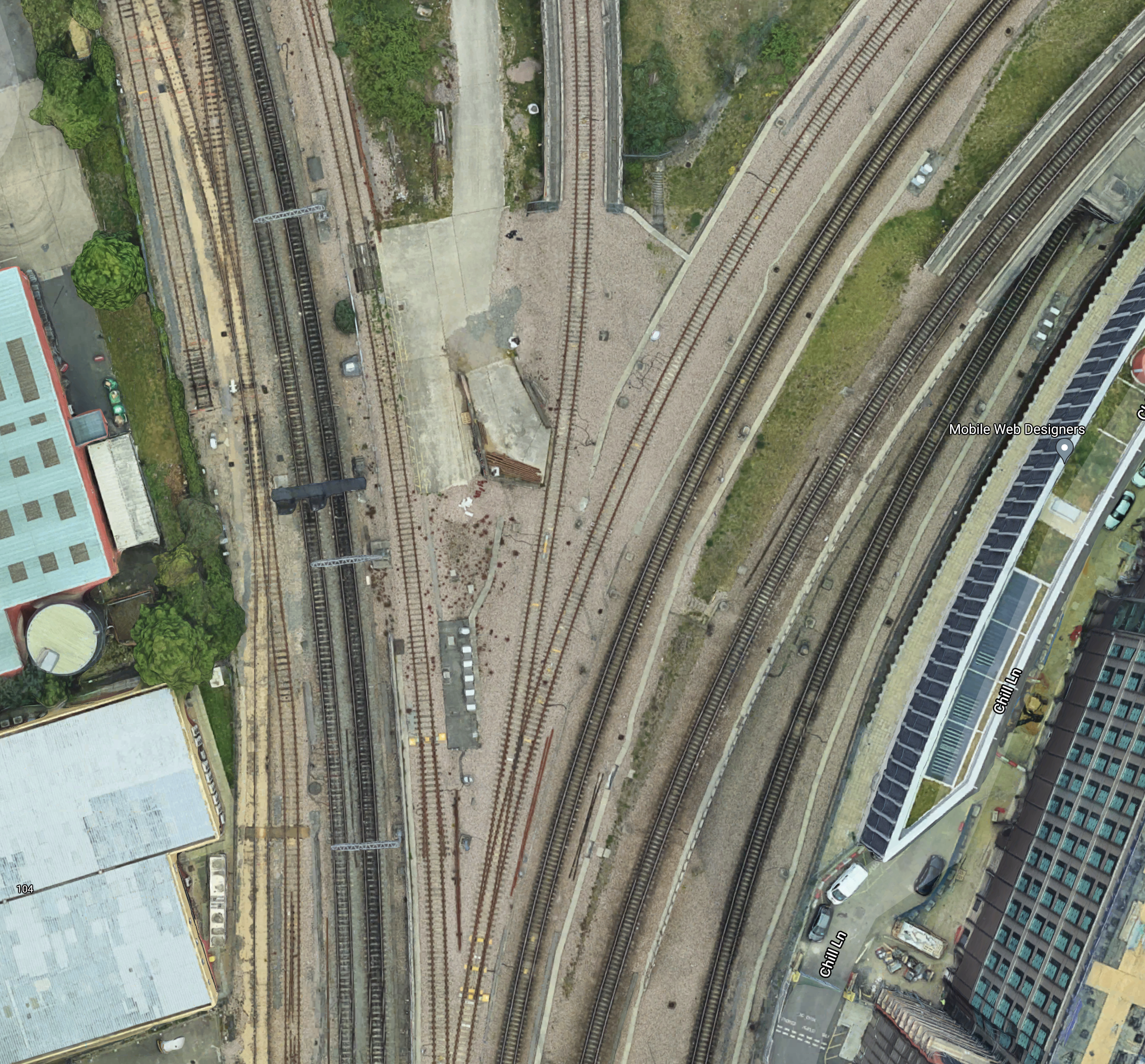
Note.
The two dark-coloured tracks of the Midland Main Line running North.
There appear to be four tracks running North East towards High Speed One.
Between the two sets of tracks two further tracks lead to the North.
The track closest to the Midland Main Line joins to the slow lines of the Midland Main Line.
The other one connects to the North London Line.
This Google Map shows the connecting lines to the High Speed One tunnel.
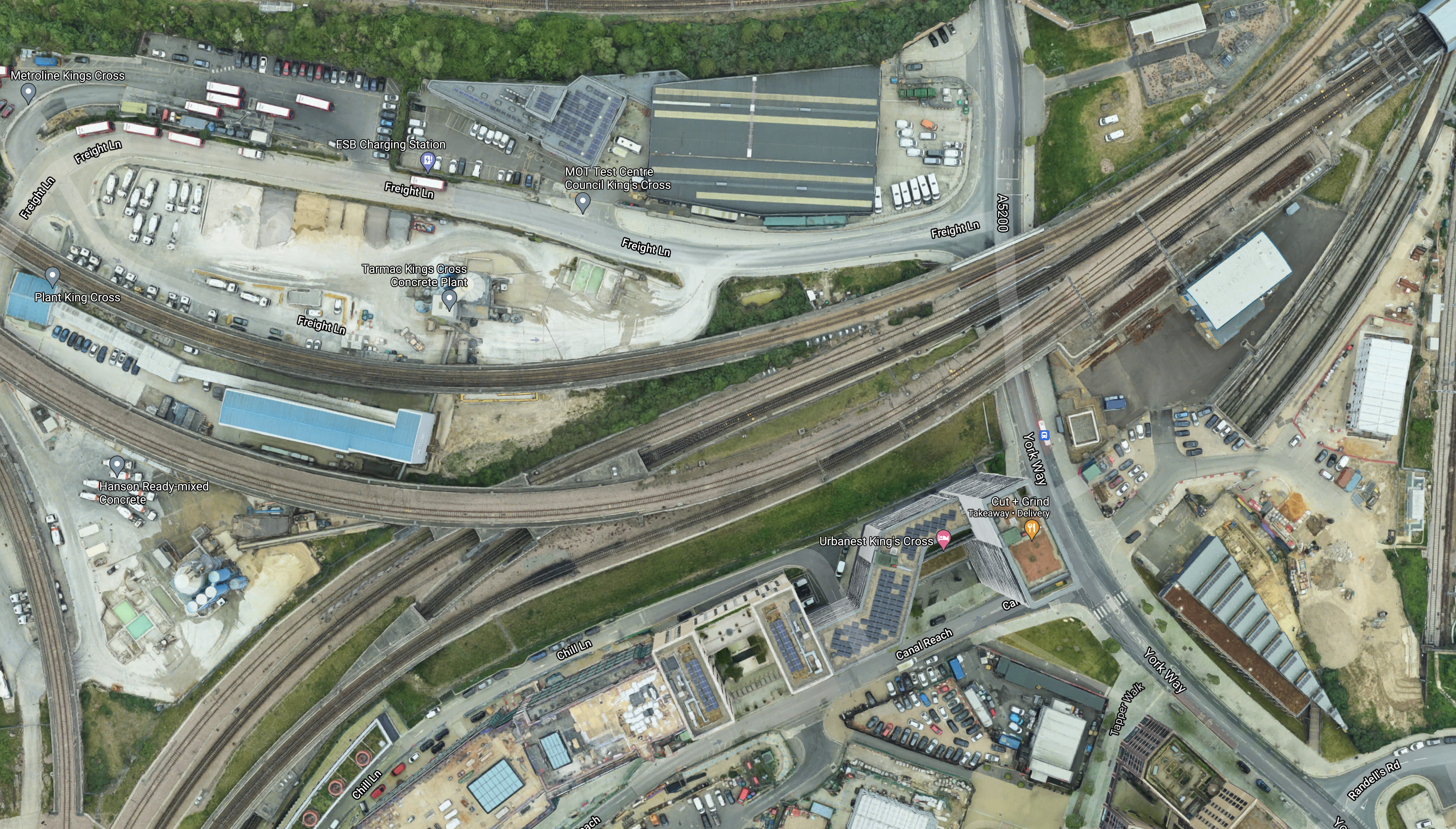
Note the tunnel portal is in the North-East corner of the map.
- It looks to me that the following connections are possible.
- St. Pancras station Eurostar platforms and Midland Main Line.
- St. Pancras station Eurostar platforms and North London Line to the West.
- High Speed One and North London Line to the West.
These connections are in addition to those connections needed to run scheduled services.
They would enable trains to take the following routes.
- St. Pancras station Eurostar platforms and Midland Main Line.
- St. Pancras station Eurostar platforms and the West Coast Main Line via North London Line
- High Speed One and the West Coast Main Line via North London Line
- St. Pancras station Eurostar platforms and the Great Western Main Line via North London Line
- High Speed One and the Great Western Main Line via North London Line
I suspect most of the times, that these routes are used it is for engineering purposes or behaps dragging a failed train out of St. Pancras.
But the track layout would seem to allow the following.
Direct electric freight and passenger services between High Speed One and Birmingham, Cardiff, Glasgow, Liverpool and Manchester.
Direct electric passenger services between High Speed One and Sheffield and Leeds, with a reverse at St. Pancras, after the Midland Main Line were to be fully electrified.
Was this by design for Eurostar or was it just what Network Rail ended up with?
A Modern Regional Eurostar Service
These are my thoughts on a modern Regional Eurostar service.
Rolling Stock
High Speed Two is coming and this year, the company will order some of the rolling stock.
There will be fifty-four trains
The trains will be Classic-Compatible for running on the West Coast Main Line.
They will be 200 metres long and be able to run in pairs.
They will be able to operate at 225 mph.
The operating speed of High Speed One is 186 mph.
I can see no reason why trains of this type, couldn’t run between St. Pancras and many destinations in Europe.
North Of England And The Continent
Could this be the service pattern?
- One train could start in the North West and another in the North East.
- Both trains would proceed to St. Pancras picking up passengers en route.
- At St. Pancras the two trains would join together.
- The driver could then position themselves in the front cab and take High Speed One, through the Channel Tunnel.
The train could even split at Calais to serve two different Continental destinations.
Going North, the spitting and joining would be reversed.
What Infrastructure Would Be Needed?
I suspect the following will be needed.
- The West Coast Main Line and the Midland Main Line would need in-cab digital ERTMS signalling.
- Full electrification of the Midland Main Line would probably be necessary, as I don’t think the tunnel allows diesel trains to pass through.
- Some platform lengthening might be needed.
It would not be an expensive scheme.
What Timings Would Be Possible?
Using current timings you get the following times.
- Leeds and Paris – Five hours
- Leeds and Brussels – Four hours forty minutes
- Manchester and Paris – Five hours
- Manchester and Brussels – For hours forty minutes
- Newcastle and Paris – Six hours
- Newcastle and Brussels – Five hours thirty minutes
Note, that the times are best estimates and include a long stop of several minutes at St. Pancras.
Could Sleeper Service Be Run?
I don’t see why not!
Conclusion
It looks like it may be possible to run regional services to Europe, where pairs of train split and join at St. Pancras.
St
‘Sleeper Trains’ London To Berlin And Prague A New Possibility
The title of this post, is the same as the title of this article on Rail Technology Magazine.
This is the introductory paragraph.
For those who have grown a travel bug during lockdown, the truth is that flying looks like it won’t be a viable option as a global pandemic persists. However, for those who dream to travel again, there might be some hope. With growing new interest, there are ambitious plans to take overnight ‘Sleeper trains’ services through the channel tunnel from London to cities around Europe .
I regularly use sleeper trains to Scotland, as they deliver me North of the Border for an early start or are ideal for coming back ;ate after a busy day.
As I can sleep with no trouble on a train and generally book a few days in advance, it generally works out that the cost of the sleeper one way is good value, as it avoids paying for a hotel.
Certainly, in the UK, if you use sleeper trains properly and have a rail-card, I find them convenient and good value. A couple of times, there’s also been a party in the lounge car.
It appears that the first sleeper trains will start from Brussels.
- NightJet already run a service between Brussels and Vienna.
- A route of Brussels and Prague via Amsterdam, Berlin and Dresden is suggested.
- These routes could be extended to London, at some time in the future.
But if they were timed appropriately, you could take an afternoon or evening Eurostar to Brussels and have supper before you get the sleeper, either on Eurostar or in Brussels.
With sleeper trains popping up in several places in Europe and becoming more fashionable with better rolling stock, I’m sure that this sleeper train would work.
Brussels and Berlin is currently seven hours with a change, so a sleeper train without a change could probably take you to Berlin for eight in the morning, if it left Brussels at about yen at night.
New Fleet To Make Nightjet ‘The Best Option For Travelling Between Major European Cities’
The title of this post, is the same as that of this article on Railway Gazette International.
This is the first paragraph.
The exterior design and first painted carbody for the fleet of coaches which Siemens Mobility is to supply for Nightjet night train services has been unveiled by Austrian Federal Railways.
This is a €500m project involving.
- New trains
- Additional destinations
- New services
ÖBB intends to buy 33 Nightjet trains, which will be introduced into services from 2022.
This is the last paragraph.
Meanwhile, ÖBB intends to introduce its planned Wien/Innsbruck – Amsterdam Nightjet service from April 2021, with Wien – München – Paris and Zürich – Amsterdam services following in December.
It looks like ÖBB are moving closer to the UK.
I’m looking forward to taking a sleeper between London and Vienna.
 The Anonymous Widower