Heathrow Rail Link Project Could Be ‘Reopened’
The title of this post, is the same as that of this article on the BBC.
This is the sub-heading.
Network Rail has said plans for a rail link between the Great Western mainline and Heathrow Airport could still move forward if funding is found in the future.
These three paragraphs give the current status of the scheme.
The Local Democracy Reporting Service recently reported that the project had been put on hold.
It began in 2012 and involved proposals for a 4 mile (6.5km) rail link to allow train services from Reading and Slough in Berkshire to reach Heathrow using a tunnel.
The £900m scheme would allow people living to the west of Heathrow to travel direct to the airport, instead of having to go into London.
These are some other facts and my thoughts.
The All-Party Parliamentary Group (APPG) For The Western Rail Link To Heathrow
According to the BBC article, this has now been established and this is said.
Labour MP for Slough, Tanmanjeet Singh Dhesi, held a debate in parliament on the western rail link in April and established the All-Party Parliamentary Group (APPG) for the Western Rail Link to Heathrow, to make sure it “remains on the government’s agenda”.
He said the project had been “beset by delays and funding challenges” but still had “wide cross-party and local support”.
Parliamentary backing is surely a good thing.
The Current Scheme
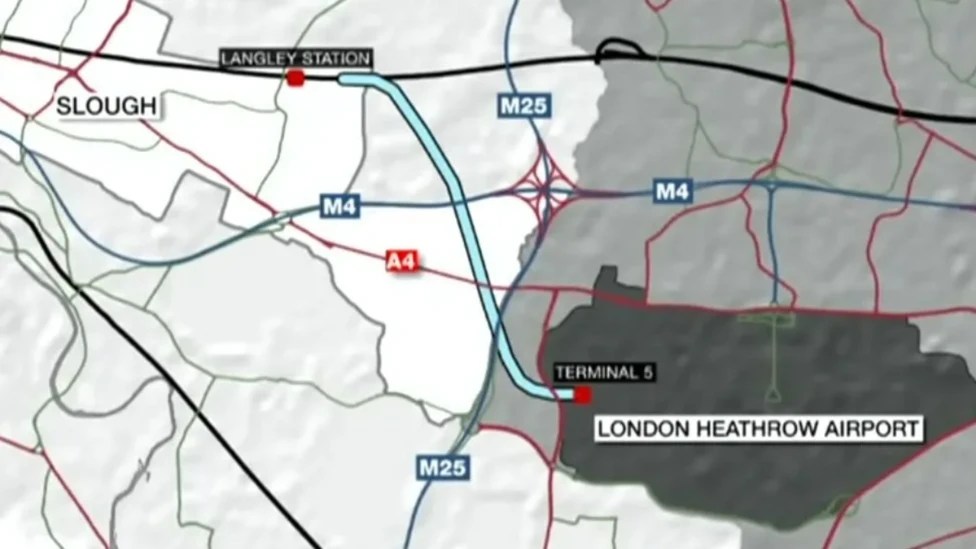
The BBC article shows this map with a rail link connecting the Great Western Main Line to Terminal 5 railway station.
Note.
- The rail link starts from East of Langley station.
- Terminal 5 station can take full-length Elizabeth Line trains.
- Main line trains from Bristol, Cardiff and Wales and the West should be able to access Heathrow.
But I suspect, that there would be extensive changes to Heathrow’s railways to access the other terminals. This would explain the near billion pound cost of the link.
I also suspect that it would take about eight to ten years to build and from what I havc heard, the rail link is urgently needed.
RailAir
RailAir is the current way of travelling between Reading station and Heathrow Airport.
This is the first paragraph of RailAir’s Wikipedia entry.
RailAir describes a number of airport bus and coach services designed to connect the National Rail network to airports in the United Kingdom. Services are currently concentrated on Heathrow Airport, with one other from Luton Airport. RailAir services are operated as public transport services by or on behalf of train operators, where the whole journey is paid for as a through-ticket which combines the railway and bus journey, although journeys can be made using the bus only. As such, many are operated where the train and bus operator are owned by the same company.
Could RailAir be updated to be a more frequent and integrated service?
CoacH2
This page on the Advanced Propulsion Centre UK web site is entitled CoacH2 – Next Generation Hydrogen Fuel-Cell Coach Powertrain Demonstrator.
This is the sub-heading.
Accelerating the development of zero-emission hydrogen fuel-cell electric coaches, with a full on-vehicle technology demonstrator.
These are the first two paragraphs.
Coaches are an integral part of the public transport network, with over 30,000 diesel coaches operating across the UK and Ireland. Due to the specific demands of coach operation (motorway driving, long-range, high passenger and luggage loading capacity) decarbonisation options for this sector are extremely limited with hydrogen fuel-cell technology considered the most viable choice. This project will tackle this difficult to decarbonise sector by developing, testing and validating an innovative hydrogen fuel-cell powertrain suitable for coach applications.
Delivered by a Northern Irish consortium spanning OEM, coach operator and academia, CoacH2 will accelerate the development of zero-emission, fuel-cell electric coaches, with a full on-vehicle technology demonstrator to be manufactured and showcased at Cenex Expo 2024.
As I indicated in British Buses For British Bottoms, Wrightbus build a good well-built, smooth-riding and comfortable bus, so now they can add hydrogen-powered coaches to the product range.
This press release on the Wrightbus web site is entitled Wrightbus Coach Demonstrator Unveiled At Cenex Expo, gives more information on CoacH2.
- The demonstrator has a power of 300 Kw.
- It has a range of 1,000 km. on one refueling.
- An internet search reveals a launch date of 2026 for the hydrogen-powered coach.
I wonder, if RailAir changed their coaches to these new Wrightbus hydrogen-powered coaches, they would transform travel to airports all over the UK.
If the hydrogen-powered coaches are of the same quality of their hydrogen-powered siblings, they will be a quality product with good road-holding, sufficient performance and superb passenger comfort.
RailAir could be the ideal, initial application.
Conclusion
A proper rail link to Heathrow from Reading is needed, but it will take at least ten years to build and cost a billion pounds.
However the RailAir links to Heathrow from Reading and Woking can be improved by using high-performance Wrightbus hydrogen-powered coaches.
Heathrow Rail Link Withdrawn, But MP Vows To Carry On
The title of this post, is the same as that as this article on Rail Magazine.
These are the first three paragraphs.
Hopes for a rail link between the Great Western Main Line and Heathrow Airport appear to have finally ended.
The scheme had been on hold since 2021, when Network Rail staff working on it were transferred to other tasks.
At the time, NR called it a “controlled pause”, but a pre-application process has now been withdrawn, according to the Planning Inspectorate website.
Currently, the two main routes to Heathrow from the Great Western Main Line are.
- Continue to Paddington and get either the Heathrow Express or the Elizabeth Line to the airport.
- Use the RailAir bus from Reading to the airport.
Both routes probably encourage passengers and staff to drive to the airport.
I have my thoughts.
Tan Dhesi
The article says this about this MP’s support for the rail link.
However, Slough MP Tan Dhesi, a former shadow transport minister, believes the link still has wide support as it would bring 20% of the UK population within one interchange of its busiest airport.
Dhesi led an All-Party Parliamentary Group for the Western Rail Link to Heathrow before the General Election. He now plans to re-launch the group, as some previous members have since lost their seats.
He has a point, but is this because a large number of his constituents work at Heathrow.
Would an improved local bus service, at least partially serve the need?
RailAir Between Reading And Heathrow
This appears to have two drawbacks.
- It only runs every thirty minutes.
- It doesn’t serve Terminal Four.
But at least it runs modern coaches, not buses.
I would increase the frequency to perhaps every twenty or even fifteen minutes, serve Terminal Four and perhaps in the future, switch to Wrightbus’s new hydrogen coaches, which I wrote about in Wrightbus Hydrogen Coach Planned For 2026.
I feel that switching to hydrogen power, may attract more passengers to the route.
Obviously, I feel the other RailAir routes from Guildford, Watford and Woking to Heathrow would also be updated.
Improving The Rail Route Between Reading And Heathrow Via Hayes And Harlington Station
Hayes and Harlington station has the following frequencies to Heathrow and Reading, in trains per hour (tph)
- Heathrow Terminals Two & Three – 6 tph
- Heathrow Terminal Four – 4 tph
- Heathrow Terminal Five – 2 tph
- Maidenhead – 2 tph
- Reading – 2 tph
More trains between Reading and Hayes and Harlington might encourage more passengers to use the trains.
Could Hayes And Harlington Station Become A Transport Hub For Heathrow?
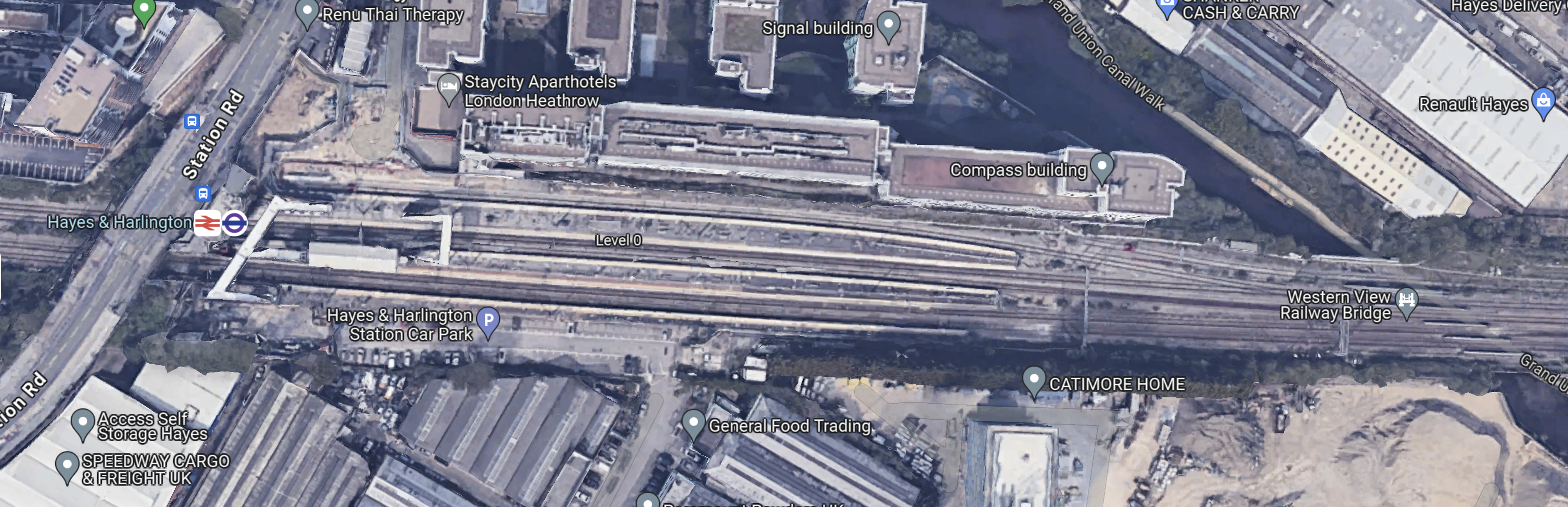
This Google Map shows Hayes and Harlington station.
Note.
- It has platforms on all four tracks of the Great Western Main Line.
- There is a London-facing bay platform to terminate Elizabeth Line trains, if needed.
- The land to the North of the station has been developed.
- There is land to the South of the station that could be developed.
Could the space above the tracks, with some of the land to the South of the station be developed into a transport hub for Heathrow?
Heathrow Southern Railway
I prefer the Heathrow Southern Railway, which is a comprehensive, privately funded scheme.
A Very Busy Paddington – 4th July 2023
On my trip to Marsh Barton station, Paddington was very busy, as these pictures show.





Note.
- Trains were leaving to Cheltenham Spa, Great Malvern. Newquay and Paignton, in addition to the more expected destinations of Bristol Temple Meads, Cardiff and Swansea.
- I took the Elizabeth Line to the station and it was very busy.
I feel, that action needs to be taken to increase the capacity of the station for both passengers and trains.
These are my thoughts.
Catching Trains From Reading
Recently, if I want to go somewhere, that is within an hour West of Reading station, I’ve started taking the Elizabeth Line to Reading using my Freedom Pass and then buying an Off Peak Day Return ticket from Reading.
- It saves a few pounds.
- I can catch the Elizabeth Line train at Moorgate direct to Reading, after having breakfast on Moorgate.
- Moorgate is an easy bus ride from outside my house.
I suspect some other Freedom Pass holders will start to use Reading station to go West.
The only disadvantages are that you miss the Reading train and have to wait half-an-hour for another and that buying tickets at Reading means leaving the station.
Improvements, I would make would include.
- Four trains per hour (tph) between Whitechapel and Reading.
- A ticket machine on the bridge at Reading station, so that those needing a ticket can buy one without leaving the station.
I suspect other improvements could also improve this option.
A Second Concourse At The Western End Of Paddington Station
If you go to Paddington station on the Hammersmith and City Line of the Underground, you can walk across the top of the main station and take stairs down to the platform for your departing train.
There has been talk of improving this area of the station, so that passengers using that route from the Underground have an easier route with more facilities like cafes, shops and toilets.
I’m all for this improvement.
What Is The Point Of Heathrow Express?
On my trip, I watched a Heathrow Express arrive in Paddington and just a few people got off.
I am utterly certain, that the Elizabeth Line is giving Heathrow Express a good kicking, as it is so much better connected to the important destinations within London, like Bond Street, Canary Wharf, Farringdon for Thameslink, Liverpool Street for The City, Stratford for events and Whitechapel for the East London Line.
Discussions of the future of Heathrow Express, must also include the Western Rail Link to Heathrow, which is currently being planned by Network Rail.
This page on the Network Rail web site gives more details, including these benefits for the link.
- Reduce rail journey times between Reading and Heathrow by delivering a new, faster, frequent, more reliable direct train service to Heathrow with four trains per hour in each direction. All trains would call at Reading and Slough and alternate trains at Twyford and Maidenhead. Journey times could be as short as 26 minutes from Reading and 6 to 7 minutes from Slough.
- Significantly improve rail connectivity to Heathrow from the Thames Valley, South Coast, South West, South Wales and West Midlands.
- Provide an alternative form of transport for passengers and the large number of people who work at the airport who are currently travelling by road.
- Ease congestion on some of the UK’s busiest roads, the M4, M3 and M25 resulting in lower CO2 emissions equivalent to approximately 30 million road miles per year, helping to deliver the UK’s climate change and carbon reduction targets.
- Generate economic growth and new jobs across the Thames Valley and surrounding areas.
- Reduce passenger congestion at London Paddington.
There is then the question of who should run the service; Heathrow Express, the Elizabeth Line or both.
At the present time, trains from London to Heathrow are.
- Elizabeth Line – 2 tph – Shenfield and Terminal 5
- Elizabeth Line – 4 tph – Abbey Wood and Terminal 4
- Heathrow Express – 4 tph – Paddington and Terminal 5
Note.
- All trains also serve Heathrow Terminals 2 and 3.
- The Piccadilly Line also serves all Heathrow Terminals.
- It appears that Terminal 4 is only served by the Elizabeth Line.
- Terminal 5 has 6 tph, but the Western Rail Link will be at a frequency of four tph.
Because of the mismatch at Terminal 5 and that two tph will stop at Slough, Maidenhead and Twyford, I suspect we might see the following services on the Western Rail Link
- Elizabeth Line – 2 tph – Terminal 5 and Reading via Slough, Maidenhead and Twyford
- Heathrow Express – 2 tph – Terminal 5 and Reading via Slough.
Note.
- This would give Reading and Central London, a much-needed four tph on the Elizabeth Line. Two tph would be direct and two tph would be via Heathrow.
- It would not require any more paths in the Elizabeth Line Central Tunnel, as the 2 tph between Shenfield and Terminal 5 will just be extended to Reading.
- Heathrow Express has Western access with a connection to Reading.
It looks like this service pattern could be a good compromise.
I also suspect that this would improve passenger numbers for Heathrow Express.
Could Heathrow Express Run Its Service Using One Platform At Paddington?
I am fairly certain that this would be possible, if passenger access to the platforms at Paddington station were to be improved, by the building of a second concourse at the Western end of the station.
It is also likely, that full digital signalling will be applied between Paddington and Reading and this will surely improve the ease of running four tph into one platform at London Paddington for Heathrow Express.
I can see, that a reorganisation of Heathrow Express after the building of a second Western concourse at Paddington and the Western Rail Link to Heathrow, that Heathrow Express could be able to release a platform.
Could Great Western Railway Reorganise Suburban Services?
These are Great Western Railway’s suburban services, that terminate at Paddington.
- 1 tph – London Paddington and Oxford via Reading and Didcot Parkway
- 2 tph – London Paddington and Didcot Parkway via Slough, Maidenhead, Twyford, Reading, Tilehurst, Pangbourne, Goring & Streatley and Cholsey
- 1 tph – London Paddington and Newbury via Reading, Theale and Thatcham
Note.
- The Oxford services, are run by Class 800 trains, running as either five-car, nine-car or ten-car trains.
- Oxford is also served by the hourly Paddington and Great Malvern service.
- All of the other services, are run by Class 387 trains, running as either four-car or eight-car trains.
- There doesn’t seem to be any pattern to the platforms used by these services.
I find the last point very surprising, as my extensive scheduling experience says that it is easier to schedule several similar processes, rather than a number of different ones.
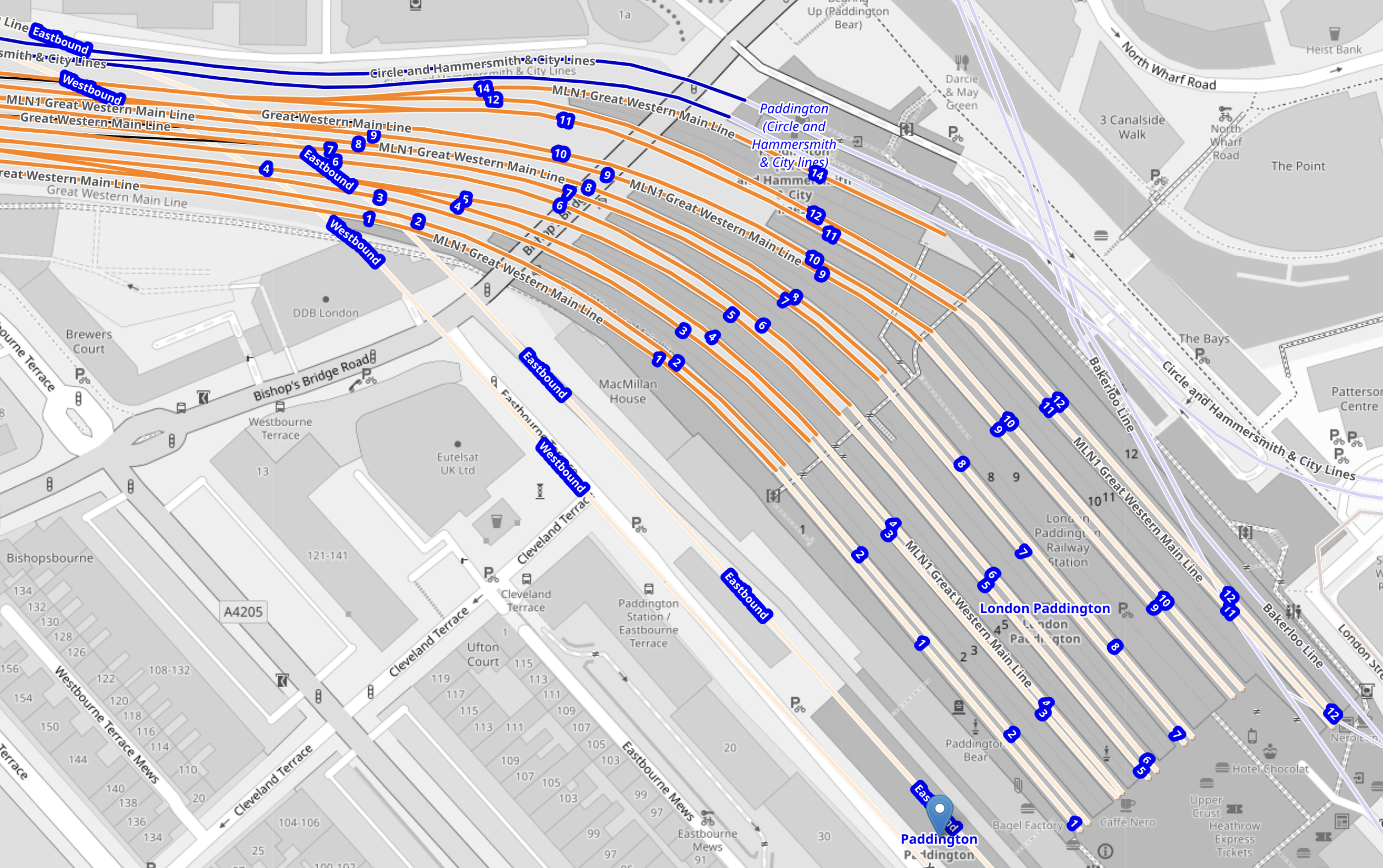
This OpenRailwayMap shows the platforms at Paddington station.
Note.
- The platforms are numbered 1 to 14 from South-West to North-East.
- Platforms 1 to 12 all appear to long platforms about the same length.
- As some platforms can take ten-car Class 800 trains, I wouldn’t be surprised to find out all platforms 1-12 can.
- The only short platform is platform 14, which can accommodate an eight-car Class 387 train, which is 163 metres long.
It looks to me, with twelve long similar platforms, they can schedule the platforms on the fly, so perhaps this explains, the randomness of platform allocations.
I think in an ideal world, I would try and organise these services as follows.
- The Oxford and Great Malvern services could share a platform at Paddington, which would help passengers to find the next Oxford train.
- The Didcot Parkway and Newbury services could also share a platform at Paddington, for the same reason.
- Unless Didcot Parkway and Newbury services are occasionally run by a twelve-car train, they could even use the short platform 14.
This would surely be a more efficient use of the platforms at Paddington station.
Could Didcot Parkway Services Become Another Elizabeth Line Destination?
Consider.
- Didcot Parkway to London Paddington services appear to use the same tracks as Elizabeth Line services between Reading and Southall West Junction, where they change to the main line for Paddington.
- London Paddington to Didcot Parkway services appear to use the main line from Paddington to Dolphin Junction, which is just to the East of Slough station, where it joins the same tracks as Elizabeth Line services to Reading.
- Nine-car Class 345 trains are forty metres longer than an eight-car Class 387 train.
- Class 345 trains are 90 mph trains.
- Class 387 trains are 110 mph trains.
- Class 387 trains wouldn’t fit the platform edge doors in the Elizabeth Line Central Tunnel.
It would appear that the Didcot Parkway and London Paddington services could be moved to the Elizabeth Line, by doing the following.
- The Class 387 trains would be replaced by Class 345 trains.
- Trains to London would go straight on at Southall West Junction and through the Elizabeth Line Central Tunnel.
- Trains from London would emerge from the Elizabeth Line Central Tunnel on the right track for Reading.
- There might be a need to lengthen a few platforms.
Note.
- The Didcot Parkway to London Paddington services would not need to use the main line.
- 2 tph would be removed from Paddington station.
As one electric train is being replaced by another, there would probably be no need for more electrification.
Could Newbury Services Become Another Elizabeth Line Destination?
Consider.
Freight trains appear to be able to go from Theale station to Platform 5 at Slough station, through Platform 15 at Reading station, which is a possible route that a Newbury to the Elizabeth Line Central Tunnel train would take.
Freight trains appear to be able to go from Platform 4 at Slough station to Theale station, through Platform 15 at Reading station, which is a possible route that an Elizabeth Line Central Tunnel to Newbury train would take.
It would appear that the Newbury and London Paddington services could be moved to the Elizabeth Line, by doing the following.
- The Class 387 trains would be replaced by Class 345 trains.
- Trains through Reading would follow the freight route.
- There might be a need to lengthen a few platforms.
Note.
- The Newbury to London Paddington services would not need to use the main line.
- 1 tph would be removed from Paddington station.
As one electric train is being replaced by another, there would probably be no need for more electrification.
Conclusion
It looks like the capacity of Paddington station can be increased by the following.
- Building a new second concourse at the Western end of the station.
- Heathrow Express releasing a platform.
- Oxford and Great Malvern services could share a platform at Paddington
- Moving Didcot Parkway and Newbury services to the Elizabeth Line.
No new electrification would be required.
Effects Of The ULEZ In West London
This page on the Transport for London web site is entitled ULEZ Expansion 2023.
This is the first paragraph.
To help clear London’s air and improve health, the Ultra Low Emission Zone (ULEZ) is expanding across all London boroughs from 29 August 2023.
These are some points from the rest of the page.
- Poor air quality is impacting the health of Londoners, and it’s mainly caused by polluting vehicles.
- Air pollution even contributes to the premature death of thousands of Londoners every year.
- 9 out of 10 cars seen driving in outer London already meet the ULEZ emissions standards.
- If you drive anywhere within the ULEZ and your vehicle does not meet the emissions standards, you could face a daily charge of £12.50.
- Residents of the ULEZ are not exempt from the charge.
- Any money received from the scheme is reinvested into running and improving London’s transport network, such as expanding bus routes in outer London.
There is no reference to trucks or HGVs.
These are my thoughts.
Objections To The ULEZ
If you type ULEZ into Google and look at the News page, you get a lot of stories that don’t show the ULEZ in a good light.
Here are a few headlines.
- BBC – ULEZ: Labour MPs Seek Support For Non-Londoners
- BBC – Firms In Essex Could Close Due To ULEZ, Warns Business Leader
- Big Issue – London’s Ulez Plans Could Hit Disabled People, Charities And Small Businesses The Hardest
- Daily Mail – Sadiq Khan Claims That Nazis Have Infiltrated Anti-Ulez Protests
- Guardian – EU Motorist Fined Almost £11,000 After Falling Foul Of London Ulez Rule
- Guardian – London’s Mayor Faces High Court Challenge Over Ulez Expansion
- Kent Live – Anti-ULEZ Campaign Group Support Soars As Kent Drivers ‘Unfairly Targeted’
- LBC – No More Ulez? Sadiq Khan Considers Scrapping Controversial Scheme And Replacing It With ‘Pay-As-You-Drive’ System
- Slough Observer – Ulez Faces High Court Challenge
- Which? – Why It Could Cost £17.50 To Drop A Loved One At Heathrow This Summer
It looks like Sadiq Khan has fallen into a hole.
And he hasn’t stopped digging!
To make it worse, he has suggested a Pay-As-You-Drive System. I seem to remember, that a Dutch Prime Minister, who tried it, lost the next election.
But then Sadiq Khan likes tolls as the new Silvertown Tunnel and the Blackwall Tunnel will be tolled in a few years.
Heathrow Airport
Heathrow Airport is one of the world’s busiest airports and 76,000 people work at the airport, with many more employed nearby.
The airport handled 61.6 million passengers in 2022, which is a few short of 170,000 per day.
If you consider that those that work at the airport do two trips per day and passengers generally do one, that means there are 322,000 trips per day to or from the airport.
But as it now so easy to get to the Airport using the Elizabeth Line will more people use the new line to meet and greet and say goodbye to loved ones or business associates. Since the Elizabeth Line opened, I’ve met a couple of friends at Heathrow, who were passing through.
I wonder, if that daily journey total of 322,000 could be nearer to 350,000 or even 400,000.
If the ULEZ charge makes some passengers and staff switch from their car to using a bus or train, this probably means that public transport to and from the airport, will need to be boosted by a substantial amount.
But improving public transport to Heathrow wouldn’t be easy.
- The Elizabeth Line seems to have put a big hole in the finances of Heathrow Express.
- How many more trains can be squeezed into the Heathrow Tunnel?
- The Western Rail Link to Heathrow would probably need to be built. But that seems to be in limbo.
- New trains for the Piccadilly Line are a few years away.
It might have been better to build a different scheme for Western access to Heathrow like the Heathrow Southern Railway.
I suspect that there will be a lot more passengers on the Elizabeth Line to and from Heathrow.
A ULEZ For Heathrow
This article on fleetworld, from four years ago, is entitled Heathrow To Introduce Charging ULEZ In 2022.
It hasn’t happened, but that doesn’t mean it won’t be implemented in the future.
If it did happen, there would be more passengers for the Elizabeth Line.
The Elizabeth Line
I have written three posts about how busy the Western section of the Elizabeth Line can get.
- Very Busy Lizzie
- Elizabeth Line: Commuters Say Service ‘Not What Was Promised’
- So Many Cases On A Train!
Is there sufficient capacity to accommodate all the ULEZ-dodgers on the trains to and from Heathrow?
To make matters worse, there is a large Asian population from the Indian sub-continent living along the Elizabeth Line between Ealing Broadway and Reading.
- They seem to be enthusiastic users of the line.
- Having ridden several times on crowded Indian trains, perhaps using trains is very much part of South Asian culture.
- I also suspect that a lot of Indian families have spread themselves along the line, just like my mother’s close family spread themselves along the 107 bus route.
In Very Busy Lizzie, I said this.
Reading needs four tph to Central London.
The ULEZ will make this even more essential.
The Piccadilly Line
The Piccadilly Line may be getting new trains, but it is not a line that is blessed with lots of step-free stations.
The West London Orbital Railway
It does appear that the West London Orbital Railway may be more likely to be built, than a few months ago.
In Is There Progress On The West London Orbital Railway?, I wrote about a report, that consultants were being chosen.
This railway could ease pressure on the railways in West London.
Cutting Pollution In London From Trucks
London like all big cities has a lot of trucks.
As the average truck has a much larger engine than the average car, I would suspect it gives out more pollution.
One way to cut pollution from large vehicles would be to run them on hydrogen.
But unlike some cities in the UK, London has no hydrogen policy and filling stations to fill them up.
The Mayor could at least get a workable hydrogen policy.
Conclusion
I suspect the next Mayor of London will have to have a rethink on the ULEZ and implement a hydrogen policy.
So Many Cases On A Train!
This afternoon about three, I went to West Ealing station to see what it was like to transfer between the Elizabeth Line Central Tunnel and the Western Branch at Paddington.
Coming back, I took an Elizabeth Line service that had started from Heathrow Airport and it was one of the busiest Lizzies, I’d ever ridden!
To get on the train at West Ealing station, I got in to probably coach 4 of 9, as that was in the dry and the back end of the train I needed for Moorgate station was certainly in the wet.
I then had to walk half the length of the train to get to the back of the train.
It was not easy, as the train was full of scores of passengers with large wheelie cases.
This got me thinking.
Are Passengers Transferring To The Lizzie Line?
And especially those with large cases. that are the sort you could use for bringing in a pair of folded-up contortionists.
- These cases don’t fit well on the Piccadilly Line, which has only a few step-free stations.
- From what I’ve seen cases are easily wheeled to Elizabeth Line platforms at Heathrow.
- Many of these cases won’t fit in the average family car.
- All parking is expensive at Heathrow, whether it is short, medium or long.
- Valet parking at Heathrow has been devalued by all the scam artists.
- Taxis are the province of those that own oil wells, hedge funds or belong to the highest wunch of bankers.
- Pick-up and drop-off is now very expensive.
- There were a good proportion of couples, who were both dragging or pushing a massive case.
- The Elizabeth Line is cheaper than the Heathrow Express.
- The Elizabeth Line like the Piccadilly Line allows the use of a bank card as a ticket.
- Only the Elizabeth and Piccadilly Lines take you direct to dozens of stations with only same-platform interchanges.
- The Elizabeth Line has step-free interchanges with the Bakerloo, Circle, District, Hammersmith and City, Jubilee, and Metropolitan Lines, the Docklands Light Railway and the London Overground.
- Whitechapel has been turned into a major transport hub for the Easternmost part of London.
There seems to be quite a few reasons why a traveller going to or from Heathrow might at least try the Elizabeth Line.
And travellers seemed to be doing it in droves today!
Were Upmarket Passengers Using The Lizzie Line?
Take the couple next to me on the train from West Ealing.
- Around sixty.
- Very well-dressed.
- Possibly Mediterranean or South American.
- Matching medium-size wheelie-cases.
- She was wearing expensive glasses.
A couple of years ago, they would have probably used the Heathrow Express.
They certainly weren’t the only passengers, who looked like archetypal Heathrow Express passengers.
Will The Lizzie Line Take Passengers From The Piccadilly Line?
As the cost will be the same, I suspect the answer will be yes.
Although, there will be groups of travellers, who will probably remain loyal to the Piccadilly Line.
- If you were going to or from the step-free Cockfosters or Oakwood, with a heavy case, all the way on the Piccadilly Line could be a simple sensible option. I used to live near Oakwood station and remember several long trips on the Piccadilly Line, but not too Heathrow.
- The step-free Kings Cross St. Pancras, Green Park, Knightsbridge and Earls Court may well have reasons to keep their regular passengers.
- Those only travelling a few stops to or from Heathrow will probably stay with the Piccadilly Line for convenience.
- Transport for London have been adding step-free access to the Heathrow Branch and this will surely promote use.
The Piccadilly Line is also getting new trains in a few years.
In Extending The Elizabeth Line – Piccadilly Line To Ealing Broadway, I talked about a proposal to turnback some Piccadilly Line trains at Ealing Broadway station.
I think it is a good idea, as it could make it simpler for Piccadilly Line passengers to access Heathrow and reduce congestion on the Piccadilly Line.
Will The Lizzie Line Take Passengers From The Heathrow Express?
This is an extract from Extending The Elizabeth Line – Piccadilly Line To Ealing Broadway
It will be difficult to predict what will happen to Heathrow Express, but I suspect several groups of passengers will desert it.
- Passengers wanting to go anywhere East of Paddington without changing trains.
- Passengers wanting any Elizabeth Line station.
- Passengers, who don’t like the prices of Heathrow Express.
- Passengers using Oyster or contactless cards.
- Passengers who want to ride on London’s spectacular new Elizabeth Line.
After Old Oak Common station is opened for High Speed Two, the numbers could further decrease.
Will Heathrow Express survive?
Will The Lizzie Line Attract Passengers Who Usually Drive?
Large swathes of the country already have single-change step-free access to the Elizabeth Line.
- All services out of Liverpool Street and/or Stratford.
- All services out of Moorgate.
- All Thameslink services through Farringdon.
- All services out of Paddington.
- All services through Abbey Wood.
- When Crossrail to Ebbsfleet (C2E) opens, this will add all services through Gravesend and Ebbsfleet.
- When High Speed Two opens, this will add all services through Old Oak Common.
- When the Western Rail Approach To Heathrow is completed, this will add all services through Reading.
If you can get a train direct to the Elizabeth Line network and then a train direct to your terminal, would you seriously want all the hassle of parking after a two hour drive?
I can see parking at Heathrow suffering a severe lack of demand.
Conclusion
Lizzie will start a revolution in travel to and from Heathrow.
What Will Boris Do About The Proposed Third Runway At Heathrow?
I have tackled this before in October 2016 in a post called Changing Sides.
This was how I started that post.
There is an interesting article in The Sunday Times today, entitled Boris Retreats In Fight Against Third Runway.
Boris is apparently saying he won’t oppose a third runway at Heathrow, so if anything he’s being consistent in changing horses, just as he did with Michael Gove.
But perhaps more surprisingly, Willie Walsh, the Chief Executive of IAG, who own BA, is quoted as calling Heathrow a fantasy project, which has been gold-plated and inflated by the owners to maximise their returns, at the expense of the airlines.
The paper also says that Gatwick will build a new runway anyway.
Remember, it was written before Theresa May’s government decided to allow Heathrow’s Third Runway.
Since the decision to allow Heathrow to build a Third Runway was made nearly three years ago in October 2016, there have been a lot of changes.
Notably, Boris has gone from Foreign Secretary and an MP in a Heathrow Expansion-opposing constituency to Prime Minister.
As Prime Minister he is supposed to look at the bigger picture.
Unless he’s totally stupid he must have noted the following.
Brexit Has Changed From A Simple Quick Exit Into A Slow And Very Tortuous Process
I would expect an opinion poll would show that the UK population thinks that sorting out Brexit is a much more important problem, than the decision on a new runway in the South East of England.
So will Boris put Heathrow’s Third Runway on the back burner, given the following factors
Gatwick Will Build A Second Runway Anyway
In the Wikipedia entry for Gatwick Airport, there is a section entitled Expansion Proposals, where this is the first paragraph.
Gatwick has been included in a number of reviews of airport capacity in southeastern England. Expansion options have included a third terminal and a second runway, although a 40-year agreement not to build a second runway was made in 1979 with West Sussex County Council. Expanded operations would allow Gatwick to handle more passengers than Heathrow does today, with a new terminal between two wide-spaced runways. This would complement or replace the South Terminal, depending on expected future traffic.
My project management knowledge tells me, that Gatwick could add a second runway and upgrade the terminals in a shorter time, than Heathrow can build a third runway.
But more importantly, Gatwick Airport could build the extra runway and terminal without disruption to airport passengers, aircraft and road traffic on the nearby M23.
Boris’s only problem with Gatwick expansion, is the amount of post he’ll get from Disgusted of Tunbridge Wells.
Disruption Must Be Avoided
Recent timetabling and construction fiascoes on Thameslink and Northern Rail should have sent a message to politicians, that large infrastructure projects must be created without disrupting train or air passengers and road traffic.
Can Heathrow Be Built Without Disrupting Traffic On The M25?
It is interesting to look back at the basic facts at the construction of Heathrow Terminal 5.
- A public enquiry into the project lasted 525 days.
- The terminal sits on a 260 hectare site.
- Construction started in 2002.
- The terminal opened in 2008.
- Construction finisged in 2011.
- The terminal cost £4.2billion.
The construction of Terminal 5, also needed the M25 to be widened and linked to the terminal.
This Google Map shows Heathrow Terminal 5 and its relationship to Heathrow’s current two runways and the M25.
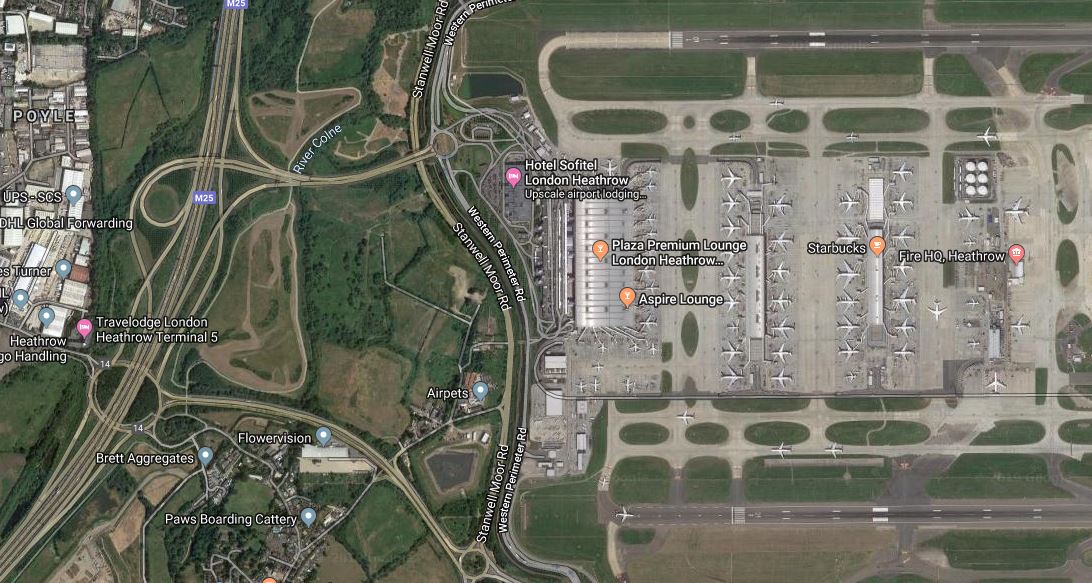
I remember the construction of Terminal 5 well, if only because, I was stuck in or moving slowly along that section of the M25 so many times.
As this immense construction project, is probably in living memory of much of the population of West London, how will they react to the thought of all the disruption, that building the third runway will cause.
Would Uxbridge, throw Boris out, if he approved the building of a third runway at Heathrow?
Heathrow Is A Pollution Blackspot
Various factors mean, that the surroundings of Heathrow are a pollution blackspot, mainly caused by the large number of diesel vehicles on the M4 and M25 motorways and others bringing passengers and goods to the airport.
I believe that any Planning Permission for the third runway, will require Heathrow to do something about the pollution. This could be easier than anybody thinks, as more of us will be using electric vehicles by the time the runway opens.
Heathrow are already proposing their ULEZ or Ulta Low Emission Zone.
Heathrow Rail Access Will Improve
Crossrail will eventually serve Heathrow in a year or so and this will improve rail access to the Airport significantly.
Other rail links are also in prospect.
- The Western Rail Approach to Heathrow could be open by 2024.
- Heathrow Southern Railway could be built.
- The West London Orbital could be built.
The first two would be privately financed.
This better rail access may reduce the traffic and pollution around the airport, but it will make it easier, for passengers to use the airport and traffic will grow.
High Speed Rail
Increasingly, Heathrow and the other London airports, will come under competition from High Speed Rail.
Eurostar has upwards of seventy percent of the London-Paris and London-Brussels passenger markets.
I have travelled a few times from London to Amsterdam on Eurostar and feel that four hours is my limit for comfortable train travel.
I estimate the following journeys would be possible on Eurostar.
- London and Cologne via Brussels in four hours
- London and Bordeaux via Paris in four and a half hours.
- London and Frankfurt in Five hours.
Another competitor to air services out of London will be London and Edinburgh services on the East Coast Main Line, which are being updated with new faster trains and journey times under four hours.
Air Cargo And Heathrow
I looked up air cargo in Wikipedia and these points are there.
- Fifty-percent of all air frieght is belly-cargo on airlines.
- An industry expert estimates that 15-20 tonnes of air cargo is worth 30-40 economy passenger seats, when both are on passenger planes.
- In 2017, the IATA observed a 9% rise in freight tonne kilometres
- Boeing is doubling its 767F production since 2016 to three per month in 2020.
Heathrow dominates the air cargo traffic into and out of the UK and last year it handled 1,788,815 tonnes of cargo, which was a 5.3% increase in tonnage on 2017.
However, it does appear that the second largest cargo airport in the UK; East Midlands, handled about the same amount of freight as Heathrow in April 2018.
There is also the East Midlands Gateway close to that airport, which will be a massive logistics park., with a rail connection.
Perhaps the pressures of the congested Heathrow, with some nudging from the Government could remove the cargo aircraft from the airport to more suitable airports like East Midlands and Doncaster Sheffield.
Manchester Airport Is The Most Important Airport North Of London
Manchester Airport is the busiest Airport after Heathrow and Gatwick and over the next few years it will catch up to a certain extent.
In Changes Signalled For HS2 Route In North, I said this about Manchester Airport’s rail connectivity if High Speed Two and Northern Powerhouse Rail are combined across the Pennines.
If High Speed Two and Northern Powerhouse Rail are developed as laid out in the Transport for the North report, the following cities will be connected to Manchester Airport.
- Birmingham – High Speed Two
- Blackpool – Northern Powerhouse Rail/West Coast Main Line
- Bradford – High Speed Two/Northern Powerhouse Rail
- Carlisle – Northern Powerhouse Rail/West Coast Main Line
- Edinburgh – Northern Powerhouse Rail/East Coast Main Line
- Glasgow – Northern Powerhouse Rail/West Coast Main Line
- Hull – High Speed Two/Northern Powerhouse Rail
- Leeds – High Speed Two/Northern Powerhouse Rail
- London – High Speed Two
- Newcastle -High Speed Two/Northern Powerhouse Rail
- Preston – Northern Powerhouse Rail/West Coast Main Line
- Sheffield – Northern Powerhouse Rail
- Sunderland – Northern Powerhouse Rail
- York – High Speed Two/Northern Powerhouse Rail
Manchester Airport will probably become the most important station in the North with High Speed connections to a large part of England and Scotland.
Heathrow and Gatwick will find they have a very big and well-connected Northern competitor.
Extinction Rebellion And Other Environmental Protesters
Most of the environmental protesters like Extinction Rebellion seem to have focused their attention on Heathrow, where airports are concerned.
They will fight tooth and nail to stop Heathrow’s third runway.
Will Heathrow Get The Planning Permission They Need?
I think that this is the sort of planning decision, that will end up with the Secretary of State for Environment, Food and Rural Affairs; Theresa Villiers.
Her Wikipedia entry says this.
Villiers favours construction of a high-speed rail link from London to Birmingham and Manchester, arguing that flyers could use capacity at airports such as Birmingham International and Manchester International Airport.
She is also quoted as being against a third runway at Heathrow, when she was a member of Davisd Cameron’s cabinet.
Grant Schapps, who is the current Secretary of State for Transport, could be more supportive to Heathrow’s application.
The Mood Of The UK About The Environment
The view of the average UK voter on the environment has changed markedly in the last few years, driven by documentaries, events and politics from around the world.
Boris’s father; Stanley Johnson has written books on the environment and received the Greenpeace Award for Outstanding Services to the Environment, so this could fit with his opposition to a third runway at Heathrow, when he was Mayor of London.
Do Heathrow Airport Have A Plan B?
In Heathrow Plans Runway Over M25 In 30-Year Expansion, I outlined how I thought the runway would be built.
The Times says this about the construction program.
Only the runway would be built by the opening date of early 2026.
Other facilities such as new terminals, car parks, hotels and transit systems would open from 2030, with an expansion of Terminal 5 the priority
This means that the extra runway capacity can be used initially to better accommodate the same number of flights.
Perhaps Plan B would mean changing the order of construction, leaving a space for the third runway and getting Planning Permission to build it in perhaps starting in 2028.
Conclusion
This is a tough one to call and I know what I would do. I would just let it fester until the decision was forced by another factor.
But Boris is the Prime Minister and will have to make a decision!
D
Heathrow Plans Runway Over M25 In 30-Year Expansion
The title of this post, is the same as that of an article in Saturday’s copy of The Times.
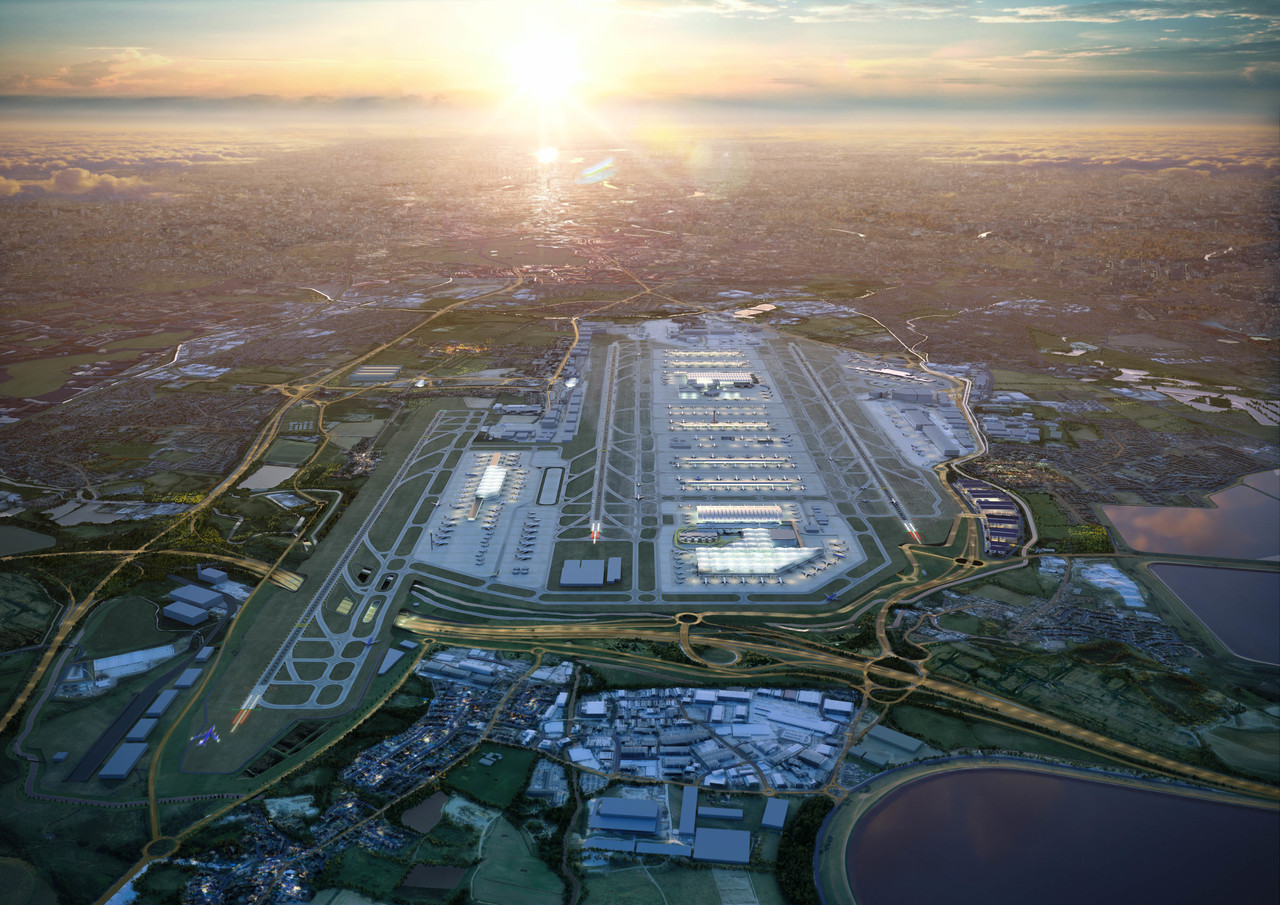
This picture, which I downloaded from this page on the Heathrow web site, shows the proposed expansion.
For comparison this Google Map shows the Airport recently.

These are some of my thoughts.
The Position Of The Third Runway
As can be seen, the new third runway is to the North-West of the North Runway.
- It will extend all the way to the M25.
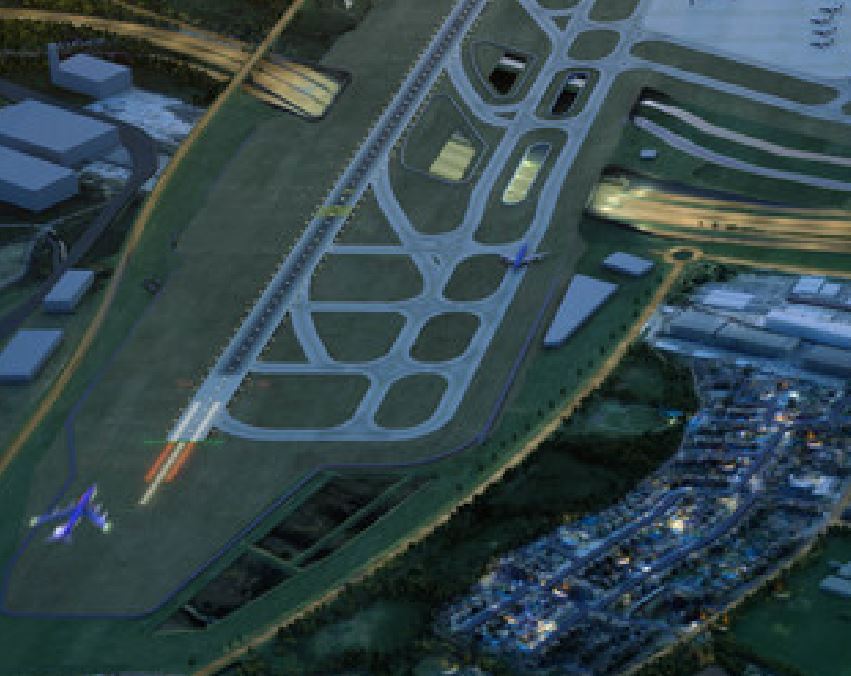
- The M25 will be lowered and the new runway and two parallel taxiways will cross the road on a series of bridges.
This enlargement from the first image shows the crossing of the M25 and two other roads.
Note.
- The runway is on the left, which increases the spacing with the North Runway
- How openings between the runway and the taxiways will allow natural light onto the motorway.
- In the picture you can see five angled taxiways joining the runway from the two taxiways. Does this design mean that aircraft spend a minimum of time queuing for take-off? Similar but not so extreme layouts can also be seen on the two existing runways.
What intrigues me, is what looks to be a hole in front of the ends of the taxiways.
Could it be rail or road access to the airport?
This map from Network Rail shows the route of the proposed Western Rail Approach To Heathrow.
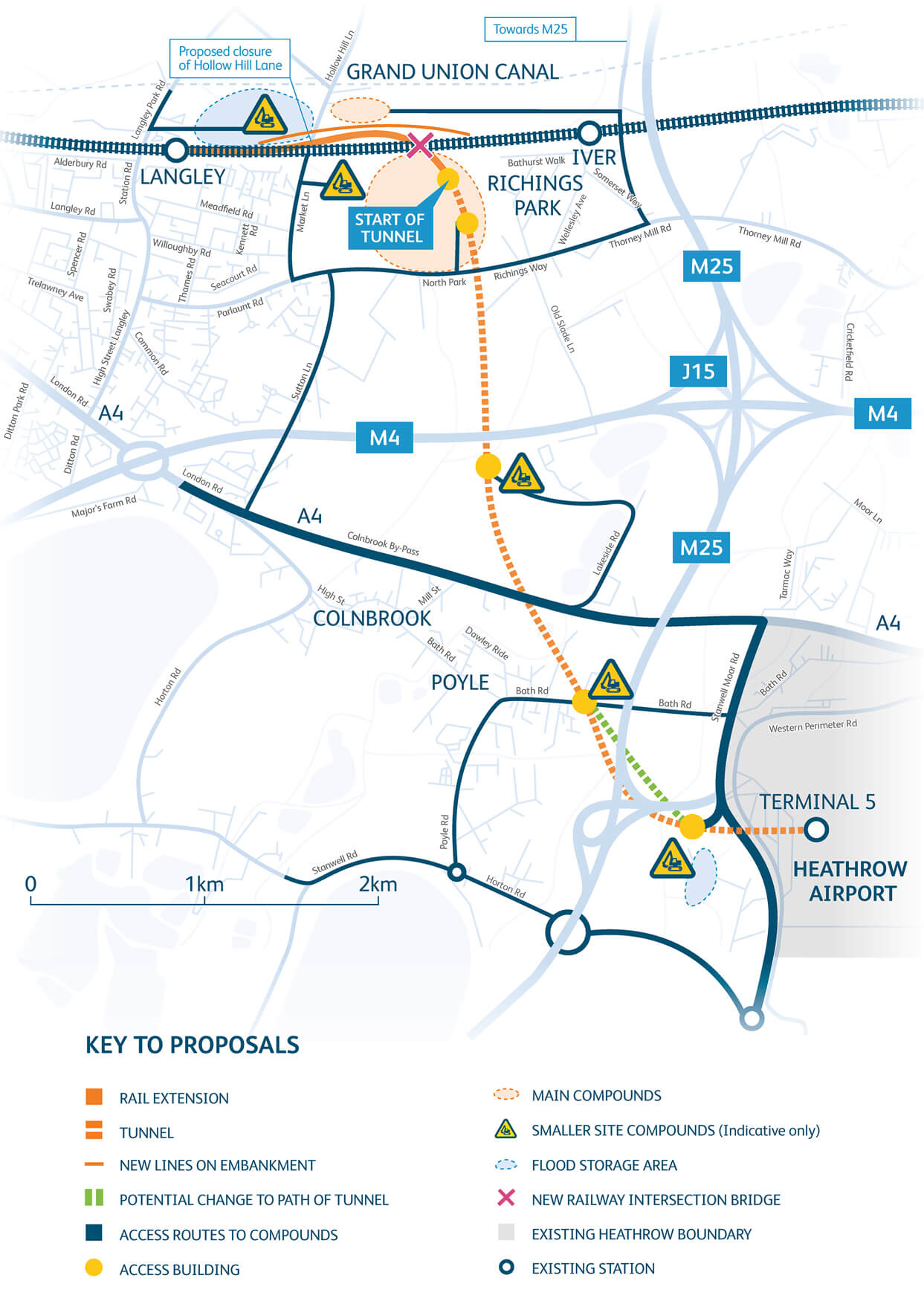
It looks like the dark holes could be the railway, between Langley and Terminal 5.
This section of the rail link is supposed to be in tunnel, but I wonder if costs could be saved if it is in a buttressed cutting, designed in cooperation between Heathrow and Network Rail.
Obviously, it will need to be in tunnel to cross under the M25.
I think that rather cleverly, the runway has been slotted in with the best use of the limited land available.
A Phased Construction Program
The Times says this about the construction program.
Only the runway would be built by the opening date of early 2026.
Other facilities such as new terminals, car parks, hotels and transit systems would open from 2030, with an expansion of Terminal 5 the priority
This means that the extra runway capacity can be used initially to better accommodate the same number of flights.
If Heathrow get it right passengers. should see the following.
- They would suffer less from construction.
- Fewer taxi delays on the ground.
- Less long fuel-burning taxiing between gate and runway.
- More flights leaving on time.
It might also enable air traffic controllers to allocate aircraft noise in a fairer manner.
Car Psrking
Two huge new car parks are to be built North and South of the Airport, which in conjunction with new hotels would be connected to the terminals by an underground transit system.
This article on International Airport Review is entitled Heathrow To Launch First Airport Ultra Low Emission Zone.
So doesn’t the building of large car parks contradict this policy.
It would unless, the car parks are designed for the future.
- Electric cars only.
- Intelligent chargers for every parking space.
- Whilst the cars are parked and connected, they would be a massive energy storage battery for the National Grid.
When you arrived back to your car after a week in Greece, there would be enough power in the battery for your next journey.
By 2030, there will be a substantial need for parking for electric cars at railway stations and airports. Parking solutions like this will help reduce the carbon footprint of airports.
Conclusion
2030 is ten years away and Heathrow will have to work hard to build an airport fit for those times.
Is There A Need For A Waterloo To Gatwick Service?
Whilst writing Are Network Rail And Heathrow Southern Railway Moving Towards A Joint Project On Western And Southern Access To Heathrow Airport?, I got to thinking about connectivity to London’s two main airports; Heathrow and Gatwick.
If both the Western Approach To Heathrow (WRAtH) and Heathrow Southern Railway (HSR) schemes are completed, Heathrow will have direct connections to the following major stations and areas.
- Canary Wharf using Crossrail
- City of London using Crossrail
- Clapham Junction using HSR
- HS1 using a future Crossrail to Ebbsfleet
- HS2 using Crossrail
- Liverpool Street using Crossrail
- Reading using WRAtH
- Waterloo using HSR
- West End using Crossrail
Many more places will need a single change at Clapham Junction, Farringdon, Reading, Stratford, Waterloo or Woking.
Awkward stations to get to and from Heathrow include Kings Cross, London Bridge, St. Pancras and Victoria.
Admittedly, Kings Cross, London Bridge and St. Pancras can be reached using Crossrail and Thameslink or the Underground, but Victoria is not easy as Crossrail doesn’t have an interchange with the Victoria Line.
Gatwick will have direct connections to the following major stations and areas.
- City of London using Thameslink
- HS1 using Thameslink
- Reading using GWR
- Victoria using Southern or Gatwick Express
- West End using Thameslink
Many more places will need a single change at Clapham Junction, Farringdon, Reading, or Victoria.
Awkward stations to and from Gatwick include Canary Wharf, Euston, Liverpool Street, Paddington and Waterloo.
Consider these points about Waterloo station.
Waterloo Has The Connectivity
Waterloo is on four Underground lines.
- Bakerloo Line for North West London, Paddington, West End,, South East London and North East London in collaboration with Dear Old Vicky!
- Charing Cross Branch of the Northern Line for North London, Euston and the West End.
- Jubilee Line for North West London, West End, Canary Wharf and Stratford.
- Waterloo & City Line for Bank and the City of London.
Waterloo also has its own network of frequent and comprehensive services to South West London and further afield.
Waterloo Could Be Getting Crossrail 2
In Sadiq Khan’s dreams!
The Bakerloo Line Extension and the West London Orbital Railway are much more urgent to be built, but they don’t serve Surrey, where posh commuters live!
Waterloo Is Almost A Tourist Destination
I say almost, as it is just a short walk from Westminster, several important museums and galleries, and the Thames.
Waterloo Station Is A Place To Meet Friends And Business Associates
I regularly meet friends as they pass through Waterloo station, as it has several restaurants, where you can sit, eat, drink and chat.
Waterloo Station Is Going To Be Developed
Plans are being developed to build above Waterloo station.
Could this include more hotels, in addition to offices and housing?
Why Has There Been Talk Of A Service Between Waterloo and Heathrow For Years, But Nothing About A Link To Gatwick?
Heathrow AirTrack was proposed by BAA some years ago and now Heathrow Southern Railway are putting in a privately-funded proposal.
But search for a proposal for a direct service between Waterloo and Gatwick and you find nothing sensible.
- Could it be that the route is too difficult or there is not enough capacity at Gatwick and/or Waterloo?
- Is it that a route to Heathrow would be much more profitable, as it is so much bigger?
- Is it tradition? Waterloo serves the South West and London Bridge and Victoria serves the South.
But time is moving on, a larger Waterloo and Gatwick stations are coming and Network Rail are getting some of their best brains around digital signalling.
A Waterloo And Gatwick Airport Service
As Gatwick expands, I believe that a direct service between Waterloo and Gatwick Airport will become more necessary.
The Route Of The Service
I’m not sure of this, but I believe that there is a route between Waterloo and Streatham Common or East Croydon stations, which could be used for a Waterloo to Gatwick service.
- It may need to use the flyover at Waterloo, that used to be used by Eurostar.
- I wrote about using the flyover in Waterloo Upgrade August 2017 – Waterloo To Sevenoaks.
- Could it use a route like Brixton, Herne Hill, Tulse Hill, West Norwood, Gipsy Hill, Crystal Palace, Norwood Junction and East Croydon?
- Once on the Brighton Main Line it would be plain sailing.
- Of the stations on the route I mentioned, only Norwood Junction has a direct service to Gatwick.
- A rebuilt Brixton station with its Victoria Line connection could be a valuable interchange.
- Crystal Palace will have a six trains per hour (tph) service on the Overground to Highbury & Islington.
- The route is fully electrified using third-rail.
I’m sure a practical and useful route can be found.
The Frequency Of The Service
Gatwick, Heathrow and Stansted Express services have a frequency of four tph.
So I wouldn’t think it unreasonable for a service between Waterloo and Gatwick Airport stations to have the same frquency.
Express Or Typical Suburban Service
Airport trains around London fall into two styles.
- Express – Gatwick Express, Heatrow Express and Stansted Express.
- Typical Standard Suburban Train – Crossrail and Thameslink.
As I am happy to use Thameslink to Gatwick, I have no particular preference. Except that if getting an early flight out of Gatwick, I take a night bus to Victoria and then use Gatwick Express, as it runs all night.
Passenger demand would decide, the level of service.
Trains For The Service
An appropriate train would be chosen to match the service style.
- Express – Class 387 train as per Gatwick or Heathrow Express
- Suburban Train – SWR’s Class 701 train
Both would do a very capable job.
Platforms At Waterloo
If I assume that Heathrow Southern Railway’s four tph service between Waterloo and Heathrow uses a single platform at Waterloo, I would expect it will be one of the higher-numbered platforms.
So could a Gatwick service with the same frequency use the next door platform?
This would surely be very convenient.
Conclusion
I think it is quite likely that a service between Waterloo and Gatwick Airport could be run.
But whether it is worthwhile is another matter.
Are Network Rail And Heathrow Southern Railway Moving Towards A Joint Project On Western And Southern Access To Heathrow Airport?
In Could Rail Access To Heathrow Be Formed Of The Best Bits Of Various Schemes?, which I wrote in August 2018, I came to an extensive series of conclusions, which I have now changed as HS4Air and Windsor Link Railway have now been consigned to the landfill site of unbuilt projects.
In Could Rail Access To Heathrow Be Formed Of The Best Bits Of Various Schemes, But Discounting HS4Air And Windsor Link Railway?, I give my latest views.
These were my conclusions.
Heathrow Connectivity
Heathrow needs a very high level of connectivity, for passengers, workers and freight.
The two major schemes, that are left, provide that.
- Heathrow Southern Railway, which extends Heathrow Express to the South West and provides links to Waterloo and Greater South London.
- Western Rail Approach To Heathrow does what it says in the name.
Both schemes would share the same Western access route to Terminal 5 station and this could be modified to serve a new rail terminal under the new third runway.
What About The Workers?
Heathrow’s other big need is rail access for the increasing numbers of people, who work at the airport and live locally.
- Heathrow Southern Railway links the airport to South West London.
- Western Rail Approach To Heathrow links the airport to Reading and Slough.
- Crossrail links the airport to Old Oak Common with its housing developments and rail connections with High Speed 2 and the London Overground.
- West London Orbital Railway will bring more workers and passengers to Old Oak Common from all over North West and South West London.
Old Oak Common will be important for many working at the airport.
Pollution Solution
As the airport develops, Heathrow Southern Railway and Western Rail Approach To Heathrow could together make a substantial reduction in the pollution emitted by the airport.
Old Oak Common station
Old Oak Common station will become an important interchange for workers and passengers travelling to and from Heathrow.
- It must be totally step-free.
- Some of the long interchange walks on current plans should be augmented by travelators.
- Crossrail is planning six tph between Old Oak Common and Heathrow. Is that enough?
Get Old Oak Common right and all those needing to go to and from Heathrow will benefit.
Heathrow And Gatwick
The connection between Heathrow and Gatwick airports is tortuous at present, but will get better as the years progress, as Crossrail and Thameslink improve.
As the airports grow, with a third runway at Heathrow and a second one at Gatwick, how many people will want to travel quickly between the two airports, as increasingly, both airports will offer services to more destinations?
As a Londoner, I also believe that we will see more split flights, where passengers stopover in London for a night or two, when they are going halfway around the world.
Terminal London will be the best airport transfer terminal in the world.
Heathrow And High Speed One
I will be very surprised if many travellers need to go quickly between Heathrow and High Speed One.
For those that need to do it, using an extended Crossrail between Heathrow and Ebbsfleet will probably be good enough.
Heathrow And High Speed Two
For all sorts of reasons Heathrow needs good connectivity to High Speed Two.
With the elimination of direct access to the airport by High Speed Two, a short journey between Heathrow Airport and Old Oak Common stations will have to be acceptable.
It should also be noted, that Network Rail’s Western Approach To Heathrow (WRAtH) and Heathrow Southern Railway (HSR) would share the following infrastructure or interests.
- Heathrow Terminal Five station.
- The Western access tunnel and track to Heathrow.
- Network Rail is planning a flyover at Woking, which would help HSR’s plans.
If a rail terminal were to be built under a new third runway, that too would be shared.
An Update On Heathrow Southern Railway
In the May 2019 Edition of Modern Railways there is an article which Is entitled Time For Action On Heathrow’s Southern Link.
Most of the article takes the form of an interview with Graham Cross, who is the Chief Executive of HSR.
The first part is a call to the Government to make a decision soon, as otherwise HSR’s funding and timescale will be at risk.
In the rest of the article, Mr. Cross talks about the project and introduces some changes.
More Tunnels
This is an extract from the Modern Railways article.
The line would be mainly in tunnel to minimise environmental impact. “We would need to tunnel under certain obstacles anyway, and once you’ve set up tunnel boring machines, you might as well stay underground.” says Mr.Cross.
Could this move to tunnels also be driven by improved tunnelling techniques and cost savings, in addition to the environmental impact?
If so, will we be seeing more new tunnels in the UK, for rail, roads, electricity and sewage?
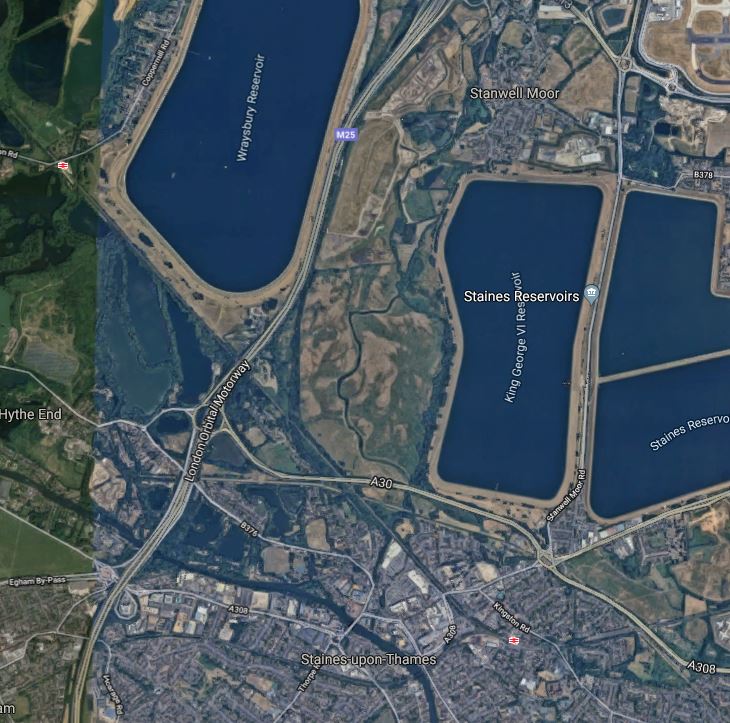
This Google Map shows the Northern section of the HSR route.
Note
- The South-Western corner of Heathrow Airport can just be seen in the North-Eastern corner of the map.
- Wraysbury station is towards the North-Western corner of the map.
- The M25 running North-South
- Staines station is the station South of the King George VI Reservoir
- The Staines-Windsor Line running North-West from Staines station.
- The Waterloo-Reading Line running West from Staines station.
The HSR would need to thread its way on the Eastern side of the M25.
From the map in the Modern Railways article, it appears that the route from Heathrow Terminal 5 station splits into two Southerly routes a short distance to the East of the point where the Staines-Windsor Line goes under the M25.
This map from carto.metro.free.fr may help to make everything clearer.
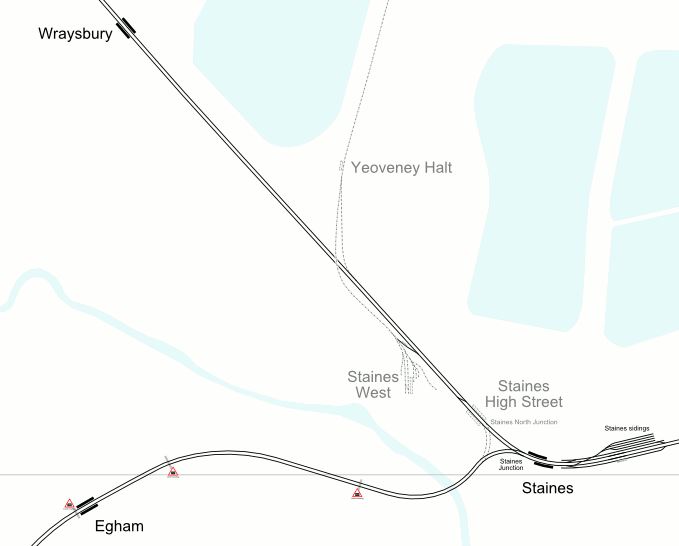
Note.
- The reservoirs are shown.
- The troublesome level crossings between Staines and Egham.
- It also spears that there is a disused railway going North through Yeovenney Halt.
- Yeovenney Halt would not be far from the route of the HSR to the East of where the M25 and the Staines-Windsor Line cross.
This Google Map shows the area in detail.
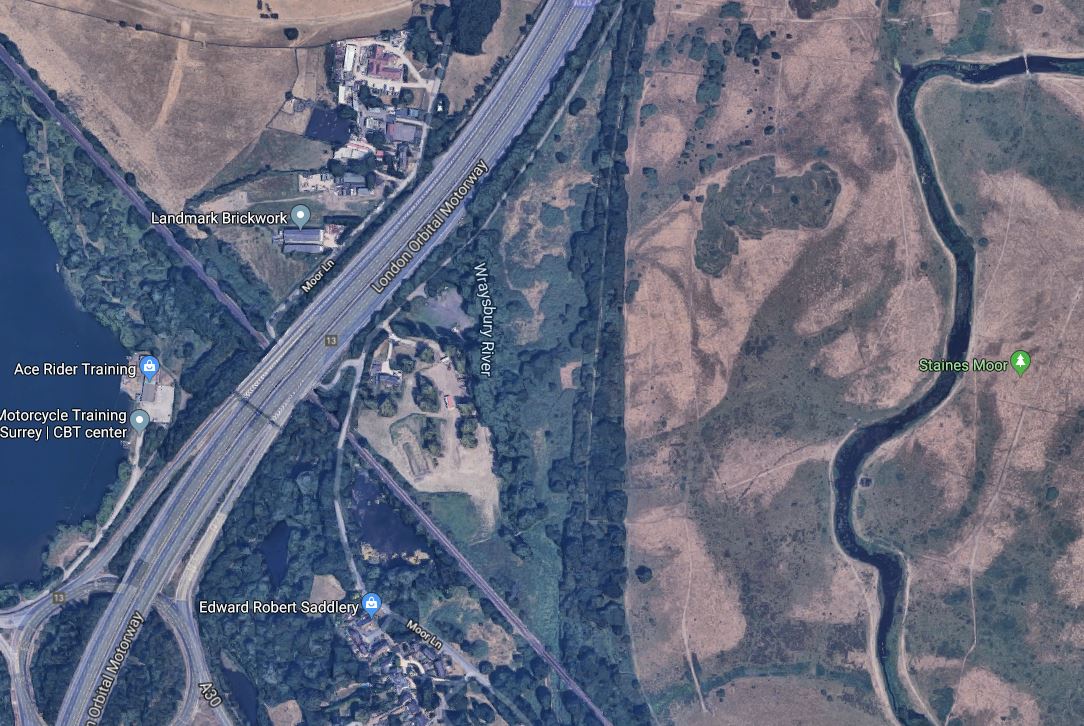
It’s not an area that with large numbers of houses and businesses.
Two routes are shown for HSR on the map in Modern Railways from the area to the East of where the M25 and the Staines-Windsor Line cross.
- One route joins the Staines- Windsor Line to take trains to and from Staines station.
- A second route is shown passing under the Staines-Windsor Line.
Note.
- As there is plenty of space, a flyover could be built if needed to connect Heathrow Airport to Staines station.
- The space would also be useful for creating a tunnel portal to continue the route to the South.
Two options are shown on the map in Modern Railways, to connect Heathrow to the Chertsey Branch Line.
Option 3 connects to North of Virginia Water station.
Option 8 connects to North of Chertsey station.
This Google Map shows Virginia Water and Staines stations and the area in between.
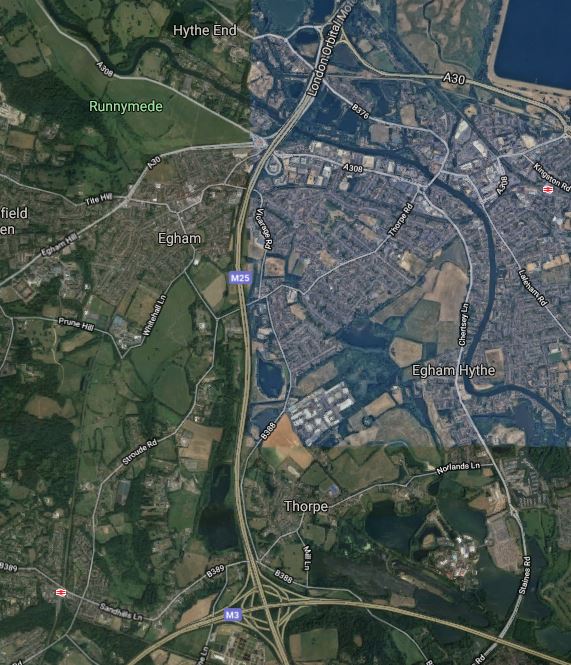
Note
- Virginia Water station is towards the bottom-left of the map,
- Staines station is towards the top right.
- The area of Yeovenney Halt can just be seen.
This Google Map shows the area between M25 and Chertsey station.

Note that Chertsey station is in the South-East corner of the map.
It looks like one or even both of the routes from Yeovenney Halt to the Chertsey Branch Line could be fairly easy to dig.
- There could be suitable sites at both Virginia Water and Chertsey.
- The distance is under ten miles.
- Much of the work could probably be done without closing the railways.
- There’s space for a flyover at both locations.
- Very few, if any business or residents would need to sell up and move.
- The tunnels could even be under the M25.
As Mr. Cross said, tunnelling could be a good option.
As WRAtH will also be tunnelled could both twin bore tunnels be dug with the same tunnel boring machines? Or as part of the same contract?
There certainly seem to be options for co-operation between the two projects to save money.
No West-Facing Triangular Junction At Staines
This is an extract from the Modern Railways article.
An earlier idea to create a triangular junction with a west-facing connection towards Egham did not command local aupport and was dropped.
I described this previously in Heathrow Southern Railway’s Proposed Chord At Staines.
It was intended to enable a two tph service between Weybridge and Heathrow Terminal 5 stations.
I would assume passengers are happy to change trains at Staines, which is step-free.
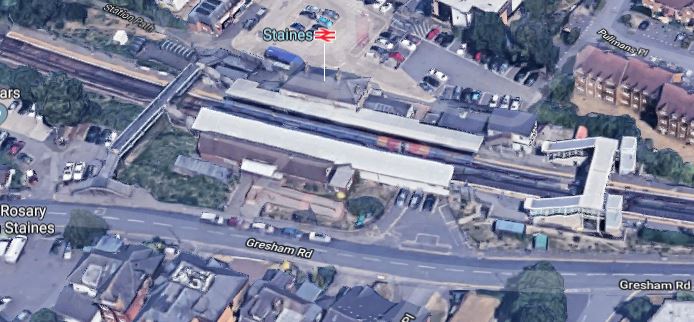
The Google Map visualisation, shows the footbridge at Staines station.
Waterloo To Heathrow Services
This is an extract from the Modern Railways article.
The first would comprise a four trains per hour (tph) service from Waterloo to Heathrow Terminal 5 as an extension of existing SWR services, with 2 tph running via Twickenham and 2 tph via Hounslow. HSR envisages these services would be formed of SWR’s new Class 701 trains.
Note.
- Ten-car Class 701 trains will probably be used.
- These trains have 556 seats and can accommodate 740 standees, which is nearly 1300 passengers.
The frequency and capacity compares well with Crossrail to the Airport.
Heathrow Express Extension To Woking, Guilford and Basingstoke
This will become two services wit a frequency of two tph.
- Paddington and Guildford via Old Oak Common, Heathrow, Woking and Basingstoke.
- Paddington and Guildford via Old Oak Common, Heathrow, Woking and Guildford.
Note.
- Basingstoke, Guildford and Paddington get a direct train to Heathrow, Old Oak Common and Paddinhgton.
- Twelve car Class 387 trains would work the service.
- My rough estimate says thirty four-car sets would be needed.
- A twelve-car Class 387 train has sixty percent more seats than a nine-car Class 332 train.
It is also said in the article, that a flyover could be built at Woking in CP6, which would help the Heathrow Express services.
Crossrail Extension To A Bay Platform At Staines Station
In Heathrow Southern Railway’s Plans For Staines, I discussed a plan to extend Crossrail services from Heathrow Terminal 5 station to a bay platform at Staines station.
It is not mentioned in the Modern Railways , so am I right to think, it is not going to happen.
- The proposed Waterloo to Heathrow Terminal 5, will provide a capacity of 5,200 passengers per hour between Staines and Heathrow Terminal 5
- Do WRAtH intend to run the two tph, that HSR wanted for Staines, to Slough and Reading to provide Western access to Heathrow?
So dropping the original plan is probably a reasonable decision.
How Many Trains Will Use Heathrow Terminal 5 Station
Currently, the service to Heathrow Terminal 5 station is as follows.
- 4 tph – Heathrow Express – Paddington and Terminal 5
- 2 tph – TfL Rail – Paddington and Terminal 5
There is also a shuttle to Terminal 4 station, running approximately every fifteen minutes.
Crossrail
After Crossrail opens the service will be.
- 4 tph – Heathrow Express – Paddington and Terminal 5
- 2 tph – Croosrail – Paddington and Terminal 5
Only the name on the train and the train type will have changed.
WRAtH
According to Wikipedia, WRAtH will have the following services.
t is envisaged that there would be a service of four trains an hour from Heathrow to Slough and Reading. Earlier publicity also suggested there would be two trains per hour to Twyford and Maidenhead.
Heathrow Express have offered to run services to Reading which would stop only at Slough.
I have I have a few thoughts.
- A service from Reading must have access to all terminals at Heathrow.
- All stations between Langley and Reading need at least two tph to Heathrow.
- Should services between Paddington and Heathrow be extended to Reading?
- Services must run on a 24/7 basis, to allow people to get to and from work and passengers on seriously delayed flights to get to their destination..
One way to provide a good basic service would be to combine the shuttle between Terminal 4 and 5 with the service to Slough and Reading.
- A train starting at Reading would call at a number of stations including Slough on its way to Heathrow Airport.
- It would then call at the following station in order; Heathrow Terminal 5, Heathrow Central, Heathrow Terminal 4, Heathrow Central and Heathrow Terminal 5.
- It would then return to Reading via Slough.
The stopping pattern between Langley and Reading would be arranged to suit passenger needs.
Advantages of this extended shuttle are as follows.
- All terminals are served by services originating in the West.
- The four tph shuttle is matched with four tph on WRAtH to and from Reading.
- No Westward-facing bay platform is needed at Terrminal 5 to turn trains from Reading.
- A Westward-facing bay platform might be useful for service recovery.
All trains using WRAtH to and from Reading would use through platforms at Terminal 5.
HSR
HSR will have the following services.
- 2 tph – Heathrow Express – Paddington and Basingstoke via Woking
- 2 tph – Heathrow Express – Paddington and Guildford via Woking
- 2 tph – SWR – Waterloo and Terminal 5 via Hounslow and Staines
- 2 tph – SWR – Waterloo and Terminal 5 via Twickenham and Staines
Note.
- The Heathrow Express services will use through platforms.
- The Waterloo services could use a bsay platform.
This map from carto.metro.free.fr shows the current layout of platforms at Heathrow.
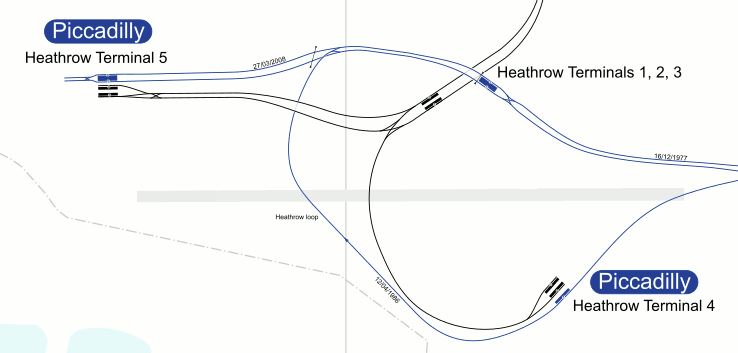
Adding all the requirements together, the following platforms will be needed.
Two through platforms for the following services.
- 2 tph – Heathrow Express – Paddington and Basingstoke via Woking
- 2 tph – Heathrow Express – Paddington and Guildford via Woking
- 4 tph – Crossrail – WRAtH services between Reading and all terminals
Note.
- Eight tph would not be difficult to handle.
- Heathrow Express and the WRAtH services would alternate.
- There would be same platform interchanges between Heathrow Express and WRAtH services.
In addition, there would be the following.
- A bay platform for Waterloo services.
- Possibly another platform for service recovery.
Ther could also be extra platforms for long distance services between Heathrow Terminal 5 and destinations like Bristol, Cardiff, Oxford and Plymouth
It has amazed me, how by combining HSR, Crossrail, Heathrow Express and WRAtH services together needs so few platforms in Terminal 5 station.
Conclusion
Network Rail’s Western Appoach To Heathrow and Heathrow Southern Railway may currently be two separate schemes with different funding models, but they have a lot of shared infrastructure, interests and objectives.
Both projects would surely be better with strong co-operation.
Judging by how well it all seems to fit, it does seem that they are talking.
 The Anonymous Widower