Meet The British Inventor Who Came Up With A Green Way Of Generating Electricity From Air – In His Shed
The title of this post, is the same as that of this article on inews, which is written by the respected BBC journalist; Tom Heap.
This is the first two paragraphs.
In 25 years of reporting on the environment, I’ve become unshakably convinced in the seriousness and urgency of tackling climate change, but also rather dismayed that our successes in reducing greenhouse gases and promising scientific breakthroughs go largely unreported.
I’ve seen super plants that improve photo-synthesis, cows that belch less methane and next-gen solar panels. But there is one individual who deserves to be as famous in green-tech as Elon Musk for how his invention could help stop global warming.
The man is Peter Dearman from Bishop’s Stortford and his invention is the technology behind Highview Power, that is building a 250 MWh liquid air battery at Carrington, near Manchester.
Trump And The Open
This BBC story today, which was entitled Trump National Stripped Of 2022 US PGA Championship.
The Times also has an article today, saying that Trump has been lobbying hard to get The Open allocated to his course at Turnberry.
I have a feeling that the access and the fact that in 2024, the Open will go to Troon will scupper Trump’s ambitions.
Good crowds will need good transport access and preferably by rail to a large population centre with lots of hotels.
- 2021 – Royal St. Georges – The nearby Sandwich station is being lengthened to take high speed trains from London, especially for the tournament.
- 2022 – St. Andrews – Perhaps too short a time to put in the long-promised rail link to Leuchars, but the train service to Aberdeen, Edinburgh and Glasgow from Leuchars is good.
- 2023 – Royal Liverpool – The course has a nearby station at Hoylake and Merseyrail are getting new fleets of classy Swiss trains. Enthusiasts could always take the ferries part of the way from Liverpool.
- 2024 – Troon – The rail line to Glasgow goes past the course and there’s time to build a temporary station if needed.
The other courses on the active rota for the Open are.
- Carnoustie – The nearby Golf Street station is used during major golf tournaments.
- Muirfield – This course has had other problems. But the rail links are not good.
- Royal Birkdale – Like Royal Liverpool, it has a nearby Merseyrail station.
- Royal Lytham and St. Annes – This course has a station and it looks like the rail link will be upgraded soon.
- Royal Portrush – The nearby railway station was rebuilt for the 2019 Open
There is no rail line anywhere near Turnberry.
I feel that the R & A have enough excuses to avoid giving the Open to Turnberry.
It looks to me that Trump bought the wrong golf course.
Network Rail’s Big Push
The title of this press release on the Network Rail web site is 11,000 Tonne Tunnel To Be Installed On The Railway In First For UK Engineering.
They have also released this aerial photograph of the tunnel, before it is pushed into place.
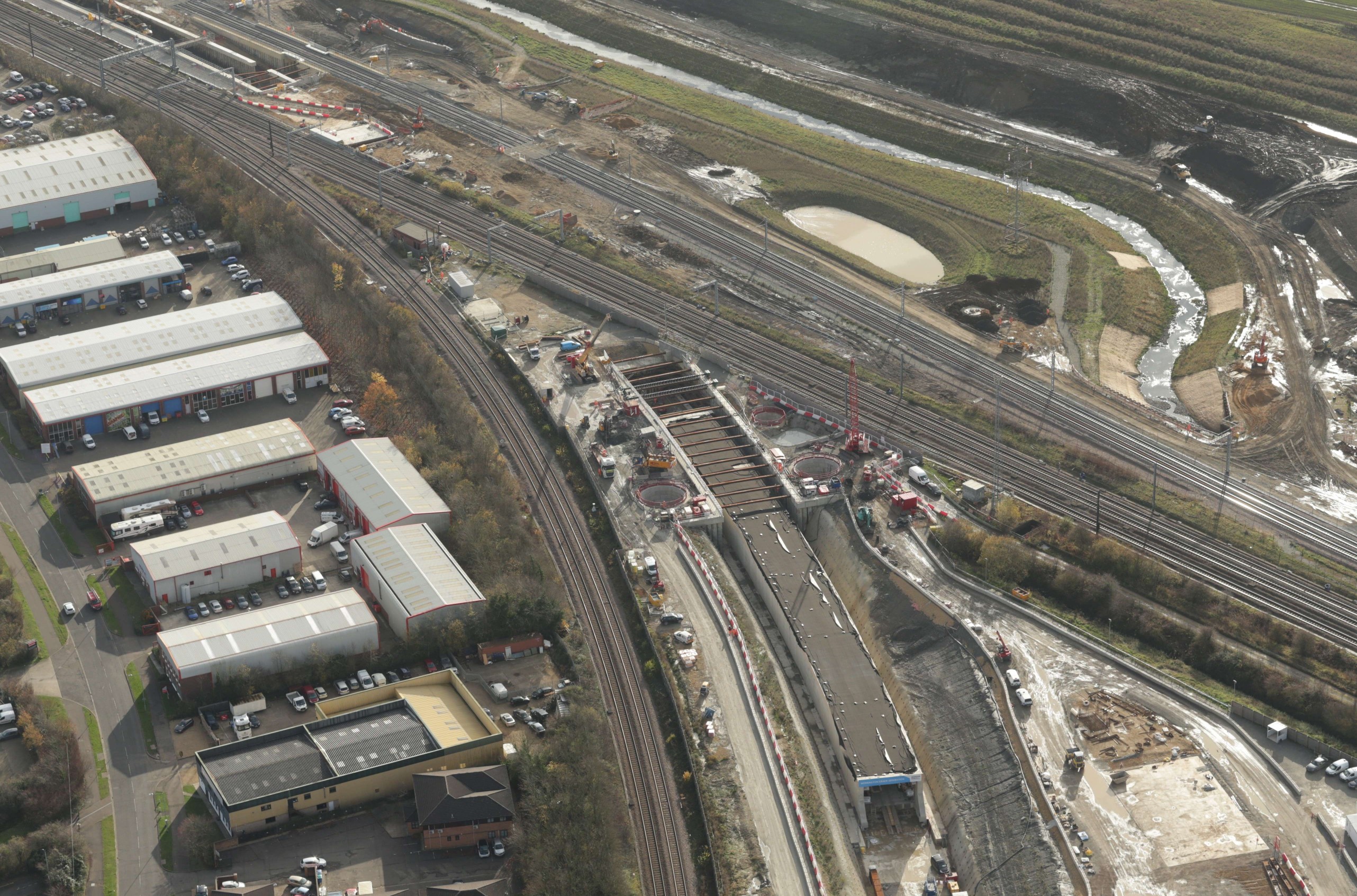
Note.
- The tunnel, which is just a curved concrete box is in the middle of the picture.
- To its left is the double-track Peterborough-Lincoln Line.
- Running across the far end of the tunnel are the multiple tracks of the East Coast Main Line.
- Peterborough is a few miles to the left, with the North to the right.
This Google Map shows the same area from directly above.

Note.
- The double-tracks of the Stamford Lines closest to the South-West corner of the map. These link the Peterborough-Birmingham Line to Peterborough.
- Next to them are the triple tracks of the East Coast Main Line.
- The third rail line is the double-track of the Peterborough and Lincoln Line.
- The new tunnel can be seen at the top of the map.
This map from Network Rail, shows the new track layout.
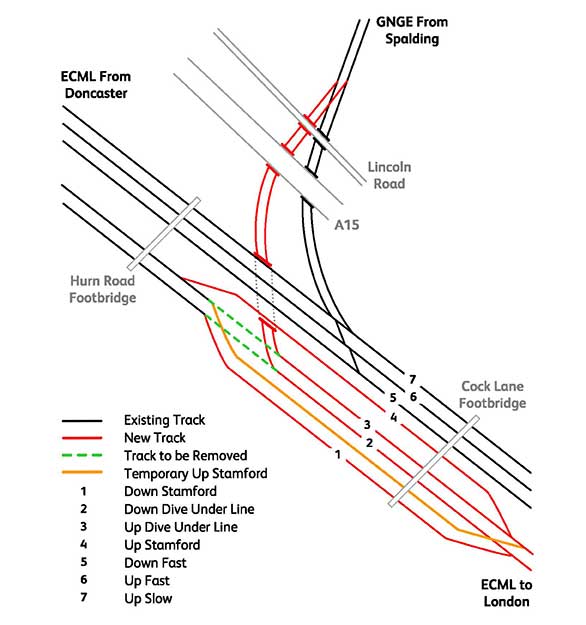
The map shows that the Stamford Line will divide with two tracks (1 and 4) going North to Stamford as now. Two new tracks (2 and 3) will dive-under the East Coast Main Line to join the existing Peterborough and Lincoln Line.
The tracks will run through the tunnel in the pictures, after it has been pushed under the East Coast Main Line.
- This will mean that the many freight trains between Peterborough and Lincoln will not have to cross the East Coast Main Line on the flat.
- This in turn could allow faster running of trains on the East Coast Main Line, that are not stopping at Peterborough.
This second Google Map shows the area to the North of the first map.
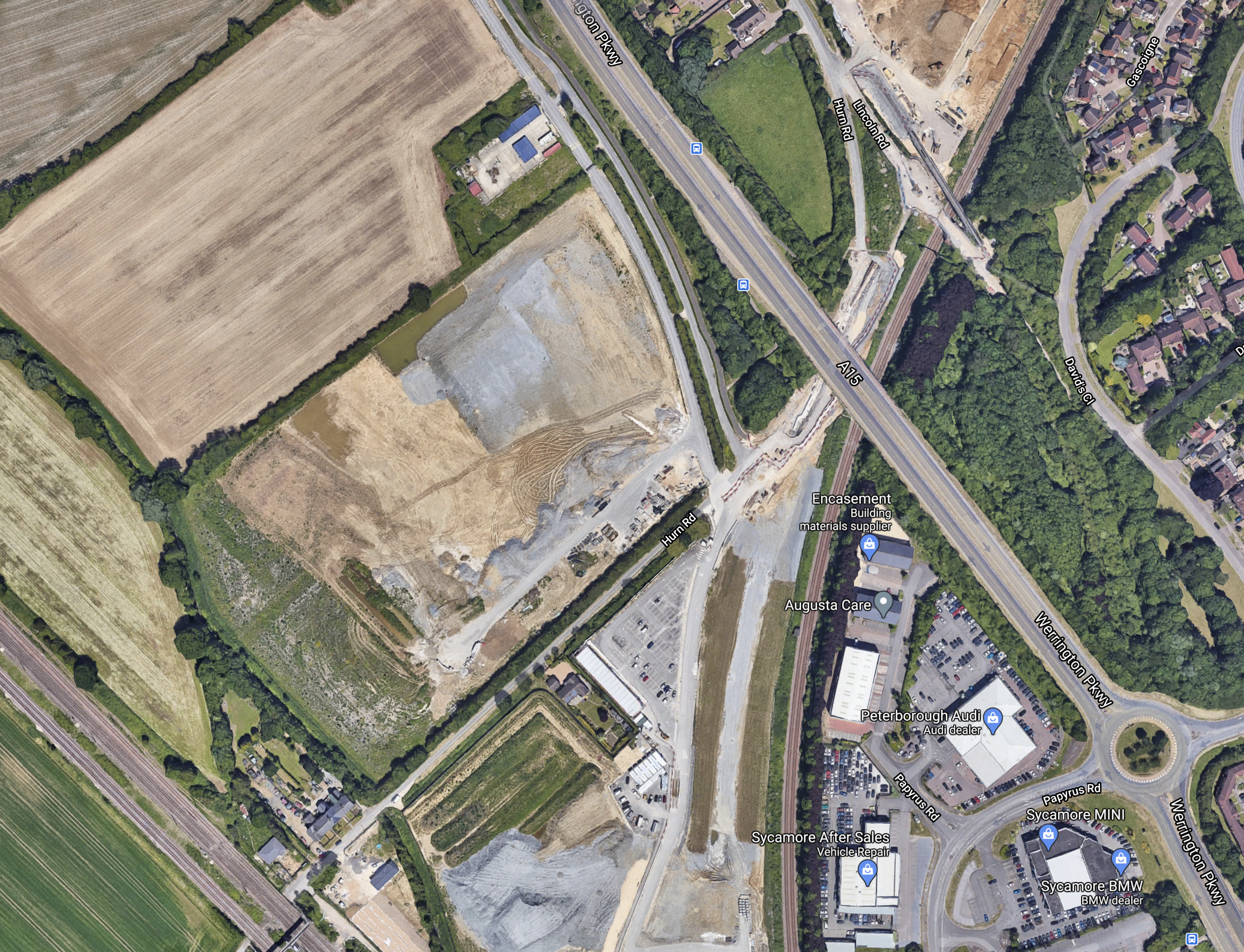
Note.
- The East Coast Main Line in the South-West corner of the map.
- The Peterborough and Lincoln Line curving from North-South across the map.
- A bridge would appear to be being constructed to take the A15 road over the new tracks, that will go through the tunnel.
- Another bridge will be constructed to take Lincoln Road over the new tracks.
It is certainly not a small project.
That is emphasised by this third Google Map, which is to the North of the previous map.
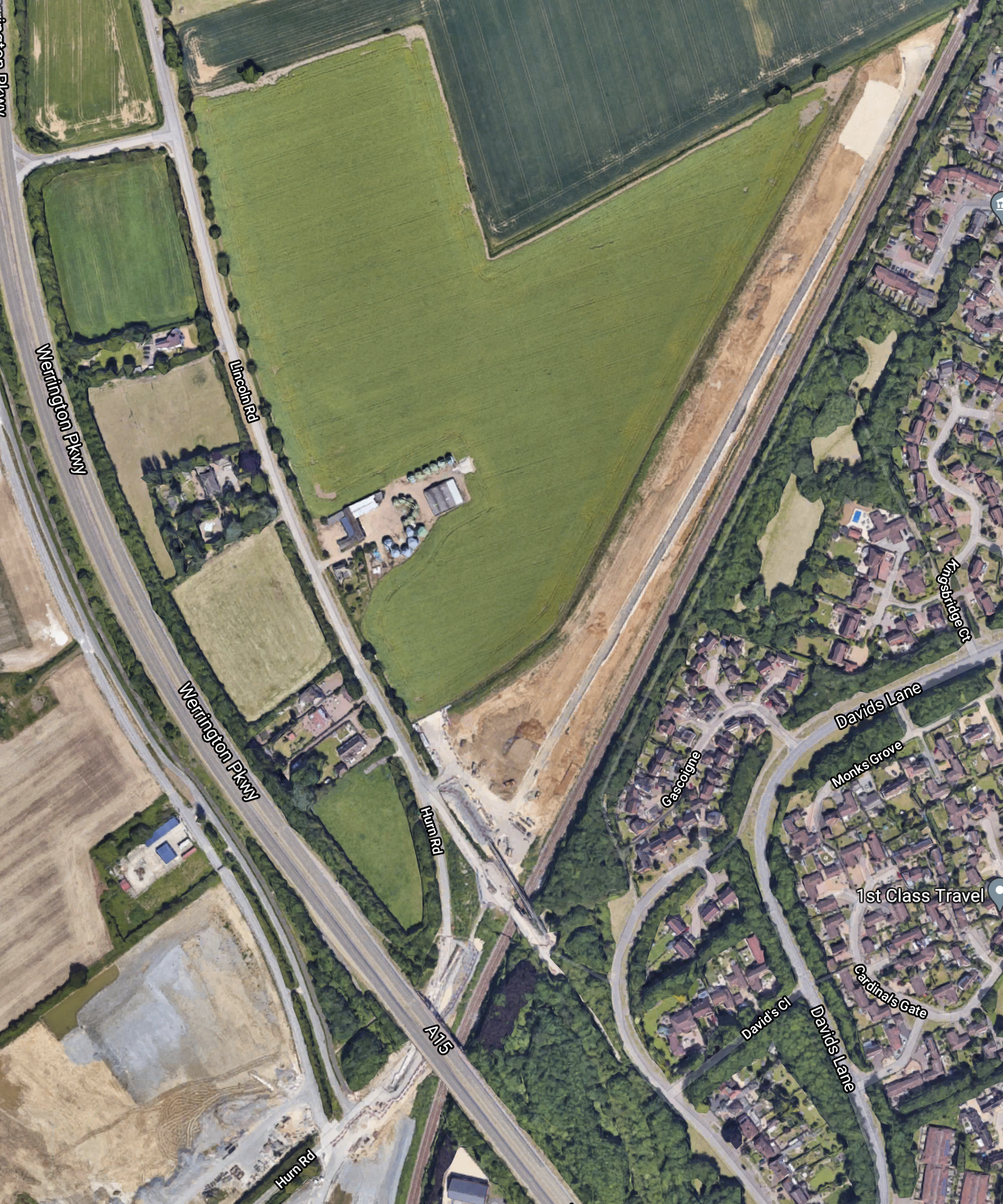
This map would appear to show space for more than a pair of tracks.
It looks to me, that space is being left for future rail-related development.
- Could it be for a small freight yard, where trains could wait before proceeding?
- If it were electrified, it could be where freight trains to and from London, switched between electric and diesel power.
- Could it be passing loops, so that freight trains can keep out of the way of faster passenger trains?
- Would it be a place for a possible new station?
If it is to be a full rail freight interchange, I can’t find any mention of it on the Internet.
The Big Push
Summarising, what is said in the press release, I can say.
- Major works to occur over nine days between 16 and 24 January
- It will be pushed at 150cm per hour.
- A reduced level of service will operate.
- It will take several weekends.
I hope it’s being filmed for later broadcasting.
Thoughts On Services
I have a few thoughts on passenger services.
London And Lincoln Via Spalding And Sleaford
Consider.
- Peterborough and Lincoln is 57 miles.
- The route has lots of level crossings.
- Much of the route between Peterborough and Lincoln has an operating speed of 75 mph
- There is a 50 mph limit through Spalding. Is this to cut down noise?
- Trains between Peterborough and Lincoln take a shortest time of one hour and twenty-three minutes, with four stops.
- Peterborough and Lincoln is 57 miles.
- This is an average speed of 41 mph.
I wonder what time a five-car Class 800 train would take to do the journey.
- At an average speed of 50 mph, the train would take 68 minutes and save 15 minutes.
- At an average speed of 60 mph, the train would take 57 minutes and save 26 minutes.
- At an average speed of 70 mph, the train would take 49 minutes and save 18 minutes.
As the fastest London Kings Cross and Peterborough time is 46 minutes, this would mean that with an average speed of 60 mph, a time between London Kings Cross of one hour and forty-three minutes could be possible.
- There could be additional time savings by only stopping at Peterborough, Spalding and Sleaford.
- The Werrington Dive Under looks to be built for speed and could save time.
- If the 50 mph limit through Spalding is down to noise, battery electric trains like a Hitachi Intercity Tri-Mode Battery Train might be able to go through Spalding faster.
- Could some track improvements save time between Peterborough and Lincoln?
As the fastest journeys via Newark to Lincoln take one hour and fifty-six minutes, it looks to me, that LNER might be able to save time by going via Spalding and Sleaford after the Werrington Dive Under opens.
London And Skegness
If there were a fast London train from Sleaford, it will take under an hour and thirty minutes between London Kings Cross and Sleaford.
- Currently, the connecting train between Skegness and Sleaford takes an hour for the forty miles.
- The service is currently run by Class 158 trains.
- With some 100 mph trains on the Skegness and Sleaford service, it might be possible to travel between London and Skegness in two hours and fifteen minutes with a change at Sleaford.
There would appear to be possibilities to improve the service between London and Skegness.
Lincoln And Cambridge
I used to play real tennis at Cambridge with a guy, who was a Cambridge expansionist.
He believed that Cambridge needed more space and that it should strongly rcpand high-tech research, development and manufacturing all the way across the fens to Peterborough and beyond.
I listened to his vision with interest and one thing it needed is a four trains per hour express metro between Cambridge and Peterborough.
- Ely and Peterborough should be electrified for both passenger and freight trains.
- March and Spalding should be reopened.
- Cambridge has the space for new services from the North.
Extending the Lincoln and Peterborough service to Cambridge could be a good start.
Conclusion
The Werrington Dive Under will certainly improve services on the East Coast Main Line.
I also feel, that it could considerably improve rail services between London and South Lincolnshire.
It certainly looks, like Network Rail have designed the Werrington Dive Under to handle more traffic than currently uses the route.
Towns like Boston, Skegness, Sleaford and Spalding aren’t going to complain.
Inner Eye AI Identifies Tumours To Speed Up Treatment Of Cancer
The title of this post is the same as that of this article on The Times.
This is the introductory paragraph.
A hospital in Cambridge is the first to use artificial intelligence technology developed by Microsoft to treat cancer patients faster, helping to cut the treatment backlog and save lives.
There is only one NHS hospital in Cambridge and that is Addenbrooke’s, who probably saved my life, by diagnosing me as coeliac in 1997.
This paragraph explains the development of the software and how it will be deployed across the NHS.
Inner Eye is the result of an eight-year project with Microsoft and Addenbrooke’s and is being introduced in other NHS trusts. It is easy to access and free to use. When the AI tool is in place, hospitals will be able to use their own data to improve accuracy.
This paragraph sums up the usefulness of the system.
Pat Price, a professor at Imperial College London and chairwoman of Action Radiotherapy, a charity, said: “This is just one brilliant example of the quiet but amazing technological revolution that has unfolded in radiotherapy in recent years and could dramatically improve cancer survival rates.”
It really is amazing how since my wife died of a squamous cell carcinoma of the heart, treatment of cancer has improved.
I can envisage a time, when a rare cancer like that, which killed her in three months, will be survivable!
North Dakota Coal Country Backlash Against Wind Energy Is Misguided, Wind Advocates Say
The title of this post, is the same as that of this article on Inforum.
This is the introductory paragraph.
Two counties in North Dakota coal country have passed policies aimed at banning wind power development — but federal studies show that abundant natural gas is chiefly to blame for the closure of coal-fired power plants.
It appears that the closure of 1151 MW Coal Creek power station in 2022, will cost almost a thousand jobs.
This is the downside of decarbonisation.
These two paragraphs give a flavour of the argument.
Coal country officials have said they’re not against wind power, but said the economic benefits of wind can’t begin to compare to the contributions, in jobs and tax revenues, to coal-fired power plants and the mines that supply them. Most jobs involving a wind farm come during construction.
“There will be a limited number of permanent jobs after the tower is up, if and when that happens,” said Buster Langowski, the Mercer County economic development director. Wind farms need only four or five employees to operate. “That’s not a lot of folks.”
It appears that the changeover needs to be better managed.
‘Natural’ Nasal Spray Could Stop Virus Before It Enters The Body
The title of this post, is the same as that of this article on The Times.
This is the two introductory paragraphs.
A Canadian nasal spray that has been shown to stop the coronavirus from spreading through the body will begin its first UK clinical trial tomorrow.
The SaNOtize nitric oxide spray is designed to prevent the virus from passing through the nose to the respiratory system. The trial will be run by Ashford and St Peter’s Hospitals NHS Foundation Trust in Surrey.
I shall be watching SaNOtize‘s development with interest, as something that could be similar got my life on track!
I am 73 and I was a very sickly child, despite the persistence of the GP, who delivered me, who was the superbly-named Dr. Egerton White, to try and sort out my problems.
I was always, having terms off school with respiratory problems, probably caused by the London smogs of the 1950s. We lived in Southgate and they had as bad smogs as anyone.
In the end, with the connivance of a pharmacist called Halliday, they formulated a nasal spray, that worked. I can still smell it!
My health improved with the Clean Air Act and during University in the seaside city of Liverpool.
Later, I worked for ICI on chemical plants and there was an unfounded story, that the pensions were good, as working on ammonia plants and the like kept you clear of all the viruses going around. But on retirement in all that clear air, you got everything that was going and died soon after leaving work. Hence the pension scheme had more money than it needed.
My health also improved, when at fifty I was diagnosed as a coeliac and went gluten-free.
Now after returning to London after the death of my wife and son to cancer, and suffering a serious stroke, my head is all choked up by the pollution. The Covid-19 lockdown makes it difficult to take the cure, which is a couple of days by the sea. Biarritz, Gdansk and Liverpool work a treat.
Trump Got It Wrong!
Trump was advocating injecting bleach to cure the Covids.
- Note that bleach is a strong alkali
- This spray is based on nitric oxide, which when mixed with water forms nitrous acid.
- Wikipedia says not to mix-up the weak nitrous acid with nitric acid.
So Trummkopf couldn’t tell his alkali from his acid, which surely is a recipe for disaster.
Nitric Oxide
This is part of the introduction in the Wikipedia entry for nitric oxide.
An important intermediate in industrial chemistry, nitric oxide forms in combustion systems and can be generated by lightning in thunderstorms. In mammals, including humans, nitric oxide is a signaling molecule in many physiological and pathological processes. It was proclaimed the “Molecule of the Year” in 1992. The 1998 Nobel Prize in Physiology or Medicine was awarded for discovering nitric oxide’s role as a cardiovascular signalling molecule.
I remember a fascinating BBC Horizon program about nitric oxide’s role as a signalling molecule.
- It started with research done by a veterinary professor at Glasgow University, who believed that after experimenting with penises from dead bulls, concluded that nitric oxide had something to do with it.
- But his ideas were so out-of-kilter with established thought, that his research was sidelined at conferences in journals.
- Reasons like it was a poison and such a simple molecule were given.
- Then in London, someone who knew of his research, had a patient dying of toxic shock syndrome.
- He suggested injecting the lady, with large amounts of nitric oxide, in the hope they could save her life.
- Her partner agreed.
And as it worked, there was a very happy ending.
I
All Platforms Should Be Wide Like This
It is my view, that all platforms, like this one at Angel station should be wide.

Consider,
- It must be less likely, that passengers get knocked onto the tracks.
- Wide platforms must be easier for all passengers to navigate.
- Blind people with of without guide dogs must find it easier.
Let’s see a few more. And with step-free access between platform and train!
Companies Have New Take On Old Energy Storage Tech
The title of this post, is the same as that of this article on Hackaday.
This is the introductory paragraph.
According to Spectrum, several companies are poised to make a splash storing energy with gravity. That sounds fancy and high tech at first, but is it, really? Sure, we usually think of energy storage as some sort of battery, but there are many energy storage systems that use water falling, for example, which is almost what this new technology is all about. Almost, since instead of water these new systems move around multi-ton blocks.
The article gives a review of Energy Vault, Gravitricity and another company called Gravity Power.
This is the article’s take on Gravity Power.
The scale of the weights is hard to imagine. Another company, Gravity Power, claims they could deliver 400 megawatts for 16 hours using an 8 million metric ton piston. There’s no word on how long it takes to bring that piston back to the charged position after the 16 hours, though. A Boeing 757-200, for example, weighs about 100 tons when loaded with fuel and passengers. So imagine 80,000 giant airplanes melted down. It makes Energy Vault’s 35-ton weights seem much more reasonable.
Looking at the Gravity Power web site, their technology is described on this page, where this is the first paragraph.
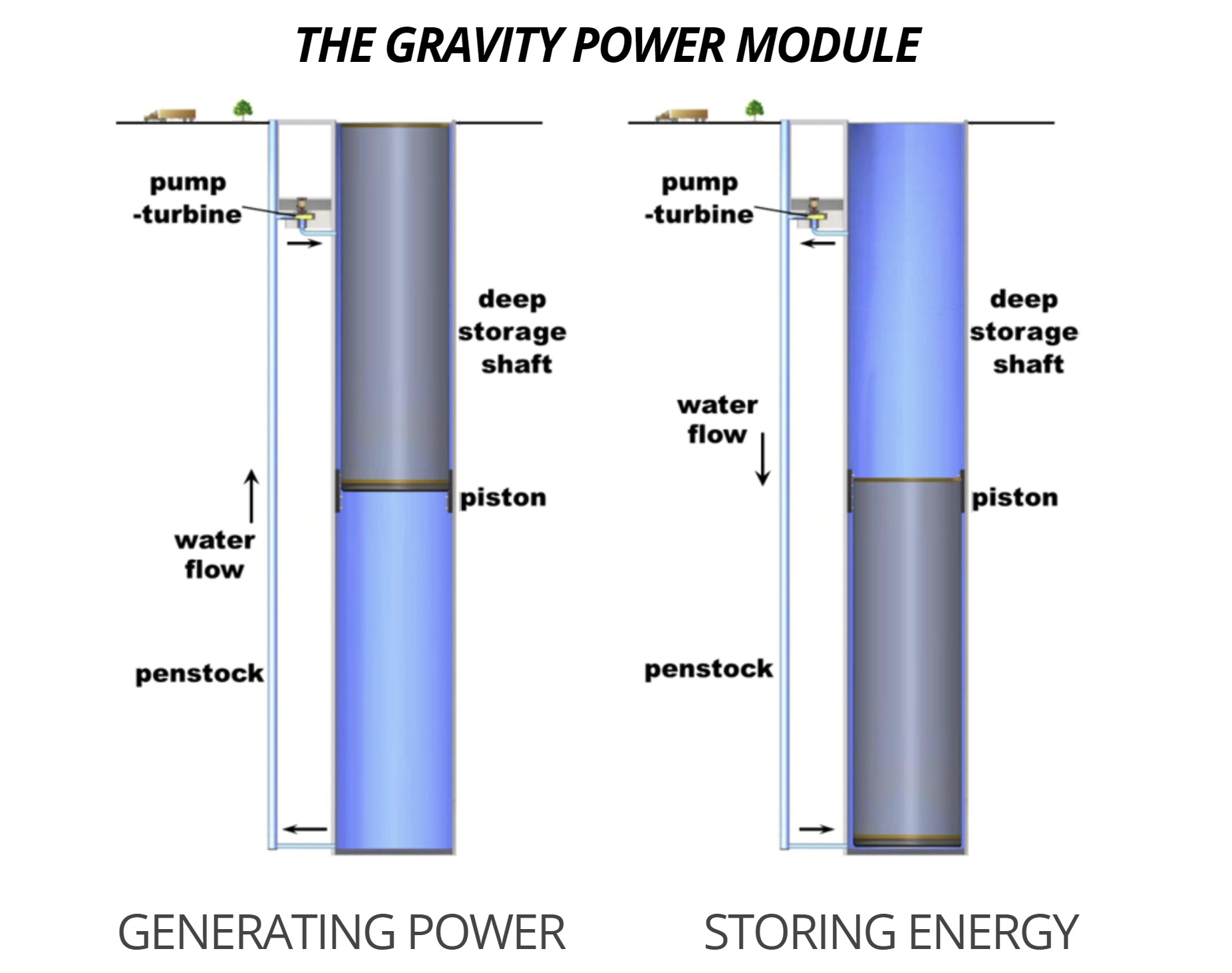
The GPM (Gravity Power Module) uses a very large piston that is suspended in a deep, water-filled shaft, with sliding seals to prevent leakage around the piston and a return pipe connecting to a pump-turbine at ground level. The piston is comprised of reinforced rock and in some cases concrete for low cost. The shaft is filled with water once, at the start of operations, but is then sealed and no additional water is required.
This graphic from the page explains the technology.
My worry would be water leakage past the piston.
This does sound like an idea from William Armstrong, who was responsible for many things including the hydraulic accumulator.

The picture shows the hydraulic accumulator at Limehouse in London.
I visited the Limehouse Accumulator during Open House in 2012 and wrote about it in Open House – The Limehouse Hydraulic Accumulator.
EU Backs Orsted Team On Green Hydrogen Initiative
The title of this post, is the same as that as that of this article on renews.biz.
This is the sub-title of the article.
European Commission Funding For The Oyster Project That Also Includes Siemens Gamesa, Element Energy and ITM Power
There is a press release on ITM Power’s web site.
This paragraph sums up the project.
ITM Power, Ørsted, Siemens Gamesa Renewable Energy, and Element Energy have been awarded EUR 5 million in funding from The Fuel Cells and Hydrogen Joint Undertaking (FCH2-JU) under the European Commission to demonstrate and investigate a combined wind turbine and electrolyser system designed for operation in marine environments.
This is said about the design of the electrolyser.
The electrolyser system will be designed to be compact, to allow it to be integrated with a single offshore wind turbine, and to follow the turbine’s production profile. Furthermore, the electrolyser system will integrate desalination and water treatment processes, making it possible to use seawater as a feedstock for the electrolysis process.
It looks like it will be a standalone turbine, that instead of producing electricity it will produce hydrogen.
This paragraph gives the objective of the project.
The OYSTER project partners share a vision of hydrogen being produced from offshore wind at a cost that is competitive with natural gas (with a realistic carbon tax), thus unlocking bulk markets for green hydrogen making a meaningful impact on CO2 emissions, and facilitating the transition to a fully renewable energy system in Europe.
The project will run from 2021 to 2024.
When I first heard about creating hydrogen offshore with a combined wind-turbine and electrolyser, I thought this could be the way to go.
It’s certainly a way to produce large quantities of green hydrogen.
But I also feel, the process has a serious rival in Shell’s Blue Hydrogen Process, which uses a catalyst to split methane into hydrogen and carbon dioxide.
Shell will need uses for the carbon dioxide or worked-out gas fields to store it.
Hitachi Targets Next Year For Testing Of Tri-Mode IET
The title of this post, is the same as that of this article on Rail Magazine.
This is the first two paragraphs.
Testing of a five-car Hitachi Class 802/0 tri-mode unit will begin in 2022, and the train could be in traffic the following year.
It is expected that the train will save more than 20% of fuel on Great Western Railway’s London Paddington-Penzance route.
This is the Hitachi infographic, which gives the train’s specification.

I have a few thoughts and questions.
Will The Batteries Be Charged At Penzance?
Consider.
- It is probably not a good test of customer reaction to the Intercity Tri-Mode Battery Train, if it doesn’t work on batteries in stations through Cornwall.
- Every one of the eight stops in Cornwall will need an amount of battery power.
- London trains seem to take at least half-an-hour to turn round at Penzance.
- London trains seem to take around 7-13 minutes for the stop at Plymouth.
So I think, that batteries will probably need to be charged at Penzance and possibly Plymouth, to achieve the required battery running,
There is already sufficient time in the timetable.
A charging facility in Penzance station would be a good test of Hitachi’s method to charge the trains.
Will Hyperdrive Innovation’s Battery Pack Be A Simulated Diesel Engine?
At the age of sixteen, for a vacation job, I worked in the Electronics Laboratory at Enfield Rolling Mills.
It was the early sixties and one of their tasks was at the time replacing electronic valve-based automation systems with new transistor-based systems.
The new equipment had to be compatible to that which it replaced, but as some were installed in dozens of places around the works, they had to be able to be plug-compatible, so that they could be quickly changed. Occasionally, the new ones suffered infant-mortality and the old equipment could just be plugged back in, if there wasn’t a spare of the new equipment.
So will Hyperdrive Innovation’s battery-packs have the same characteristics as the diesel engines that they replace?
- Same instantaneous and continuous power output.
- Both would fit the same mountings under the train.
- Same control and electrical power connections.
- Compatibility with the trains control computer.
I think they will as it will give several advantages.
- The changeover between diesel engine and battery pack could be designed as a simple overnight operation.
- Operators can mix-and-match the number of diesel engines and battery-packs to a given route.
- As the lithium-ion cells making up the battery pack improve, battery capacity and performance can be increased.
- If the computer, is well-programmed, it could reduce diesel usage and carbon-emissions.
- Driver conversion from a standard train to one equipped with batteries, would surely be simplified.
As with the diesel engines, all battery packs could be substantially the same across all of Hitachi’s Class 80x trains.
How Many Trains Can Eventually Be Converted?
Great Western Railway have twenty-two Class 802/0 trains.
- They are five-cars.
- They have three diesel engines in cars 2, 3 and 4.
- They have a capacity of 326 passengers.
- They have an operating speed of 125 mph on electrification.
- They will have an operating speed of 140 mph on electrification with in-cab ERTMS digital signalling.
- They have an operating speed of 110 mph on diesel.
- They can swap between electric and diesel mode at line speed.
Great Western Railway also have these trains that are similar.
- 14 – nine-car Class 802/1 trains
- 36 – five-car Class 800/0 trains
- 21 – nine-car Class 800/3 trains
Note.
- The nine-car trains have five diesel engines in cars 2,3, 5, 7 and 8
- All diesel engines are similar, but those in Class 802 trains are more powerful, than those in Class 800 trains.
This is a total of 93 trains with 349 diesel engines.
In addition, there are these similar trains in service or on order with other operators.
- LNER – 13 – nine-car Class 800/1 trains
- LNER – 10 – five-car Class 800/2 trains
- LNER – 12 – five-car Class 801/1 trains
- LNER – 30 – nine-car Class 801/2 trains
- TransPennine Express – 19 – five-car Class 802/2 trains
- Hull Trains – 5 – five-car Class 802/3 trains
- East Coast Trains – 5 – five-car Class 803 trains
- Avanti West Coast – 13 – five-car Class 805 trains
- Avanti West Coast – 10 – seven-car Class 807 trains
- East Midland Railway – 33 – five-car Class 810 trains
Note.
- Class 801 trains have one diesel engine for emergency power.
- Class 803 trains have no diesel engines, but they do have a battery for emergency power.
- Class 805 trains have an unspecified number of diesel engines. I will assume three.
- Class 807 trains have no batteries or diesel engines.
- Class 810 trains have four diesel engines.
This is a total of 150 trains with 395 diesel engines.
The Rail Magazine finishes with this paragraph.
Hitachi believes that projected improvements in battery technology, particularly in power output and charge, could enable diesel engines to be incrementally replaced on long-distance trains.
Could this mean that most diesel engines on these Hitachi trains are replaced by batteries?
Five-Car Class 800 And Class 802 Trains
These trains are mainly regularly used to serve destinations like Bedwyn, Cheltenham, Chester, Harrogate, Huddersfield, Hull, Lincoln, Oxford and Shrewsbury, which are perhaps up to fifty miles beyond the main line electrification.
- They have three diesel engines, which are used when there is no electrification.
- I can see many other destinations, being added to those reached by the Hitachi trains, that will need similar trains.
I suspect a lot of these destinations can be served by five-car Class 800 and Class 802 trains, where a number of the diesel engines are replaced by batteries.
Each operator would add a number of batteries suitable for their routes.
There are around 150 five-car bi-mode Hitachi trains in various fleets in the UK.
LNER’s Nine-Car Class 800 Trains
These are mainly used on routes between London and the North of Scotland.
In LNER Seeks 10 More Bi-Modes, I suggested that to run a zero-carbon service to Inverness and Aberdeen, LNER might acquire rakes of carriages hauled by zero-carbon hydrogen electric locomotives.
- Hydrogen power would only be used North of the current electrification.
- Scotland is looking to have plenty of hydrogen in a couple of years.
- No electrification would be needed to be erected in the Highlands.
- InterCity 225 trains have shown for forty years, that locomotive-hauled trains can handle Scottish services.
- I also felt that the trains could be based on a classic-compatible design for High Speed Two.
This order could be ideal for Talgo to build in their new factory at Longannet in Fife.
LNER’s nine-car Class 800 trains could be converted to all-electric Class 801 trains and/or moved to another operator.
There is also the possibility to fit these trains with a number of battery packs to replace some of their five engines.
If the planned twenty percent fuel savings can be obtained, that would be a major improvement on these long routes.
LNER’s Class 801 Trains
These trains are are all-electric, but they do have a diesel engine for emergencies.
Will this be replaced by a battery pack to do the same job?
- Battery packs are probably cheaper to service.
- Battery packs don’t need diesel fuel.
- Battery packs can handle regenerative braking and may save electricity.
The installation surely wouldn’t need too much test running, as a lot of testing will have been done in Class 800 and Class 802 trains.
East Coast Trains’ Class 803 Trains
These trains have a slightly different powertrain to the Class 801 trains. Wikipedia says this about the powertrain.
Unlike the Class 801, another non-bi-mode AT300 variant which despite being designed only for electrified routes carries a diesel engine per unit for emergency use, the new units will not be fitted with any, and so would not be able to propel themselves in the event of a power failure. They will however be fitted with batteries to enable the train’s on-board services to be maintained, in case the primary electrical supplies would face a failure.
The trains are in the process of being built, so I suspect batteries can be easily fitted.
Could it be, that all five-car trains are identical body-shells, already wired to be able to fit any possible form of power? Hitachi have been talking about fitting batteries to their trains since at least April 2019, when I wrote, Hitachi Plans To Run ScotRail Class 385 EMUs Beyond The Wires.
- I suspect that Hitachi will use a similar Hyperdrive Innovation design of battery in these trains, as they are proposing for the Intercity Tri-Mode Battery Train.
- If all trains fitted with diesel engines, use similar MTU units, would it not be sensible to only use one design of battery pack?
- I suspect, that as the battery on a Class 803 train, will be mainly for emergency use, I wouldn’t be surprised to see that these trains could be the first to run in the UK, with a battery.
- The trains would also be simpler, as they are only battery-electric and not tri-mode. This would make the software easier to develop and test.
If all trains used the same battery pack design, then all features of the pack, would be available to all trains to which it was fitted.
Avanti West Coast’s Class 805 Trains
In Hitachi Trains For Avanti, which was based on an article with the same time in the January 2020 Edition of Modern Railways, I gave this quote from the magazine article.
Hitachi told Modern Railways it was unable to confirm the rating of the diesel engines on the bi-modes, but said these would be replaceable by batteries in future if specified.
Note.
- Hitachi use diesel engines with different ratings in Class 800 and Class 802 trains, so can probably choose something suitable.
- The Class 805 trains are scheduled to be in service by 2022.
- As they are five-cars like some Class 800 and Class 802 trains will they have the same basic structure and a powertrain with three diesel engines in cars 2, 3 and 4?
I think shares a basic structure and powertrain will be very likely, as there isn’t enough time to develop a new train.
I can see that as Hitachi and Great Western Railway learn more about the performance of the battery-equipped Class 802 trains on the London and Penzance route, that batteries could be added to Avanti West Coast’s Class 805 trains. After all London Euston and North Wales and London Paddington and Cornwall are routes with similar characteristics.
- Both routes have a high speed electrified section out of London.
- They have a long section without electrification.
- Operating speeds on diesel are both less than 100 mph, with sections where they could be as low as 75 mph.
- The Cornish route has fifteen stops and the Welsh route has seven, so using batteries in stations will be a welcome innovation for passengers and those living near the railway.
As the order for the Avanti West Coast trains was placed, whilst Hitachi were probably designing their battery electric upgrade to the Class 800 and Class 802 trains, I can see batteries in the Class 805 trains becoming an early reality.
In Hitachi Trains For Avanti, I also said this.
Does the improvement in powertrain efficiency with smaller engines running the train at slower speeds help to explain this statement from the Modern Railways article?
Significant emissions reduction are promised from the elimination of diesel operation on electrified sections as currently seen with the Voyagers, with an expected reduction in CO2 emissions across the franchise of around two-thirds.
That is a large reduction, which is why I feel, that efficiency and batteries must play a part.
Note.
- The extract says that they are expected savings not an objective for some years in the future.
- I have not done any calculations on how it might be achieved, as I have no data on things like engine size and expected battery capacity.
- Hitachi are aiming for 20 % fuel and carbon savings on London Paddington and Cornwall services.
- Avanti West Coast will probably only be running Class 805 trains to Chester, Shrewsbury and North Wales.
- The maximum speed on any of the routes without electrification is only 90 mph. Will less powerful engines be used to cut carbon emissions?
As Chester is 21 miles, Gobowen is 46 miles, Shrewsbury is 29.6 miles and Wrexham General is 33 miles from electrification, could these trains have been designed with two diesel engines and a battery pack, so that they can reach their destinations using a lot less diesel.
I may be wrong, but it looks to me, that to achieve the expected reduction in CO2 emissions, the trains will need some radical improvements over those currently in service.
Avanti West Coast’s Class 807 Trains
In the January 2020 Edition of Modern Railways, is an article, which is entitled Hitachi Trains For Avanti.
This is said about the ten all-electric Class 807 trains for Birmingham, Blackpool and Liverpool services.
The electric trains will be fully reliant on the overhead wire, with no diesel auxiliary engines or batteries.
It may go against Hitachi’s original design philosophy, but not carrying excess weight around, must improve train performance, because of better acceleration.
I believe that these trains have been designed to be able to go between London Euston and Liverpool Lime Street stations in under two hours.
I show how in Will Avanti West Coast’s New Trains Be Able To Achieve London Euston and Liverpool Lime Street In Two Hours?
Consider.
- Current London Euston and Liverpool Lime Street timings are two hours and thirteen or fourteen minutes.
- I believe that the Class 807 trains could perhaps be five minutes under two hours, with a frequency of two trains per hour (tph)
- I have calculated in the linked post, that only nine trains would be needed.
- The service could have dedicated platforms at London Euston and Liverpool Lime Street.
- For comparison, High Speed Two is promising one hour and thirty-four minutes.
This service would be a Marketing Manager’s dream.
I can certainly see why they won’t need any diesel engines or battery packs.
East Midland Railway’s Class 810 Trains
The Class 810 trains are described like this in their Wikipedia entry.
The Class 810 is an evolution of the Class 802s with a revised nose profile and facelifted end headlight clusters, giving the units a slightly different appearance. Additionally, there will be four diesel engines per five-carriage train (versus three on the 800s and 802s), and the carriages will be 2 metres (6.6 ft) shorter.
In addition, the following information has been published about the trains.
- The trains are expected to be capable of 125 mph on diesel.
- Is this speed, the reason for the fourth engine?
- It is planned that the trains will enter service in 2023.
I also suspect, that like the Class 800, Class 802 and Class 805 trains, that diesel engines will be able to be replaced with battery packs.
Significant Dates And A Possible Updating Route For Hitachi Class 80x Trains
I can put together a timeline of when trains are operational.
- 2021 – Class 803 trains enter service.
- 2022 – Testing of prototype Intercity Tri-Mode Battery Train
- 2022 – Class 805 trains enter service.
- 2022 – Class 807 trains enter service.
- 2023 – First production Intercity Tri-Mode Battery Train enters service.
- 2023 – Class 810 trains enter service.
Note.
- It would appear to me, that Hitachi are just turning out trains in a well-ordered stream from Newton Aycliffe.
- As testing of the prototype Intercity Tri-Mode Battery Train proceeds, Hitachi and the operators will learn how, if batteries can replace some or even all of the diesel engines, the trains will have an improved performance.
- From about 2023, Hitachi will be able to design tri-mode trains to fit a customer’s requirements.
- Could the powertrain specification of the Class 810 trains change, in view of what is shown by the testing of the prototype Intercity Tri-Mode Battery Train?
- In parallel, Hyperdrive Innovation will be building the battery packs needed for the conversion.
Batteries could be fitted to the trains in three ways,
- They could be incorporated into new trains on the production line.
- Batteries could be fitted in the depots, during a major service.
- Trains could be returned to Newton Aycliffe for battery fitment.
Over a period of years as many trains as needed could be fitted with batteries.
Conclusion
I believe there is a plan in there somewhere, which will convert many of Hitachi’s fleets of trains into tri-mode trains with increased performance, greater efficiency and less pollution and carbon emissions.
 The Anonymous Widower