The Day I Saw The Rolling Stones And Bo Diddley
With the release of their new album, I had to look up where I saw the Stones.
I was still at school and I knew I saw them at the Regal Edmonton cinema, which is now a Sainsburys supermarket.
The Internet says they played there on the 2nd of October 1963, when they toured with Bo Diddley, who I also remember seeing at the same venue.
This Wikipedia entry is entitled The Rolling Stones British Tour 1963, also states that the Everly Brothers were on the bill.
It was nearly sixty years ago.
A year later, I saw a similar gig on the 20th of October at the same venue, with The Animals, Carl Perkins, The Nashville Teens, The Quotations, Tommy Tucker and Elkie Brooks. Who was Tommy Tucker?
Those were the days!
Offshore Wind Could Secure Scottish Green Hydrogen Potential – Report
The title of this post, is the same as that of this article on offshoreWIND.biz.
This is the sub-heading.
New and existing offshore wind farms could help generate large amounts of green hydrogen and support the UK and EU meet their net zero targets, if the necessary infrastructure can be put in place, according to a new report commissioned by Crown Estate Scotland.
This page on the Crown Estate Scotland gives the full report.
The report contains a lot of interesting information.
Toyota Unveils Prototype Hydrogen Fuel Cell Hilux
The title of this post, is the same as that of this article in The Engineer.
This is the sub-heading.
Toyota has today (September 5, 2023) unveiled a prototype hydrogen fuel cell-powered Hilux at Toyota Manufacturing UK’s Burnaston car plant in Derby.
This is the first paragraph.
The pick-up has been developed in a joint project with consortium partners Ricardo, ETL, D2H Advanced Technologies and Thatcham Research. and funding from the government via the Advanced Propulsion Centre (APC).
It would appear to be a consortium of some of the important great and good of British automobile engineering.
- Ricardo are a well-respected environmental and engineering consultancy, who probably know more about powering vehicles, than most companies have forgotten.
- Thatcham Research is the motor insurers’ automotive research centre.
- The Advanced Propulsion Centre collaborates with UK government, the automotive industry and academia to accelerate the industrialisation of technologies.
To my mind, the great advantage is that they are starting with a vehicle that has a formidable reputation.
When I outlined, the product to a friend, who had owned vehicles of this type, his reply was “Wow!”
Points from the article include.
- The expected driving range is more than 365 miles.
- The project began in early 2022 with a feasibility study undertaken by TMUK and Toyota Motor Europe with the consortium partners.
- Design and development started at July 1, 2022.
- Prototype construction began on June 5, 2023.
- The first vehicle was completed in three weeks.
- Ten preproduction examples will be produced before the end of the year.
- Ricardo supported preparations for the prototype build and will undertake complete evaluation of the vehicle over the coming months.
- Thatcham Research supported the project through the provision of sustainable repair consultancy and the preparation of hydrogen training for the repair market.
On paper, it looks like the consortium have taken an extremely useful vehicle and updated it for the 21st century.
Inly time will tell, if the design is right.
I have a few questions.
What Is The Towing Performance?
In my experience, many owners will want to tow heavy trailers, horse boxes or portable cafes and toilets for events like music festivals and agricultural and country shows.
If the towing performance matches that of a diesel Hilux, Toyota will probably have got it right.
How Many Miles Does The v Average Small Builder Or Smallholder Do In A Week?
Toyota must know this from servicing records of the diesel HiLux fleet.
I would suspect for many, 365 miles would allow a weekly or twice weekly refuelling!
Where Would Owners Refuel Their Hydrogen-Powered HiLux?
I suspect that Toyota dealerships Selling Hydrogen-Powered HiLux and Mirai, would make their own arrangements.
Would A Hydrogen-Powered HiLux Help To Decarbonise Work Sites?
I suspect it would and the electrical system could probably be used to power and charge small electrical tools.
Would A Hydrogen-Powered HiLux Be An Ideal Farm Runabout?
I am thinking about a friend of mine, who is a Suffolk farmer, who farms rare breed sheep.
He uses a big pick-up to tow a large trailer to take the sheep to market and shows and to move them around the country to other breeders. He has in the past used a golf buggy to check on his flocks and help with the welfare of the animals.
Some of his sheep are raised on the saltings, which gives them a unique flavour, but does involve the occasional accident, and sometimes needs a tricky recovery.
I spoke to him last night and he will be looking at this Toyota. His current vehicle does tend to frighten the sheep as it is too noisy.
Would A Hydrogen-Powered HiLux Work Well In Hot Countries?
The current HiLux is built in South Africa and those for Europe were generally made there.
So I would expect some African examples could have been made there.
Some hydrogen fuel cells need to be cooled, so would this be a problem in hot countries?
On the other hand , it does seem that hydrogen production in hot countries, with all that sun, might not be a problem.
Would A Hydrogen-Powered HiLux Make A Good Technical?
Diesel HiLux are popular as technicals and I suspect that the hydrogen-powered HiLux will be just as good.
Although the low-down mounting of the hydrogen tanks may make them susceptible to landmines.
Why Is It Not Called A HyLux?
I couldn’t resist asking that.
Conclusion
I like the hydrogen-powered HiLux and feel it will be a winner.
Malta Months Away from First Offshore Wind Tender, Identifies Six Floating Wind Areas
The title of this post, is the same as that of this article on offshoreWIND.biz.
This is the sub-heading.
Malta’s Ministry for the Environment, Energy and Enterprise has issued a draft National Policy for the Deployment of Offshore Renewable Energy for public consultation and has demarcated six floating offshore wind development areas located beyond the country’s 12-nautical-mile territorial waters and into its potential Exclusive Economic Zone (EEZ).
These are the first three paragraphs.
According to the Ministry, an international call for expressions of interest will be launched after the public consultation and the subsequent updating of the policy document, while a Strategic Environmental Assessment (SEA) will be prepared at the same time. The completion of a plan-level SEA will help further narrow down the preliminary areas and pinpoint the preferred locations for offshore renewable installations.
The six areas, as well as the rest of Malta’s potential EEZ, have been deemed most suitable for floating offshore wind and solar technologies and, according to the policy, the government has taken into account the possibility of having projects that combine the two technologies.
Looking at other offshore and marine renewables, the government has determined that, although not precluded, wave and tidal energy potential for Malta is considered very limited.
Note.
- Malta has no domestic resource of fossil fuels and no gas distribution network.
- Renewable energy on Malta has one of the lowest shares in the European Union.
- Malta has four operational electricity plants , with a total capacity of 537.8 MW.
- There is a 200 MW interconnector to Sicily.
- Malta has run a pilot project to assess floating solar power.
- The article embraces solar power, but dismisses wave and tidal power.
As the article says that Malta has 25 GW of offshore wind potential, I suspect that Malta will attract bids for the offshore wind licences around the island from some of the world’s largest, experienced and most well-respected offshore wind companies.
I do have a few thoughts.
A Large Generation Capacity
If Malta develops its full 25 GW of offshore wind potential, it will have more than enough electricity for its normal use.
This could mean.
- Malta could have all the electricity needed to run air-conditioners everywhere.
- Malta could export electricity to Sicily.
- Malta could become a hydrogen production centre.
- I also suspect, it could mean that Malta would need some energy storage.
I’ll look at the last two points, in the next two sections.
Hydrogen Production
In the last year or so I’ve written several posts about Offshore Hydrogen Production and Malta would it seems be an ideal location to develop this industry.
- Hydrogen could be used for transport on the island.
- Hydrogen could replace imports of gas.
- Hydrogen could be exported by tanker.
- Lhyfe and other companies are developing offshore hydrogen production.
I don’t think, there would be a problem recruiting engineers to develop the industry.
Energy Storage
Because of the large generation capacity around Malta, even with substantial hydrogen production, I am sure there will be a need for some energy storage around the island.
In UK Cleantech Consortium Awarded Funding For Energy Storage Technology Integrated With Floating Wind, I described a technique called Marine Pumped Hydro, which is being developed by the STORE Consortium.
- Energy is stored as pressurised water in 3D-printed hollow concrete spheres fitted with a hydraulic turbine and pump.
- The spheres sit on the sea-bed.
- This page on the STORE Consortium web site, describes the technology in detail.
- The technology is has all been used before, but not together.
I think it is excellent technology and the UK government has backed it with £150,000 of taxpayers’ money.
I also believe that Marine Pumped Hydro or something like it, could be the solution to the intermittency of wind farms.
It could be ideal to use in the seas around Malta.
Conclusion
Malta could be a renewable energy hub in the middle of the Mediterranean.
I think the Malta renewable energy developments, will show how various technologies can work together.
Artemis Technologies Unveils All-Electric CTV Design
The title of this post, is the same as that of this article on offshoreWIND.biz.
This is the sub-heading.
UK-based Artemis Technologies has unveiled the design of its 100 per cent electric high-speed crew transfer vessel (CTV) for the offshore wind industry.
These are the first two paragraphs.
The Artemis EF-24 CTV has a maximum speed of 36 knots and a foiling range of 87 nautical miles.
The vessel is intended to transport up to 24 industrial personnel and the incorporation of the company’s Artemis eFoiler system should ensure a smooth and comfortable ride as well as reduce passenger and crew susceptibility to seasickness, Artemis said.
The Artemis Technologies web site has a home page with a video showing one of their hydrofoil workboats at speed in Belfast Harbour.
Conclusion
This looks to be viable technology.
The last two paragraphs, indicate how the vessels could be charged in the future.
Artemis Technologies, together with its partners, is developing offshore charging points for electric vessels.
The goal of the project is to design, build, and test an electric charge point situated on a wind turbine. This approach will access the infrastructure already in place such as a turbine platform and electrical cables, to provide renewable electricity to vessels.
Artemis Technologies is certainly a company that appears to be going places.
Fresh Air Fuels Global
Because of its history, South Africa has developed technology to create biofuels, as alternatives to diesel.
If you read the Wikipedia entry for South African chemical company; SASOL, you’ll see the things that South African chemists did, to get round the sanctions imposed because of apartheid.
SASOL has advanced the Fischer–Tropsch process and uses it to produce diesel and other fossil fuels.
Note that Velocys have also developed this process to make sustainable aviation fuel in the UK.
Fresh Air Fuels Global have a page on the G-volution web site.
The page is dominated by an infographic, which shows organic waste (animals and plants) going into an anaerobic digester, which produces.
- Biogas, which is used to create heat, electricity, CO2, biomethane, fuel and gas for the grid.
- Digestate, which is used for fertiliser and livestock bedding.
It almost sounds too good to be true.
This is the mission statement below the graphic.
Our mission: To be the most reliable producer of energy secure low carbon fuels.
There is then these paragraphs, which explain the relationship between G-volution and Fresh Air Fuels Global.
Global energy security concerns and climate targets necessitate countries and businesses to transition away from high-cost fossil fuels towards low-carbon alternatives.
Over more than a decade, Cape Advance Engineering South Africa (CAE) have been developing an incredibly cost-effective Anaerobic Digestion (AD) technology, which has proven to generate renewable energy from organic waste in the form of gas, heat and electricity that is cost competitive with fossil fuels.
G-Volution has partnered with CAE to form Fresh Air Fuels Global (FAFG), with aim of introducing the CAE technology to international markets that the G-Volution already have a foothold, constructing AD plants and creating carbon neutral biofuel from waste that can be used in dual fuel engines.
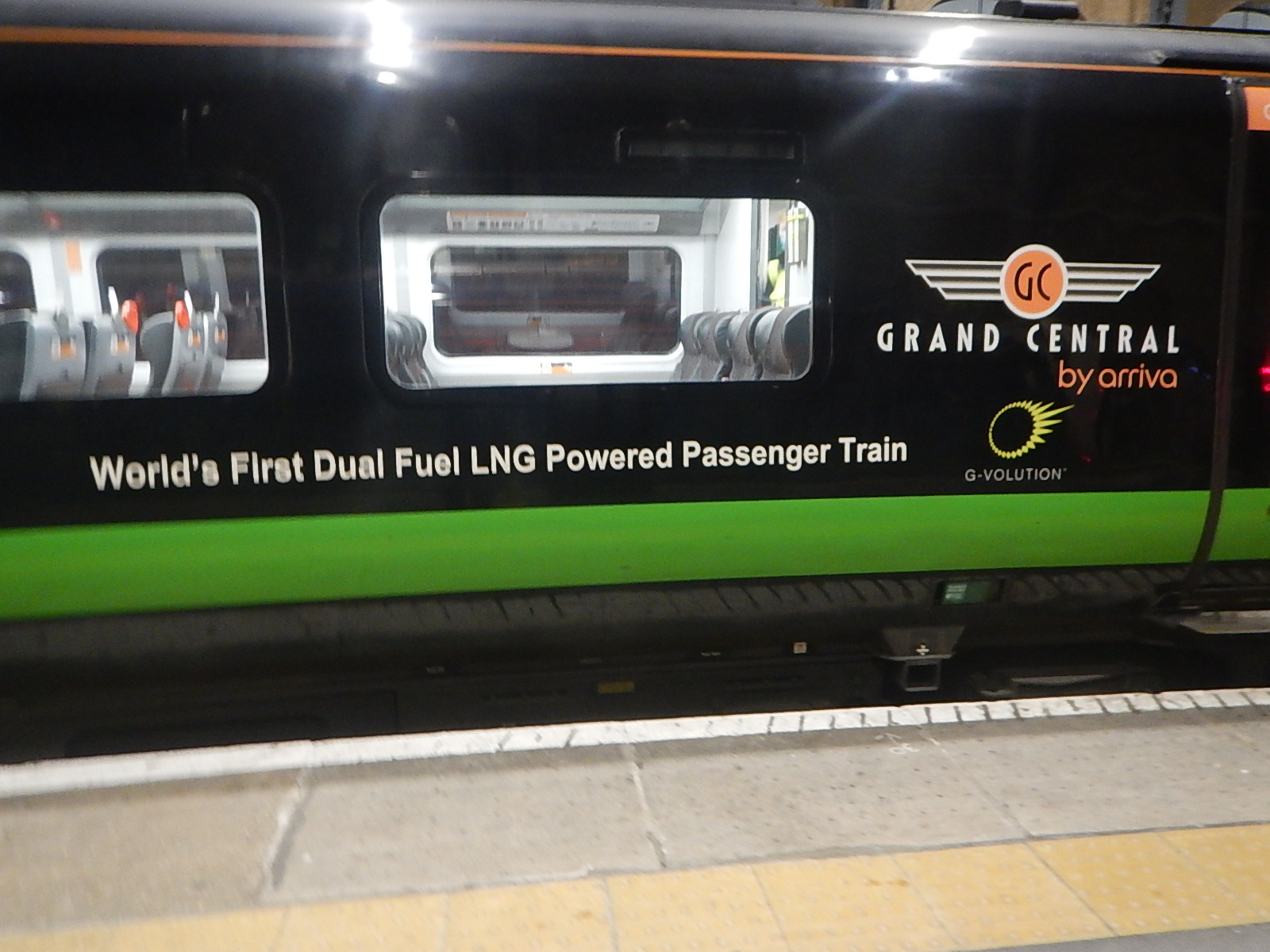
In Grand Central DMU To Be Used For Dual-Fuel Trial, I describe how G-volution’s dual fuel technology has been applied to one of Grand Central’s Class 180 train.
This picture I took after travelling in a Grand Central Class 180 train, shows that G-volution don’t hide their light under a bushel.
Note.
- This train appears to run on diesel and liquified natural gas.
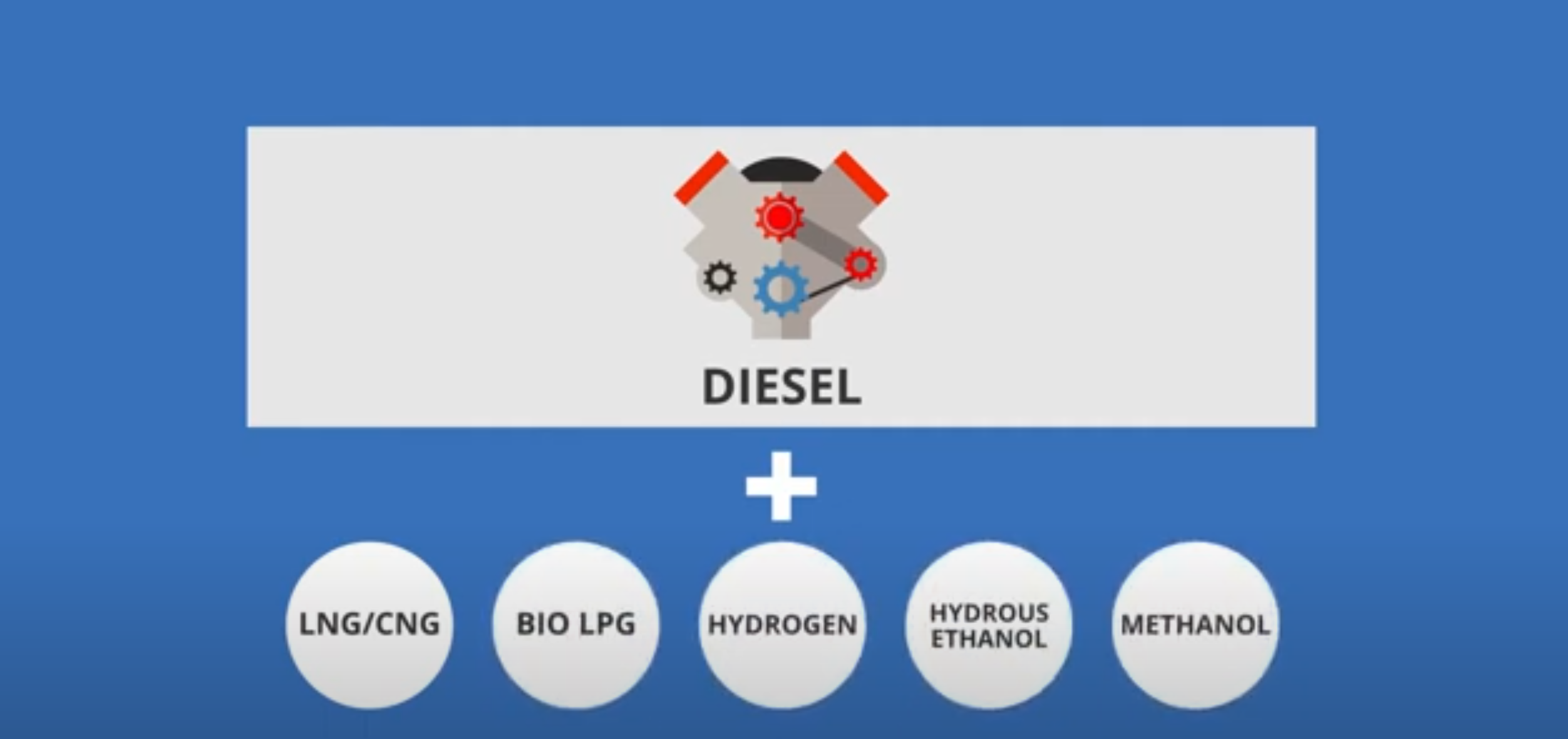
- This G-volution video gives more details.
This clip from the video, shows the possible fuels.
Note.
- Can the dual fuel engine use biodiesel or HVO instead of diesel?
- It looks like the Fresh Air Fuels Global process can produce biomethane, which could be liquified as LNG.
- Hydrogen is the only true zero-carbon secondary fuel.
- There is a Wikipedia entry for ethanol fuel.
- Hydrous ethanol is about 95% ethanol and 5% water and is used as a fuel in Brazil in petrol cars.
- There is a Wikipedia entry for the use of methanol as fuel.
Have G-volution got access to the technology to both reduce the fuel consumption of diesel engines and run them on zero-carbon fuel?
UK Trains That Have Cummins QSK-19 R Diesel Engines
Grand Central’s Class 180 trains have a Cummins QSK-19 R diesel engine.
All these trains have the same engine.
- 14 – Class 180 trains
- 51 – Class 185 trains
- 34 – Class 220 trains
- 44 – Class 221 trains
- 27 – Class 222 trains
In addition, Class 175 trains have a different engine made by Cummins.
Conclusion
If G-volution’s technology can be made to work successfully, it could play a large part in the decarbonisation of UK passenger trains.
On Track For A Low Carbon Energy Future – Centrica Signs Corporate Power Deal With Deutsche Bahn
The title of this post, is the same as that of this press release from Centrica.
These two paragraphs outline the deal.
Centrica Energy Trading has signed a two-year corporate power purchase agreement (PPA) with Deutsche Bahn, Germany’s national railway company.
Starting January 2024, Centrica will offtake power from three onshore wind farms with an installed capacity of 60.7 MW. The sites, developed by Prokon AG in Germany, have a total of 45 turbines and will provide approximately 70GWh of renewable electricity annually to Deutsche Bahn.
Sounds like good business to me! You buy electricity from three German onshore wind farms and flog it to a large German company and probably get an appropriate commission in Euros.
Support For Offshore Wind In New Jersey Drops, Industry Points To Effect Of Misinformation
The title of this post, is the same as that of this article on offshoreWIND.biz.
This is the sub-heading.
The number of New Jersey residents who support offshore wind fell by more than 20 per cent since 2019, from 76 per cent four years ago to just over half (54 per cent) now, and the number of those opposing offshore wind has climbed from 15 per cent to 40 per cent since 2019.
These are the first two paragraphs.
This is according to the results of a poll performed earlier this month by the Monmouth University Polling Institute, which found that 40 per cent of New Jerseyans think offshore wind farms could hurt the state’s summer tourism economy and 45 per cent see a connection between wind energy development and the recent beached whale phenomenon in New Jersey.
Furthermore, only 22 per cent expect the offshore wind industry to create a lot of jobs for the state, with most (55 per cent) saying that a few new jobs would be created and 15 per cent expecting that the industry would not create any new jobs.
It would appear that much of the drop in support has been down to Republicans.
The article is definitely a must-read.
Sun-Powered Rooftops Could Generate Two Nukes Of Electricity…If England Follows Peterborough’s Lead
The title of this post, is the same as that of this press release from the Energy and Climate Intelligence Unit.
This is the sub-heading.
Household and commercial rooftop solar could save £450 million on bills.
These are the first two paragraphs.
If all English constituencies matched Peterborough, which has the highest proportion of homes with rooftop solar photovoltaic (PV) panels, the country’s solar capacity could be increased by around 7GW (gigawatts), new analysis from the Energy and Climate Intelligence Unit (ECIU) has found.
The nuclear power station Hinkley C will have a capacity of around 3.2GW, so the capacity rooftop solar on domestic properties could be more than the capacity of two new nuclear power stations.
It is an interesting thought.
I should say, that I have rooftop solar and it generates more electricity, than I ever thought it would.
I find this an interesting paragraph.
In addition, industry analysis shows that the capacity potential of solar on the roofs of commercial properties, such as warehouses, is 15GW. Combined, Peterborough levels of domestic solar and industry estimates for commercial solar could deliver an additional 22GW capacity, which is the equivalent of the capacity of almost 7 nuclear power stations. However, industry has reported that it is currently difficult to get commercial roof top developments connected to the grid, with waits up to a decade or more, and it can be costly.
22 GW is a lot of electricity, but I do feel, that with innovation that probably uses energy storage devices, the connection problems can be solved.
In Denny Bros Completes Solar Scheme At Bury St Edmunds Factory, I wrote about what one company in Suffolk has done with their roofs.
The technology already exists, so how long will it be before a company offers an electrolyser to convert excess electricity into hydrogen, which is used for transport, heating or an industrial process?
In Government Hydrogen Boost To Help Power Kimberly-Clark Towards 100% Green Energy Target, I talked about how Kimberly-Clark are partially switching from natural gas to green hydrogen.
TransPennine Express To Stop Using Loco-Hauled Push-Pull Trains In December
The title of this post, is the same as that of this article on Railway Gazette.
This is the sub-heading.
TransPennine Express has confirmed that it will cease using its push-pull sets of Class 68 locomotives and MkVa coaches, previously designated Nova 3 sets, from the December 2023 timetable change.
These are my thoughts.
The Nova 3 Trains
Currently, the Nova 3 trains are made up from the following.
- 14 – Class 68 locomotives
- 52 – Mark 5a coaches
- 14 – Driving Van Trailers
Note.
- There have been complaints about the noise of the Class 68 locomotives at Scarborough and also at Marylebone with Chiltern Railways.
- The Class 68 locomotives could be switched to freight duties.
- The coaches are capable of 125 mph.
- A maximum of thirteen sets can be created.
- I suspect CAF wouldn’t object to being asked to build some more Mark 5a coaches and driving van trailers.
- The current fleet has a spare locomotive and a spare driving van trailer to allow for servicing.
All locomotives and coaches are a maximum of seven years old, so will have plenty of life left.
The Class 93 Locomotive
Rail Operations Group have ordered ten Class 93 locomotives, with twenty options, which have an impressive specification.
- Built by Stadler in Valencia.
- Same family as a Class 68 and 88 locomotive.
- Electric, diesel and battery power
- 110 mph operating speed
- Ability to pull passenger and freight trains.
- Delivery scheduled for 2023.
I believe that if the Class 68 diesel locomotive of a Nova 3 train, were to be replaced with a Class 93 locomotive, a very useful train would be created.
- It would be ten mph faster, than a Nova 3 train.
- It could use the diesel engine and the batteries to bridge gaps in electrification.
- By adding extra carriages it could be tailored to the needs of a route.
- In Vegetable Oil Fuelling Chiltern Railways Trains In UK First, I discuss how it might be possible to run all these locomotives on HVO to cut emissions.
- It could be quieter.
Could it be a simple way to reduce carbon emissions on a route?
The Successor To The Class 93 Locomotive
Stadler keep innovating in their designs for locomotives and are already building hydrogen-powered multiple units.
I can see Stadler coming up with a hydrogen-powered locomotive, with the following specification.
- In the same family as Class 68, 88 and 93 locomotives.
- Ability to do everything that Class 68, 88 and 93 locomotives can do.
- Ability to use 25 KVAC overhead electrification, where it exists.
- Ability to be able to be fitted with third-rail equipment, so it can use 750 VDC third-rail electrification, where it exists.
- At least a 110 mph operating speed.
- Range of at least 200 miles on hydrogen.
Stadler would sell a lot of these locomotives to decarbonise railways all over the world.
Possible Routes
These are possible routes for a rake of Mark 5a coaches hauled by a Class 93 locomotive or its zero-carbon successor.
Hull Trains
Consider.
- Hull Trains is an open access operator.
- Hull Trains currently have a fleet of five Class 802 trains, each of which have five-cars.
- A Class 93 locomotive has a power of 900 kW on diesel, whereas the Class 802 train has 2100 kW.
- The Class 802 train has nearly ten percent more capacity.
- In Ten-Car Hull Trains, I saw two Class 802 trains working as a pair. Does this indicate they have a capacity problem?
- Between Hull and the East Coast Main Line is only 36.1 miles and isn’t very challenging and I suspect could probably be easily handled by a Class 93-hauled rake of Mark 5a coaches.
- Adding extra coaches would not be difficult and would probably be less costly than with the more complex Class 802 trains.
- Hull Trains need to have a plan to decarbonise.
- HVO could be used to cut down emissions.
A Class 93-hauled rake of Mark 5a coaches could be an intermediate step to full decarbonisation with a hydrogen locomotive.
Would other operators of Class 802 trains like to increase their fleets, by adding Hull Trains’s five Class 802 trains?
TransPennine Express
Consider.
- TransPennine Express currently have four different fleets of trains, so it must cause problems with the allocation of drivers.
- The Class 397 trains are confined to the West Coast Main Line.
- So that leaves the bi-mode Class 802 trains and the diesel Class 185 trains to work the TransPennine routes.
The Wikipedia entry for the Class 802 train, gives more details of the plans for the Class 802 trains.
During October 2021, it was announced that TransPennine Express, Hitachi, and Angel Trains had agreed to convert one of the former’s Nova 1 trainsets into a battery hybrid train on a trial basis with the aim of supporting the technology’s further development. If successful, Hitachi and Angel Trains have proposed the retrofitting of the entire fleet. In January 2022, reports emerged that the Nova 1 fleet was operating under diesel power even when operating on entirely electrified sections of the East Coast Main Line on account of the insufficient power supplies present along the line; national railway infrastructure owner Network Rail is reportedly set to complete upgrades to the power supplies within two years.
The fleet is also set to benefit from the rollout of electrification under the Transpennine route upgrade scheme. The company’s management has noted that, in the event of largescale electrification being funded and implemented, the Class 802s could have some of their engines removed to reduce roughly 15% of their weight and thus raise their efficiency. Furthermore, Leo Goodwin, TPE’s managing director, has observed that while the Class 802s have an initial maximum speed of 125 mph (201 km/h), they have the capability of being modified for operating at 140 mph (230 km/h) if infrastructure upgrades were to permit such speeds at a future date.
Could an augmented fleet of battery-electric Class 802 trains handle the bulk of the TransPennine routes, with the shorter and unelectrified ones still being handled by the Class 185 trains?
These shorter routes are.
- Leeds and Huddersfield
- Manchester Piccadilly and Huddersfield
- York and Scarborough
Plans only exist to electrify Leeds and Huddersfield.
I suspect a few more battery-electric Class 802 trains would be needed.
Great Western Railway
Could a Class 93-hauled rake of Mark 5a coaches be used as a replacement for the GWR Castles or short-formation InterCity125s?
- They both have four passenger coaches.
- They are both 125 mph trains.
- A Class 68 locomotive could be used on routes without electrification.
- HVO could be used to cut down emissions.
- The Mark 5a coaches would probably be quieter, as they only have one diesel engine.
A Class 93-hauled rake of Mark 5a coaches could be an intermediate step to full decarbonisation with a hydrogen locomotive.
Alternatively, five-car Class 802 trains could be used as replacements for GWR Castles.
Great Western Railway also have the problem of decarbonising services between Bristol/Gloucester and Weymouth/Southampton/Portsmouth.
Great Western Railway look like they’re needing some innovative thinking.
I also suspect a few more battery-electric Class 802 trains would be needed for other routes.
Transport For Wales Rail
Transport for Wales Rail run a Premier Service between Holyhead and Cardiff using Class 67 locomotives and Mark 4 coaches.
According to the Wikipedia entry for Transport for Wales Rail, they have seven sets of 4/5 coaches to run this service.
If Transport for Wales Rail wanted to decarbonise this route, they would need to replace the locomotives for a zero-carbon unit.
Perhaps, their best solution, would be to wait until a suitable hydrogen-powered locomotive is available and buy seven rakes of new coaches with driving van trailers.
Grand Union
Grand Union has a detailed Wikipedia entry, where this is the first paragraph.
Grand Union is a prospective open access operator who are proposing to operate train services in the United Kingdom from England to Wales and Scotland. Grand Union is headed by Ian Yeowart, who founded previous open access operators Alliance Rail Holdings and Grand Central before selling both to Arriva.
That seems a sound foundation.
- They have permission to run trains between Paddington and Carmarthen starting in December 2024.
- They have also applied to run trains between Euston and Stirling.
- They are now backed by Spanish companies; Serena Industrial Partners and Renfe.
- They are proposing to use nine Mark 4 coaches hauled by Class 93 locomotives.
Consider.
- CAF has a factory in Wales.
- CAF has sold trains to Transport for Wales.
- The Mark 5a coaches will definitely be available by December 2024.
- Mark 5a coaches could easily be arranged as a rake of eight coaches and a driving van trailer.
- Grand Union is backed by Spanish companies.
I wouldn’t be surprised if Grand Union were to use sets of CAF-built Mark 5a coaches for their Carmarthen service. And later for their Stirling service.
A Class 93-hauled rake of Mark 5a coaches could be an intermediate step to full decarbonisation with a hydrogen locomotive.
Grand Central
Consider.
- Grand Central is another open access operator.
- Grand Central has a mixed fleet of twelve five-car diesel trains.
- These trains run under electrification on the East Coast Main Line.
- According to the Wikipedia entry for Grand Central trains, they have plans for expansion across the North and to and from London.
- Grand Central need to have a plan to decarbonise.
- HVO could be used to cut down emissions.
A Class 93-hauled rake of Mark 5a coaches could be an intermediate step to full decarbonisation with a hydrogen locomotive.
South Western Railway
South Western Railway have an excellent fleet of new or nearly new trains, with the exception of the diesel Class 158 and Class 159 trains, that work services between Waterloo and Exeter trains via Basingstoke and Salisbury.
- Waterloo and Exeter is 172 miles.
- Only the 47.7 miles between Waterloo and Basingstoke is electrified with 750 VDC third-rail electrification.
- Train lengths vary between five and eight cars.
- The current trains date from around 1990 and must need replacing soon.
I wouldn’t be surprised that if after a rebranding with new trains, this could be a popular route.
A version of Hitachi’s ubiquitous bi-mode Class 802 could be used.
But.
- They would need to be ordered and built.
- The third-rail gear, would need to be developed and tested.
- Passengers would be travelling for over two and a half hours with underfloor diesel engines.
An alternative could be a Class 68-hauled rake of Mark 5a coaches.
- These trains would be available after release from TransPennine Express.
- They would run in TransPennine Express formation.
- Length could be adjusted by adding or removing coaches, if required.
- The noise is all in the locomotive, which is isolated from the passengers.
At some point in the future, the route could be decarbonised by swapping the locomotive for a hydrogen-electric locomotive with the ability to handle third-rail electrification.
ScotRail
ScotRail have a similar problem to Great Western Railway with their short-formation InterCity125s.
- They have 52 Class 43 locomotives and 120 Mark 3 coaches, which is probably enough for 24 trains.
- Scotland has substantial amounts of electrification.
- I feel that a Class 68-hauled rake of Mark 5a coaches would be a more than adequate replacement.
- Class 93 locomotives could be used where routes are partially electrified.
- Scotland is not going to be short of green hydrogen.
When a suitable hydrogen-electric locomotive is available, these trains can be decarbonised.
CrossCountry
CrossCountry have a fleet consisting of the following trains.
- 5 – 2+7 InterCity125 trains
- 7 – two-car Class 170 trains
- 22 – three-car Class 170 trains
- 34 – four-car Class 220 trains
- 4 – four-car Class 221 trains
- 20 – five-car Class 221 trains
Note.
- The fleet is all diesel.
- I’ll ignore the Class 170 trains in this analysis.
- The Class 220 and 221 trains often work in pairs to provide the required capacity.
So how could these trains be decarbonised?
- The InterCity125s and the Class 220 and 221 trains could be replaced by a locomotive-hauled rake of Mark 5a coaches of an appropriate length.
- Motive power could be provided by an appropriate Class 68 or 93 locomotive.
When a suitable hydrogen-electric locomotive is available, these trains can be fully decarbonised.
Decarbonisation Of UK Main Line Services
It is generally assumed that the railways of the UK will need to fully decarbonise if the UK and the constituent nations are going to meet their decarbonisation targets.
I believe that my analysis shows that decarbonisation of main line passenger services can be achieved by the purchase of two types of trains.
- Five-car bi-mode Class 802 trains or similar.
- Locomotive-hauled rakes of Mark 5a coaches of an appropriate length.
Note.
- The Class 802 trains would be mainly to augment existing Hitachi fleets.
- Some Class 802 trains would be fitted with batteries instead of diesel generators to handle gaps in the electrification.
- The rakes of coaches would be powered by an appropriate locomotive.
- The lengths of the rakes of coaches would be adjusted to meet the demand of each service.
Initially, the following locomotives would be used.
- Class 68 locomotives would be used on unelectrified lines.
- Class 93 locomotives would be used on full or partially electrified lines.
When the hydrogen-electric locomotives become available, these would take over the routes, which couldn’t be decarbonised by full electrification or by using a Class 93 locomotive.
 The Anonymous Widower