Highview Power Unveils $1bn Of Liquid-Air Energy Storage Projects In Spain
The title of this post, is the same as that of this article on Recharge Magazine.
The article is based on this press release from Highview Power, which is entitled Highview Power Developing 2 GWh of Liquid Air Long Duration Energy Storage Projects in Spain.
This is the introductory paragraph from the press release.
Highview Power, a global leader in long duration energy storage solutions, announced today it is developing up to 2 GWh of long duration, liquid air energy storage projects across Spain for an estimated investment of around $1 billion. These projects will enable several Spanish regions to move towards their net zero emissions target.
The press release also says this about location and size.
Highview Power is planning to develop up to seven CRYOBattery™ projects ranging from 50 MW/300 MWh in Asturias, Cantabria, Castilla y Leon, and the Canary Islands.
Three of these areas are in Northern Spain and the other is a group of islands.
As Spain has at least two large pumped storage systems, perhaps geography rules this proven technology out in these areas.
System Modularity
According to the Wikipedia entry for Highview Power, the two current CRYOBatteries under development are sized as follows.
- Carrington, Manchester, UK – 50 MW/250 MWh – Under construction
- Vermont, USA – 50 MW/400 MWh – Under development
Do the figures indicate that several systems will share the same 50 MW core power system, with a number of liquid air tanks to give the appropriate capacity?
I have extensively modelled chemical plants in my past to see, how different sizes work and I am fairly certain, that Highview Power have developed a design, that is extremely flexible.
It looks like if initial calculations show that a system capable of supplying 50 MW for five hours is needed, but operation proves that a capacity of six hours would be better, that all Highview Power need to do is add another 50 MWh tank.
This is surely an operator’s dream, as if say a developer builds a thousand dwellings and/or a windfarm nearby and more energy storage is needed, an appropriate number of extra tanks can be added.
Sourcing The 50 MW Core Power System
I talked about how the first system at Carrington will use a system from MAN Energy Solutions in MAN Energy Partners With Highview Power On Liquid-Air Energy-Storage Project.
This surely is an approach that minimises risk.
Sourcing The Storage Tanks
I have been searching the Internet for manufacturers of cryogenic gas tanks and I’ve found them in countries like Australia, Brazil, Germany, India, South Africa, Spain, the UK and the US.
But then most hospitals have one for their liquid oxygen.
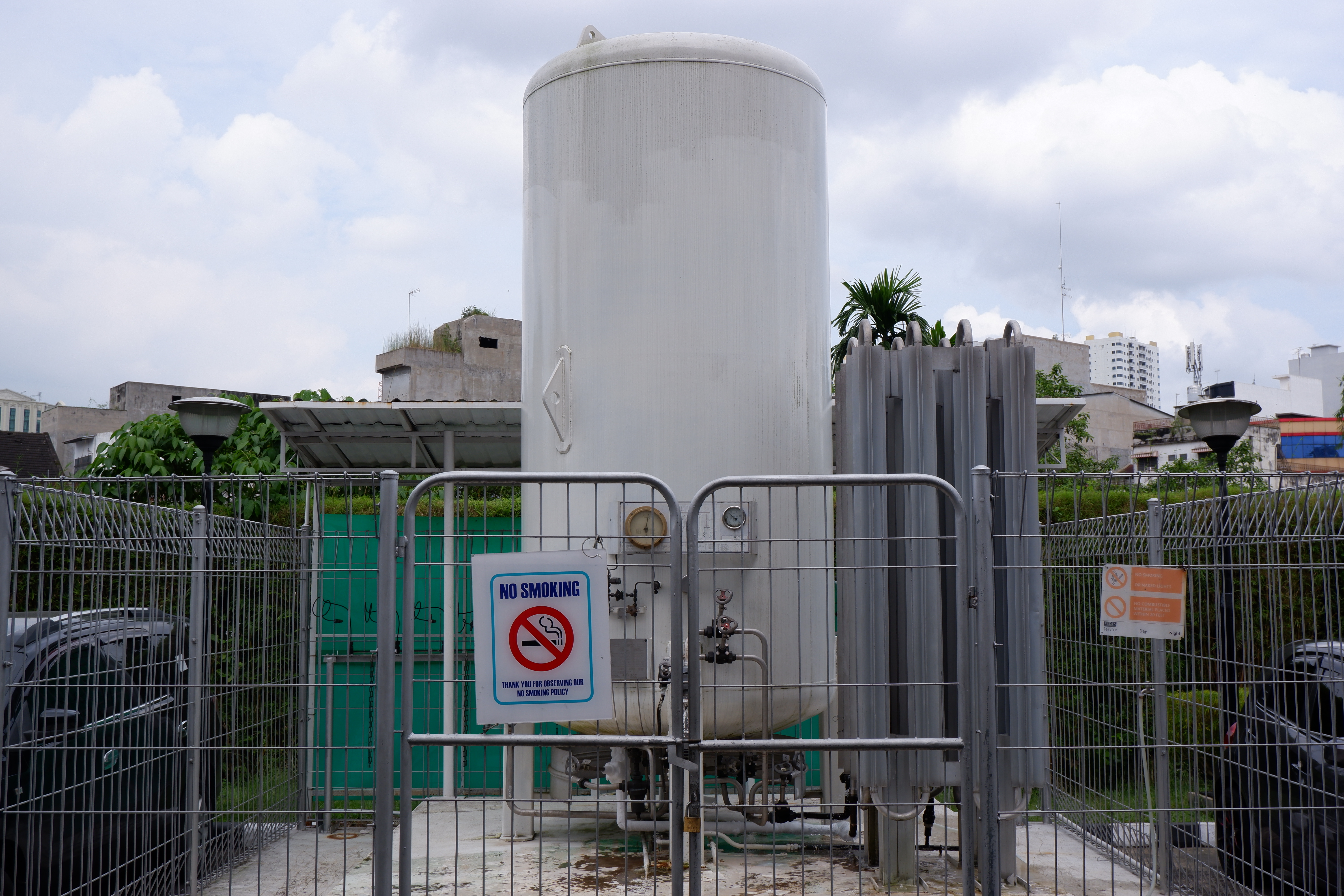
This image was from shutterstock.
They are not difficult to find.
Spain And Renewable Energy
Spain is a large producer of renewable energy and also a leader in wind and solar power technology.
See Renewable Energy in Spain on Wikipedia for more details.
Siemens Gamesa, which was created by a merger of a German and a Spanish company and is headquartered at Zamudio in Spain, have also developed the Siemens Gamesa ETES, which is a volcanic rock-based energy storage system about the same size of Highview Power’s CRYOBattery.
Conclusion
It looks to me, that Highview Power have closed a good sale.
A Trip To Corby
I took these pictures on a trip to Corby this morning.

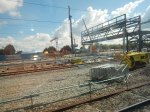



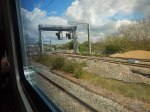



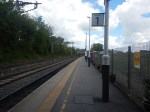

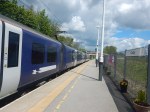
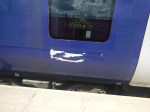
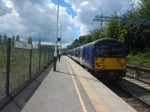
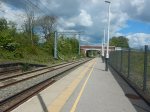

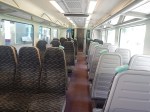
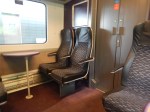


These are my thoughts.
Trains To And From Corby
I got a Class 222 train to Corby and an eight-car Class 360 train back.
Brent Cross West Station
There was a lot of constructruction activity at the new Brent Cross West station.
Luton Airport Parkway Station
The extensions to Luton Airport Parkway station look to be comprehensive, with several escalators.
The Luton DART connection to Luton Airport appears to be under test, so should open in 2022.
But will there be any air passengers to use it?
I last used it in 2008, when I went to see England play in Belarus.
Electrification North Of Bedford
The electrification North of Bedford station is obviously complete on the slow lines, but on the fast lines, as the pictures show, the gantries are all erected, but there are still wires to be installed.
But as the Class 810 trains won’t be in service until 2023, there’s still a bit of time.
The gantries certainly look sturdy, as this picture shows.
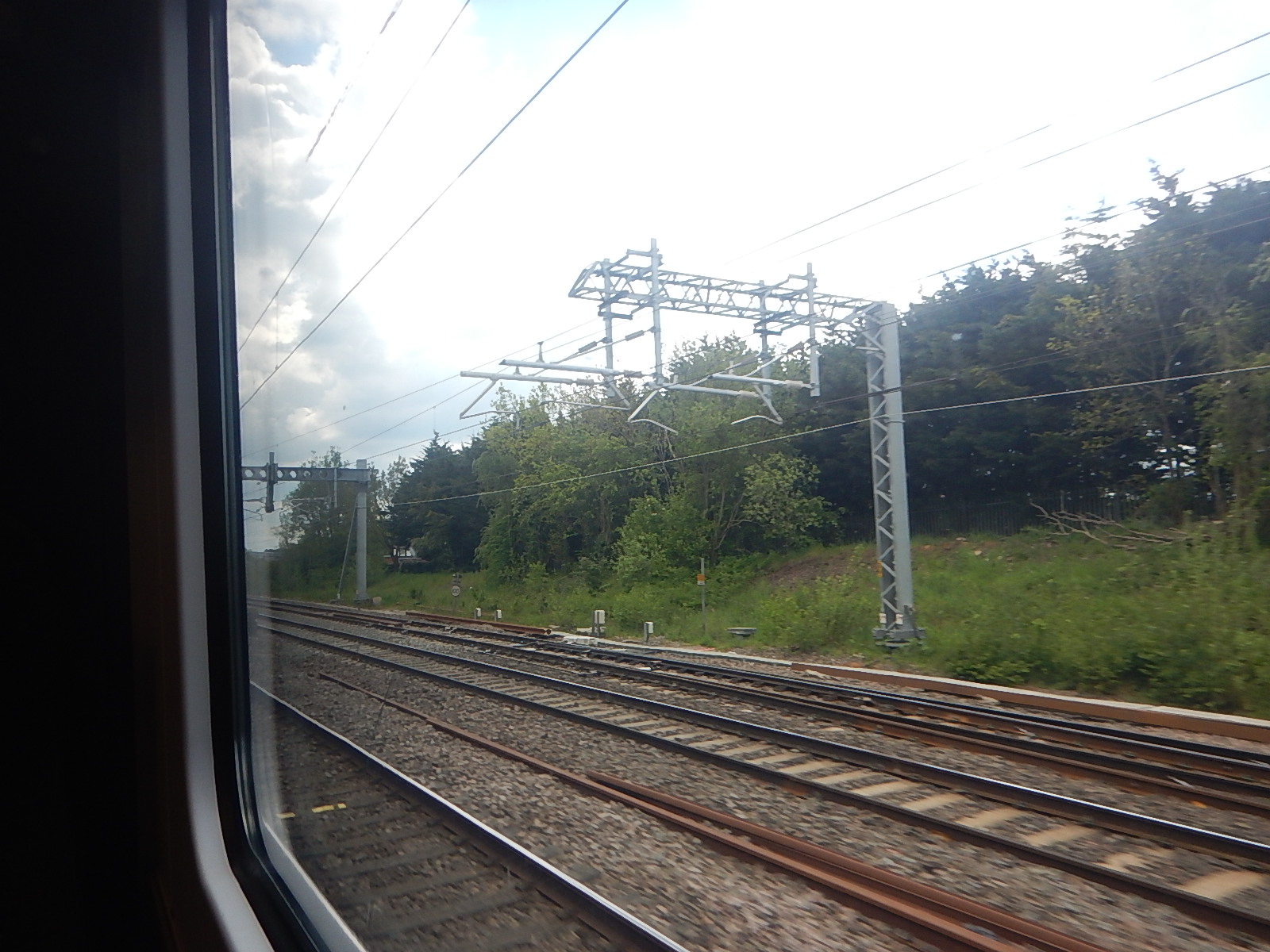
They’re certainly built for 125 mph, but as the Class 810 trains will be capable of 140 mph with full digital in-cab signalling, I would hope that the electrification has been installed to that standard. Or at least to a standard, that can be easily upgraded!
Corby Station
Corby station has been finished to a single-platform station, which is able to accept a twelve-car Class 360 train.
This should be adequate for the current half-hourly service, as a single platform can handle a least four trains per hour (tph) and several around the country regularly do.
Both tracks through the station are electrified and I suspect with a second platform bridge, both could be used by electric trains to create a two-platform station.
But there would appear to be no need at the moment.
Even, if it were to be decided to extend one tph to Oakham and Melton Mowbray stations, this could probably be accommodated on the single-platform.
Network Rail seem to have already installed a crossover South of Corby station, so that trains can use the single platform.
Serving Oakham And Melton Mowbray
I discussed this extension in detail in Abellio’s Plans For London And Melton Mowbray Via Corby And Oakham.
In the related post, I said this.
This page on the Department for Transport web site is an interactive map of the Abellio’s promises for East Midlands Railway.
These are mentioned for services to Oakham and Melton Mowbray.
-
- After electrification of the Corby route there will continue to be direct service each way between London and Oakham and Melton Mowbray once each weekday, via Corby.
- This will be operated with brand new 125mph trains when these are introduced from April 2022.
This seems to be a very acceptable minimum position.
When my Class 222 train arrived in Corby at 1154, it waited a couple of minutes then took off to the North.
I then took the next train to London, which was an eight-car Class 360 train which formed the 1211 service back to St. Pancras.
Meanwhile the Class 222 train, that I’d arrived on did a reverse in the Corby North Run Around Loop finally arriving back in Corby at 1345. The train had taken one hour and forty-nine minutes to return to Corby.
It might be just coincidence, but are East Midlands Railway doing timing tests to see if services can be extended to Oakham And Melton Mowbray?
It should be noted that service times North of Corby are as follows.
- Corby and Oakham – 19 mins – 14.3 miles
- Corby and Melton Mowbray – 31 mins – 25.7 miles
- Melton Mowbray and Leicester – 17 mins – 12.8 miles (estimate) – CrossCountry service
My logic goes like this.
- It looks to me that it would not be unreasonable that a Class 222 train could run between Corby and Leicester in forty-eight minutes.
- Double that and you get one hour and thirty eight minutes, for a journey from Corby to Leicester and back.
- Subtract that time from the one hour and forty-nine minutes that my train took to reverse and there is eleven minutes for a turnback at Leicester station.
- Eleven minutes would certainly be long enough to tidy a train and for the crew to change ends.
I also believe that the 35.8 miles would be possible for a Class 810 train fitted with one or more battery power-packs instead of a similar number of the four diesel engines.
So are East Midlands Railway doing tests to find the most efficient way to serve Oakham And Melton Mowbray?
On The Corby Branch
I travelled North on a Class 222 diesel train and South on an electric Class 360 train.
On the Corby branch, I was monitoring the train speed on an app on my phone and both trains travelled at around 90 mph for most of the way.
There were sections at up to 100 mph and the track was generally smooth.
I was left with the impression, that trains might be able to go faster on the branch.
Average speeds for the 2.5 miles of the branch were as follows according to these timings from realtimetrains.
- Class 222 train – Arriving – 5.25 mins – 28.6 mph
- Class 222 train – Leaving – 5 mins – 30 mph
- Class 360 train – Arriving – 7.5 mins – 20 mph
- Class 360 train – Leaving – 5 mins – 30 mph
It doesn’t appear that there are much difference in the timings, although it might be said, that the electric approach is more cautious.
The Class 360 Trains
The Class 360 trains have not been refurbished yet although as my pictures show, some have been given a new livery.
In Are Class 360 Trains Suitable For St. Pancras And Corby?, I said this about the train refurbishment.
This page on the Department for Transport web site is an interactive map of the Abellio’s promises for East Midlands Railway.
These features are mentioned for Midland Main Line services to Corby.
-
- Increased capacity
- Twelve-car trains in the Peak.
- More reliable service
- Improved comfort
- Passenger information system
- Free on-board Wi-Fi
- At-seat power sockets
- USB points
- Air conditioning
- Tables at all seats
- Increased luggage space
- On-board cycle storage
What more could passengers want?
It certainly hasn’t happened in full.
I did ask a steward, when the new interiors will be installed and he said they were running late because of the pandemic.
Performance Of The Class 360 Trains
I used my app to follow the speed of the Class 360 train, that brought me back to London.
- The train hit a maximum speed of about 105 mph.
- The train arrived in London a minute late.
I feel that as the drivers get used to their new charges, they will match the timetable.
Conclusion
I have a feeling that in a couple of years, these trains will fulfil Abellio’s promises.
An Elegant Way To Cope With Roof Leaks
I took these pictures at St. Pancras station.



Note.
- The full wording is “I catch rain, not rubbish”
- The green grass is something like Astroturf.
- There were three of them!
- They appear to be fitted with castors.
I’m surprised, I’ve not seen this idea used before.
Rolls-Royce Seeks Private Funds To Power Nuclear Project
The title of this post, is the same as that of this article on The Times.
The article is based on this press release on the Rolls-Royce web site, which is entitled More Power And Updated Design Revealed As Nuclear Power Team Targets First Place In The Assessment Queue In Autumn 2021.
This is the first two paragraphs.
The consortium, led by Rolls-Royce, which is creating a compact nuclear power station known as a small modular reactor (SMR), has revealed its latest design and an increase in power as it completes its first phase on time and under budget.
It has also announced it is aiming to be the first design to be assessed by regulators in the second half of 2021 in the newly-opened assessment window, which will keep it on track to complete its first unit in the early 2030s and build up to 10 by 2035.
It would appear that they are following AstraZeneca’s example and building the relationships with the regulators early, so the process of regulation doesn’t delay entry into service.
An Updated Design
These two paragraphs describe the design changes.
As the power station’s design has adjusted and improved during this latest phase – with more than 200 major engineering decisions made during this latest phase – the team has optimised the configuration, efficiency and performance criteria of the entire power station , which has increased its expected power capacity, without additional cost, from 440 megawatts (MW) to 470MW.
The refreshed design features a faceted aesthetic roof; an earth embankment surrounding the power station to integrate with the surrounding landscape; and a more compact building footprint, thanks to successes optimising the use of floor space.
These changes appear to be positive ones.
Transformation To A Focussed Business
Rolls-Royce are transforming the current consortium to an as yet unnamed stand-alone business, as detailed in this paragraph from the press release.
With a focus on continuing its progress at pace, the UK SMR team is transitioning from being a collaborative consortium to a stand-alone business, which will deliver a UK fleet of power stations to become a low carbon energy bastion alongside renewables, while securing exports to make the power station a key part of the world’s decarbonisation toolkit.
Are Rolls-Royce aiming to repeat the success they’ve had with Merlins in World War II and large turbofan engines for airliners with small modular nuclear reactors that decarbonise the world? The strategy is certainly not going against the heritage of the company.
Use Of A Small Modular Nuclear Reactor
This paragraph from the press release outlines a few uses.
The power station’s compact size makes it suitable for a variety of applications, helping decarbonise entire energy systems. Each power station can supply enough reliable low carbon power for around one million* homes, or be used to power net zero hydrogen and synthetic aviation fuel manufacturing facilities, desalination plants or energy intensive industrial sites.
Their size would appear to increase the number of applications.
Hydrogen Production
I particularly like the idea of using an SMR to produce hydrogen for chemical feedstock or to make steel.
I indicated this in Will INEOS And Rolls-Royce Get Together Over Hydrogen Production?
I estimate that a 470 MW SMR would produce around 4,900 tonnes of hydrogen per day.
The numbers certainly seem convenient.
Cost Of Energy And Capital Costs
Tom Samson, Chief Executive Officer of the UK SMR consortium is quoted as saying.
Nuclear power is central to tackling climate change, securing economic recovery and strengthening energy security. To do this it must be affordable, reliable and investable and the way we manufacture and assemble our power station brings down its cost to be comparable with offshore wind at around £50 per megawatt-hour.
Hinckley Point C has a strike price of over £80 per megawatt-hour.
The release also gives a price of around £2.2 billion per unit dropping to £1.8 billion by the time five have been completed.
Benefits To The UK
The press release lists these benefits to the UK.
- create 40,000 regional UK jobs by 2050
- generate £52 billion of economic benefit
- have 80% of the plant’s components sourced from the UK
- target an additional £250 billion of exports – memoranda of understanding are already in place with Estonia, Turkey and the Czech Republic
The value of exports would indicate export sales of over a hundred reactors.
Lifetime
The press release indicates the following about the lifetime of the reactors.
- The reactor will operate for at least 60 years.
- The design, which will be finalised at the end of the regulatory assessment process, proposes that all used fuel will be stored on each site for the lifetime of the plant.
I would assume that Rolls-Royce are developing a philosophy for taking the SMRs apart at the end of their life.
Construction
This paragraph from the press release talks about the construction process.
The power station’s design cuts costs by using standard nuclear energy technology used in 400 reactors around the world, so no prototyping is required. The components for the power station are manufactured in modules in factories, before being transported to existing nuclear sites for rapid assembly inside a weatherproof canopy. This replicates factory conditions for precision activities and further cuts costs by avoiding weather disruptions. The whole sequence secures efficiency savings by using streamlined and standardised processes for manufacturing and assembly, with 90% of activities carried out in factory conditions, helping maintain extremely high quality. In addition, all spoil excavated will be reused on site to build the earth embankment, removing the need for it to taken off site, reducing road journeys that are both financially and environmentally costly.
I have talked to project managers, who have assembled factory-built railway stations and their experiences would back the Rolls-Royce method of construction.
My project management knowledge would also indicate, that the construction of an SMR could be much more predictable than most construction projects, if the factory-built modules are built to the specification.
Funding
According to the article in The Times, the consortium now seems to be in line for £215 million of Government funding, which will unlock £300 million of private funding.
Conclusion
It looks like this project will soon be starting to roll.
DfT To Have Final Say On Huddersfield Rebuild Of Rail Station And Bridges
The title of this post, is the same as that of this article on Rail Technology Magazine.
This is the first paragraph.
As part of the £1.4bn Transpennine Route Upgrade. Transport Secretary Grant Shapps is to rule on planned changes to Huddersfield’s 19th century rail station and not the Kirklees council, in what is to be a huge revamp of the line between Manchester and York.
According to the article eight bridges are to be replaced or seriously modified.

As Huddersfield station (shown) is Grade I listed and three other Grade II listed buildings and structures are involved, I can see this project ending up with a substantial bill for lawyers.
But then, to have a world-class railway across the Pennines, a few eggs will need to be broken.
Electric Trains Across The Pennine
This page on the Network Rail web site describes the Huddersfield To Westtown (Dewsbury) Upgrade.
When the upgrade and the related York To Church Fenton Improvement Scheme is completed, the TransPennine route between Huddersfield and York will be fully-electrified.
As Manchester To Stalybridge will also have been electrified, this will mean that the only section without electrification will be the eighteen miles across the Pennines between Stalybridge and Huddersfield.
Will this final eighteen miles ne electrified?
Eighteen miles with electrification at both ends will be a short jump for a Hitachi Intercity Tri-Mode Battery Train, the specification of which is shown in this Hitachi infographic.

The Class 802 trains of TransPennine Express are able to be converted into these trains.
The trains could work these routes.
- Liverpool Lime Street and Scarborough
- Manchester Airport and Redcar
- Liverpool Lime Street and Edinburgh via Newcastle
- Manchester Airport and Newcastle
- Manchester Piccadilly and Hull
- Manchester Airport and Cleethorpes
Note.
- I suspect some more Class 802 trains with batteries will be needed.
- The trains would either use battery or diesel power to reach Hull, Redcar and Scarborough or there could be a few miles of electrification to stretch battery range.
- Will the Class 68 diesel locomotives be replaced with Class 93 tri-mode locomotives to haul the Mark 5A coaches to Scarborough.
- Manchester Airport and Cleethorpes could be a problem and will probably need some electrification around Sheffield and Grimsby.
This would just mean TransPennine’s two short routes to be decarbonised.
- Manchester Piccadilly and Huddersfield
- Huddersfield and Leeds
As except for the eighteen mile gap between Stalybridge and Huddersfield, these two routes are fully-electrified, I suspect that a battery-electric version of a 110 mph electric train like a Class 387 or Class 350 train could run these routes.
Conclusion
It looks like if these sections of the TransPennine Express network are upgraded and electrified.
- York and Church Fenton
- Huddersfield and Westtown
- Manchester and Staylebridge
Together with a few extra miles of electrification at strategic points, that TransPennine Express will be able to decarbonise.
Romania Wants To Buy Hydrogen-Powered Trains
The title of this post, is the same as that of this article on Romania Insider.
This is the first paragraph.
Romania’s minister of transport announced that the National Relaunch and Resilience Plan (PNRR) includes the purchase of some 10-12 hydrogen-powered trains for the Bucharest-Pitesti route.
Note that Bucharest and Pitesti are about 120 kilometres apart.
Conclusion
It looks like an ideal route for hydrogen trains.
- New hydrogen trains can probably take over from the current diesel trains with only a few modifications to the tracks and signalling.
- A hydrogen refuelling station would need to be provided.
- The route is not overly long.
- The train manufacturer could be delivering a standard fully-financed package of trains, hydrogen refuelling system and training.
As it is effectively, a replacement of one self-powered train with another, from the time order to in service could be a fairly short time of a couple of years or so.
BECCS Beats Hydrogen For Decarbonizing Steel In Europe: ArcelorMittal
The title of this post, is the same as that of this article on S & P Global Platts.
This is the first paragraph.
Bioenergy with carbon capture and storage (BECCS) offers a more cost-effective, readily available solution for decarbonizing the steel industry in Europe than clean hydrogen, steel producer ArcelorMittal’s head of strategy David Clarke said May 17.
So what do they mean by bioenergy?
To make iron from iron ore, you need a reducing agent like carbon or hydrogen.
Iron ore is rich in oxides of iron.
The carbon is usually some form of coal, which produces large amounts of carbon dioxide with the oxygen from the iron oxides.
Hydrogen produces lots of water with the oxygen.
David Clarke of ArcelorMittal explains the process in the article.
“We know biomass worked as a replacement for coal,” he said. “We’ve been using it in our operations in Brazil and other places for many, many years. We have a project in Belgium that we’ll be starting up next year using waste wood, using that to make bio-coal,” with a project to take the emissions from the bio-coal to produce bioethanol.
Is this a case of Back-To-The-Future? If I remember my history, didn’t Iron Age men use charcoal to smelt iron and other metal ores?
If those scientists from Velocys can make Sustainable Aviation Fuel and biodiesel from household waste and used disposable nappies, can they apply their magic to make bio-coal?
I see great cost advantages with this process, as surely it would enable existing blast furnaces to be used, provided they were fitted with carbon capture and storage.
It’s Time To Detopsify Stratford Station
Stratford Station has grown like Topsy for too long and has several problems and possible future expansions.
Not least of these include.
- The final arrival of Crossrail.
- A direct connection to Chingford.
- A Stansted Express service.
- Massive housing developments in the area.
- More hotels
- New cultural developments like the branch of the Victoria and Albert Museum.
- A new campus for University College London.
This article on IanVisits is entitled Stratford Station Set For Massive Transformation.
This is his opening paragraph.
Stratford station could be radically redeveloped under plans being worked on by the rail companies and local council.
That is rather understated!
The station will become several times busier and needs a complete rethink, many more services and deTopsification.
These are my thoughts.
The Development Of The High Meads Loop
The High Meads Loop exists and is a double-track loop that can turn trains arriving at Stratford station via Lea Bridge station.
- It is underneath the Eastfield Shopping Centre – Westfield is in the West of London.
- Each track of the loop has its own long platform in the station. – Platform 11 is for clockwise trains and Platform 12 is for anti-clockwise.
- It has been used in the past for a Stansted Express service.
The Wirral Line in Liverpool like the High Meads Loop is now a modern loop for turning trains.
- The Wirral Loop is only single-track.
- It gives connections for over thirty stations on the Wirral and in Cheshire and North Wales to Liverpool City Centre.
- It is run by fifty-year-old Class 507 and Class 508 trains.
- The loop has now been improved and can handle upwards of the fourteen trains per hour (tph) it currently does.
Merseyrail will soon be introducing new Class 777 trains on the Wirral Line in the near future and will be increasing services and the number of destinations.
British Rail’s vision for Liverpool, that was cruelly cut-short by Liverpool MP; Harold Wilson, is finally coming to fruition.
Newcastle also got its British Rail tunnel which is now being used by the Metro, but what would have happened in Manchester if British Rail had been allowed to build the Picc-Vic Tunnel?
I have a strong belief, that a Lea Valley Metro can be developed on the West Anglia Main Line.
- It would have two Southern terminals – Liverpool Street station and the High Meads Loop at Stratford.
- When it opens, Crossrail will mean that Liverpool Street and Stratford stations will be seven or eight minutes apart with a frequency of at least 12 tph.
- Northern terminals would include Broxbourne, Cheshunt, Chingford, Enfield Town and Hertford East.
- Crossrail 2 was planned to have a frequency of 10 and 15 tph between Tottenham Hale and Broxbourne stations.
I believe that if services in East London are thoroughly reorganised, that all the benefits of Crossrail 2 can be brought to East London by the use of the High Meads Loop and the upgrading of existing lines.
Stansted Express Services
Go to Stratford station and there is an out-of-date sign at the end of Platform 1 and 2, where the Overground trains terminate.

It directs passengers to Platform 12 for Stansted Airport.
The picture was taken in 2017, but there is still a walk-through to Platform 12, that I use regularly, if I’m changing between London Overground and Greater Anglia or TfL Rail services to destinations on both the West Anglia or Great Eastern Main Lines.
I believe that there is still a need for a Stansted Express services from Stratford, as for some people, including myself, it is easier to get to Stratford, than Liverpool Street.
From some places the connections to and from Stansted are not very good. Try going between London Bridge, Canterbury, Euston, Victoria or Waterloo and Stansted with a few mobility issues like a heavy suitcase and/or a baby, without a degree in Ducking-and-Diving!
An additional Stansted Express service from Stratford would make things a lot easier to get to the airport for many travellers, because of Stratford’s connections to the Central, Jubilee and North London Lines and SouthEastern’s Highspeed services.
Better Connection Between High Speed One And The High Meads Loop For Passengers
Some passenger connections are missing at Stratford.
This is indicated in the IanVisits article.
This map from cartometro.com shows the Topsy-like nature of the platforms at Stratford.
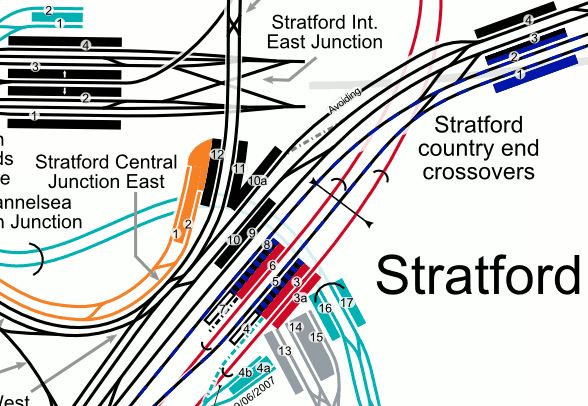
Note.
- The Docklands Light Railway is shown in turquoise.
- The DLR platforms in the North-West corner of the map are those of Stratford International station.
- High Speed One and the four platforms of Stratford International station are shown in black.
- The North London Line of the London Overground is shown in orange.
- The North London Line terminates in Platforms 1 and 2, which have a level link to Platform 12.
- Platform 12 is on the anti-clockwise platform for the High Meads Loop and has step-free access to the subway system underneath the station.
- Platform 11 is on the clockwise platform for the High Meads Loop and has level access to Platform 10a and full step-free access,
- Platform 10a is used by some services to East Anglia.
- Crossrail is shown in blue.
- The Central Line is shown in red.
- The Jubilee Line is shown in silver.
It is not the best passenger-friendly station layout.
- Inevitability, you often find yourself trudging a long way at Stratford station.
- Changing to or from any high speed services is supremely difficult.
- Often you have to walk through the busy Eastfield Shopping Centre.
Particularly annoying for me is coming back from Kent on High Speed One and needing to take the North London Line, as I do several times a year.
As it involves a long walk through the Shopping Centre, I now take the easy way out and carry on to St. Pancras and get a taxi home.
As Stratford International is one of the draughtiest stations in England, the station is a real Design Crime and it needs a serious makeover.
Conclusion
Sort it!
USTDA Grants $1 Million To Support Battery Storage Project In Africa
The title of this post, is the same as that of this article on Running Africa.
This is the first two paragraphs.
The United States Trade and Development Agency (USTDA), an independent body of the US government, has reportedly issued a grant of just under USD 1 million to support feasibility studies for large-scale battery storage schemes in Senegal and Mozambique.
Notably, these large-scale battery storage projects have been grouped with wind energy in Mozambique in Southeast Africa as well as Senegal in West Africa.
A Dutch company seems to be doing the development.
We need more aid projects like these, as with electricity and clean water life can be so much better!
On Track – Network Rail Reaches Key Milestone On Dartmoor Line
The title of this post, is the same as that of this news release on the Network Rail web site.
These are the first two paragraphs.
The reopening of the railway line between Okehampton and Exeter is one step closer after Network Rail finished relaying the new track and sleepers this week.
Following the confirmation of government funding in March, engineers started immediately and have worked tirelessly upgrading this 14 mile stretch of track between Okehampton and Coleford Junction, where the Dartmoor Line joins the existing railway line to Exeter.
Perhaps the most significant fact about this project, is the speed with which work has progressed since it started.
So far it appears the following has been done.
- 11 miles of track has been laid.
- 24.000 new concrete sleepers have been installed.
- 29,000 tonnes of ballast has been installed.
Much of the work was done by a clever machine which is shown in a video.
I do wonder if this machine, when it finishes in Devon will be sent all the way to Newcastle to relay the Northumberland Line in the same manner.
 The Anonymous Widower