Offshore Wind Champion Appointed As £160m Floating Offshore Wind Fund Opens For Expressions Of Interest
The title of this post, is the same as that of this press release from Kwasi Kwarteng.
These three paragraphs describe the policy.
Ambitious plans to expand offshore wind around the United Kingdom to power homes and businesses with cheap, homegrown energy received a further boost today with the appointment of a new government champion and a multimillion-pound manufacturing fund opening for expressions of interest.
The appointment of Tim Pick as the first UK Offshore Wind Champion was confirmed by Prime Minister Boris Johnson and Business and Energy Secretary Kwasi Kwarteng today.
The Floating Offshore Wind Manufacturing Investment Scheme (FLOWMIS) will provide £160 million in government funding to boost floating offshore wind capability around the UK at sites in Scotland, Wales and elsewhere by supporting manufacturers and giving private investors the confidence to back this emerging sector which is expected to rapidly expand in the years ahead.
Floating offshore wind needs the following components.
- Wind turbines, which are the same as those used onshore.
- Floats, which are generally made from steel, but concrete can also be used. There are a few proven designs, like the Windfloat from Principle Power.
- Mooring systems for the turbines.
- Electrical substations and cables.
There is also a need for deep water docks, with large cranes to assemble the systems, prior to towing the turbines into position.
Floating offshore wind is a new industry and there will be new ideas coming through from innovators.
I feel that the strategy could help bring new ideas through.
Welsh Firm Wins £300K BEIS Grant To Advance Hydrogen Fuel Tech
The title of this post, is the same as that of this article on Wales247.
This is the first two paragraphs.
A gasification pioneer aims to seal the UK’s low-carbon future after winning a Government grant worth nearly £300,000 to develop waste-to-hydrogen production technology, innovation funding specialist Catax can reveal.
Compact Syngas Solutions (CSS), based in Deeside, Wales, has secured £299,886 from the Department for Business, Energy and Industrial Strategy (BEIS) with the help of Catax. The funding comes from the Low Carbon Hydrogen Supply 2 Programme, which is part of the Net Zero Innovation Portfolio.
Note.
- The objective is produce syngas or green hydrogen from waste that would normally be sent to landfill.
- Syngas, or synthesis gas, is a fuel gas mixture consisting primarily of hydrogen, carbon monoxide, and very often some carbon dioxide.
- Syngas can be used as a fuel in internal combustion engines.
The name of the company; Compact Syngas Solutions could indicate that the company aim to have a compact system to produce syngas or green hydrogen.
I have come across other companies looking at waste diverted from landfill to create aviation fuel, diesel or hydrogen.
I have invested in one; Velocys, through the Stock Market, as I feel this area of technology will be big in the future.
Compact Syngas Solutions seem to have a different take. However like many other, I suspect catalysts are involved.
Conclusion
I think, this will be a company to watch.
The Massive Hydrogen Project, That Appears To Be Under The Radar
This page on the SSE Thermal web site, is entitled Aldbrough Gas Storage.
This is the introductory paragraph.
The Aldbrough Gas Storage facility, in East Yorkshire, officially opened in June 2011. The last of the nine caverns entered commercial operation in November 2012.
This page on Hydrocarbons Technology is entitled Aldbrough Underground Gas Storage Facility, Yorkshire.
It gives these details of how Aldbrough Gas Storage was constructed.
The facility was originally planned to be developed by British Gas and Intergen in 1997. British Gas planned to develop Aldbrough North as a gas storage facility while Intergen planned to develop Aldbrough South.
SSE and Statoil became owners of the two projects in 2002 and 2003. The two companies combined the projects in late 2003. Site work commenced in March 2004 and leaching of the first cavern started in March 2005.
The storage caverns were created by using directional drilling. From a central area of the site, boreholes were drilled down to the salt strata located 2km underground.
After completion of drilling, leaching was carried out by pumping seawater into the boreholes to dissolve salt and create a cavern. Natural gas was then pumped into the caverns and stored under high pressure.
Six of the nine caverns are already storing gas. As of February 2012, dewatering and preparation of the remaining three caverns is complete. Testing has been completed at two of these caverns.
The facility is operated remotely from SSE’s Hornsea storage facility. It includes an above ground gas processing plant equipped with three 20MW compressors. The gas caverns of the facility are connected to the UK’s gas transmission network through an 8km pipeline.
Note.
- The caverns are created in a bed of salt about two kilometres down.
- It consists of nine caverns with the capacity to store around 370 million cubic metres (mcm) of gas.
- Salt caverns are very strong and dry, and are ideal for storing natural gas. The technique is discussed in this section in Wikipedia.
As I worked for ICI at Runcorn in the late 1960s, I’m very familiar with the technique, as the company extracted large amounts of salt from the massive reserves below the Cheshire countryside.
This Google Map shows the location of the Aldbrough Gas Storage to the North-East of Hull.
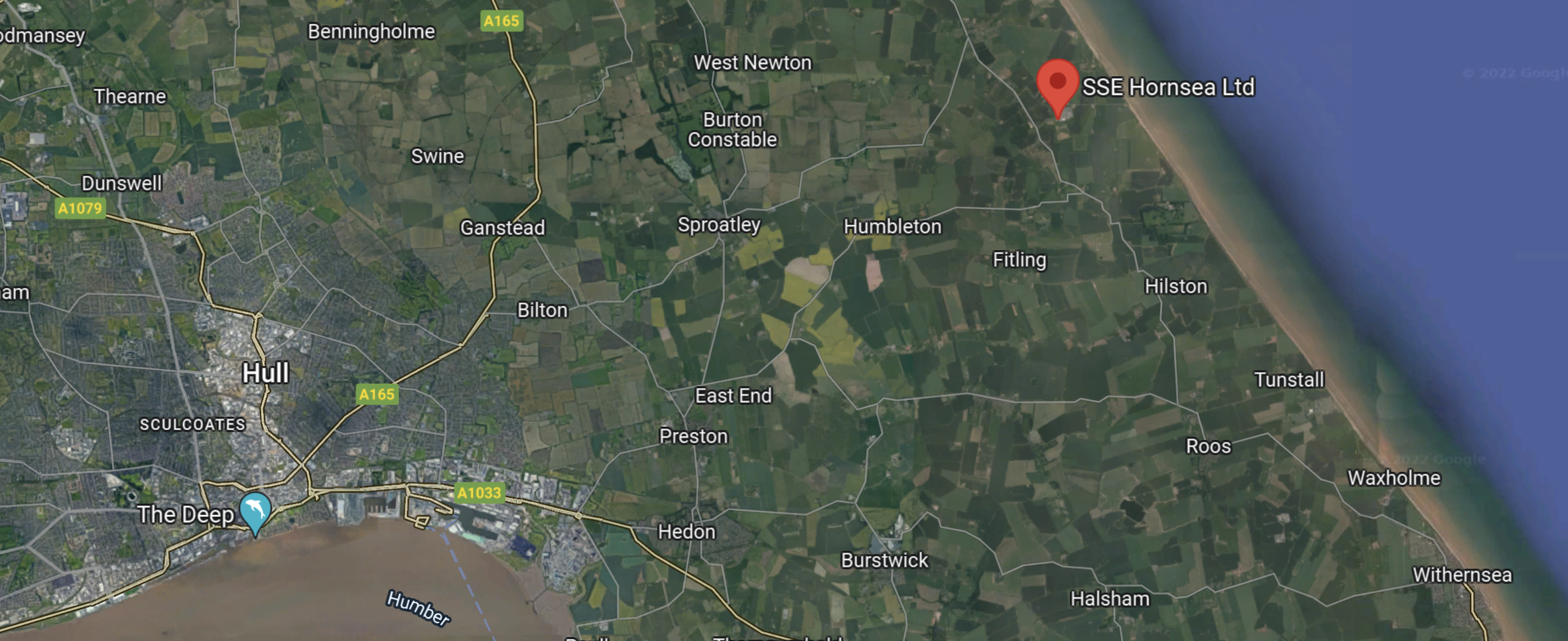
Note.
- The red-arrow marks the site of the Aldbrough Gas Storage.
- It is marked on the map as SSE Hornsea Ltd.
- Hull is in the South-West corner of the map.
This Google Map shows the site in more detail.
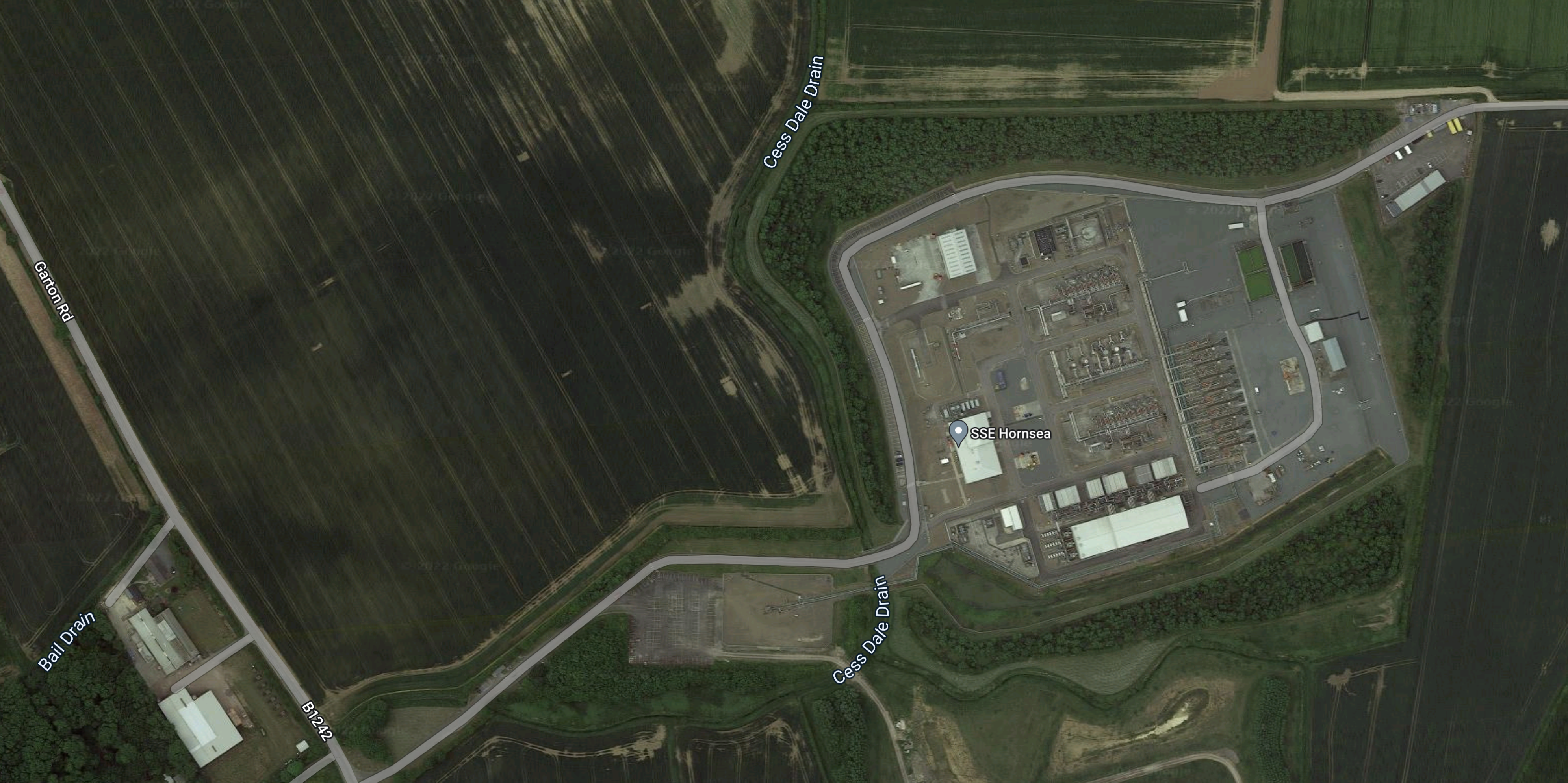
It appears to be a compact site.
Atwick Gas Storage
This page on the SSE Thermal web site, is entitled Atwick Gas Storage.
This is said on the web site.
Our Atwick Gas Storage facility is located near Hornsea on the East Yorkshire coast.
It consists of nine caverns with the capacity to store around 325 million cubic metres (mcm) of gas.
The facility first entered commercial operation in 1979. It was purchased by SSE in September 2002.
This Google Map shows the location of the Atwick Gas Storage to the North-East of Beverley.
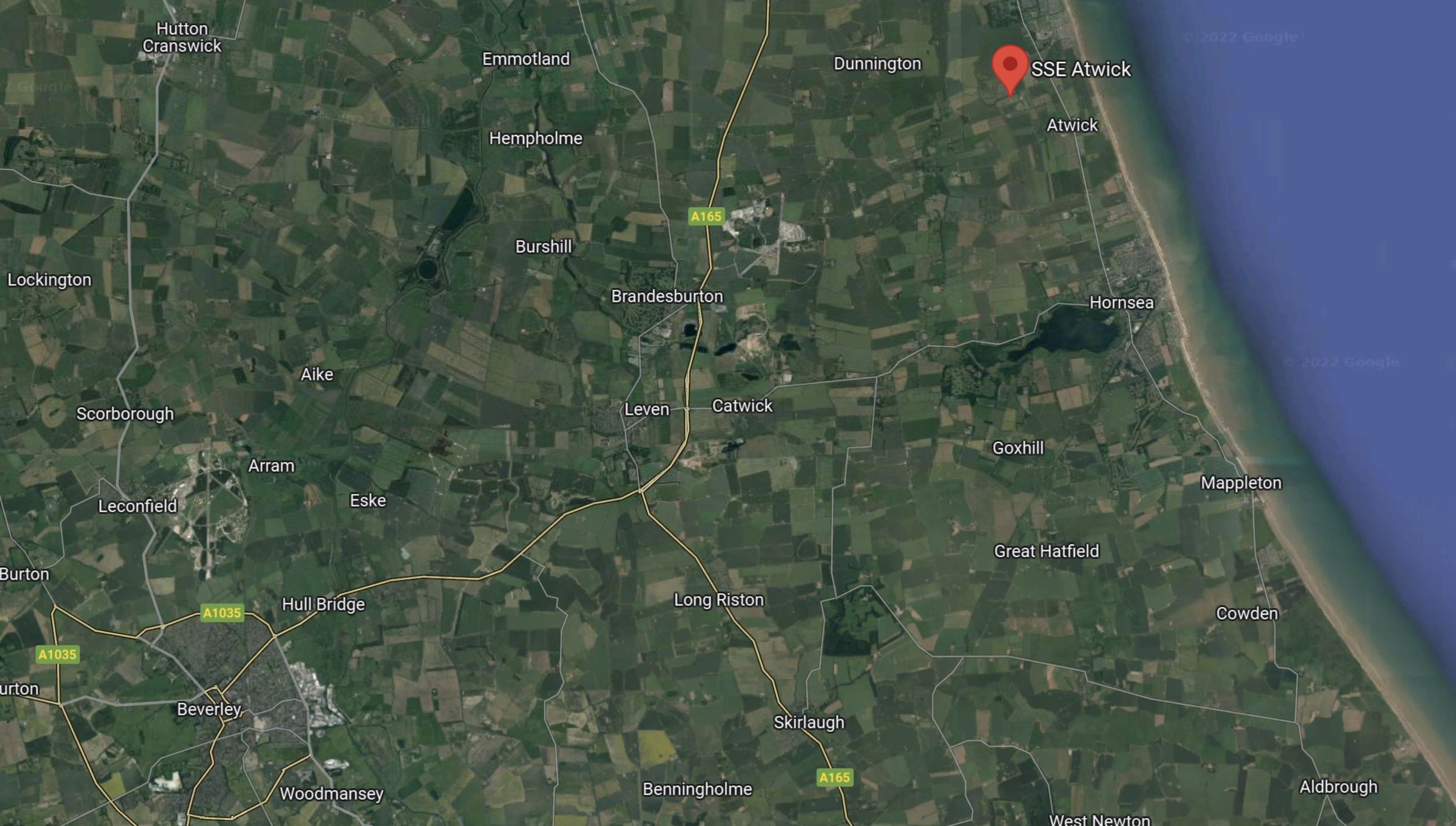
Note.
- The red-arrow marks the site of the Atwick Gas Storage.
- It is marked on the map as SSE Atwick.
- Beverley is in the South-West corner of the map.
This Google Map shows the site in more detail.
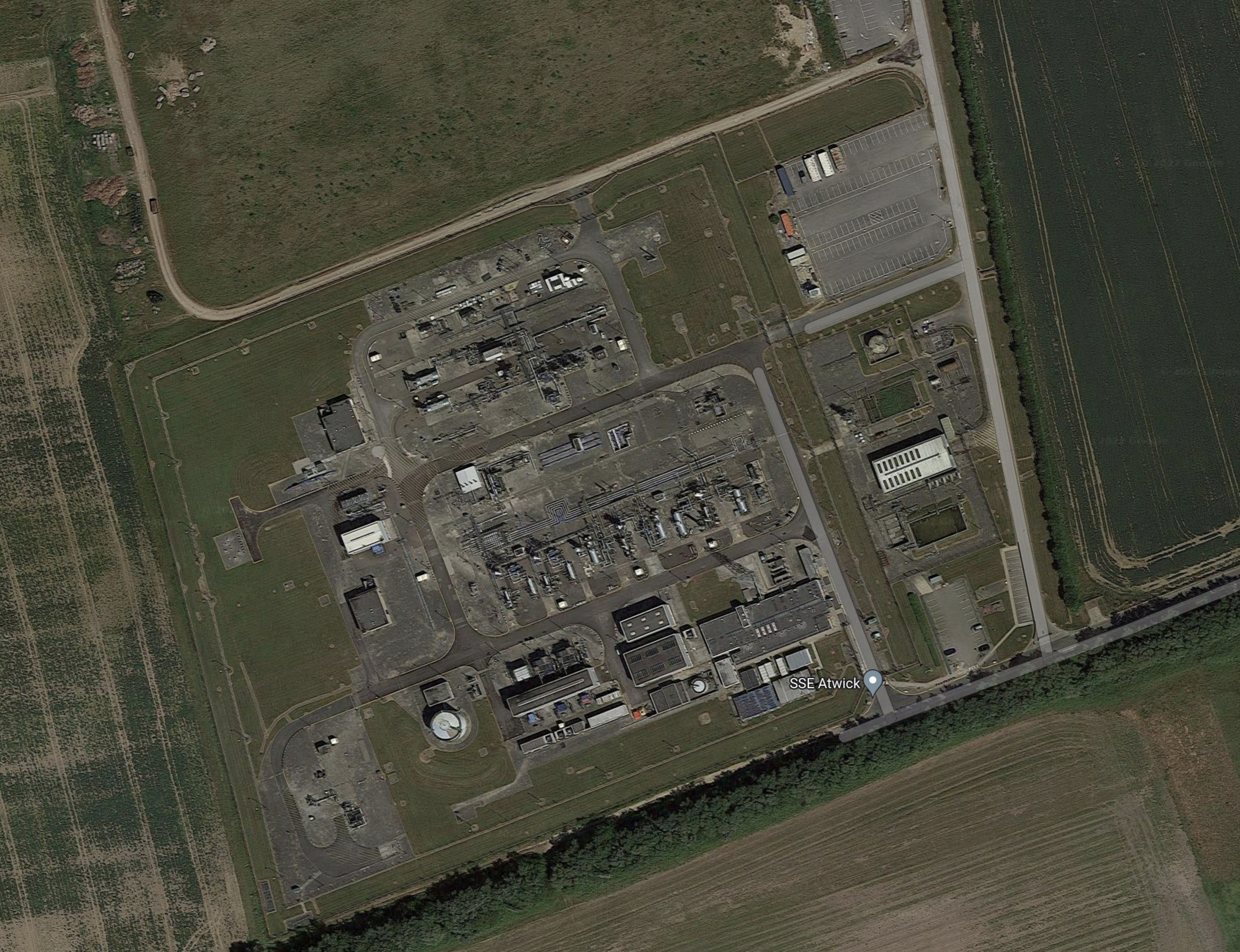
As with the slightly larger Aldbrough Gas Storage site, it appears to be compact.
Conversion To Hydrogen Storage
It appears that SSE and Equinor have big plans for the Aldbrough Gas Storage facility.
This page on the SSE Thermal web site is entitled Plans For World-Leading Hydrogen Storage Facility At Aldbrough.
These paragraphs introduce the plans.
SSE Thermal and Equinor are developing plans for one of the world’s largest hydrogen storage facilities at their existing Aldbrough site on the East Yorkshire coast. The facility could be storing low-carbon hydrogen as early as 2028.
The existing Aldbrough Gas Storage facility, which was commissioned in 2011, is co-owned by SSE Thermal and Equinor, and consists of nine underground salt caverns, each roughly the size of St. Paul’s Cathedral. Upgrading the site to store hydrogen would involve converting the existing caverns or creating new purpose-built caverns to store the low-carbon fuel.
With an initial expected capacity of at least 320GWh, Aldbrough Hydrogen Storage would be significantly larger than any hydrogen storage facility in operation in the world today. The Aldbrough site is ideally located to store the low-carbon hydrogen set to be produced and used in the Humber region.
Hydrogen storage will be vital in creating a large-scale hydrogen economy in the UK and balancing the overall energy system by providing back up where large proportions of energy are produced from renewable power. As increasing amounts of hydrogen are produced both from offshore wind power, known as ‘green hydrogen’, and from natural gas with carbon capture and storage, known as ‘blue hydrogen’, facilities such as Aldbrough will provide storage for low-carbon energy.
I have a few thoughts.
Will Both Aldbrough and Atwick Gas Storage Facilities Be Used?
As the page only talks of nine caverns and both Aldbrough and Atwick facilities each have nine caverns, I suspect that at least initially only Aldbrough will be used.
But in the future, demand for the facility could mean all caverns were used and new ones might even be created.
Where Will The Hydrogen Come From?
These paragraphs from the SSE Thermal web page give an outline.
Equinor has announced its intention to develop 1.8GW of ‘blue hydrogen’ production in the region starting with its 0.6GW H2H Saltend project which will supply low-carbon hydrogen to local industry and power from the mid-2020s. This will be followed by a 1.2GW production facility to supply the Keadby Hydrogen Power Station, proposed by SSE Thermal and Equinor as the world’s first 100% hydrogen-fired power station, before the end of the decade.
SSE Thermal and Equinor’s partnership in the Humber marks the UK’s first end-to-end hydrogen proposal, connecting production, storage and demand projects in the region. While the Aldbrough facility would initially store the hydrogen produced for the Keadby Hydrogen Power Station, the benefit of this large-scale hydrogen storage extends well beyond power generation. The facility would enable growing hydrogen ambitions across the region, unlocking the potential for green hydrogen, and supplying an expanding offtaker market including heat, industry and transport from the late 2020s onwards.
Aldbrough Hydrogen Storage, and the partners’ other hydrogen projects in the region, are in the development stage and final investment decisions will depend on the progress of the necessary business models and associated infrastructure.
The Aldbrough Hydrogen Storage project is the latest being developed in a long-standing partnership between SSE Thermal and Equinor in the UK, which includes the joint venture to build the Dogger Bank Offshore Wind Farm, the largest offshore wind farm in the world.
It does seem to be, a bit of an inefficient route to create blue hydrogen, which will require carbon dioxide to be captured and stored or used.
Various scenarios suggest themselves.
- The East Riding of Yorkshire and Lincolnshire are agricultural counties, so could some carbon dioxide be going to help greenhouse plants and crops, grow big and strong.
- Carbon dioxide is used as a major ingredient of meat substitutes like Quorn.
- Companies like Mineral Carbonation International are using carbon dioxide to make building products like blocks and plasterboard.
I do suspect that there are teams of scientists in the civilised world researching wacky ideas for the use of carbon dioxide.
Where Does The Dogger Bank Wind Farm Fit?
The Dogger Bank wind farm will be the largest offshore wind farm in the world.
- It will consist of at least three phases; A, B and C, each of which will be 1.2 GW.
- Phase A and B will have a cable to Creyke Beck substation in Yorkshire.
- Phase C will have a cable to Teesside.
Creyke Beck is almost within walking distance of SSE Hornsea.
Could a large electrolyser be placed in the area, to store wind-power from Dogger Bank A/B as hydrogen in the Hydrogen Storage Facility At Aldbrough?
Conclusion
SSE and Equinor may have a very cunning plan and we will know more in the next few years.
Salt Deposits And Gas Cavern Storage In The UK
This post is mainly to point to this useful document on the government web site, that is entitled Salt Deposits And Gas Cavern Storage In The UK With A Case Study Of Salt Exploration From Cheshire.
UK Energy Exports To Europe At Record High
The title of this post, is the same as that of this article on The Times.
This is the first two paragraphs.
Britain has exported record amounts of gas to Europe so far this year as its liquefied natural gas terminals receive shipments destined for the Continent.
Electricity exports also have surged to unprecedented highs in recent weeks after an unexpected glut of gas pushed down short-term gas prices and resulted in gas-fired power plants generating more for export.
Who’d have thought it, that all those gas pipelines and electricity interconnectors between the UK and the Continent of Europe would be part of the replacementliqui for Russian gas.
According to Wikipedia, we have three liquified natural gas terminals; two at Milford Haven; South Hook and Dragon, and Grain on the Isle of Grain.
Note.
- South Hook is Europe’s largest liquified natural gas terminal and is owned by a partnership of the Qataris, ExxonMobil and Elf.
- South Hook and Dragon together can provide 25 % of the UK’s natural gas needs.
- Grain is owned by National Grid and according to Wikipedia, is in terms of storage capacity it is the largest LNG facility in Europe and the eighth largest in the world.
- Grain can supply 20 % of the UK’s natural gas needs.
- Grain has a reloading facility, so that gas can be exported.
- Grain seems to be continually expanding.
- Both Milford Haven and the Isle of Grain have large gas-fired power-stations.
Politicians say we don’t have enough gas storage, but we do seem to have world-class LNG terminals.
I have a couple of extra thoughts.
Blending Natural Gas With Hydrogen
HyDeploy is a project investigated blending hydrogen natural gas to cut carbon emissions. The project is described in this post called HyDeploy.
Surely, these terminals could be places, where hydrogen is blended with our natural gas supply.
- The terminals are connected to the UK gas network.
- Both Milford Haven and the Isle of Grain should have access to large amounts of offshore wind energy in the next few years, which could be used to generate green hydrogen.
- The terminals would need electrolysers to generate the hydrogen.
The Isle of Grain already has a blending capability.
NeuConnect
NeuConnect is an under-development interconnector between the Isle of Grain in Kent and Wilhelmshaven in Germany.
- It will have a capacity 1.4 GW.
- All the planning permissions seem to be in place.
- Prysmian have won a € 1.2 million contract to deliver the interconnector.
- Arup and German engineering firm Fichtner have formed a joint venture to provide project services for the interconnector.
- Construction could start this year.
It looks like the Germans will be replacing some of Putin’s bloodstained gas with clean zero-carbon energy from the UK.
Should We Develop More Gas Fields?
There are some gas fields in the seas around the UK, like Jackdaw, that could be developed.
Suppose, we extracted the gas and sent it to the reloading terminal on the Isle of Grain through the gas transmission network, where it could be exported by ship, to the Continent.
The UK would not be increasing its carbon emissions, as that would surely be the responsibility of the end-user.
Should We Develop More Gas Fired Power-Stations?
I believe it is possible to develop carbon-capture technology for gas-fired power stations.
The carbon dioxide would be either used in a beneficial way or stored in perhaps a worked-out gas field under the North Sea.
So long as no carbon dioxide is released into the atmosphere, I don’t see why more gas-fired power stations shouldn’t be developed.
What is happening at Keadby near Scunthorpe would appear to be one model for zero-carbon power generation.
Keadby Power Station
This is an existing
Conclusion
We will be exporting more energy to the Continent.
Affordable Blue Hydrogen Production
The title of this post, is the same as that of this page on the Shell Catalysts & Technologies web site.
This is said at the top of the page.
Natural gas producers are at a crossroads. They face a shifting regulatory landscape emphasising emissions reduction and an economic environment where cash preservation is critical. Shell Catalysts & Technologies offers resource holders a phased approach to diversifying their portfolios towards clean hydrogen fuels by leveraging proven and affordable capture technologies and catalysts.
My knowledge of advanced chemical catalysts is small, but I did work in the early 1970s on a project with one of ICI’s experts in the field and he told me some basics and how he believed that in the future some new catalysts would revolutionise chemical process engineering.
Wikipedia’s definition of catalysis, or the action of catalysts is as follows.
Catalysis is the process of increasing the rate of a chemical reaction by adding a substance known as a catalyst.
When I heard that Velocys were going to develop a catalyst-based system to turn household waste into sustainable aviation fuel, I did make a small investment in the company, as I thought the project could have legs.
Shell’s process takes natural gas and converts one molecule of methane (CH4) into two molecules of hydrogen (H2) and one of carbon dioxide (CO2) using one molecule of oxygen (O2) from the air.
In the Shell Blue Hydrogen Process, does a clever catalyst extract the carbon atom from the methane and combine it with two oxygen atoms to create a molecule of carbon dioxide? If it does, then this would leave the four atoms of hydrogen to form two molecules of H2 and the catalyst to go and repeat its magic on another methane molecule.
The video on the Shell site claims to do the conversion 10-25 % cheaper than current carbon intensive methods like steam reforming.
For every two molecules of hydrogen produced, both the Shell Blue Hydrogen Process and steam reforming will produce one molecule of carbon dioxide.
If you look at steam reforming it is an endothermic process, which means heat has to be added. The classic endothermic process is dissolving ice cubes in a glass of water.
Shell don’t say, but does their process need less energy to be added, because their clever catalyst does a lot of the work?
I wouldn’t be surprised if the reaction takes place in a liquid, with hydrogen and carbon dioxide bubbling out.
- The two gases would be separated by using their different physical properties.
- Carbon dioxide is heavier for a start.
Whatever Shell have done, it is probably pretty impressive and has probably taken many years to develop.
If as I suspect, it produces pure carbon dioxide, that would be an added bonus, as some uses of carbon dioxide wouldn’t want impurities.
Uses of pure carbon dioxide include.
- Feeding it to soft fruits, flowers, salad vegetables and tomatoes growing in large greenhouses.
- Dry ice.
- Mineral Carbonation International can use carbon dioxide to make building products like blocks or plasterboard.
- It can be added to concrete.
The more of the carbon dioxide that can be used rather than stored the better.
Aussie Billionaire Aims To Mine $8bn US Fund For Coal-To-Hydrogen Industrial Conversion
The title of this post, is the same as that of this article on Recharge.
These are the first two paragraphs.
Twiggy Forrest-owned Fortescue’s project to tap renewable energy on Washington state grid – where surplus hydroelectric power usually exported to Canada and western seaboard – for clean hydrogen production at Centralia site.
Fortescue Future Industries (FFI), owned by Australian billionaire Andrew ‘Twiggy’ Forrest, is planning to convert a former coal mine in US state of Washington into a green hydrogen production facility, using funds it hopes to win from the federal government’s $8bn H2 hub fund, the company said on Friday.
These are some other points about FFI’s plans.
- A former coal mine will be converted into a green hydrogen production facility.
- The facility will be located at Industrial Park at TransAlta.
- It will use 300 MW of renewable electricity.
- Production of green hydrogen will be 110 tonnes per day or 40,000 tonnes per year.
Hopefully, they will have Federal Funds to support the development.
The article also details other hydrogen developments in the United States, with hydrogen hubs earmarked for New England, Midwest, West Virginia and Arkansas, Louisiana and Oklahoma.
It certainly looks that the United States is getting serious about hydrogen.
Drax Submits Application To Expand Iconic ‘Hollow Mountain’ Power Station
The title of this post, is the same as that of this press release from Drax.
The project is called Cruachan 2 and is described on this web site.
This is the introduction to the project.
We have kickstarted the planning process to build a new underground pumped hydro storage power station – more than doubling the electricity generating capacity at Cruachan.
The 600 megawatt (MW) power station will be located inside Ben Cruachan – Argyll’s highest mountain – and increase the site’s total capacity to 1 gigawatt (GW).
The new power station would be built within a new, hollowed-out cavern which would be large enough to fit Big Ben on its side, to the east of Drax’s existing 440MW pumped storage hydro station. More than a million tonnes of rock would be excavated to create the cavern and other parts of the power station. The existing upper reservoir, which can hold 2.4 billion gallons of water, has the capacity to serve both power stations.
Note.
- The generation capacity will be increased from 440 MW to 1040 MW, which is an increase of 36 %.
- Cruachan has a storage capacity of 7.1 GWh, which will not be increased.
- Cruachan opened in October 1965, so the generating equipment is nearly sixty years old.
I will assume that Drax and its various previous owners have kept the turbines, generators, dam and associated pipework in good condition, but as an Electrical Engineer, I do believe that the modern equipment, that will be used in Cruachan 2 will offer advantages.
- One of these advantages could be the ability to ramp up power faster, than the original equipment.
- I also suspect, it will have a sophisticated computer control system, that will allow the output of the power station to be precisely controlled.
These two features should mean that when a spike in power demand happens, that the combined Cruachan will step up to the plate.
So all those watching the Celtic and Rangers match on television, will still get their half-time cuppa.
I suspect that the combined Cruachan will be a power regulator of the highest quality.
Will The Storage Capacity Of Drax Be Increased?
Drax don’t appear to have any plans for increasing the size of the upper reservoir and I suspect that geography can’t deliver an affordable solution.
But.
- Loch Awe is an excellent lower reservoir for a pumped storage system.
- The building of Cruachan 2 may create substantial employment and economic benefits in the area.
- Cruachan 2 is not the only pumped storage scheme under development in the area.
- The UK needs as much pumped energy storage as can be created.
I wouldn’t be surprised to see, further development of Cruachan, if Cruachan 2 is an overwhelming success.
It’ll all be down to the geography and the economics.
Xlinks Welcomes New Investor Octopus Energy In Providing Cheap Green Power To Over 7 Million Homes
The title of this post, is the same as that of this press release from Xlinks.
These are the first three paragraphs.
Xlinks is pleased to announce a financial and strategic partnership with energy tech pioneer Octopus Energy Group.
The Morocco – UK Power Project will speed up the UK’s transition to net zero by laying four 3,800km-long subsea cables to connect a huge renewable energy farm in the Moroccan desert with Devon in South West England. Morocco is setting its sights on becoming a world leader in solar energy, already boasting some of the world’s largest solar arrays, and meeting two-fifths of its electricity demand with renewables. There will be huge economic benefits to both countries involved, with Xlinks bringing green energy and engineering jobs to both the UK and Morocco.
The project will diversify UK supply routes and boost energy security through the supply of 3.6 GW of reliable, clean power to the UK for an average of 20 hours a day, enough green energy to power about 7 million homes.
Note.
- The cables will be nearly 2,400 miles
- It is scheduled to be operational in 2027.
- Xlinks is expected to deliver power at £48/MWh, which is comparable with offshore wind.
- Wikipedia talks of a Hinkley Point C strike price of £92.50/MWh (in 2012 prices).
- Greg Jackson, founder of Octopus Energy Group, is also a personal investor in the project.
- Greg Jackson is interviewed in this article in today’s Sunday Times.
I wrote more about this project in Moroccan Solar-Plus-Wind To Be Linked To GB In ‘Ground-Breaking’ Xlinks Project.
Conclusion
This mega-project could be approaching the point, where the starting gun is fired.
New Mobile Hydrogen Unit Unveiled By Logan Energy In Bid To Accelerate Greener Transport
The title of this post, is the same as that of this article on Fuel Cell Works.
This sums up the development, that has been unveiled by Logan Energy.
It is a compression trailer, that looks like it could be towed by any vehicle capable of towing a horse box.
- The compressor can transfer hydrogen between any two cylinders at all the usual pressures.
- It is aimed at both the bus and heavy goods vehicle market.
- The hydrogen capacity of the trailer is not stated.
I feel that this sort of development will help operators embrace hydrogen.
A bus company for instance could have an appropriate number of trailers, for their fleet of hydrogen buses.
- The bus company would need a suitable towing vehicle, like a light truck.
- Trailers would be filled at an electrolyser outside of the city.
- Each bus depot could have a space, where a trailer could be parked to fill the buses.
- A schedule would probably need to be developed for filling the trailers.
We will see more developments like this.
But they will have to compete with companies like ITM Power, who can supply on-site electrolysers.
 The Anonymous Widower