New-Age Battery Pioneer Zinc8 Ties Up With Indian Transformer-Maker For Global Push
The title of this post, is the same as that of this article on Recharge.
I think, it shows the way the energy storage market is going, where alliances are being formed to exploit the new technologies.
A transformer maker and a battery storage company must be a good match.
Conclusion
I still very much feel that Zinc8, will be a success.
Norsk e-Fuel Planning Europe’s First Commercial Plant for Hydrogen-Based RAF
The title of this post, is the same as that, of this article on Renewable Energy Magazine.
This is the introductory paragraph.
Norske e-Fuel AS, the new European industry consortium headquartered in Oslo, has plans to industrialize Power-to-Liquid technology (PtL) in Norway for the European Market. The new state-of-the-art project will allow the conversion of Norway’s extensive renewable electricity resources into renewable fuels.
This paragraph explains the process.
Using a single step co-electrolysis process, the innovative technologies of Sunfire and Climeworks convert renewable electricity, water and CO2 captured from ambient air and unavoidable CO2 sources into syngas. Renewable fuels, such as jet fuel, are then produced through further processing and refining. The certified end products can be used directly in existing infrastructures.
Note.
- Climeworks is a company that captures carbon from the atmosphere.
- It is a very different process to that used by Altalto, which I wrote about in Grant Shapps Announcement On Friday, Altalto use household, industrial and woody waste as a starting point.
- However both processes use syngas, as an intermediate.
Wikipedia describes syngas as a fuel gas mixture consisting primarily of hydrogen, carbon monoxide, and very often some carbon dioxide.
Scotland’s Mines To Be At Centre Of Green Energy Renaissance
The title of this post, is the same as that of this article on the Glasgow Herald.
The article is a good explanation of the pros and cons of using the heat stored in disused coal mines, to heat hones and businesses.
East Coast Main Line Northern Power Supply Works Funded
The title of this post, is the same as that of this article on Railway Gazette.
This is the introductory paragraph.
As part of its £1·2bn East Coast Upgrade programme, Network Rail has awarded a £216·2m contract to the Rail Electrification Alliance for the long-awaited strengthening of the 25 kV 50 Hz traction power supplies on the northern section of the East Coast Main Line between Doncaster and Edinburgh.
It is much-needed. if the planned extra electric services are to be run on the route.
These could include.
- East Coast Train‘s new London and Edinburgh service.
- Extra TransPennine Express services and some services converting from diesel traction.
- Extra LNER services to Middlesbrough and other destinations.
- Conversion of Grand Central services to electric or bi-mode traction.
Will Freightliner use some of its new fleet of thirteen Class 90 locomotives on the route?
Will News Of The Upgrade Bring Forth Train And Locomotive Orders?
I wonder if this could happen.
Freight operators need to decarbonise, but surely there’s a bit of a chicken-and-egg situation on the East Coast Main Line, as there’s no point in ordering electric locomotives for the route, until you have a date, from when they can be used.
Conclusion
This upgrade will have some very good xonsequences.
Scunthorpe Steelworks
On my way back from Cleethorpes, I passed Scunthorpe Steelworks.


It did seem rather quiet, although I did pass a train-load of new rails on their way to somewhere.
The Future Of Steel-Making
Steel-Making is on its uppers in the UK and it has a bad carbon footprint.
However, various processes are in development that could make the industry fit for the Twenty-First Century.
HIsarna Steelmaking
In Whitehaven Deep Coal Mine Plan Moves Step Closer, I said this.
In Wikipedia, there is an entry for the HIsarna ironmaking process.
This process is being developed by the Ultra-Low Carbon Dioxide Steelmaking (ULCOS) consortium, which includes Tata Steel and the Rio Tinto Group. Reduction in carbon-dioxide produced by the process compared to traditional steel-making are claimed to be as high as fifty percent.
This figure does not include carbon-capture to reduce the carbon-dioxide still further.
However, looking at descriptions of the process, I feel that applying carbon-capture to the HIsarna steelmaking process might be a lot easier, than with traditional steelmaking.
As Scunthorpe is close to Theddlethorpe Gas Terminal, the captured carbon-dioxide could probably be stored in wells connected to the terminal.
Hydrogen Steelmaking
North-East Lincolnshire is becoming the new Aberdeen, but instead of being based solely on oil and gas, there is a large proportion of wind energy being reaped.
In the future, I believe that a lot of this wind energy will be turned into hydrogen gas both onshore and increasing off-shore scores of miles out in the North Sea. There is talk of upwards of 70 GW of wind turbines being installed and much of it will be turned into hydrogen in North-East Lincolnshire.
In Funding Award to Supply An 8MW Electrolyser, I wrote about hydrogen steelmaking and the HYBRIT process in particular.
Will some of this massive amount of hydrogen be piped to Scunthorpe to make steel?
Conclusion
The future of steelmaking in Scunthorpe, doesn’t have to be all doom and gloom.
Green Tugboats? ‘Revolutionary’ Hydrogen Ship Engine Unveiled In Belgium
The title of this post, is the same as that of this article on Business Green.
This is the first paragraph.
A “revolutionary” hybrid ship engine powered by green hydrogen and diesel has been unveiled today in Belgium, with developers claiming the innovation could cut CO2 emissions from ships, trains and electricity generators by up to 85 per cent.
The engine has been given the name BeHydro.
The first order has been received by the developers; ABC, for two 2MW dual fuel engines that will be installed on a hydrogen-powered tug for the Port of Antwerp.
Motors up to the size of 10 MW are under development.
This is the last sentence of the article.
In theory, any large diesel engine can be replaced by a BeHydro engine. The hydrogen future starts today.
It is a quote from the CEO of one of the companies involved.
Conclusion
This is a development to follow.
The BeHydro engine, with its dual-fuel approach, is claimed to cut carbon emissions by 85 %.
In the Wikipedia entry for ABC or Anglo Belgian Corporation, there is a section called Products. This is a paragraph.
The engines are found in use on large river barges such as those found on the Rhine, coastal freighters, fishing boats, ferries, tugboats (which typically use 2 engines), and other ships. Other applications include electricity generation, and pumping engines, engines for cranes, and locomotives (including the Belgian Railways Class 77 and Voith Maxima), as well as dual fuel (gas/oil) DZD engines.
I feel that that the BeHydro engine will keep the company busy.
Vital Energi To Build Waste Heat From Power Plant Centre
The title of this post, is the same as that of this article on the Construction Enquirer.
This is the introductory paragraph.
Waste heat from the nearby £680m North London Waste Authority (NLWA) Energy Recovery Facility will be used to heat homes and businesses in the London Borough of Enfield.
Some of the homes, will be on the 82-hectare Meridian Water development.
We will see more schemes like this.
Green Hydrogen For Scotland
The title of this post, has been taken from this press release from ITM Power, which is entitled ‘Green Hydrogen For Scotland’ To Help Reach Net Zero Targets: First Project To Deliver A 10MW Electrolyser To Glasgow Facility.
This is the introductory paragraph.
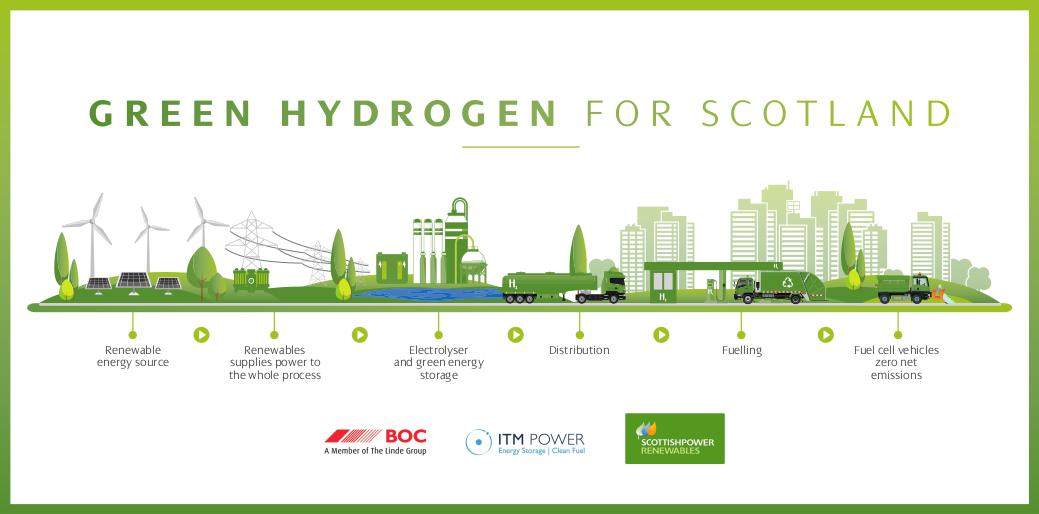
A pioneering Strategic partnership has been established to create new green hydrogen production facilities with clusters of refuelling stations across Scotland, supporting the country’s efforts to achieve net zero by 2045. ‘Green Hydrogen for Scotland’ – a partnership of ScottishPower Renewables, BOC (a Linde company) and ITM Power – brings together industry-leading names in the renewables and clean fuel industries to offer an end-to-end market solution for reducing vehicle emissions through the provision of green hydrogen.
Other details include.
- The green hydrogen production facility located on the outskirts of Glasgow will be operated by BOC.
- ITM Power will deliver a 10 MW electrolyser.
- Electricity will come from , wind and solar produced by ScottishPower Renewables.
- The project aims to supply hydrogen to the commercial market within the next two years.
This ITM Power infographic outlines Green Hydrogen for Scotland.
Surely it should be called tartan hydrogen. Does anybody know a tartan containing the blue of Scotland, the white of Yorkshire and the black, red and gold of Germany?
Why Canada’s Geothermal Industry Is Finally Gaining Ground
The title of this post, is the same as that of this article on the Narwhal.
When I think of Canada, I don’t think hot rocks and volcanoes.
But read the article and this Wikipedia article, which is entitled Geothermal Power In Canada, that adds more flesh.
This is an interesting paragraph.
At present, Canada remains the only major country in the Pacific Rim that is not producing electricity from its geothermal resources. This is despite the fact that the colder it is outside, the more electricity a geothermal power plant can produce. This is because the larger the temperature differentials between the geothermal resource and the ambient air temperature, the more efficiently geothermal plants operate. This makes geothermal power ideal for cold northern countries.
Iceland is certainly blessed, with mountains, volcanoes, hot rocks and cooler weather.















In 2016, sixty-five per cent of Iceland’s electricity and space heating was from geothermal sources.
I took the pictures on a summer holiday In July.
It looks like if the articles on the Narwhal and Wikipedia are to be believed, Canada could exploit a lot of geothermal energy resources.
Canada though will have the advantages of not being first.
The technology has already developed in countries like Iceland, the United States and the Philippines.
A lot of the skills needed is available in Canada’s oil industry.
We’re even seeing oilfield services companies like Schlumberger moving into geothermal energy. I wrote about that in Schlumberger New Energy And Thermal Energy Partners Form Geothermal Development Company STEP Energy.
We shouldn’t forget the potential for geothermal energy in the UK. We’re looking seriously in Cornwall and already extracting heat from the Underground in Islington, using similar techniques.
See Drilling Starts For ‘Hot Rocks’ Power In Cornwall and Bunhill 2 Energy Centre.
Conclusion
Geothermal energy would appear to have a high capital cost, but should return a fixed income year-on-year.
For this reason, I believe that funding for viable geothermal schemes, will be easier to obtain, as we improve the engineering and the returns increase.
So expect more geothermal schemes in the future.
The Power Of Community In A Crisis
The title of this post, is the same as that of this article on Business Green.
This is the introductory paragraph.
OVO’s Kate Weinberg reflects on a hugely eventful year since the energy giant debuted its ground-breaking Plan Zero strategy
I have been using OVO for some years now and have not had the smallest quibble in that time.
They salso handle the Feed-In Tariff for my solar panels.
 The Anonymous Widower