Teesworks Joins Forces With NatPower On 1GW UK BESS
The title of this post, is the same as that of this article on Solar Power Portal.
These are the first two paragraphs.
Teesworks, the UK’s largest industrial zone, has revealed plans for a 1GW battery energy storage system (BESS) in partnership with renewables developer NatPower.
The project will be constructed over 50 acres of the Long Acres section of the 4500-acre Teesworks site. Construction costs are expected to total around £1 billion. While the main plan for the BESS is focused on renewable energy storage, the company also noted that the system could also support electric vehicle (EV) charging in the future.
The article then lists several large BESS projects, that are under development.
It also suggests that investment in batteries is in a healthy state.
Council Wants To Only Serve Vegan Food At Events
The title of this post, is the same as that of this article on the BBC.
This is the sub-heading.
A West Yorkshire council will only provide vegan food at its meetings and events if a new catering plan is approved.
These three paragraphs explain the policy.
Calderdale Council wants its menus to be entirely plant-based, with a preference for seasonal and non-processed foods.
The council adopted a climate change emergency policy in 2020, which included a commitment to using plant-based catering.
Senior councillors will be asked to recommend that the vegan food scheme is adopted at a meeting on 3 June.
I am coeliac and have to eat a gluten-free diet. Sometimes, I will eat meals marked as vegan, but only after I have checked they are gluten-free.
A couple of times in my life, I have been told that I will be fine with a restaurants’s organic vegan food.
These incidents weren’t in the UK and I quickly moved on to a restaurant, which served food, that I could eat.
But you don’t know, where these sort of restrictions will lead.
- Suppose a Muslim-dominated council, insisted that all women kept their hair covered.
- Or all butcher’s shops in the area were to be closed!
- Will the local hosputal have to serve vegan food?
Any restaurant or catering facility, must serve, what its patrons want or need to eat.
Brand New Battery Technology To Be Trialled On TransPennine Train
The title of this post, is the same as that of this press release from Hitachi.
These three bullet points, act as sub-headings.
- First-ever trial in the UK to replace a diesel engine with a battery on an intercity train is underway.
- Pioneering collaboration between Angel Trains, TransPennine Express, Turntide Technologies and Hitachi Rail.
- Hitachi Rail has built a battery using the North East supply chain, with one battery unit predicted to reduce emissions and fuel costs by as much as 30%.
These are my thoughts on some of the paragraphs in the press release.
The First Paragraph
This is the first paragraph.
Testing of the UK’s first intercity battery train commenced earlier today. The battery, which generates a peak power of more than 700kw, has now been successfully retrofitted onto a TransPennine Express ‘Nova 1’ train (five-carriage intercity Class 802), ahead of the trial on Transpennine routes this summer.
Each of the three diesel power packs in on of TransPennine Express’s Class 802 trains can generate 700 kW, so the battery packs can provide the same power as the current Rolls-Royce mtu diesel power packs.
The Third Paragraph
This is the third paragraph.
The single battery unit is incredibly powerful, storing enough electricity to power more than 75 houses for a day. This impressive energy and power density will deliver the same levels of high-speed acceleration and performance, while being no heavier than the diesel engine it replaces.
This equity of high-speed acceleration and performance is to be expected, as the train power and weight is the same, if the power is diesel engines or batteries.
The Fourth Paragraph
This is the fourth paragraph.
The installation of a battery will reduce emissions and improve energy efficiency. It is predicted to reduce emissions and fuel costs by as much as 30% on a Hitachi intercity train.
I would assume that this improvement in emissions and fuel costs, is due to the use of regenerative braking to recharge the batteries, when the train slows down.
The Fifth Paragraph
This is the fifth paragraph.
Most importantly for passengers, the trial will test how intercity trains can enter, alight and leave non-electrified stations in zero-emission battery mode to improve air quality and reduce noise pollution.
As the trains enter a non-electrified station, the regenerative braking will recharge the batteries to both power the train in the station and accelerate the train on its way.
The Seventh Paragraph
This is the seventh paragraph.
The trial will provide real-world evidence to inform the business case for a 100% -battery-electric intercity train, capable of running up to 100km in battery mode. This remarkable range means this battery technology could be deployed to cover the final non-electrified sections of intercity routes in the coming years. It will also demonstrate how battery technology can reduce infrastructure costs by reducing the need for overhead wires in tunnel sections and over complex junctions.
Note that 100 kilometres is 62.1 miles.
You can never do too much real world testing!
These are my further thoughts.
Acceleration And Braking Under Battery Power
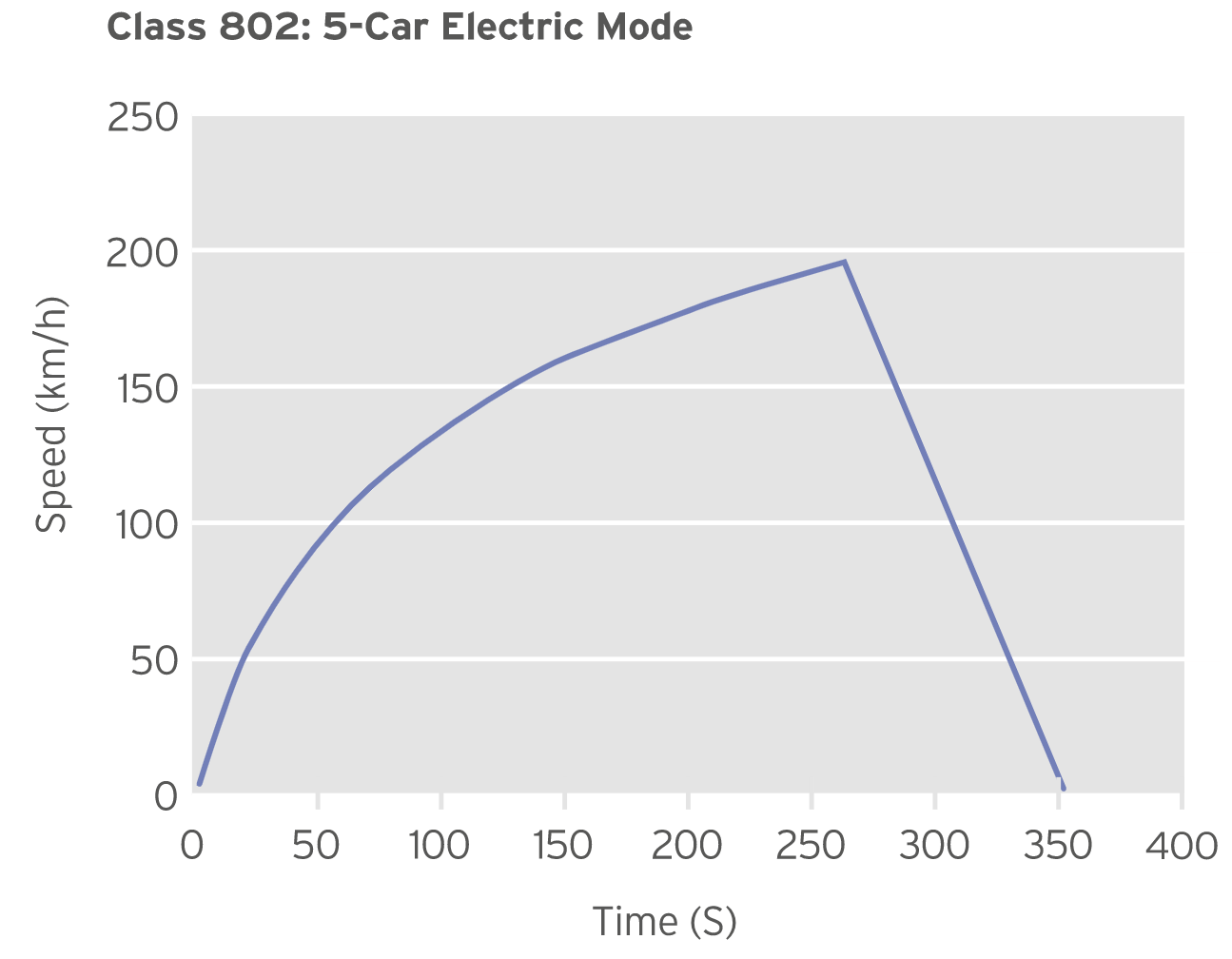
This graph from Eversholt Rail, shows the acceleration and deceleration of a five-car Class 802 electric train.
As Hitachi have said in the press release that.
- The weight of a battery pack is the same as a diesel engine.
- The power of a battery pack is the same as a diesel engine.
The acceleration and braking curve for a Class 802 train, with a single traction battery will surely be the same.
Would this mean, that if a battery-electric train replaced a diesel-electric train, the timetable would be the same?
What would be the effects, if a second diesel engine were to be replaced with a battery pack?
- The train would still weigh the same.
- The train’s performance would still be the same.
- The train would have 1400 kW of power available, but I doubt this could be used efficiently, as it might exceed the train’s performance limits.
- The train would have enough electricity for a 200 kilometre or 124.3 mile range.
There might be a need for a sophisticated control system to set the power mode, but in my experience of riding in the cab of an InterCity 125 and a Boeing 747, drivers or pilots have enough intelligence and fingers to control systems with multiple engines.
What would be the effects, if a third diesel engine were to be replaced with a battery pack?
- The train would still weigh the same.
- The train’s performance would still be the same.
- The train would have enough electricity for a 300 kilometre or 186.4 mile range.
The range is sufficient for a lot of routes.
London And Beverley
Consider.
- This route has 44.3 miles of unelectrified track between Temple Hirst Junction and Beverley.
- One battery range is 100 kilometres or 62.1 miles.
- As the trains have three slots for battery packs or diesel engines, they could always carry a diesel engine for emergencies.
The route could be run in one of two ways.
- By using one battery, that would be charged at Beverley.
- By two batteries, that would be charged on the main line to the South of Temple Hirst Junction. One battery would be used in each direction.
Note.
- The second method would not require any new infrastructure at Beverley or Hull.
- All batteries would be identical 100 km batteries.
- Trains would just swap an appropriate number of diesel engines for batteries.
The service could run as soon as the trains had the power transplants.
Using The Lincoln Diversion
In Extra Luggage Racks For Lumo, I also talked about Lumo taking the diversion via Lincoln.
Consider.
- This route is 88.5 miles of unelectrified track.
- It would be possible to be handled by a Class 802 train with two battery packs.
- Hull Trains will need battery packs to get to Beverley.
- Some LNER services will use battery packs.
Perhaps trains will use one battery to Lincoln and one from.
Crewe And Holyhead
In October 2023, the government said, that the North Wales Coast Line would be electrified.
Consider.
- Crewe and Holyhead are 105.5 miles apart.
- The route currently has no electrification.
- It has been planned to electrify the 21.1 miles between Crewe and Chester for some time.
- A lot of the route West of Chester may arouse the wrath of the Nimbies and be politically difficult to electrify, as castles and electrification don’t mix.
- Llandudno Junction station might be a station, where trains could be charged.
- Shotton and Chester stations need rebuilding.
- The line is not short of electric power, because of Electric Mountain and the windfarms along the coast.
- The route will soon be served by Hitachi Class 805 trains.
I believe the North Wales Coast Line could be one of those routes, which Hitachi’s partial electrification might be ideal.
I also believe that, it could be an extension of High Speed Two from Crewe, which provided a zero-carbon route between London and Ireland.
Conclusion
I can see if the tests perform as expected, that there will be some battery express trains running soon.
Do RWE Have A Comprehensive Hydrogen Plan For Germany?
What is interesting me, is what Germany company; RWE is up to. They are one of the largest UK electricity producers.
In December 2023, they probably paid a low price, for the rights for 3 x 1.4 GW wind farms about 50 km off North-East Norfolk from in-trouble Swedish company; Vattenfall and have signed contracts to build them fairly fast.
In March 2024, wrote about the purchase in RWE And Vattenfall Complete Multi-Gigawatt Offshore Wind Transaction In UK.
Over the last couple of years, I have written several posts about these three wind farms.
March 2023 – Vattenfall Selects Norfolk Offshore Wind Zone O&M Base
November 2023 – Aker Solutions Gets Vattenfall Nod To Start Norfolk Vanguard West Offshore Platform
December 2023 – SeAH To Deliver Monopiles For Vattenfall’s 2.8 GW Norfolk Vanguard Offshore Wind Project
Then in July 2023, I wrote Vattenfall Stops Developing Major Wind Farm Offshore UK, Will Review Entire 4.2 GW Zone
Note.
- There does appear to be a bit of a mix-up at Vattenfall, judging by the dates of the reports.Only, one wind farm has a Contract for Difference.
- It is expected that the other two will be awarded contracts in Round 6, which should be by Summer 2024.
In December 2023, I then wrote RWE Acquires 4.2-Gigawatt UK Offshore Wind Development Portfolio From Vattenfall.
It appears that RWE paid £963 million for the three wind farms.
I suspect too, they paid for all the work Vattenfall had done.
This transaction will give RWE 4.2 GW of electricity in an area with very bad connections to the National Grid and the Norfolk Nimbies will fight the building of more pylons.
So have the Germans bought a pup?
I don’t think so!
Where Is Wilhemshaven?
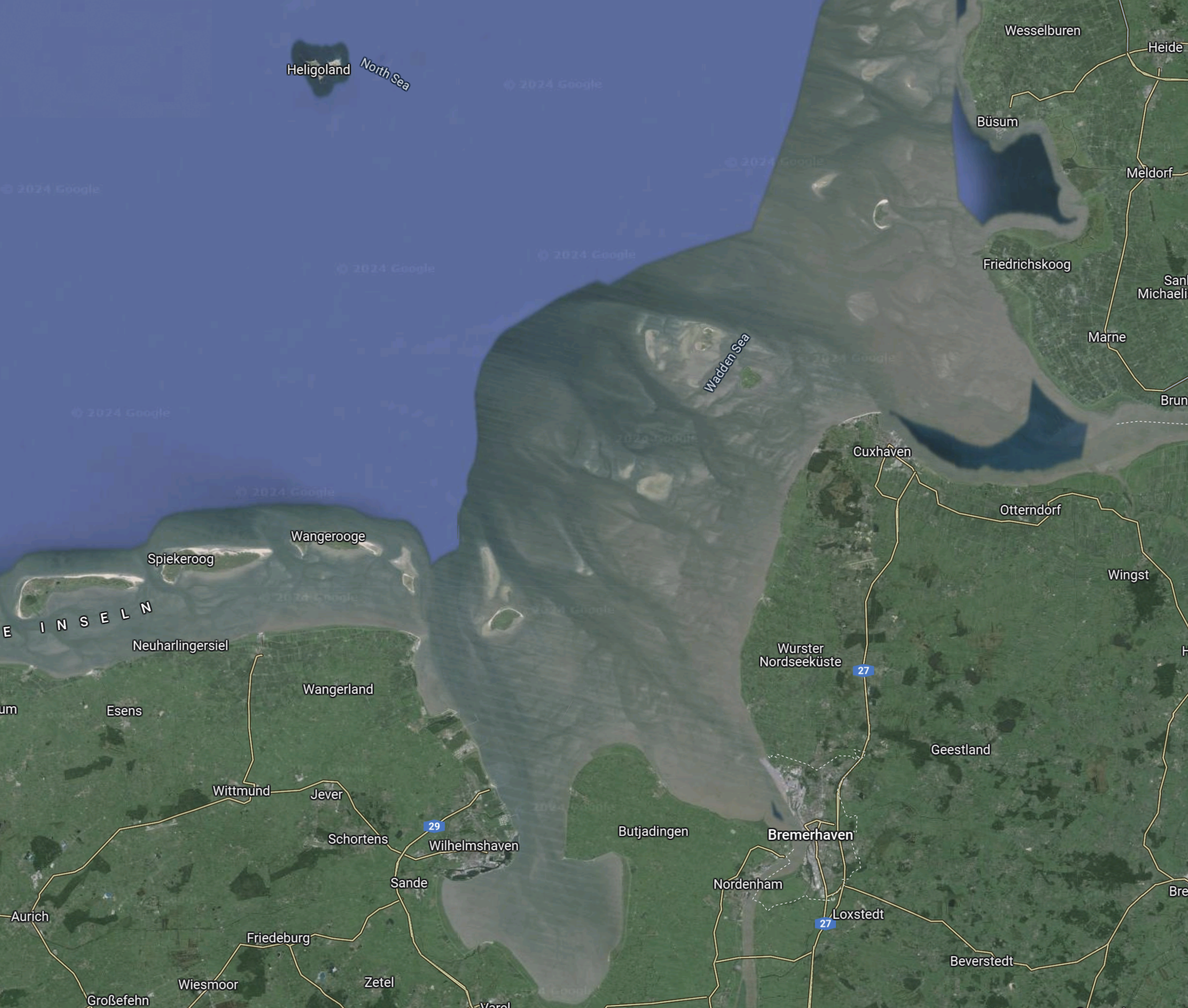
This Google Map shows the location of Wilhemshaven.
Note.
- Heligoland is the island at the top of the map.
- The Germans call this area the Wdden Sea.
- The estuaries lead to Wilhelmshaven and Bremerhaven.
- Cuxhaven is the port for Heligoland, which is connected to Hamburg by hydrogen trains.
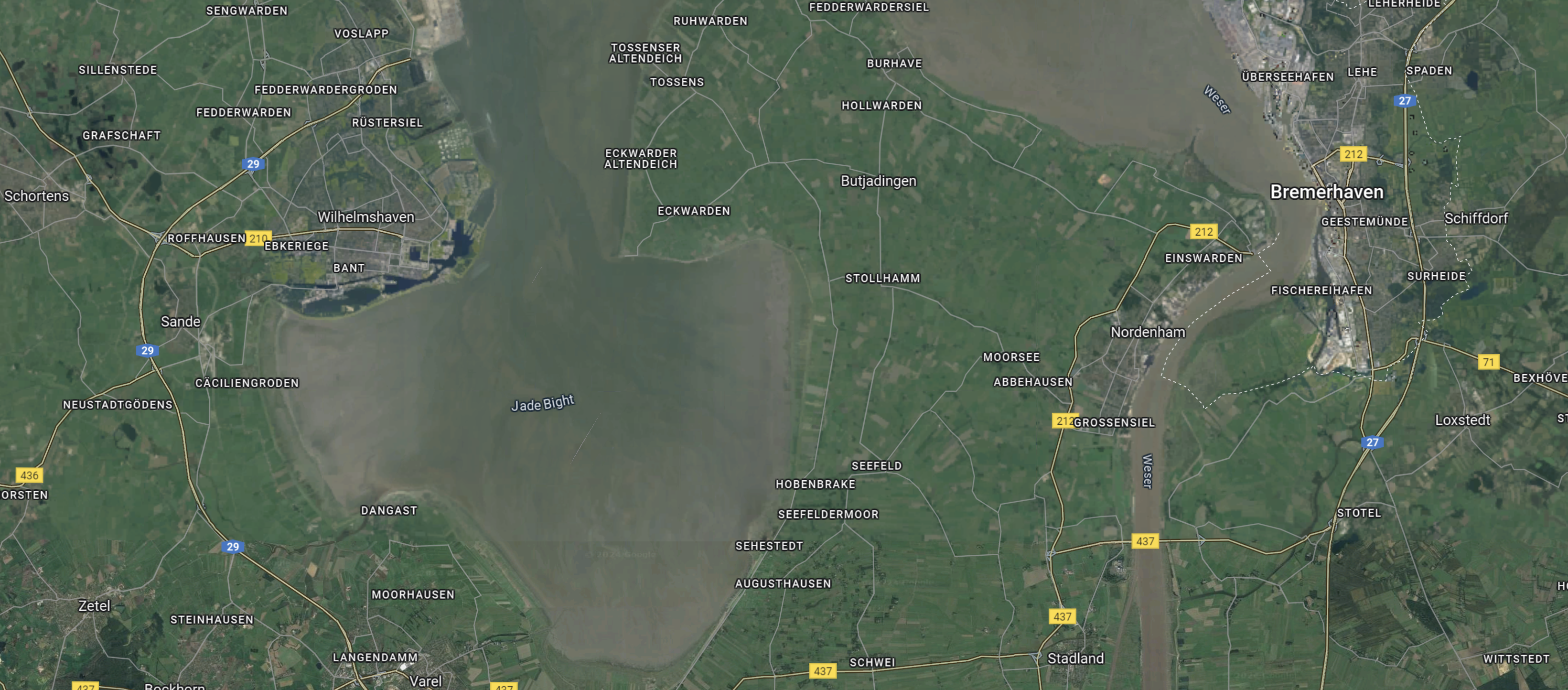
This second map shows between Bremerhaven and Wilhelmshaven.
Note.
- Wilhelmshaven is to the West.
- Bremerhaven is in the East.
- The River Weser runs North-South past Bremerhaven.
I’ve explored the area by both car and train and it is certainly worth a visit.
The Wilhemshaven Hydrogen Import Terminal
German energy company; Uniper is building a hydrogen import terminal at Wilhemshaven to feed German industry with hydrogen from places like Australia, Namibia and the Middle East. I wrote about this hydrogen import terminal in Uniper To Make Wilhelmshaven German Hub For Green Hydrogen; Green Ammonia Import Terminal.
I suspect RWE could build a giant offshore electrolyser close to the Norfolk wind farms and the hydrogen will be exported by tanker or pipeline to Germany or to anybody else who pays the right price.
All this infrastructure will be installed and serviced from Great Yarmouth, so we’re not out of the deal.
Dogger Bank South Wind Farm
To make matters better, RWE have also signed to develop the 3 GW Dogger Bank South wind farm.
This could have another giant electrolyser to feed German companies. The wind farm will not need an electricity connection to the shore.
The Germans appear to be taking the hydrogen route to bringing electricity ashore.
Energy Security
Surely, a short trip across the North Sea, rather than a long trip from Australia will be much more secure and on my many trips between the Haven Ports and The Netherlands, I haven’t yet seen any armed Houthi pirates.
RWE And Hydrogen
On this page on their web site, RWE has a lot on hydrogen.
Very Interesting!
H2ercules
This web site describes H2ercules.
The goal of the H2ercules initiative is to create the heart of a super-sized hydrogen infrastructure for Germany by 2030. To make this happen, RWE, OGE and, prospectively, other partners are working across various steps of the value chain to enable a swift supply of hydrogen from the north of Germany to consumers in the southern and western areas of the country. In addition to producing hydrogen at a gigawatt scale, the plan is also to open up import routes for green hydrogen. The transport process will involve a pipeline network of about 1,500 km, most of which will consist of converted gas pipelines.
Where’s the UK’s H2ercules?
Conclusion
The Germans have got there first and will be buying up all of our hydrogen to feed H2ercules.
Construction Under Way To Double Power Station Capacity At Centrica’s Brigg Energy Park
The title of this post, is the same as that of this press release from Centrica.
This is the sub-heading.
Four ultra-efficient engines have arrived at Centrica’s former combined cycle gas power station at Brigg, with construction work underway on an expansion of the peaking plant at the Lincolnshire site.
These three paragraphs give more details about the project.
The business is installing the four engines inside the former turbine hall at the power station, which was decommissioned in 2020, helping to create nearly 100MW of fast response assets capable of meeting demand when renewable generation is low.
The expanded power plant will be hydrogen-ready, and form part of a trial due to start in late 2024 to blend hydrogen into the gas, ramping up from a three per cent blend to 20 per cent, with a long term vision to move towards 100 per cent hydrogen and to deploy similar technology across all peaking plants.
Work at Brigg is expected to last around nine months and the plant will be fully operational in early 2025.
These are my thoughts.
Hydrogen Blend Operation
The second paragraph indicates that Centrica will be using Brigg power station to research the use of hydrogen blends.
Hydrogen blends could offer a way an easy way to cut hydrogen emissions, so it is good, that Centrica are researching their use in gas-fired power stations.
Brigg As A Peaking Plant
This paragraph from the press release, explains what Centrica means by a peaking plant.
Peaking plants only generate electricity when there’s high or peak demand for electricity, or when generation from renewables is too low to meet demand. Once connected to the grid, the engines will have the capacity to power 20,000 homes for a full day when required, which will maintain stability and deliver reliable power across the grid.
The second paragraph also says this.
A long term vision to move towards 100 per cent hydrogen and to deploy similar technology across all peaking plants.
Does this mean that all peaking plants will move to hydrogen-fired generation?
Brigg Redevelopment
This paragraph from the press release, outlines Centrica’s plans for Brigg power station.
Centrica is redeveloping the Brigg energy park which, once complete, will be home to a 50MW battery, commercial-scale hydrogen production using HiiROC technology (in which Centrica has a five per cent stake), and 100MW of gas peaking plant.
Note.
- I would assume that the battery, will be able to provide 50 MW for at least two hours, so the battery electric storage system (BESS) will be at least a 50 MW/100 MWh unit.
- The HiiROC technology is being developed on the other side of the Humber in Hull.
- HiiROC technology captures the carbon in the gas as carbon black, which has uses in its own right, in agriculture and tyre and other manufacturing.
- Both a battery and a gas peaking plant, will be used at Brigg to match generation with demand.
I wouldn’t be surprised that to use both a battery and a gas peaking plant, is the most efficient way to balance the renewable energy.
Hydrogen Production
The HiiROC technology that will be used at Brigg can extract hydrogen from a variety of sources including biomethane, chemical plant off gas or natural gas.
The HiiROC technology can be scaled to fit the application.
I feel that the versatility of the HiiROC technology, may result in using some unusual feeds to produce hydrogen.
As an example of the deployment of a small HiiROC system , one at a sewage works could provide hydrogen for the utility company’s vehicles.
The main use of the hydrogen would be to provide a clean fuel for the gas-fired peaking plant.
I also wouldn’t be surprised to see the hydrogen, sold and distributed to the local area, from an energy park, like Brigg.
Conclusion
Increasingly, backup for renewables will use a wide range of zero-carbon technologies.
TetraSpar Demonstrator Floating Wind Turbine Hits 63 Pct Capacity Factor In Norway
The title of this post, is the same as that of this article on offshoreWIND.biz.
This is the sub-heading.
Stiesdal has revealed that its TetraSpar Demonstrator, located in Norway, has reached a capacity factor of 63 per cent.
These three paragraphs give a few more details.
Since its commissioning in late 2021, the TetraSpar Demonstrator has been operational at METCentre in Norway, delivering green energy, gathering data, validating numerical models, supporting research and development projects, and serving as a living laboratory for the development of floating wind technology, said Stiesdal in a recent social media post.
To date, the demonstrator has generated more than 37 GWh of renewable energy, according to the company. The 3.6 MW Siemens Gamesa direct-drive wind turbine and very high wind speeds at the METCentre site combined to yield a capacity factor of 54 per cent, said Stiesdal.
In the first two years of operation, the availability was recorded at 97 per cent and 98.3 per cent, respectively. For 2024, the availability has increased to 99.5 per cent with a capacity factor of almost 63 per cent, according to the company.
I have some further thoughts.
Tetra Offshore Foundations For Any Water Depth
The title of this section, is the same as that of this page on the Siesdal web site.
The page gives a lot of information and says that the TetraSpar can handle water depth of over a thousand metres.
Wind Farm Capacity Factor
The Wikipedia entry for capacity factor says this about the range of wind farm capacity factors.
Wind farms are variable, due to the natural variability of the wind. For a wind farm, the capacity factor is determined by the availability of wind, the swept area of the turbine and the size of the generator. Transmission line capacity and electricity demand also affect the capacity factor. Typical capacity factors of current wind farms are between 25 and 45%. In the United Kingdom during the five year period from 2011 to 2019 the annual capacity factor for wind was over 30%.
From that paragraph, 63 % seems to be extraordinarily good.
Conclusion
The TetraSpar appears to be a powerful concept.
An Incident In My Childhood
I must have been about five or six.
All I can remember, is that she found me very red all over, grabbed me and took me upstairs where she put me in a bath.
I don’t think, she called the doctor.
I now wonder, if the incident was when a low-pressure went over and it drained the water out of my body.
Last night, there was rain in the night, and I’ve woken up with a pain in my hip. I shall have a bath soon.
Strangely, none of my three boys seemed to suffer similar incidents. So perhaps, they don’t have my strange leaky skin?
Debenhams Oxford – May 27th, 2024
These pictures show the current state of the Debenhams store in Oxford.
















This will be the first development of those, that I talked about in Crown Estate To Spend £1.5bn On New Laboratories.
- I have deliberately shown pictures of the Junction, where the Debenhams building occupies the North-West corner.
- There is a Waterstones opposite the Debenhams building, on a busy junction between George and Magdalen Streets.
- There is a bus information display on the corner.
- There are a lot of chain eateries and a pub; the Wig & Pen.
These are a few thoughts.
Does the Debenhams Building Have Any Car Parking?
I would doubt it, but there may be a need to bring in large equipment.
Taxis To And From The Station
Note.
- I took a black taxi from the station to just outside the Debenhams building and it cost me the princely sum of £5,20.
- I also noted there was a rank at the rear of the building.
- In both locations, taxis were ready to roll.
That looked reasonable.
Buses To And From The Station
Staff at Oxford station, assured me that buses were available, but due to all the road works and Bank Holiday chaos, I suspect it could be improved, when the station upgrade is complete.
Walking To The Station
I took this second set of pictures as I walked from the Debenhams building back to the station.












Note.
- I walked from the junction by Debenhams, along George Street.
- It was a fairly straight line and level.
- There were no signposts between Debenhams and the station.
- There was quite a bit of blocked traffic.
- The route could do with some improvement like refurbished pavements and a few direction signs.
It took me about twenty-four minutes and at 76, I walked it easily.
On entering the station, I walked straight on to the platform for my train back to Reading, which was two minutes late.
Cycling
I suspect that many will cycle to work in the Debenhams building, as it is in Oxford.
But then, I suspect the Crown Estate, their architects and builders will know the appropriate provision to make.
Is The Debenhams Building At A Good Location?
When I was around 23, I used to reverse commute to ICI in Welwyn Garden City.
This involved.
- A ten-minute walk from St. John’s Wood to Chalk Farm tube station.
- A Northern Line train to King’s Cross station.
- A suburban train to Welwyn Garden City station.
- A fifteen-minute walk to my place of work.
St. John’s Wood to Oxford would involve.
- A fourteen-minute bus ride to St. Paddington station.
- A suburban train to Oxford station.
- A twenty-minute walk to my place of work.
A Brompton bicycle would help.
Knowing Cambridge as I do, the Debenhams building would be very well-located, if it were in Cambridge in a similar location, with respect to the railway station.
I feel that the Debenhams building passes the location test.
Korean Hydrogen Bus Adoption Emerging To Block Low-Priced Electric Buses From China
The title of this post, is the same as that of this article on BusinessKorea.
These are the first two paragraphs.
Major Korean business groups such as Samsung, SK, Hyundai Motor, and POSCO are expanding the introduction of hydrogen buses. They are more efficient than electric buses, and can run 635 kilometers on a single charge, making them suitable for long-distance commuting. Expanding hydrogen mobility, including buses, is considered the first step in building an entire hydrogen ecosystem.
SK Group is one of the most active companies in expanding hydrogen buses. According to SK Group on May 26, SK siltron has decided to replace its commuter buses for employees of its Gumi plant in North Gyeongsang Province with hydrogen buses. Additional deployments are under consideration after a pilot run in the first half of the year. In early May, SK hynix introduced three of the Universe model, Hyundai’s hydrogen bus for commuting. SK E&S recently completed the world’s largest liquefied hydrogen plant in Incheon and plans to soon expand its hydrogen refueling stations nationwide to 20.
The Korean bus seem to have developed a strategy to protect themselves from the Chinese.
I have a few thoughts.
Korea And HiiROC
Hyundai and Kia have joined Centrica in taking stakes in Hull-based startup HiiROC, which I wrote about in Meet HiiROC, The Startup Making Low-Cost Hydrogen Free From Emissions.
London’s Future Bus Fleet
There are rumours on the Internet that Sadiq Khan, will replace all London’s buses with new Chinese buses.
How will I get around, as I don’t ride in anything that was made in China?
Conclusion
We live in interesting times.
Last Night, I Had A Very Bad Night’s Sleep
I usually sleep very well. In fact like my father, if I need a nap, I can even take it on a hard upright chair.
He would have a nap like this every day in his printworks. It also looks like my 53 year old middle son has this ability to take a quick nap.
Last night, I slept very badly and woke about two, with a pain in my hip.
I nearly phoned 111, as I felt so rough. Luckily I didn’t!
I didn’t get much more sleep and eventually had perhaps a nap of an hour or so, before I gave up and got out of bed to do a few puzzles on the Internet.
After a large mug of tea, the pain in my hip receded.
My now-retired GP, reckoned I suffered when the atmospheric pressure was low.
So, did an area of low pressure pass through last night and suck water out of my body?
After a good bath, I certainly feel better now, with no pain in my hip.
In My Strange Skin, I describe an incident, where weather sucked water out of my body!
It’s Now Ten O’Clock
I’ve survived the day and managed to take a train to Reading and back.
I had intended to take pictures in Oxford, but when I got to Reading, it was raining hard and I turned back.
 The Anonymous Widower