High Speed Two To Lancaster
There has been a lot of speculation about the Northern end of High Speed Two, so I might as well add sort out a few facts and add a bit of speculation of my own.
The Current Lancaster Service
I shall look at the 07:30 train on the 29th September 2023.
- It was a nine-car Class 390 train or Pendolino, which left on time.
- Euston and Lancaster are 230 miles apart.
- The train passed Crewe at 09:59
- The train arrived at Warrington Bank Quay at 09:14 and left at 09:15.
- The train arrived at Wigan North Western at 09:25 and left at 09:26.
- The train arrived at Preston at 09:39 and left at 09:41.
- The train arrived at Lancaster at 09:55 and left at 09:57.
- The journey took two hours and 25 minutes
- The average speed was 95.2 mph.
- There is at least one train per hour (tph).
Lancaster Will Get Its Own High Speed Two Service
This graphic shows High Speed Two services after Phase 2b is completed.
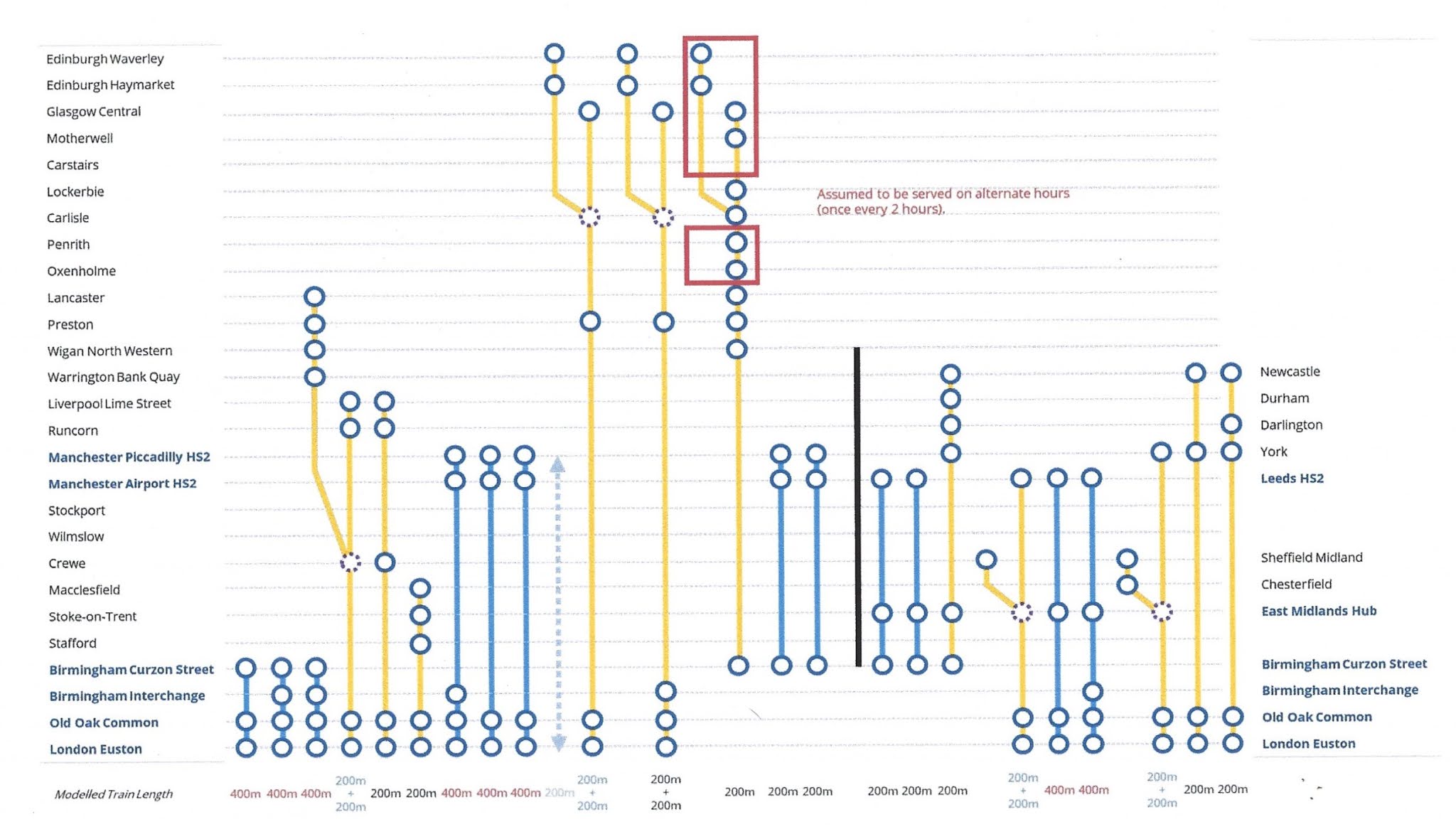
Note.
- Lancaster and Liverpool share a pair of High Speed Two Classic Compatible trains, that will split and join at Crewe.
- The Lancaster service will stop at Warrington Bank Quay, Wigan North Western and Preston, to the North of Crewe.
The Wikipedia entry for High Speed Two gives these times for trains from London after Phase 2a opens to Crewe.
- Crewe – 56 minutes
- Warrington Bank Quay – One hour and 20 minutes
- Wigan North Western – One hour and 34 minutes
- Preston – One hour and 18 minutes
- Lancaster – Two hours and 3 minutes
- Oxenholme – One hour and 56 minutes
- Carlisle – Two hours and 23 minutes
Note.
- The Crewe, Warrington Bank Quay, Wigan North Western and Lancaster times will apply to the direct Lancaster service.
- The Preston and Carlisle times apply to the non-stop Scottish service.
- Oxenholme will be reached with a change from London.
- Currently, Pendolinos travel between Crewe and Lancaster in an hour or a few minutes less.
I feel the Lancaster time is suspect and a better time would be around one hour and 52-56 minutes.
140 Mph Running Between Crewe And Preston
Consider.
- London Euston and Crewe is 56 minutes
- One hour and 18 minutes to Preston infers a time of 22 minutes between Crewe and Preston.
- Crewe and Preston is 51 miles.
This implies an average speed of 139 mph.
As the West Coast Main Line was built for 140 mph, when digital signalling was installed, this would appear to be feasible, once the signalling is upgraded.
It may also mean, that faster times are possible in services to Warrington Bank Quay and Wigan North Western.
Crewe And Warrington Bank Quay
Consider.
- The distance is 24.1 miles
- HS2 will take 24 minutes with one acceleration and one deceleration, which probably take a maximum of 4 minutes in total.
- I explain the four minutes in High Speed Two To Crewe.
This gives an average speed of 72.3 mph.
Warrington Bank Quay And Wigan North Western
Consider.
- The distance is 11.7 miles
- HS2 will take 14 minutes with one acceleration and one deceleration, which probably take a maximum of 4 minutes in total.
This gives an average speed of 70.2 mph.
Wigan North Western And Lancaster
Consider.
- The distance is 36.1 miles
- HS2 will take 29 minutes with two accelerations and two decelerations, which probably take a maximum of 8 minutes in total.
- I will also allow a minute for the dwell time at Preston.
This gives an average speed of 108.3 mph.
Crewe And Lancaster
Consider.
- The distance is 72 miles
- HS2 will take 67 minutes with four accelerations and four decelerations, which probably take a maximum of 16 minutes in total.
- I will also allow a minute for the dwell times at Warrington Bank Quay, Wigan and Preston.
This gives an average speed of 90.6 mph.
I now feel happier about two hours and three minutes between London and Lancaster.
Conclusion
The West Coast Main Line needs upgrading to full in-cab digital signalling as soon as possible.
Once working it would give journey time savings for everybody travelling on the line.
See Also
Could High Speed Two Finish At Lichfield?
Maverick Clean Air Candidate Who Ran For Mayor Of London Is Back In Politics
The title of this post, is the same as that, of this article on Air Quality News.
This is the sub-heading.
One of the most enthusiastic political advocates of clean air is once again throwing his hat into the electoral ring by announcing that he will stand in both the forthcoming Rutherglen and Hamilton West by-election and the Mid Bedfordshire by-election.
This is the introductory paragraph.
Prince Ankit Love, Emperor of India* may not be the best known political figure, but he’s certainly a persistent one. Representing the One Love Party, he was the youngest candidate in the 2016 London Mayoral election, where his policies focussed on London’s housing crisis and air pollution.
I didn’t know you could stand in two by-elections at the same time! What if you won both?
High Speed Two To Crewe
There has been a lot of speculation about the Northern end of High Speed Two, so I might as well add sort out a few facts and add a bit of speculation of my own.
Sample Times Between London And Crewe
These are selected times from the 27th September 2023.
- 07:30 – Glasgow Non-Stop – 1:29
- 07:33 – Manchester Piccadilly – 1:37 – Stops at Stafford
- 07:43 – Liverpool Lime Street – 1:40 – Stops at Milton Keynes
- 08:30 – Glasgow Non-Stop – 1:29
- 08:33 – Manchester Piccadilly – 1:37 – Stops at Stafford
- 08:43 – Liverpool Lime Street – 1:40 – Stops at Milton Keynes
- 09:02 – Holyhead – 1:40 – Stop at Stafford
- 15:02 – Chester – 1:40 – Stops at Tamworth, Lichfield Trent Valley and Stafford
Note.
- The 07:30 and 08:30 Glasgow services appears to be pathed for one of the Class 390 Pendolino electric trains and were run by Pendolinos.
- The 07:33 and 08:33 Manchester services appears to be pathed for one of the Pendolino electric trains and were run by Pendolinos.
- The 07:43 and 08:43 Liverpool services appears to be pathed for one of the new Class 807 electric trains, but were run by Pendolinos.
- The 15:02 Chester service appears to be pathed for one of the new Class 805 bi-mode trains.
- All services except the Glasgow services stop at Crewe.
- As London Euston and Crewe is 158 miles, the non-stop Glasgow services average 107 mph, the one-stop Manchester service averages 98 mph and the one-stop Liverpool service averages 95 mph.
I have some further thoughts.
How Long Does A Stop Take?
I’ve looked at some stops of Glasgow, Liverpool and Manchester services
Crewe
Looking at timings between Weaver Junction and Norton Bridge, I have found the following times.
- Glasgow-Euston – 23 minutes
- Liverpool-Euston – 28 minutes
Note.
- Manchester services don’t go through Weaver Junction.
- Weaver Junction and Norton Bridge are respectively North and South of Crewe.
- The Liverpool service stops at Crewe, where it has a dwell time of two minutes.
- The Glasgow service goes straight through Crewe.
The Crewe stop takes a total of 5 minutes of which 3 minutes are deceleration and acceleration to and from linespeed.
Stafford
Looking at timings between Norton Bridge and Colwich, I have found the following times.
- Glasgow-Euston – 7½ minutes
- Liverpool-Euston – 7½ minutes
- Manchester -Euston – 14 minutes
Note.
- Norton Bridge and Colwich are respectively North and South of Stafford.
- The Manchester service stops at Stafford, where it has a dwell time of two minutes.
- The Glasgow and Liverpool services go straight through Stafford.
The Stafford stop takes a total of 6½ minutes of which 4½ minutes are deceleration and acceleration to and from linespeed.
Milton Keynes
Looking at timings between Weedon and Bletchley, I have found the following times.
- Glasgow-Euston – 11½ minutes
- Liverpool-Euston – 16 minutes
- Manchester -Euston – 12½ minutes
Note.
- Weedon and Bletchley are respectively North and South of Milton Keynes.
- The Liverpool service stops at Milton Keynes, where it has a dwell time of one minute.
- The Glasgow and Manchester services go straight through Milton Keynes.
The Milton Keynes stop takes a total of 4 minutes of which 3 minutes are deceleration and acceleration to and from linespeed.
Average Speeds Between Crewe And London
London Ruston and Crewe is 158 miles according to Real Time Trains.
So what would times would various average speeds deliver?
- 100 mph – 95 minutes
- 110 mph – 86 minutes
- 120 mph – 79 minutes
- 125 mph – 76 minutes
- 130 mph – 73 minutes
- 140 mph – 68 minutes
Obviously, any average speed with over 125 mph running, will need full digital signalling.
Liverpool And London In Two Hours
Tucked away beside the Grand Union Sets Out Stirling Ambitions article in the December 2022 Edition of Modern Railways is a report on Avanti West Coast’s application for a second service between Euston and Liverpool.
This is said.
Avanti West Coast has applied for access rights for its second hourly Euston to Liverpool service, starting from December 2023, although a phased introduction of the new service is likely. This would make use of Avanti’s new fleet of 10×7-car Class 807 Hitachi EMUs, which are expected to enter service from Autumn 2023. The ‘807s’ would be deployed on the current hourly Liverpool service, on which a call at Liverpool South Parkway would be added. (provision is made for this in the December 2022 timetable.).
Pendolinos would then operate the second service each hour, calling at Lichfield Trent Valley and Tamworth.
A linespeed project is in progress to raise the permissible speed for non-tilting trains on the West Coast Main Line, and Avanti’s new Hitachi trains will take advantage of this.
I’ll take a quick look at the Crewe and Runcorn section.
- It is 22.5 miles.
- It takes 19 minutes.
- That is an average speed of 71 mph.
- Crewe and Weaver Junction has a speed limit of at least 110 mph
- Runcorn and Weaver Junction has a speed limit of at least 90 mph for most of the way.
- If with their superior performance, the new Class 807 trains could average 90 mph between Crewe and Runcorn, they would take 15 minutes.
- Achieving the 90 mph average may need a bit of track realignment and some signaling changes.
The four minutes saved would be enough to handle the extra stop at Liverpool South Parkway.
Consider.
- Currently, Pendolino trains do Liverpool and Crewe in 38 minutes, which includes the stop at Runcorn.
- My calculation with the Class 807 trains, shows that with a bit of extra signalling, the new trains could do Liverpool and Crewe in 38 minutes with the two stops.
- The stop at Crewe will subtract 5 minutes from the base journey time.
- The stop at Milton Keynes will subtract 4 minutes from the base journey time.
This means the base journey time between Crewe and London will be 73 minutes.
This would indicate that the trains would be running at 130 mph to achieve the two hours.
But there are five accelerations and five decelerations on a journey between London and Liverpool and the new Class 807 trains are the Lotuses of Hitachi’s family of AT-300 trains; lightweight and powerful.
Suppose they could save thirty seconds for each acceleration and deceleration.
The base journey time between Crewe and London will be 78 minutes.
This would indicate that the trains would be running at over 120 mph to achieve the two hours.
I certainly feel, that Liverpool and London in two hours is certainly possible using the new Class 807 trains.
London and Crewe with two stops would be times at one hour and twelve minutes.
But what about the Pendolinos?
- My last return trip from Liverpool did a practice call at Liverpool South Parkway and still arrived in London a few minutes early.
- The Pendolinos will still benefit from any improvements, between Crewe and Runcorn, which could reduce the Liverpool and Crewe time from 38 minutes to 34 minutes.
- The stop at Crewe will subtract 5 minutes from the base journey time.
- The stops at Lichfield Trent Valley and Tamworth will both subtract 4 minutes from the base journey time.
This means the base journey time between Crewe and London will be 73 minutes, which is the same as for the Class 807 trains.
This would indicate that the trains would be running at 130 mph to achieve the two hours.
Could this average speed be achieved by the selective application of full digital signalling, perhaps on the Trent Valley Line?
But it does appear to me, that the Pendolinos can get very close to two hours between London and Liverpool.
London and Crewe with three stops would be times at one hour and sixteen minutes.
Crewe And London Non-Stop
Consider.
- Pendolinos between London and Glasgow, go non-stop between London and Crewe.
- I have calculated that Pendolinos between London and Liverpool, will take one hour and sixteen minutes with three stops between London and Crewe.
- The three stops take a total of thirteen minutes.
I wouldn’t be surprised to see London and Glasgow Pendolinos take one hour and three minutes between London and Crewe.
This would knock twenty-six minutes off journey times between London and Glasgow.
Conclusion
I believe that with relatively minor improvements on the West Coast Main Line and the Liverpool branch, the following can be achieved.
- Liverpool and London can be around two hours with new Class 807 trains or Pendolinos.
- Liverpool and London services can increase their calls in the Midlands.
- London and Glasgow services can be nearly half-an-hour faster.
- The fastest London and Crewe services could be just over an hour using Pendolinos.
I also believe that the only serious infrastructure needed is some track realignment and some updated signalling.
See Also
Could High Speed Two Finish At Lichfield?
The Diesel Power Of The Class 805 Trains
Avanti West Coast’s new Class 805 trains, will probably start running between London Euston and Chester, Shrewsbury and North Wales before the end of the year.
But will they have the 560 kW engines of the Class 800 trains or the the 700 kW engines of the Class 802 trains?
On this page of Eversholt Rail’s web site, there is a detailed specification for a Class 802 train.
It says these trains have a top speed of 110 mph on diesel.
But it also says this about the design of the trains.
They have been designed to meet the operational requirements of the West of England route and are used on services out of London Paddington to Plymouth and Penzance.
The class 802 is almost identical to the class 800, the differences are that class 802s have a higher rated engine output to tackle the gradients through Devon and Cornwall, and a superior diesel range to provide the IET experience to the wider Greater Western Network, they also have a larger brake resistor which reduces brake pad usage and requires less maintenance.
Wikipedia also says that these are the diesel engine sizes in the three main classes of these Hitachi AT 300 trains.
- Class 800 train – 560 kW – Three engines for five cars
- Class 801 train – 560 kW – One emergency engine for five cars
- Class 802 train – 700 kW – Three engines for five cars
- Class 810 train – 735 kW – Four engines for five cars
All these four trains have similar bodyshells and running gear, so I suspect that to run at similar cruising speeds, similar amounts of power will be needed.
If the Class 802 train has a speed of 110 mph on diesel, then a rough estimate of the cruising speed of a train with the 560 kW engines can be estimated by doing this simple calculation. Note that air resistance is proportional to the square of the speed.
Square root (110*110 *560/700) = 98.4 mph
I have looked on OpenRailwayMap at all the tracks to the West of Wolverhampton, where these trains will run and the highest maximum operating speed I can find is 90 mph.
As the Class 805 trains have a reprofiled nose, which could be more aerodynamic, they may be able to cruise at 90 mph.
I believe that a train with three 560 kW engines will suit Avanti West Coast purposes well.
What Is The Operating Speed Of The Class 810 trains?
I can use a similar calculation to estimate the maximum operating speed of the Class 810 trains, that will operate on the Midland Main Line.
Consider.
- The Class 802 train has a total power of 2100 kW
- The Class 810 train has a total power of 2940 kW
- The Class 810 train with only three working engines has a total power of 2205 kW
I can estimate the cruising speed by doing this simple calculation, which is similar to the one for the Class 805 train.
Square root (110*110 *2940/2100) = 130 mph
I can also do it for a train running on three engines.
Square root (110*110 *2205/2100) = 113 mph
I looks to me, that the following is possible.
- As Class 810 trains can achieve the maximum speed of 125 mph on both diesel and electric power, the timetable is independent of the progress of the electrification.
- If the 125 mph sections are ignored, the fastest sections of line have a maximum speed of 110 mph, which could be possible on three engines.
- North of the electrification, where the maximum speed is only 110 mph, engines could be selectively rested to avoid overheating.
Four engines give a lot of interesting options.
I can’t wait to take a ride.
Could The Class 810 Trains Be Fitted With Batteries?
When, the electrification reaches Market Harborough station, there will be no 125 mph sections on the Midland Main Line, which are not electrified.
This Hitachi infographic shows the Hitachi Intercity Tri-Mode Battery Train.

A Class 810 version of this train would have three diesel engines and one battery pack.
- It would have all the features of the infographic.
- My calculations give it a top speed of 113 mph on a route, where the maximum speed North of the electrification is 110 mph.
- I also suspect, it could bridge any small gaps in the electrification.
It would have the very positive effects of saving fuel and cutting pollution in stations.
DuPont Introduces First Ion Exchange Resin For Green Hydrogen Production
The title of this post, is the same as that of this press release from DuPont.
This is the sub-heading.
Newly designed ion exchange resin with extended service time designed to enhance electrolyzer operation
This is the first paragraph.
DuPont today announced the launch of its first product dedicated to the production of green hydrogen – the DuPont™ AmberLite™ P2X110 Ion Exchange Resin. To support the production of hydrogen from water, this newly available ion exchange resin is designed for the unique chemistry of electrolyzer
Put simply, it appears, that DuPont’s new product will improve the overall efficiency of the electrolysis of water to produce hydrogen.
New Rolls-Royce Engine For Hybrid-Electric Flight Completes Successful First Fuel Burn
The title of this post is the same as that of this press release from Rolls-Royce.
This is the sub-heading.
A new Rolls-Royce small gas turbine that has been specifically developed to power hybrid-electric flight has successfully completed its first fuel burn. The engine has been designed using novel combustion technology to produce ultra-low emissions and this significant achievement confirms the effectiveness of the compact, power-dense turbine that will be integrated into a light-weight turbogenerator system.
This first paragraph gives more details.
The complete turbogenerator system is being developed for the Advanced Air Mobility (AAM) market. This includes electrical vertical take-off and landing (eVTOL) or electric short take-off and landing (eSTOL) aircraft for Urban Air Mobility (UAM) and commuter aircraft applications up to 19 seats. The gas turbine under test also has potential applications within helicopter, auxiliary power unit (APU) and defense markets.
Looking at Wikipedia, it appears that a typical 19 seat airliner needs two engines with a power between 500 and 600 kW.
This would fit with the next paragraph of the press release.
The turbogenerator system will complement Rolls-Royce’s electrical propulsion portfolio by delivering an on-board power source with scalable power offerings between 500 kW and 1,200 kW enabling extended range on sustainable aviation fuels and later, as it becomes available, through hydrogen combustion. This will open up new, longer routes than electric battery powered aircraft can support today.
I can envisage electric 19-seat airliners powered by either two 600 kW engines or one 1200 kW engine.
But then the mind boggles at the applications for this range of engines.
Scotland’s 25 GWh Energy Storage Arriving By Stealth
In SSE Unveils Redevelopment Plans For Sloy Hydro-Electric Power Station, I introduced SSE Renewable’s plan to convert the UK’s largest hydro-electric power station into a pumped storage hydroelectric station, that can store 25 GWh of electricity and generate 152.5 MW of electricity.
After a public consultation in July, which unfortunately, I was unable to get to, SSE have now published a comprehensive document, which details their plans.
These are some points from the document.
- There will be no increase in the generating capacity of 152.5 MW, which is about half the size of a gas-fired power station.
- SSE designed a similar scheme for Sloy in 2009.
- Pumped storage systems need a lot of water. The Loch Sloy scheme has Loch Lomond.
- The development of pumped storage at Sloy would only require construction work to be carried out in the grounds of the existing power station.
- No permanent new works would be required at Sloy Dam or outside of the existing station boundary.
- A new above ground structure would be required which would contain a main hall with vehicular access, laydown areas, an overhead travelling crane, electrical switchgear and control systems.
- A new underground pump hall would be required to house two pumps. This would link to the intake structure and would be approximately 20m below the existing ground level.
- The existing tailrace to Loch Lomond, will be used to bring water to the pumps.
- Construction could start in 2025, with completion in 2027.
This redevelopment is a much less complex construction project, than building the original power station in the 1950s.
It also looks like the construction will not cause much disruption in the local area.
Hence my view, that this storage is arriving by stealth and won’t be noticed by those passing the power station.
After reading this SSE document, I wonder how many similar 1950s hydroelectric power stations have been upgraded to pumped storage stations in the last few years.
Also, if their Sloy scheme is successful, will SSE be looking for other hydroelectric power stations to convert to pumped storage?
This article on renews.biz is entitled Vattenfall Plans To Build 730MW Of Swedish Hydro Power, where this is a paragraph.
Vattenfall is also conducting a pilot study to investigate reinstating the Juktan power station on the Storjuktan lake adjacent to the Umeälven river in Västerbotten, to a pumped storage plant with a capacity of up to 380MW.
Note.
- Juktan power station was built as a pumped storage station and converted to a standard one.
- It has a web page.
- As the paragraph says it could be converted back!
So other companies and countries are thinking the same way!
Strathclyde University’s Prediction
This page on the Strathclyde University web site, gives these figures in GWh for the possible amounts of pumped storage that can be added to existing schemes.
- Errochty – 16
- Glasgarnock – 23
- Luichart – 38
- Clunie – 40
- Fannich – 70
- Rannoch – 41
- Fasnakyle – 78
- Tummel – 38
- Ben Lawers – 12
- Nant – 48
- Invermoriston – 22
- Invergarry – 41
- Quoich – 27
- Sloy – 20
That is a total of 514 GWh.
These figures must give SSE food for thought.
These new schemes are also being planned.
- Balliemeanoch – 1.5GW/45 GWh
- Coire Glas – 1.5 GW/30 GWh
- Corrievarkie – 600 MW/14.5 GWh
- Fearna – 1.8 GW/37 GWh
- Loch Earba – 900 MW/33 GWh
- Loch Kemp – 300 MW/9 GWh
- Loch Na Cathrach/Red John – 450 MW/2.8 GWh
These could bring the potential pumped storage in Scotland to 685.3 GWh.
ILI Group To Develop 1.5GW Pumped Storage Hydro Project
The title of this post, is the same as that of this article on the Solar Power Portal.
This is the sub-heading.
The pumped hydro facility will be located at Loch Awe, which is also home to Kilchurn Castle.
These paragraphs outline the story.
Clean energy developer ILI Group has begun the initial planning phase for a new pumped storage hydro project in Scotland.
The Balliemeanoch project at Loch Awe, Dalmally in Argyll and Bute will be able to supply 1.5GW of power for up to 30 hours. It is the third and largest of ILI’s pumped storage hydro projects, with the other two being Red John at Loch Ness and Corrievarkie at Loch Ericht.
The Balliemeanoch project will create a new ‘head pond’ in the hills above Loch Awe capable of holding 58 million cubic meters of water when full.
Note.
- At 1.5 GW/45 GWh, it is a large scheme and probably the largest in the UK.
- This is the third massive pumped storage hydro scheme for the Highlands of Scotland after SSE’s 1.5 GW/30 GWh Coire Glas and 152 MW/25 GWh Loch Sloy schemes.
- I describe the scheme in more detail in ILI Group To Develop 1.5GW Pumped Storage Hydro Project.
The article also has this paragraph.
It follows a KPMG report finding that a cap and floor mechanism would be the most beneficial solution for supporting long duration energy storage, reducing risks for investors while at the same time encouraging operators of new storage facilities to respond to system needs, helping National Grid ESO to maintain security of supply.
A decision on funding would be helpful to all the energy storage industry.
Rolls-Royce And Zero Petroleum Join Forces To Develop Sustainable Future
The title of this post, is the same as that of this press release from Rolls Royce.
This is the sub-heading.
Rolls-Royce has entered a landmark agreement with breakthrough Energy company Zero Petroleum to promote further development of the company’s power and propulsion solutions with fossil-free synthetic fuels.
These two paragraphs outline the agreement.
The new agreement will see the two parties collaborate to demonstrate Rolls-Royce engines for aviation, marine and defence with Zero® synthetic fuels.
This has the potential to include Zero’s entire range of synthetic fuels – petrol, diesel and jet fuel – with data gathered from engine testing used to prove the credentials required to achieve international fuel certification standards. Synthetic fuels deployed by Rolls-Royce in engine tests will directly reduce associated carbon emissions.
Are Rolls-Royce going to do their engine testing using synthetic fuels to reduce their carbon emissions?
It certainly looks like they might and I suppose it does two tests at the same time.
Rolls-Royce Seem To Be Using Technology To Save The Company
Big companies like Rolls-Royce, who are very much toed up with fossil fuels have two options; give up or fight using the only weapons they have; superb technology and a lot of experience.
There are only a small group, that seem to be fighting to succeed. To Rolls-Royce, I would add Cummins, Fortescue Future Industries, Ricardo and SSE, and possibly BP and Centrica.
Scottish Project To Explore Tugdock Tech Application To Accelerate Floating Wind Development
The title of this post, is the same as that of this article on offshoreWIND.biz.
This is the sub-heading.
The joint venture behind the Salamander floating wind project and the UK developer of marine buoyancy technology, Tugdock, have signed a memorandum of understanding (MOU) to collaborate on research and innovation related to the development of technologies and supply chain for floating wind energy in Scotland.
This is the introductory paragraph.
The 100 MW floating wind farm, developed jointly by Simply Blue Group and Ørsted, and Subsea7 as a minority partner, is one of the 13 projects selected in Scotland’s Innovation and Targeted Oil and Gas (INTOG) leasing round and one of the five INTOG innovation projects which signed exclusivity agreements with Crown Estate Scotland in May.
There is more about Tugdock on their web site.
I like the concept, but then I did a lot of simulation of floating structures in the 1970s, which I wrote about in The Balaena Lives.
 The Anonymous Widower