‘Dramatically More Powerful’: World’s First Battery-Electric Freight Train Unveiled
The title of this post, is the same as that of this article in The Guardian.
It is a good article about Wabtec’s new FLXdrive battery train and is very positive about it coming from a typical Guardian direction.
The article is a must-read.
I am beginning to feel that what Wabtec has done is to create a practical and affordable solution, that will cut carbon emissions in a difficult area, that produces the figures and also is understandable by diverse groups, like journalists, politicians and environmentalists. And they are backing it with academic research from a good university.
I also believe that the technology can be applied to existing locomotives as I outlined in Could Class 66 Locomotives Be Converted Into Battery-Electric Locomotives?.
Could this be another example of positive environmental change brought about by when the big beasts play their cards in the jungle?
Going green is a way of company survival! And Wabtec are going in that direction.
Could Class 66 Locomotives Be Converted Into Battery-Electric Locomotives?
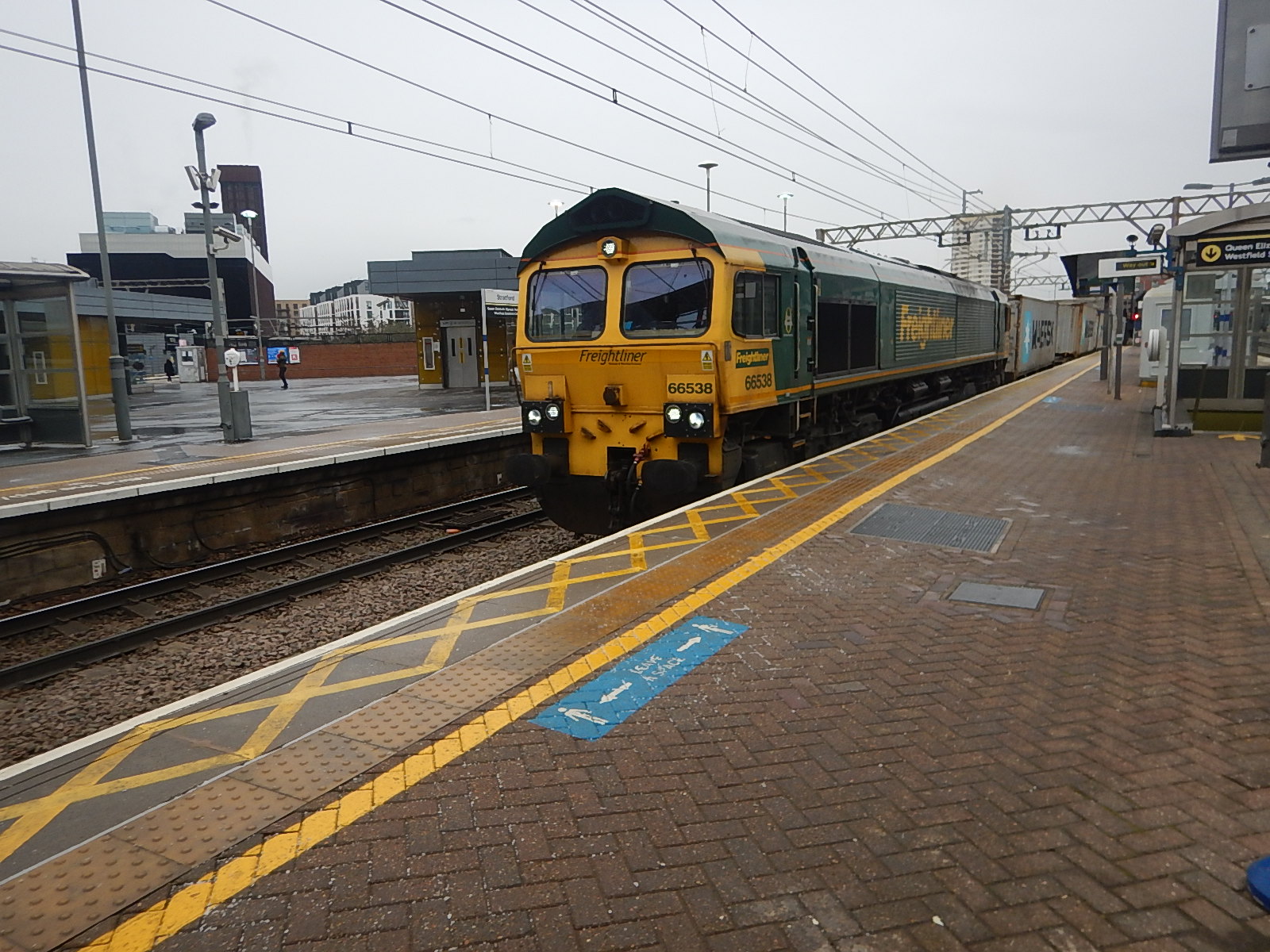
This picture shows a Freightliner Class 66 locomotive passing through Stratford with a multimodal freight train.
These are a few thoughts on converting some of the four hundred and eighty Class 66 locomotives into battery-electric locomotives.
An Estimate Of Performance Of A Battery Electric Class 66 Locomotive
In Iron Ore Miner Orders Heavy-Haul Battery Locomotive, I said this about a UK-sized locomotive based on Wabtec’s FLXdrive battery-electric technology.
I could envisage Wabtec designing a UK-sized battery-electric locomotive with these characteristics.
- 2.5 MW power output, which is similar to a Class 66 locomotive.
- A battery size of perhaps 1.8 MWh based on Wabtec’s FLXdrive technology.
- A pantograph to charge the batteries and also power the locomotive where electrification exists.
- 75 mph operating speed.
- Ability to work in tandem with a Class 66 locomotive.
All technology is under Wabtec’s control.
This locomotive could have a range of at least fifty miles on battery power, doing the sort of duties that Class 66 locomotives do!
So it would be able to take a multimodal container train out of the Port of Felixstowe to the electrification at Ipswich.
The Class 66 Locomotive Is Diesel-Electric
The Class 66 locomotive is a diesel-electric locomotive, where the diesel engine drives an alternator, which generates electricity, which then powers the six traction motors, which are arranged, so that there is one on each of the six axles.
This should make conversion easier, as the heavy lump of the engine and the alternator would be replaced with a large number of lithium-ion batteries.
Wabtec Has A Modular Battery System
This article on Railway Age gives a lot of detail and several pictures of the modular FLXdrive battery system.
- Each module is a 4.9 kWh battery, that weighs 72.6 Kg.
- Batteries are arranged into strings, which feed the traction motors.
- There is a sophisticated control system, which ensures that a module failure doesn’t disable the locomotive.
- The battery system is air-cooled.
I would expect that Wabtec could arrange a number of modules in the stripped out body of a Class 66 locomotive.
The FLXdrive Battery System Handles Regenerative Barking
The Railway Age article says this.
Battery charging while the FLXdrive is operating occurs through regenerative dynamic braking.
This will certainly improve efficiency.
Could A Pantograph Be Fitted To A Class 66 Locomotive?
This picture of a Class 66 locomotive was taken at Peterborough.

Note the 25 KVAC overhead electrification and the gap between the wires and the roof of the locomotive.
I don’t think it would the toughest job to design a pantograph for a Class 66 locomotive.
What Would Be The Use Of A Battery Electric Class 66 Locomotive With A Fifty Mile Range?
I believe that a surprising number of duties currently handled by Class 66 locomotives could be performed by a battery-electric Class 66 locomotive.
- The locomotives would effectively be electric locomotives with a last fifty mile capability.
- The number of possible duties will increase as electrification increases.
- They would be ideal to support track maintenance activities.
- They would be a zero-carbon locomotive with a low noise footprint.
As I said earlier, they should be able to haul a heavy intermodal train out of the Port of Felixstowe.
Would A Battery-Electric And A Diesel-Electric Class 66 Locomotive Working As A Pair Be Able to Handle The Heaviest Trains?
As the Americans and Canadians have shown with more than one locomotive, where one is a battery-electric locomotive can reduce the carbon-emissions, the same rules must apply in the UK.
Conclusion
I am not a lover of the smelly, noisy and polluting diesel Class 66 locomotives, but it does look it could be possible to convert some into battery-electric locomotives.
I wouldn’t be surprised to see Wabtec convert some Class 66 locomotives into battery-electric locomotives.
I also believe, that conversion of Class 66 locomotives to battery-electric operation could be the most affordable way to help decarbonise rail freight.
FLXdrive ‘Electrifies’ Pittsburgh
The title of this post, is the same as that of this article on Railway Age.
The article describes Wabtec’s FLXdrive locomotive, as “the world’s first 100% battery, heavy-haul locomotive”
It is well worth a read, as it describes some of the design philosophy.
In addition, this page on the Wabtec web site gives some details of the locomotive.
It is powered by lithium-ion batteries.
- There are around 20,000 battery cells
- The batteries have their own air-conditioning
- There is a sophisticated battery-management system.
- The total battery size is 2.4 MWh
- Power output is 4400 HP or 3.24 MW
- Locomotive will run for 30-40 minutes at full power.
- The locomotive has regenerative braking.
- Operating speed is 75 mph
Note that running at 75 mph for 40 minutes would cover fifty miles.
The Railway age article has this paragraph, which describes a partnership between Carnegie-Mellon University (CMU), Genesee & Wyoming and Wabtec to create the Freight Rail Innovation Institute.
CMU, Genesee & Wyoming and Wabtec also hope to create the Freight Rail Innovation Institute, described as “the first-of-its-kind effort to create zero-emission locomotives, develop technology that increases freight rail utilization and improve safety by 50%, and create 250,000 jobs by 2030.” G&W’s Buffalo & Pittsburgh Railroad will pilot technologies developed by the Freight Rail Innovation Institute, including a zero-emissions battery and hydrogen-powered train that is planned for revenue operation on 200 miles of track between Pittsburgh and Buffalo, N.Y. within the next three years.
Note.
- The paragraph is very much a mission statement.
- Genesee & Wyoming are the parent of Freightliner in the UK, who are developing a dual-fuel locomotive, that I wrote about in Freightliner Secures Government Funding For Dual-Fuel Project.
It strikes me CMU, Genesee & Wyoming and Wabtec are on the right track.
Iron Ore Miner Orders Heavy-Haul Battery Locomotive
The title of this post, is the same as that of this article on Railway Gazette.
This is the first two paragraphs.
Mining company Roy Hill has ordered a Wabtec FLXdrive battery-electric heavy-haul freight locomotive. This will replace one the four ES44ACi diesel-electric locos used to haul its 2 700 m long iron ore trains, and is expected to reduce fuel costs and emissions by ‘double digit’ percentages while also cutting maintenance costs.
The locomotive is scheduled to be delivered in 2023. It will have a capacity of 7 MWh, an upgrade from the 2·4 MWh prototype which Wabtec and BNSF tested in revenue service in California earlier this year.
Note.
- It will have a 7 MWh battery.
- 2700 metres is 1.6 miles.
It looks to me, that the three diesel locomotives and one battery locomotive are arranged as a massive hybrid locomotive and I suspect that with sophisticated control systems, those double digit cuts in fuel costs and emissions would be possible.
A couple of years ago, I took this picture near Shenfield.
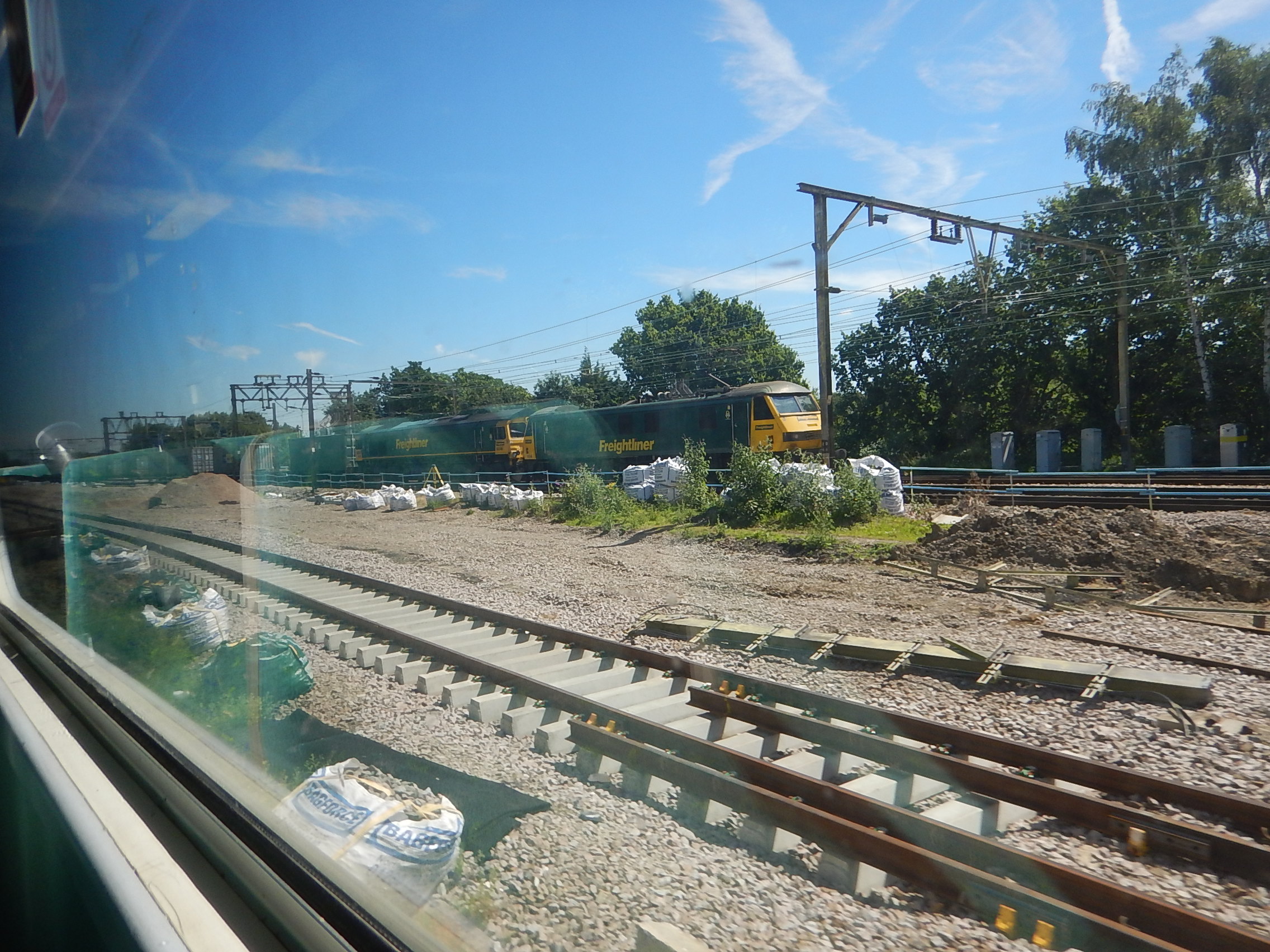
This double-headed train has a Class 90 electric locomotive and a Class 66 diesel locomotive at the front of a long freight train.
- The Class 90 locomotive has an TDM system for multiple working.
- The Class 66 locomotive has an AAR system for multiple working.
So does this mean that the two locomotives can’t work together, which if it does begs the question of what is happening.
- Had the Class 66 locomotive failed and Class 90 was acting as a Thunderbird?
- Was the Class 66 locomotive being moved from one depot to another for maintenance or repair?
- Was it an experiment to see if the two locomotives could work together?
I sometimes think that I didn’t see this unusual formation, but then the camera doesn’t lie.
But could we learn from what Wabtec are doing for Roy Hill in Australia?
The Class 93 Locomotive
Rail Operations Group have already ordered thirty Class 93 tri-mode locomotives from Stadler, which have following power ratings.
- Electric – 4000 kW
- Diesel – 900 kW
- Hybrid – 1300 kW
If this locomotive is capable of hauling the heaviest intermodal freight trains out of Felixstowe, Southampton and other ports and freight terminals, it could contribute to substantial reductions in the diesel fuel used and emissions.
As an example, I will use a freight train between Felixstowe North Terminal and Trafford Park Euro Terminal.
- It is a route of 280 miles.
- I will ignore that it goes along the North London Line through North London and along the Castlefield Corridor through Manchester Piccadilly station.
- There is fifteen miles without electrification at the Felixstowe end.
- There is under three miles without electrification at the Manchester end.
On this service , it could be as much as 94 % of diesel and emissions are saved, if the Class 93 locomotive can haul a heavy freight train out of Felixstowe. A few miles of strategically-placed electrification at the Ipswich end would help, if required.
It must also be born in mind, that the Class 93 locomotive is a 110 mph locomotive on electric power and could probably do the following.
- Run at 100 mph on the busy Great Eastern Main Line.
- Run at faster speeds on the West Coast Main Line.
- Fit in well with the 100 mph passenger trains, that run on both routes.
So not only does it save diesel and carbon emissions, but it will save time and make the freight train easier to timetable on a route with lots of 100 mph passenger trains.
The Class 93 locomotive looks like it could be a game-changer for long-distance intermodal freight, especially, if there were short sections of strategically-placed electrification, added to the electrified network.
Emissions could also be reduced further by using some for of sustainable fuel.
The picture shows a Class 66 locomotive, which is powered by Hydrotreated Vegetable Oil or HVO.
I can see that all diesel-powered trains and locomotives will be powered by sustainable fuels by the end of this decade.
A Wabtec Battery-Electric Locomotive
Wabtec is building a battery-electric locomotive for Roy Hill in Australia.
This article on Railway Age talks about Wabtec’s FLXdrive battery locomotives and describes some features of the locomotive for Roy Hill in Australia.
It mentions pantographs and overhead wires to charge the batteries.
- Wabtec’s prototype battery locomotive has a power output of 3.24 MW and a battery size of 2.4 MWh
- The Roy Hill battery locomotive has a power output of 3.24 MW and a battery size of 7 MWh
I could envisage Wabtec designing a UK-sized battery-electric locomotive with these characteristics.
- 2.5 MW power output, which is similar to a Class 66 locomotive.
- A battery size of perhaps 1.8 MWh based on Wabtec’s FLXdrive technology.
- A pantograph to charge the batteries and also power the locomotive where electrification exists.
- 75 mph operating speed.
- Ability to work in tandem with a Class 66 locomotive.
All technology is under Wabtec’s control.
This locomotive could have a range of at least fifty miles on battery power.
I think this locomotive could handle these routes.
- Peterborough and Doncaster via the Great Northern and Great Eastern Joint Line via Lincoln, with some form of charging at halfway.
- Felixstowe and Nuneaton, with some extra electrification at some point between Peterborough and Leicester.
- Oxford and Birmingham, with possibly some extra electrification in the middle.
One option for charging electrification, would surely be to electrify passing loops.
I think a battery-electric locomtive based on Wabtec’s FLXdrive technology could be a very useful locomotive.
Could Wabtec’s Battery-Electric Locomotive Pair-Up With A Class 66 Locomotive?
Roy Hill will use their locomotive to form a consist of three diesel locomotives and one battery locomotive to obtain double-digit savings of fuel and emissions, when hauling iron-ore trains that are 1.6 miles long on a route of 214 miles.
We don’t have massive iron-ore trains like this, but we do move huge quantities of segregates and stone around the country in trains generally hauled by Class 66 locomotives.
So could a Class 66 or another suitable locomotive be paired-up with a battery-electric locomotive to make savings of fuel and emissions?
I would suggest that if it works in Australia, the technology will probably work in the UK.
The biggest problem for Wabtec is that the heavy end of the market may well be a good one for hydrogen-powered locomotives. But Wabtec are going down that route too!
Conclusion
I am convinced that the two decarbonisation routes I have outlined here are viable for the UK.
But I also feel that locomotive manufacturers will produce hydrogen-powered locomotives.
Other companies like Alstom, Siemens and Talgo will also offer innovative solutions.
Will Zero-Carbon Freight Trains Be Powered By Battery, Electric Or Hydrogen Locomotives?
These are a few initial thoughts.
We Will Not Have A One-Size-Fits-All Solution
If you consider the various freight and other duties, where diesel locomotives are used, you get a long list.
- Light freight, where perhaps a Class 66 locomotive moves a few wagons full of stone to support track maintenance.
- Intermodal freight, where a Class 66 locomotive moves a long train of containers across the country.
- Stone trains, where a Class 59 or Class 70 locomotive moves a very heavy train of aggregate across the country.
- Empty stock movements, where a diesel locomotive moves an electrical multiple unit.
- Supporting Network Rail with trains like the New Measurement Train, which is hauled by two diesel Class 43 power cars.
- Passenger trains at up to and over 100 mph.
I can see a need for several types of zero-carbon locomotive.
- A light freight locomotive.
- A medium freight locomotive, that is capable of hauling many intermodal trains across the country and would also be capable of hauling passenger services.
- A heavy freight locomotive, capable of hauling the heaviest freight trains.
- A Class 43 power car replacement, which would probably be a conversion of the existing power cars. Everybody loves InterCity 125s and there are over a hundred power cars in regular service on railways in the UK.
There are probably others.
The UK Hydrogen Network Is Growing
Regularly, there are news items about companies in the UK, who will be providing green hydrogen to fuel cars, vans, buses, trucks and trains.
Hydrogen is becoming a fuel with a much higher availability.
The UK Electricity Network Is Growing And Getting More Resilient
We are seeing more wind and solar farms and energy storage being added to the UK electricity network.
The ability to support large numbers of battery-electric buses, cars, trucks and trains in a reliable manner, is getting more resilient and much more comprehensive.
There Will Be More Railway Electrification
This will happen and installation will be more innovative. But predicting where electrification will be installed, will be very difficult.
Hydrogen Fuel Cells Now Have Rivals
Hydrogen fuel cells are normally used to convert hydrogen gas to electricity.
But over the last few years, alternative technology has evolved, which may offer better methods of generating electricity from hydrogen.
- Rolls Royce have developed a beer keg-sized 2.5 MW generator, that could run on hydrogen, which I wrote about in Our Sustainability Journey.
- Honeywell are possibly going the same route, which I wrote about in Honeywell Introduces Power Source For Hybrid-Electric Aircraft.
- JCB have converted diesel engines to run on hydrogen, which I wrote about in JCB Finds Cheap Way To Run Digger Using Hydrogen.
- Caterpiller, Cummins and Rolls-Royce mtu are showing signs of taking a similar route to JCB.
Fuel cells will not be having it all their own way.
Batteries Are Improving Their Energy Density
This is inevitable. and you are starting to see improvements in the fabrication of the battery packs to get more kWh into the space available.
In Wrightbus Presents Their First Battery-Electric Bus, I said this about the Forsee batteries used in the new buses from Wrightbus.
The Forsee brochure for the ZEN SLIM batteries gives an energy density of 166 Wh per Kg. This means that the weight of the 454 kWh battery is around 3.7 tonnes.
A one-tonne battery would have a capacity of 166 kWh.
- It is the highest value I’ve so far found.
- Technology is likely to improve.
- Other battery manufacturers will be striving to match it.
For these reasons, in the rest of this post, I will use this figure.
Some Example Locomotives
In this section, I shall look at some possible locomotives.
Conversion Of A Class 43 Power Car
There are two Class 43 power cars in each InterCity 125 train.
- The diesel engine is rated at 1678 kW.
- The transmission is fully electric.
- These days, they generally don’t haul more than five or six intermediate Mark 3 coaches.
I would see that the biggest problem in converting to battery power being providing the means to charge the batteries.
I suspect that these power cars would be converted to hydrogen, if they are converted to zero-carbon.
- I would estimate that there is space for hydrogen tanks and a small gas-turbine generator in the back of the power car.
- Much of the existing transmission could be retained.
- A zero-carbon power car would certainly fit their main use in Scotland and the South-West of England.
- I doubt hydrogen refuelling would be a problem.
They may even attract other operators to use the locomotives.
A Battery-Electric Locomotive Based on A Stadler Class 88 Locomotive
I am using this Class 88 locomotive as a starting point, as the locomotive is powerful, reliable and was built specifically for UK railways. There are also ten already in service in the UK.
In Thoughts On A Battery Electric Class 88 Locomotive On TransPennine Routes, I started the article like this.
In Issue 864 of Rail Magazine, there is an article, which is entitled Johnson Targets A Bi-Mode Future.
As someone, who has examined the mathematics of battery-powered trains for several years, I wonder if the Age of the Hybrid Battery/Electric Locomotive is closer than we think.
A Battery/Electric Class 88 Locomotive
After reading Dual Mode Delight (RM Issue 863), it would appear that a Class 88 locomotive is a powerful and reliable locomotive.
-
- It is a Bo-Bo locomotive with a weight of 86.1 tonnes and an axle load of 21.5 tonnes.
- It has a rating on electricity of 4,000 kW.
- It is a genuine 100 mph locomotive when working from 25 KVAC overhead electrification.
- The locomotive has regenerative braking, when working using electrification.
- It would appear the weight of the diesel engine is around seven tonnes
- The closely-related Class 68 locomotive has a 5,600 litre fuel tank and full of diesel would weight nearly five tonnes.
The locomotive would appear to be carrying between 7 and 12 tonnes of diesel-related gubbins.
Suppose that the diesel-related gubbins of the Class 88 locomotive were to be replaced with a ten tonne battery.
Using the Forsee figures, that I quoted earlier, this battery would hold 1660 kWh.
At the power level of the 700 kW of the Caterpillar C27 diesel engine in the Class 88 locomotive, that would give more than two hours power.
It looks to me, that a battery-electric Class 88 locomotive could be a very useful locomotive.
It might even be able to haul freight trains in and out of the Port of Felixstowe, which would be a big advantage in decarbonising the port.
Certainly, methods to charge battery trains on the move, are being developed like the system from Hitachi ABB Power Grids, that put up short sections of 25 KVAC overhead electrification, which would be driven by a containerised power system.
These systems and others like them, may enable some battery-electric freight trains to work routes like.
- Felixstowe and Ipswich.
- Ipswich and Peterborough
- Peterborough and Nuneaton.
- Peterborough and Doncaster via Lincoln
- Birmingham and Oxford
None of these routes are fully-electrified.
But because of the power limit imposed by the batteries, these locomotives will need to be recharged at points on the route.
This Google Map shows the Ipswich and Peterborough route crossing the Fen Line at Ely station.
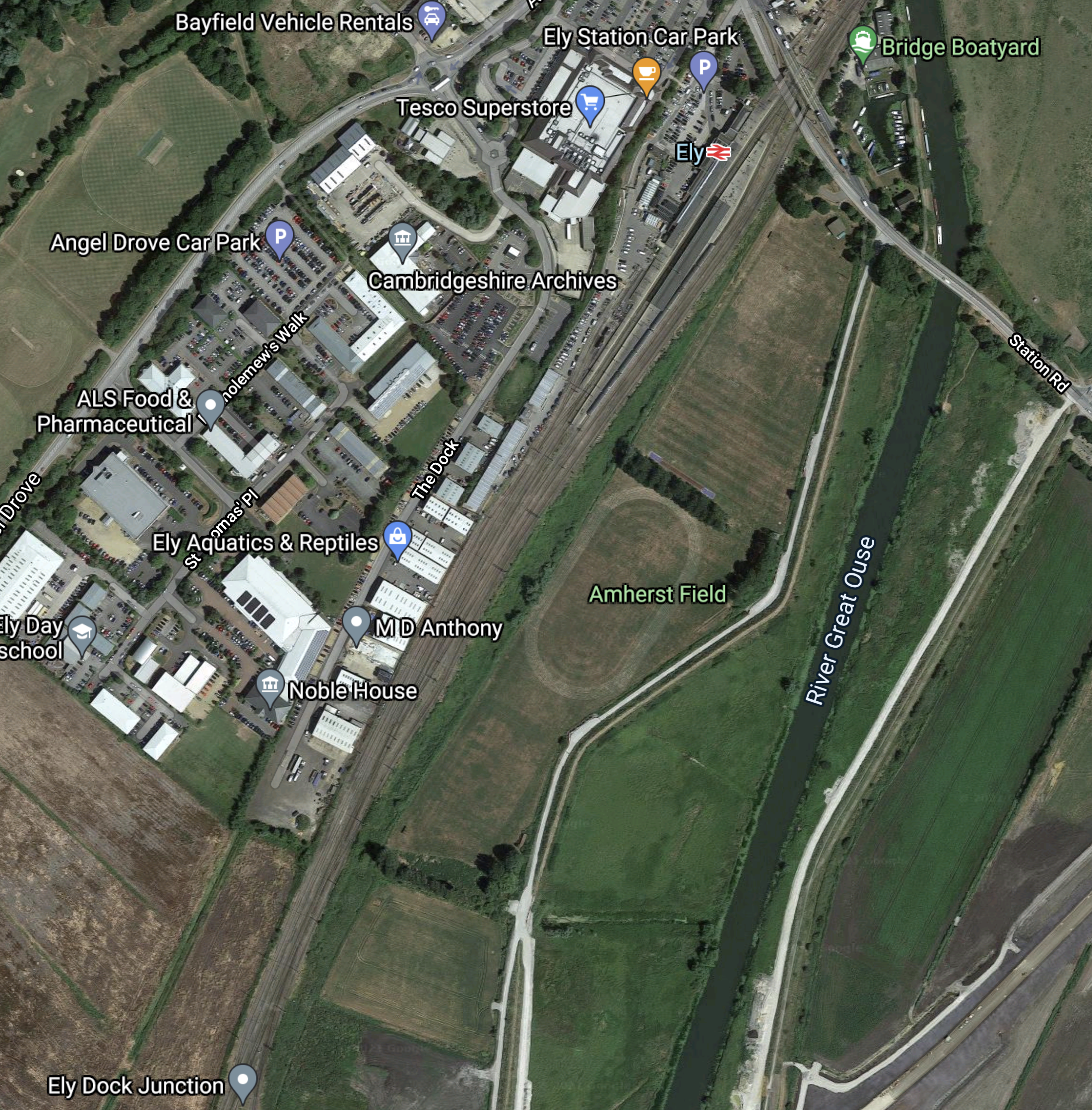
Note.
- Ely Dock junction in the South-West corner, where the line from Ipswich and Bury St. Edmunds joins the lines through Ely.
- Ely station towards the North-East corner of the map.
- Passenger trains run through the station.
But freight trains can take a route on the Eastern side of the station, which is not electrified.
At Ely station, a loop like this can be electrified using the existing electrification power supply, but at other places, systems like that from Hitachi ABB Power Grids can be used to electrify the loop or an appropriate section of the route.
These short sections of electrification will allow the train to progress on either electric or battery power.
A Hydrogen-Electric Locomotive Based on A Stadler Class 88 Locomotive
In The Mathematics Of A Hydrogen-Powered Freight Locomotive, I looked at creating a hydrogen-powered locomotive from a Class 68 locomotive.
I decided it was totally feasible to use readily available technology from companies like Rolls-Royce and Cummins to create a powerful hydrogen-powered locomotive.
The Class 68 locomotive is the diesel-only cousin of the electro-diesel Class 88 locomotive and they share a lot of components including the body-shell, the bogies and the traction system.
I suspect Stadler could create a Class 88 locomotive with these characteristics.
- 4 MW using electric power
- At least 2.5 MW using hydrogen power.
- Hydrogen power could come from Rolls-Royce’s 2.5 MW generator based on a small gas-turbine engine.
- 100 mph on both electricity and hydrogen.
- It would have power output on hydrogen roughly equal to a Class 66 locomotive on diesel.
- It would have a range comparable to a Class 68 locomotive on diesel.
This locomotive would be a zero-carbon Class 66 locomotive replacement for all duties.
A Larger And More Powerful Hydrogen-Electric Locomotive
I feel that for the largest intermodal and stone trains, that a larger hydrogen-electric locomotive will be needed.
With the way Wabtec are going in the United States, I wouldn’t be surprised to see a suitable locomotive cross the pond.
Conclusion
In the title of this post, I asked if freight locomotives of the future would be battery, electric or hydrogen.
I am sure of one thing, which is that all freight locomotives must be able to use electrification and if possible, that means both 25 KVAC overhead and 750 VDC third rail. Electrification will only increase in the future, making it necessary for most if not all locomotives in the future to be able to use it.
I feel there will be both battery-electric and hydrogen-electric locomotives, with the battery-electric locomotives towards the less powerful end.
Hydrogen-electric will certainly dominate at the heavy end.
Nunhead Junction Improvement
London has a rail capacity problem, for both freight and passenger trains.
This report from Network Rail is entitled The London Rail Freight Strategy (LRFS).
One of the secondary recommendations of the report is to improve Nunhead junction.
The report explains it like this.
Rail freight stakeholders have consistently highlighted Nunhead as a priority location for improving the flow of freight around the London orbital routes. The junction to the immediate east of the station is a flat crossing where two lines of route and multiple passenger and freight services groups converge into the South London Line, creating a pinch point for capacity.
Freight train drivers, when consulted for input into this strategy, flagged the route eastbound from Peckham Rye through Nunhead and towards Lewisham as a challenging section on which to keep heavier trains moving. This is primarily a consequence of the relatively slow permissible speed of 25mph over Nunhead Junction when routed towards Lewisham,
which follows a steadily rising gradient from Peckham Rye.The option proposed by this strategy is for changes to the track alignment in order to increase the speed of the turnout towards Lewisham, as far as can be achieved without affecting the speed of the main route towards Catford. This option would primarily benefit the performance of eastbound freight flowing from the South London Line towards the North Kent lines, one of the key rail freight corridors in the South East, enabling freight trains to run at faster and more consistent speeds towards Lewisham.
This would most likely increase right time presentation at the critical flat junction at Lewisham, as well as assisting the flow of passenger and freight trains to the Catford Loop by ensuring preceding Lewisham-bound traffic can clear Nunhead Junction as quickly as possible.
Addressing the existing constraints to freight traffic through Nunhead, which by their nature most affect the heavier bulk traffic that characterises the North Kent corridor, would also support industry aspirations to maximise the payloads that trains can haul.
This map from cartometro.com shows the route between Nunhead and Lewisham stations.

And this Google Map shows Nunhead station and the junction.
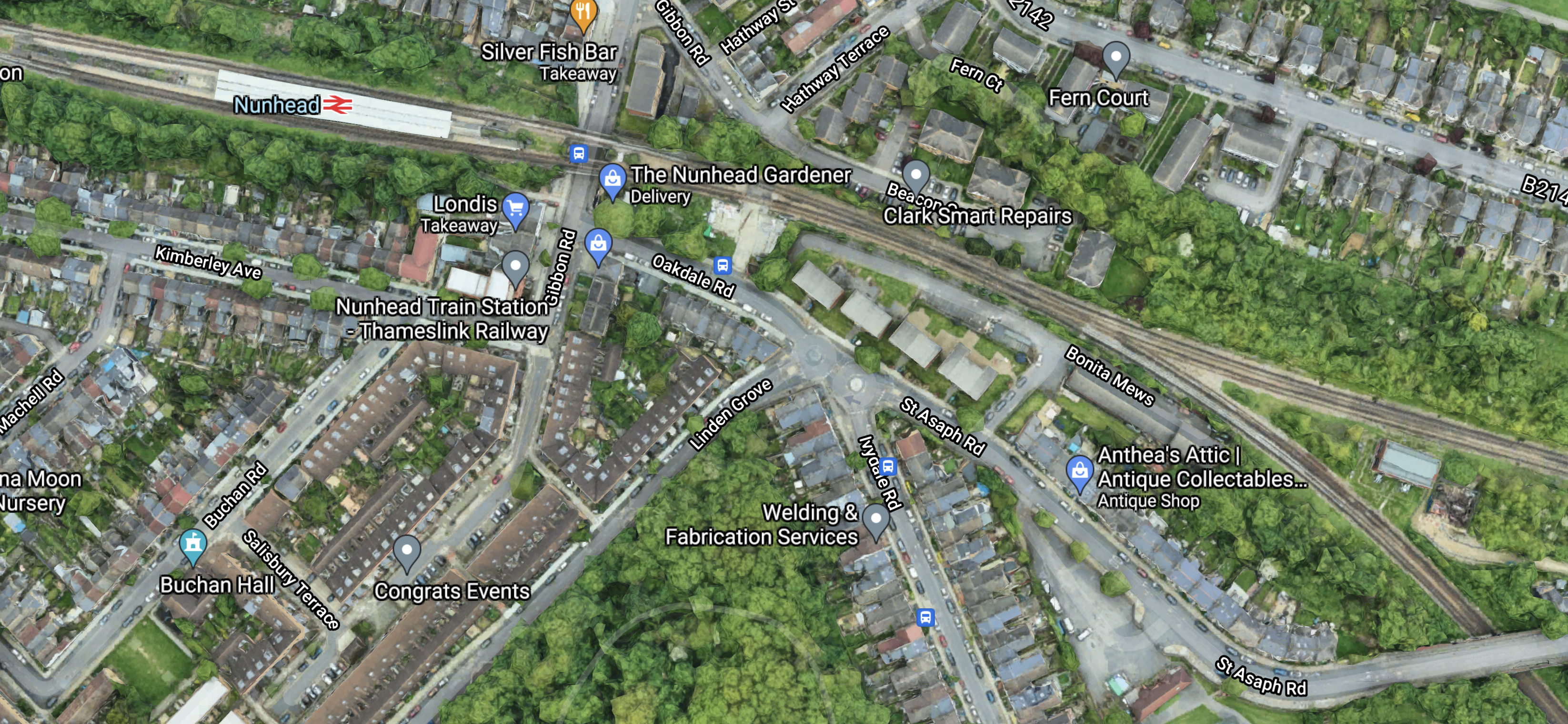
Note.
- Nunhead junction is towards the right of the map.
- The lines going to the East go to Lewisham.
- The lines going to the South East go to Crofton Park and Catford.
- I have counted the freight trains through Nunhead junction on real time trains and there can be as main as six trains per hour (tph), through the junction at times, using both Lewisham and Crofton Park routes.
But there would also appear to be plenty of space around the junction to realign the tracks.
As many trains need to go East from Lewisham and there are two flat junctions on the route; Nunhead and Lewisham, anything that improves keeping to schedule is to be welcomed.
The Use Of Electric Haulage
All routes through Nunhead junction have 750 VDC third-rail electrification, but I suspect all freight trains through the junction are diesel hauled.
Real time trains also shows that many of the trains through Nunhead junction also use the West London Line through Shepherd’s Bush.
In Decarbonisation Of London’s Freight Routes, I proposed a dual-voltage battery-electric locomotive to handle freight trains.
Perhaps more capable battery-electric freight locomotives with their better acceleration, are part of the solution at Nunhead junction.
Conclusion
This appears to be a well-thought out solution to one of the problems for freight trains in London.
I also believe that dual-voltage battery-electric locomotives could be part of the solution at Nunhead junction and would also help in many other places on the UK rail network.
Related Posts
These are related posts about the London Rail Freight Strategy (LRFS).
Decarbonisation Of London’s Freight Routes
East Coast Main Line South Bi-Directional Capability
Gauge Improvements Across London
Headway Reductions On The Gospel Oak To Barking, North London and West London Lines
Heavy Axle Weight Restrictions
Kensal Green Junction Improvement
Longhedge Junction Speed Increases
Moving The West London Line AC/DC Switchover To Kensington Olympia
Moving The West London Line AC/DC Switchover To Shepherd’s Bush
Stratford Regulating Point Extension
BNSF and Wabtec Commence Battery-Electric Locomotive Pilot Test In California
The title of this post, is the same as that of this press release from BNSF.
This is the introductory paragraph.
BNSF Railway Company (BNSF) and Wabtec’s (NYSE: WAB) exploration of the future potential of battery-electric locomotives crosses another significant milestone this week as they begin testing the technology in revenue service between Barstow and Stockton, California. As BNSF seeks ways to further reduce its environmental impact, the advancement of battery technology offers some possible solutions.
“We’ve got everything in place and we’re ready to see how this next-generation locomotive performs in revenue service,” said John Lovenburg, BNSF vice president, Environmental. “BNSF is focused on continuing to reduce our environmental impact, and we’re committed to doing our part to test and assess the commercial viability of emerging technologies that reduce emissions.”
They have also released this video.
It certainly seems to work.
 The Anonymous Widower