ORR: Open Access Services Given Green Light Between London And Stirling
The title of this post is the same as that of this press release from the Office of Rail and Road.
This is the sub-heading.
The latest access decision by the Office of Rail and Road (ORR) provides more services for rail passengers travelling between London and central Scotland.
These five paragraphs detail the ORR’s decision.
ORR has today (7 March) given the go-ahead for Grand Union Trains, an open access operator, to start a new train service between London and the city of Stirling, from June 2025. ORR’s decision will offer more choice to passengers, bring private sector investment to the railway and increase competition.
Grand Union Trains will introduce four new return services per day between London Euston and Stirling stations. These services will also call at Milton Keynes Central, Nuneaton, Crewe (subject to agreement between Grand Union Trains and Network Rail), Preston, Carlisle, Lockerbie, Motherwell, Whifflet, Greenfaulds and Larbert. Larbert, Greenfaulds and Whifflet will receive their first direct services to London.
ORR found that the proposed services would increase choice for passengers, significantly increasing direct journey opportunities to and from London and central and southern Scotland, while making use of existing capacity on the network.
The new services will be the first run by an open access operator on the West Coast Mainline. Open access operators run services independently of government funding as they do not have a franchise agreement with government.
Following ORR’s decision to approve new Grand Union Trains services between Carmarthen in south Wales and London Paddington in 2022, ORR has now approved open access services on three of Britain’s major routes.
Note.
- The Grand Union service appears to be running into London Euston. Earlier plans had it terminating at Queen’s Park station.
- Larbert, Greenfaulds and Whifflet will receive their first direct services to London.
- London Euston and Stirling is electrified all the way.
- The third open access service, that the ORR has approved is the Lumo service between King’s Cross and Edinburgh via the East Coast Main Line.
I have a few thoughts.
Stirling Is An Ideal Place To Explore Central Scotland By Train
In Stirling, I give the reasons, why I spent a couple of days in Stirling, when I wanted to visit several places in Central Scotland.
Note.
- Stirling has direct services to Aberdeen, Dundee, Edinburgh, Glasgow, Inverness and Perth.
- Aberdeen is one hour and 15 minutes away.
- Dundee is just 63 minutes away.
- Edinburgh is just 48 minutes away.
- Glasgow is just 39 minutes away.
- Inverness is two hours and 46 minutes away.
Stirling has about a dozen affordable hotels and guest houses within walking distance of the station, as this map shows.
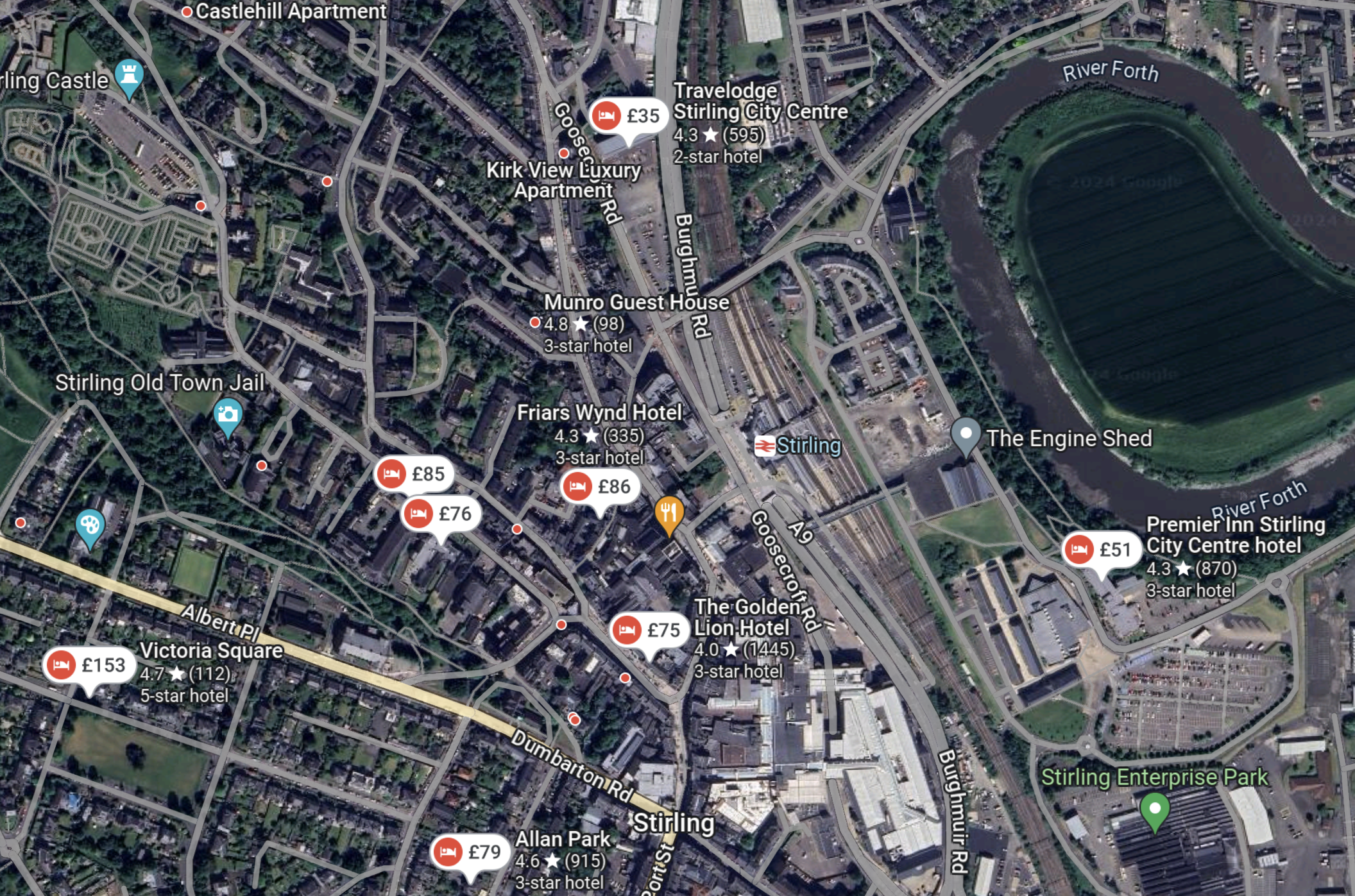
Stirling would appear to have got Central Scotland covered.
Could The Train Serve Gleneagles?
Gleneagles is about twenty minutes North of Stirling and is served by the Caledonian Sleeper from London.
This Google Map shows the area around Gleneagles station.
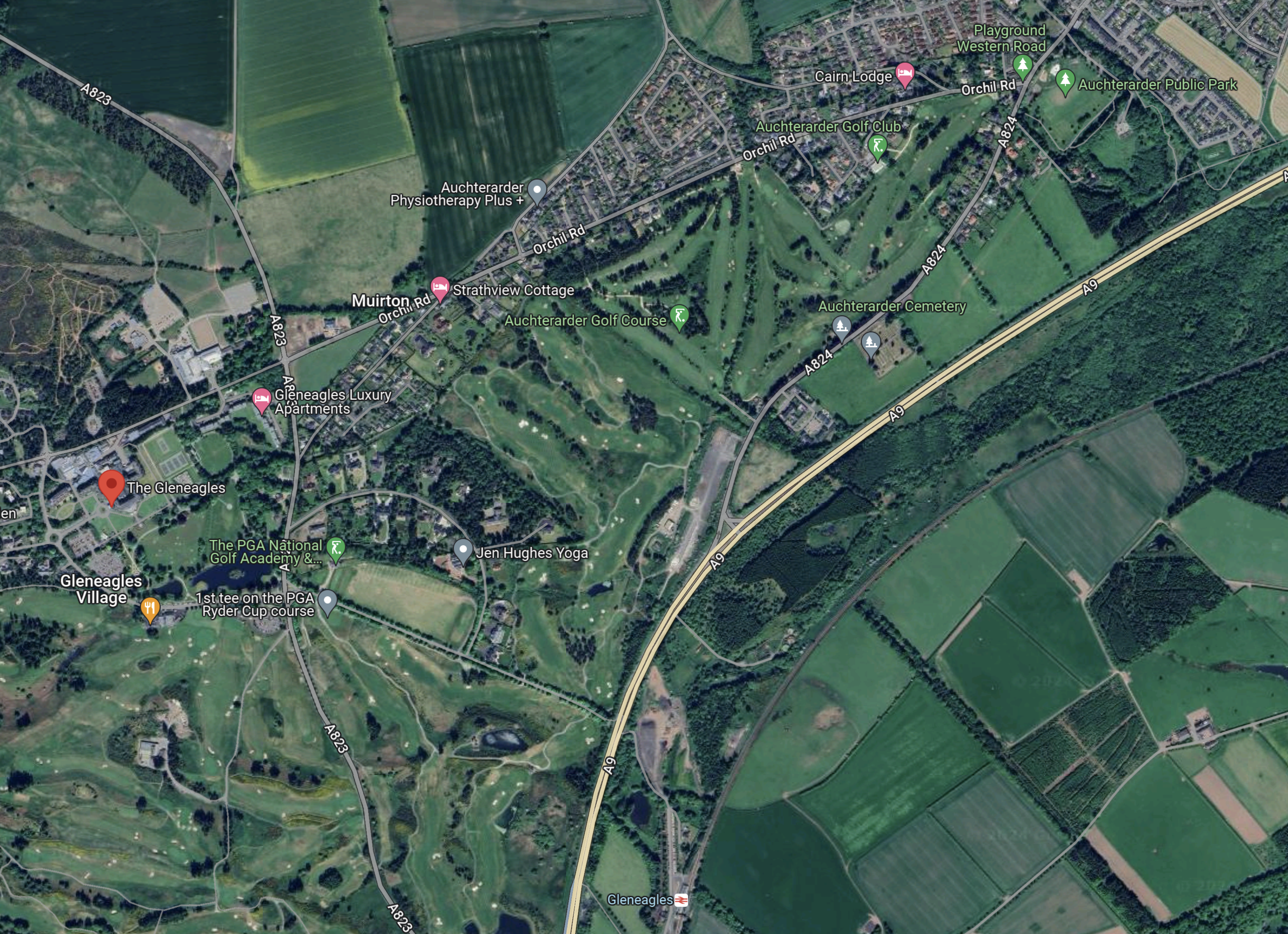
Note.
- Gleneagles station is at the bottom of the map.
- The red arrow indicates the famous Gleneagles hotel.
- The pink dots are other hotels.
- Airbnb lists several very splendid properties in the varea.
Not everybody, who goes to the Gleneagles area will be exceedingly rich and I could see the Gleneagles area generating substantial business for Grand Union Trains. I suspect the best way to serve Gleneagles would be a zero-emission coach from Stirling.
Along The Motherwell And Cumbernauld Line
Between Motherwell and Stirling, a lot of the route used is on the Motherwell and Cumbernauld Line.
- The line is fully-electrified.
- It is only 28.9 miles between Motherwell and Stirling.
- \cumbernaukd and Motherwell takes 20 minutes.
I do wonder, if extra stops might be worthwhile.
Motherwell Has Good Connections To Edinburgh And Glasgow
As well as Stirling, Motherwell has good connections to both Edinburgh and Glasgow, so some passengers might find their most convenient route involves a change at Motherwell.
Nuneaton And Scotland Would Get A New Service
Nuneaton has been named by Avanti West Coast, as a place that needs more trains, as it connects with the service between Birmingham and Stansted Airport, via Coleshill Parkway, Leicester, Peterborough, March, Ely and Cambridge.
I suspect that, Nuneaton will become an interchange, between East Anglia and, the North West and West Scotland.
Milton Keynes And Scotland Should Get An Improved Service
Consider.
- It appears that all Avanti West Coast services between Milton Keynes and Scotland, go via Birmingham.
- I suspect that Grand Union’s route using the Trent Valley Line could be faster with similar trains.
- Creating a new route between Milton Keynes and Stirling could be a good move, as it gives one-change access to much of Central Scotland.
- Milton Keynes has good local connections to places like Northampton, Rugby, Tring and Watford Junction.
- Milton Keynes will be a stop on the new East-West Railway.
- From many stations, it will be quicker to go via Milton Keynes rather than Euston.
I suspect Milton Keynes could be a nice little earner.
Will Grand Union’s Trains Be Fitted With Digital Signalling?
Consider.
- At some point in the next ten years the West Coast Main Line will be fitted with digital signalling, to enable trains to run at 140 mph on selected parts of the route.
- Digital signalling will allow extra services between London Euston and Motherwell.
- Motherwell and London Euston is 388 miles.
I suspect, that Grand Union’s Trains will need to be fitted with digital signalling, so they can save time on services and possibly add in a few more.
It will add costs, although the faster speed will surely attract passengers.
Will Grand Union’s Trains Be Electric?
There are these train services going between England and Scotland.
- Avanti West Coast – London Euston to Edinburgh Waverley via Birmingham New Street – 7 tpd – Class 390 – Electric
- Avanti West Coast – London Euston to Glasgow Central via Birmingham New Street – 5 tpd – Class 390 – Electric
- Avanti West Coast – London Euston to Glasgow Central via Trent Valley – 1 tph – Class 390 – Electric
- CrossCountry – Plymouth to Edinburgh Waverley – 1 tph – Class 220/221 – Diesel – Uses diesel all the time
- LNER – London King’s Cross/Leeds to Aberdeen – 4 tpd – Class 800 – Bi-mode – Uses diesel North of Edinburgh
- LNER – London King’s Cross to Inverness – 1 tpd – Class 800 – Bi-mode – Uses diesel North of Stirling
- LNER – London King’s Cross to Edinburgh Waverley – 3p2h – Class 800 – Bi-mode or Class 801 – Electric
- LNER – London King’s Cross to Glasgow Central – 1 tpd – Class 801 – Electric
- LNER – London King’s Cross to Stirling – 1 tpd – Class 801 – Electric
- Lumo – London King’s Cross to Edinburgh – 5 tpd – Class 803 – Electric
- TransPennine Express – Newcastle to Edinburgh Waverley – 7 tpd – Class 802 – Bi-mode
- TransPennine Express – Liverpool Lime Street to Glasgow Central – 2 tpd – Class 397 – Electric
- TransPennine Express – Manchester Airport to Edinburgh Waverly – 1 tp2h – Class 397 – Electric
- TransPennine Express – Manchester Airport to Glasgow Central – 1 tp2h – Class 397 – Electric
Note.
- tpd is trains per day.
- tph is trains per hour.
- tp2h is trains per two hours.
- LNER services to Glasgow and Stirling are likely to be dropped.
- Some Lumo services are likely to be extended from Edinburgh to Glasgow.
- Many services South from Stirling to Edinburgh Waverley and Glasgow Queen Street are electric.
The current two tpd direct trains to Stirling are electric and if you change at Edinburgh Waverley or Glasgow, it is likely to be an all-electric service.
For marketing reasons, I would recommend, that Grand Union Trains ran electric trains between London Euston and Stirling, as they are competing against an all-electric service.
Although to meet service dates it might be necessary to run something like a diesel Class 222 train to get the service started.
What Trains Will Grand Union Use?
The Wikipedia entry for Grand Union Trains, says this for their London Euston and Stirling service.
In 2023 Grand Union revised its proposal changing its planned rolling stock to Class 22x units, at the same time the start date for this service was changed to June 2025.
I would suspect they will put in the order for new electric trains fairly sharpish.
The new trains could be.
- A variant of Hitachi’s Class 800 trains.
- A variant of CAF’s Class 397 trains.
Would they have an emergency battery un case of overhead line failure?
How Long Will A Service Take?
The service can be divided into two sections.
- London Euston and Motherwell – 388 miles.
- Motherwell and Stirling – 28.9 miles.
Note.
- The 08:30 train from Euston to Motherwell takes 4 hours and 17 minutes with six stops via Nuneaton.
- The Grand Union Trains service will also have six stops and go via Nuneaton.
I would expect with today’s signalling and electric trains, that Euston and Motherwell would take a maximum of 4 hours and 17 minutes.
- The twenty minute time to Cumbernauld could be added.
- The twenty-five minute time between Cumbernauld and Stirling could be added.
It looks the time would be just over five hours.
I doubt there would be much scope for increasing speed North of Motherwell, but could there be savings made to the South of Motherwell?
Consider.
- London Euston and Motherwell is 388 miles.
- Four hours and 17 minutes is 257 minutes.
- Motherwell is on the main London Euston and Glasgow Central route.
This is an average speed between London Euston and Motherwell of 90.6 mph.
By comparison.
- London King’s Cross and Edinburgh is 392.6 miles.
- Journeys can take four hours and 20 minutes or 260 minutes.
This is an average speed between London King’s Cross and Edinburgh of 90.6 mph.
In the next decade, there will be improvements on both the East and West Coast Main Lines.
- King’s Cross and Edinburgh is currently being digitally signalled.
- London Euston and Glasgow Central is likely to be an early priority for digital signalling after London King’s Cross and Edinburgh is completed.
- When High Speed Two opens to Birmingham and Lichfield, High Speed Two trains between London Euston and Glasgow Central will use the West Coast Main Line to the North of Lichfield.
- I wouldn’t be surprised to see some track realignment and modifications to improve speeds on the West Coast Main Line to the North of Lichfield.
I can build a table of times between London Euston and Motherwell against average speed.
- 90 mph – 4 hours 19 minutes
- 100 mph – 3 hours 53 minutes
- 110 mph – 3 hours 32 minutes
- 120 mph – 3 hours 14 minutes
- 125 mph – 3 hours 6 minutes
- 130 mph – 2 hours 59 minutes
Note.
- Adding 15 minutes gives a London Euston and Glasgow Central time.
- Adding 45 minutes gives a London Euston and Stirling time.
- Averaging 120 mph would give London Euston and Glasgow Central or Stirling times of under four hours.
It strikes me, that to improve Anglo-Scottish relations and to make rail a better alternative to flying, a priority for all West Coast services is to improve the West Coast Main Line and install digital signalling, so that a 120 mph average is possible between London Euston and Motherwell.
What Difference Will High Speed Two Make?
High Speed Two is claiming it will knock thirty minutes off times between London Euston and Glasgow Central, when it opens to Birmingham and Lichfield.
But Grand Union Trains are not expected to use the new line between London Euston and Lichfield, as High Speed Two will, as it will make calling at Milton Keynes and Nuneaton impossible, as they are bypassed by High Speed Two.
Conclusion
This train service is going to be good for Milton Keynes, Nuneaton and Stirling and all the towns in Central Scotland.
But they must make full use of the available electrification.
Lumo Carbon Data Shows Its Trains Are 22 Times Greener Than Flying
The title of this post, is the same as that of this article on Rail Advent.
These paragraphs detail how the figures were obtained.
To mark the second anniversary of its branding as ‘Lumo’, the operator commissioned consultancy firm Arup to provide an independent report about all direct emissions from its operations; emissions from the grid-supplied energy it uses; and other emissions in its supply chain.
Scope 1: Direct emissions from operations that are owned and controlled by Lumo;
Scope 2: Emissions from the use of grid-supplied electricity, heat, steam and/or cooling by Lumo;
Scope 3: All other emissions that occur in the value chain of Lumo.In the last two years, Lumo has carried over two million passengers. The figures reveal that, per passenger, emissions from a London-to-Edinburgh journey are twenty-two times the level for flying (149 kgCO2e) than for using Lumo (6.8kgCO2e).
I have a few thoughts.
Carbon Savings With LNER
LNER’s Class 801 trains are similar to Lumo’s Class 803 trains.
The main difference, is that the LNER have emergency diesel engines, whereas Lumo have emergency batteries to run the trains systems, if the catenary goes down.
So LNER on balance will generate a bit more carbon than Lumo.
But the difference will be marginal.
Carbon Savings With Avanti West Coast
Avanti’s Class 390 trains to Scotland, are all-electric, so there will be a carbon-saving.
Probably about the same as with LNER.
Avanti West Coast’s New Class 807 Trains
If the Class 807 trains were cars, they would be Lotuses.
- They are electric only and have no heavy diesel engines or traction batteries.
- They don’t even have emergency batteries for when the catenary fails.
- They have a redesigned nose. Is it more aerodynamic?
- The heavy tilt mechanism is history.
- As with all the other Hitachi high speed trains, they are capable of 125 mph, or 140 mph if the signalling permits.
These trains will undoubtedly have faster acceleration and deceleration and could probably knock minutes off the timings at all the stops.
Tucked away beside the Grand Union Sets Out Stirling Ambitions article in the December 2022 Edition of Modern Railways is a report on Avanti West Coast’s application for a second service between Euston and Liverpool.
This is said.
Avanti West Coast has applied for access rights for its second hourly Euston to Liverpool service, starting from December 2023, although a phased introduction of the new service is likely. This would make use of Avanti’s new fleet of 10×7-car Class 807 Hitachi EMUs, which are expected to enter service from Autumn 2023. The ‘807s’ would be deployed on the current hourly Liverpool service, on which a call at Liverpool South Parkway would be added. (provision is made for this in the December 2022 timetable.).
Pendolinos would then operate the second service each hour, calling at Lichfield Trent Valley and Tamworth.
A linespeed project is in progress to raise the permissible speed for non-tilting trains on the West Coast Main Line, and Avanti’s new Hitachi trains will take advantage of this.
I can’t wait to go to Liverpool in one of these trains.
Their carbon emissions should be in line with Lumo.
Avanti West Coast’s New Class 805 Trains
These are equivalent to the Class 802 trains, but with probably Class 807 train interiors and looks.
I wonder how long these trains will keep their diesel engines before battery power is the most affordable option.
Once they go battery-electric, their carbon emissions should be in line with Lumo.
Conclusion
I can’t see any other mantra than.
Electric good, diesel bad
Especially, if like most computers, it’s just plug and play.
High Speed Two To Blackpool
There has been a lot of speculation about the Northern end of High Speed Two, so I might as well add sort out a few facts and add a bit of speculation of my own.
The Current Blackpool Service
I shall look at the 05:35 train on the 5th October 2023.
- It was a pair of Voyagers or Class 221 trains.
- Euston and Blackpool North are 226.5 miles apart.
- The train called at Preston, Wigan North Western, Warrington Bank Quay, Crewe and Stafford
- The train should have arrived at Preston at 05:56 and left at 0600.
- The train should have arrived at Wigan North Western at 06:11 and left at 06:12.
- The train should have arrived at Warrington Bank Quay at 06:22 and left at 06:24.
- The train should have arrived at Crewe at 06:46 and left at 06:55.
- The train should have arrived at Stafford at 07:13 and left at 07:14.
- The train should have arrived at London Euston at 08:35
- The journey took three hours.
- The average speed was 75.5 mph.
- The Crewe and Blackpool North section is 68.5 miles and the train is scheduled to take one hour and eleven minutes.
- The average speed between Crewe and Blackpool North is 57.9 mph.
- There are three trains per day (tpd).
Note.
- Other services between London Euston and Blackpool North are run by eleven-car Class 390 trains or Pendolinos.
- Blackpool North is fully electrified to London.
This means that London Euston and Blackpool North could be run using High Speed Two Classic-Compatible trains.
I have a few questions.
What Time Would Be Possible At The Present Time?
Consider.
- According to the Wikipedia entry for High Speed Two, one hour and seventeen minutes is the fastest time between London Euston and Stafford.
- The 05:35 is timed to take one hour and thirteen minutes with the four stops, between Blackpool North and Stafford.
This would give a London Euston and Blackpool North time of two hours and thirty minutes.
What Time Would Be Possible When High Speed Two Lite Opens To Handsacre Junction?
Consider.
- According to the Wikipedia entry for High Speed Two, fifty-five minutes will be the fastest time between London Euston and Stafford, after High Speed Two opens to Handsacre junction.
- The 05:35 is timed to take one hour and thirteen minutes with the four stops, between Blackpool North and Stafford.
This would give a London Euston and Blackpool North time of two hours and eight minutes.
What Frequency Would Be Needed?
LNER seem to run their secondary services to places like Harrogate and Lincoln using a frequency of one train per two hours (tp2h).
That could be an ideal frequency.
Would There Be A Path For The Train To And From London Euston?
This graphic shows High Speed Two services after Phase 2b is completed.
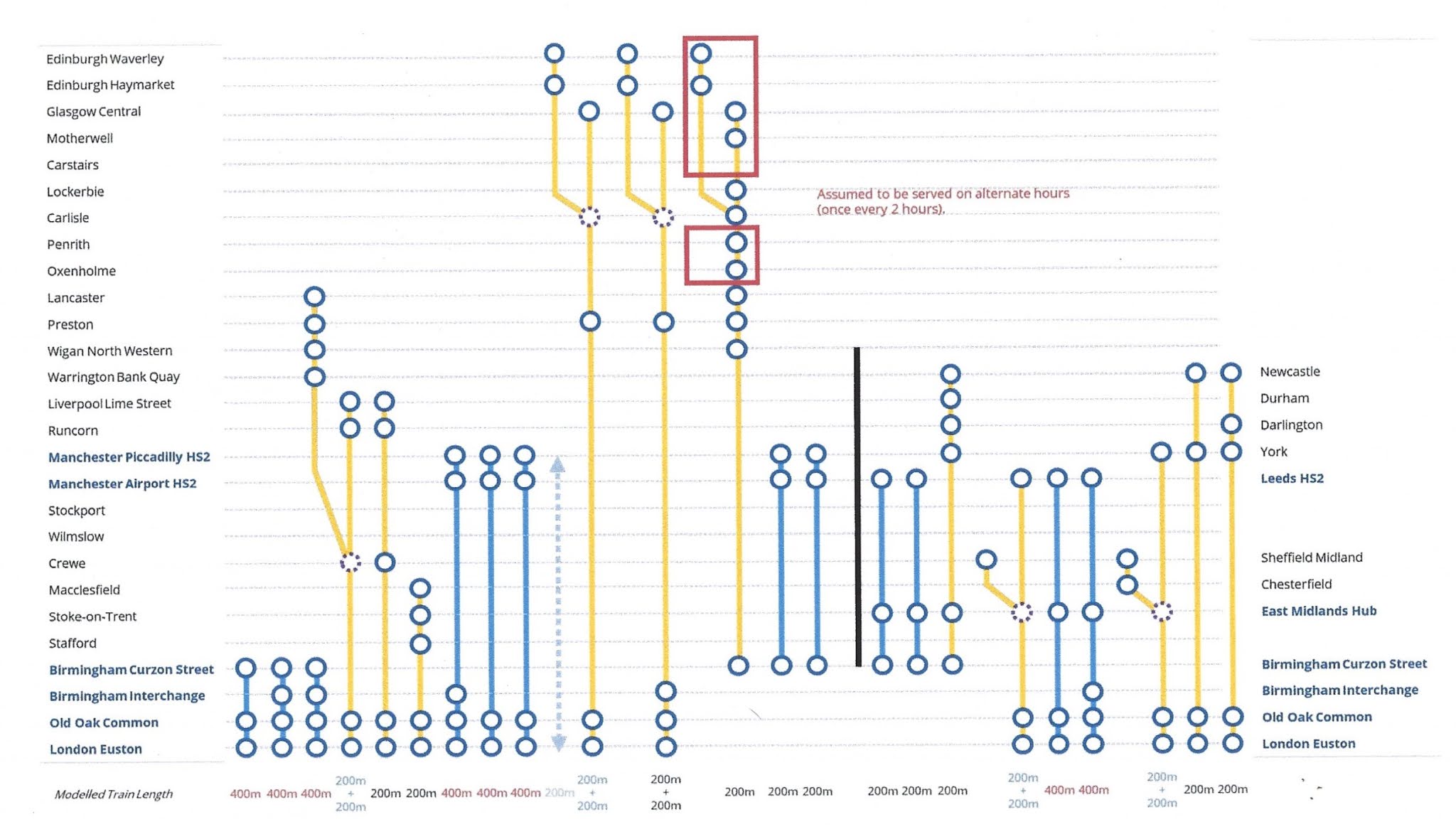
Note.
- Services shown in blue are run by High Speed Two Full Size trains.
- Services shown in yellow are run by High Speed Two Classic-Compatible trains.
- Each of these trains will have a frequency of one tph.
- The nine paths to the right of the vertical black line will not be needed for some time. If ever!
- It looks like a maximum of only eleven paths will be needed to the South of Birmingham.
- It looks like a maximum of only fourteen paths will be needed to the North of Birmingham.
In Will High Speed Two Lite Make Stafford An Important Station?, I totted up all the services through Stafford after High Speed Two Lite opened to Handsacre junction and got these figures.
- Through Stafford station, there are totals of 11 tpd and 14 tph.
- Along the Trent Valley Line, there are totals of 11 tpd and 12 tph.
- North of Stafford on the West Coast Main Line, there are totals of 9 tpd and 12 tph.
- South of Stafford on the West Coast Main Line, there are totals of 2 tpd and 2 tph.
- Between Stafford and Stoke-on-Trent, there are totals of 2 tph.
I accounted for services moving from the West Coast Main Line to High Speed Two.
Consider.
- A large proportion of the route between Preston and Handsacre junction, where the route would join High Speed Two Light has two dedicated high speed tracks and two tracks for freight and local services.
- Digital signalling on High Speed Two has been designed to handle eighteen trains per hour (tph) at 225 mph.
- Surely, the two dedicated high speed tracks, if fitted with High Speed Two digital signalling could handle say 16 tph at 140 mph.
- Network Rail are good at juggling trains to squeeze in more services.
- Extra paths could be created by splitting and joining trains at Crewe or Preston.
My Control Engineering training and practice tells me that it should be possible to add perhaps two tph between Preston and Euston.
Conclusion
I believe that High Speed Two Classic-Compatible trains could be close to two hours between Blackpool and London Euston, when High Speed Two Lite opens from Handsacre junction.
Could The High Speed Two Link Between Lichfield And Crewe Still Be Built?
The original plan for High Speed Two included two routes between Lichfield and Crewe.
This map clipped from the High Speed Two web site, shows the two routes.
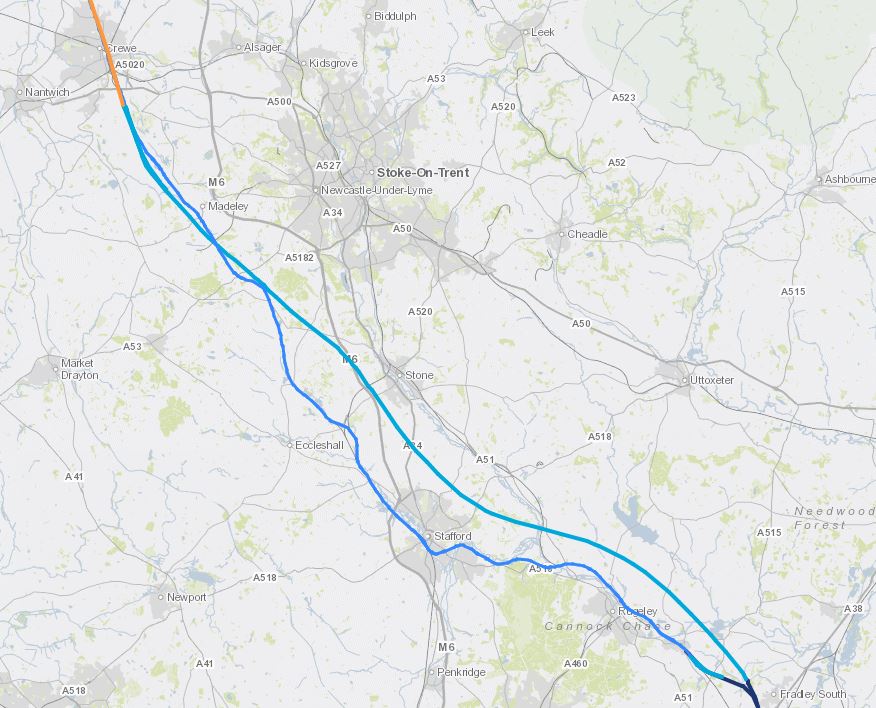
Note.
- High Speed Two Phase 2a is shown in blue.
- High Speed Two Phase 2b is shown in orange.
- Crewe is in the North-West corner of the map, at the Southern end of the orange section.
- The junction at Lichfield is in the South-East corner of the map.
- The lighter blue route to the East, between the Lichfield junction and Crewe is the proposed new tracks of High Speed Two.
- The darker blue route to the West, between the Lichfield junction and Crewe is the existing route of the Trent Valley Line and the West Coast Main Line.
- The Trent Valley Line joins the West Coast Main Line at Stafford.
This second map clipped from the High Speed Two web site, shows the junction North of Lichfield, where High Speed Two connects to the Trent Valley Line through Stafford.

Note.
- High Speed Two runs North-South across the map.
- After the Junction by Fradley South, High Speed Two to Crewe and the North, is the branch to the East.
- The other branch connects to the Trent Valley Line at Handsacre junction.
- Trent Valley Line can be picked out North of Lichfield, where it passes through Lichfield Trent Valley station.
The Trent Valley Line is no Victorian double-track slow-speed bottleneck.
- The route between Rugby and Crewe is generally three or four tracks, with only one short stretch of double track, through Shugborough tunnel.
- The speed limit is generally 110 mph, with 90 mph at Shugborough.
- I wouldn’t be surprised to see Avanti West Coast’s Class 390 and Class 807 trains could be running at up to 140 mph on the route, if digital signalling were to be installed.
- This speed would probably be attained by High Speed Two trains.
London Euston and Stafford would only have under twenty miles of slower line and that could be 140 mph, so High Speed Two times on the route could be very fast.
Trains Between London And Stafford Before And After High Speed Two To Lichfield
Currently, Avanti West Coast trains take around one hour and seventeen minutes between London and Stafford.
The Wikipedia entry for High Speed Two gives these times between London and Stafford.
- Fastest time before High Speed Two – one hour and seventeen minutes.
- Time after Phase 2a of High Speed Two opens – fifty-five minutes.
Note.
- That is a time saving of twenty-two minutes.
- High Speed Two Trains will use the link between the junction at Lichfield and the Trent Valley Line.
- High Speed Two will also add eighteen trains per hour (tph) to the capacity between London and Lichfield.
This would seem to mean that any trains going to or through Stafford will be twenty-two minutes faster, if they use High Speed Two between London and Lichfield.
Trains Between London And Crewe Before And After High Speed Two To Crewe
Currently, Avanti West Coast trains take around one hour and thirty minutes between London and Crewe.
The Wikipedia entry for High Speed Two gives these times between London and Crewe.
- Fastest time before High Speed Two – one hour and thirty minutes.
- Time after Phase 2a of High Speed Two opens – fifty-six minutes.
Note.
- That is a time saving of thirty-four minutes.
- High Speed Two Trains will use the direct line between Lichfield and Crewe.
- High Speed Two will also add eighteen tph to the capacity between London and Crewe.
This would seem to mean that any trains going to or through Crewe will be thirty-four minutes faster, if they use High Speed Two between London and Crewe.
High Speed Two Between Lichfield And Crewe Only Saves An Extra Twelve Minutes
It appears that extending High Speed Two to Crewe only saves an extra twelve minutes.
But it will also have these benefits.
High Speed Two Full-Size trains will be able to run to Crewe.
High Speed Two will also add eighteen tph to the capacity between London and Crewe.
Savings From Scrapping High Speed Two Between Lichfield And Crewe
In addition to the savings of the scrapping of the line, I suspect that any modifications to Crewe station will be much simpler.
I wonder how much will be saved by not building High Speed Two to Crewe.
Could The High Speed Two Link Between Lichfield And Crewe Still Be Built?
This is the question I asked in the title.
We know the benefits of building High Speed Two and as time progresses we’ll know the costs and the disruption the building will cause with an increasing accuracy.
I also believe that even High Speed Two Lite will be a rip-roaring success, and other places will want their own High Speed Two service, which will need an increase in capacity North of Lichfield.
So there will come a point, when there is an overwhelming case to build the High Speed Two Link Between Lichfield and Crewe.
Because of that we must make sure, that any sales of land or properties, doesn’t compromise building the High Speed Two Link Between Lichfield and Crewe.
Conclusion
There will come a point, when the amount of traffic, will mean that it is worth building the High Speed Two Link Between Lichfield and Crewe.
My other conclusion is important and the route of the originally proposed High Speed Two Link Between Lichfield and Crewe, must not be compromised.
High Speed Two To Stoke-on-Trent
Some of you out there might be a bit worried after Rishi Sunak’s speech today, when he announced he’d cancelled High Speed Two, as you might be losing a future high speed service.
Currently, Stoke-on-Trent is served by two trains per hour (tph), that run between London and Manchester Piccadilly.
- One train calls at Milton Keynes Central, Rugby, Macclesfield and Stockport, and takes about 1:33 to Stoke and 2:12 to Manchester Piccadilly.
- The other calls at Nuneaton and Stockport, and takes about 1:30 to Stoke and 2:06 to Manchester Piccadilly.
- Trains are both 9-car and 11-car Class 390 trains or Pendolinos.
- All trains go via Colwich.
This map shows the Colwich, Stafford and Stoke-on-Trent.
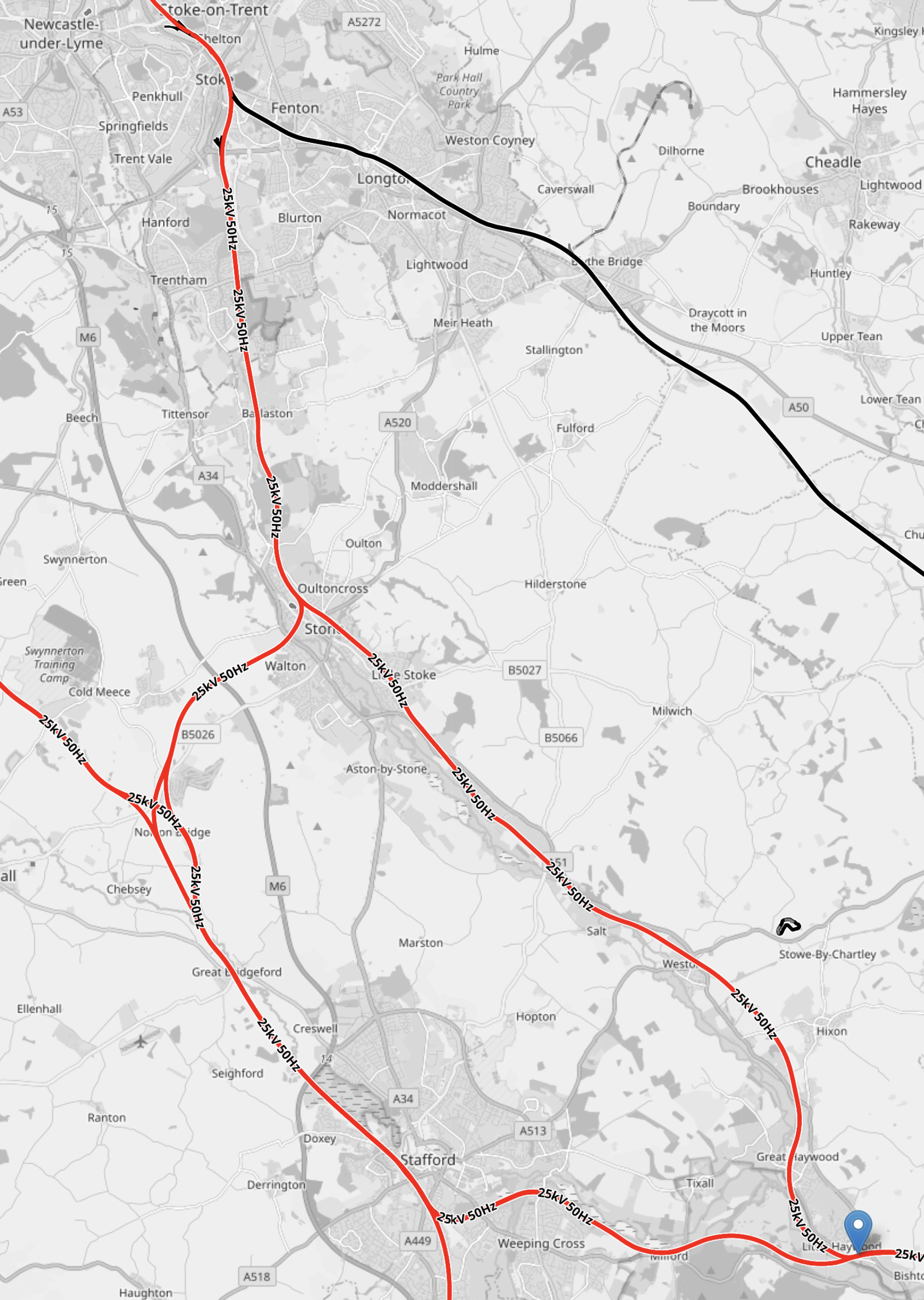
Note.
- Electrified lines are shown in red.
- The line across the South-West corner of the map is the West Coast Main Line.
- Stafford is the Northern end of the Trent Valley Line, which runs East along the bottom of the map.
- The Trent Valley Line, which is a by-pass of the West Coast Main Line, rejoins that line at Rugby.
- Stoke-on-Trent is in the North-West corner of the map.
- Colwich is in the South-East corner of the map and is marked by a blue arrow.
- There are two routes between Stone-on-Trent and Colwich; the more-direct Northern route and a Southern route via Stafford.
The current services between London and Stoke-on-Trent use the more-direct Northern route, although they can take the Southern route via Stafford.
This must mean that as Stoke-on-Trent services take the Northern route, there are more paths through Stafford for West Coast Main Line services to and from Liverpool, Manchester and Scotland.
This graphic shows High Speed Two services after Phase 2b is completed.
Note.
- Services shown in blue are run by High Speed Two Full Size trains.
- Services shown in yellow are run by High Speed Two Classic-Compatible trains.
- Each of these trains will have a frequency of one tph.
The third High Speed Two Classic-Compatible train from the left is a London and Macclesfield service, which will stop at Stafford and Stoke-on-Trent, has the following timings from London.
- Stafford – 0:55 – 22 minutes faster
- Stoke-on-Trent – 1:10 – 14 minutes faster
- Macclesfield – 1:30 – 11 minutes faster
I have a few thoughts and questions.
How Does This High Speed Two Service Get To And From London?
The service goes through Stafford and then takes the Trent Valley Line to the South.
This map clipped from the HS2 site, shows the original layout of HS2 to the North and East of Lichfield.
Note.
- High Speed Two runs North-South across the map.
- After the Junction by Fradley South, the now-scrapped High Speed Two to Crewe and the North, is the branch to the East.
- The other branch connects to the Trent Valley Line, which can be picked out North of Lichfield, where it passes through Lichfield Trent Valley station.
- The Trent Valley Line goes North-West through Colwich to Stafford, where the line rejoins the West Coast Main Line.
As the Eastern branch North from the junction has been scrapped, all trains between London and North would go via this link between High Speed Two at Lichfield and Trent Valley Line through Stafford.
Can The Current Trains and the High Speed Two Classic-Compatible Trains Share Tracks?
The answer will be yes, as the High Speed Two Classic-Compatible trains have been designed to share tracks with existing trains.
Full digital signalling may be needed to enable 140 mph running and more paths on the classic lines.
Will There Be A Second High Speed Two Service To Stoke-On-Trent And Stafford?
One of the problems with High Speed Two is that it won’t call at stations in the Midlands that are currently served by Avanti West Coast.
- Currently, stations with an Avanti call are Milton Keynes Central, Nuneaton and Rugby.
- Avanti’s second Liverpool service will call at Tamworth and Lichfield Trent Valley.
- In the June 2023 Edition of Modern Railways, Avanti’s Managing Director; Andy Mellors talks about the benefits the company accrues from stopping in the Midlands.
I believe that after High Speed Two opens, that a semi-fast service could run between London and Manchester.
- It would be run by a Class 390 train or Pendolino.
- It would use the route currently used by Manchester services via Stoke-on-Trent.
- At the Southern end, it would terminate in London Euston.
- It could call at Watford Junction, Milton Keynes Central, Rugby, Nuneaton, Lichfield Trent Valley, Stoke-on-Trent, Macclesfield and Stockport.
- ,Station stops would be arranged as to need.
- A one stop service to London takes 90 minutes from Stoke-on-Trent, with a two-stopper taking 93 minutes, so does each stop with a Pendolino add three minutes to the journey time?
Such a service could be developed to give stations like Stoke-on-Trent a second service to London.
The Lines Around Stafford
This map from OpenRailwayMap shows the lines around Stafford.
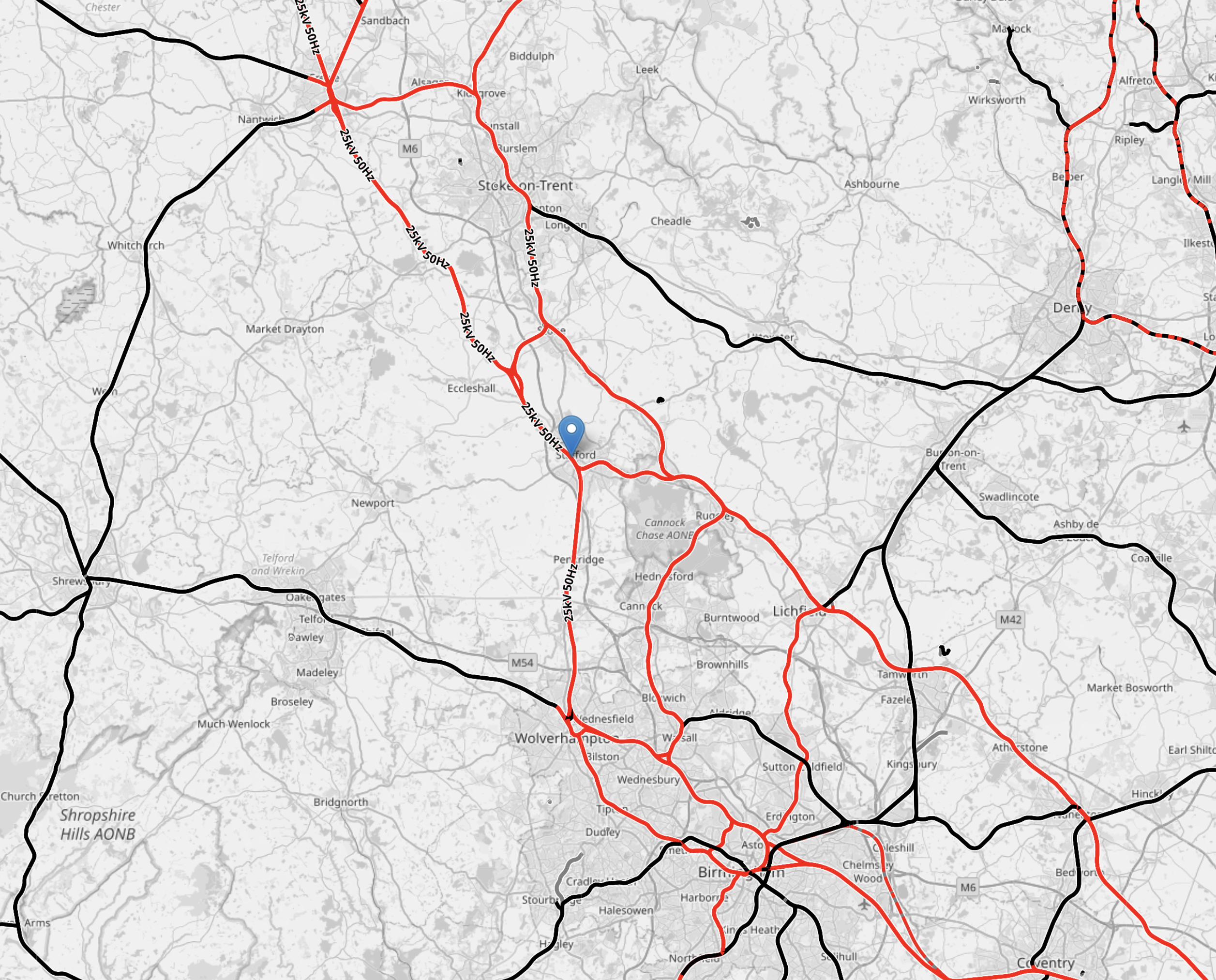
Note.
- Red lines are electrified.
- Black Lines are not.
- Stafford is marked by the blue arrow.
Selective electrification could probably improve connectivity by a large margin.
This Google map shows Stafford station.
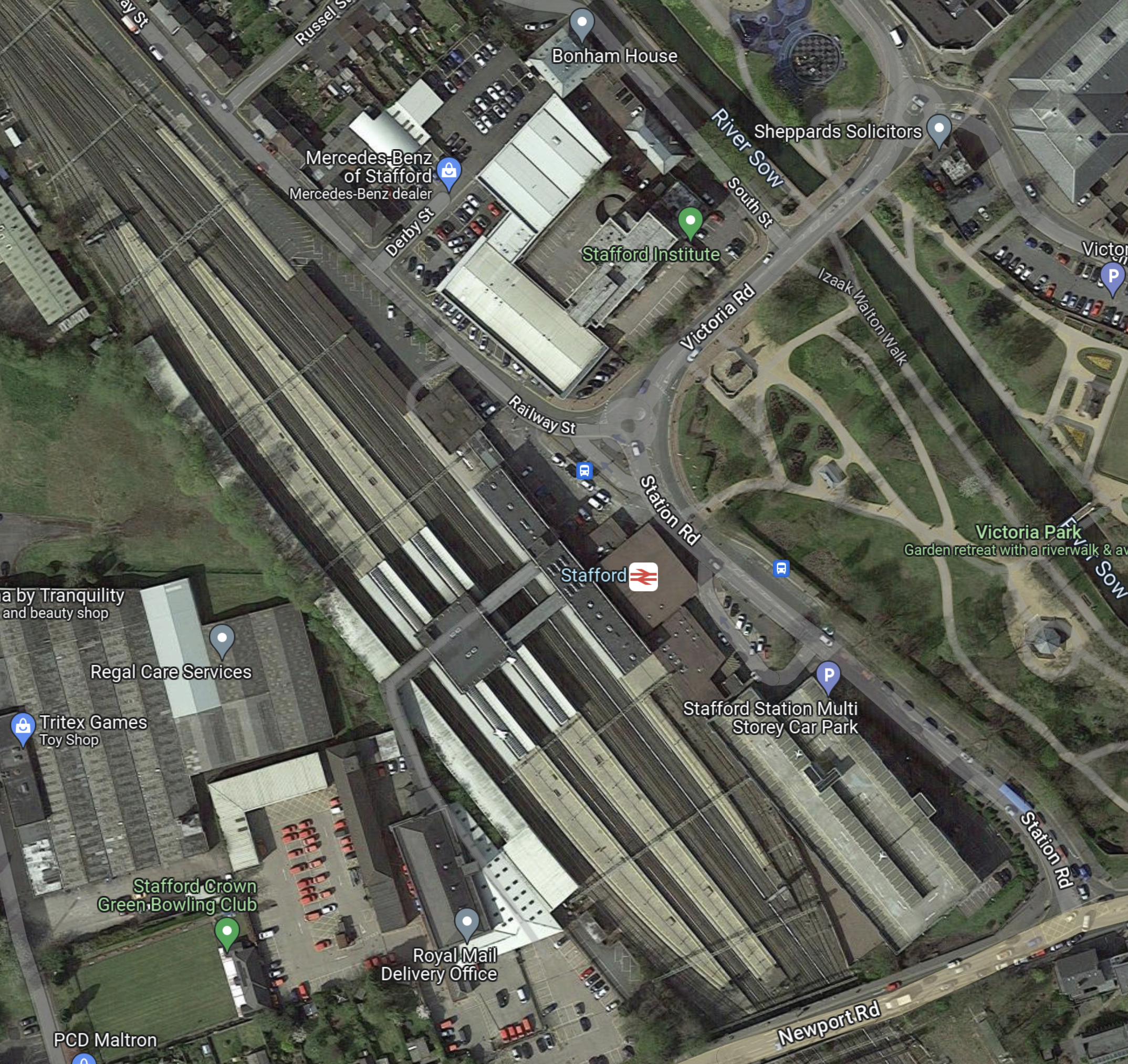
I feel that Stafford station could be developed into a major interchange between High Speed Two and local services.
Conclusion
It looks to me that Stoke-on-Trent will be well-served by High Speed Two.
See Also
Could High Speed Two Finish At Lichfield?
Could High Speed Two Finish At Lichfield?
I wrote this post before Rishi Sunak made his speech.
I went to Manchester and Liverpool yesterday by train.
I took the 10:33 from Euston and this a summary of my journey.
- The train left Euston half a minute early.
- It arrived at Stafford (133.5 miles) at 11:50 and left at 11:52.
- It arrived at Crewe (158.0 miles) at 12:08 and left at 12.10.
- It arrived at Wilmslow (176.9 miles) at 12:25 and left at 12:27.
- It arrived at Stockport (183.0 miles) at 12:35 and left at 12:37.
- It arrived in Manchester Piccadilly (188.9 miles) at 12:46.
- It was two minutes late into Manchester and more or less on time at the other stops.
Note.
- The route was via the Trent Valley Line and the train passed through Nuneaton, Tamworth, Lichfield Trent Valley, Colwich and Stafford.
- Euston and Manchester had been timetabled at two hours and eleven minutes.
- This is an average speed of 86.5 mph.
- The Wikipedia entry for High Speed Two gives the fastest time before High Speed Two opens as one hour and fifty-four minutes.
- This will be an average speed of 99.4 mph.
Coming home, I took the 18:48 from Liverpool Lime Street and this a summary of my journey.
- The train left Liverpool on time.
- It arrived at Runcorn (13.2 miles) at 18:58 and left at 19:02.
- It arrived at Crewe (35.8 miles) at 19:26 and left at 19:28.
- It arrived at Milton Keynes (143.8 miles) at 20:27 and left at 20:29.
- It arrived in Euston (183.6 miles) at 21:00.
- It was five minutes late into Crewe and two minutes early at Euston.
Note.
- The route was via the Trent Valley Line and the train passed through Stafford, Colwich, Lichfield Trent Valley, Tamworth and Nuneaton.
- Liverpool and Euston had been timetabled at two hours and twenty minutes.
- This is an average speed of 78.7 mph.
- The Wikipedia entry for High Speed Two gives the fastest time before High Speed Two opens as two hours and three minutes.
- This will be an average speed of 89.6 mph.
This map clipped from the High Speed Two web site, shows the junction North of Lichfield, where High Speed Two connects to the Trent Valley Line through Stafford.
Note.
- High Speed Two runs North-South across the map.
- After the Junction by Fradley South, High Speed Two to Crewe and the North, is the branch to the East.
- The other branch connects to the Trent Valley Line at Handsacre junction.
- Trent Valley Line can be picked out North of Lichfield, where it passes through Lichfield Trent Valley station.
The Trent Valley Line is no Victorian double-track slow-speed bottleneck.
- The route between Rugby and Crewe is generally three or four tracks, with only one short stretch of double track, through Shugborough tunnel.
- The speed limit is generally 110 mph, with 90 mph at Shugborough.
- I wouldn’t be surprised to see Avanti West Coast’s Class 390 and Class 807 trains could be running at up to 140 mph on the route, if digital signalling were to be installed.
- This speed would probably be attained by High Speed Two trains.
London Euston and Stafford would only have under twenty miles of slower line and that could be 140 mph, so High Speed Two times on the route could be very fast.
This second map clipped from the High Speed Two web site, shows between High Speed Two’s two Birmingham stations and Lichfield.
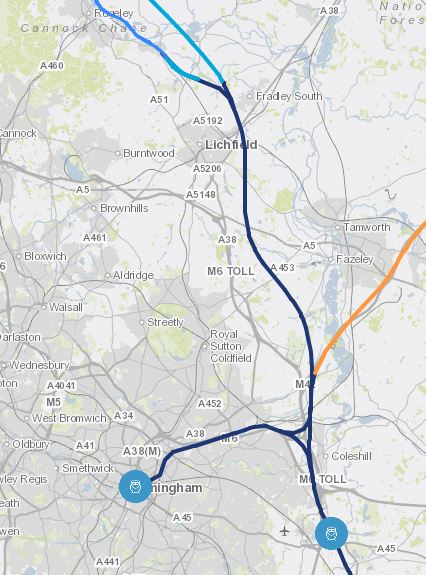
Note.
- High Speed Two Phases 1 and 2a are shown in blue.
- High Speed Two Phase 2b is shown in orange.
- At the top of the map, can be seen the junction, where High Speed Two to the North splits, that was shown in the previous map.
- The large blue dot in the West at the bottom of the map, is Birmingham Curzon Street station.
- The other large blue dot is Birmingham International station.
- The three sections of High Speed Two to London, Birmingham Curzon Street and the North meet at a triangular junction between the two Birmingham stations.
- High Speed Two to the East Midlands, branches off to the East North of the triangular junction.
This third map clipped from the High Speed Two web site, shows between Lichfield and Crewe.
Note.
- High Speed Two Phase 2a is shown in blue.
- High Speed Two Phase 2b is shown in orange.
- Crewe is in the North-West corner of the map, where at the South end of the orange section.
- The junction at Lichfield is in the South-East corner of the map.
- The lighter blue route to the East, between the Lichfield junction and Crewe is the new tracks of High Speed Two.
- The darker blue route to the West, between the Lichfield junction and Crewe is the existing route of the Trent Valley Line and the West Coast Main Line.
- The Trent Valley Line joins the West Coast Main Line at Stafford.
These are a few thoughts and questions.
How Will Trains Go Between Birmingham Curzon Street And London?
Trains will use the triangular junction shown in the second map to go between the two Birmingham stations and then head South,
How Will Trains Go Between Birmingham Curzon Street And The North?
Trains will use the triangular junction shown in the second map to turn North and then take one of the two routes to the North; High Speed Two or Trent Valley Line/West Coast Main Line.
How Will Trains Go Between Birmingham Curzon Street And The North If High Speed Two Between Birmingham And The North Is Scrapped?
If High Speed Two is scrapped from the Northern point of the triangular junction to the North, there will be no way that trains could go North from Birmingham Curzon Street.
- The overcrowded Birmingham New Street station will still be the link to the North of England and Scotland for Birmingham.
- How would trains connect to the future branch to East Midlands Parkway, which connects just North of the triangular junction?
I suspect that a short stub will be built North of the triangular junction to connect to the Trent Valley Line, which is currently, the main route of trains between London and the North through the West Midlands, for trains that don’t go through Birmingham.
Trains Between London And Stafford
Currently, Avanti West Coast trains take around one hour and seventeen minutes between London and Stafford.
The Wikipedia entry for High Speed Two gives these times between London and Stafford.
- Fastest time before High Speed Two – one hour and seventeen minutes.
- Time after Phase 2a of High Speed Two opens – fifty-five minutes.
Note.
That is a time saving of twenty-two minutes.
High Speed Two Trains will use the link between the junction at Lichfield and the Trent Valley Line.
How Many Avanti West Coast Services Use The Trent Valley Line?
These trains use the Trent Valley Line.
- London and Holyhead – 8 tpd
- London and Liverpool Lime Street – 1 tph, which is planned to increase to 2 tph
- London and Manchester Piccadilly – 2 tph
- London and Blackpool North – 1 tpd
- London and Glasgow – 1 tph
Note.
- tpd is trains per day
- tph is trains per hour
This is roughly six tph.
Would It Be Possible To Finish High Speed Two At The Lichfield Junction And Connect It To The Trent Valley Line?
This is a repeat of the first map.
Note.
- High Speed Two runs North-South across the map.
- After the Junction by Fradley South, High Speed Two to Crewe and the North, is the branch to the East.
- The other branch connects to the Trent Valley Line at Handsacre junction.
- Trent Valley Line can be picked out North of Lichfield, where it passes through Lichfield Trent Valley station.
If the Eastern branch North from the junction were to be scrapped, all trains between London and North would go via Stafford.
As all these tracks are planned and must be at an advanced stage, that is ready for construction, I feel the route would be feasible.
It would have these benefits.
- Birmingham Curzon Street services and the North-West of England and the West of Scotland would be possible.
- Services between London and Stafford will be twenty-two minutes faster, than they are now.
- Time savings will also apply to services from London to Liverpool, Macclesfield, Manchester, Stoke-on-Trent and all stations between Crewe and Glasgow.
The capacity of the Trent Valley Line would be the limiting factor.
Time Savings Between Crewe And Preston
According to the Wikipedia entry for High Speed Two, after Phase 2a of High Speed Two opens, these will be the fastest times to Crewe and Preston.
- Crewe – 0:56
- Preston 1:18
Note.
- The fastest Preston service runs non-stop between Euston and Preston.
- Crewe and Preston are 51 miles apart.
A time of 22 minutes between Crewe and Preston, means the average speed is 139 mph.
Does this mean that High Speed Two will improve between Crewe and Preston to allow 140 mph non-stop running?
But 22 minutes is certainly an improvement on the current time between Crewe and Preston for Scottish trains of 40 minutes.
Time Savings Between Crewe And Liverpool
The upgrading of the line between might save another couple of minutes between Crewe and Weaver junction.
What Times Would Be Possible Via High Speed Two And The Trent Valley Line?
These times are based on the following.
- The twenty-two minute saving to Stafford, as all High Speed Two services to the North-West of England and the West of Scotland will go via Phase 1 of High Speed Two and Stafford.
- A saving of eighteen minutes will be applied to Scottish services because of savings between Crewe and Preston.
This would give these times in hours:minutes.
- Blackpool – 2:10
- Carlisle – 2:35
- Chester – 1:28
- Crewe – 1:08
- Glasgow – 3:50
- Holyhead – 3:10
- Lancaster – 2:03
- Liverpool Lime Street – 1:41
- Llandudno Junction – 2:24
- Macclesfield – 1:30
- Manchester Piccadilly via Crewe – 1:52
- Oxenholme – 1:54
- Preston – 1:46
- Runcorn 1:31
- Stafford – 0:55
- Stockport – 1:35
- Stoke-on-Trent – 1:10
- Warrington – 1:22
- Wigan 1:33
- Wilmslow – 1:25
I have calculated extra services to Blackpool and North Wales.
Adding The Lichfield And Crewe Section
Consider.
- My calculations indicate that London and Crewe will take 1:08.
- The Wikipedia entry for High Speed Two, after Phase 2a of High Speed Two opens, gives the fastest time to Crewe as 0:56.
This indicates that adding the section of High Speed Two between Lichfield and Crewe will save a further twelve minutes.
Conclusion
I strongly believe that an upgraded Trent Valley Line linked to a shortened High Speed Two at Lichfield could improve journey times between London, Birmingham and the North.
There are certainly savings to be made.
See Also
High Speed Two To Crewe
There has been a lot of speculation about the Northern end of High Speed Two, so I might as well add sort out a few facts and add a bit of speculation of my own.
Sample Times Between London And Crewe
These are selected times from the 27th September 2023.
- 07:30 – Glasgow Non-Stop – 1:29
- 07:33 – Manchester Piccadilly – 1:37 – Stops at Stafford
- 07:43 – Liverpool Lime Street – 1:40 – Stops at Milton Keynes
- 08:30 – Glasgow Non-Stop – 1:29
- 08:33 – Manchester Piccadilly – 1:37 – Stops at Stafford
- 08:43 – Liverpool Lime Street – 1:40 – Stops at Milton Keynes
- 09:02 – Holyhead – 1:40 – Stop at Stafford
- 15:02 – Chester – 1:40 – Stops at Tamworth, Lichfield Trent Valley and Stafford
Note.
- The 07:30 and 08:30 Glasgow services appears to be pathed for one of the Class 390 Pendolino electric trains and were run by Pendolinos.
- The 07:33 and 08:33 Manchester services appears to be pathed for one of the Pendolino electric trains and were run by Pendolinos.
- The 07:43 and 08:43 Liverpool services appears to be pathed for one of the new Class 807 electric trains, but were run by Pendolinos.
- The 15:02 Chester service appears to be pathed for one of the new Class 805 bi-mode trains.
- All services except the Glasgow services stop at Crewe.
- As London Euston and Crewe is 158 miles, the non-stop Glasgow services average 107 mph, the one-stop Manchester service averages 98 mph and the one-stop Liverpool service averages 95 mph.
I have some further thoughts.
How Long Does A Stop Take?
I’ve looked at some stops of Glasgow, Liverpool and Manchester services
Crewe
Looking at timings between Weaver Junction and Norton Bridge, I have found the following times.
- Glasgow-Euston – 23 minutes
- Liverpool-Euston – 28 minutes
Note.
- Manchester services don’t go through Weaver Junction.
- Weaver Junction and Norton Bridge are respectively North and South of Crewe.
- The Liverpool service stops at Crewe, where it has a dwell time of two minutes.
- The Glasgow service goes straight through Crewe.
The Crewe stop takes a total of 5 minutes of which 3 minutes are deceleration and acceleration to and from linespeed.
Stafford
Looking at timings between Norton Bridge and Colwich, I have found the following times.
- Glasgow-Euston – 7½ minutes
- Liverpool-Euston – 7½ minutes
- Manchester -Euston – 14 minutes
Note.
- Norton Bridge and Colwich are respectively North and South of Stafford.
- The Manchester service stops at Stafford, where it has a dwell time of two minutes.
- The Glasgow and Liverpool services go straight through Stafford.
The Stafford stop takes a total of 6½ minutes of which 4½ minutes are deceleration and acceleration to and from linespeed.
Milton Keynes
Looking at timings between Weedon and Bletchley, I have found the following times.
- Glasgow-Euston – 11½ minutes
- Liverpool-Euston – 16 minutes
- Manchester -Euston – 12½ minutes
Note.
- Weedon and Bletchley are respectively North and South of Milton Keynes.
- The Liverpool service stops at Milton Keynes, where it has a dwell time of one minute.
- The Glasgow and Manchester services go straight through Milton Keynes.
The Milton Keynes stop takes a total of 4 minutes of which 3 minutes are deceleration and acceleration to and from linespeed.
Average Speeds Between Crewe And London
London Ruston and Crewe is 158 miles according to Real Time Trains.
So what would times would various average speeds deliver?
- 100 mph – 95 minutes
- 110 mph – 86 minutes
- 120 mph – 79 minutes
- 125 mph – 76 minutes
- 130 mph – 73 minutes
- 140 mph – 68 minutes
Obviously, any average speed with over 125 mph running, will need full digital signalling.
Liverpool And London In Two Hours
Tucked away beside the Grand Union Sets Out Stirling Ambitions article in the December 2022 Edition of Modern Railways is a report on Avanti West Coast’s application for a second service between Euston and Liverpool.
This is said.
Avanti West Coast has applied for access rights for its second hourly Euston to Liverpool service, starting from December 2023, although a phased introduction of the new service is likely. This would make use of Avanti’s new fleet of 10×7-car Class 807 Hitachi EMUs, which are expected to enter service from Autumn 2023. The ‘807s’ would be deployed on the current hourly Liverpool service, on which a call at Liverpool South Parkway would be added. (provision is made for this in the December 2022 timetable.).
Pendolinos would then operate the second service each hour, calling at Lichfield Trent Valley and Tamworth.
A linespeed project is in progress to raise the permissible speed for non-tilting trains on the West Coast Main Line, and Avanti’s new Hitachi trains will take advantage of this.
I’ll take a quick look at the Crewe and Runcorn section.
- It is 22.5 miles.
- It takes 19 minutes.
- That is an average speed of 71 mph.
- Crewe and Weaver Junction has a speed limit of at least 110 mph
- Runcorn and Weaver Junction has a speed limit of at least 90 mph for most of the way.
- If with their superior performance, the new Class 807 trains could average 90 mph between Crewe and Runcorn, they would take 15 minutes.
- Achieving the 90 mph average may need a bit of track realignment and some signaling changes.
The four minutes saved would be enough to handle the extra stop at Liverpool South Parkway.
Consider.
- Currently, Pendolino trains do Liverpool and Crewe in 38 minutes, which includes the stop at Runcorn.
- My calculation with the Class 807 trains, shows that with a bit of extra signalling, the new trains could do Liverpool and Crewe in 38 minutes with the two stops.
- The stop at Crewe will subtract 5 minutes from the base journey time.
- The stop at Milton Keynes will subtract 4 minutes from the base journey time.
This means the base journey time between Crewe and London will be 73 minutes.
This would indicate that the trains would be running at 130 mph to achieve the two hours.
But there are five accelerations and five decelerations on a journey between London and Liverpool and the new Class 807 trains are the Lotuses of Hitachi’s family of AT-300 trains; lightweight and powerful.
Suppose they could save thirty seconds for each acceleration and deceleration.
The base journey time between Crewe and London will be 78 minutes.
This would indicate that the trains would be running at over 120 mph to achieve the two hours.
I certainly feel, that Liverpool and London in two hours is certainly possible using the new Class 807 trains.
London and Crewe with two stops would be times at one hour and twelve minutes.
But what about the Pendolinos?
- My last return trip from Liverpool did a practice call at Liverpool South Parkway and still arrived in London a few minutes early.
- The Pendolinos will still benefit from any improvements, between Crewe and Runcorn, which could reduce the Liverpool and Crewe time from 38 minutes to 34 minutes.
- The stop at Crewe will subtract 5 minutes from the base journey time.
- The stops at Lichfield Trent Valley and Tamworth will both subtract 4 minutes from the base journey time.
This means the base journey time between Crewe and London will be 73 minutes, which is the same as for the Class 807 trains.
This would indicate that the trains would be running at 130 mph to achieve the two hours.
Could this average speed be achieved by the selective application of full digital signalling, perhaps on the Trent Valley Line?
But it does appear to me, that the Pendolinos can get very close to two hours between London and Liverpool.
London and Crewe with three stops would be times at one hour and sixteen minutes.
Crewe And London Non-Stop
Consider.
- Pendolinos between London and Glasgow, go non-stop between London and Crewe.
- I have calculated that Pendolinos between London and Liverpool, will take one hour and sixteen minutes with three stops between London and Crewe.
- The three stops take a total of thirteen minutes.
I wouldn’t be surprised to see London and Glasgow Pendolinos take one hour and three minutes between London and Crewe.
This would knock twenty-six minutes off journey times between London and Glasgow.
Conclusion
I believe that with relatively minor improvements on the West Coast Main Line and the Liverpool branch, the following can be achieved.
- Liverpool and London can be around two hours with new Class 807 trains or Pendolinos.
- Liverpool and London services can increase their calls in the Midlands.
- London and Glasgow services can be nearly half-an-hour faster.
- The fastest London and Crewe services could be just over an hour using Pendolinos.
I also believe that the only serious infrastructure needed is some track realignment and some updated signalling.
See Also
Could High Speed Two Finish At Lichfield?
High Speed Two To Manchester
There has been a lot of speculation about the Northern end of High Speed Two, so I might as well add sort out a few facts and add a bit of speculation of my own.
The Current Manchester Piccadilly Services
Currently, there are three trains per hour (tph) between London Euston and Manchester Piccadilly.
The services stop as follows.
- Milton Keynes Central, Rugby, Stoke-on-Trent, Macclesfield and Stockport
- Nuneaton, Stoke-on-Trent and Stockport
- Stafford, Crewe, Wilmslow and Stockport
Note.
- One service goes via Crewe.
- Two services go via Stoke-on-Trent.
- All services go via Stockport.
- A London and Manchester Piccadilly train could go via Milton Keynes Central, Nuneaton, Rugby, Stafford, Stoke-on-Trent, Macclesfield and Stockport.
- A London and Manchester Piccadilly train could go via Crewe, Wilmslow and Stockport.
The two trains detailed would mean that Manchester wouldn’t lose any connectivity.
I would expect that Manchester Piccadilly needs at least three tph to and from London.
This graphic shows High Speed Two services after Phase 2b is completed.
Note.
- Services shown in blue are run by High Speed Two Full Size trains.
- Services shown in yellow are run by High Speed Two Classic-Compatible trains.
- Full Size Services will only run to Manchester Airport and Manchester Piccadilly after Phase 2b is completed to Manchester Piccadilly.
- Classic-Compatible Services will be able to run to to Manchester Piccadilly after Phase 2a is completed.
- Two London and Manchester Piccadilly trains will call at just Old Oak Common and Manchester Airport.
- A third London and Manchester Piccadilly train will call at Old Oak Common, Birmingham International and Manchester Airport.
- Two Birmingham Curzon Street and Manchester Piccadilly trains will call at just Manchester Airport.
- Despite Wilmslow and Stockport being shown in the list of stations on the left hand side of the graphic, no High Speed Two services appear to call at the two stations.
The graphic of High Speed Two services also shows these Full-Size services to Manchester Piccadilly.
- Three tph to London Euston
- Two tph to Birmingham Curzon Street
Some or all of these services will surely be run by High Speed Two Classic-Compatible trains.
What services will run to Manchester between the opening of Phase 2a and the opening of Phase 2b?
I will now give some possibilities for services.
London and Manchester Piccadilly Via Crewe, Wilmslow And Stockport
I shall look at the 07:33 train to Manchester Piccadilly on the 20th September 2023.
- It was a service via Stafford, Crewe, Wilmslow and Stockport
- It was a nine-car Class 390 train or Pendolino, which left on time.
- Euston and Manchester Piccadilly are 188.9 miles apart.
- The train called at Crewe at 09:08 and left at 09:10.
- The average speed between London Euston and Crewe is 70.7 mph.
- The train arrived in Manchester Piccadilly on time at 09:44.
- The journey took two hours and 11 minutes
- The average speed was 86.5 mph.
- The Crewe and Manchester Piccadilly section is 30.9 miles and the train is scheduled to take 34 minutes.
- The average speed between Crewe and Manchester Piccadilly is 54.5 mph.
- The example train slows past Crewe because of two stops at Wilmslow and Stockport.
When Phase 2a of High Speed Two opens a replacement for this service via Crewe, could operate as follows.
- It could use High Speed Two between and Crewe.
- It could use the current route between Crewe and Manchester Piccadilly.
- It would probably use a 200 metre long High Speed Two Classic-Compatible trains.
- I wouldn’t be surprised, that the current Pendolino service between Euston and Manchester Piccadilly via Crewe, Wilmslow and Stockport was retired.
- The new High Speed Two service could take over the path currently used by the current Pendolino service, between Crewe and Manchester Piccadilly.
- The train could stop at Crewe, Wilmslow and Stockport as required.
- If it stopped at Crewe, Wilmslow and Stockport, it would restore some of the connectivity to smaller places.
According to the Wikipedia entry for High Speed Two, these will be the timings.
- London Euston and Crewe – 56 minutes
- London Euston and Manchester Piccadilly Phase 2a – One hour and 30 minutes
- London Euston and Manchester Piccadilly Phase 2b – One hour and 11 minutes
From these figures and the times of the 07:33, I can deduce these journey times for trains via Crewe, Wilmslow and Stockport.
- Currently, Crewe and Manchester Piccadilly takes 34 minutes.
- High Speed Two after Phase 2a will also take 34 minutes.
I am surprised that sectional timings on this section of the West Coast Main Line are the same as current timings. Digital signalling and the faster acceleration and deceleration of the new trains, are quite likely to decrease times.
Because they are both 34 minutes, does that mean that services will stop at Crewe, Wilmslow and Stockport?
London and Macclesfield Via Stafford And Stoke-on-Trent
This map of High Speed Two in North West England was captured from the interactive map on the High Speed Two web site.

Note.
- The map dates from around October 2020.
- The current West Coast Main Line (WCML) and Phase 2a of High Speed Two are shown in blue.
- Phase 2b of High Speed Two is shown in orange.
- The main North-South route, which is shown in blue, is the WCML passing through Crewe, Warrington Bank Quay and Wigan North Western as it goes North.
- The Western Branch, which is shown in blue, is the Liverpool Branch of the WCML, which serves Runcorn and Liverpool.
- High Speed Two, which is shown in orange, takes a faster route between Crewe and Wigan North Western.
- The Eastern Branch, which is shown in orange, is the Manchester Branch of High Speed Two, which serves Manchester Airport and Manchester Piccadilly.
- The route in the East, which is shown in blue, is the Macclesfield Branch of High Speed Two, which serves Stafford, Stoke-on-Trent and Macclesfield.
The route of Northern Powerhouse Rail between Manchester Airport and Liverpool has still to be finalised.
The London and Macclesfield service is as follows.
- There will be one tph
- There are intermediate stops at Stafford and Stoke-on-Trent.
- Macclesfield has a long electrified bay platform, which looks like it will take a 200 m High Speed Two Classic-Compatible train.
- Macclesfield Station And High Speed Two has pictures of the station.
- Four tph operate between Stoke-on-Trent and Manchester Piccadilly via Macclesfield.
- Timings from London would be 55 minutes to Stafford, 70 minutes to Stoke-on-Trent and 90 minutes to Macclesfield.
In some ways, I was surprised about this High Speed Two service.
But it does give an easy connection to Stafford and Stoke-on-Trent.
London and Manchester Piccadilly via Macclesfield, Stafford And Stoke-on-Trent
Currently, Avanti West Coast run a service between London and Manchester which runs as follows.
- It calls at Milton Keynes Central, Rugby, Stoke-on-Trent, Macclesfield and Stockport
- It also passes through Watford Junction, Nuneaton, Tamworth and Lichfield Trent Valley.
- It could pass through Stafford.
- It would mean that Stafford and Stoke-on-Trent were served by 2 tph.
- It is run by a Pendolino.
- It has a frequency of 1 tph.
- The current service takes two hours and 6 minutes.
- A few minutes would be added for each extra stop.
I believe it could be a very useful service.
I wonder if it could be run as a complimentary service to High Speed Two to serve more places on the route.
A Second High Speed Two Service Between London and Manchester Piccadilly Via Crewe, Wilmslow And Stockport
So far, I have mapped out three possible services.
- High Speed Two – London and Manchester Piccadilly Via Crewe, Wilmslow And Stockport – One hour and thirty minutes
- High Speed Two – London and Macclesfield Via Stafford and Stoke – One hour and thirty minutes
- Pendolino – London and Manchester Piccadilly Via Milton Keynes Central, Rugby, Nuneaton, Tamworth, Lichfield Trent Valley, Stafford, Stoke-on-Trent, Macclesfield and Stockport – Two hours and 6 minutes plus 4 minutes for each extra stop.
I suspect that four tph could be a good frequency.
The simplest extra service would probably be another High Speed Two London and Manchester Piccadilly Via Crewe, Wilmslow And Stockport.
But it could be another Pendolino service to serve more places.
I believe a service pattern could be arranged with these features.
- Major cities and towns between London and Manchester have at least two tph.
- A larger number of towns and cities have at least one tph.
Note that many stations on the route already have Pendolino services.
Phase 2b Would Be The Ultimate Solution
Phase 2b which will involve a tunnel via Manchester Airport to new platforms in Manchester Piccadilly could be the ultimate solution.
Phase 2b is also needed so that full-size High Speed Two trains can be run to Manchester Piccadilly.
But it will be difficult, expensive and disruptive to build.
Conclusion
I believe it could be easy to plan four services between London and Manchester Piccadilly or Macclesfield.
- High Speed Two Full-Size train – London and Manchester Piccadilly Via Crewe, Wilmslow And Stockport – One hour and eleven minutes
- High Speed Two Classic-Compatible train – London and Macclesfield Via Stafford and Stoke – One hour and thirty minutes
- High Speed Two Full-Size train – London and Manchester Piccadilly Via Crewe, Wilmslow And Stockport – One hour and eleven minutes
- Pendolino – London and Manchester Piccadilly Via Milton Keynes Central, Rugby, Nuneaton, Tamworth, Lichfield Trent Valley, Stafford, Stoke-on-Trent, Macclesfield and Stockport – Two hours and 6 minutes plus 4 minutes for each extra stop.
Note.
Services 1 and 3 are identical, but don’t need to be.
Service 4 could be run by a High Speed Two Classic-Compatible train.
See Also
Could High Speed Two Finish At Lichfield?
High Speed Two To Wigan
There has been a lot of speculation about the Northern end of High Speed Two, so I might as well add sort out a few facts and add a bit of speculation of my own.
The Current Wigan North Western Service
I shall look at the 08:30 train to Glasgow on the 20th September 2023.
- It was an eleven-car Class 390 train or Pendolino, which left on time.
- Euston and Wigan North Western are 193.8 miles apart.
- Trains call at only Warrington Bank Quay
- The train passed Crewe at 09:59
- The train called at Warrington Bank Quay at 10:14 and left at 10:15.
- The train arrived at Wigan North Western at 10:25 on time.
- The journey took one hour and 55 minutes
- The average speed was 101.1 mph.
- The Crewe and Wigan North Western section is 35.8 miles and the train is scheduled to take 26 minutes.
- The average speed between Crewe and Wigan North Western is 82.6 mph.
The train slows past Crewe because of the stop at Warrington Bank Quay.
London Euston And Wigan North Western After Phase 2a Of High Speed Two Opens
According to the Wikipedia entry for High Speed Two, these are the timings.
- London Euston and Crewe – 56 minutes
- London Euston and Warrington Bank Quay – One hour and 20 minutes
- London Euston and Wigan North Western – One hour and 34 minutes
From these figures and the times of the 08:30, I can deduce these journey times.
- Currently, Crewe and Warrington Bank Quay takes 16 minutes and High Speed Two will take 24 minutes
- Currently, Warrington Bank Quay and Wigan North Western takes 10 minutes and High Speed Two will take 14 minutes
- Currently, Crewe and Wigan North Western takes 26 minutes and High Speed Two will take 38 minutes
I am surprised that sectional timings on this short section of the West Coast Main Line are slower than current timings. Digital signalling and the faster acceleration and deceleration of the new trains, are more likely to decrease times, than increase them.
London Euston And Preston After Phase 2a Of High Speed Two Opens
According to the Wikipedia entry for High Speed Two, these are the timings.
- London Euston and Crewe – 56 minutes
- London Euston and Warrington Bank Quay – One hour and 20 minutes
- London Euston and Wigan North Western – One hour and 34 minutes
- London Euston and Preston – One hour and 18 minutes
This graphic shows High Speed Two services.
Note that Preston gets two non-stop services to and from London and another with stops at Warrington Bank Quay and Wigan North Western, and a train split/join at Crewe.
The one hour and 18 minutes surely applies to one or both of the non-stop services.
140 Mph Running Between Crewe And Preston
Consider.
- London Euston and Crewe is 56 minutes
- One hour and 18 minutes to Preston infers a time of 22 minutes between Crewe and Preston.
- Crewe and Preston is 51 miles.
This implies an average speed of 139 mph.
As the West Coast Main Line was built for 140 mph, when digital signalling was installed, this would appear to be feasible, once the signalling is upgraded.
It may also mean, that faster times are possible in services to Warrington Bank Quay and Wigan North Western.
Consider.
- Crewe and Wigan North Western is 35.8 miles
- High Speed Two will take 38 minutes
- The average speed between Crewe and Wigan North Western will be just 56.5 mph.
But if it could run at 140 mph mph between Crewe and Wigan North Western, the base time would be just over 15 minutes.
To this time must be added two full station stops and the time it takes to split or join.
With the superior acceleration and deceleration of the High Speed Two trains and their level of automation, these operations will not take 23 minutes.
I believe that this means that minutes can be saved on services to Lancaster, Liverpool Lime Street, Warrington Bank Quay and Wigan North Western.
London Euston And Wigan North Western After Phase 2b Of High Speed Two Opens
There will be no changes as the full-size High Speed Two trains are not planned to run to the North of Crewe.
See Also
High Speed Two To Liverpool
There has been a lot of speculation about the Northern end of High Speed Two, so I might as well add sort out a few facts and add a bit of speculation of my own.
The Current Liverpool Service
I shall look at the 08:43 train on the 18th September 2023.
- It was a nine-car Class 390 train or Pendolino, which left on time.
- Euston and Liverpool Lime Street are 193.7 miles apart.
- The train called at Milton Keynes Central, Crewe and Runcorn
- The train arrived at Crewe at 10:24 and left at 10:26.
- The train arrived at Runcorn at 10:43 and left at 10:44.
- The train arrived at Liverpool Lime Street at 11:04 on time.
- The journey took two hours and 21 minutes
- The average speed was 82.4 mph.
- The Crewe and Liverpool Lime Street section is 39.7 miles and the train is scheduled to take forty minutes.
- The average speed between Crewe and Liverpool Lime Street is almost exactly 60 mph.
- The slower average speed is because the train is slowing for a gradual stop in Liverpool and the only fast section is the 110 mph section between Crewe and Weaver Junction, where the Liverpool Branch leaves the West Coast Main Line.
- There is one train per hour (tph).
There are probably only limited ways that time can be saved between Crewe and Liverpool Lime Street.
- The West Coast Main Line between Crewe and Weaver Junction takes twelve minutes and has an operating speed of 110 mph, so saving a few minutes might be possible, by upgrading the speed on this line with digital signalling to allow 140 mph running.
- It might be possible to save a couple of minutes at the Runcorn stop by using the superior performance of the new Class 807 or High Speed Two trains.
- The slowing down into and accelerating out of Liverpool might be improved by digital signalling and trains with better performance.
It should be noted that Liverpool Lime Street station was recently remodelled to improve operation of the station and the tracks connecting it to Runcorn.
I would be fairly sure that Network Rail and Avanti West Coast have got Crewe and Liverpool Lime Street times to a minimum. As this route will become part of High Speed Two, I suspect that Network Rail/Avanti have done extensive computer simulations of the route, to make sure they get it as quick and efficient as possible.
The New Class 807 Trains
The Class 807 trains, which enter service this year or early next, are the Lotuses in Hitachi’s AT 300 family of high speed trains.
- They are electric only and have no heavy diesel engines or traction batteries.
- They don’t even have emergency batteries for when the catenary fails.
- They have a redesigned nose. Is it more aerodynamic?
- As with all the other Hitachi high speed trains, they are capable of 125 mph, or 140 mph if the signalling permits.
These trains will undoubtedly have faster acceleration and deceleration and could probably knock minutes off the timings at all the stops.
A Second Hourly Train To Liverpool
Tucked away beside the Grand Union Sets Out Stirling Ambitions article in the December 2022 Edition of Modern Railways is a report on Avanti West Coast’s application for a second service between Euston and Liverpool.
This is said.
Avanti West Coast has applied for access rights for its second hourly Euston to Liverpool service, starting from December 2023, although a phased introduction of the new service is likely. This would make use of Avanti’s new fleet of 10×7-car Class 807 Hitachi EMUs, which are expected to enter service from Autumn 2023. The ‘807s’ would be deployed on the current hourly Liverpool service, on which a call at Liverpool South Parkway would be added. (provision is made for this in the December 2022 timetable.).
Pendolinos would then operate the second service each hour, calling at Lichfield Trent Valley and Tamworth.
A linespeed project is in progress to raise the permissible speed for non-tilting trains on the West Coast Main Line, and Avanti’s new Hitachi trains will take advantage of this.
Note.
- The current Liverpool service stops at Milton Keynes Central, Crewe and Runcorn.
- Liverpool South Parkway station is too short for the longest Pendolinos or Class 390/1 trains.
- When the second service is implemented will it stop at Milton Keynes Central, Crewe, Runcorn and Liverpool South Parkway?
- Will the Pendolinos only stop at Lichfield Trent Valley and Tamworth?
Will Avanti West Coast use the trains to take advantage of their strengths?
- The new lighter Class 807 trains will use their superior acceleration and deceleration to execute fast stops at more stations.
- The shorter Class 807 trains will call at Liverpool South Parkway.
- The current Pendolinos will use their tilt to run as fast as possible between London Euston and Liverpool.
I also suspect that Avanti West Coast will adjust the stopping pattern to attract passengers. I read somewhere, that a stop at Nuneaton to connect to Leicester, Peterborough, Cambridge and Stansted Airport, was a possibility.
More Details Of A Second Hourly Train To Liverpool – 30th September 2023.
Real Time Trains is now showing the details of the second service between London Euston and Liverpool.
These are the future timings of the 09:13 train from Liverpool.
- Liverpool – Leave at 09:13
- Runcorn – Arrive at 09:28 and leave at 09:29½
- Crewe – Arrive at 09:49 and leave at 09:56
- Stafford – Arrive at 10:14½ and leave at 10:16½
- Lichfield Trent Valley – Arrive at 10:29½ and leave at 10:31½
- Tamworth – Arrive at 10:36½ and leave at 10:38½
- Nuneaton – Arrive at 10:49 and leave at 10:51
- Milton Keynes Central – Arrive at 11:21 and leave at 11:23
- Euston – Arrive at 11.59
Note.
- This service has not been activated yet.
- It is pathed for a Class 80x train.
- There are seven stops.
- It will take two hours and 46 minutes.
- Liverpool and Crewe will take 36 minutes.
- There are two other inactivated services like this running through Birmingham and Northampton.
Could these services have been timetabled to test connectivity?
High Speed Two Classic Compatible Trains
These High Speed Two Classic Compatible trains are to be built for High Speed Two.
- They will be able to run on both High Speed Two and current high speed lines like the East Coast Main Line and the West Coast Main Line.
- They will have an operating speed of 205 mph on High Speed Two.
- They will be able to operate at appropriate speeds on existing high speed lines. Typically, that is 125 mph, but with full digital signalling that is 140 mph.
- They are two hundred metres long and are sixty metres shorter than an eleven-car Pendolino.
- They are being built by a Hitachi-Alstom joint venture.
This document on the Government web site is the Train Technical Specification for High Speed Two Classic-Compatible Trains.
Introducing The High Speed Two Classic Compatible Trains Into Service
Consider.
- London Euston and Liverpool Lime Street services can be run by eleven-car Pendolinos.
- It looks like after the introduction of the second service between London Euston and Liverpool Lime Street is introduced, it will be run by Pendolinos and it could be a two-stop service.
- The High Speed Two Classic Compatible trains should be able to run any service currently run by an eleven-car Pendolino.
So will Avanti West Coast use this second hourly London Euston and Liverpool Lime Street service to introduce the new High Speed Two Classic Compatible trains into public service?
- It would make sure the trains and existing track and signals were fully debugged.
- It would inform the public that High Speed Two is on its way.
- It would be good marketing for High Speed Two.
- They might shave a few minutes off journey times.
- It could use all the existing infrastructure.
- It will provide work for Alstom in Derby.
I feel Avanti West Coast just might!
London Euston And Liverpool Lime Street Before Phase 2a Of High Speed Two Opens
According to the Wikipedia entry for High Speed Two, these are the fastest timings.
- London Euston and Crewe – One hour and 30 minutes
- London Euston and Runcorn – One hour and 53 minutes
- London Euston and Liverpool Lime Street – Two hours and 3 minutes
Currently, the fastest London and Liverpool Lime Street trains take two hours and 21 minutes, so are the Class 807 trains going to be eighteen minutes faster?
From these figures and the times of the 0843, I can deduce these journey times.
- Currently, Crewe and Runcorn takes 17 minutes and the Class 807 train will take 23 minutes
- Currently, Runcorn and Liverpool Lime Street takes 20 minutes and the Class 807 train will take 10 minutes
- Currently, Crewe and Liverpool Lime Street takes 38 minutes and the Class 807 train will take 33 minutes
It looks like there may be slight problems with Wikipedia’s figures. But they were published before Avanti West Coast had run a Class 807 train between Crewe and Liverpool Lime Street. I think we’ll have to wait and see what turns up on Saturday, the 9th of December 2023, when the timetables change.
But I do feel now that the Class 807 trains will achieve London Euston and Liverpool Lime Street in two hours and three minutes.
London Euston And Liverpool Lime Street After Phase 2a Of High Speed Two Opens
According to the Wikipedia entry for High Speed Two, these are the timings.
- London Euston and Crewe – 56 minutes
- London Euston and Runcorn – One hour and 14 minutes
- London Euston and Liverpool Lime Street – One hour and 32 minutes
From these figures and the times of the 0843, I can deduce these journey times.
- Currently, Crewe and Runcorn takes 17 minutes and High Speed Two will take 18 minutes
- Currently, Runcorn and Liverpool Lime Street takes 20 minutes and High Speed Two will take 18 minutes
- Currently, Crewe and Liverpool Lime Street takes 38 minutes and High Speed Two will take 36 minutes
There doesn’t seem to be much of a saving between today’s Pendolino and High Speed Two between Crewe and Liverpool Lime Street.
Could it be that the work to improve Liverpool Lime Street station and its approaches a few years ago sorted out a lot of problems and Crewe and Liverpool Lime Street is now almost to the standard needed for High Speed Two?
If savings are made anywhere by High Speed Two, it could be between Runcorn and Liverpool Lime Street.
Looking at the operating speeds on OpenRailwayMap, there appears to be a 30 mph section of track for a couple of miles out of Liverpool Lime Street, which includes a sharp curve.
This Google Map shows the approaches to Lime Street station.
Note.
- The tracks across the top of the map are the main electrified Liverpool and Manchester tracks.
- The building in the middle is Alstom Traincare’s Liverpool Depot.
- The line to Runcorn enters the map in the South-East corner and curves around the depot to join the tracks into Lime Street station.
- The operating speed gradually reduces from 30 mph on this map to less than 15 mph in Lime Street station.
Perhaps, this 30 mph section is to be improved to gain the couple of minutes.
I also think, that savings could be possible at Runcorn station.
If when the second service starts, the Pendolinos don’t stop at Runcorn, that would save a few minutes.
The Class 807 and the High Speed Two Classic Compatible trains with their superior acceleration and deceleration could save a couple of minutes in the stop at Runcorn.
I very much feel that as the Pendolinos manage to achieve Crewe and Liverpool Lime Street in 38 minutes, that Pendolinos on the second service, Class 807 and the High Speed Two Classic Compatible trains, will all manage 36 minutes or less on the route.
London Euston And Liverpool Lime Street After Phase 2b Of High Speed Two Opens
There will be no changes as the full-size High Speed Two trains are not planned to run into Liverpool Lime Street.
Conclusion
It looks to me, that the Crewe and Liverpool Lime Street leg of High Speed Two is more or less complete.
Times between London and Liverpool will be as follows.
- Before High Speed Two Phase 2a – 2 hours and 3 minutes
- After High Speed Two Phase 2a – 1 hour and 32 minutes
- After High Speed Two Phase 2b – 1 hour and 32 minutes
I believe that for many this will be fast enough, especially as it’s nearly complete.
See Also
Could High Speed Two Finish At Lichfield?
 The Anonymous Widower