Midlands Rail Hub Looks To The Future With Preferred Alliance Partners
The title of this post, is the same as that of this press release from Network Rail.
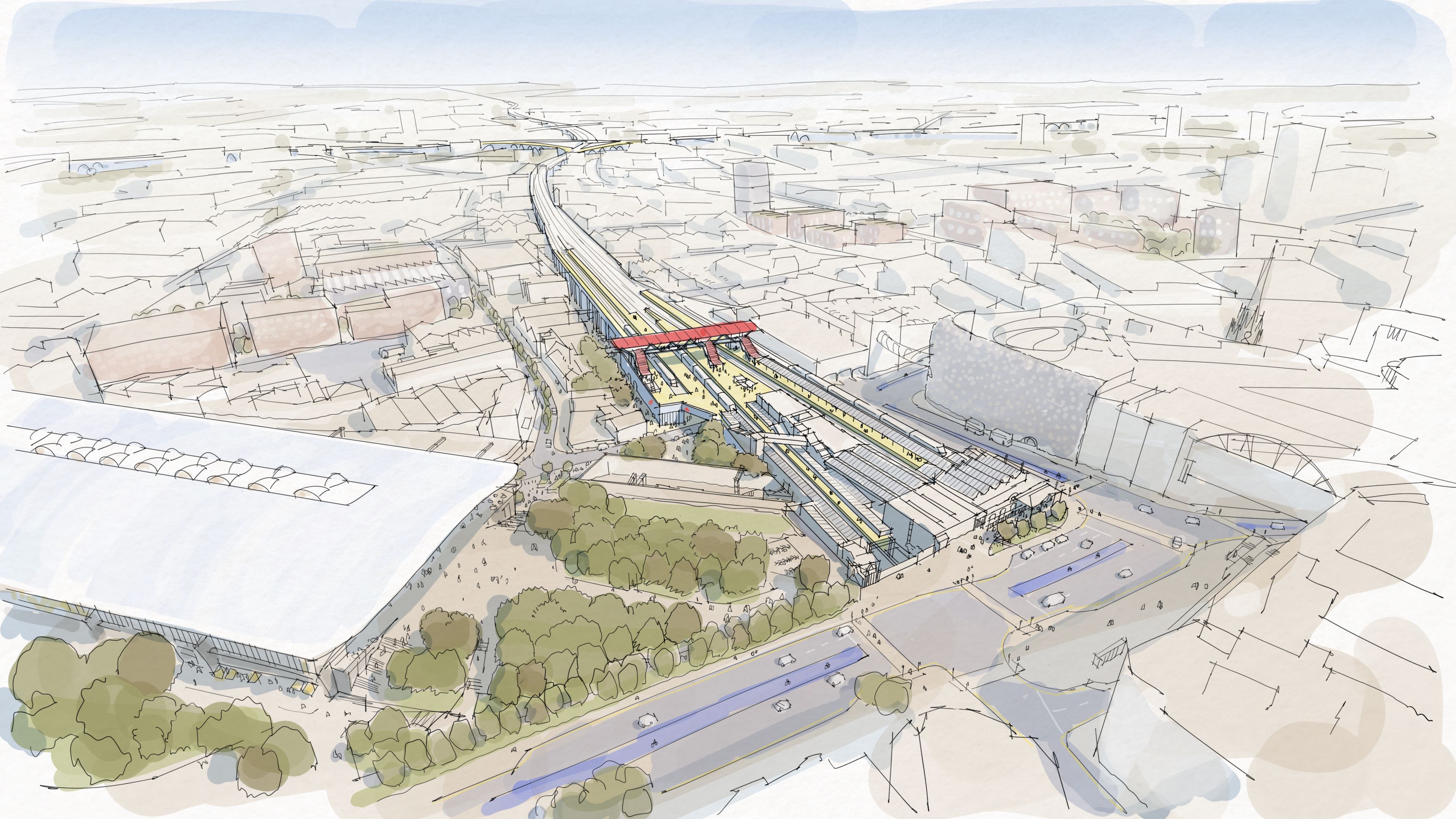
The press release has a spectacular picture, which I’m showing here.
Note.
- High Speed Two’s Curzon Street station is on the left.
- Birmingham Moor Street station is in the centre.
- There appears to be parkland between the two stations.
- Is that the West Midlands Metro running across in front of Moor Street station?
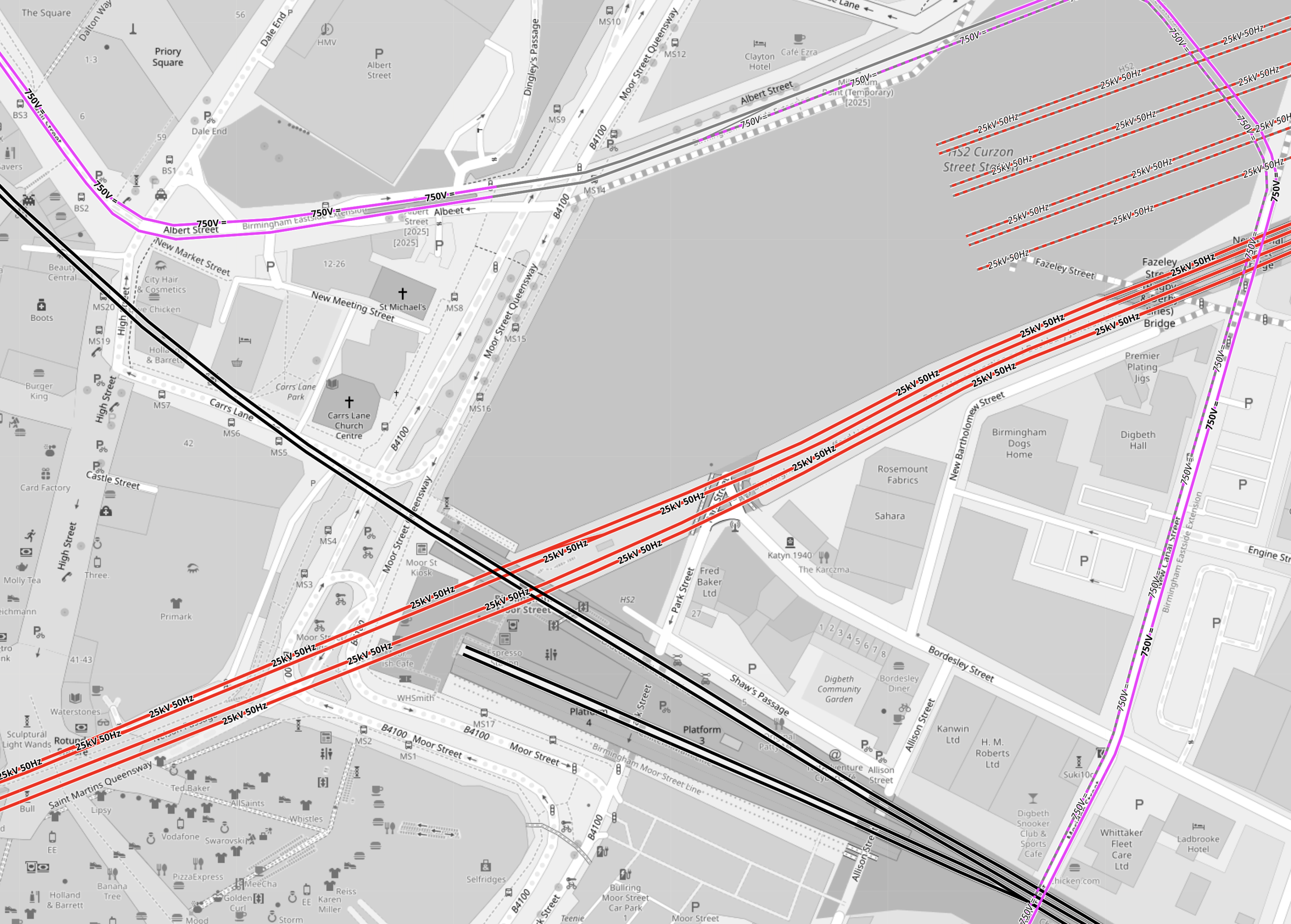
This OpenRailwayMap shows the railway lines in the area.
Note.
- Electrified tracks are shown in red.
- Tracks without electrification are shown in black.
- West Midlands Metro tracks are shown in mauve.
- The red tracks going diagonally across the map are the four electrified tracks going into Birmingham New Street station.
- Birmingham New Street station is off the map to the West.
- To the North of the tracks going into Birmingham New Street station, there are the seven platforms of High Speed Two’s Curzon Street station.
- The four platforms without electrification are shown South of the tracks into Birmingham New Street station.
- Two platforms at Birmingham Moor Street station are through platforms, that pass under Birmingham City Centre to Birmingham Snow Hill station.
- The other two platforms at Birmingham Moor Street station are bay platforms.
- The West Midlands Metro appears to take a loop around the stations.
But when you get into the words of the press release, there are a lot of vegetables and very little meat.
- The Midlands Rail Hub could cost around £1.75bn if delivered in full.
- The government’s recent spending review committed to progress the next stage of Midlands Rail Hub.
- Alongside this, planning is underway to begin to deliver two smaller but significant upgrades to benefit passengers as quickly as possible.
- The Alliance partners will be VolkerRail, Laing O’Rourke, AtkinsRéalis, Siemens Mobility, and Network Rail.
These four paragraphs indicate the work, that could be done.
The biggest change will be connecting the Chiltern main line, which runs into Moor Street, with the Camp Hill lines which run towards the South West and East Midlands via two new chords in Bordesley, near Birmingham city centre.
The transformation of the network will include running more train services on key routes through Birmingham and significantly improving connections for the millions of people who use the railway every day.
Work will be prioritised to explore how smaller, but vital, pieces of work which will provide passengers and communities with quicker benefits, including new journey options and more trains can be delivered as soon as possible.
They include reopening platform 4 at Snow Hill station so additional Chiltern Railways services can run directly between Birmingham’s business district and London Marylebone, and redeveloping Kings Norton station and the lines through it so extra Cross City trains can be added and new Midlands Rail Hub-enabled services can call there.
Three projects are specifically mentioned.
- The new chords in Bordesley.
- The reopening of platform 4 at Snow Hill station.
- The redeveloping of Kings Norton station.
I shall now look at each in detail.
The New Chords At Bordesley
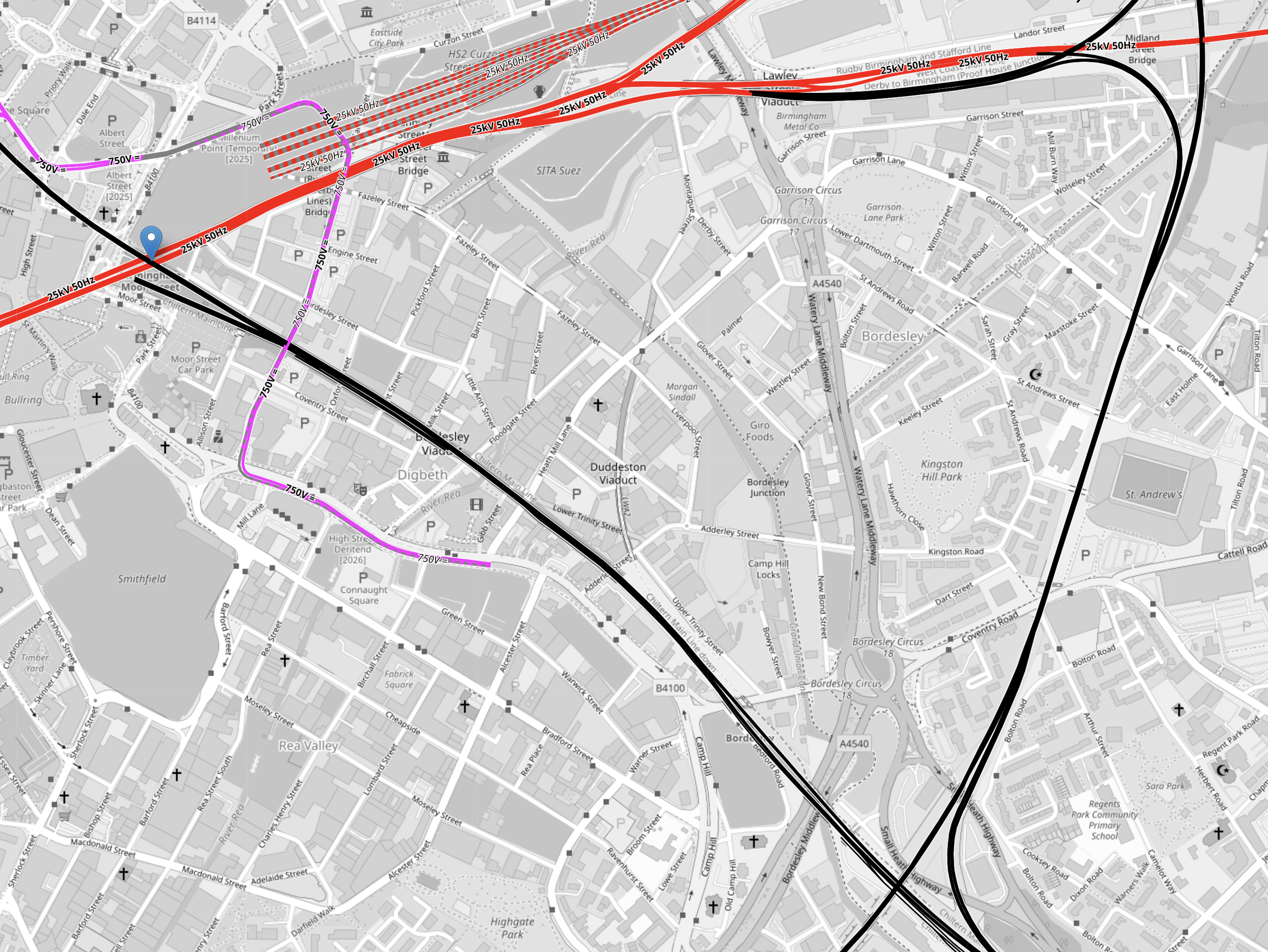
This OpenRailwayMap shows the tracks going into and around Birmingham Moor Street station.
Note.
- Electrified tracks are shown in red.
- Tracks without electrification are shown in black.
- West Midlands Metro tracks are shown in mauve.
- The red tracks going diagonally across the map are the four electrified tracks going into Birmingham New Street station.
- Birmingham New Street station is off the map to the West.
- To the North of the tracks going into Birmingham New Street station, there are the seven platforms of High Speed Two’s Curzon Street station.
- The black track running NW-SE is the Chiltern Main Line between London Marylebone and Birmingham Moor Street stations.
- Birmingham Moor Street station is indicated by the blue arrow in the North-West corner of the map.
- The black track running NE-SW is the Camp Hill Line, that allows services to cross Birmingham.
Two new chords will be built where the Chiltern Main and the Camp Hill Lines cross, to allow services on the Camp Hill Line to call at Birmingham Moor Street station.
Consider.
- The press release described these chords as the biggest change.
- The chords will probably not be fully used, until the new stations are built on the Camp Hill Line.
- There may be need for extra platforms at Birmingham Moor Street station to accommodate any new services.
For these reasons, I suspect that these chords could well be the project that is pushed back to a later date.
The Reopening Of Platform 4 At Snow Hill Station
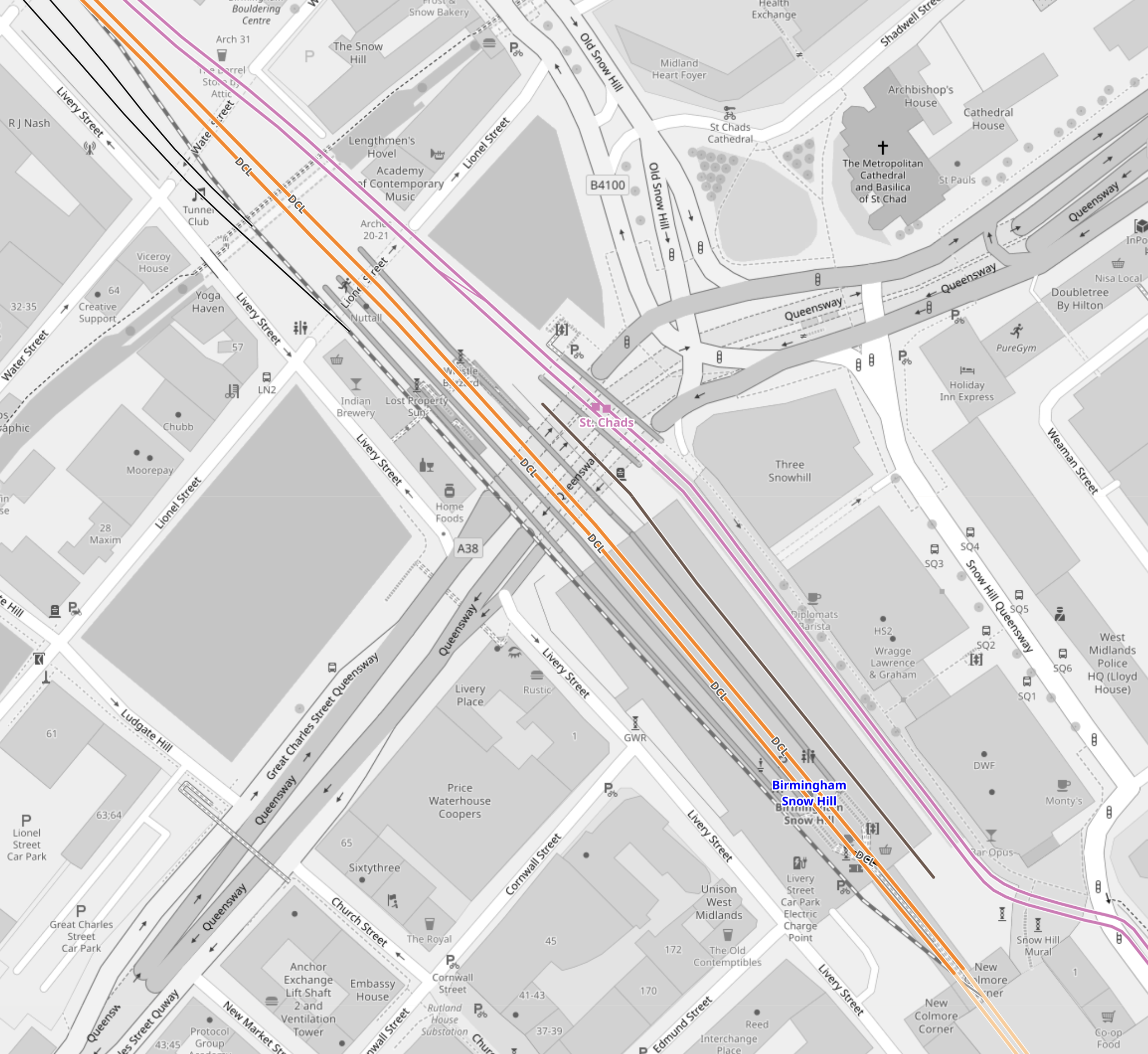
This OpenRailwayMap shows the track layout at Birmingham Snow Hill station.
Note.
- The two lilac tracks are the West Midlands Metro.
- The two orange tracks are the two through tracks between Birmingham Moor Street and Stourbridge Junction stations.
- Platform 3 is the Southbound track to Birmingham Moor Street on the right.
- Platform 2 is the Northbound track to Stourbridge Junction on the left
- Platform 1 is a loop on left.
- Platforms 1, 2 and 3 are all bi-directional.
- The closed Platform 4 is on the right and is shown by the black track.
I would expect that this reopening could be fairly straightforward and may also have worthwhile benefits.
- Would an extra platform, allow all Chiltern services to serve both Birmingham Moor Street and Birmingham Show Hill stations?
- Chiltern would probably find it easy to extend services from Birmingham to the North-West of the city.
- In this century, services have run as far as Wrexham from Marylebone.
- If all Chiltern services terminated at Birmingham Show Hill station would this have operational and/or marketing advantages?
- If all Chiltern services terminated at Birmingham Show Hill station would this, make it easier for some passengers to get a train to London and the South?
- If all Chiltern services terminated at Birmingham Show Hill station would this release a platform at Birmingham Moor Street station for other services?
These are a few pictures of Birmingham Snow Hill station.
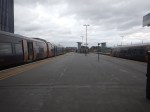
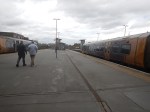
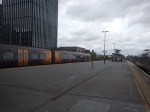
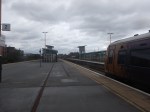

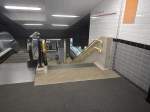

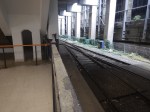

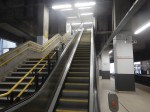

Platform 4 at Birmingham Snow Hill station could be a Build One Platform-Get One Free At Another Station situation!
The Redeveloping Of Kings Norton Station
This will probably be needed for running services on the Camp Hill Line, so why not get some of the work done early, so the rebuilding doesn’t effect existing services?
This OpenRailwayMap shows the Eastern end of Kings Norton station
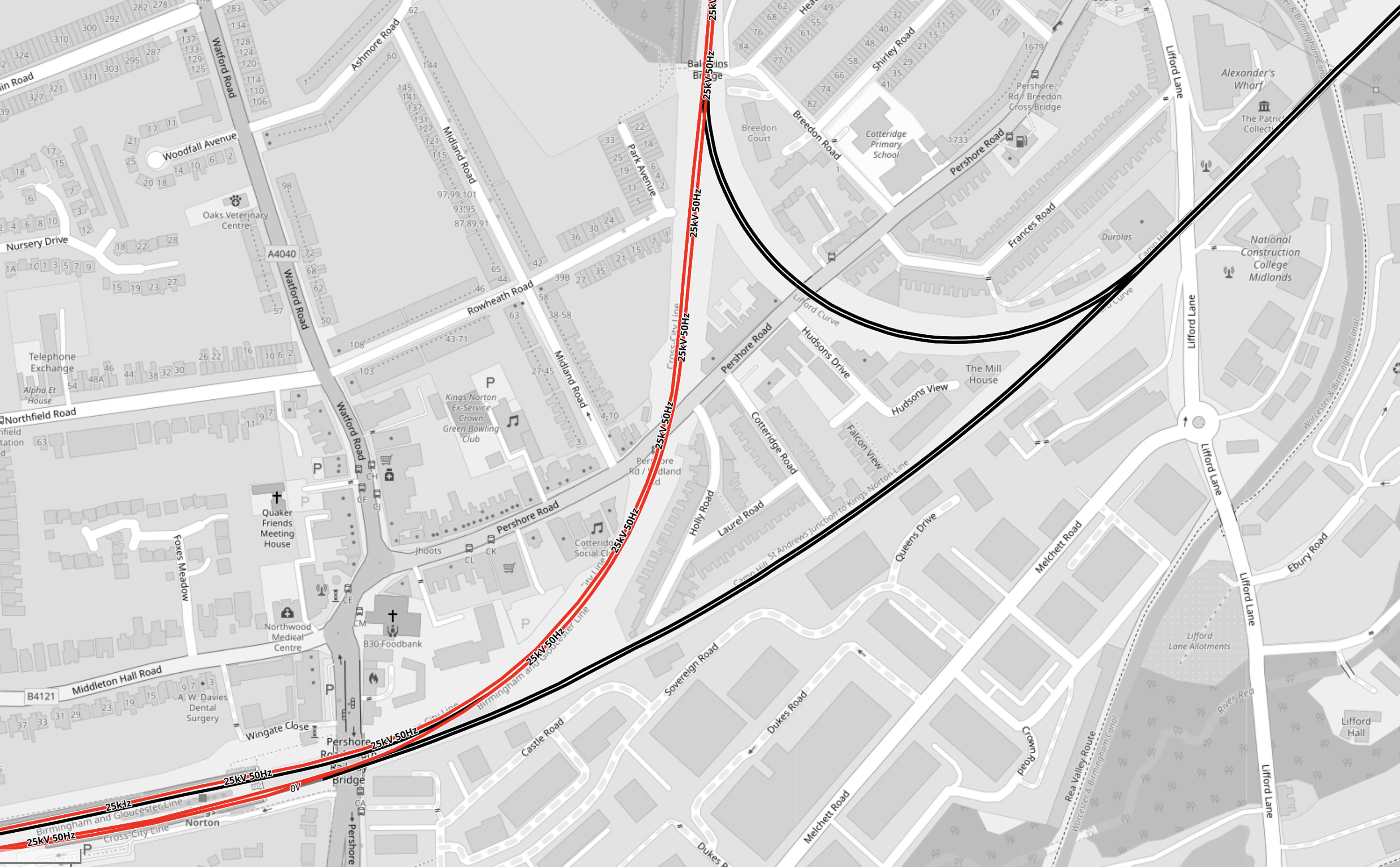
Note.
- Electrified tracks are shown in red.
- Tracks without electrification are shown in black.
- The station has four platforms, but some are unused.
- Two platforms are on an island, with a single platform on either side.
This OpenRailwayMap shows the Western end of Kings Norton station.
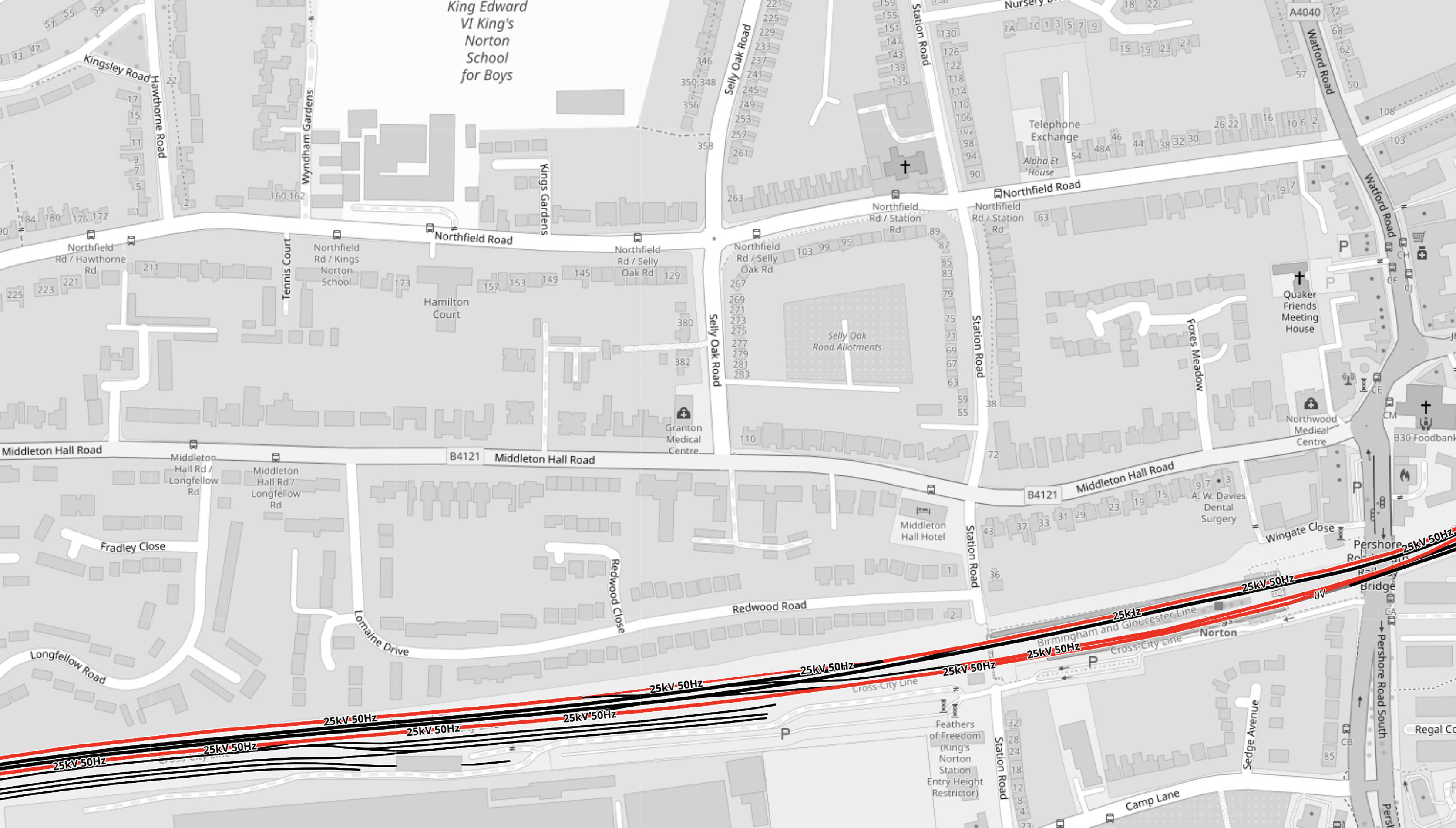
The notes to the previous map apply.
These two paragraphs from the Wikipedia entry for Kings Norton station, describe the station.
With the development of both bus and tram services, the need for such a large facility reduced from the 1930s onwards. The result is that today although all four platforms remain in place, only the outer two are in passenger use, with the middle island platforms now derelict.
Refurbished as part of the Cross-City line in 1978, it retained some of its original features following refurbishment, unlike the other ‘cross city line’ stations. The original station building survived, leased out for commercial purposes, until it was demolished in February 2006 for safety reasons. An extension car park provides a Park and Ride facility.
Disabled-access doesn’t seem to be the best either.
These pictures show the station.
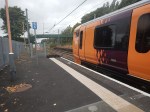
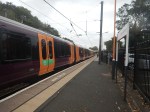
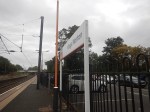
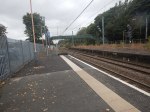
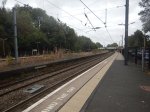
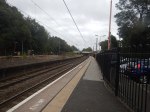
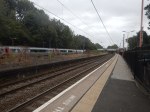
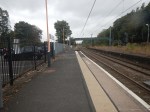
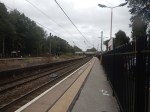
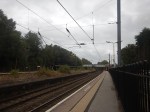
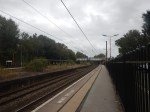
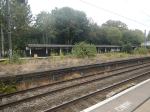
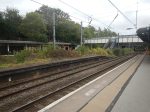
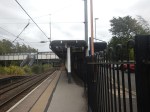
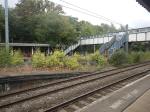
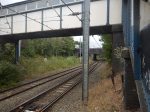
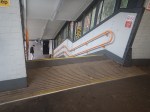
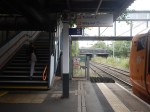
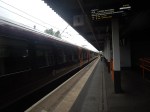
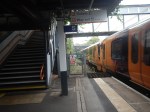
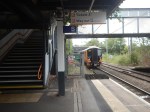
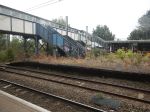
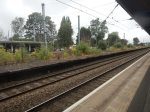
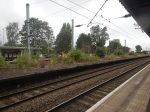
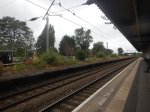
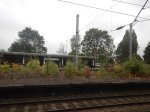
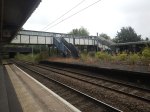
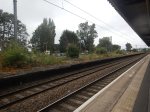
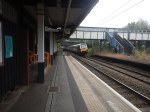
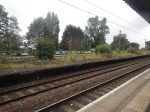
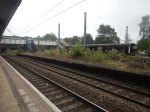
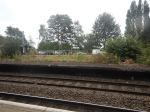
Note.
- As I guessed, there is no disabled-access.
- But there are Braille markings on the handrails down to the platforms.
- Two CrossCountry trains are seen going through the station.
- The local Class 730 trains, lights and information screens appeared to be new.
- Three platforms are electrified, but the fourth is not.
- The electrification structure could probably be used to electrify the fourth platform.
- Only the two outside platforms ; 1 and 4 are in use, with the central island platforms ; 2 and 3 left derelict.
- There is car parking and possibly space for more.
- The two active platforms are 150 metres long and the six-car Class 730 trainstrains appear to be 144 metres long.
- The Class 220 trains, that are run by CrossCountry Trains appear to be 93 metres long.
It was one of the scruffiest stations, that I’ve ever seen.
These are my thoughts on the station.
Handling The Camp Hill Line
Refurbishing Kings Norton Station
I don’t feel, that this will be the most horrendous of jobs, as it is very much a job, where all the rubbish and wild forest is removed and new platforms and a bridge are built.
Thoughts On Tram-Trains In Manchester
The State Of Public Transport In the North
Over the last few years plans have been put in place to improv the state of the public transport of the major cities of the North and progress has started to happen, with new trains, trams and light rail systems being planned and in some cases coming into service.
Birmingham, Coventry And The West Midlands
A lot of investment has been made and it is continuing.
- Birmingham New Street station has been rebuilt.
- Coventry and Wolverhampton stations have been remodelled.
- Two new stations were built in Birmingham for the Commonwealth Games.
- A large number of new Class 730 local trains are being brought into service.
- Birmingham stations are being updated for High Speed Two.
- The West Midland Metro has been extended at both ends and a second line is under construction.
Transport in the wider West Midlands has been greatly improved.
Derby, Nottingham, Sheffield And The East Midlands
The major investment in this area is the electrification of the Midland Main Line and the provision of new Hitachi electric Class 810 trains.
In addition the following has been done.
- The Hope Valley line between Manchester and Sheffield has been improved.
- Derby station has been improved.
- The local trains have been refurbished.
- The power supply has been improved.
- An application for an Open Access service to Sheffield has been made.
The improvements in the East Midlands, will not be on the same scale as in the West Midlands, but they will make a difference.
Leeds, Bradford And West Yorkshire
For decades, West Yorkshire and especially Bradford has lagged behind the rest of the North.
But at least things are stirring.
- Plans have been laid to create a through station in Bradford.
- Leeds station has been refurbished.
- An extra platform is being added at Bradford Forster Square station.
- The TransPennine Upgrade is underway to electrify between Huddersfield and York.
- Hitachi have developed a battery-electric high speed train for the TransPennine route.
- Bradford is installing a hydrogen electrolyser, so that the city can have hydrogen buses to cope with the hills.
- Plans are now being developed to create a metro for Leeds and Bradford.
West Yorkshire is closing the gap to the rest of the North.
Liverpool And Merseyside
Again, a lot of investment has been made.
- The approaches to Liverpool Lime Street station have finally been sorted, with more tracks and new signalling.
- Liverpool Lime Street station has been improved and is now one of the finest stations in Europe.
- Trains are now approaching High Speed Two times between Crewe and Liverpool.
- More services between London and Liverpool can now be planned, with the arrival of new Class 807 trains.
- Some new stations have been built and more are planned.
- A large number of new Class 777 local trains are being brought into service.
Transport in the wider Merseyside has been greatly improved.
Newcastle, Tyneside And Northumberland
The area is getting investment, but not as much in proportion as others.
- The Metro trains are being replaced and the Metro itself, is getting a major update.
- The East Coast Main Line has received improvements to power supplies, signalling and some bottlenecks.
- The Northumberland Line to Ashington is being brought back into operation.
It’s a start, but if the Northumberland Line is a success, I can see a call for more line re openings.
Manchester And Greater Manchester
If you look at each of the areas, they generally have one or more large projects.
- Birmingham, Coventry And The West Midlands – Birmingham New Street station, Class 730 Trains, High Speed Two, West Midland Metro
- Derby, Nottingham, Sheffield And The East Midlands – Midland Main Line, Class 810 Trains, Hope Valley Line, Open Access To Sheffield
- Leeds, Bradford And West Yorkshire – Leeds station, Bradford improvements, TransPennine Upgrade, Battery-Ekectric Trains, Leeds Metro
- Liverpool And Merseyside – Liverpool Lime Street Improvements, Class 807 Trains, Class 777 Trains
- Newcastle, Tyneside And Northumberland – Metro upgrade with New Trains, Northumberland Line
So what improvements are in the pipeline for Greater Manchester?
This Wikipedia entry is entitled Proposed Developments Of Manchester Metrolink.
The proposed developments include in the Wikipedia order.
- New Metrolink Stop: Stop to serve new housing development proposed at Elton Reservoir on the Bury Line.
- New Metrolink Stop: Stop to serve new housing development proposed at Sandhills on the Bury Line.
- New Metrolink Stop: Stop to serve new housing development proposed at Cop Road on the Oldham and Rochdale Line.
- Airport Line extension to Terminal 2: A short extension of the Airport Line from the current Manchester Airport station to the site of the expanded Terminal 2.
- Airport Line extension to Davenport Green: An extension of the Airport Line from Roundthorn to the site of the proposed Manchester Airport High Speed station on the HS2 high speed network.
- Oldham–Heywood via Rochdale tram-train pathfinder: A tram-train service utilising the heavy rail Calder Valley line to connect Oldham to Heywood through Rochdale railway station.
- Manchester Airport–Wilmslow via Styal tram-train pathfinder: A tram-train service operating on the southern section of the heavy rail Styal Line between Manchester Airport and Wilmslow in Cheshire.
- South Manchester–Hale via Altrincham tram-train pathfinder: An extension of Metrolink’s Altrincham Line using tram-train to reach Hale on the heavy rail Mid-Cheshire line.
- Improved Metrolink frequency between Piccadilly and Victoria stations: Increasing capacity to provide a direct service from Rochdale and Oldham to Manchester Piccadilly.
- Interventions to improve Metrolink capacity and reliability: Includes improvements to turnback facilities and double-tracking currently single-track sections.
- Further interventions to improve Metrolink capacity and reliability: Includes longer vehicles, a third depot and double-tracking currently single-track sections.
- Manchester–Stalybridge extension: An extension of the East Manchester Line from Ashton-under-Lyne to Stalybridge.
- Manchester–Middleton extension: A proposed spur from the Bury Line connecting to the town of Middleton.
- Oldham–Middleton extension: A spur from Oldham to Middleton.
- MediaCityUK–Salford Crescent: A line connecting the MediaCityUK tram stop to the Salford Crescent railway station interchange. Further new Metrolink.
- Connections between Salford Crescent, Inner Salford and the City Centre: Extension of the MediaCityUK–Salford Crescent line into the regional centre.
- Completion of the Airport Line (Wythenshawe Loop): Completion of the Wythenshawe Loop by connecting the Metrolink lines between the Davenport Green and Manchester Airport Terminal 2 extensions.
- Port Salford/Salford Stadium extension: Extending the Trafford Park Line from the Trafford Centre to a proposed container terminal at Port Salford.
- Glossop tram-train: A tram-train service utilising the Glossop line between Manchester and Glossop in Derbyshire.
- Marple tram-train: A tram-train service utilising the Hope Valley line branches north of Marple towards Manchester.
- Manchester–Wigan via Atherton tram-train: A tram-train service utilising the Atherton section of the Manchester–Southport line between Manchester and Wigan.
- Manchester–Warrington tram-train: A tram-train service utilising the southern route of the Liverpool–Manchester lines between Manchester and Warrington.
- Stockport–Hazel Grove tram-train: A tram-train service between Stockport and the suburb of Hazel Grove.
- Stockport–Manchester Airport tram-train: A tram-train service between Stockport and Manchester Airport.
- Rochdale–Bury via Heywood tram-train: Extension of the Oldham–Heywood tram-train pathfinder from Heywood to Bury.
- Manchester Airport–Mid Cheshire tram-train: A tram-train service from Manchester Airport using a proposed Western Link rail line to the Mid-Cheshire line.
- Stockport–Ashton via Denton and Reddish tram-train: A tram-train service utilising the Stockport–Stalybridge line from Stockport to Ashton.
- Cornbrook–Manchester Airport via Timperley tram-train: A tram-train service from Cornbrook using the Altrincham line to Timperley, the Mid Cheshire line to Baguley, then the Wythenshawe Loop to Manchester Airport.
- Regional centre metro tunnel: Providing capacity for more services on the network.
- Oldham–Greenfield via Grotton extension: A Metrolink spur from Oldham town centre to Greenfield railway station on the Huddersfield line.
- Oldham–Royton extension: A Metrolink spur from the Oldham and Rochdale line to the town of Royton.
Note.
- The number of times that tram-trains are mentioned.
- But with its numerous rail and tram lines, Greater Manchester is ideally suited for conversion to tram-trains.
- There are three pathfinder routes for tram-trains, which will be converted first to prove the technology.
These are my detailed thoughts on tram-trains in Greater Manchester,
All Routes Could Be Run By Identical Tram-Trains
If this can be arranged, it is surely preferable from the operator, staff and passengers point-of-view.
Tram-Trains Can Run On Secondary Routes Like The Calder And Hope Valley Lines
In Manchester, this would enable some routes to be swapped from the rail to the tram network.
It would also allow trams to run between networks, so you could have a direct tram service between say Stockport and Sheffield on the Hope Valley Line.
Tram-Trains Can Be Faster
Tram-trains can be faster, when running on rail lines, so they don’t hold up expresses.
What Do Tram-Trains Look Like?
This is one of Sheffield’s Class 399 tram-trains at Rotherham Parkgate.
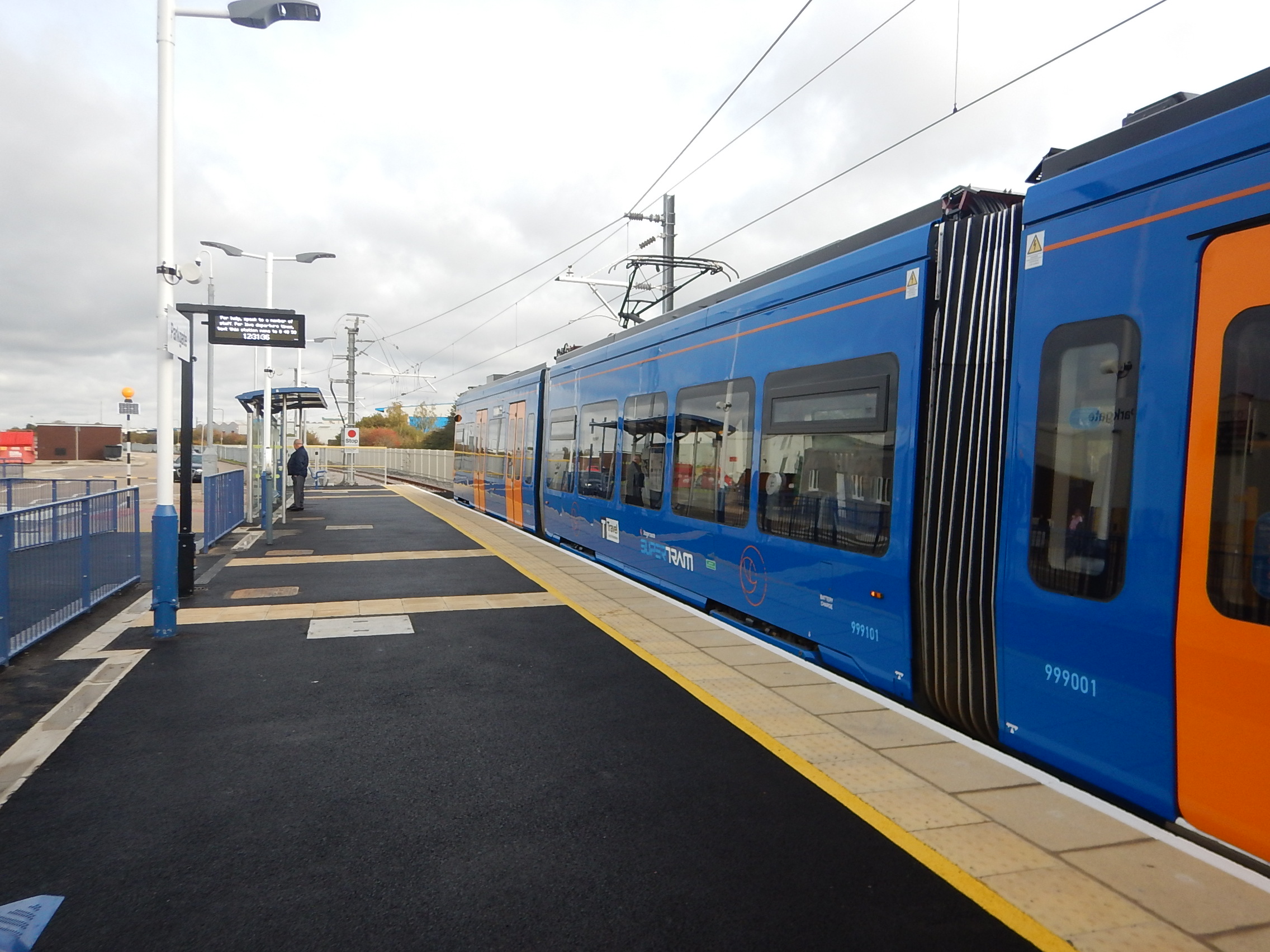
Note.
- This tram-train is a member of the Stadler Citylink family.
- this version can be powered by either 750 VDC or 25 KVAC.
- The Welsh version will also have battery-power.
- It is a three-car tram train.
- There is step-free access.
The Wikipedia entry for the Stadler Citylink has lots more details.
Stadler have just launched a new smaller one- or two-car tram-train.
This image from the press release shows the prototype hydrogen-powered one-car RS ZERO.
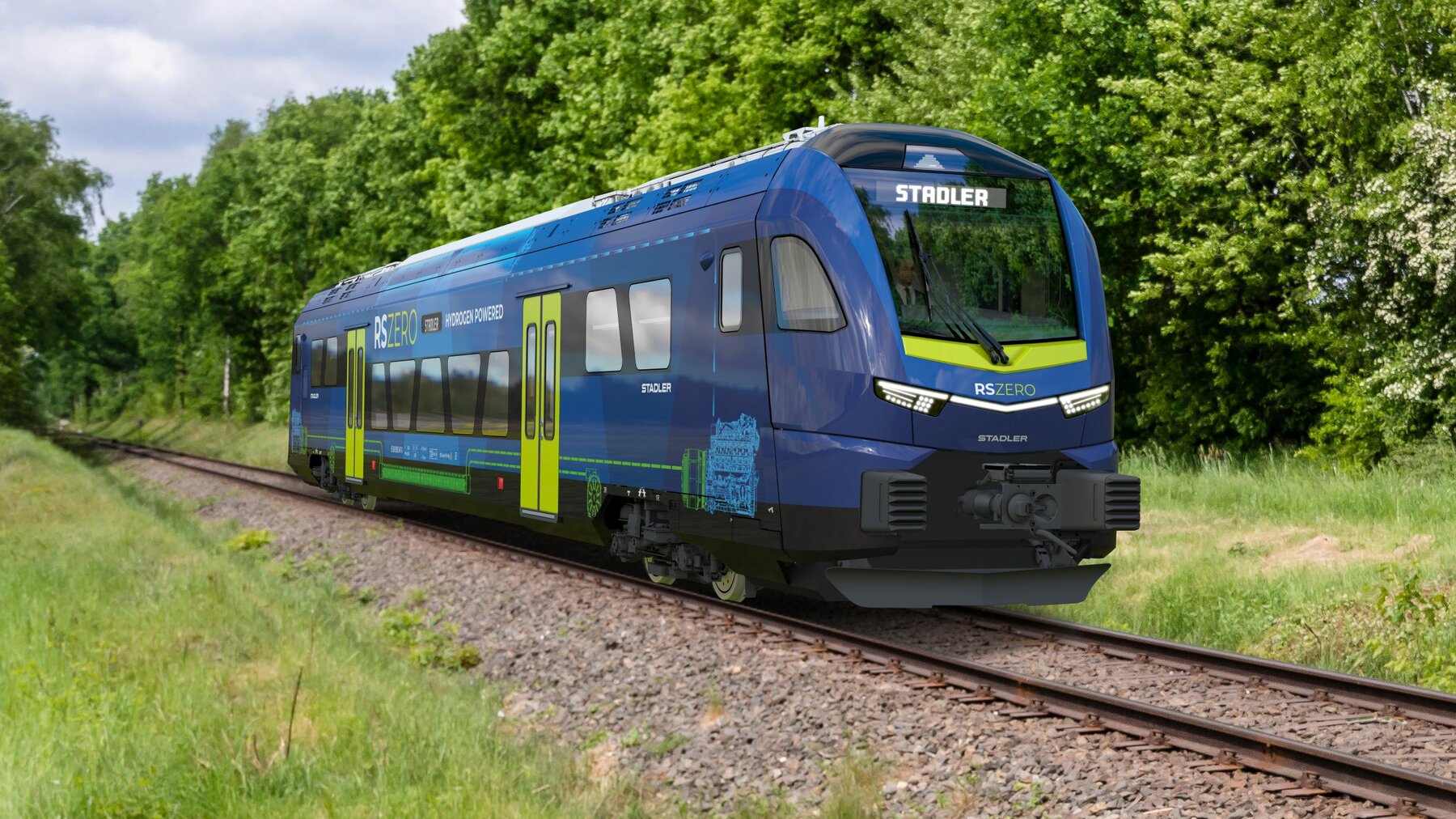
Note.
- The Regio-Shuttles can run as up to seven car trains.
- These RS ZERO are powered by overhead electrification, battery or hydrogen power.
- They can carry 170 passengers at 75 mph.
- They can run as train-trams using the Chemnitz model on compatible tram networks.
- The interiors are very flexible.
- An RS ZERO can be fitted with toilets for the posher parts of Manchester.
- Typically, a one-car RS ZERO handles a similar passenger load to a one-car Metrolink vehicle.
The more I compare the RS ZERO with the Metrolink’s trams, the more it looks like Stadler’s design has a Metrolink order firmly in its sights.
A Simple Tram-Train Example
The Altrincham Line of the Metrolink, runs between Altrincham and Deansgate-Castlefield in Central Manchester.
- Tram-trains would be capable of sharing the tracks with the current trams.
- Initially, they would run an identical service to the same destinations in the North.
- At either Navigation Road or Altrincham stations, they would switch to the heavy rail track.
- They would then travel to Hale or whatever station is determined to be the terminus.
Tram-trains would be a simple way of extending a tram service along a heavy eail line.
The Range Of The RS ZERO
This article on the Railway Gazette is entitled Prototype RS Zero Hydrogen Or Battery Railcar For Secondary Lines Unveiled At InnoTrans, has this paragraph.
The hydrogen powered RS Zero has a range of more than 700 km in the single car version, and a two-car version would offer more than 1 000 km. Battery trains will offer ranges of 80 to 110 km or 90 to 180 km. The maximum speed is 120 km/h.
As Chester and Manchester is only 45 miles or 72.4 kilometres, ways and means of running the battery versions on the route should be possible.
In fact, as Stockport and Manchester Piccadilly is already electrified at 25 KVAC and a return trip to Manchester Piccadilly from Stockport probably takes about twenty-five minutes, I would envisage that an RS ZERO would leave Stockport for Chester with a full battery. As Stockport and Chester is only 39.2 miles or 63 kilometres, the RS ZERO should do the trip if it started with a full battery and had a short length of electrification at Chester to top up the battery, if needed.
Other Possible Tram-Train Routes From Stockport
It is indicated the Metrolink would like to run other tram-train routes from Stockport.
- Ashton – Not sure of the route
- Buxton – 31.8 km
- Hazel Grove – 5 km – Electrified
- Manchester Piccadilly – 9 km – Electrified
- Manchester Airport – Not sure of the route
- Sheffield – 59 km – Will be electrified at Sheffield
Note.
- This would speed up Sheffield services.
- Buxton would be an interesting route and would probably use Newton’s friend to help on the return.
I suspect that nearly all local services from Manchester through Stockport could be run by battery-electric or hydrogen tram-trains.
The Glossop Line Could Be Converted To Tram-Train
It’s already electrified so why not?
Conclusion
It strikes me, that a lot of Manchester’s suburban rail network could be converted to RS ZERO tram-trains.
The RS ZERO tram-trains could also be used on existing tram routes to convert them to tram-train operation and extend them.
As a bonus Manchester’s trains would be substantially decarbonised.
Observing Trains At Stafford Station
I’m fairly certain, that I’ve only been to Stafford once in my life, in the past. That would be in 1968, when I went to English Electric in the town, when I was looking for a job on leaving Liverpool University.
In the end, my first job on leaving was at ICI in Runcorn.
As Stafford station, is on the West Coast Main Line, I’ve been through the station many times, on my way to Liverpool, Manchester, Preston, Scotland and other places in the North West of England.
I travelled North to Stafford in one of London Northwestern’s Class 350 trains, which definitely had ironing board seats. Some of these trains are being replaced with new Class 730 trains.
Stafford Station
This OpenRailwayMap shows the layout of platforms at the station.
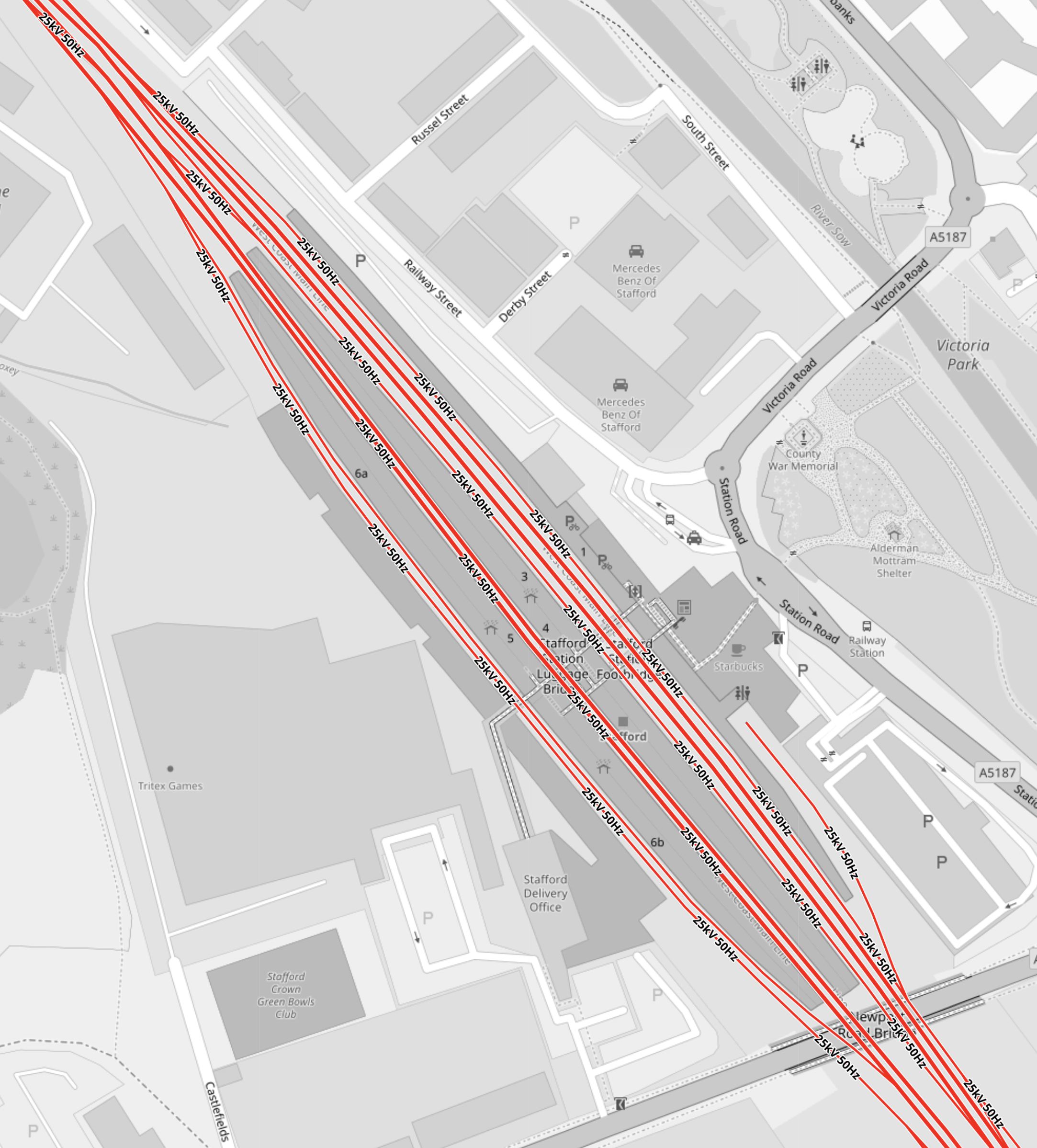
Note.
- Platforms are numbered starting with Platform 1 in the East.
- There are five through tracks for passenger trains and a double-track goods loop.
- All tracks are electrified and bi-directional.
- The platforms are three hundred metres long, but I feel they could be lengthened to take the 400 metre long High Speed Two trains.
- The platforms are certainly long enough for pairs of 200 metre long High Speed Two trains, to split and join at the station.
These pictures show Stafford station.
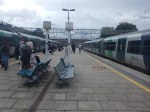
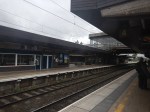
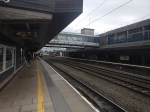
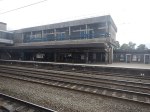
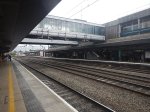
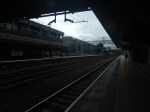
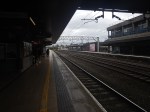
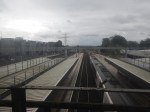
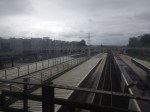
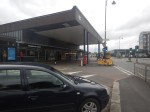
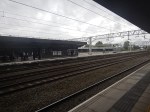
Note.
- The station was built of concrete in the early 1960s.
- It has a unique feature, in that there is a waiting area above the tracks, so kids of all ages can watch the trains speed through.
- It has been improved several times in recent years.
- It is step-free with several lifts.
I feel, the station could be converted into a major High Speed Two hub station.
High Speed Two Services
This graphic shows High Speed Two services after Phase 2b is completed.
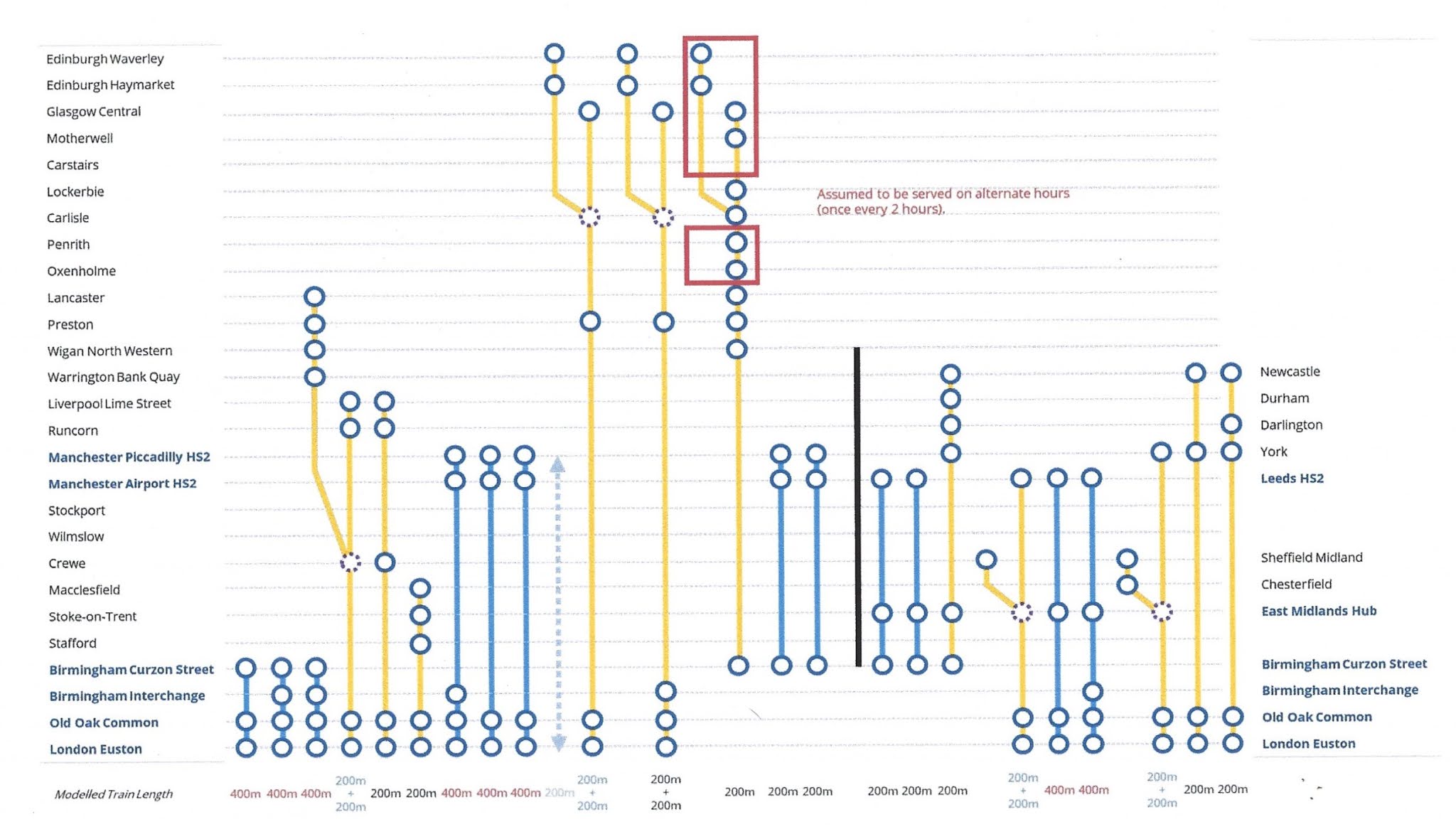
Note.
- Everything to the right of the vertical black line has now been cancelled
- Services shown in blue are run by High Speed Two Full Size trains.
- Services shown in yellow are run by High Speed Two Classic-Compatible trains.
- Each of these trains will have a frequency of one train per hour (tph).
These High Speed Two trains pass through Stafford.
- London and Lancaster/Liverpool Lime Street – Split/Join at Crewe
- London and Crewe/Runcorn/Liverpool Lime Street
- London and Stafford/Stoke-on-Trent/Macclesfield
- London and Manchester Airport/Piccadilly
- London and Manchester Airport/Piccadilly
- London and Manchester Airport/Piccadilly
- London and Edinburgh/Glasgow – Split/Join at Carlisle
- London and Edinburgh/Glasgow – Split/Join at Carlisle
- Birmingham and Edinburgh/Glasgow
- Birmingham and Manchester Airport/Piccadilly
- Birmingham and Manchester Airport/Piccadilly
In addition space will need to be found for these other services.
- Avanti – London and Chester/North Wales
- Avanti – London and Blackpool
- Freight – London and Liverpool/Manchester and Scotland
That gives a total of at least fourteen tph through Stafford station or one every 257 seconds.
Between Stafford and Crewe, with the completion of the flyover at Norton Bridge, there is effectively four tracks all the way, so this should give enough capacity to allow fourteen tph between Stafford and Crewe.
Between Stafford and Handsacre junction, where High Speed Two will join the Trent Valley Line about half the route is four-track with the rest being just two-track.
Will the two-track section be able to handle fourteen tph? I suspect it will, especially, as it is sandwiched between two four-track sections.
These are my thoughts about making the most of capacity through Stafford station.
Could Pairs Of High Speed Two Trains, Split And Join At Stafford?
Stafford station has 300 metre long platforms and pairs of High Speed Two Trains are 400 metres long.
Looking at maps and pictures of Stafford station, I suspect that lengthening the platforms at Stafford would be possible.
In the provisional High Speed Two service diagram, that I displayed earlier, these are two services.
- London and Crewe/Runcorn/Liverpool Lime Street
- London and Stafford/Stoke-on-Trent/Macclesfield
These could be run as a pair of trains between London and Stafford.
One advantage of running the two services as a pair, is that it would reduce the number of trains between Stafford and Handsacre junction by one, which might help the scheduling of trains through the double-track section, of the Trent Valley Line.
Fitting In The London and Chester/North Wales Services
Consider.
- These important services will soon be run by five-car Class 805 trains.
- The trains are diesel-electric.
- A pair would be 260 m long.
- There are ten trains per day (tpd) on the route.
The service has a few problems.
- It takes up a path between Crewe and Handsacre junction via Stafford, where train paths are at a premium.
- It is not zero-carbon.
- If London and Holyhead times were reduced, it would probably attract more passengers to the route.
As there are plenty of spare paths on High Speed Two, due to the cancellation of the Eastern leg, the easiest way to speed up the service would be to use High Speed Two between Handsacre junction and London.
200 metre long High Speed Two Classic-Compatible trains could be used, but this would need one of the following.
Electrification between Crewe and Holyhead. Although this was promised by the last government, I suspect the antis will stop it.
Partial electrification between Crewe and Holyhead. As Crewe and Holyhead is only 105.5 miles, I suspect a creditable scheme to use battery-electric trains could be developed. These trains could be useful in opening up High Speed Two to other destinations.
Could Other Services Piggy-Back On London and Chester/North Wales Services?
The London and Chester/North Wales services would all be run by 200 metre long High Speed Two trains.
There would be no reason, why on the London end of the journey, they could be paired with another High Speed Two train to and from another destination.
- They could split and join with a Blackpool service at Crewe.
- They could split and join with a Barrow service at Crewe.
- They could split and join with a second Stoke-on-Trent/Macclesfield service at Stafford.
Services like these, would improve the coverage of High Speed Two.
As with the joining of the Liverpool Lime Street and Macclesfield services, the pairing of trains reduces the number of paths needed on the double-track section of the Trent Valley Line to the South of Stafford.
Other Splitting And Joining At Stafford
It may be possible to arrange other splitting and joining at Stafford.
By rearranging the Manchester and/or the Scottish services, it might be possible to reduce the number of trains, through the double-track section of the Trent Valley Line.
There are certainly several possibilities.
Conclusion
Stafford station could be crucial, in making High Speed Two Lite feasible.
Destination Manchester
The title of this post is the same as the title of this page on the London North Western Railway web site.
The page introduces, the operator’s proposed new service to Manchester.
As a progressive rail operator we’re always looking to develop our services and timetables to provide a better travelling experience for our customers. We are ambitious and our team seek innovative solutions to create new journey opportunities.
That’s why we have developed proposals for our trains to begin serving Manchester for the first time. Under the plans, our existing hourly service between Crewe and London Euston would be extended to Manchester city centre from summer 2026.
Following the cancellation of the northern leg of HS2, these proposals will provide much-needed connectivity between Manchester, the West Midlands and London, with thousands of extra seats every day.
In more detail, the extended London Euston and Crewe service to Manchester Victoria station, will create the following.
- Additional capacity and comfortable, affordable journeys to and from Manchester city centre
- A great alternative to car and coach travel, with fares up to 50% cheaper than the main intercity train operator
- New regular direct services to Warrington for passengers at Milton Keynes, Rugby and Lichfield
- New regular direct services to Manchester for passengers at Rugeley, Lichfield, Tamworth and Atherstone
Note.
- The service will pass through Warrington Bank Quay, Stockport, Earlestown, Newton-le-Willows, Eccles and Salford Central to reach Manchester Victoria, so could be a comprehensive service to the Northern and Western parts of Manchester City Centre. It would just depend on the stopping pattern in the City Centre.
- There would be good connections to Manchester Metrolink at Eccles and Manchester Victoria.
- All stations on the Manchester Metrolink can be reached either direct or with a single change from Manchester Victoria.
- Manchester Metrolink is touch-in and out with a credit card.
- Manchester Victoria is very well connected by rail to cities and important destinations across the North including Blackburn, Blackpool, Bradford, Burnley, Halifax, Hebden Bridge, Huddersfield, Leeds, Liverpool, Preston, Wigan and York.
- The page talks of a London Euston and Manchester Victoria time of three hours and ten minutes.
- Manchester Stations is a group of the four stations; Manchester Piccadilly, Manchester Oxford Road, Manchester Victoria and Deansgate. Often a ticket to Manchester Stations is a few pounds cheaper and more convenient, if you are visiting several places in the City Centre.
The London Euston and Manchester Victoria service looks to me to be a well-thought out proposal.
A New Connection To Manchester Airport
Under a title of Anything Else on the page on the London North Western Railway web site, this is said.
As well as the proposal to extend our London Euston-Crewe services to Manchester Victoria, we are also proposing to begin running trains to Manchester Airport. This will involve extending our existing service between Stafford and Crewe, providing direct connectivity to the airport from Stoke-on-Trent and Staffordshire. More details on this proposal will be announced in due course.
Note.
- The extended Stafford and Manchester Airport service could call at Stone, Stoke-on-Trent, Longport, Kidsgrove, Alsager, Crewe, and possibly Wilmslow and Styal.
- Stafford, Stone, Stoke-on-Trent, Longport, Kidsgrove and Alsager would gain direct services to and from Manchester Airport.
- It would appear that the current Stafford and Crewe service waits in Stafford station for at least fifteen minutes.
- The current Stafford and Crewe service appears to always use platform 6 at Stafford.
- The current Euston and Crewe service appears to always use platform 3 at Stafford.
- The current Crewe and Euston service appears to always use platform 1 at Stafford.
- The current Birmingham and Liverpool service appears to always use platform 5 at Stafford.
- The current Liverpool and Birmingham service appears to always use platform 4 at Stafford.
I suspect that trains can be timetabled, so that the following is possible.
- An hourly London Euston and Manchester Airport service with a quick step-free change at Stafford between the London Euston and Manchester Victoria service and the Stafford and Manchester Airport service.
- An hourly Manchester Airport and London Euston service with a quick step-free change at Stafford between the Manchester Airport and Stafford service and the Manchester Victoria and London Euston service.
- An hourly Birmingham New Street and Manchester Airport service with a quick cross-platform change at Stafford between the Birmingham New Street and Liverpool Lime Street service and the Stafford and Manchester Airport service.
- An hourly Manchester Airport and Birmingham New Street service with a quick step-free change at Stafford between the Manchester Airport and Stafford service and the Liverpool Lime Street and Birmingham New Street service.
Note.
- I suspect more changes at Stafford could be cross-platform.
- I also suspect that it is possible to arrange that all services to the same destination, leave from the same platform, at the same time or times each hour.
- It would appear too, that if you want a cheap ticket price to Liverpool Lime Street, Manchester Victoria or Stoke-on-Trent, then you may have to change at Stafford.
It appears all more affordable London Northwestern Railway trains will go via Stafford.
I have some further thoughts.
Stafford And Manchester Airport Timings
With all the stops, it looks like Stafford and Manchester Airport will take about 78 minutes, but if they used the West Coast Main Line and didn’t stop the time could be reduced to just under an hour.
The Class 730 Trains
The services will be run by 110 mph Class 730 trains.
In 2018, there was talk of a bi-mode 125 mph Aventra, which I wrote about in Bombardier Bi-Mode Aventra To Feature Battery Power.
Currently, the Class 730 trains are 110 mph trains.
Would it help timetabling and capacity if these trains could be stretched to 125 mph?
Avanti West Coast
Several Avanti West Coast services stop at Stafford.
Their services could be half-an-hour quicker to Stafford, but they wouldn’t have the same stopping patterns.
In response to the competition, Avanti West Coast might run a few Manchester Airport Expresses using their new Class 805 trains.
A Second Service Between Stoke And Manchester Airport
I feel this might be needed and perhaps it could be faster, by using the direct route between Stafford and Crewe.
Avanti West Coast could use it to create a one-change fast service between London Euston and Manchester Airport, if they felt such a service were to be needed.
Conclusion
I like this proposal.
But there is a lot of fine tuning to do!
Alstom Plans To Operate Its Own Passenger Train Service In The UK For The First Time
The title of this post, is the same as that of this press release from Alstom.
These two bullet points, act as sub-headings.
- Alstom is partnering with SLC Rail to form a new open access rail operation between North Wales, Shropshire, the Midlands and London
- Formal application now being submitted to the Office of Rail and Road (ORR) with passenger service sought from 2025
These are the first three paragraphs.
Alstom, global leader in smart and sustainable mobility, plans to operate a new passenger rail service across England and Wales. Working in partnership with consultancy SLC Rail, the open access operation will be known as Wrexham, Shropshire and Midlands Railway (WSMR).
As the country’s foremost supplier of new trains and train services, and a leading signalling and infrastructure provider, Alstom will operate its own rail service in the UK for the first time.
WSMR is seeking to introduce direct connectivity to and from North Wales, Shropshire, the Midlands and London that doesn’t exist today, linking growing communities and businesses, and making rail travel more convenient, enjoyable and affordable.
I can’t remember a service proposal being put forward by a train manufacturer since the privatisation of UK’s railways in the 1990s.
This is some more information and my thoughts.
The Route
This paragraph from the press release, describes the route.
The proposal envisages a service of five trains per day in each direction Monday to Saturday, with four travelling both ways on Sundays. Trains will stop at Gobowen, Shrewsbury, Telford Central, Wolverhampton, Darlaston, Walsall, Coleshill Parkway, Nuneaton and Milton Keynes on their journey between Wrexham General and London Euston.
Note.
- The proposed call at the new Darlaston station.
- The route is electrified between Euston and Nuneaton and Walsall and Wolverhampton.
- Much of the route North of Nuneaton is on tracks with a maximum speed of 70-80 mph.
The route is in these sections.
- Euston and Nuneaton – 96.7 miles – electrified
- Nuneaton and Walsall – 26.7 miles
- Walsall and Wolverhampton – 6.7 miles – electrified
- Wolverhampton and Shrewsbury – 29.7 miles
- Shrewsbury and Wrexham General – 30.3 miles
That is a total of 190.1 miles or 380.2 miles round trip.
I suspect that the service will need bi-mode trains.
Should The Service Call At Wellington?
This article on the BBC is entitled Rail Company Urged Not To Forget Wellington.
This is the sub-heading.
A rail company which is bidding to bring back a direct service between Shropshire and London has been urged not to forget a town.
These are the first three paragraphs.
Wrexham, Shropshire and Midlands Railway said it was preparing to apply to the government to run the service.
Trains would stop at Gobowen, Shrewsbury, Telford, Wolverhampton, Walsall, Coleshill and Nuneaton.
But Telford and Wrekin Council said the omission of Wellington as a stop was “short-sighted”.
Although Wellington is smaller than than Shrewsbury and Telford, it looks like a bit of analysis would provide a solution, that would be acceptable for all parties.
The Trains
In the press release, this phrase is used.
positive impact to both communities and the environment.
I can’t see any more electrification being erected on the route, so the trains will need to be bi-mode.
- Bi-mode diesel trains won’t have a positive impact on the environment.
- As the route between Wolverhampton and Wrexham General is not electrified, a battery-electric train would need a range of at least 60 miles or 120 miles for the round trip, if there were no charging at Wrexham General.
- But Alston are developing a Hydrogen Aventra, which I wrote about in Alstom And Eversholt Rail Sign An Agreement For The UK’s First Ever Brand-New Hydrogen Train Fleet.
So could Alstom be using this route to trial and showcase their new Hydrogen Aventra?
I believe that the route will be very suitable for a hydrogen train.
- Changeover between electric and hydrogen power can always take place in a station.
- All hydrogen refuelling could be performed at one end of the route.
- A large proportion of the UK’s green hydrogen is produced by INEOS at Runcorn, which is less than fifty miles from Wrexham. A refuelling tanker could supply the train, as they do on some hydrogen routes in Germany.
- London has only small amounts of hydrogen infrastructure.
I suspect that refuelling will be done at the Wrexham end of the route.
This Alstom visualisation shows the train.
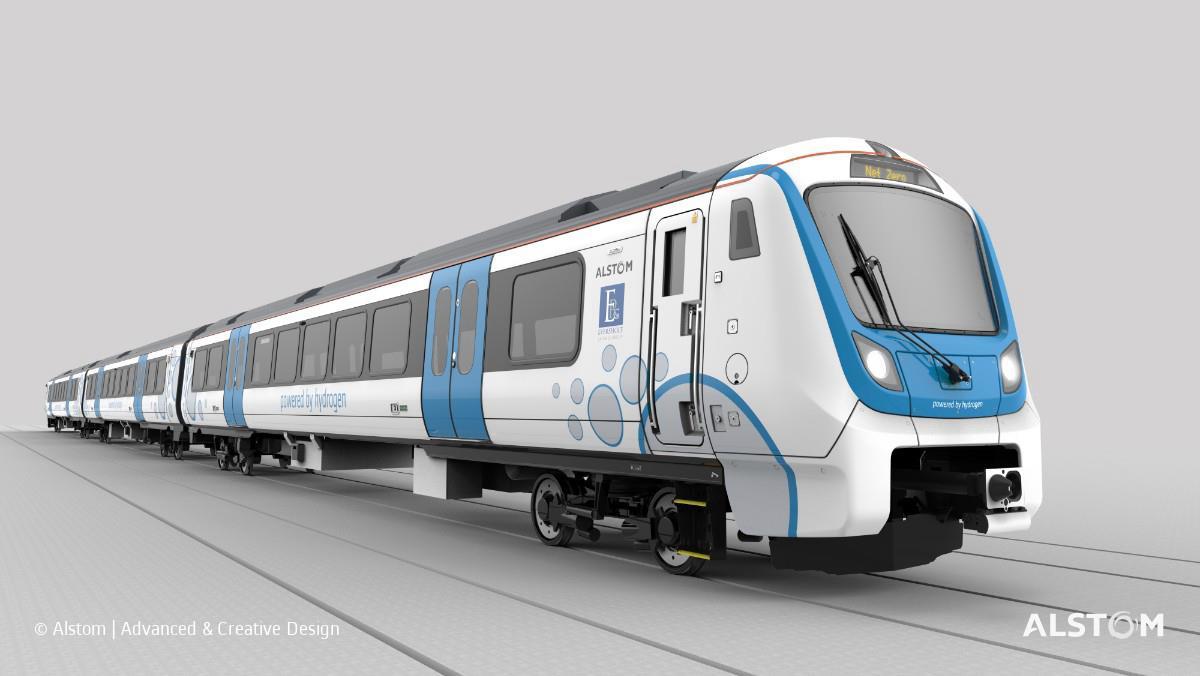
But it is only a three-car train.
- That is not a problem, as Aventras can be lengthened as required to the length required for the number of passengers.
- Some Aventras, like the Class 701 trains for South Western Railway, have even been ordered as ten-car trains.
- Two three-car trains may also be the ideal capacity, running as a six-car train.
So capacity will not be a problem.
If it is assumed that Alstom’s trains for the WSMR route, can use the overhead wires, where they exist, each trip between Wrexham General and London will require a total of 86.7 miles or 140 kilometres of running on hydrogen.
- A round trip will therefor require 280 kilometres of running on hydrogen.
- But between London Euston and Nuneaton, it will just be another electric train.
- I suspect that like the similar Class 730 train, it will be capable of 110 mph on the West Coast Main Line.
- Alstom’s Coradia iLint hydrogen train has a range of around a 500-800 kilometres on hydrogen.
- The WSMR trains will probably be 100 mph trains using hydrogen on a route, where that speed is possible.
So if a Hydrogen Aventra has a similar range to the Coradia iLint, it will be able to do two round trips before refuelling.
How Long Will The Service Take?
West Midlands Trains, who use the similar Class 730 trains take one hour and eleven minutes between London Euston and Nuneaton with a single stop at Milton Keynes Central.
As the WSMR trains will use the same route, I suspect the same time can be used.
As Nuneaton and Wrexham General are 93.4 miles apart a table can be created showing the time for the rest of the journey for different average speeds
- 50 mph – 1 hour 52 minutes – 3 hours 3 minutes.
- 60 mph – 1 hour 33 minutes – 2 hours 44 minutes.
- 70 mph – 1 hour 20 minutes – 2 hours 31 minutes.
- 80 mph – 1 hour 10 minutes – 2 hours 21 minutes.
Note.
- The first time is the Nuneaton and Wrexham General time and the second time is the overall journey time.
- Typical Avanti West Coast services via Crewe and a change at Chester, take between two-and-a-half and three hours.
I suspect, if the WSMR trains can keep the speed up through the Midlands, that two hours and 30 minutes could be possible.
Could The Hydrogen Aventra Run At 125 mph Under The Wires?
In March 2018, I wrote Bombardier Bi-Mode Aventra To Feature Battery Power, which was based on this article in Rail Magazine.
These are a few points from the article.
- Development has already started.
- Battery power could be used for Last-Mile applications.
- The bi-mode would have a maximum speed of 125 mph under both electric and diesel power.
- The trains will be built at Derby.
- Bombardier’s spokesman said that the ambience will be better, than other bi-modes.
- Export of trains is a possibility.
- Bombardier’s spokesman also said, that they have offered the train to three new franchises. East Midlands, West Coast Partnership and CrossCountry.
Have Alstom looked at what they bought from Bombardier and decided the following train is possible?
- Five-cars or what the customer needs.
- 125 mph under the wires.
- Running on hydrogen away from the wires.
- 100 mph on tracks without electrification.
Obviously, maximum speeds would depend on track limits.
Looking at 125 mph Avanti West Coast trains that have a Milton Keynes stop between London Euston and Nuneaton, they can reach Nuneaton ten minutes quicker than West Midlands Trains 110 mph Class 730 trains.
Two hours and 30 minutes between London Euston and Wrexham is looking increasingly possible.
Are we seeing an audacious proposal from Alston to sell new trains to CrossCountry and a host of other franchises?
Conclusion
London Euston and Wrexham would appear to be an excellent route for an Aventra-based hydrogen train.
- It can probably cruise at 110 mph on the West Coast Main Line between London Euston and Nuneaton.
- All switchovers between electrification and hydrogen can be performed in electrified stations.
- Hydrogen would only be used North of Nuneaton.
- The train can be refuelled at Wrexham General, with fuel supplied from INEOS at Runcorn.
- Given the typical 1000 km. range of hydrogen trains, a train can probably do three round trips without refuelling.
I can see this being a service with an excellent operational record.
Alstom And VMS Present New Battery-Powered Train
The title of this post, is the same as that of this article on Rail Technology Magazine.
This is the sub-heading.
Alstom and the Central Saxony transport authority, Verkehrsverbund Mittelsachsen (VMS) in Germany have unveiled a new battery-powered train developed by Alstom.
These first four paragraphs are very information rich.
A total of eleven Coradia Continental battery-electric trains have been ordered by VMS. These trains will enter service in 2024 on the Chemnitz-Leipzig line.
The Coradia Continental battery-electric train has a range of up to 120 kilometres and can be operated under catenary as well as on non-electrified sections of line. The three-car trains are 56 metres long and can seat up to 150.
The new train can also reach maximum speeds of 160 km/h in battery mode. The capacity of the high-performance lithium-ion batteries is calculated to guarantee catenary-free operation on the Chemnitz-Leipzig line without sacrificing performance.
Müslüm Yakisan, president of Alstom Region DACH, said: “Alstom’s ambition is to be the global leader in sustainable mobility, reducing emissions and pollution in catenary-free operation. The presentation of the first battery-powered train developed by Alstom is an important step in this direction.
These seem to be a very useful battery-electric train.
- Battery or catenary operation
- Three-cars of 19 metres
- Fifty seats per car
- 100 miles per hour
A three-car Class 730 train has the following characteristics.
- three cars of 20 metres
- 199 seats.
- 90 miles per hour
Can we have a battery version soon? Please!
New Station Proposed For National Arboretum
The title of this post, is the same as that of this article on Railnews.
This is the first two paragraphs.
It has been revealed that a new station is being proposed at Alrewas between Lichfield Trent Valley high level and Wichnor Junction, which is on the line linking Tamworth and Burton-on-Trent. The original station serving the village of Alrewas was closed in 1965, although the line remained open.
A new Alrewas station would serve the National Memorial Arboretum, which is visited by more than 300,000 people a year and stages 250 events, including services of remembrance. It includes a Railway Industry Memorial, which was unveiled in May 2012, and also a memorial commemorating the thousands of prisoners of war who were forced to work on the infamous Burma Railway in the Second World War.
I first wrote about this proposed station in Everybody Could Do Better For Rail In South Staffordshire.
Two totally unrelated events had happened.
- I heard the exchange during Prime Minister’s Questions and Michael Fabricant was passionate about creating the rail service on the freight-only line to give passenger train access to the National Memorial Arboretum and Alrewas.
- Burton were playing Manchester City in the League Cup, so the Police thought it would be a good idea to shut the M6. Nothing moved for hours and many Burton supporters missed the match.
Note.
- Quite frankly, it is a disgrace, that the National Memorial Arboretum, has been designed for most visitors to come by car.
- The M6 incident was caused by illegal immigrants stuffed into the back of a truck, but surely the Police reaction to shut the motorway for so long was over the top?
- I have been to Burton by train a couple of times and it is one of those places, you wouldn’t go to by train, unless it was absolutely essential.
It would appear that after a quick glance, Michael Fabricant’s proposal could be one of those ideas, that would benefit a lot of travellers.
These are a few thoughts on the new service.
Services To And From Burton-on-Trent Station
I said this about services to and from Burton-on-Trent in Everybody Could Do Better For Rail In South Staffordshire.
If you look at the train services from the town, you can go to faraway places like Glasgow and Plymouth, but services to practical local places like Lichfield, Stoke and Derby are rare. There used to be a service to London, but that was discontinued in 2008.
A regular service between Burton and Lichfield, running at a frequency of two trains per hour (tph) could connect at Lichfield to the following services.
- Hourly services on the West Coast Main Line
- Half-hourly services across Birmingham on the Cross-City Line.
If a decent service via Lichfield had existed, how many fans on that League Cup night, would have used the trains to get to Manchester?
Not many probably, as there would not have been a late train home, as is particularly common in The Midlands. Try getting back to London from Derby, Nottingham or Sheffield, after 21:30 for example!
I am certain, that with a station at Alrewas and a well-designed train service between Burton-on-Trent and Birmingham stations via Alrewas for the National Memorial Arboretum and Lichfield would be a positive addition to the transport system of the area.
Electrification Between Litchfield Tent Valley And Burton-on-Trent Stations
This map from Open Railway Map shows the track between Litchfield Tent Valley and Burton-on-Trent stations.

Note.
- Burton-on-Trent station is in the North-East corner of the map.
- Lichfield Trent Valley station is in the South-West corner of the map.
- Burton-on-Trent and Lichfield Trent Valley stations are probably less than fifteen miles apart.
- The orange line is the Burton-upon-Trent and Birmingham line via Tamworth.
- The yellow line is the Burton-upon-Trent and Birmingham line via Lichfield.
The National Memorial Arboretum is just South of the junction between the orange and yellow lines.
This second map from Open Railway Map shows this junction to a larger scale.
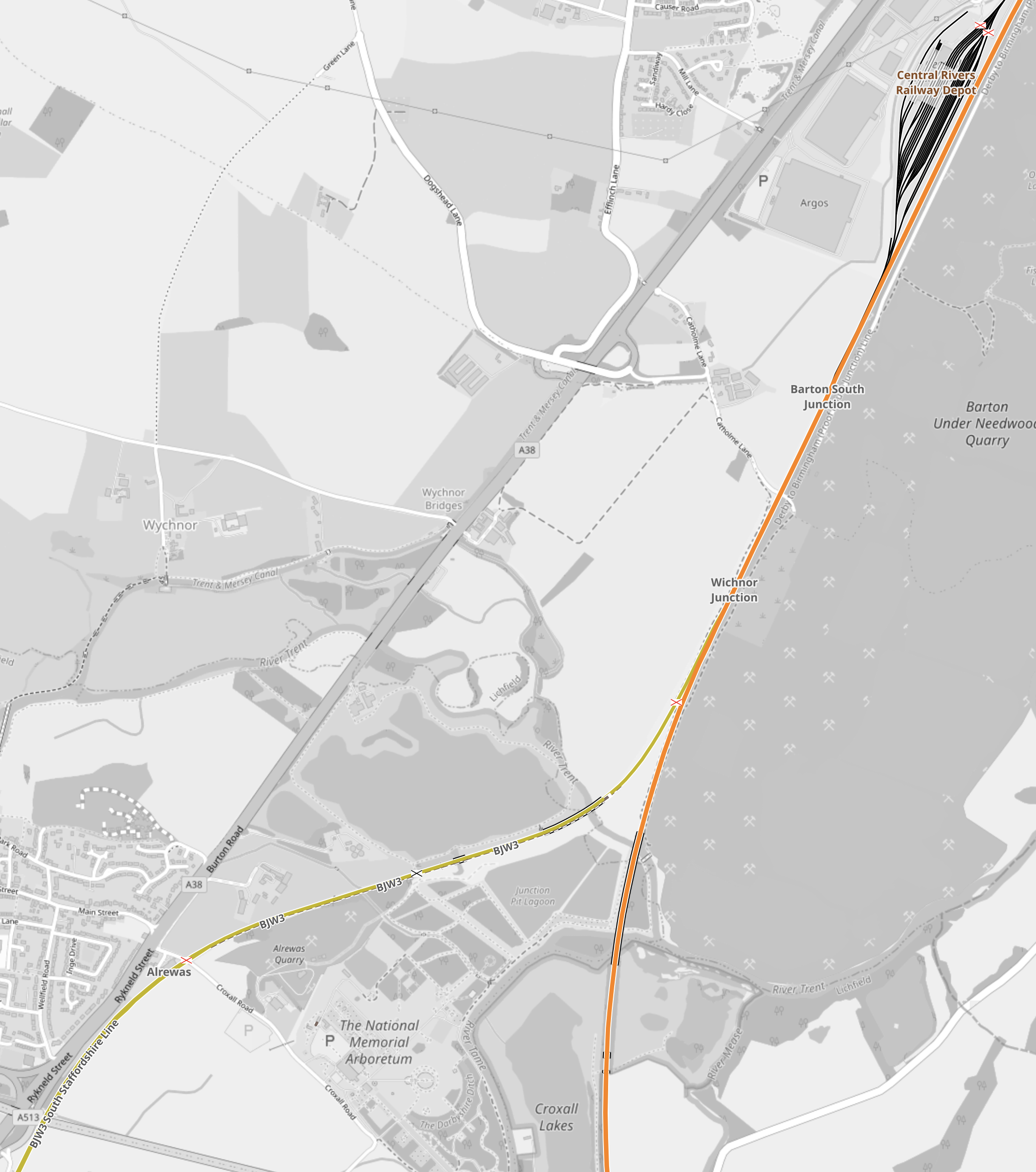
Note.
- The National Memorial Arboretum can be seen between the two tracks.
- The village of Alrewas and the site of the proposed Alrewas station are to the West of the arboretum.
- Central Rivers depot, where CrossCountry trains are serviced, is in the North-East corner of the map.
- I have found a twelve car formation of Class 220 trains running between Birmingham New Street station and Central Rivers depot.
There is electrification at Lichfield Trent Valley station as this picture shows.

This electrification could be extended as far as required.
I would extend the electrification all the way to Burton-on-Trent.
- This would mean that the Class 730 trains used on the Cross-City Line could terminate at Burton-on-Trent station, rather than Lichfield Trent Valley station, after extra stops at Alrewas for the National Memorial Arboretum and possibly another new station at Barton-under-Needwood.
- Excursion trains for the National Memorial Arboretum could be electric-hauled.
- It would also mean that electric trains could reach Central Rivers depot under their own power.
- It would probably require less than fifteen miles of double-track electrification.
- I suspect that the West Coast Main Line electrification could provide enough power for the branch electrification to Burton-upon-Trent.
I doubt that this would be considered a major electrification scheme.
Electric Services Between Birmingham New Street And Leicester Stations Via Burton-on-Trent
Consider.
- Leicester and Burton-on-Trent stations are under thirty miles apart on the Ivanhoe Line.
- The Ivanhoe Line is an existing freight line, that could be opened to passenger trains.
- Leicester is to be electrified in the Midland Main Line electrification.
A battery-electric service could be run between Birmingham New Street and Leicester stations via Burton-on-Trent, Alrewas and Lichfield Trent Valley stations.
It should also be noted that East Midlands Railway run a service between Lincoln and Leicester.
- Nottingham and Leicester will probably electrified with the rest of the Midland Main Line.
- Only thirty-four miles of the route between Leicester and Lincoln is not electrified.
If it were felt to be needed, a battery-electric service could be run between Birmingham New Street and Lincoln stations.
Heritage Rail Excursions To The National Memorial Arboretum
Type “Coach Trips To The National Memorial Arboretum” and you get a good selection of trips from all over the UK.
I believe that the National Memorial Arboretum, would make the ideal destination for steam- or diesel-hauled heritage rail excursions with all the trimmings.
- They could even be hauled by a Class 90 electric locomotive, dating from the late 1980s, if the route between Alrewas and Lichfield were to be electrified.
- Rakes of comfortable Mark III coaches could be used.
- A long platform at Alrewas station would be needed, so that the maximum size of heritage train could be handled.
- For steam locomotives, there may need to be a runround loop.
Track improvements at Lichfield Trent Valley station, may allow direct services from London.
This page on the West Midlands Rail Executive web site is entitled Steam Engine Rolls Into Moor Street Station To Launch New Vintage Trains Partnership.
This is the first two paragraphs.
Historic steam engines are set to play a greater role in the region’s rail network following the signing of a ground-breaking new partnership.
The West Midlands Rail Executive (WMRE) has teamed up with Tyseley-based Vintage Trains in a bid to establish the Shakespeare Line as Britain’s premier mainline heritage railway.
Perhaps, it would be possible to run a heritage train like a short-formation InterCity 125 between Stratford-om-Avon and the National Memorial Arboretum.
Conclusion
Opening up of the Lichfield Trent Valley and Burton route to passenger trains opens up a lot of possibilities.
Alstom Hydrogen Aventras And Extension Of The Birmingham Cross-City Line
In Alstom And Eversholt Rail Sign An Agreement For The UK’s First Ever Brand-New Hydrogen Train Fleet, I give my thoughts on Alstom’s new hydrogen train, which I have called the Alstom Hydrogen Aventra.
In that post, decide that the proposed Alstom Hydrogen Aventras are based on the three-car Class 730/0 trains that have been ordered by West Midlands Trains for Birmingham’s electrified Cross-City Line.
I then go on to say.
There are plans to expand the line in the future and I do wonder if the proposed Alstom Hydrogen Aventras could be the ideal trains for extending the network.
Expansion plans are detailed a section called Future, in the Wikipedia entry for the Cross-City Line, where these plans are indicated.
- Reintroduction of local trains on the Camp Hill Line.
- Extension of electrification and services to Burton-on-Trent via a reopened Alrewas station, which would serve the National Memorial Arboretum.
In addition, the Walsall and Wolverhampton Line is being reopened to passenger trains.
These new and possibly other services will need no new tracks, but more electrification and extra new trains.
In 2015, I wrote Electrification May Be In Trouble Elsewhere, But The Brummies Keep Marching On, which looked at electrification progress in the UK and the Birmingham in particular, where the electrification of the Chase Line seemed to be going well. So unlike in some places, where electrification seems to be accident-prone, Birmingham seems to avoid the sort of problems, that happened in the Preston and Blackpool and GOBlin electrifications.
But the Alstom Hydrogen Aventra gives Birmingham and the West Midlands a unique advantage compared to say Leeds or Manchester.
Birmingham can obtain a unified fleet, which to the passengers and the drivers looks the same, but in fact are two separate classes of three-car trains; the Class 730/0 electric train and the Alstom Hydrogen Aventra.
- Where electrification exists, the Class 730/0 trains will be used and where there is no electrification, the Alstom Hydrogen Aventra will work the route on hydrogen.
- All that is needed is to provide good tracks and signalling and the Alstom Hydrogen Aventras will take you where you want to go.
- Through the centre of Birmingham, these trains will use the existing electrification.
- It would be a network, that would be simple to expand.
The only other English city to use a similar technique will be Liverpool, where Merseyrail’s new Class 777 trains will use battery power outside of the electrified core.
Conclusion
If Birmingham uses their disused but still existing railway lines and adds new trains as required, they can create a world-class suburban network, with the Cross-City Line at its centre
Alstom And Eversholt Rail Sign An Agreement For The UK’s First Ever Brand-New Hydrogen Train Fleet
The title of this post, is the same as that of this press release from Alstom.
This is the first two paragraphs.
Alstom, Britain’s leading train manufacturer and maintenance provider, and Eversholt Rail, leading British train owner and financier, have today announced a Memorandum of Understanding aimed at delivering the UK’s first ever brand-new hydrogen train fleet.
The two companies have agreed to work together, sharing technical and commercial information necessary for Alstom to design, build, commission and support a fleet of ten three-car hydrogen multiple units (HMUs). These will be built by Alstom in Britain. The new HMU fleet will be based on the latest evolution of the Alstom Aventra platform and the intention is that final contracts for the fleet will be signed in early 2022.
This is an Alstom visualisation of the train.
The first thing I notice is that the train doesn’t have the same aerodynamic nose as this current Class 710 train, which is one of the London Overground’s Aventras.
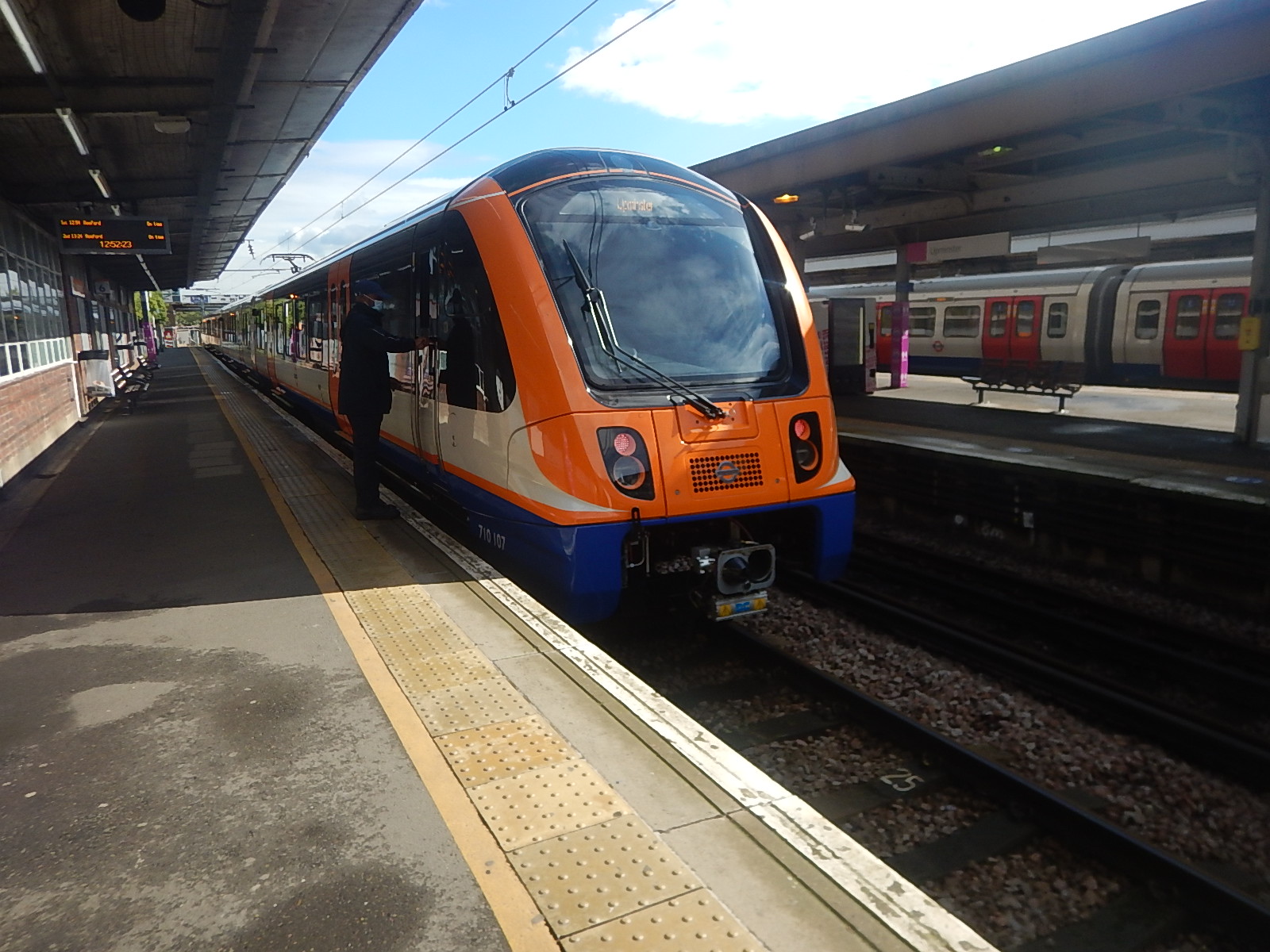
Note how the lights, coupler position and the front-end structure are all different.
These are my further thoughts on the design.
The Aventra’s Traction System
In this article in Global Rail News from 2011, which is entitled Bombardier’s AVENTRA – A new era in train performance, gives some details of the Aventra’s electrical systems. This is said.
AVENTRA can run on both 25kV AC and 750V DC power – the high-efficiency transformers being another area where a heavier component was chosen because, in the long term, it’s cheaper to run. Pairs of cars will run off a common power bus with a converter on one car powering both. The other car can be fitted with power storage devices such as super-capacitors or Lithium-ion batteries if required. The intention is that every car will be powered although trailer cars will be available.
Unlike today’s commuter trains, AVENTRA will also shut down fully at night. It will be ‘woken up’ by remote control before the driver arrives for the first shift
This was published over ten years ago, so I suspect Bombardier (or now Alstom) have refined the concept.
Bombardier have not announced that any of their trains have energy storage, but I have my suspicions, that both the Class 345 and Class 710 Aventra trains use super-capacitors or lithium-ion batteries, as part of their traction system design.
- I was told by a Bombardier driver-trainer that the Class 345 trains have an emergency power supply. When I said “Batteries?”, He gave a knowing smile.
- From the feel of riding on Class 710 trains, as a Control Engineer, I suspect there is a battery or supercapacitor in the drive system to give a smoother ride.
I also feel that the Aventra has been designed, so that it can accept power from a large variety of sources, which charge the battery, that ultimately drives the train.
The Formation Of A Three-Car Aventra
The only three-car Aventra is the Class 730/0 train.
I have not seen one of one of these trains in the metal and the formation can’t be found on the Internet. But Wikipedia does show the pantograph on the middle car.
In The Formation Of A Class 710 Train, I said this.
Here is the formation of the train.
DMS+PMS(W)+MS1+DMS
The plates on the individual cars are as follows.
DMS – Driving Motored Standard
-
- Weight – 43.5 tonnes
- Length – 21.45 metres
- Width 2.78 metres
- Seats – 43
The two DMS cars would appear to be identical.
PMS  -Pantograph Motored Standard
-
- Weight – 38.5 tonnes
- Length – 19.99 metres
- Width 2.78 metres
- Seats – 51
The signifies a wheelchair space.
MS1 – Motored Standard
-
- Weight – 32.3 tonnes
- Length – 19.99 metres
- Width 2.78 metres
- Seats – 52
It is similar in size to the PMS car, but has an extra seat.
So could the formation of a three-car Aventra be?
DMS+PMS(W)+DMS
I have just removed the MS1 car.
This would mean that a three-car Aventra has the following dimensions and capacity.
- Weight – 125.5 tonnes
- Length – 62.89 metres
- Seats – 137
There will probably be a difference between these figures and those of a three-car Class 730 train, as those trains have end-gangways.
Could All The Hydrogen Gubbins Fit Underneath The Train?
These pictures show the space underneath a Class 710 train.
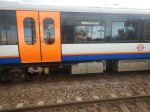
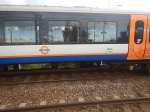
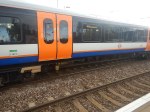
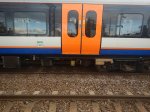
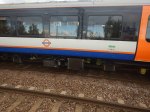
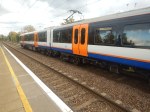
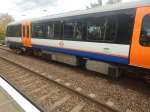
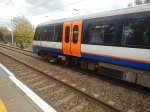
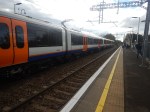
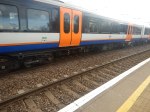
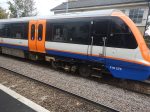
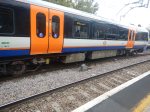
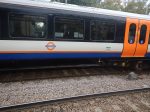

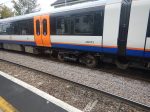
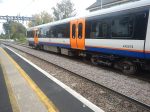
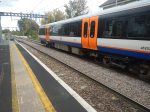
If you also look at Alstom’s visualisation of their Hydrogen Aventra on this post, there would appear to be lots of space under the train.
It should also be noted that Birmingham University’s engineers have managed to put all of the hydrogen gubbins underneath the floor of Porterbrook’s Class 799 train.
Looking at my pictures, you can see the following.
- The two DMS (Driving Motored Standard) cars have large boxes underneath
- The MS1(Motored Standard) car is fairly clear underneath. But this will probably not be there in a three-car train.
- The PMS (Pantograph Motored Standard) car has some space underneath.
If more space needs to be created, I suspect that the cars can be lengthened, between the bogies. The Class 710 trains have twenty metre intermediate cars, whereas some versions have twenty-four metre cars.
I believe that Aventras have been designed, so that various power sources could be installed under the floor.
When the Aventra was designed, over ten years ago, these could have included.
- A diesel generator and all the fuel tanks and cooling systems.
- A battery or other energy storage system.
Since then two other suitable power sources have been developed.
- Rolls-Royce, Honeywell and others have developed small and powerful gas-turbine generators.
- Ballard Power Systems and others have developed hydrogen fuel cell generators.
If you look at the proportions of the Alstom hydrogen train and the pictures of Class 710 trains, I feel that the Alstom train could have the longer twenty-four metre cars.
It may be a tight fit compared to creating the Alstom Coradia iLint hydrogen train, but I would feel it is possible to install a fuel cell or cells, the required cooling and the hydrogen tanks, having seen cutaway drawings of hydrogen-powered double-deck buses on the Wrightbus web site.
Interestingly, the Alstom press release doesn’t mention fuel cells, so could the train be powered by a small gas turbine?
I think it is unlikely, but it is technically feasible.
Does The Alstom Hydrogen Aventra Have Longer Cars?
I have been looking at pictures of Aventras on Wikipedia and in my own archive.
It appears that only Aventras with twenty-four metre carriages have five windows between the pair of double-doors in the intermediate carriages.
This picture shows the PMS car from a Class 710 train.
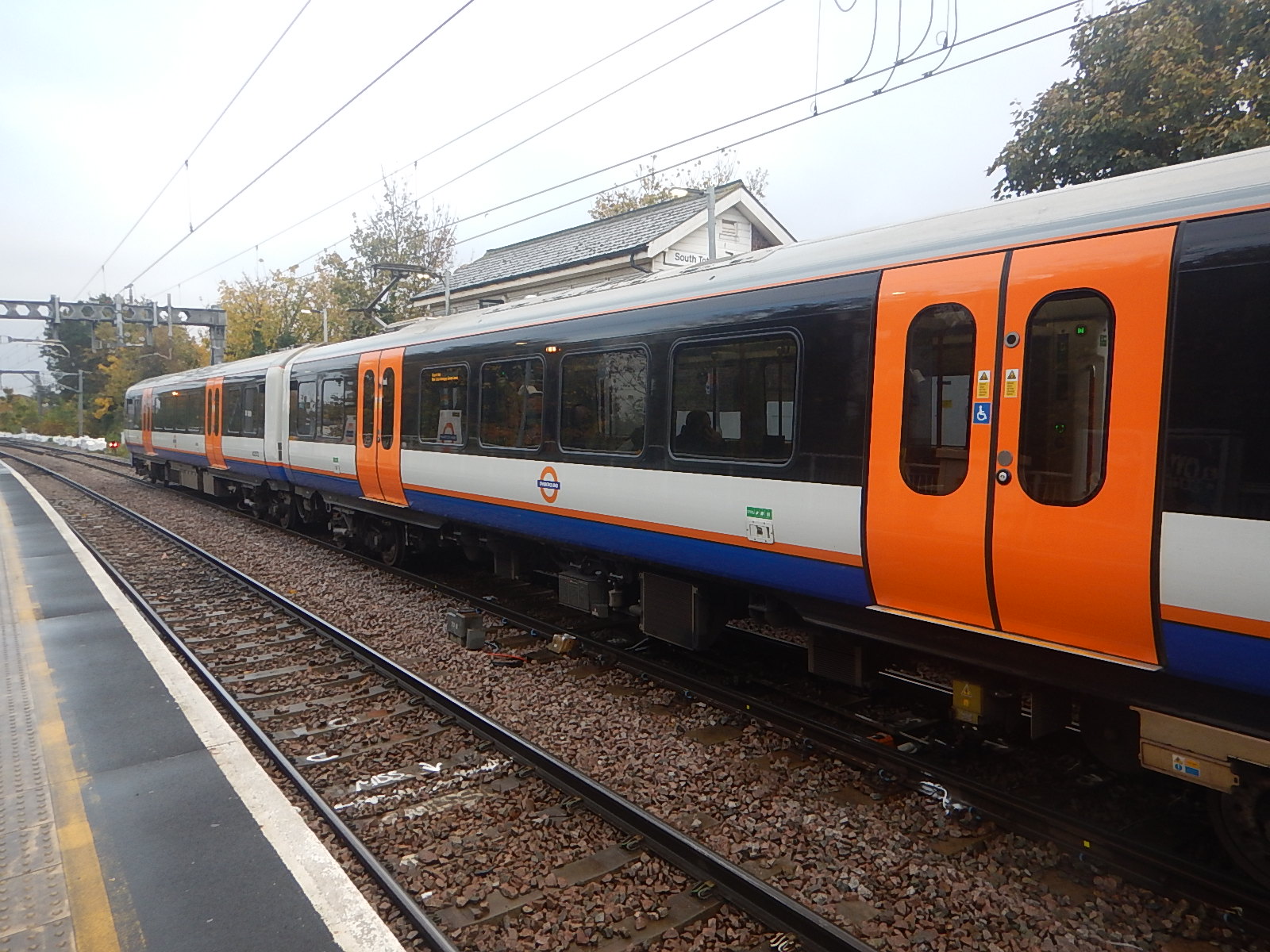
The PMS car is to the right and has four windows between the doors.
This is the side view of one of Greater Anglia’s Class 720 trains.
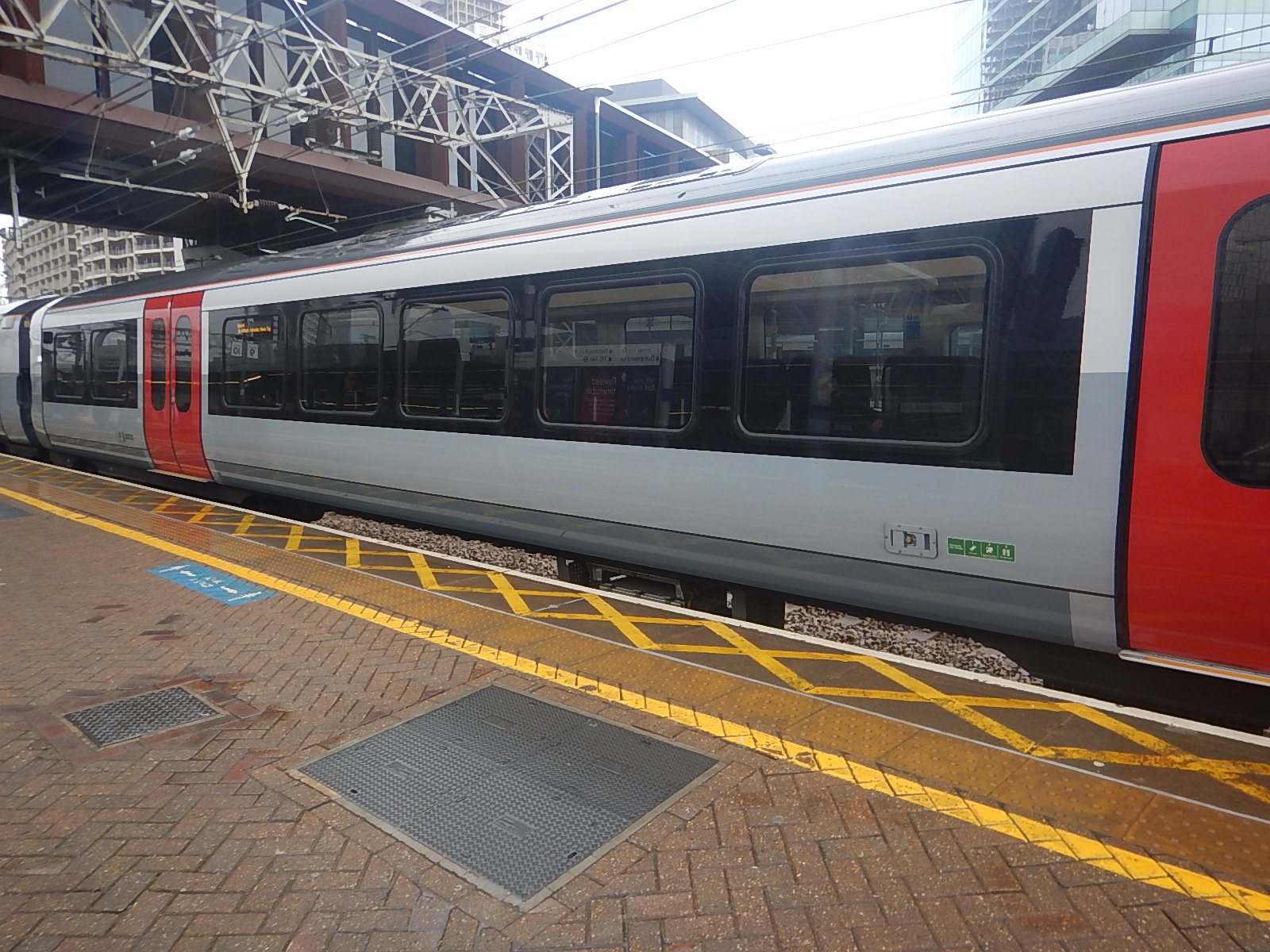
It has twenty-four metre intermediate cars and five windows.
It looks to me that the Alstom Hydrogen Aventra will have twenty-four metre cars.
This will give an extra four x 2.78 metres space under the train compared to a Class 710 train.
It would also appear that the Aventras with twenty-four metre cars also have an extra window in the driving cars, between the doors.
Does the four metre stretch make it possible to position tubular hydrogen tanks across the train to store a practical amount of hydrogen?
Is The Alstom Hydrogen Train Based On A Three-Car Class 730/0 Train?
I have just found this video of a three-car Class 730/0 under test.
And guess what! It has five windows between the doors.
But then it is a train with twenty-four metre cars.
It looks to me, that Alstom have looked at the current Aventra range and decided that the three-car Class 730/0 could be the one to convert into a useful train powered by hydrogen.
So if it is a Class 730/0 train with hydrogen gubbins under the floor, what other characteristics would carry over.
- I suspect Aventras are agnostic about power and so long as they get the right quantity of volts, amps and watts, the train will roll along happily.
- But it means that the train can probably use 25 KVAC overhead electrification, 750 VDC third-rail electrification, hydrogen or battery power.
- I wouldn’t be surprised if if could use 15 KVAC and 3KVDC overhead electrification for operation in other countries, with perhaps a change of power electronics or transformer.
- The interior layout of the trains can probably be the same as that of the Class 730/0 trains.
- The Class 730/0 trains have an operating speed of 90 mph and this could be good enough for hydrogen.
This could be a very capable train, that could find a lot of applications.
Could The Proposed Alstom Hydrogen Aventra Be Considered To Be A Class 730/0 Train With A Hydrogen Extender?
It appears that the only difference between the two trains is that the proposed Alstom Hydrogen Aventra has a hydrogen propulsion system, that can be used when the electrification runs out.
The hydrogen fuel cell will convert hydrogen into electricity, which will either be used immediately or stored in a battery on the train.
The Class 730/0 trains have already been ordered to run services on Birmingham’s electrified Cross-City Line.
There are plans to expand the line in the future and I do wonder if the proposed Alstom Hydrogen Aventras could be the ideal trains for extending the network.
How Does The Alstom Hydrogen Aventra Compare With The Class 600 Breeze Train?
The Class 600 train, which is based on the British Rail-era Class 321 train seems to have gone cold.
If it was a boxing match, it would have been stopped after the fourth round, if not before.
This Alstom visualisation shows the Class 600 train, which is also known as the Breeze.
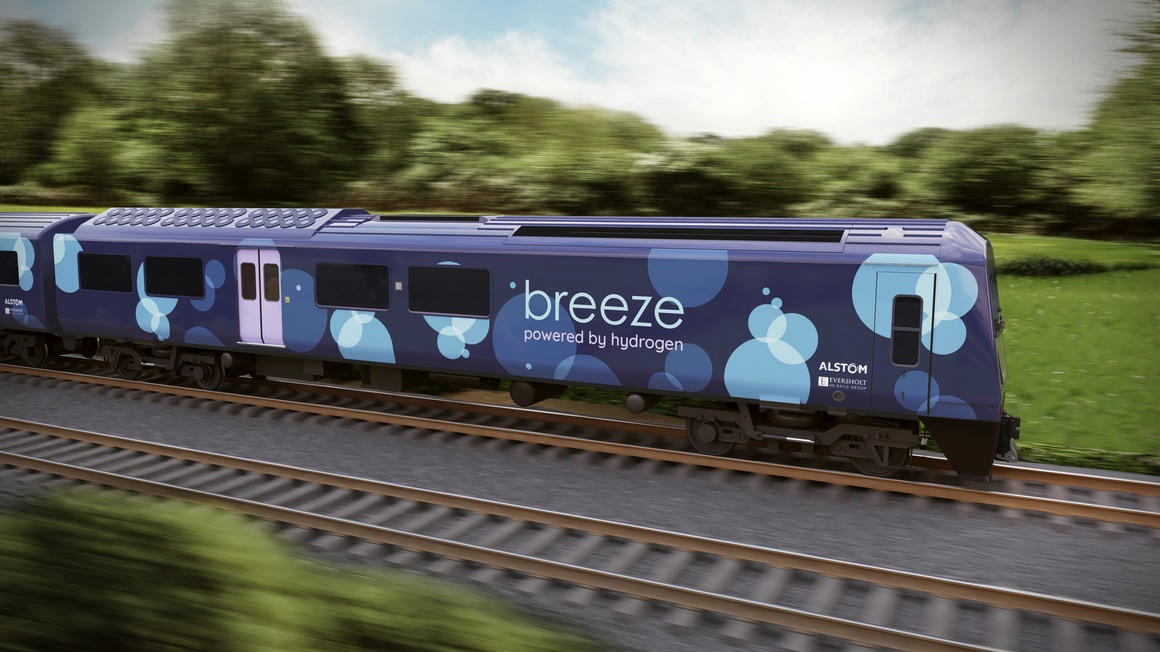
I have a feeling that Alstom have done their marketing and everybody has said that the Class 600 train wouldn’t stand up to a modern train.
- When you consider that each end of the train is a hydrogen tank, I wonder if possible passenger and driver reaction has not been overwhelmingly positive.
- The project was announced in January 2021 and in the intervening time, hydrogen technology has improved at a fast pace.
- There could even be a battery-electric version of the proposed Alstom Hydrogen Aventra.
- The modern train could possibly be lengthened to a four or five car train.
It does strike me, that if Alstom are going to succeed with hydrogen trains, that to carry on with the Class 600 train without an order into the future is not a good idea.
How Does The Alstom Hydrogen Aventra Compare With The Alstom Coradia iLint?
The Alstom Coradia iLint is the world’s first hydrogen train.

It is successfully in service in Germany.
These are some characteristics of the Coradia iLint from the Internet.
- Seats – 180
- Length – 54.27 metres
- Width – 2.75 metres
- Height – 4.31 metres
- Operating Speed – 87 mph
- Range – 370-500 miles
- Electrification Use – No
The same figures for the Alstom Hydrogen Aventra are as follows.
- Seats – 164
- Length – 72 metres
- Width – 2.78 metres
- Height – 3.76 metres
- Operating Speed – 90 mph
- Range – Unknown
- Electrification Use – Unknown, but I would expect it is possible.
Note.
- I have taken figures for the Alstom Hydrogen Aventra from the Class 730/0 train and other Aventras.
- The number of seats is my best estimate from using the seat density of a Class 710 train in a 24 metre long car.
- The width and height seem to be standard for most Aventras.
- Alstom have said nothing about the range on hydrogen.
- I am surprised that the Aventra is the wider train.
But what surprises me most, is how similar the two specifications are. Had the designer of the original Lint hoped to sell some in the UK?
What Is The Range Of The Alstom Hydrogen Aventra?
When they launched the Breeze, Alstom were talking about a range of a thousand kilometres or just over 620 miles.
I have talked to someone, who manages a large bus fleet and they feel with a hydrogen bus, you need a long range, as you might have to position the bus before it does a full day’s work.
Would similar positioning mean a hydrogen train needs a long range?
I suspect it would in some applications, but if the train could use electrification, as I suspect the Alstom Hydrogen Aventra can, this must help with positioning and reduce the range needed and the amount of hydrogen used.
Would Alstom aim to make the range similar to the Coradia iLint? It’s probably a fair assumption.
Could the Alstom Hydrogen Aventra Be Extended To Four Or Five Cars?
I don’t see why not, as Aventras are designed to be lengthened or shortened, by just adding or removing cars, just like their predecessors the Electrostars were.
I can certainly see routes, where a longer Alstom Hydrogen Aventra could be needed and if Alstom have also decided that such a train could be needed, they will surely have investigated how to lengthen the train.
Applications In The UK
These are links to a few thoughts on applications of the trains in the UK.
- Alstom Hydrogen Aventras And Extension Of The Birmingham Cross-City Line
- Alstom Hydrogen Aventras And The Reopened Northumberland Line
- Alstom Hydrogen Aventras And Great Western Branch Lines Between Paddington And Oxford
- Alstom Hydrogen Aventras And The Uckfield Branch
There are probably a lot more and I will add to this list.
Applications Elsewhere
If the Coradia iLint has problems, they are these.
- It can’t use overhead electrification, where it exists
- It has a noisy mechanical transmission, as it is a converted diesel multiple unit design.
The Alstom Hydrogen Aventra can probably be modified to use electrification of any flavour and I can’t see why the train would be more noisy that say a Class 710 train.
I suspect Alstom will be putting the train forward for partially-electrified networks in countries other than the UK.
Conclusion
This modern hydrogen train from Alstom is what is needed.
It might also gain an initial order for Birmingham’s Cross-City Line, as it is a hydrogen version of the line’s Class 730/0 trains.
But having a hydrogen and an electric version, that are identical except for the hydrogen extender, could mean that the trains would be ideal for a partially-electrified network.
There could even be a compatible battery-electric version.
All trains would be identical to the passenger and probably the driver too. This would mean that mixed fleets could be run by an operator, with hydrogen or battery versions used on lines without electrification as appropriate.
Talks Take Place Over Plans To Reopen Railway Line Between Lichfield And The National Memorial Arboretum
The title of this post, is the same as that of this article on Lichfield Live.
The title is a good summary of what happened between the local MP, the Chief Executive of the West Midlands Rail Executive and the Chief Executive of the National Memorial Arboretum.
This map shows the National Memorial Arboretum.
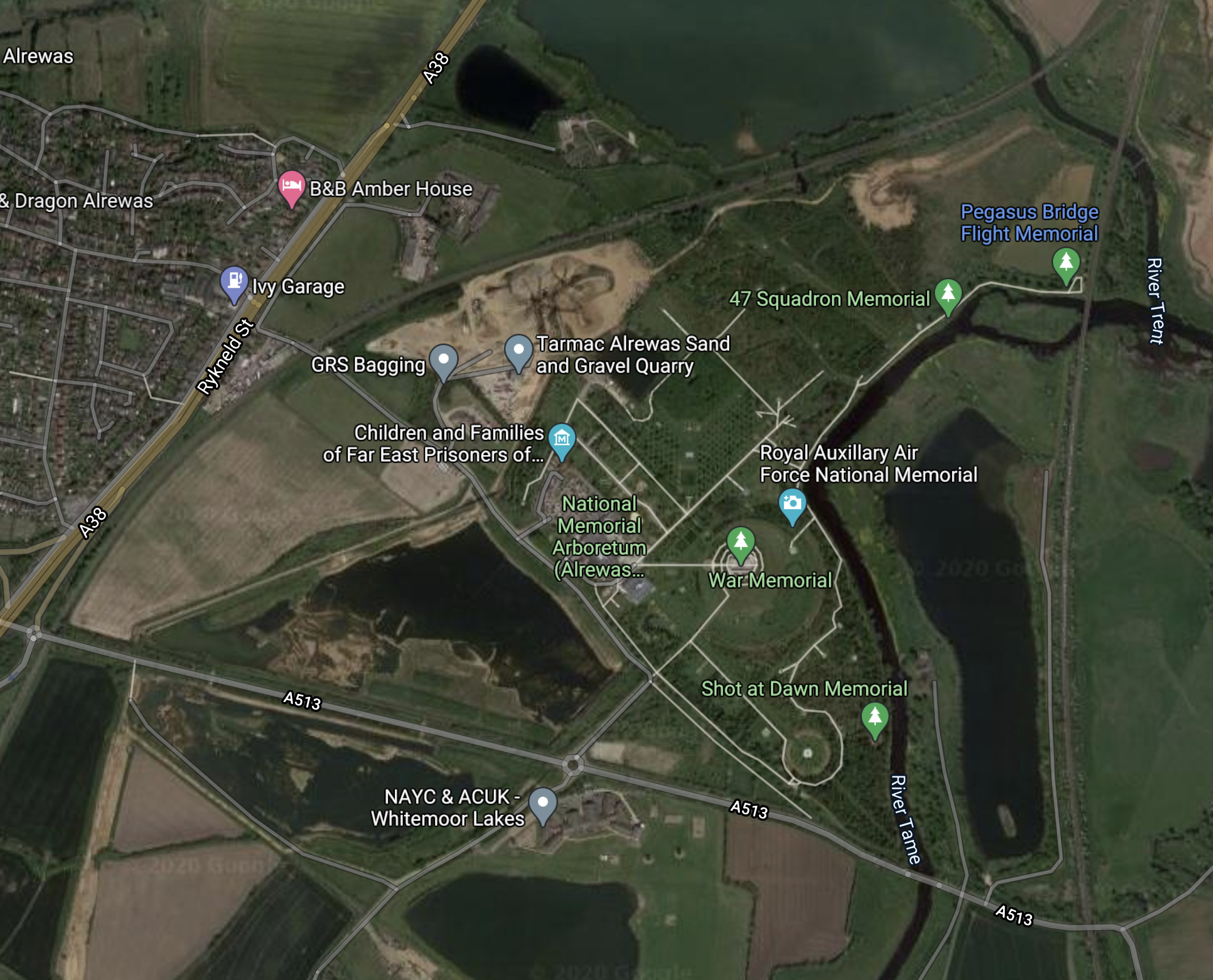
Note.
- The village of Alrewas is to the North West of the arboretum.
- The Burton and Lichfield line lies between the village and the arboretum.
- The station will go on this line.
The article also gives details of the station.
- It would initially be a simple single-platform station.
- Trains would not be electric.
- if successful, a two-platform station would be built.
- This station would be connected to the village by a footbridge over the A38.
- Many visitors would be able to walk to the arboretum, but an environmentally-friendly shuttle would be provided.
One of those at the talks is quoted as calling the station; National Memorial Arboretum at Alrewas.
A Train Service To National Memorial Arboretum at Alrewas
Currently, there is an electric train service to the high-level platform at Lichfield Trent Valley station, which is shown in this picture.
Note.
- The service runs with a frequency of two trains per hour (tph) across the City of Birmingham to either Redditch or Bromsgrove.
- The trains are being replaced with new Class 730 trains.
- Lichfield Trent Valley and Alrewas are about six miles apart.
- Lichfield Trent Valley and Burton-on-Trent are less than fifteen miles apart.
As the new Class 730 trains are Aventras, there is the possibility, that battery electric versions could be created.
Because of the distances involved, extending this route to the National Memorial Arboretum at Alrewas or even Burton-on-Trent, using battery electric trains is a very feasible proposition.
No new infrastructure, except for the new station at National Memorial Arboretum at Alrewas would be needed.
Conclusion
This is a very sensible proposal and I can’t understand, why when the National Memorial Arboretum was first proposed, that this rail service wasn’t built at the same time.
 The Anonymous Widower