London And Newcastle In A Day By Lumo
On Monday, the weather for yesterday in the North-East seemed set fair, I was able to get tickets on Lumo both ways for a reasonable price and the new Northumberland Line had opened.
So I decided to go for it.
My outward journey was on the 10:45 and the return was on the 17:52, which gave me more than enough time to take a train to Ashington and back.
I took these pictures as I arrived in and changed cmy trains at Newcastle.





















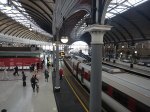


Note.
- The weather in Geordieland was gorgeous.
- Is there another station in the UK, with an approach with such a large number of bridges over a large river.
- I took the bridge pictures from the lobby of the train.
- The blue railway bridge is on the East side of the train.
- The modern road bridge is on the West side of the train.
- In The Bridges of Newcastle, there are more pictures of Newcastles’s bridges.
- To change trains, I had to cross from one side of the station to the other on a stiff bridge without lifts.
- The Northumberland Line trains run every thirty minutes.
These are some further thoughts on Newcastle station, which I will write later.
Timings Going North
The train left Kings Cross at 10:45½, which was just thirty seconds late.
It arrived in Newcastle at 13:48, which was four minutes late.
The journey time had been three hours and two and a half minutes.
Timings Going South
The train left Newcastle at 17:52, which was on time.
It arrived in Kings Cross at 21:17, which was thirty-three minutes late.
The thirty-three minute delay, must raise the possibility of delay repay.
It does!
Three Hours London Newcastle?
These timings must raise the possibility of a sub-three hour time. on the train, between London King’s Cross and Newcastle stations.
The digital signalling that is currently being installed, with perhaps a few timetable tweaks should do it for both Lumo and LNER.
Could The Trains Absorb The Airline Passengers?
Consider.
- In 2023, 437,735 passengers flew between London Heathrow and Newcastle airports.
- This is just 1,200 passengers per day.
- A five-car Class 803 train has 403 seats.
It would appear that a few extra trains and some targeted marketing, could convert London and Newcastle into an all-electric train route.
Seats
Train seats are a bone of contention to many rail passengers these days.
I first rode on Lumo to Scotland in 2021 and wrote about it in London To Edinburgh On Lumo, where I was fairly complimentary about the seats.
They certainly are better than some train seats I have ridden in.
Am I Tired Today?
Not particularly! But I wasn’t very energetic during my four hours in the North.
Tickets For Onward Journeys
The main purpose of my trip was to ride the Northumberland Line to Ashington.
I made the mistake of not buying my ticket for the second train in London, as I hadn’t realised that my train from London and the Ashington train used different sides of the station.
- It was a stiff walk for me between trains.
- In order to buy a ticket, you need to pass through the barriers twice to get to the ticket office or a machine.
- There was no ticket facilities on the far side of the station, where the Lumo train arrived.
- The ticket machines didn’t accept contactless cards.
- Information was lacking.
The outcome was that I nearly missed my train to Ashington.
So to be sure of catching your connection, if you are changing trains at Newcastle, make sure you buy your tickets before you leave your first station.
Fourteen New Trains To Drive First Rail Open Access Growth
The title of this post, is the same as that of this press release from First Group.
These four bullet points are sub-headings.
- The Group has signed an agreement with Angel Trains and Hitachi to lease 14 new five-car class 80X Hitachi electric, battery electric or bi-mode trains (70 cars in total) at a cost of c.£500m including maintenance, over a ten year lease period
- The trains will be manufactured by Hitachi in County Durham, securing the skills base and jobs in the local area
- The new trains will enable FirstGroup to significantly expand its open access portfolio and will be used on the newly announced London-Carmarthen route and to increase the number of cars on the existing Lumo and Hull Trains services
- The agreement also contains an option for FirstGroup to lease up to an additional 13 trains on the same terms if the Group’s open access applications are granted by the Office of Rail and Road (‘ORR’)
These first three paragraphs add a bit more detail.
Prime Minister Sir Keir Starmer is visiting Newton Aycliffe, County Durham, today to celebrate a significant agreement for the Hitachi factory which has secured an order to manufacture 70 new rail cars for FirstGroup’s growing open access business, creating certainty for the manufacturing skills base, and the factory’s future.
The Lease Agreement will deliver 14 new trains, which will not only give the Group a homogenous fleet across its open access operations, ensuring flexibility and reliability for customers, but also facilitates the Group’s strategic objective of materially increasing its open access capacity. Delivery of the new trains is expected to commence in late 2027. The lease will be financed by Angel Trains, adding to their portfolio of Hitachi assets. The trains will be maintained by Hitachi at their facilities around the country.
The trains will be used on the Group’s open access rail services, including the Carmarthen-London route announced on 5 December, and the existing Hull Trains and Lumo services on the East Coast Mainline.
Note.
- Does the presence of Keir Starmer indicate any approval for open access?
- Trains could be electric, battery electric or bi-mode.
- Bi-mode trains should only be purchased these days, if they are convertible to battery-electric trains. Hitachi’s can.
- Delivery is expected to commence in late 2027.
- The first fourteen trains will be deployed on the London to Carmarthen, Edinburgh and Hull routes.
This table shows the trains needed initially for each route.
- Carmarthen – Class 802 trains – 5 tpd – 5 trains – 75.3 miles unelectrified
- Edinburgh – Class 803 trains – 5 tpd – 5 trains – electrified
- Hull – Class 802 trains – 5 tpd – 5 trains – 44.3 miles unelectrified
Note.
- tpd is trains per day.
- I’m assuming that as unelectrified distances to Carmarthen and Hull are not that far apart, the number of trains needed is the same.
- Class 802 trains are bi-mode.
- Class 803 trains are electric.
After the fourteen new trains are delivered, there will be a combined fleet of 29 trains.
Consider.
- Hull Trains have started running some services as pairs of trains. I wrote about this in Ten-Car Hull Trains.
- Lumo has been a success and perhaps needs more capacity.
The Wikipedia entry for Grand Union says this.
Grand Union proposed to operate with ex-LNER Class 91s and Rail Operations Group Class 93s hauling nine-car Mark 4s and a Driving Van Trailer.
So perhaps the Carmarthen service needs ten-car trains.
That would mean that the number of routes needed for the three routes would be as follows.
- Carmarthen – Class 802 trains – 5 tpd -10 trains
- Edinburgh – Class 803 trains – 5 tpd -10 trains
- Hull – Class 802 trains – 7 tpd – 10 trains
It would appear that we’re a train short with 29 in the combined fleet against a need of 30 trains.
But then it would also appear that Hull Trains can provide the required five/ten car service with only four trains.
I would assume that the extra train, goes to make up the numbers for Lumo’s Carmarthen service.
Rochdale Station – 12th November, 2024
Yesterday, I went to Rochdale station, to ascertain, the suitability of running a Lumo service between Euston and Rochdale stations.



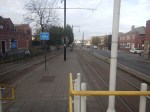
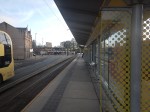
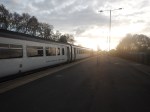




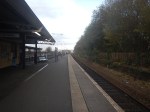
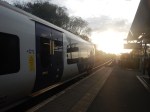
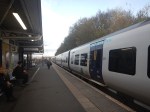




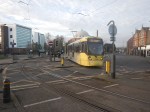
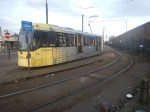

Note.
- The building in the style of a mosque, is actually a Catholic church.
- The island tram platform is at right angles to the railway lines through the station.
- The tram takes you a short distance to the North to the town centre.
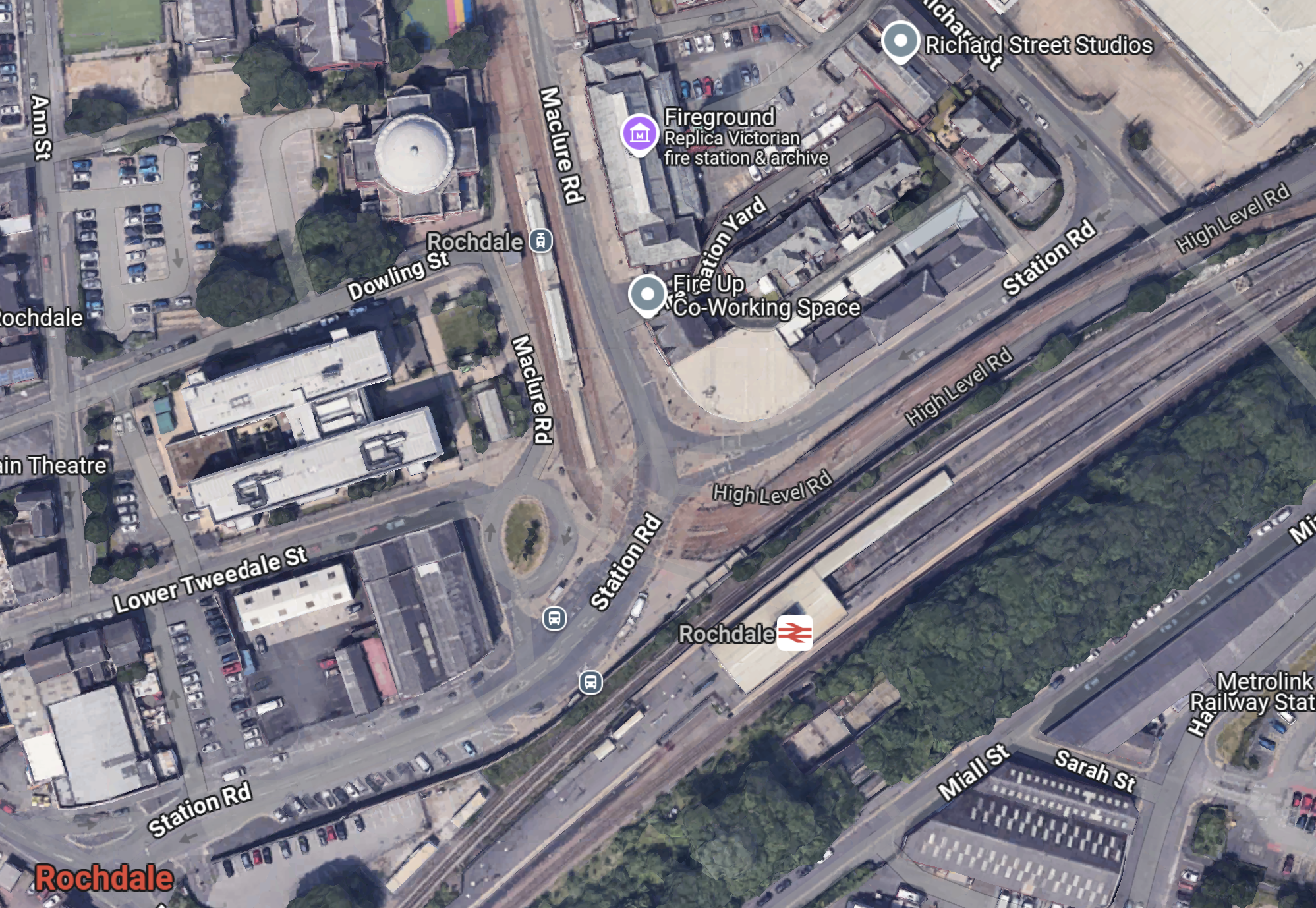
This map shows the station and the tram stop.
Note.
- The station has four platforms and two tram platforms.
- The two outer train platforms are quite long.
- The West-facing bay platform could probably take a five-car Lumo train.
- The tram platform runs North from the station.
- There is a co-working space by the tram-stop.
- There is a cafe in the station.
- There is a manned ticket office.
- Car parking is free.
- There are sixteen bicycle spaces.
With some tidying up, this could be a neat interchange.
These are my thoughts.
Will Rochdale Station Accommodate One Of Lumo’s Five-Car Trains?
The Wikipedia entry for Rochdale station, says this about the Bay Platform 4, that was used for the Cltheroe train.
In 2015, construction on a fourth railway platform began. The 135m-long bay platform was completed in 2016 and is used to relieve congestion at Manchester Victoria, where terminating trains would otherwise occupy the through platforms; numerous services now continue on to Rochdale as opposed to terminating at Victoria. It is located at the south end of the main island platform, with the southbound through line having been re-aligned slightly further east to accommodate the new terminating line and is used by the half-hourly stopping service from Blackburn/Clitheroe via Bolton and Victoria.
A 135 metre platform should be able to accommodate a five-car train with 27 metre carriages, so it looks like a 5-carriage Lumo train with 26-metre cars would fit in the bay platform 4.
Will Rochdale Station Accommodate A Pair Of Lumo’s Five-Car Trains?
Consider.
- Lumo’s Hitachi trains, like all their siblings can run in pairs. As I reported in Ten-Car Hull Trains, Hull Trains do it regularly.
- Rochdale station may or may not be able to accommodate a pair of five-car trains, but say if one of Manchester’s Premier League clubs was playing in the FA Cup Final, I’m sure they would find a way to run a ten-car train to London.
- It looks like Warrington Bank Quay, Newton-le-Willows, Eccles and Manchester Victoria could all take 10-car trains.
- Euston probably can as well, as 9-car and 11-car Class 390 trains are 217.5 and 265.3 metres respectively long respectively and a 10-car Lumo train would only be 260 metres.
Perhaps, one train can start at Rochdale and the other at Manchester Victoria, before they join at Victoria and go to London as a pair.
Could The Lumo Service Be Extended Across The Pennines?
Distances Along the Calder Valley Line to Leeds are as follows.
- Rochdale 10.4 miles –
- Hebden Bridge – 23.6 miles
- Halifax – 32.7 miles
- Low Moor – 37.5 miles
- Bradford Interchange – 40.4 miles
- Leeds – 49.8 miles
Note.
- The 70 km. rang of a Lumo train will be 43.5 miles.
- The train can be charged at both end stations and will be fully charged, when it leaves Manchester Victoria and Leeds.
- There are short lengths of electrification at Manchester Victoria and Leeds.
- There may be extra electrification between Bradford Interchange and Leeds, in the next few years.
I am fairly certain, that a battery-electric Lumo Class 803 train will be able to provide a London Euston and Leeds service.
How Long Will Services Take?
Timings on the extended route from London Euston to Manchester Victoria, Rochdale, Bradford and Leeds would take.
- London-Euston – Warrington Bank Quay – One hour and forty-four minutes – Current Avanti timings.
- Warrington Bank Quay – Newton-le-Willows -Eleven minutes – Current Northern timings.
- Newton-le-Willows – Eccles -Ten minutes – Current Northern timings.
- Eccles – Manchester Victoria – Ten minutes – Current Northern timings.
- Manchester Victoria – Rochdale – Fourteen minutes – Current Northern timings.
- Rochdale – Hebden Bridge – Sixteen minutes – Current Northern timings.
- Hebden Bridge – Halifax – Fifteen minutes – Current Northern timings.
- Halifax – Low Moor – Six minutes – Current Northern timings.
- Low Moor – Bradford Interchange -Ten minutes – Current Northern timings.
- Bradford Interchange – Leeds – Nineteen minutes – Current Northern timings.
Totals.
- London and Manchester Victoria – Two hours and fifteen minutes.
- London and Rochdale – Two hours and twenty-nine minutes.
- London and Bradford – Three hours and six minutes.
- London and Leeds – Three hours and twenty-five minutes.
I suspect times could be speeded up a bit.
Proposed Developments Of Manchester Metrolink
This sub-title has its own Wikipedia entry.
Developments that would be beneficial to a Lumo service might include.
A station at Cop Road on the Oldham and Rochdale Line, that would support new housing.
Tram-trains between Oldham and Heywood On the Calder Valley Line.
These two developments will directly bring more passengers to the Lumo service, but because the Lumo service has links with the Metrolink at Eccles, Manchester Victoria and Rochdale any Metrolink improvements should benefit the Lumo service.
London And Edinburgh By Lumo Using the Joint Line Diversion
This press release on the First Group web site is entitled FirstGroup Applies To Run Rochdale To London Rail Service With New British-Built Trains.
These are the first two paragraphs.
FirstGroup plc, the leading private sector transport operator, has submitted the first phase of an application for a new open access rail service between Rochdale and London to the Office of Rail and Road (ORR), restoring this direct link for the first time in almost a quarter of a century.
FirstGroup plans to expand its open access rail operations as part of its successful Lumo business, building on Lumo’s existing service which has transformed long-distance connectivity between London and Edinburgh and helped support a growth in passenger numbers for all operators on the East Coast Mainline. All of the trains on this new route will be electric and battery powered, and the service will be operated by brand new trains built in the UK.
Note.
- This service will be run under the Lumo brand.
- Battery-electric trains will be used.
- Stops will include Manchester Victoria, Eccles, Newton-le-Willows and Warrington Bank Quay.
- Only 15 km. of the route, between Miles Platting and Rochdale is not electrified.
Allowing for out and back trips between Platting and Rochdale, a sensible reserve and I suspect a battery-electric train with a range of 40-50 kilometres, would allow the train to be able to do a round trip to Rochdale from London Euston.
Hitachi have now published this page on their web site, which is entitled Intercity Battery Trains.
These are the first two paragraphs.
A quick and easy application of battery technology is to install it on existing or future Hitachi intercity trains. Hitachi Rail’s modular design means this can be done without the need to re-engineer or rebuild the train and return them to service as quickly as possible for passengers.
Replacing one diesel engine with just one battery reduces emissions by more than 20% and offers cost savings of 20-30%. Our intercity battery powered trains can cover 70km on non-electrified routes, operating at intercity speeds at the same or increased performance.
It would appear that Hitachi’s standard Intercity Battery Train will have a range of 70 km.
- A 70 km. range would be more than enough to handle Lumo’s Euston and Rochdale service.
- Lumo’s Class 803 trains don’t have a diesel generator to replace.
- One car does have a smaller battery for emergency hotel power, should the electrification fail.
As an Electrical Engineer, I wouldn’t be surprised to find out that the traction batteries of Hitachi’s standard Intercity Battery Train and the emergency batteries of Lumo’s Class 803 trains are of a similar design. The batteries could even be interchangeable, which would enable both Lumo’s routes to Scotland and Rochdale to use identical Class 803 trains.
Lumo’s Class 803 trains would have this specification.
- All-electric.
- Emergency battery to provide back-up hotel power.
- A range on battery of 70 km or 43 miles away from electrification.
The off-electrification range could be very useful in getting round incidents or overhead wiring problems.
An extended range of 70 km. would allow the following destinations to have all-electric services from London.
- Beverley #
- Bristol Temple Meads #
- Cheltenham #
- Chester
- Harrogate
- Huddersfield
- Hull
- Lincoln
- Middlesbrough
- Swansea #
Destinations marked with a hash (#), would need charging at the final destination.
A more detailed analysis will probably show other possible routes.
It looks to me, that Hitachi have got the specification of their Intercity Battery Train about right.
Bridging The Joint Line Diversion
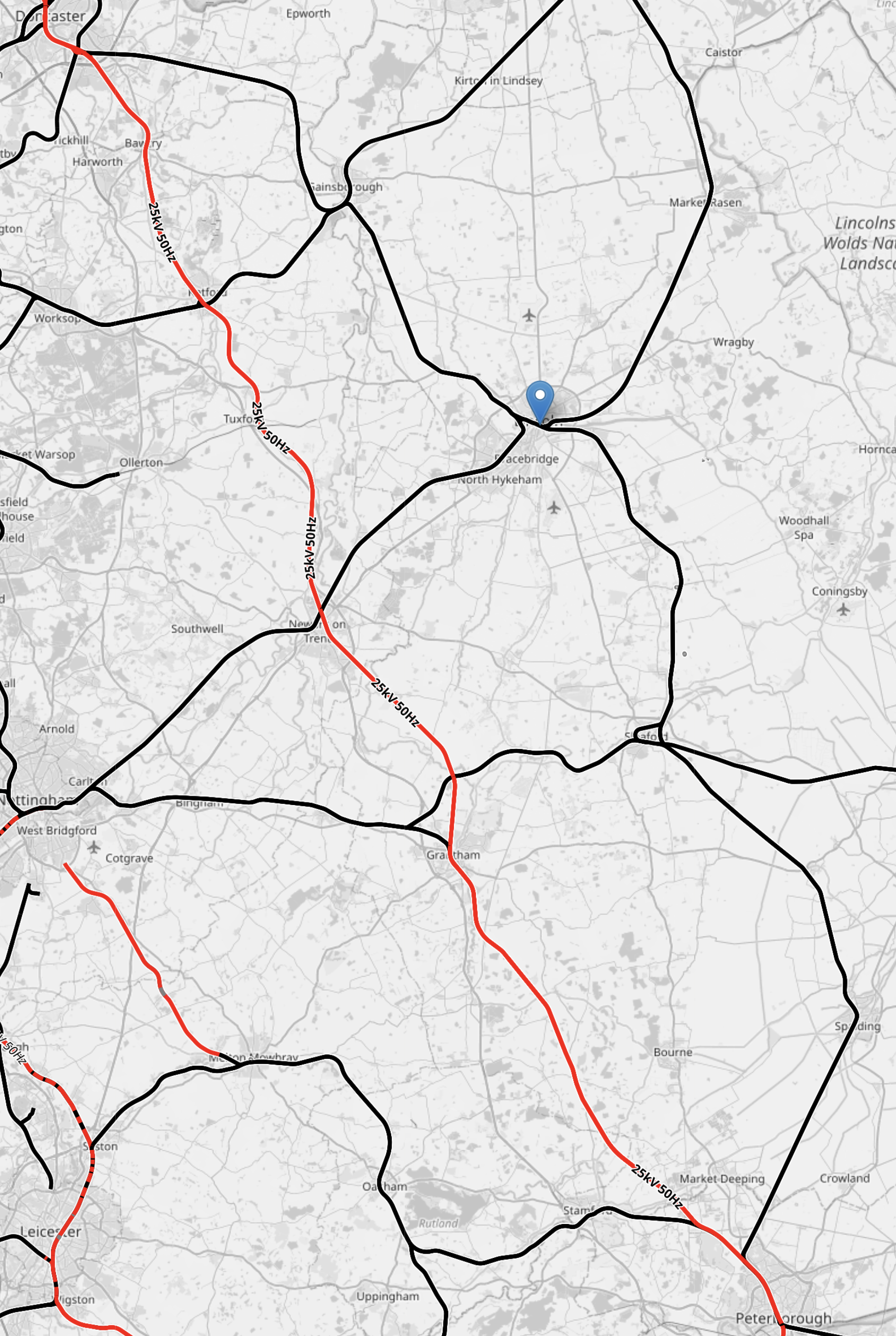
This OpenRailwayMap shows the Great Northern and Great Eastern Joint Line (GNGE) or Joint Line.
Note.
- Doncaster is in the North-West corner of the map.
- Peterborough is in the South-East corner of the map.
- The red line connecting them is the East Coast Main Line.
- Lincoln station is marked by the blue arrow.
Great Northern and Great Eastern Joint Line (GNGE) is described like this by its Wikipedia entry.
The Great Northern and Great Eastern Joint Railway, colloquially referred to as “the Joint Line” was a railway line connecting Doncaster and Lincoln with March and Huntingdon in the eastern counties of England. It was owned jointly by the Great Northern Railway (GNR) and the Great Eastern Railway (GER).
Over the last decades of the Twentieth Century, the Joint Line declined and British Rail did their worst to simplify the route.
But in the 2010s, Network Rail developed the route into a by-pass for the East Coast Main Line between Werrington and Black Carr junctions via Lincoln.
- Trains are routed via Spalding, Sleaford, Lincoln, Saxilby and Gainsborough.
- There is no electrification.
- The route can handle two freight trains per hour.
- The route can handle 9 ft. 6 in containers.
- There is a passenger service between Doncaster and Peterborough via Lincoln.
- Self-powered trains like InterCity125s, Class 800 trains and Class 802 trains can use their diesel power to use the diversion.
- All-electric trains, like LNER’s Class 801 trains and Lumo’s Class 803 trains have no self-power, so can’t use the diversion.
- Black Carr junction and Lincoln is 35 miles.
- Werrington junction and Lincoln is 51.7 miles.
The January 2024 Edition of Modern Railways says that the diversion is approximately 90 miles or 145 kilometers.
It would appear that there are two simple solutions.
- Electrify a section through Lincoln, so that Lincoln is within 70 kilometres of the electrification at both Werrington and Black Carr junctions.
- Fit bigger batteries to the trains.
A combination of both solutions might be possible.
ORR: Open Access Services Given Green Light Between London And Stirling
The title of this post is the same as that of this press release from the Office of Rail and Road.
This is the sub-heading.
The latest access decision by the Office of Rail and Road (ORR) provides more services for rail passengers travelling between London and central Scotland.
These five paragraphs detail the ORR’s decision.
ORR has today (7 March) given the go-ahead for Grand Union Trains, an open access operator, to start a new train service between London and the city of Stirling, from June 2025. ORR’s decision will offer more choice to passengers, bring private sector investment to the railway and increase competition.
Grand Union Trains will introduce four new return services per day between London Euston and Stirling stations. These services will also call at Milton Keynes Central, Nuneaton, Crewe (subject to agreement between Grand Union Trains and Network Rail), Preston, Carlisle, Lockerbie, Motherwell, Whifflet, Greenfaulds and Larbert. Larbert, Greenfaulds and Whifflet will receive their first direct services to London.
ORR found that the proposed services would increase choice for passengers, significantly increasing direct journey opportunities to and from London and central and southern Scotland, while making use of existing capacity on the network.
The new services will be the first run by an open access operator on the West Coast Mainline. Open access operators run services independently of government funding as they do not have a franchise agreement with government.
Following ORR’s decision to approve new Grand Union Trains services between Carmarthen in south Wales and London Paddington in 2022, ORR has now approved open access services on three of Britain’s major routes.
Note.
- The Grand Union service appears to be running into London Euston. Earlier plans had it terminating at Queen’s Park station.
- Larbert, Greenfaulds and Whifflet will receive their first direct services to London.
- London Euston and Stirling is electrified all the way.
- The third open access service, that the ORR has approved is the Lumo service between King’s Cross and Edinburgh via the East Coast Main Line.
I have a few thoughts.
Stirling Is An Ideal Place To Explore Central Scotland By Train
In Stirling, I give the reasons, why I spent a couple of days in Stirling, when I wanted to visit several places in Central Scotland.
Note.
- Stirling has direct services to Aberdeen, Dundee, Edinburgh, Glasgow, Inverness and Perth.
- Aberdeen is one hour and 15 minutes away.
- Dundee is just 63 minutes away.
- Edinburgh is just 48 minutes away.
- Glasgow is just 39 minutes away.
- Inverness is two hours and 46 minutes away.
Stirling has about a dozen affordable hotels and guest houses within walking distance of the station, as this map shows.
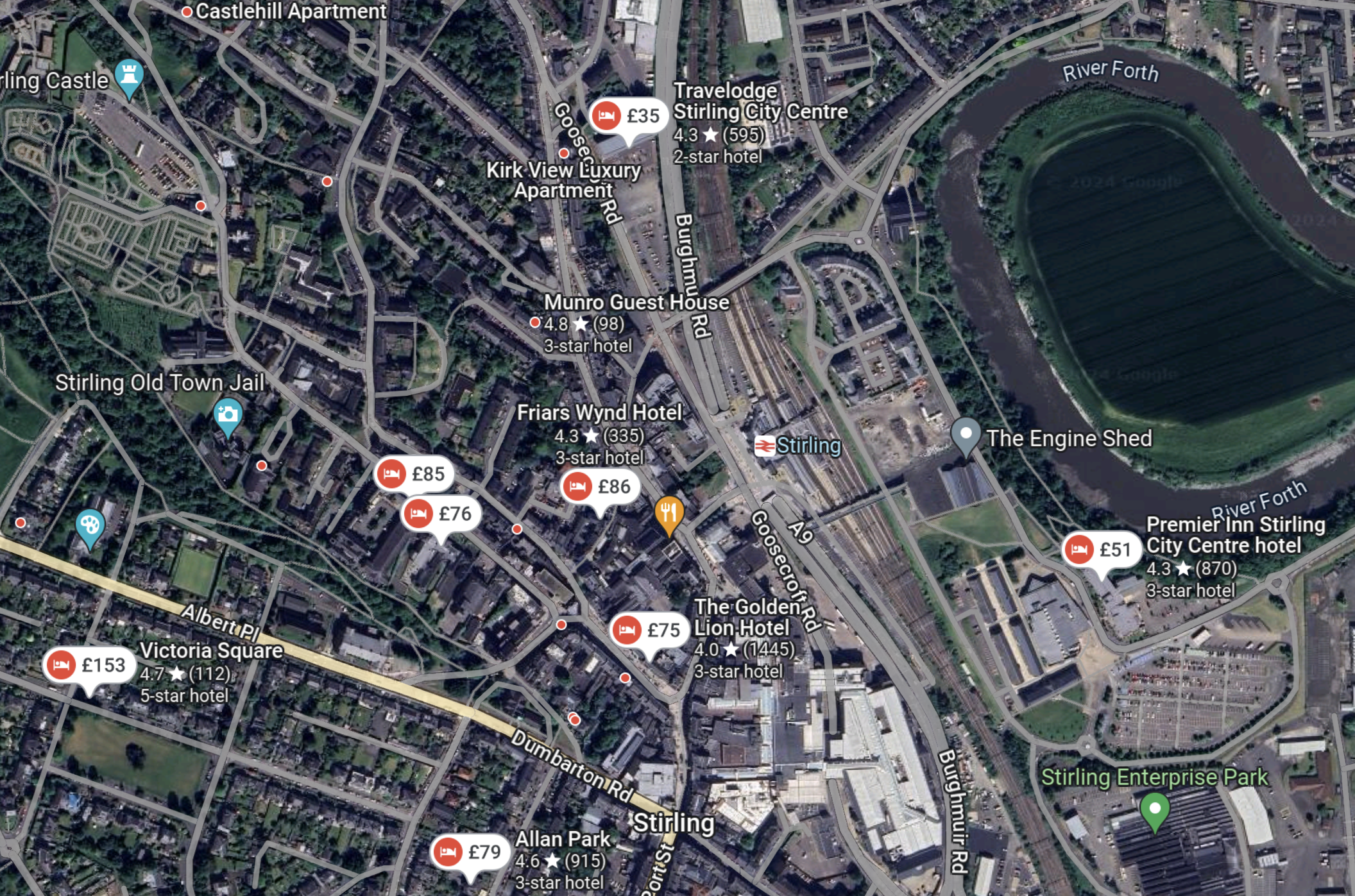
Stirling would appear to have got Central Scotland covered.
Could The Train Serve Gleneagles?
Gleneagles is about twenty minutes North of Stirling and is served by the Caledonian Sleeper from London.
This Google Map shows the area around Gleneagles station.
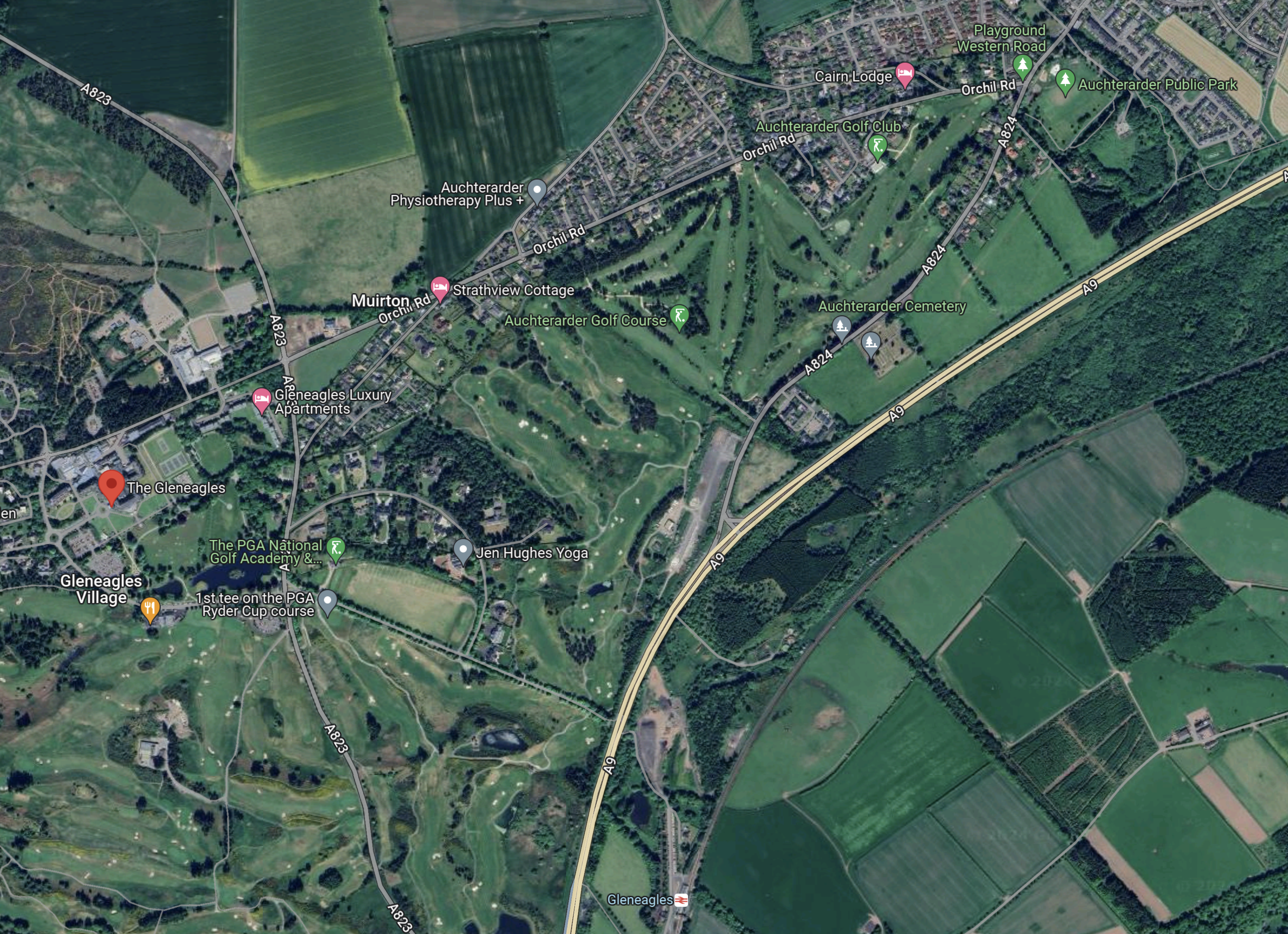
Note.
- Gleneagles station is at the bottom of the map.
- The red arrow indicates the famous Gleneagles hotel.
- The pink dots are other hotels.
- Airbnb lists several very splendid properties in the varea.
Not everybody, who goes to the Gleneagles area will be exceedingly rich and I could see the Gleneagles area generating substantial business for Grand Union Trains. I suspect the best way to serve Gleneagles would be a zero-emission coach from Stirling.
Along The Motherwell And Cumbernauld Line
Between Motherwell and Stirling, a lot of the route used is on the Motherwell and Cumbernauld Line.
- The line is fully-electrified.
- It is only 28.9 miles between Motherwell and Stirling.
- \cumbernaukd and Motherwell takes 20 minutes.
I do wonder, if extra stops might be worthwhile.
Motherwell Has Good Connections To Edinburgh And Glasgow
As well as Stirling, Motherwell has good connections to both Edinburgh and Glasgow, so some passengers might find their most convenient route involves a change at Motherwell.
Nuneaton And Scotland Would Get A New Service
Nuneaton has been named by Avanti West Coast, as a place that needs more trains, as it connects with the service between Birmingham and Stansted Airport, via Coleshill Parkway, Leicester, Peterborough, March, Ely and Cambridge.
I suspect that, Nuneaton will become an interchange, between East Anglia and, the North West and West Scotland.
Milton Keynes And Scotland Should Get An Improved Service
Consider.
- It appears that all Avanti West Coast services between Milton Keynes and Scotland, go via Birmingham.
- I suspect that Grand Union’s route using the Trent Valley Line could be faster with similar trains.
- Creating a new route between Milton Keynes and Stirling could be a good move, as it gives one-change access to much of Central Scotland.
- Milton Keynes has good local connections to places like Northampton, Rugby, Tring and Watford Junction.
- Milton Keynes will be a stop on the new East-West Railway.
- From many stations, it will be quicker to go via Milton Keynes rather than Euston.
I suspect Milton Keynes could be a nice little earner.
Will Grand Union’s Trains Be Fitted With Digital Signalling?
Consider.
- At some point in the next ten years the West Coast Main Line will be fitted with digital signalling, to enable trains to run at 140 mph on selected parts of the route.
- Digital signalling will allow extra services between London Euston and Motherwell.
- Motherwell and London Euston is 388 miles.
I suspect, that Grand Union’s Trains will need to be fitted with digital signalling, so they can save time on services and possibly add in a few more.
It will add costs, although the faster speed will surely attract passengers.
Will Grand Union’s Trains Be Electric?
There are these train services going between England and Scotland.
- Avanti West Coast – London Euston to Edinburgh Waverley via Birmingham New Street – 7 tpd – Class 390 – Electric
- Avanti West Coast – London Euston to Glasgow Central via Birmingham New Street – 5 tpd – Class 390 – Electric
- Avanti West Coast – London Euston to Glasgow Central via Trent Valley – 1 tph – Class 390 – Electric
- CrossCountry – Plymouth to Edinburgh Waverley – 1 tph – Class 220/221 – Diesel – Uses diesel all the time
- LNER – London King’s Cross/Leeds to Aberdeen – 4 tpd – Class 800 – Bi-mode – Uses diesel North of Edinburgh
- LNER – London King’s Cross to Inverness – 1 tpd – Class 800 – Bi-mode – Uses diesel North of Stirling
- LNER – London King’s Cross to Edinburgh Waverley – 3p2h – Class 800 – Bi-mode or Class 801 – Electric
- LNER – London King’s Cross to Glasgow Central – 1 tpd – Class 801 – Electric
- LNER – London King’s Cross to Stirling – 1 tpd – Class 801 – Electric
- Lumo – London King’s Cross to Edinburgh – 5 tpd – Class 803 – Electric
- TransPennine Express – Newcastle to Edinburgh Waverley – 7 tpd – Class 802 – Bi-mode
- TransPennine Express – Liverpool Lime Street to Glasgow Central – 2 tpd – Class 397 – Electric
- TransPennine Express – Manchester Airport to Edinburgh Waverly – 1 tp2h – Class 397 – Electric
- TransPennine Express – Manchester Airport to Glasgow Central – 1 tp2h – Class 397 – Electric
Note.
- tpd is trains per day.
- tph is trains per hour.
- tp2h is trains per two hours.
- LNER services to Glasgow and Stirling are likely to be dropped.
- Some Lumo services are likely to be extended from Edinburgh to Glasgow.
- Many services South from Stirling to Edinburgh Waverley and Glasgow Queen Street are electric.
The current two tpd direct trains to Stirling are electric and if you change at Edinburgh Waverley or Glasgow, it is likely to be an all-electric service.
For marketing reasons, I would recommend, that Grand Union Trains ran electric trains between London Euston and Stirling, as they are competing against an all-electric service.
Although to meet service dates it might be necessary to run something like a diesel Class 222 train to get the service started.
What Trains Will Grand Union Use?
The Wikipedia entry for Grand Union Trains, says this for their London Euston and Stirling service.
In 2023 Grand Union revised its proposal changing its planned rolling stock to Class 22x units, at the same time the start date for this service was changed to June 2025.
I would suspect they will put in the order for new electric trains fairly sharpish.
The new trains could be.
- A variant of Hitachi’s Class 800 trains.
- A variant of CAF’s Class 397 trains.
Would they have an emergency battery un case of overhead line failure?
How Long Will A Service Take?
The service can be divided into two sections.
- London Euston and Motherwell – 388 miles.
- Motherwell and Stirling – 28.9 miles.
Note.
- The 08:30 train from Euston to Motherwell takes 4 hours and 17 minutes with six stops via Nuneaton.
- The Grand Union Trains service will also have six stops and go via Nuneaton.
I would expect with today’s signalling and electric trains, that Euston and Motherwell would take a maximum of 4 hours and 17 minutes.
- The twenty minute time to Cumbernauld could be added.
- The twenty-five minute time between Cumbernauld and Stirling could be added.
It looks the time would be just over five hours.
I doubt there would be much scope for increasing speed North of Motherwell, but could there be savings made to the South of Motherwell?
Consider.
- London Euston and Motherwell is 388 miles.
- Four hours and 17 minutes is 257 minutes.
- Motherwell is on the main London Euston and Glasgow Central route.
This is an average speed between London Euston and Motherwell of 90.6 mph.
By comparison.
- London King’s Cross and Edinburgh is 392.6 miles.
- Journeys can take four hours and 20 minutes or 260 minutes.
This is an average speed between London King’s Cross and Edinburgh of 90.6 mph.
In the next decade, there will be improvements on both the East and West Coast Main Lines.
- King’s Cross and Edinburgh is currently being digitally signalled.
- London Euston and Glasgow Central is likely to be an early priority for digital signalling after London King’s Cross and Edinburgh is completed.
- When High Speed Two opens to Birmingham and Lichfield, High Speed Two trains between London Euston and Glasgow Central will use the West Coast Main Line to the North of Lichfield.
- I wouldn’t be surprised to see some track realignment and modifications to improve speeds on the West Coast Main Line to the North of Lichfield.
I can build a table of times between London Euston and Motherwell against average speed.
- 90 mph – 4 hours 19 minutes
- 100 mph – 3 hours 53 minutes
- 110 mph – 3 hours 32 minutes
- 120 mph – 3 hours 14 minutes
- 125 mph – 3 hours 6 minutes
- 130 mph – 2 hours 59 minutes
Note.
- Adding 15 minutes gives a London Euston and Glasgow Central time.
- Adding 45 minutes gives a London Euston and Stirling time.
- Averaging 120 mph would give London Euston and Glasgow Central or Stirling times of under four hours.
It strikes me, that to improve Anglo-Scottish relations and to make rail a better alternative to flying, a priority for all West Coast services is to improve the West Coast Main Line and install digital signalling, so that a 120 mph average is possible between London Euston and Motherwell.
What Difference Will High Speed Two Make?
High Speed Two is claiming it will knock thirty minutes off times between London Euston and Glasgow Central, when it opens to Birmingham and Lichfield.
But Grand Union Trains are not expected to use the new line between London Euston and Lichfield, as High Speed Two will, as it will make calling at Milton Keynes and Nuneaton impossible, as they are bypassed by High Speed Two.
Conclusion
This train service is going to be good for Milton Keynes, Nuneaton and Stirling and all the towns in Central Scotland.
But they must make full use of the available electrification.
Lumo In Discussions To Operate Glasgow Services
The title of this post, is the same as that of this press release from FirstGroup.
These four paragraphs give more details.
FirstGroup, the leading private sector transport operator, today announces that its popular open access rail service Lumo is in discussions with Transport Scotland and Network Rail to extend some of its London-Edinburgh trains to and from Glasgow.
Having identified opportunities to extend a number of daily journeys to and from Glasgow in the timetables for 2025 and beyond, work will now continue with Transport Scotland and track infrastructure manager Network Rail to agree final route options and timings ahead of an application for access rights to the Office of Rail and Road (‘ORR’), the industry regulator.
If successful, the new services could be in operation from next summer.
Lumo’s proposed new offering will improve links for customers travelling between Newcastle and Glasgow, giving people a choice of services without needing to change trains. In addition, a significant number of users of Lumo’s current London-Edinburgh trains go on to travel through to Glasgow via other connections, and through this move, Lumo aims to offer a direct through service for these customers.
I have a few thoughts.
There Appears To Be A Need For An Affordable London And Glasgow Service
This is the last sentence of my extract from the press release.
In addition, a significant number of users of Lumo’s current London-Edinburgh trains go on to travel through to Glasgow via other connections, and through this move, Lumo aims to offer a direct through service for these customers.
This looks to be a service, that has been suggested by an analysis of passengers’ tickets.
Which Station Will Lumo Use In Glasgow?
Consider.
- The current LNER service between London King’s Cross and Glasgow, uses Glasgow Central station and it takes 66 minutes between Edinburgh and Glasgow Central stations.
- LNER’s service also calls at Haymarket and Motherwell.
- ScotRail services between Edinburgh and Glasgow Queen Street take about 49-50 minutes.
I suspect, that Lumo will take the faster route.
Newcastle And Glasgow Is A New Route
Currently, all passengers between Glasgow and Newcastle have to change at Edinburgh.
This will be the first direct train in my memory, except for LNER’s single daily service between London and Glasgow Central, which stops at Newcastle.
What About The Football?
Glasgow is very much about football.
Would it be possible to use Lumo to see a match starting at 15:00 on a Saturday afternoon, if you lived in London?
- The 05:48 train from King’s Cross on a Saturday arrives in Edinburgh at 10:07.
- Trains between Edinburgh and Glasgow take fifty minutes, so I feel it would be reasonable to be able to get to Glasgow by 10:57.
This time would be more than early enough to have a few swift halves and see the match if it started at 15:00.
But would it be possible to get back to London after the match?
- The last train leaves Edinburgh at 17:55 and arrives in King’s Cross at 22:26.
- Applying the fifty minute journey time between Edinburgh and Glasgow means it will leave at 17:05.
- It appears that from Ibrox and Celtic Park to Glasgow Central or Glasgow Queen Street station is about twenty minutes.
On the current timetable, it would appear to be possible, but tight.
One alternative would be to take the Caledonian Sleeper back to London. But it doesn’t appear to run on a Saturday night.
Coaches do run and an overnight coach costs around twenty pounds.
It looks like if Lumo ran a service about 18:00 on a Saturday to London, it wouldn’t run empty.
Will Lumo Need More Trains?
In the press release, FirstGroup plc Chief Executive Officer Graham Sutherland, is quoted as saying.
Once preferred route options and timings have been agreed, discussions will continue with Network Rail and the ORR to secure the required approvals. The journeys would be operated within the existing Lumo fleet of all-electric trains and it is anticipated that the additional services could begin in summer 2025.
That looks to me, that they will not be obtaining more trains before next summer.
In Ten-Car Hull Trains, I noted that some of Hull Trains services were now running as ten-car trains.
If the passenger demand is there for ten-car trains to Hull, which is almost exactly half the distance of Edinburgh, I would expect that in the future, Lumo will be running some services as ten-car trains.
In Extra Luggage Racks For Lumo, which is based on an article in the November 2023 Edition of Modern Railways, an alternative view on more trains is taken.
The Modern Railways article finishes with this paragraph.
Lumo celebrated its second birthday in late October and was also set to mark the carriage of its two-millionth passenger. It is understood Lumo is interested in augmenting its fleet, such has been the success of the service; while many operators favour bi-mode units, Lumo is proud of its all-electric credentials so straight EMUs are still preferred, although the possibilities of including batteries which could power the trains may be pursued (the ‘803s’ have on-board batteries, but only to provide power to on-board systems if the electricity supply fails).
I find this development very interesting.
As London King’s Cross and Edinburgh and Glasgow are all electric routes, in normal service batteries should not be needed, but sometimes trains have to use the diversion via Lincoln, which I have estimated is 86.5 miles.
As an electrical engineer, I’ve always believed that the emergency batteries in the Class 803 trains are very similar to the traction batteries that Hitachi are developing for the Class 802 trains.
A traction battery, that was capable of handling the diversion would stop Lumo having to cancel occasional services.
Conclusion
An extension to Glasgow looks like it could be a simple and profitable way to extend the current Lumo service.
But it might need some extra trains in the future.
A Lumo service to Glasgow, might be helped by a seven-day service on the Caledonian Sleeper, so passenger could go North on Lumo and South on the Sleeper to get a full day in Glasgow.
New LNER Fleet To Have Joint Line Capability
The title of this post, is the same as that of an article in the January 2024 edition of Modern Railways.
This is the text of the article.
LNER’s new fleet of CAF tri-mode trains, for which an order was confirmed in November, has been specified with the capability to operate via the Joint Line via Spalding and Lincoln in case of closures on the East Coast Main Line between Peterborough and Doncaster.
CAF will supply 10×10-car trains with overhead electric, battery and diesel capability, financed by Porterbrook. The inclusion of diesel engines as part of the winning bid, rather than a straightforward battery-electric unit, has surprised some observers, but LNER’s specification was that the fleet should have sufficient self-powered capability to cover the length of the joint line, which is approximately 90 miles. This is currently to be considered to be beyond the scope of battery-power alone, although as the technology evolves diesel engines could be replaced by batteries. The configuration of diesel engines and batteries within the sets has yet to be decided.
LNER frequently uses the Joint Line as a diversionary route, both during planned engineering work and at times of disruption, but only its bi-mode Azumas are currently able to traverse it under their own power (electric sets have been hauled by a diesel locomotive, but this is now a very rare occurrence). The new CAF fleet will replace the InterCity 225 electric fleet, and the self-power capability will provide valuable resilience to LNER to divert via non-electrified routes.
While the ‘225s’ are currently confined to services between King’s Cross and Leeds/York, if the enhanced December 2024 timetable goes ahead as currently planned (see story above) they will operate north of York once again on some of the hourly services which will terminate at Newcastle. However, LNER is having to limit the use of the sets before the Class 91 locomotives and Mk 4 coaches come due for major overhauls: the decision to retain 12 locos and eight rakes of coaches was based on the intended timescale for replacing the fleet at the time, but confirming the order for the new CAF tri-modes has taken longer than anticipated, largely due to delays in receiving Government approval to place the order.
This article has got me thinking.
The InterCity225 Trains Need Replacing Urgently
The Modern Railways article states that the need to replace the InterCity 225s is getting urgent, as more than the Azumas will be needed for the December 2024 timetable and the InterCity 225s are getting to the end of their economic life.
As LNER have been doing reasonably well lately, a cock-up caused by lack of trains at Christmas 2024 would be the last thing they need.
Currently, LNER have enough Mark 4 coaches for eight trains, so ordering ten new CAF tri-mode trains will allow for a small amount of extra services.
The CAF tri-mode trains were only ordered in November 2023, so getting them delivered for December 2024 would be tight.
As I write this on the 31st December 2023, trains from King’s Cross to Leeds included.
- 5 x InterCity225
- 5 x 10-car Azuma
- 7 x 9-car Azuma
- 2 x 5-car Azuma
So there were InterCity 225s running on that day.
A Few Distances Around Lincolnshire
I believe that because of offshore wind, interconnectors and other renewable energy developments, that Lincolnshire will become an energy powerhouse, supporting the East Midlands and also exporting electricity and hydrogen to Europe through pipelines and interconnectors.
Because of this and other developments, I believe that rail passenger traffic to and around the county will increase significantly.
These are a few selected distances.
- Doncaster and Cleethorpes – 52.1 miles
- Grantham and Skegness – 58.2 miles
- Lincoln and Doncaster – 36.8 miles
- Lincoln and Newark – 16.8 miles
- Lincoln and Peterborough – 54.8 miles
- Lincoln and Cleethorpes – 47.2 miles
Note.
- This means that the length of the Joint Line, which between Werrington Junction and where it rejoins the East Coast Main Line to the South of Doncaster is no more than ninety miles. This ninety mile distance was assumed in the Modern Railways article.
- Peterborough and Cleethorpes via Lincoln is ninety-two miles.
- I estimate that around four miles could be easily electrified at Werrington, which would reduce these two distances by four miles.
- Newark and Cleethorpes via Lincoln is sixty-four miles.
It looks like if a battery-electric train had a range of 92 miles and there was charging at Cleethorpes and Skegness, Lincolnshire could have a first class zero-carbon rail service.
CAF Tri-Mode Trains And The Joint Line
This is the first sentence in the Modern Railways article.
LNER’s new fleet of CAF tri-mode trains, for which an order was confirmed in November, has been specified with the capability to operate via the Joint Line via Spalding and Lincoln in case of closures on the East Coast Main Line between Peterborough and Doncaster.
Note.
- The Modern Railways article states the Joint Line is approximately 90 miles.
- As I stated earlier with some strategically placed electrification at Werrington and South of Doncaster, this distance without electrification can probably be shortened by a few miles.
It looks like any service run by a CAF tri-mode train will be able to use the Joint Line.
Hitachi Class 801 Trains And The Joint Line
Unless the Joint Line is electrified or the all-electric Class 801 trains are fitted with batteries of a sufficient size the Class 801 trains will not be able to use the Joint Line.
Hitachi Class 800/802 Trains And The Joint Line
If currently, the Class 800/802 trains can handle the Joint Line on their diesel engines, they can continue to do this.
Hitachi Class 803 Trains And The Joint Line
Unless the Joint Line is electrified or Class 803 trains are fitted with batteries of a sufficient size the Class 803 trains will not be able to use the Joint Line.
Hitachi Class 80x Trains With Batteries And The Joint Line
Note that Lumo’s Class 803 trains are already fitted with an emergency battery for hotel power. So Hitachi must have information on how their batteries perform in service.
This press release from Hitachi, which is entitled Hitachi And Eversholt Rail To Develop GWR Intercity Battery Hybrid Train – Offering Fuel Savings Of More Than 20% announced the start of Hitachi’s battery-electric program in December 2020.
This is a paragraph.
The projected improvements in battery technology – particularly in power output and charge – create opportunities to replace incrementally more diesel engines on long distance trains. With the ambition to create a fully electric-battery intercity train – that can travel the full journey between London and Penzance – by the late 2040s, in line with the UK’s 2050 net zero emissions target.
Hitachi have now published this page on their web site, which is entitled Intercity Battery Trains.
The page has this sub-heading.
Accelerate the decarbonisation of intercity rail with batteries
These are the first two paragraphs.
A quick and easy application of battery technology is to install it on existing or future Hitachi intercity trains. Hitachi Rail’s modular design means this can be done without the need to re-engineer or rebuild the train and return them to service as quickly as possible for passengers.
Replacing one diesel engine with just one battery reduces emissions by more than 20% and offers cost savings of 20-30%. Our intercity battery powered trains can cover 70km on non-electrified routes, operating at intercity speeds at the same or increased performance.
It appears to be a masterful application of an old electrical or software engineer’s trick.
In the 1960s, I spent time in two summer holidays building transistorised control systems in a rolling mills to replace obsolete control systems that used thermionic valves and relays.
Are Hitachi just replacing a diesel power pack with a battery pack, that has the same power and control functionality?
In The Data Sheet For Hitachi Battery Electric Trains, I looked at Hitachi’s published data sheet, which has these bullet points.
- 750kW peak power
- Weight neutral
- At least 20% lower CO2 emissions
- 70km on non-electrified routes
- 20% reduction in whole life maintenance costs
- Up to 30% fuel cost savings
- Zero emissions in and out of stations
- Charge on the move
- 10 year life span
Note.
- 750 kW peak power, is around the power of the diesel-engine, that will be replaced.
- I wouldn’t be surprised that powerwise, the battery pack looks like a diesel engine.
- Weight neutral means that acceleration and performance will be unchanged. I suspect this means that current timetables can be achieved.
- Batteries are easier to maintain than diesels.
- It is stated that a train can be fully-decarbonised.
I have a feeling these trains are no ordinary battery-electric trains.
This paragraph, that I quoted earlier gives details on battery range.
Replacing one diesel engine with just one battery reduces emissions by more than 20% and offers cost savings of 20-30%. Our intercity battery powered trains can cover 70km on non-electrified routes, operating at intercity speeds at the same or increased performance.
If one battery can give seventy kilometres or 43.5 miles, what distances would be possible in the various Hitachi Class 80x trains on the UK rail network?
- Five-car Class 800 – Three diesel engines
- Nine-car Class 800 – Five diesel engines
- Five-car Class 801 – One diesel engine
- Nine-car Class 801 – One diesel engine
- Five-car Class 802 – Three diesel engines
- Nine-car Class 802 – Five diesel engines
- Five-car Class 803 – One battery
- Five-car Class 805 – Three diesel engines
- Seven-car Class 807 – No diesel engine or battery
- Five-car Class 810 – Four diesel engines
Note.
- The Class 801 trains have one diesel engine for emergency use.
- The Class 803 trains have one battery for emergency use.
- The Class 807 trains appear to be built for top speed and acceleration and have no unnecessary weight.
In The Data Sheet For Hitachi Battery Electric Trains, I came to the conclusion, that if all diesel engine packs are be replaced by batteries, the train has a range of around 117-121 miles.
If my calculation is correct, I believe that Hitachi battery-electric trains will be capable of using the Joint Line, if all diesel engines are replaced by battery packs.
Surely, if a number of Hitachi trains could use the Joint Line in addition to the ten CAF tri-mode trains, this would minimise disruption to passengers and increase revenue on days, when the East Coast Main Line was closed for engineering works or an incident.
Will The Hitachi Class 80x Trains With Batteries Or The CAF Tri-Mode Trains Have The Longer Range Without Electrification?
Consider.
- Cleethorpes could be the problem, as it is 64 miles from Newark and 92 miles from Peterborough and a round trip without charging at Cleethorpes for a battery-electric might be a trip to far.
- But a tri-mode train like that from CAF with an on-board diesel, should have the range.
- More range for a tri-mode train, just needs bigger fuel tanks.
- I also suspect Cleethorpes has the equipment to refuel a diesel train, as all services to the station are diesel powered.
The article also says this.
The inclusion of diesel engines as part of the winning bid, rather than a straightforward battery-electric unit, has surprised some observers, but LNER’s specification was that the fleet should have sufficient self-powered capability to cover the length of the joint line, which is approximately 90 miles. This is currently to be considered to be beyond the scope of battery-power alone, although as the technology evolves diesel engines could be replaced by batteries.
Could it be that some of LNER’s routes like Aberdeen, Cleethorpes and Inverness have longer running without electrification, than Hitachi’s trains with batteries can achieve. Perhaps, this is why they lost the order?
Pairs Of Hitachi Class 80x Trains With Batteries And The Joint Line
I suspect if one five-car train with batteries can handle the Joint Line, then a pair could also handle it, if the train’s control system allowed it.
Will The Joint Line Be Slower Than The East Coast Main Line?
Consider.
- The Joint Line is not the slowest line in the country and large sections of the route, have a top speed of 60 mph or higher.
- It is surprisingly straight.
- There are some slower sections, through Lincoln and Sleaford.
- The average speed between Peterborough and Lincoln of local trains is about 50 mph.
- The average speed between Doncaster and Lincoln of local trains is about 48 mph.
I suspect that the expresses, should be able to achieve 60 mph between Peterborough and Doncaster, with a small amount of track improvement.
This would mean the following times between Doncaster and Peterborough.
- Via the Joint Line – 90 minutes
- Via East Coast Main Line – 50 minutes
It looks like forty minutes will be added to journey times.
Would There Be Any Point In Running Some Services Via The Joint Line?
Consider.
- Lincoln has one train per two hours (tp2h) to and from King’s Cross.
- A King’s Cross and Doncaster service could use the Joint Line and call at Peterborough, Spalding, Sleaford, Lincoln Central, Gainsborough Lea Road and Doncaster.
- If it terminated at Harrogate, Leeds or York, it could ease congestion on the East Coast Main Line between Peterborough and Doncaster.
- Lincoln is making a name for itself as a University town.
- Lincolnshire is getting more important with respect to renewable energy and innovative food production.
- The frequency would be at least one tp2h.
- If needed, Lincoln Central could be electrified to charge passing trains.
- The service could also go via Cambridge to provide East Anglia and its technological powerhouse with better connections to and from the North.
It would all depend on where extra rail services are needed.
Could Cleethorpes And Grimsby Town Have A Service From King’s Cross?
In Azuma Test Train Takes To The Tracks As LNER Trials Possible New Route, I discuss how in June 2023, LNER ran a test train to Cleethorpes and Grimsby Town.
- With all the energy development going on in North-East Lincolnshire, I suspect that a service between King’s Cross and Cleethorpes via Lincoln, Market Rasen, Barnetby and Grimsby Town could be viable.
- I suspect that the energy developments could find recruitment difficult and say a one tp2h service to Peterborough might ease the problem.
- Whether it ran to Lincoln via Newark and the East Coast Main Line or via Spalding and Sleaford would be down to predicted traffic.
- The distance via Newark would be 64 miles or 128 miles return.
- The distance via Peterborough would be 92 miles or 184 miles return.
- These distances would probably mean that a battery-electric train would need charging at Cleethorpes.
So would it be better if the Cleethorpes trains were to be run by CAF tri-mode trains.
Could Cleethorpes Services Be Paired With The York Service?
The current King’s Cross and Lincoln service uses the same path as a York service.
- Both services leave King’s Cross at six minutes past the hour.
- York trains leave at odd hours.
- Lincoln trains leave at even hours.
If the York service used the Joint Line and the Lincoln service were to be extended to Cleethorpes, Lincoln would receive an hourly service.
- One service could go via Newark and the other via Peterborough, Spalding and Sleaford.
- A path on the East Coast Main Line would be saved.
- The service to York could go via Leeds.
- The York service could be extended to Middlesbrough, Scarborough or Sunderland.
- I suspect that timings to Cleethorpes and York could be a similar six-hour round trip.
- CAF tri-mode trains would be needed for the Cleethorpes services.
- Either train type could work the York services.
There are various possibilities to improve the train service been London and Lincolnshire.
What Will Be The Maximum Range Of The CAF Tri-Mode Trains?
When determining this, LNER would probably have taken into account all current and every possible service, that they might run in the future, which was not fully electrified.
These would include.
- London King’s Cross and Aberdeen – 91.4 miles
- London King’s Cross and Bradford Interchange via Shaftholme junction – 47.8 miles
- London King’s Cross and Cleethorpes via Newark and Lincoln – 64 miles
- London King’s Cross and Cleethorpes via Peterborough, Spalding and Lincoln – 92 miles
- London King’s Cross and Harrogate via Leeds – 18.3 miles
- London King’s Cross and Inverness– 151.1 miles
- London King’s Cross and Hull via Temple Hirst junction – 36.1 miles
- London King’s Cross and Lincoln – 16.8 miles
- London King’s Cross and Middlesbrough via Northallerton – 20.3 miles
- London King’s Cross and Scarborough via York – 42.1 miles
- London King’s Cross and Sunderland via Northallerton – 47.4 miles
They would also have taken in possible diversion routes.
- London King’s Cross and Carlisle via Leeds – 86.8 miles
- London and Edinburgh – 400 miles
- London King’s Cross and Newcastle via Northallerton and Durham Coast Line – 59.6 miles
Note.
- The distance is the length without electrification.
- London King’s Cross and Carlisle is a possible diversion route, if between Leeds and Edinburgh is blocked.
- A London King’s Cross and Edinburgh capability might be needed, if there was something like a serious weather problem, bringing down the overhead wires.
- London King’s Cross and Newcastle via Northallerton and Durham Coast Line is a possible diversion route, if between Northallerton and Newcastle is blocked.
LNER’s longest route without electrification is to Inverness and it is 151.1 miles between Stirling and Inverness.
London King’s Cross and Cleethorpes via Peterborough, Spalding and Lincoln could be longer, if it were to be run as a return trip of 184 miles.
LNER will probably have specified the range they need on the longest route they run or might run in the future, as there is no point in buying a fleet of trains and then finding that they can’t handle all your routes. They would also include all possible emergency routes, just as they’ve already included the Joint Line.
Out of curiosity I asked Professor Google how far a diesel train could run on a full tank of diesel and got this answer.
According to the traction manual for 158/159 stock each coach has a 400 gallon tank or 1818 Ltr. £2500 at the filling station.
The manual also says that that is enough fuel to travel Waterloo to Exeter and back twice over. Which is 688 miles exactly. Guess there is spare in there for shunting and idling at terminus. Still an mpg of 1.7.
It looks to me, that if a humble Class 158/159 train has a range of nearly 700 miles, then LNER can probably have virtually any distance they want for their new trains.
These journeys will probably all be possible.
- Between London King’s Cross and Edinburgh – 400 miles
- A round trip between Stirling and Inverness – 302.2 miles
- A round trip between Peterborough and Cleethorpes – 184 miles
Professor Google also gives the diesel range of a Class 800 train as 650 miles.
Conclusion
It looks to me, that LNER, Lumo and FirstGroup have a serious plan to decarbonise their network.
All services, that can be decarbonised by replacing diesel generator units, with electrical battery packs.
LNER’s longer routes will use the new CAF trains.
These will be fully decarbonised at a later date.
Extra Luggage Racks For Lumo
The title of this post, is the same as a small article in the November 2023 Edition of Modern Railways.
Thiese are the first two paragraphs.
Lumo is to remove eight seats from each of its five Class 803 EMUs to make way for additional luggage racks.
Two seats will be removed from four of the five vehicles in each unit to make space for the luggage racks. The move has required a variation of Lumo’s track access agreement, with the Office of Road and Rail, which as originally approved specified that each train must have 400 seats.
The article also states that Lumo has stopped carrying bikes and the bike areas are now used for luggage.
Batteries For Lumo?
The article finishes with this paragraph.
Lumo celebrated its second birthday in late October and was also set to mark the carriage of its two-millionth passenger. It is understood Lumo is interested in augmenting its fleet, such has been the success of the service; while many operators favour bi-mode units, Lumo is proud of its all-electric credentials so straight EMUs are still preferred, although the possibilities of including batteries which could power the trains may be pursued (the ‘803s’ have on-board batteries, but only to provide power to on-board systems if the electricity supply fails).
I find this development very interesting.
As an electrical engineer, I’ve always believed that the emergency batteries in the Class 803 trains are very similar to the traction batteries that Hitachi are developing for the Class 802 trains.
- One design of battery must surely save time and costs in design and testing.
- The difference between the two batteries might be only software and the total capacity of the lithium-ion cells.
- In service testing under real operating conditions can be carried out in Lumo’s Class 803 trains.
- Traction and emergency batteries would be interchangeable, so some operators, who didn’t always need traction but wanted emergency on-board power could be setup as required for the route.
If traction batteries gave the train a range of perhaps 15-20 miles, this might well be enough range, for the train to get through or to the next station, if there was to be an incident like catenary failure or a derailed freight train blocking the line. Obviously, Lumo will have records of all external failures that have affected them.
Consider.
- I have calculated that Peterborough and Doncaster via Lincoln is 88.5 miles.
- I also believe it is likely that in the future, there may be some electrification at Lincoln to charge battery-electric trains.
- Lincolnshire is flat.
Would it be possible for Lumo trains to use a single traction battery to take the Great Northern and Great Eastern Joint Line to get round engineering works on the East Coast Main Line?
What Length Of Trains Could Lumo Run?
In Ten-Car Hull Trains, I talked about Hull Trains running ten-car trains to Hull.
I would expect that all Lumo’s stops are possible with ten-car trains.
As the trains are all Plug-and-Play, Lumo could either run pairs of trains or perhaps lengthen all trains to any size between six and nine cars.
Could Lumo Piggy-Back An Aberdeen Service On An Edinburgh Train?
The line between Edinburgh and Ladybank is being electrified and Ladybank is just 91.4 miles South of Aberdeen.
- A pair of Class 803 trains could leave King’s Cross running as a ten-car formation.
- The leading train would be a Class 803 train equipped with a traction battery.
- The trailing train would be a Class 803 train equipped with the normal emergency battery.
- Aberdeen passengers would get in the leading train.
- The train would run as normal to Edinburgh.
- At Edinburgh the two trains would split with the leading train going on to Aberdeen and the trailing train getting ready to return to London.
The train going to Aberdeen would need sufficient battery range to cover the 91.4 miles to Aberdeen, where it would recharge to make the journey back to Ladybank, Edinburgh and the South.
What About Inverness?
Dunblane is the nearest electrified station to Inverness, but it is 146.2 miles away over a route with lots of steep climbs.
I doubt that a battery-electric train could handle that route.
Conclusions
Luggage seems to be getting more of a problem on trains and buses.
It does appear that a very innovative battery philosophy from Hitachi is emerging.
Lumo Carbon Data Shows Its Trains Are 22 Times Greener Than Flying
The title of this post, is the same as that of this article on Rail Advent.
These paragraphs detail how the figures were obtained.
To mark the second anniversary of its branding as ‘Lumo’, the operator commissioned consultancy firm Arup to provide an independent report about all direct emissions from its operations; emissions from the grid-supplied energy it uses; and other emissions in its supply chain.
Scope 1: Direct emissions from operations that are owned and controlled by Lumo;
Scope 2: Emissions from the use of grid-supplied electricity, heat, steam and/or cooling by Lumo;
Scope 3: All other emissions that occur in the value chain of Lumo.In the last two years, Lumo has carried over two million passengers. The figures reveal that, per passenger, emissions from a London-to-Edinburgh journey are twenty-two times the level for flying (149 kgCO2e) than for using Lumo (6.8kgCO2e).
I have a few thoughts.
Carbon Savings With LNER
LNER’s Class 801 trains are similar to Lumo’s Class 803 trains.
The main difference, is that the LNER have emergency diesel engines, whereas Lumo have emergency batteries to run the trains systems, if the catenary goes down.
So LNER on balance will generate a bit more carbon than Lumo.
But the difference will be marginal.
Carbon Savings With Avanti West Coast
Avanti’s Class 390 trains to Scotland, are all-electric, so there will be a carbon-saving.
Probably about the same as with LNER.
Avanti West Coast’s New Class 807 Trains
If the Class 807 trains were cars, they would be Lotuses.
- They are electric only and have no heavy diesel engines or traction batteries.
- They don’t even have emergency batteries for when the catenary fails.
- They have a redesigned nose. Is it more aerodynamic?
- The heavy tilt mechanism is history.
- As with all the other Hitachi high speed trains, they are capable of 125 mph, or 140 mph if the signalling permits.
These trains will undoubtedly have faster acceleration and deceleration and could probably knock minutes off the timings at all the stops.
Tucked away beside the Grand Union Sets Out Stirling Ambitions article in the December 2022 Edition of Modern Railways is a report on Avanti West Coast’s application for a second service between Euston and Liverpool.
This is said.
Avanti West Coast has applied for access rights for its second hourly Euston to Liverpool service, starting from December 2023, although a phased introduction of the new service is likely. This would make use of Avanti’s new fleet of 10×7-car Class 807 Hitachi EMUs, which are expected to enter service from Autumn 2023. The ‘807s’ would be deployed on the current hourly Liverpool service, on which a call at Liverpool South Parkway would be added. (provision is made for this in the December 2022 timetable.).
Pendolinos would then operate the second service each hour, calling at Lichfield Trent Valley and Tamworth.
A linespeed project is in progress to raise the permissible speed for non-tilting trains on the West Coast Main Line, and Avanti’s new Hitachi trains will take advantage of this.
I can’t wait to go to Liverpool in one of these trains.
Their carbon emissions should be in line with Lumo.
Avanti West Coast’s New Class 805 Trains
These are equivalent to the Class 802 trains, but with probably Class 807 train interiors and looks.
I wonder how long these trains will keep their diesel engines before battery power is the most affordable option.
Once they go battery-electric, their carbon emissions should be in line with Lumo.
Conclusion
I can’t see any other mantra than.
Electric good, diesel bad
Especially, if like most computers, it’s just plug and play.
The Ways First Group, Hitachi, Hyperdrive Innovation and Turntide Technologies Can Enable Electric Trains To Run Between Basingstoke And Exeter
Who Are Turntide Technologies?
The Wikipedia entry for the company starts with this paragraph.
Turntide Technologies is a US-based business that makes intelligent, sustainable motor systems. Turntide applies its Technology for Sustainable Operations across buildings, agriculture, and transportation segments. It maintains operations in the USA, Canada, the United Kingdom, and India.
These three paragraphs from the Technology section of the Wikipedia entry outline their technology.
Turntide’s core product is its Technology for Sustainable Operations, a cloud-based open platform that monitors and automates building and vehicle systems. The platform is powered by its Smart Motor System, a connected hardware-software machine built around a high rotor pole switched reluctance motor.
Southern California Edison utility certified in 2018 that the V01 Smart Motor System reduced energy consumption by 23%-57% compared with a standard AC induction motor, and 11% compared with an induction motor controlled by a variable frequency drive.
In 2019, National Renewable Energy Laboratory certified that Turntide’s motor reduced energy consumption in refrigerator condenser fans by 29%-71%.
Note.
- Turntide’s efficiencies, which appear to have been verified by reputable organisations, if they can be reproduced in traction systems for battery-powered transport could improve range substantially.
- There are also other more efficient electric motors being developed.
- I wrote about Norfolk-based advanced traction motor company; Equipmake in Equipmake Hybrid To Battery Powered LT11.
- Motors like these, are the engineer’s cure for range anxiety.
I have to ask, if Hitachi (, and Stadler) are using more efficient motors to stretch the range of their battery-electric trains.
Initially, Hitachi asked Hyperdrive Innovation to design battery packs for Class 802 and other similar trains.
These three posts give some details about the battery project involving the two companies.
- Hitachi And Eversholt Rail To Develop GWR Intercity Battery Hybrid Train – Offering Fuel Savings Of More Than 20%
- Hitachi Rail And Angel Trains To Create Intercity Battery Hybrid Train On TransPennine Express
- More On Batteries On Class 802 Trains
Consider.
- In June 2021, Turntide acquired Hyperdrive Innovation.
- So did this effectively invite Turntide to the project?
- According to the Internet, Hitachi are one of the largest manufacturers of electric motors.
- Turntide are very-well funded by the likes of Bill Gates, Robert Downey Junior and some big funds.
Has there been some intense design meetings, which have been beneficial to all parties?
In my experience, these groupings don’t often work out how they should!
But this relationship seems to be doing fine.
One of Hitachi’s managers from the battery-train project even appears in the video on Turntide’s home page.
Electrifying Basingstoke And Exeter
Consider these facts about the route.
- Basingstoke and Salisbury is 35.8 miles.
- Salisbury and Exeter is 88.5 miles.
- Basingstoke and Exeter is 124.3 miles.
- There is no electrification.
- There are 14 stops between Salisbury and Exeter.
- There are 4 stops between Basingstoke and Salisbury.
- Trains are up to nine car Class 159 trains.
- Average speeds are not much better than 50 mph.
- Maximum speeds vary between 75 and 90 mph.
To get an estimate of how much energy, a Basingstoke and Exeter train will use, I’ll start with a figure from How Much Power Is Needed To Run A Train At 125 Or 100 mph?.
At 125 mph, a Class 801 train has a usage figure of 3.42 kWh per vehicle mile.
As drag is proportional to the square of the speed, which gives
- At 100 mph, a Class 801 train has a usage figure of 2.19 kWh per vehicle mile.
- At 80 mph, a Class 801 train has a usage figure of 1.40 kWh per vehicle mile.
For this calculation I’ll take the 80 mph figure of 1.40 kWh per vehicle mile.
Assuming a five-car train travelling between Basingstoke and Exeter, which is 124.3 miles gives a figure of 870 kWh.
But this is only one use of energy on the train.
- Every time, the train accelerates it will need power, but it will charge itself using regenerative braking.
- An all-electric Class 803 train has a mass of 228.5 tonnes and carries 400 passengers.
- If I assume that each passenger is 80 Kg including baggage, bikes and buggies, that gives a mass of 32 tonnes or a total mass of 260.5 tonnes.
- Putting these figures into Omni’s Kinetic Energy calculator gives a figure of 46.3 kWh at 80 mph.
As there are eighteen stops along the route and at each stop it could lose up to twenty percent of its energy, this means that the eighteen stops will cost 166.7 KWh.
Adding this to the 870 KWh it takes to maintain speed, it looks like a trip between Basingstoke and Exeter will take 1036.7 kWh.
Could this be a 200 kWh battery in each coach?
Obviously, this is only a rough calculation and with the better figures Hitachi would have, I would suspect much better answers.
But I do believe that it would be possible to run between Basingstoke and Exeter on battery power, if the train was efficient.
Charging The Train
The train would be charged on the third-rail electrification between Waterloo and Basingstoke.
But what would happen at Exeter?
The trains could be bi-modes like Hitachi’s Class 395 trains for Southeastern,
One of Vivarail’s third-rail charging systems, that First Group, acquired from the Receiver of Vivarail could be used.
Getting The Order Right
Would between Basingstoke and Exeter, be a sensible route to convert to battery-electric trains early, as it would release a useful fleet of diesel trains, that might be able to fill in for a couple of years by replacing the Castles!
 The Anonymous Widower