Could The Settle And Carlisle Be Used As A More Formal Route?
In June 2021, I wrote Through Settle And Carlisle Service Under Consideration, which starts like this.
The title of this post, is the same as that of an article in the June 2021 Edition of Modern Railways.
This is the first paragraph.
Plans for a new Leeds to Glasgow through service via the Settle and Carlisle line are being developed, with CrossCountry and the Department for Transport starting to look at the possible scheme.
It sounds like a sensible idea to me.
The article also suggests the following.
- CrossCountry is a possible operator.
- CrossCountry are keen to improve services between Leeds and Glasgow
- The trains could be InterCity 125s, freed up, by a the arrival of Class 221 trains from Avanti West Coast, when they receive their new Class 805 trains.
- Maintenance of the trains wouldn’t be a problem, as this could be done at Neville Hill in Leeds or Craigentinny in Edinburgh.
- Services could start in December 2023.
But nothing more has been heard.
However some things have happened.
The Settle And Carlisle Has Become A Popular Charter Route
Google AI gave me this paragraph.
The Settle and Carlisle line is an extremely popular, premier route for heritage rail charters, steam excursions, and luxury rail tours in the UK, often operating at full capacity. Renowned for its scenic 72-mile journey through the Yorkshire Dales and Pennines, it features iconic structures like the Ribblehead Viaduct.
I have also written these posts about charters on the Settle and Carlisle Line.
Scheduled Steam-Hauled Services For the Settle And Carlisle Railway
Rail Operator Crosses Line For First Time In Years
‘Staycation Express’ To Return Along Full Length of S & C
It doesn’t appear that the numbers of charter trains are showing any sign of decrease.
LNER Has Ordered Class 897 Trains
When LNER took over the East Coast Main Line services, they had six main classes of trains.
- Five-car Class 800/1 bi-mode trains
- Nine-car Class 800/2 bi-mode trains
- Five-car Class 801/1 electric trains
- Nine-car Class 801/2 electric trains
- Seven-car InterCity225 trains
- Nine-car InterCity225 trains
Note.
- The five-car trains can run in pairs as ten-car trains.
- The Class 800 and Class 801 trains can run to destinations, that lack full electrification using diesel power where needed.
- Hitachi are developing battery-power for rail routes without electrification.
In 2023 to replace the InterCity225 trains ten ten-car Class 897 tri-mode trains were ordered from CAF, which will soon be in service, over all LNER’s network.
LNER Has Fully Electrified And Unelectrified Destinations
LNER’s current destinations, that are fully electrified to King’s Cross include.
- Bradford Forster Square
- Berwick on Tweed
- Darlington
- Doncaster
- Durham
- Edinburgh Haymarket
- Edinburgh Waverley
- Grantham
- Keithley
- Leeds
- Newark Northgate
- Newcastle
- Peterborough
- Retford
- Shipley
- Skipton
- Stevenage
- Wakefield Westgate
- York
Whilst those are not fully electrified include.
- Aberdeen
- Cleethorpes
- Dundee
- Grimsby Town
- Harrogate
- Huddersfield
- Horsforth
- Hull
- Inverness
- Lincoln
- Middlesbrough
- Sheffield
- Sunderland
- Thornaby
- Worksop
Note.
- Other destinations can be added as required.
- I suspect, that Class 897 trains will be able to approach many stations without electrification on battery power alone.
- Staff and Passengers would probably like underground stations like Sunderland to be worked on batteries alone.
The Class 800 bi-mode, the Class 801 electric and the Class 897 tri-mode trains will give LNER a very flexible fleet.
Onward To Skipton, Carlisle and Glasgow Central And Edinburgh From Bradford Forster Square
I wonder is someone has realised that the Class 897 trains could use their tri-mode capabilities to invade Scotland?
This OpenRailwayMap shows the railways between the Scottish Lowlands and northern England.
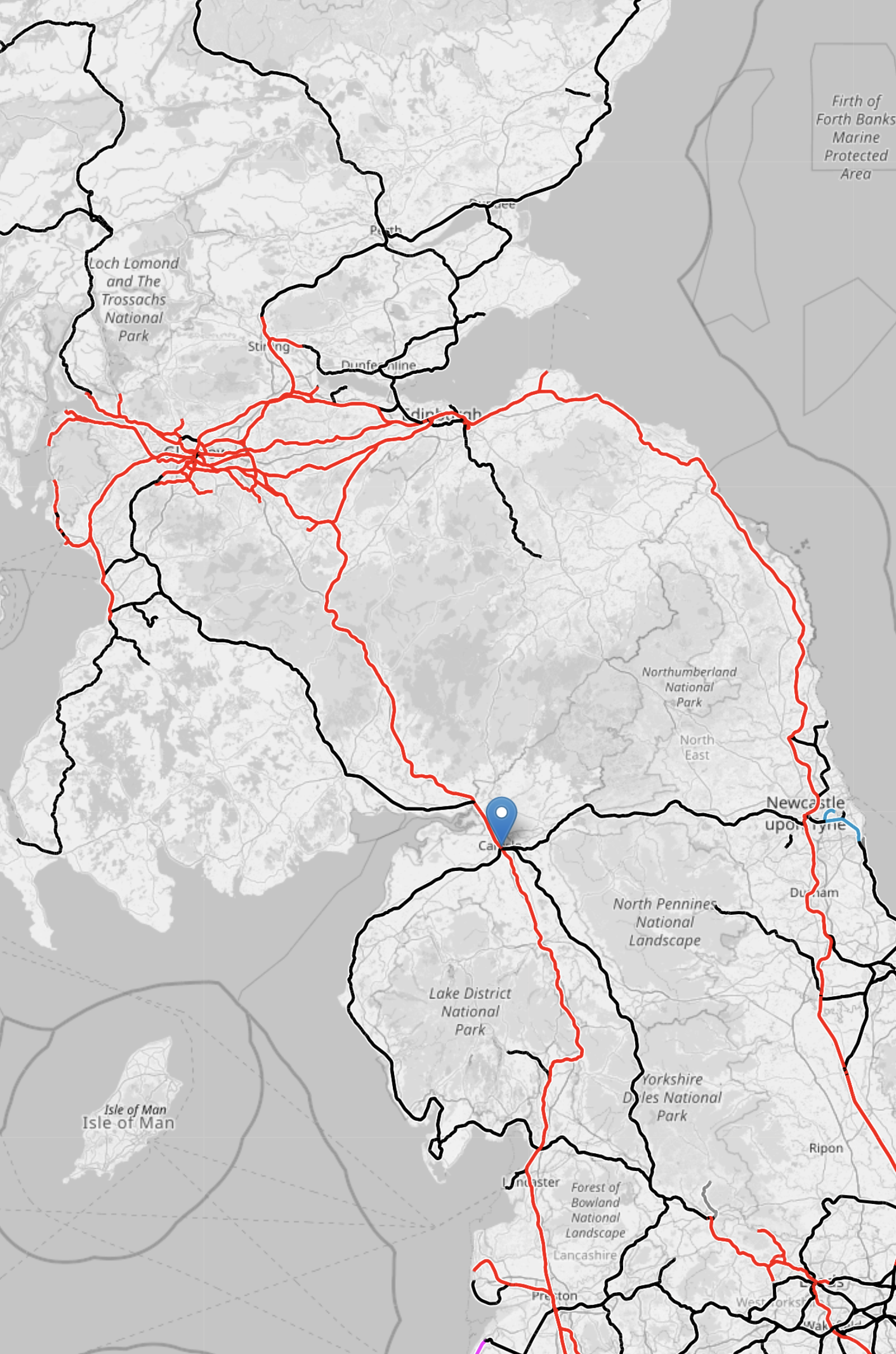
Note.
- Red tracks are electrified.
- Black tracks are not.
- The blue arrow in the middle of the map indicates Carlisle.
- The red track going North-South through Carlisle is the West Coast Main Line.
- The black track going South from Carlisle is the Settle and Carlisle Line.
- Where it turns red is at Skipton station and the electrification can power the train to Bradford Foster Square, Doncaster, Leeds or Sheffield stations.
- The West Coast Main Line splits North of Carlisle and electrified trains can reach either Glasgow Central in the West or Edinburgh Haymarket or Waverley in the East.
- The black track going North-South between Carlisle and Glasgow via Dumfries is the Glasgow South Western Line, which can be used as a diversionary route by some trains with a self-powered capability.
The Settle and Carlisle Line certainly makes Anglo-Scottish routes more robust and flexible when there is bad weather, engineering works or overhead wire or signalling failures.
Will Class 897 Trains Be Able To Run On The Settle And Carlisle Line?
I asked Google AI this question and it gave this answer.
Yes LNER’s new Class 897 tri-mode trains (scheduled for introduction from 2027) will be able to run on the Settle and Carlisle line. As tri-mode electro-diesel multiple units, these 10-car trains are designed to operate across the entire LNER network, utilizing electric, diesel, or battery power to manage non-electrified routes like this, providing a modern alternative to older, diesel-only fleets.
Key details regarding Class 897 on the Settle and Carlisle Line:
Tri-mode Capability: These trains can run on electric, diesel, or battery power, making them highly versatile for non-electrified, scenic, or challenging routes.
Operating Strategy: The trains are designed for flexibility and can be used across the LNER network, which includes routes connecting to Scotland via the West Coast Main Line (WCML) or through services from Leeds.Upgrading Service: They will replace the 40-year-old InterCity 225 fleet, offering a more environmentally friendly, modern alternative to current diesel bi-modes, such as the Class 800/802.
The route is a major, yet challenging, rail line featuring 20 viaducts and 14 tunnels, making it suitable for modern, versatile train sets.
I also believe that running Class 897 trains between Yorkshire and Glasgow offers opportunities to run new services, that will appeal to both travellers and rail operators.
Does The UK Need More Passenger Rail Capacity Between Yorkshire And Glasgow?
I asked Google AI this question and it gave this answer.
Yes, the UK requires more passenger rail capacity between Yorkshire and Glasgow due to severe overcrowding and forecasted demand growth. Major routes like the East Coast Main Line (ECML) and West Coast Main Line (WCML) are, or will soon be, at maximum capacity. Key constraints include infrastructure limitations and the need for better Scotland-England connectivity.
Key insights on this need:
Capacity Constraints: The WCML, particularly at its southern end, is already effectively full, with limited capacity for additional, longer trains. Similarly, the ECML is experiencing significant overcrowding.
Growing Demand: Passenger demand for long-distance rail travel continues to rise, with significant increases noted in journeys between Scotland and other regions.
Infrastructure Issues: Constraints include steep inclines, tight curves, and the need to mix passenger and freight traffic, particularly on the West Coast route.
Proposed Solutions: While some improvements are planned, such as Lumo extending services to Glasgow, the Integrated Rail Plan (IRP) focuses on capacity enhancements in the North/Midlands.
Strategic Need: Enhanced, high-speed connections are considered essential for long-term economic integration and to prevent increased air travel/emissions.
The great advantage of the route, is that is already in place.
Can The Settle And Carlisle Line Handle Planned Diversions?
Can The Settle And Carlisle Line Handle The Caledonian Sleeper?
I asked Google AI this question and it gave this answer.
The Settle-Carlisle line is not a standard route for the Caledonian Sleeper, which typically travels via the West Coast Main Line (WCML) to Edinburgh, Glasgow, and beyond. While the line is a scenic, double-track route with significant infrastructure, it is generally used for local services and freight, not long-distance, heavy sleeper trains.
Key Considerations:
Route: The Caledonian Sleeper operates on the West Coast Main Line, serving destinations like Edinburgh, Glasgow, Aberdeen, Inverness, and Fort William.
Capacity & Infrastructure: While the Settle-Carlisle line has major structures like the Ribblehead Viaduct, it is not the primary route for high-speed or overnight sleeper services.
Operational Normal: The sleeper service splits into portions at Edinburgh, and does not regularly operate via the Settle-Carlisle line.
In short, the Settle-Carlisle line is not designed for or used by the Caledonian Sleeper, which operates via the West Coast Main Line.
But it does appear, that in the past some sleeper trains have used it.
How Many Freight Trains Use the Settle And Carlisle Line In A Typical Day?
This article on the BBC is entitled Settle To Carlisle line: Shortage of trains ‘Hampering Growth’, says this about the number of trains.
From only two trains a day in the 1980s the Settle and Carlisle line now sees 14 passenger and 18 freight services a day.
That is progress!
‘A Rare Opportunity’: Northern Will Run Service Along Heritage Railway Line For The First Time And Tickets Are Now On Sale
The title of this post, is the as that of this news item from Northern Trains.
This is the sub-heading.
Northern will run a service along a heritage railway line for the first time, to raise money for charity.
These four paragraphs add detail to the story.
Tickets are now on sale for the service, which will set off from Darlington station on Sunday, 22 February and complete a return trip along Weardale Railway before heading back to Darlington.
Northern has been working closely with Weardale Railway to organise this event.
The railway, which opened in 1847, is a popular tourist attraction and allows visitors to travel on heritage trains along a picturesque 16-mile route. It runs between Bishop Auckland West and Stanhope in County Durham.
In 2020, it was saved from administration by The Auckland Project, which has since provided significant investment to fund essential repairs and infrastructure improvements.
Note.
- The train will be one of Northern’s Class 158 trains.
- Tickets are being sold for £25 and the proceeds will be donated to two local charities: The Angel Trust, based in Bishop Auckland, and 123help4familys, based in Stanhope.
- The train will leave Darlington at 09:46 and finishes its trips up and down the Weardale Line at Darlington at 17:44.
I won’t be going, as I can’t fit the day together.
Is There Support For An Extended Service From Bishop Auckland?
I asked Google AI, this question, and got this mildly surprising answer.
Yes, there is support for extended services in Bishop Auckland, primarily through NHS GP extended access, which provides appointments outside of normal hours (6 PM – 8 PM weekdays and weekends) at Bishop Auckland Hospital. The Urgent Treatment Centre is available 24/7, and various community-based support services, including care agencies and mental health support, are also available.
If the hospital and the other medical facilities are open, surely in a rural area, if they are needed, transport should be available.
Is There A Need For More Housing In Bishop Auckland?
Yes, there is a significant, documented need for more housing in Bishop Auckland to address a, “chronic shortage of quality bungalows and assisted living” alongside a broader demand for modern, energy-efficient homes. The town is undergoing a regeneration with plans for increased, “affordable housing” and “100% affordable” developments (e.g., in “Westerton Road” and “Holdforth Crescent”) to meet the growing population and “economic needs”.
Note.
- A regular service to Darlington may make building more housing viable.
- Judging by the amount of new houses along the Northumberland Line, the new railway has encouraged their building.
Services and stations could be added as required, as appears to be being done on the Northumberland Line.
New Station Openings In Early 2026
This post is for two reasons.
I needed an answer to my query.
I wanted to explore the competence of Google AI.
When I typed the title of this post into Google AI, I received this answer.
Several new railway stations in the UK are scheduled to open or begin passenger services in early 2026, primarily in the West Midlands, Northumberland, Devon, and Cambridgeshire.
- Darlaston (between Walsall and Wolverhampton)
- Willenhall (between Walsall and Wolverhampton)
- Kings Heath (Camp Hill line, Birmingham)
- Moseley Village (Camp Hill line, Birmingham)
- Pineapple Road (Camp Hill line, Birmingham)
- Bedlington
- Northumberland Park (interchange with Tyne and Wear Metro)
- Cambridge South (Cambridgeshire) – Expected to open in June 2026, connecting the biomedical campus to London, Birmingham, Stansted, and Gatwick airports.
- Okehampton Interchange (Devon) – This new park and ride station, part of the Devon Metro plan, is planned to open in spring 2026.
- Magna (Rotherham) – A new tram-train and park & ride stop is due to open in early 2026.
- Darlington Station redevelopment (County Durham) – Major redevelopment works are “on target” for completion in spring 2026.
It looks to me, that Google AI made a good fist of my question.
Darlington Station – 26th June 2025
I visited Darlington station, three times on my trip.
These pictures are in chronological order.
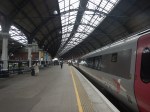
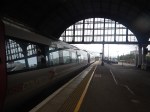
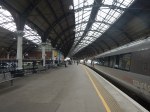
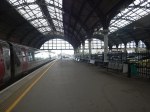
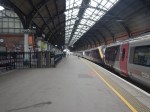
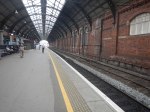
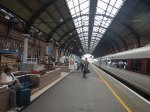
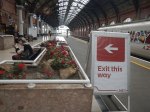
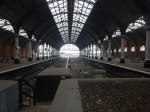
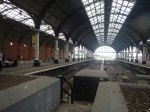
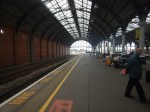
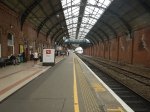
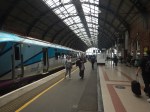
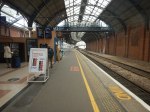
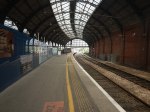
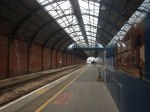
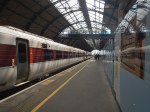
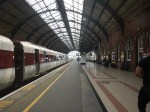
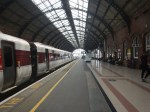
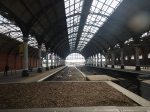
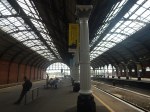
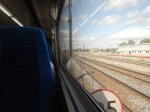
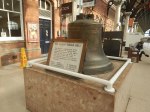
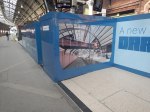
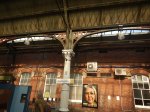
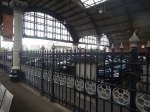
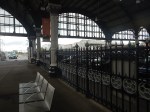
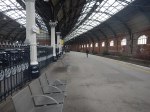
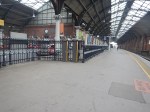
Note.
- The station is being given a major upgrade, so it can handle more trains.
- The station has a large number of top-quality Victorian features.
- The station is Grade II* Listed.
- Inside the enormous train-shed are two long platforms, that handle most of the trains and two South-facing bay platforms.
- Two new platforms, which are numbered 5 & 6, and possibly a double-track avoiding line are being added outside the train-shed on the East side.
- In images with a comment saying Note Platform 5, the new long electrified Platform 5 can be seen.
- Platform 5 appears to be already electrified at its Southern end.
These three OpenRailwayMaps shows the future layout.
The first OpenRailwayMap shows the junction, where the branch to Newton Aycliffe, Shildon and Bishop Auckland connects.
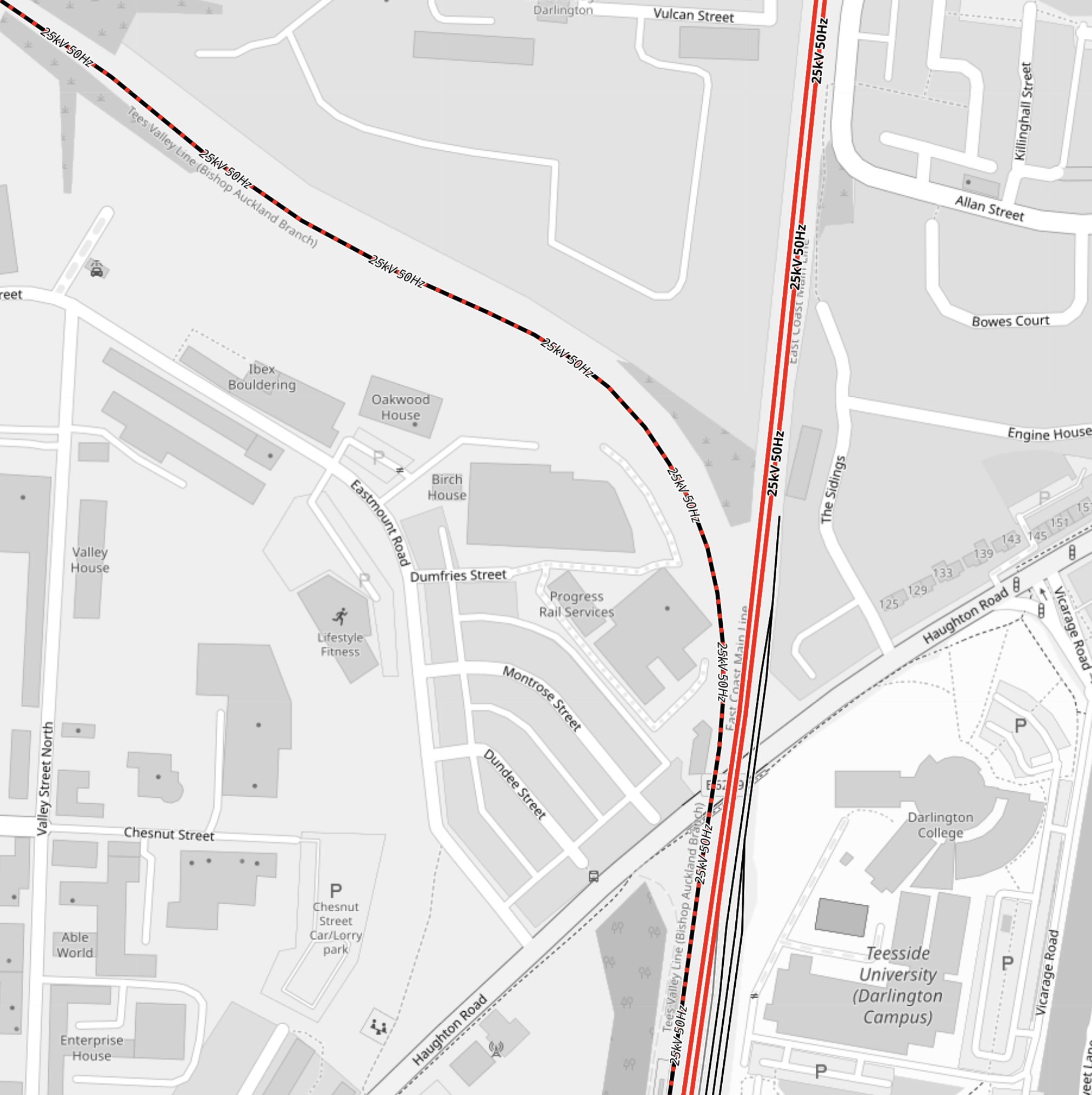
Note.
- The red tracks are electrified and indicate the East Coast Main Line.
- The track curving off to the North-West is the Bishop Auckland Branch.
- The black tracks are not-electrified.
- The Bishop Auckland Branch is shown dotted black and red, as it will be electrified, so that Hitachi can get their new trains to the East Coast Main Line.
- The two tracks of the East Coast Main Line are very straight and the map shows them to have a 125 mph operating speed.
The second OpenRailwayMap, shows the lines immediately to the South of Darlington station.
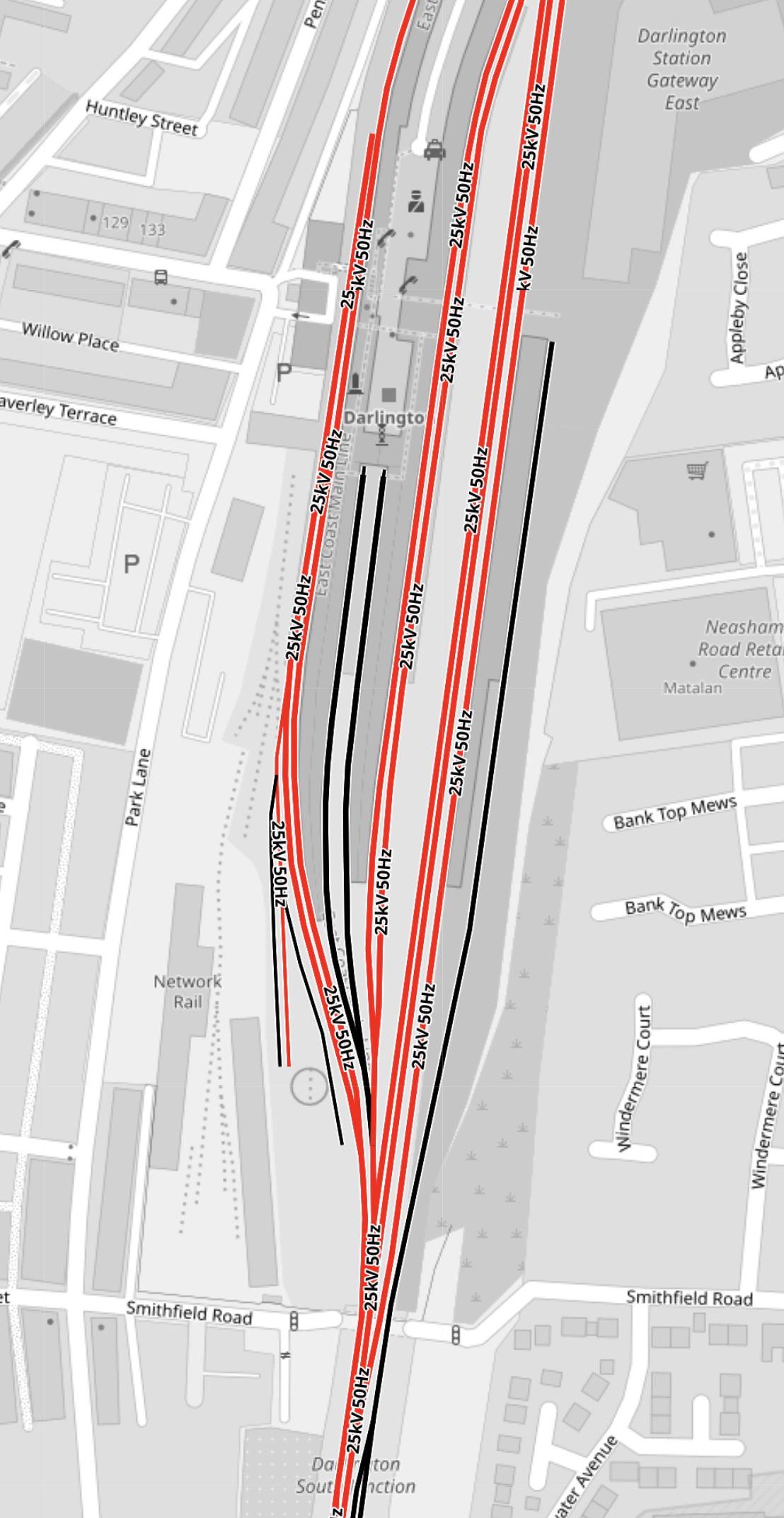
Note.
- The red tracks are electrified.
- The black tracks are not electrified.
- Tracks are number 4, 3, 2 and 1 from the West.
- The Southern ends of Platforms 1 and 4, and Platforms 2 and 3, which are inside the current train-shed appear to be virtually unchanged.
- Platform 1 is electrified and will probably still cater for Southbound trains.
- Platforms 2 and 3 are bay platforms without electrification for trains terminating at Darlington.
- Platform 4 is electrified and will probably still cater for Northbound trains.
- There is an electrified avoiding line to the East of Platform 1.
- The brick wall of the current train shed is in the white space to the East of Platform 1.
- Outside the current train shed are two electrified 125 mph lines, an electrified through platform and a South-facing bay platform without electrification.
- The new electrified platform looks very long. Could it be long enough to handle a pair of High Speed Two Classic-Compatible trains? I suspect though it is long enough to handle the splitting and joining of a pair of five-car Hitachi Class 80x trains.
- The new bay platform looks longer that the current bay platforms 2 & 3. Is it long enough to handle a five-car Hitachi Class 80x train?
- It does appear from the track layout, that the new electrified platform is connected to the East Coast Main Line, the Saltburn branch and stabling sidings to the North of the station.
- The new bay platform appears to be connected to the Saltburn branch.
The two new platforms also appear to be adjacent to an area of the station, which is labelled Darlington Station Gateway East. I would assume, that this proximity will be used to make the station easy for changing trains.
The third OpenRailwayMap shows the section of the station between the two previous maps.
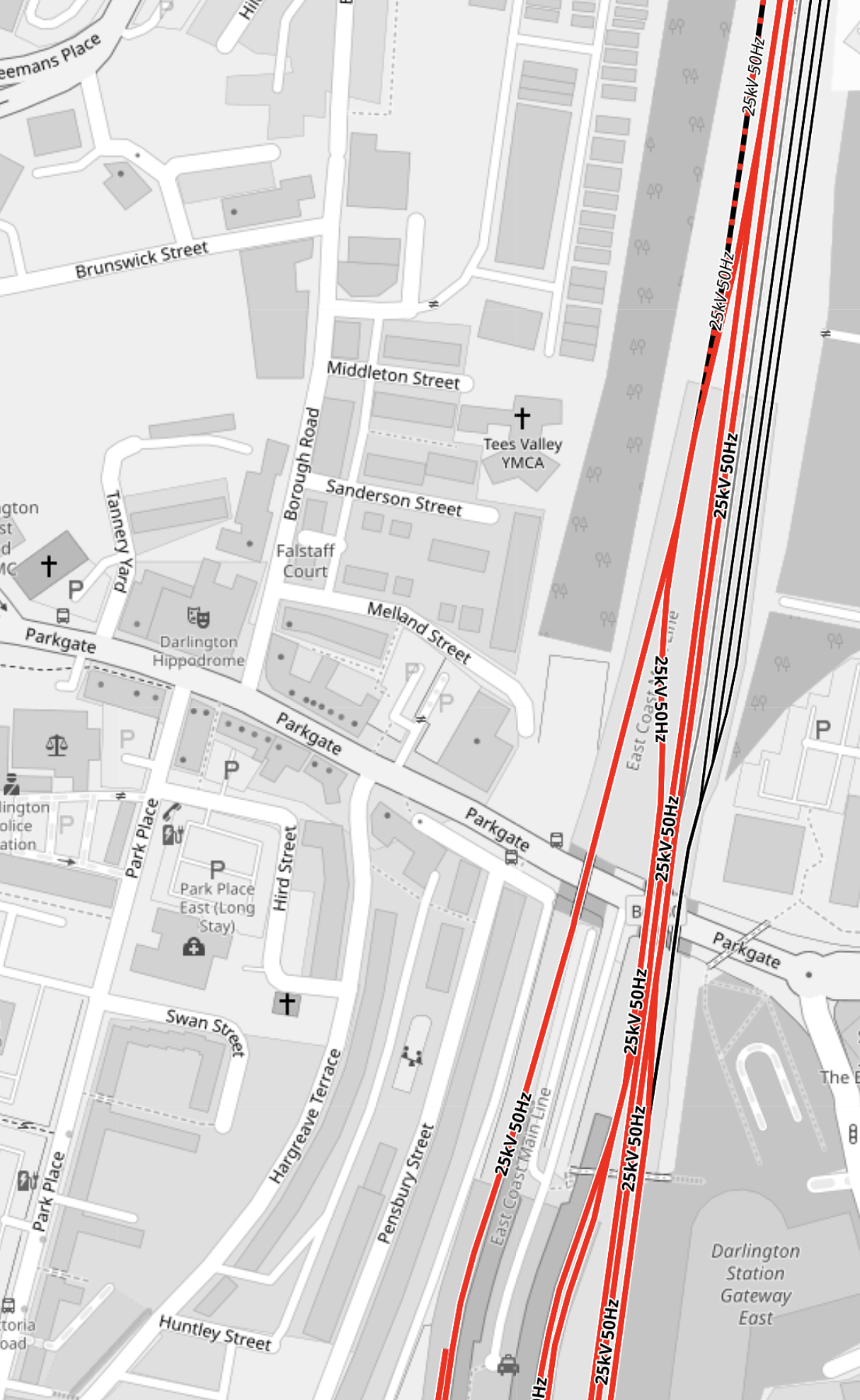
Note.
- The red tracks are electrified.
- The black tracks are not-electrified.
- The Darlington end of the Bishop Auckland Branch is shown dotted black and red, as it will be electrified, so that Hitachi can get their trains to and from the East Coast Main Line.
- Both Platforms 1 and 4 appear to connect to the East Coast Main Line, so high speed services can operate as they do now, by taking a diversion through the current Darlington station.
- To the East of the East Coast Main Line, there appear to be some very useful stabling sidings.
I have some general thoughts about Darlington station.
Will Trains Not Stopping At Darlington Station Use The New 125 mph Lines Through the Station?
It does appear that the two 125 mph lines through the new part of the station are very straight.
- They are shown as 125 mph, but could be faster.
- It should be remembered that according to Wikipedia, British Rail built the Selby Diversion for 160 mph in 1983.
- Between Durham and York stations is 66.2 miles of mainly 125 mph railway.
I believe that cutting out the need for trains to slow to go through Darlington station could save several minutes.
Will Trains Stopping At Darlington Station Use The Current Platforms 1 And 4 As They Do Now?
The track layout would seem to allow this and those changing to another train, would not have to walk a long way.
Can Trains Stopping At Darlington Station Use The New Eastern Platforms?
I have examined the second and third maps in detail and it looks as if the track layout will allow trains on the East Coast Main Line in both directions to stop at the long electrified platform.
The shorter bay platform appears to be only connected to the Tees Valley Line to Middlesbrough and Saltburn.
How Long Are The New Eastern Platforms?
Estimating against the scale on the map, I reckon these are the likely lengths.
- Long electrified platform – 400 metres – Appears to be numbered 5
- Bay platform – 200 metres – Appears to be numbered 6.
These are very useful lengths.
An Aerial View Of The New Platforms
This image from Tees Valley Combined Authority shows the Northern ends of the new platforms and the new footbridge.
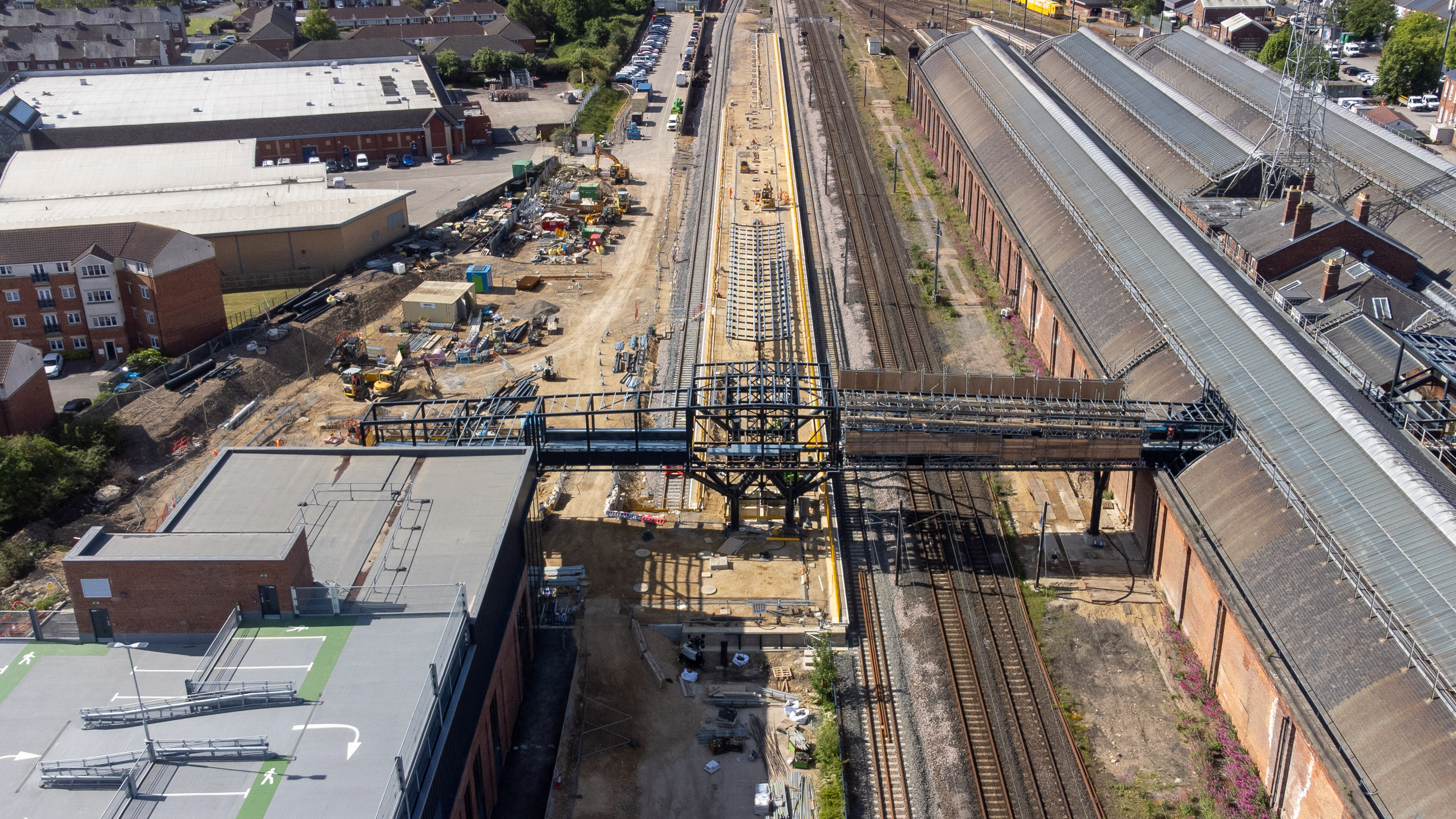
Note.
- The original four-platform Victorian station is on the right, which is the Western side.
- The East wall of the Victorian train shed can be clearly seen.
- The two absolutely straight 125 mph lines, that allow trains to bypass the original station are closest to the wall.
- The long electrified platform, which appears to be numbered 5, also appears to be absolutely straight.
- The unelectrified bay platform, which appears to be numbered 6, is to the left.
- Platforms 5 and 6 would seem to be separated by a wide island platform, which would make interchange easy.
This page on the Network Rail web site, gives more information.
Car Parking At Darlington Station
This image from Tees Valley Combined Authority shows the Northern end of the station.
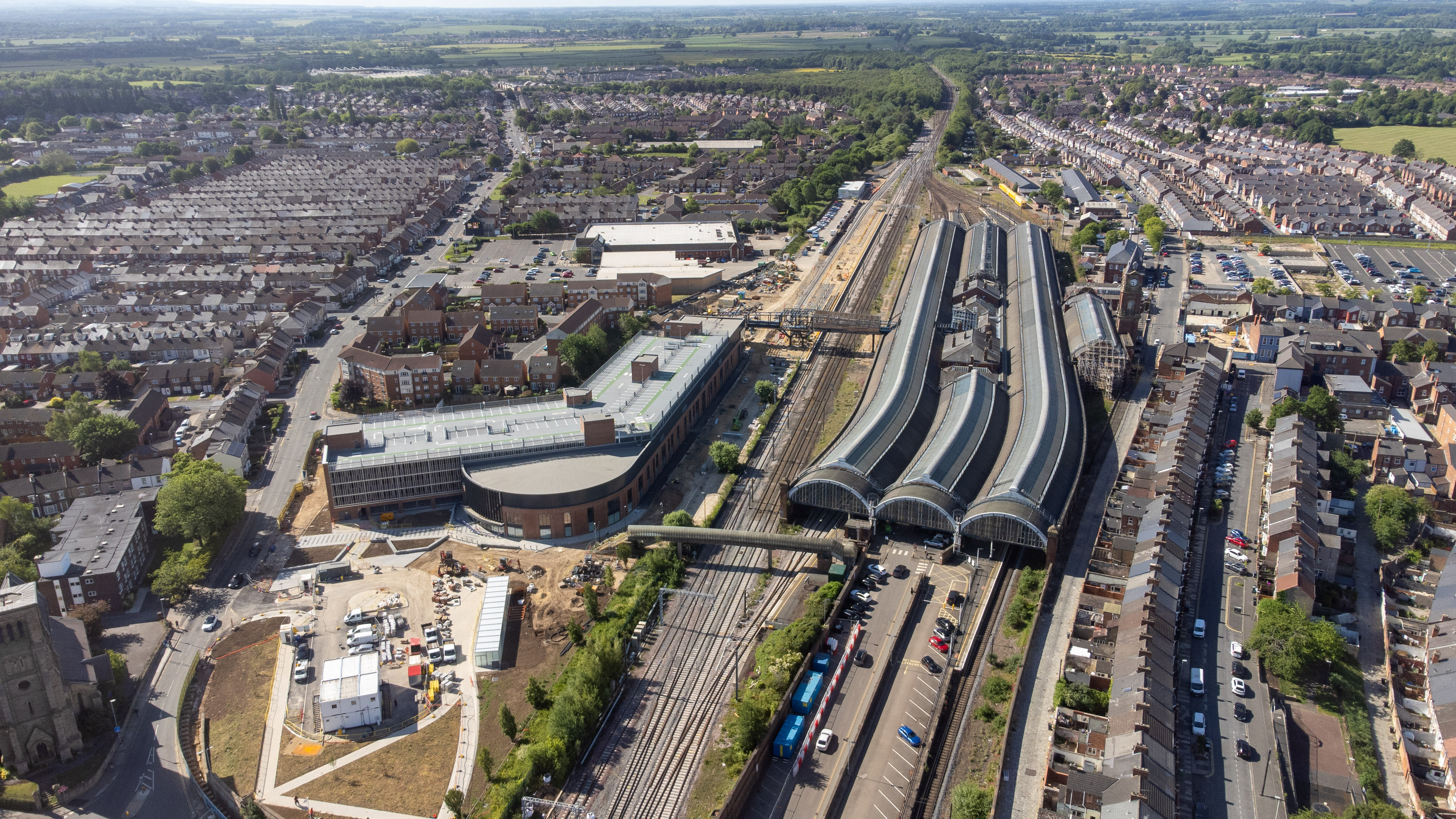
Note.
- The three sections of the Victorian station.
- The two new platforms ; 5 and 6 at the top of the image.
- The two 125 mph lines bypassing the Victorian station.
- There are two new footbridges connecting the Victorian station to the land on the other side of the 125 mph lines.
To the left of the station, there appears to be a massive multi-story car-park.
I asked Google about the new car park at Darlington station and got this reply.
The new multi-story car park at Darlington Station will have a capacity of more than 650 vehicles. This is part of a larger £140 million redevelopment of the station, which also includes new platforms and an eastern concourse. The car park will include accessible parking bays and electric car charging points.
This image from Tees Valley Combined Authority shows the car parking from the South.
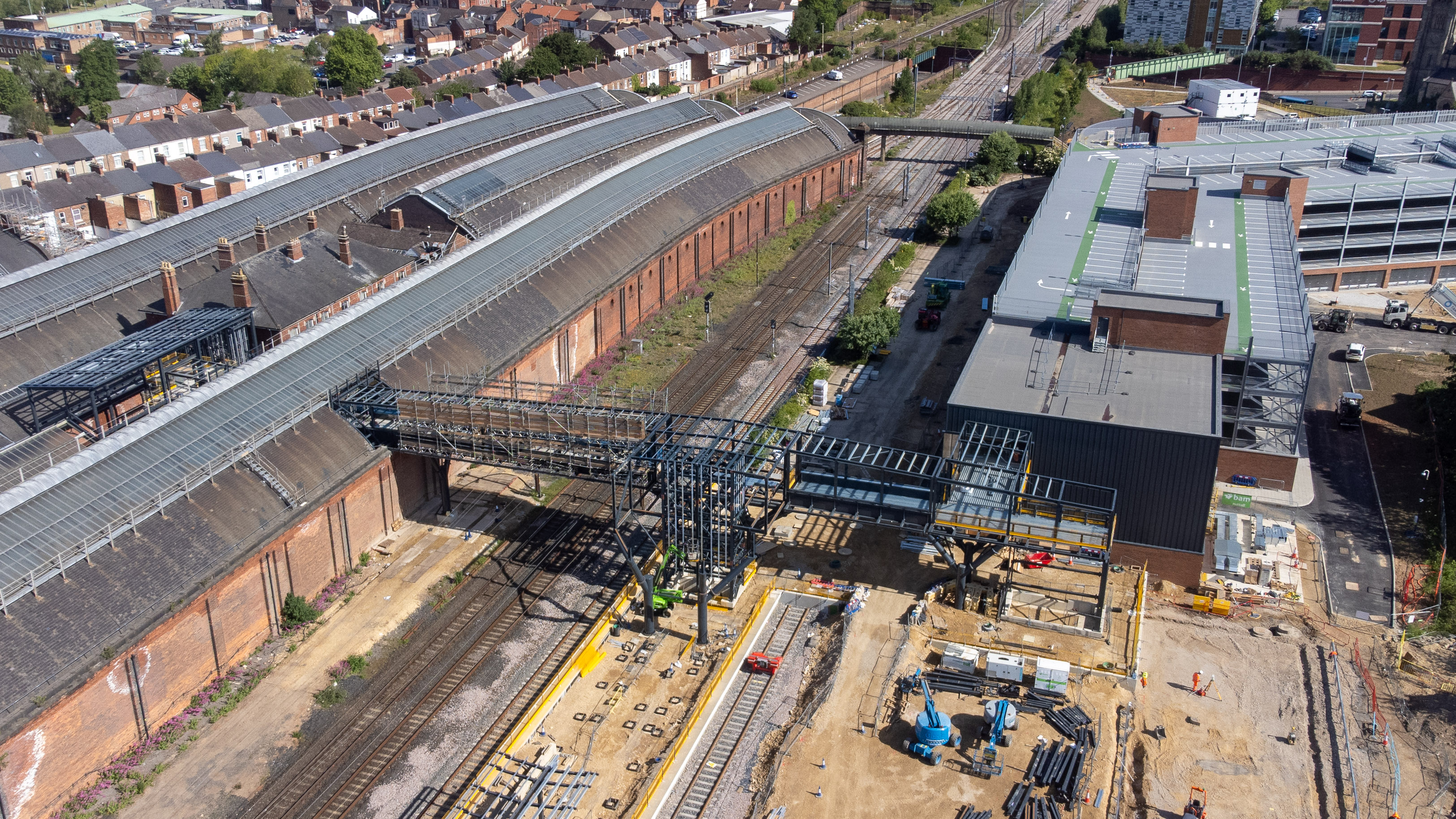
Note.
- The building appears to be a five-story car park.
- There appears to be a very easy connection between the car park and the bridge to the station.
- From the roof layout, there appears to be several lifts.
- It looks like there will be a large area between the platforms and the car park, where travellers can meet and socialise.
- The bay platform 6 already has a pair of red buffer stops.
Railways may have come to Darlington two hundred years ago and it looks like they are getting the car parking at the station ready for at least the next two hundred.
Further Electrification
If as I expect, the UK embraces battery electric technology for local and regional trains, I can see the three South-facing bay-platforms being electrified, so they could charge he battery-electric trains.
This picture shows that bars have been placed across Platforms 2 and 3, that could be used to support the electrification.
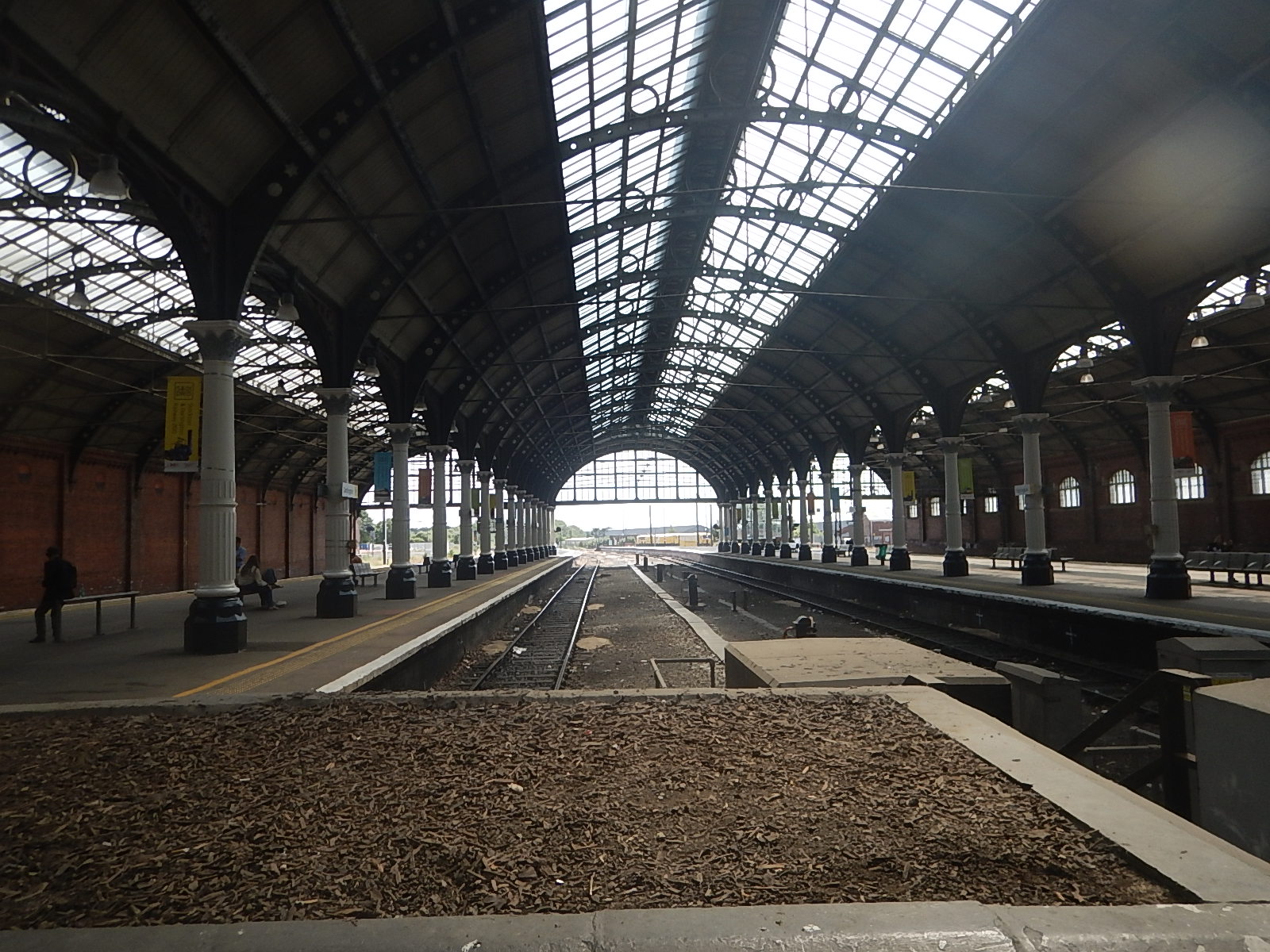
This method has been used in Victorian stations in the UK before. I show some installations and discuss electrifying Victorian stations in Could Hull Station Be Electrified?.
Darlington Station And High Speed Two
This graphic shows the original service pattern for High Speed Two.
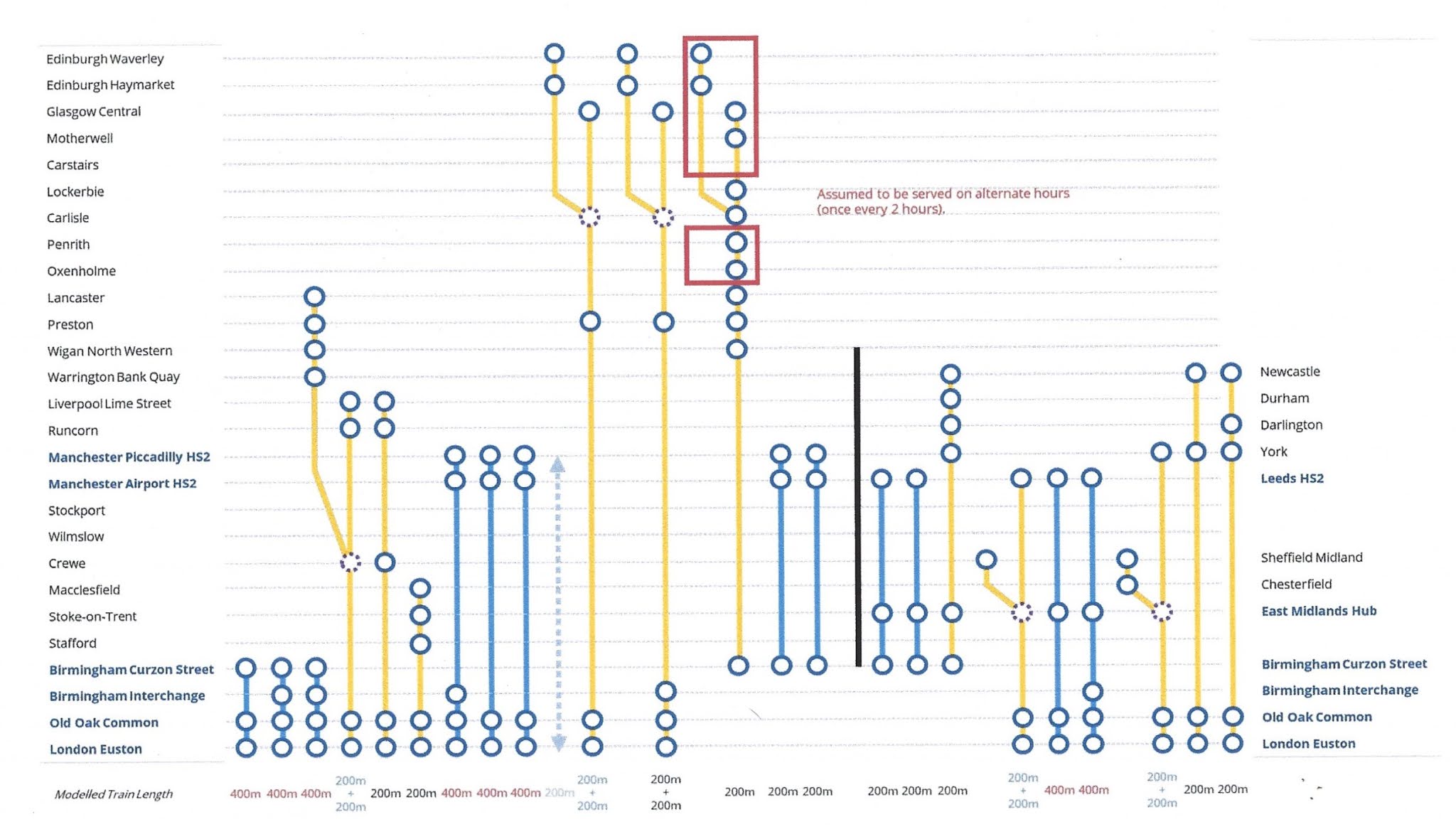
Note.
- There are seventeen paths terminating in the South at Euston station.
- Six of these paths go to Leeds, Newcastle or York.
- As the Eastern leg has been abandoned, that means there will be no High Speed Two trains to Leeds HS2, York, Darlington, Durham and Newcastle via the East Coast Main Line.
Darlington was to be served by these hourly services.
- Train 17 – Birmingham Curzon Street and Newcastle via East Midlands Hub, York, Darlington and Durham.
- Train 23 – London and Newcastle via York and Darlington.
Both trains would have been a single 200 metre long High Speed Two Classic-Compatible train.
Joining And Splitting Trains At Darlington
As Platform 5 looks like it would be a 400 metre long platform, it would look like it would be possible to handle a pair of High Speed Two Classic-Compatible trains.
But these trains will not now be serving Darlington in the near future, as the Eastern leg of High Speed Two has been cancelled.
A pair of nine-car Class 801 trains would be 467.4 metres long and might be able to fit into Platform 5.
But a pair of seven-car trains would certainly fit into a 400 metre Platform 5.
In Do Class 800/801/802 Trains Use Batteries For Regenerative Braking?, I found this snippet in an Hitachi document.
To simplify the rearrangement and management of train configurations, functions are provided for identifying the train (Class 800/801), for automatically determining the cars in the trainset and its total length, and for coupling and uncoupling up to 12 cars in
normal and 24 cars in rescue or emergency mode.
So I suspect with software updates two nine-car trains could run together.
Suppose LNER wanted to attack the airlines on the London and Scottish route.
- Two seven- or nine-car Class 800 or 801 trains would leave Edinburgh working as a pair.
- First stop would be Platform 5 in Darlington.
- The trains would split in Darlington.
- One train would go to King’s Cross stopping at perhaps Doncaster and Peterborough.
- The other train would go to St. Pancras stopping at perhaps Leeds, Sheffield, Nottingham and Bedford.
Note.
- A seven-car Azuma would be under 200 metres long.
- Seven-car trains would fit in St. Pancras.
- LNER have run an Azuma train into St. Pancras.
- The train would interchange with East-West Rail at Bedford.
- Travellers to and from East Anglia would change at Peterborough.
Large areas of England would have a fast route to and from Scotland.
Darlington And Bishop Auckland – 26th June 2025
My second trip out from Darlington was to Bishop Auckland station and I took these pictures on the way up and down.
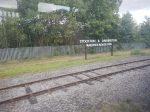
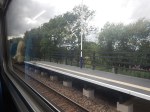
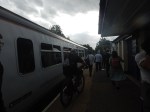
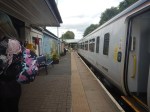

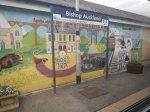
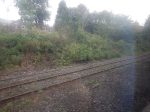
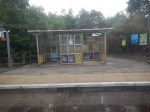
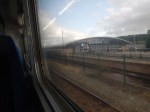
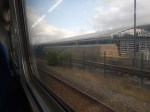
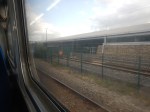
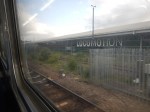

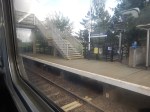
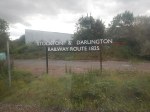
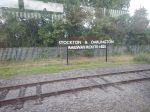
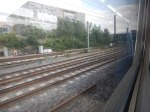
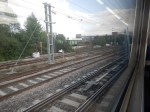
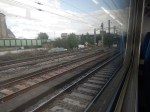
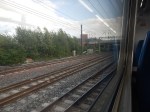
Note.
- Bishop Auckland station is a one-platform station, but all the other stations seem to be two-platform stations.
- The railway museum; Locomotion seems to be within walking distance of Shildon station.
- There is a short section of electrified track, that Hitachi use to test trains and get them to the East Coast Main Line.
The stations seemed tidy and clean, but more step-free access is needed.
I have some further thoughts.
The Location Of Hitachi Rail
This Google Map shows the location of Hitachi Rail.
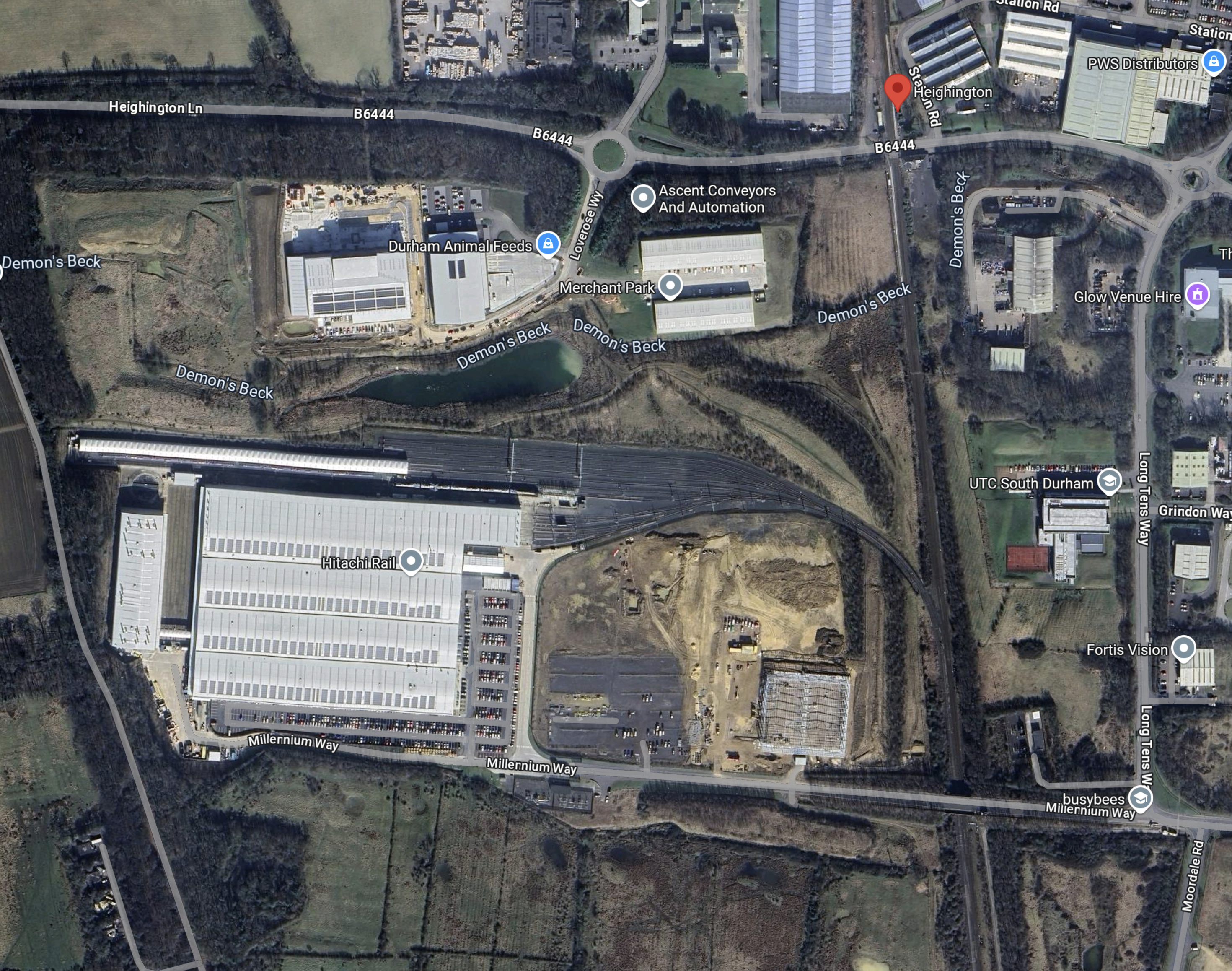
Note.
- Heighington station on the Tees Valley Line is marked by the red arrow.
- Hitachi Rail is the large building in the South-West corner of the map.
- There appear to be electrified sidings to the North of the factory, which have a connection to the Tees Valley Line.
From the map it looks efficient and well-designed.
Could The Services On The Branch Be Run By Battery-Electric Trains?
I don’t think there would be too many problems.
- Bishop Auckland and Darlington is only twelve miles.
- Both platforms at Darlington used by Tees Valley Line services are electrified.
- The single platform at Bishop Auckland station could be fitted with one of Siemens’s Rail Charging Convertors.
- Hitachi at Newton Aycliffe might like some more formal electrification between Newton Aycliffe and Darlington stations.
- An electrified Tees Valley Line would surely be useful to Hitachi for showing the capabilities of battery-electric trains.
This would be a very easy line to run using battery-electric trains.
Is Liverpool Going To Get High Speed One-Point-Five?
Some of the best train journeys, I’ve ever had were not on high speed trains on specially-built tracks.
- The Thunder of Three-Thousand Three-Hundred Horses is from the early 1970s and describes a trip back from Darlington behind a Class 55 locomotive or Deltic.
- Norwich-In-Ninety Is A Lot More Than Passengers Think! describes a trip from London to Norwich and back, in the early days of the Norwich-in-Ninety timetable behind a Class 90 locomotive.
- I could add a journey on an InterCity 125 from London to Plymouth, which was running nearly thirty minutes late at Newbury, but was on time at Exeter.
The connection between these stories, was that all had a superb biological control system in the cab, who with help from the signallers was able to keep to a difficult schedule or make up time.
Last year, I made several journeys between Euston and Liverpool Lime Street. A couple of the journeys were unusual in that we arrived at our destination around six or more minutes early.
I suspect, that Avanti West Coast were experimenting to make sure that they get the new two trains per hour (tph) for the route perfect.
In Avanti West Coast Looks To Recover, I said this about Euston and Liverpool Lime Street services.
A paragraph talks about the second hourly service between London and Liverpool.
Avanti still has ambitions to introduce a second hourly service between Euston and Liverpool, but when this will come in will depend on demand recovery.
Consider.
- If would be desirable if some or all trains running on the route could achieve a timing of two hours between London and Liverpool.
- It is felt that the second service should stop at Liverpool South Parkway station, where the platforms are too short for eleven-car Class 390 trains.
- Avanti have stated they would like more stops in the Trent Valley, especially at Nuneaton, where they would connect to services to the East Midlands.
- Nuneaton is almost exactly halfway between London and Liverpool.
- Running two tph with Class 807 trains would need nine trains and Avanti have only ordered ten in total.
I believe that a practical timetable like this could work.
- Class 390 train – one tph – Non-stop or perhaps a single stop in the Midlands – Under two hours
- Class 807 train – one tph – Stopping at Nuneaton, Stafford, Crewe, Runcorn and Liverpool South Parkway – Current time or better
An hourly service between London and Liverpool in under two hours would surely be a passenger magnet.
So what is possible?
I found this service on Real Time Trains, which ran on the 16th February 2023.
- Scheduled to leave Liverpool Lime Street at 0943, but left at 1012 or 29 minutes late.
- Train did a ninety second unadvertised stop at Liverpool South Parkway. Now running 26 minutes late.
- There was a two minute stop at Runcorn and a four-minute stop at Crewe. Now running 25 minutes late
- There was a one-minute stop at Milton Keynes. Now running 20 minutes late.
- The train arrived in London Euston at 1220 or 16 minutes late.
Note.
- Liverpool Lime Street and London Euston took 2 hours and 8 minutes.
- As Liverpool Lime Street and London Euston is a distance of 193.6, a 128 minute journey is an average speed of 90.7 mph
- Liverpool Lime Street and Crewe took 32 minutes with two stops.
- Crewe and London Euston took 1 hour and 32 minutes with one stop.
- In West Coast Main Line Electro-Diesels On Test, I found that a Glasgow and London train took 1 hour and 28 minutes between Crewe and London Euston.
- All services last week had the unadvertised stop at Liverpool South Parkway
What can be deduced from these figures?
- If the Crewe stop were to be cut out, two hours and four minutes could certainly be possible between Liverpool Lime Street and London Euston with a Class 390 train.
- I also suspect that if the train were to be run non-stop, that the other four minutes could be saved.
So will Avanti West Coast run the current service using new Class 807 trains, with the extra stop at Liverpool South Parkway and perhaps other stations and the additional hourly train with a non-stop nine-car Class 390 train?
This way of delivering a two tph service would mean.
- Runcorn, Crewe and Milton Keynes would not lose any of their current fast services to and from Liverpool Lime Street and London Euston.
- Liverpool South Parkway station is probably a more convenient location for some passengers going to and from the South. It would gain an hourly service to London Euston.
- There will be an additional 77% of seats between Liverpool Lime Street and London Euston.
- Passengers who don’t like tilting trains could use the Class 807 trains.
- One tph would be timed for two hours or under and would be a marketing man’s dream.
No train would be slower than the current services.
Improvements To The Non-Stop Class 390 Train Service
I earlier said.
As Liverpool Lime Street and London Euston is a distance of 193.6, a 128 minute journey is an average speed of 90.7 mph.
An average speed of 90.7 mph, doesn’t seem fast for a Class 390 train with an operating speed of 125 mph or 140 mph under full ERTMS digital signalling.
These are some times for a selection of average speeds between Liverpool Lime Street and London Euston.
- 90 mph – 2 hours 9 minutes
- 100 mph – 1 hour 56 minutes
- 110 mph – 1 hour 46 minutes
- 120 mph – 1 hour 37 minutes
- 125 mph – 1 hour 33 minutes
- 130 mph – 1 hour 29 minutes
- 135 mph – 1 hour 26 minutes
- 140 mph – 1 hour 23 minutes
Note.
- Average speeds of upwards of 130 mph are unlikely, but I’ve added them to show that the train speed is less important than the speed of the track.
- High Speed Two’s planned time between Liverpool Lime Street and London Euston is 1 hour and 32 minutes.
But I do think times of around 1 hour and 35 minutes should be possible for non-stop Class 390 trains between Liverpool Lime Street and London Euston with an improved track and full ERTMS digital signalling.
Improvements To The Stopping Class 807 Train Service
As the track of the West Coast Main Line is improved with better track and full ERTMS digital signalling, this will also benefit the times of the stopping service run by the new Class 807 trains.
The Class 807 train with its lighter weight will have better acceleration than the current Class 390 trains. This will mean, that they will not be slowed as much, when they stop.
It may be possible to add extra stops at places like Watford Junction, Nuneaton and Stafford and still time the train for a few minutes over two hours.
Avanti West Coast Looks To Recover, is a post, that I wrote based on an interview in Modern Railways with Phil Whittingham, who is MD of Avanti West Coast.
There is a lot of talk in the article about.
- Using Nuneaton to connect the North West and the East Midlands.
- The acceleration of the Class 807 trains.
- Improving the Customer Service.
I think that Liverpool will find it is connected to more of the country on services with just a single change.
Conclusion
Liverpool is getting greater connectivity to the Midlands and the South-East of England, with times, that could be improved to be comparable with High Speed Two.
Proposals Submitted To Create Darlington To Dales Rail Link
The title of this post, is the same as that of this article on the Durham County Council web site.
These paragraphs outline the proposals.
The proposals will focus on development of the Darlington-Dales corridor, improving the connectivity of towns and villages along the Weardale line. It will also review the possibility of providing a link to Crook.
This new rail link would support economic development along the Darlington-Dales corridor, helping to attract visitors and boost spend in these areas by connecting tourism sites including Hamsterley Forest, Bishop Auckland town centre, the Durham Dales, and the Weardale Railway.
The enhanced rail connectivity would also enable residents to access wider education and job opportunities, while reducing the environmental impact of the county’s transport system by providing an alternative to cars.
It looks at first glance to be practical proposals, that could be easily achieved without spending a fortune.
As Teesside has a plentiful supply of hydrogen and is even planning a depot for hydrogen trains, what would new Alstom Aventra hydrogen trains between Weardale and Saltburn via Darlington, do for tourism in the area?
The Integrated Rail Plan For The North And Midlands And The East Coast Main Line
Note that this is not a finished post.
To read the The Integrated Rail Plan For The North And Midlands (IRP), click this link.
There is a section in the IRP called Serving Leeds, York and North East England.
It is a section of six paragraphs and I shall describe their contents in detail separately.
Paragraph 3.41
This is said in the IRP.
Under the original plans, HS2 trains would have served Leeds, York and North East England via the West Midlands, with the Eastern Leg branching off from the Phase One line just north of Birmingham Interchange.
This is a significantly longer route than the current East Coast Main Line from King’s Cross, which goes directly up the eastern side of the country.
Due to capacity constraints north of Doncaster HS2 trains to Newcastle and York could also only be accommodated at the expense of existing services, potentially reducing or removing connections between the North East and Doncaster, Newark and Peterborough.
Unlike the West Coast Main Line, there is also potential to lengthen existing trains by up to three carriages, increasing the number of seats on those trains by around 40%.
Geography wins and I’ll discuss the train lengthening later.
Paragraph 3.42
This is said in the IRP.
The IRP has concluded in favour of a significant package of upgrades to the East Coast Main Line which could deliver similar journey times to London and capacity improvements for York and the North East as the original proposals – but many years sooner, and with operational carbon savings because trains will be taking a shorter route.
Speed is important in both project delivery and running of the trains.
Paragraph 3.43
This is said in the IRP.
We are therefore taking forward a substantial package of investment for the East Coast Main Line between London and Leeds and the North East, subject to future business case. Development work will consider interventions from both NPR designs undertaken by Network Rail, mainly focussed on York and northwards, and work undertaken by Mott MacDonald for the Department for Transport focused on the line south of York. North of York we will look to increase the number of paths for long distance high speed trains from 6 to 7 or 8 per hour. In addition to the already planned roll-out of digital signalling, work is expected to include looking at opportunities to improve rolling stock performance; power supply upgrades to allow longer and faster trains; route upgrades to allow higher speeds, including of up to 140mph on some sections; measures to tackle bottlenecks, for example south of Peterborough and at stations and junctions such as Newark, Doncaster, York, Northallerton, Darlington and Newcastle all of which limit speed and capacity; and to replace level crossings where needed.
We will ask Network Rail to now take forward these proposals, including considering any alternatives which may deliver better outputs and/or more cost-effective solutions.
I’ll discuss a lot of this later in more detail.
Paragraph 3.44
This is said in the IRP.
This package is intended to:
-
- Cut journey times from London to a range of destinations, including Leeds, Darlington, Northallerton, Durham, and Newcastle by up to 28 minutes, bringing journey times closer to those proposed by HS2, much earlier than previously planned;
- Allow the introduction of longer trains, increasing the number of seats;
- Provide 7–8 long distance high speed paths per hour north of York to Newcastle, compared to the current 6 paths (and so allowing a minimum of two fast Manchester to Newcastle services each hour alongside other ambitions);
- Improve performance and reliability, enabling faster and more reliable services for passengers.
I’ll discuss a lot of this later in more detail.
Paragraph 3.45
This is said in the IRP.
Journey times from London to Newcastle under this plan could be as little as 2 hrs 25-28 minutes (subject to stopping pattern), about 21-24 minutes faster than now and 8 minutes slower than under the full HS2 plans.
Journey times to York and Darlington under this plan would be about 15 minutes faster than now and 12-14 minutes slower than under the full HS2 plans.
Journey times from London to Leeds, at around 1 hour 53, would be about 20 minutes faster than now, but 32 minutes slower than under the full HS2 plans.
I’ll discuss a lot of this later in more detail.
Paragraph 3.46
This is said in the IRP.
Journey times from Birmingham to Leeds would be around 30 minutes faster than the current typical time, and, subject
to further analysis, York and the North East could be would be around 30 minutes faster than the current typical time,
via HS2 Western Leg, Manchester and NPR (based on indicative train service).
I’ll discuss a lot of this later in more detail.
My Thoughts
These are my thoughts.
Longer Trains
This is said in Paragraph 3.41
Unlike the West Coast Main Line, there is also potential to lengthen existing trains by up to three carriages, increasing the number of seats on those trains by around 40%.
The Hitachi Class 800, Class 801, Class 802 and Class 803 trains, that run the routes out of King’s Cross come in lengths of five, nine and ten coaches.
- The maximum length of an individual train is twelve cars according to this Hitachi document.
- All destinations with the possible exception of Harrogate, Lincoln and Middlesbrough can handle the current nine-car trains.
- Lengthening a five-car train by three cars would increase capacity by 60 %. You’d just run a current nine-car train.
- Lengthening a nine-car train by three cars would increase capacity by 33.3 %. Poor maths but possible.
- Lengthening a ten-car train by three cars would increase capacity by 30 %. Two trains would have to be lengthened, as ten-car trains are a pair of five-car trains.
It looks to me that the IRP is talking about running twelve-car trains.
- The Hitachi trains are all plug-and-play.
- The main stations on the route are Doncaster, Edinburgh, King’s Cross, Leeds, Newcastle and York.
- Some platforms would need to be lengthened, but some like Edinburgh, Leeds and York are probably already long enough.
But what about the important London terminus at King’s Cross?
These pictures show the Northern ends of the platforms at King’s Cross station.
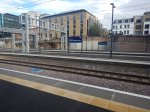
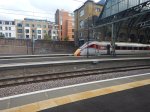
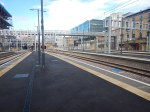
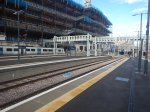
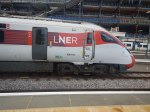
The two trains are both nine-car Hitachi Class 800 or Class 801 trains and I was standing in line with their noses.
I wonder what is the maximum length of trains that can be handled in these platforms.
- They can certainly handle ten-car trains, as LNER run these to Leeds.
- Looking at maps, I suspect that eleven-car trains could be the largest that can be handled.
I suspect it will be tight, but I suspect with a simple platform extension, twelve car trains could be accommodated in King’s Cross station.
Journey Times
These times come from High Speed Two’s Journey Planner and the IRP.
- London and Edinburgh – Three hours and forty-eight minutes – Four hours and nineteen minutes – Three hours and fifty-eight minutes – My estimate based on IRP figures
- London and Newcastle – Two hours and seventeen minutes – Two hours and forty-nine minutes – Two hours and 25-28 minutes
- London and Durham – Two hours and sixteen minutes – Two hours and fifty-five minutes – Two hours and forty minutes
- London and Darlington – One hour and fifty minutes – Two hours and twenty-two minutes – Two hours and seven minutes
- London and York – One hour and twenty-four minutes – Two hours and ten minutes – One hour and fifty-five minutes – My estimate based on IRP figures
- London and Leeds – One hour and twenty-one minutes – Two hours and thirteen minutes – One hour and fifty-three minutes
Note.
- The first time is that from High Speed Two, which assumes the Eastern Leg of High Speed Two has been built.
- The second time is the current best time via the East Coast Main Line.
- The third time is the IRP’s estimate via an upgraded East Coast Main Line.
- Where the estimates are mine it is noted.
London and York and London and Leeds are under two hours, London and Newcastle is under three hours and London and Edinburgh is under four hours.
Are these times fast enough for modal shift from the Air and Roads to Rail?
Project Delivery
Rail projects in the UK have a variable record in the delivering of projects on time and on budget.
I haven’t done the full analysis, but I do believe that smaller projects have a better record of delivery, based on media reports.
In Railway Restored: Regular Trains To Run On Dartmoor Line For First Time In 50 Years, Network Rail have delivered an important smaller project, for which I said.
Network Rail have set themselves a good precedent to open the line in nine months and £10 million under budget.
As the improvement of the East Coast Main Line is more of a succession of smaller projects, rather than one large project does this mean it is more likely to be delivered on time and on budget?
Extra Paths
This is said in Paragraph 3.43
North of York we will look to increase the number of paths for long distance high speed trains from 6 to 7 or 8 per hour.
One of the min reasons for building High Speed Two, but here we have extra capacity being created on the East Coast Main Line.
One extra path would be very good, but two would be excellent.
Power Supply Upgrades
In the last eighteen months, I’ve written two articles about updating of the power supply on the East Coast Main Line.
- East Coast Main Line Northern Power Supply Works Funded
- East Coast Main Line Electrification Research Agreement
The second article talks about the involvement of the University of Leeds to get the power supply to a high standard.
It does appear that Network Rail are doing all they can to enable the East Coast Main Line to handle the eight electric trains per hour
140 mph Running
There are several elements to the successful achievement of 140 mph running on a railway.
- The trains must be capable of running safely at 140 mph.
- The track must be able to support trains at that speed.
- The signalling must be in-cab and fully tested.
- The electrification must be designed for running at the required speed.
- The drivers must be fully trained.
Note.
- There are certainly 140 mph trains in service and there are tracks in the UK, where they can be tested at that speed.
- I wouldn’t be surprised as we have been running 140 mph InterCity 225 trains on the East Coast Main Line for thirty years, that a lot of the track is already profiled for 140 mph running.
- The digital signalling is being installed.
- The electrification on the East Coast Main Line has been dodgy for years, but is now being upgraded.
- Drivers are probably the least to worry about, as they probably know the route well and are honing their skills in simulators.
I can see 140 mph running being delivered in stages and on time.
Darlington Improvements
In First Phase Of ‘Transformational’ Darlington Rail Station Upgrade Approved, I said this about the improvements at Darlington station.
This upgrade is on the Eastern side of the current station and will include a new entrance, station building, concourse and three new platforms.
This design should allow the following.
-
- LNER, High Speed Two and other expresses not stopping at the Darlington station to pass through at speeds of up to 125 mph or more.
- Expresses stopping in the station will slow and accelerate in less time than they do now.
- It will probably allow more local trains to Bishops Auckland, Middlesbrough and Saltburn
A seventy-five percent increase in platforms probably offers other advantages.
This could knock several minutes off journey times.
York Improvements
I describe this problem and my solution in Improving The North Throat Of York Station Including Skelton Bridge Junction.
My solution won’t happen, as I advocate replacing the historic Skelton Bridge with a modern four-track bridge.
Effects On Lincoln Service
It will be interesting to see how the improvements to the East Coast Main Line effect LNER’s service between King’s Cross and Lincoln.
Any time improvements South of Newatk will surely be reflected in the time between King’s Cross and Lincoln.
Conclusion
The plan seems feasible to me.
Reopening The Darlington – Weardale Line To Passenger Services
On October 27th this Beeching Reversal Project was given £50,000 to build a case for reopening.
The current Weardale Railway is a heritage line, that extends the current National Rail service between Darlington and Bishop Auckland stations further up Weardale.
- It is a single track railway.
- The current operational length is 18 miles between Bishop Auckland West and Stanhope stations.
- The line could be extended a few miles to the site of the former Wearhead station.
- Thre is a station at the village of Stanhope which i has a castle, a community hospital and a population of 1,600.
- There is a station at the village of Frosterley which has a population of 700.
- There is a station at the village of Witton-le-Wear which has a population of 700.
- There seem to be lots of caravan parks along the river.
- From my virtual helicopter, the track looks in reasonable condition.
- There appear to be a couple of passing loops.
- There don’t appear to be any tunnels.
- The Weardale Railway has several bridges over the River Wear.
- I suspect the scenery is not bad.
To my untrained eye, this section of railway would appear to have possibilities for reopening, without any serious engineering problems.
These are a few of my thoughts.
The Connection To National Rail
This Google Map shows Bishop Auckland station, where the Weardale Railway connects to the National Rail network.
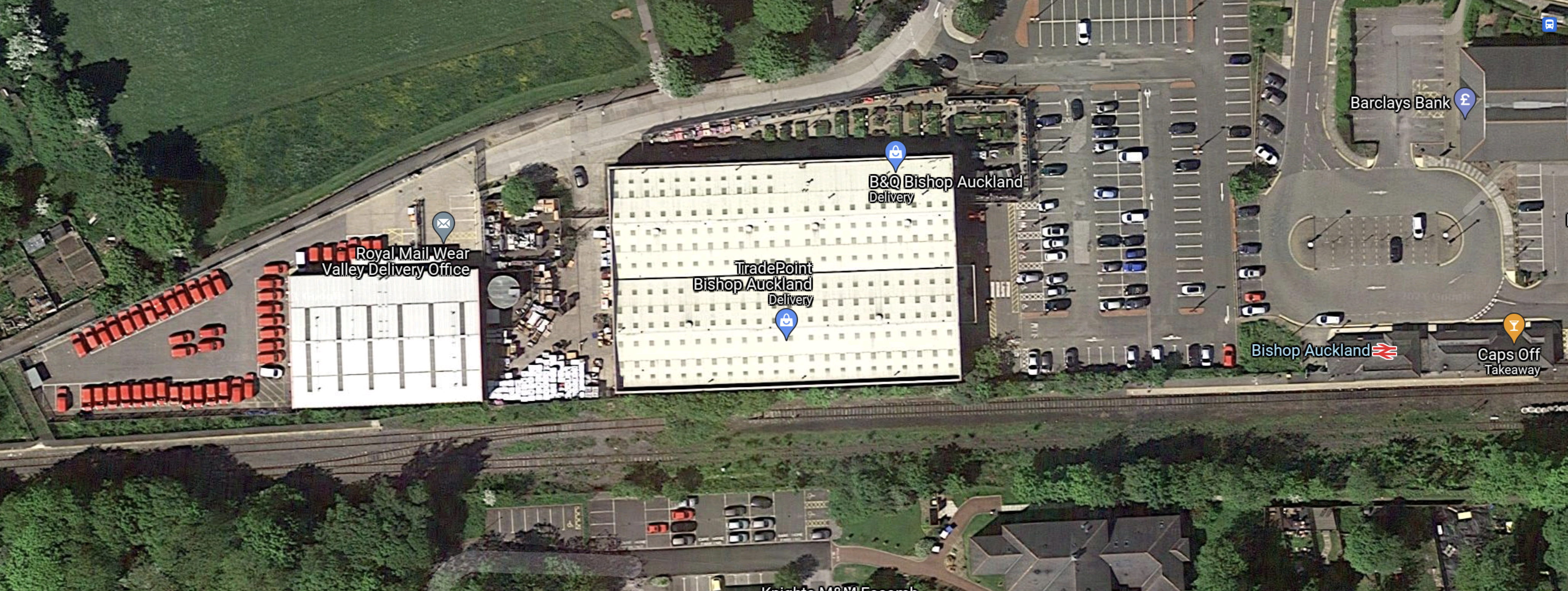
Note.
- The station appears to be well-placed in the town.
- There is plenty of space for tracks connecting the two systems.
I suspect that building a combined through and terminal station that would satisfy the needs of all stakeholders would not be the most challenging of tasks.
Could The Extended Line Have A Japanese Fairy Godmother?
Consider.
- Hitachi’s train factory at Newton Aycliffe is five miles to the South of Bishop Auckland.
- Hitachi have stated that they are developing battery-electric trains for lines without electrification.
- Developers of modern trains with complicated computer systems seem to go through many software versions.
I have to ask the question, if Hitachi would like to have a twenty-mile test track on their doorstep?
If they were testing trains that were agnostic about their power supply, the Weardale Railway would not need to be electrified, although there could be a couple of charging systems.
Would Access To The Quarries At Wearhead Be Needed?
The original Weardale Railway was built to access the quarries at Wearhead, but they switched to road transport some years ago.
This Google Map shows the Wearhead area.
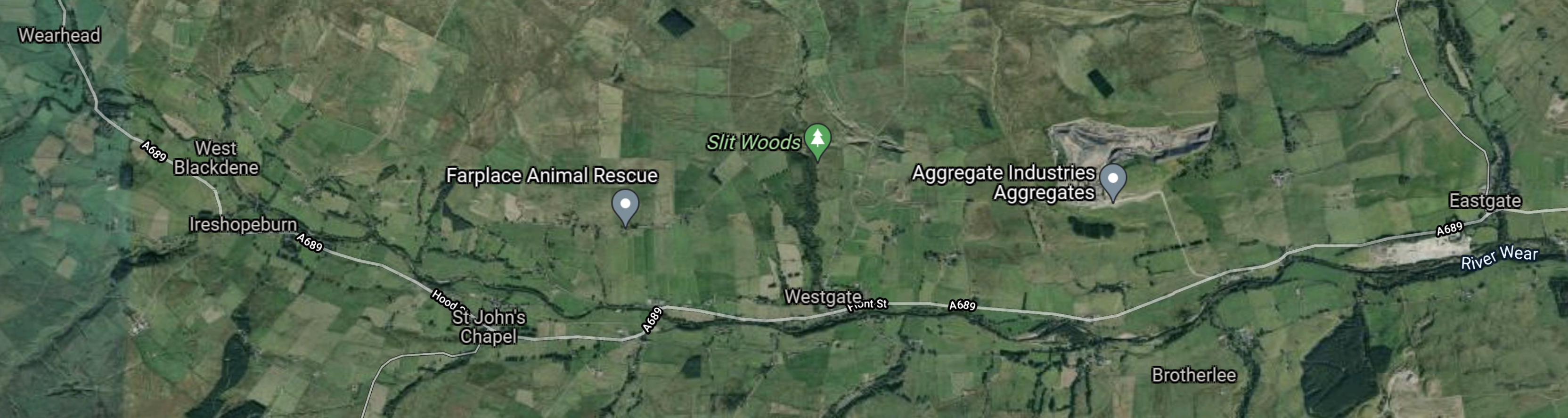
Note.
- Wearhead is in the North-West corner of the map.
- There is a quarry and there used to be a fluorspar mine.
- The white scar at the East of the map was a cement works.
Is there something, that could possibly be mined in this area, that could be taken out by train.
I think it should be born in mind, that mining and quarrying used to be a very dirty and carbon-intensive industry, but big mining companies are now embracing zero-carbon technology.
Could A Holiday Company Like Center Parcs Develop A Site In The Wear Valley?
I noticed a lot of caravans and chalets, as I examined the line.
Could a big operator like Center Parcs develop one of their holiday centres?
It could even be developed with a station.
Is New Housing Needed?
Does the local authority want to develop housing along the line?
What Rolling Stock Will Be Used?
There is no point in extending the line in these days of global warming without providing zero-carbon trains.
The Tees Valley Combined Authority is keen on hydrogen and there are good reasons.
- There is hydrogen available from chemical plants on Teesside.
- Hydrogen will give the trains a long range.
- The trains would probably only need refuelling once a day.
- In addition, Alstom are looking for an order for their Class 600 train, which is a conversion of a Class 321 train.
But I have my doubts about Alstom’s trains and Hitachi have doubts about hydrogen.
Consider.
- Do you really want to run hydrogen trains on a line where steam trains run?
- Darlington station is fully-electrified and it is also to be remodelled for more capacity and High Speed Two.
- Bishop Auckland and Darlington is just twelve miles.
- Darlington and Saltburn is just thirty miles.
With charging systems at Bishop Auckland, Saltburn and Stanhope, I am fairly sure Hitachi could develop an electric train for Teesside’s railways.
Conclusion
Hitachi could be key to the design of the reopening of the Darlington and Weardale Line.
First Phase Of ‘Transformational’ Darlington Rail Station Upgrade Approved
The title of this post is the same as that of this article on the North East Times.
This upgrade is on the Eastern side of the current station and will include a new entrance, station building, concourse and three new platforms.
This design should allow the following.
- LNER, High Speed Two and other expresses not stopping at the Darlington station to pass through at speeds of up to 125 mph or more.
- Expresses stopping in the station will slow and accelerate in less time than they do now.
- It will probably allow more local trains to Bishops Auckland, Middlesbrough and Saltburn
A seventy-five percent increase in platforms probably offers other advantages.
 The Anonymous Widower