Two Thirds Of Sofia Wind Turbines Installed
The title of this post, is the same as that of this article on offshoreWIND.biz.
This is the sub-heading.
Seventy wind turbines have been installed at RWE’s Sofia offshore wind farm in the UK, according to a Notice to Mariners recently issued by the project team.
These two paragraphs give more details of the installation process.
The first of the project’s 100 Siemens Gamesa SG 14-222 DD wind turbines was installed in March 2025, and the work reached the halfway mark in September last year. The vessel deployed for the work is Cadeler’s Wind Peak, which is carrying components for six turbines per trip, operating from the port of Hull.
IWS service operation vessel (SOV) IWS Seawalker is supporting the wind turbine installation work.
Note.
- Sofia is being installed by German Company ; RWE.
- Sofa will use 14 MW Siemens Gamesa wind turbines, some of which have recyclable blades.
- The installation process is being carried out nearly 200 kilometers out to sea on the Dogger Bank.
The power will be connected to the grid at Lackenby substation, which is near the Wilton chemical works, which can certainly you the electricity.
Does Wilton Chemical Works Have A Power Station?
I asked GoogleAI, the question in the title of this section and received this reply.
Yes, the Wilton International industrial site (formerly associated with ICI chemical works) has multiple power stations and significant on-site energy generation, operated primarily by Sembcorp Utilities UK. The site features a biomass power station (Wilton 10), a further biomass unit (Wilton 11), and an energy-from-waste plant, supplying electricity and steam to chemical and industrial businesses on-site.
Note.
- Wilton 10 opened as a biomass power station in 2002.
- Wilton 11 opened as a biomass power station in 2016.
I seem to remember, that one of these power stations was there on my visits to Wilton for ICI in the 1970s.
Key details regarding power generation at Wilton:
Biomass & Waste-to-Energy:
The site transitioned from coal-fired units to renewable biomass and waste-to-energy, utilizing wood and other byproducts for power and heat generation.
Sembcorp Utilities:
Sembcorp operates the site’s energy infrastructure, which includes five different generation assets and a private wire network.
Capacity: The site hosts significant generation capacity, including a 52MW biomass unit and a 35MW unit.
Future Projects: The site is involved in developments for net-zero emissions, including the Whitetail Clean Energy project, which is planned as the UK’s first Net Zero emissions power plant with Carbon Capture and Storage (CCS).
The site serves as a “plug and play” industrial location offering on-site, cost-effective energy.
Conclusion
This would appear to be a sensible small power system providing 1400 GW of wind power, backed up if needed be by the two biomass units, which total 87 MW.
Note, that ICI were storing gases under the site for many years, so I suspect, that Carbon Capture and Storage, might work well at this location.
I can see other places, where a wind farm, is combined with energy from waste for backup.
Are Wind Farms Being Backed Up By Energy From Waste Units In The UK?
I asked GoogleAI, the question in the title of this section and received this reply.
Yes, but only in a limited, complementary capacity, rather than as a direct, large-scale substitute for wind power.
Energy from Waste (EfW) units—commonly known as incinerators—are increasing in the UK, but their role in the grid is different from how we “back up” wind.
Here is a breakdown of how it works:
1. The Role of EfW (Baseload, not Backup)
Baseload Generation: EfW plants run 24/7 to burn waste. They provide a steady, consistent, predictable “baseload” of electricity (about 2–3% of UK supply).
Intermittency: Because they run constantly, they cannot ramp up and down quickly when the wind stops blowing. Therefore, they are not a “flexible” backup in the same way gas power plants are.
Partial Renewable: Around 50% of the energy produced by EfW is considered renewable (organic waste), helping the UK hit green targets.
2. What Actually Backs Up Wind?
When wind farms stop producing power during low-wind periods (often called “dunkelflaute”), the UK relies on other sources:
Natural Gas Plants: These are the primary, flexible backup that can ramp up instantly to fill gaps in renewable production.
Interconnectors: Imported electricity from other countries (e.g., Norway, France).
Battery Storage: Growing, but still small-scale compared to total demand.
3. How EfW Helps the Grid
EfW does assist the grid by providing system inertia and consistent, low-carbon, on-demand energy, reducing the need for more fossil fuels to be burnt at certain times. They are particularly useful for providing power when the grid is congested, but they do not specifically act as a “spare tire” for wind farms.
4. Future Trends
The government is looking to attach Carbon Capture and Storage (CCS) to EfW units, which would make them a low-carbon, dependable, and sustainable part of the energy mix by the 2030s.
In summary: EfW plays a part in supporting a greener grid, but it is not a direct substitute for the flexibility required to back up intermittent wind power.
5. Hydrogen Power
This is a section, that artificial intelligence has unsurprisingly left out, as no country has yet built the hydrogen storage and the power stations to generate the electricity, when it is needed.
But Note.
- SSE are building a big hydrogen store in Yorkshire at Aldbrough.
- Centrica are converting the Rough gas storage to a hydrogen store.
- SSE are building a 910 MW hydrogen-powered power station at Keadby.
- SSE are building a 1200 MW hydrogen-powered power station at Ferrybridge.
I suspect if you were building a chemical plant and Wilton fitted your budget, you would take a look.
Development Consent Decision On 3 GW Dogger Bank South Project Postponed
The title of this post, is the same as that of this article on offshoreWIND.biz.
This is the sub-heading.
The UK Secretary of State for Energy Security and Net Zero has set a new deadline for the decision on the Development Consent Order (DCO) for Dogger Bank South, a 3 GW offshore wind project developed by RWE, which the company owns in partnership with Masdar.
These two paragraphs add more detail to the project.
The statutory deadline for the decision on the project was 10 January 2026. This has now been moved to 30 April.
According to a statement from the Minister for Energy Consumers, Martin McCluskey, the extension will allow time to request further information that was not provided for consideration during the examination period and to give all interested parties the opportunity to review and comment on such information.
I clipped this map from the Dogger Bank South web site.
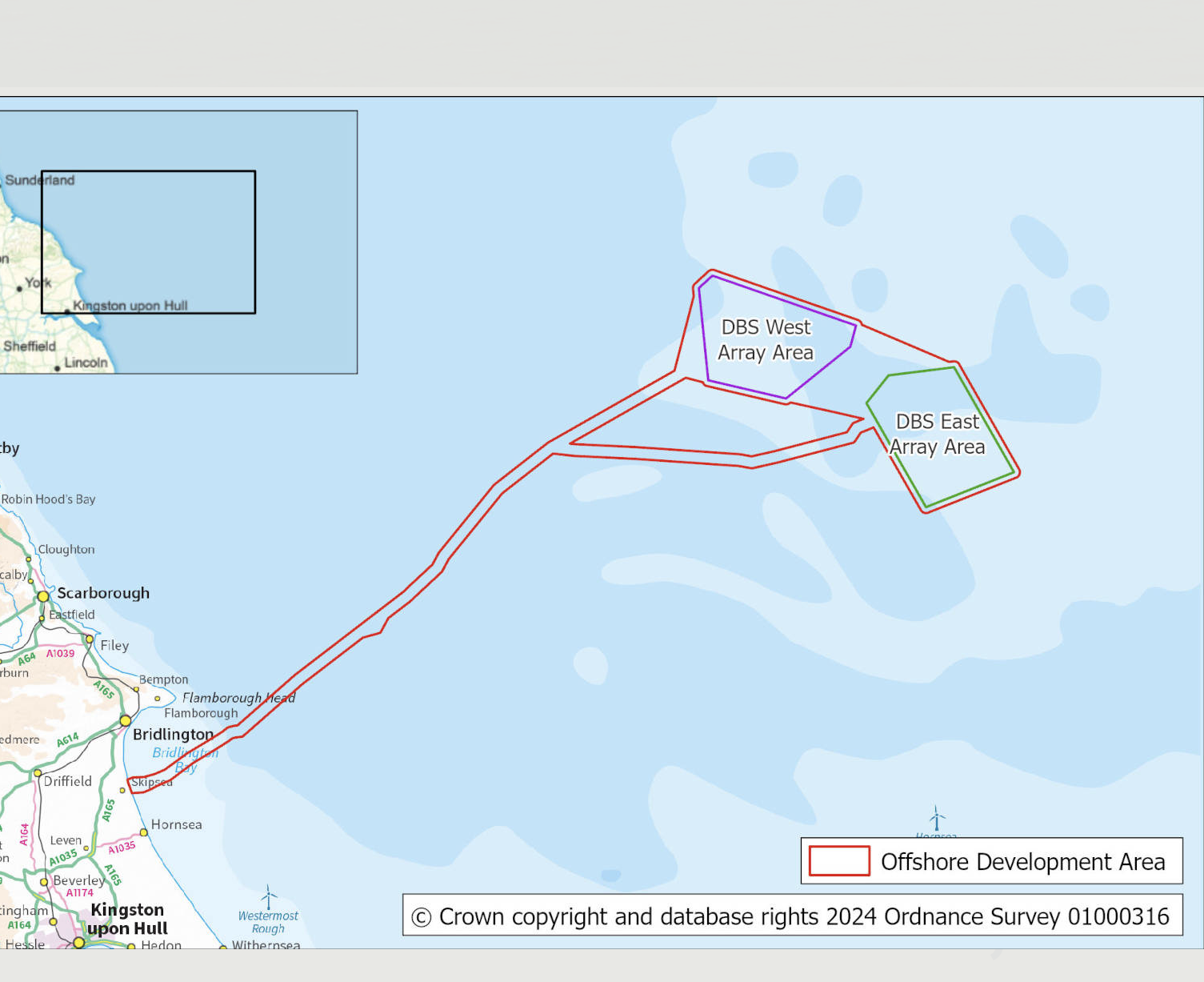
Note.
- Bridlington, Kingston-Upon-Hull and Scarborough can be picked out on the coast of East Yorkshire.
- The two wind farms and the route of the cables to the shore can be clearly seen.
I just wonder, whether the nature of the project is changing.
Consider.
- Three GW is a lot of power to move across Yorkshire to where it can be connected to the grid.
- In Consultation On Offshore Wind Reform: Hydrogen Sector Calls For Hybrid Connection Concepts And Warns Of Compensation Risks, German companies involved in the AquaVentus project are calling for more hydrogen to be produced offshore and piped to the shore.
- Could hydrogen produced in the Dogger Bank Wind farms be piped to the Northern end of the AquaVentus pipeline on the German sector of the Dogger Bank?
- A pipeline or cable could still bring energy to Yorkshire.
- The hydrogen could go to the hydrogen stores at Aldbrough and Rough.
- SSE and Centrica could play hydrogen-bankers to the Germans, as Germany is short of hydrogen storage.
- East Yorkshire is building two hydrogen power stations at Keadby and Ferrybridge.
- Support for the Dogger Bank South wind farms will probably be from RWE’S Grimsby hub.
Is this the Anglo-German co-operation, I talked about in UK And Germany Boost Offshore Renewables Ties at work?
I can see benefits for this arrangement for the UK.
- Hydrogen production is offshore.
- A lot of the onshore employment is in the UK.
- There will be a hydrogen pipeline between Germany and the vast hydrogen storage of Humberside via the German Dogger Bank and Dogger Bank South wind farms.
- Will there be a hydrogen pipeline between the North of Scotland and Humberside via the AquaVentus pipeline?
- There will also be a substantial cash flow to the UK Treasury because of all the hydrogen production in UK waters.
RWE may also be able to use a standard hydrogen production platform in German and UK waters.
This is the sort of plan, that the money men will like.
Dogger Bank D Welcomes Confirmation Of Grid Connection Location
The title of this post, is the same as that of this press release from SSE Renewables.
This is the sub-heading.
Project team now focusing full attention on electrical transmission system connection.
These four paragraphs describe the proposed connection to the National Grid.
SSE Renewables and Equinor have welcomed confirmation of a grid connection location from the Electricity System Operator (ESO) for a proposed fourth phase of the world’s largest offshore wind farm.
Dogger Bank D will now connect into Birkhill Wood, a proposed new 400kV substation located in the East Riding of Yorkshire which will be built as part of National Grid’s Great Grid Upgrade.
The announcement follows the publication of an impact assessment for the South Cluster by ESO, relating to energy projects which are due to be electrically connected off the east coast of England.
With the location of a grid connection confirmed, Dogger Bank D will now focus its full attention on connecting to the electrical transmission system.
This is a big change from December 2023, when I wrote Plans for Hydrogen Development At Dogger Bank D Gain Ground, which indicated that Dogger Bank D would be used to produce hydrogen, so the grid connection wouldn’t be needed.
Using A Offshore Hybrid Asset Between the UK And Another European Country
This is the next paragraph on the SSE Renewables press release.
The project is also exploring the future possibility of the development of Dogger Bank D to be coordinated with an Offshore Hybrid Asset between the UK and another European country’s electricity market to form a multi-purpose interconnector. This option would increase energy security for the UK and reduce the need to curtail offshore wind output in times of oversupply on the GB network.
Note that just over the boundary of the UK’s Exclusive Economic Zone are the Dutch and German Exclusive Economic Zones.
It is not unreasonable to believe that UK, Dutch and German grid could all be connected on the Dogger Bank.
Connecting Everything Up At Birkhill Wood
This is the next paragraph on the SSE Renewables press release.
The project team are undertaking a site selection process to identify potential cable corridors and where other onshore infrastructure associated with the grid connection at Birkhill Wood may be sited. Consultation will be held later this year to introduce the connection proposals to the local community.
At least now, with the connection to Birkhill Wood confirmed, SSE and Equinor will be able to supply any electricity generated at Dogger Bank D to the UK grid, up to limit of the connection.
The Value Of Electricity That Could Be Generated At Dogger Bank D
Consider.
- The wind farm has a capacity of 2 GW or 2,000 MW.
- There are 365 days in most years.
- There are 24 hours in the day.
- This means that 17, 520,000 MWh could be generated in a year.
- A large wind farm like Hornsea One has a twelve month rolling capacity factor of 46.6%.
- Applying this capacity factor says that 8,164,320 MWh will be generated in a year.
- The Contract for Difference Round 6 for this electricity will be £73/MWh.
Applying that figure gives a yearly turnover of £ 595,995,360 or £ 297,997,680 per installed GW.
It is not unreasonable to assume that half of this electricity were to be exported to power Germany industry.
It could be a nice little earner for the Treasury.
UK And Germany Boost Offshore Renewables Ties
The title of this post, is the same as that of this article on offshoreWIND.biz.
This is the sub-heading.
A new partnership between the UK and German governments has been agreed on 3 November to help secure safe, affordable, and clean energy for consumers in both nations for the long-term and bolster energy security. Both countries commit to strengthening cooperation in renewables, notably offshore wind and electricity interconnection.
These two paragraphs introduce the deal.
Under the new partnership signed in London by Energy Security Secretary Claire Coutinho and Germany’s Vice Chancellor, Robert Habeck, the UK and Germany have reaffirmed their shared ambition and commitment to net zero and progressing the energy transition.
Europe’s two largest economies have also doubled down on commitments made under the Paris Agreement to limit global warming to 1.5 degrees.
i think this could be a worthwhile follow-up to the relationship, that Boris Johnson and Olaf Scholz seemed to encourage after their high profile meeting in April 2022.
This press release from Downing Street is entitled PM meeting with German Chancellor Olaf Scholz: 8 April 2022 and this is the first two paragraphs.
The Prime Minister welcomed German Chancellor Olaf Scholz to Downing Street this afternoon to discuss the West’s response to Putin’s barbaric invasion of Ukraine.
The two leaders shared their disgust at the Russian regime’s onslaught and condemned Putin’s recent attacks.
I wrote Armoured Vehicles For Ukraine based on some of the things said in the press conference after what seemed to be a very wide discussion.
But it was these paragraphs in the press release that caught my eye.
They also agreed on the need to maximise the potential of renewable energy in the North Sea and collaborate on climate ambitions and green energy.
The Prime Minister said he wanted to further deepen the UK’s relationship with Germany, and intensify its cooperation across defence and security, innovation and science.
After Boris and Olaf’s meeting at Downing Street, I have been able to write these posts about the Anglo-German energy relationship and also make some other observations.
- Mona, Morgan And Morven
- UK-German Energy Link Reaches Financial Close
- RWE, Siemens and other German companies seem to be building a strong presence in the UK.
- Rolls-Royce are doing the same in Germany.
Claire Coutinho and Robert Habeck seem to be wanting to continue the co-operation, judging by this paragraph from the article on offshoreWIND,biz.
The energy and climate partnership sees both countries commit to enhancing cooperation in renewables, particularly in offshore wind and electricity interconnection, including offshore hybrid interconnection.
The most significant part of this paragraph is the mention of offshore hybrid interconnection.
If you want more details on their meeting, this document is the official UK Government declaration.
I have my thoughts.
What Is Meant By Offshore Hybrid Interconnection?
Type “Offshore Hybrid Interconnection” into Google and the first page is this page from National Grid, that is entitled Offshore Hybrid Assets, that has this sub-heading.
How the North Sea has the potential to become Europe’s green energy ‘powerhouse’
This is the introductory paragraph.
Now more than ever we need more renewable energy to make energy cleaner, more affordable, and more secure. The North Sea offers an incredible opportunity for the UK and our European neighbours to deliver huge increases in offshore wind. But delivering new offshore wind will require more infrastructure, which will have an impact on communities.
Hybrid is all-purpose comfort word like cashmere, platinum or puppies.
The page on the National Grid web site describes The Next Generation Interconnector with these paragraphs.
Interconnectors already provide a way to share electricity between countries safely and reliably. But what if they could do much more than that? What if interconnectors could become an offshore connection hub for green energy?
Instead of individual wind farms connecting one by one to the shore, offshore hybrid assets (OHAs) will allow clusters of offshore wind farms to connect all in one go, plugging into the energy systems of neighbouring countries.
And then there is this section entitled Tomorrow’s Solution: Offshore Wind And Interconnectors In Harmony, where this is said.
Today, offshore wind and interconnectors operate alongside each other, connecting to the shore individually. In the future, offshore hybrid assets could enable offshore wind and interconnection to work together as a combined asset.
We now call this type of infrastructure an offshore hybrid asset (OHA), but we used to refer to it as a multi-purpose interconnector (MPI). We changed it because we work so closely together with Europe, it made sense to use the same terminology.
The page on the National Grid web site also has an interactive graphic, which shows the benefit of the approach.
LionLink
National Grid are already developing LionLink, with Dutch grid operator; TenneT, which will be a multi-purpose interconnector linking the UK and the Netherlands.
LionLink is described on this page from National Grid, where this is the sub-heading.
We’re developing a first-of-its-kind electricity link to connect offshore wind between the UK and the Netherlands.
This is the introductory paragraph.
Designed together with our Dutch partners TenneT, LionLink (formerly known as EuroLink) is an electricity link that can supply around 1.8 gigawatts of clean electricity, enough to power approximately 1.8 million British homes. By connecting Dutch offshore wind to Dutch and British markets via subsea electricity cables called interconnectors, LionLink will strengthen our national energy security and support the UK’s climate and energy goals.
Will we be planning a similar electric handshake with the Germans?
How Much Offshore Wind Power Are We Talking About?
This is answered by the last two paragraphs of the article on offshoreWIND.biz.
Around 75 per cent of installed offshore wind capacity in the North Sea is in German and British waters. This is helping to drive the UK’s ambition for up to 50 GW of offshore wind, including up to 5 GW of floating wind, by 2030, the governments said.
Germany is aiming at installing 30 GW by 2030.
That is an Anglo-German starter for eighty GW.
Electrolysers In The Middle If The North Sea
Why Not?
This is a clip from National Grid’s graphic on the page that introduces Offshore Hybrid Assets,
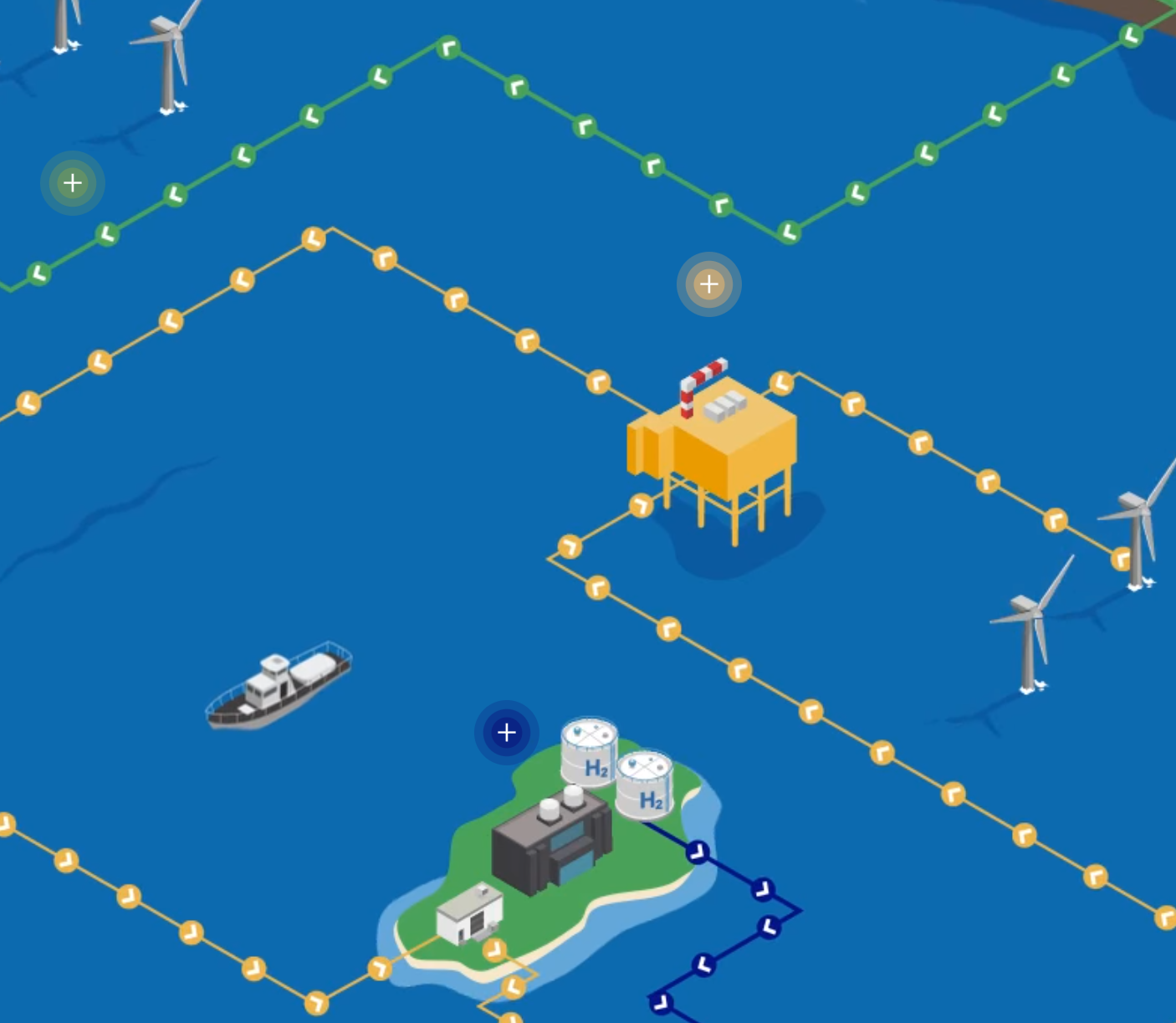
It shows an offshore hydrogen electrolyser.
- You could have an offshore hybrid asset that went between say Bacton in Norfolk and Hamburg via these assets.
- One or more wind farms in UK territorial waters.
- A mammoth offshore electrolyser, with hydrogen storage, possibly in a depleted gas field.
- One or more wind farms in German territorial waters.
Electricity will be able to go three ways; to the UK, to Germany or to the electrolyser.
The Involvement Of German Energy Companies In UK Territorial Waters
Wikipedia lists offshore fifteen wind farms, that have German owners in UK territorial waters, that total 12,960 MW.
This compares with.
- Equinor – 6 wind farms totalling 6466 MW.
- Ørsted – 15 wind farms totalling 9683 MW.
- Scottish Power – 2 wind farms totalling 5,000 MW.
- SSE Renewables – 15 wind farms totalling 15,591 MW.
- Vattenfall – 6 wind farms totalling 4384 MW.
As there is a number of partnerships, these figures only show the relative sizes of the investment by individual companies.
But at nearly 13 GW, the amount of total German investment in UK territorial waters is substantial.
Is This Solely An Anglo-German Club Or Can Others Join?
Consider.
- It seems to me, that because of the LionLink, the Dutch are already involved.
- TenneT is also a large electricity distributor in Germany.
- Countries with substantial shares of the water and winds of the North Sea in addition to Germany, the Netherlands and the UK, include Belgium, Denmark and Norway.
- The UK has interconnectors with Belgium, Denmark, France, Germany, Norway and the Netherlands.
It appears that the world’s largest multi-national power generator is evolving by stealth.
North Sea Wind Power Hub
This concept seems to have developed around 2017, by Danish, Dutch and German interests.
The Wikipedia entry introduces it like this.
North Sea Wind Power Hub is a proposed energy island complex to be built in the middle of the North Sea as part of a European system for sustainable electricity. One or more “Power Link” artificial islands will be created at the northeast end of the Dogger Bank, a relatively shallow area in the North Sea, just outside the continental shelf of the United Kingdom and near the point where the borders between the territorial waters of Netherlands, Germany, and Denmark come together. Dutch, German, and Danish electrical grid operators are cooperating in this project to help develop a cluster of offshore wind parks with a capacity of several gigawatts, with interconnections to the North Sea countries. Undersea cables will make international trade in electricity possible.
Currently, the UK is developing these wind farms on their portion of the Dogger Bank.
- Doggerbank A – 1235 MW – Started producing electricity in 2023.
- Doggerbank B – 1235 MW – Planned commissioning in 2024.
- Doggerbank C – 1218 MW – Planned commissioning in 2025.
- Doggerbank D – 1320 MW – Being planned.
- Doggerbank South – 3000 MW – Being planned.
Note.
- That’s a total of 8 GW.
- A, B, C and D are being developed by a consortium of SSE Renewables and Equinor.
- South is being developed by RWE.
- This web site is for Dogger Bank D.
- This web site is for Dogger Bank South.
This map from the European Atlas of the Seas, shows the various exclusive economic zones (EEZ) in the North Sea.

Note.
- The pinkish zone to the East of the UK, is the UK’s EEZ.
- The light blue zone at the top is Norway’s EEZ.
- The greenish zone in the North-East corner of the map is Denmark’s EEZ.
- The light blue zone below Denmark’s EEZ is Germany’s EEZ.
- Then we have the EEZs for The Netherlands, Belgium and France.
The Dogger Bank is situated where the British, Dutch, German and Norwegian EEZs meet.
All five Dogger Bank wind farms are in British waters.
The Wikipedia entry for the Dogger Bank says this about its size.
The bank extends over about 17,600 square kilometres (6,800 sq mi), and is about 260 by 100 kilometres (160 by 60 mi) in extent. The water depth ranges from 15 to 36 metres (50 to 120 ft), about 20 metres (65 ft) shallower than the surrounding sea.
This probably makes it easy to accommodate a large fixed-foundation wind farm.
Overlaying the map in the Wikipedia entry, with the EEZ map, I’m fairly sure that the northeast end of the Dogger Bank is close to where the EEZs meet.
Progress On The North Sea Wind Power Hub
The North Sea Wind Power Hub has a web site, but it seems to be more about thinking than doing.
It seems to have been hijacked by that august body; The Institute of Meetings Engineers.
This page on the web site, which is entitled Explore The Future Energy Highways, has a simple interactive map.
This shows its vision for 2030.
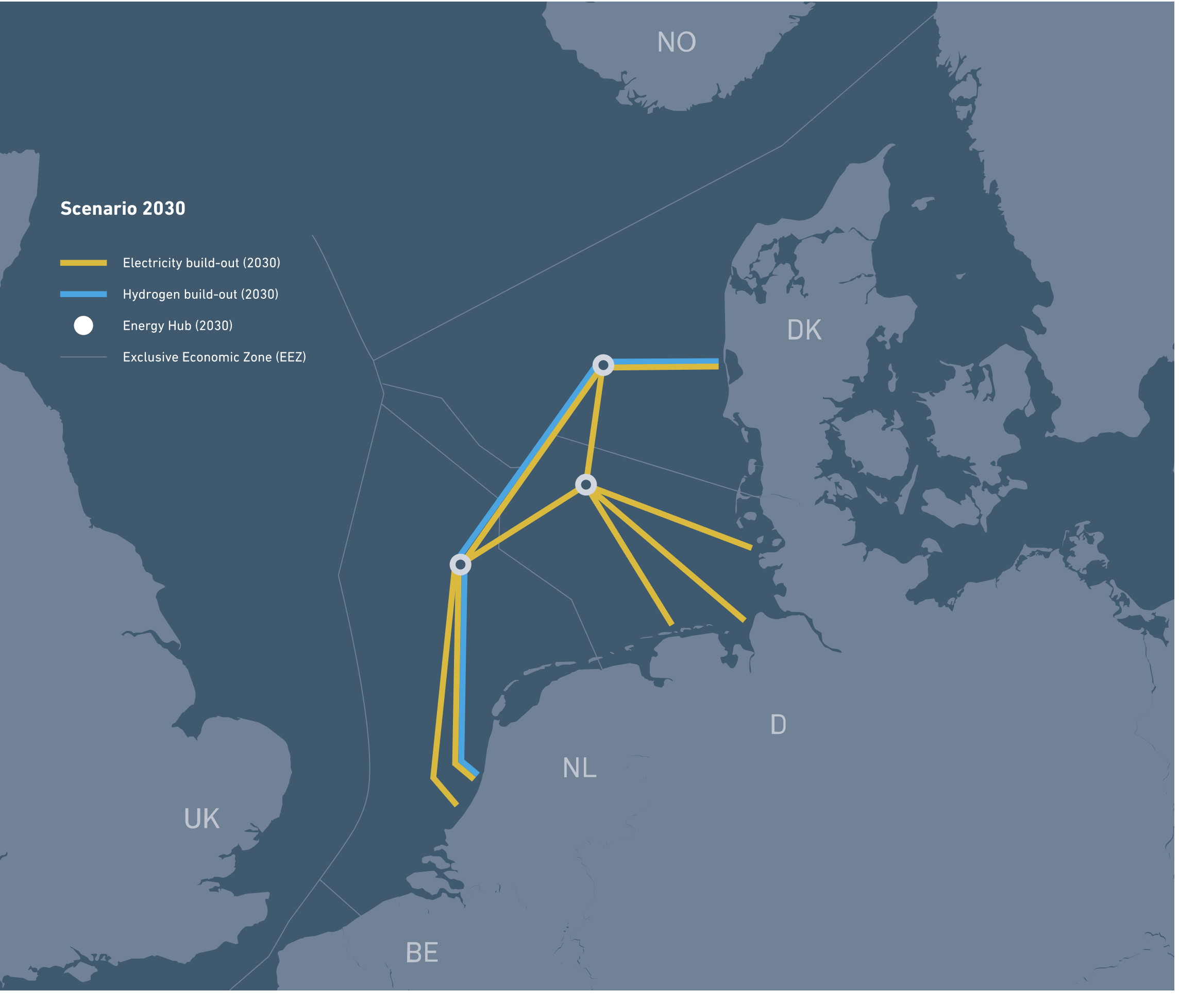
Note.
- Yellow is electricity links to be built before 2030.
- Blue is hydrogen links to be built before 2030.
- Feint lines indicate the EEZ boundaries.
There are two problems with this layout.
- It doesn’t connect to the Dogger Bank area, where the original plan as detailed in Wikipedia talked about “Power Link” artificial islands.
- No hydrogen is delivered direct to Germany.
This shows its vision for 2050.
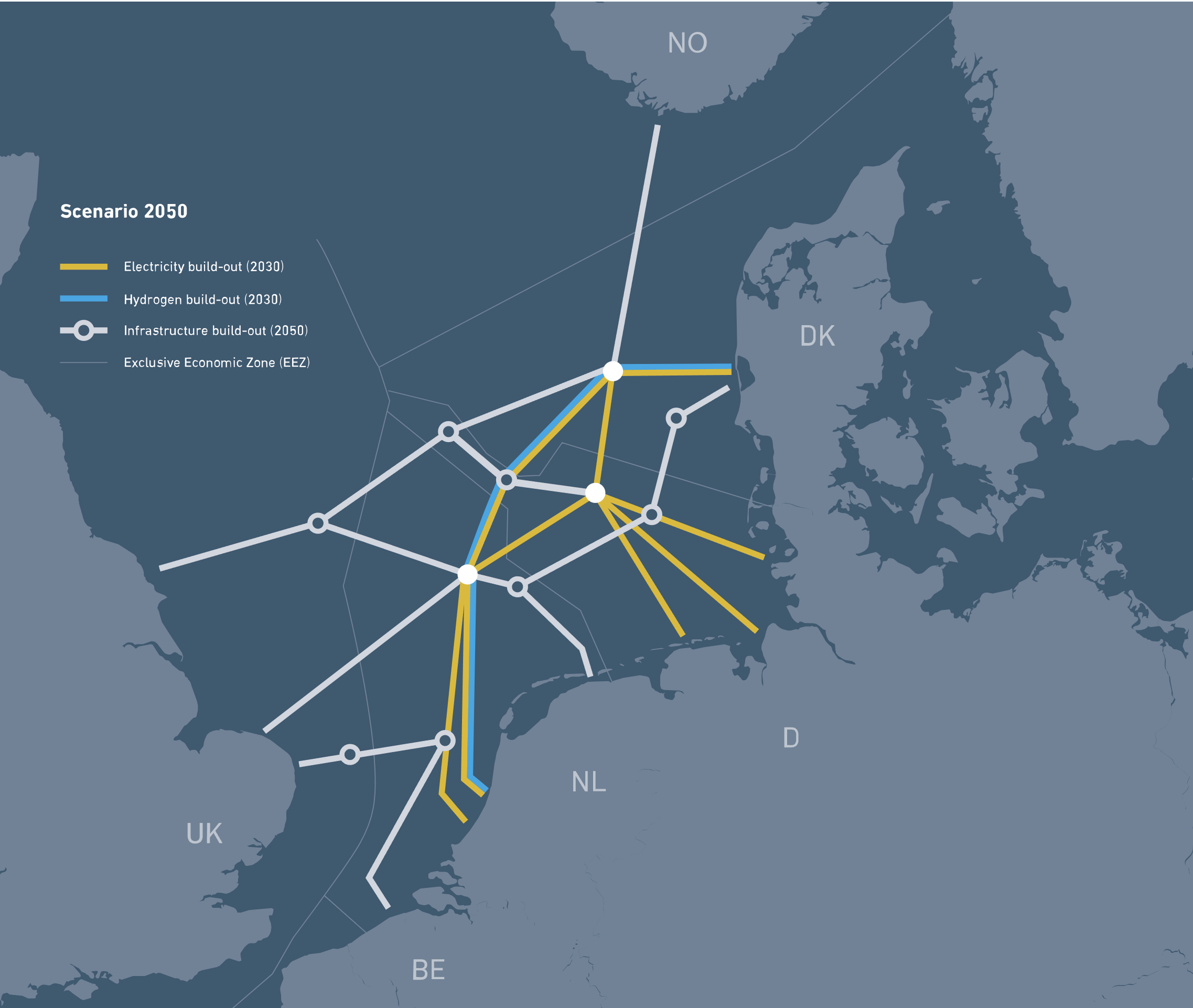
Note.
- Yellow, blue and feint lines are as before.
- White is electricity links to be built before 2050.
- There appears to be a node on the Dogger Bank in the German EEZ. This node could be connected to the “Power Link” artificial islands.
- The Southernmost connection to East Anglia could be Bacton.
- The other Norfolk connection could be where wind farms are already connected.
- The Northern connection could be Teesside, where some of the Dogger Bank wind farms connect.
- If the Northern connection to England is Teesside, then first node, which is in the British EEZ, could be one of the offshore sub-stations in the Dogger Bank wind farm complex.
This all seems a lot more feasible.
A New Offshore Hybrid Asset Between Teesside And Germany
Consider.
- A new offshore sub-station will be needed in the German EEZ to connect the “Power Link” artificial islands to the power network.
- The new offshore sub-station will eventually have three interconnectors to the German coast.
- Only the 1218 MW Dogger Bank C wind farm will be connected to the Teesside onshore substation.
- Germany has a power supply problem, after shutting down nuclear power stations and building more coal-fired power stations.
A new Offshore Hybrid Asset between Teesside and Germany could be created by building the following.
- A the new offshore sub-station in the German EEZ to connect the “Power Link” artificial islands to the power network.
- An interconnector between a sub-station of the Dogger Bank wind farm complex and the new sub-station
- A second interconnector to connect the new sub-station for the “Power Link” artificial islands to the German electricity grid.
All of the work would be done mainly in the German EEZ, with a small amount in the British EEZ.
Where Does Dogger Bank South Fit In?
Consider.
- Dogger Bank South is planned to be a 3 GW wind farm.
- It will need a 3 GW connection to the onshore electricity grid.
- Creyke Beck substation is the proposed location for the onshore connection.
- It is owned by German electricity company; RWE.
Could it be that some of the electricity produced by Dogger Bank South is going to be sent to Germany or to another node to produce hydrogen?
It certainly illustrates the value of an Offshore Hybrid Asset.
World’s Largest-Of-Its-Kind Power Line To Deliver Clean Power To 1.8m UK Homes And Boost Energy Security
The title of this post, is the same as that as this press release from the UK Government.
These are the three bullet points of the press release.
- LionLink power line between UK and Netherlands will deliver enough electricity to power more homes than Manchester and Birmingham combined.
- Agreement made as Grant Shapps leads delegation of leading businesses to key North Sea Summit.
- Part of renewed Government drive to work with business to help grow the economy.
These three paragraphs outline the project.
The world’s largest multi-use electricity power line will be built under the North Sea, boosting UK energy supplies with enough to power 1.8 million homes – more than Birmingham and Manchester combined.
The new LionLink will connect the UK and the Netherlands with offshore wind farms, providing clean affordable and secure energy to Britain which will help cut household bills and drive Putin’s Russia further out of the energy market.
The cross-border electricity line will be only the second of its kind in the world, with the first having been built by Germany and Denmark. However, it will be able to carry more than four times the amount of electricity as its predecessor – making it the largest of its kind in terms of capacity anywhere in the world.
Note.
- I suspect the LionLink will go via the Dogger Bank, where Danish, Dutch, German and UK territorial waters meet an we are already building 8 GW of fixed foundation offshore wind. The other countries are also active in the area.
- The press release doesn’t mention, where the LionLink will make landfall in the UK.
- Much of the connection will probably use the cables being laid for the Dogger Bank wind farms.
- There is also no mention of the North Sea Wind Power Hub, which could be an artificial island on the Dogger Bank.
There is also a press release on the National Grid web site, which is entitled National Grid And TenneT Collaborate On Proposed First-Of-A-Kind Anglo-Dutch Electricity Link, which gives more details.
- The capacity is stated to be 2 GW.
- Like the current BritNed interconnector, the project will be a cooperation between National Grid And TenneT.
- TenneT is a limited liability company owned by the Dutch government, that is a transmission system operator in the Netherlands and in a large part of Germany.
There is also a diagram, showing how the LionLink will work, which includes these components.
- On the Dutch side, there is an offshore AC>DC Converter Station, which is connected to the Dutch electricity grid and one or more offshore wind farms.
- Across the border between the Dutch and UK Exclusive Economic Zones, there will be a HVDC cable.
- The HVDC cable will terminate in an onshore DC>AC Converter Station in the UK, which will be connected to the UK electricity grid.
No details of the two landfalls have been given.
More information is given in this article on offshoreWIND.biz, which is entitled UK And Netherlands Unveil Multi-Purpose Interconnector Plans.
- This shows a map of the North Sea with an interconnector running in a straight line between possibly Rotterdam and Bacton in Norfolk.
- A wind farm is shown connected to this interconnector.
This paragraph describes the windfarm and the interconnector.
LionLink, a multi-purpose interconnector that was announced today at the North Sea summit, could connect a Dutch offshore wind farm with a capacity of 2 GW to both countries via subsea interconnectors.
If the wind farm has a capacity of 2 GW, I would assume it can supply up to 2 GW to the UK and The Netherlands.
This is a classic system, that can be optimised by the application of sound principles.
All electricity generated by the wind farm must be used, stored or converted into green hydrogen.
Electricity will be distributed as to need.
Energy storage or electrolysers could be sited at either end or even in the wind farm.
I would suspect that more wind farms could be connected to the interconnector.
The team, that write the control system for the grid will have a lot of fun!
BritNed
I have a feeling that National Grid and TenneT have taken a long hard commercial look at the electrical and financial performance of BritNed over the last year and decided, that a second connection would be to the mutual benefit of both companies, their customers and the UK and The Netherlands in general.
It would also be twice as difficult for terrorists sponsored by Putin to cut two cables.
Conclusion
This is a great leap forward for wind power in the North Sea and Europe.
GE Developing 18 MW Haliade-X Offshore Wind Turbine
The title of this post, is the same as that of this article on offshoreWIND.biz.
This is the sub-heading.
GE could soon join the list of wind turbine manufacturers who have passed the current 15 MW “threshold” by producing and/or announcing more powerful models. According to information recently shared with investors, the US-headquartered company is likely to climb up the offshore wind turbine output ladder, currently led by Chinese OEMs, with an up to 18 MW Haliade-X turbine.
Note.
- GE’s current largest turbine is a 14.7 MW example.
- GE are supplying the 3.7 GW of turbines for the Dogger Bank wind farms.
It does look like GE intend to put the Chinese in their place.
Dogger Bank – The Joke That Is Growing Up To Be A Wind Powerhouse
The Wikipedia entry for the Dogger Bank, describes it like this.
Dogger Bank is a large sandbank in a shallow area of the North Sea about 100 kilometres (62 mi) off the east coast of England.
But many of my generation remember it from its use in the Shipping Forecast and as a joke place like the Balls Pond Road, Knotty Ash and East Cheam, in radio and TV comedy from the 1950s and 1960s.
But now it is being turned into one of the largest wind powerhouses!
According to Wikipedia’s list of the UK’s offshore wind farms, these wind farms are being developed on the Dogger Bank.
- Sofia Offshore Wind Farm – 1400 MW – Under Construction – Commissioning in 2023/26 – £39.65/MWh – RWE
- Dogger Bank A – 1235 MW – Under Construction – Commissioning in 2023/24 – £39.65/MWh – SSE/Equinor
- Dogger Bank B – 1235 MW – Pre-Construction – Commissioning in 2024/25 – £41.61/MWh – SSE/Equinor
- Dogger Bank C – 1218 MW – Pre-Construction – Commissioning in 2024/25 – £41.61/MWh – SSE/Equinor
- Dogger Bank D – 1320 MW – Early Planning – SSE/Equinor
- Dogger Bank South – 3000 MW – Early Planning – RWE
Note.
- These total up to 9408 MW.
- The Dogger Bank wind farms have their own web site.
- The Sofia offshore wind farm has its own web site.
- The Dogger Bank South wind farms have their own web site.
- Dogger Bank A and Dogger Bank B will connect to the National Grid at Creyke Beck to the North of Hull.
- Sofia and Dogger Bank C will connect to the National Grid at Lazenby on Teesside.
But this is only the start on the British section of the Dogger Bank.
This map, which comes courtesy of Energy Network Magazine and 4C Offshore is entitled 2001 UK Offshore Windfarm Map shows all UK offshore wind farms and their status. It looks to my naive mind, that there could be space for more wind farms to the North and West of the cluster of Digger Bank wind farms.
The North Sea Wind Power Hub
The UK doesn’t have full territorial rights to the Dogger Bank we share the bank with the Danes, Dutch and Germans.
In the Wikipedia entry for the Dogger Bank wind farm, this is said about the North Sea Wind Power Hub.
Dutch, German, and Danish electrical grid operators are cooperating in a project to build a North Sea Wind Power Hub complex on one or more artificial islands to be constructed on Dogger Bank as part of a European system for sustainable electricity. The power hub would interconnect the three national power grids with each other and with the Dogger Bank Wind Farm.
A study commissioned by Dutch electrical grid operator TenneT reported in February 2017 that as much as 110 gigawatts of wind energy generating capacity could ultimately be developed at the Dogger Bank location.
Note.
- 110 GW shared equally would be 27.5 GW.
- As we already have 9.4 GW of wind power, under construction or in planning around the Dogger Bank, could we find space for the other 18.1 GW?
- I suspect we could squeeze it in.
If we can and the Danes, Dutch and Germans can generate their share, the four countries would each have a 27.5 GW wind farm.
What would put the icing on the cake, would be if there could be a massive battery on the Dogger Bank. It wouldn’t be possible now and many would consider it a joke. But who knows what the capacity of an underwater battery based on concrete, steel, seawater and masses of ingenuity will be in a few years time.
Where Does Norway Fit In To The North Sea Wind Power Hub?
It could be argued that Norway could also connect to the North Sea Wind Power Hub.
- 110 GW shared equally would be 22 GW.
- Norway can build massive pumped storage hydroelectric power stations close to the landfall of an interconnector to the North Sea Wind Power Hub.
- the British, Danes, Dutch and Germans can’t do that, as they don’t have any handy mountains.
- Norway is a richer country the others involved in the project.
I can see Norway signing up to the North Sea Wind Power Hub.
The North Sea Link
The Wikipedia entry for the North Sea Link, introduces it like this.
The North Sea Link is a 1,400 MW high-voltage direct current submarine power cable between Norway and the United Kingdom.
At 720 km (450 mi) it is the longest subsea interconnector in the world. The cable became operational on 1 October 2021.
It runs between Kvilldal in Norway and Blyth in Northumberland.
I wouldn’t be surprised to see that the North Sea Link is modified, so that it has a connection to the North Sea Wind Power Hub.
Plans Emerge For 8 GW Of Offshore Wind On Dogger Bank
Wikipedia has an entry, which is a List Of Offshore Wind Farms In The United Kingdom.
The totals are worth a look.
- Operational – 13279 MW
- Under Construction – 4125 MW
- Proposed Under The UK Government’s Contracts For Difference Round 3 – 2412 MW
- Proposed Under The UK Government’s Contracts For Difference Round 4 – 7026 MW
- Exploratory Phase, But No Contract for Difference – Scotland – 24,826 MW
- Exploratory Phase, But No Contract for Difference – England – 14,500 MW
Note.
- That gives a Grand Total of 66,168 MW or 66.168 GW.
- The government’s target is 50 GW of offshore wind by 2030.
- The typical UK power need is around 23 GW, so with nuclear and solar, we could be approaching three times the electricity generation capacity that we currently need.
The figures don’t include projects like Berwick Bank, Cerulean Wind, Norfolk Vanguard or Northern Horizons, which are not mentioned in Wikipedia’s list.
I regularly look at the list of wind farms in this Wikipedia entry and noticed that the number of Dogger Bank wind farms had increased.
They are now given as.
- Dogger Bank A – 1200 MW – Completion in 2023/24
- Dogger Bank B – 1200 MW – Completion in 2024/25
- Dogger Bank C – 1200 MW – Completion in 2024/25
- Dogger Bank D – 1320 MW – No Completion Given
- Dogger Bank South – 3000 MW – No Completion Given
Note, that gives a Grand Total of 7920 MW or 7.920 GW.
This article on offshoreWIND.biz is entitled BREAKING: SSE, Equinor Plan 1.3 GW Dogger Bank D Offshore Wind Project.
It was published on the October 6th, 2022 and starts with this summary.
SSE Renewables and Equinor are looking into building what would be the fourth part of Dogger Bank Wind Farm, the world’s largest offshore wind farm, whose three phases (A, B and C) are currently under construction. Surveys are now underway at an offshore site where the partners want to develop Dogger Bank D, which would bring Dogger Bank Wind Farm’s total capacity to nearly 5 GW if built.
Obviously, there are a few ifs and buts about this development, but it does look like SSE Renewables and Equinor are serious about developing Dogger Bank D.
More Dogger Bank Gigawatts for UK As RWE Moves Forward With Two 1.5 GW Projects
This subheading describes, the 3 GW wind farm, that I listed earlier as Dogger Bank South.
These three paragraphs describe the projects.
RWE is now moving forward with two new offshore wind farms in the Zone, each with a 1.5 GW generation capacity, after the company obtained approval from the UK Secretary of State for Business, Energy and Industrial Strategy (BEIS) to enter into an Agreement for Lease with The Crown Estate this Summer, following the Round 4 leasing process.
The wind farms will be built at two adjacent sites located just southwest of the Dogger Bank A offshore wind farm and are dubbed Dogger Bank South (DBS) East and Dogger Bank South (DBS) West.
RWE has also started with geophysical seabed surveys within the wind turbine array areas for its two new projects.
It appears that they have already got the leasing process started.
When Will Dogger Bank D And Dogger Bank South Be Operational?
Consider.
- In How Long Does It Take To Build An Offshore Wind Farm?, showed that a lot of offshore wind farms have gone from planning permission to first operation in six years.
- I don’t think that there will be planning permission problems on the Dogger Bank.
- The two wind farms are a continuation of Dogger Bank A, B and C and the Sofia wind farms.
- A lot of the construction, would be more of the same.
With average luck, I can see Dogger Bank D and Dogger Bank South in full production before the end of 2028.
An Update To Will We Run Out Of Power This Winter?
My Methods
Project Timescales For Wind Farms
In How Long Does It Take To Build An Offshore Wind Farm?, I came to these conclusions.
- It will take six years or less from planning consent to commissioning.
- It will take two years or less from the start of construction to commissioning.
I shall use these timescales, as any accelerations by the government, will only reduce them.
Dates
If a date is something like 2024/25, I will use the latest date. i.e. 2025 in this example.
The Update
In Will We Run Out Of Power This Winter?, which I wrote in July this year, I did a calculation of how much renewable energy would come on stream in the next few years.
I summarised the amount of new renewable energy coming on stream like this.
- 2022 – 3200 MW
- 2023 – 1500 MW
- 3024 – 2400 MW
- 2025 – 6576 MW
- 2026 – 1705 MW
- 2027 – 7061 GW
This totals to 22442 MW.
But I had made two omissions.
- Hornsea 3 wind farm will add 2582 MW in 2026/27.
- Hinckley Point C nuclear power station will add 3260 MW in 2027.
Ørsted have also brought forward the completion date of the Sofia wind farm to 2023, which moves 1400 GW from 2024 to 2023.
The new renewables summary figures have now changed to.
- 2022 – 3200 MW
- 2023 – 2925 MW
- 3024 – 1326 MW
- 2025 – 6576 MW
- 2026 – 1705 MW
- 2027 – 13173 MW
This totals to 28554 MW.
Note.
- The early delivery of the Sofia wind farm has increased the amount of wind farms coming onstream next year, which will help the Winter of 2023/2024.
- It will also help the Liz Truss/Kwasi Kwarteng government at the next election, that should take place in early 2025.
- Hornsea 3 and Hinckley Point C make 2027 a big year for new renewable energy commissioning.
By 2027, we have more than doubled our renewable energy generation.
The Growth Plan 2022
In this document from the Treasury, the following groups of wind farms are listed for acceleration.
- Remaining Round 3 Projects
- Round 4 Projects
- Extension Projects
- Scotwind Projects
- INTOG Projects
- Floating Wind Commercialisation Projects
- Celtic Sea Projects
I will look at each in turn.
Remaining Round 3 Projects
In this group are the the 1200 MW Dogger Bank B and Dogger Bank C wind farms, which are due for commissioning in 2024/25.
Suppose that as with the Sofia wind farm in the same area, they were to be able to be brought forward by a year.
The new renewables summary figures would change to.
- 2022 – 3200 MW
- 2023 – 2925 MW
- 3024 – 3726 MW
- 2025 – 5076 MW
- 2026 – 1705 MW
- 2027 – 13173 MW
This totals to 28554 MW.
It looks like if Dogger Bank B and Dogger Bank C can be accelerated by a year, it has four effects.
- The renewables come onstream at a more constant rate.
- SSE and Equinor, who are developing the Dogger Bank wind farms start to get paid earlier.
- The UK gets more electricity earlier, which helps bridge the gap until Hornsea 3 and Hinckley Point C come onstream in 2027.
- The UK Government gets taxes and lease fees from the Dogger Bank wind farms at an earlier date.
Accelerating the remaining Round 3 projects would appear to be a good idea.
Round 4 Projects
According to Wikipedia’s list of proposed wind farms, there are six Round 4 wind farms, which total up to 7026 MW.
Accelerating these projects, is probably a matter of improved government regulations and pressure, and good project management.
But all time savings in delivering the wind farms benefits everybody all round.
This document from the Department of Business, Industry and Industrial Strategy lists all the Contracts for Difference Allocation Round 4 results for the supply of zero-carbon electricity.
Many of these projects are smaller projects and I suspect quite a few are shovel ready.
But as with the big wind farms, there are some projects that can be brought forward to everybody’s benefit.
Norfolk Boreas
Norfolk Boreas wind farm is one of the Round 4 projects.
The wind farm is shown as 1400 MW on Wikipedia.
On the web site, it now says construction will start in 2023, which could mean a completion by 2025, as these projects seem to take about two years from first construction to commissioning, as I showed in How Long Does It Take To Build An Offshore Wind Farm?.
The new renewables summary figures would change to.
- 2022 – 3200 MW
- 2023 – 2925 MW
- 3024 – 3726 MW
- 2025 – 6476 MW
- 2026 – 1705 MW
- 2027 – 11773 MW
This still totals to 28554 MW.
This acceleration of a large field would be beneficial, as the 2025 figure has increased substantially.
I would suspect that Vattenfall are looking hard to accelerate their Norfolk projects.
Extension Projects
I first talked about extension projects in Offshore Wind Extension Projects 2017.
The target was to add 2.85 GW of offshore wind and in the end seven projects were authorised.
- Sheringham Shoal offshore wind farm – 719 MW with Dudgeon
- Dudgeon offshore wind farm – 719 MW with Sheringham Shoal
- Greater Gabbard offshore wind farm
- Galloper offshore wind farm
- Rampion offshore wind farm – 1200 MW
- Gwynt y Môr offshore wind farm – 1100 MW
- Thanet offshore wind farm – 340 MW
These are the best figures I have and they add up to an interim total of 3359 MW.
I suspect that these projects could be easy to accelerate, as the developers have probably been designing these extensions since 2017.
I think it is reasonable to assume that these seven wind farms will add at least 3000 MW, that can be commissioned by 2027.
The new renewables summary figures would change to.
- 2022 – 3200 MW
- 2023 – 2925 MW
- 3024 – 3726 MW
- 2025 – 6476 MW
- 2026 – 1705 MW
- 2027 – 14773 MW
This now totals to 31554 MW.
Accelerating the extension projects would be a good idea, especially, as they were awarded some years ago, so are probably well into the design phase.
ScotWind Projects
I first talked about ScotWind in ScotWind Offshore Wind Leasing Delivers Major Boost To Scotland’s Net Zero Aspirations.
It was planned to do the following.
- Generate 9.7 GW from six wind farms with fixed foundations.
- Generate 14.6 GW from ten floating wind farms.
But since then three more floating wind farms with a total capacity of 2800 MW have been added, as I wrote about in Three Shetland ScotWind Projects Announced.
I suspect that some of these projects are ripe for acceleration and some may well be generating useful electricity by 2030 or even earlier.
INTOG Projects
I wrote about INTOG in What Is INTOG?.
I can see the INTOG Projects contributing significantly to our fleet of offshore wind turbines.
I have already found a 6 GW/£30 billion project to decarbonise oil and gas rigs around our shores, which is proposed by Cerulean Winds and described on this web page.
If the other large INTOG projects are as good as this one, then we’ll be seeing some sensational engineering.
Floating Wind Commercialisation Projects
This page on the Carbon Trust website is entitled Floating Wind Joint Industry Programme (JIP).
They appear to be very much involved in projects like these.
The page has this description.
The Floating Wind Joint Industry Programme is a world leading collaborative research and development (R&D) initiative dedicated to overcoming technological challenges and advancing commercialisation of floating offshore wind.
This graphic shows the partners and advisors.
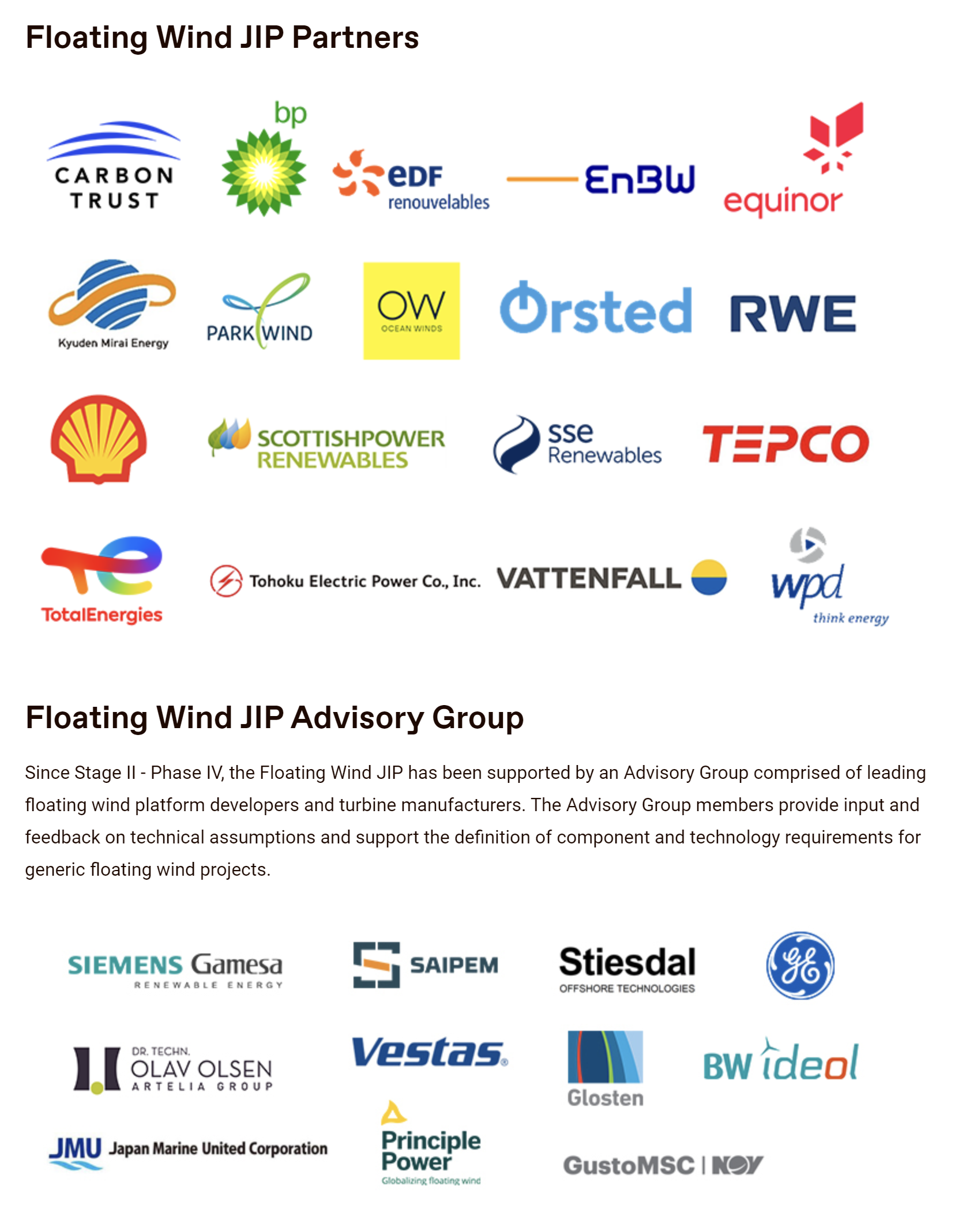
Most of the big wind farm builders and turbine and electrical gubbins manufacturers are represented.
Celtic Sea Projects
The Celtic Sea lies between South-East Ireland, Pembrokeshire and the Devon and Cornwall peninsular.
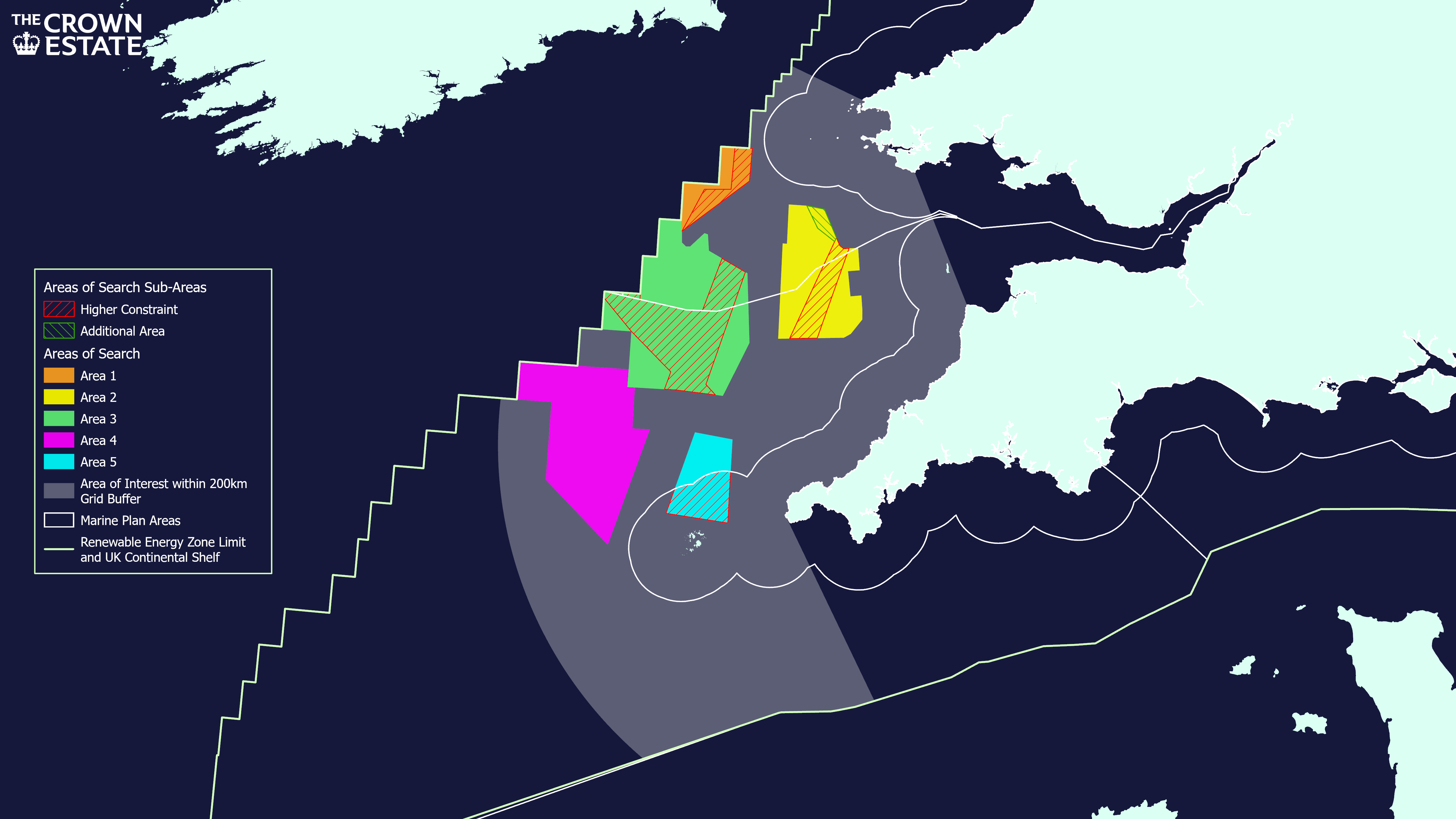
The Crown Estate kicked this off with press release in July 2022, that I wrote about in The Crown Estate Announces Areas Of Search To Support Growth Of Floating Wind In The Celtic Sea.
This map shows the five areas of search.
One Celtic Sea project has already been awarded a Contract for Difference in the Round 4 allocation, which I wrote about in Hexicon Wins UK’s First Ever CfD Auction For Floating Offshore Wind.
Other wind farms have already been proposed for the Celtic Sea.
In DP Energy And Offshore Wind Farms In Ireland, I said this.
They are also developing the Gwynt Glas offshore wind farm in the UK sector of the Celtic Sea.
- In January 2022, EDF Renewables and DP Energy announced a Joint Venture partnership to combine their knowledge and
expertise, in order to participate in the leasing round to secure seabed rights to develop up to 1GW of FLOW in the Celtic Sea. - The wind farm is located between Pembroke and Cornwall.
The addition of Gwynt Glas will increase the total of floating offshore wind in the UK section of the Celtic Sea.
- Blue Gem Wind – Erebus – 100 MW Demonstration project – 27 miles offshore
- Blue Gem Wind – Valorus – 300 MW Early-Commercial project – 31 miles offshore
- Falck Renewables and BlueFloat Energy – Petroc – 300 MW project – 37 miles offshore
- Falck Renewables and BlueFloat Energy – Llywelyn – 300 MW project – 40 miles offshore
- Llŷr Wind – 100 MW Project – 25 miles offshore
- Llŷr Wind – 100 MW Project – 25 miles offshore
- Gwynt Glas – 1000 MW Project – 50 miles offshore
This makes a total of 2.2 GW, with investors from several countries.
It does seem that the Celtic Sea is becoming the next area of offshore wind around the British Isles to be developed.
How do these wind farms fit in with the Crown Estate’s plans for the Celtic Sea?
I certainly, don’t think that the Crown Estate will be short of worthwhile proposals.
Conclusion
More and more wind farms keep rolling in.
Highview Power’s Plan To Add Energy Storage To The UK Power Network
The plan was disclosed in this article on the Telegraph, which is entitled Britain Will Soon Have A Glut Of Cheap Power, And World-Leading Batteries To Store It, by Rupert Pearce, who is Highview’s chief executive.
His plan is to build twenty of Highview Power’s CRYOBatteries around the country.
- Each CRYOBattery will be able to store 30 GWh.
- Each CRYOBattery will be one of the largest batteries in the world.
- They will have three times the storage of the pumped storage hydroelectric power station at Dinorwig.
- They will be able to supply 2.5 GW for twelve hours, which is more output than Sizewell B nuclear power station.
The first 30 GWh CRYOBattery is planned to be operational by late 2024.
- It will be built on Humberside.
- Humberside is or will be closely connected to the Dogger Bank, Hornsea and Sofia wind farms.
- When fully developed, I believe these wind farms could be producing upwards of 8 GW.
The Telegraph quotes Rupert Pearce as saying this.
We can take power when the grid can’t handle it, and fill our tanks with wasted wind (curtailment). At the moment the grid has to pay companies £1bn a year not to produce, which is grotesque.
I certainly agree with what he says about it being a grotesque practice.
It sounds to me, that Rupert’s plan would see Highview Power in the waste electricity management business.
- The wasted wind would just be switched to the Humberside CRYOBattery, if there was too much power in the area.
- The CRYOBattery might be conveniently located, where the wind farm cables join the grid.
- Dogger Bank A and B wind farms are connected to Creyke Beck substation, which is North of the Humber.
- Hornsea 1 and Hornsea 2 wind farm are connected to Killingholme substation, which is South of the Humber.
- Hornsea 3 wind farm will be connected to Norfolk.
- Hornsea 4 wind farms will be connected to Creyke Beck substation
- It looks like the combined capacity of Dogger Bank A, Dogger Bank B and Hornsea 4 could be around 3.4 GW.
- Sofia wind farm will be connected to Lazenby substation near Redcar.
- As the CRYOBattery is buying, selling and storing electricity, I would assume that there’s money to be made.
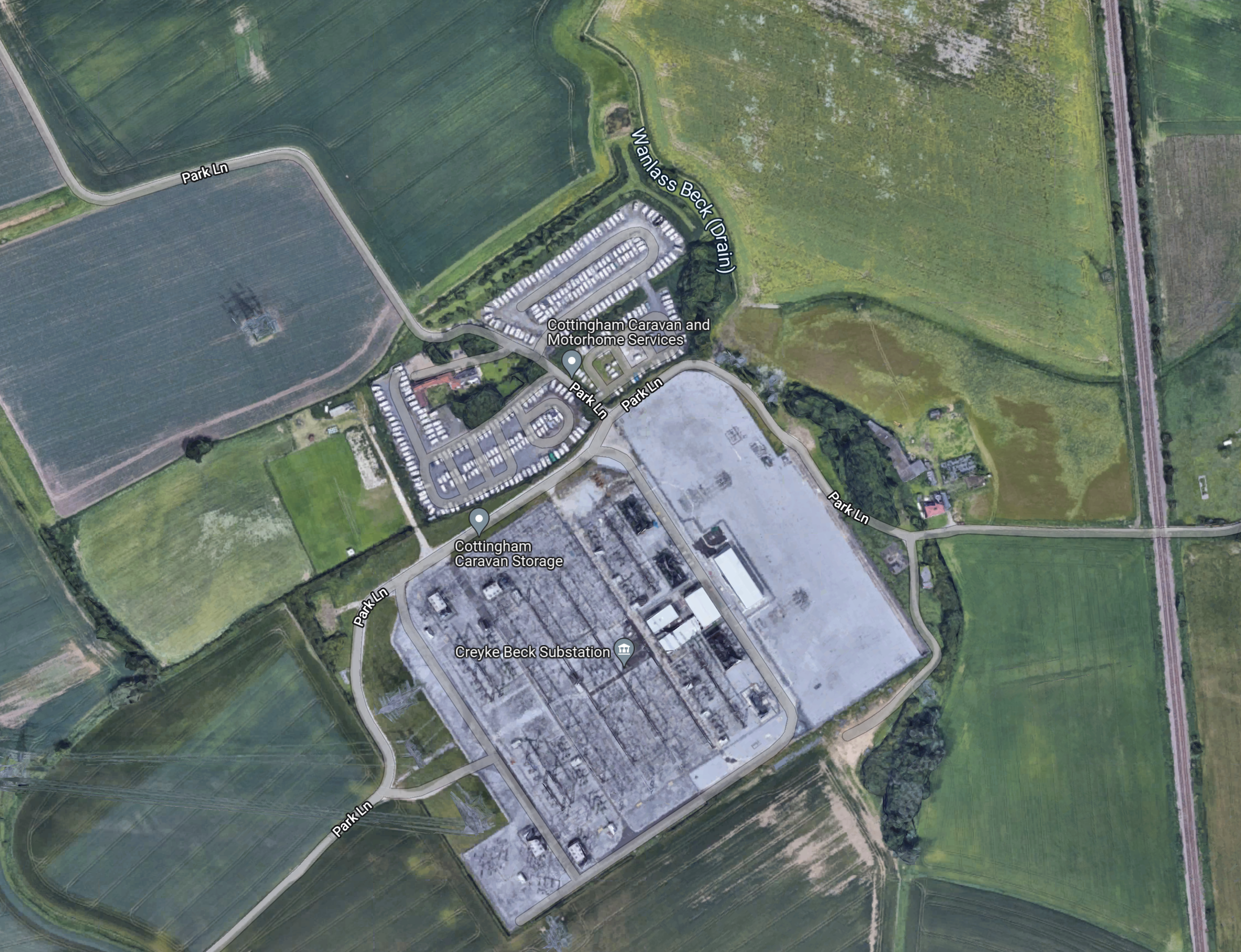
This Google Map shows Creyke Beck substation.
Note.
- It is a large site.
- Creyke Beck Storage have built a 49.99 MW lithium-ion storage battery on the site.
- The Northern part of the site is used to store caravans.
- It looks like the combined capacity of Dogger Bank A, Dogger Bank B and Hornsea 4 could be around 3.4 GW.
It looks like a 30 GWh CRYOBattery with a maximum output of 2.5 GW would be an ideal companion for the three wind farms connected to Creyke Back substation.
The combination could probably supply upwards of 2.5 GW to the grid at all times to provide a strong baseload for Humberside.
Conclusion
Will the income from the Humberside CRYOBattery be used to fund the next CRYOBattery?
I very much think so as it’s very sensible financial management!
 The Anonymous Widower