£350m Investment For Britain’s First Mainline Digital Railway
The title of this post, is the same as that of this article on Rail Technology Magazine.
This is the introductory paragraph.
The East Coast Main Line will become Britain’s first mainline digital rail link with £350m of new investment to install state-of-the-art electronic signalling designed to cut journey times and prevent delays.
We’re finally going digital!
Will The East Coast Main Line Give High Speed Two A Run For Its Money To The North East Of England?
I have looked up High Speed Two timings on their Journey Time Calculator and compared them with current LNER timetables.
- London-Leeds – Current – 136 minutes – HS2 – 81 minutes
- London-York – Current – 111 minutes – HS2 – 84 minutes
- London – Darlington – Current – 141 minutes – HS2 – 112 minutes
- York- Darlington – Current – 27 minutes – HS2 – 26 minutes
- London – Durham – Current – 170 minutes – HS2 – 138 minutes
- York – Durham – Current – 45 minutes – HS2 – 44 minutes
- London – Newcastle – Current – 170 minutes – HS2 – 137 minutes
- York – Newcastle – Current – 55 minutes – HS2 – 51 minutes
- London – Edinburgh – Current – 259 minutes – HS2 – 220 minutes
- Newcastle – Edinburgh – Current – 83 minutes – HS2 – 83 minutes
- York – Edinburgh – Current – 138 minutes – HS2 – 134 minutes
Note.
- I have assumed that Newcastle and Edinburgh takes 83 minutes, which is the current timing.
- The time savings possible to the North of Leeds are only a few minutes.
- As an example, the straight route between York and Darlington is 34 miles, which means an average speed of only 75 mph.
Serious work needs to be done North of York to improve timings.
Improvements To The East Coast Main Line
Various improvements to the East Coast Main Line are in process of building designed or built.
Extra Tracks
These example of more tracks are from the Wikipedia entry for the East Coast Main Line.
- Four tracks are being restored between Huntington and Woodwalton.
- Freight loops between York and Darlington.
There are probably other places, which will see extra tracks in the next few years.
Power Supply And Electrification
Wikipedia identified places where the power supply and the electrification could be better.
This sentence indicates the comprehensive nature of the planned work.
Power supply upgrades (PSU) between Wood Green and Bawtry (Phase 1 – completed in September 2017) and Bawtry to Edinburgh (Phase 2), including some overhead lines (OLE) support improvements, rewiring of the contact and catenary wires, and headspan to portal conversions (HS2P) which were installed at Conington in January 2018.
The Hertford Loop Line is also due to have some power supply upgrades.
Station Improvements
Darlington, Kings Cross, Stevenage and York will have track improvements, which will improve the capacity of the tracks through the stations.
Werrington Dive Under
The Werrington Dive Under will be a big improvement. This is an extract from the Wikipedia entry.
The project will see the construction of 1.9 miles (3 km) of new line that will run underneath the fast lines, culverting works on Marholm Brook and the movement of the Stamford lines 82 feet (25 m) westwards over the culverted brook. This will mean that trains for the GN/GE line no longer need to cross the fast lines on the level, nor use the Up Fast line between Peterborough station and the junction. The project, coupled with other ECML improvement schemes (such as the four tracking from Huntingdon to Woodwalton) will improve capacity on the line through Peterborough by 33% according to Network Rail. This equates to two extra train paths an hour by 2021, when the work is scheduled to be completed. In turn, this will remove 21 minutes from the fastest King’s Cross to Edinburgh Waverley service, and 13 minutes from the fastest King’s Cross to Leeds service. It will also see an increase of 1,050 ‘intercity’ seats per hour on express trains through Peterborough.
The upgrade will add two more train paths to the route and knock 21 and 13 minutes off the faster Edinburgh and Leeds services respectively.
The Newark Flat Crossing
This is the railway equivalent of a light-controlled pedestrian crossing in the middle of a motorway.
This Google Map shows the crossing.
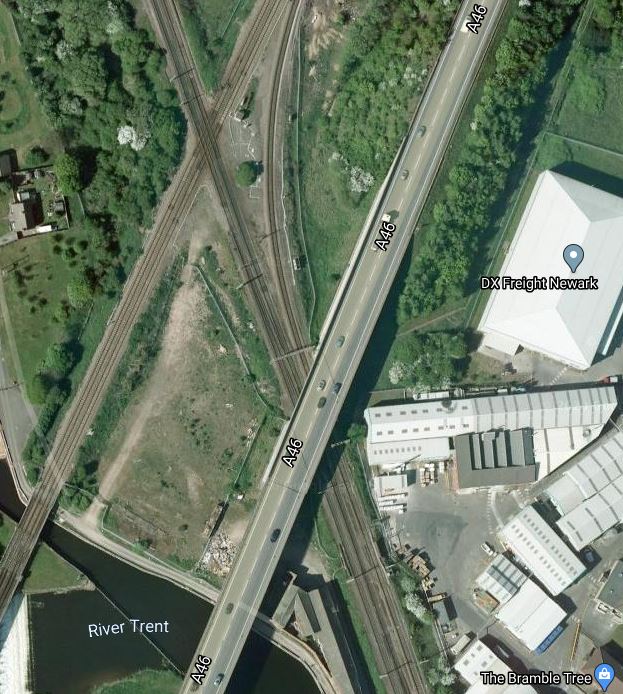
Note.
- The East Coast Main Line running roughly North-South
- The A 46 road crossing the line.
- The Nottingham-Lincoln Line running parallel to the railway.
- A chord allowing trains to go between the Nottingham-Lincoln Line and Newark North Gate station, which is to the South.
- The River Trent.
Complicated it certainly is!
I wrote about the problems in The Newark Crossing and felt something radical needed to be done.
Looking at the numbers of trains at the Newark Crossing.
- The number of trains crossing the East Coast Main Line, is typically about three to five trains per hour (tph) and they block the East Coast Main Line for about two minutes.
- But then there could be a fast train around every four minutes on the East Coast Main Line, with eight tph in both directions.
The numbers of trains and their speeds would probably cut out a Control Engineer’s solution, where all trains are computer controlled through the junction.
Although, it might be possible to reduce the number of conflicting trains on the East Coast Main Line dramatically, by arranging a Northbound and a Southbound express passed each other at the flat junction.
There’s also the problem of what happens if a crossing train fails, as it goes over the East Coast Main Line. But that must be a problem now!
Whatever happens here will be a well-thought through solution and it will add to the capacity of the East Coast Main Line and increase the line-speed from the current 100 mph.
Level Crossings
Wikipedia says this about level crossings.
Level crossing closures between King’s Cross and Doncaster: As of July 2015 this will no longer be conducted as a single closure of 73 level crossings but will be conducted on a case-by case basis (for example, Abbots Ripton Level Crossing will close as part of the HW4T scheme).
It is my personal view that all should be removed.
ERTMS Signalling
Wikipedia says this about the installation of ERTMS digital in-cab signalling.
The line between London King’s Cross and Bawtry, on the approach to Doncaster, will be signalled with Level 2 ERTMS. The target date for operational ERTMS services is December 2018 with completion in 2020.
Note that, ERTMS is needed for 140 mph running.
140 mpg Running
Wkipedia says this about 140 mph running.
Increasing maximum speeds on the fast lines between Woolmer Green and Dalton-on-Tees up to 140 mph (225 km/h) in conjunction with the introduction of the Intercity Express Programme, level crossing closures, ERTMS fitments, OLE rewiring and the OLE PSU – est. to cost £1.3 billion (2014). This project is referred to as “L2E4” or London to Edinburgh (in) 4 Hours. L2E4 examined the operation of the IEP at 140 mph on the ECML and the sections of track which can be upgraded to permit this, together with the engineering and operational costs.
A rough calculation indicates that up to eleven minutes could be saved by this upgrade, between London and Darlington.
Prospective Timings On The East Coast Main Line
Consider.
- The package of new trains level crossing closures, ERTMS, OLE rewiring and the OLE PSU, which is collectively known as L2E4 should deliver Edinburgh in four hours.
- Nineteen minutes need to be saved on current times.
- I believe that if the train takes four hours or less, travellers will switch from the airlines.
- High Speed Two are aiming for a time of 220 minutes, but is this by the West or East Coast routes?
- As their proposed Glasgow service has a similar time, I assume it is by the West Coast route.
- Wikipedia states that an Open Access Operator was thinking of running Class 390 trains or Pendelinos between London Kings Cross and Edinburgh in 223 minutes.
If the managers of LNER are the least bit ambitious, I can see them wanting to run a service between London and Edinburgh, in a time that is several minutes under four hours.
It should always be remembered that the East Coast Main Line was built for speed, as these true stories illustrate.
- Mallard set the world speed record for steam locomotives in 1938 of 126 mph, on the line.
- The record time between London and Edinburgh was set in 1991 by an InterCity 225 train at a minute under three-and-a-half hours.
I even have my own special memory of the line, which I wrote about in The Thunder of Three-Thousand Three-Hundred Horses. Behind a Deltic or Class 55 locomotive, I went from Darlington to London in two hours and fifteen minutes, which is faster than today’s fastest trains. Not bad for a 1960s design, but the train was a coach short and had a clear run. And was probably extremely-well driven.
Is the East Coast Main Line and especially the section South of Darlington, a route, where a knowledgeable driver can coax the maximum out of a high speed train?
Possible savings over the next few years include.
Werrington Junction
When this is completed, it could knock twenty-one minutes off the timings to Edinburgh.
Newark Crossing
How much time could be saved here?
There must be some time savings if the line speed can be increased from 100 mph.
140 mph Running
The various improvements in L2E4 are intended to enable services to run between London and Edinburgh in under four hours.
- Does L2E4 include any possible time savings from the Werrington Dive Under?
- Does L2E4 include any possible time savings from improvements at Newark?
- What is the completion date for L2E4?
- Most of the time savings for L2E4 will be South of Darlington as the track is straighter.
As I said earlier a rough calculation indicates that L2E4 will save about eleven minutes to the South of Darlington.
Conclusion
There must be over thirty minutes of savings to be accumulated on the East Coast Main Line. Much of it because of the Werrington and Newark improvements will be South of Darlington.
I wouldn’t be surprised to see timings like these.
- London-Leeds – Current – 136 minutes – HS2 – 81 minutes – Possible ECML – 120 minutes
- London-York – Current – 111 minutes – HS2 – 84 minutes – Possible ECML – 90 minutes
- London – Darlington – Current – 141 minutes – HS2 – 112 minutes – Possible ECML – 115 minutes
- London – Durham – Current – 170 minutes – HS2 – 138 minutes – Possible ECML – 130 minutes
- London – Newcastle – Current – 170 minutes – HS2 – 137 minutes – Possible ECML – 130 minutes
- London – Edinburgh – Current – 259 minutes – HS2 – 220 minutes – Possible ECML – 210 minutes
It looks to me, that the East Coast Main Line could be fulfilling the aspirations of British Rail’s engineers of the 1980s.
Could High Speed Two Be A One-Nation Project?
As currently envisioned, High Speed Two is very much an English project, with the following routes
- London and Birmingham
- London and Liverpool via Birmingham
- London and Manchester Airport/Manchester via Birmingham and Crewe
- London and Sheffield via Birmingham and the East Midlands Hub
- London and Leeds via Birmingham and the East Midlands Hub
There are large numbers of mid-sized towns and cities that it won’t serve directly.
The West Coast Main Line
The West Coast Main Line serves the following routes.
- London and Birmingham
- London and Liverpool via Crewe
- London and Manchester via Crewe
- London and Glasgow via Crewe, Wigan, Preston and Carlisle
- London and Blackpool via Crewe, Wigan, Preston
- London and North Wales via Crewe and Chester.
It could probably be considered a two or two-and-a-half nation line, as it serves the Western half of Scotland and the Northern half of Wales.
Add the West Coast Main Line and High Speed Two together and you get a line, that serves a lot more places like Blackpool, Carlisle, Chester, Edinburgh, Glasgow, Preston, Stafford, Stoke and Wigan.
- The current plan for both routes envisage them both being run by Avanti West Coast, so it looks like High Speed Two is being designed to work with the West Coast Main Line.
- Destinations like Carlisle, Glasgow and Preston will be served using the West Coast Main Line.
- Compatible trains will be built that can be run on both lines.
- Some stations will be shared.
It does seem that there are advantages, if the two routes are considered as one system.
The East Coast Main Line
The East Coast Main Line serves the following routes.
- London and Bradford
- London and Cambridge
- London and Edinburgh via Doncaster, York and Newcastle
- London and Harrogate via Leeds
- London and Hull
- London and Kings Lynn via Cambridge
- London and Lincoln via Newark.
- London and Leeds via Doncaster
- London and Middlesbrough
- London and Skipton via Leeds
- London and Sunderland
The East Coast Main Line could become another high speed line.
Extra services could be added.
- London and Norwich via Cambridge
- London and Nottingham
- London and Grimsby and Cleethorpes via Lincoln.
- London and Sheffield via Retford.
Add the East Coast Main Line and High Speed Two together and there could be a wider range of towns and cities served.
- Peterborough and Doncaster could play the same role in the East as Birmingham and Crewe will play in the West.
- The East Coast Main Line between London and Doncaster will be upgraded to in-cab ERTMS signalling in a few years time, which will allow 140 mph running on several sections of the route.
- Improvements are either under way or being planned to reduce bottlenecks on the East Coast Main Line.
- If High Speed Two can handle eighteen trains per hour (tph), then surely the East Coast Main Line, which has a lot of quadruple track, can handle upwards of twelve 140 mph trains per hour between London and Doncaster, after the improvements to track and signalling.
- I estimate that 140 mph running between London and Doncaster could save as much as twenty minutes.
- I feel that Barnsley, Doncaster, Hull, Leeds, Sheffield and York could all be reached in under two hours from London using the existing Azuma trains.
- This morning the 0700 from Kings Cross is timetabled to reach York at 0852. Would it be possible for London and York to be around just ninety minutes?
- Savings would also apply to trains between London and Leeds, Middlesbrough, Newcastle, Scotland and Sunderland.
- Sub-four hour journeys between London and Edinburgh would be commonplace.
Note that the Internet gives a driving time of nearly three and a half hours between London and Leeds. Surely, two hours or less on High Speed Yorkshire would be much preferable.
I would add this infrastructure.
- There might be a good case to create electrified routes to Hull and Sheffield and between Sheffield and Leeds, but they wouldn’t be needed to start the service or obtain the time savings. But they would ease operation, cut carbon emissions and save a few more minutes.
- A station at Doncaster-Sheffield Airport.
- A parkway station at Barnsley on the Dearne Valley Line with direct services to Doncaster, Leeds, London and Sheffield.
The two latter improvements have been proposed in Sheffield Region’s transport plans.
High Speed Yorkshire should be finished as soon as possible. A completion date of 2024 is not unreasonable.
Northern Powerhouse Rail
Northern Powerhouse Rail is a plan to build an East-West high speed line or at least a much faster one, than the overcrowded joke, that presently exists.
I discussed the latest thinking in Changes Signalled For HS2 Route In North and the latest thinking and my views can best be summarised as follows.
- Northern Powerhouse Rail will be an improved line with some new sections, between Liverpool and Hull via Manchester Airport, Manchester and Leeds.
- Northern Powerhouse Rail and High Speed Two will connect at High Legh.
- Northern Powerhouse Rail and High Speed Two will share infrastructure.
- The High Speed Two route to Manchester would be via Birmingham, Crewe, High Legh and Manchester Airport.
- The High Speed Two route to Liverpool would be via Birmingham, Crewe, High Legh and Warrington
- Hull will get a London service from High Speed Two via Birmingham, Crewe, High Legh and Manchester Airport, Manchester and Leeds
The Oakervee review of High Speed Two is also underway and leaks are suggesting, that the report is recommending that High Speed Two be built in full, but differently.
One important thing, that is happening, is that Network Rail have started the procurement process to improve the current line between Leeds and Huddersfield, as I reported in Network Rail Reveals Detailed £2.9bn Upgrade Plans For TransPennine Route.
- Extra tracks will be built.
- There will be some extra electrification.
I very much feel, that this is one of the most difficult TransPennine sections to improve.
The other sections are summarised as follows.
- Liverpool and Manchester Airport via Warrington and High Legh is across the flat lands of North Cheshire and could follow the M56.
- Manchester Airport and Manchester will probably be a high speed tunnel.
- Manchester and Huddersfield section could possibly be improved in the short term
- Leeds and Hull and the required connections to the East Coast Main Line are in the flat lands of East Yorkshire.
It looks to me, that Network Rail have a plan in there to perhaps deliver improved services East of Huddersfield and radiating from Leeds in the next few years.
It certainly needs improvement, as the TransPennine route must be the worst main line in the UK.
A One-Nation Railway
I think these lines can be connected to create an integrated high speed network.
- High Speed Two
- West Coast Main Line
- East Coast Main Line
- Northern Powerhouse Rail
But.
- It doesn’t connect to the whole country and needs to be extended.
- It won’t be fully developed until at least 2035.
- Improvements are needed now!
So what could be substantially delivered of the core network, by say 2024, which is around the date of the next General Election?
- Faster and more frequent services on the East Coast Main Line.
- An electrified higher capacity and faster line between Leeds and Huddersfield and possibly between Leeds and Hull.
- New East Coast Main Line services from London to Barnsley Dearne Valley, Bradford, Cleethorpes, Doncaster Sheffield Airport, Grimsby, Harrogate, Huddersfield, Middlesbrough, Norwich, Nottingham, Scarborough and Sheffield and Sunderland.
- Sub-four hour services between London and Edinburgh.
- New local services to connect Blyth and Ashington to the East Coast Main Line at Newcastle.
- A Tees Valley Metro connecting Bishop Auckland, Whitby and all in between to the East Coast Main Line at Darlington.
- Improved local services between York and Leeds via Harrogate, Sheffield and Leeds via the Dearne Valley and on other lines in Yorkshire.
Effectively, the recommendations of this report on the Transport for the North web site, which is entitled At A Glance – Northern Powerhouse Rail, which apply to Leeds and Sheffield would have been implemented to connect to high speed services at Doncaster, Leeds, Sheffield and York.
Technology used would include.
- Some more electrification using the power from the electrified East Coast Main Line.
- Conventional electric trains and compatible battery trains.
- Tram-trains feeding into the Sheffield Supertram.
- ERTMS digital signalling on the East Coast Main Line and the major branches to Hull, Leeds and Middlesbrough.
There would also need to be an increase in LNER’s Azuma fleet. But that is already rumoured as I wrote in More New Trains On LNER Wish List.
Could we see as many as twelve Axumas per hour between London and Doncaster? Yes!
Could it all be delivered by the 2024 General Election? Yes!
High Speed Scotland
The Scottish Nationalist Party is pushing for High Speed Two to be extended to Scotland.
I think that this will eventually be a feasible project, but it will be a very expensive and perhaps built around 2040.
These are my thoughts for the next few years up to 2024.
High Speed To Edinburgh
Consider.
- Edinburgh currently supports a half-hourly service to and from London.
- East Coast Trains are proposing to add five trains per day to this route.
- TransPennine Express will run an hourly service between Edinburgh and Liverpool, via Manchester, Leeds, York and Newcastle, which starts at the December 2019 timetable change..
- CrossCountry run an hourly service between Aberdeen and Plymouth.
- It looks like Edinburgh and Newcastle have a four tph service.
All services, except the CrossCountry are planned to be run by Hitachi’s Class 800, 802 or 803 trains.
- Currently, services take ninety minutes for the 125 miles between Newcastle and Edinburgh.
- The Hitachi trains are all capable of 140 mph with digital signalling.
- The Hitachi trains have better acceleration.
- The route is fully electrified. Although, there are reports it needs enhancing to be able to handle the current number of trains.
How many minutes can be taken off thjs route, with a new timetable on a line running only Hitachi high speed trains?
Probably not that many, but it would ensure all London and Edinburgh trains were under four hours.
But it will all happen by 2024?
High Speed To Glasgow
So Edinburgh is alright, but what about Glasgow?
Consider.
- Glasgow currently supports an hourly service to and from London.
- TransPennine Express run an hourly service to and from Manchester Airport
- TransPennine Express will run a three trains per day service to and from Liverpool.
Glasgow has a much lower frequency service to and from England than Edinburgh.
Currently, London and Glasgow takes over four-and-a half hours and there is going to be no serious improvement, until High Speed Two opens to Crewe, when the time could drop to perhaps just over three-and-a half hours.
But that won’t happen until possibly 2030.
In Does One Of Baldrick’s Descendents Work For Avanti West Coast?, I detail a cunning plan, that might allow London and Glasgow in four hours.
This was my conclusion in the other article.
To improve services between London and Birmingham, Blackpool, Liverpool and Scotland, appears to need the following.
- Ten new Hitachi trains.
- Full digital signalling on the West Coast Main Line.
- Track improvements on the West Coast Main Line
- Upgrading of the Pendelinos to allow 140 mph running.
This should reduce London and Glasgow to around four hours and London and Liverpool to around two hours.
There may be advantages in replacing the Pendelinos with the Classic-compatible High Speed Two trains on the London and Glasgow service as early as possible.
- There would be a large increase of capacity between London and Glasgow.
- What would be the possible speed of the Classic-compatible trains on updated track North of Crewe? I will assume 140 mph, but it could be more! That’s called engineering!
- London and Glasgow timings would be improved, as soon as digital signalling is installed.
- The trains would get a thorough testing before the opening of High Speed Two to Birmingham.
At least one platform at Glasgow Central would need to be extended to take a four-hundred metre long train.
According to Wikipedia, the Classic-compatible trains will be introduced from 2026.
I think by the December 2026 timetable change Glasgow could see a four-hour service to and from London.
But could it be 2024, if the Pendelinos can pick up time North of Crewe with digital signalling?
The Borders Railway
If High Speed Two is going to be a One Nation project, the Borders Railway must be extended from Tweedbank to Carlisle via Hawick.
Could this be done by 2024?
It would be a close-run thing! But possible!
The Glasgow South Western Line
The Glasgow South Western Line, is a secondary route between Glasgow and Carlisle.
It should be electrified early, so that during the upgrading of the West Coast Main Line North of Carlisle it can be used as a diversionary route.
Scotland Could Have Two Four-Hour Fully-Electrified Routes To And From London
But it’s not just London that gets good connectivity to and from Scotland!
- Birmingham
- Bradford
- Carlisle
- Leeds
- Liverpool
- Manchester
- Newcastle
- Peterborough
- Preston
- Wolverhampton
- York
All these cities will have direct connections to Edinburgh and/or Glasgow.
High Speed Midlands
Almost unnoticed and with little fuss, the Midland Main Line is being upgraded to provide 125 mph services between London and Chesterfield, Derby, Leicester, Nottingham and Sheffield.
- New Hitachi bi-mode Class 804 trains will improve speeds and increase capacity
- Over the last decade or so, the track has been upgraded for 125 mph running.
- Electrification will reach between London and Market Harborough.
- Market Harborough station has been remodelled to remove a bottleneck.
- The Corby branch will be electrified with the trains running half-hourly.
I also think, that the Midland Main Line will link into all the improvements between Barnsley, Doncaster, Leeds and Sheffield and provide the following.
- A high speed route between Leeds and the East Midlands.
- A route for a Barnsley and London service.
- A second route for Leeds and London services..
It also seems that rail planners are getting innovative with the design of the Midland Main Line.
- It appears that the Midland Main Line and High Speed Two’s spur to Sheffield will be combined into an electrified line between Clay Cross North Junction and Sheffield via Chesterfield.
- An improved link to the East-West Rail link at Bedford could improve links between the North-East and the South of England.
- The disused rail line between Market Harborough and Northampton could be reopened.
The line is a lot more than a connection between London and the East Midlands.
The upgrade should be complete by 2024.
East West Rail
East West Rail is still in a long planning stage, but it now looks likely to provide more than a passenger link between Oxford and Cambridge.
- New freight routes for Felixstowe and Southampton.
- Extra passenger services between Oxford and Reading in the West and Cambridge, Ipswich and Norwich in the East.
- Connections to the Great Western Main Line, the Chiltern Line, West Coast Main Line, Midland Main Line, East Coast Main Line and the Great Eastern Main Line.
It has also been suggested that East West Rail should be connected to High Speed Two at a new station at Calvert. This could give Bristol, Cardiff and Southampton good links to and from High Speed Two.
Great Western Main Line
At the December 2019 timetable change, there has finally been some good news in the saga of the electrification of the Great Western Main Line.
- Services between London and Bristol have been improved.
- The timetable has been improved.
Whether it will stand up is another matter.
Certainly by 2024, it will be a much better main line.
It could have full digital in-can signalling, which could result in 140 mph running and journey time savings.
Who knows?
But what excites me is the possibility of a connection between High Speed Two and East West Rail at Calvert, which will allow trains to run between Bristol, Cardiff and Swansea, in Wales and the West and the North on a mainly electrified high speed railway.
High Speed North Wales
Avanti West Coast is purchasing thirteen new Hitachi bi-mode trains to run services to Chester and North Wales.
I can’t see much speed improvement in the services, although if the West Coast Main Line gets digital signalling, this could save a few minutes between London and Crewe.
High Speed Ireland
The technology is now available to build a rail bridge between Scotland and the island of Ireland.
I laid out the arguments in A Solution To The Northern Irish Problem!.
The Lincoln Solution
Lincoln is a city, that has been ignored by UK railways for decades.
But not any more as LNER now run six return trips a day to the city on Mondays to Saturdays and five on Sundays.
I wrote about the improvements in The Shape Of Train Services To Come.
How many other cities and large towns would benefit from a Lincoln solution?
LNER have already launched a similar service to Harrogate at the December 2019 timetable change and I’m sure that more will follow.
Disability And Access Issues
A true one-nation railway wouldn’t exclude anybody from using the trains.
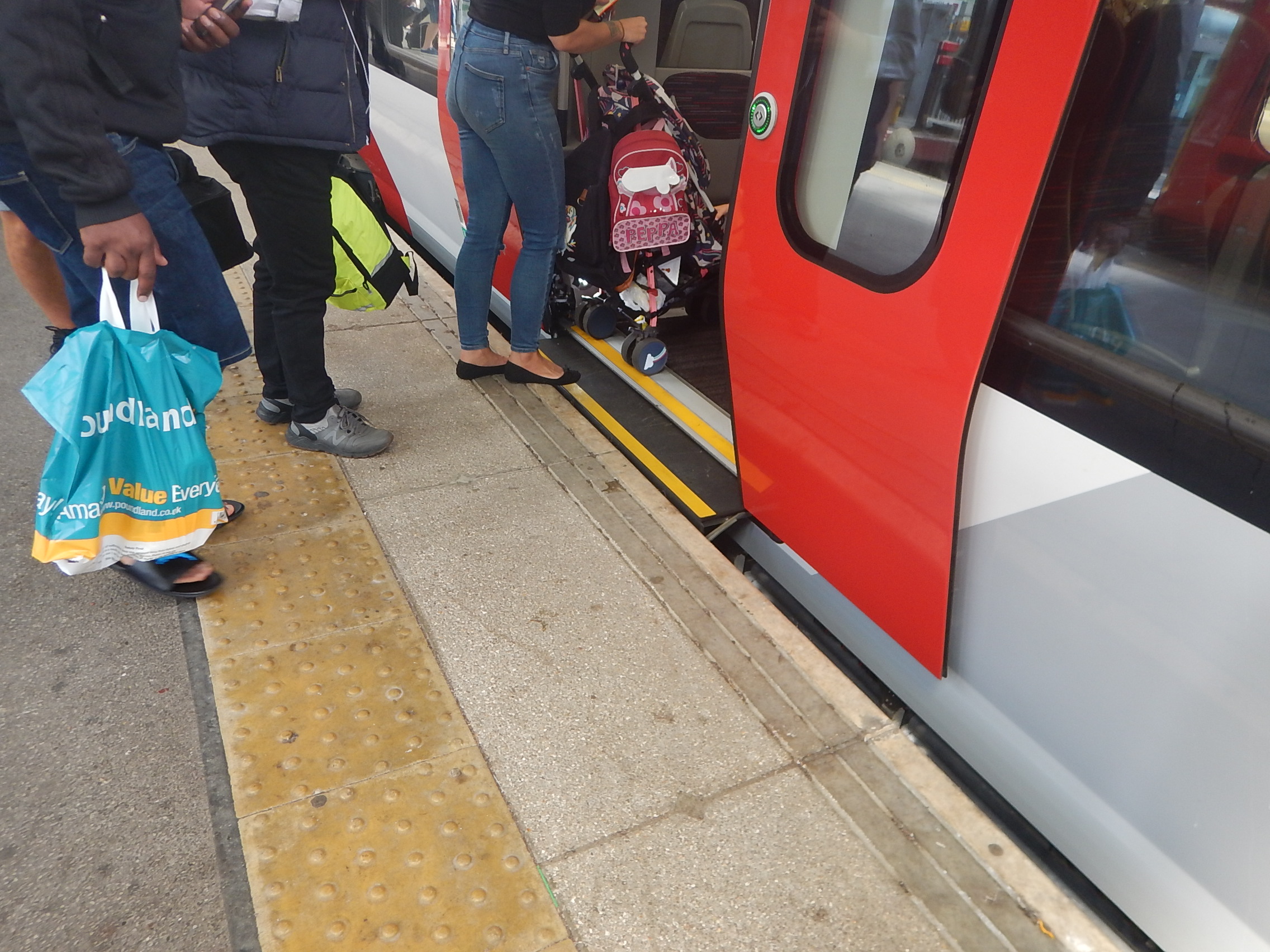
Strides have been made to put up step-free bridges, but some of the access between platform and train is truly dreadful.
This picture shows what can be achieved by good design on a Class 755 train.
And this is the step on one of Hitachi’s new trains.
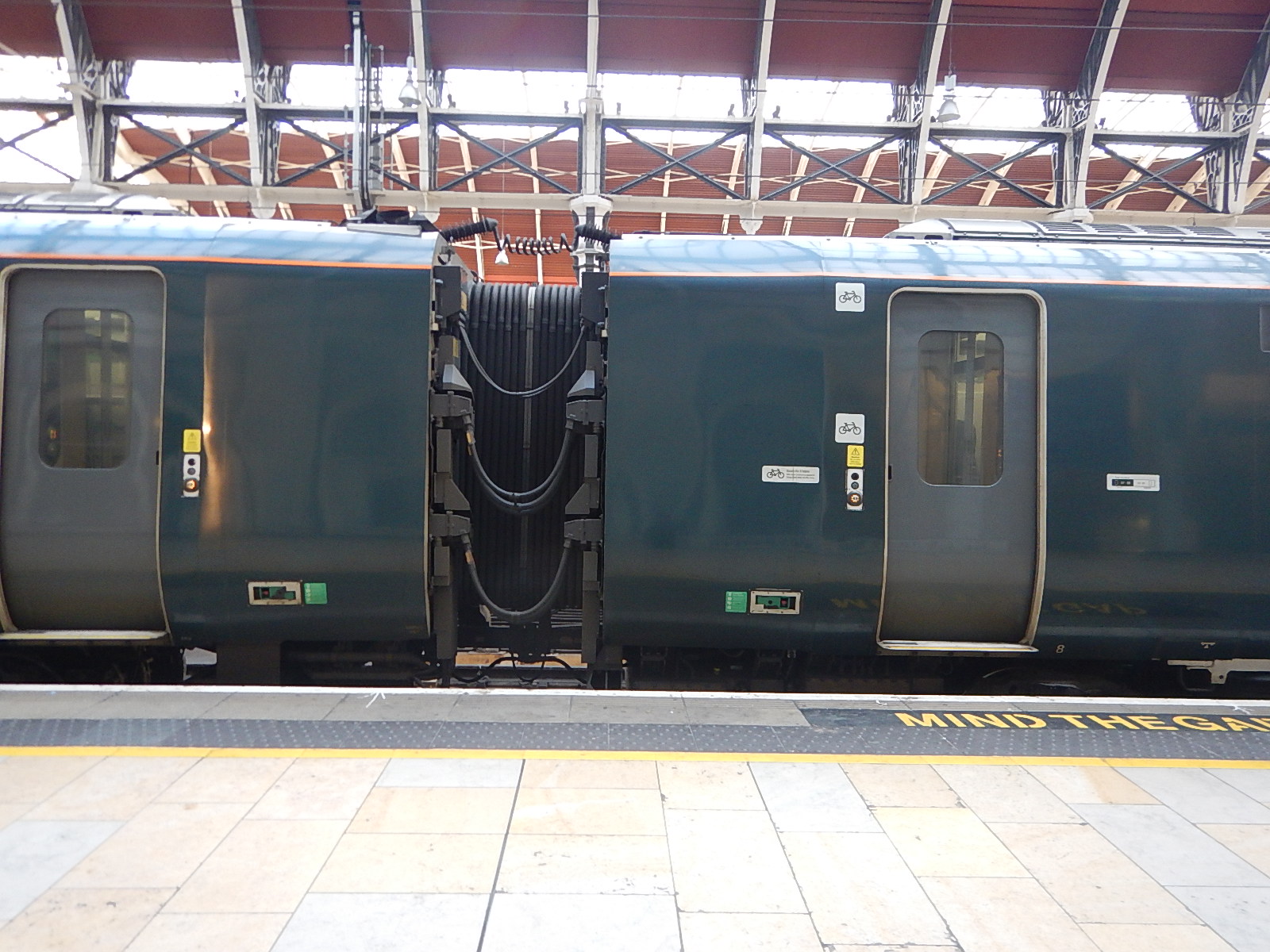
Note that all doors on these Hitachi trains are also far too narrow.
Some train manufacturers can do much better.
Recurring Themes
In this analysis, there are factors that keep cropping up.
Digital Signalling Or ERTMS
This is the key to squeezing more trains into our overcrowded railway.
Between London and Doncaster on the East Coast Main Line, should be operational in a few years and I believe the following lines should follow as soon as possible.
- East Coast Main Line between Doncaster and York and possibly Newcastle.
- East Coast Main Line North Of Newcastle
- West Coast Main Line North Of Crewe
- West Coast Main Line South Of Crewe
- Midland Main Line
- Great Western Main Line
As a time-expired Control Engineer, I believe that in-cab digital signalling is a major key to increasing capacity.
Faster Line Speeds
Some routes like TransPennine, have Victorian line speeds
Network Rail showed how it could improve line speed with the remodelling at Market Harborough station.
Bottlenecks, like the Trowse Swing Bridge at Norwich need immediate removal, no matter what the Heritage Taliban and other Luddites say.
New Hitachi Trains
There will be several more orders for the next generation of Hitachi’s high speed trains.
I have been critical of Hitachi’s manufacturing processes for these trains in the past, but they seem now to be running well in fleet service.
A standard UK train on 125 mph lines, that can also handle 140 mph with digital signalling must be a good thing for all sorts of reasons.
New Feeder Services
Several new feeder services have been indicated and there should be a lot more of these to bring the benefit of the high speed network to more of the UK population.
Delivering The Improvements
Geographically, the places where improvements are needed are spread thinly around the country and vary from projects with a cost of tens of millions to those with costs of tens of billions.
In the UK, we tend to go for the big hit, when perhaps several smaller ones might give a better short-term improvement.
We also duck projects, which would annoy the noisy local interests.
We need to have fundamental rethink about how we deliver and pay for rail improvements.
Conclusion
I am fairly pleased overall in that I think by 2024, many places in the UK, will have a much better train service than they do now!
Delivery of High Speed Two, East West Rail and Northern Powerhouse Rail as soon as possible after 2024, will be the icing on the cake.
Will It Be A One-Nation Project?
I think it can be!
Rochdale Still Doesn’t Have A Direct Link To Manchester Airport
The title of this post is the same as that of this article on Richdale Online.
I recently went to Rochdale to see Ipswich play and what surprised me about the town, was how far it was from my hotel close to Manchester Victoria station.
I went on a tram and it took over an hour and it was also very crowded.
I then walked about a mile to the football ground. Luckily a friendly Rochdale supporter showed me the way.
But is Rochdale’s link to Manchester Airport, any worse than say Walthamstow’s link to Heathrow or Gatwick.
- Rochdale Town Centre to Manchester Airport by train – 1:05
- Rochdale Town Centre to Manchester Airport by tram – 2:02
- Rochdale Station to Manchester Airport by train – 0,:55
- Rochdale to Manchester Airport by taxi- 0:27
- Walthamstow Central to Heathrow Airport by Underground and Heathrow Express – 1:05
- Walthamstow Central to Heathrow Airport by Underground – 1:27
- Walthamstow to Heathrow Airport by taxi – 1:27
- Walthamstow Central to Gatwick Airport by train – 1:22
Note.
- All journeys, except the taxis, need at least one change.
- My lawyer son lives in Walthamstow and always flies from Heathrow.
- He gets there by Underground, with one cross-platform change at Finsbury Park.
- Crossrail won’t help the man on the Walthamstow Underground.
- In Manchester the taxi is quicker, but it isn’t in London.
These are my thoughts.
Mancunians Are More Impatient
Not my view, but the view of a Northern station guy, who has worked on Platforms 13 and 14 at Manchester Piccadilly and busy stations on the London Overground.
He thought that they were sometimes in such a hurry to get on a train, that the train is delayed.
He also said, if you ask Londoners to stand behind the yellow line, they do. Mancunians don’t!
Access To Northern And TransPennine Trains Is Bad
Consider.
- There is often a step up into the train in Manchester.
- Manchester Metrolink is generally step-free into the tram.
- Parts of London Underground/Overground are step-free.
- The new TransPennine trains have pathetic and slow end-door access.
The two train companies have bought fleets of trains that are not fit for purpose.
The Manchester Airport Rail Link Is At Full Capacity
Manchester Airport station, does not have the best rail line from the City Centre.
Wikipedia says this.
Any future additional services to the Airport are in doubt without further infrastructure works; unresolved issues surround the lack of new ‘through’ platforms at Manchester Piccadilly which have been shelved by the government and the Styal Line to Manchester Airport operating at full capacity with little resilience to absorb delays.
The Rochdale Online article blames the stations in Manchester, but the Styal Line is equally to blame.
The Long Term Solution Is High Speed Two
In the 2030s, High Speed Two will solve the problem by using a tunnel between Manchester Airport and the City Centre.
It will also do the following.
- Provide direct access between Manchester Airport and the Midlands, the South and London.
- Provide direct access to Liverpool and Warrington in the West.
- Provide direct access to Huddersfield, Bradford, Leeds, Hull and the North East, in the East.
- All services will probably be at least five trains per hour (tph).
But High Speed Two won’t provide a direct link to Richdale.
Passengers between Rochdale and Manchester Airport will still have to change in the City Centre.
Unless of course, some TransPennine services to Manchester Airport are discontinued, as they can be done by High Speed Two.
This would free up paths to add extra services to Manchester Airport.
An Interim Solution
Not only Rochdale, but other towns and cities across the North like Bradford moan about lack of a direct service to and from Manchester Airport.
So what would I do?
Ban Freight Trains Through The Castlefield Corridor
This may not be possible, but it should be a long term objective.
It will cost money, but it would release capacity through the Castlefield Corridor.
Ban Trains Without Level Access At Stations In The Castlefield Corridor
I know that Northern and TransPennine have just bought a load of new trains, but they make matters worse in the stations through the Castlefield Corridor.
All Trains To The Airport Must Be Eight Cars
This makes sense as it increases the capacity, but use the same number of paths.
- Eight-car Class 379 trains – Stansted Express – 160 metres and 418 passengers
- Five-car Class 802 trains – TransPennine Express – 130 metres and 342 passengers
- Eight-car Class 331 trains – Northern – 190 metres and 568 passengers
It does appear that the new trains are also setting new standards for train length.
ERTMS Signalling Should Be Installed Between Manchester Victoria And Manchester Airport
ERTMS signalling would give more flexibility on the route.
Create A Manchester Airport Express
This has been suggested and would have the following characteristics.
- Running between Manchester Airport and Manchester Victoria via Deansgate, Manchester Oxford Road and Manchester Piccadilly.
- Eight cars
- Airport-style interiors
- Step-free access at all stations.
- Four tph
- Running twenty-four hours a day.
- It would have step-free access to the Metrolink at Manchester Victoria, Deansgate and Manchester Piccadilly.
Ideally it would use dedicated platforms at Manchester Airport and Manchester Victoria. The platform at Victoria would hopefully have cross-platform interchange with services going through the station from East to West.
Reduce TransPennine Services To The Airport
TransPennine Express runs the following hourly services to the Airport
- Cleethorpes via a reverse at Manchester Piccadilly.
- Edinburgh or Glasgow via the Castlefield Corridor
- Middlesborough via the Castlefield Corridor
- Newcastle via the Castlefield Corridor
Why not cut-back either the Newcastle or Middlesborough service to Manchester Victoria and make sure it has good cross-platform access to the Manchester Airport Express?
These services are regularly cut-back anyway due to the congestion.
Demolish Manchester Oxford Road Station And Build A Station That’s Fit For Purpose
Manchester Oxford Road is one of ultimate design crimes on the UK Rail network.
- The new or refurbished station would be step-free.
- Platforms would be able to accept two hundred metre long trains.
- A well-designed bay platform would be provided to turn trains from the North efficiently.
- Up to four tph could probably be turned back.
Network Rail do station and track layout design generally very well and I’m sure that a redesigned Oxford Road station could improve capacity through the Castlefield Corridor.
Improve Deansgate And Manchester Piccadilly Stations
If longer trains are to be run through the Castlefield Corridor, then the platforms at these two stations will need lengthening and passenger access will need to be improved.
Is There A Place For Tram-Trains?
Manchester are keen on using tram-trains to improve the Metrolink network.
This map clipped from Wikipedia shows the layout of the Metrolink in the City Centre.
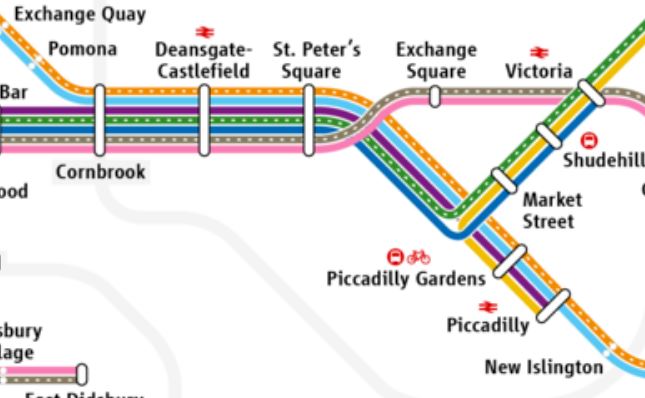
Note.
- Manchester Piccadilly, Deansgate and Manchester Victoria all have step-free connections to the trains to and from Manchester Airport.
- The new Trafford Line will branch off at Pomona.
I think it is likely, that any new lines run by tram-trains will pass through at least one of the connecting stations.
This will increase the list of places that will have good access with a single change to and from Manchester Airport.
Conclusion
There would appear to be a lot of scope to create a high-capacity link between Manchester and the Airport.
But it does appear that the current timetable leaves little or no room to expand the service.
That is why, I believe a simpler but higher capacity service, based on a Manchester Airport Express could be developed.
Changes Signalled For HS2 Route In North
The title of this post is the same as that as this article on Rail News.
This is the first two paragraphs.
The government is reconsidering the route of HS2 between Crewe and Manchester and also between Birmingham and Leeds, which are jointly known as Phase 2b.
A consultation has been launched on proposals to use HS2 as a regional route, by providing two new junctions so that Northern Powerhouse Rail services could use HS2 to reach Manchester.
The Times also has a news item entitled HS2 To Link With Northern Powerhouse Line, that adds some other details to the story.
This is the start of the news item.
HS2 trains will be able to run across Northern England under plans for a fully-integrated high-speed network.
The government said yesterday that HS2 would connect into a proposed east-west route across the Pennines, enabling trains to run directly between more cities.
Four years ago, I wrote Whither HS2 And HS3?, which argued for greater integration of the two routes and more tunnelled stations under major cities to build High Speed Two and Northern Powerhouse Rail with less disruption.
Part of that post was deliberately over the top, but it seems that others have been thinking in a similar way.
The Times also says the following.
- Two junctions near High Legh will connect High Speed Two and the East-West line.
- High Speed Two will be realigned between Nottingham and Derby to avoid a year-long part-closure of the M1.
- The government has insisted that both High Speed lines are necessary.
- Northern Powerhouse trains would be able to use High Speed Two.
- High Speed Two trains may be able to run at speed direct to Liverpool, Bradford and Hull.
- The CBI are quoted as liking the proposal.
The Times also has a map that shows the proposed routes of the High Speed railways.
At A Glance – Northern Powerhouse Rail
This is the name of this report on the Transport for the North web site.
I will use information from this report , when it is relevant and the best available.
My Thoughts
These are my thoughts on the project taking information from the two articles and the Transport for the North report.
Preamble – Line Speeds On High Speed Two, The West Coast Main And The East Coast Main Line
High Speed Two is being designed for running at a speed of 225 mph with a capacity of eighteen trains per hour (tph)
The West And East Coast Main Lines are designed for 125 mph running for most of their lengths.
In the future, with the addition of in-cab digital signalling, it is intended that these two lines will be upgraded to allow running at 140 mph.
A Liverpool and Manchester High Speed Line
Looking at the map and the position of High Legh, it appears that a new High Speed line could be built Vaguely along the route of the M56 between Liverpool and Manchester.
- It appears to cross the Mersey to the West of Warrington.
- It appears to go South of Warrington, where there could be a station.
- It would call at Manchester Airport.
From this article in the Knutsford Guardian, which is entitled Government Releases New HS2 Plans For High Legh And Ashley, I suspect there will be a lot of opposition from local politicians and residents.
I seem to remember, a lot of opposition to the building of the M56.
This could be a difficult route to persuade the local people to accept.
This Google Map shows Manchester Airport.

Note how the M56 motorway passes across the North-West of the Airport.
Could the Liverpool and Manchester High Speed Line be alongside the motorway or even in a tunnel underneath?
This second Google Map shows the area around High Legh.
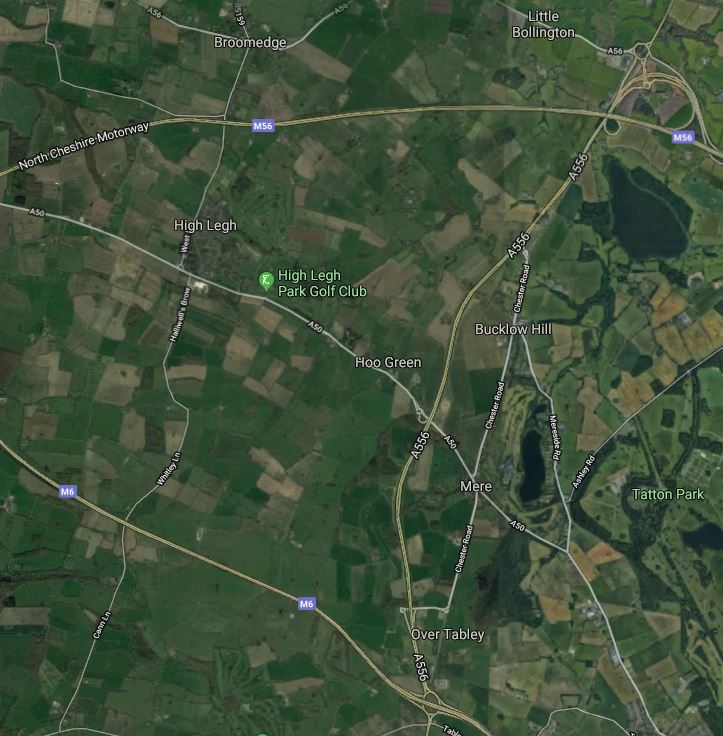
Note.
- The M56 going across the top of the map.
- The spaghetti in the North-East corner of the map is Junction 8 on the M56, where it joins the A556.
- The new A556 by-pass route to the West of the original route.
- The M6 running diagonally across the map.
- High Legh village is just to the North-West of the middle of the map.
This clip of a map from the Transport for the North report shows a schematic of the current and possible rail links in the area.

High Speed Two would appear to come North and split into two routes.
- One continues North to join the existing West Coast Main Line just South of Wigan.
- Another goes through Crewe station.
North of Crewe, the two routes join and then split into three at the Junction labelled 6.
- To Warrington and Liverpool
- To Wigan, Preston and Scotland
- To Manchester Airport and Manchester.
A second Junction labelled 5, allows Northern Powerhouse Rail trains to run Liverpool-Warrington-Manchester Airport-Manchester.
This is a new layout and has the following advantages.
- I estimate that trains could save 7-8 minutes on services running between Crewe and Wigan because of the longer running at High Speed Two operating speeds at 225 mph.
- ,If they don’t stop at Crewe and Runcorn, further minutes could be saved.
- Trains between London and Preston and London and Glasgow could skip the stop at Warrington to save further minutes.
- There could be an advantageous reorganisation of stopping patterns.
- London and Liverpool services and Liverpool and Manchester services could stop at Warrington, which would give Warrington very good connections.
- The Liverpool-Manchester and Liverpool-Crewe Lines could be built to High Speed Two standards, which could allow 225 mph running.
I also think the track layout can be run alongside or underneath the various motorways in the area for a lot of the route between Liverpool, Crewe, Warrington and Manchester Airport.
It would appear to be a very good solution to a complex problem and overall, I suspect it gives better connectivity, at a more affordable cost, whilst creating a railway that can be built with less disruption and will ultimately produce less noise.
The Transport for the North report, also says the following.
- There could be a new Warrington South Parkway station.
- Six tph between Liverpool and Manchester via Warrington are planned.
- Journey times will be 26 minutes.
The Twenty-first Century will finally get a modern and fast Liverpool and Manchester Railway.
Liverpool And Manchester Timings To And From London
The High Speed Two entry on Wikipedia gives the following timings after Phase Two is completed.
- London and Liverpool – One hour and thirty-six minutes
- London and Manchester – One hour and eight minutes
The Liverpool timing is slower, as for these timings, it runs on 125 mph lines between Crewe and Liverpool with a possible stop at Runcorn.
I feel that the proposed route to a new station in Liverpool city centre will reduce the Liverpool timing.
- There will be more running at 225 mph.
- There will be no slow local traffic.
- There will only be a stop at Warrington in a new purpose-built station.
I would not be surprised to see very similar sub-seventy minute times for both services.
It would dampen any rivalry between the two cities and if London and Wigan could be achieved in a similar time, it would surely ease train scheduling for the future operator of High Speed Two.
The Liverpool Lime Street Capacity Problem
This article on the Liverpool Echo is entitled New High-Speed Rail Station For Liverpool City Centre Takes Step Forward.
This is an extract.
A plan to build a completely new high-speed rail station in the CENTRE of Liverpool is taking a major step forward today – and Everton’s chief executive will be leading it.
Transport leaders want to build a new high-speed line into Liverpool to connect with HS2 to London and the planned Northern Powerhouse rail line across the north.
That means an entirely new “architecturally stunning” station in Liverpool city centre as Lime Street is too small to cope with the extra traffic.
So why is Lime Street station still too small, as it has been increased in capacity in the last couple of years?
I will look at the direct Virgin services between Euston and Liverpool Lime Street.
- Northbound trains leave at XX:07 and take two hours and 12-14 minutes for the journey.
- Trains wait for 26-28 minutes in the platform at Liverpool Lime Street station.
- Sorthbound trains leave at XX:47 and take two hours and 12-16 minutes for the journey.
- Trains wait for 4-8 minutes in the platform at Euston station.
It looks to me, that Virgin are using the platform at Lime Street station to balance the service. It does mean that trains probably keep more reliably to the timetable, but it hogs the platform at Liverpool Lime Street
Virgin want to increase the frequency to two tph and the London and Liverpool timing of around two hours and 12-16 minutes, means that a second platform is needed at Liverpool Lime Street station.
The station has now been remodelled and at least one extra platform has been added.
The problem could also be solved if the classic Virgin services took say one hour and 52 minutes between Euston and Liverpool.
This would enable the following.
- Trains would leave Euston and Liverpool Lime Street at the same time.
- Trains would have eight minutes to turn round at each end of the journey.
- There would be a very passenger-friendly journey time of under two hours.
I think this will happen at some time in the future.
- Digital signalling and track improvements will allow a high proportion of 140 mph running.
- New trains will have faster dwell times at stations.
, Competing against High Speed Two will drive faster services on the classic route.
High Speed Two is currently saying that London and Liverpool services will take one hour and thirty-six minutes and run at a two tph frequency.
This will probably mean that a clock-face timetable will be difficult without trains waiting in platforms at each end of the journey for a long time.
It will certainly mean that High Speed Two between London and Liverpool will need two platforms at the Northern end.
Even if the proposed one hour and thirty-six minutes was reduced to my estimate of seventy minutes to the new station, there would still be a need for two platforms. Liverpool is just a little bit too far away from London.
In addition Northern Powerhouse rail is saying that it will be running six tph between Liverpool and Manchester.
It would be difficult to fit all the platforms needed into Lime Street station.
A New Liverpool City Centre High Speed Station
This Google Map shows Liverpool Lime Street station and the surrounding area.
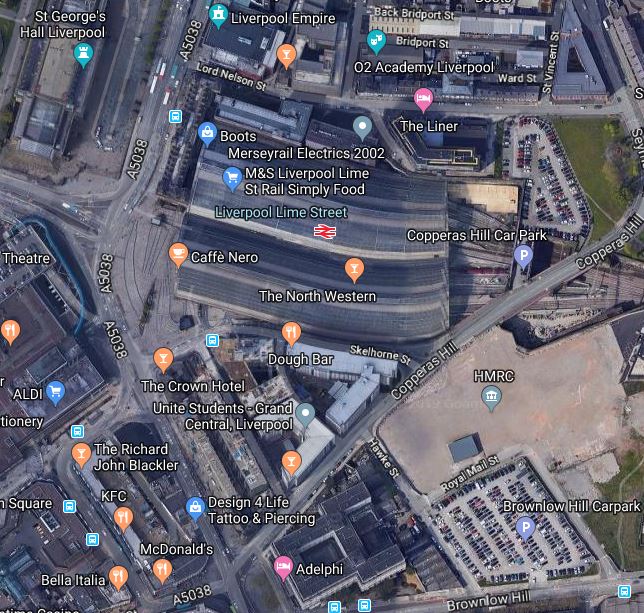
Consider.
- Lime Street station has a well-developed network of local rail lines going North, East, South and West under the Mersey, which are being updated with new trains and extra destinations.
- Liverpool Lime Street station is a Grade II Listed building.
- It is surrounded to the North and West with a cluster of historically and culturally important buildings including the Grade I Listed St. George’s Hall.
- Close to and alongside the North and South sides of the station are buildings that few would mourn if they were demolished.
- Between the station and the University of Liverpool to the East, there is a lot of land, that is mainly surface car parking and more low-grade buildings.
I think designing a High Speed station close to the current Lime Street station could be the sort of challenge many world-class architects will relish.
How Many Platforms And What Capacity Would Be Needed For A New Liverpool City Centre High Speed Station?
We already know that the following High Speed services are planned.
- Two tph between Liverpool and London.
- Six tph between Liverpool and Manchester and beyond.
- Would extra services to Glasgow and Birmingham be needed?
- There could also be long turnround times, which need extra platforms, as I indicated earlier.
It should also be noted that according to Wikipedia, Birmingham’s City Centre High Speed station; Birmingham Curzon Street station is being designed with seven platforms.
I could see an eighteen tph High Speed station with at least eight platforms.
- Two platforms would be for London services
- Three or four platforms would be for Manchester and beyond services
- Two or three platforms would be for other and future services and service recovery.
- All platforms would be able to accept maximum length High Speed Two trains.
The capacity of the station must be large enough for all future eventualities
I could envisage the following Northern Powerhouse Rail services, sometime in the future.
- Four tph -Liverpool and Hull via Manchester Airport, Manchester and Leeds
- Two tph -Liverpool and Edinburgh via Manchester Airport, Manchester, Leeds, York and Newcastle
- Two tph -Liverpool and Sunderland via Manchester Airport, Manchester, Leeds, York and Middlesbrough
- Two tph – Liverpool and Sheffield via Manchester Airport and Manchester
There could also be two tph to each of Birmingham, Glasgow and London.
The absolute limit between Liverpool and High Legh Junction would probably be eighteen tph, which is the design capacity of High Speed Two.
I am assuming that the High Speed sections of Northern Powerhouse Rail will be built as near as possible to High Speed Two standards, as regards train capacity, track, electrification, signalling and stations.
How Would Trains Access The New Liverpool City Centre High Speed Station?
To the East of Lime Street station is the campus of Liverpool University. There are a large number of buildings and to make things more difficult there is a cathedral, a brand-new hospital (Hopefully!) and several Listed buildings.
There is also no obvious route for a new High Speed Railway into a new station close to the current Lime Street.
I feel that the only solution is to bore a tunnel to bring the High Speed Railway to the city-centre. from perhaps six miles to the East of the city.
- The tunnels would be only for High Speed services.
- I suspect the preferred route would include tunnelling under some existing rail lines or motorways.
- This would mean that High Speed services would be unhindered by local traffic, when approaching or leaving Liverpool.
- Speed would be at least 140 mph.
This is only following a similar philosophy to that used to bring High Speed One into St. Pancras under East London, where the tunnels are under the North London Line.
Would The New Liverpool City Centre High Speed Station Be On The Surface Or Underground?
Recently, two semi-underground stations linked to deep tunnels have been built in the UK; Stratford International and the Paddington station for Crossrail. Crossrail and London’s Northern Line Extension have also shown how stations, that are deep underground, can have large developments on top.
I know the area around the Lime Street station well and I have a strong three-dimensional sense and feel that there is a solution that could be developed.
The final solution would be one for architects, council planners, engineers , politicians and accountants.
Between Manchester Airport And Manchester Piccadilly
Most current trains between Manchester Piccadilly and Manchester Airport stations take between 15-18 minutes.
I don’t believe that these times are compatible with a 26 minute time between Liverpool and Manchester Piccadilly.
So I am fairly certain that to achieve the planned time in the Transport for the North report, that an almost direct tunnel between Manchester Airport and Manchester Piccadilly stations is necessary.
Could the tunnel pass through underground platforms at Manchester Piccadilly station, which run across the station and then surface to connect with the chosen route to Leeds?
In an earlier plan, referenced under Manchester City Centre (Phase 2b) in the Wikipedia entry for High Speed Two,, this is said.
The route will continue from the airport into Manchester city centre via a 7.5-mile (12.1 km) twin bore branch tunnel under the dense urban districts of south Manchester before surfacing at Ardwick.
Under the earlier plan, trains would have gone into a rebuilt Manchester Piccadilly station.
This Google Map shows the tracks between Manchester Piccadilly station and Ardwick, where Siemens have a train care facility.
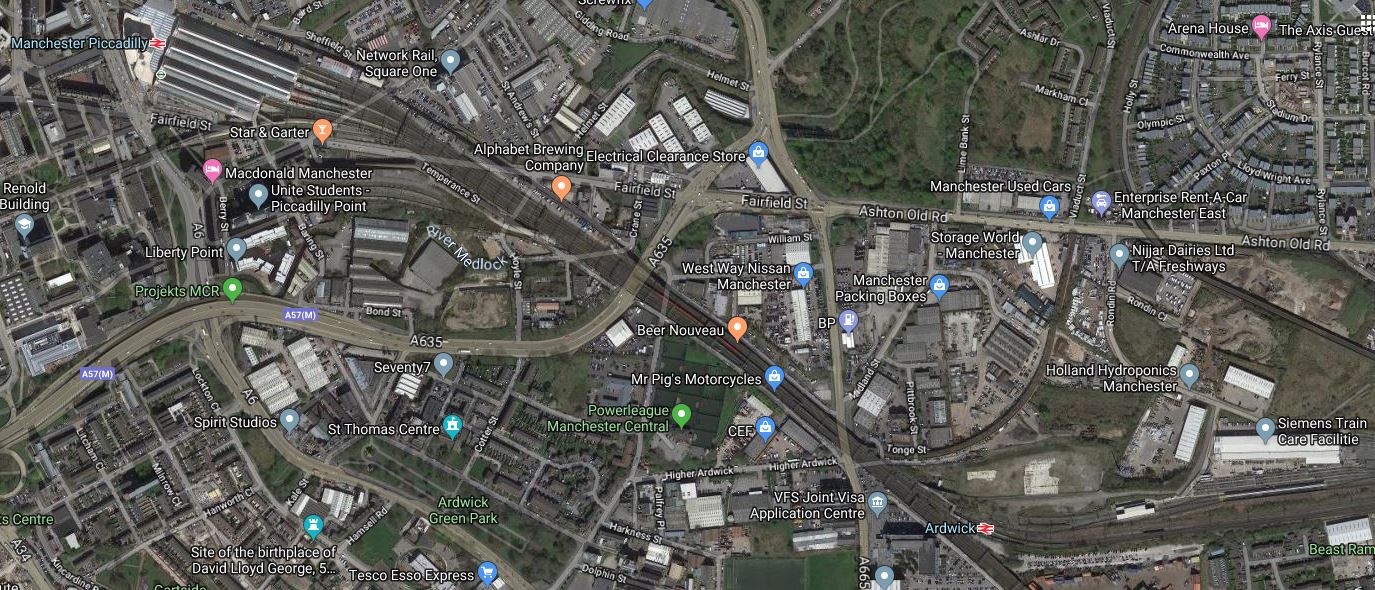
Note.
- If the tunnels emerged at Ardwick after passing under Manchester Piccadilly station, they would be pointing in more of less the right direction to emerge at Ardwick and continue on the way to Leeds, via the Huddersfield Line
- Under the earlier plan, I suspect the tunnels would go in a wide loop around South Manchester.
This tunnelled approach to new underground platforms at Manchester Piccadilly has the following advantages.
- High Speed services between Manchester Piccadilly and Manchester Airport stations would have their own dedicated High Speed line.
- Much of the tunnelling to the East of Manchester Piccadilly station could be under existing railway infrastructure.
- Through and terminal platforms as needed would be provided under the current Manchester Piccadilly station.
- Escalators and lifts would connect the underground platforms to local services and the Manchester Metrolink.
- By choosing the right orientation for the tunnel and position for the underground platforms, it may be possible to have a second entrance to the underground station from Piccadilly Gardens.
- The current Manchester Piccadilly station would only need refurbishing, rather than a total rebuild.
Manchester would have the fastest conventional airport link in the world. Who needs Hyperloop or Maglev?
Would Any High Speed Services To And From London Terminate At Manchester?
If London and Manchester trains have a sub-seventy minute journey time, trains would need to wait for some minutes in a terminal platform. It is the Liverpool problem all over again.
- These would need to be long enough for a full-length train.
- They would be expensive to build, as they would be underground.
So I suspect that providing services to cities beyond Manchester would actually reduce the complication and cost of the underground station.
Services at the underground station at Manchester Piccadilly would be as follows.
- Northern Powerhouse Rail – Six tph between Liverpool and Manchester Piccadilly
- High Speed Two – Three tph between Manchester Piccadilly and London
- Northern Powerhouse Rail – Six tph between Manchester Piccadilly and Leeds.
Surely, this means that three tph must terminate in the underground platforms!
If trains emerge at Ardwick, they could also continue on the Hope Valley Line to Sheffield.
If two tph could go to Sheffield, this means that the service pattern through the underground platforms could be.
- High Speed Two – Two tph between London and Hull via Manchester Airport, Manchester Piccadilly nd Leeds
- High Speed Two – One tph between London and Edinburgh via Manchester Airport, Manchester Piccadilly, Leeds, York and Newcastle.
- Northern Powerhouse Rail – One tph between Liverpool and Edinburgh via Manchester Airport, Manchester Piccadilly, Leeds, York and Newcastle.
- Northern Powerhouse Rail – Two tph between Liverpool and Sheffield via Manchester Airport and Manchester Piccadilly
- Northern Powerhouse Rail – Two tph between Liverpool and Hull via Manchester Airport, Manchester Piccadillyand Leeds
- Northern Powerhouse Rail – One tph between Liverpool and Sunderland via Manchester Airport, Manchester Piccadilly, Leeds, York and Middlesbrough.
I have shown that it is possible to design a schedule, where no High Speed services need to terminate in Manchester Piccadilly station.
So all the underground station would need is two through platforms.
A turnback could be provided at Ardwick for service recovery.
Overall services from the underground stations would be as follows.
- Two tph – Edinburgh
- Four tph – Hull
- Nine tph – Leeds
- Six tph – Liverpool
- Three tph – London
- Nine tph – Manchester Airport
- One tph – Middlesbrough
- Two tph – Newcastle
- Two tph – Sheffield
- One tph – Sunderland
- Five tph – York
This was only after a few minutes juggling. I’m sure a professional could be better.
The only reason to add bay platforms to the underground station would be, if high speed regional services like those at St. Pancras were to be run terminate in Manchester.
The through station concept also means that if demand was such, that Manchester needed four or more tph to or from London, Manchester is future-proofed.
Could Island Platforms Be Built At Manchester Piccadilly And Manchester Airport High Speed Stations?
Some of London’s Jubilee Line stations, with the highest capacity like Canada Water, Canary Wharf, London Bridge, Waterloo and Westminster, have their Jubilee Line platforms designed to the following rules.
- Tracks perhaps twenty or thirty metres apart.
- A wide concourse between the two platforms, so travellers and staff can freely circulate.
- Escalators and lifts in the concourse..
- Platform-edge doors for safety.
It is a very good starting point, but it could be taken further.
- Step-free access between platform and train, through wide doors..
- Large numbers of information displays.
- Tickets would indicate the door number to use.
- Toilets and kiosks
- Lots of visible staff, rather than the North’s usually few invisible versions.
Everything would be geared to a quick and easy boarding and leaving the trains.
Liverpool And Manchester Timings To And From London
The High Speed Two entry on Wikipedia gives the following timings after Phase Two is completed.
- London and Liverpool – One hour and thirty-six minutes
- London and Manchester – One hour and eight minutes
The Liverpool timing is slower, as for these timings, it runs on 125 mph lines between Crewe and Liverpool with a possible stop at Runcorn.
I feel that the proposed route to a new station in Liverpool city centre will reduce the Liverpool timing.
- There will be more running at 225 mph.
- There will be no slow local traffic.
- There will only be a stop at Warrington in a new purpose-built station.
I would not be surprised to see very similar sub-seventy minute times for both services.
It would dampen any rivalry between the two cities and if London and Wigan could be achieved in a similar time, it would surely ease train scheduling for the future operator of High Speed Two.
Liverpool And Manchester Journeys
I also suspect that nearly all Liverpool and Manchester passengers would use the High Speed services running between the city centres and Manchester Airport every ten minutes, which would take twenty-six minutes.
One estimate on the Internet says it takes fifty minutes to drive!
As both cities have extensive and interconnecting local rail, tram and bus networks, would this mean simplification of the other services between the two cities?
The Castlefield Corridor
Hopefully something will be done to sort out this route between Manchester Piccadilly and Manchester Victoria stations.
- I am very surprised that freight trains for Trafford Park Freight Terminal still use the Castlefield Corridor.
- Will there still be a need to provide as many services to Manchester Airport, as surely passengers will use the High Speed route, which will be running every ten minutes and will probably be a escalator or lift away?
- Would there be any need for long distance services to run through the route?
- Manchester Airport to Edinburgh, Hull, Leeds, Newcastle and York would go via Northern Powerhouse Rail under Manchester Piccadilly and the City Centre.
- Manchester Airport to Liverpool and Warrington would leave the Airport to the West and go direct.
- Manchester Airport to Blackpool, Glasgow, and Preston would leave the airport to the West and would take the West Coast Main Line at High Legh.
- Manchester Airport to Birmingham, and London would leave the airport to the West and would take High Speed Two at High Legh.
I think the Castlefield Corridor end up as a series of train or tram-train routes across Manchester.
Consider.
- Merseyrail’s Northern Line is a series of routes across Liverpool.
- The Cross-City Line is a series of routes across Birmingham.
- The Tyne and Wear Metro is a series of routes across Newcastle.
- Thameslink is a series of routes across London.
- The East London Line is a series of routes across East London.
Note that the last two routes, have been planned to handle in excess of 20 tph.
Why should the Castlefield Corridor routes be any different?
It’s just another cross-city line!
If there was a direct escalator and lift connection from Platforms 13 and 14 at Manchester Piccadilly station, the routes through the Castlefield Corridor would be a superb system connecting passengers to High Speed Two and Northern Powerhouse Rail.
The Future Of The West Coast Main Line
Consider.
- It appears Crewe and Warrington will be by-passed by new High Speed tracks.
- A new Warrington station with calls from High Speed Two services, will have good rail links to Chester, East Liverpool, North Wales and West Manchester.
- Wigan station is well-connected with commuter lines to Kirkby, Liverpool, Manchester and Southport, which would bring passengers to High Speed Two services stopping in the station.
- Preston station will connect passengers from Blackpool and North West Lancashire to High Speed Two services.
I wouldn’t be surprised to see the West Coast Main Line between Crewe and Preston converted into quadruple track all the way.
- Two High Speed tracks with at least 140 mph running and only one stop at Wigan.
- Two slow tracks for freight and local services, with stops as necessary.
Separation of High Speed services on 140 mph tracks with perhaps a capacity of at least fifteen tph, raises the possibility of using 140 mph electric multiple units running High Speed regional services.
- Northern terminals could be Blackburn, Blackpool and Burnley.
- Southern terminals could be Crewe, Liverpool, Manchester and Stoke.
- Liverpool services would terminate in the new High Speed platforms.
- Manchester services would call at Manchester Airport.
- Manchester services would terminate in bay platforms in the underground High Speed station underneath Manchester Piccadilly, with quick and easy access to the High Speed services.
- All High Speed local services would call at Preston and Wigan.
Trains would have the following characteristics.
- Capable of 140 mph running.
- High capacity, quality interiors.
- Step-free access between train and platform.
- Able to use platform-edge door used by the High Speed trains.
Think of a modernised Class 195 train, used for high speed commuter services between St. Pancras and Kent.
If a battery-electric capability could be added, the towns and cities served could increase dramatically.
- Northern terminals could be Barrow, Hebden Bridge and Windermere.
- Southern terminals could be Chester.
- Carlisle could be served using the Cumbria Coast Line via Barrow, Sellafield, Workington and Whitehaven.
I can see a large High Speed regional network developing around a 140 mph West Coast Main Line between Crewe and Preston.
North of Preston, the West Coast Main Line will become a double-track line with the passenger trains travelling at 140 mph.
A Manchester And Leeds High Speed Line
In Lord Adonis On Crossrail Of The North, I compared the current route between Leeds and Manchester with the Ipswich and Norwich route, that I know well.
- Both routes are roughly the same length.
- Ipswich and Norwich has a 100 mph line speed, with usually just two stops.
- Manchester and Leeds has a much slower line speed, with umpteen stops.
- The fastest trains between Manchester Victoria and Leeds take forty-nine minutes, with a stop at Huddersfield, and are just 1 train per hour (tph).
- Norwich and Ipswich in a couple of years, will take 30 minutes at a frequency of 3 tph.
This clip of a map from the Transport for the North report shows a schematic of the rail links to the East of Manchester.
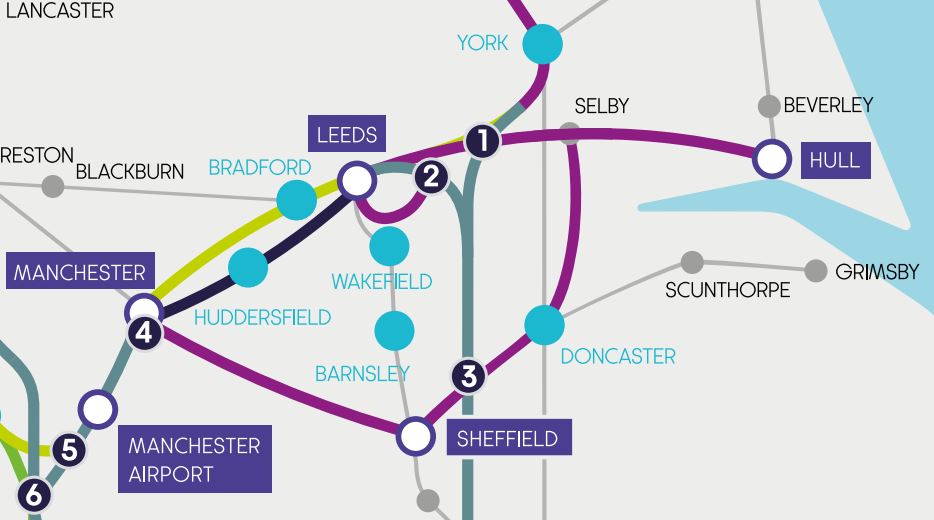
Two alternative routes are proposed.
- The black route would be created by upgrading the Huddersfield Line.
- The yellow route would be a new route via Bradford.
The Transport for the North report says this about the Leeds-Manchester service.
- There will be six tph.
- The journey will take 25 minutes.
The next two sections give my thoughts on these options.
Upgrading The Huddersfield Line
It will be a tough ask to upgrade this line so that a twenty-five minute time can be achieved.
I suspect though, it wouldn’t have been suggested unless it were possible.
Manchester And Leeds Via Bradford Low Moor
The Transport for the North report indicates that this could be via Bradford Low Moor station.
To get a twenty-five minute time between Leeds and Manchester with a ten minute frequency, which I believe is the minimum service the two cities deserve, would be like passing a whole herd of camels through the eye of a single needle.
The Swiss, who lets face it have higher hills, than we have in Northern England would create a new route mainly in tunnel between the two cities, with perhaps an underground station beneath the current Grade I Listed; Huddersfield station.
The transport for the North report suggests Bradford Low Moor station, as an intermediate station, so why not Bradford Low Moor and Huddersfield stations?
Note that the Gotthard Base Tunnel, which opened a couple of years ago, deep under the Alps, is about the same length as a Leeds and Manchester tunnel, and cost around eight billion pounds.
It would be expensive, but like Crossrail in London, the tunnel would have big advantages.
- It could be built without disrupting current rail and road networks.
- It would have a capacity of up to thirty tph in both directions.
- Unlike Crossrail, it could handle freight trains.
- It would unlock and join the railway systems to the East and West.
I believe, it would be a massive leap forward for transport in the North of England.
Upgrade Or Tunnel Between Manchester And Leeds?
Obviously, the tunnel would take several years to bore.
So to get Northern Powerhouse Rail up and running, the Huddersfield Line would be upgraded first.
At a future time, the tunnel would be constructed.
Hopefully, it could be built, when the finance became available, without disrupting existing train services.
After the tunnel was built, there could be a division of services.
- High Speed Two and Northern Powerhouse Rail services would use the tunnel.
- Stopping services would use the Classic route on the Huddersfield Line.
All passengers would get the service they need.
Freight would have an extra route, if it could use the High Speed tunnel.
High Speed Lines East Of Leeds
I’ll repeat the map I included earlier, which shows the route of High Speed Two and the two Northern Powerhouse Rail routes to the East of Leeds.
The three Junctions labelled on the map are.
- Junction on High Speed Two mainline for Leeds – North East services.
- Junction on High Speed Two Leeds spur to facilitate through services via existing Leeds station.
- Junction on High Speed Two mainline for Sheffield – Leeds services.
The two main Northern Powerhouse Rail routes East of Leeds are.
- A connection to the East Coast Main Line for York, Newcastle and Edinburgh.
- An extension Eastwards to Hull.
Having ridden around these lines in the last few weeks, I believe that these routes could be upgraded to a High Speed standard.
- The East Coast Main Line is mainly four-track and could be capable of 140 mph running, with in-cab digital signalling.
- An electrified link between Leeds and the East Coast Main Line has been promised for years.
- Replace the Selby swing bridge and the line between Leeds and Hull could probably be upgraded to an electrified 125 mph line with 140 mph available with in-cab signalling.
The Northern Powerhouse Rail report gives these proposed details of services East of Leeds.
- Leeds and Newcastle -four tph in 58 minutes.
- Leeds and Hull – two tph in 38 minutes
If all the lines East of Leeds were electrified, local services could be run by 140 mph electrical multiple units, likethose I proposed for Liverpool and Manchester High Speed regional services. These would not delay the High Speed services.
Liverpool and Hull Timings
The Northern Powerhouse Rail report doesn’t give a timing for this route across Northern England, but it does give the intermediate timings
- Liverpool and Manchester – 26 minutes
- Manchester and Leeds – 25 minutes
- Leeds and Hull – 38 minutes
This gives a time of 90 minutes between Liverpool and Hull, which compares with the current fastest time of 2:32 hours.
In addition, the frequency of the service would certainly be at least two tph and possibly as high as four tph.
Hull Station As A High Speed Terminal
Hull station has been earmarked for some time as an Eastern terminal for Northern Powerhouse Rail.
This Google Map shows the station.
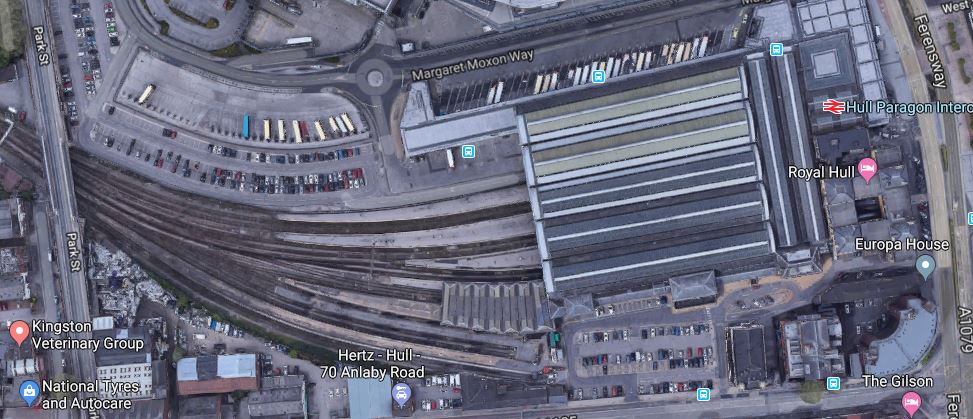
The station is large, with six platforms, and would have no problem accommodating long High Speed Two trains.
Could using Hull station as a terminal for a London-Birmingham-Manchester Airport-Manchester-Leeds-Hull service be a sensible response to saving costs and reducing disruption in the building of High Speed Two to Leeds?
- Northern Powerhouse Rail will need a High Speed link across or under the Pennines, but Leeds station is congested.
- The new Junction 2 on the Northern Powerhouse Rail map, has been designed to allow services through Leeds station.
- Leeds station probably would not be able to turn round a High Speed servicefrom London, without the previously planned substantial rebuilding.
- Could the passengers at Leeds cope with all the disruption?
- One extra High Speed service in both directions between Manchester and Hull every hour, could probably be accommodated using modern digital signalling.
- The train might even split and join at Leeds to serve both Newcastle and Hull.
Using Hull as a terminal probably has other advantages.
- There is probably space to add a stabling facility close to the station.
- Upgrading the route between Hull and Selby, would speed-up London to Kings Cross services via the East Coast Main Line.
- Electrification between Hull and Leeds would allow substantial improvement in local services around Hull.
If you look at the whole High Speed Two route between London and Hull via Manchester and Leeds, the route would be as follows.
- High Speed Two between London and Crewe.
- New High Speed railway between Crewe and Manchester via High Legh and Manchester Airport
- New High Speed route across or under the Pennines to Leeds.
- Upgraded line between Leeds and Hull.
I believe that it would be possible to run between London and Manchester at 225 mph and up to 140 mph on all the rest of the route.
Manchester Airport Connectivity
If High Speed Two and Northern Powerhouse Rail are developed as laid out in the Transport for the North report, the following cities will be connected to Manchester Airport.
- Birmingham – High Speed Two
- Blackpool – Northern Powerhouse Rail/West Coast Main Line
- Bradford – High Speed Two/Northern Powerhouse Rail
- Carlisle – Northern Powerhouse Rail/West Coast Main Line
- Edinburgh – Northern Powerhouse Rail/East Coast Main Line
- Glasgow – Northern Powerhouse Rail/West Coast Main Line
- Hull – High Speed Two/Northern Powerhouse Rail
- Leeds – High Speed Two/Northern Powerhouse Rail
- London – High Speed Two
- Newcastle -High Speed Two/Northern Powerhouse Rail
- Preston – Northern Powerhouse Rail/West Coast Main Line
- Sheffield – Northern Powerhouse Rail
- Sunderland – Northern Powerhouse Rail
- York – High Speed Two/Northern Powerhouse Rail
Manchester Airport will probably become the most important station in the North with High Speed connections to a large part of England and Scotland.
The Big Advantage Of Route Sharing
Suppose you have arrived in Manchester Airport and need to get home in Hull.
Because both High Speed Two and Northern Powerhouse Rail will run between the Airport and Hull, the frequency will be increased.
There could be the following services.
- High Speed Two – 2 tph between London and Hull
- Northern Powerhouse Rail – 2 tph between Liverpool and Hull
Giving a train every fifteen minutes.
High Speed East Coast Between London and Yorkshire, the North East Of England and Edinburgh
The East Coast Main Line is not mentioned in either of the articles, I have quoted in this post.
This line will see big changes in the next few years.
- All services from East Coast Trains, Hull Trains and LNER and some services from TransPennine Express will be run by 140 mph-capable Class 800/801/802 trains.
- ERTMS will be installed between London and Doncaster.
- Extra tracks will be added in places.
- Werrington Junction will be improved.
Large sections of the line will be capable of 140 mph running.
Currently, the fastest non-stop trains between London and Doncaster take a few minutes over ninety minutes. With 140 mph trains, I think the following times are easily possible.
- London and Doncaster – 80 minutes
- London and Hull – A few minutes over two hours, running via Selby.
- London and Leeds – A few minutes less than two hours, running on the Classic route.
For comparison High Speed Two is quoting 88 minutes for London Euston and Leeds, via Birmingham and East Midlands Hub.
I think we may have the making of a railway race between London and Leeds
- London Kings Cross via Peterborough, Wakefield and Doncaster
- London Euston via Birmingham and East Midlands Hub
- London Euston via Birmingham, Manchester Airport, Manchester and Bradford.
In addition, if the Leeds and Hull Line via Selby were to be upgraded to a High Speed route capable of running at up to 140 mph, I believe that by 2024 or 2025 could see London and Hull covered in under two hours.
The East Coast Main Line will be a High Speed Line in all but name.
The improvements and the 140 mph operating speed will create more capacity and I believe services from Kings Cross could be something like.
- London and Bradford – Two tph
- London and Edinburgh – Three or four tph – One or two tph via Leeds
- London and Hull – Two tph
- London and Leeds – Three or four tph
- London and Lincoln – Two tph
- London and Middlesbrough – Two tph
- London and Newcastle – Four tph
- London and Scarborough – One tph
- London and Sunderland – Two tph
- Leeds and Edinburgh – Two or three tph
Selective joining and splitting could be used to make better use of paths South of Doncaster.
I haven’t proven it, but my gut feeling for the numbers, is that LNER with their fleet of Azumas, will be capable of running a Turn-Up-And-Go service of four tph between London Kings Cross and Leeds, Newcastle and Edinburgh.
I suspect, that hey’ll have to buy a few more trains.
With the open access operators providing extra services, I suspect that there will be at least two tph between London Kings Cross and Bradford, Harrogate, Hull, Middlesbrough, Scarborough and Sunderland.
It would be the ultimate High Speed service based on a route that was designed by Victorians.
To make the most of the East Coast Main Line improvements, the following Northern Powerhouse Rail improvements should be done.
- Leeds to Hull
- Leeds to the Northbound East Coast Main Line
I’ve already discussed the first, but the second would do the following.
- Speed up services between Leeds and Newcastle and Scotland.
- Allow LNER to run electric trains between London and Scotland via Leeds.
- Create an electrified route between Neville Hill Depot and York.
- Create an electrified diversion through Leeds for the East Coast Main Line
High Speed East Coast is on the way.
High Speed Services To Sheffield
This clip of a map from the Transport for the North report shows a schematic of the rail links in East Yorkshire.
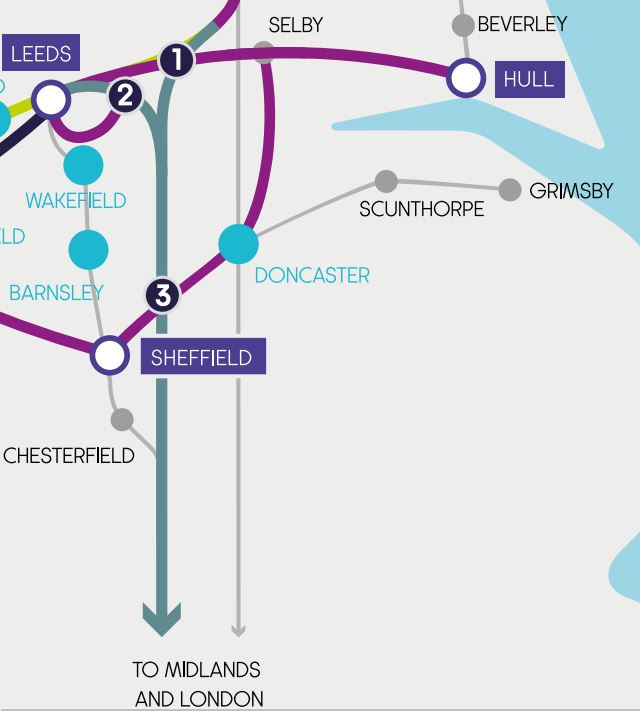
I can remember, when the Master Cutler used to run to Sheffield via the East Coast Main Line in the 1960s.
Even if a train took thirty minutes to go between Sheffield and Doncaster, it will still be a journey time of under two hours between London Kings Cross and Sheffield.
But note that on the map the route between Sheffield and Doncaster is shown as to be improved for Northern Powerhouse Rail.
If the route were to be electrified, it could give Sheffield and Rotherham a High Speed route to London Kings Cross.
The Classic route to Sheffield via the Midland Main Line is being upgraded.
- It will be electrified as far North as Market Harborough.
- Much of the route will have a 125 mph operating speed and perhaps 140 mph with in-cab signalling.
- It will share the 15.5 mile Northern section of the spur between High Speed Two and Sheffield, meaning it will be electrified between Clay Cross North Junction and Sheffield.
So when the new 125 mph bi-mode trains start running between St. Pancras and Sheffield, I would suspect that timings on this route could be below the two-hour mark.
Sheffield will get a much improved train service to and from the South.
Sheffield And Hull
The map in the Northern Powerhouse Rail report, shows a route between Sheffield and Hull via Doncaster as improved Northern Powerhouse Rail.
- It includes Sheffield and Doncaster, which could be improved to a High Speed electrified line.
- Part of the route between Doncaster and Selby is the East Coast Main Line, which should be able to sustain 140 mph running in a few years.
- Selby and Hull, is another route to be improved by Northern Powerhouse Rail.
Northern Powerhouse Rail are planning two tph in fifty minutes between Sheffield and Hull.
They could be 125 mph electric multiple units, which are a bit better than the current Pacers.
Some local services use a second route via Doncaster, Thorne, Goole, Gilberdyke and Brough.
Between Doncaster and Gilberdyke is not planned for improvement in the Northern Powerhouse Rail report, but at only twenty-five miles, it could easily be run by using 125 mph battery-electric trains, which would charge their batteries whilst running at both ends of the route.
- I wonder if it would be best to electrify the Thorne/Goole first, to give diversion for trains between Doncaster and Hull, whilst the Selby Swing Bridge is electrified.
- I have just read on this page of the Historic England web site, that the Selby Swing Bridge was Listed as Grade II ion the 23rd April 2015. So is this the reason why the electrification between Leeds and Hull has stalled?
- An electrified Thorne/Google route, might be used for local trains, whilst expresses used the Selby route.
- Selby has a couple of useful West-facing bay platforms.
There certainly seems to be some innovative Project Management at work
After all, train operators wouldn’t probably want to cut off one of their markets, whilst upgrading and electrification are underway.
Sheffield and Grimsby Via Doncaster and Scunthorpe
This route is shown on the Northern Powerhouse Rail map.
- There is an hourly TransPennine Express service between Cleethorpes station and Manchester Airport via Scunthorpe, Doncaster and Sheffield.
- There are a few sundry local services.
- The route serves the important Port of Immingham.
- A large renewable energy industry is developing in North Lincolnshire.
- British Steel has just folded at Scunthorpe.
The route doesn’t really fit the Northern Powerhouse ideal and it has a totally inadequate passenger service.
Could this route be improved to provide better rail services to the area, that sometimes, the rest of the UK forgets?
- Electrification might be needed to handle the heavy freight from Scunthorpe and Immingham.
- Would an LNER service between London Kings Cross and Cleethorpes be welcomed?
- Cleethorpes and Manchester Airport needs to at least be doubled in frequency.
With all the energy projects going on in North Lincolnshire, this area could become the Lincolnshire Powerhouse.
Sheffield And Leeds
Long-terms plans for traffic between these two cities will probably be by Junctions 2 and 3 on the map in the Northern Powerhouse Rail report.
The Northern Powerhouse Rail report, suggests that the trains will use High Speed Two and some infrastructure improvements and will run at a frequency of four tph and take 28 minutes.
This is a good service and compares well with what is planned between Ipswich and Norwich.
In the meantime, the main route is the Hallam Line, where trains take eighty minutes for the forty-five miles
Let’s hope Northern’s more powerful new Class 195 trains, bring the journey time under the hour.
Barnsley and Rotherham mustn’t be left out of the benefits of Northern Powerhouse Rail.
- In Sheffield Region Transport Plan 2019 – A New Station At Barnsley Dearne Valley, I discuss Sheffield’s plans for Barnsley Dearne Valley station on the Dearne Valley Line.
- There are also plans for a new station on the Dearne Valley Line at Rotherham.
- These two stations will be served by an extended East Midlands Railway London and Sheffield service to Leeds.
- One tph between London and Leeds via Rotherham, Barnsley and Wakefield would surely be welcomed.
Is this the beginning of Yorkshire Powerhouse Rail?
Sheffield And Manchester
The Northern Powerhouse Rail map has this route marked as Northern Powerhouse Rail.
As a lot of freight traffic is generated along the Hope Valley Line, which is the only route between the two cities, will this route be upgraded for a faster speed and greater capacity.
Will the Hope Valley Line be electrified?
- At the Western end, it is electrified as far as far as Hazel Grove station.
- At the Eastern end, High Speed Two will mean there will be electrification at Dore Junction.
- The distance between Dore Junction and Hazel Grove station is about thirty miles.
- My helicopter didn’t show that many bridges or level crossings.
- There are three long tunnels on the route, which are a total of eight miles long. Depending on their condition, these could be easy or difficult to electrify.
- Much of the electrification at the Western end looks in need of replacement.
This is one for the project engineers and accountants, but I wouldn’t be surprised to see this route electrified.
High Speed Two Routes
From the map it appears that in addition to the current proposed routes for High Speed Two trains.
- London-Birmingham-Liverpool (96 mins from 128)
- London-Birmingham-Manchester (68 mins from 128)
- London-Birmingham-Wigan and then on the West Coast Main Line to Glasgow. (218 mins from 248)
- London-Birmingham-East Midlands Hub-Sheffield-Leeds (82 mins from 132) and then on the East Coast Main Line to Newcastle 138 mins from 172)
Two new routes would be added via the new High Legh junctions.
- London-Birmingham–Manchester Airport-Manchester-Leeds-Hull
- London-Birmingham-Manchester Airport-Manchester-Leeds-Newcastle
In addition Liverpool would be served via the High Legh junctions.
This page on The Guardian is a useful guide to current and HS2 tomings, which I have used here.
My best estimates for the new layout are as follows.
London-Birmingham-Liverpool via High Legh – 66 mins
London-Birmingham-Manchester Airport-Manchester via High Legh – 66 mins
London-Birmingham-Manchester Airport-Manchester-Leeds via High Legh – 92 mins
London-Birmingham-Manchester Airport-Manchester-Leeds-Hull via High Legh – 130 mins
Note.
- To avoid problems, Liverpool and Manchester will probably end up with the same scheduled times.
- I suspect that the High Legh route may save more time, than I have estimated.
- Any savings South of High Legh will benefit all routes.
As under the new proposals London and High Legh will be continuous High Speed line, with High Speed spurs to Liverpool, Manchester Airport and Manchester, it would appear that the proposals offer faster journey times to the area.
Building High Speed Two And Northern Powerhouse Rail
There is an old Project Management phrase about
Getting All Your Ducks In A Row!
I think, that someone has been thinking hard as it appears the building of the second phase of High Speed Two and Northern Powerhouse Rail together can offer a lot of benefits.
These are my thoughts on the project order.
Devise An Intelligent Electrification Philosophy
Transport for Wales and their contractors are devising an intelligent discontinuous electrification philosophy for the South Wales Metro.
The Hallam, Hope Valley and Huddersfield Lines will be tricky to improve and electrify.
- They run through picturesque countryside.
- There are a large number of overbridges and some level crossings..
- There could be objections.
- There are some long tunnels.
- Access could be difficult.
- Speed limits will need to be increased.
Every trick will need to be employed.
- Instead of rebuilding overbridges, electrification could be discontinuous as in South Wales.
- Trains would have enough energy storage to bridge gaps in electrification.
- Tunnels will be electrified using rails on the roof or as third-rail.
- Intelligent fast-charging for trains with batteries will be deployed.
Less obtrusive electrification could also be used, as I described in Prototype Overhead Line Structure Revealed.
It does seem to be a good attempt to reduce the clutter of girders, gantries and wires!
Leeds And Sheffield Improvements
Leeds and Manchester is a difficult rail journey, but so is Leeds and Sheffield.
This route can be improved, by doing what I indicated earlier.
- Complete the electrification.
- Improve the track and signalling where necessary.
- Build new stations at Barnsley Dearne Valley and Rotherham.
- From 2022, East Midlands Railway should run at least one tph between St. Pancras and Leeds via Sheffield, Meadowhall, Rotherham, Barnsley Dearne Valley and Wakefield Westgate.
- Add extra trains between Sheffield and Leeds to give Northern Powerhouse Rail’s promised four tph in twenty-eight minutes
This would introduce competition and options for travel to and from Leeds.
Conclusion – This upgrade would bring large benefits to the area and should have the highest priority.
Lines East Of Leeds
These are the lines East of Leeds.
- A connection to the East Coast Main Line for York, Newcastle and Edinburgh.
- An extension Eastwards to Hull.
These would not be the most expensive sub-project, but they would give the following benefits, when they are upgraded.
- Electric trains between Hull and Leeds.
- Electric trains between Hull and London.
- Electric access to Neville Hill Depot from York and the North.
- An electric diversion route for the East Coast Main Line between York and Doncaster.
- The ability to run electric trains between London and Newcastle/Edinburgh via Leeds.
Hull and Humberside will be big beneficiaries.
The trains that the train operators have ordered can run all the services.
Once ERTMS is installed on the East Coast Main Line, train travel between London and Hull could be under two hours.
Conclusion – These lines should be improved sooner rather than later.
Midland Main Line Between Clay Cross Junction And Sheffield
This section of track will be shared between High Speed Two and the Midland Main Line.
- It is 15.5 miles long.
- It will be electrified.
- The only intermediate station is Chesterfield, which will need to be substantially rebuilt.
- It will have a high line speed, perhaps even in excess of 140 mph.
- Currently, the line carries about ten tph in both directions.
Completing this sub-project early would give benefits.
- The bi-mode trains due to be introduced on the Midland Main Line in 2022, would benefit from the improved electrified line.
- Timings on services between London and Sheffield would be reduced to under two hours.
An electrical supply for the electrification would have to be provided in Sheffield, which would be useful, if other electrification projects were to be started in the area.
Conclusion – This line should be improved and electrified, sooner rather than later.
Electrification Of The Hope Valley Line
Work is already planned to upgrade capacity on the Hope Valley Line.
Having looked at several electrification projects in the last few years, it is my belief that delays can occur because of bad surveys and preparation work done too late and in great haste.
So why not do as much of this work, whilst the capacity is upgraded?
Electrification of what would be a well-surveyed and prepared railway, with an immaculate track, must be a lot easier to plan, install and deliver on time.
Conclusion – This line should be improved and electrified, sooner rather than later, especially as it could be a test project for other lines through the hills.
Improvement And Possible Electrification Of The Huddersfield Line
Improvement of this line could probably give a large benefit to services between Leeds and Manchester via Huddersfield.
- Current services on the line would be speeded up.
- More services could be possible.
On the down side, it is a busy route and improvement will be very difficult.
Conclusion – This important route should be improved as soon as possible.
Building The Liverpool And Manchester High Speed Line
This will be a large and complex project.
It will involve building the following.
- Around thirty miles of new railway.
- New platforms and/or stations in Liverpool, Warrington, Manchester Airport and Manchester.
- A Tunnel between Manchester Airport and Manchester.
- Diversion of the West Coast Main Line through or around Crewe and Warrington.
- Building of the two junctions at High Legh.
- Connection to High Speed Two towards Birmingham and London.
It is my opinion, that the diversion of the West Coast Main Line should be opened at the same time as High Speed Two reaches Crewe, in 2027.
Conclusion -The diversion of the West Coast Main Line should be given priority, but the Liverpool and Manchester High Speed line can be done later.
Good Project Management Is Needed
I am sure, that Northern Powerhouse Rail and High Speed Two can work together to produce a schedule that delivers benefits in a steady stream.
They must be bold and not allow the politicians to derail the project or move it in an unsustainable direction, based on pressure from their constituents.
Conclusion
Linking the building of Phase Two of High Speed Two and Northern Powerhouse Rail would appear to be a sensible solution to expanding the economy of Northern England.
The Future Of Class 378 Trains
This post is a musing on the future of the Class 378 trains.
The Thames Tunnel
The Thames Tunnel is the tail that wags the East London Line, when it comes to trains.
- For evacuation and safety purposed, trains running through the tunnel, must have an emergency exit through the driver’s cab.
- It hasn’t happened yet, as far as I know, but a version of Sod’s Law states if you ran trains without this emergency exit, you’d need to use it.
- London Overground’s Class 378 trains have this feature, but their Class 710 trains do not.
So it would appear that until Bombardier build an Aventra with an emergency exit through the driver’s cab, that the existing Class 378 trains must work all services through the Thames Tunnel.
Incidentally, I can’t think of another long tunnel, that might be served by the London Overground, so it could be that Class 378 trains will be the only trains to go through the Thames Tunnel, until they wear out and need to go to the scrapyard.
Six Car Trains On The East London Line
I covered this in Will The East London Line Ever Get Six-Car Trains? and I came to this conclusion.
I will be very surprised if Network Rail’s original plan on six-car trains on the East London Line happens in the next few years.
It might happen in the future, but it would need expensive platform extensions at Shadwell, Wapping, Rotherhithe and Canada Water and Surrey Quays stations.
Increased Frequency On The East London Line
If five-car Class 378 trains are the limit, the only way to increase capacity of the East London Line would be to increase frequency.
The current frequency of the East London Line is sixteen trains per hour (tph)
There are four tph on each of these routes.
- Dalston Junction And Clapham Junction
- Dalston Junction And New Cross
- Highbury & Islington And Crystal Palace
- Highbury & Islington And West Croydon
Two increases are planned.
- 2018 – 6 tph – Highbury & Islington And Crystal Palace
- 2019 – 6 tph – Dalston Junction And Clapham Junction
This would increase the frequency of the East London Line to twenty tph.
It will probably mean an updated digital signalling system on the East London Line.
Eventually, I think it likely, that a full ERTMS system as is fitted to Thameslink and Crossrail will be fitted to at least the East London Line, but possibly the whole Overground network.
Digital signalling would certainly allow the twenty-four tph frequency of Thameslink and CXrossrail, which could mean that the four routes all received a frequency of four tph.
But Thameslink and Crossrail are theoretically capable of handling thirty tph or a train every two minutes, through their central tunnels.
If the two modern multi-billion pound tunnels can handle 30 tph, why can’t their little brother, that started life as a half-million pound pedestrian tunnel in 1843,
The Number Of Trains Needed For The Current Service
If I go through the routes of the original Overground, I find the following.
Dalston Junction And Clapham Junction
Trains take 46 minutes to go South and 44 minutes to come North and a round trip would take two hours.
This means that the current four tph service would need eight trains.
A six tph service in the future would need twelve trains.
Dalston Junction And New Cross
Trains take 22 minutes both ways and a round trip would take an hour.
This means that the current four tph service would need four trains.
A six tph service in the future would need six trains.
Highbury & Islington And Crystal Palace
Trains take 44 minutes to go South and 43 minutes to come North and a round trip would take two hours.
This means that the current four tph service would need eight trains.
A six tph service in the future would need twelve trains.
Highbury & Islington And West Croydon
Trains take 52 minutes both ways and a round trip would take two hours.
This means that the current four tph service would need eight trains.
A six tph service in the future would need twelve trains.
This means that the current four tph on all four routes needs twenty-eight trains.
The Proposed 2020 Service
This will have two extra tph to Crystal Palace and Clapham Junction and will need thirty-six trains.
Six Trains Per Hour On All Four Routes
as each route terminates at both ends in a single platform, which can handle six tph, with the right signalling, I feel that this could be the design objective of the East London Line, when it was built in the early-2010s.
This could be achieved with forty-two trains, leaving perhaps twelve to fifteen trains for other duties, depending on how many are needed on stand-by or are in maintenance.
What Could Be Done With Twelve Trains?
As I calculated earlier, three routes need twelve trains to provide a six tph service.
- Dalston Junction And Clapham Junction
- Highbury & Islington And Crystal Palace
- Highbury & Islington And West Croydon
All three services take between 44 and 52 minutes.
So could another six tph service that takes around this time be added to the current four services?
Willesden Junction As A Northern Terminal
Trains could take the North London Line to Willesden Junction and terminate in the Bay Platform 2.
I estimate the following timings from Willesden Junction.
- Highbury & Islington – 27 mins
- Dalston Junction – 31 mins
- Whitechapel – – 41 mins
- New Cross – 49 mins
- Crystal Palace – 64 mins
- Clapham Junction – 73 mins.
- West Croydon – 74 mins
It would appear that the only possible Southern terminal of the current four, would be New Cross, as that is the only terminal within the 44-52 minute range of journey time.
So could a service between Willesden Junction and New Cross replace the current one between Dalston Junction and New Cross?
- It would need to be run using dual-voltage trains
- Voltage changeover could be at Highbury & Islington station.
- Extending the New Cross service would free up a bay platform at Dalston Junction station.
- It should be possible to have a frequency of six tph.
- Serious modifications or additions to infrastructure would probably not be required.
As running to Willesden Junction was talked about before the Overground opened, I wonder if the numerous crossovers on the North London Line, already allow trains from the East London Line to terminate at Willesden Junction.
Southern Terminals Via New Cross Station
This map from carto.metro.free.fr shows the lines at New Cross station.
Note how the double-track East London Line, shown in orange, arrives from Surrey Quays station arrives in the North-Western corner of the map, becomes a single-track and then goes under the main lines before going into the bay platform D.
This Google Map shows the same area.
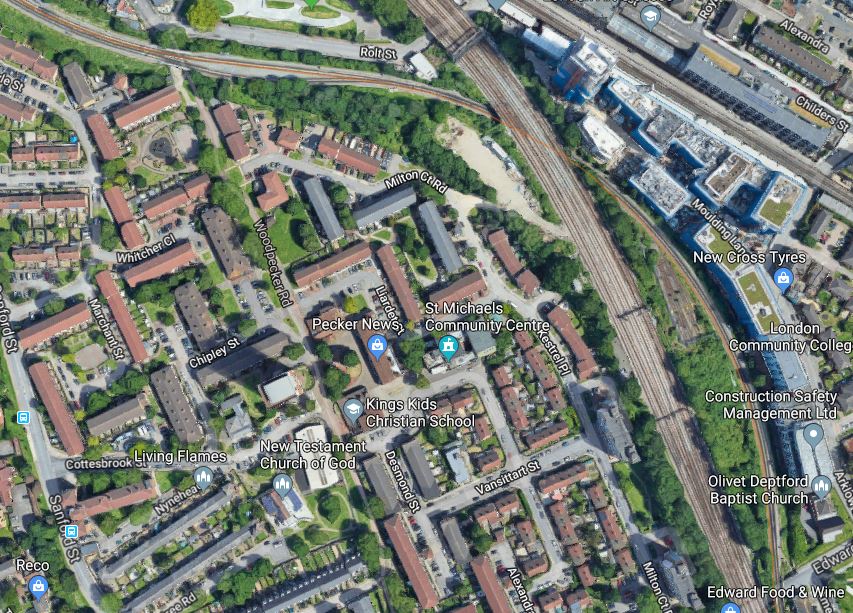
The London Overground track is clearly visible.
Could extra track be added, to enable the following?
- Southbound trains could join the main line and stop in Platform C
- Northbound could leave the main line after stopping in Platform A and go towards Surrey Quays station.
If this is possible, then trains could run between Dalston Junction and Lewisham stations.
Once at Lewisham they would have choice of Southern terminal,
Hayes As A Southern Terminal
Consider a service between Dalston Junction and Hayes stations.
- I estimate that a train could go between the two stations in 53 minutes.
- Hayes station has two terminal platforms
Six tph would probably be too many services, but 2-3 tph might be very welcome.
Orpington As A Southern Terminal
Consider a service between Dalston Junction and Orpington stations.
- I estimate that a train could go between the two stations in 47 minutes.
- Orpington station has three terminal platforms.
Six tph would probably be too many services, but 2-3 tph might be very welcome.
A Combined Hayes And Orpington Service
As a case can be made for services to both Hayes and Orpington via Lewisham, I think the ideal service could be two tph to both Hayes and Orpington.
- There would be four tph between Dalston Junction and Lewisham.
- Stations on the East London Line would have access to the important interchange station at Lewisham.
- Several stations on the routes to Hayes and Orpington would have a two tph service to Crossrail and the Jubilee Line.
Other Stations Via New Cross
Looking at rail maps, there would seem to be several possibilities including with their times from Dalston junction station.
- Beckenham Junction – 41 mins
- Bromley North – 40 mins
- Gove Park – 35 mins
There are probably others.
Southern Terminals Via Peckham Rye Station
As an example Streatham Common station is planned to be a major interchange and is 43 minutes from Dalston Junction.
Would a bay platform work here as an East london Line terminal?
Conclusion
If all fifty-seven Class 378 trains worked the East London Line, they could run six tph on the current routes.
- Dalston Junction And Clapham Junction
- Dalston Junction And New Cross
- Highbury & Islington And Crystal Palace
- Highbury & Islington And West Croydon
It would need forty-two trains.
Suppose the Dalston Junction and New Cross service was replaced with a Willesden Junction and New Cross service.
- This would provide a useful direct four tph service between East and North London.
- Changing at Highbury & Islington station would be avoided for a lot of journeys.
- The journey time wold be around 49 minutes.
- A two tph service would need four trains.
- A four tph service would need eight trains.
- A six tph service would need twelve trains.
- Many journeys between North and South London would now be possible with just a single same platform interchange.
To run the following frequencies on this route would mean these total frequencies on the East London Line and total numbers of trains.
- 2 tph – 20 tph – 40 trains
- 4 tph – 22 tph – 44 trains
- 6 tph – 24 tph – 48 trains
I think that if the figures are juggled a bit, there is enough trains to run extra services to one or more Southern destinations from Dalston Junction.
My preference would be a split service of 2 tph to both Hayes and Orpington via New Cross, where some new track would be needed.
This would do the following.
- Create a frequent connection between South-East and North-East London.
- Both areas would be connected to Crossrail and several Underground Lines, including the future Bakerloo Line Extension.
- The Hayes Line would be shared between Overground and Southeastern trains.
No more new trains or large amounts of new infrastructure would be needed.
I suspect that London Overground and the new Southeastern franchise can do better than my musings.
ProRail And Arriva Launch Automation Trials
The title of this post, is the same as that of this article on Railway Gazette.
I have posted this article, because it lays out in a simple way, the benefits of digital signalling and Automatic Train Operation.
Latest On The Class 717 Trains For The Great Northern
This is another tweet from the South East Rail Group.
Because of centre door of the cab some start signals can’t be sighted by the driver. Thus SDO will be used and trains stopped short. Once ERTMS is installed (the trains already have the in-cab signalling displays to go with it) then fixed signals and triphandles will be removed.
They also say that squiadron service is could be on March 11th.
Effect Of ERTMS
The tweet also confirms that ERTMS will be available on this line, after the first stage of installation of ERTMS on the East Coast Main Line.
Currently, the service to Moorgate station is twelve trains per hour (tph) in the Off Peak, with extra services in the Peak.
As Thameslink and Crossrail will be running twenty-four tph in a couple of years, so when ERTMS is working on the Southern part of the East Coast Main Line and on the Northern City Line into Moorgate station, how many trains per hour will be possible to Moorgate?
The current twelve tph means that turning the trains at Moorgate must be done in five minutes, which having watched the process is fairly relaxed.
Fifteen tph and a four minute turnround is certainly possible, as that is sometimes achieved in the Peak with the ancient Class 313 trains.
With a fleet of twenty-five trains, and a frequency of twenty-four tph possible under ERTMS, I suspect that twenty tph and a three minute turnround at Moorgate could be achieved all day.
Highbury & Islington Interchange With The Victoria Line
With Dear Old Vicky gamely plugging on at thirty-six tph, the typical maximum wait in a cross-platform interchange will be as follows.
- Victoria to Northern City – three minutes
- Northern City to Victoria – one minute and forty seconds.
How many passengers will use this route to the City rather than use the London Overground?
Interchange With Crossrail At Moorgate
The Northern City will be my link to Crossrail, as I can walk or get a bus to Essex Road station.
The interchange between Crossrail and the Northern City Lines will be high capacity, feature a lot of escalators and be fully step-free.
Conclusion
London’s forgotten underground line with its tragic history of the Moorgate Tube Crash, will become a new star in the broad firmament of London’s railways.
It just needs some improvements to some of the stations.
ERTMS Rollout Between London-Paris-Brussels Agreed
The title of this post, is the same as that of this article on Global Rail News.
This is the first paragraph.
An agreement has been reached by the infrastructure managers of the high-speed railway between London, Paris and Brussels – one of Europe’s busiest routes – to coordinate the rollout of European Rail Traffic Management System (ERTMS).
Rollout of ERTMS on these important routes must surely be a good idea, if it can enable extra and faster services on these busy routes.
First ‘717’ In UK In June
The title of this post is the same as that of a short article in the May 2018 Edition of Modern Railways.
This is the first paragraph.
The first Class 717 EMU, built by Siemens for Govia Thameslink Railway’s Great Northern suburban services into Moorgate, is due to arrive in the UK in June.
The article also makes these statements, about the new Class 717 trains.
- The first unit is planned to enter service in September.
- The full fleet of 25 x 6-car units will be deployed in Winter 2018.
- The current Class 313 trains will be replaced.
- The new trains will have no toilets or First Class.
- The new trains will have power points and wi-fi.
By virtue of the cross-platform connection between the Northern City Line and Victoria Line, these trains will improve a valuable link between North East London and the City of London.
When Crossrail opens in December 2018 at Moorgate station, the Northern City Line will have a step-free below-ground connection to Liverpool Street station and all the Underground lines serving the two stations.
Ducking and diving will move to a whole new level.
What Will The New Trains Do For Me?
For my own part, if the frequency on the Northern City Line is increased, I shall use the line from Essex Road station to get to Moorgate for Crossrail and the Central Line.
I suspect my house will go up in value!
How Will The New Trains Affect The Service?
The New Trains Are Faster
The current Class 313 trains are 75 mph trains, whereas the new Class 717 trains are 100 mph trains.
This increased operating speed will have two effects, when running on the East Coast Main Line and to Letchworth Garden City.
- Time might be saved.
- As their operating speed is the same as Thameslink’s closely-related Class 700 trains, they might make keeping to time easier.
Time savings on the Hertford Loop Line, will be more difficult, as the line only has a 75 mph operating speed.
However, speed improvements on the Hertford Loop Line would surely result in faster trains to Hertford, Letchworth Garden City and Stevenage.
The New Trains Could Change Voltage Faster
Trains on the Northern City Line need to change voltage at Drayton Park station. I have observed Class 700 trains, do this on Thameslink and they do it without fuss and very reliably.
The Class 717 trains will probably use the same pantograph, so we could be seeing a smoother and faster changeover.
The New Trains Will Probably Be Ready For ERTMS
The Class 700 trains are fitted for ERTMS, so they can work the Thameslink tunnel under Automatic Train Operation.
As this method of signalling and control will be fitted to the East Coast Main Line to improve caacity, the new Class 717 trains will probably be ERTMS-ready.
It should be noted that the Hertford Loop Line has been used as an ERTMS test track and I suspect engineers know the performance improvement ERTMS would bring to the line.
I suspect in a few years, the Northern City Line and services out of Moorgate will be run automatically, with the driver monitoring the system.
The New Trains Will Stop In A Shorter Time At Stations
The new Class 717 trains will have the these advantages of modern trains over the current ones.
- They will be able to accelerate to line speed in a shorter time.
- They will be able to brake faster.
- Wider doors and larger lobbies will enable shorter loading and unloading times.
- The trains will have better systems to help the driver.
These will all result in time savings at each stops.
Currently, the four destinations have the number of stops to Moorgate.
- Hertford North – 49-53 minutes – 12 stops
- Letchworth Garden City – 75 minutes – 19 stops
- Stevenage – 68-72 minutes – 14 stops
- Welwyn Garden City – 47-48 minutes – 16 stops
Because of the high number of stops, saving a minute at each stop would speed up the train service.
Less Trains Could Be Needed For The Current Service
As an example, take the Moorgate to Letchworth service.
The current service is one train per hour (tph), which takes 75 minutes. In its simplest form, allowing for turnround at both ends, trains take up to three hours for the round trip, so three trains are needed for the service.
But if the faster Class 717 trains can save a minute at each stop and run faster on the East Coast Main Line, it might be possible to reduce the round trip to several minutes under two hours. If that is possible, then only two trains would be needed for the route.
Improve The Hertford Loop Line
With its low operating speed of 75 mph, the new Class 717 trains can’t take full sadvantage of their increased speed.
There are already plans for new bay platforms at Gordon Hill and Stevenage stations, so what other plans are being progressed to improve the Hertford Loop Line?
The New Trains Could Have Less Seats And More Capacity
I can only give a rough estimate for this as I can’t find the capacity of a Class 717 train.
These are cars, car length and capacity for various trains.
- Class 707 trains -five x 20 m. – 275 seats + 533 standing
- Class 717 trains – six x 20.2 m. – No figures.
- Class 313 trains – three x 20.2 m. – 232 seats
- 2 x Class 313 trains – six x 20.2 m. 464 seats
A rough calculation for the Class 717 train using the figures for a similar Class 707 train and adjusting for another ytailer carriage gives the following.
339 seats + 657 standing = 996 total
Incidemtally, I’ve stood on a crowded Class 707 train, and it was not an unpleasant experience, as there were plenty of handholds.
This picture shows handholds on the seats and between carriages.
I hope the Class 717 trains have 2 + 2 seating, like the Class 707 trains.
Improved Services To And From Moorgate
Current services to and from Moorgate station are as follows.
- Three tph to Welwyn Garden City
- Three tph to Hertford North, with one tph extended to Letchworth Gsrden City.
This means that there are six tph between Alexandra Palace and Moorgate stations.
From the May 2018 timetable change, the service levels will become.
- Four tph to Welwyn Garden City
- Five tph to Hertford North, with two tph extended to Stevenage or Watton-at-Stone.
- No direct services will run to Letchworth Garden City. Change seems to be a cross-platform interchange at Finsbury Park.
The service termination at Watton-at-Stone station is only temporary until Network Rail build a new bay platform at Stevenage station.
These changes mean that there will be nine tph between Alexandra Palace and Moorgate stations.
This frequency is already achieved in the Peak, from Monday to Friday. But it now appears, it will be running all day from the May 2018 timetable change.
I found this document on the Rail Delivery Group web site, which is entitled 6,400 Extra Trains A Week To Run To More Places, More Often.
It says these services will be added in 2019.
- An increase of 2 Hertford Loop trains per hour, Moorgate-Hertford
- An increase of 1 Hertford Loop train per hour, Moorgate-Stevenage
- An increase of 1 train per hour, Moorgate-Welwyn Garden City
In the May 2018 edition of Modern Railways, this is said.
New Class 717 EMUs will eplace the current Class 313s on these services from the autumn, with a further frequency boost planned in May 2019.
Adding this all together gives the following.
- Five tph to Welwyn Garden City
- Seven tph to Hertford North, with three tph extended to Stevenage.
This means that there will be twelve tph between Alexandra Palace and Moorgate stations. Or a train every five minutes.
It would appear that the overall effect of what Govia Thameslink Railway is doing is as follows.
- Restricting the running of Moorgate services on the East Coast Main Line.
- Provide a five tph Turn-Up-And-Go service from Welwyn Garden City.
- Provide a seven tph Turn-Up-And-Go service from Hertford North.
- Provide a six tph Turn-Up-And-Go Thameslink service from Stevenage.
- Provide a three tph service to Moorgate from Stevenage and Watton-at-Stone. Could it be expanded to a Turn-Up-And-Go four tph.
- Stations North of Stevenage will be served by Thameslink services to Cambridge and Peterborough.
- Thameslink services will stop at Stevenage and Finsbury Park for interchange with Moorgate services.
Will all of of this, downgrade Welwyn North station, by offering better services at Knebworth, Stevenage, Watton-at-Stone and Welwyn Garden City stations?
Consider.
- Welwyn North station handles about 600.000 passengers a year.
- Welwyn North station only has a service of two tph.
- Welwyn North station lies on the double-track section of the East Coast Main Line over the Digswell Viaduct.
- Knebworth station handles 600,000 passengers a year, but is on a four-track section of the line.
- Watton-at-Stone station, which is perhaps four kilometres to the East handles 100,000 passengers a year, but appears to be short of car parking.
I’m pretty certain, that if Welwyn North station could be closed, then the notorious bottleneck of the Digswell Viaduct could be eased.
So are Network Rail and Govia Thameslink Railway working towards a situation, where this will be able to happen.
They could do the following.
- Provide more car parking at Knebworth, Stevenage, Watton-at-Stone and Welwyn Garden City stations.
- Build a new Park-And-Ride station in South Stevenage on the Hertford Loop Line.
- Improve timings between Stevenage and Moorgate.
- Extend more Hertford North services to Stevenage. Six tph would probably be the limit for a single bay platform at Stevenage.
Shutting Welwyn North station would be controversial and heavily resisted.
How Many Trains Will Be Needed?
In May 2019, I think the service will be as follows.
- Five tph to Moorgate to Welwyn Garden City
- Four tph to Moorgate to Hertford North,
- Three tph Moorgate to Stevenage.
I’ll now look at each separately.
Moorgate To Welwyn Garden City
Trains take just under around 47-48 minutes and there are sixteen intermediate stops.
Currently, I suspect a train takes two hours to do a round trip, which would allow up to 12-13 minutes to turn round at each end.
- Three tph would need six trains.
- Four tph would need eight trains.
- Five tph would need ten trains.
But supposing the Class 717 trains, with faster running on the East Coast Main Line and faster stops could reduce this to under thirty minutes with a round trip of an hour.
- Four tph would need four trains.
- Five tph would need five trains.
Note.
- Currently, all trains are turned in Platform 4.
- Will Platform 4 be able to handle four tph after the May 2018 timetable change?
- Will Platform 4 be able to handle five tph after the May 2019 timetable change?
- There are sidings easily accessible to the North of Platform 4.
- Trains leaving Welwyn Garden City for Moorgate use a flyover to cross to the Up Slow line.
If five tph with just five trains is possible, it’s well worth achieving. But it could be a hard ask!
Moorgate To Hertford North
Trains take around 49-53 minutes and there are twelve intermediate stops.
This service would be another two hour round trip.
- Three tph would need six trains.
- Four tph would need eight trains.
- Five tph would need ten trains.
The new Class 717 trains couldn’t probably do the trip in thirty minutes, but a ninety minute round-trip would surely be possible.
- The proposed four tph would need six trains.
Note.
- Four tph is the frequency that will be running from May 2019.
- Four tph could also be easily handled in the bay platform at Hertford North station.
Any track improvement would help.
Moorgate To Stevenage
Trains take around 68-72 minutes and there are fourteen intermediate stops.
The new Class 717 trains with their faster running and faster stops, should be able to do this trip under the hour, with a possible two-hour round trip.
If this could be achieved the service would need the following trains.
- The proposed three tph would need six trains.
- Four tph would need eight trains.
Improving the Hertford Loop Line, so that the Class 717 trains could fully use their 100 mph operating speed could be key.
Summarising The Trains Needed
Summarising gives.
- Three tph between Moorgate and Stevenage would need six trains.
- Four tph between Moorgate and Hertford North would need eight trains with a two hour round trip.
- Cut that to a ninety-minute round trip and six trains could be needed.
- Five tph between Moorgate and Welwyn Garden City could possibly be run with five trains or need as many as ten.
A pessimistic answer for the number of trains could be as high as 24, which fits well with a fleet of twenty five trains.
But an optimistic solution might need.
- Six trains for Stevenage
- Six trains for Hertford North
- Five trains for Welwyn Garden City
This would leave several trains for increasing frequency.
Increasing The Service After May 2019
Improving The Hertford Loop Line
If the Class 717 trains could use their speed, this would enable faster journeys and could allow extra paths for more trains.
ERTMS On The Moorgate Lines
It is already used by Thameslink and is scheduled to be used on the East Coast Main Line.
Will it be added to the Hertford Loop Line and on the Northern City Line?
ERTMS and a degree of Automatic Train Control, could be a game changer.
Fitting the necessary equipment to the Class 717 trains, shouldn’t be the most difficult of jobs, as the system is already fitted to Thameslink’s Class 700 trains.
Increased Frequency Into Moorgate
Consider.
- Currently, in the Peak, the Class 313 trains running under control of conventional signalling manage 11 tph at times.
- From May 2019, Gover Thameslink Railway will be running 12 tph into Moorgate all day.
- Thameslink and Crossrail should be handling 24 tph, by the end of 2019.
- Brixton station on the Victoria Line handles upwards of thirty tph with two platforms.
- Transport for London and Londoners have a lot of experience about loading and unloading trains.
Look at this schematic of the vast Crossrail complex linking Liverpool Street and Moorgate stations.
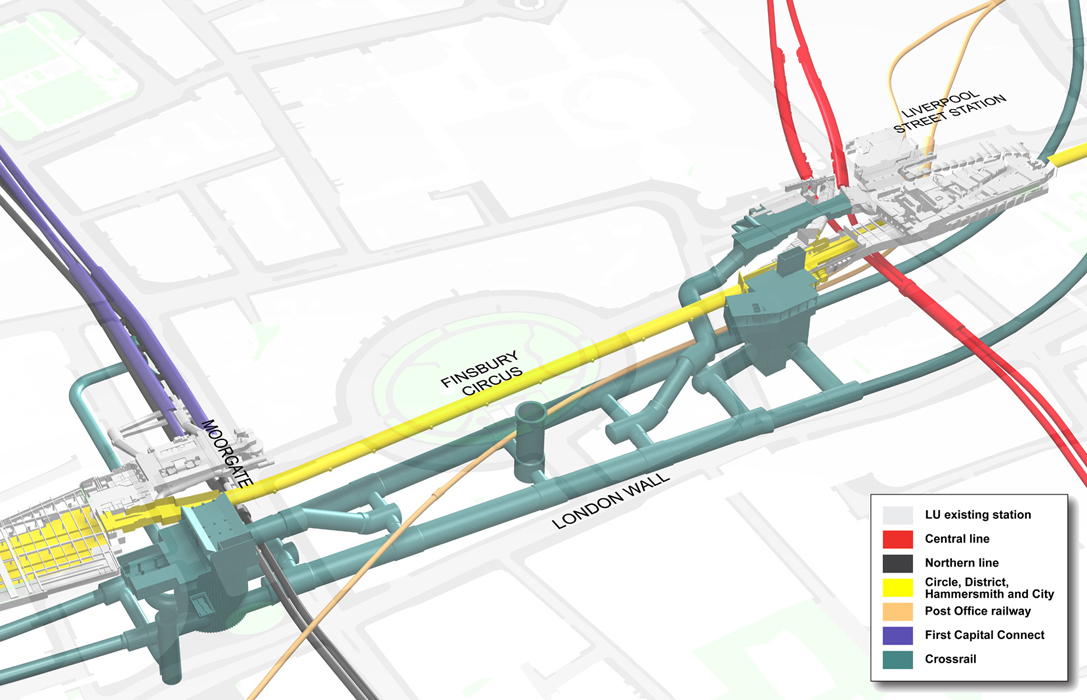
Note the Northern City Line in dark blue at the left, with a new pedestrian tunnel linking to Crossrail. This will help handle the passenger flows between Crossrail and the Northern City Line.
With ERTMS and Automatic Train Control, I wonder what, is the maximum number of trains that can be handled at Moorgate?
Twelve is obviously possible with the current infrastructure, as it is only one more than what is currently achieved in the Peak.
My experience says that with good electronic and organisational systems, that fifteen tph should be possible in both directions between Moorgate and Finsbury Park stations.
An Extra Train To Stevenage
Current plans envisage three tph between Moorgate and Stevenage.
The new bay platform at Stevenage would easily handle four tph and if the sufficient trains are available, I could see this extra service implemented.
The following frequencies would be achieved.
- Four tph – Stevenage and Watton-at-Stone.
- Eight tph – Hertford North.
The Northern City Line would obviously need to be able to handle the extra train.
Gordon Hill Station As An Extra Terminus
Gordon Hill station is sometimes used as an extra terminus to turn trains from Moorgate in the Peak.
I can see this continuing, as surely it increases the capacity at the Moorgate end of the line.
Conclusion
It will be interesting to swee how this line develops in the future.
 The Anonymous Widower