Could London And Central Scotland Air Passengers Be Persuaded To Use The Trains?
How Many Passengers Fly Between London And Edinburgh?
Wikipedia gives these figures for 2024 for passengers from Edinburgh to London
- London City – 334,873
- London Gatwick – 476,152
- London Heathrow – 1,148,634
- London Luton – 338, 729
- London Stansted – 693,953
This gives a total of 2,992,341.
As Wikipedia doesn’t give complete figures for from London to Edinburgh, for the purpose of this analysis, I’ll assume they are the same.
How Many Passengers Fly Between London And Glasgow?
Wikipedia gives these figures for 2024 for passengers from Glasgow to London
- London City – 208,405
- London Gatwick – 456,002
- London Heathrow – 954,027
- London Luton – 255,095
- London Stansted – 225,110
This gives a total of 2,098,639.
As Wikipedia doesn’t give complete figures for from London to Glasgow, for the purpose of this analysis, I’ll assume they are the same.
How Many Passengers Fly Between London And Scotland’s Central Belt?
Adding the two figures gives 5,090,980. in both directions.
Which is an average of 97,903 per week or 13,948 per day.
How Many Train Seats Run Between London And Scotland’s Central Belt?
These figures are for Friday the 1st of August.
- Aventi West Coast – London Euston and Glasgow Central – 5 x 9-car Class 390 train – 2,345 seats
- Aventi West Coast – London Euston and Glasgow Central – 16 x 11-car Class 390 train – 6,677 seats
- LNER – London King’s Cross and Edinburgh – 26 x 9-car Class 801 train – 15,886 seats
- Lumo – London King’s Cross and Edinburgh – 5 x 5-car Class 803 train – 2,010 seats
Note.
- All services are all-electric.
- All services are fairly new or have recently been refurbished,
This gives a total of 26,918 train seats.
Adding Lumo’s Service To Glasgow
In Lumo Will Extend Its King’s Cross And Edinburgh Service To Glasgow, I suggested that the Glasgow service would be run as follows from December 2025.
- Two existing Lumo services will leave London as pairs of five-car trains.
- The pairs will split at Edinburgh.
- The leading train will go on to Glasgow Queen Street calling at Edinburgh Haymarket and Falkirk High stations.
- The trailing train will return to London King’s Cross.
- At the end of the day, the two trains in Glasgow will do a fast run back to London King’s Cross as a pair of 5-car trains.
This will add 804 seats per day between London and Glasgow Queen Street in both directions.
The daily total would now total 27,722 train seats, which compares with a daily average of 13,948 passengers per day, who travel by air.
Adding Lumo’s Service To Stirling
In Lumo To Expand Scotland’s Rail Network With New London-Stirling Rail Route From Spring 2026, I talk about Lumo’s new service to Stirling.
- There will be five trains per day (tpd) in each direction.
- Lumo’s new route will link London Euston directly to Stirling, also calling at Milton Keynes, Nuneaton, Crewe, Preston, Carlisle, Lockerbie, Motherwell, Whifflet (serving Coatbridge), Greenfaulds (serving Cumbernauld) and Larbert.
- The service will use 6-car Class 222 trains, which in the linked post, I estimate will have a similar one-class capacity to the Class 803 trains between London King’s Cross and Edinburgh.
- If the capacity of the two train types is similar, this should give operational advantages and allow some more Class 803 trains to run the Euston and Stirling route.
This second Scottish route will add 2010 train seats per day between London Euston and Stirling in both directions.
The daily total would now total 29,732 train seats, which compares with a daily average of 13,948 passengers per day, who travel by air.
Could More Capacity Be Added Between London And Scotland’s Central Belt?
I believe some of the Lumo services between London King’s Cross and Edinburgh could be doubled up to a pair of trains.
There would have to be no platform length issues at London King’s Cross, Stevenage, Newcastle and Morpeth stations.
If three trains could be doubled up, that would add 1,206 train seats per day between London and Edinburgh in both directions.
The daily total would now total 30,938 train seats, which compares with a daily average of 13,948 passengers per day, who travel by air.
I also suspect, that some of the Stirling services could be doubled up.
Connectivity Of England’s Northern Airports To London And Central Scotland
Birmingham Airport
Consider.
- There are easyJet flights to Edinburgh and Glasgow
- There are 1.5 trains per hour (tph) between Birmingham New Street and Edinburgh.
- There are 6 tpd between Birmingham New Street and Glasgow.
You would make your choice and pay the money.
East Midlands Airport
There are no flights or trains to Edinburgh and Glasgow.
Leeds Airport
Consider.
- There are no flights to Edinburgh or Glasgow.
- There is one tph between Leeds and Edinburgh
- There is one tpd between Leeds and Glasgow
Could Leeds and Glasgow get better connectivity?
Liverpool Airport
Consider.
- There are no flights to Edinburgh or Glasgow.
- There is one tph between Liverpool Lime Street and Edinburgh
- There is three tpd between Liverpool Lime Street and Glasgow
The Liverpool area is well connected to Crewe, Warrington Bank Quay, Wigan North Western and Preston stations on the West Coast Main Line for alternative services to Glasgow.
Manchester Airport
Consider.
- There are no flights to Edinburgh or Glasgow.
- There is one tph between Manchester Airport and Scotland via Manchester Piccadilly and Manchester Oxford Road, which alternates between Edinburgh and Glasgow.
The Manchester area is well connected to Crewe, Warrington Bank Quay, Wigan North Western and Preston stations on the West Coast Main Line for alternative services to Glasgow.
Omio gives this summary of flights between Heathrow and Manchester airports.
Flights from Manchester Airport to London Heathrow Airport depart on average 8 times per day, taking around 1h 6m. Cheap flight tickets for this journey start at £63 but you can travel from only £16 by coach.
Wrightbus and others will be producing mouse-quiet hydrogen-powered coaches in a couple of years. I suspect these will give short flights a good kicking.
Newcastle Airport
Consider.
- There are no flights to Edinburgh or Glasgow.
- There is three tph between Newcastle and Edinburgh with an additional 5 tpd from Lumo.
- There is two tpd between Newcastle and Glasgow.
- There is one tpd between Newcastle and Stirling.
- From December 2025, Lumo will add two tpd from Newcastle to Glasgow and one tpd from Glasgow to Newcastle.
- In Lumo Will Extend Its King’s Cross And Edinburgh Service To Glasgow, I stated that I believe that Lumo’s Glasgow to Newcastle service will be a late evening ten-car train, so travellers can have a long day in Glasgow, Edinburgh and Newcastle and still return to London.
Lumo would appear to fill in the gap between Newcastle and Glasgow.
Google AI gives this summary of flights between Heathrow and Newcastle airports.
There are usually 5-6 direct flights per day between Newcastle and Heathrow airports. These flights are operated by British Airways. The average flight time is around 1 hour and 10 minutes.
Note.
- In 2024, 497, 469 passengers flew between between Heathrow and Newcastle airports, which is an average of 681 passengers in each direction every day.
- This was an increase of 13.6 % on 2023.
- From December Lumo will be running extra London King’s Cross and Newcastle services, with each train having 402 seats.
- The improvements in rail services in and around Newcastle in recent months, will surely bring more passengers to use trains from Newcastle station.
- Will Lumo also target adverts at airline passengers?
London and Newcastle could be another route for mouse-quiet hydrogen-powered coaches.
Conclusion
These numbers summarise my calculations.
- Currently an average of 13,948 passengers per day fly between London and Central Scotland.
- Currently, there are 26,918 train seats available per day between London and Central Scotland.
- In December 2025, Lumo will add another 804 low-cost train seats between London King’s Cross and Glasgow Queen Street.
- In Spring 2026, Lumo will add 2010 low-cost train seats between London Euston and Stirling.
- From Spring 2026, there will be 29,732 train seats available per day between London and Central Scotland.
- This represents a 10 % increase of seats on the trains between London and Central Scotland.
How many passengers, who normally fly, will switch to using the train?
- Lumo may only offer one class, but you get a trolley and can order food from M & S and others to be delivered to your seat.
- Both LNER and Lumo accept dogs. I don’t know about Avanti.
- All services will be all-electric, when Lumo gets its new electric trains for Stirling, in a few years.
- It looks to me like Lumo could be offering a late train back to London from Edinburgh and Glasgow.
- Digital signalling on the East Coast Main Line should speed up services.
If Lumo to Glasgow and Stirling works out, it could also cut the total carbon footprint of travel between London and Central Scotland.
A Bespoke Tram-Train For The UK
Trams, tram-trains, trains and anything that runs on rails is generally very expensive.
Does this partly explain, why the UK has relatively few urban tramways and railways?
In Stadler Presents Mock-Up Of Tram-Trains For German And Austrian Operators, I discussed how five German and Austrian operators had got together to create a common tram-train design, that would be suitable for all the operators.
The mayor of one of the cities involved in the joint order, said savings of the order of a million euros per vehicle may have resulted from the common design.
I would also feel that savings in operational costs, design of infrastructure, spares inventory and other costs would also result.
Identical tram-trains would make through running between networks easier.
Where Could Tram-Trains Be Used In The UK?
Consider.
- Currently, tram-trains are running in Sheffield and a battery-electric version of the same Stadler Citylink tram-train will soon be running in Cardiff.
- Cardiff, is developing a Cardiff Crossrail on tram-train principles across the city.
- Sheffield have said that they will be replacing their trams and I believe they could use developments of their excellent Stadler tram-trains.
- Sheffield is likely to extend their tram system and might include tram-trains to Doncaster.
- Cities that have talked about adding tram-trains to their tram networks include Birmingham, Blackpool, Manchester and Nottingham.
- Leeds is developing a metro system, which could be developed using tram-train principles.
- Glasgow has talked about a tram-train to Glasgow Airport for some time.
- The East-West Rail Link is proposing a tram-train link between Ipswich and Felixstowe to allow more freight trains into the Port of Felixstowe.
There could be quite a number of tram-trains being used in the UK, especially if they are used as at Felixstowe, to increase freight capacity into ports.
These are a few of my thoughts.
Battery-Electric Tram-Trains
I would envisage, that a lot of the new tram-trains would operate using batteries. Especially, as battery-electric trains are showing quite long ranges of upwards of thirty miles.
Already trams in Birmingham and trains on Merseyside, are operating using batteries and it avoids the expense of putting up catenary, if enough exists to charge the trams.
Replacement of Diesel Multiple Units By Battery-Electric Tram-Trains
There are some branch lines, where diesel multiple units run off a branch of an electrified main line.These services could be decarbonised by changing the rolling stock.
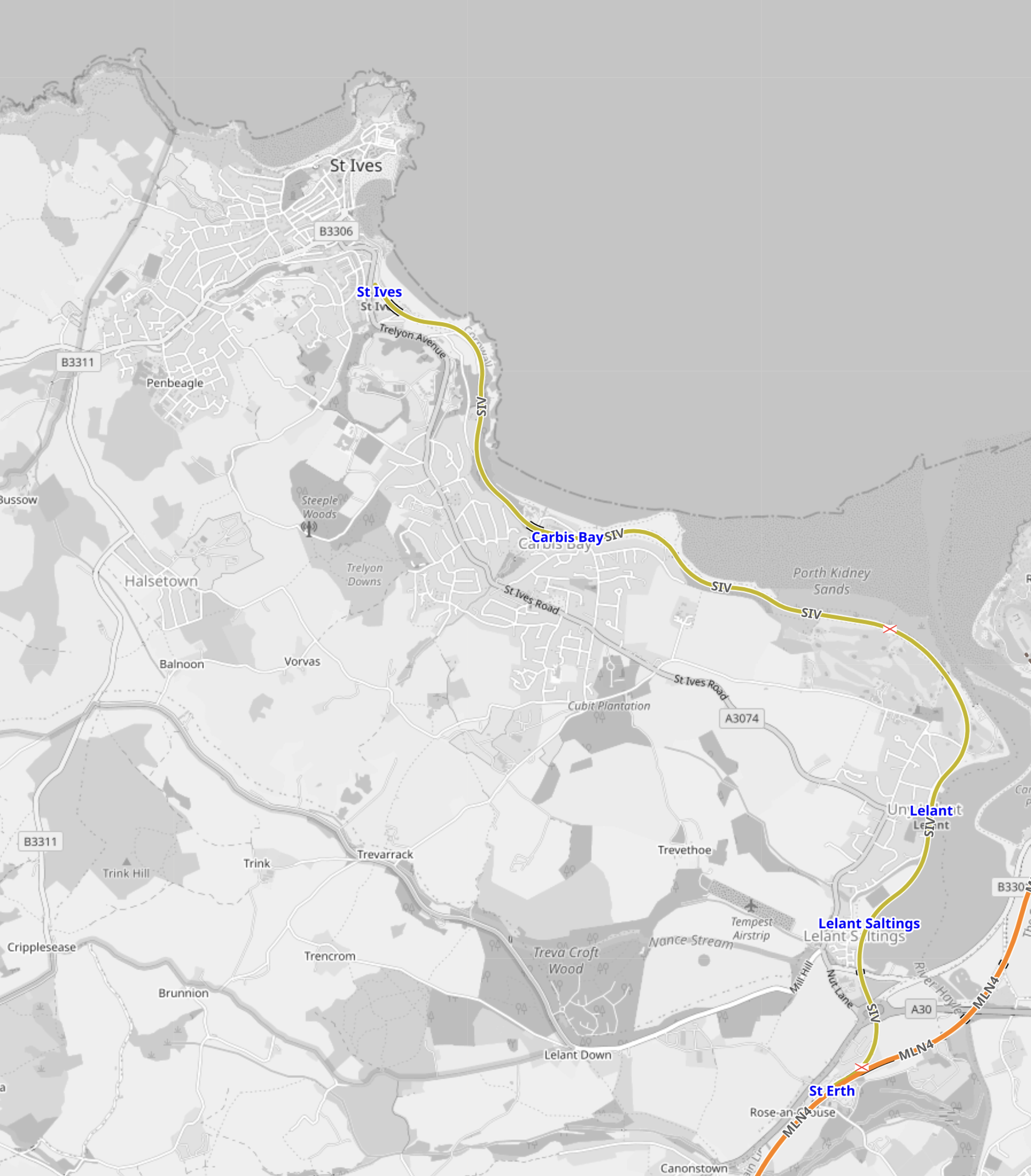
This OpenRailwayMap shows the St. I’ves Bay Line in Cornwall.
Note.
- The St. Ives Bay Line is shown in yellow.
- The Southern terminal is St. Erth station, where it connects to the Cornish Main Line, which is shown in orange.
- The Northern terminal is St. Ives station, which is towards the top of the map.
- The St. Ives Bay Line is 4.25 miles long.
- No tracks are electrified.
- There are three intermediate stations.
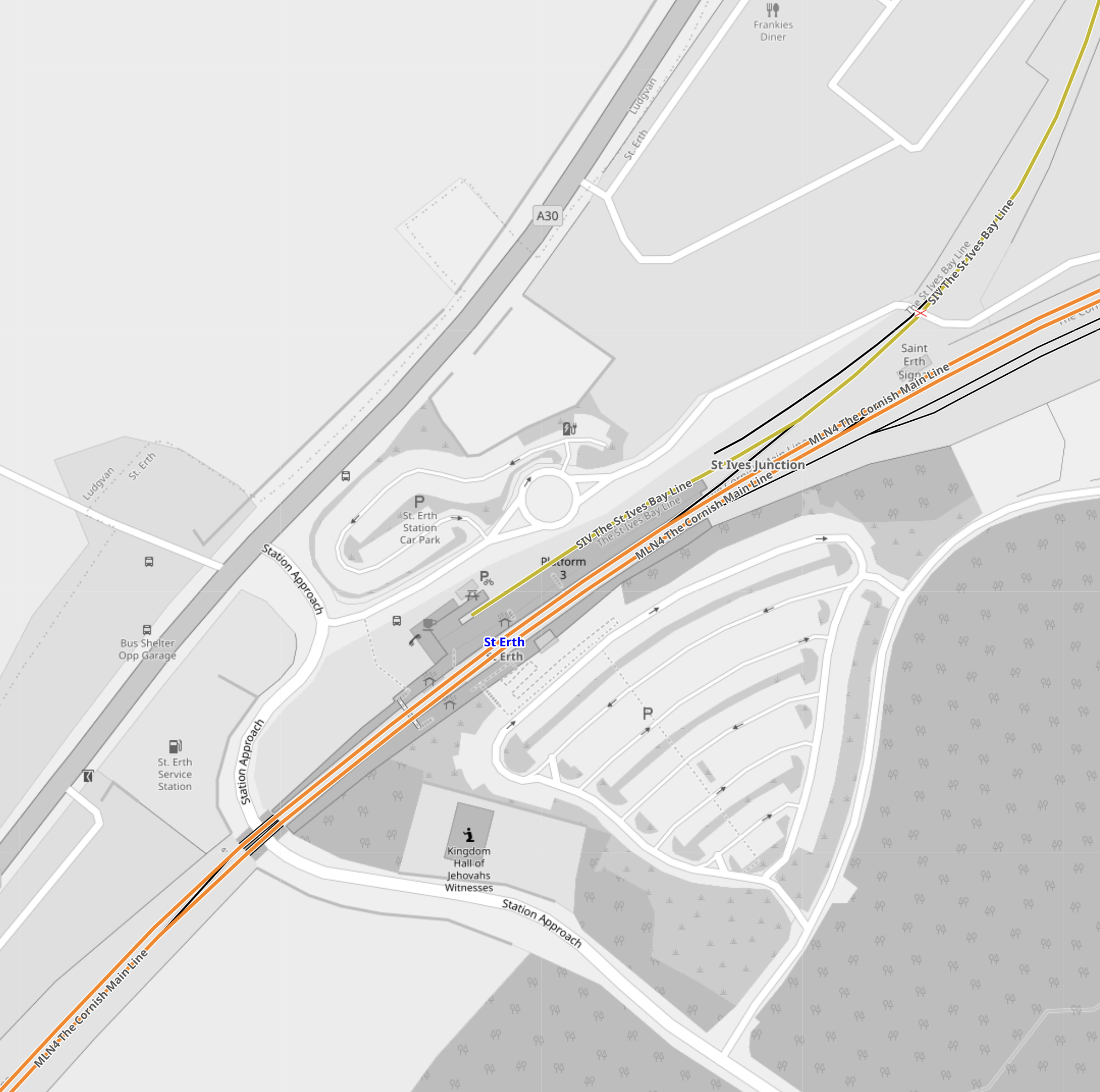
This second OpenRailwayMap shows St. Erth station in more detail.
Note.
- The St. Ives Bay Line has its own platform at the side of the station.
- I am fairly certain, that some form of charging could be installed in this platform.
- At the other side of the Cornish Main Line are two sidings, which could be used for cleaning and maintenance.
A neat zero-carbon branch line could easily be created.
New Branch Lines To New Developments
In Sheffield Region Transport Plan 2019 – A New Tram-Train Route To A New Station At Waverley, I gave my view on a tram-train loop from the Sheffield-Lincoln Line to serve the Advanced Manufacturing Centre and new housing at Waverley.
The tram-train would run as a train to the branch line for the development and then run as a battery-electric tram, through the development.
As the Midland Main Line to Sheffield will be electrified, the tram-trains could be charged on the electrification in Sheffield station.
Build Them In Doncaster
Wabtec are closing Doncaster works.
Surely this would be the site to assemble the scores of tram-trains that could be needed in the UK.
Conclusion
Tram-trains could do a lot to improve the railways of the UK.
They would also help to decarbonise the existing system.
Are LNER Going To Take On The Airlines?
Nine years ago, I wrote Edinburgh – Plane Or Train?, after a trip to Scotland, where I took easyJet up and came back in First Class by train.
- Both trips were about five hours door-to-door.
- The flight was about six quid more,
- But I got free food and drink on the train.
- Security on the plane was a pain.
- I had to take my passport for identification at Stansted.
I haven’t flown internally in Great Britain since, although, I have flown to Belfast.
For shorter flights the market is going towards rail, as these posts seem to suggest.
- 2.7M Tonnes Of Co2 Could Be Saved Per Year If UK Domestic Flights Went Electric
- Air Travellers To Be Hit By Carbon Charge On All Tickets
- Climate Change ‘May Curb Growth In UK Flying’
- France Bans Short-Haul Flights To Cut Carbon Emissions
- KLM Replaces Plane With High Speed Train
- Lumo Carbon Data Shows Its Trains Are 22 Times Greener Than Flying
- Next Time I’ll Go By Train
- Ryanair One Of Europe’s Top Polluters, EU Data Suggests
- Stop Taking Internal Flights And Go Green, Says Lib Dem Contender Davey
The climate seems to be turning against flying short-haul.
This is a paragraph, in this press release from LNER, which is entitled First Tri-Mode Long Distance Trains For The East Coast Main Line.
This new fleet of trains will keep LNER on track to reduce its emissions by 67 per cent by 2035 and be net zero by 2045. LNER has already reduced carbon emissions by 50 per cent compared with 2018/19. Per mile, LNER trains produce 15 times less carbon emissions than a domestic flight.
Are LNER building a number of climate-based sticks, with which to beat the airlines on the routes, where they compete?
These are my thoughts on the various routes, where LNER compete with airlines.
Newcastle
Newcastle is an interesting one.
- Newcastle station is in the city centre and is on the Tyne and Wear Metro.
- London King’s Cross is one of London’s major Underground hubs.
- There are lots of buses and local trains within walking distance of both stations.
- There are three trains every two hours and an additional eight trains per day (tpd) between the two London King’s Cross and Newcastle stations.
- Lumo also run five tpd on the route.
- There are generally no security delays at rail stations.
- London King’s Cross is laid out to maximise passenger flows. If it gets busy, everybody just walks out into King’s Cross Square.
- I’ve never had a problem at Newcastle station with overcrowding.
Perhaps, if you live near one of the airports, flying is more convenient.
LNER’s weapons against the airlines between London King’s Cross and Newcastle will be convenience and journey times.
Convenience is all about the location of the stations, their excellent local transport networks and good walking routes around the station.
Journey times will only get better, as the magic of digital in-cab signalling, allows the Azumas, the new CAF tri-mode long distance trains and the few remaining InterCity 225s to show what they were designed to do.
Dalton-on-Tees, where the first phase of the digitally signalling will end, is 39.8 miles South of Newcastle, so once the Newcastle train is passes Dalton-on-Tees on the East Coast Main Line, it will be a digital-signalled electrified railway all the way to Woolmer Green.
- Dalton-on-Tees is 39.8 miles South of Newcastle
- Woolmer Green is 244.8 miles South of Newcastle.
- Dalton-on-Tees and Woolmer Green is 205 miles.
- Newcastle and Dalton-on-Tees takes 37 minutes.
- Woolmer Green and King’s Cross takes 18 minutes
- Trains take typically an average three hours and nine minutes between London and Newcastle.
- A typical train time by LNER between Dalton-on-Tees and Woolmer Green is two hours and 14 minutes.
- This is an average speed of 91.8 mph between Dalton-on-Tees and Woolmer Green.
- Between London King’s Cross and Newcastle is fully-electrified.
I can build a table of timings and savings at various average speeds.
- 120 mph – 103 minutes – two hours and 38 minutes – 31 minutes
- 125 mph – 98 minutes – two hours and 33 minutes – 36 minutes
- 130 mph – 95 minutes – two hours and 30 minutes – 39 minutes
- 135 mph – 91 minutes – two hours and 26 minutes – 43 minutes
- 140 mph – 88 minutes – two hours and 23 minutes – 46 minutes
Note.
- The first field is the average speed between Dalton-on-Tees and Woolmer Green.
- The second field is the time between Dalton-on-Tees and Woolmer Green.
- The third field is the time between London and Newcastle.
- The fourth field is the saving over current timings.
- The London and Newcastle time is calculated by adding the times for the three sections together.
I have regularly timed trains at a very constant 125 mph, so with digital signalling, I suspect an average of 130 mph is possible.
This would mean, times of a few minutes under two hours and thirty minutes could be possible between London and Newcastle.
Edinburgh
Edinburgh builds on the improvements South of Newcastle.
Edinburgh station Waverley is a well-connected station.
- There are lots of buses, local trains and the Edinburgh Tram within walking distance of Edinburgh Waverley station.
- There are three trains every two hours and an additional seven tpd between the London King’s Cross and Edinburgh Waverley stations.
- Lumo also run five tpd on the route.
- Trains take typically an average four hours and thirty minutes between London and Edinburgh Waverley.
- Any savings because of the digital in-cab signalling between London and Newcastle can be applied to London and Edinburgh Waverley services.
As my calculations showed that averaging 130 mph between Dalton-on-Tees and Woolmer Green could save 39 minutes on journey times, I am fairly sure than a sub-four hour journey time will be possible between London and Edinburgh Waverley.
It should also be noted that that the power supply has been improved between Newcastle and Edinburgh Waverley.
- The distance between Newcastle and Edinburgh Waverley is 124.2 miles
- Newcastle and Edinburgh Waverley takes around one hour and 30 minutes.
- This is an average speed of 82.8 mph between Newcastle and Edinburgh Waverley.
- Between London King’s Cross and Edinburgh Waverley is fully-electrified.
As the record time for between London King’s Cross and Edinburgh Waverley was set by an InterCity225 train in 1993 at three hours and twenty-nine minutes, I suspect that with more digital signalling and some track improvements, that there are more journey time improvements to be squeezed out.
I certainly believe that a time of three hours and fifty minutes between London and Edinburgh Waverley will be regularly achieved. This is a journey time saving of around forty minutes.
Dundee
Dundee has an airport and a station on the East Coast Main Line.
Trains between London King’s Cross and Dundee take around five hours and 45 minutes.
LNER run three trains per day to and from London King’s Cross and one tpd to and from Leeds.
CrossCountry also run services.
Loganair has two flights per day to Heathrow.
Aberdeen
Aberdeen builds on the improvements South of Edinburgh.
The four direct tpd between London and Aberdeen take around seven hours and ten minutes.
This should come down to around six hours and thirty minutes with the journey time savings between London King’s Cross and Edinburgh Waverley.
Will this tempt travellers from the airlines?
Battery-Electric Trains To Dundee And Aberdeen
One thing that will help, is that Edinburgh and Aberdeen is to be partially electrified.
InPiling Work To Get Underway To Electrify Line To Fife, I included this Network Rail map of the electrification.
This map has been downloaded from the Network Rail web site.
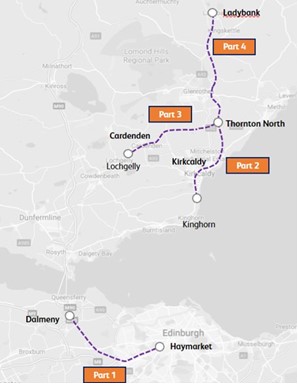
The electrification is split into four phases.
- Haymarket and Dalmeny – 25 km
- Kirkcaldy and Thornton North – 25 km.
- Lochgelly and Thornton North – 20 km.
- Thornton North and Ladybank – 34 km.
Note.
- The last three phases of electrification connect to Thornton North.
- The new rail link to Leven will also be electrified. and connected to Thornton North.
- The Forth Bridge is not to be electrified.
As Ladybank station is just 91.4 miles from Aberdeen, I suspect LNER will use Hitachi Intercity Battery Hybrid Trains to serve Aberdeen.
If these trains haven’t got the range, then I suspect LNER’s new CAF Tri-Mode Trains could handle the route.
Inverness
Inverness has a problem.
Zero-carbon trains will be unlikely to get to the city without full electrification of the Highland Main Line.
- Dunblane is the nearest electrified station to Inverness, but it is 146.2 miles away over a route with lots of steep climbs.
- I doubt that a battery-electric train could handle that route.
One solution would be for LNER to run the new CAF Tri-Mode Trains to Inverness using HVO or biodiesel.
Glasgow
Glasgow is the only other Scottish city with an airport and good rail connections to the South.
I am sure that Avanti West Coast will target airline passengers, if LNER prove it is a successful policy.
Other Factors
These are other factors, that will come into a traveller’s choice.
First Class
Some travellers like a bit more comfort and service.
Ability To Work
Some travellers like to work on a train.
You Don’t Get Tables On a Plane
I like to open a paper or magazine flat, which is difficult on a plane.
Views Tend To Be Better On a Train
Providing you get a window!
Parking Tends To Be Better At An Airport
But it may be more expensive!
Security Is Less Hassle On A Train
At the moment!
You Don’t Need To Prove Your Identity On A Train
Not in the UK! Yet!
Conclusion
It looks like LNER can offer the airlines to four of our major Northern cities serious zero-carbon competition.
Rockton To Buy Up To 40 Heart Aerospace ES-30 Electric Aircraft
The title of this post, is the same as that of this article on Aviation Source News.
These are the first two paragraphs.
Swedish investment and aircraft leasing company Rockton has confirmed that it will acquire up to 40 of Heart Aerospace’s regional electric aircraft, the ES-30.
The purchase confirmation converts an earlier letter of intent with the Swedish aircraft manufacturer into firm purchase orders for 20 aircraft with purchase rights for 20 more.
It’s good to see a leasing company getting involved, as it probably means that the finances are viable.
The Wikipedia entry for Heart Aerospace, describes the range of the ES-30 like this.
The ES-30 is planned to have a 108 nautical miles (200 kilometres; 124 miles) fully electric range or a 215 nmi (398 km; 247 mi) range when also using generators powered by aviation biofuel. A range of 430 nmi (800 km; 490 mi) could be possible if only 25 passengers are carried.
These are some UK airport to airport distances.
- Aberdeen – Kirkwall – 124 miles
- Aberdeen – Sumburgh – 188 miles
- Anglesey – Belfast – 109 miles
- Anglesey – Belfast City – 109 miles
- Anglesey – Cork – 192 miles
- Anglesey – Derry – 163 miles
- Anglesey – Dublin – 71 miles
- Anglesey – Ronaldsway – 58 miles
- Anglesey – Shannon – 186 miles
- Anglesey – Waterford – 130 miles
- Birmingham – Belfast – 226 miles
- Birmingham – Dublin – 200 miles
- Birmingham – Edinburgh – 250 miles
- Birmingham – Glasgow – 260 miles
- Birmingham – Inverness – 363 miles
- Birmingham – Kirkwall – 451 miles
- Birmingham – Newcastle – 178 miles
- Birmingham – Newquay – 198 miles
- Birmingham – Schipol – 402 miles
- Birmingham – Sumburgh – 513 miles
Birmingham – Wick – 418 miles - Edinburgh – Schipol – 473 miles
- Gatwick – Edinburgh – 356 miles
- Gatwick – Schipol – 374 miles
- Glasgow – Belfast – 106 miles
- Glasgow – Belfast City – 103 miles
- Glasgow – Derry – 121 miles
- Glasgow – Kirkwall – 221 miles
- Glasgow – Sumburgh – 300 miles
- Glasgow – Stornoway – 177 miles
- Haverfordwest – Waterford – 94 miles
- Haverfordwest – Newquay – 94 miles
- Heathrow – Newquay – 212 miles
- Humberside – Schipol – 333 miles
- Inverness – Kirkwall – 106 miles
- Inverness – Sumburgh – 190 miles
- Leeds – Schipol – 386 miles
- Liverpool – Belfast City – 151 miles
- Liverpool – Cardiff – 135 miles
- Liverpool – Dublin – 140 miles
- Liverpool – Haverfordwest – 127 miles
- Liverpool – Norwich – 180 miles
- Liverpool – Ronaldsway – 89 miles
- London City – Haverfordwest – 167 miles
- London City – Humberside – 145 miles
- London City – Manchester – 161 miles
- London City – Norwich – 100 miles
- Manchester – Schipol 413 miles
- Newcastle – Cardiff – 230 miles
- Newcastle – Belfast City – 168 miles
- Newcastle – Newquay – 346 miles
- Newcastle – Schipol – 395 miles
- Newquay – Brest – 140 miles
- Newquay – Cardiff 98 miles
- Newquay – Cork – 180 miles
- Newquay – Deauville – 241 miles
- Newquay – Dinard – 183 miles
- Newquay – Dublin – 212 miles
- Newquay – Guernsey – 128 miles
- Newquay – Jersey – 152 miles
- Newquay – Nantes – 211 miles
- Newquay – Orly – 351 miles
- Newquay – Rouen – 285 miles
- Newquay – Scillies – 68 miles
- Newquay – Waterford – 150 miles
- Norwich – Schipol – 277 miles
- Ronaldsway – Belfast – 75 miles
- Ronaldsway – Belfast City – 62 miles
- Ronaldsway – Birmingham – 165 miles
- Ronaldsway – Dublin – 80 miles
- Ronaldsway – East Midlands – 161 miles
- Ronaldsway – Glasgow – 123 miles
- Ronaldsway – Leeds – 121 miles
- Ronaldsway – Manchester – 109 miles
- Southend – Schipol – 180 miles
- Stansted – Aberdeen – 379 miles
- Stansted – Edinburgh – 316 miles
- Stansted – Glasgow – 334 miles
- Stansted – Inverness – 426 miles
- Stansted – Schipol – 335 miles
- Stansted – Wick – 472 miles
- Sumburgh – Bergen – 226 miles
- Sumburgh – Kirkwall – 85 miles
Note.
- I have included Schipol, as in certain areas of the UK, passengers sometimes fly long-haul from Schipol.
- I have included Haverfordwest, as it will be close to all the wind farm activity in the Celtic Sea.
- I have included Anglesey, as I think it has possibilities.
- The distances wee calculated using on of the Free Map Tools.
These are some more specific thoughts.
The Basic ES-30 And The UK
With a range of 124 miles, I don’t believe that the range is long enough for the UK.
But saying that there are some established routes, where it should be able to operate.
- Glasgow – Belfast
- Glasgow – Belfast City
- Glasgow – Derry
- Haverfordwest – Waterford
- Haverfordwest – Newquay
- Inverness – Kirkwall
- Liverpool – Haverfordwest
- Liverpool – Ronaldsway
- London City – Norwich
- Newquay – Cardiff
- Newquay – Scillies
- Ronaldsway – Belfast
- Ronaldsway – Belfast City
- Ronaldsway – Dublin
- Ronaldsway – Glasgow
- Ronaldsway – Leeds
- Ronaldsway – Manchester
These routes have the following in common.
- They are mostly between major airports with advanced facilities.
- Most airports served have access to renewable electricity.
- Some of the routes can support hundred seat airliners.
- Fifty percent go to the Isle of Man.
I can see several routes between the UK and the island of Ireland and to and from the Isle of Man using ES 30 aircraft.
The Extended Range ES-30 And The UK
The 247 mile range of the extended range ES-30, brings lots more routes into play.
Key routes could be the following.
- Aberdeen – Kirkwall
- Aberdeen – Sumburgh
- Anglesey – Cork
- Anglesey – Shannon
- Birmingham – Belfast
- Birmingham – Dublin
- Birmingham – Newcastle
- Birmingham – Newquay
- Glasgow – Kirkwall
- Glasgow – Stornoway
- Heathrow – Newquay
- Inverness – Sumburgh
- Liverpool – Belfast City
- Liverpool – Dublin
- Liverpool – Norwich
- London City – Haverfordwest
- London City – Humberside
- London City – Manchester
- Newcastle – Belfast City
- Newcastle – Cardiff
- Newquay – Brest
- Newquay – Cork
- Newquay – Deauville
- Newquay – Dinard
- Newquay – Dublin
- Newquay – Guernsey
- Newquay – Jersey
- Newquay – Nantes
- Newquay – Waterford
- Ronaldsway – Birmingham
- Ronaldsway – East Midlands
There will also be other routes.
The Extended Range With 25 Passengers ES-30 And The UK
The 490 mile range of the extended range ES-30 with only 25 passengers, brings a few more routes into play.
- Birmingham – Edinburgh
- Birmingham – Glasgow
- Birmingham – Inverness
- Birmingham – Kirkwall
- Birmingham – Schipol
- Birmingham – Wick
- Edinburgh – Schipol
- Gatwick – Edinburgh
- Gatwick – Schipol
- Glasgow – Sumburgh
- Humberside – Schipol
- Leeds – Schipol
- Manchester – Schipol
- Newcastle – Newquay
- Newcastle – Schipol
- Newquay – Orly
- Newquay – Rouen
- Norwich – Schipol
- Southend – Schipol
- Stansted – Aberdeen
- Stansted – Edinburgh
- Stansted – Inverness
- Stansted – Glasgow
- Stansted – Schipol
- Stansted – Wick
Note.
- All airports East of Birmingham and Manchester seem to be close enough to Schipol for an Extended Range ES-30 with 25 passengers to serve the route.
- Most major Scottish Airports can be reached from Stansted.
- Flying from Gatwick to Scottish Airports is around forty miles longer than flying from Stansted.
Liverpool Airport
Liverpool Airport could be a major destination for the ES 30, as it could be a key airport for flying between the UK and the island of Ireland.
Liverpool would obviously need the electric infrastructure, but I also believe it needs a better connection to the major railway station at Liverpool South Parkway, which has extensive rail connections.
This Google Map shows the area between Liverpool South Parkway station and the airport.

Note.
- Liverpool South Parkway station is marked by the red arrow in the North-West corner of the map.
- The airport is in the opposite corner, with the terminal to the North of the runway.
- The main railway between the South and Liverpool Lime Street passes to the South of the station.
- The A561 passes across to the South of the railway and to the North of the airport.
I suspect some form of people mover like the Luton DART can be built between the station and the airport.
It should be noted that as Hunts Cross has only one platform for Merseyrail Northern Line trains and this could be a factor in limiting the line’s capacity. So could a second platform be installed at the airport to both act as an airport station and to increase the frequency on the Northern Line?
I believe that in a couple of years, journey times between Euston and Liverpool South Parkway will be under two hours and they will only get shorter with High Speed Two. With a fast connection between the airport and the station, there could be a sub-three-hour zero-carbon route between London and the island of Ireland.
- Avanti West Coast Class 805 train to Liverpool South Parkway.
- People mover to the airport.
- Electric aircraft on the 140 miles to Dublin.
Dublin air traffic are usually efficient in getting planes in quickly.
Glasgow Airport
Glasgow Airport could be a major destination for the ES 30, as it could be a key airport for flying between the UK and the island of Ireland.
As with Liverpool Airport it needs a better connection to the rail network.
If Glasgow Airport is successful running zero-carbon aircraft to Ireland, this could change all previous thinking on a Glasgow Airport Rail Link.
Ronaldsway Airport
Geography and electric airliners could be very kind to Ronaldsway Airport and the Isle of Man.
- Electric airliners can easily reach much of the island of Ireland and the UK mainland between Glasgow and Birmingham, from Ronaldsway Airport with ease.
- The Isle of Man will in a couple of years be surrounded by wind farms.
- With other developments on the island, it could sell itself to the UK and Ireland, as a green holiday destination.
But what would the motorcycle enthusiasts say?
Anglesey Airport
I believe that Anglesey Airport could be brought to life in a big way by electric aircraft like the ES-30 or the Eviation Alice.
These are flight distances from Anglesey Airport.
- Anglesey – Belfast – 109 miles
- Anglesey – Belfast City – 109 miles
- Anglesey – Cork – 192 miles
- Anglesey – Derry – 163 miles
- Anglesey – Dublin – 71 miles
- Anglesey – Ronaldsway – 58 miles
- Anglesey – Shannon – 186 miles
- Anglesey – Waterford – 130 miles
All of these except for Cork, Derry, Shannon and Waterford would be possible in the basic ES-30.
This Google Map shows the airport, which is also labelled as RAF Valley.

Note that the North Wales Coast Line passes the site on the North-East side.
At present, Avanti West Coast trains take nearly four hours between London and Holyhead.
But later this year, new bi-mode Class 805 trains will replace, the current diesel only Class 221 trains.
- The current diesel only trains take two hours and five minutes between Crewe and Holyhead.
- The current diesel only trains take one hour and forty-three minutes between Crewe and London Euston.
- The fastest electric trains take one hour and twenty-nine minutes between Crewe and London Euston.
- High Speed Two trains will take 56 minutes between Crewe and London Euston.
When you consider that a lot of the North Wales Coast Line, is straight and flat, I can see the following times being possible, with some improvement and smart electrification between Crewe and Holyhead and a smaller number of stops.
- Crewe and Anglesey Airport – One hour and twenty minutes
- London Euston and Anglesey Airport – Two hours and fifty minutes
With High Speed Two Classic-Compatible trains, the London Euston and Anglesey Airport time could be below two hours and thirty minutes.
I believe that with a well-designed terminal at Anglesey Airport, this could be the fastest zero-carbon way between London and Ireland.
Haverfordwest Airport
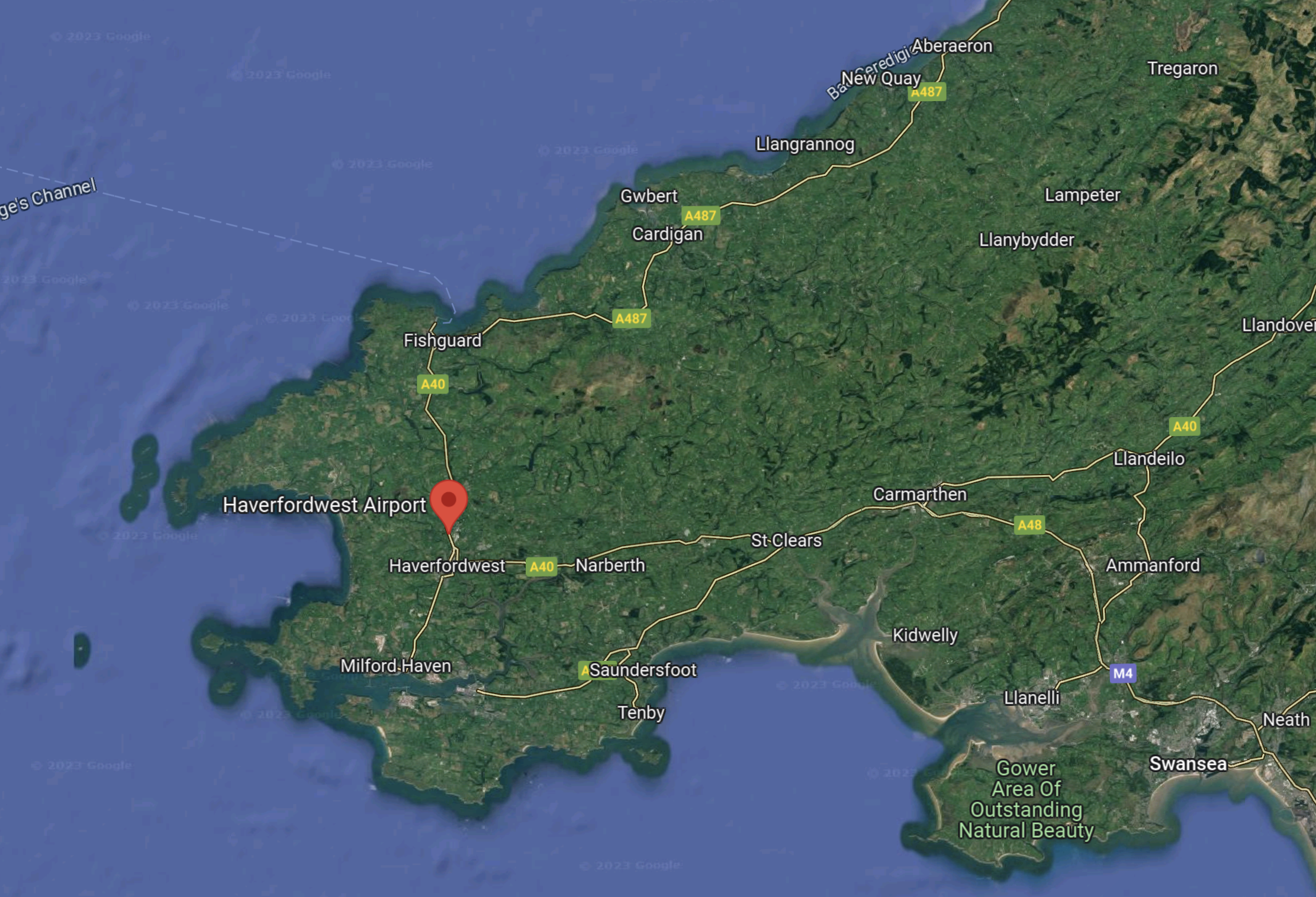
This Google Map shows the location of Haverfordwest Airport in the East of Pembrokeshire.
This second Google Map shows a close-up of the airport.

This map from OpenRailwayMap shows the airport and the nearest railway station.
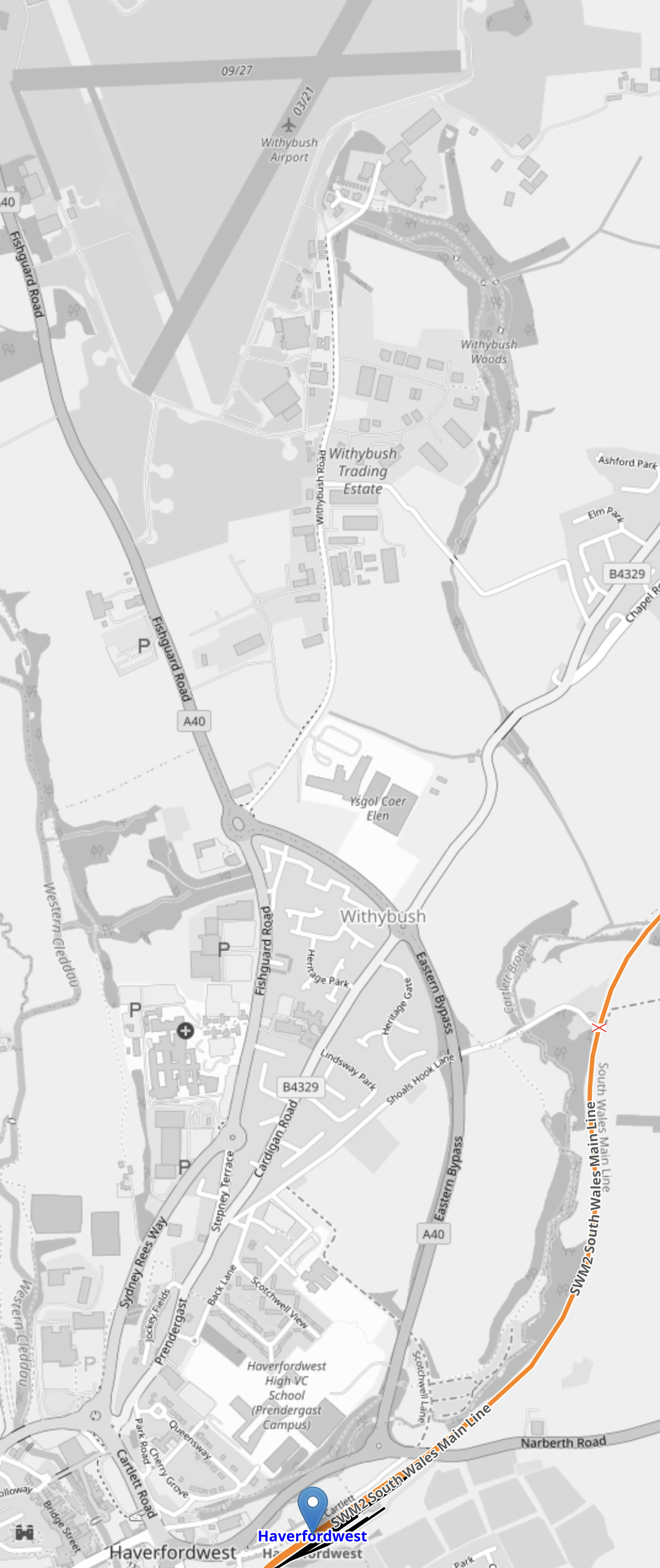
Note.
- Haverfordwest Airport is at the top of the map.
- Haverfordwest station is at the bottom of the map.
- There are rail connections to Cardiff, Fishguard, Milford Haven, Pembroke Dock and Swansea from the the station.
- Rail passengers for London would change at Swansea.
The road looks good between the airport and the station, so would an electric bus to handle transfers be ideal?
Consider.
- I have flown myself into Haverfordwest Airport and there were no navigation or operational problems that I can remember.
- With all the wind farm development planned for the coast of Pembrokeshire and the Celtic Sea, I feel that an airport in the area with regular flights to London and perhaps Waterford in Ireland could be essential.
- London City and Haverfordwest airports are 167 miles apart
- Waterford and Haverfordwest airports are 94 miles apart
- Quiet electric aircraft may ease any planning problems.
- Will a helicopter base be needed for serving wind farms in the Celtic Sea?
I believe, Haverfordwest Airport could be converted into a high-class airport for the Eastern tip of South Wales.
Haverfordwest Airport could also attract other services, given that the Welsh Government have a policy of not building new roads.
I have a feeling that quiet electric airliners will lead to the development of airports like Haverfordwest as feeder airports for the Heathrows and Schipols of this world.
Waterford Airport
Waterford Airport has recently been expanded and it appears from the Wikipedia entry, they are expecting more tourists.
This Google Map shows the position of the airport and the railway station in Waterford.

Note.
- The red arrow at the top of the map indicates Waterford station on the Northern side of the city.
- The airport is indicated by the blue dot in the South-East corner of the map.
- The airport is about ten kilometres from the City Centre.
In the past, Waterford has been quite a busy airport, but Covid-19 seems to have killed most of the traffic.
So could a zero-carbon service between Waterford and Haverfordwest be profitable?
- Those working with the wind energy in the Celtic Sea might find route useful.
- It would give a low-carbon route between Waterford and South Wales, which some might like.
- I also believe that the novelty of flying in an electric plane would attract passengers.
Waterford and Haverfordwest might be one of those routes, where electric planes might be worth trying.
This Google Map shows the Celtic Sea.
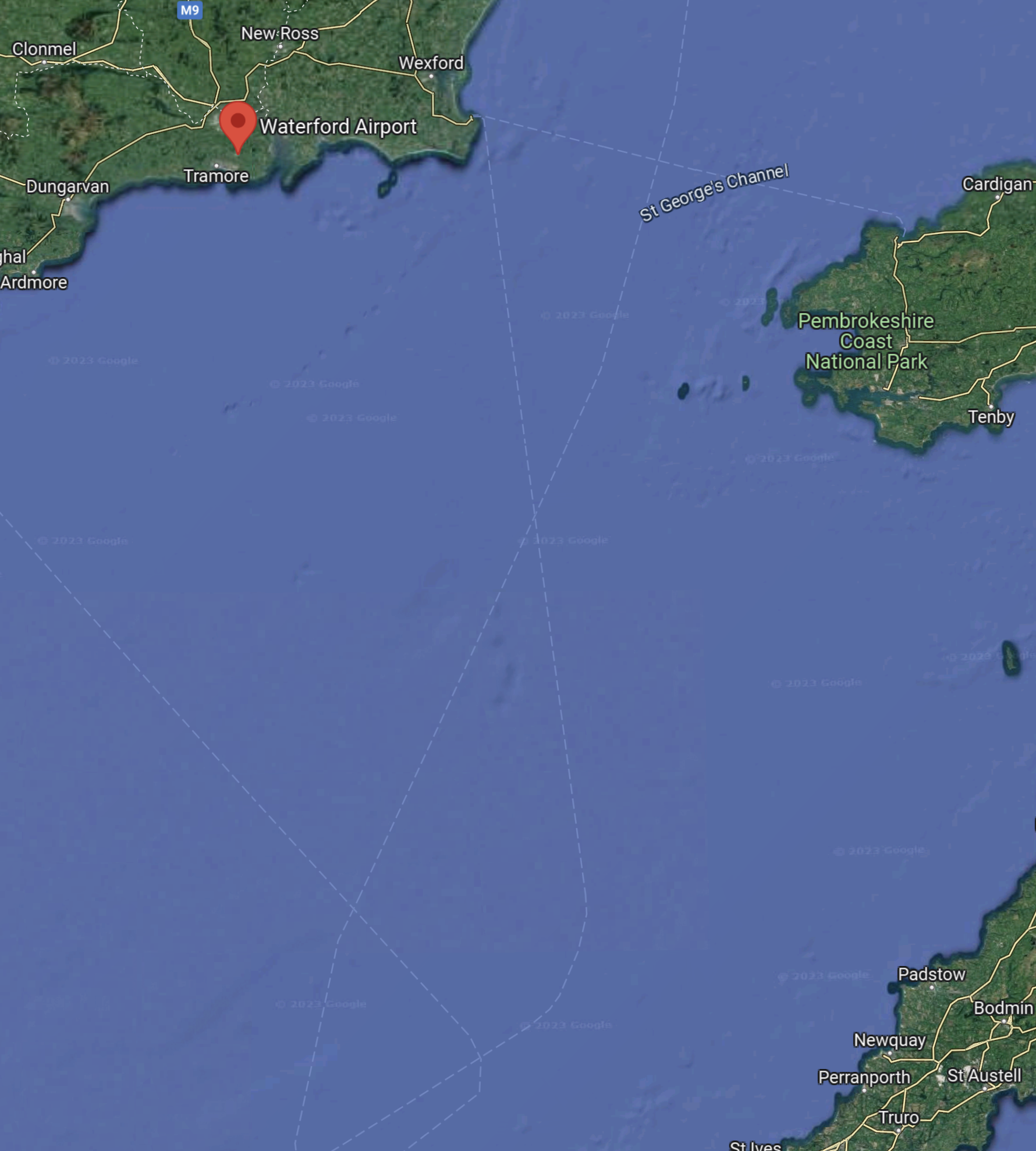
Note.
- Waterford Airport is indicated in red on the South-East corner of Ireland.
- Haverfordwest Airport is on the South-Western tip of Wales.
- Newquay Airport is in the South-East corner of the map on the North coast of Cornwall.
There could be as much as 50 GW of floating wind farms installed in this area.
I feel that there could be a case for a triangular Haverfordwest, Newquay and Waterford service.
Newquay Airport
Newquay Airport has been in the news recently because of the antics of Richard Branson and Virgin Orbit.
This Google Map shows the airport in relation to the town.
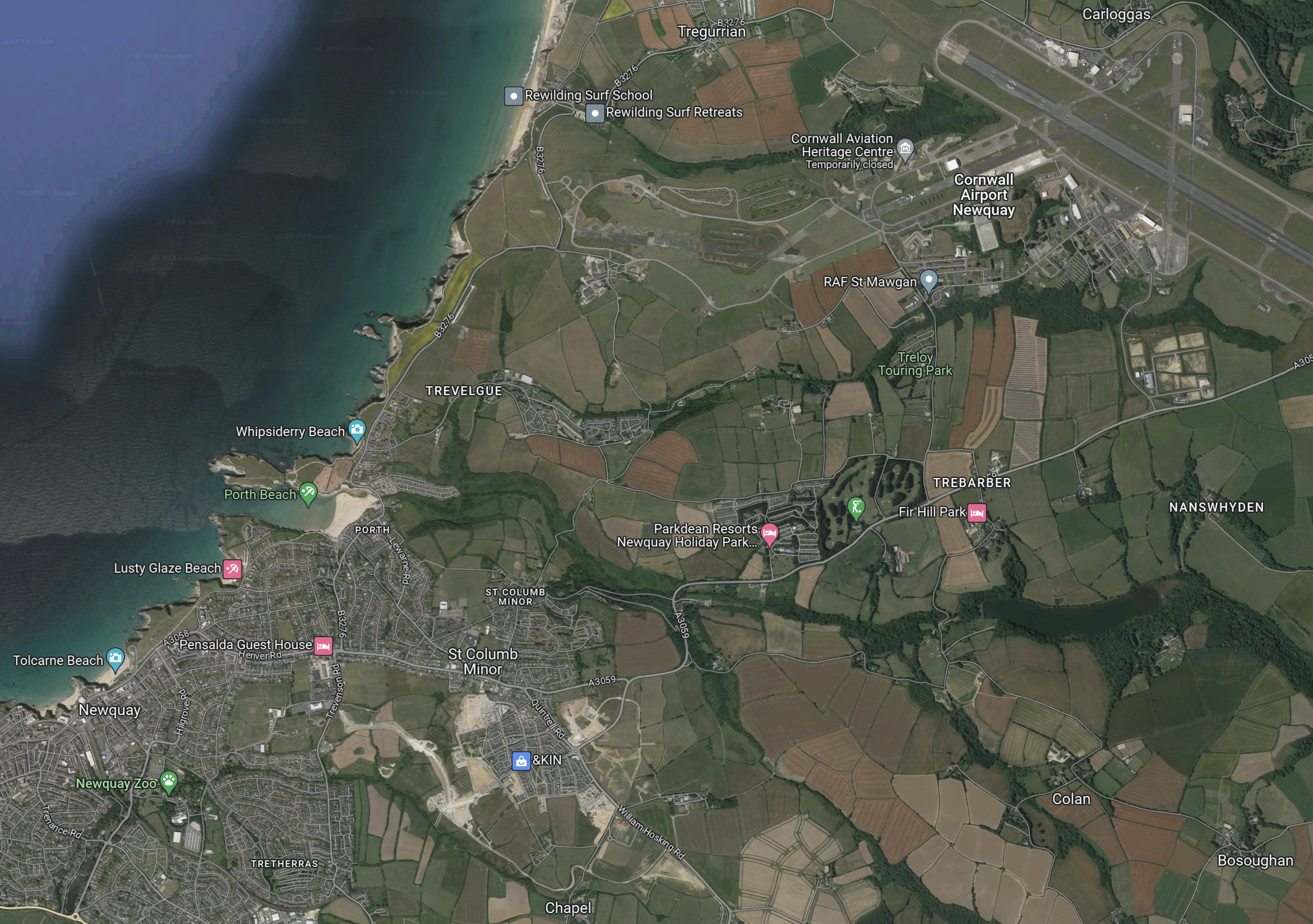
Note.
- The airport is in the North-East corner and boasts a long runway.
- The airport serves well over a dozen destinations.
- The town of Newquay is in the South-West corner of the map.
- Newquay station is by the sea.
All of these places would be suitable destinations for electric aircraft.
- Birmingham
- Brest
- Cardiff
- Cork
- Deauville
- Dinard
- Dublin
- Guernsey
- Heathrow
- Jersey
- Nantes
- Orly
- Rouen
- Scillies
- Waterford
Newquay Airport could get very busy with electric aircraft supporting tourism and the developing wind power industry.
This second Google Map shows the town centre and station.

Surely, having the station by Great Western Beach is good marketing.
In The Proposed Mid-Cornwall Metro, I talked about a plan to run an hourly Metro service between Newquay and Falmouth.
This article on Rail Technology Magazine is dated January 2023 and entitled Mid Cornwall Metro Secures £50m In Levelling Up Funding, where these are the first two paragraphs.
Following yesterday’s major Levelling Up funding announcement, the government has pledged an almost £50m grant to improve the railways linking Newquay, St Austell, Truro and Falmouth in Cornwall.
This financial aid to improve Cornwall Rail links represents the only successful bid out of four that were submitted to the Levelling up funding. The improvement scheme will be helmed by a partnership with Great Western Railway and Network Rail.
Note.
- I believe this means the Mid-Cornwall Metro will be built.
- Especially as looks like it will cost less than £100 million.
- As this Metro will serve Newquay, it shouldn’t be too difficult to link the plane with the train, with perhaps a zero-carbon bus.
- The Metro would then link Newquay Airport to the main population centres of Newquay, St Austell, Truro and Falmouth.
- If the Metro could be run using zero-carbon trains, that would surely put the icing on the cake!
The map from OpenRailwayMap shows the route.
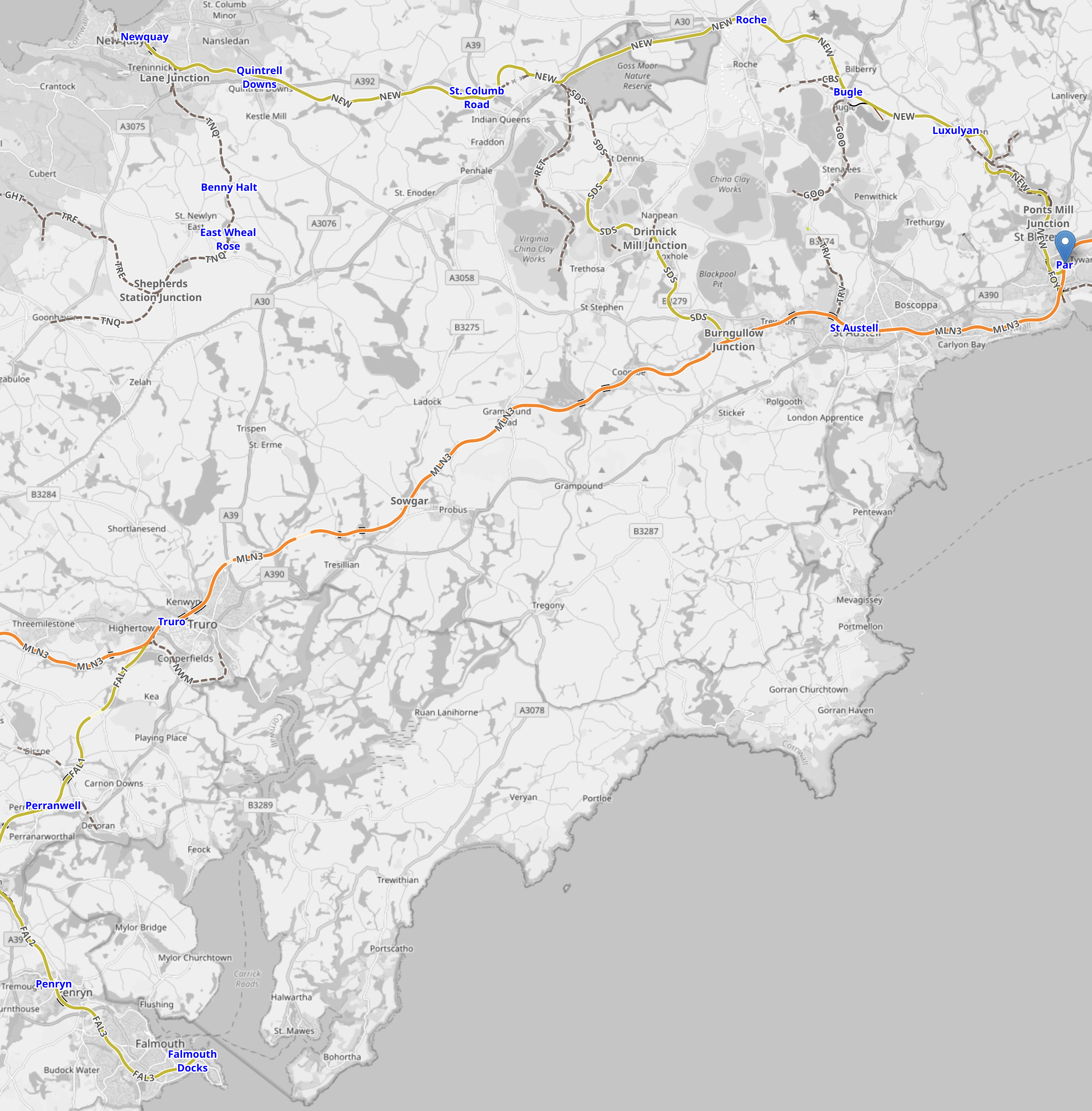
Note.
- Newquay is in the North-West corner of the map.
- Trains spend around 6-7 minutes waiting at Newquay.
- The blue arrow in the North-East corner marks Par station, where a chord will be reinstated to allow trains to go between Newquay and St. Austell.
- Par is the nearest station to the Eden Centre.
- Newquay and Par is 20.6 miles.
- The route, then goes along the Cornish Main Line, through St. Austell and then on to Truro.
- Par and Truro is 18.9 miles.
- At Truro the Metro would take the Falmouth branch.
- Falmouth and Truro is 11.8 miles.
- Trains spend around 7-8 minutes waiting at Falmouth Docks
- The total route is just over fifty miles, which probably means that battery-electric trains could work the route with charging at each end, whilst the train is turned round.
This airport and metro combination could give a big-boost to zero-carbon tourism.
Inverness Airport
Inverness Airport has recently been expanded with a station on the Inverness and Aberdeen Line.
Consider.
- Electric aircraft like the ES-30 will be able to reach both Kirkwall on Orkney and Sumburgh on Shetland from both Inverness and Aberdeen Airports.
- Sumburgh would need an extended range ES-30.
- Flights would be a few miles shorter from Inverness than from Aberdeen.
- Kirkwall and Sumburgh is only 85 miles, so there may be possibilities for serving both Orkney and Shetland with one flight.
- Extended range ES-30s might be able to do return trips to Kirkwall without a major charge at Kirkwall.
- I once flew in my Cessna-340 to Kirkwall to see the original turbine, that was placed on the island. There is a lot of cold forbidding sea in the area. Perhaps the slightly shorter trip from Inverness, might be better for everybody’s nerves?
- Just as the oil and gas industry did in the last century, I can see the offshore wind power industry generating a lot of passenger traffic to the Orkney and Shetland Islands.
Both Inverness and Aberdeen can be reached from Stansted by an ES-30 carrying a reduced passenger load.
Birmingham Airport
Birmingham Airport could become a major base for electric aircraft.
The 247 mile range of the extended range ES-30 would allow it to be able to reach the following places.
- Belfast
- Dublin
- Newcastle
- Newquay
- Ronaldsway
Reduce the passenger load slightly to 25 passengers and the plane would be able to reach.
- Edinburgh
- Glasgow
- Inverness
- Kirkwall
- Wick
But Birmingham Airport is only 65 minutes from Euston and will in the future be served by High Speed Two, in under an hour.
The airport also has a large catchment area of its own, who might be tempted to choose flying zero-carbon.
Spokes From Speke
In the 1980s, I went to a presentation from Royal Mail in Ipswich about guaranteed next day delivery of parcels. It was important to me, as I was writing software that needed to get from Ipswich, where it was created to London, where it would be tested and installed on customers machines. We also needed to get copies to our customers in Edinburgh and Aberdeen.
The Royal Mail’s latest concept of Spokes From Speke was described.
- All urgent parcels and First Class mail would be collected from the local sorting office and taken to the local airport, which in our case would probably have been Stansted.
- These consignments would then be flown to Speke Airport as Liverpool Airport was known in those days at around midnight.
- They would then be sorted and reloaded onto other planes to complete their journey.
- The planes would then return home and the parcels and mail would be delivered by truck to the local sorting office.
Aircraft used included Short Skyvans and piston-engined twins. Some we’re the quietest of aircraft.
I have heard or read somewhere that in some airports, there were complaints about noisy aircraft flying in and out in the middle of the night.
Now fifty years on companies are looking to speed up deliveries.
- In the UK, companies are experimenting with 100 mph overnight parcels trains.
- This article on Railway Gazette is entitled Varamis Rail Launches Regular Express Light Freight Service.
- Eversholt Rail are putting money behind converting redundant electric multiple units into parcel trains.
But DHL in the USA are going another way and have ordered twelve Alice aircraft from Eviation.
It looks like the cargo Alice could have a useful load of just over a tonne and a range of around 290 miles.
I can envisage flights of near-silent silent Alices sneaking into and out of airports in the middle of the night to deliver and collect urgent parcels.
Techniques like Spokes From Speke will come again, but this time with electric aircraft.
How Would The ES-30 Compare With An Eviation Alice?
The Wikipedia entry for the Eviation Alice gives these figures.
- Passengers – 9
- Maximum Speed – 300 mph
- Range – 290 miles
- Take-off distance – 840 metres
- Landing distance – 620 metres
Note.
- These are figures that most pilots would expect from an aircraft of this size.
- My Cessna 340 was about the same and about eight percent slower.
- It also had a much longer range.
If you look at my list of flights, these will not be possible.
- Birmingham – Inverness – 363 miles
- Birmingham – Kirkwall – 451 miles
- Birmingham – Schipol – 402 miles
- Bimingham – Sumburgh – 513 miles
Birmingham – Wick – 418 miles - Edinburgh – Schipol – 473 miles
- Gatwick – Edinburgh – 356 miles
- Gatwick – Schipol – 374 miles
- Glasgow – Sumburgh – 300 miles
- Humberside – Schipol – 333 miles
- Leeds – Schipol – 386 miles
- Manchester – Schipol 413 miles
- Newcastle – Newquay – 346 miles
- Newcastle – Schipol – 395 miles
- Newquay – Orly – 351 miles
- Stansted – Wick – 472 miles
- Sumburgh – Bergen – 226 miles
- Sumburgh – Kirkwall – 85 miles
Note.
- Most routes that are too long are to Schipol or Scotland.
- Anglesey appears to have Ireland extremely well covered.
- Birmingham, Glasgow and Liverpool keep their Irish routes.
- Newquay is still a hub, that would promote tourism in Cornwall and only loses the Orly connection, although it keeps the flight to Heathrow.
- Ronaldsway still looks to be a possible zero-carbon airport.
I would suggest that a range of 290 miles, is an ideal one for an electric aircraft in the UK, as it can handle a large number of routes.
These are routes that I feel would attract a large number of passengers.
- Anglesey – Belfast – 109 miles
- Anglesey – Belfast City – 109 miles
- Anglesey – Derry – 163 miles
- Anglesey – Dublin – 71 miles
- Glasgow – Belfast – 106 miles
- Glasgow – Belfast City – 103 miles
- Glasgow – Derry – 121 miles
- Heathrow – Newquay – 212 miles
- Inverness – Kirkwall – 106 miles
- Inverness – Sumburgh – 190 miles
- Liverpool – Belfast – 153 miles
- Liverpool – Belfast City – 151 miles
- Liverpool – Dublin – 140 miles
- Liverpool – Norwich – 180 miles
- Liverpool – Ronaldsway – 89 miles
- London City – Humberside – 145 miles
- London City – Manchester – 161 miles
- Newcastle – Cardiff – 230 miles
- Newcastle – Belfast City – 168 miles
- Newquay – Brest – 140 miles
- Newquay – Cardiff 98 miles
- Newquay – Cork – 180 miles
- Newquay – Deauville – 241 miles
- Newquay – Scillies – 68 miles
- Newquay – Waterford – 150 miles
- Norwich – Schipol – 277 miles
- Ronaldsway – Belfast City – 62 miles
- Ronaldsway – Dublin – 80 miles
- Ronaldsway – Glasgow – 123 miles
- Southend – Schipol – 180 miles
- Sumburgh – Kirkwall – 85 miles
Alice may not be big enough for some routes.
But it will be a wonderful route-proving aircraft for the larger ES-30 and other zero-carbon aircraft.
Conclusion
There will be a lot of uses for battery-electric aircraft in the UK.
Don’t Rule Out Rail Link Says Glasgow Airport Boss
The title of this post, as the same as that of this article on the Evening Times.
Surely, the Airport must know best what passengers want!
Scrapping Of Airport Link ‘Lack Of Ambition’ At The Heart Of Government
The title of this post is the same as that of this article on Rail Technology Magazine.
This is one of those sagas that rumbles on and on, with all those involved in the decision having different views on how to solve the problem.
I suspect a very experienced transport engineer and planner from Aberdeen, Cardiff or Liverpool, could tell the Glaswegians what they really need on the back of a used envelope.
But there are so many politicians grinding axes in the decision, that nothing sensible will ever happen.
One of my Glaswegian friends told me some years ago, that they should close both Edinburgh and Glasgow Airports and build a new rail-connected airport between the two cities.
Look at these distances
- London to Gatwick – 27 miles
- London to Stansted – 38 miles
- Edinburgh to Glasgow – 46 miles
Perhaps my friend has a point, as a shared airport would be closer to Edinburgh and Glasgow, than Gatwick and Stansted are to London.
But as someone, who has only ever used Glasgow Airport once, I think that Glasgow’s biggest rail problem is the two separate stations in the centre with no simple interchange.
I walk between the two,stations, but not everybody can.
Row Erupts Over Decision To Scrap Glasgow Rail Link For Transport Pods
The title of this post is the same as that of this article on Global Construction Review.
This is the first two paragraphs.
A row has broken out over a decision to cancel a direct rail link between Glasgow Airport and the town of Paisely, just east of Glasgow, in favour of exploring a self-driving transportation pod system.
The direct rail link was announced as part of a £1.1bn investment in the Glasgow City Region deal agreed in 2014 and was expected to be operational by 2025.
I am not sure, which system I prefer, but then I’m a rather different type of airport traveller.
- I generally travel alone.
- I rarely have anything more than a man-bag and a small hold-all.
- I want convenience and can easily walk up to a kilometre with my hold-all.
- I only fly Ryanair as an airline of last resort.
But what annoys me most, is if to get to the Airport, I have to scratch around buying a ticket for the link from the station to the Airport.
At all London Airports, except Luton, you buy a ticket to the airport station or use a contactless card.
Luton is introducing an automated shuttle between the airport and Luton Airport Parkway station and if it is not free, I’ll never use the airport.
A Tram-Train Rail Link
Edinburgh and Manchester Airports have tram links between the Airport and the City Centre, so I can’t see any problems with a tram-train link, that instead of dropping you on the street in the City Centre, as a tram would do, drops you in a railway station.
The way Manchester is thinking about tram-trains, I wouldn’t be surprised to see them at Manchester Airport.
Based on what I have seen in Sheffield, I don’t believe there would be any serious problems developing a tram-train link to Glasgow Airport..
However, these could be issues.
- Is there enough spare capacity on the Inverclyde Line?
- The tram-train link would go to Paisley Gilmore Street and Glasgow Central stations, but what if your local train service to Glasgow goes to Glasgow Queen Street station.
Would many people still use their cars to get to the Airport?
A Pod System
I wrote about the proposed pod system for Glasgow Airport in An Innovative Scheme For A Rail Link To Glasgow Airport.
It has its plus points, but I worry that getting the right number of pods to provide a good service might be tricky.
Would many people still use their cars to get to the Airport?
IThe Connection In Glasgow
Glasgow’s problem is that both these links connect into the centre of Glasgow at Glasgow Central station.
So if your connection to Glasgow comes into Glasgow Queen Street station, you will have to hump your bags across the City Centre.
A plan has existed for years to create Crossrail Glasgow, which would make matters easier.
But nothing has so far been decided.
Conclusion
There is no point in building any form of link to Glasgow Airport, unless Crossrail Glasgow is built.
Otherwise, passengers with an indirect route to Glasgow Central station will still drive or avoid the airport entirely.
Procrastination Over Airport Rail Links
This article in the Glasgow Evening Times is entitled Glasgow Airport Rail Link: Fresh Fears Over Plans As MSP Slams Delay.
The title says it all.
Of the airports in the UK, the following have or will have good rail or tram links.
- Birmingham
- Cardiff
- Edinburgh
- Gatwick
- Heathrow
- London City
- Luton – Building a people-mover between the airport and station.
- Manchester
- Newcastle
- Southampton
- Southend
- Stansted
In addition, the following airports have been talking about rail links.
- Belfast City
- Bristol
- East Midlands
- Glasgow
- Leeds/Bradford
- Liverpool
In fact they’ve been talking about rail links for decades.
As I started with a report about Glasgow, if you want to see how they have taken two decades to get nowhere, read the Wikipedia entry for the Glasgow Airport Rail Link.
The latest £144million plan involves tram-trains running from Glasgow Central station.
Currently, of the airports, that have talked for years, I believe the following could use tram-train technology to provide the airport rail link.
- Bristol
- East Midlands
- Glasgow
- Leeds/Bradford
- Liverpool
Now that tram-trains are working well in Sheffield and have been ordered for the South Wales Metro, surely this technology can be considered almost mainstream for the UK.
In the specific case of Glasgow the following would be needed.
- Modification of platforms at Glasgow Central and Paisley Gilmour Street stations, so they would give level-access to the tram-trains.
- Creation of a single-track spur to the airport without electrification, that ends in a single platform, close to or in the airport terminal.
- A fleet of Class 399 tram-trains with a battery capability, as have been ordered for the South Wales Metro.
- Improved signalling to handle the extra trains.
Note.
- Space should be left, so that in the future, the airport spur could be doubled.
- A flat junction would probably work initially, but provision for a flying junction for the spur should be made.
- Currently, four trains per hour (tph) run past the Airport.
- Could the tram-trains be built to give level access to standard height platforms, so that no substantial modification of existing platforms would be needed?
It also strikes me, that this could be a privately funded scheme.
- Glasgow Airport is ultimately owned by Ferrovial and Macquarie Group, who will be the main beneficiary of the scheme.
- Both Ferrovial and Macquarie Group are companies that invest in infrastructure.
- The Class 399 tram-trains can obviously be leased.
So what’s the problem?
- Network Rail are against the scheme, as it’s not one of theirs.
- The Scottish government won’t sanction a privately-funded scheme.
- Various interests want a different scheme.
- The jury is still out on tram-trains.
- It’s a scheme for Glasgow and the decision is taken in Edinburgh.
- Glasgow would get a better airport link than Edinburgh.
Enlighten me!
Other Airport Links
Once Glasgow is completed, other airport links could be built using the same techniques.
I have a feeling, that another airport will get a tram-train link before Glasgow!
Architect Produces Longest Moving Walkway Alternative To Tram-Train Glasgow Airport Link
The title of this post is the same as that of this article in The Herald.
The world’s longest travelator would link a new station on the Inverclyde Line to the Airport.
This Google Map shows the Airport and the rail line.
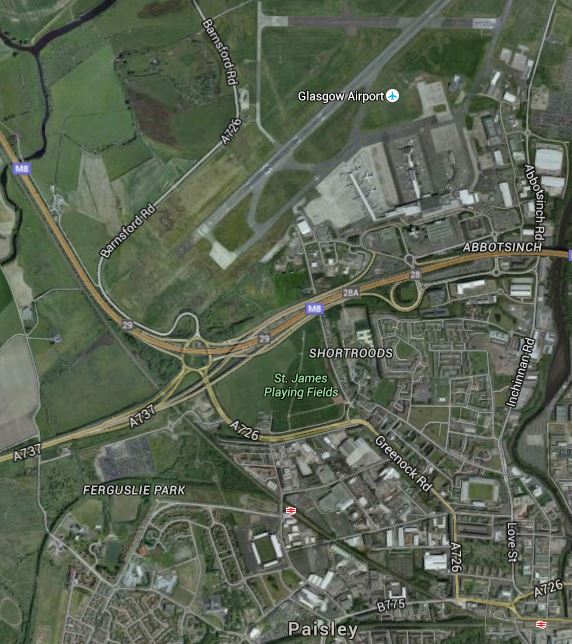
The railway runs at right-angles to the runway alongside the M8 motorway. The station in the middle of the map is Paisley St. James station.
The article says the station will be built near the Ferguslie Park housing estate in Paisley. It is marked on the map to the West of Paisley St. James station.
These are my thoughts on the plan.
Ferguslie Park Station
This enlarged map shows Ferguslie Park, the complicted motorway junction and Paisley St. James station.
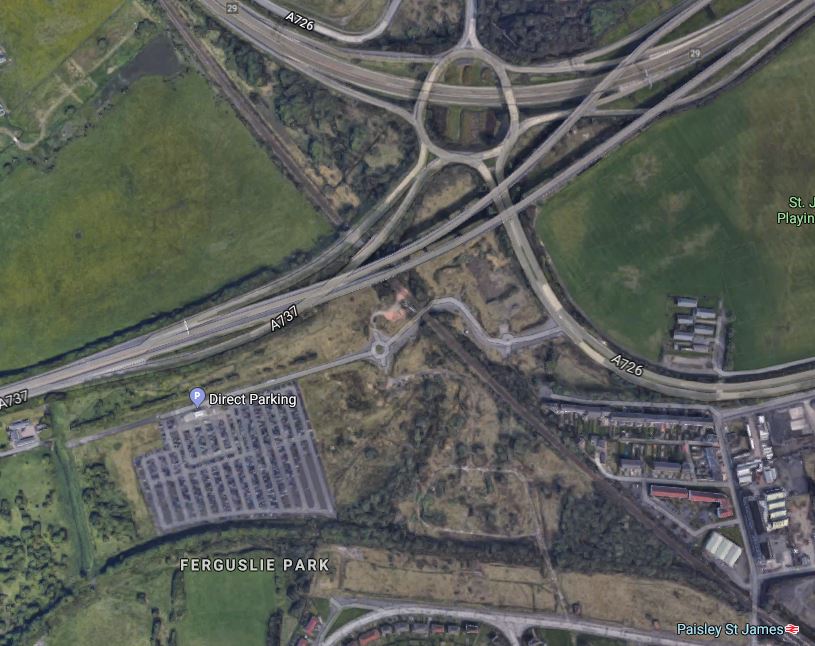
From the look of this map, it would appear that there used to be a triangular junction here. Where did that railway go?
The position will have to chosen with care, as it can’t be too near to Paisley St. James station and in a position that allowed an easy connection to a travelator to and from the Airport.
Frequency Of Trains
Airports around the UK have these numbers of trains in each hour.
- Birmingham has upwards of eight trains in both directions.
- Edinburgh has six trams.
- Gatwick has four Express services and will have ten Thameslink services in both directions.
- Heathrow has four Express services and will have at least four Crossrail service.
- Luton has seven trains in both directions.
- Manchester has nine trains and twelve trams.
- Newcastle has at least four Metro trains.
- Stansted has four Express services.
Surely, the service to Ferguslie Park must have a frequency of at least four trains per hour!
This would not be unobtainable, as the two termini of Gourock and Wemyss Bay stations have enough capacity.
The Long Travelator
I believe a long travelator would work, but I do think it would have to be designed carefully in sections for Health and Safety reasons.
My real reservations are that after my visit to Paisley St. James station, which I wrote about in Paisley St. James Station, I do wonder how passengers will like a travelator link.
- The area is fairly bleak, for a wait of up to fifteen minutes.
- Inside a tram would be more comfortable.
- There would need to be a step-free bridge at the new station.
In my view it would like a cheap option, that would be difficult to expand.
Using A Tram-Train
Since the travelator plan was published in the Herald, Stadler have launched tram-trains with a battery capability for the South Wales Metro.
These could do the following as a minimum.
- Run between Glasgow Central and Paisley Gilmour Street stations using the 25 KVAC overhead electrification.
- Run a frequency of four tram-trains per hour on a bi-directional single-track spur without electrification to a single platform at the Airport.
- Run between Paisley St. James station and the Airport on batteries, that would be charged between Glasgow Central and Paisley Gilmour Street stations.
- Stop at Paisley Gilmour Street station to change power source.
- Handle 230 passengers in each tram-train.
The system could also be expanded if needed.
- The tram-trains could work in pairs.
- The spur could be double track.
- A second platform could be built at the Airport.
This could handle up to eight tram-trains per hour.
Is Glasgow A World City?
Probably not yet!
Consider.
- Glasgow hosted the Commonwealth Games in 2014.
- Glasgow hosted the European Games in 2018.
- It has the facilities to handle World Championships in many sports.
- It has two football teams, that regularly play in European competitions.
- Hampden Park has hosted six European football finals.
At least on the wider sporting front, it can be considered an important city, that is on a par with Manchester in England.
And I think it will soon be recognised as a World City!
For this reason alone, the Airport needs a proper rail service, rather than a travelator to a bleak station.
Other Airports
The following Airports in the UK need a decent rail link.
- Bristol
- East Midlands
- Leeds
- Liverpool
A similar tram-train link could be provided in a similar manner at these airports and probably many others around Europe and the rest of the World.
Conclusion
I will be very surprised, if Glasgow Airport doesn’t get a tram-train link, that uses batteries.
Glasgow Looks To Venice With Water Taxi Service To Airport
In Wikipedia, there is a section called Venice of the North. Included in the list of thirty-seven cities are the likes of Ansterdam, Birmingham, Copenhagen, Gdansk, Lubeck, St. Petersburg and Stockholm.
But surely Amiens, Colmar, Manchester, Skipton and various places I’ve never heard of, is taking the list too far!
The title of this post is the same as an article in the Scotsman, about a Glaswegian, who intends to start a water taxi service to Glasgow Airport.
This Google Map shows Glasgow Airport, which has the Black Cart Water to the North and the White Cart Water to the East.
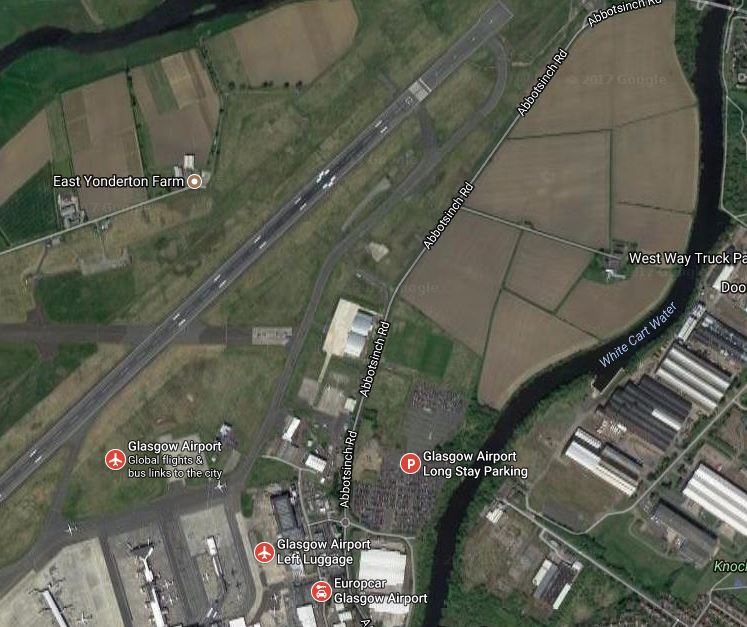
The two waters join to the North of the Airport and then flow into the River Clyde.
This is proposed.
- The boat terminal at the airport would be on a pontoon on the White Cart Water, about five hundred metres East of the airport.
- Transfer from the airport to boat would be initially by golf buggy.
- The trip to the City Centre would take 25 minutes by fast boat.
It’s the sort of plan, that if carried out with style could work very well!
This Google Map shows the River Clyde through Glasgow.
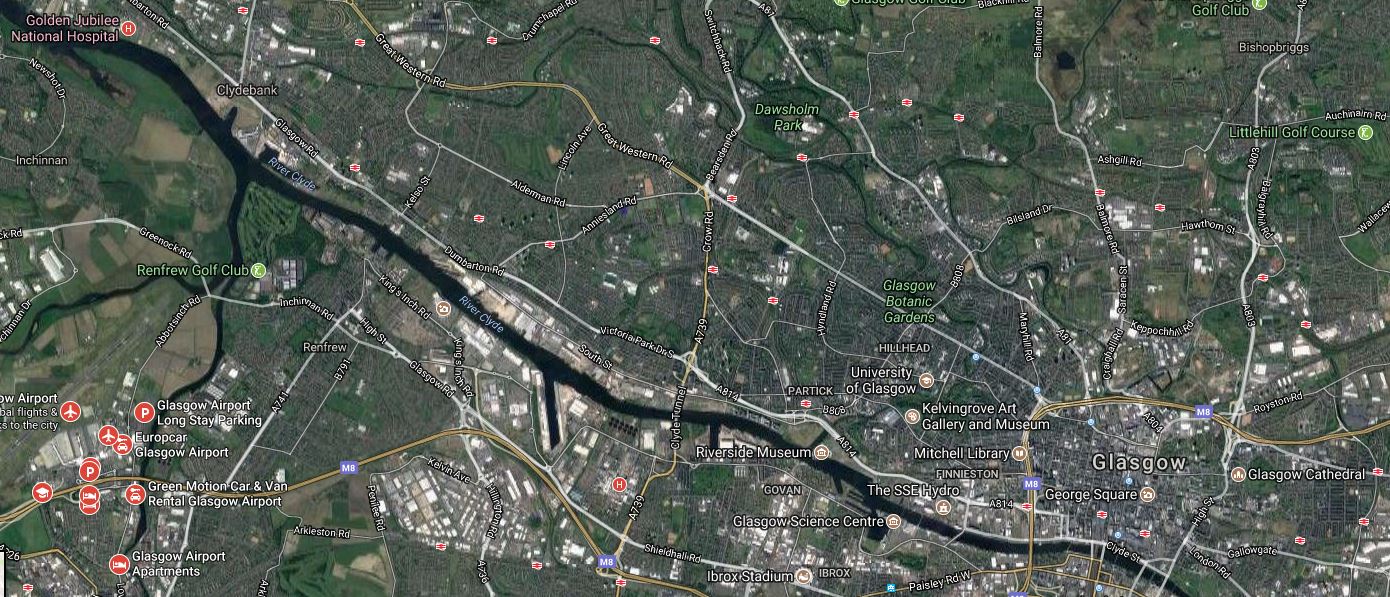
Unlike the Thames through London, it appears to be straight.
The Airport is at the West of the map between the fork of the Black and White Cart Waters.
It was always thought that river buses on the Thames wouldn’t work, but over recent years, the Thames Clippers seem to have made a success of it.
Perhaps someone will make the same concept work in Glasgow.
Conclusion
I wish the guy well and I suspect that in a few years, the Clyde will be an important commuter, tourist and sairport route.
It just needs the right design of boat.
 The Anonymous Widower