Huddersfield Station – 30th September 2025
This press release on the Network Rail Media Centre is entitled Huddersfield Station Set To Reopen Next Week With New Temporary Layout.
As it is now next week, I went to have a look at the progress today.
I made a mistake and got on a Grand Central Train, which meant, I had to change at York.
Speeding past Drax power station on the Selby Diversion, I took these pictures.
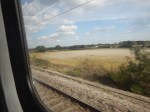
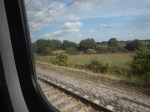
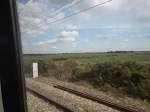
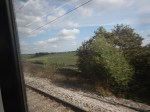

We were only in a 125 mph diesel, so we couldn’t take advantage of the 160 mph running, that the East Coast Main Line’s new signalling might allow on this section. The Wikipedia entry for the Selby Diversion, says this about the possible speeds.
The line was the first purpose-built section of high-speed railway in the UK having a design speed of 125 mph; however, research by British Rail in the 1990s indicated that the route geometry would permit up to 160 mph operation, subject to the necessary overhead line equipment and signalling upgrades. The new line also avoided the speed restriction over the swing bridge at Selby. The former ECML route, the NER’s 1871 York and Doncaster branch line, was closed from Selby northwards.
As the Selby Diversion opened in 1983, I wouldn’t be surprised that the calculations were performed on British Rail Research’s Pace 231-R, which was similar to the one I used at ICI and the pair, that NASA used calculate how to land Apollo on the moon.
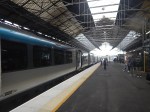
When I eventually got to Huddersfield, I took these pictures.
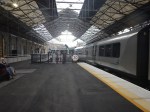
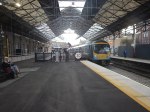
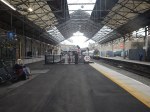
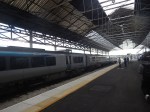
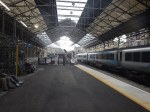






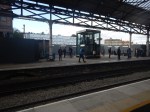
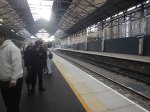
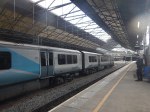
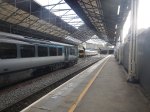
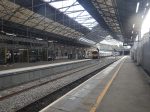
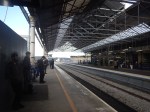
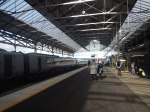
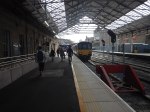
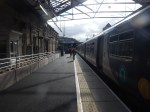
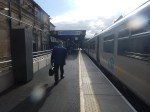
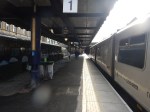
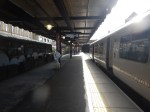
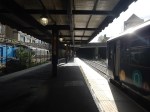
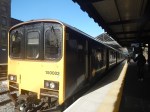
Note.
- In I’ve Just Glimpsed The Future Of Train Travel Across The North Of England And I Like It, there are pictures of Huddersfield station, that were taken on the 21st August, soon after the work started.
- In Huddersfield Station – 15th December 2023, there are pictures of Huddersfield before the work started.
- Much of the work seems to have been done at the Western end of the station to lengthen the platform on the Penistone Line to Sheffield.
- Platform 2 for the Penistone Line has also been renumbered Platform 1.
Work still to be carried out at Huddersfield station, includes refurbishing the roof, installing the electrification and adding a couple of new platforms.
These are my thoughts.
Which Platforms Will Be Electrified?
This OpenRailwayMap shows the proposed electrification in Huddersfield station.
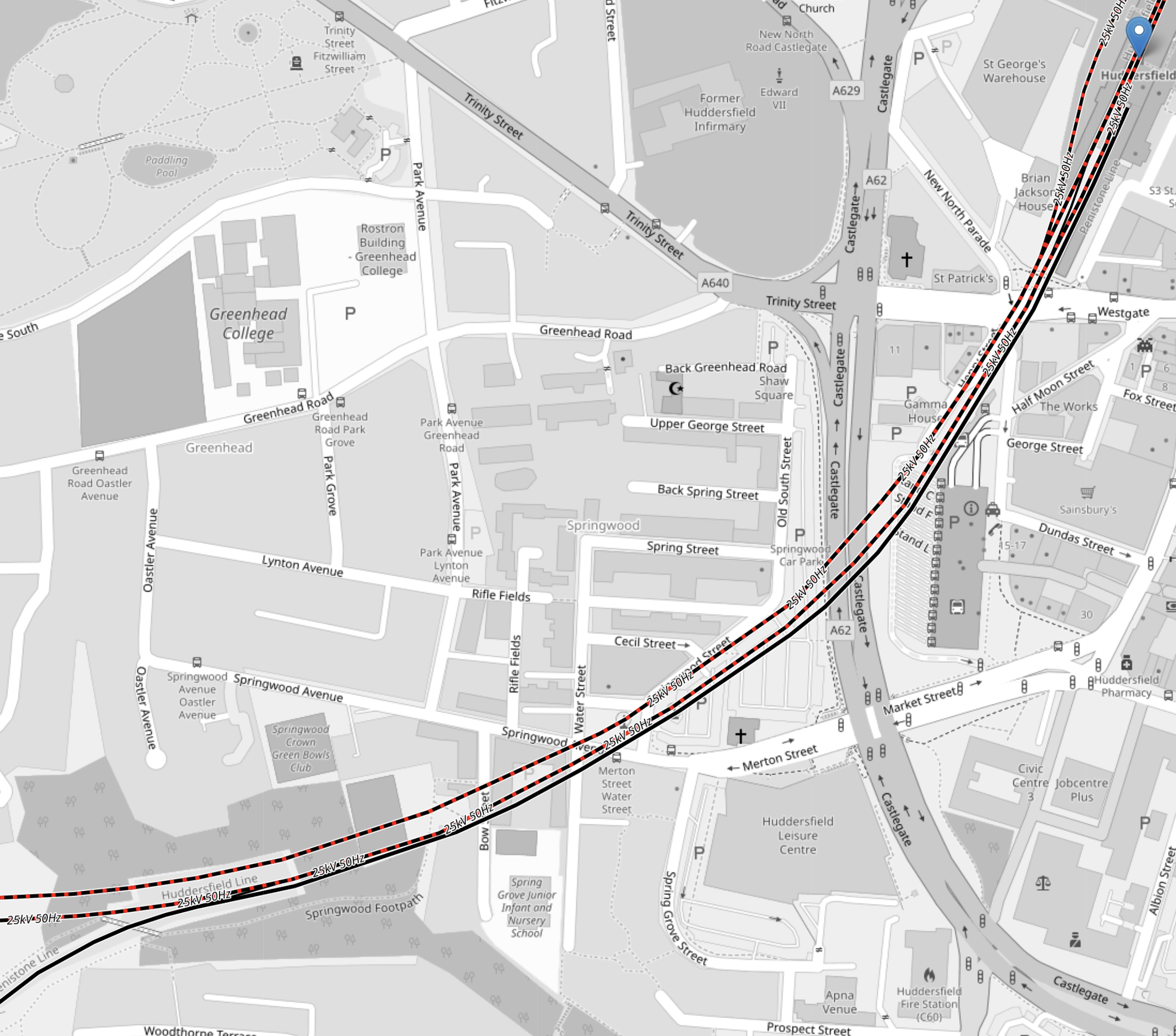
Note.
- The blue arrow in the North-East corner of the map indicates Huddersfield atation.
- The two red-and-black tracks going diagonally across the map are the Hudderfield Line.
- The red-and-black colour, indicates that the two tracks will be electrified.
- South of these two tracks, the Penistone Line sneaks into Platform 1 at Huddersfield station.
- The Penistone Line goes to Sheffield in a South-Westerly direction.
- There appears to be a crossover, so that trains from the Penistone Line can use both Platforms 1 and 2 in Huddersfield station.
- The OpenRailwayMap appears to show planned electrification between Stalybridge and Leeds stations.
- To the East of Leeds planned electrification is shown as far as Micklefield and Church Fenton stations.
Once installed, this electrification will create a complete electrified route across the Pennines from Liverpool Lime Street in the West to the East Coast Main Line in the East.
This OpenRailwayMap shows the planned electrification between Micklefield and Hull stations.
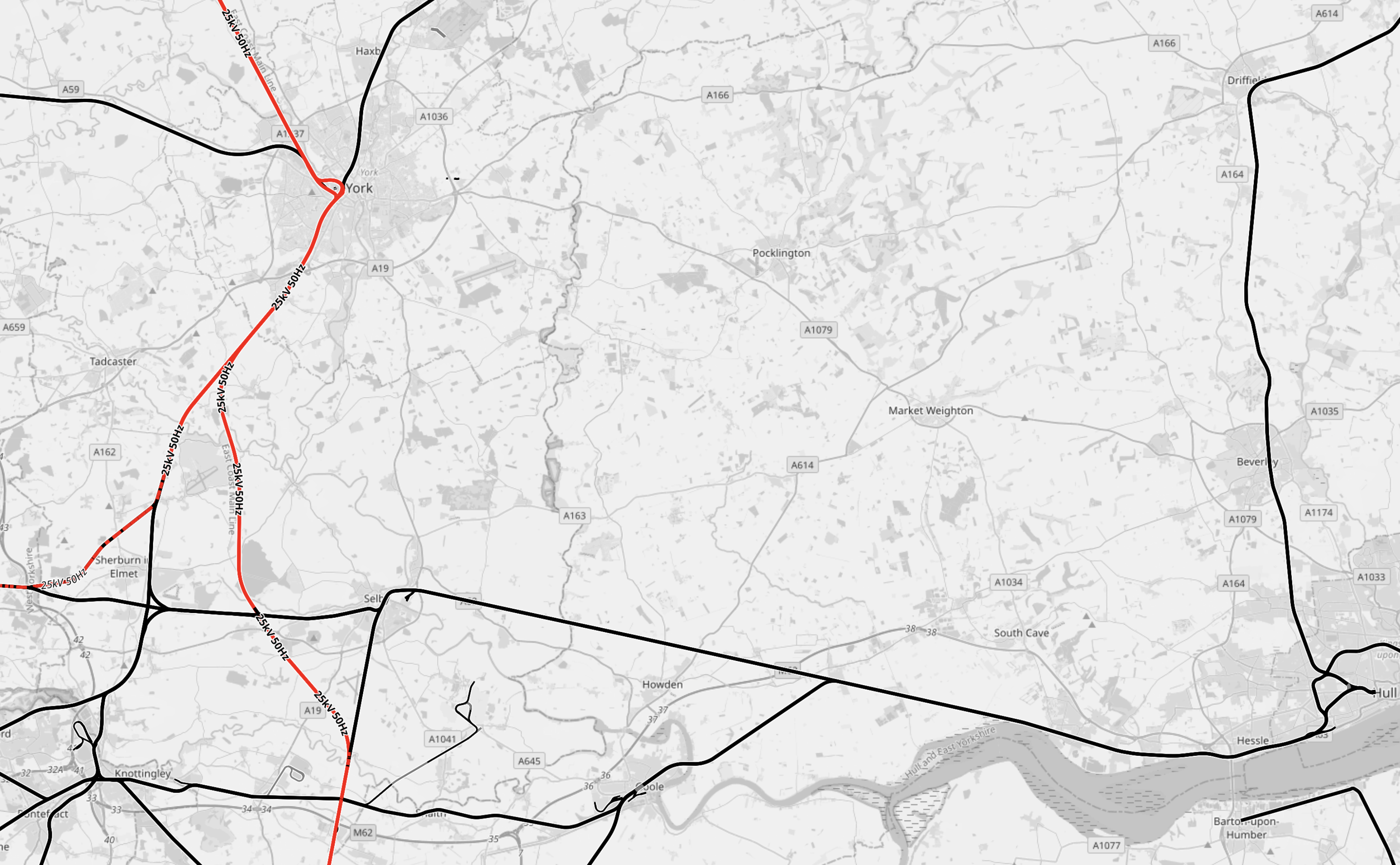
Note.
- Red tracks are electrified.
- Black tracks are not electrified.
- York is in the North-West corner of the map, with the electrified East Coast Main Line going through the station North-South.
- South of York, the East Coast Main Line now splits.
- The Western branch includes an electrified line to Micklefield station, Neville Hill depot and Leeds station.
- The Eastern Branch is the Selby Diversion, which is an electrified 160 mph line, that avoids the Selby coalfield.
- Running West-East across the map is the unlectrified Micklefield and Hull Line, which goes via Selby.
- Hull is in the South-East corner of the map.
- Hull is 42 miles from Micklefield and 36.1 miles from the Temple Hirst junction on the Selby Diversion, so it is within range of battery-electric trains, with charging at Hull station.
- Hitachi’s battery-electric Class 802 trains, used by Hull Trains and TransPennine Express, which are currently on test, should certainly be able to serve Hull.
Hull can become an electrified station, without the expense and disruption of full electrification.
How Long Is Platform 1 At Huddersfield Station?
This OpenRailwayMap shows the new Platform 1 at Huddersfield station.
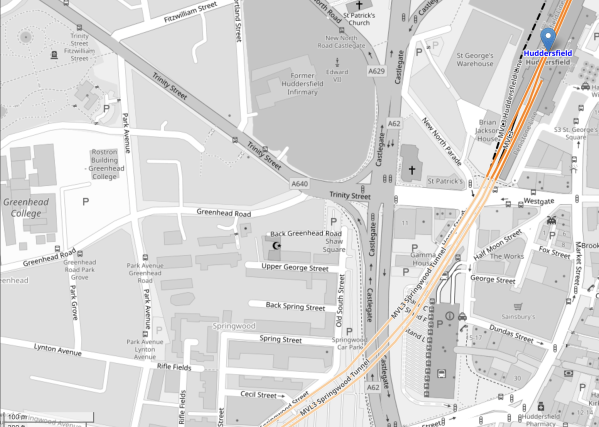
Note.
The blue arrow indicates Huddersfield station.
- The three darker orange lines indicate the two through platforms 2 and 3, and the reconfigured bay platform 1.
- There is a cross-over between platforms 1 and 2, which connects Platform 2 to the Penistone Line.
- In the South-West corner of the map is a hundred metre scale.
- Using the scale, I estimate that the length of the bay platform 1 is around 120 metres.
- In the last two rows of pictures in the gallery of this post, a three car Class 150 train is shown in Platform 1.
- A three car Class 150 train is approximately sixty metres long.
Looking at the pictures, I wouldn’t be surprised if the new platform has been designed to take two three-car Class 150 trains. It would certainly take a pair of two-car Class 150 trains.
Other trains and their lengths that might use the platform include.
- Class 170 – three-car – 70.85 metres
- Class 195 – two-car – 48.05 metres
- Class 195 – three-car – 71.40 metres
- Class 195 – 2 x two-car – 96.10 metres
- Class 810 – five-car – 120 metres
The Class 810 uses 24 metre cars, so that a pair of trains, will fit in St. Pancras. But with perhaps selective door opening could a single Class 810 train run a St. Pancras and Huddersfield service, perhaps with a split and join at Sheffield.
Electrification Across The Pennines
The TransPennine Route will be electrified between Liverpool Lime Street and Micklefield stations, once the current works between Huddersfield and Leeds are complete.
Sections without electrification include.
- Bradford Interchange and Doncaster – 52.1 miles
- Cleethorpes and Doncaster – 52.1 miles
- Harrogate and Leeds – 18.3 miles
- Hazel Grove and Doncaster – 52.6 miles
- Hull and Micklefield – 42 miles
- Hull and Temple Hirst junction – 36.1 miles
- Saltburn and Northallerton – 28.1 miles
- Sunderland and Northallerton – 46.8 miles
- Scarborough and York – 42.1 miles
I expect that Hitachi trains with batteries or CAF’s tri-mode trains will be able to handle these routes in a low-carbon manner.
Electrification Between Stalybridge And Huddersfield
This section is shown as being electrified on OpenRailwayMap.
But as it is only 18 miles and includes the Standedge Tunnels will the route use battery-electric trains?
New Direct Rail Link To Seaham: How This Picturesque Seaside Town Will Connect To London Starting December 2025
The title of this post is the same as that of this article on Travel and Tour World.
This is the first paragraph.
Starting December 2025, the picturesque seaside town of Seaham in County Durham will become even more accessible with a new direct rail link to London. This marks an exciting chapter in the town’s history, as Seaham’s first direct rail service will make it easier for tourists and business travelers alike to visit this charming coastal destination. Known for its stunning clifftop vistas, rocky beaches, and no fewer than 10 fish and chip shops, Seaham is already a popular spot for day-trippers, and this new rail service will only add to its appeal.
This section in the Wikipedia entry for Seaham station, gives the current rail services from the town.
As of the May 2021 timetable change, the station is served by an hourly service between Newcastle and Middlesbrough. Most trains continue to Hexham (or Carlisle on Sunday) and Nunthorpe. Two trains per day (three on Sunday) continue to Whitby. All services are operated by Northern Trains.
With Grand Central trains, serving Seaham four times per day in each direction, Seaham could be a very convenient place to explore the North-East of England.
If the timing of the services is right, Seaham could also become popular with visiting football fans at Middlesbrough, Newcastle and Sunderland, wanting to combine an away match with a weekend away.
This Google Map shows the town.
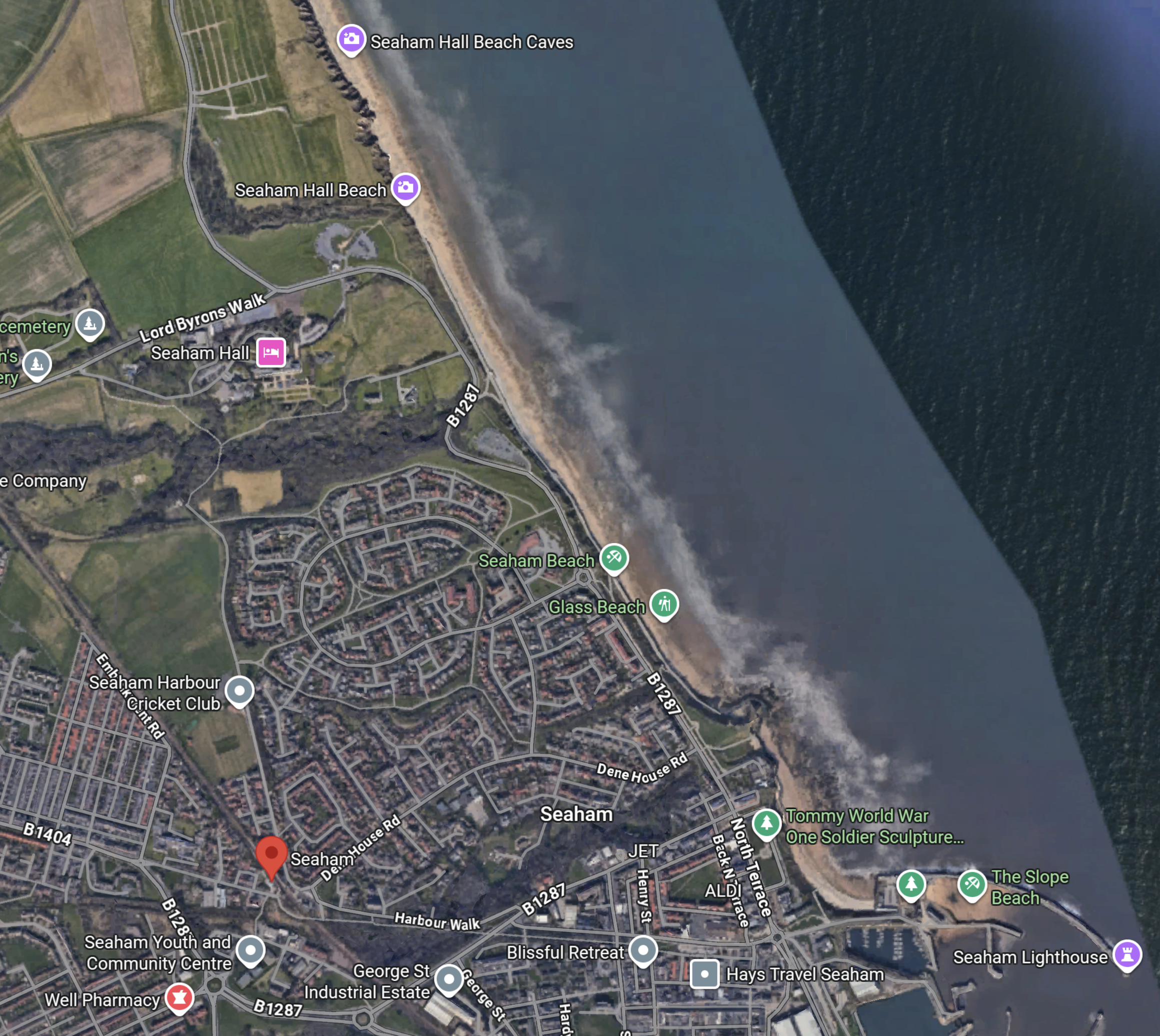
Note.
- The station is indicated by the red arrow.
- Beaches stretch along the town.
- There is a port with a lighthouse.
- There is even a 5-star hotel; Seaham Hall on Lord Byron’s Walk. The hotel has 21 suites and a spa.
- I can certainly see the hotel having a zero-carbon mini-bus meeting all eight Grand Central Trains.
I don’t think Grand Central Trains will be short of passengers on this route. Especially as from 2028, they will serving the town with new Hitachi battery-electric trains.
Conclusion
How many other towns in the UK could benefit from a four trains per day service to London?
Do Hitachi Battery Electric InterCity Trains Have Problems?
I asked Google the question in the title of this post and got this answer.
While Hitachi’s battery-powered intercity trains have shown promising results in trials, particularly regarding fuel savings and emissions reduction, there are some potential challenges and considerations. These include safety concerns related to lithium battery fires, especially in the event of a crash or derailment, as well as range limitations for longer journeys. However, the technology is continuously evolving, and Hitachi is actively working to address these issues.
That seems fairly positive.
There is also this article on the BBC, which everybody should read, which is entitled Will New Battery-Powered Trains Replace Diesel, And Are They Safe?.
In The Data Sheet For Hitachi Battery Electric Trains, I look at the data sheet, that Hitachi published in late 2023.
These were my conclusions about the data sheet.
These are my conclusions about Hitachi’s battery packs for Class 80x trains, which were written in November 2023.
- The battery pack has a capacity of 750 kWh.
- A five-car train needs three battery-packs to travel 100 miles.
- A nine-car train needs five battery-packs to travel 100 miles.
- The maximum range of a five-car train with three batteries is 117 miles.
- The maximum range of a nine-car train with five batteries is 121 miles.
As battery technology gets better, these distances will increase.
Hitachi have seen my figures.
They also told me, that they were in line with their figures, but new and better batteries would increase range.
125 mph trains with a 120 mile range on batteries, would revolutionise UK train travel.
LNER’s Class 897 Trains
In the Wikipedia entry for LNER, this is said about LNER’s new ten CAF tri-mode trains.
In November 2023, LNER placed an order for 10 ten-car tri-mode (electric, diesel and battery power) Civity trains from CAF. In August 2024, it was announced that the units will be designated Class 897 under TOPS.
According to their Wikipedia entry, it appears the Class 897 trains will be delivered from 2027.
Can I Build A Schedule For The Introduction Of New Trains, Services and Batteries?
I think that I can from the information that is out there.
- East Coast Main Line – December 2025 – Introduction of Lumo between London King’s Cross and Glasgow
- West Coast Main Line – Spring 2026 – Introduction of Lumo between London Euston and Stirling
- Midland Main Line – 2026-2027 – Introduction of EMR Class 810 trains between London St. Pancras and Leicester, Derby, Nottingham and Sheffield.
- East Coast Main Line – From 2027 – Introduction of LNER Class 897 trains between London King’s Cross and Yorkshire.
Note.
- The two Lumo services use trains already in service.
- The Class 810 trains for EMR are being debugged and introduced at the present time.
- The only new trains are the Class 897 trains for LNER.
- The introduction of the Class 897 trains will allow LNER to withdraw some trains for refurbishment and fitting of batteries.
This would mean that before the next general election, almost the full timetable between London and the North of England and Scotland would have been implemented using diesel-electric technology.
Is it a low-risk start to the full electrification of services to the North?
The second-phase would see battery-electric trains introduced.
I believe that Grand Central’s new trains would be brought into service first.
- The new trains are scheduled to be introduced in 2028.
- Grand Central will still have the diesel trains for backup.
- Their new trains would be similar to the other Hitachi trains.
- It looks like they could be doing some splitting and joining.
After the Grand Central trains had been introduced successfully, the trains for the other Hitachi operators would have batteries fitted.
I suspect short routes like Lincoln would be electrified with battery-electric trains first.
There would also need to be short lengths of electrification erected, so that trains could be charged to send them on their way.
Other routes could also be electrified in the same way.
- Basingstoke and Exeter
- Birmingham and Aberystwyth
- Bristol and Penzance
- Cardiff and Swansea
- Crewe and Holyhead
- Edinburgh and Aberdeen
- Edinburgh and Inverness
- Reading and Taunton
- Swindon and Gloucester
If this technique could work for main lines, surely a scaled down version with smaller trains would work for branch lines.
Conclusion
Consider.
- It looks to me, that someone has planned this thoroughly.
- It all fits together extremely well.
It could be the first phase of a cunning plan to use battery-electric trains to electrify the UK’s railways.
Passengers will also see benefits, from when Lumo runs its first train into Glasgow Queen Street station.
I don’t think Hitachi’s trains have any problems, but there is enough float in this plan to make sure, it can be implemented on time and on budget.
Batteries Ordered For Grand Central Inter-City Trains
The title of this post, is the same as that of this article on Railway Gazette.
These three paragraphs add detail to the article.
Hitachi Rail has selected Turntide Technologies to supply lithium iron phosphate batteries for use on electric-diesel-battery hybrid inter-city trainsets it is to build for Arriva’s open access operator Grand Central.
Nine five-car trainsets are to be manufactured at Hitachi Rail’s Newton Aycliffe factory for delivery in 2028 under a order placed by leasing company Angel Trains in March.
Under the latest agreement announced on July 2 Hitachi Rail will place orders worth nearly £10m for Turntide to continue with R&D and supply next-generation LFP batteries, which are designed to be smaller and more powerful than previous lithium-ion batteries. The Safety Integrity Level 2 and IEC 61508 compliant battery management system will detect and mitigate hazards and meet the IEC 62243 cybersecurity standard.
There is also this paragraph, which describes the benefits of the trains.
The battery technology is expected to cut the Grand Central trains’ emissions and fuel consumption by around 30%, with the trains entering and exiting stations in zero-emission mode to improve air quality and reduce noise in urban centres.
Angel Trains, Grand Central, Hitachi Rail and Turntide Technologies seem to be playing this all carefully, as I suppose that they don’t want to be left with a large problem, if the current government decides to take over open access services.
An Extreme Day Out – Bradford Forster Square Station
It seems to be the fashion to go and visit somewhere far away in a day. So why not?
For my first trip in this vein, I decided on the spur of the moment to go to Bradford Forster Square station.
Why Did I Choose Bradford Forster Square Station?
There are three main reasons.
- A new platform has just opened at the station to handle the longest LNER trains.
- LNER are now running a seven trains per day (tpd) service via Leeds.
- I wanted to see how LNER’s walk-up ticketing performed on the route.
In addition, I wanted to see how the service performed, now that Bradford is this year’s UK City of Culture.
King’s Cross To Bradford Forster Square Station For £43.00 With A Railcard
I just missed the 11:03, so I booked the 13:03 for £43.00 with my Senior Railcard, from one of the numerous ticket machines in King’s Cross.
The train arrived on time in two hours 47 minutes for the 199.4 miles, which was an average speed of 72 mph.
In What Will Be The Fastest Times Possible Between London King’s Cross And Leeds?, I predicted this.
I wouldn’t be surprised to see with full digital signalling and a 125 mph average between London King’s Cross and Leeds.
- 125 mph Base Time – 89 minutes.
- Four Acceleration/Deceleration sections at 6 minutes each – 24 minutes.
- Three Dwell Times at 2 minutes each – 6 minutes
This would mean a total time of one hour and 59 minutes.
As my Bradford service took two hours and 28 minutes between London King’s Cross And Leeds, that would mean, that a time close to two hours and fifteen minutes could be possible between London King’s Cross and Bradford Forster Square stations.
There Weren’t Many Passengers Between Leeds And Bradford Forster Square Stations
These pictures show the nearly empty train and the small numbers, who alighted at Bradford Forster Square station.
But I don’t think three in the afternoon is a time, when many passengers will need to go between Leeds and Bradford Forster Square stations.
Bradford Forster Square Station
I described that station, with its new Platform 0 in Bradford Forster Square Station – 20th May 2025, where I said the station needed these additions.
The station needs a few additions, like a proper coffee shop, a better shop, ticket machines and toilets.
But it’s not been open very long.
Bradford Forster Square Station To King’s Cross For £25.70 With A Railcard
I bought this ticket from a Yorkshire Lass in the Ticket Office.
There Weren’t Many Passengers Between Bradford Forster Square And King’s Cross Stations
Only about a dozen passengers boarded the train at Bradford Forster Square and some got out at Leeds.
In fact the train wasn’t very busy all the way to London with perhaps twenty passengers in my carriage, when we arrived in King’s Cross.
Will This Service Develop Into A Two-Hourly London King’s Cross And Leeds Or Bradford Forster Square Service With A Trans-Yorkshire Service Tacked On?
Currently, it is the following.
- An express service between King’s Cross and Leeds with stops at Peterborough, Doncaster and Wakefield Westgate.
- An express service between King’s Cross and Bradford Forster Square with stops at Peterborough, Doncaster, Wakefield Westgate and Leeds.
- A local service between Doncaster and Bradford Forster Square with stops at Wakefield Westgate and Leeds.
- Additional calls on some services are at Stevenage, Grantham, Retford and Shipley.
In addition the following would be possible.
- Pairs of trains could split at Leeds, with one train going to Bradford Forster Square and the other train to somewhere like Harrogate, Huddersfield or Skipton.
- Additional stops could be added between Leeds and Bradford Forster Square without slowing services between Leeds and King’s Cross.
But then where does this fit with LNER buying ten CAF tri-mode trains?
Surely they would get better flexibility, if they’d bought more Azumas, which could run on the electrification all the way to Bradford Forster Square, Huddersfield and Skipton. If some had batteries, they could run all the way to Harrogate.
LNER’s Disabled-Unfriendly Refreshments System
I am not disabled, but I only have one fully-working hand, as the school bully broke my left humerus and I have difficulty doing certain things with my left hand, due to the quality of the care I received in Highlands Hospital in Winchmore Hill.
Having a left-sided stroke didn’t help either.
One of the things, I can’t do is take pictures on my mobile phone, so I always carry a proper camera. Because of the injury, I have also never read a QR code with my phone.
On LNER’s trains to get a drink, you either have to order it by reading a QR code or walking to the buffet.
As on the train going North, the buffet was closed, I went thirsty.
In future, if I have a choice of trains, I’ll choose one with a trolly service.
Are The CAF Tri-Mode Trains Part Of A Plan To Drive Open Access Operators Out Of Yorkshire?
This is possibly the only scenario that makes sense.
The ten-car tri-mode trains would be used to take over Grand Central’s services to Bradford Interchange and Sunderland, and Hull Trains services to Hull.
After Monday, LNER are now running more daily services to Bradford Forster Square, than Grand Central are to Bradford Interchange.
If like my return to London on Tuesday, you can buy a walk-up ticket on LNER, then why would you travel on Grand Central.
Conclusion
£68.70 is not a bad price for what is in effect a walk-up day return to Bradford Forster Square.
I’ve just looked how much, I would be charged for an advance ticket on Friday, using the trains I used on Tuesday.
I could get a ticket for £25.70 going North and £28.95 going South or a total of £54.65. All are with my Senior Railcard.
But it does look to me, that LNER and the Government are trying to drive Grand Central off the Bradford route.
If I am right and Hull Trains and Lumo will be next in LNER’s sights, then what was Starmer and other Government ministers doing at the launch of orders for new trains for Grand Central, Hull Trains and Lumo?
After 104 Years UK’s Longest Train Route Is Cancelled For Ever
The title of this post, is the same as that of this article on The Times.
These three paragraphs describe the last journey.
With a muted fanfare the UK’s longest train rolled out of Aberdeen on Friday morning for its final sojourn down to Penzance, ending a service that connected both ends of the country for more than 100 years.
The 8.20am CrossCountry train took 13 hours and 20 minutes, with stops at 35 stations along the way, to cover the 774-mile route. Passengers spent more than two hours of the journey in the stations.
The service, which was launched in 1921, headed south through York, Bristol, Taunton and Truro on its way past some of the country’s finest landscapes, and arrived in Penzance at 9.31pm.
Looking at a ticket site and it appears that by using two trains from Aberdeen to King’s Cross and Paddington to Penzance you can be a few minutes faster, if you know your Underground.
This route will get quicker.
- As the East Coast Main Line rolls out its new digital signalling, this should speed up trains, by allowing some running at 140 mph instead of the current 125 mph.
- LNER will also be bringing their new tri-mode (electric/battery/diesel) trains into service, which could give some speed improvements on the diesel section North of the Forth Bridge in terms of speed and ride noise, especially as ScotRail will be partially electrifying part of this section.
- GWR should also be upgrading some of their fleet to tri-mode, which should improve speed and ride noise on the sections, where the route is not electrified.
- CrossCountry could compete, by buying new trains, but it would be a big financial risk, as the London route should get quicker, as track improvements and increased use of digital signalling speed up services from London to Aberdeen and Penzance.
CrossCountry ‘s owner; Arriva isn’t standing still, but have applied for extra Grand Central open access services on the East Coast Main Line to Scunthorpe and Cleethorpes and a new service from Newcastle to Brighton via Birmingham, which will partly fill the gap caused by the loss of the Aberdeen and Penzance service, by linking with GWR at Reading and LNER at Newcastle.
Arriva Group Submits Open Access Rail Application To Connect Newcastle And Brighton, Via London Gatwick
The title of this post, is the same as that of this press release from Arriva Group.
These three bullet points act as sub-headings.
- New services operated by Arriva’s Grand Central would introduce a direct rail connection between the Northeast and Midlands to London Gatwick and the South Coast.
- Making better use of available network capacity, the proposed route would connect underserved communities in the UK and enhance long-distance connectivity without the need to interchange through London.
- The application reflects Arriva’s wider European strategy to connect people and places through sustainable transport solutions, strengthening regional economies and supporting modal shift.
This introductory paragraph provides more details.
Arriva Group has today announced it is submitting an open access application to the Office of Rail and Road (ORR) to introduce a new direct rail service between Newcastle and Brighton, via London Gatwick, providing vital connectivity for underserved communities along the route.
Other points to note include.
- There will be five trains per day in each direction.
- The proposed service would call at Durham, Darlington, Northallerton, York, Doncaster, Sheffield, Derby, Burton-on-Trent, Birmingham New Street, Warwick Parkway, Banbury, Oxford, Reading, Wokingham, Guildford, Redhill, London Gatwick and Haywards Heath.
- The service would be operated by Grand Central.
- The service could be introduced from December 2026.
It will be the be the first direct service between Newcastle and Brighton.
This final paragraph outlines where the service fits in Arriva’s wider philosophy.
The plans are part of Arriva Group’s broader commitment to strengthening regional connectivity and making better use of available rail capacity. By opening up new travel corridors, Arriva is helping to connect more people to jobs, education and leisure opportunities – and to encourage a greater shift from private cars to public transport.
There are certainly plenty of places in Europe, that could use a service like this one between Brighton and Newcastle.
In The Ultimate Open Access Service, I describe a possible open access service between Amsterdam and Hamburg, which is about the same distance as Brighton and Newcastle, which is 372.8 miles by Arriva’s proposed route.
These are some of my thoughts in no particular order.
A High-Class Service Between Oxford And Brighton Could Be An Interesting Development In Its Own Right
Governments, rail operators and passenger groups of all persuasions and flavours have warmly welcomed the planned reopening of the rail route between Oxford and Cambridge.
I suspect an Oxford and Brighton service would be equally welcomed.
Brighton may not be an academic powerhouse yet, but it does have one thing that Oxford and Cambridge lack ; the sea.
Gatwick Airport Will Surely Welcome The Extra Connectivity
Gatwick Airport will expand and extra rail services will do the following for the airport.
- Make it easier to get the planning permission for the second runway.
- Make it easier for passengers and airport and airline staff to get to the airport.
- Surely, the more direct rail connections the airport has, will increase the likelihood, that families and other groups, will choose to fly from Gatwick.
- More train services could cut the amount of car parking per flight needed at the airport.
Gatwick Airport station has recently rebuilt and added extra capacity, so I doubt there will be trouble accommodating another ten trains per day.
Would The Army Welcome The New Service?
Two of the British Army’s main training areas are in North Yorkshire and in Surrey.
Would they find a train service between the two areas useful?
What Trains Will Grand Central Trains Use For The New Service?
In Arriva Group Invests In New Battery Hybrid Train Fleet In Boost To UK Rail Industry, I talked about how Grand Central will be acquiring Hitachi trains for their routes between London and Bradford and Sunderland.
- These will be Hitachi tri-mode trains.
- The trains will have a range of over forty miles on batteries.
- They will probably be serviced in Yorkshire or the North-East.
- The trains will be built by Hitachi at Newton Aycliffe, with batteries from Turntide Technologies in Sunderland.
- The first trains will be delivered in 2028.
As Arriva intend to start services from December 2026, they would probably use diesel trains to start with.
I would expect that Grand Central would go for a unified fleet, which would mean more Hitachi tri-mode trains.
For convenience, they could all be serviced at Doncaster, which all Grand Central services will pass through.
What Sections Will Not Be Electrified Between Brighton and Newcastle?
As far as I can see from OpenRailwayMap, the following sections of the route are not electrified.
- Two sections of the North Downs Line – 29 miles.
- Didcot and Birmingham New Street – 80.9 miles
- Birmingham New Street and Derby – 41.3 miles
- Derby and Sheffield – 36.4 miles
- Sheffield and Doncaster – 18.4 miles
Note.
- Electrification South of Reading will be third rail, so some trains will need to have third-rail shoes.
- The length without electrification is a total of 206 miles.
- As Newcastle and Doncaster, Redhill and Brighton, Reading and Didcot, and Birmingham New Street station are all electrified, the longest sections the trains would run without electrification would be between Didcot and Birmingham New Street and between Birmingham New Street and Doncaster.
- The planned electrification between Derby and Sheffield would make life easier.
It appears that trains capable of handling a hundred miles of unelectrified railway are needed.
Hitachi have shown that a five-car train with one battery will travel 70 km (43.5 miles) on a full battery, so one with three batteries should be able to manage the hundred miles needed in a few years.
Will Any Extra Electrification Be Needed?
I think Birmingham New Street station will be the critical point.
- The next electrification on the route to the South of Birmingham New Street is at Didcot, which is 80.9 miles away.
- The next electrification on the route to the North of Birmingham New Street is at Doncaster, which is 96.1 miles away.
These battery ranges should be possible, but an alternative would be to provide an electrified platform at one or more intermediate stations to be safe.
Stations that could be equipped to the South would include Oxford and Banbury and to the North would include Burton-on-Trent, Derby and Sheffield.
Perhaps electrifying a single platform at these stations, should be the first thing to be done, so that battery-electric trains can run on some useful routes as soon as they are delivered and approved.
Electric Trains, Even Battery-Electric Ones, Will Be Quick Off The Mark
Electric trains have good acceleration and I wonder, if this acceleration will enable stops, that are not feasible with diesel trains to be fitted in with electric trains, without having to take the same time penalty.
This might allow useful stops to be added to the service.
- Chesterfield is not mentioned, but most trains passing through stop.
- As I said, Farnborough North could be a useful stop for the Army.
- There might be a case for selective stopping patterns.
Battery-electric trains stop without any noise or pollution.
Connection To The Ivanhoe Line At Burton-on-Trent
The proposed Ivanhoe Line is intended to link Burton-on-Trent and Leicester.
As it is intended that the Newcastle and Brighton service will call ten times per day at Burton-on-Trent station, this must surely improve the economics of the Ivanhoe Line.
Are there any other new or reopened rail schemes, that will be helped by the proposed Brighton and Newcastle service?
Updated Frequencies At Sheffield
Currently, trains at Sheffield have these daily frequencies to the towns and cities on the proposed Newcastle and Brighton route.
- Newcastle – 18
- Durham – 16
- Darlington – 15
- Northallerton – 0
- York – 19
- Doncaster – 64
- Derby – 58
- Burton-on-Trent – 9
- Birmingham New Street – 21
- Warwick Parkway – 0
- Banbury – 0
- Oxford – 3
- Reading – 4
- Wokingham – 0
- Guildford – 0
- Redhill – 0
- London Gatwick – 0
- Haywards Heath – 0
- Brighton – 0
Note.
- Sheffield gets five trains per day (tpd) direct connections to nine new destinations.
- Other useful destinations will get five more tpd.
- Reading is a useful interchange for Wales and the West.
- Guildford is a useful interchange for Portsmouth, Southampton and West Surrey.
- Reading and Guildford have coach services to Heathrow.
There are also a large number of universities along the route.
Hitachi Can Offer A One-Supplier Battery-Electric Train Solution
It should be noted that Hitachi can offer a complete package including battery-electric trains and all the electrification, transformers and other electrical gubbins needed.
So perhaps for the Chiltern Main Line, which is used for part of the route between Didcot and Birmingham, Hitachi could deliver a one-supplier solution, that would also electrify Chiltern’s services between Marylebone and Birmingham Moor Street.
Remember, Chiltern are another Arriva Group company.
If Hitachi get this right, I can see other lines being electrified in this way.
Could This One-Supplier Battery-Electric Solution Be Exported?
I discussed this in Arriva Group Invests In New Battery Hybrid Train Fleet In Boost To UK Rail Industry, where I suggested that the United States could be a market.
- Arriva Group are ultimately American-owned.
- Hitachi’s battery technology is also American-owned.
In these days of Trump’s tariffs, these could prove useful facts.
As Arriva Group used to be owned by Deutsche Bahn, they may be another interested party, especially as they have a lot of lines, where I believe Hitachi’s solution would work.
Conclusion
A battery-electric railway service of nearly four hundred miles would certainly attract the passengers.
Does Innovation Get Mr. Ed Miliband Better Prices To Doncaster?
The East Coast Main Line has ticketing unlike any other in the UK.
Turn up at any LNER station to go to any station that is served by trains from that station and you will be given a choice of the best prices at the ticket machines or at the booking office.
Effectively, you are sold your choice of the cheapest Advance tickets for your journey, at the time of booking.
In the last few months, I have taken three trips from London to Doncaster. All were priced between £20 and £25, with one trip on each of Grand Central, Hull Trains and LNER.
Some might argue it is because of the three Open Access operators on the route, that good value is available. But I would argue that it is down to the fact that because of the Open Access operators there is more seats on the route.
This ticketing model should be adopted on the West Coast Main Line and the Midland Main Line.
The ticketing has certainly modified my behaviour.
If I want to go to Sheffield, I go to Doncaster, as it’s a lot cheaper, then get a local train between Doncaster and Sheffield.
Ed Miliband Is A Doncaster MP
When he is going between his Doncaster North constituency and London, does he use last minute ticketing?
Arriva Group Invests In New Battery Hybrid Train Fleet In Boost To UK Rail Industry
The title of this post, is the same as that of this news item from Arriva Group.
These four bullet points act as sub-headings.
- Order worth around £300 million for fleet of new trains, which will increase seats by 20 per cent, improving capacity and connectivity.
- 45 rail cars to be manufactured at Hitachi Rail in the North East and financed by Angel Trains, helping secure highly skilled jobs and unlocking a new advanced manufacturing opportunity for rail.
- State-of-the-art ‘tri-mode’ train technology has proven its ability to cut emissions and fuel costs by around 30 per cent to support UK Government’s decarbonisation agenda.
- Announcement is made from Hitachi’s Newton Aycliffe factory and attended by the Secretary of State for Transport, Heidi Alexander MP.
These three paragraphs give more details.
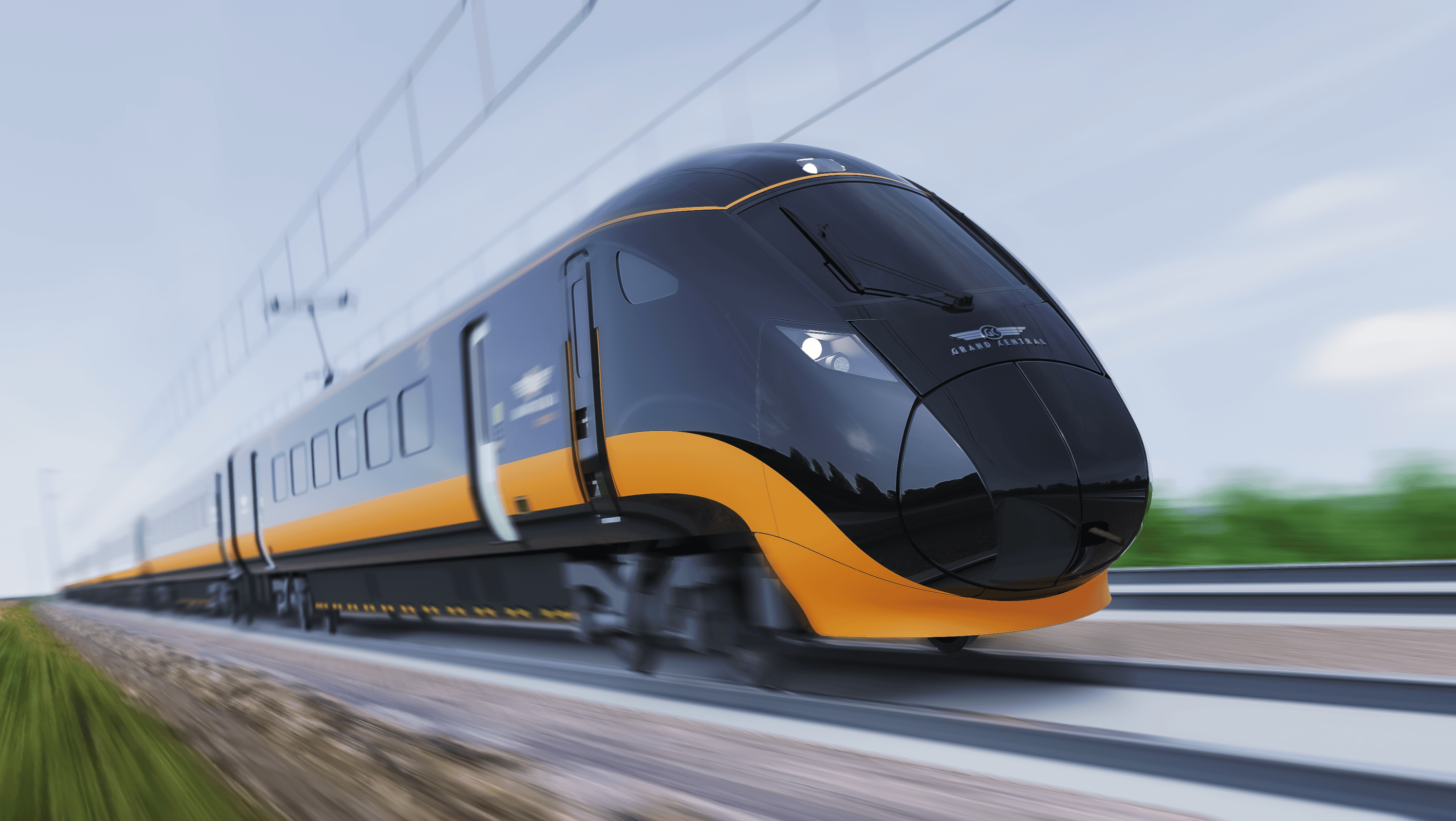
Arriva Group announced today an order for nine cutting-edge battery hybrid trains to replace its entire Grand Central fleet, providing a major boost to regional economies and offering passengers more comfortable, greener travel options.
The order for 45 Hitachi Rail ‘tri-mode’ cars, which have the flexibility to run on electrified and non-electrified tracks, along with a 10-year maintenance contract, represents an investment of around £300 million. Tri-mode means the trains can be powered using electricity, battery or diesel.
It follows approval by the rail regulator for extended track access rights for Grand Central’s existing services through to 2038, with the investment underpinning Arriva’s long-term commitment to UK rail and to delivering sustainable public transport solutions to communities up and down the country and across Europe.
The trains will be built by Hitachi at Newton Aycliffe.
I have some further thoughts and questions.
What Distances Will The Trains Run Away From Electrification?
The distances that the various services will run away from electrification are as follows.
- King’s Cross and Bradford Interchange – Doncaster and Bradford Interchange – 52.1 miles.
- King’s Cross and Cleethorpes – Doncaster and Cleethorpes – 52.1 miles.
- King’s Cross and Sunderland – Longlands junction and Sunderland – 48.5 miles.
It would appear that a train with a range away from electrification of 55 miles would be enough, if there were to be charging at all the destinations.
Will The Trains Be Able To Take The Great Northern And Great Eastern Joint Line (GNGE) Diversion Via Lincoln On The East Coast Main Line?
I discussed using this diversion in detail in London And Edinburgh By Lumo Using the Joint Line Diversion.
In that post, I said this.
The January 2024 Edition of Modern Railways says that the diversion is approximately 90 miles or 145 kilometers.
If the trains have a 90 mile capability on batteries and/or diesel, they will be able to use the diversion.
As Hull Trains, LNER and Lumo all need this ability to take the GNGE Diversion, I suspect, it will be a tick-box on the order form for the trains.
When Will The Trains Be In Service?
The news item says this.
The trains will be delivered in 2028 under a 10-year leasing arrangement, in partnership and financed by Angel Trains.
Will The New Trains Be Faster?
They might save a couple of minutes, if Doncaster is the first stop.
Will The New Trains Be Quieter?
The news item says this about noise and emissions.
State-of-the-art ‘tri-mode’ train technology has proven its ability to cut emissions and fuel costs by around 30 per cent to support UK Government’s decarbonisation agenda.
Hitachi have said that the diesel engines will not run in stations.
Could The Trains Run Grand Central’s Routes Carbon-Free?
In The Data Sheet For Hitachi Battery Electric Trains, I came to these conclusions
- The battery pack has a capacity of 750 kWh.
- A five-car train needs three battery-packs to travel 100 miles.
- A nine-car train needs five battery-packs to travel 100 miles.
- The maximum range of a five-car train with three batteries is 117 miles.
- The maximum range of a nine-car train with five batteries is 121 miles.
As battery technology gets better, these distances will increase.
If I was choosing the trains for Grand Central, the trains would be able to operate these routes without using diesel.
- Doncaster and Bradford Interchange and return.
- Doncaster and Cleethorpes and return.
- Longlands junction and Sunderland and return.
Passengers might not like to have noisy passengers.
Probably, the best insurance policy to avoid running out of battery power, would be to have perhaps fifty metres of electrification at terminal stations. Hitachi claim they can offer a nice line in short lengths of electrification.
Quiet Trains Should Attract Passengers
I’ve seen it before and also with buses.
The Number Of Trains Ordered
The basic order is for nine trains, but Railway Gazette says this.
Arriva welcomed the ‘swift decision-making’ by ORR and the backing of the Department for Transport and Network Rail. It has also submitted applications to run more trains to Bradford and introduce services to Cleethorpes, and has an option to buy more trains if these are approved.
I’ve read somewhere that the option is for three extra trains.
So that’s a total of twelve, which would replace the ten Class 180 trains and two Class 221 trains, that Grand Central Trains currently run.
What About Chiltern Railways And CrossCountry?
Train operating companies Chiltern Railways, CrossCountry and Grand Central Trains are all wholly owned subsidiaries of Arriva Trains UK, who are described like this in the first paragraph of their Wikipedia entry.
Arriva UK Trains Limited is the company that oversees Arriva’s train operating companies in the United Kingdom. It gained its first franchises in February 2000. These were later lost, though several others were gained. In January 2010, with the take-over of Arriva by Deutsche Bahn, Arriva UK Trains also took over the running of those formerly overseen by DB Regio UK Limited
Arriva is ultimately owned by American infrastructure investment company; I Squared Capital.
Both Chiltern Railways and CrossCountry have trains, that are coming to the date, when they will need to be replaced and similar trains to those ordered by Grand Central could be suitable. to replace some.
Chiltern Railways have six rakes of Mark 3 coaches, that are hauled by diesel locomotives between London Marylebone and Birmingham Moor Street stations, These rakes of coaches could be replaced by Hitachi tri-mode trains, of perhaps five or six cars.
Chiltern Railways also have about sixty assorted diesel multiple units totalling up to about 150 carriages.
CrossCountry Trains have twenty-nine two- or three-car Class 170 trains and sixty-one four- or five car Class 220 or 221 trains. All these ninety trains were built this century and are diesel-powered.
The Government’s policy of net-zero by 2050, would probably mean a significant number of these smaller diesel multiple units need to be replaced by 2030.
If the Grand Central Trains new Hitachi trains are a success, then changing the longer four-, five- and six-car trains for similar Hitachi trains, would be a low-risk replacement strategy for I Squared Capital, that could be applied at Chiltern Railways and CrossCountry.
I can also see a need for a two-, three- or four-car tri-mode train for Chiltern Railways and CrossCountry.
Was The Date Of The Announcement Significant?
In October 2020, I wrote Hitachi Targets Export Opportunities From Newton Aycliffe and I believe that tri-mode trains like these that Grand Central have ordered could have export opportunities.
One country for exports has possibilities and that is the United States.
- Hitachi AT-300 trains like these don’t need expensive high-speed tracks and there are probably many lines in the United States, where these trains could fit existing tracks.
- This page on the Hitachi Rail web site is entitled Hitachi Rail in the USA and Canada.
- In the UK, companies like GWR, LNER, Southeastern and TransPennine Express effectively use theHitachi trains as fast commuter trains on some routes.
- Trump’s tariffs would only be 10 % on these trains.
- The Grand Central version looks very stylish!
- Hitachi’s battery technology is owned by Turntide Technology, who are a US company.
- For some routes, the trains would probably only need to be battery-electric.
Has the experience of running Chiltern Railways, CrossCountry and Grand Central Trains convinced I Squared Capital, that running railways is a good investment?
Have I Squared Capital identified some railroads in the United States, that could follow a similar upgrade path to Chiltern Railways?
Was it significant that the order was announced the day after Trump’s tariffs?
.
The Train Trip Where I Arrived Before My Train
Yesterday, I went to Sheffield on Grand Central Trains. But owing to a small mix-up at Peterborough station, I ended up getting to Doncaster on an LNER train, before my Grand Central Train arrived.
This was the sequence of events.
- I bought a ticket from a machine at King’s Cross for Doncaster for the keen single price of £25.70 with my Senior Railcard.
- I had managed to assign myself a forward facing window seat.
- The aisle seat was occupied by a large man before I took my seat.
- But I was able to squeeze past.
- I did tell my travelling companion that I was going to Doncaster., as I have been known to fall asleep on trains and didn’t want to end up in Bradford.
- My train left for Doncaster at 10:52.
- I then found thyself waking up, with the train stopped in a station, which I didn’t recognise.
- So I asked my companion, where we were and he said. “Doncaster!”
- I then squeezed past him again and left the train, only to find, that I had got out at Peterborough.
- Luckily, by the time I realised I was at the wrong station, an LNER train had arrived that was also going to Doncaster.
- So a helpful member of LNER’s station staff told me to get on the LNER train.
- Another helpful member of LNER’s train staff approved my ticket, so I didn’t have to buy another.
- As my new train, passed Retford, we passed the Grand Central Train at rest in Retford station.
- I arrived in Doncaster at 12:45.
Looking at Real Time Trains, I find this is said.
This service was cancelled between Retford and Bradford Interchange due to the train striking a bird (V8)
As it was a V8 bird, I assume it was a large one.

