Polanski And Farage Don’t Agree. But They Have More In Common Than You Might Think
The title of this post, is the same as that of this article on the BBC, by Laura Kuenssberg.
It is very much a must read article comparing two of the most controversial party leaders in the UK.
This is the sub-heading.
One is a former stockbroker from the south who, by his own proud admission, loves smoking, drinking and women. The other’s a proud vegan, gay, northern former actor, who told me he’d never drunk a drop.
These first three paragraphs add detail to the story.
But the jubilant Zack Polanski and Nigel Farage have rather a lot in common.
Before you scream, burst out laughing, or think I have lost my marbles, of course, there are very big differences between them.
The Greens talk about a climate emergency. Reform UK calls the government green plans, “net stupid zero”.
This is Laura’s summing up of the Terrible Twins.
Their views on the cause of Britain’s pain vary wildly.
The Greens might point the finger at the super-rich, the “donor billionaires” they often cite. Reform often blames immigration, which they controversially characterise as an “invasion” of people arriving in the UK without permission.
But both parties feed off and stir up sentiment that’s felt by lots of the public: that Britain doesn’t work any more.
Whether it’s the new Green MP saying “working hard used to get you something” in her victory speech, or Nigel Farage repeatedly telling us “Britain is broken”, the same argument flows from both: that the country is in such a dreadful state that only new political saviours can fix it.
And both Reform and the Greens are willing to push the conventions of what traditional UK politicians would find acceptable – or what they believe would make them electable.
That’s not just about their image or the unstuffy ways they court publicity – Nigel Farage willingly going into the I’m A Celebrity jungle, or Zack Polanski being seen on a dance floor in campaign videos – but how they choose to focus on sensitive issues, where others might not choose to tread.
I would disagree that Britain is broken, but that it needs someone with sensible policies that everybody can get behind.
The Greens policies on the super-rich would drive anybody with ambition and money from this country and already countries like Canada are advertising for migrants.
With two immigrant lines, Farage is everything my father thought was bad about Oswald Mosley and his fascists in the 1930s. If a Reform UK Government started rounding up illegal immigrants on the streets, the violence would probable be enormous.
How Much Renewable Energy Will The UK Be Generating By 2030?
I have to admit, that whether you like the Tories or not, they have developed an energy generation policy and an energy relationship with Germany, that appears to be working and is allowing the current Government to do a bit of spending on defence and other needs.
I asked Google AI, the question in the title of this section and received this reply.
The UK government has set an ambitious target to reach 95% low-carbon electricity generation by 2030, aiming for a system driven by 43-50 GW of offshore wind, 27-29 GW of onshore wind, and 45-47 GW of solar power. This plan aims to dramatically reduce fossil fuel reliance, supported by 23-27 GW of battery capacity.
Key 2030 Renewable Energy Projections & Targets:
Total Clean Power Goal: The goal is 95% of electricity from low-carbon sources (renewables and nuclear) by 2030, up from roughly 74% in 2024.
Offshore Wind: Target of 43-50 GW, deemed crucial to powering the grid.
Onshore Wind: Target of 27-29 GW, with recent policy changes lifting bans to accelerate development.
Solar Power: Target of 45-47 GW, aiming to triple current capacity.
Flexibility: 23-27 GW of battery capacity and 4-6 GW of long-duration storage are needed to manage intermittency.
Challenges and Forecasts:
Shortfall Risks: While the government target is high, some projections suggest wind and solar may only account for 44% of generation by 2030, requiring significant acceleration to reach the 95% clean goal.
Investment Needs: Achieving these goals requires an estimated £48 billion in additional investment, on top of planned projects.
Progress: In 2024, renewable sources already hit a record of over 50% in certain quarters, with low-carbon sources overall (including nuclear) providing nearly 70% of generation.
My Thoughts
I will add some of my thoughts.
Electricity Demand: As I write, according to National Grid: Live it is 33.3 GW, which is met by with Production of 27.1 GW and Transfers of 6.2 GW.
Electricity Production: In 2030, I believe that if the UK has long-term battery capacity of something like 4 GW/40 GWh, that total UK electricity production could be upwards of 125 GW.
Hinckley Point C Power Station: This should add 1.6 GW in 2030 and 2031 to further boost UK electricity production.
Pumped Storage Hydro: In How Much Pumped Storage Hydro Will Be Operational In The UK By 2030?, I estimate that the Bank of England standard of energy storage, will add 5 GW of electricity production.
Highview Power: Highview Power are developing long duration liquid-air energy storage and have identified locations for sixteen 300 MW/3.2 GWh monsters.
Excess Electricity Production: This will be exported, either as electricity or after conversion to hydrogen. It will be a Magic Money Forest for the victor of the General Election in 2029.
If Hinckley Point C, the pumped storage hydro and Highview Power’s batteries work as their engineers hope, then the result of the next General Election will be predictable.
It is certainly, Kier Starmer’s to win, by getting the energy right!
Highview Power And The 2029 General Election
Every extra GWh added to energy storage has the following affect.
It will mean that more wind farms will not have to be switched in times of high wind and over production, as the electricity can be stored.
At the present time, there are four ways of storing energy.
- Turn it into hydrogen. But the Hindenberg did a good PR job for not using hydrogen.
- Store it in a pumped storage hydro system, but these have problems with their large land use.
- Store it in a large lithium battery, but these have problems with fire risks and need a large amount of expensive lithium.
- Store it in one of Highview Power’s liquid air batteries.
I believe that Highview Power’s liquid-air long duration batteries, have several advantages.
- They are built from readily available components.
- They can be scaled to the need at the location, where they are installed.
- A small one is 50 MW/300 MWh and a large one is 300 MW/3.2 GWh.
- The batteries come with grid stabilisation and other features.
- The batteries have a lifespan of greater than 50 years
- The energy storage fluid, is captured from the air.
- They are a product, that would be easy to finance in quantity.
- Goldman Sachs is an investor.
- A village with a power problem could fund a Highview Power battery and have a nice little earner, with perhaps a wind turbine on a nearby hill.
- Centrica is an investor.
If a politician were to understand it, it could wind them the next General Election.
Farage Faces Questions Over Who Funded £885,000 Clacton Constituency Home
The title of this post, is the same as that as this article on the BBC.
This is the sub-heading.
Reform UK leader Nigel Farage faces pressure to account for how his partner paid for a £885,000 home after a BBC investigation raised further questions about his previous explanation.
These two introductory paragraphs, give more details.
The Clacton MP has denied avoiding more than £44,000 in additional stamp duty on the purchase of the constituency home by putting it in his partner Laure Ferrari’s name, saying that she bought it with her own funds.
He suggested that she was able to afford to buy the four-bedroom home, which was bought without a mortgage, because she comes from a wealthy French family.
The BBC appears to have fully investigated the deal and doubt the veracity of some of the tale, that Farage told.
I notice, that the house in question is in Frinton.
My late wife was a barrister and once acted for the Co-op to get an off-licence in the town.
- Up until this action the town had been dry.
- C told me, that the Co-op had appointed a charming Asian gentleman as a manager.
- She used all her legal charm to get the action through.
- She also joked afterwards about hate mail, but I don’t think it was serious.
It appears that you can still buy alcohol in Frinton.
Almost One Million Smokers Are Too Ill To Work
The title of this post, is the same as that of this article on The Times.
This is the sub-heading.
Smokers are three times more likely than non-smokers to be out of work owing to poor health, and numbers are rising fast
These three paragraphs give more details.
Nearly a million people who smoke in England are out of work due to illness, research has found, with the figure rising by nearly 80 per cent in the past decade.
As a proportion, almost three times as many working-age smokers compared with non-smokers were out of work due to ill health, with 11.3 per cent of smokers and 3.3 per cent of non-smokers not working for health reasons.
As of March, more than a fifth of UK working-age adults were not in work, with 8.7 million having a condition that limited their ability to sustain employment.
As the research comes from University College London, I think we can be sure, it has been properly peer-reviewed.
Nigel Farage
You rarely see NF without a cigarette in his hand.
That would not be the sort of image, I would want in my representative or heaven help me, my Prime Minister.
NF is the Member of Parliament for Clacton.
This paragraph is from the Wikipedia entry for Clacton-on-Sea.
As common with many English seaside towns, unemployment has remained stubbornly high in Clacton.[14] In 2023, Clacton won a £20 million government levelling-up grant to improve the town centre.
I asked Google AI what is the percentage of smokers in Clacton-on-Sea and received this answer.
The smoking prevalence in Clacton-on-Sea (within the Tendring district) rose to 20% in 2023, bucking the UK-wide trend of declining smoking rates and representing a significant increase from 14% the previous year. This figure is considerably higher than the national average, which was 11.9% in the same year, but similar to rates observed in other areas.
Now there’s a thing!
Similar data for the other Reform UK MPs are as follows.
Lee Anderson – Ashfield – Ex-Smoker
Specific smoking percentage data for the Ashfield area isn’t readily available in the search results, but Nottinghamshire’s smoking rate was 15.4% in 2020, which is above the England average, with rates varying significantly by district. For instance, in 2020, the rate in Mansfield was higher at 23.1%, while Rushcliffe had a lower rate of 3.6%.
Richard Tice – Boston & Skegness – Non-Smoker
While a precise percentage for Skegness isn’t available, the local area has a higher-than-average smoking prevalence, with some reports indicating Lincoln and Boston (both in the same county) have some of the highest rates in the East Midlands, and the Lincolnshire Integrated Care Board noted a 16% prevalence for Lincolnshire in March 2024, an increase from previous years.
Sarah Pochin – Runcorn & Helsby – Unknown
There is no exact percentage for smokers specifically in Runcorn, but for the wider region, an overall adult smoking rate of 11.34% was recorded by Cheshire West and Chester Council in 2021. Higher rates were seen in adults aged 18-64, where the prevalence was 22.9% in the same area.
Rupert Lowe – Great Yarmouth – Appears to be against more smoking bans
The smoking prevalence in Great Yarmouth was 17.6% in 2022, which is the highest in Norfolk and significantly above the national average of approximately 13% for adults in England. This data comes from a Norfolk Insight report using Office for Health Improvement and Disparities (OHID) data from the Annual Population Survey
James McMurdock – South Basildon & East Thurrock – Unknown
There is no specific data available for “South Basildon” regarding the percentage of smokers; however, national data for the UK from 2023 shows that the overall proportion of current smokers was 11.9%. More granular data from a 2022 Office for National Statistics (ONS) report indicates that smoking prevalence can vary significantly by location, with local rates like Basildon (13.3%) and other areas of England showing different figures than the national average.
The pattern is very mixed
I also asked Google AI, if Reform UK has a policy on smoking and received this answer,
Reform UK does not have a published, comprehensive policy on smoking on its website, and has not taken a stance on the Tobacco and Vapes Bill, which includes a phased smoking ban. However, public polling by The Health Foundation in late 2024 indicated support for public health measures to prevent ill health from tobacco, alcohol, and unhealthy food, though specific results for Reform UK voters were not broken out in that instance.
It would appear that they are firmly sitting on the fence.
Desperate Times Call For Desperate Measures
The title for this post was inspired by this article on the BBC, which is entitled Water Scheme Kicks In To Boost Severn Amid Drought.
This is the sub-heading.
A groundwater scheme in Shropshire that pumps additional water into the River Severn has been switched on
These are the first three paragraphs, which add more detail.
It comes after the Environment Agency (EA) last month declared drought status for the West Midlands, following the driest spring in 132 years.
The scheme, owned and operated by the agency, pumps groundwater stored naturally in sandstone underneath much of north Shropshire, and delivers it through an underground network of pipes into the Severn.
The scheme pumps almost 40 Olympic-sized swimming pools of fresh water every day into the river, with a total of 49 pumps and 53km (32.9m) of underground pipes.
It looks a good scheme to me, but I suspect, those pumps and pipes didn’t come cheap.
These two further paragraphs, explain how it works.
Two reservoirs in Wales – Clywedog and Vyrnwy – are the first resources used to top up the river during dry weather.
The groundwater scheme is the last option to be brought into operation during dry conditions, because of how resource-intensive it is.
I suspect politicians like Trump and Farage would not have sanctioned a scheme like this, as it only protects a river.
This page on the Environment Agency blog gives more details of the scheme.
I looked up the title, that I’ve used for this post on Google AI and received this answer.
“Desperate times call for desperate measures” is an idiom suggesting that unusual problems or difficult circumstances may require unconventional or extreme solutions that would not normally be considered. The phrase originated from an ancient Greek physician, Hippocrates, who wrote about extreme diseases needing extreme methods of cure. The saying acknowledges that when faced with significant challenges, bold or drastic decisions may be necessary for survival or success.
As it seems the scheme is working well, I feel that the decision to build it, was the right one.
Nigel Farage Speech: Persistent Offenders Would Face Life Sentences
The title of this post, is the same as that of this article in The Times.
This is the sub-heading.
The Reform UK leader pledged more prison spaces, deportation of criminals and zero-tolerance policing as part of a six-week Lawless Britain campaign drive.
These three paragraphs give more detail about what criminals can expect and how much it will cost.
Every shoplifter would be prosecuted and stop and search powers used to “saturation point” under Nigel Farage’s pledge to make Reform UK the “toughest party on law and order this country has ever seen”.
He said that a Reform government would crack down on prolific offending by imposing life sentences on those who commit three or more offences.
The Reform leader set out plans to spend £17.4 billion to cut crime by half in the first five years if the party wins the next general election — an annual cost of £3.5 billion.
At least hanging and flogging aren’t mentioned. But he does suggest sending one of our worst child murderers to El Salvador and that Britain would leave the European Convention on Human Rights.
This paragraph says how he will pay for this law and order policy.
Farage said Reform would pay for the £17.4 billion law and order crackdown by ditching HS2 and net zero policies — money which has also been pledged for other policies.
I have just done a little calculation about how much offshore wind power should be commissioned by January 2029, which will likely be before the expected 2029 General Election.
- In October 2023, there was 15,581 MW of operational offshore wind.
- Currently there are 10,842 MW under construction, that should be commissioned by January 2029.
- There is also 2,860 MW of smaller wind farms, which have yet to be started that should be commissioned by January 2029.
- That all totals up to 29, 285 MW or 29.3 GW.
- Another 12 GW of offshore wind is scheduled to be commissioned in 2029 and 2030.
Currently, as I write this we are generating 29.3 GW from all sources.
I asked Google AI how much solar energy we will have in January 2029 and got this answer.
In January 2029, the UK is projected to have a significant amount of solar energy capacity, with the government aiming for 45-47 GW of total solar power by 2030.
Let’s assume the sun only shine half the time and say 20 GW on average.
We’ll also have 4.4 GW from Hinckley Point C and Sizewell B, as all other nuclear will have been switched off.
I asked Google AI how much energy storage we’ll have by January 2029 and got this answer.
In January 2029, the UK is projected to have around 120 GWh of battery energy storage capacity, according to a European report. This is part of a broader goal to reach 400 GWh by 2029 for the EU-27, with the UK contributing significantly to this total.
If there’s say another Great Storm, the dozens of interconnectors between the UK and Europe should keep us all going.
It looks to me that by January 2029, we’ll be substantially on the way to being powered by renewables.
Most of the net zero money will have been spent and we’ll be almost at net zero.
Phase One of High Speed Two has a target date of 2030, and I suspect that the engineers working on the project will get trains running between Old Oak Common and Birmingham Curzon Street stations before the General Election, just because if NF’s going to cancel the project, they might as well do their best to get him to lose the election.
So at best he might get a year’s savings from stopping High Speed Two, but an unfinished High Speed Two, will be a joke on NF and make him look a complete laughing stock!
Farage Wants HS2 Scrapped
The title of this post, is the same as a sub-title in this article on The Times. which is entitled HS2: Labour confirms delay until 2033.
This is the sub-heading.
Nigel Farage has called for the whole HS2 project to be scrapped.
These two paragraphs give NF’s view.
The Reform UK leader told the Commons: “Has the moment not come, rather than having another reset, to recognise this is a failure?
“Let’s scrap HS2, let’s use the tens of billions of pounds we can save in the next decade to upgrade railway lines across the entirety of the United Kingdom to the benefit of many millions and spend the rest on other national priorities in these financially straitened times.”
Farage’s simplistic plan will appeal to his disciples, but the major thing that is needed, is more capacity between South and North. Or North and South depending on where you live!
HS2 will provide an extra seventeen paths between London and a large triangular junction in the West Midlands.
If HS2 Is Not Built There Will Be More Cars And Trucks On The Roads
In Footage Released Of East West Rail’s First Commercial Freight Train, I wrote about the SEGRO Logistics Park Northampton (SLPN), which would generate lots of road and rail traffic. Without developments like HS2, the roads will just get clogged up.
High Speed Two’s Originally Proposed Service Pattern
This graphic shows the original service pattern for High Speed Two.
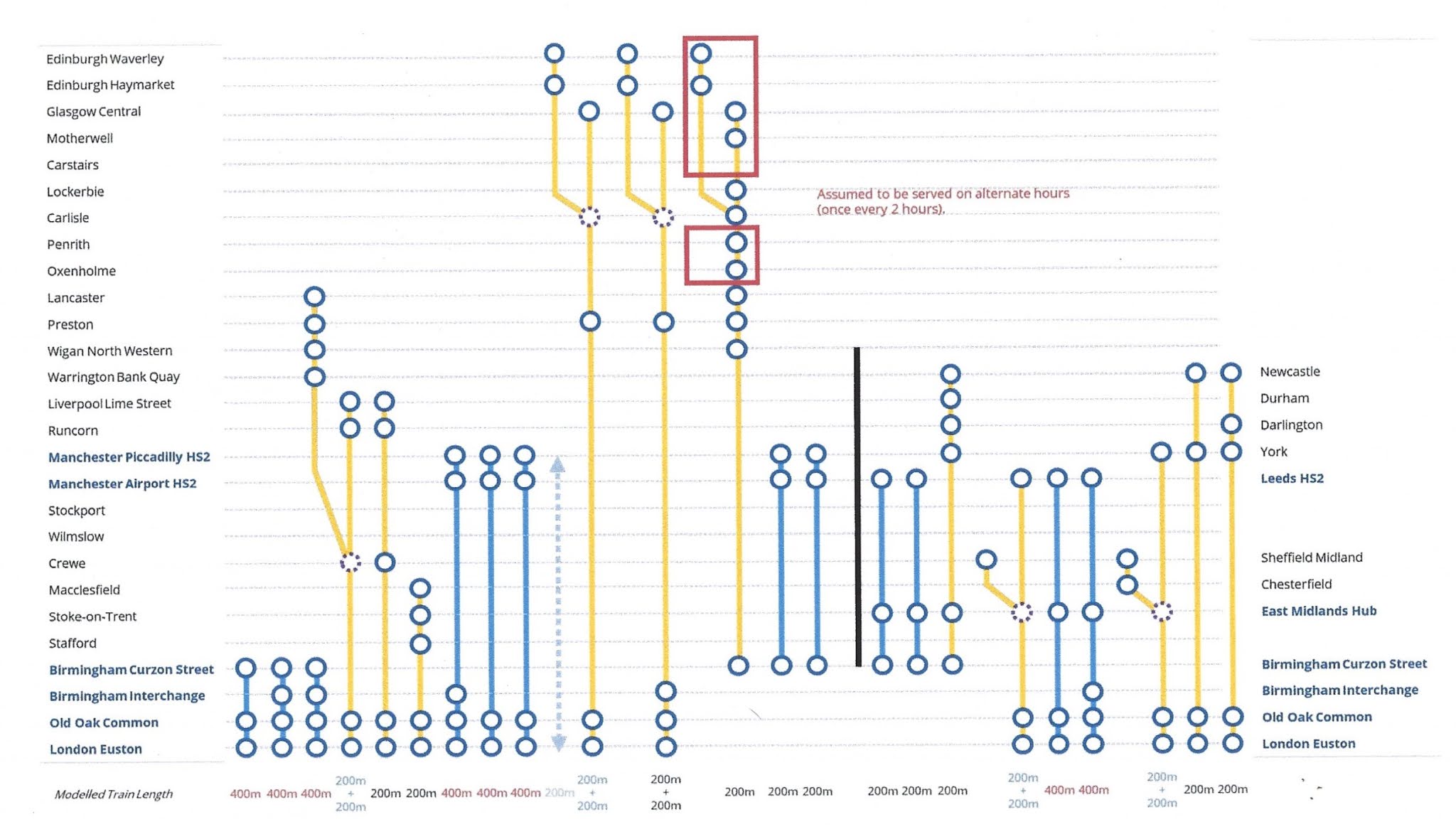
Note.
- There are seventeen paths terminating in the South at Euston station.
- Six of these paths go to Leeds, Newcastle or York.
- As the Eastern leg has been abandoned, that means six extra trains can run between London and the large triangular junction in the West Midlands.
Six extra trains running to the West side of England and Scotland could give a substantial improvement of services.
High Speed Yorkshire
HS2 needs to be paired with High Speed Yorkshire, which would mainly be an upgrading of the East Coast Main Line running at up to 160 mph to serve Lincolnshire, Yorkshire, the North-East and East Scotland.
Note.
- British Rail built the Selby Diversion in the 1980s to run at 160 mph.
- Digital signalling is currently being installed on this route and this will allow trains to speed through the two bottlenecks of the Digswell Viaduct and the Newark Crossing.
- Times of three-and-a-half hours between King’s Cross and Edinburgh, should be possible.
These times should give the airlines a good kicking on London-Newcastle and London-Scotland routes.
Fast services would run on High Speed Yorkshire to Alnwick, Barnetby, Barnsley, Beverley, Berwick, Bradford, Brough, Cleethorpes, Darlington, Doncaster, Durham, Edinburgh, Goole, Grantham, Grimsby, Harrogate, Huddersfield, Hull, Leeds, Lincoln, Middlesbrough, Newcastle, Peterborough, Pontefract, Retford, Rotherham, Scarborough, Scunthorpe, Sheffield, Skipton, Stevenage, Sunderland, Wakefield, Worksop and York.
Most of these towns and cities are already served by Hitachi or other high speed trains from King’s Cross.
A high proportion of the services to Yorkshire destinations will be under two hours from London.
When the current trains need replacing, they could be replaced by High Speed Two Classic-Compatible trains.
Onward From Handsacre Junction
Services to the North-West and Scotland will join the Trent Valley Line at Handsacre junction.
This OpenRailwayMap shows the Trent Valley Line between Crewe station and Handacre junction.
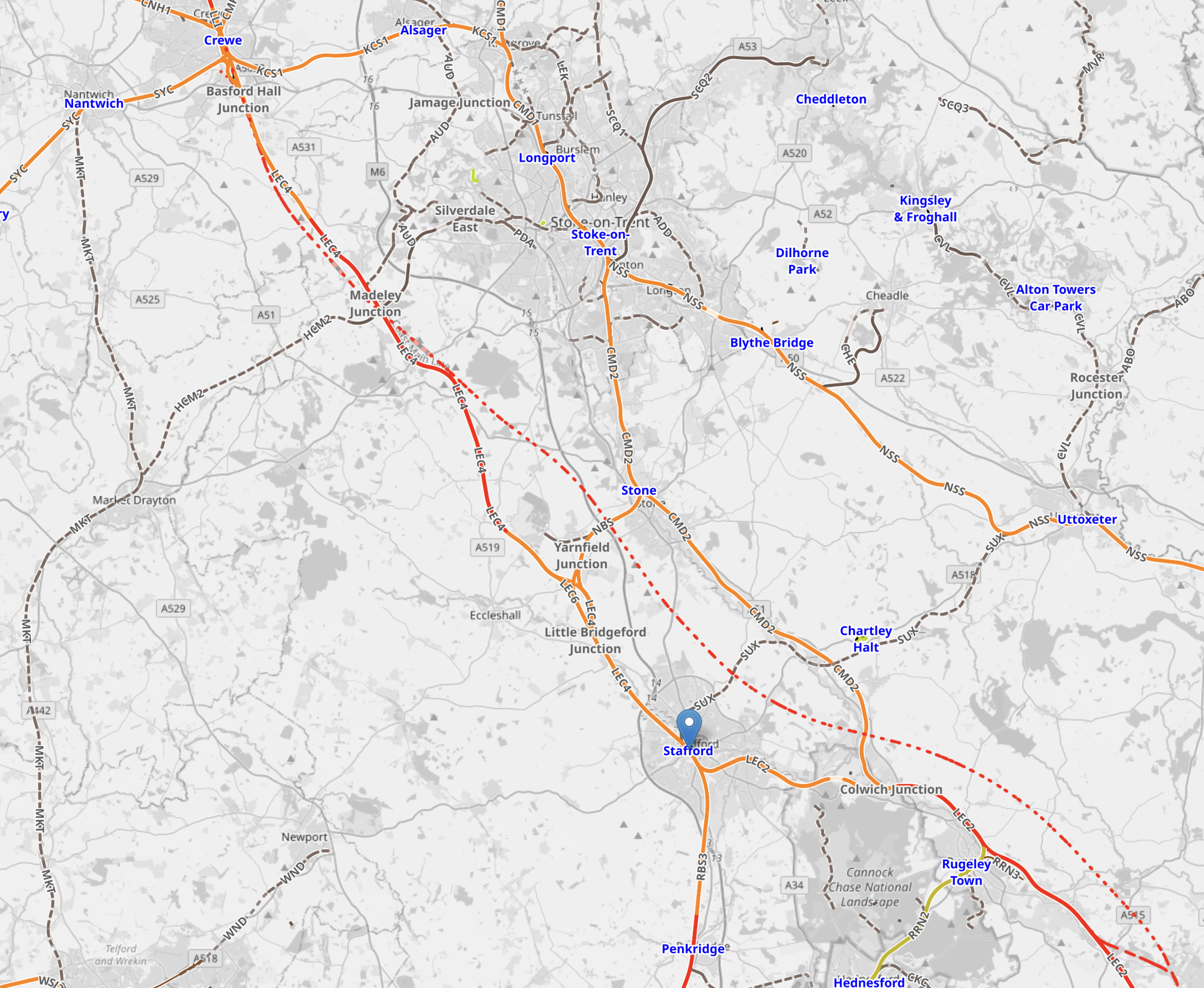
Note.
- The proposed route of High Speed Two is shown as a dotted line, running diagonally across the map.
- The red track to its West is the Trent Valley Line, which is a section of the West Coast Main Line.
- Handsacre junction is in the South-East corner of the map.
- The blue arrow indicates Stafford station on the West Coast Main Line.
- The main High Speed Two tracks will not connect to Stafford or Stoke-on-Trent stations.
- Crewe station is in the North-West corner of the map.
- Crewe station and Handsacre junction are 37.6 miles apart.
With the exception of the 6 mile twin-track section between Stafford Trent Valley and Colwich junctions, it appears that Crewe station and Handsacre junction is all quadruple track.
This OpenRailwayMap shows the Trent Valley Line between Stafford stationand Colwich junction.
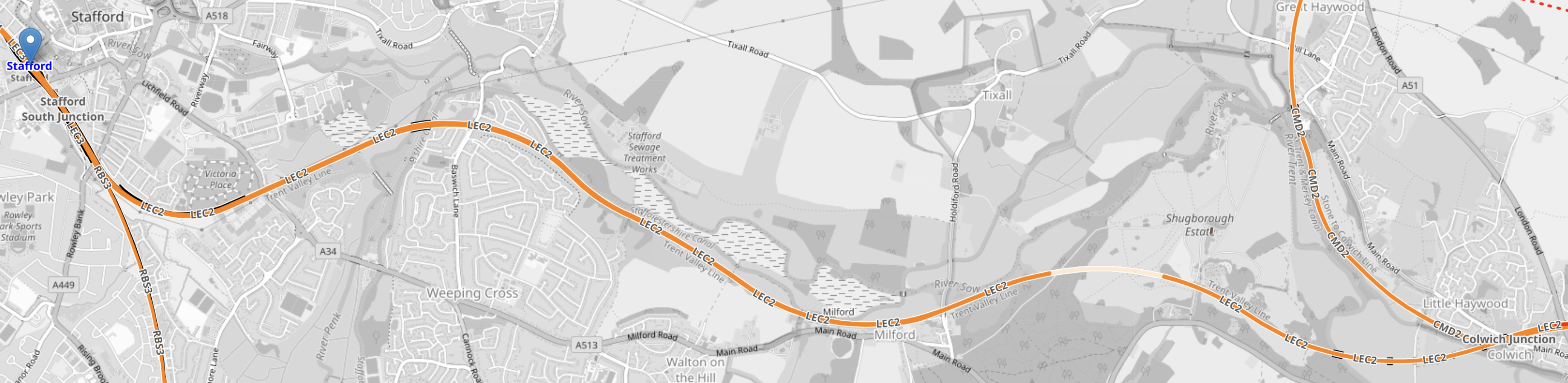
Note.
- The Trent Valley Line, which is a section of the West Coast Main Line, runs across the map.
- The arrow in the North-West corner of the map indicates Stafford station.
- Colwich junction is in the South-East corner of the map.
- About three-quarters of the way across, the track is shown in cream. This is the twin-track Shugborough Tunnel, which is around a half-mile long.
- The Shugborough Tunnel has a 100 mph maximum speed.
- The portals of Shugborough Tunnel are Grade II Listed and the Wikipedia entry for the tunnel is certainly worth a read.
How Many High Speed Two trains per hour (tph) will use the Trent Valley Line route?
The original proposal in the graphic earlier shows these trains.
- 4 – London to Lancaster/Liverpool Lime Street – Splits at Crewe
- 5 – London to Liverpool Lime Street
- 6 – London to Stafford, Stoke -on-Trent and Macclesfield
- 7 – London and Birmingham Interchange to Manchester Airport and Manchester Piccadilly
- 8 – London to Manchester Airport and Manchester Piccadilly
- 9 – London to Manchester Airport and Manchester Piccadilly
- 10 – London and Birmingham Interchange to Preston, Carlisle, Edinburgh Haymarket and Edinburgh Waverley/Glasgow Central – Splits at Carlisle
- 11 – London Euston to Preston, Carlisle, Edinburgh Haymarket and Edinburgh Waverley/Glasgow Central – Splits at Carlisle
- 12 – Birmingham Curzon Street to Wigan North Western, Preston, Lancaster, Oxenholme, Penrith, Carlisle, Edinburgh Haymarket and Edinburgh Waverley Or Wigan North Western, Preston, Lancaster, Carlisle, Lockerbie, Motherwell and Glasgow Central- Services alternate.
- 13 – Birmingham Curzon Street to East Midlands Hub, Manchester Airport and Manchester Piccadilly
- 14 – Birmingham Curzon Street to East Midlands Hub, Manchester Airport and Manchester Piccadilly
Note.
- It looks like there will be eleven High Speed Two tph on the Trent Valley Line.
- As East Midlands Hub will not be built, I will assume trains 13 and 14 will be Birmingham Curzon Street to Manchester Airport and Manchester Piccadilly.
- Other trains will need to use the route.
- I suspect that freight trains, that couldn’t maintain 100 mph would not be allowed.
I believe that digital signalling can handle all the trains between Handsacre Junction and Crewe.
- Trains 10 and 11 would run every thirty minutes to give two tph between London and Glasgow Central and two tph between London and the two Edinburgh stations.
- Each of these trains would lead a flight of trains behind them through the Trent Valley Line.
- The last trains going North in the flights, would be trains 4 and 6, as they stop on the Trent Valley Line section.
I have written a lot of scheduling algorithms in the last fifty years and I wouldn’t be surprised if flights could be up to 7 or 8 trains, running 3 or 4 minutes apart.
It would be an impressive sight.
What Timings Would Be Possible On High Speed Two Using Handsacre Junction And The Trent Valley Line?
In Where Is Handsacre Junction? I calculated some times on High Speed Two to various destinations, using Handsacre junction and the Trent Valley Line. This is a more comprehensive table.
- London and Blackpool North – 205 mph – 1:55
- London and Blackpool North – 140 mph – 2:12
- London and Carlisle – 205 mph – 2:45
- London and Carlisle – 140 mph – 3:01
- London and Crewe – 205 mph – 1:03
- London and Crewe – 140 mph – 1:19
- London and Edinburgh Waverley – 205 mph – 4:14
- London and Edinburgh Waverley – 140 mph – 4:30
- London and Glasgow Central – 205 mph – 4:22
- London and Glasgow Central – 140 mph – 4:38
- London and Handsacre junction – 205 mph – 0:35
- London and Handsacre junction – 140 mph – 0:51
- London and Lancaster – 205 mph – 1:50
- London and Lancaster – 140 mph – 2:06
- London and Liverpool Lime Street – 205 mph – 1:46
- London and Liverpool Lime Street – 140 mph – 2:02
- London and Manchester Piccadilly – 205 mph – 1:41
- London and Manchester Piccadilly – 140 mph – 1:57
- London and Preston – 205 mph – 1:31
- London and Preston – 140 mph – 1:47
- London and Stafford – 205 mph – 0:45
- London and Stafford – 140 mph – 1:01
- London and Stoke-on-Trent – 205 mph – 0:55
- London and Stoke-on-Trent – 140 mph – 1:11
- London and Wigan North Western – 205 mph – 1:17
- London and Wigan North Western – 140 mph – 1:33
Note.
- 205 mph could be the average speed between London Euston and Handsacre junction for High Speed Two Classic-Compatible trains.
- 140 mph could be the average speed between London Euston and Handsacre junction for Class 390 trains.
- Times are in hh:nn.
- For times North of Handsacre junction are typical Class 390 times.
A typical timing between London Euston and Handsacre junction for Class 390 trains is 71 minutes, so if High Speed Two services were run using Class 390 trains, twenty minutes would be saved on all services via Handsacre junction compared to current Avanti West Coast services.
I have some other thoughts.
Using Class 390 Trains Is Not My Idea
This article on Rail nBusiness UK is entitled Viewpoint: Buy tilting trains and finish Delta Junction to salvage HS2, says Gibb.
This is the sub-heading.
UK: Procurement of a fleet of tilting trains and a focus on Birmingham – Manchester services are key to making the most the descoped High Speed 2 scheme, former Virgin Trains executive Chris Gibb tells Rail Business UK.
Chris Gibb has the right experience. and has been used as a go-to man, when projects are in trouble.
The major points of his plan are as follows.
- Connect High Speed Two to the Trent Valley Line to go North from the Midlands.
- Initially, use Class 390 trains or Pendelinos on Liverpool, Manchester and Scottish services.
- Run Class 390 trains at 140 mph between Euston and Handsacre junction.
- When the Pendelinos need to be retired, buy a new set of tilting trains.
- Complete the North-to-West leg of High Speed Two’s triangular junction, so that trains can run between Birmingham Curzon Street and Manchester.
- Gibb proposes a Blackpool service, that splits and joins with a Liverpool service. I assume he means train 5.
Gibb feels a fundamental review of the operating principles and fleet requirements is now needed.
It is a well-thought out viewpoint and very much a must-read.
Ørsted Pulls Plug On 2.4 GW Hornsea 4 Offshore Wind Project In UK
The title of this post, is the same as that of this article on offshoreWIND.biz.
This is the sub-heading.
Ørsted has discontinued the development of the UK’s Hornsea 4 offshore wind farm in its current form. The developer said the 2.4 GW project has faced rising supply chain costs, higher interest rates, and increased construction and delivery risks since the Contract for Difference (CfD) award in Allocation Round 6 (AR6) in September 2024.
This introductory paragraph adds more detail.
In combination, these developments have increased the execution risk and deteriorated the value creation of the project, which led to Ørsted stopping further spending on the project at this time and terminating the project’s supply chain contracts, according to the Danish company. This means that the firm will not deliver Hornsea 4 under the CfD awarded in AR6.
Consider.
- Hornsea 4 will be connected to the grid at a new Wanless Beck substation, which will also include a battery and solar farm, which will be South West of the current Creyke Beck substation. Are Ørsted frightened of opposition from the Nimbies to their plans?
- I also wonder if political uncertainty in the UK, and the possibility of a Reform UK government, led by Nigel Farage is worrying companies like Ørsted.
So will factors like these prompt companies like Ørsted to move investment to countries, where they welcome wind turbines like Denmark, Germany and The Netherlands.
Could Ørsted Be Looking At An Alternative?
This is a map of wind farms in the North Sea in the Dogger Bank and Hornsea wind farms, that I clipped from Wikipedia..
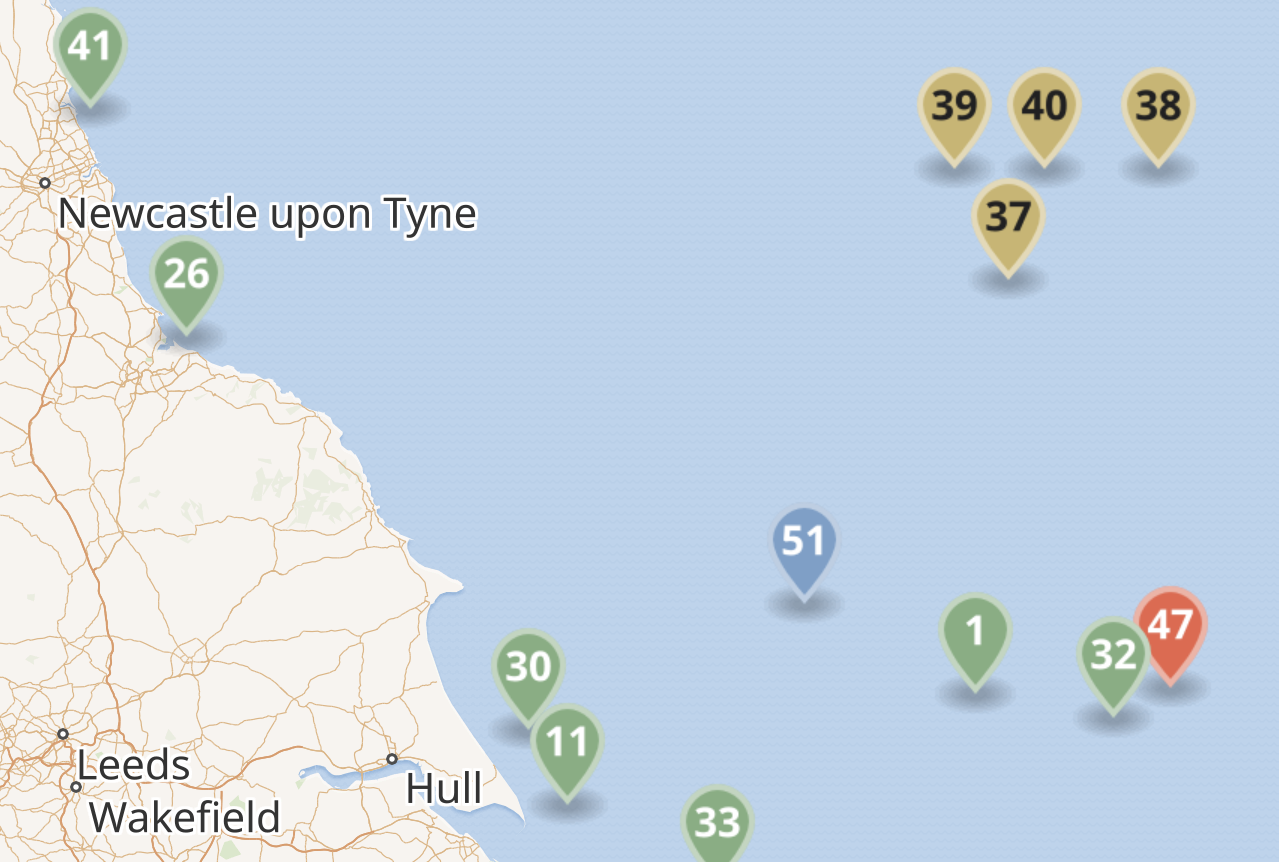
These are the Dogger Bank and Hornsea wind farms and their developers and size
- 37 – Dogger Bank A – SSE Renewables/Equinor – 1,235 MW
- 39 – Dogger Bank B – SSE Renewables/Equinor – 1,235 MW
- 38 – Dogger Bank C – SSE Renewables/Equinor – 1,218 MW
- 40 – Sofia – RWE – 1,400 MW
- 1 – Hornsea 1 – Ørsted/Global Infrstructure Partners – 1,218 MW
- 32 – Hornsea 2 – Ørsted/Global Infrstructure Partners – 1,386 MW
- 47 – Hornsea 3 – Ørsted – 2,852 MW
- 51 – Hornsea 4 – Ørsted – 2,400 MW
Note.
- That is a total of 12, 944 MW, which is probably enough electricity to power all of England and a large part of Wales.
- Wikipedia’s List of offshore wind farms in the United Kingdom, also lists a 3,000 MW wind farm, that is being developed by German company ; RWE called Dogger Bank South,
- The Dogger Bank South wind farm is not shown on the map, but would surely be South of wind farms 37 to 40 and East of 51.
- The Dogger Bank South wind farm will raise the total of electricity in the Dogger Bank and Hornsea wind farms to just short of 16 GW.
Connecting 16 GW of new electricity into the grid, carrying it away to where it is needed and backing it up, so that power is provided, when the wind doesn’t blow, will not be a nightmare, it will be impossible.
An alternative plan is needed!
AquaVentus To The Rescue!
AquaVentus is a German plan to bring 10 GW of green hydrogen to the German mainland from the North Sea, so they can decarbonise German industry and retire their coal-fired power stations.
- I introduce AquaVentus in AquaVentus, which I suggest you read.
- AquaVentus is being developed by RWE.
- AquaVentus connects to a German hydrogen network called H2ercules to actually distribute the hydrogen.
This video shows the structure of AquaVentus.
I clipped this map from the video.

Note.
- The thick white line running North-West/South-East is the spine of AquaVentus, that will deliver hydrogen to Germany.
- There is a link to Esbjerg in Denmark, that is marked DK.
- There appears to be an undeveloped link to Norway, which goes North,
- There appears to be an undeveloped link to Peterhead in Scotland, that is marked UK.
- There appears to be a link to just North of the Humber in England, that is marked UK.
- Just North of the Humber are the two massive gas storage sites of Aldbrough owned by SSE and Brough owned by Centrica.
- Aldbrough and Rough gas storage sites are being converted into two of the largest hydrogen storage sites in the world!
- There appear to be small ships sailing up and down the East Coast of the UK. Are these small coastal tankers, that are distributing the hydrogen to where it is needed?
When it is completed, AquaVentus will be a very comprehensive hydrogen network.
I believe that offshore electrolysers could be built in the area of the Hornsea 4 and Dogger Bank South wind farms and the hydrogen generated would be taken by AquaVentus to either Germany or the UK.
- Both countries get the hydrogen they need.
- Excess hydrogen would be stored in Aldbrough and Rough.
- British Steel gets decarbonised.
- A 1.8 GW hydrogen-fired powerstation at Keadby gets the hydrogen it needs to backup the wind farms.
Germany and the UK get security in the supply of hydrogen.
These may be my best guesses, but they are based on published plans.
Rumours Grow Over Future Of HS2
The title of this post is the same as that of this article on Railnews.
This is the first paragraph.
The future of HS2 appears to be increasingly in doubt, as reports suggest that the forthcoming Oakervee Review will axe Phase 2b between the West Midlands and Yorkshire and possibly cancel the project entirely.
The article also says this about the first phase of the project.
Another possibility is that Phase 1 between London and Birmingham could be built more cheaply by lowering the maximum speed from the presently-planned 250km/h. Such a reduction would reduce the new line’s capacity and lengthen journey times but still ease the pressure on the West Coast Main Line, where paths are in short supply.
There are three suggestions in these two paragraphs and before I discuss them, I’ll detail the various phases of the project as they are current proposed.
The Phases Of High Speed Two
High Speed Two will be two phases with the second phase split into two.
- Phase 1 – London and the West Midlands
- Phase 2a – West Midlands and Crewe
- Phase 2b – Crewe and Manchester and West Midlands and Leeds
The plan improves links between London and several major cities in the Midlands and North.
Northern Powerhouse Rail
I am a great believer in holistic design and in the economies of doing several similar projects together or in a well-defined sequence, that delivers benefits in a stream.
For that reason, I believe that the equally-important Northern Powerhouse Rail should be designed in conjunction with High Speed Two, to achieve the following objectives.
- A better railway, that connects more towns and cities.
- A phased delivery of benefits.
- Possible cost savings.
This report on the Transport for the North web site which is entitled At A Glance – Northern Powerhouse Rail, advocates a much better approach.
- High Speed Two would go from Crewe to Hull via Warrington, Manchester Airport, Manchester Piccadilly, Huddersfield, Bradford and Leeds.
- Northern Powerhouse Rail would go from Liverpool to Hull via Warrington, Manchester Airport, Manchester Piccadilly, Huddersfield, Bradford and Leeds.
- There would be a double junction at High Legh between Liverpool and Manchester, that connects the two routes.
- London and Liverpool services would use the Western end of Northern Powerhouse Rail from High Legh.
- There would be improvements East of Leeds to connect to Sheffield and the East Coast Main Line.
This map shows the high speed railways between Crewe, Liverpool, Manchester and Warrington.

I discussed, what has been proposed by Transport of the North in Changes Signalled For HS2 Route In North.
Cutting High Speed Two To An Affordable Budget
I’ll take the three suggestions in the Rail News article.
Suggestion One – Cancel The Project
This is actually the second suggestion, but I think the article kills it in the second paragraph, that I quoted, when it says that High Speed Two is needed to ease pressure on the West Coast Main Line.
Cancellation would probably be a vote loser and a big stick with which to beat Boris, if he brought forward any environmental proposals.
I doubt cancellation will happen, unless we get someone like Nigel Farage as Prime Minister.
Suggestion Two – Cancel Phase 2b Between The West Midlands And Yorkshire
This clip of a map from the Transport for the North report shows a schematic of the rail links to the East of Manchester.
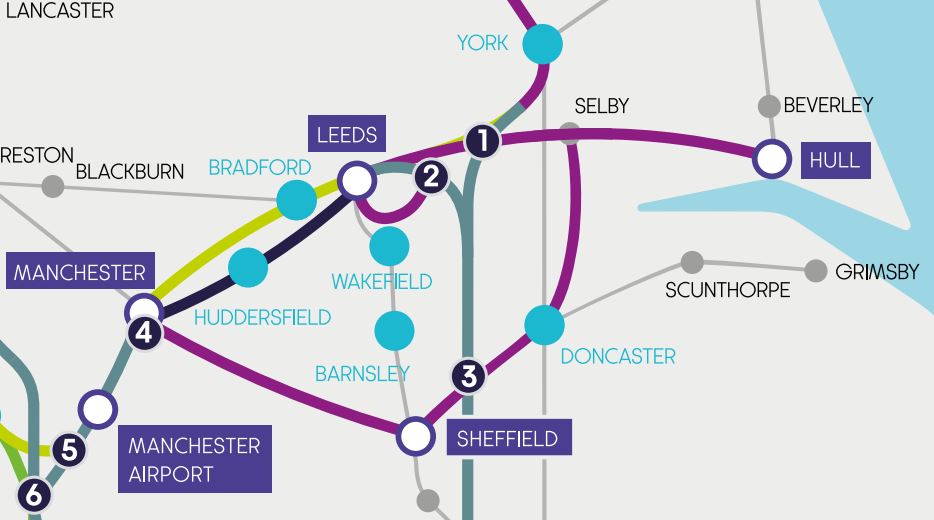
Northern Powerhouse Rail would offer a lot of improvements, which are shown in purple.
There are also these projects that will improve trains to and from Yorkshire.
- Northern Powerhouse Rail between Liverpool and Hull via Manchester Airport, Manchester Piccadilly, Huddersfield, Bradford and Leeds.
- A possible connection between Northern Powerhouse Rail and High Speed Two at High Legh.
- Midland Main Line upgrade with 125 mph bi-mode trains between London and Sheffield.
- 140 mph running on the East Coast Main Line between London and Doncaster and onward to Bradford, Hull, Leeds and York.
I’ll add a few more flesh to the points.
High Speed Two To Hull
If High Speed Two connects to Northern Powerhouse Rail at High Legh it will join everything together.
- High Speed Two trains would run between London and Hull via Birmingham, Crewe, Manchester Airport, Manchester Piccadilly, Huddersfield, Bradford and Leeds.
- Very expensive infrastructure would be shared between High Speed Two and Northern Powerhouse Rail.
- Leeds and Manchester would be just twenty minutes apart, with trains from both lines on the same tracks.
- Hull station has the space to handle the trains.
Combining the two routes should save billions.
Midland Main Line To Sheffield, Rotherham, Barnsley, Wakefield And Leeds
This is already ptoposed for the Midland Main Line.
- New stations will be built at Rotherham and Barnsley.
- Four fast trains per hour between Sheffield and Leeds can be delivered.
- 125 mph bi-mode trains to Yorkshire via the East Midlands.
But what about the following?
- Could the Erewash Valley Line be used instead of a new High Speed Two line between the East Midlands and Sheffield?
- Could the Midland Main Line be electrified and upgraded to 140 mph running like the East Coast Main Line?
Similar connectivity to that of High Speed Two can be created at a lower cost.
Cancellation of the Eastern Leg of Phase 2b would mean there would be no improved link between the West and East Midlands.
Perhaps, the Eastern leg of High Speed Two, would run only to the proposed East Midlands Hub station at Toton.
Increasing Capacity On The East Coast Main Line
In Thoughts On A 140 mph East Coast Main Line Between London And Doncaster, I did a crude calculation to see how many extra trains could be run between London and Doncaster on a digitally signalled 140 mph East Coast Main Line.
This was my conclusion.
If something similar to what I have proposed is possible, it looks like as many as an extra seven tph can be accommodated between Kings Cross and the North.
That is certainly worth having.
Extra trains could be run between Kings Cross and Bradford, Hull, Leeds, Nottingham and Sheffield.
Estimated timings would be eighty minutes to Doncaster and under two hours to Leeds.
Suggestion Three – Reduce Speed In Phase 1
There is always a tendency for project promoters to make sure their project is the biggest and the best.
There will be an optimum speed for a London and Birmingham high speed line, which balances benefits, costs, noise and disturbance. One politician’s optimum will also be very different to another’s.
Such parameters like operating speed and capacity must be chosen with care.
Conclusion
I believe, that we need the capacity of both High Speed Two and Northern Powerhouse Rail to move passengers and freight.
So we should design them together and with other improvements like the Midland Main Line and the East Coast Main Line.
High Speed Two And Brexit
This article on the BBC, is entitled HS2: High-Speed Line Cost ‘could Rise By £30bn’.
Brexiteers like Boris Johnson and Nigel Farage have said in the past, that they are minded to cancel the project.
But surely Boris and Nigel believe that we’ll all be better off under Brexit, so we will have the money for the NHS, kicking the foreigners out of the UK, building a wall to stop the emigrants walking across the Irish Border and High Speed Two.
They can’t have it both ways!
Or is it that both wouldn’t be seen dead on a train?
Science Has Dim View Of Brexiteers’ Brains
The title of this post is the same as that as an article on Page 3 of The Sunday Times
This is the first three paragraphs.
It is a belief that some pro-Europeans already hold dear, but a group of scientists now claim to have confirmed it: Brexit voters are less bright than remainers.
Researchers gave 11,225 volunteers psycholigical tests before the referendum and asked how they intended to vote. Results suggest that leavers tended to be less numerate, more impulsive and more prone to accept the unsupported claims of authoritarian figures.
“Compared with remain voters, leave voters displayed significantly lower levels of numeracy and appeared more reliant on impulsive thinking.” said the researchers, based at Missouri University.
Nigel Farage is quoted as saying the research was “divisive and arrogant”.
Some would say those two words should be applied to him.
 The Anonymous Widower