Rail Minister Marks Completion Of £150m Hope Valley Railway Upgrade
The title of this post is the same as that of this article on Rail Magazine.
These first two paragraphs summarise the work.
More reliable journeys are promised on the Hope Valley line between Manchester and Sheffield after a £150 million upgrade was completed in early April.
Over the last three years, the existing platform at Dore & Totley station on the south side of Sheffield has been extended to cope with six-coach trains. Meanwhile the second platform has been rebuilt and commissioned (after it was removed in the 1980s), two mechanical signal boxes have been abolished and a new one-kilometre freight loop laid in the Peak District. At Hathersage, a pedestrian crossing has also been removed and replaced with a footbridge.
These are my thoughts.
Dore And Totley Station
The Rail Magazine article says this about the improvements at Dore and Totley station.
Replacing two tracks through Dore & Totley removes a single-track bottleneck that often saw Sheffield to Manchester express services held up by slower stopping services and cement trains destined for Earles Sidings. A nine-day shutdown of the route in March was needed to finish the work.
The new platform sits between the Midland Main Line and the Hope Valley line, so can only be reached via the new footbridge or lifts. As well as the usual ‘blister paving’ slabs marking the edge of the platform, other tactile paving has been laid to help people with visual impairments find their way around the station.
This OpenRailwayMap shows the new layout of tracks at Dore and Totley station.

Note.
- The four tracks at the North of the map go to Sheffield station.
- The Eastern pair of tracks are the Midland Main Line and they go to the South-East corner of the map for Chesterfield and the South.
- The Western pair of tracks are the Hope Valley Line and they go to the South-West corner of the map for Manchester.
- The blue lettering in the middle of the map indicates Dore and Totley station.
- There is a single track curve between the Midland Main Line and the Hope Valley Line, which is mainly used by freight trains.
This secondOpenRailwayMap shows Dore and Totley station in greater detail.

The big improvement is that the Hope Valley Line is now double instead of single track, which must eliminate a lot of delays.
These pictures show the station in July 2020.
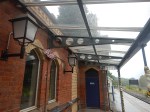


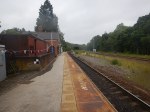


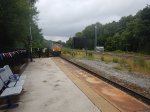
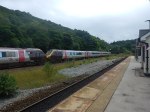
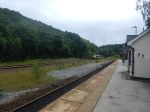

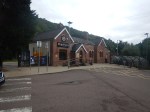


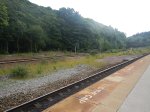
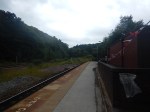
The pictures clearly show the single track and platform at Dore and Totley station.
Dore South Curve
Dore South Curve links the Southbound Midland Main Line with the Westbound Hope Valley Line.
This OpenRailwayMap shows the curve.

There is a crossover in the South-West corner of the map, so with careful signalling, trains can use the Dore South Curve in both directions.
Bamford Loop
This is a freight loop between Bamford and Hathersage stations.
This OpenRailwayMap shows the loop.

Note.
- The Hope Valley Line goes diagonally across the map.
- Manchester is to the North-West.
- Sheffield is to the South-East.
- Bamford station is in the North-West corner of the map.
- Hathersage station is just off the South-East corner of the map.
- The loop is on the Northern side of the Hope Valley Line.
The loop will most likely be used by trains going to Sheffield or Chesterfield.
Hathersage Footbridge
This Google Map shows Hathersage station.

Note.
- Dore Lane and the B 6001 appear to pass under the railway.
- There appears to be what could be foundations just to the West of the platforms at Hathersage station.
- From pictures found by Google the bridge appears to be a simple steel structure.
I shall have to go and take pictures.
Fast Trains Between Manchester And Nottingham
In the Wikipedia entry for the Hope Valley Line, this is said.
Nottinghamshire County Council and the Department for Transport have investigated the possibility of adding another service that does not call at Sheffield in order to improve the journey time between Nottingham and Manchester. Stopping (and changing direction) in Sheffield, the fastest journey is 110 minutes (in 2019), but the council has estimated bypassing Sheffield would cut the time to 85 minutes. Suggested improvements on a 2+1⁄2-mile (4 km) stretch near Stockport may reduce journey times by 2–3 minutes.
Consider.
- According to Google, the driving time between the two cities is 128 minutes and the motorway route is via the M1 and M62.
- If nearly half-an-hour could be saved between Manchester and Nottingham could be a big saving in journey time.
- Manchester Piccadilly is likely to be rebuilt for High Speed Two and a fast route via Nottingham could be a viable alternative.
- Both Manchester and Nottingham have good local tram and train networks.
- As the electrification of the Midland Main Line progresses, the route will be increasingly suitable for 100 mph battery-electric trains.
A Manchester and Nottingham express service looks to be an easy service to implement after the Hope Valley Line has been improved.
Hourly Stopping Trains Between Manchester And Sheffield
The Wikipedia entry for the Hope Valley Line gives these details for the stopping service between Manchester Piccadilly and Sheffield.
- Trains are hourly.
- Trains call at Reddish North, Brinnington, Bredbury, Romiley, Marple, New Mills Central, Chinley, Edale, Hope, Bamford, Hathersage, Grindleford and Dore & Totley.
- But some services do not call at some or all of Edale, Bamford, Hathersage, Grindleford and Dore & Totley giving some 2-hour gaps between services at these stations.
Let’s hope that some of the extra capacity is used to provide a regular service at all stations on the Hope Valley Line.
As in a few years, it will have electrification at both ends, this route could be very suitable for battery-electric trains.
Completion Date
It appears that the first day, when passengers will be able to use the new upgraded tracks and stations will be Thursday, the 2nd of May.
Conclusion
The improvements, certainly seem to allow extra and improved services through on the Hope Valley Line.
I also feel that in a few years, services will be run by battery-electric trains.
Could East Midland Railway’s Leicester And Lincoln Service Be Extended To Burton On Trent?
After my trip to Lincoln and Cleethorpes earlier this week, I got to thinking about how train services could be improved in the area.
Cleethorpes As A Battery-Electric Train Hub Station
In Cleethorpes Station – 28th June 2023, this was my last sentence.
Cleethorpes station could be at the centre of its own battery-electric train network, with all trains powered by just 3.3 miles of single-track electrification.
Services running to Cleethorpes station could be.
- East Midlands Railway – Barton-on-Humber and Cleethorpes via Barrow Haven, New Holland, Goxhill, Thornton Abbey, Ulceby, Habrough, Stallingborough, Healing, Great Coates, Grimsby Town, Grimsby Docks and New Clee, which currently runs two-hourly, but probably should run hourly. Barton-on-Humber and Grimsby Town is not electrified and is 19.6 miles or 39.2 miles for a round trip.
- East Midlands Railway – Leicester and Cleethorpes via Syston, Sileby, Barrow-upon-Soar, Loughborough, East Midlands Parkway, Attenborough, Beeston, Nottingham, Newark Castle, Collingham, Swinderby, Hykeham, Lincoln, Market Rasen, Barnetby, Habrough and Grimsby Town which currently runs two-hourly, but probably should run hourly. Nottingham and Grimsby Town is not planned to be electrified and is 77.8 miles.
- LNER – London King’s Cross and Cleethorpes via Stevenage, Peterborough, Grantham, Newark Northgate, Lincoln, Market Rasen, Barnetby, Habrough and Grimsby Town, which would run at least two trains per day (tpd). Newark Northgate and Grimsby Town is not electrified and is 60.6 miles.
- TransPennine Express – Liverpool Lime Street and Cleethorpes via Liverpool South Parkway, Warrington Central, Birchwood, Manchester Oxford Road, Manchester Piccadilly, Stockport, Sheffield, Meadowhall, Doncaster, Scunthorpe, Barnetby, Habrough and Grimsby Town, which runs hourly. Hazel Grove and Grimsby Town is not electrified and is 101.4 miles.
Note.
- All services to Cleethorpes could be run using a battery-electric train, with the range of a Stadler FLIRT Akku, which is 139 miles.
- Cleethorpes station will soon have four terminal platforms. Could it be one platform for each service?
- The 3.3 miles of single-track electrification would be between Cleethorpes and Grimsby stations.
- I am assuming that all services should be at least hourly, except London King’s Cross.
- If the frequency of services to London King’s Cross, were to be increased, the extra services would take-over paths of the East Midlands Railway services between Lincoln and Cleethorpes.
- I am also assuming that the Midland Main Line electrification has been completed through Leicester to Nottingham, as is currently planned.
Cleethorpes will become a very well-connected station.
Collateral Benefits Of Cleethorpes As A Fossil Fuel-Free Station
If all services to Cleethorpes are run by battery-electric trains, then there will be collateral benefits.
- All passenger train services in North-East Lincolnshire will be zero-carbon.
- TransPennine Express’s Southern route between Liverpool Lime Street and Cleethorpes via Manchester, Sheffield and Doncaster will be zero-carbon.
- LNER’s services to London King’s Cross from Lincolnshire will be zero carbon.
Manchester and Sheffield will be linked by an hourly electric service, just as it was between 1953 and 1981.
The Ivanhoe Line
I wrote about the Ivanhoe Line in Reinstatement Of The Ivanhoe Line.
- There is a proposed reinstatement of passenger services between Leicester and Burton-on-Trent stations.
- I estimate it’s a distance of around 37 miles.
- There would be some new stations on the route.
In the Wikipedia entry for the Ivanhoe Line, there is a section called Future, where this is said.
The intermediate stations are capable of taking only a two-coach train, which has led to overcrowding on some services, especially now that the service is extended to Nottingham and Lincoln. The latest Route Utilisation Strategy for the East Midlands makes recommendations for platform lengthening.
East Midlands Parkway railway station has now been built on the route. The Borough of Charnwood’s local plan of 2004 anticipates a station at Thurmaston.
In 2022 the closed section of the line was one of nine schemes chosen to undergo a feasibility scrutiny by Network Rail as part of the government’s Restoring Your Railway programme. If approved, work could start in 2024 and the line reopened in 2026
Note.
- The first paragraph refers to the existing section of the Ivanhoe Line, to the North of Leicester.
- I went to Burton once for the football and it’s a difficult place to get to from North London by train.
- Burton-on-Trent station was fully refurbished in 2011.
- Burton-on-Trent station has hourly services from CrossCountry trains.
It seems that a creditable plan is emerging.
Service Frequency Between Burton-on-Trent And Leicester
As Burton-on-Trent station has hourly services, I suspect that this will be the initial frequency between Burton-on-Trent and Leicester.
But I could see this frequency being increased, if there were long waits during interchange at Burton-on-Trent.
Average Speed Of The Service And Estimate For A Time Between Cleethorpes And Burton-on-Trent
The current Grimsby Town and Leicester service is over a route of 105.3 miles and a direct service takes two hours and thirty-seven minutes.
This is an average speed of 40.24 mph.
I can now give an estimate for a Cleethorpes and Burton-on-Trent service.
The distance will be 105.3+3.3+37, which is 145.6 miles.
An estimate of the time using a speed of 40.24 mph is three hours and thirty-seven minutes.
But seeing that a good proportion of the route has a 110 mph operating speed, I suspect that a 100 mph train could do the trip faster.
Could Cleethorpes And Burton-on-Trent Be Worked By A Battery-Electric Train?
The route could be effectively four sections.
- Cleethorpes and Grimsby Town – 3.3 miles – Electrified
- Grimsby Town and Nottingham – 77.8 miles – Not Electrified
- Nottingham and Leicester – 27.5 miles – Being Electrified
- Leicester and Burton-on-Trent – 37 miles – Not Electrified
Note.
- In a round trip, there are two sections of 77.8 miles and two consecutive sections of 37 miles.
- Battery-electric trains would be charged on the electrified section of the route.
I am sure that a battery-electric train with a range of greater than 77.8 miles would handle the service.
Thoughts On The East Midlands Railway Timetable After Class 810 Trains Enter Service
East Midlands Railway will soon be replacing their diesel Class 222 trains with new bi-mode Class 810 trains.
- 32 trains will be replaced by 33 trains.
- 167 cars will be replaced by 165 cars.
- The current trains come in four, five and seven cars.
- The new trains come in five-cars only.
- The platforms at St. Pancras station can accept a pair of the new trains.
- Both Class 222 and Class 810 trains are genuine 125 mph trains.
- St. Pancras and Corby takes one hour and fifteen minutes
- St. Pancras and Nottingham takes hour and forty-five minutes
- St. Pancras and Sheffield takes two hours
The current services are as follows.
- St. Pancras and Corby via Luton Airport Parkway, Luton, Bedford, Wellingborough and Kettering
- St. Pancras and Nottingham via Kettering, Market Harborough, Leicester, Loughborough (1 tph), East Midlands Parkway (1 tph) and Beeston (1 tph).
- St. Pancras and Sheffield via Leicester, Loughborough (1 tph), East Midlands Parkway (1 tph), Long Eaton (1 tph), Derby and Chesterfield.
Note.
All services are two trains per hour (tph)
If all services were run by single trains, the following number of trains would be needed for each service.
- St. Pancras and Corby – 6 trains
- St. Pancras and Nottingham – 8 trains
- St. Pancras and Sheffield – 9 trains
Note.
- This means a total of twenty-three trains.
- I am assuming, that trains can turn round in fifteen minutes at each end of the journey.
- If pairs of trains run, then the numbers can be doubled to forty-six trains.
These are my thoughts.
Do The Luton Airport Express Services Need Pairs Of Trains?
The Corby service is now branded as the Luton Airport Express.
This picture shows a packed Luton Airport Express at Luton Airport Parkway station.

After seeing this, I believe that a pair of trains must run to Corby to pick up passengers, who want a fast service to and from Luton Airport.
Will The Class 810 Trains Replace The Class 360 Trains To Corby?
If all services are run by single Class 810 trains, the following would apply.
- The current service pattern would need 23 trains.
- All stations would get the same number of trains to and from St. Pancras.
- All East Midlands Railway out of St. Pancras would use the same 125 mph electric trains and services could probably be speeded up.
- The Class 810 train has 2.94 MW on diesel and the Class 360 train has 1.55 MW on electric, so I suspect that the Class 810 train has the faster acceleration.
- Bedford, Kettering, Luton, Luton Airport Parkway, Market Harborough and Wellingborough would have 125 mph electric commuter services to and from London.
- Corby and Luton Airport Parkway services would have marginally more seats, if Corby services were pairs of trains.
There would be ten spare trains, if the Class 360 trains were replaced or four spare trains, if pairs of trains ran to Corby.
Would Class 810 Trains Running On Electric Execute Stops Faster?
This document on Rail Engineer gives these figures for total power on electric of Class 802 trains.
- Five-car – 2712 kW
- Nine-car – 4520 kW
Note.
- These figures are based on a Hitachi figure of 226 kW for the power of a traction motor.
- The five-car train has twelve motors and the nine-car has twenty.
- As a five-car train has three powered cars and a nine-car train has five, it looks like each powered car has four traction motors.
- The document also says that the power to weight ratio on electric is thirty percent more than on diesel.
This document on the Hitachi web site provides this schematic of the traction system.

Note that four traction motors are confirmed.
Consider the power of the various trains, that run or will run on the Midland Main Line.
- Four-car Class 180 train has one 559 kW diesel engine per car.
- Four, five and seven-car Class 222 train has one 559 kW diesel engine per car.
- Four-car Class 360 train has 1.55 MW on electric – 387 kW per car.
- Five-car Class 810 train has 2.94 MW on diesel – 588 kW per car.
- Five-car Class 810 train has 2.94 MW on electric – 588 kW per car.
Note.
- The Class 810 train will out-accelerate the Class 360 train as it has at least 40 percent more power on electric.
- The Class 810 train has pantographs on both driving cars.
- The Class 810 train has two powered cars; numbers 2 and 4.
- I have assumed that if the Class 810 train can handle 2.94 MW on both diesel and electric.
- With eight traction motors, they would need to be 367.5 kW.
- The Class 810 train should out-accelerate the Class 180 train and Class 222 train as it has at five percent more power on both diesel and electric.
I think it is also relevant that the order for the Class 810 trains was placed in August 2019 and Hitachi announced their collaboration with Eversholt Rail Group to develop the battery-electric versions of the Class 802 trains only sixteen months later. As the Class 810 appears to be an revolution of the Class 802 train, I suspect that Hitachi were working hard on battery design, as this train’s design evolved.
These are the five cars of the Class 810 train.
- 1 – DPTS – Driver-Pantograph-Trailer-Standard with Generator Unit
- 2 – MS – Motored-Standard with Generator Unit
- 3 – TS – Trailer-Standard with Transformer
- 4 – MC – Motored-Composite with Generator Unit
- 5 – DPTF – Driver-Pantograph-Trailer-First with Generator Unit
Note.
- Generator Unit is a diesel generator.
- Motored means the car has four traction motors.
- Composite means a car with both First and Standard accommodation.
- Cars 1-2, and 4-5, form two power units with two generator units, four traction motors and a pantograph, at each end of the train. Cables would connect them to the transformer in car 3.
It looks a neat solution, which probably has high reliability.
I can envisage the two generator units under cars 2 and 4 could be replaced by battery packs.
- The battery packs would mimic the function of the generator units.
- Noise in cars 2 and 4 would be reduced.
- Carbon emissions would be reduced.
- The battery packs would be charged, when running under the wires or possibly from chargers or short length of overhead wires at terminal stations.
- The battery packs would handle regenerative braking.
- Adding battery packs would allow the trains to jump gaps left in the electrification.
At some point in the future, the other two generator units could be removed or replaced with battery packs, depending on whether full electrification happens on the Midland Main Line.
These meanderings convince me that the Class 810 trains will be able to save time in the stops on the Midland Main Line.
Because of these savings, I can see East Midlands Railway, reorganising stops on the electrified section of the route, as although the stop will add a minute or two, this lost time will be picked up on savings at existing stops and by more 125 mph running.
Could The Nottingham And Sheffield Services Be Combined?
These are the current services to Nottingham and Sheffield.
- St. Pancras and Nottingham via Kettering, Market Harborough, Leicester, Loughborough (1 tph), East Midlands Parkway (1 tph) and Beeston (1 tph).
- St. Pancras and Sheffield via Leicester, Loughborough (1 tph), East Midlands Parkway (1 tph), Long Eaton (1 tph), Derby and Chesterfield.
Note.
- Both services call at Leicester , Loughborough and East Midlands Parkway.
- Some trains call at Luton Airport Parkway, Luton, Bedford, Wellingborough, Kettering and Market Harborough on the section of the Midland Main Line, which is currently being electrified between Kettering and Wigston.
- A lot of money has been spent on the Luton DART and it only has two fast trains from St. Pancras. Four tph would be ideal.
Suppose the Sheffield and Nottingham trains operated like this.
- A pair of Class 810 trains would leave St. Pancras.
- South of Leicester, they would call at one or two stations, as defined in the timetable.
- They would then call at Leicester , Loughborough and East Midlands Parkway.
- At East Midlands Parkway, the two trains would split.
- One train would go to Sheffield and the other would go to Nottingham, stopping as defined in the timetable.
Note.
- Because of the trains superior performance, they would be doing quicker calls at stations, which should allow the existing timetable to be maintained or even improved.
- Hitachi trains can split and join in around two minutes.
- These trains would call at Luton Airport Parkway, to give that station four tph from St. Pancras, Luton and Bedford.
I calculated earlier that a 2 tph Sheffield service would need nine trains. So if it served both Nottingham and Sheffield it would need another nine trains. This would give a total of eighteen trains.
- If the St.Pancras and Corby service were to be run by pairs of Class 810 trains, this would require twelve trains.
- Adding the two services together would require thirty trains. Would three trains be enough for backup and in maintenance?
I suspect splitting and joining at East Midlands Parkway could be beneficial.
Could Four tph Be Run To Nottingham And Sheffield?
Consider.
- Bristol, Cardiff, Edinburgh, Leeds, Liverpool, Manchester, Newcastle, Norwich, Southampton and York all get two tph from London.
- Some closer stations like Birmingham, Cambridge, Ipswich, Leicester, Oxford and Reading get more.
- Most of these routes are electrified and run modern trains.
I wouldn’t say never, but adding two tph to both Nottingham and Sheffield services would require.
- Two more hourly train paths on both between St. Pancras and Nottingham, and St. Pancras and Sheffield.
- Eighteen extra trains.
But as a sub-two hour service would be running on both routes, it would probably be possible to accurately predict, when more trains were needed.
Electrification Through Leicester
As more electrification is added, this should result in faster journeys, that reduce carbon emissions.
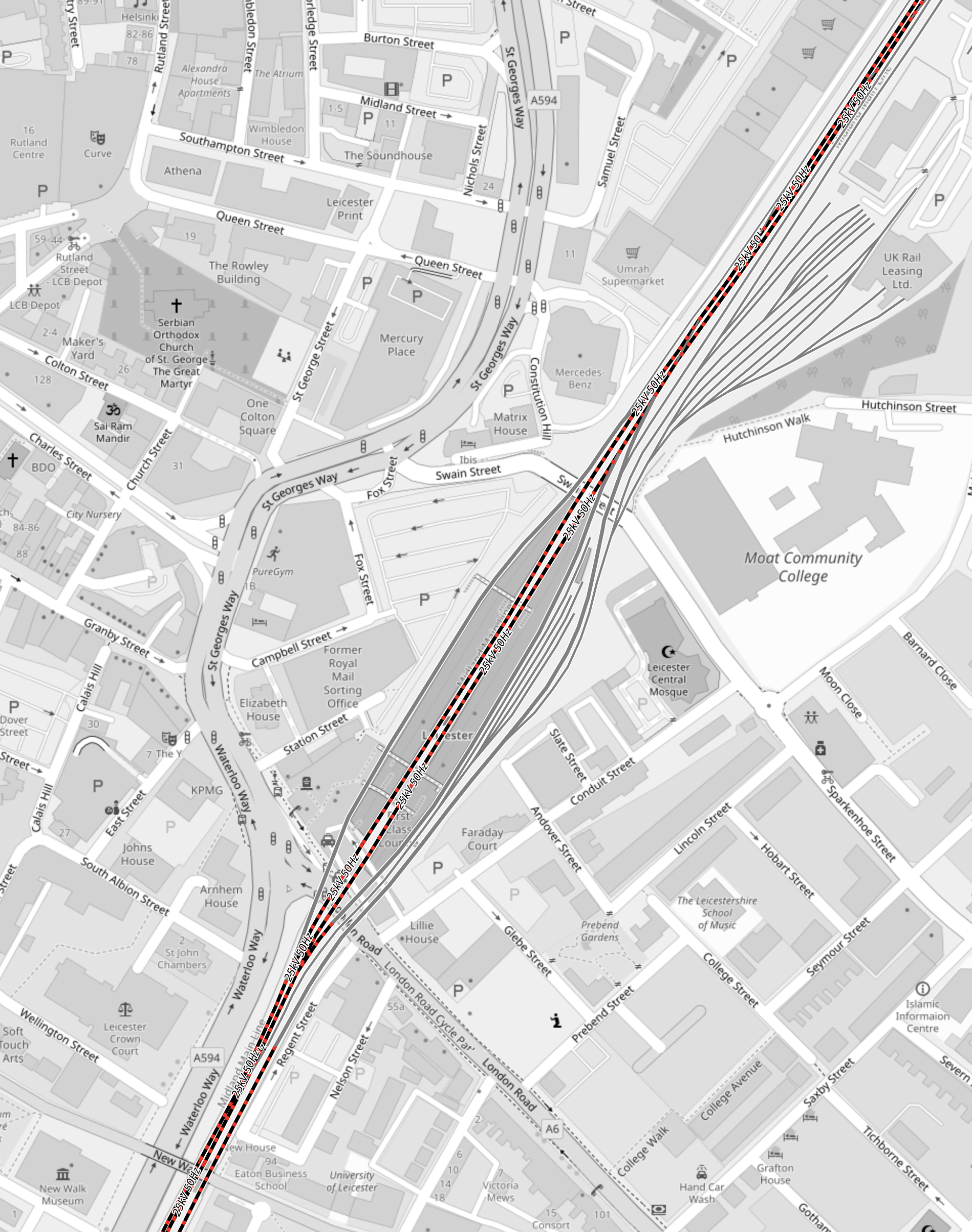
OpenRailwayMap is now showing the electrification as dotted lines on the Midland Main Line.
This map shows the electrification scheme through Leicester.
Note.
- Only the two main lines in the centre of the station seem to be going to be electrified.
- These lines are used by East Midlands Railway’s through trains and surprisingly some freight trains.
- Terminating services from places like Birmingham, Grimsby and Lincoln seem to stop in the outer platforms.
This picture shows the platforms from the Northern footbridge.

This picture shows the platforms from the Northern footbridge.
At the Southern end of the station, the tracks go under the London Road bridge. This map shows the tracks there.

Note.
- The two main tracks of the Midland Main Line appear that they will be electrified.
- But the lines at each side are not electrified.
Some years ago I came back to London from Leicester with a group of drivers. At one point, the conversation turned to electrification and they said that they had met a Network Rail engineer, who had told them, that the bridge was rather low for electrification and the track couldn’t be lowered because Leicester’s main sewer was underneath the railway.
It looks like Network Rail have found a way to squeeze two electrified tracks through the middle of the bridge and then use diesel, battery or other self-powered trains on lines without electrification on either side.
Skegness Station To Benefit From A £3.3m Improvement Package
The title of this post, is the same as that of this article on Rail Technology Magazine.
I took these pictures of Skegness station, on a visit to the town in July last year, which I wrote about in A Trip To Skegness.
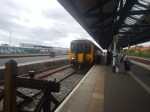


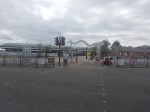
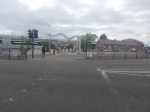
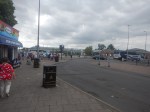


I feel that Skegness station would welcome some improvement.
The Rail Technology Magazine article says this about the project.
Upon completion of the project, customers will be able to utilise a number of enhanced facilities, including an improved accessible toilet with changing spaces, two new start-up offices, a community café and retail provisions. Upgrades will continue through improved access into the station for pedestrians and vehicles, offering integration with the surrounding community.
Work is hoped to start this year.
A Modern Zero-Carbon Train Service
If £3.3 million is going to be spent on Skegness station, would it not be a good idea to have better trains serving the station.
In A Trip To Skegness, I talked about updating the hourly Nottingham and Skegness service using Class 170 trains with Rolls-Royce MTU Hybrid PowerPacks.
I wonder if this route could be improved by fitting the Class 170 trains with Rolls-Royce MTU Hybrid PowerPacks?
- The hybrid technology would have a lower fuel consumption and allow electric operation in stations.
- The prototype hybrid is already working on Chiltern Railways in a Class 168 train.
- The Class 168 train is an earlier version of the Class 170 train and they are members of the Turbostar family.
- Rolls-Royce are developing versions of these hybrid transmissions, that will work with sustainable fuels.
- As we have a total of 207 Turbostar trainsets, these could be a convenient way of cutting carbon emissions on long rural lines.
- As Rolls-Royce MTU are also developing the technology, so their diesel engines can run on hydrogen, it is not outrageous to believe that they could be on a route to complete decarbonisation of this type of train.
I believe that we could see hydrogen-hybrid Class 170 trains, with a Rolls-Royce badge on the side.
But would it be possible to go the whole way using one of Stadler’s battery-electric trains?
Consider the service between Nottingham and Skegness.
- It is hourly.
- The route is run by 100 mph Class 170 trains.
- Nottingham and Grantham are 22.7 miles apart.
- Grantham and Skegness are 58.2 miles apart.
- Trains take four minutes to reverse at Grantham.
- Trains wait 20 minutes before returning at the two end stations.
- Trains reverse at Nottingham in a bay platform, which is numbered 2.
- Grantham is electrified.
- Nottingham station will be electrified in the next few years.
- Skegness station is next to the bus station in the middle of the town, so hopefully the electricity supply is robust enough to charge buses and trains.
Stadler make a train called an Akku.
- It is a member of the FLIRT family.
- It is a 100 mph train.
- I wrote Stadler FLIRT Akku Battery Train Demonstrates 185km Range, which means it could run between Nottingham and Skegness without intermediate charging.
This leads me to the conclusion that with charging systems at Nottingham and Skegness and taking a four-minute top-up at Grantham if needed, a FLIRT Akku could handle this route with ease.
Conclusion
Skegness is a town that needs leveling-up. A refurbished station and 100 mph electric trains to Grantham and London would be a good start.
Avanti West Coast Looks To Recover
The title of this post is the same as an article in the March 2022 Edition of Modern Railways.
These are some points from the article.
Passengers Numbers Are Recovering
This is a paragraph.
Mr. Wittingham says the recovery has been strongest on the Anglo-Scottish and Liverpool corridors, while Manchester have begun to bounce back. Slowest to recover is the London to West Midlands market; ‘there’s several operators here and we were the main carrier of business passengers, and that sector has been recovering more slowly than leisure’ says Mr. Whittingham.
Phil Whittingham is MD of Avanti West Coast.
Train Numbers Are Recovering
Avanti are building up train numbers from Euston after the pandemic.
Frequencies are as follows in trains per hour (tph)
- Pre-Covid – 9
- During the pandemic – 4
- From December 2021 – 7
- Omicron – 4
- From February 2022 – 6
- From May 2022 – 6+
Avanti have reacted to demand.
Three Classes Of Travel
This is a paragraph.
Avanti’s business has historically been driven by leisure travel – before Covid this accounted for broadly 60 % of passengers, with most of the rest travelling for business plus a smaller number of commuters. ‘The demand is there, and we think by next year we’ll be on the way to full recovery’ says Mr. Whittingham. ‘Leisure has been strong, especially at weekends, but the missing bit is the corporate market.’
Avanti have been running a marketing campaign and it appears to have been successful.
This paragraph describes Avanti’s new Standard Premium class.
Last year, Avanti West Coast launched a new class of travel – Standard Premium. This was first introduced in May on an upgrade-only basis before going fully live in September with the option to book online in advance. The new class sits between Standard and First, giving passengers larger seats and greater space but without some of the extras that come with First Class Travel such as complimentary refreshments and lounge access.
These are Mr. Whittingham’s comments on the three classes.
The current split of passengers is 84% Standard, 12 % First and 4 % Standard Premium, but given the latter has been in place for less than a year there is clearly scope for growth. ‘Our research shows people have been upgrading to Standard Premium rather than downgrading from First’.
I have yet to try Standard Premium, but I will next time I use Avanti.
Refreshments
Avanti have decided to serve different refreshments in Standard Premium and First classes.
- In Standard Premium, they are now offering At Seat Orders.
- In First, they have updated the menu.
Both seem to have been well-received.
I like this statement from Mr. Whittingham.
We’ve tried to make it a more personalised service with a less rigid structure, so we give customers what they want, when they want it, rather than when we want to give it to them.
A Consistent Offer
This is a paragraph.
Mr. Whittingham says Avanti has not yet confirmed whether t will offer three classes of travel on the new Hitachi trains it has ordered, but says the aim is to provide a more consistent offer. Assisting this will be changes in the ongoing Pendolino refurbishment, where 11-car sets are having Coach G converted from First to Standard accommodation, meaning all Pendolinos, whether nine-car or 11-car, will have three coaches for First and Standard Premium passengers.
My instinct says that the four trains will be something like.
- Class 390 train – Pendolino – Nine-car – three First/Standard Premium cars – six Standard cars
- Class 390 train – Pendolino – Eleven-car – three First/Standard Premium cars – eight Standard cars
- Class 805 train – Hitachi – Five-car – one First/Standard Premium car – four Standard cars
- Class 807 train – Hitachi – Seven-car – two First/Standard Premium car – five Standard cars
Note.
- The Class 805 and Class 807 Hitachi trains are very much plug-and-play and can be lengthened or shortened as required.
- A regular passenger between London and Liverpool, who regularly upgrades from Standard to Standard Premium in a Class 390 train could be a bit miffed if he couldn’t, because the service was being run by a Class 807 train.
- Hitachi would probably be very happy to add extra cars to the Class 805 and Class 807 trains.
As the Class 390 Pendolino trains are being refurbished, I do wonder if they will be receiving some fittings from the Hitachi trains to make sure the trains are consistent to both on-board staff and passengers.
Pendolino Investment
The Pendolino refurbishment is comprehensive.
- It is one of the largest such programmes ever undertaken in the UK.
- Leasing company; Angel Trains are funding the work.
- Alstom are doing the work at Widnes.
- There appears to be a smooth plan to refurbish all trains.
- Coach G will be converted from First to Standard accommodation in eleven-car trains.
- Mr. Whittingham says that all trains will come out looking like a new train.
The eleven-car trains are being converted first, as the conversion of Coach G gives a capacity benefit of around thirty seats.
The awful seats in Standard Class will be replaced with Lumo-style seats and laptop-friendly fold-down tables.

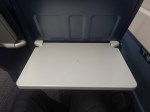
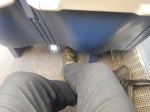
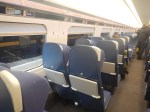
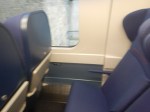
These seats will be a big improvement!
New Trains Coming
This paragraph introduces the new trains.
The second major fleet investment from Avanti is the £350 million for new trains from Hitachi, financed by Rock Rail. These comprise 13×5-car Class 805 bi-modes, ordered for destinations off the electrified route including North Wales and Shrewsbury and 10×7-car Class 807 electrics. Deployment plans for the latter are still being worked through but are likely to include services to Birmingham and Liverpool, and potentially to Blackpool.
What is not said in this paragraph, is that all trains have a redesigned front end, which I suspect is more aerodynamic.
The all-electric Class 807 trains have no diesel engines or batteries, so have they been put on a diet, to improve the acceleration?
In Will Avanti West Coast’s New Trains Be Able To Achieve London Euston and Liverpool Lime Street In Two Hours?, I came to these conclusions.
- A two hour service between London Euston and Liverpool Lime Street will be possible with Avanti West Coast’s new Class 807 trains.
- The current Class 390 trains could go a bit faster and if they cut out a couple of stops could probably break two hours.
I also calculated that a two tph service between London and Liverpool in two hours would need nine trains.
Timetable Changes
This paragraph introduces the article’s section on timetable changes.
The project in turn feeds into a major timetable change planned by Avanti and other West Coast main line operators. This will be the first significant change to West Coast main line schedules since 2008; ‘the world has changed, and we need to think about how we best serve our markets’ says Mr Whittingham.
This paragraph sums up the major changes.
Of note are the planned changes to the pattern of London to West Midlands services; the pre-Covid 20-minute interval would be amended to offer faster journey times and greater connectivity. Also featuring in the new timetable aspirations would be additional Trent Valley calls in some Liverpool and Manchester services; Mr Whittingham cites as one benefit of this the potential for improved journey times between the North West and the East Midlands via a change of train at Nuneaton. The Hitachi trains, with their better acceleration, will be particularly useful on services with more frequent stops.
The next three sections will look at some timetable changes in a bit more detail.
London And West Midlands Services
Replacement of twenty diesel Class 221 trains with thirteen bi-mode Class 805 trains will mean a major reorganisation of services to the West Midlands.
- Some current diesel services will now be electric.
- All services between Birmingham New Street and Euston will now be electric.
- No services will run on diesel under live electrification.
- Avanti have promised to serve Walsall.
- There will be extra services to Shrewsbury and other places.
The electric services will also speed up some services to the West Midlands.
North West And East Midlands Services
I will look at train times for services between the North West (Liverpool Lime Street and Manchester Piccadilly) and the East Midlands (Leicester, Nottingham and Lincoln), where passengers change at Nuneaton.
These are the current fastest possible times according to the National Rail journey planner.
- Liverpool Lime Street and Leicester -2:24 with changes at Crewe and Nuneaton,
- Manchester Piccadilly and Leicester – 2:11 with change at Sheffield
- Liverpool Lime Street and Nottingham – 2:42 with no changes
- Manchester Piccadilly and Nottingham – 1:51 with no changes
- Liverpool Lime Street and Lincoln- 3:42 with changes at Sheffield and Doncaster
- Manchester Piccadilly and Lincoln – 2:38 with change at Sheffield
Note that times are in hours:minutes.
These are all current times for the various legs if the route is via Nuneaton.
- Avanti West Coast – Liverpool Lime Street and Nuneaton – 1:18
- Avanti West Coast – Manchester Piccadilly and Nuneaton – 1:13
- CrossCountry – Nuneaton and Leicester – 0:27
- East Midlands Railway – Leicester and Nottingham – 0:48 – Time from Leicester and Lincoln service.
- East Midlands Railway – Leicester and Nottingham – 0:20 – Time from St. Pancras and Nottingham service.
- East Midlands Railway – Leicester and Lincoln -1:42 – Time from Leicester and Lincoln service.
- East Midlands Railway – Nottingham and Lincoln -0:52 – Time from Leicester and Lincoln service.
Note that the two Avanti West Coast times have been estimated by taking the time from Real Time Trains and adding three minutes for the acceleration or deceleration at Nuneaton.
These would be possible times between the North West and the East Midlands via Nuneaton.
- Liverpool Lime Street and Leicester – 1:47
- Manchester Piccadilly and Leicester – 1:42
- Liverpool Lime Street and Nottingham – 2:37
- Manchester Piccadilly and Nottingham – 2:32
- Liverpool Lime Street and Lincoln- 3:31
- Manchester Piccadilly and Lincoln – 3:26
Note that I am assuming changes at Nuneaton and Leicester are cross-platform or same platform changes that take two minutes.
But there is another level of improvement possible.
Suppose that East Midlands Railway’s Lincoln and Leicester service were to be extended to Nuneaton and run by a train with this specification.
- 125 mph operating speed.
- Battery-electric power.
- 100 mph operating speed on battery power.
- Range of 56 miles on battery
- Ability to use the Midland Main Line electrification, when it is erected.
Charging stations would be needed at Nuneaton and Lincoln.
These would be possible times between the North West and the East Midlands via Nuneaton with the one change at Nuneaton.
- Liverpool Lime Street and Leicester – 1:45
- Manchester Piccadilly and Leicester – 1:40
- Liverpool Lime Street and Nottingham – 2:05
- Manchester Piccadilly and Nottingham – 2:00
- Liverpool Lime Street and Lincoln- 2:57
- Manchester Piccadilly and Lincoln – 2:52
Note.
I am assuming that the timings for the Nuneaton and Leicester and the Nottingham and Lincoln legs are as for the current trains.
I am assuming the change at Nuneaton is a cross-platform or same platform change that takes two minutes.
Trains run on battery where tracks are not electrified.
I can build a table of current times, times via Nuneaton and savings.
- Liverpool Lime Street and Leicester -2:24 – 1:45 – 0:39
- Manchester Piccadilly and Leicester – 2:11 – 1:40 – 0.31
- Liverpool Lime Street and Nottingham – 2:42 – 2:05 – 0:37
- Manchester Piccadilly and Nottingham – 1:51 – 2:00 – 0.09 slower
- Liverpool Lime Street and Lincoln- 3:42 – 2:57 – 0.45
- Manchester Piccadilly and Lincoln – 2:38 – 2:52 – 0:14 slower
It does appear that by using the 125 mph speed of the West Coast Main Line has a positive effect on some times from the North West to the East Midlands.
But times could be reduced further.
- Installing full digital signalling, that would enable 140 mph running between Crewe and Nuneaton, could save ten minutes.
- Improving the Nuneaton and Leicester and the Nottingham and Lincoln legs could allow faster running.
The more I look at changing at Nuneaton, I feel it is a good idea.
- It improves the connections between East Midlands Parkway and Loughborough and the North West.
- It improves the connections between Cambridge, Peterborough and Stansted Airport and the North West, if the change at Nuneaton is to CrossCountry’s Stansted Airport and Birmingham New Street service.
- It improves the connections between Coventry and Leamington Spa and the North West.
Avanti have come up with a cunning plan, worthy of Baldrick at his best.
A Second Hourly Service Between London And Liverpool
A paragraph talks about the second hourly service between London and Liverpool.
Avanti still has ambitions to introduce a second hourly service between Euston and Liverpool, but when this will come in will depend on demand recovery.
Consider.
- If would be desirable if some or all trains running on the route could achieve a timing of two hours between London and Liverpool.
- It is felt that the second service should stop at Liverpool South Parkway station, where the platforms are too short for eleven-car Class 390 trains.
- Avanti have stated they would like more stops in the Trent Valley, especially at Nuneaton, where they would connect to services to the East Midlands.
- Nuneaton is almost exactly halfway between London and Liverpool.
- Running two tph with Class 807 trains would need nine trains and Avanti have only ordered ten in total.
I believe that a practical timetable like this could work.
- Class 390 train – one tph – Non-stop or perhaps a single stop in the Midlands – Under two hours
- Class 807 train – one tph – Stopping at Nuneaton, Stafford, Crewe, Runcorn and Liverpool South Parkway – Current time or better
An hourly service between London and Liverpool in under two hours would surely be a passenger magnet.
How Feasible Is A High Speed Line Between Birmingham And Nottingham?
In Red Wall Commuters To Get Rail Revolution, I indicated that the Department of Transport is considering creating three new high speed lines in the Midlands and the North of England.
One is proposed between Birmingham and East Midlands Parkway, which is described in the original article in The Sunday Times like this.
A 42-mile line from Birmingham to East Midlands Parkway, just south of Nottingham. This is expected to cut journey times between the two cities from 72 minutes to 27 minutes.
There is a currently, a CrossCountry service between Nottingham and Birmingham New Street stations.
- The frequency is two trains per hour (tph)
- Trains are generally three- or four-car formations of Class 170 diesel trains.
- All trains stop at Tamworth, Burton-on-Trent and Derby.
- Some trains stop at Wilnecote, Willington, Spondon, Long Eaton and Beeston
- The services take upwards of seventy-one minutes.
Note.
- The frequency between Birmingham New Street and Derby is four tph.
- Trains reverse at Derby which takes seven minutes.
- Three tph stop at Burton-on-Trent.
I feel that the current service is very much a compromise, which is trying to handle three services.
- A fast train between Birmingham and Nottingham.
- A fast train between Birmingham and Derby.
- A local service between Nottingham and Derby.
High Speed Two will be providing a non-stop service between Birmingham Curzon Street and East Midlands Hub stations.
- The frequency will be three tph.
- There will also be an hourly train between Birmingham Interchange and East Midlands Hub station.
- The services will take twenty minutes or slightly less from Interchange.
The services will only get you to East Midlands Hub station.
In addition after High Speed Two opens Midlands Connect are planning to run a direct service between Nottingham and Birmingham Curzon Street stations.
- The frequency will be one tph.
- The service will use High Speed Two Classic Compatible trains.
- The only stop will be East Midlands Hub station.
- The service will take thirty-three minutes.
So how does a new high speed line connect Birmingham and Nottingham in twenty-seven minutes?
Consider.
- The route between Birmingham New Street and North Stafford Junction is 35.9 miles
- At North Stafford junction a double-track freight line leads to the East.
- The freight line passes to the North of East Midlands Airport and South of Long Eaton station before joining the Midland Main Line at Trent junction to the North of East Midlands Parkway station.
- Trains can pass straight into Nottingham via Beeston.
- Nottingham is just 6.7 miles to the East of Trent junction and East Midlands Parkway is just a mile South of Trent junction.
- South Stafford junction to Trent junction is probably about seven miles.
I believe that this is the route that will be upgraded to create a high speed line between Birmingham and Nottingham.
- Part of the route between Tamworth and Burton-on-Trent was upgraded to 125 mph running by British Rail.
- Between Birmingham New Street and North Stafford Junction is used by CrossCountry services between Birmingham and Derby and Nottingham.
- I believe that the route can be fully electrified and upgraded, so that most of the route could be suitable for 125 mph running.
- The Midland Main Line is already capable of handling trains at 125 mph.
This should make it possible for services to run between Birmingham New Street and Nottingham in the required twenty-seven minutes.
I will answer a few questions.
Could The Trains Serve Birmingham Curzon Street In Birmingham?
In Birmingham Airport Connectivity, I said this
But look at this map clipped from the High Speed Two web site.
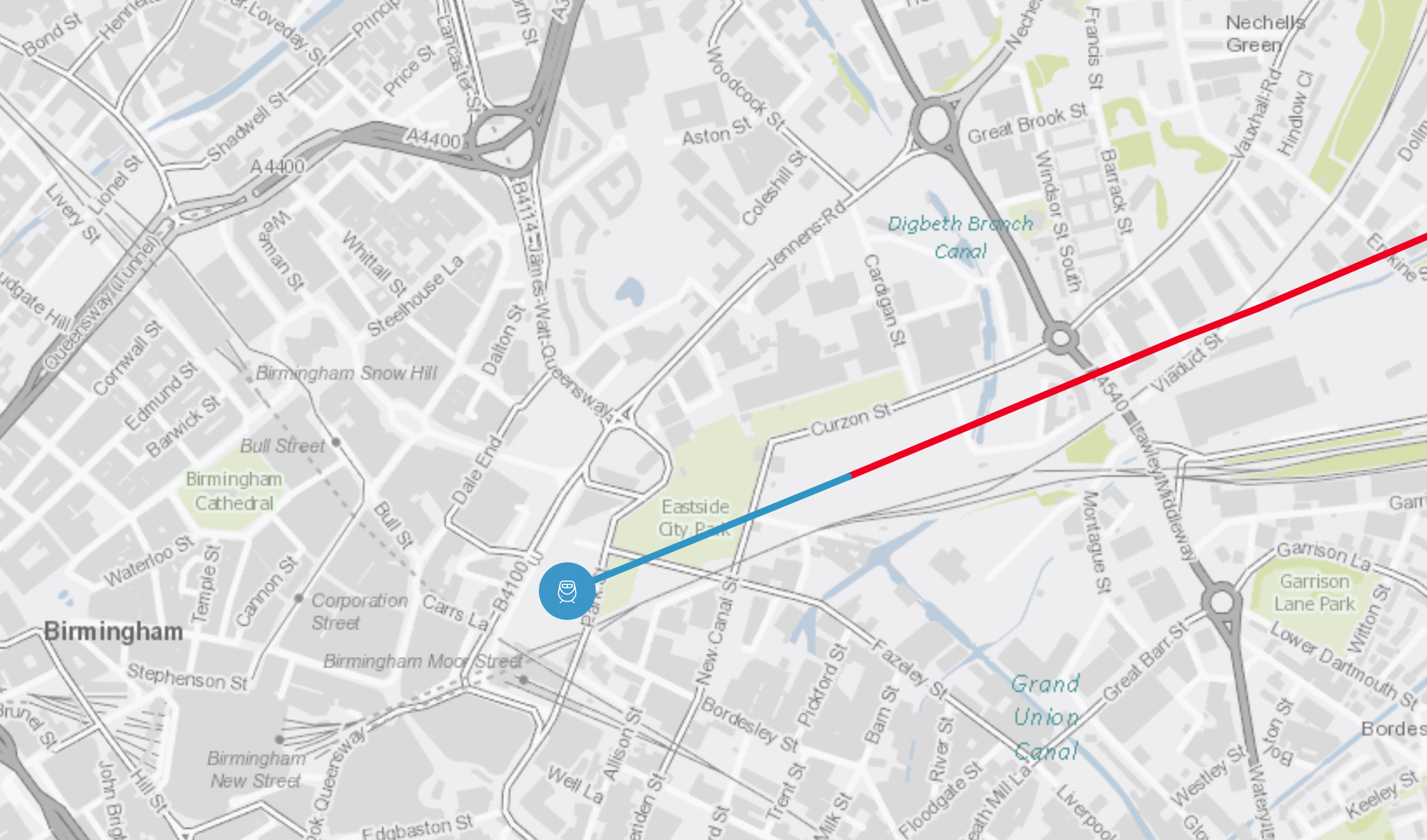
Note.
- The blue dot shows the location of Curzon Street station.
The West Coast Main Line running into New Street station, is just to the South of Curzon Street station.
New Street station can be picked out to the West of Curzon Street station.
This Google Map shows a close-up of the current Curzon Street station site.
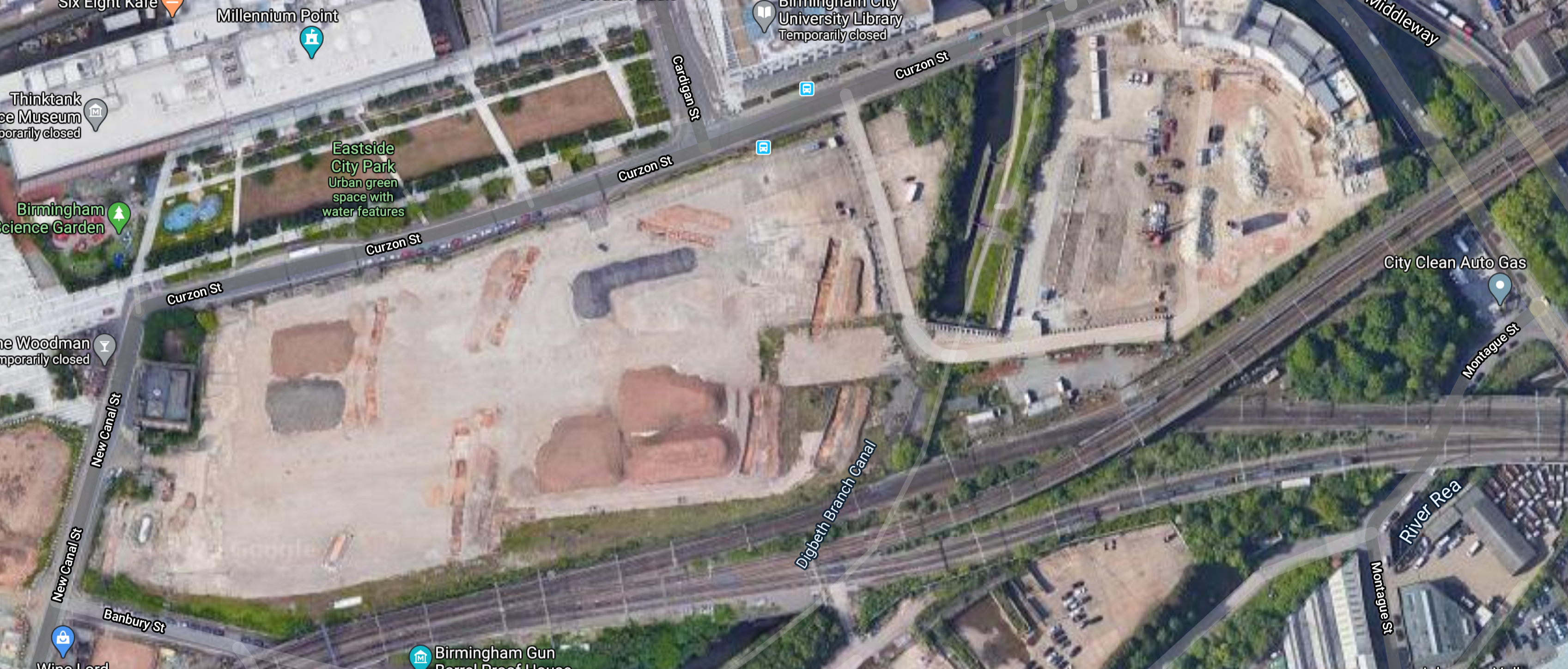
The same pattern of rail lines going past the Curzon Street site into New Street station can be picked out.
Surely, a connection could be made to allow trains from a couple of platforms in Curzon Street station to terminate trains from the West Coast Main Line.
Possible services could include.
- London Euston and Birmingham Curzon Street via Watford Junction, Milton Keynes, Rugby and Coventry
- Cardiff and Birmingham Curzon Street via Bristol Parkway, Swindon, Oxford and Milton Keynes.
- Cambridge and Birmingham Curzon Street via Bristol Parkway, Bedford and Milton Keynes.
There are a lot of possibilities to give High Speed Two much bigger coverage.
I also suspect that the proposed Nottingham and Birmingham service could terminate in Birmingham Curzon Street.
Could High Speed Two Classic Compatible Trains Run Between Birmingham And Nottingham?
As High Speed Two Classic Compatible Trains would have the same loading gauge as current trains, I don’t see why not.
Could A London Euston And Nottingham Service Be Run With A Reverse At Birmingham Curzon Street?
These are prospective times for High Speed Two.
- London Euston and Birmingham Curzon Street – 45 minutes
- London Euston and East Midlands Hub – 52 minutes
Note that East Midlands Hub and Nottingham could take at least twenty minutes.
And this is a current timing.
- London St. Pancras And Nottingham – 95 minutes
It is possible calculate the time for London Euston to Nottingham with a reverse at Birmingham.
- London Euston and Birmingham Curzon Street – 45 minutes
- Reverse at Birmingham Curzon Street – 3 minutes
- Birmingham Curzon Street and Nottingham – 27 minutes
This would give a time of 75 minutes between London Euston and Nottingham.
It does look to me, that the fastest route between London and Nottingham, will be to to go via Birmingham and the proposed new high speed route.
So the answer to the question in the title of this section is a Yes!
Could A London Euston And Sheffield Service Be Run With A Reverse At Birmingham Curzon Street?
These are prospective times for High Speed Two.
- London Euston and Birmingham Curzon Street – 45 minutes
- London Euston and East Midlands Hub – 52 minutes
- London Euston and Sheffield – 87 minutes
And these are current timings.
- London St. Pancras And Derby- 85 minutes
- London St. Pancras And Sheffield- 118 minutes
- Birmingham New Street And Derby- 33 minutes
- Birmingham New Street And Sheffield- 75 minutes
It is possible calculate the time for London Euston to Sheffield with a reverse at Birmingham.
- London Euston and Birmingham Curzon Street – 45 minutes
- Reverse at Birmingham Curzon Street – 3 minutes
- Birmingham Curzon Street and Sheffield – 75 minutes
This would give a time of 123 minutes between London Euston and Sheffield.
I wonder what time could be achieved between London Euston and Sheffield could be achieved with improvements to the following lines.
- The CrossCountry Route between North Stafford junction and Derby station.
- The Midland Main Line between Derby and Sheffield.
I would expect that the improvement to these routes would include.
- At least almost full electrification.
- Removal of level crossings.
- Full digital signalling.
- Upgrading to 140 mph running.
I could see the following service improvements.
- A substantial reduction of the times between Birmingham and Sheffield.
- Derby and Burton-on-Trent would get a fast service to London Euston via High Speed Two.
- Derby and Burton-on-Trent would get a fast service to Birmingham probably with a frequency of 4 tph.
- CrossCountry services between Birmingham and Sheffield would be faster.
Derby and Burton-on-Trent would get a much better train service.
Could Burton-on-Trent, Derby, Nottingham And Sheffield Be served By Trains Splitting And Reversing At Birmingham Curzon Street?
These are prospective frequencies for High Speed Two.
- Burton-on-Trent – No trains
- Chesterfield 1 tph
- Derby – No trains
- East Midland Hub – 7 tph
- Nottingham – 0 tph
- Sheffield – 2 tph
Suppose there were two tph between London and Birmingham Curzon Street, that split into two trains in Birmingham.
- One train could go to Nottingham and call at Tamworth and Burton-on-Trent.
- The other train could go to Sheffield and call at Tamworth, Burton-on-Trent, Derby and Chesterfield.
This would give the following frequencies from London on High Speed Two.
- Burton-on-Trent – 2 tph
- Chesterfield – 2 tph
- Derby – 2 tph
- Nottingham – 2 tph
- Sheffield – 2 tph
Note that I am ignoring the Eastern Leg of High Speed Two in this analysis.
Could We Go For The Full Burton?
In the previous sections, I suggested serving Nottingham and Sheffield from Euston using High Speed Two with a reverse at Birmingham Curzon Street, where the train would split into two trains, with one train going to Sheffield and the other going to Nottingham.
But could the split be at a rebuilt Burton station?
Consider.
- Burton station could become an Eastern terminus of Birmingham’s Cross-City Line.
- Burton station could become the Western terminus of the Ivanhoe Line to Leicester.
- If the Cross Country Route is upgraded, Burton station would have fast connections to Birmingham, Derby, Chesterfield, Sheffield and Leeds,
- If the new Birmingham and Nottingham route is created, this would mean fast connections to Nottingham and possibly Lincoln.
Burton-on-Trent could become the passenger rail hub for the Mid Midlands.
I
Thoughts On The Eastern Leg Of High Speed Two
These are a few thoughts on the Eastern Leg of High Speed Two.
Serving The North-East Quarter Of England From London
In Anxiety Over HS2 Eastern Leg Future, I gave a table of timings from London to towns and cities in the North-East quarter of England from Lincoln and Nottingham Northwards.
I’ll repeat it here.
- Bradford – Will not be served by High Speed Two – One hour and fifty-four minutes
- Cleethorpes – Will not be served by High Speed Two – Two hours and fifty-one minutes
- Darlington – One hour and forty-nine minutes – One hour and forty-nine minutes
- Doncaster – Will not be served by High Speed Two – One hour
- Edinburgh – Three hours and forty minutes via Western Leg – Three hours and thirty minutes.
- Grimsby – Will not be served by High Speed Two – Two hours and thirty-six minutes
- Harrogate – Will not be served by High Speed Two – One hour and fifty-two minutes
- Huddersfield – Will not served by High Speed Two – Two hours and eight minutes
- Hull – Will not be served by High Speed Two – One hour and fifty minutes
- Leeds – One hour and twenty-one minutes – One hour and thirty minutes
- Lincoln – Will not be served by High Speed Two – One hour and fifty-one minutes
- Middlesbrough – Will not be served by High Speed Two – Two hours and twenty minutes
- Newcastle – Two hours and seventeen minutes – Two hours and sixteen minutes
- Nottingham – One hour and seven minutes – One hour and fifty minutes
- Scarborough – Will not be served by High Speed Two – Two hours and fifty-seven minutes
- Sheffield – One hour and twenty-seven minutes – One hour and twenty-seven minutes
- Skipton – Will not be served by High Speed Two – Two hours and seven minutes
- Sunderland – Will not be served by High Speed Two – Two hours and thirty minutes
- York – One hour and twenty-four minutes – One hour and twenty-four minutes
Note.
- I have included all destinations served by Grand Central, Hull Trains and LNER.
- I have included Nottingham and Sheffield for completeness and in case whilst electrification is installed on the Midland Main Line, LNER run services to the two cities.
- I suspect LNER services to Bradford, Harrogate, Huddersfield and Skipton will split and join at Leeds.
There are a total of nineteen destination in this table.
- Twelve are not served by High Speed Two.
- Six are not more than fifteen minutes slower by the East Coast Main Line.
Only Nottingham is substantially quicker by High Speed Two.
Serving The North-East Quarter Of England From Birmingham
Fenland Scouser felt the above table might be interesting to and from Birmingham with or without the Eastern Leg of High Speed Two.
I think, I can give more information than that and it should be possible to give for each destination the following.
- Whether of not the route exists on High Speed Two.
- Time on High Speed Two from Birmingham.
- Time on High Speed Two and Northern Powerhouse Rail from Birmingham via Manchester
- Time by current trains from Birmingham
In the following table, the fields are in the order of the previous table.
- Bradford – No direct route – No time – One hour and three minutes – Two hours and twenty-seven minutes
- Cleethorpes – No direct route – No time – Three hours and eight minutes – Three hours and eighteen minutes
- Darlington – Route Exists – One hour and twenty-three minutes – One hour and forty minutes – Two hours and fifty-five minutes
- Doncaster – No direct route – No time – One hour and thirty-six minutes – Two hours and nineteen minutes
- Edinburgh- Route Exists – Three hours and fourteen minutes – Four hours – Four hours and thirteen minutes
- Grimsby – No direct route – No time – Two hours and fifty-three minutes – Three hours and three minutes
- Harrogate – No direct route – No time – One hour and twenty-eight minutes – Three hours
- Huddersfield – No direct route – No time – Fifty-six minutes – Two hours and eleven minutes
- Hull – No direct route – No time – One hour and forty-four minutes – Three hours and two minutes
- Leeds – Route Exists – Forty-nine minutes – One hour and six minutes – One hour and fifty-nine minutes
- Lincoln – No direct route – No time – Two hours and fifty-three minutes – Two hours and thirteen minutes
- Middlesbrough – No direct route – No time – Two hours and twenty-nine minutes – Three hours and thirty-two minutes
- Newcastle – No direct route – No time – Two hours and four minutes – Three hours and twenty-six minutes
- Nottingham – Route Exists – Fifty-seven minutes – Two hours and fifty-five minutes – One hour and ten minutes
- Sheffield – Route Exists – Thirty-five minutes – One hour and thirty-four minutes – One hour and fifteen minutes
- Skipton – No direct route – No time – One hour and forty-three minutes – Two hours and fifty-two minutes
- Sunderland – No direct route – No time – Two hours and fifty-nine minutes – Three hours and fifty-eight minutes
- York – Route Exists – Fifty-seven minutes – One hour and twenty-eight minutes – Two hours and twenty-seven minutes
Note.
- No time means just that!
- One of the crucial times is that Birmingham Curzon Street and Leeds is just an hour and six minutes via High Speed Two and Northern Powerhouse Rail. This time gives good times to all destinations served from Leeds.
- Nottingham and Sheffield are both around an hour and fifteen minutes from Birmingham New Street, by the current trains.
I’ll now look at some routes in detail.
Birmingham And Leeds
The time of one hour and six minutes is derived from the following.
- Birmingham Curzon Street and Manchester Piccadilly by High Speed Two – Forty-one minutes
- Manchester Piccadilly and Leeds by Northern Powerhouse Rail – Twenty-five minutes
It would be seventeen minutes slower than the direct time of forty-nine minutes.
But it is quicker than the current time of one hour and fifty-nine minutes
Note.
- As Manchester Piccadilly will have a time to and from London of one hour and eleven minutes, Leeds will have a time of one hour and twenty-six minutes to London via Northern Powerhouse Rail and Manchester.
- If the Eastern Leg is built, The London and Leeds time will be one hour and twenty-one minutes.
- The Eastern Leg would therefore save just five minutes.
The Northern Powerhouse route could probably mean that Huddersfield, Bradford and Hull would be served by High Speed Two from London.
Manchester Airport, Manchester Piccadilly and Leeds would be connected by a tunnel deep under the Pennines.
- Manchester Piccadilly, Huddersfield and Bradford could be underground platforms added to existing stations.
- Piccadilly and Leeds would have a journey time of under 25 minutes and six trains per hour (tph).
- The tunnel would also carry freight.
- It would be modelled on the Gotthard Base Tunnel in Switzerland.
I wrote full details in Will HS2 And Northern Powerhouse Rail Go For The Big Bore?
Birmingham And Nottingham
The time of two hours and fifty-five minutes is derived from the following.
- Birmingham Curzon Street and Manchester Piccadilly by High Speed Two – Forty-one minutes
- Manchester Piccadilly and Leeds by Northern Powerhouse Rail – Twenty-five minutes
- Leeds and Nottingham – One hour and forty-nine minutes
It would be one hour and fifty-eight minutes slower than the direct time of fifty-nine minutes.
The current time of one hour and ten minutes is much quicker.
Birmingham And Sheffield
The time of two hours and thirty-four minutes is derived from the following.
- Birmingham Curzon Street and Manchester Piccadilly by High Speed Two – Forty-one minutes
- Manchester Piccadilly and Leeds by Northern Powerhouse Rail – Twenty-five minutes
- Leeds and Sheffield – One hour and twenty-eight minutes
It would be one hour and fifty-nine minutes slower than the direct time of thirty-five minutes.
The current time of one hour and fifteen minutes is much quicker.
Conclusions On The Timings
I am led to the following conclusions on the timings.
The building of the Eastern Leg of High Speed Two gives the fastest times between Birmingham and Leeds, Nottingham and Sheffield.
But if the Eastern Leg of High Speed Two is not built, then the following is true, if Northern Powerhouse Rail is created between Manchester and Leeds.
The time of an hour and six minutes between Birmingham Curzon Street and Leeds is probably an acceptable time.
This time probably enables acceptable times between Birmingham Curzon Street and destinations North of Leeds.
But with Nottingham and Sheffield the current CrossCountry service is faster than the route via Manchester.
The speed of the CrossCountry services surprised me, but then there is a section of 125 mph running between Derby and Birmingham, which is used by CrossCountry services between Birmingham New Street and Leeds, Nottingham and Sheffield.
This table gives details of these services.
- Birmingham New Street and Leeds – 116,4 miles – One hour and 58 minutes – 59.3 mph
- Birmingham New Street and Nottingham – 57.2 miles – One hour and 14 minutes – 46.4 mph
- Birmingham New Street and Sheffield – 77.6 miles – One hour and 18 minutes – 59.7 mph
Note.
- The Leeds and Sheffield services are run by 125 mph Class 220 trains.
- The Notting service is run by 100 mph Class 170 trains.
- All trains are diesel-powered.
As there is 125 mph running between Derby and Birmingham, the train performance probably accounts for the slower average speed of the Nottingham service.
CrossCountry And Decarbonisation
Consider.
- CrossCountry has an all-diesel fleet.
- All train companies in the UK are planning on decarbonising.
- Some of CrossCountry’s routes are partially electrified and have sections where 125 mph running is possible.
The only standard train that is built in the UK that would fit CrossCountry’s requirements, would appear to be one of Hitachi’s 125 mph trains like a bi-mode Class 802 train.
- These trains are available in various lengths
- Hitachi will be testing battery packs in the trains in the next year, with the aim of entering service in 2023.
- Hitachi have formed a company with ABB, which is called Hitachi ABB Power Grids to develop and install discontinuous electrification.
When CrossCountry do replace their fleet and run 125 mph trains on these services several stations will be connected to Birmingham for High Speed Two.
The route between Leeds and Birmingham via Sheffield is part of the Cross Country Route, for which electrification appears to have planned in the 1960s according to a section in Wikipedia called Abortive British Rail Proposals For Complete Electrification,
I suspect that the following times could be achieved with a frequency of two tph
- Birmingham New Street and Leeds – 90 minutes
- Birmingham New Street and Nottingham – 60 minutes
- Birmingham New Street and Sheffield – 60 minutes
It is not the Eastern Leg of High Speed Two, but it could do in the interim.
Electrification Of The Midland Main Line
I don’t believe that the Midland Main Line needs full electrification to speed up services to Derby, Nottingham and Sheffield, but I believe that by fitting batteries to Hitachi’s Class 810 trains, that will soon be running on the line and using the Hitachi ABB Power Grids system of discontinuous electrification, that the route can be decarbonised.
I would also apply full digital in-cab signalling to the Midland Main Line.
Conclusion
We will need the Eastern Leg of High Speed Two at some time in the future, but if we do the following we can do more than cope.
- Create Northern Powerhouse Rail between Manchester and Leeds, so that High Speed Two can serve Leeds and Hull via Manchester.
- Decarbonise CrossCountry with some 125 mph battery-electric trains.
- Electrify the Midland Main Line.
I would also deliver as much as possible before Phase 1 and 2a of High Speed Two opens.
EMR Set To Retain Liverpool – Nottingham Service
The title of this post is the same as that of this article on Railway Gazette.
This is the introductory paragraph.
The Department for Transport has confirmed to East Midlands Railway that, for the time being at least, it is no longer planning to transfer the Liverpool Lime Street – Nottingham service to TransPennine Express from the December 2021 timetable change.
My experience of the service is limited these days, but occasionally, I do use the Liverpool and Sheffield section of the service to get across the Pennines on trips North.
In January 2020, I had a horrendous trip on an overcrowded train composed of several one-car Class 153 trains, which I wrote about in Mule Trains Between Liverpool And Norwich.
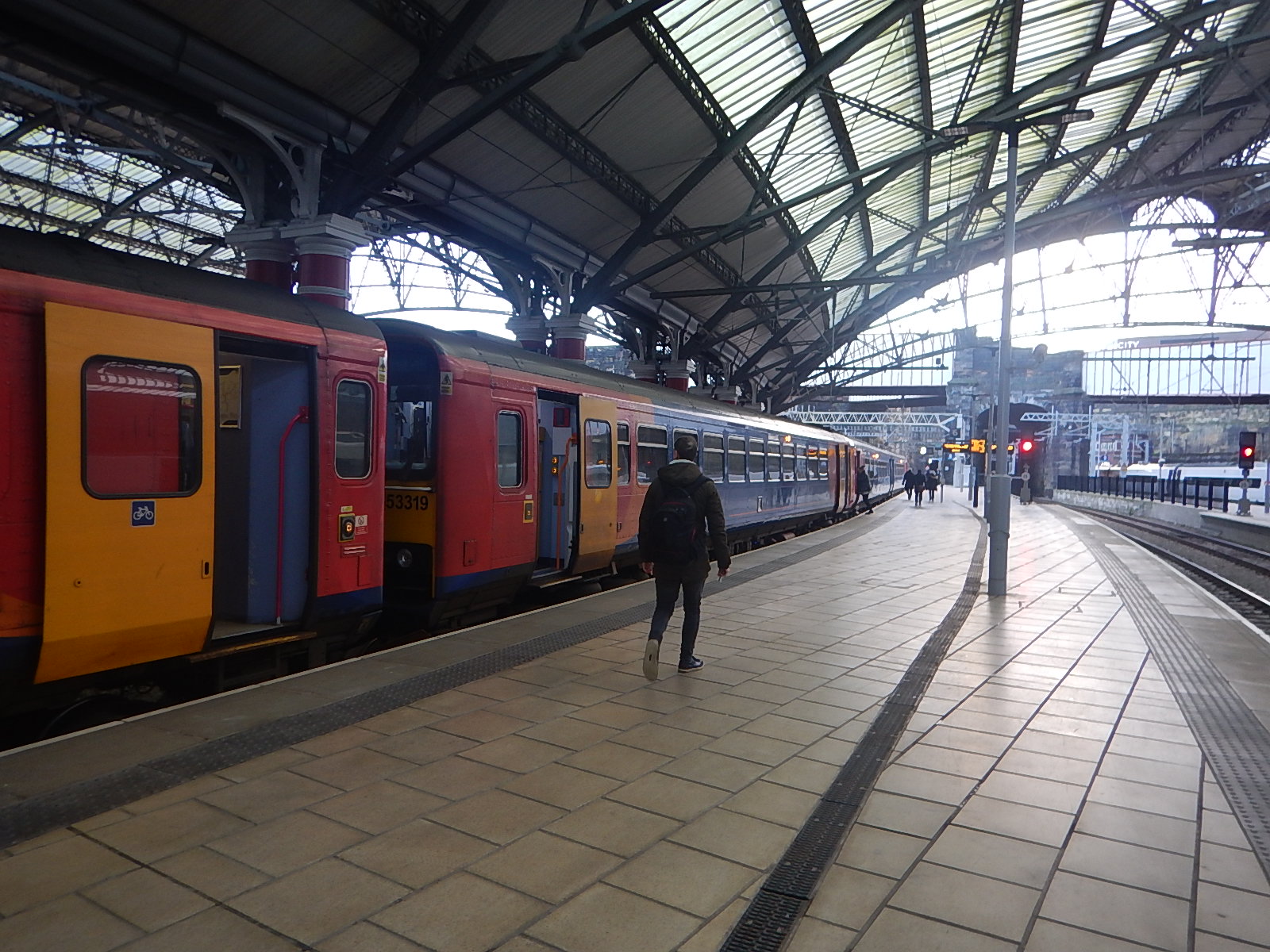
This is not the way to run a long distance service, which takes over five and a half hours.
The plan to improve the service involves splitting it into two from the December 2021 timetable change.
- Liverpool and Nottingham
- Derby and Norwich
It was thought that the Liverpool and Nottingham section would be going to TransPennine Express (TPE).
These points summarise the Railway Gazette article.
- TPE were training drivers and that has now stopped.
- EMR have told staff, they will be keeping both services.
- The service will still be split.
- EMR will not have enough trains to run the split service.
This paragraph sums up what could happen to run the service.
One option favoured by industry insiders would see EMR take on 15 Class 185 Desiro trainsets which are due to be released by TPE during 2021 as its fleet renewal programme concludes. These trains are maintained by Siemens at its conveniently located Ardwick depot in Manchester.
I see this splitting, as being a pragmatic solution to the problems of running a long service, with a very varied loading at various parts of the route.
- As one company runs both sections, the changeover can be arranged to be very passenger-friendly.
- EMR manage the possible change stations at Derby and Nottingham.
- Passengers can be given proper care in the changeover.
- Derby gets a direct connection to Peterborough, Cambridge and Norwich.
With my East Anglian hat on, I can see advantages in the split, as I regularly used to travel as far as Derby or Nottingham, when I lived in the East, but only once took the full service to Liverpool.
I have a few thoughts.
Capacity Between Liverpool And Nottingham
This section of the service is generally run by a pair of Class 158 trains, which have a capacity of around 140 each or 280 in total.
The Class 185 trains have three-cars and a capacity of 180 seats.
Currently, Liverpool and Nottingham takes just under two hours and forty minutes, which would make for a comfortable six-hour round trip. This would mean, that an hourly service between the two cities, will need a fleet of six trains.
Under Future in the Wikipedia entry for Class 185 trains, this is said.
Following the August 2020 decision not to transfer the Liverpool Lime Street to Nottingham route to TransPennine Express, East Midlands Railway could opt to take on the 15 trainsets due to be released from TPE to run this route.
Fifteen trains would be more than enough trains to run a pair on each hourly service and perhaps run some extra services.
Pairs of Class 185 trains between Liverpool and Nottingham would go a long way to solve capacity problems on this route.
Calling At Derby
The current service between Liverpool and Norwich doesn’t call at Derby, as it uses the Erewash Valley Line via Alfreton.
The proposed Eastern portion of the split service has been proposed to terminate at Derby, so passengers would change at Nottingham, if they wanted to travel to Sheffield, Manchester or Liverpool.
As East Midlands Railway, runs both services, they can optimise the service to serve and attract the most passengers.
Preparation For High Speed Two At East Midlands Hub Station
Eventually, the two halves of the Liverpool and Norwich service must surely call at the future East Midlands Hub station for High Speed Two, so future routes must fit in with the plans for High Speed Two.
But there’ll be plenty of time to get that right.
Interchange At Nottingham
I’m sure a quick and easy interchange can be performed at Nottingham.
In the simplest interchange, the two services could share a platform and passengers could just walk between the two trains on the level.
The following sequence could be used at Nottingham.
- The train from Derby to Norwich would arrive in the platform and stop at the Eastern end of the platform.
- The train from Liverpool to Nottingham would arrive in the platform and stop close behind it.
- Passengers on the train from Liverpool, who wanted to take the Norwich train, would simply walk a along the platform and board the train.
- The Norwich train would leave when ready.
- The train from Liverpool would stay where it had stopped and be prepared for the return trip to Liverpool.
- , The next train from Norwich to Derby would pull in behind the Liverpool train.
- Passengers on the train from Norwich, who wanted to take the Liverpool train, would simply walk a along the platform and board the train.
- The Liverpool train would leave when ready.
- Finally, the Norwich to Derby train would leave for Derby.
Only one platform would be needed at Nottingham station, that would need to be long enough to handle the two trains.
Between Norwich And Derby
This is the only section of the Liverpool and Norwich route with any electrification.
- Currently about thirty miles between Grantham and Peterborough are electrified.
- The lines around Ely and Norwich are also electrified.
I think that Ely and Peterborough will be electrified earlier than other lines.
- It would be part of an electrified freight route between Felixstowe and the East Coast Main Line.
- It would enable electric passenger trains between Cambridge and the North.
- It would mean the Ipswich and Peterborough services could be run by battery electric trains.
- It could be a useful electrified diversion route to London, during engineering works.
,This extra electrification, would also mean that Norwich and Derby would probably be within range of battery electric trains.
Stadler have stated that Greater Anglia’s Class 755 trains can be converted from bi-mode into battery electric trains.
So as Greater Anglia and East Midlands Railway are both Abellio companies, could we see battery electric operation on the around 150 miles between Norwich and Derby?
Conclusion
Splitting the Liverpool and Norwich service opens up a lot of possibilities to improve the service.
A Trip To Grantham Station – 4th November 2020
I hadn’t intended to go to Grantham station, but that’s what I did on the last day before lockdown.
Over the last couple of weeks, I’ve been talking to a guy in Lincolnshire, who read Energy In North-East Lincolnshire, on this blog.
Last week, we both realised that we’d worked together in the 1970s, when he worked at a bank in the City, and I did some data analysis for the section, where he worked.
He is unwell with cancer at the moment and suggested I come down and see him in Skegness, where he now lives with his wife.
So I arrived at Grantham and found that the connecting train was running nearly an hour late and even then it was terminating at Boston.
After a quick exchange of texts, I told him the bad news and he gave me the good news, that his condition had improved and would be able to see me after Christmas and/or lockdown.
Luckily, I was able to change my ticket and took the next train back to London, after taking these pictures of the station.
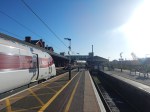
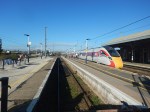
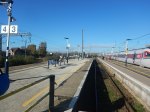
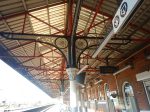
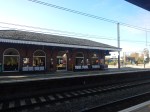
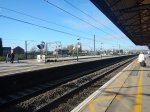
I just had time to have a last drink of Aspall cyder before lockdown, in the station bar.
These are some thoughts.
Platform Layout At Grantham
The Wikipedia entry for Grantham station says this about the platforms.
It is composed of four platforms; platforms 1 and 2 are on the East Coast Main Line and are responsible for express services between London and Scotland. Platform 1 serves exclusively London King’s Cross via Peterborough and Stevenage; Platform 2 serves cities of northern England and Edinburgh. Platform 2, 3 and 4 are formed from a large island platform structure. Platform 3 is a bay platform at the northern end of the station that is used to allow local trains to reverse, while Platform 4 is a two-way platform that is used by East Midlands Railway. Only Platform 1 has amenities, including toilets, refreshments and a buffet.
This Google Map shows the station.
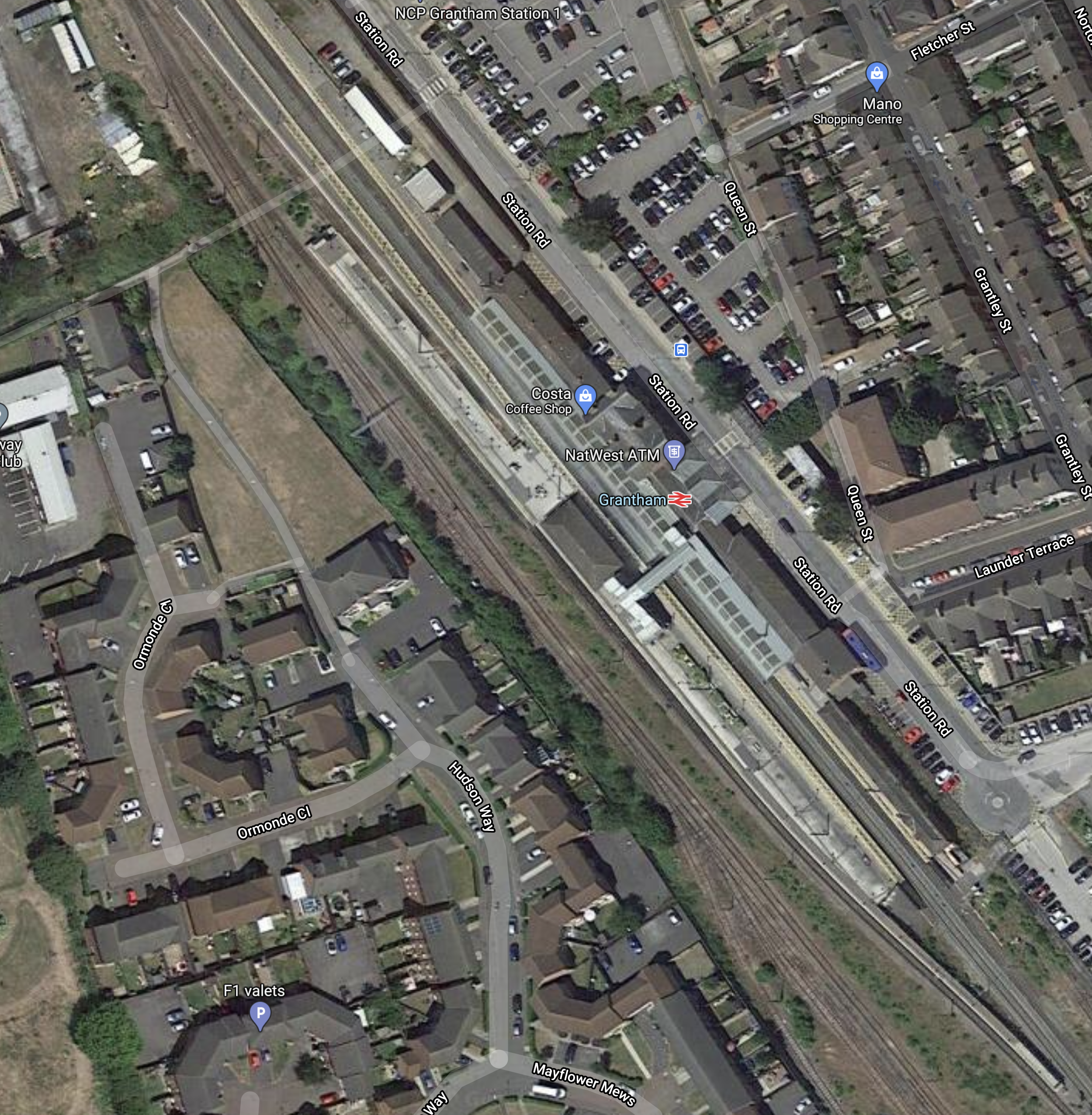
Note.
- Platforms are numbered 1 to 4 from East to West.
- Platforms 1 and 2 are long enough to take two five-car Class 800 trains working as a pair.
- Platform 4 may be long enough for these pairs of trains or could be made so.
- All trains to and from Nottingham call in Platform 4.
- Trains from Nottingham to Peterborough call in Platform 4 before crossing over to the down lines.
- There would appear to be no easy way for a Southbound train on the East Coast Main Line to access Platform 4.
- Platform 3 didn’t get much use on the day I visited.
There is also an avoiding line to allow freight and other passing trains to avoid going through the platforms.
Services Through Grantham Station
Services stopping at Grantham are as follows.
- LNER – One tp2h – London Kings Cross and Harrogate via Stevenage, Grantham, Doncaster, Wakefield Westgate, Leeds
- LNER – One tp2h – London Kings Cross and Bradford Forster Square via Stevenage, Grantham, Doncaster, Wakefield Westgate, Leeds
- LNER – One tp2h – London Kings Cross and Lincoln via Stevenage, Peterborough, Grantham and Newark North Gate
- LNER – One tp2h – London Kings Cross and York via Stevenage, Peterborough, Grantham, Newark North Gate, Retford and Doncaster.
- Hull Trains – Five tpd – London Kings Cross and Hull via Stevenage, Grantham, Retford, Doncaster, Selby, Howden and Brough
- Hull Trains – Two tpd – London Kings Cross and Beverley via Stevenage, Grantham, Retford, Doncaster, Selby, Howden, Brough, Hull and Cottingham.
- East Midlands Railway – One tph – Liverpool Lime Street and Horwich via Peterborough and Nottingham
- East Midlands Railway – One tph – Nottingham and Skegness
Note.
- tph is trains per hour
- tp2h is trains per two hours.
- tpd is trains per day.
Adding the services together, there is a frequent service between Stevenage, Peterborough, Grantham and Newark North Gate.
Train Timings Between London Kings Cross and Grantham
The fastest trains take 67 minutes between London Kings Cross and Grantham.
- The distance is 105.5 miles
- This would be an average speed of 94.5 mph.
- The East Coast Main Line is being upgraded with in-cab digital ERTMS signalling, which will allow 140 mph running.
- The works at Kings Cross station will have increased the station’s capacity.
I wouldn’t be surprised to see a time between London Kings Cross and Grantham, of under an hour, time-tabled in the near future.
Could There Be A London Kings Cross and Nottingham Service Via Grantham?
On this page on UK Rail Forums, this was posted in 2010.
According to today’s East Midlands news on BBC1, Network Rail is considering inviting tenders to run a faster service from Nottingham to London King’s Cross via Grantham, from 2014. The present service of around 1hr 45m is considered too slow by passengers.
How would this new service be reconciled with the much-publicised capacity constraints at Welwyn and at King’s Cross itself? Will the proposed possible service be diesel-powered under the wires from Grantham, or will the Grantham-Nottingham stretch be electrified? Interesting times.
Technology has changed since 2010 and the East Coast Main Line has improved.
- King;s Cross station is being sorted.
- Digital ERMTS signalling is coming to the East Coast Main Line
- Hatachi’s new Class 800 trains have arrived and could go between Grantham and Nottingham on diesel power.
- Grantham and Nottingham takes 35 minutes on a service with three stops, that’s timed for a Class 153 train.
- Grantham and Nottingham is just over twenty miles.
As I said earlier, that I believe Grantham and London could be inside an hour, I wouldn’t be surprised to see a Nottingham and London Kings Cross service in under an-hour-and-a-half.
But it could be better than that?
Hitachi’s Regional Battery Train
This is the train that could unlock the potential of a London Kings Cross and Nottingham service.
This Hitachi infographic gives details of the train.

Note that the train has a range of 90 kilometres or 56 miles, at speeds of up to 100 mph.
The trains would be ideal for a London Kings Cross and Nottingham service.
- They would charge the batteries, whilst using the electrification on the East Coast Main Line.
- The battery range is such, that it would not need any charging between leaving Grantham and returning there from Nottingham.
- They could travel at speeds of up to 140 mph on the East Coast Main Line, once the digital ERTMS signalling is installed.
- Stops could be at Stevenage, Peterborough and Grantham.
LNER’s five-car Class 800 trains, which are branded Azumas can be turned into Regional Battery Trains, by replacing the three diesel engines with battery packs.
I would suspect that times of around eighty minutes, between London Kings Cross and Nottingham, could be in order.
A Park-And-Ride For Nottingham And London
Nottingham has several Park-and-Ride sites, that are served by the trams. of the Nottingham Express Transit, which already calls at Nottingham station.
Would another site on the rail line between Grantham and Nottingham be useful?
This map shows. where the rail line crosses the A46, near its junction with the A52.
Note the Grantham and Nottingham line running across the top of the map and the big junction between the A52 and the A46.
It looks to be a good place for a Park-and-Ride station, if it was decided one needed to be built.
There might also be sites further in towards Nottingham, close to the racecourse or the Holme Pierpoint National Watersports Centre.
A Combined Nottinghamshire And Lincolnshire Service
I originally called this section a Combined Nottingham And Lincoln Service, but I don’t see why it can’t serve most of both counties.
Consider.
- Birmingham, Brighton, Cambridge, Oxford and Southend get two services from the capital by different routes.
- Hitachi’s Class 800 trains can Split/Join in around two minutes.
- Running five-car Class 800 trains all the way between London Kings Cross and Lincoln is not a good use of a valuable train path on the East Coast Main Line.
- Lincoln is just 16.5 miles and 24 minutes from the East Coast Main Line.
- Nottingham is 22 miles and could be 20 minutes from the East Coast Main Line.
- Both Lincoln and Nottingham would be in battery range for a return trip from the East Coast Main Line.
- Platforms 1, 2 and 4, at Grantham are long enough to handle two Class 800 trains, running as a pair and regularly pairs call in Platforms 1 and 2.
I believe it would be possible for a pair of Regional Battery Trains to do the following.
- Leave London Kings Cross and run to Grantham in an hour, stopping at Stevenage and Peterborough.
- Stop in Platform 4 at Grantham station, where the trains would split.
- One train would continue on the East Coast Main Line to Newark North Gate station, where it would leave the East Coast Main Line and go to Lincoln.
- The other train would continue to Nottingham.
Note.
- Coming back, the process would be reversed with trains joining in Platform 1 or Platform 4 at Grantham.
- There may need to be some track and signalling modifications, but nothing too serious or challenging.
Connections to other parts of Nottinghamshire and Lincolnshire would be as follows.
- Nottingham and Nottinghamshire would be connected using the Nottingham Express Transit and the Robin Hood and Maid Marian Lines from Nottingham station.
- All stations between Grantham and Nottingham would be reached from either Grantham or Nottingham.
- All stations to Boston and Skegness would be reached from Grantham.
- All stations between Newark and Lincoln would be reached from either Lincoln or Newark.
- All stations between Doncaster and Lincoln would be reached from either Doncaster or Lincoln.
- All stations between Peterborough and Lincoln would be reached from either Lincoln or Peterborough.
- All stations to Market Rasen, Grimsby Town and Cleethorpes would be reached from Lincoln.
Note.
- I feel that some Lincoln services could be extended to Cleethorpes via Market Rasen and Grimsby Town.
- Hopefully, a timetable could be developed, so that no connection was overly long.
Most of the distances are not unduly long and I would hope that most secondary services could be battery electric trains, which would be charged in the larger stations like Boston, Cleethorpes, Doncaster, Grantham, Lincoln, Mansfield, Nottingham, Peterborough, Sleaford, Spalding and Worksop.
Doncaster, Grantham and Peterborough already have 25 KVAC overhead electrification and this could be used to charge the trains, with possibly some small extensions.
The other stations will need a number of systems to charge the trains, as they pass through.
Some stations will be suitable for the installation of the standard 25 KVAC overhead electrification, but others will need specialised charging systems.
It appears that Adrian Shooter of Vivarail has just announced a One-Size-Fits-All Fast Charge system, that has been given interim approval by Network Rail.
I discuss this charger in Vivarail’s Plans For Zero-Emission Trains, which is based on a video on the Modern Railways web site.
There is more about Vivarail’s plans in the November 2020 Print Edition of the magazine, where this is said on page 69.
‘Network Rail has granted interim approval for the fast charge system and wants it to be the UK’s standard battery charging system’ says Mr. Shooter. ‘We believe it could have worldwide implications.’
Vivarail’s Fast Charge system must surely be a front-runner for installation.
What frequency of the Combined Nottinghamshire And Lincolnshire service would be needed and could be run?
Consider.
- Currently, Lincoln is served with one tp2h with a five-car Class 800 train running the service.
- The Lincoln service alternates with a one tp2h service to York, which also calls at Retford and Doncaster.
- Work is progressing on increasing the number of high speed paths on the East Coast Main Line.
Obviously, an hourly service to both Nottingham and Lincoln would be ideal and would give most of the two counties an hourly service to and from London Kings Cross with a single change at either Doncaster, Grantham. Lincoln, Newark, Nottingham or Peterborough.
- An hourly service might be difficult to timetable because of the York service.
- But I don’t believe it would be impossible to setup.
Especially if after, the Eastern leg of High Speed Two opens, East Coast Main Line services from London Kings Cross to North of York are replaced in part, by High Speed Two services.
The Effect Of High Speed Two
High Speed Two will build a new station at Toton called East Midlands Hub station.
- The station will be situated about halfway between Nottingham and Derby, with frequent connections to both cities.
- There will be frequent services to Birmingham, Leeds, London, Newcastle and Sheffield.
- I wouldn’t be surprised to see a direct service to Edinburgh and Glasgow from the station.
- There will be a lot of economic growth around the station.
I very much feel, that a lot of passengers were travel to East Midlands Hub station for both long distance trains and to access the Derby-Nottingham area.
A Cambridge And Birmingham Service
In How Many Trains Are Needed To Run A Full Service On High Speed Two?, I proposed a Cambridge and Birmingham Curzon Street service.
This is what I said.
The obvious one is surely Cambridge and Birmingham
- It would run via Peterborough, Grantham, Nottingham and East Midlands Hub.
- It would connect the three big science, engineering and medical centres in the Midlands and the East.
- It would use High Speed Two between Birmingham Curzon Street and East Midlands Hub.
- It could be run by High Speed Two Classic-Compatible trains.
It might even be a replacement for CrossCountry’s Stansted Airport and Birmingham service.
Timings for the various legs could be.
- Cambridge and Peterborough – CrossCountry – 49 minutes
- Peterborough and Grantham – LNER – 19 minutes
- Grantham and Nottingham -Best Estimate – 20 minutes
- Nottingham and Birmingham Curzon Street – Midlands Rail Engine – 33 minutes
Note.
- This totals to two hours and one minute.
- The current service takes two hours and forty-four minutes.
- The Ely and Peterborough and Grantham and Nottingham legs are not electrified.
If the route were to be fully electrified or the trains were to be fitted with batteries, the time via High Speed Two, would surely be several minutes under two hours.
Conclusion
These objectives are possible.
- An hourly service between London Kings Cross and Grantham, Lincoln, Newark and Nottingham.
- A very much more comprehensive train service for Nottingham and Lincolnshire.
- A two hour service between Cambridge and Birmingham.
Most of the services would be zero carbon.
No major infrastructure would be needed, except possibly completing the electrification between Nottingham and Ely, some of which is probably needed for freight trains anyway.
Alternatively, the High Speed Two Classic-Compatible trains could be fitted with batteries.
Hopes Rekindled Of Full Midland Main Line Electrification
The title of this post, is the same as that of this article on Rail Magazine.
This is the key section of the article.
During a House of Commons debate on transport on September 17, HS2 Minister Andrew Stephenson said in response to a question from Alex Norris (Labour/Co-op, Nottingham North): “We are currently delivering the Midland Main Line upgrade, which includes electrification from London to Kettering, with additional electrification to Market Harborough being developed.
“Further electrification of the MML is currently at an early stage, but it is being examined by Network Rail.”
Stephenson said the DfT will continue to work closely with NR on the development of a proposal that would include approaches to advancing the delivery of electrification across the route.
The title of the article, probably sums it up well.
Electrification Of The Midland Main Line
Having read lots of stories about electrification of Midland Main Line, I think the following must be born in mind.
- Electrification on the line will reach as far North as Market Harborough station.
- The route between Sheffield station and Clay Cross North Junction will be shared with High Speed Two. It will obviously need to be electrified for High Speed Two.
- The section of the Midland Main Line between Derby and Clay Cross North Junction, runs through the World Heritage Site of the Derwent Valley Mills. The Heritage Taliban will love the electrification, with a vengeance.
- Electrification through Leicester station could be tricky, as the station building and the A6 road are over the tracks and there is limited clearance. Electrification could involve major disruption to the trains for some time.
These are some of the distances involved of sections of the route that are not electrified.
- Market Harborough and Derby are 54 miles apart.
- Market Harborough and Clay Cross North Junction are 67 miles apart.
- Market Harborough and Chesterfield are 70 miles apart.
- Market Harborough and Nottingham are 44 miles apart
- Market Harborough and Leicester are 16 miles apart.
- Derby and Clay Cross North Junction are 21 miles apart.
Since 2017, when electrification for the full route was originally abandoned, there have been big changes in rolling stock technology.
The biggest change has been the development of battery trains.
Hitachi’s Regional Battery Trains
This infographic from Hitachi gives the specification for their Regional Battery Train.
Note.
- The trains have a range of 56 miles on battery power.
- The trains can cruise at 100 mph on battery power.
- Hitachi have said that all of their AT-300 trains can be converted into Regional Battery Trains.
- Trains are converted by removing the diesel engines and replacing them with battery packs.
- I suspect these battery packs look like a diesel engine in terms of control inputs and performance to the driver and the train’s computer.
It is extremely likely, that the bi-mode Class 810 trains, which are a version of the AT-300 train, that have been ordered for the Midland Main Line can be converted into Regional Battery Trains.
These trains have four diesel engines, as opposed to the Class 800 and Class 802 trains, which only have three.
These are reasons, why the trains could need four engines.
- The trains need more power to work the Midland Main Line. I think this is unlikely.
- Four engine positions gives ,more flexibility when converting to Regional Battery Trains.
- Four battery packs could give a longer range of up to 120 kilometres or 75 miles.
It could just be, that Hitachi are just being conservative, as engines can easily be removed or replaced. The fifth-car might even be fitted with all the wiring and other gubbins, so that a fifth-engine or battery pack can be added.
I suspect the train’s computer works on a Plug-And-Play principle, so when the train is started, it looks round each car to see how many diesel engines and battery packs are available and it then controls the train according to what power is available.
London St. Pancras And Sheffield By Battery Electric Train
Any battery electric train going between London St. Pancras and Sheffield will need to be charged, at both ends of the route.
- At the London end, it will use the electrification currently being erected as far as Market Harborough station.
- At the Sheffield end, the easiest way to charge the trains, would be to bring forward the electrification and updating between Sheffield station and Clay Cross North Junction, that is needed for High Speed Two.
This will leave a 67 mile gap in the electrification between Market Harborough station and Clay Cross North junction.
It looks to me, the Class 810 trains should be able to run between London St. Pancras and Sheffield, after the following projects are undertaken.
- Class 810 trains are given four battery packs and a battery range of 75 miles.
- Electrification is installed between Sheffield station and Clay Cross North Junction.
Trains would need to leave Market Harborough station going North and Clay Cross Junction going South with full batteries.
Note.
- Trains currently take over an hour to go between Chesterfield to Sheffield and then back to Chesterfield, which would be more than enough to fully charge the batteries.
- Trains currently take around an hour to go between London St. Pancras and Market Harborough, which would be more than enough to fully charge the batteries.
- Chesterfield station is only three miles further, so if power changeover, needed to be in a station, it could be performed there.
- Leeds and Sheffield are under fifty miles apart and as both stations would be electrified, London St. Pancras and Sheffield services could be extended to start and finish at Leeds.
London St. Pancras and Sheffield can be run by battery electric trains.
London St. Pancras And Nottingham By Battery Electric Train
Could a battery electric train go from Market Harborough to Nottingham and back, after being fully-charged on the hour-long trip from London?
- The trip is 44 miles each way or 88 miles for a round trip.
- Services have either three or eight stops, of which two or three respectively are at stations without electrification.
- Trains seem to take over thirty minutes to turnback at Nottingham station.
Extra power North of Market Harborough will also be needed.
- To provide hotel power for the train, during turnback at Nottingham station.
- To compensate for power losses at station stops.
If 75 miles is the maximum battery range, I doubt that a round trip is possible.
I also believe, that Hitachi must be developing a practical solution to charging a train during turnback, at a station like Nottingham, where trains take nearly thirty minutes to turnback.
If the Class 810 trains have a battery range of 75 miles, they would be able to handle the London St. Pancras and Nottingham service, with charging at Nottingham.
Conclusion
It appears that both the Nottingham and Sheffield services can be run using battery electric Class 810 trains.
- All four diesel engines in the Class 810 trains would need to be replaced with batteries.
- The route between Clay Cross North Junction and Sheffield station, which will be shared with High Speed Two, will need to be electrified.
- Charging facilities for the battery electric trains will need to be provided at Nottingham.
On the other hand using battery electric trains mean the two tricky sections of the Derwent Valley Mills and Leicester station and possibly others, won’t need to be electrified to enable electric trains to run on the East Midlands Railway network.
Will it be the first main line service in the world, run by battery electric trains?

