Murphy Starts Work On £2.5bn Eastern Green Link 1
The title of this post, is the same as that as this article on Construction Enquirer.
This is the sub-heading.
Murphy has started work on its first package on the vast £2.5bn Eastern Green Link 1
These two paragraphs add more detail.
The joint venture between SP Energy Networks and National Grid Electricity Transmission will see the installation of a 196km, high voltage, subsea electricity cable between Torness in East Lothian, Scotland, and Hawthorn Pit in County Durham.
Murphy is one of the main works contractors alongside Metlen, GE Vernova and Prysmian.
Murphy’s task seems to be to design and build the new substation, integrate it with the existing one and connect it all to Eastern Green Link 1 and other assets. Work is expected to complete in March 2028.
Google AI predicts that Eastern Green Link 1 will be commissioned by 2029, so it should be up and running before the expected election helping to balance and stabilise Scottish and English wind power at a rate of up to 2 GW day and night.
The March Of The Batteries
One of my Google alerts picked up this story from the Solar Power Portal, which is entitled Gresham House To Acquire 480MW BESS, Completes Financing On 397MW Portfolio.
This is the sub-heading.
Gresham House Energy Storage Fund signed a Sale and Purchase agreement (SPA) for the conditional acquisition of a 480MW BESS project, while also completing funding on a 397MW portfolio that will begin construction.
I asked Google AI, “How Big Is Gresham Houuse’s Portfolio Of Batteries?” an received this answer.
Gresham House Energy Storage Fund (GRID) operates a portfolio exceeding 1GW of utility-scale battery capacity in the UK, with an active pipeline of future and recently financed projects.
Their operational capacity features:
Operational Capacity: Exceeds 1GW (approx. 1,072MW/1,701MWh) across dozens of sites.
Market Share: Owns roughly 17% to 20% of all utility-scale batteries in Great Britain.
Haven’t they done well!
When Will Highview Power Complete The Carrington Battery?
Highview Power is building a 50 MW/300 MWh liquid air battery at Carrington, near Manchester.
I asked Google AI,the title of this section and received this reply.
Highview Power’s Carrington liquid air energy storage facility in Greater Manchester is scheduled to be operational by late 2026.
The grid stabilization phase is set to begin early in the year, with full long-duration operations following shortly after.The £300 million project at the Trafford Low Carbon Energy Park is a pioneering commercial-scale “cryobattery” that liquefies and stores air to capture excess renewable energy.
Key details of the completed facility:
Capacity: 300 MWh of storage (delivering 50 MW for six hours)
Reach: Capable of supplying electricity to approximately 480,000 homes
Technology: Liquid Air Energy Storage (LAES)
When Will Highview Power Complete The Livingstone Battery?
Highview Power is building a300 MW/3.2 GWh liquid air battery at Livingstone near Glasgow.
I asked Google AI, the title of this section and received this reply.
Highview Power is not currently building a battery in Livingstone. They are developing a major \(2.5 \text{ GWh}\) liquid air energy storage (LAES) plant in Hunterston, Scotland, which is scheduled to come online by 2030.
According to the Highview Power web site, a 300 MW/3.2 GWh “cryobattery” is being built at the site.
How Much Offshore Wind Power Will Be Installed This Year?
In UK Offshore Wind In 2030 – Calculated May 2026, I said that 2635 MW would be commissioned this year.
Conclusion
We’re running hard, but will we keep ahead of the tsunami of offshore wind and solar panels we are installing.
In UK Offshore Wind In 2030 – Calculated May 2026, my latest calculations show that by 2036, we will have installed 61,337 MW of offshore wind alone.
How Many Of Their 300 MW/3.2 GWh Liquid Air Batteries Do Highview Power Think They Can Install?
I asked Google AI, the title of this section and received this reply.
Highview Power plans to install several of their 300 MW/3.2 GWh “Millennium Series” cryogenic plants. They are specifically developing two initial flagship sites in the UK, with the intention to scale up rapidly over the next decade to capture a significant share of national long-duration energy storage targets.
Highview Power is executing a multi-billion-pound programme to build out these multi-technology storage facilities, which combine liquid air energy storage and lithium-ion batteries.
The two primary 3.2 GWh projects advancing through the UK regulatory system include:
Hunterston, North Ayrshire (Scotland): Slated as the first of the Millennium Series, designed to provide up to 3.2 GWh of capacity (powering around 650,000 homes).It is advancing through the regulatory assessment and construction phases.
Killingholme, Lincolnshire (England): A second 3.2 GWh facility.
Both the Hunterston and Killingholme sites were deemed eligible for support under the UK government’s “cap and floor” super-battery scheme.
Two 300 MW/3.2 GWh “Millennium Series” cryogenic plants will do very nicely!
Engineering is the science of the possible, whereas politics is dreams of the impossible.
Mooir Vannin Offshore Wind Farm
This is a wind farm off the Isle of Man, that I missed as it is not on Wikipedia’s List of Offshore Wind Farms In The United Kingdom.
But it does have a web site, which has this handy map.
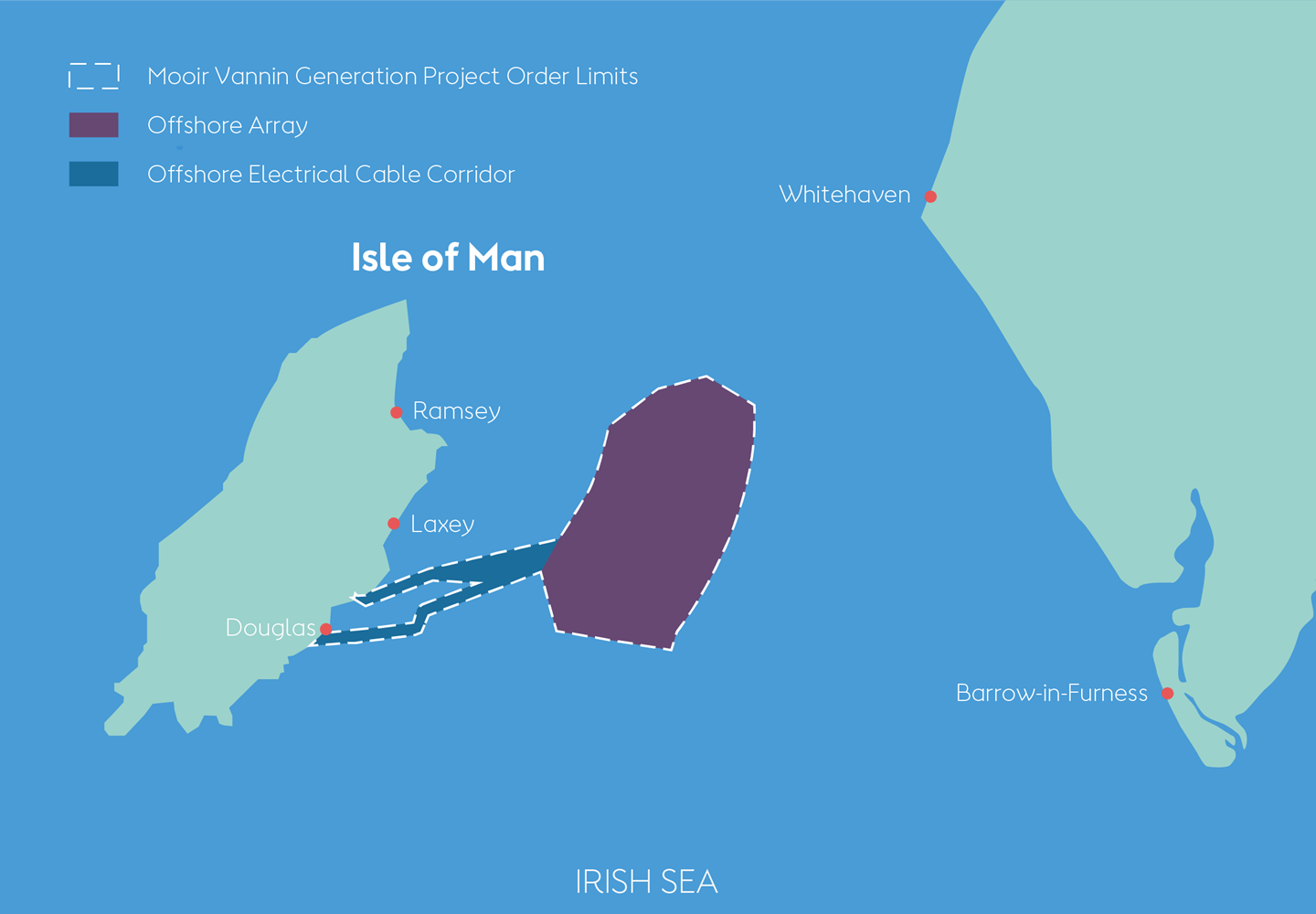
Note.
- The wind farm will have a capacity of 1.4 GW.
- Ørsted is building the web farm.
- It has planning permission.
- The operations base for the proposed Mooir Vannin Offshore Wind Farm will be located at Douglas Harbour on the Isle of Man.
- The Port is Owned By The Isle Of Man Government.
- Anticipated operational start date is the mid 2030s. I’ll assume 2035.
- According to the web site, connection will be to Douglas on the Isle of Man and Penwortham, Lancashire in the UK.
- Penwortham is part of Preston.
- Penwortham substation already has a 50 MW/50 MWh BESS and may get a bigger one.
- Current fossil-fuel power stations on the Isle of Man, include a number of diesel power stations and a 64 MW CCGT. They also have a 23 MW steam generator.
It looks like Mooir Vannin is large enough to give the island a carbon-free energy supply, backed up, by the UK National Grid at Penwortham.
I asked Google AI, “If The Isle of Man Was Going Into The Data Centre Business”, and received this reply.
The Isle of Man is actively positioning itself as a premier hub for data centres, tech firms, and AI companies. The government is utilizing its robust infrastructure, strong regulatory environment, and competitive tax policies to attract high-value data businesses to the island.
It also looks like they have a water system, that has a hydro-electric power-station.
Ørsted Is Danish
Ørsted is Danish and all of those countries to the North East of the UK have lots of islands.
So I asked Google AI, this question.”Does Denmark Have Any Islands With Power Stations?”, and received this comprehensive answer.
Yes, Denmark has several islands with power stations, ranging from natural islands utilizing large wind and biomass facilities to massive, pioneering “Energy Islands” built specifically as offshore power hubs.
Key Examples Include:
Bornholm (Baltic Sea): Designated as a major green “Energy Island” hub. It functions as a massive collection and distribution point for surrounding offshore wind farms, routing renewable energy to both the Danish grid and neighboring countries like Germany.
SamsØ (Kattegat strait): Known globally as a renewable energy island.
It is entirely powered by local onshore and offshore wind turbines and uses a mix of solar and battery storage systems to manage its energy needs, including marina charging.
North Sea Energy Island (VindØ): This is a colossal artificial island project (located roughly 80–100 km off the coast of Jutland) designed to act as an offshore power plant.
It acts as a hub to harvest and convert wind energy from hundreds of surrounding turbines.
Are Ørsted and Highview Power Still Talking?
In Highview Power, Ørsted Find Value In Integrating Offshore Wind With Liquid Air Energy Storage, it appeared that they still were.
As it appears that Highview Power’s Liquid Air Energy Storage can be sized to the application, I wouldn’t be surprised to see one of their batteries on an island powered by Danish wind turbines.
In Is Sumitomo Heavy Industries Highview Power Energy Storage System On Line At Hiroshima?, I describe how a Highview Power application, that uses cold, solar panels and a small Highview Power battery to increase the efficiency of a CNG Terminal.
How Many Of The UK’s Power Stations Are On Islands?
I asked Google AI this question and I received this answer.
There are three major, conventional thermal power stations on the UK’s offshore islands (two in Scotland and one in the Channel Islands), alongside several small-scale community-owned renewable plants that operate entirely off-grid.
The main island-based power stations include:
Lerwick Power Station (Shetland): A 66-73 MW diesel-fired plant commissioned in 1953. It provides a baseline of electricity for the Shetland mainland.
Sullom Voe Terminal Power Station (Shetland): An independent gas-fired station (roughly 92 MW capacity).
Its primary purpose is to serve the Sullom Voe gas terminal, but it also supplies the Shetland grid.
Queen’s Road Power Station (Jersey): A multi-engine facility in the Channel Islands that uses a mix of gas turbines and diesel generators to maintain island capacity.
(Note: Major UK islands, like the Isle of Wight, Anglesey, and the Isle of Skye, are physically connected to the mainland electricity grid via subsea cables, so they do not house their own large-scale, standalone power stations).
Beyond these conventional thermal stations, several smaller Scottish islands run on micro-grid, renewable-only power stations.
For instance:The Isle of Eigg: Powered entirely by a micro-grid of hydro, wind, and solar, completely disconnected from the UK grid.
It looks to me, that the Isle of Man, Shetland and Jersey, are the three most likely islands to get upgraded power systems and it also looks like Ørsted have the experience to make a good fist of it.
Conclusion
I have asked the question, I asked for the UK for a range of countries and I have received some interesting answers from Google AI. But the general trend seems to be to use appropriately-size medium-size and upwards, zero-carbon power stations with microgrids as on the Island of Eigg in the UK.
But I do believe that applying the technology that Ørsted, Highview Power and others are rolling out, that we can give the remote islands and places of Buckminster Fuller’s Spaceship Earth, the zero carbon power they need.
News From Four Big Projects On The 15th May 2026
Are things hotting up in the offshore wind business in the UK? Or is it just a coincidence?
But these four projects were all announced on the 15th May 2026.
Aberdeenshire Council Greenlights Onshore Plans For 1 GW Scottish Floating Wind Project
The Buchan Offshore Wind consortium, comprising BayWa r.e., Elicio, and BW Ideol, has received planning consent from Aberdeenshire Council for the onshore infrastructure that will connect the proposed 1 GW Buchan floating wind farm to the grid. Commissioning in 2033.
Ocean Winds Receives Full Onshore Planning Consent for 2 GW Caledonia Offshore Wind Farm
Ocean Winds, a 50-50 joint venture owned by EDP Renewables and ENGIE, has received full onshore planning consent for its 2 GW Caledonia offshore wind farm following approval by Aberdeenshire Council’s Infrastructure Services Committee on 14 May. Commissioning in 2032.
UK Grants Development Consent For 3 GW Dogger Bank South Offshore Wind Project.
The UK Department for Energy Security and Net Zero has granted development consent for two Dogger Bank South (DBS) offshore wind farms, Dogger Bank South West and Dogger Bank South East, which are planned to have a combined installed capacity of 3 GW. Commissioning in 2031 (DBS West) and 2032 (DBS East).
RWE and SSE Secure Consent For 1 GW North Falls Offshore Wind Farm
The North Falls Offshore Wind Farm joint venture between RWE and SSE Renewables has been granted development consent for its 1 GW project by the UK Department for Energy Security and Net Zero (DSNEZ). Commissioning in 2030.
It looks like another 7 GW of onshore wind is on its way! The commissioning dates are my best estimates based on past history.
UK Offshore Wind In 2030 – Calculated June 2026
The next general election is likely to be held in 2029, so how much wind energy will be added before the next Parliament?
The Current Position
The Wikipedia entry for the list of operational wind farms in the UK, says this.
In July 2025, there were offshore wind farms consisting of 2,809 turbines with a combined capacity of 16,035 megawatts.
Due To Be Commissioned In 2026
It would appear these wind farms will come on-line in 2026.
- Dogger Bank A – 1235 MW – Fixed
- Sofia – 1400 MW – Fixed
This would add 2 wind farms and 2635 MW to give a total of 18,670 MW.
Due To Be Commissioned In 2027
It would appear these wind farms will come on-line in 2027.
- Dogger Bank B – 1235 MW – Fixed
- Dogger Bank C – 1218 MW – Fixed
- East Anglia 1 North – 800 MW – Fixed
- East Anglia 2 – 900 MW – Fixed
- East Anglia 3 – 1372 MW – Fixed
- Hornsea 3 – 2852 MW – Fixed
- Inch Cape – 1080 MW – Fixed
- Llŷr 1 – 100 MW – Floating
- Llŷr 2 – 100 MW – Floating
- Norfolk Boreas – 1380 MW – Fixed
- Pentland – 100 MW – Floating
- Whitecross – 100 MW – Floating
This would add 12 wind farms and 11237 MW to give a total of 29,907 MW.
Due To Be Commissioned In 2028
It would appear these wind farms will come on-line in 2028.
- Morecambe – 480 MW – Fixed
This would add 1 wind farm and 480 MW to give a total of 30,387 MW.
Due To Be Commissioned In 2029
It would appear these wind farms will come on-line in 2029.
- Mona – 1500 MW -Fixed
- West Of Orkney – 2000 MW – Fixed
This would add 2 wind farms and 3500 MW to give a total of 33,887 MW.
Due To Be Commissioned In 2030
It would appear these wind farms will come on-line in 2030.
- Ramplion 2 Extension – 1200 MW – Fixed
- Norfolk Vanguard East – 1380 MW – Fixed
- Norfolk Vanguard West – 1380 MW – Fixed
- Awel y Môr – 1100 MW – Fixed
- Berwick Bank – 4100 MW – Fixed
- Outer Dowsing – 1500 MW – Fixed
- Caledonia – 2000 MW – Fixed
- N3 Project – 495 MW – Fixed/Floating
- North Falls – 504 MW – Fixed
This would add 9 wind farms and 13,659 MW to give a total of 47,656 MW.
Due To Be Commissioned In 2031
It would appear these wind farms will come on-line in 2031.
- Awel y Môr – 775 MW – Fixed
- Berwick Bank – 1380 MW – Fixed
- Dogger Bank SW – 1500 MW – Fixed
- Morven Phase 1 – 1500 MW – Fixed
- Spiorad na Mara – 840 MW – Mixed
This would add 5 wind farms and 5,995 MW to give a total of 53,651 MW.
Due To Be Commissioned In 2032
It would appear these wind farms will come on-line in 2032.
- Caledonia – 2000 MW – Fixed
- Dogger Bank SE – 1500 MW – Fixed
- Seagreen Phase 1A – 500 MW – Fixed
This would add 3 wind farms and 4,000 MW to give a total of 57,651 MW.
Due To Be Commissioned In 2033
It would appear these wind farms will come on-line in 2033.
- Ayre 1008 MW – Fixed
- Bowdun – 1008 MW – Fixed
- Buchan – 960 MW – Floating
- Morven Phase 2 – 1500 MW – Fixed
This would add 4 wind farms and 4,476 MW to give a total of 62,017 MW.
Due To Be Commissioned In 2035
It would appear these wind farms will come on-line in 2035.
- Dogger Bank D – 1320 MW – Fixed
- Mooir Vannin – 1400 MW -Fixed
This would add 2 wind farms and 2,720 MW to give a total of 64,737 MW.
Due To Be Commissioned In 2036
It would appear these wind farms will come on-line in 2036.
- Havbredey – 1,500 MW – Fixed
This would add 1 wind farm and 1,500 MW to give a total of 66,347 MW.
Capacity Summary
- 2025 – None – 16,035 MW
- 2026 – 2635 MW – 18,670 MW
- 2027 – 11237 MW – 29,907 MW
- 2028 – 480 MW – 30,387 MW
- 2029 – 3500 MW – 33,887 MW
- 2030 – 13,659 MW – 47.656 MW
- 2031 – 5,995 MW – 53,651 MW
- 2032 – 4,000 MW – 57,651 MW
- 2033 – 4,476 MW – 62,127 MW
- 2034 – None – 62,127 MW
- 2035 – 2,720 MW – 64,847 MW
- 2036 – 1,500 MW – 66,347 MW
Note.
- The first figure is my estimate of what will be added in the year.
- The second figure is my estimate of what will be the total at the end of the year.
- Currently, we’re generating and importing a total of 29.33 GW.
We’re still be adding capacity into the 2030s.
The Average Size Of A Wind Farm
This is 1.26 GW.
Gas-Fired Power Still Looks A Safe Bet For Centrica In The Renewables Era
I feel rather surprisingly, the title of this post, is the same as this article on the Guardian.
You’d think, that they would be critical of Centrica for keeping the gas power stations going.
But this is the sub-heading.
There will still be a need to have gas in the wings to keep the lights on, so the financials stack up on Severn plant purchase.
So why should Centrica buy a 832 MW closed cycle gas fired power station?
These posts describe, what Centrica have done at Brigg with another closed cycle gas fired power station.
- Construction Under Way To Double Power Station Capacity At Centrica’s Brigg Energy Park
- Hydrogen Milestone: UK’s First Hydrogen-to-Power Trial At Brigg Energy Park
Will Centrica be taking closed cycle gas fired power stations and making them more efficient to provide the back up to wind farms, when wind is having an off day?
I wouldn’t be surprised, if Centrica put a big battery on the two sites, as after all they are a godparent to Highview Power.
Are there any more closed cycle gas fired power stations, that they can acquire?
I asked, Google AI,”How many closed cycle gas fired power stations are there in the uk?” and received this answer.
As of early 2026, there are approximately 35 active combined cycle gas turbine (CCGT) power stations—often referred to as closed-cycle—in the UK.
These plants provide the bulk of the UK’s gas-fired capacity, totaling roughly 30-35 GW along with smaller, single-cycle (OCGT) plants which are used for backup.
Total Capacity: The total capacity of all gas-fired generation (CCGT and others) is approximately 35.7 GW.
Role in Power Mix: CCGTs are highly efficient and provide baseload power, while OCGT plants (about 14+ sites) are typically used for peak demand.
Key Locations: Major plants include Pembroke (RWE), Staythorpe (RWE), Didcot B (RWE), and Connah’s Quay (Uniper).
These plants remain the largest single source of electricity generation on the UK grid, though they are increasingly being paired with carbon capture proposals.
I think, that Engineer Baldrick is now working for Centrica and he has a cunning plan to use efficient CCGT power stations to back up the wind.
Consider.
- Severn power station is an 832 MW combined cycle power plant running on natural gas, which is located near Newport in South Wales.
- 4.5 GW of offshore wind is to be built near Port Talbot.
- Will some hydrogen generated by HiiROC be used to part-fire Severn power station and reduce its carbon footprint.
- South Wales can easily find space for a couple of Highview 300 MW/3.2 GWh CRYOBatteries.
- It would be useful to have a good-sized hydrogen store in South Wales.
That mix would surely provide enough reliable power for green steelmaking and a few data centres.
Europe: New Fund To Upgrade Solar And Wind Assets With Battery Storage
The title of this post, is the same as that of this article on Review Energy.
This is the sub-heading.
The Aream Group has launched a new European investment vehicle targeting the renewable energy sector, with a strategy that combines power generation, storage and electricity marketing.
These three paragraphs add more details to the story.
The Clean Energy Future Fund II (CEFF II) will focus on integrating renewable generation assets with battery storage systems to improve the use of grid connections, which are increasingly scarce across European markets. According to Markus W. Voigt, Executive Chairman of aream Group, the hybrid model is designed to respond to growing volatility in electricity markets.
“With this hybrid approach, we are leveraging the changes and increased volatility in the European electricity markets for the benefit of our investors,” Voigt said.
The fund will primarily invest in Europe, with a particular focus on Germany, and will build on an existing portfolio of operational assets. A central element of the strategy is the addition of battery storage to solar and wind farms, allowing them to evolve from pure generation assets into providers of grid services.
I have a Google Alert which looks for “Energy Storage Fund” and this story was one of nine substantial stories.
This story talks about €400 million and two others talk about €300 million and AU $ 1.4 billion, respectively.
So hopefully, this money will help to mop up some of the energy wasted, when wind farms are curtailed.
Certainly, these funds don’t seem to have difficulty finding money to invest.
Could A Feeder Network Of Local Trains Be Developed For HS2 At Lancaster Station?
Lancaster station is one of the less important stations that will be served by High Speed Two.
I visited in May 2025 and afterwards wrote Lancaster Station – 23rd May 2025.
This OpenRailwayMap shows the railway network around Lancaster.
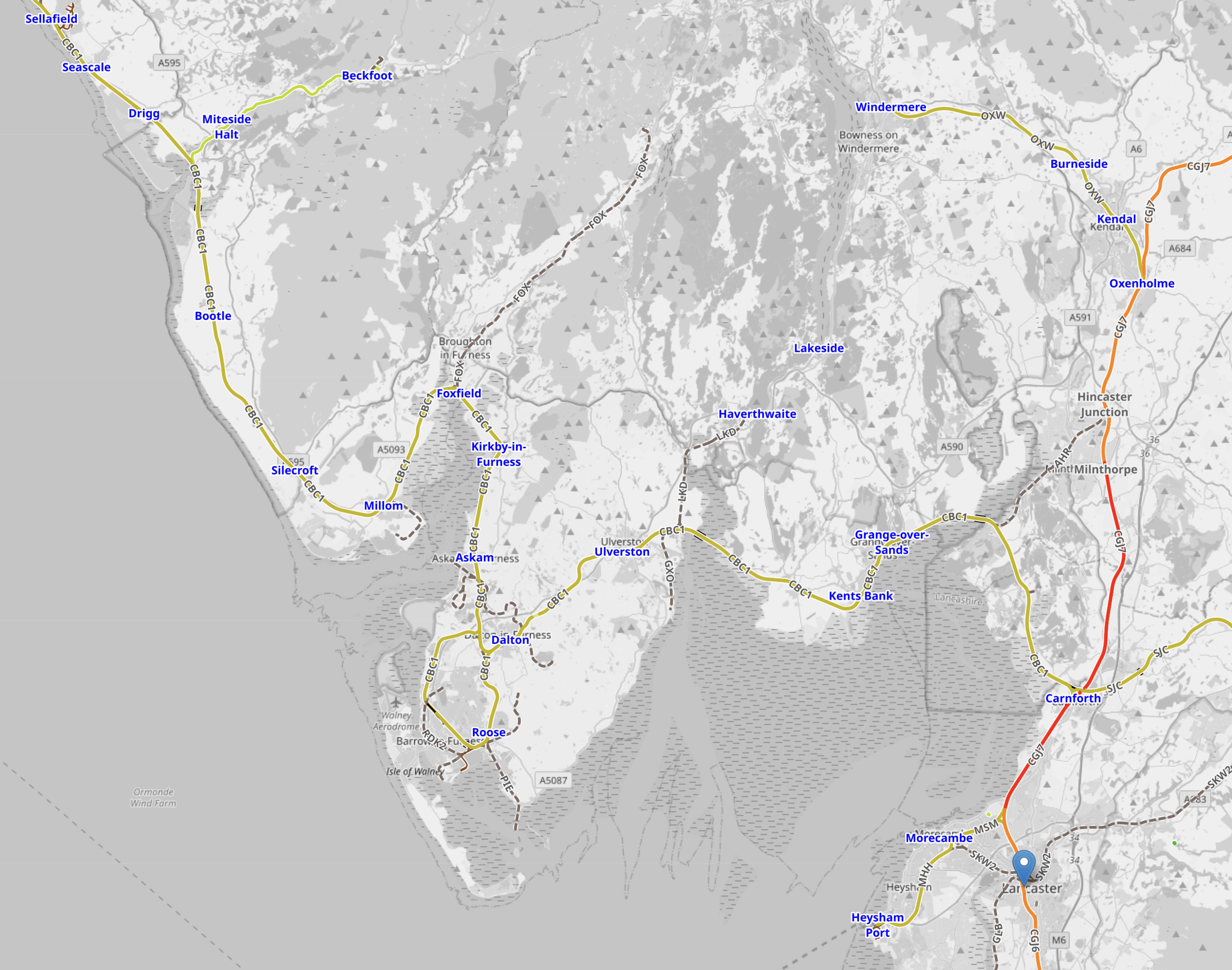
Note.
- The red track on the East side of the map is the electrified West Coast Main Line.
- The location of Lancaster station is indicated by a blue arrow.
- Morecambe, where the Eden Project North is being developed and the important port of Heysham are on the coast to the West of Lancaster.
- Oxenholme station is towards the North-East corner of the map, on the main line.
- The Windermere branch connects to the main line at Oxenholme station.
- HS2 will use the West Coast Main Line and call at Lancaster and Oxenholme.
North of Oxenholme, HS2 calls at Penrith and Carlisle, before going on to Glasgow and Scotland.
West of the main line, the map is dominated by the waters of Morecambe Bay, which in recent decades has produced a lot of our gas, but is now transitioning to an area, that will produce a few gigawatts of wind power.
North of Morecambe Bay, there is the Lake District, with the shipbuilding at Barrow and the nuclear waste processing at Sellafield on the coast.
It is an important area of England, where there is a lot going on!
Tying it all together is the yellow ribbon of the Cumbrian Coast Line, which connects Carnforth and Carlisle on an hourly basis.
- The service calls at Grange-over-Sands, Barrow-in-Furness, Millom, Ravenglass, Drigg, Seascale, Sellafield, St Bees, Whitehaven, Workington, Maryport, Aspatria, Wigton and other places.
- Four services a day link Carlisle and Lancaster stations.
- Carlisle and Lancaster stations are 120.5 miles apart via the coast and according to Google AI, the journey takes between three and three-and-a-half hours.
- In From Barrow-in-Furness To Ravenglass, From Ravenglass to Sellafield and From Sellafield To Carlisle, there are some images, that give a flavour of the route.
This is a route, that is worth decarbonising.
Consider.
- There is a couple of gigawatt of wind power in the bay to charge any batteries with green electricity or make green hydrogen.
- There is a project called BARROW GREEN HYDROGEN, which is located in Barrow-in-Furness.
- Both hydrogen and battery-powered trains could handle the hundred and twenty miles of the Cumbrian Coast Line.
- A zero-carbon train running silently round the Lake District could be a tourist attraction in its own right.
- Hydrogen-powered buses could provide the local transport.
Given the scenery and the closeness to the Lake District and High Speed Two, I suspect that major train manufacturers like Alstom, CAF and Siemens will be keen to bid.
No Panic At The Pumps … South Koreans Just Stop Driving On Wednesdays
The title of this post, is the same as that of this article on The Times.
This is the sub-heading.
President Lee Jae-myung has urged the public to ‘save every drop of fuel’ and introduced a number-plate rotation to keep drivers off the road
These first three paragraphs deeply illustrate the differences between the energy situation in North and South Korea.
From the lookout point atop Mount Dora, in the heart of the demilitarised zone that has separated the peninsula since 1953, you can clearly see where South Korea ends and North Korea begins.
The trees that proliferate across Korea’s undulating topography come to an abrupt halt. On the land that sits beyond, a farmer can be seen guiding an ox pulling a plough.
Sealed off from the world economy for 73 years, communist North Korea has resorted to cutting down much of its vegetation to burn for fuel. Democratic South Korea, by contrast, has established deep global trading ties that allow the country to import vital natural resources it cannot produce domestically.
North Korean communism certainly can’t be considered green.
I find these two paragraphs extremely significant.
South Korea may have to import almost all of its crude oil, but the country plays a huge role in refining it into petrol, diesel and jet fuel before shipping it around the world. This means that demand from overseas for Korea’s refined products is greater than ever, which has forced the government to step in. The country’s Ministry of Trade, Industry and Energy has implemented mandatory caps on refined petroleum products.
Of all South Korea’s refined products, kerosene, or jet fuel, is the most in demand. The country is one of the biggest exporters of jet fuel in the world. The US, for instance, relies on it for 70 per cent of its total jet fuel imports.
They could also be problematical for the country, as they will surely need to replace these jet fuel exports with exports of sustainable aviation fuel (SAF).
Most viable processes, that I’ve seen need the following ingredients.
- Lots of hydrogen or masses of GWhs of electricity to make it.
- Some carbon atoms, which can even be captured from the air or a gas-fired power station.
- Some form of Fischer-Tropsch process to force the atoms to make sustainable aviation fuel.
There are several companies that can do this, with British ones seeming to often to be connected to Oxford University.
There is also this Anglo-Korean connection over hydrogen.
I asked Google AI, who are investors in innovative hydrogen production company; HiiROC, which is a spin-out of the University of Hull, and received this answer.
HiiROC, a UK-based developer of “turquoise” hydrogen technology, is backed by a consortium of major industrial and financial players, including Centrica, Melrose Industries, HydrogenOne Capital Growth, Hyundai, Kia, Wintershall Dea, VNG, and Cemex Ventures. The company has raised over £40 million to develop its thermal plasma electrolysis technology.
Note the presence of two of the biggest Korean companies ; Hyundai and Kia.
HiiROC is also five times more efficient than traditional electrolysis.
Google AI says this about South Korean offshore wind.
South Korea is aggressively developing its offshore wind sector, targeting 14.3 GW to 15 GW of installed capacity by 2030, with over 116 projects and 44 GW of capacity under development. The country aims for a 2030 renewable energy share of 20-30%, leveraging floating technology for massive projects like the 3.2 GW Jindo project.
It appears to me, that South Korea will replace their market share of the jet fuel market with sustainable aviation fuel (SAF).
I’m also sure, that if the Koreans need to produce more hydrogen to make more SAF to power the world’s aircraft, Centrica will help them to rent some of our empty seas.
I can see the Koreans, with a little help from their friends, including the UK, dominating the SAF market.

