On The Bonnie, Bonnie Banks o’ Loch Lomon’
I couldn’t resist using the first line of one of the most famous Scottish traditional songs, as the title of this post.
But a very significant power station project, is to be undertaken in the area.
These are the opening few sentences of the Wikipedia entry for the Loch Sloy Hydro-Electric Scheme.
The Loch Sloy Hydro-Electric Scheme is a hydro-electric facility situated between Loch Sloy and Inveruglas on the west bank of Loch Lomond in Scotland. It is also within the Arrochar Alps. The site was originally suggested as the location of a huge pumped-storage scheme in 1936 by Edward MacColl, but this was rejected as being uneconomic. After the North of Scotland Hydro-Electric Board was created in 1943, it became the first of their proposed schemes.
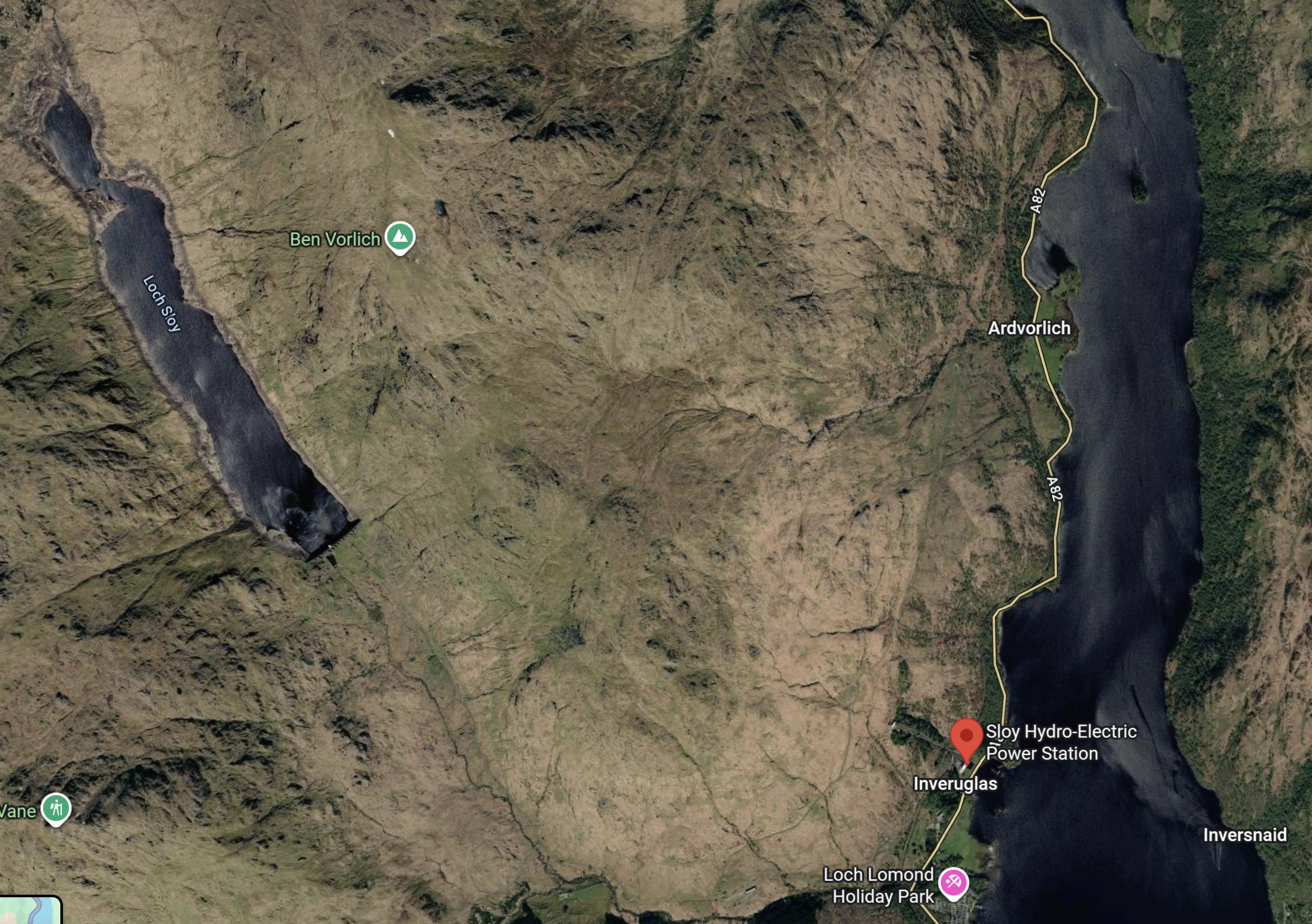
This Google Map shows Loch Lomond and Loch Sloy.
Note.
- Loch Sloy is in the North-West corner of the map.
- Loch Lomond is on the Eastern side of the map.
- The red arrow indicates the main buildings of the LochSloy Hydro-Electric Power Station.
- Loch Sloy is eight-hundred feet above Loch Lomond.
- The total generating capacity of the power station is 152.5 MW.
The facility is operated by Scottish and Southern Energy, and is normally in standby mode, ready to generate electricity to meet sudden peaks in demand. It can reach full capacity within 5 minutes from a standing start.
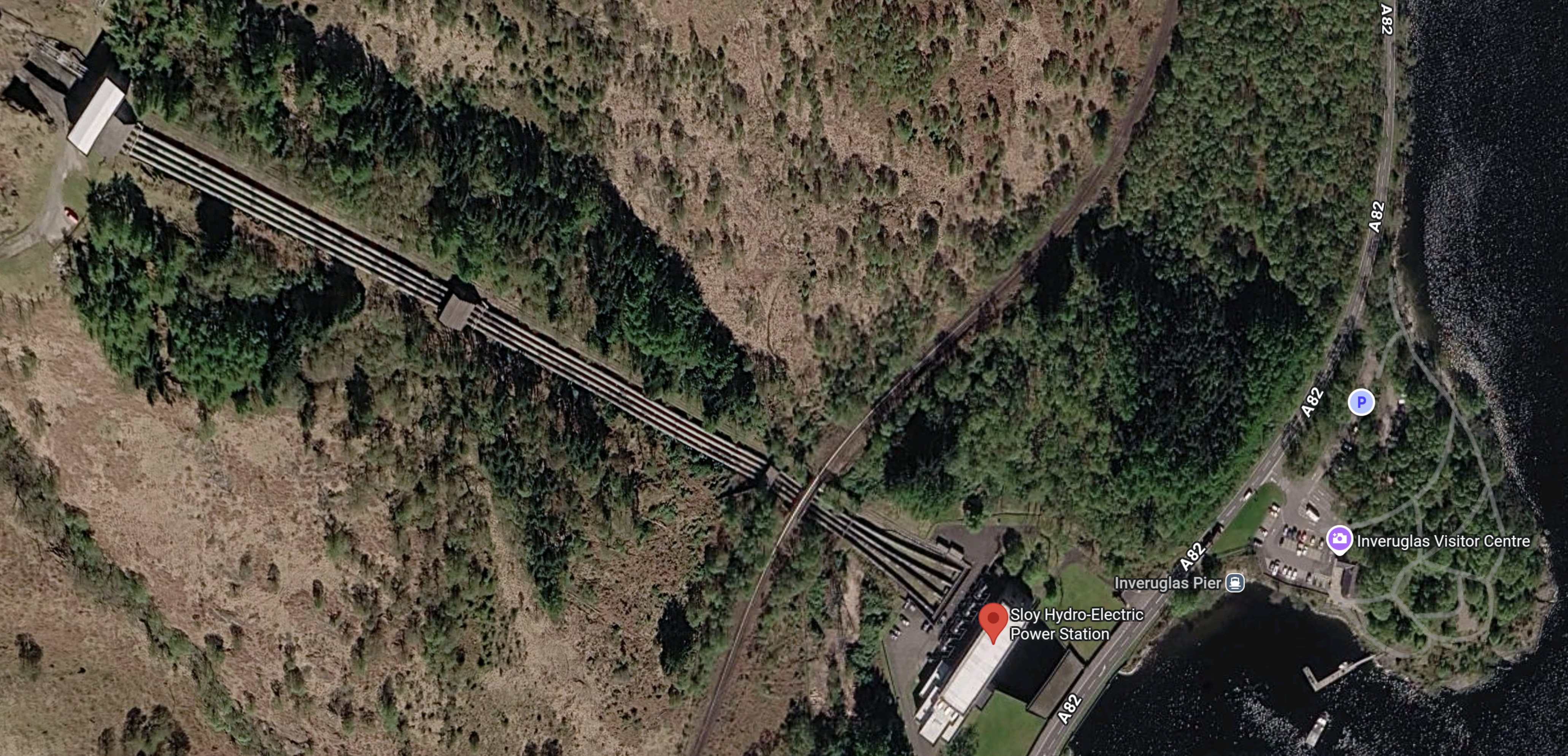
This second Google Map shows the power station to a larger scale.
Note.
- Loch Sloy is to the North-West of the North-West corner of the map.
- Loch Lomond is on the Eastern side of the map.
- The red arrow indicates the main buildings of the Loch Sloy Hydro-Electric Power Station.
- The four pipes carry water from Loch Sloy to the actual power station.
- The single-track West Highland Line crosses over the four pipes at their South-Eastern end.
The design of Loch Sloy Hydro-Electric Power Station is typical of many hydro-electric stations all over the world.
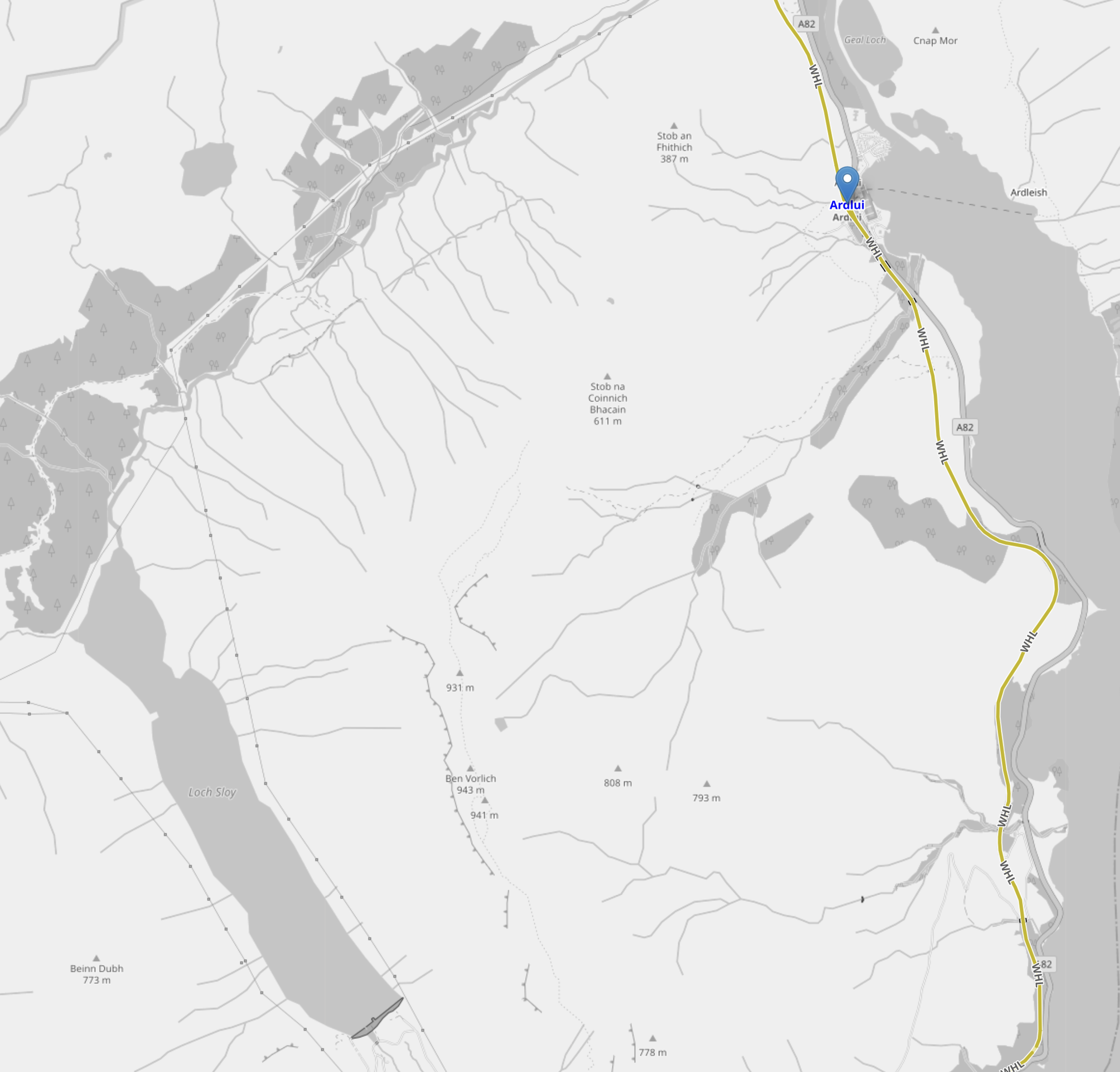
This third map is an OpenRailwayMap of the area.
Note.
- Loch Sloy is on the Western side of the map.
- Loch Lomond is on the Eastern side of the map.
- The yellow track is the single-track West Highland Line between Glasgow and Mallaig via Fort William
- The blue arrow indicates Ardlui station.
The railway goes close to the power station.
A Platinum Celebration for Sloy Power Station!
The title of this section is the same as this must-read web page on the SSE web site, which dates from 2020.
Sloy Power Station Development Plans
This second must read web page on the SSE web site is entitled Sloy Power Station.
This is the sub-heading.
We’re Proposing To Convert Our Iconic 1950s Hydro Station To Pumped Storage Hydro
This is the introduction to the development.
In April 2025, we submitted a planning application to the Scottish Government to convert the iconic Sloy Power Station into a pumped storage hydro scheme.
Our proposals would bolster energy security and help provide the large-scale and flexible renewable energy back-up needed in a future UK net zero power system, helping meet the UK Government’s ambition of Clean Power by 2030.
If approved for delivery, the converted Sloy scheme would be capable of delivering up to 16GWh of long-duration electricity storage capacity.
It could provide firm, flexible renewable energy for up to 100 hours non-stop.
It appears that the upgraded power station will effectively become a 160 MW/16 GWh long duration energy store.
Currently, the UK’s largest pumped storage power station is the 1727 MW/9.1 GWh Electric Mountain in North Wales.
The updated Sloy power station will have less output, but more storage capacity, than Electric Mountain.
Should There Be A Railway Station At Loch Sloy Power Station?
Google AI gives this answer in reply to “Loch Sloy Railway Station”.
There was never a permanent public railway station called Loch Sloy, but temporary private platforms like Inveruglas railway station and Faslane Platform railway station served the area. These stops were built in 1945 by the London and North Eastern Railway (LNER) to haul materials and workers—including prisoners of war—for the construction of the Loch Sloy Hydro-Electric Scheme.
Note.
- Surely, similar reasons to those in 1945 could apply to the development of the power station. Materials and workers could be brought in by rail.
- Given, the power station’s historic significance, I believe that it could become a tourist attraction and/or education centre.It could be a stop for the Caledonian Sleeper.
I believe that as time passes, the power station’s historic significance will increase.
Are There Any Other Hydro Power Stations, That Can Be Upgraded To Pumped Storage Hydro?
Google AI can’t find anything at present.
UK Army Commissions 1.7GWh/year Solar Project At Larkhill Garrison
The title of this post, is the same as that of this article on the Solar Power Portal.
This is the sub-heading.
The installation spans 2.5 hectares and comprises more than 4,000 PV panels.
These three paragraphs give a few more details.
The project forms part of the Army’s Project Prometheus programme, which is deploying rooftop and ground-mounted solar PV systems across suitable sites on the Army estate. It was delivered by Aspire Defence Services on behalf of the Defence Infrastructure Organisation (DIO).
The Ministry of Defence is also partnered with Great British Energy to deploy solar across its sites.
The commissioning follows an expansion of solar capacity at Larkhill this year through the addition of the ground-mounted array and four rooftop PV installations.
Note.
- Larkhill has a Wikipedia entry.
- Larkhill is part of the Salisbury Plain Training Area, which also has a Wikipedia entry.
- The Salisbury Plain Training Area takes up 11 % of the County of Wiltshire and is as large as the Isle of Wight.
There certainly would appear to be plenty of space for 4,000 solar panels.
Does The Army’s Project Prometheus Programme Include Batteries?
I asked Google AI, the question in the title of this section and received this reply.
The British Army’s Project Prometheus primarily focuses on generating renewable energy through solar PV systems, though specific related net-zero initiatives on the defense estate incorporate separate energy storage components like batteries.
Project Prometheus Overview
Core focus: Deploying ground-mounted and rooftop solar photovoltaic (PV) arrays across the military estate.
Main goal: Increase green energy supply, cut carbon emissions, and reduce grid electricity dependency.
Integration with Energy Storage
Solar focus: Primary Project Prometheus installations route generated electricity directly to local military buildings or export surpluses back to the national grid.
Associated storage: While standalone solar arrays under Prometheus distribute power dynamically, separate broader sustainability and pilot schemes across the military net-zero portfolio—such as Project Taurus or thermal storage trials—run alongside it to evaluate localized battery storage capabilities.
Project Prometheus would appear to be a typical well-designed solar power programme.
Project Taurus
Project Taurus has been mentioned and Google AI gave me this overview.
Project Taurus in the UK Ministry of Defence refers to a sustainable energy initiative by the British Army to construct solar-powered carports featuring electric vehicle (EV) charging ports and battery storage, starting at Army Headquarters in Andover.
It looks to me, that Project Taurus could have applications outside the military.
Comet Ridge Lands Gladstone Gas Deal
It is obviously Highview Power’s day, as this project in Queensland, Australia gets five mentions in my Google Alert for Highview Power.
The title of this post, is the same as that of this article on Industry Queensland.
This is the sub-heading.
Mahalo gas hub developer Comet Ridge has reached a deal with Highview Power to supply the large-scale electricity project it is planning to build at the Aldoga State Development area near Gladstone.
These four paragraphs give a summary of the project.
The volume of gas targeted is 3.6 PJ/a (10 TJ/d) for a minimum of five years.
Highview’s Central Queensland Energy Storage Project is to be constructed in two phases.
Phase 1 consists of a 400MW four-hour battery energy storage system, two 200MW open-cycle gas turbines, a 370MVA synchronous condenser, and associated substations and transmission lines.
Phase 2 will be the build-out of a 200MW 12-hour liquid air energy storage system.
It looks like Highview Power’s battery is one of their larger systems and is a 200 MW/2.4 GWh version.
On Highview Power’s Projects page, this is said under a header of Australia.
Highview is developing a series of base‑load renewable energy power stations in Australia, with planning now underway for three major programmes. In Gladstone, Central Queensland, and Townsville, North Queensland, we are progressing large scale projects combining LDES and short-term battery storage. On the Darwin–Katherine network in the Northern Territory, plans are advancing for an integrated scheme incorporating solar generation, LDES and battery. Together, these initial developments will help Australia meet its target of halving carbon emissions by 2030 and achieving net zero by 2050.
Gladstone is named in this story and on Highview Power’s web site.
Could Highview Power be making a breakthrough in process engineering after Sumitomo’s success at the LNG Terminal at Hiroshima.
Chance For Rail To Distribute Hydrogen And Use It As Alternative Power Supply
The title of this post, is the same as that of this article on Rail Magazine.
These are the first three paragraphs.
Hydrogen can have a future in logistics as well as being an alternative power source for traction.
Speaking at RAIL Live, Mark Downing, Head of Industrial Energy at Heavy Haul Rail, argued that rail was best suited for the transport of hydrogen.
“Energy has always moved by rail. You’ve got coal, you’ve got fuel, this is the next energy process that can be put onto rail at scale,” he said.
Mark Downing talks a lot of sense.
The article has a heading picture of a HydroFlex or Class 799 train,which is a hydrogen-hybrid train that can be powered by electrification or an onboard hydrogen fuel cell.
I’d certainly like to see a Class 799 train running services on an appropriate branch line. The article suggests the West of Wales, or the North of Scotland.
Charles Calvert, Chief Innovation Officer at Vanguard Sustainable Transport Solutions, gives this view. “I would love to see at least one of those routes get decarbonised by any other measure in the next five years.”
Google AI says this about the range of a HydroFlex train.
The HydroFLEX train, developed by Porterbrook and the University of Birmingham, has a potential range of over 300 miles on a single fill of hydrogen.
The long range would probably allow the refuelling point to be developed at a safe point on the route, where hydrogen could be delivered by rail.
The Birmingham International and Aberystwyth route could be a possible hydrogen route.
- It has a total length of 132.3 miles
- There is no electrification between Aberystwyth and Shrewsbury, which is a distance of 111.2 miles.
- As Aberystwyth station has the Vale of Rheidol steam railway, I suspect that Aberystwyth station would not be an ideal refuelling point.
- But Machynlleth Maintenance Depot could be, although it is 20.7 miles and 35 minutes from Aberystwyth.
- The Aberystwyth and Pwllheli services split and join at Machynlleth station, so could refuelling be combined with the split and join?
- Pwllheli and Machynlleth are 57.8 miles and 150 minutes apart.
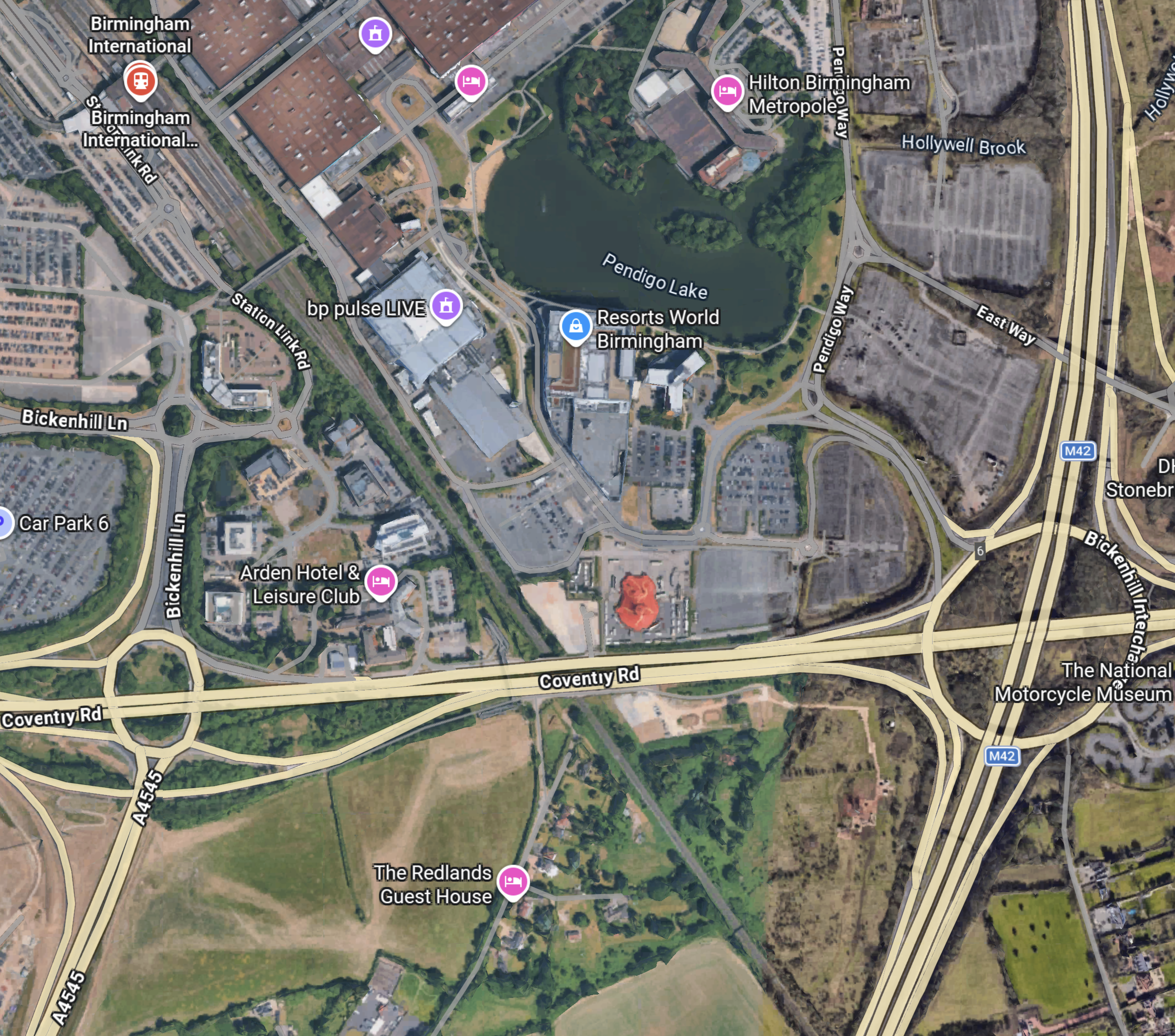
The most promising of the English stations would be Birmingham International station, which is shown in this Google Map.
Note.
- Birmingham International station is in the North-West corner of the map.
- The electrified Rugby, Birmingham and Stafford Line runs diagonally through the map.
- In addition to their Aberystwyth/Pwllheli service, there is also a Llandudno Junction service that terminates at Birmingham International.
- I wonder, if there is space South of Coventry Road, to build a combined charging and hydrogen refuelling station, that could refuel all trains terminating at Birmingham International.
As the section without electrification is 111.2 miles on the Aberystwyth service, 148.3 miles on the Pwllheli service and 116.5 miles on the Llandudno Junction service , I suspect that these services could be too far for battery-electric trains, without charging at the Western end.
INTERVIEW – Combining Geothermal Power With Minerals Key To Viability, says GEL CEO
The title of this post, is the same as that of this article on Renewables Now.
These three paragraphs introduce, this very much a must-read article.
Producing critical minerals such as lithium alongside geothermal electricity generation could make deep geothermal projects economically viable, according to Ryan Law, founder and chief executive of UK deep geothermal firm Geothermal Engineering Ltd (GEL).
Electricity generation on its own is quite challenging economically, but combining that baseload power with commodity pricing from the minerals seems to get these projects relatively easily funded, he told Renewables Now.
Law also pointed out that geothermal electricity generation began in Italy more than 100 years ago, but the geothermal wells there were initially used to extract boric acid. “It’s just interesting that the story started with geothermal power as a sort of mineral extraction process,” he noted
It certainly looks like we’ve gone round in a large virtuous circle.
These are some points from the article.
There Have Always Been Minerals In Geothermal Fluids
But because they were cheap and no-one bothered about them coming from China, nobody thought about mining them.
Oil And Gas Expertise Helps The Geothermal Sector
This is a sentence.
Law emphasised that the geothermal sector needs a lot of equipment and skills from the oil and gas industry, which currently in the UK are concentrated in Aberdeen. He said the UK will need a strong oil and gas industry until geothermal becomes large enough to absorb those jobs.
Law said we mustn’t disband that sector too quickly.
The US Appears To Be Backing The Sector
These are two paragraphs.
Law said he could see the sector scaling significantly within a decade, driven largely by developments in the US. He pointed to a number of big financial raises in the US recently.
“And also that the US government is very behind the mineral production,” Law remarked.
Conclusion
Geothermal energy paired with the mining of rare earth minerals could be a surprising winner in a decarbonising world.
Great Portland Street – 22nd July 2026
Out of curiosity, I went back to Great Portland Street, this morning.
I took these pictures.





























Note.
- I used to visit the area a lot in the 1970s, to see Time Sharing Ltd., who were a computer company, that I did a lot of work with.
- Time Sharing Ltd has a Wikipedia entry.
- I don’t think there were buses down Great Portland Street in the 1970s.
- The area is dominated by the buildings of the Portland Hospital.
- The Mason’s Arms has changed its name to The Lucky Saint.
- The Mason’s Arms, was where we all drunk.
The area has much changed.
UK’s Largest Onshore Wind Farm To Be Rebuilt With Fewer, Larger Turbines
The title of this post is the same as that of this article on the BBC.
This is the sub-heading.
One of Europe’s biggest onshore wind farms is to be flattened and rebuilt with fewer, taller turbines, its owner has announced.
These three paragraphs add more detail to the story.
Whitelee Windfarm has been producing electricity for about 20 years on a stretch of moorland near Eaglesham, south of Glasgow, but is reaching the end of its life.
Scottish Power Renewables says the existing 215 turbines will be replaced in three phases with around 124, each of which will be about 110m (361ft) taller.
The £1.5 billion “repowering” project will take 10 years to complete and will double the electricity output from 539 megawatts to 1 gigawatt, which is enough to power about 650,000 homes.
I asked Google AI,”Will there be any objectors to the repowering of Whitelee Wind Farm” and received this reply.
While there are no formal objectors on record yet, opposition to the repowering of Whitelee Wind Farm is highly anticipated. The developer, ScottishPower Renewables, officially filed their proposal with the Scottish Government in July 2026, but the formal planning application is not expected to be submitted until December 2027.
Anticipated objectors and their concerns typically include:
Campaign Groups & Environmentalists: Organisations like Scotland Against Spin generally challenge large-scale onshore wind projects over landscape dominance, ecological impacts, and the sheer scale of the new turbines.
Visual and Height Concerns: The repowering plan proposes replacing the existing 215 turbines with roughly 124 much larger machines. Each new turbine will stand roughly 110m taller than the current ones, which is expected to draw objections from those concerned about the visual alteration of the moorland.
Aviation and Radar Issues: Taller turbines and longer blades frequently raise fresh concerns and potential clearance objections from civil aviation and military radar stakeholders.
The BBC article finishes with this paragraph.
The work at Whitelee is expected to generate about £330m for the Scottish economy.
How many Scottish jobs will a third of a billion pounds sustain?
Blackfriars Station – 22nd July 2026
I feel that with a few modifications, Thameslink could solve some of London’s airport connectivity and general transport capacity problems.
So this morning, I went to Blackfriars station and took these pictures.














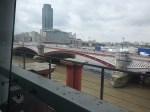

















Note.
- Blackfriars station has two through platforms and two South-facing bay platforms.
- Blackfriars station is fully step-free.
- The two through platforms handle just 12 trains per hour (tph).
- Both Thameslink and the Elizabeth Line are designed to handle up to 24 tph.
The Wikipedia entry for Thameslink, says this about the frequency of operation.
The new services began operating in 2018, though the full projected timetable of 24 trains per hour has never been achieved.
So how could this spare capacity be used?
Could A Gatwick And Luton Airport Express Service Be Developed?
Consider.
- Thameslink already has a 2 tph Bedford and Brighton service, that already stops at the two airports, but it also stops at twenty other stations.
- Thameslink already has a 2 tph Bedford and Three Bridges service, that already stops at the two airports, but it also stops at nineteen other stations.
- Both airports have a 6 tph service, that stops in Central London at London St Pancras International(for Eurostar), Farringdon (for the Elizabeth Line), City Thameslink, London Blackfriars and London Bridge.
- East Midlands Railway operates a 2 tph St.Pancras International and Corby service, which stops at Luton Airport Parkway, Luton, Bedford, Wellingborough, Kettering, which takes only 32 minutes. This service uses a dedicated platform at St.Pancras International, where platform space is limited.
I wonder if it would be better if the East Midlands Railway service became an Express service through the Thameslink core and perhaps replaced one of Bedford’s Thameslink services. Bedford would still have the same number of services, but two would be a lot faster.
Battery-electric trains might even extend the service to Leicester, which might allow extra stations at Oakham and Melton Mowbray to be added.
Loganair Agrees To Buy Five Beta Technologies’ Alia CTOL (CX300) Electric Aircraft For Use Across Scotland
The title of this post, is the same as that of this article on the John O’Groat Journal.
These two paragraphs add some detail.
A “truly historic moment” in regional air travel could soon see electric aircraft transporting passengers between between Highlands and Islands airports.
Loganair announced a deal to buy five all-electric aircraft, with options for five more, on Monday.
The first aircraft is expected to be in service in 2029.
As an engineer and a former private pilot, I felt this would happen at some time, but not as early as this.
Read the Wikipedia entry for the plane to find out more about this fascinating aircraft.
Four Of The Largest Grid Batteries From Fidra
Fidra have made a big splash as they enter the UK’s Long Duration Energy Storage market, with three grid batteries.
Bicker Fen 1 and 2
Capacity – 1.20 GW/2.40 GWh
Web site
Commission Date – BF1-2028, BF2-2029
Thorpe Marsh
Capacity – 1.45 GW/2.90 GWh
Commission Date – Q1-2027
West Burton C
Capacity – 500 MW/1 GWh
Commission Date – Q4-2027
Note.
- All are two-hour batteries.
- Each battery has some drone footage of the site.

