Hampstead Homes Left To Rot On Billionaires’ Row
The title of this post is the same as this article in today’s copy of The Times.
The article talks how multi-million pound houses in The Bishops Avenue ae being left to go to rack and ruin by their owners, who tend to be rich foreign nationals.
I hate waste and if a house is allowed to decay like this it should be a criminal offence, except in certain limited circumstances.
The Bishops Avenue is in the London Borough of Barnet and like most London Boroughs, Barnet needs more housing.
I hope the next Government brings in legislation to make sure our housing stock is kept up to standard.
North And South
I went to see Spurs this afternoon to see them play Burnley.
Coming home, I got the train between White Hart Lane and Hackney Downs stations. As we walked to the bus for Dalston, there was a mixed group of fans.
Most of the Burnley fans were smoking, as opposed to few of the Spurs fans.
Is this the difference between North and South?
New Trains For West Coast Will Be Built By Hitachi
The title of this post, is the same as that of this article on Railnews.
With the new Franchise; Avanti West Coast, starting services in a few days, more detail is starting to be added to their plans.
New Trains
This is said about the new trains to be added to the fleet.
Hitachi is to build 23 new trains for the West Coast Partnership, with the aim of having them in service by 2022.
The fleet will consist of 10 seven-car electric units and 13 five-car bi-mode units, and will be based on Hitachi’s existing Intercity Express models.
These are my thoughts about the trains.
Routes
According to Wikipedia, the bi-mode trains will be used from Euston to Chester, Gobowen, Holyhead, Llandudno and Shrewsbury and the electric trains will be used from Euston to Birmingham New Street, Blackpool North and Liverpool.
In Service Date
The Railnews article and a very similar one in Rail Magazine say that the trains will enter service by or around 2022.
This probably means that they will be built after the Class 804 trains for East Midlands Railway.
Comparison With Class 804 Trains
It has been stated that the Class 804 trains will have the following. characteristics.
- Twenty-four metre long cars, as opposed to twenty-six metres of a Class 802 train.
- Four diesel engines in a five-car train, instead of three in a Class 802 train.
- They will have a reprofiled nose.
They can be considered to be the Mark 2 version of Hitachi’s Intercity Express.
The car length for the Avanti West Coast trains has been specified at twenty-six metres, which is two metres longer than that of the current Class 390 trains on the West Coast Main Line,
So will Avanti West Coast’s trains be based on the Mark 2 version?. It’s logical, that they will.
Performance
The trains for Avanti West Coast will need to keep up with the Class 390 trains, which have the advantage of tilt.
The Railnews article says this about performance.
Although the new trains will not have tilt equipment, their superior acceleration should compensate for slightly slower speeds on some sections of line.
I think that the removal of tilt equipment could be a good thing.
- Removal could reduce the weight of the train, which would result in increased acceleration.
- Does tilting reduce the ride quality?
- Of all the express trains on the UK network, the Class 390 trains, are the ones I avoid because the trains are cramped and so many seats have a bad view.. Is this caused by incorporating tilting or by crap design?
I also wonder if the reprofiled nose will improve the aerodynamics of the new trains for both the East Midlands Railway and Avanti West Coast.
Better aerodynamics would help during a high-speed cruise.
Train Length
Class 390 trains have two car lengths.
- An intermediate car is 23.9 metres
- A driving car is 25.1 metres
This means the following.
- A nine-car Class 390/0 train is 217.5 metres long.
- An eleven-car Class 390/1 train is 265.3 metres long.
If the Hitachi trains have seven twenty-six metre cars, then they are 182 metres long or 35.5 metres shorter.
I find that surprising, but it does mean they fit shorter platforms. Is this needed for new destinations like Walsall?
Seating Capacity
The Railnews says this about seating.
There will more seats, because a seven-car train will have 453 and five-car sets will have 301. First said the seven-car version will have about the same number of seats as a nine-car Pendolino, because each IET vehicle is longer, at 26m
Seating on current trains is as follows.
- A nine-car Class 390 train seats 463 passengers.
- A five-car Class 221 train seats 250 passengers.
It would appear that the bi-mode trains seat another fifty-one passengers, than the trains they are replacing, which must be good for the routes to Chester, Shrewsbury and North Wales.
As the seven car trains are not replacing any other trains, Aventi West Coast will have n increase in capacity.
Adding up the numbers, it appears that the Avanti West Coast fleet will have three more trains and 3443 more seats.
If they should need more cars or trains, Avanti West Coast should be able to buy them easily.
Out of curiosity, how many passengers could be seated in an Hitachi train, that is the same length as an eleven-car Class 390/1 train.
As this train is 265 metres, a ten-car Hitachi train would be almost the same length.
Assuming the same passenger density as the seven-car trains, a ten-car train would have 647 seats. The current Class 390/1 train has 589 seats, so there would be an increase of sixty seats.
Train Finance
The trains are financed by Rock Rail West Coast; a joint venture between Rock Rail and Aberdeen Standard Investments.
If your pension is with Aberdeen Standard, you may ultimately own a seat or a door handle on these trains, as pension funds find trains a good way of turning pension contributions into the long-term pension, we’ll hopefully all need.
Nationalisation of the trains themselves would probably blow a hole in a lot of pension pots.
Food Offering
The Railnews article says this about food.
The details of catering on board have yet to be finalised, but Railnews has learned that there will be a buffet counter as well as trolley services, and that one of the main food suppliers will be Marks and Spencer.
Over the last couple of years, a food war seems to have developed between Virgin and LNER and as a coeliac, I’ve noticed an improvement in gluten-free food.
Marks and Spencer have done a deal with British Airways, so surely a deal with a train company must fit that model.
- M & S already deliver to shops in most of Avanti West Coast’s destinations.
- M & S are one of the best on getting allergies correct.
- M & S are one of the UK’s most trusted brands.
FirstGroup, who are a seventy percent sharewholder in Avanti West Coast, might like to roll this food model out in their other rail franchises; Great Western Railway, Hull Trains, South Western Railway, TransPennine Express and the future East Coast Trains.
Hull
Hull station is an interesting case, although it has nothing to do with Avanti West Coast.
- It is a major terminus for Hull Trains and TransPennine Express.
- Hull Trains market themselves as a quality local train service to and from London.
- Hull station does not have a M & S Simply Food.
- M & S are closing their main store in Hull.
- There are reportedly spare units in the large Hull station.
A well-designed M & S food hub in Hull station could be of great benefit to both FirstGroup and M & S.
Conclusion
Hitachi seem to be able to manipulate the train length to give customers the capacity they want.
But that is good design.
A Gluten-Free Lunch From Pret a Manger
This picture shows my lunch today.

The gluten-free open sandwich came from Pret a Manger and the bottle of Adnams came from Marks and Spencer, a few doors away.
- The outlet opened today and a manager confirmed that they have done gluten-free for some months.
- They also have a tablet-based menu checker.
- It will be very useful for me, if it does well in Dalston.
- The beer may not be gluten-free, but my body says it is for me.
- It was a good delicious lunch for me!
It brought back memories for me of many lunches in the Bull at Burrough Green, where I would regularly have a similar lunch in pre-coeliac days.
A Massive Increase In Train Capacity In Ten Years
The Class 378 trains, were introduced as three-car trains on the North London Line in July 2009.
The original service was three trains per hour (tph) between Stratford and both Clapham Junction and Richmond stations.
This meant there were six tph between Stratford and Willesden Junction stations.
Or a capacity of eighteen carriages per hour!
This article on Railway Gazette is entitled UK Railway News Round-Up.
This is an extract.
From December 15 services between Willesden Junction and Clapham Junction, and between Willesden Junction and Richmond, will increase from four to five trains/h, giving a 10 trains/h service between Willesden Junction and Stratford.
As the trains are now five-cars, that is a capacity of fifty carriages per hour.
That is an increase of a hundred and eighty percent over ten years.
I suspect, they’ll still be full in the Peak!
President Putin To Set Up Russian Web Encyclopaedia To Rival ‘Unreliable’ Wikipedia
An article with this title, was published in yesterday’s Times.
The title is a very good summary.
Tottenham Court Road Western Entrance – 2nd December 2019
These pictures show the new Western entrance to Tottenham Court Road station.




This Google Map shows the location of the massive double-ended station.
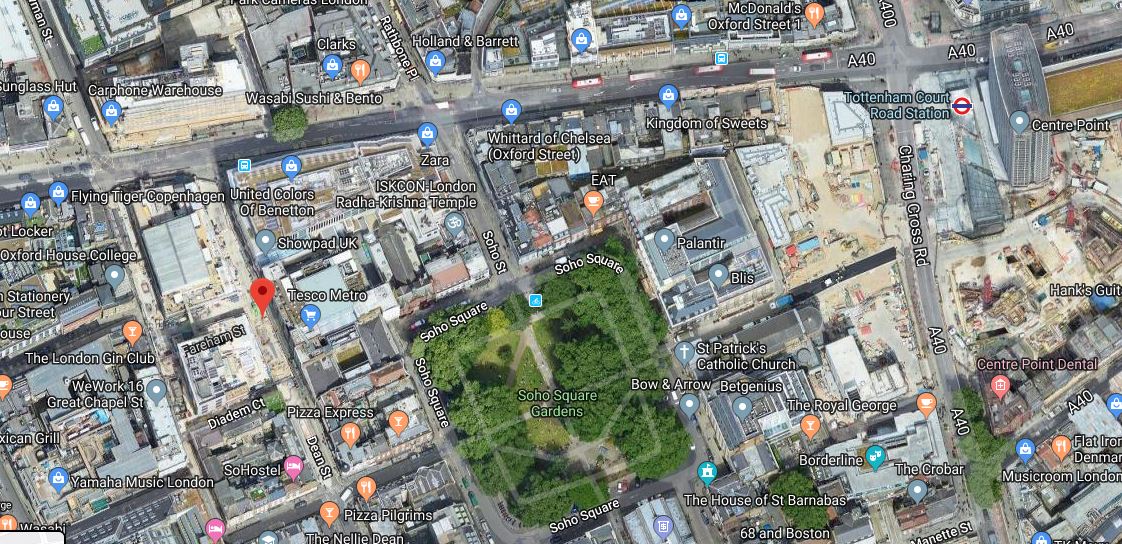
Note.
- Soho Square is the green space in the middle of the map.
- The Eastern entrance to the station is by Centre Point in the North East corner of the map.
- The new Western entrance is to the West of the red arrow.
The size of the station is such, that passengers will have to make sure they get out at the right end of the train.
- For Marks and Spencer at the Pantheon, get out at the Western entrance to the station.
- For Primark and the other shops clustered around the current station entrance, get out at the Eastern entrance to the station.
- For Tottenham Court Road, Charing Cross Road, the Dominion Theatre and Centre Point, get out at the Eastern entrance to the station.
A few years ago, a young Crossrail engineer told me, that the stations are very long underground.
Perhaps they should have a directory of all shops, theatres, hotels, attractions and other sites on the platforms, to ensure that passengers use the best entrabce for their destination.
This image shows a visualisation of the station.
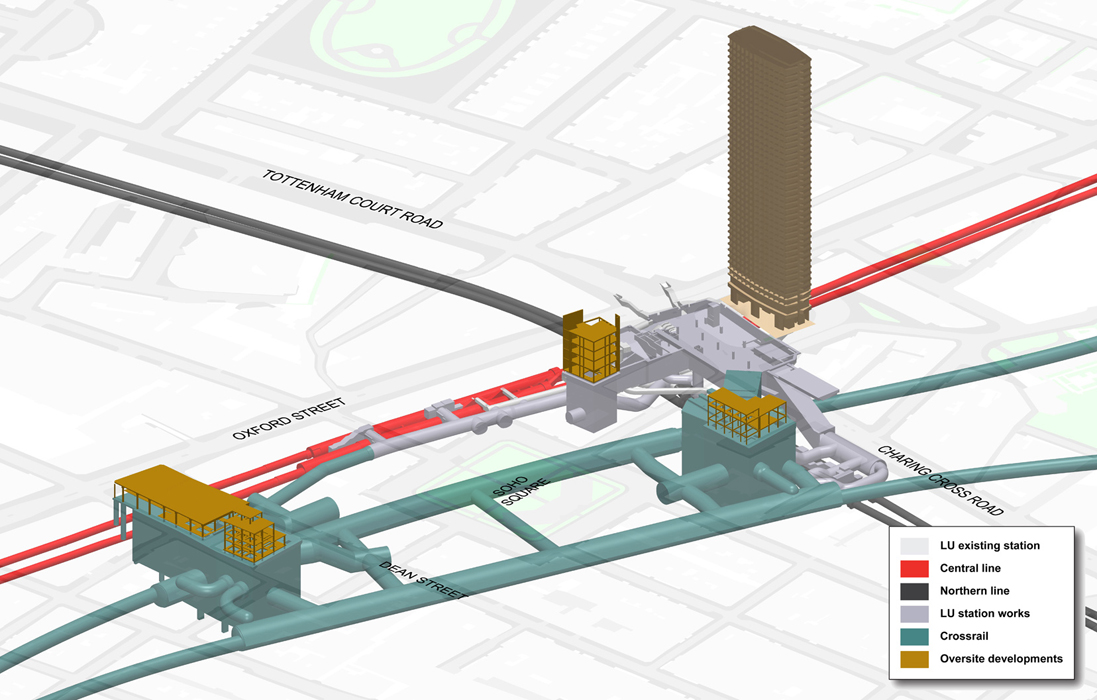
Note.
- The Westerm entrance is the one on the left.
- Centre Point at the Eastern end of the complex, by the Eastern entrance.
The visualisation also shows lots of detail.
The Connecting Tunnel Between The Two Entrances
There appears to be a connecting tunnel between the two entrances.
This pictures show the inside of the Eastern end of the tunnel which has already been built.




Note.
- The relatively cramped Central Line platform.
- The tunnel has good connections to the Central Line.
- It looks like the Western end of the connecting tunnel will be extended towards the Western Entrance.
- Obviously, breaking through between the connecting tunnel and its extension, will be one of the last jobs to do.
The completed tunnel will allow the following.
- Passengers entering the station at either entrance to be able to access the Central Line.
- Passengers needing to access the Northern Line to be able to enter at the Western Entrance and use the connecting tunnel.
Will this tunnel be a good walking route, when it’s raining cats, dogs and hippopotami on the surface?
Access To Crossrail
Both entrances will have their own step-free access to the Crossrail platforms.
Because Crossrail is at a different level to the Central and Northern Lines, it appears that passengers needing to change to and from Crossrail will probably come to the surface by lift or escalator and then go back down again using a second set.
This may seem to make walking distances longer, but I suspect the following.
- It makes the station easier to construct.
- Access to existing lines can be maintained during construction.
- It allows for the installation of multiple escalators for high capacity.
There are also older stations in London, where there are up and down changes of lines. So perhaps it’s an affordable way of building the connection.
Changes Between Crossrail and The Central Line
Crossrail and the Central Line have several interchanges.
- Stratford, where the interchange is cross-platform.
- Liverpool Street
- Tottenham Court Road
- Bond Street
- Ealing Broadway, where the interchange is on the surface. See Crossrail And Ealing Broadway Station for my thoughts on the interchange.
I suspect that there will be a certain amount of ducking and diving by passengers, as they go on their easiest way. Many will probably change at Stratford, as it is a walk across the platform.
Will Tottenham Court Road station see a lot of passengers changing between Crossrail and the Central Line?
I have no idea. But I suspect that Transport for London will be able to make an accurate prediction, based on information from London’s contactless ticketing.
It does look though from the visualisation, that the following can be ascertained.
- There will be an escalator and a walk to change between Crossrail and the Central Line at Tottenham Court Road station.
- The change may be easier at the Western end of the Crossrail station.
- The design of the Central Line with two tunnels close together and not much space for stairs and lifts between them, makes a high-capacity link to the large connecting tunnel difficult to built.
- There appears to be no provision to extend the connecting tunnel to the West. The original plan was to pedestrianise Oxford Street, but that has been abandoned, due to pressure from residents and Westminster Council.
It is an illustration of the difficulty of connecting to London’s older Underground lines.
Changes Between Crossrail and The Northern Line
Crossrail and the Charing Cross branch of the Northern Line only have the single interchange at Tottenham Court Road station.
- Does this mean it is expected to be busy, as the Charing Cross branch of the Northern Line serves Euston, Waterloo and will serve the new Battersea extension?
- From the visualisation, there appear to be lots of connections between Crossrail and the Northern Line at the Eastern entrance.
These pictures show some of the tunnels leading to both Crossrail and the Northern Line at the Eastern entrance.




It looks like Transport for London are expecting a party. But you’ll probably need to be in the Eastern end of the Crossrail trains, to do a fast interchange.
If you get out at the Western end of the train, you’ll have to walk back along the connecting tunnel.
Crossrail 2
Crossrail 2 will complicate and improve things further at Tottenham Court Road station, as it sits between the proposed Crossrail 2 stations of Victoria and the mega-station Euston-St. Pancras-Kings Cross.
Will Cinderella Come To The Rescue?
The Docklands Light Railway (aka Cinderella) was the star of the 2012 Olympics transport system and she now has ambitions to expand to the West, as I wrote about in A Connection Between City Thameslink Station And The Docklands Light Railway.
This map from Transport for London, shows the possible Western extension of the DLR.
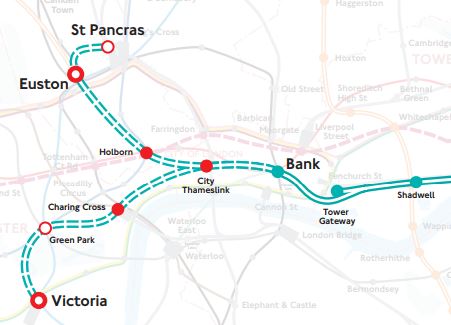
With all the problems of the funding of Crossrail 2, this extension could create a lot of important connections across the City.
It already connects or will soon connect.
- Canary Wharf and Bank
- City Airport and Bank
- Crossrail’s South Eastern Branch and Bank, with a change at Custom House station.
The upgrade at Bank, which should complete in a couple of years will help, with better connections to the Central, Circle, District and Northern Lines.
If the extension to the DLR is built, it would connect Canary Wharf, City Airport and Crossrail’s South Eastern Branch in the East, with Charing Cross, Euston, Kings Cross, St. Pancras, Thameslink and Victoria in the West.
It would also take the pressure off of some of Central London’s most crowded lines.
So get your coal shovel out Cindy and start digging!
Rochdale Still Doesn’t Have A Direct Link To Manchester Airport
The title of this post is the same as that of this article on Richdale Online.
I recently went to Rochdale to see Ipswich play and what surprised me about the town, was how far it was from my hotel close to Manchester Victoria station.
I went on a tram and it took over an hour and it was also very crowded.
I then walked about a mile to the football ground. Luckily a friendly Rochdale supporter showed me the way.
But is Rochdale’s link to Manchester Airport, any worse than say Walthamstow’s link to Heathrow or Gatwick.
- Rochdale Town Centre to Manchester Airport by train – 1:05
- Rochdale Town Centre to Manchester Airport by tram – 2:02
- Rochdale Station to Manchester Airport by train – 0,:55
- Rochdale to Manchester Airport by taxi- 0:27
- Walthamstow Central to Heathrow Airport by Underground and Heathrow Express – 1:05
- Walthamstow Central to Heathrow Airport by Underground – 1:27
- Walthamstow to Heathrow Airport by taxi – 1:27
- Walthamstow Central to Gatwick Airport by train – 1:22
Note.
- All journeys, except the taxis, need at least one change.
- My lawyer son lives in Walthamstow and always flies from Heathrow.
- He gets there by Underground, with one cross-platform change at Finsbury Park.
- Crossrail won’t help the man on the Walthamstow Underground.
- In Manchester the taxi is quicker, but it isn’t in London.
These are my thoughts.
Mancunians Are More Impatient
Not my view, but the view of a Northern station guy, who has worked on Platforms 13 and 14 at Manchester Piccadilly and busy stations on the London Overground.
He thought that they were sometimes in such a hurry to get on a train, that the train is delayed.
He also said, if you ask Londoners to stand behind the yellow line, they do. Mancunians don’t!
Access To Northern And TransPennine Trains Is Bad
Consider.
- There is often a step up into the train in Manchester.
- Manchester Metrolink is generally step-free into the tram.
- Parts of London Underground/Overground are step-free.
- The new TransPennine trains have pathetic and slow end-door access.
The two train companies have bought fleets of trains that are not fit for purpose.
The Manchester Airport Rail Link Is At Full Capacity
Manchester Airport station, does not have the best rail line from the City Centre.
Wikipedia says this.
Any future additional services to the Airport are in doubt without further infrastructure works; unresolved issues surround the lack of new ‘through’ platforms at Manchester Piccadilly which have been shelved by the government and the Styal Line to Manchester Airport operating at full capacity with little resilience to absorb delays.
The Rochdale Online article blames the stations in Manchester, but the Styal Line is equally to blame.
The Long Term Solution Is High Speed Two
In the 2030s, High Speed Two will solve the problem by using a tunnel between Manchester Airport and the City Centre.
It will also do the following.
- Provide direct access between Manchester Airport and the Midlands, the South and London.
- Provide direct access to Liverpool and Warrington in the West.
- Provide direct access to Huddersfield, Bradford, Leeds, Hull and the North East, in the East.
- All services will probably be at least five trains per hour (tph).
But High Speed Two won’t provide a direct link to Richdale.
Passengers between Rochdale and Manchester Airport will still have to change in the City Centre.
Unless of course, some TransPennine services to Manchester Airport are discontinued, as they can be done by High Speed Two.
This would free up paths to add extra services to Manchester Airport.
An Interim Solution
Not only Rochdale, but other towns and cities across the North like Bradford moan about lack of a direct service to and from Manchester Airport.
So what would I do?
Ban Freight Trains Through The Castlefield Corridor
This may not be possible, but it should be a long term objective.
It will cost money, but it would release capacity through the Castlefield Corridor.
Ban Trains Without Level Access At Stations In The Castlefield Corridor
I know that Northern and TransPennine have just bought a load of new trains, but they make matters worse in the stations through the Castlefield Corridor.
All Trains To The Airport Must Be Eight Cars
This makes sense as it increases the capacity, but use the same number of paths.
- Eight-car Class 379 trains – Stansted Express – 160 metres and 418 passengers
- Five-car Class 802 trains – TransPennine Express – 130 metres and 342 passengers
- Eight-car Class 331 trains – Northern – 190 metres and 568 passengers
It does appear that the new trains are also setting new standards for train length.
ERTMS Signalling Should Be Installed Between Manchester Victoria And Manchester Airport
ERTMS signalling would give more flexibility on the route.
Create A Manchester Airport Express
This has been suggested and would have the following characteristics.
- Running between Manchester Airport and Manchester Victoria via Deansgate, Manchester Oxford Road and Manchester Piccadilly.
- Eight cars
- Airport-style interiors
- Step-free access at all stations.
- Four tph
- Running twenty-four hours a day.
- It would have step-free access to the Metrolink at Manchester Victoria, Deansgate and Manchester Piccadilly.
Ideally it would use dedicated platforms at Manchester Airport and Manchester Victoria. The platform at Victoria would hopefully have cross-platform interchange with services going through the station from East to West.
Reduce TransPennine Services To The Airport
TransPennine Express runs the following hourly services to the Airport
- Cleethorpes via a reverse at Manchester Piccadilly.
- Edinburgh or Glasgow via the Castlefield Corridor
- Middlesborough via the Castlefield Corridor
- Newcastle via the Castlefield Corridor
Why not cut-back either the Newcastle or Middlesborough service to Manchester Victoria and make sure it has good cross-platform access to the Manchester Airport Express?
These services are regularly cut-back anyway due to the congestion.
Demolish Manchester Oxford Road Station And Build A Station That’s Fit For Purpose
Manchester Oxford Road is one of ultimate design crimes on the UK Rail network.
- The new or refurbished station would be step-free.
- Platforms would be able to accept two hundred metre long trains.
- A well-designed bay platform would be provided to turn trains from the North efficiently.
- Up to four tph could probably be turned back.
Network Rail do station and track layout design generally very well and I’m sure that a redesigned Oxford Road station could improve capacity through the Castlefield Corridor.
Improve Deansgate And Manchester Piccadilly Stations
If longer trains are to be run through the Castlefield Corridor, then the platforms at these two stations will need lengthening and passenger access will need to be improved.
Is There A Place For Tram-Trains?
Manchester are keen on using tram-trains to improve the Metrolink network.
This map clipped from Wikipedia shows the layout of the Metrolink in the City Centre.
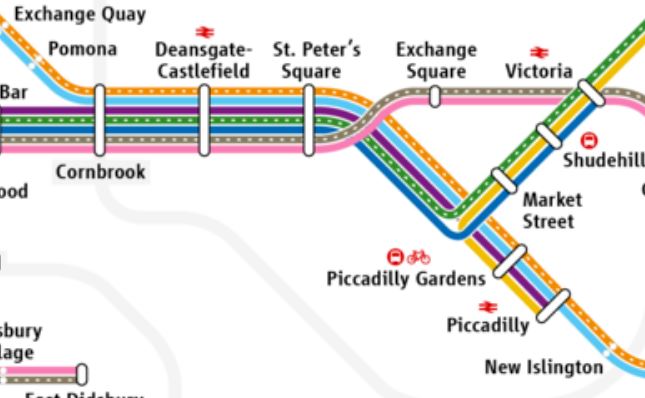
Note.
- Manchester Piccadilly, Deansgate and Manchester Victoria all have step-free connections to the trains to and from Manchester Airport.
- The new Trafford Line will branch off at Pomona.
I think it is likely, that any new lines run by tram-trains will pass through at least one of the connecting stations.
This will increase the list of places that will have good access with a single change to and from Manchester Airport.
Conclusion
There would appear to be a lot of scope to create a high-capacity link between Manchester and the Airport.
But it does appear that the current timetable leaves little or no room to expand the service.
That is why, I believe a simpler but higher capacity service, based on a Manchester Airport Express could be developed.
BlackRock Renewables Fund Hits USD 1bn In 1st Close
The title of this post, is the same as that of this article on Renewables Now.
Wikipedia says this about BlackRock.
BlackRock is one of the world’s largest asset managers with $6.84 trillion in assets under management as of August 2019.
The company has been very successful over the years and although there have been controversies about their investments in fossil fuels, their move into renewables and energy storage must be significant.
If you are managing money for organisations like pension funds and insurance companies, you must be prudent, as otherwise little pensioners and the insured won’t get paid.
The Electric Aviation Revolution Will Be Televised … By MagniX And Harbour Air
The title of this post, is the same as that of this article on GeekWire.
These are a few points from the article.
- The target date is December 11th.
- The first flight could be delayed by weather.
- Harbour Air’s CEO, Greg McDougall, will put his money where his mouth is and take the first test flight.
- The first test flight will only be a few minutes.
I wish Greg McDougall all the best!
 The Anonymous Widower