Rail Solar Projects Pave The Way For Renewables
The title of this post, is the same as that of this article on Engineering and Technology.
This is the introductory sub-title.
Electric trains could provide a huge guaranteed market for renewables, but it will need some railway-specific power equipment.
The article then goes on to describe how Riding Sunbeams are developing and sourcing the equipment to connect both 750 VDC and 25 KVAC electrification directly to solar panels.
It is not as easy, as you might think!
‘Build Greener’ You Say Boris? Got It. Just Say The Word, We’re Ready Here In North West England
The title of this post, is the same as that of this article on H2 View.
The article is written by Cadent‘s Network Director for the North West and what she says is a must-read.
Keadby 3 Low-Carbon Power Station
This article on Business Live is entitled Huge Green Power Station Proposed By SSE As It Embraces Hydrogen And Carbon Capture.
SSE Thermal is working on a low-carbon 910 MW gas-fired power station to join Keadby and Keadby 2 power stations in a cluster near Scunthorpe.
A spokesman for SSE is quoted as saying they will not build the plant without a clear route to decarbonisation.
On this page of their web site, SSE Thermal, say this about Keadby 3.
As part of our commitment to a net zero emissions future, Keadby 3 will only be built with a clear route to decarbonisation, either using hydrogen as a low-carbon fuel, or equipping it with post-combustion carbon capture technology. The project is at the early stages of development and no final investment decision has been made.
It should also be noted that SSE Renewables have also built a wind farm at Keadby. The web site describes it like this.
Keadby Wind Farm is England’s largest onshore wind farm. This 68MW renewable energy generation site can power approximately 57,000 homes.
There are a lot of good intentions here and I think that SSE haven’t disclosed the full picture.
It would seem inefficient to use hydrogen to power a gas-fired power station to achieve zero-carbon power generation.
- If you are using hydrogen created from steam reforming of methane, this creates a lot of carbon-dioxide.
- If you are using green hydrogen produced by electrolysis, then, why don’t you store the electricity in a battery?
Perhaps, SSE are trying out a new process?
This Google Map shows the area of Keadby to the West of Scunthorpe.
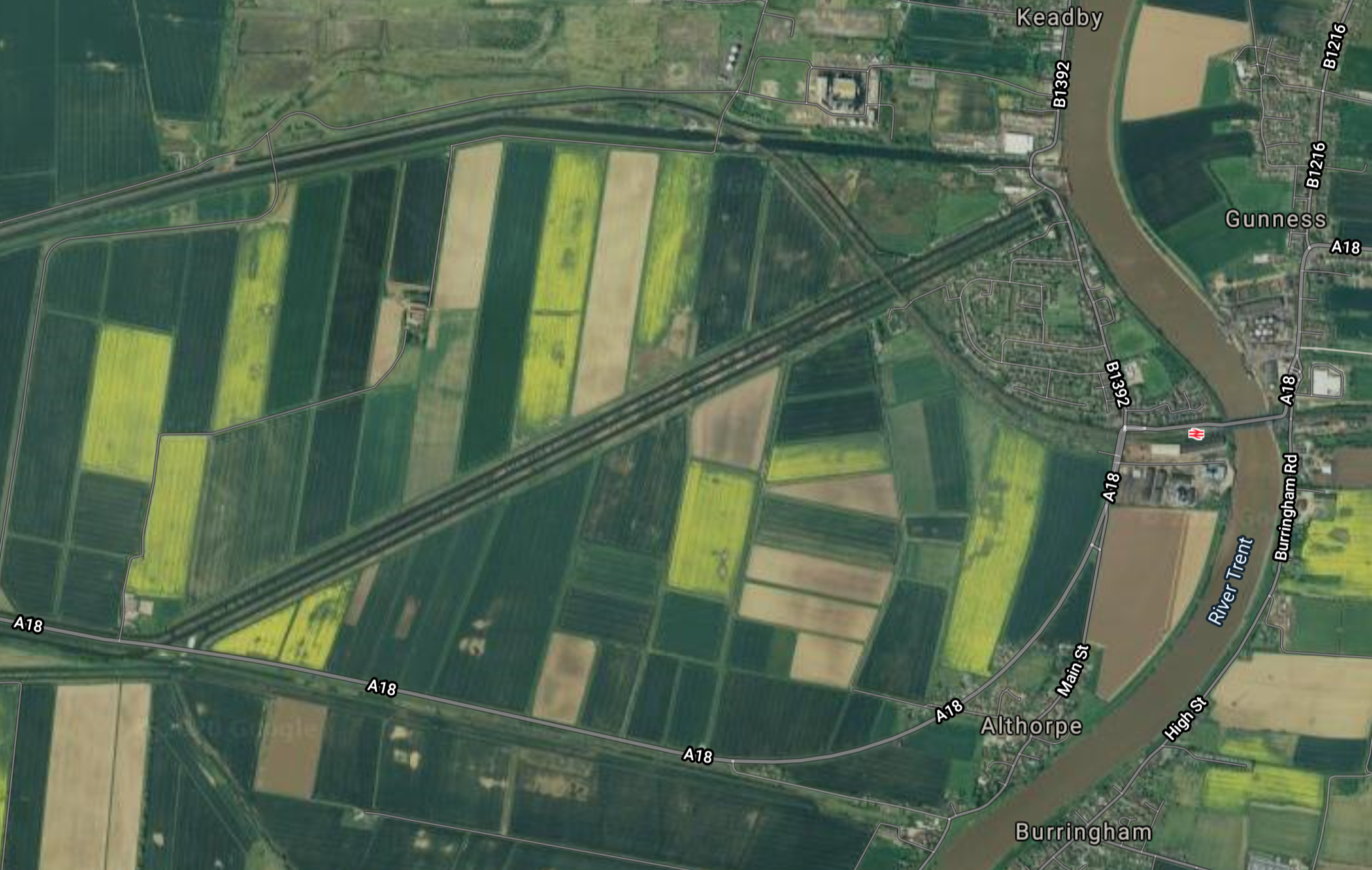
Note.
- The River Trent meandering through the area.
- Althorpe station is in the bend of the River,
- I’m fairly certain, that I remember an old airfield in the area.
- Keadby power station is a bit to the North of the waterway running West from the River and close to where the railway crosses the waterway.
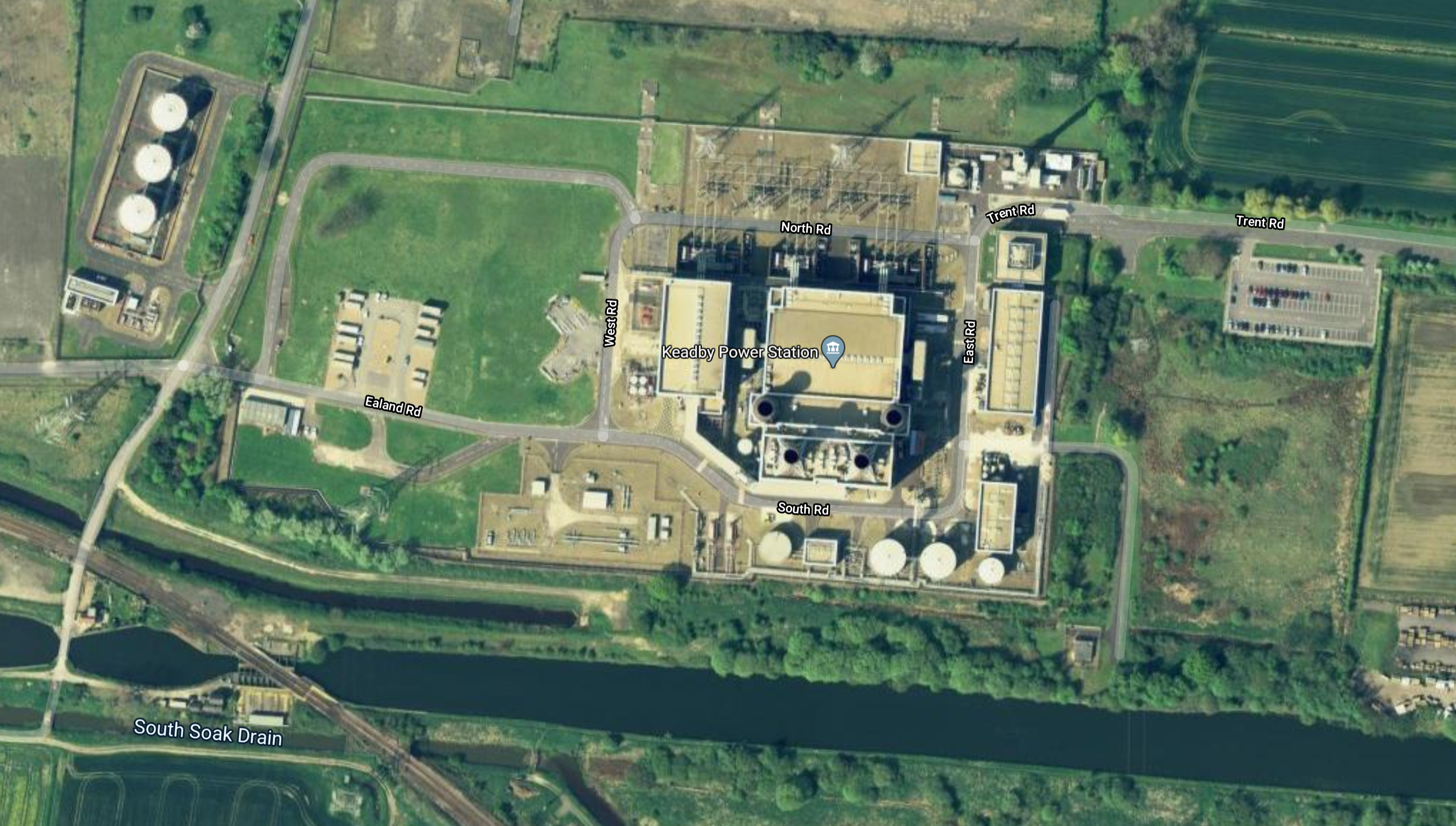
This second Google Map shows a close-up of the power station.
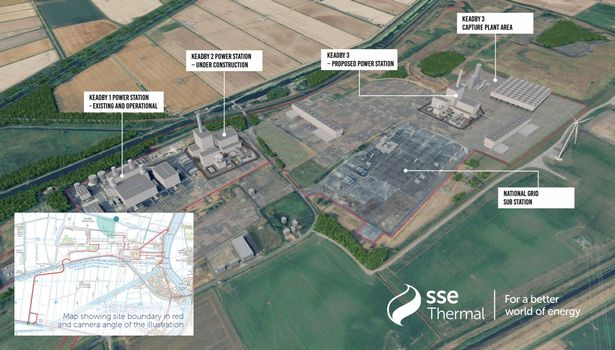
This visualisation from SSE Thermal shows how the site might look in the future.
For me the interesting location is the village of Althorpe, where C and myself had friends.
They were always getting tourists arriving in the village looking for Princess Diana’s grave!
Carbon Capture And Storage At Keadby
If SSE have three large power stations at Keadby, a shared carbon capture and storage system could be worthwhile.
- There are numerous gas fields in the area and a big gas terminal at Theddlethorpe, to where they all connect.
- I was surprised to see, that one of thee fields; Saltfleetby is owned by President Putin’s favourite gas company; Gazprom.
- Some of these fields are actually on-shore.
- The power stations probably get their gas from the same terminal.
Some of these gas fields that connect to Theddlethorpe could be suitable for storing the carbon dioxide.
As there is masses of space at Keadby, I can see more gas-fired power stations being built at Keadby.
All would feed into the same carbon capture and storage system.
If gas was needed to be imported in a liquified form, there is the Port of Immingham nearby.
Absorption Of Carbon Dioxide By Horticulture
Consider.
- Increasingly, horticulture is getting more automated and efficient.
- Automatic harvesters are being developed for crops like tomatoes and strawberries.
- Instead of storing the carbon-dioxide in worked-out gas fields, it can also be fed directly to fruit and vegetables that are being grown in greenhouses.
- Keadby is surrounded by the flat lands of Lincolnshire.
How long will it be before we see tomatoes, strawberries, peppers and cucumbers labelled as British zero-carbon products?
Offshore Hydrogen
I’ll repeat what I said in ITM Power and Ørsted: Wind Turbine Electrolyser Integration.
This is from a press release from ITM Power, which has the same title as the linked article.
This is the introductory paragraph.
ITM Power (AIM: ITM), the energy storage and clean fuel company, is pleased to share details of a short project sponsored by the Department for Business, Energy & Industrial Strategy (BEIS), in late 2019, entitled ‘Hydrogen supply competition’, ITM Power and Ørsted proposed the following: an electrolyser placed at the wind turbine e.g. in the tower or very near it, directly electrically connected to the DC link in the wind turbine, with appropriate power flow control and water supplied to it. This may represent a better design concept for bulk hydrogen production as opposed to, for instance, remotely located electrolysers at a terminal or platform, away from the wind turbine generator, due to reduced costs and energy losses.
Some points from the remainder of the press release.
- Costs can be saved as hydrogen pipes are more affordable than under-water power cables.
- The proposed design reduced the need for AC rectification.
After reading the press release, it sounds like the two companies are performing a serious re-think on how wind turbines and their links to get energy on-shore are designed.
- Will they be using redundant gas pipes to bring the hydrogen ashore?
- Will the hydrogen come ashore at Theddlethorpe and use the existing gas network to get to Keadby?
It sounds inefficient, but then the steelworks at Scunthorpe will probably want masses of hydrogen for carbon-free steel making and processing.
Boosting Power Station Efficiency
There is also a section in the Wikipedia entry for Combined Cycle Power Plant called Boosting Efficiency, where this is said.
The efficiency of CCGT and GT can be boosted by pre-cooling combustion air. This is practised in hot climates and also has the effect of increasing power output. This is achieved by evaporative cooling of water using a moist matrix placed in front of the turbine, or by using Ice storage air conditioning. The latter has the advantage of greater improvements due to the lower temperatures available. Furthermore, ice storage can be used as a means of load control or load shifting since ice can be made during periods of low power demand and, potentially in the future the anticipated high availability of other resources such as renewables during certain periods.
So is the location of the site by the Trent, important because of all that cold water?
Or will they use surplus power from the wind farm to create ice?
The Proposed North Sea Wind Power Hub
The North Sea Wind Power Hub is a proposed energy island complex on the Eastern part of the Dogger Bank.
- The Dutch, Germans and Danes are leading the project.
- Along with the Belgians, we have been asked to join.
- Some reporting on the Hub has shown, airstrips in the middle of the complex to bring the workforce to the site.
- A Dutch report, says that as much as 110 GW of wind power could be developed by 2050.
- We are also looking at installing wind farms on our section of the Dogger Bank.
Geography says, that one of the most convenient locations to bring all this electricity or hydrogen gas ashore is North Lincolnshire
A Very Large Battery
I would also put a very large battery on the site at Keadby.
One of Highview Power‘s proposed 1 GWh CRYOBatteries would be a good start. This will be four times the size of the 250 MWh CRYOBattery, which the company is currently designing and building at Carrington in Greater Manchester.
Conclusion
The three power stations at Keadby are the following sizes
- Keadby 1 – 734 MW
- Keadby 2 – 803.7 MW
- Keadby 3 – 010 MW
This adds up to a total of 2447.7 MW. And if they fit carbon capture and storage it will be zero-carbon.
Note.
- Hinckley Point C is only 3200 MW and will cost around £20 billion or £6.25 billion per GW.
- Keadby 2 power station is quoted as costing £350 million. or £0.44 billion per GW.
These figures don’t include the cost of carbon capture and storage, but they do show the relatively high cost of nuclear.
61GW Renewables And Storage Pipeline Could Bring In £125bn To Economy
I did think about calling this post something like.
- Do You Like Large Numbers?
- My Calculator Just Blew Up!
- I Don’t Believe It!
- No Wonder Rishi Sunak Has A Smile On His Face!
But I’ll use my normal introduction for this type of post!
The title of this post, is the same as that on this article of Current News.
This is the introductory paragraph.
The UK currently has a pipeline of 61GW of renewables and storage that if developed could bring in £125 billion to the UK economy.
The article also says that this pipeline could provide 200,000 jobs.
So where will this massive 61 GW of electricity come from?
- Off-shore Wind – 31.7 GW
- On-shore Wind – 11.9 GW
- Solar PV – 8.6 GW
- Storage – 8.5 GW
Where is the Nuclear Option?
iThe article also says that 18 GW of these projects are Shovel-Ready.
The figures come from UK trade association; Regen, whose Chief |Executive is the appropriately named; Merlin Hyman.
The page on the Regen web site, which is entitled Unlock Renewables For A Green Recovery, is the original document on which the Current News article is based.
Regen want three things from the Government, in return for creating all this renewable electricity capacity.
- Publish an Energy White Paper putting the UK on course for a flexible power system based on renewables and storage.
Commit to annual Contracts for Difference auctions to give investors confidence.
End the anti onshore wind policies in the English planning regime.
Some will not like the third condition.
I must go now, as I must go down the Chinese-owned Lucky Electronics Shop on Dalston Kingsland High Street to get a calculator with more digits to replace the one that blew up!
Exeter City Council Builds Its First Solar And Battery Storage Project
The title of this post, is the same as that of this article on Energy Live News.
This paragraph describes the scheme.
The plant, which had its preparatory work finished recently, will be built on an inactive landfill site and will comprise of a 1.2MW array of 3,702 solar photovoltaic (PV) modules, two battery storage containers and an electrical switch room.
I do think, this is a superb use for a old landfill site.
As I believe that some landfill sites still give off methane for many years, if this is the case, this can surely continue.
The scheme will also include a 1 MW/2 MWh battery and will be geared to providing power to a council operation’s facility and in the future to supporting an electric fleet.
This is a superb example of how to turn an unwanted toxic liability into a green asset, with several benefits.
I have not heard of something like this before, but by searching the list of solar and energy-from-waste power sites in the UK, I found a cluster around the M5 to the North of the village of Puriton.
This Google Map shows the area.
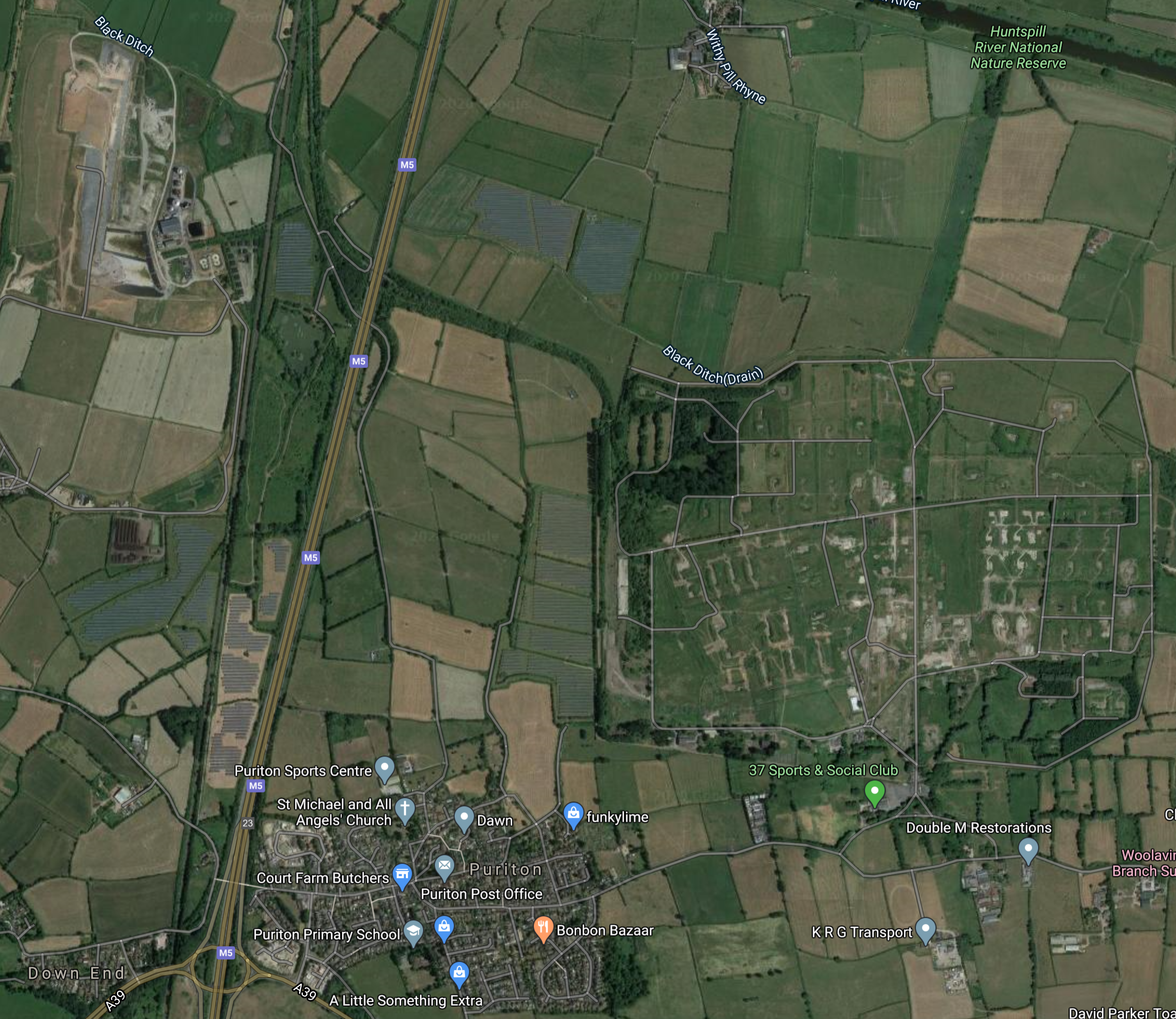
Note.
- The village of Puriton to the East of the Junction 23 of the M5, which is a forest of blue dots.
- The various solar farms showing as a blue-violet field. I can count fourteen separate fields.
In total, there are about half-a-dozen renewable energy producers in the area generating up to 25 MW of electricity.
The area to the North-East of the village with all the white dots, just above the green one, is the former Royal Ordinance Factory Bridgewater, which I’m sure solar farmers would like to get their hands on.
Would this become a modern version of swords into ploughshares?
Can A Green Revolution Really Save Britain’s Crisis-Stricken Aerospace Industry?
The title of this post, is the same as that of this article on the Telegraph.
This is the sub-title.
The Prime Minister has set a challenging target of green flights within a generation, but is it a sustainable plan?
I have read the whole article, which is mainly about Velocys and their project at Immingham to create aviation biofuel from household rubbish.
They say the main problem is scaling up the process to get enough jet fuel. When I was working at ICI in the early 1970s, modelling chemical processes, scale-up always loomed-large as a problem.
Nothing changes!
I think we’ll get to our carbon-neutral objective, for aviation, but it will be a mixture of things.
- Aviation biofuel.
- All-electric airports.
- Efficient aerodynamics and engines.
- Electric short-haul aircraft.
- Rail substitution for short flights.
Traditional aerospace must reform itself or die!
As to Velocys, they must solve their scaleup problem, so that all suitable household and industrial rubbish ends up doing something more useful, than beinmg incinerated or nuried in landfill.
British Start-Up Attempts To Bring Steam Power Back To Shipping
The title of this post, is the same as that of this article on Splash 247.
These are the introductory p[aragraphs.
A British start-up called Steamology is trying to bring steam power back to shipping. However, the key difference for this 21st century invention is that instead of steam generated by burning coal, Steamology’s steam is generated by burning pure oxygen and hydrogen, split from water.
The company has just won UK government innovation funding of £400,000 ($496,000) to trial the technology initially for trains but with a longer term view of getting it onboard ships.
There’s also a good graphic, which explains how the technology works.
Japan A ‘Very Interesting Market’ For Gore Street As It Becomes An ‘Enabler’ Of JXTG’s Transition
The title of this post, is the same as that of this article on the Solar Power Portal.
This is the introductory paragraph.
London Stock Exchange-listed energy storage fund Gore Street has outlined how it sees Japan as a “very interesting market” following its investment from JXTG Nippon Oil & Energy Corporation.
I like Gore Street’s philosophy and its execution.
I am not an investor and probably never will be, but they seem to be based on sound principles and do their modelling well. I’ve built enough large financial models to know a good one from its results.
Gore Street is normally investing in lithium-ion batteries.
- These batteries now have a predictable reliability profile and I suspect cash-flow from owning a battery is fairly predictable.
- The control and monitoring software will get better as time goes by and these batteries will probably update themselves automatically.
- They probably aren’t that affected by COVID-19, as lockdown still needs energy to be balanced and these batteries are probably performing as normal.
- The heat of the last few weeks probably caused more grief than COVID-19.
- If a site visit is necessary, they can probably be done with one man in a van with a key to the security system. So maintenance is probably easy to do, whilst maintaining social distance.
I also liked this paragraph from the article.
, Gore Street Capital CEO, Alex O’Cinneide, said that the fact that the deregulation of the Japanese market over the next few years makes it of interest to the company, alongside it having the same characteristics of the UK in terms of the decommissioning of coal, nuclear and gas and increasing levels of renewables.
Could Gore Street Energy Fund, be a safe investment for today’s difficult times?
What Does the Future of Offshore Wind Energy Look Like?
The title of this post, is the same as that of this article on Real Clear Energy.
These topics are covered.
- Improved efficiency
- Aerodynamic blades
- Sturdiness and durability
- Big data, the cloud and artificial intelligence
- Drones
- Floating turbines and deeper waters
- Complicated coastal climate zones of which North America has eight.
Some topics weren’t covered.
- Artificial islands like the Dutch, German and Danish plan for The North Sea Wind Power Hub on the Dogger Bank.
- Conversion of wind power to hydrogen at or near the offshore turbines, which I wrote about in ITM Power and Ørsted: Wind Turbine Electrolyser Integration.
The author finishes with this statement.
The integration of wind energy, in any form, can ultimately benefit all 50 states in the US by 2050 if it starts now.
In 1962, Bob Dylan, wrote this famous phrase.
The answer, my friend, is blowin’ in the wind.
Fifty-eight years later he’s been proven right, in a big way!
How Do You Save Clean Energy? This Company Plans To Pump It Underground
The title of this post is the same as that of this article on Grist.
This sentence, introduces a company called Quidnet Energy.
Last week, Quidnet, a Houston, Texas-based company, announced that it lined up a contract with the New York State Energy and Research Development Authority to construct a pilot project for its “Geomechanical Pumped Storage” technology.
Reading the article, the following points can be made.
- Quidnet is a new take on pumped storage.
- Instead of using expensive land to store water, the water is pumped underground from a supply pond into a well.
- It uses pumped storage supply chains and expertise.
- Quidnet is backed by a Bill Gates energy fund.
- About sixty percent of US power markets have the right type of rock.
The article finishes by comparing these systems with lithium-ion batteries, which double in cost every time you want to double the capacity.
But technology like from Form Energy, Highview Power and Quidnet might be a lot simpler.
This is very much a must-read article.
 The Anonymous Widower