Denmark And Germany Sign Bornholm Energy Island Agreement, First Legally Binding Cooperation On Joint Offshore Renewable Energy Project In EU
The title of this post, is the same as that of this article on offshoreWIND.biz.
This is the sub-heading.
German Federal Minister for Economic Affairs and Climate Action, Robert Habeck, and Danish Minister for Climate, Energy and Utilities, Lars Aagaard, have signed an agreement for the Bornholm Energy Island in the Baltic Sea. This is the first legally binding cooperation agreement in Europe on a joint offshore energy project under the EU Renewable Energy Directive.
Bornholm is a Danish island between Denmark, Germany and Sweden, as this map shows.

Note.
- Malmo is in Sweden.
- Copenhagen is in Denmark.
- Germany is in the South-West corner of the map.
Bornholm is the island in the North-East corner of the map.
This paragraph gives the bare details of the generation and transmission capacities.
Bornholm Energy Island, located in the Danish sector of the Baltic Sea, will facilitate connecting at least 3 GW of offshore wind generation capacity to the grid by the early 2030s. The electricity will then be transported via new grid connections to Germany (2 GW ) and to the Danish mainland (1.2 GW).
The great advantage of an energy island, is that the electricity can be sent both ways according to where it is needed.
Some of the energy islands that have been proposed also include energy storage and/or hydrogen production.
This web site gives more details of the Bornholm Energy Island.
Under a heading of Why Build Energy Islands?, these reasons are given.
- Environment and climate
- Energy security in Europe
- Inspiration for the world
Under a heading of What is an Energy Island?, this is said.
An energy island makes it possible to establish large wind farms at sea far from the coast. The energy produced by the wind turbines is sent via cables to the energy island, from where it is sent out to consumers. On Bornholm, a high-voltage facility must therefore be established on the island which can receive and distribute the electricity. After that, green power can be sent from Bornholm to millions of consumers in Denmark and Germany. Bornholm’s Regional Municipality is working hard to seize the energy island’s potential for job creation and local business growth, and in turning Bornholm into the green business beacon and transport hub for green fuels in the Baltic Sea.
I suppose it could be argued that in the UK, Orkney and Shetland are already energy islands and will become more so in years to come.
Energy islands, whether real or man paid certainly seems to be a concept that is growing in populatity, with several being developed.
Close-Up: New Scour Protection Solution That Has Potential To Cut Costs By 70 Pct Inspired By Turtles
The title of this post, is the same as that of this article on offshoreWIND.biz.
This is the sub-heading.
At the beginning of May, Balmoral presented a scour protection solution that could replace rock dumping and is set to potentially cut costs by up to 70 per cent when compared to this conventional method. In an interview with offshoreWIND.biz, the company revealed that the initial concept behind its new HexDefence system was aimed at a solution for the oil and gas industry but was further developed with the offshore wind industry in mind and that its design was inspired by – turtles.
These first two paragraphs outline HexDefence.
As reported last month, the Scotland-based engineering company introduced HexDefence saying the solution could drastically reduce scour phenomena around fixed offshore wind turbines that cause seabed erosion and a reduction in foundation strength and stiffness.
The structure provides a non-invasive approach to protecting the monopile and the immediate surrounding area and eliminates the need for rock installation which can cost up to 70 per cent more when compared to this new solution, according to Balmoral.
HexDefence has its own section of the Balmoral web site.
In my long career, I have dealt with a lot of fluid flow and I like what Balmoral are doing.
Subsea 7 To Explore Pairing Floating Offshore Hydrogen With Floating Wind Farm Off Scotland
The title of this post, is the same as that of this article on offshoreWIND.biz.
This is the sub-heading.
Subsea 7, in collaboration with OneSea Energy, has secured GBP 150,000 (around USD 187,000) in funding from the Scottish government to investigate pairing a large-scale floating hydrogen production system with a floating wind farm offshore Scotland.
Looking at the home page of the OneSea Energy web site, these statements can be read.
- Large scale floating green hydrogen solutions
- OneSea build, lease and operate floating hydrogen production solutions.
- OneSea developed concepts to produce floating green hydrogen in shallow and deep waters.
- These concepts integrate decades of experience in designing, delivering and operating offshore energy production units worldwide.
- OneSea provides full turnkey floating hydrogen production solutions.
- The OneSea business model de-risks client’s financial exposure and offers a fixed rate solution that guarantees the delivery of the committed product output.
- The fast-track and plug-and-play nature of our design allows quick deployment of the units with minimum impact to an existing offshore energy generation project.
- OneSea appear to be a company based in the Netherlands.
Note.
- I like the build, lease and operate concept.
- Pictures indicate that their production units are based on ships.
- There appear to be three different sizes of production units.
Their production units seem to serve a similar purpose as a floating production storage and offloading (FPSO) unit does in the offshore oil and gas industry.
OneSea seems to have thought deeply about how to satisfy the offshore hydrogen production market as widely as possibly.
I could see this concept being employed in several places around the UK.
eDNA Pilot Study Completed At World’s First Floating Offshore Wind Farm
The title of this post, is the same as that of this article on offshoreWIND.biz.
This is the sub-heading.
Equinor and Norwegian Research Centre (NORCE) have completed a pilot study using environmental DNA (eDNA) to monitor the biodiversity and abundance of marine life in waters around the 30 MW Hywind Scotland floating offshore wind farm.
This is the first paragraph.
Equinor and Norwegian Research Centre (NORCE) have completed a pilot study using environmental DNA (eDNA) to monitor the biodiversity and abundance of marine life in waters around the 30 MW Hywind Scotland floating offshore wind farm.
And this paragraph outlines methodology and objectives of the study.
By analysing the eDNA content in water samples, Equinor and NORCE were able to measure the biodiversity of fish species in the water surrounding Hywind Scotland. This pilot study was conducted to learn more about the potential effects that floating offshore wind farms may have on marine habitats.
The research identified 26 fish species and a harbour porpoise in the area.
According to the article, an often used method to analyse fish species is to trawl and analyse.
Surely, just to collect the eDNA from the water, is a method, that has the least effect on the fish, any porpoises and the environment.
Industry Calls For 10 GW Of Offshore Hydrogen In German National H2 Strategy
The title of this post, is the same as that of this article on offshoreWIND.biz.
This is the sub-heading.
Offshore wind and hydrogen developers and organisations in Germany have called on the federal government to set clear targets for offshore hydrogen in the update of the country’s National Hydrogen Strategy, with an additional 10 GW of offshore electrolysis capacity to be added by 2035.
These two paragraphs add detail the story and name those who are behind it.
On 26 May, several companies and industry organisations signed an appeal sent to the German Federal Government that highlights offshore hydrogen’s advantage of adding large-scale capacities and asks that a target of an additional 10 GW of offshore hydrogen by 2035 be added to both the country’s hydrogen strategy and the area development plan.
The parties that signed the appeal include the German offshore wind-to-hydrogen initiative AquaVentus, offshore wind and hydrogen players BP, Siemens Gamesa, Gasunie, Copenhagen Infrastructure Partners (CIP), EnBW, Equinor, and Lhyfe, as well as industry organisations WAB and the Federal Association of Offshore Wind Farm Operators (BWO), among others.
These two paragraphs describe an area to be developed for the first offshore hydrogen production.
As reported in January, in the country’s new area development plan for offshore wind, Germany’s Federal Maritime and Hydrographic Agency (BSH) also outlined the first offshore hydrogen area in the North Sea.
The area, SEN-1, spans over 100 square kilometres in the North Sea and will allow for an electrolysis capacity of up to 1 GW to be tested and connected with a hydrogen pipeline.
Note.
- 1 GW if electricity should create about 435 tonnes of hydrogen per day.
- That amount of hydrogen could be stored as liquid in a sphere with a radius of 11.35 metres.
SSEN Transmission Signs Debut £750m Sustainability-Linked Facility
The title of this post, is the same as that of this news item from SSE.
This is the sub-heading.
SSEN Transmission has signed its first ever sustainability-linked Revolving Credit Facility (RCF), further reinforcing the company’s commitment to sustainability in line with its Sustainability Action Plan.
This is the first paragraph.
The facility has been upgraded to include four key performance indicators, which have been designed to align with SSEN Transmission’s commitment to sustainability, and each indicator will be assessed annually during the term of the loan, thus bringing greater alignment between SSEN Transmission’s sustainability and financing strategies.
It seems to be that SSEN Transmission are benefitting from some innovative financing.
As someone, who benefited from innovative financing from a bank manager in the past, I’m all for more of this, if it helps development of our renewables.
SSE Unveils Redevelopment Plans For Sloy Hydro-Electric Power Station
The title of this post, is the same as that of this news item from SSE Renewables.
These are the two bullet points of the news item.
- Scotland First Minister Humza Yousaf welcomes plans to convert conventional hydro plant to new, flexible pumped hydro storage facility
- If approved for delivery Sloy could provide firm, flexible renewable energy for up to 160 hours non-stop, enough to power 90,000 homes for one week
This is the introductory paragraph.
SSE Renewables, as part of SSE plc, has unveiled plans to convert its 152.5MW Sloy Power Station, Britain’s largest conventional hydro power plant, into a new pumped hydro storage facility to bolster energy security and help provide the large-scale and flexible renewable energy back-up needed in a future UK net zero power system.
And this describes the output and storage capacity.
Subject to final design, the converted Sloy scheme would be capable of delivering up to 25GWh of long-duration electricity storage capacity. At the flick of a switch, the converted Sloy scheme could provide firm, flexible renewable energy for up to 160 hours non-stop, enough to power around 90,000 homes for up to one week.
The Loch Sloy Scheme
In A Lower-Cost Pumped Hydro Storage System, I described the Loch Sloy scheme, as it currently exists.
Whilst writing some of the posts recently about pumped storage I came across the Loch Sloy Hydro-Electric Scheme.
This is the introductory sentence in Wikipedia.
The Sloy/Awe Hydro-Electric Scheme is a hydro-electric facility situated between Loch Sloy and Inveruglas on the west bank of Loch Lomond in Scotland.
This page on the Greenage web site gives comprehensive details of the power station and is well worth a read.
This Google Map shows the Lochs Sloy and Lomond.
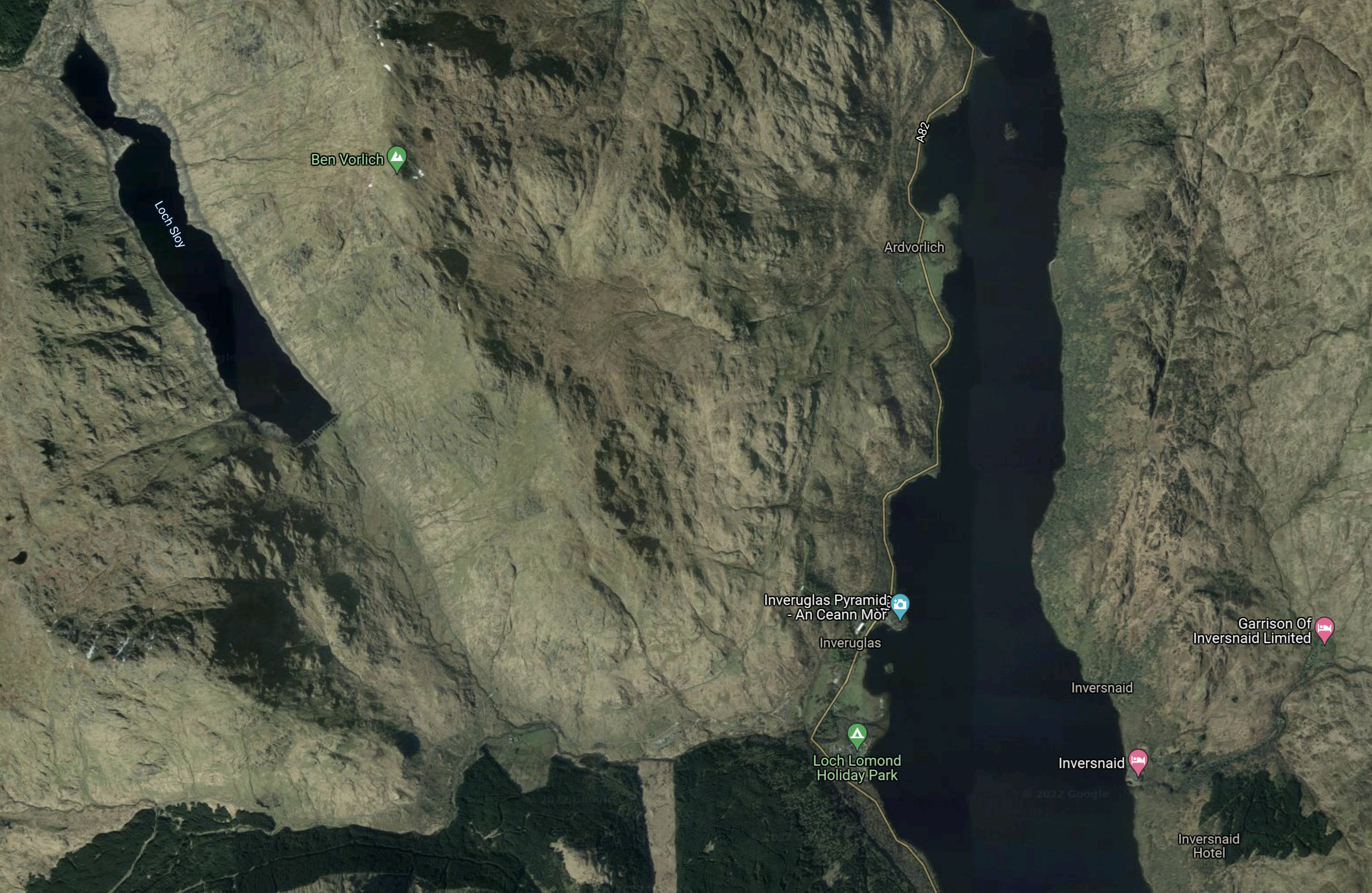
Note.
- Loch Sloy is in the North-West corner of the map.
- The page on Greenage says that Loch Sloy can store 14 GWh of electricity
- Loch Lomond is the body of water towards the Eastern side of the map.
- Inverglas is on the West bank of Loch Lomond to the North of the Loch Lomond Holiday Park, which is indicated by the green arrow with a tent.
This second Google Map shows the power station and Inverglas.
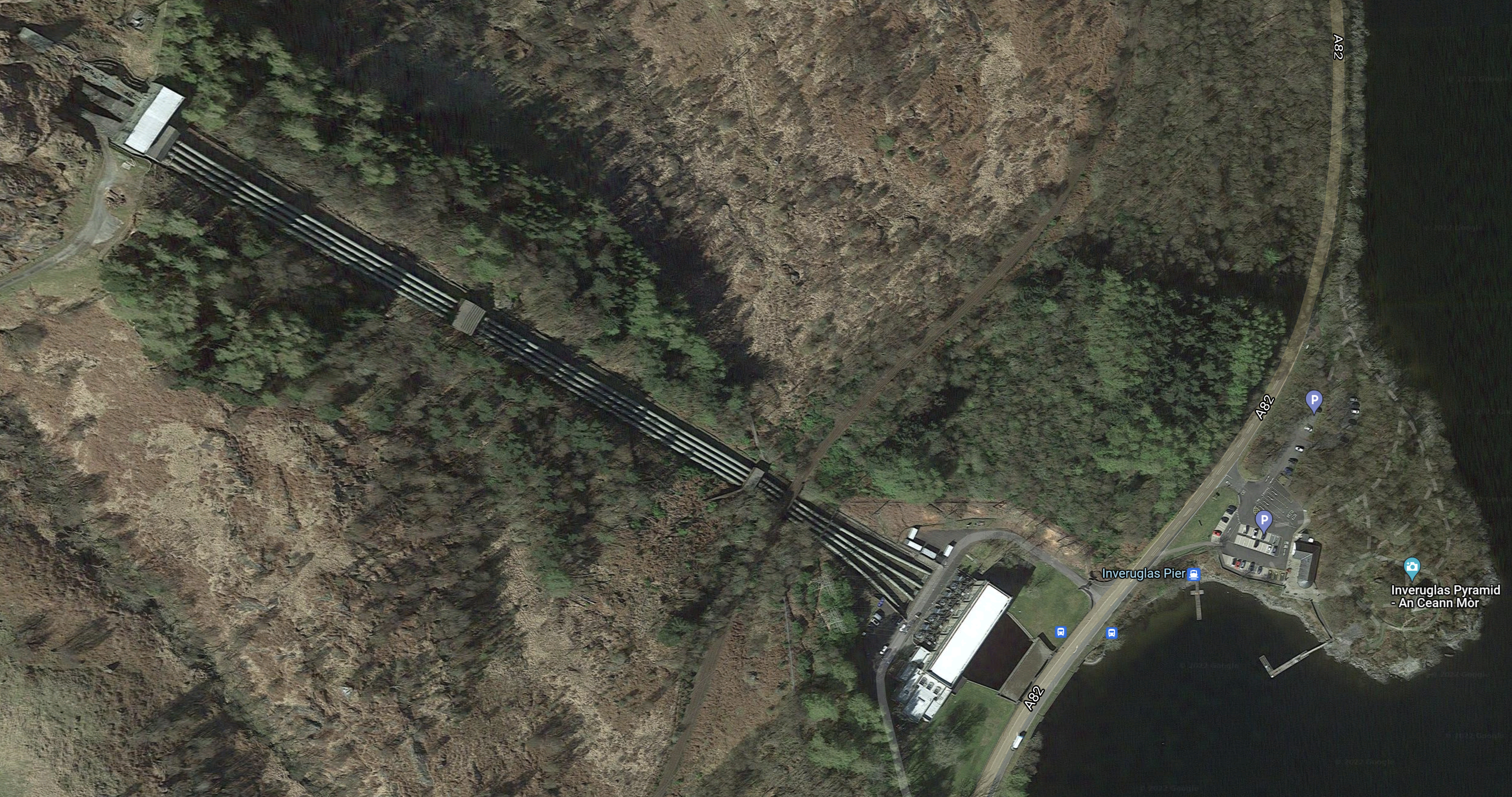
Note.
- It is a classic layout for a hydro-electric power station.
- In the North West corner of the map is the valve house, which is connected to Loch Sloy by a three kilometre tunnel.
- The valve house controls the water flows to the power station by Loch Lomond.
- There are four two-metre pipes running down the hill, one for each of the four turbines.
- According to the page on Greenage, the power station has three 40 MW turbines and one 32 MW turbine, which gives a total output of 152 MW.
- The water discharges into Loch Lomond after doing its work in the power station.
Loch Sloy is the largest conventional hydroelectric power plant in the UK.
The 2010 Plan To Add Pumped Storage To The Loch Sloy Hydro-Electric Scheme
This page on Hydro Review, which is dated the 10th of November 2010, is entitled SSE Gets Government Consent For Sloy Pumped-Storage Hydropower Project.
These are the first paragraph.
SSE Generation Ltd., the wholly owned generation business of Scottish and Southern Energy, has received consent from the Scottish Government to develop a 60-MW pumped-storage hydro project at its existing Sloy hydropower station at Loch Lomond, SSE reported.
Note.
- Two 30 MW pumps will be added to the power station to pump water up the hill from Loch Lomond to Loch Sloy.
- According to the page on Greenage, if the two pumps worked together for six hours, they would transfer 432,000 m3 of water. Note that a cubic metre of water weighs a tonne.
- Water would be transferred, when there was a surplus of energy being generated over the demand.
It would appear to be a simple scheme, as it is just adding two pumps to pump the water up the hill.
- As pumps rather than pump/turbines as at Foyers are used, there is no corresponding increase in generating capacity.
- Water also appears to be pumped up to the valve house in the existing pipes.
- Loch Sloy and Loch Lomond would not need major works to enable the scheme..
The page on Greenage gives the cost at just £40 million.
Originally, the project was supposed to have started in 2012, but as there are environmental problems with the fish, the work has not started.
These problems are detailed on the page on Greenage.
It looks like this scheme would have had an output of 152.5 MW and a storage capacity of 14 GWh.
Expanding Loch Sloy
Yesterday’s press release says this about the proposed capacity of the proposed Loch Sloy pumped storage scheme.
Subject to final design, the converted Sloy scheme would be capable of delivering up to 25GWh of long-duration electricity storage capacity.
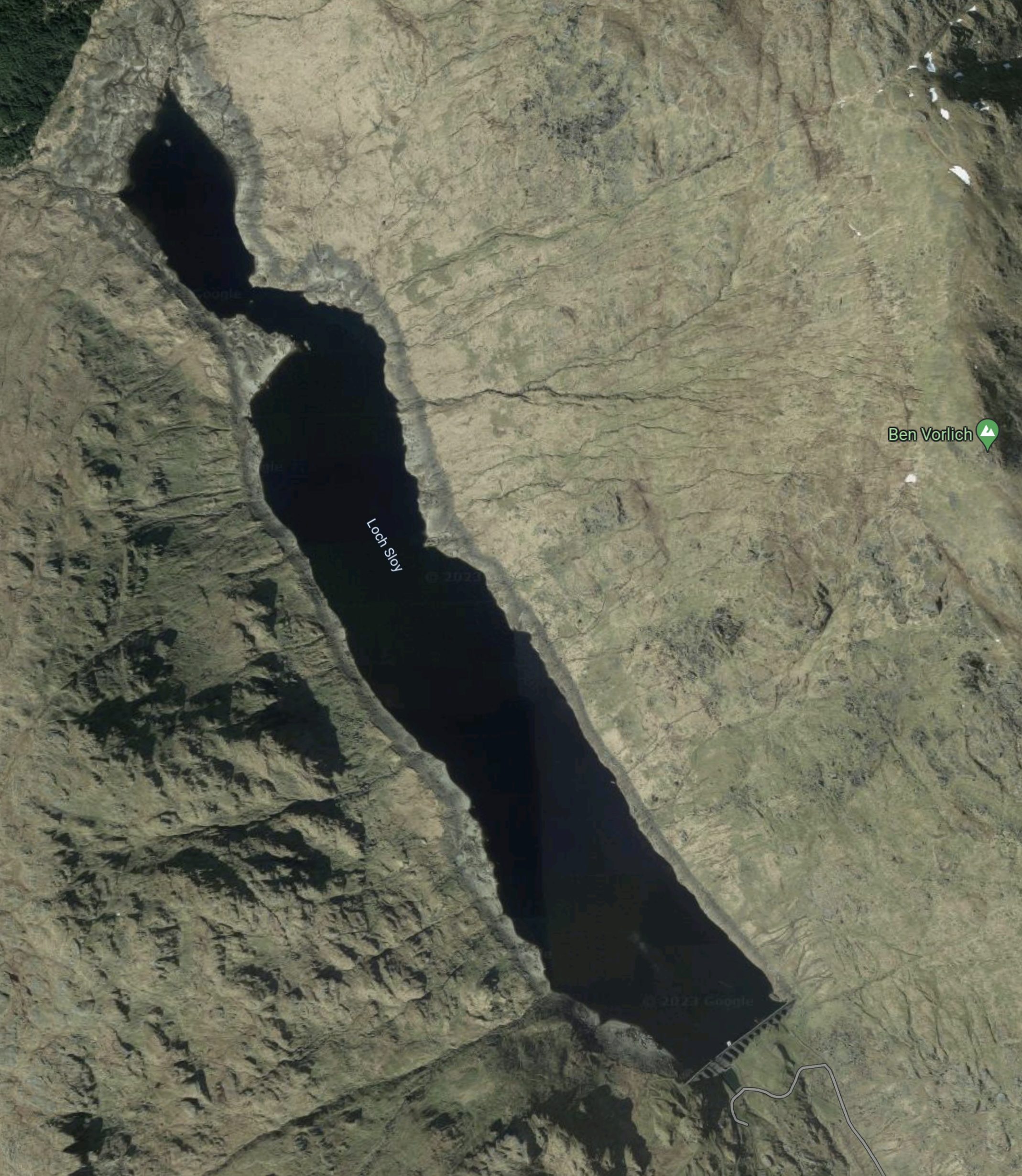
This Google Map shows Loch Sloy.
This second Google Map shows the dam at the Southern end.
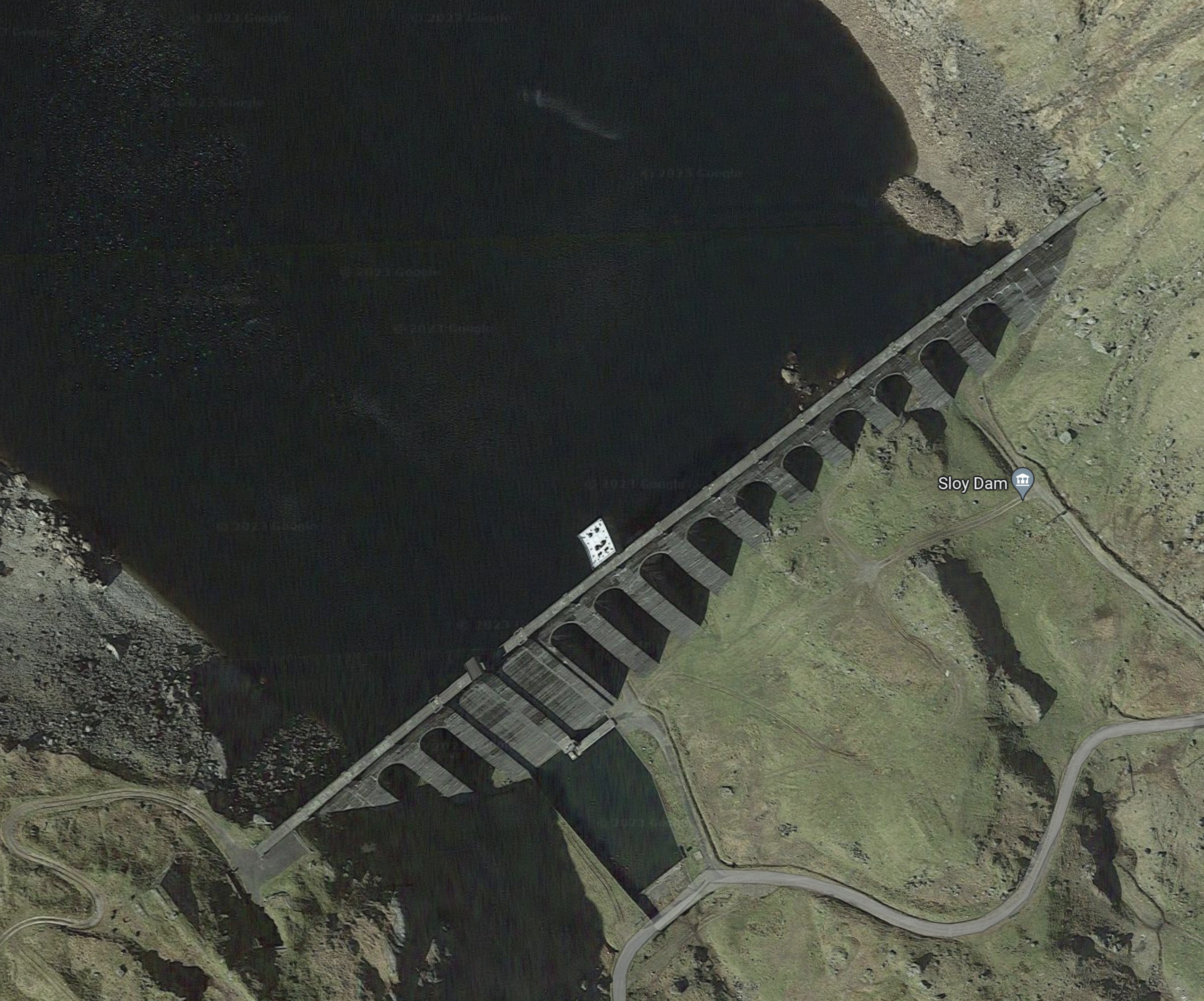
Note.
- Earlier, I said that Loch Sloy can store 14 GWh of electricity.
- To be able to store 25 GWh would need a 78 % increase in capacity.
This could be possible to be obtained by enlarging the dam and perhaps reprofiling the banks of the loch.
Expanding Loch Slow Power Station
This Google Map shows the Loch Sloy dam and the power station.
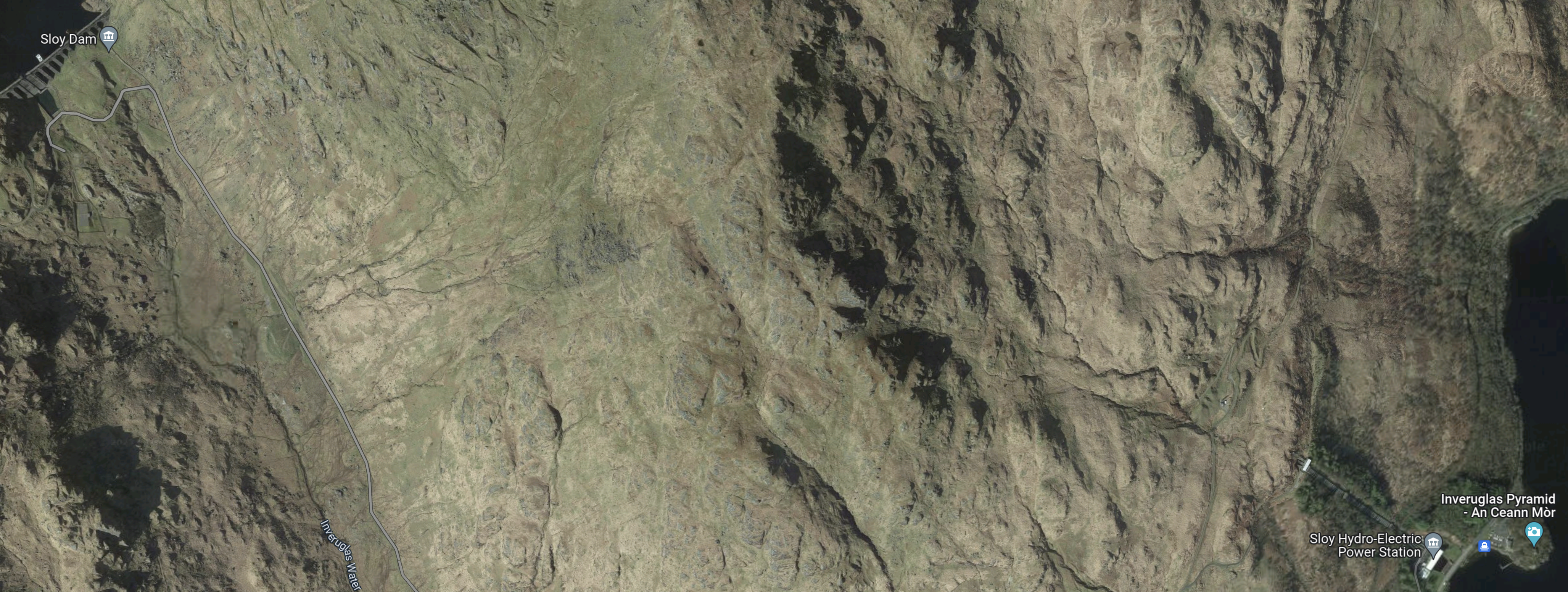
Note.
The dam is in the North-West corner of the map.
The power station is in the South-East corner of the map.
This repeat of the second Google Map shows the power station in more detail.
There appears to be plenty of space for more turbines, pumps and other electrical gubbins.
Building The Scheme
There may be enlarged buildings and extra pipes up the mountain, but hopefully the major problem of digging more tunnels through the rock may be avoided.
For these reasons, it could be a relatively easy construction project costing tens of millions.
The 14 GWh scheme from 2010 was costed at £40 million, so this 25 GWh scheme would probably cost no more than double or £80 million.
Conclusion
This is a sensible and affordable scheme, that provides a lot of energy storage
Plans Submitted For Hydrogen Pilot Plant At Humber Power Station
The title of this post, is the same as that of this article on Business Live.
This is the sub-heading.
HiiRoc and Centrica partnership at Brigg moves forward as consent sought.
These two paragraphs complete the original article.
Plans for a hydrogen pilot plant to sit alongside Centrica’s Brigg Power Station have been submitted to North Lincolnshire Council.
The low carbon fuel is set to be blended with gas at the peaking plant, in a tie-up between the energy giant and green-tech start up HiiRoc, in which it has invested. The well-backed Hull-based firm is pioneering a new production method, and was named as KPMG’s Global Tech Innovator for 2022.
I have very high hopes for HiiROC, who in addition to Centrica, have Hyundai and Kia as investors.
Endorsement from KPMG is surely positive.
Vineyard Wind To Deploy US-Based Supplier’s Bubble Curtain During Foundation Installation
The title of this post, is the same as that of this article on offshoreWIND.biz.
This is the sub-heading.
Vineyard Wind, a joint venture between Copenhagen Infrastructure Partners (CIP) and Avangrid building the first large-scale offshore wind farm in the US, has signed an agreement with the US company ThayerMahan for a pilot programme to deploy and test a secondary bubble curtain during the installation of foundations
This is the first paragraph.
A bubble curtain mitigates noise created during foundation installation by absorbing and dampening sound. First, the curtain’s large, perforated hoses are placed on the seafloor around the monopile. Then, the hoses are filled with compressed air which, once the hoses are inflated, escapes through the perforations and creates a barrier of bubbles that reduce noise.
Nothing is said, as to how the bubbles cut the noise.
I’m fairly certain that I know why.
- The speed of sound in air on a standard day at sea level static conditions, is about 340 metres/second.
- In water it’s about 1500 metres/second.
So what would the speed of sound in a bubbly mixture of air and water be?
I asked this question of Google and got this answer.
Surprisingly, in a two- fluid mixture, the measured speed of sound can be one order of magnitude smaller than that of its constituents. For example for water and air in normal conditions the speed of sound in the mixture can be about 23m/s while it is 1500m/s in water and 330m/s in air.
I even made money out of this phenomena, by backing two guys, who used it to develop an aerosol valve that used nitrogen as a propellant.
This research indirectly led to the development of the Respimat inhaler for asthma drugs.
So how does it cut the noise?
I’m not sure of this, but we do know the noise of the piling will have to go through areas of water with different speeds of sound. So is the sound attenuated as it passes through the bubble curtain by the slow speed?
I have other ideas for this interesting phenomenon and if anybody is interested please contact me. One use may have applications in mixing dissimilar fluids.
Spirit Energy Welcomes Licence Award For World-Leading Carbon Storage Facility
The title of this post, is the same as that of this news item from Centrica.
This is the sub-heading.
Spirit Energy and its shareholders, Centrica Plc and Stadtwerke München GmbH (SWM), welcome licence award for world-leading carbon storage facility
These are the first two paragraphs.
Spirit Energy – with the support of majority shareholder Centrica Plc, and Stadtwerke München GmbH (SWM) – has today (18 May) been granted a carbon storage licence by the North Sea Transition Authority (NSTA). This represents a further step towards their net zero vision of repurposing the North and South Morecambe gas fields for carbon capture and storage.
Today’s announcement places the companies at the forefront of the decarbonisation efforts in the UK, with the MNZ (Morecambe Net Zero) Cluster having the potential to be one of the UK’s biggest carbon storage hubs. It will be able to store up to a gigaton of carbon dioxide – the equivalent of three years’ worth of current UK CO₂ emissions. It could initially store above 5MTPA of CO₂, scaling in time to 25MTPA. The MNZ Cluster will be able to accept CO₂ transported by pipeline, ship and rail.
Note.
- I would assume MTPA is megaton per annum.
- In the long-term, I believe we’ll find productive uses for a substantial amount of the CO₂ we create, in agriculture, manufacturing construction materials, animal foods and textiles and in other uses.
- The MNZ Cluster is very large and will be a superb partner for Carbon Capture and Use.
- The partners will invest over £1 billion in this project pending the outcome of the Track 2 process.
Neil McCulloch, CEO of Spirit Energy, finished the news item like this.
Spirit Energy has ambitions for the two gas fields to form the core of a green super-hub. This would explore opportunities like direct air capture, the manufacture of blue hydrogen, the production of green hydrogen, the integration of other renewable power generation facilities, and energy storage – all of which would put Barrow and the North West on the map as a centre for low-carbon innovation.
It is a good vision.

