bp And Mauritania To Explore Green Hydrogen At Scale
The title of this post, is the same as that of this press release from BP.
I’m fairly certain, that this post is the first on this blog about Mauretania.
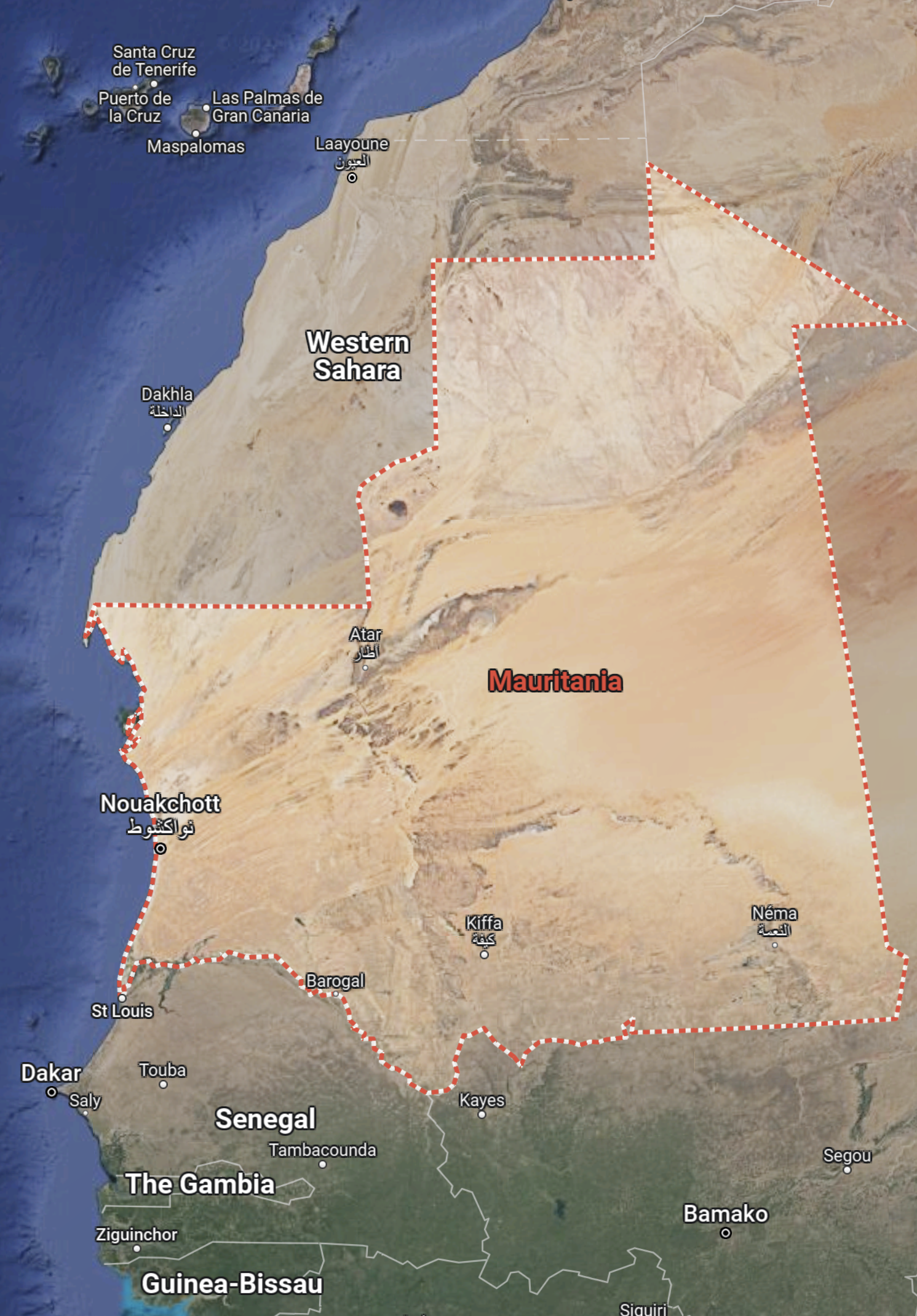
This Google Map shows the country’s position in West Africa.
Note.
- The population is about ten percent more than Wales.
- But the land area is fifty times as large.
- Most people live in the South-West of Mauretania.
The weather appears very different in the two countries.
This is the first paragraph of the press release.
bp today signed a Memorandum of Understanding (MoU) with the Government of Mauritania under which it will deliver an innovative programme exploring the potential for large-scale production of green hydrogen in the country. Building on bp’s existing strong relationships with the country, the agreement could be an important step towards the development of significant green hydrogen production in Mauritania.
There’s certainly a large area to explore.
The MoU was signed today in a meeting alongside COP27.
This paragraph outlines what will be done.
Under the agreement, bp will carry out a number of studies to evaluate the technical and commercial feasibility of producing green hydrogen in Mauritania. Green hydrogen is produced by the electrolysis of water, powered by renewable energy.
Given the area of Mauretania, there could be a substantial tonnage of green hydrogen produced.
BP And Mauritania
This paragraph details the current relationship between BP and Mauretania.
bp and Mauritania already have a long-standing relationship. bp and partners, including Mauritania’s Société Mauritanienne Des Hydrocarbures (SMH), are now working toward the completion of the Greater Tortue Ahmeyim (GTA) Phase 1 liquefied natural gas project. The development of this innovative offshore project on the border of Mauritania and Senegal was approved in 2018. It is set to produce around 2.3 million tonnes of LNG per year, with sufficient resources to support production for over 20 years. Earlier this year, bp also announced the signature of an Exploration and Production Sharing Contract for the BirAllah gas resource in Mauritania.
There could be scope to move Mauretania towards net-zero.
Electrolysis Of Salt Water
Typically electrolysis for hydrogen uses pure water, but companies like Torvex Energy, which I covered in a post called Torvex Energy can electrolyse salt water.
Surely, in a country like Mauretania, where water is much more precious than the UK, salt water electrolysis should be used.
I wouldn’t be surprised to see a major gas company like BP or Shell form a very strong relationship with Torvex Energy.
Shannon Estuary Could Support Build-Out of 30 GW Of Floating Wind, House 2 GW of Electrolysis Capacity
The title of this post, is the same as that of this article from offshoreWIND.biz.
This is the opening paragraph.
The Shannon Estuary in Ireland can support the build-out of up to 1.8 GW of floating wind per year and up to 30 GW by 2050. In addition, it could accommodate a 2 GW electrolyser for hydrogen and downstream e-fuels production, according to the US-headquartered company Bechtel, which reviewed the Shannon Foynes Port Company’s Vision 2041 masterplan.
The island of Ireland will truly be going green.
The Turbine Production Figures
The headline talks about rolling out 1800 MW of floating wind turbines per year and in the body of the article it says this.
At peak, up to 120 floating turbines could be installed offshore per year.
This would imply 15 MW turbines, which is entirely feasible.
As all these figures were produced and/or fully checked by Bechtel, I would suspect that they are very sound.
So does this imply that 120 floating wind turbines is a typical production limit of this type of turbine assembled in a custom-built facility in a port?
Centrica Partners With Hull-Based HiiRoc For Hydrogen Fuel Switch Trial At Humber Power Plant
The title of this post, is the same as that on this article on Business Live.
This is a paragraph.
It comes as the owner of British Gas has also increased its shareholding in the three-year-old business to five per cent. Last November it was one of several investors to pump £28 million into HiiRoc alongside Melrose Industries, HydrogenOne, Cemex, Hyundai and Kia, who joined existing strategic investors Wintershall Dea and VNG.
This could be sensational.
The reason I said that was that I used to share an office at ICI Mond Division, with Peter, who was putting instruments on a plant called the Badische. It was a new process to create acetylene. If I remember correctly, the process was as follows.
Ethylene was burned and then quenched in naptha.
The trouble was that the process produced a lot of carbon, which clogged the burners, and masses of black smoke, which upset everybody in Runcorn, especially on washing day!
Someone was worried that the plant might go into explosive limits, so Peter had devised a clever infra-red instrument to read the composition of the off-gas from the burner. It was found to be in explosive limits and ICI shut it down. BASF said ICI were wrong and there was no way to measure the composition of the off-gas anyway. A few months later BASF’s plant exploded and buried itself in a hillside in Southern Germany. Upon hearing this news, ICI shut the Badische for ever. ICI were annoyed in that they had to spend £200,000 on a flameless cutter to dismantle the plant.
I do wonder, if HiiROC have tamed BASF’s beast to do something useful, like produce hydrogen and carbon black!
Cummins Is Charging Towards Green
If ten years ago, you’d asked any green activist to name companies, that would be ruined by or fail to adjust to global warming by decarbonising their product line, I’m sure most big diesel engine manufacturers, like Cummins, would have been on their list.
But Cummins have successfully moved on as their latest press releases about their technology show.
- October 13th – Cummins Drives Gigawatt Electrolyzer Manufacturing Plant Forward in Spain, Expanding Its Global Clean Energy Footprint.
- October 10th – Cummins Drives Domestic Green Hydrogen Economy Forward With First U.S. Electrolyzer Manufacturing Facility.
- October 6th – Atura Power Selects Cummins To Design, Manufacture 20 MW Electrolyzer System For Niagara Hydrogen Centre.
- October 5th – Cummins’ Second Largest Solar Farm Goes Live at Rocky Mount Engine Plant.
- September 22nd – Destination IAA: Cummins Unveils New Technology For Zero-Emissions Power Solutions.
- September 20th – Cummins QSK95 Engine Proven Fully Compatible With Renewable Diesel.
- September 15th – Cummins Advocating for Racial Equity (CARE) Supports Mobile Grocery Markets in Communities Across the U.S.
- September 15th – Destination IAA: Cummins Debuting Electrified Meritor Powertrains For The First Time Since Acquisition.
- September 8th – Cummins Advocating for Racial Equity (CARE) Invests in a Sustainable Future Through Private Equity Partnership.
- September 8th – Cummins Scaling Belgium Electrolyzer Manufacturing Capacity To 1 Gigawatt Through IPCEI Support.
- September 7th – Werner Enterprises Signs Letter of Intent Planning to Secure 500 X15H Engines from Cummins.
- August 31st – Transport Enterprise Leasing Planning to Integrate Cummins’ X15H into Heavy Duty Truck Fleets.
These can be summarised as follows.
- Green Solutions – 4
- Electrolysers for green hydrogen – 3
- Decarbonisation of diesel engines – 3
- Community Support – 2
- Electric Powertrains – 1
- Solar Power – 1
According to Google, the Cummins share price has risen thirty percent in the last five years.
They must have done something right!
Centrica Re-Opens Rough Storage Facility
The title of this post, is the same as that of this press release from Centrica.
It has this sub-heading.
Rough Operational For Winter And Increases UK’s Storage Capacity By 50%.
On the face of it, this sounds like good news and these two paragraphs give more details.
Centrica has announced the reopening of the Rough gas storage facility, having completed significant engineering upgrades over the summer and commissioning over early autumn.
The initial investment programme means the company has made its first injection of gas into the site in over 5 years and is in a position to store up to 30 billion cubic feet (bcf) of gas for UK homes and businesses over winter 2022/23, boosting the UK’s energy resilience.
Note.
- The Rough gas storage facility has been able to hold up to 100 billion cubic feet of gas in the past.
- Rough is a complex field with two platforms and thirty wells transferring gas to and from the facility.
- Additionally, there is an onshore gas-processing terminal at the Easington Gas Terminal, where it connects to the UK gas network.
It appears to be a comprehensive gas storage facility, that should get us through the 2022/3 winter.
These two paragraphs from the press release, which are the thoughts of the Centrica Chief Executive are significant.
Centrica Group Chief Executive, Chris O’Shea, said “I’m delighted that we have managed to return Rough to storage operations for this winter following a substantial investment in engineering modifications. Our long-term aim remains to turn the Rough field into the world’s biggest methane and hydrogen storage facility, bolstering the UK’s energy security, delivering a net zero electricity system by 2035, decarbonising the UK’s industrial clusters, such as the Humber region by 2040, and helping the UK economy by returning to being a net exporter of energy.
“In the short term we think Rough can help our energy system by storing natural gas when there is a surplus and producing this gas when the country needs it during cold snaps and peak demand. Rough is not a silver bullet for energy security, but it is a key part of a range of steps which can be taken to help the UK this winter.”
Note.
- Effectively, in the short term, Rough is a store for gas to help us through the winter.
- In the long-term, Rough will be turned into the world’s largest gas storage facility.
- It will be able to store both methane (natural gas) and hydrogen.
Having worked with project managers on complex oil and gas platforms and chemical plants, I wouldn’t be surprised to find, that when the design of this facility is released, it will be something special.
Centrica certainly seem to have upgraded Rough to be able to play a significant short term role this winter and they also seem to have developed a plan to give it a significant long-term role in the storage of hydrogen.
Aldbrough Gas Storage
A few miles up the coast is SSE’s and Equinor’s Aldbrough Gas Storage, which is being developed in salt caverns to hold natural gas and hydrogen.
Blending Of Hydrogen And Natural Gas
I believe that we’ll see a lot of blending of hydrogen and natural gas.
- Up to 20 % of hydrogen can be blended, without the need to change appliances, boilers and processes.
- This cuts carbon dioxide emissions.
I wrote about this in a post called HyDeploy.
It might be convenient to store hydrogen in Aldbrough and natural gas in Rough, so that customers could have the blend of gas they needed.
With two large gas stores for hydrogen under development, the HumberZero cluster is on its way.
Why BMW Chair Oliver Zipse Says Hydrogen Cars Will Be The “Hippest Thing” On The Road
The title of this post, is the same as that of this article on Hydrogen Fuel News.
This is the introductory paragraph.
BMW Chair Oliver Zipse recently spoke at an interview in Goodwood, England, underscoring that hydrogen cars will soon be the most desirable zero-emission passenger vehicles to drive, not battery electrics.
He made these points and predictions.
- Electric vehicles will hit their peak in about ten years, then H2 will take over.
- After the electric car, which has been going on for about 10 years and scaling up rapidly, the next trend will be hydrogen.
- When it’s more scalable, hydrogen will be the hippest thing to drive.
I agree with him, but I do find anybody called Zipse to take seriously, because of the character in the Tom Sharpe novel; Porterhouse Blue.
UK Funds Hydrogen-Enabled Decarbonisation Of Steel, Cement, Ceramics Production
The title of this post, is the same as that of this article on Ryse Hydrogen.
This is the first paragraph.
The latest round of grants under the UK government’s Industrial Hydrogen Accelerator Programme shows the breadth of decarbonisation opportunities that hydrogen provides and the depth of innovative talent in our country.
Industries targeted by the projects that received funding include steelmaking, asphalt, cement, waste, paint, and ceramics manufacturing.
The article is good background to how hydrogen will change industry.
Improving The Wood Green And Moorgate Public Transport Corridor
This morning I went for coffee with an old school friend from Minchenden Grammar School at Southgate station.
Southgate is not a bad place to meet someone.
- There are a couple of good coffee shops.
- There are plenty of buses.
- It has a couple of the better chain restaurants including a Pizza Express.
- The area also has a lot of memories for me.
It also has one of London’s most iconic Underground stations.












It may look familiar, as it regularly crops up in film and television dramas.
- One station guy told me, that the ticket barriers have been designed to be easy to remove, so filming of an historic drama is possible.
- It was used in The End Of The Affair to portray a Central London station.
- As the escalators have the same bronze fittings as Moscow, they could be used in a story set in Russia.
As the Piccadilly Line doesn’t go anywhere near my house, to get to Southgate, I take a 141 bus to and from a convenient Piccadilly Line station.
- Going North, I changed at Manor House station.
- Coming South, I changed at Turnpike Lane station.
- I could have also have changed at Wood Green station.
The journey home had four major problems.
- The bus stop at Turnpike Lane station, is a few hundred yards from the station.
- I waited fifteen minutes for a 141 bus.
- When it did arrive, it was so packed, it didn’t have space for a miniature dachshund to squeeze in between the feet of the standing passengers.
- The traffic was very heavy, so the journey was slow.
How can this bus route cope in the Peak, if it can’t cope on a Sunday morning?
Various issues and actions and will make these capacity issues worse.
The Victoria Line Has No Direct Connection With The Elizabeth Line
In my view, this was a mistake, although not that serious, as the young or energetic can probably walk between Oxford Circus and the Hanover Square entrance to Bond Street station on the Elizabeth Line.
Will this connection develop with coffee and snack shops to ease passenger interchanges?
When and if Oxford Circus station is ever made step-free, I can imagine a tunnel, perhaps with a moving walkway being built between Oxford Circus station and he Hanover Square entrance to Bond Street station.
There is also the cross-platform interchange at Highbury & Islington station with the Northern City Line that links with Moorgate and the City of London.
The Piccadilly Line Has No Direct Connection With The Elizabeth Line
To get between the Northern stations on the Piccadilly Line and the Elizabeth Line is either a double-change at Finsbury Park and Highbury & Islington stations or a ride on the 141 bus.
I wrote about these issues in Extending The Elizabeth Line – Improving The Northern City Line.
The Elizabeth Line Will Attract Travellers To Moorgate
I notice that my own travelling patterns have changed from using the Central, Circle, District, Hammersmith & City and Metropolitan Lines to using the Elizabeth Line since it opened and I suspect, when the Elizabeth Line is fully joined up, that more passengers will travel to Moorgate to access the Elizabeth Line.
Transport for London and the Mayor Are Rerouting The 21 Bus
The 21 bus duplicates the 141 bus between Newington Green and Moorgate station.
But it is being rerouted next year, which will increase the loading on the 141 bus.
The 141 Bus Used To Be The 641 Trolleybus
When I was a child, London’s trolleybus network was extensive and to get between Wood Green and Moorgate, you would have used the 641 trolleybus.

Trolleybus Ascending Jolly Butchers Hill in Wood Green
Many like me, look back on trolleybuses with affection.
Does this historical connection encourage passengers to use the 141 bus, which is the 641 trolleybus’s successor on the route?
My parents certainly had lots of trolleybus stories.
So What Could Be Done?
There are a variety of actions that could be taken to strengthen public transport between Moorgate and Wood Green stations.
Improve The 141 Bus Route
In Does London Need High Capacity Bus Routes To Extend Crossrail?, I put forward ideas for using buses to link to the Elizabeth Line.
This was my suggestion.
I suspect any route seen as an extension of Crossrail needs to have the following characteristics.
- High frequency of perhaps a bus every ten minutes.
- Interior finish on a par with the Class 345 trains.
- Wi-fi and phone charging.
I would also hope the buses were carbon-free. Given that some of these routes could be quite long, I would suspect hydrogen with its longer range could be better.
I feel that a high-quality 141 bus running every ten minutes between London Bridge station and Palmers Green, would be just what the passengers would order.
- Palmers Green bus garage is at the Northern end of the route, so could be used for refuelling or recharging.
- London Bridge station is at the Southern end of the route and was designed with an efficient bus station.
- The 141 route connects London Bridge, Bank, Moorgate and Old Street stations in the City of London.
With the right buses, this could be a route with real quality and usefulness.
Increase The Frequency On The Northern City Line
The Northern City Line may have new Class 717 trains, but it still has a pathetic frequency of eight trains per hour (tph)
- I am sure it could be increased to at least 12 tph between Moorgate and Alexandra Palace stations.
- Something like six tph would go to Welwyn Garden City, four tph to Hertford East station and two to Stevenage.
- Large areas of the Northern suburbs would get a much better connection to the Elizabeth Line.
Once the digital signalling is installed and commissioned, no new infrastructure will be needed.
I am sure, that this would be the easiest way to improve public transport in North London.
Add Step-Free Access To As Many Stations As Possible
Moorgate, Finsbury Park, Oakwood and Cockfosters are step-free with lifts.
As many stations as budgetary constraints allow, should be made step-free.
The Belgians Go Large
This press release from Elia Group is entitled Elia Presents Its Plans For An Energy Island, Which Will Be Called The Princess Elisabeth Island.
These two paragraphs outline the project.
In the presence of federal ministers Tinne Van der Straeten (Energy) and Vincent Van Quickenborne (North Sea), system operator Elia has presented its draft plans for what will be the world’s first artificial energy island.
The Princess Elisabeth Island will be located almost 45 km off the Belgian coast and will serve as the link between the offshore wind farms in the second offshore wind zone (which will have a maximum capacity of 3.5 GW) and its onshore high-voltage grid. The energy island will also be the first building block of a European offshore electricity grid that will serve as a central hub for new interconnectors with the UK and Denmark. The island is an innovative tour de force that once again puts Belgium on the map as a pioneer in offshore energy.
Note, that Princess Elisabeth is the heir apparent to the Belgian throne.
I have some thoughts.
Will The Wind Turbines Float Or Have Fixed Foundations?
Consider.
- 3.5 GW of wind farms will probably need around 220 wind turbines.
- Most of the large wind farms in the seas around the UK, that are below about 50 miles from the shore are on fixed foundations.
- The seas around East Anglia and Belgium are probably fairly similar.
I suspect that using today’s technology, the turbines will have fixed foundations.
But floats with two or more turbines , that generate more electricity per square kilometre may be developed.
Will Hydrogen Be Generated On The Island?
This could happen and I don’t see why not.
Tankers could even dock on the island to transport the hydrogen.
Could The Island Service Floating Wind Turbines?
All that is needed, is sufficient depth of water and a large crane.
It is a possibility!
Will There Be A UK Interconnector To Princess Elisabeth Island?
The press release says this.
The energy island will also be the first building block of a European offshore electricity grid that will serve as a central hub for new interconnectors with the UK and Denmark.
There could be interconnectors all over the North Sea linking wind farms and energy islands to the UK, France, Belgium, The Netherlands, Germany, Denmark and Norway.
We’d all be in it together.
Conclusion
This is a very ambitious project.
Rolls-Royce And SOWITEC Cooperate On Power-To-X Projects
The title of this post, is the same of that of this press release from Rolls-Royce.
The press release starts with these two bullet points.
- Target: up to 500 MW electrolysis capacity for power-to-X projects
- Production of green hydrogen and e-fuels for shipping, aviation, mining, agriculture, data centers
In Rolls-Royce Makes Duisburg Container Terminal Climate Neutral With MTU Hydrogen Technology, I wrote how Rolls-Royce were building a carbon-neutral energy supply for the port.
This Rolls-Royce graphic illustrates the project.

It looks like SOWITEC would be the sort of company to install the decentralised renewables for this project.
Rolls-Royce seem to be collecting the technology to build complex projects like the power supply for the Duisburg Container Terminal, either by acquisition or negotiating friendly links.
But I do think, that Rolls-Royce possibly need two items for a complete portfolio.
A factory with a large capacity to build electrolysers. The press release says they need 500 MW by 2028 or nearly 100 MW per year.
Some form of GWh-sized energy storage. I wouldn’t be surprised to see Rolls-Royce do a deal with an energy storage company.
 The Anonymous Widower