Man In Seat 61: My Nail-Biting Journey To Orkney By Train And Ferry
The title of this post is the same as that of this article in The Times.
This is the heading.
Now the Caledonian Sleeper connects the Midlands to Scotland in style. Mark Smith travels to the UK’s most northerly rail station and beyond
These are the first two paragraphs.
In January the Caledonian Sleeper added Birmingham to its route from London to Scotland — its first new stop in 30 years. With a ticket for one of the first departures and a bucket-list desire to see the historic naval anchorage that is Scapa Flow, I would ride the sleeper to Inverness, take Scotland’s scenic Far North Line to Britain’s northernmost station and then sail across the Pentland Firth to Stromness. I could leave my Buckinghamshire home in the evening and reach Orkney 24 hours later without setting foot on a plane. It sounded like a plan.
The Highland sleeper (which travels to the Highlands; there is also a Lowland sleeper that travels to Edinburgh and Glasgow) rolled into Birmingham International at 10.42pm on the dot. I was greeted at the door by a steward with a friendly Scottish accent and my room key. He jotted down my breakfast reservation and I headed for room 4 in car L. The Cal Sleeper is rightly proud of its Scottish-made mattresses and fluffy duvets and I drifted off to sleep in my cosy berth to the sound of steel wheel on steel rail.
I feel adding a Birmingham International stop is a masterstroke, as it gives so many travel options.
- You could of course still join in London.
- I might go to Birmingham on Chiltern, as I prefer the trains to Avanti West Coast.
- There are lots of shows and exhibitions in Birmingham.
- If you had a relative in Scotland and you lived in the far South-East of England and Wales, half of the journey would be in a comfortable bed.
- Birmingham International has regular connections to Aberystwyth, Bournemouth, Pwllheli, Shrewsbury and Wrexham General.
- Some journeys might be easier with a change between plane and sleeper train at Birmingham International.
The list is endless and will grow as travellers have other ideas.
More imagination needs to be added to train journeys.
My first thoughts are.
There needs to be a Lumo-style service between Birmingham and Scotland and a sleeper between Birmingham and Penzance.
Opening Date For Final Delayed Station Confirmed
The title of this post is the same as that in this article on the BBC.
This is the sub-heading.
The opening date for the final station on a reopened railway line has finally been announced.
These four paragraphs give more details.
The Northumberland Line between Ashington and Newcastle began carrying passengers in December 2024, decades after the old service ended, but Bedlington and Northumberland Park stations remained unfinished.
It was announced in January Northumberland Park would open on 22 February, and now Northumberland County Council has announced Bedlington will officially open to passengers on 29 March.
Conservative leader Glen Sanderson thanked the local community for bearing with the “inevitable disruption”.
The overdue opening of Bedlington was blamed on ageing stonework and a water pipe under the car park, and in August an extra £37.9m was provided to ensure the project was completed.
Will It Be The Day Of The Dogs?
I wonder how many Bedlington terriers will turn up!
I asked Google AI,”Will Bedlington Terriers be going to the opening of Bedlington station?” and received this reply.
Based on current information, it is not confirmed whether the dog breed Bedlington Terriers will be attending the opening of the new Bedlington station, which is expected to open in early 2026 as part of the Northumberland Line. While the town is famous for the breed, no official event details have confirmed their presence at the opening.
If they did, the story would spread everywhere.
Will The Builders Move On To The Leamside Line?
The Leamside Line could be the next one to be rebuilt, as it’s just on the other side of the Tyne.
Or they could extend the Northumberland Line to Newbiggin-by-the-Sea.
But who knows with this Government?
Will the Liverpool Street Rebuild Include Elizabeth Line Improvements?
I asked Google AI, the question in the title of this post and received this reply.
Yes, the proposed redevelopment of London Liverpool Street Station includes improvements to integration with the Elizabeth line, aiming for a fully accessible, multi-modal, and spacious hub. The plans focus on better connecting the main concourse with the Elizabeth line, Underground, and local transport, alongside doubling the concourse size, adding new, more efficient lifts, and increasing the number of ticket barriers.
Will The Liverpool Street Rebuild Have More Platforms?
I asked Google AI, the question in the title of this post and received this reply.
The approved £1bn+ redevelopment of London Liverpool Street Station, greenlit in February 2026, focuses on increasing capacity and accessibility rather than adding new platforms. The plans, to be completed by mid-2036, involve enlarging the concourse by 76%, increasing lifts/escalators, and providing step-free access to all existing platforms.
Platform Changes: While there is no mention of increasing the total number of train platforms, the project will significantly improve access and reduce congestion.
Capacity Enhancements: The project includes a 76% increase in concourse capacity.
Infrastructure Upgrades: Escalators will increase from four to ten, and eight new lifts will be installed.
Accessibility: The project aims to provide full step-free access across all rail and underground platforms.
New Construction: A large, multi-story office building is planned above the station, and the concourse area will be redesigned for better flow.
The project aims to handle over 200 million passengers annually by the time it is finished.
This OpenRailwayMap shows the layout of tracks in the station.
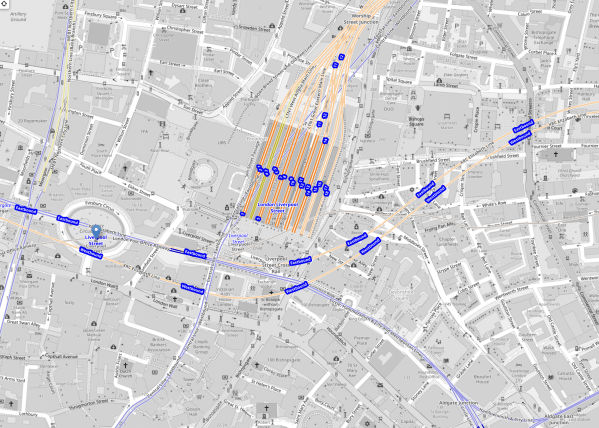
Note.
- The square block in the middle of the map are Platforms 1-18 of the main station.
- Eighteen is in the East and 1 is in the West.
- The Central Line of the London Underground runs diagonally in blue under the main station.
- Running in orange from the West to the North-East in front of the station is the Elizabeth Line.
- Running South of Lizzie in blue are the sub-surface lines of the London Underground.
I wonder, if at some point in the distant future, a terminal platform or two could be added to the very deep Elizabeth Line, that connected to tunnels underneath Liverpool Street station.
This second OpenRailwayMap shows the sub-surface lines and the Elizabeth Line, as they pass across in front of Liverpool Street station.
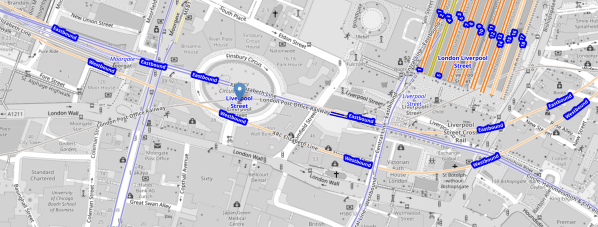
Note.
- Moorgate Station is in the North-West corner of the map
- Moorgate Statation has two virtually unused west facing bay platforms.
- The sub-surface lines are shown in blue.
- The Elizabeth Line is shown in orange.
- Finsbury Circus is in the middle of the map, with the sub-surface lines underneath.
- The Central Line is shown in blue and crosses between Finsbury Square and Liverpool Street station on its way to Bank.
- In front of Liverpool Street station, there is a disused bay platform on the sub-surface lines.
- The Bank branch of the Northern Line and the Great Northern run North from Moorgate station.
- Access to the Great Northern could be improved.
I feel there is scope for more trains to be run on the sub-surface lines through Moorgate and Liverpool Street.
- Accessibility to the sub-surface lines at Moorgate and Liverpool Street station could be improved.
- There has been talk of extending some services to Barking.
There is certainly scope to improve the sub-surface lines.
Planning Approval Granted For Network Rail’s Transformation Of Liverpool Street — Britain’s Busiest Station
The title of this post is the same as that of this article in Rail Technology Magazine.
This is the sub-heading.
Network Rail has secured a major milestone in the redevelopment of Liverpool Street station, following the City of London Planning Committee’s resolution on 10 February to grant full planning permission for the long‑awaited transformation of the UK’s busiest rail hub.
These two paragraphs adds some more detail.
The Eastern Region’s Anglia Route will oversee the upgrade, which aims to futureproof the station for decades as passenger numbers continue to grow sharply. Liverpool Street, last redeveloped in 1991, now handles 118 million passenger movements each year, and demand is projected to rise by 35%, reaching 158 million by 2041.
Looking further ahead, planners expect the station will need to accommodate over 200 million annual journeys, making capacity enhancement essential for maintaining operational performance and customer experience across London, East Anglia and the wider east of England.
To say this is a large project would be a massive understatement and I wish, that this could have been the last project planned and built by the Artemis project management system, that I wrote in a Suffolk attic fifty years ago.
This list summarises the work that will be done.
- 76% increase in overall concourse capacity
- 23% expansion of the lower concourse to smooth passenger flow
- Step‑free access from street to all platforms, including every Underground line for the first time
- Eight new large lifts, replacing the existing four‑person unit
- Escalators increased from four to ten
- New accessible entrances and intuitive wayfinding from Broadgate, Exchange Square, and key interchange points
- Toilets on all levels, including Changing Places facilities and family amenities
Respecting Heritage While Creating New Spaces
The project safeguards the station’s Victorian character, with the iconic trainshed fully preserved. The redevelopment will also create new vantage points overlooking the heritage structures, bringing passengers visually closer to the original architecture.
Above the concourse, a new office building featuring a publicly accessible roof garden will provide one of London’s most sustainably connected workplaces, directly supporting the City Corporation’s long‑term growth and employment aspirations.
Around twenty major contractors and professional firms will be handling the transformation.
Hopefully, I will be able to watch this project as it grows to occupy its place in the City of London.
‘A Rare Opportunity’: Northern Will Run Service Along Heritage Railway Line For The First Time And Tickets Are Now On Sale
The title of this post, is the as that of this news item from Northern Trains.
This is the sub-heading.
Northern will run a service along a heritage railway line for the first time, to raise money for charity.
These four paragraphs add detail to the story.
Tickets are now on sale for the service, which will set off from Darlington station on Sunday, 22 February and complete a return trip along Weardale Railway before heading back to Darlington.
Northern has been working closely with Weardale Railway to organise this event.
The railway, which opened in 1847, is a popular tourist attraction and allows visitors to travel on heritage trains along a picturesque 16-mile route. It runs between Bishop Auckland West and Stanhope in County Durham.
In 2020, it was saved from administration by The Auckland Project, which has since provided significant investment to fund essential repairs and infrastructure improvements.
Note.
- The train will be one of Northern’s Class 158 trains.
- Tickets are being sold for £25 and the proceeds will be donated to two local charities: The Angel Trust, based in Bishop Auckland, and 123help4familys, based in Stanhope.
- The train will leave Darlington at 09:46 and finishes its trips up and down the Weardale Line at Darlington at 17:44.
I won’t be going, as I can’t fit the day together.
Is There Support For An Extended Service From Bishop Auckland?
I asked Google AI, this question, and got this mildly surprising answer.
Yes, there is support for extended services in Bishop Auckland, primarily through NHS GP extended access, which provides appointments outside of normal hours (6 PM – 8 PM weekdays and weekends) at Bishop Auckland Hospital. The Urgent Treatment Centre is available 24/7, and various community-based support services, including care agencies and mental health support, are also available.
If the hospital and the other medical facilities are open, surely in a rural area, if they are needed, transport should be available.
Is There A Need For More Housing In Bishop Auckland?
Yes, there is a significant, documented need for more housing in Bishop Auckland to address a, “chronic shortage of quality bungalows and assisted living” alongside a broader demand for modern, energy-efficient homes. The town is undergoing a regeneration with plans for increased, “affordable housing” and “100% affordable” developments (e.g., in “Westerton Road” and “Holdforth Crescent”) to meet the growing population and “economic needs”.
Note.
- A regular service to Darlington may make building more housing viable.
- Judging by the amount of new houses along the Northumberland Line, the new railway has encouraged their building.
Services and stations could be added as required, as appears to be being done on the Northumberland Line.
Are Hitachi’s Tri-Mode Trains Exceeding Expectations?
I asked Google AI, the question in the title of this post and received this answer.
Yes, Hitachi’s tri-mode (battery-hybrid) trains are exceeding expectations, particularly following successful trials in the UK in late 2024. Trials of the battery-equipped Class 802/2 demonstrated superior performance to initial forecasts, leading to a £300 million order for a new fleet to be delivered in 2028.
Key findings from trials and operational expectations:
Performance Exceeded: The trial, conducted with TransPennine Express and Angel Trains, showed fuel cost savings of 35%–50%, surpassing initial predictions of up to 30%.
Operational Capability: The battery technology enabled trains to reach speeds greater than 75 mph and provided enough range for zero-emission, silent running in and out of stations, significantly reducing noise and improving air quality.
Energy Efficiency: The battery matched the weight of a diesel engine, meaning no extra track degradation.
Future Impact: The success of the trial led to an order from Arriva Group for a new fleet for Grand Central services, which will increase seating capacity by 20% and are expected to significantly reduce carbon emissions.
These trains, designed to run on electric, battery, or diesel power, are part of a push to modernize rail services, with the technology allowing for the gradual elimination of diesel-only operation on certain routes.
That is certainly good performance and Hitachi received a £300 million order, which I wrote about in Arriva Group Invests In New Battery Hybrid Train Fleet In Boost To UK Rail Industry
But I don’t think it’s all down to Hitachi, as Hitachi linked up with Sunderland-based Hyperdrive Innovation, who are JCB’s battery supplier. Hyperdrive were taken over by Turntide Technologies in 2021.
In Batteries Ordered For Grand Central Inter-City Trains, I said this.
Hitachi Rail has selected Turntide Technologies to supply lithium iron phosphate batteries for use on electric-diesel-battery hybrid inter-city trainsets it is to build for Arriva’s open access operator Grand Central.
I am coming to the conclusion, that Turntide Technologies use and/or make some very special batteries.
I asked Google AI, “Which make of battery cells does Turntide use?” and received this reply.
Based on recent announcements (2023–2025), Turntide Technologies utilizes advanced Lithium Iron Phosphate (LFP) cells for its next-generation battery systems, particularly for its partnership with Hitachi Rail.
Key details regarding Turntide’s battery cell usage include:
Chemistry Shift:
While previously associated with Nickel-Manganese-Cobalt (NMC) in some applications, Turntide has focused its recent rail projects with Hitachi on LFP technology to enhance safety and allow for more compact, powerful, and lighter battery packs.
Application:
These LFP batteries are used in high-performance, rugged, and space-limited environments, such as Hitachi’s UK battery-operated trains.
Modular Design:
Turntide’s Gen 5 battery systems are designed to be flexible for various applications including construction, agriculture, and mining, using modular, high-energy-density cells.
Previous Technology:
Previously, Turntide (which acquired Hyperdrive Innovation) used Lithium-ion NMC cells for its battery packs.
The search results do not explicitly identify a specific, named manufacturer (e.g., CATL, LG, Samsung) for the cells, but focus on the LFP chemistry utilized by Turntide.
I am also coming to the conclusion, that they took over Hyperdrive Innovation to get control of these compact, powerful, and lighter battery packs.
Northern Launches New Yorkshire Flyer Fast Service Between Leeds And Sheffield
The title of this post is the same as that of this news item from Northern Trains.
This is the sub-heading.
Northern is running a new fast service which allows customers to travel between Leeds and Sheffield in 47 minutes.
These three introductory paragraphs add more detail.
Known as the Yorkshire Flyer, as it provides a quick and convenient connection between the White Rose county’s two biggest cities, the service was officially launched during an event at Leeds station earlier today.
Cutting journey times and providing more than 30,000 extra seats a week, the service will support economic growth by making it easier for people to get to work and reach new opportunities.
It used to take all Northern customers around an hour or longer to make the journey, with trains calling at various stops along the way.
These further details come from Real Time Trains.
- The trains used appear to be two-car Class 158 trains.
- The total distance is 38.7 miles.
- Between Leeds station and South Kirkby junction is electrified and a distance of 20.6 miles.
- Trains appear to leave Leeds station at xx45.
- CrossCountry services Leeds station for Sheffield at xx15 and make a similar intermediate stop at Wakefield Westgate.
- Leeds trains for Sheffield seem to leave from Platform 12 or 12A.
- Trains appear to leave Sheffield station at xx52.
- CrossCountry services leave Sheffield station for Leeds at xx22 and make a similar intermediate stop at Wakefield Westgate.
- Sheffield trains for Leeds don’t seem to have such a regular platform, as those in the other direction. But I suppose that will be improved.
Effectively, Northern and CrossCountry have paired up two services to give a two trains per hour, fast service between Leeds and Sheffield with one stop at Wakefield Westgate.
I have some further thoughts.
The Route Could Be Run By Battery-Electric Trains
Consider.
- The only part of the route that is not electrified is the 18.1 miles between South Kirkby junction and Sheffield station.
- From talking to engineers, who are working on developing battery-electric trains, a three-car train with a battery range of fifty miles is already a possibility.
- In 2015, I actually rode on a four-car battery-electric Class 379 train, that ran reliably on the Harwich branch for three months.
- Merseyrail’s battery-electric Class 777 trains probably have the performance and are working reliably on Merseyside. But they are probably a bit slow.
I believe that any number of train manufacturers would be very pleased to provide new battery-electric trains for the route.
But Siemens must be in the prime position.
- The German company has built a £200 million train factory at Goole in East Yorkshire, which is currently building London’s Piccadilly Line trains, which have batteries.
- Siemens have already delivered trains in Germany using the technology, they would use in the UK.
- The battery charging technology they would use for other routes in the UK, is described in Technology Behind Siemens Mobility’s British Battery Trains Hits The Tracks.
- Sheffield and Leeds, would make a superb test and demonstration route for battery-electric trains, as 50% of the route is fully-electrified with 25 KVAC.
- The Sheffield and Leeds route is just down the track from the Goole factory.
- I wouldn’t be very surprised, if Siemens were very keen to get a few orders close to their factory, as they would surely be easy to support.
But the clincher must be Juergen Maier, who used to be CEO of Siemens UK, and is now Chair of Great British Energy. Maier holds both British and Austrian citizenship, and was educated in Leeds and Nottingham, so hopefully, he can give this clanger-prone government some excellent advice where they need it, from his position in Great British Energy.
Could A Stop Be Made At Meadowbank Station?
This would give access to other rail routes and the Sheffield Supertram, but most of this access could also be performed at Sheffield.
Looking at the timetable of the route, I feel that there is enough slack to fit in a stop at Meadowhall, but it would need for the route to be electrified, so that the trains had faster acceleration and deceleration.
However, battery-electric trains may have the required performance.
What Maximum Speed Would The Trains Need?
Consider.
- The current Class 158 diesel trains used between Sheffield and Leeds and in many places in the UK are 90 mph trains.
- There are also a large number of Class 170 trains in the UK, that will need to be replaced and these are 100 mph trains.
- The Sheffield and Leeds route has some sections of 85 mph running.
- Train speeds are all accurately computer-controlled.
As a Control Engineer for safety and route availability reasons, I believe the trains will have a 100 mph maximum speed, but train speed will be computer controlled.
Will The Trains Be Driver-Only Operated?
I asked Google AI if Hitachi IET trains are driver only operated (DOO) and received this reply.
Hitachi Intercity Express Trains (IETs, Class 800/802) are designed for versatile operation, capable of Driver-Only Operation (DOO) using in-cab CCTV monitors for door safety checks. While they can operate without a guard, many services, particularly on GWR, still retain a guard on board for passenger service duties, even if the driver controls the doors.
So Hitachi trains can be driver-only operated and these will surely share the tracks with the trains that work the Northern Flyer.
I asked Google AI if Thameslink trains are driver only operated (DOO) and received this reply.
Yes, all Thameslink train services are Driver Only Operated (DOO). This means the driver is solely responsible for operating the doors and ensuring the safe dispatch of the train, without a guard or conductor on board to manage the doors. Through the central London core, these trains often use Automatic Train Operation (ATO).
As I believe that Siemens would be likely to win the battery-electric train order, because of proven technology, factory location and influence of Juergen Maier, Siemens certainly have the ability to produce trains, that are driver-only operated.
I believe that, whoever builds the trains, they will be capable of driver-only operation.
But if driver-only operation is to be used will be down to politics.
- Because of the situation on East West Rail, Heidi Alexander will probably be in favour.
- The Tories and Liberal Democrats will also be in favour.
- The rail unions, the left wing of the Labour Party and the Greens will be strongly against.
- Farage and Reform UK will take a very hard line to enforce driver-only operation everywhere.
The average citizen on the Northern Flyer and all the other trains in the UK, will just want a reliable train service.
Conclusion
- This would make a superb route for a battery electric train.
- No chargers or extra electrification would need to be installed.
- There wouldn’t be much work needed to be done to the platforms or the signalling.
- The trains would use standard 25 KVAC overhead electrification for charging.
- The trains would be running close to where they were built.
I believe the new service will give a large boost to the Yorkshire economy. Even before the arrival of battery-electric trains.
Delays To Opening Makes Station A ‘Laughing Stock’
The title of this post, is the same as that of this article on the BBC.
This is the sub-heading.
Residents of Winslow are frustrated a new railway station completed over a year ago has still not opened.
These three introductory paragraphs add detail to the article.
A local councillor said it had been due to open in the Buckinghamshire town in December 2025 but there had been a “comedy of errors”, including a row over who will control the opening and closing of carriage doors.
Diana Blamires, who sits on the town council, said the local community was “obviously furious” and “it makes Winslow station a laughing stock”.
In a statement, Chiltern Railways – responsible for operating services between Oxford and Milton Keynes – said no date for the opening had yet been confirmed.
My feeling is that this project has been badly affected by two many adverse factors.
- A lack of overall leadership at the top of the project.
- Too many changes of Government in the UK.
- Are all these governments committed to the project?
- The uncertainty about the Aylesbury Spur, which I wrote about in East-West Rail: Aylesbury Spur.
- The inability to reach a sensible compromise on route through Bedford, with the large number of Nimbys in the area.
- I used to live near Newmarket and their ideas for the town will arise the anger of the horse-racing industry.
- The theme-park I wrote about in ‘Rollercoasters In My Back Yard’: Welcome To Universal Studios Bedford, hasn’t exactly helped.
- Stories like East West Rail: Could A New Rail Link ‘Tear Apart’ A Village?, don’t help.
The planning for East West Rail hasn’t been good
But another story on the BBC, which is entitled How The Elizabeth Line Has Changed Reading, has to my mind shown up the poor quality of the planning for the East West Rail.
This Is the sub-heading.
Since the Elizabeth Line opened in May 2022 it has become the UK’s busiest rail service with an estimated 750 million passenger journeys.
And this is the first paragraph.
The line provides a direct service from Reading into central London, but after years of planning and delays is the Berkshire town finally feeling the benefits of an additional connection to the capital?
Are Bicester, Bletchley, Milton Keynes, Bedford and other places going to feel a similar effect to Reading, because the railway track layouts say that if Reading gets a boost from the Elizabeth Line, then they will get one from East West Rail!
The Reading/Oxford area is where the East West and Elizabeth Lines make contact and I predict, that if in the future, you want a machine to test the strength of jelly, this will be the place, where you will go to get one invented.
Could Electric Trains Run Between St. Pancras International and Sheffield Stations With No More Electrification?
A reader suggested, that I look at this, so here goes!
- A couple of weeks ago, I took a Class 222 diesel train back from Sheffield to St. Pancras International and it seemed a few minutes quicker.
- Looking at the timetable today, at least one service on the route is now just under two hours and some others are just over.
So the new Class 810 trains may not be fully in service yet, but the trains have already had an effect on the timetable.
How Far North Is The Midland Main Line Being Electrified?
I asked Google AI this question and received this answer.
As of early 2026, the Midland Main Line (MML) is electrified as far north as Wigston, just south of Leicester.
- Northern Limit: The section from Kettering up to Wigston South Junction was energised in July 2024, representing the current northern limit of 25kV overhead line equipment (OLE).
- Pause in Further Electrification: Following a UK government spending review, the further, planned northward extension of electrification to Leicester, Derby, Nottingham, and Sheffield was indefinitely paused in July 2025.
- Current Operations: While electrification has stopped at Wigston, the line is served by new bi-mode (electro-diesel) trains, allowing for electric running from London St Pancras to Wigston before switching to diesel power.
- Previous Work: The line is also fully electrified from London St Pancras to Bedford, including the route to Corby.
Note.
- South Wigston Junction and Sheffield are 69.4 miles apart.
- The Hitachi trains can raise and lower pantographs on the move.
Distances without wires from London St. Pancras International to various destinations are as follows.
- Sheffield – 69.4 miles
- Leicester – 3.7 miles
- Derby – 36.4 miles
- Nottingham – 31.1 miles
As trains will have to go out and back to these destinations distances travelled will be doubled.
- Sheffield – 138.8 miles
- Leicester – 7.4 miles
- Derby – 72.8 miles
- Nottingham – 62.2 miles
It looks to me, that if the new Class 810 trains, can travel 138.8 miles on batteries and diesel engines as a tri-mode train, then the Midland Main Line is electrified.
Could The Sheffield Services Turn Round At Doncaster And Charge Their Batteries There?
Note.
- South Wigston Junction and Doncaster are 79.5 miles apart.
- Doncaster is a fully-electrified station.
- Sheffield and Doncaster would get two extra connecting trains per hour.
- The two services could also call at Meadowhall and/or Rotherham Central.
The Class 810 trains could charge their batteries, whilst passengers to and from Doncaster left and entered the trains.
Could A Simple Cross-Platform Change Be Arranged Between East Coast And Midland Main Line Services?
Doncaster station has two long island platforms, one of which is generally used for Northbound services and one for Southbound services.
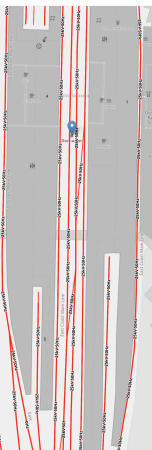
Note.
- All electrified tracks are shown in red.
- The two wide island platforms, with Northbound on the West side and Southbound on the East side.
- Each island platform has an electrified platform face on both sides.
- The four platforms faces on the island platforms can hold pairs of five-car Hitachi trains.
- There are two through tracks or avoiding lines between the two island platforms for trains that aren’t stopping.
- There are bay platforms at the ends of the station for local trains.
- The station is fully step-free with a wide pedestrian underpass.
I know the station well and it looks to me, that East Midland Railway’s five-car services for St. Pancras could charge up in the Southern ends of the four faces of the island platforms and the two South-facing bay platforms.
I also believe that a pair of five-car Class 810 trains could be handled and charged, should it become necessary.
It looks to me, that the engineers updating the East Coast Main Line, know that they were caught out badly by High Speed Two, so the redesign for the next fifty or a hundred years will be completely future-proofed.
Doncaster and London could almost be considered to be twin main lines, with two pairs of high speed lines taking different routes, that serve different towns and cities.
How Many Travellers Go Between East Scotland And The North-East of England And The English Midlands?
It must be quite a few, as in the new East Coast Main Line timetable, more Scottish services stop at places like Doncaster and Newark.
But surely, if you could go between say Perth or Aberdeen and Derby or Nottingham in two battery-electric trains, with a relaxed change at Doncaster, you’d take it?
I certainly would!
East Coast And Midland Main Lines Compared
These are times between London and Doncaster.
- Current times between Doncaster and London are typically between 1 hour and 31-40 minutes going via the East Coast Main Line.
- I estimate times between Doncaster and London will be typically 2 hours and 22-27 minutes going via the Midland Main Line.
Note.
- Doncaster and London King’s Cross is 156 miles
- Doncaster and London St. Pancras International is 183.3 miles
- So the Midland Main Line route would appear to to be about 45 minutes slower.
- I suspect, that for passengers between between London and North of York, it will always be quicker to use an East Coast Main Line service.
These are times between London and Sheffield.
- Current times between Sheffield and London are typically between 2 hours and 4-9 minutes going via the Midland Main Line.
- I estimate times between Sheffield and London will be typically between 2 hours and 2 minutes going via the East Coast Main Line.
Note.
- Sheffield and London King’s Cross is via Retford.
- Sheffield and London King’s Cross is 162.1 miles
- Sheffield and London St. Pancras International is 183.3 miles
- Sheffield and Retford is 23.5 miles
- So the Midland Main Line route would appear to to be a few minutes slower.
I would feel that there is scope that under Great British Railways to optimise services between London and Doncaster and Sheffield.
The Master Cutler
The Master Cutler is a named train, that is described in this Wikipedia entry, that was introduced in 1947.
- Over its life it has run into both King’s Cross and St. Pancras.
- I can remember the train in the 1950s, running into King’s Cross.
- It has also been run to and from Leeds.
- It has been run as a Pullman service.
- There are reports of overcrowding in recent years.
It strikes me that the Master Cutler could do with a revamp.
- As St. Pancras can accept pairs of five-car Class 810 trains, ten-car trains could be run into King’s Cross or St. Pancras.
- An alternative would be to use a nine-car Hitachi Class 800/801 train.
- All trains would be battery electric.
- All trains would use the East Coast Main Line for a faster service.
- Services could terminate in the North at Leeds.
- The service could be run as a Pullman service.
- This article on Ian Visits, writes about East Coast Main Line trains using St. Pancras.
I would create a train service, that would attract passengers from all over the world.
Who knows?
If it was conceived in the right way, it might warrant a second service or similar service on other lines like these possibilities.
London and Blackpool via Crewe, Wigan and Preston.
- London and Aberystwyth via Birmingham and Shrewsbury.
- London and Bristol via Bath
- London and Fishguard via Cardiff and Swansea
- London and Holyhead via Birmingham and Chester
- London and Liverpool
- London and Manchester
- London and Newcastle via York and Durham
- London and Norwich via Colchester and Ipswich
- London and Plymouth via Exeter
Note.
- All routes could be run using electric or battery-electric trains.
- The Fishguard and Holyhead services would be zero-carbon routes to Ireland, connecting to appropriate zero-carbon ferries.
- Could services be arranged so that all parts of the country have at least one service in both directions every day?
- In the days of British Rail, London and Norwich had a very high-class service, that could serve a full English breakfast between Colchester and London, which certainly wasn’t like the regular joke.
Get the offering right and it could level-up the UK.
 The Anonymous Widower